Skip to content
Round vs Square Splash Pad : Which Shape Is Better
# Your Trusted Inflatable Supplier In US

Choosing between a round vs square splash pad may look like a style decision, but the shape changes how the water toy works in a real backyard. It affects how much room children have to move, how easily pets step in, how the pad fits on grass or patio, where the hose sits, how water drains, and how the spray feels once the garden hose is turned on.
A round splash pad is usually better for open lawns, younger children, gentle cooling, and pets that need easy entry from different sides. A square splash pad is usually better for patios, narrow yards, siblings, active play, larger pets, and families who want more usable surface area. The best choice depends on space, spray design, PVC quality, hose placement, and daily use habits.
Many families choose by looking at the first product photo. Round looks soft and playful. Square looks bigger and more practical. But after the first setup, small details become more important: Does the pad leave enough walking room? Does water spray inward or outward? Does the dog step on the edge? Does the pad dry easily before folding? Shape starts the experience, but the right structure keeps summer play easy.
What Is Round vs Square Splash Pad?
A round vs square splash pad comparison is mainly about how each shape uses backyard space. A round splash pad creates a softer, centered play area that works well on open lawns. A square splash pad gives a more structured footprint and usually provides more usable surface area at the same listed width.
Round Splash Pad Shape
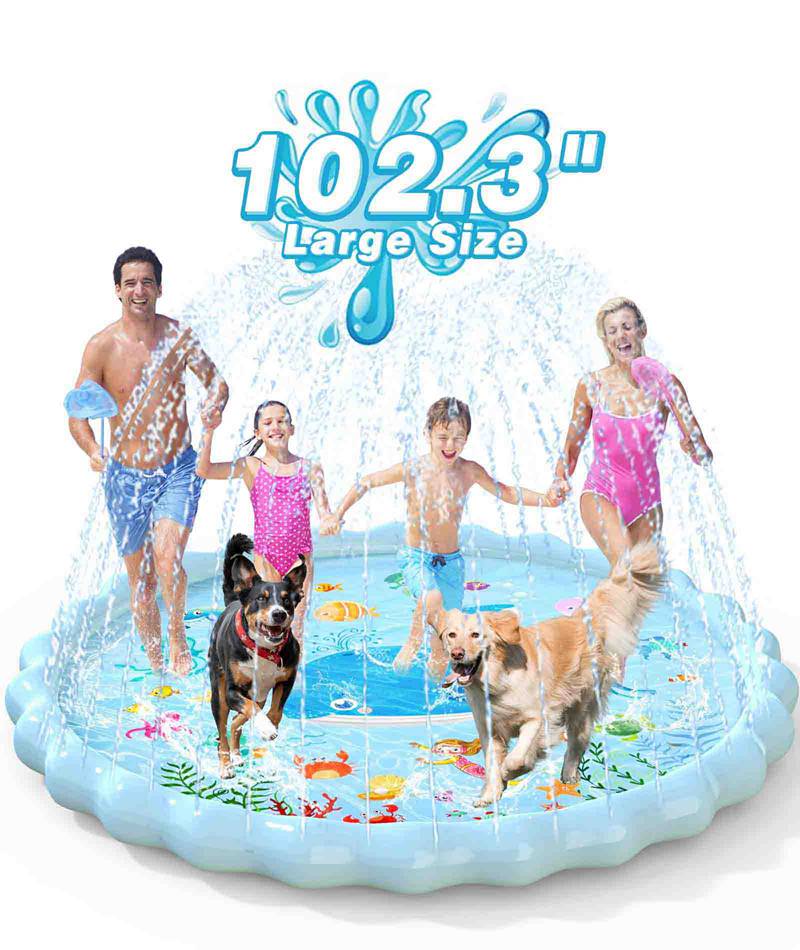
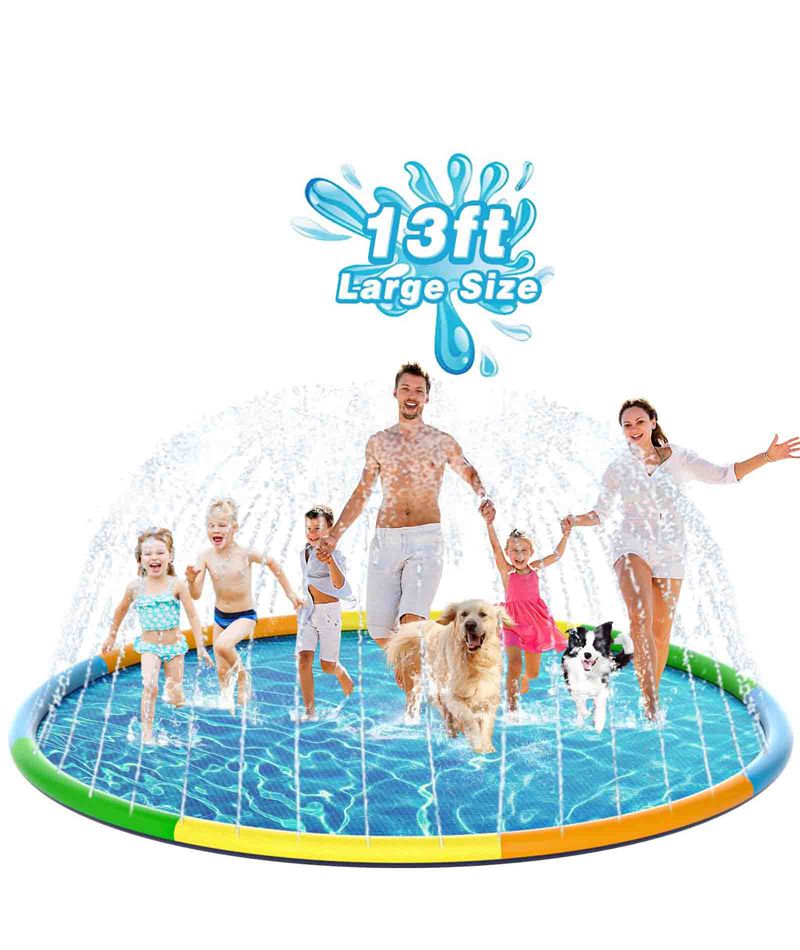
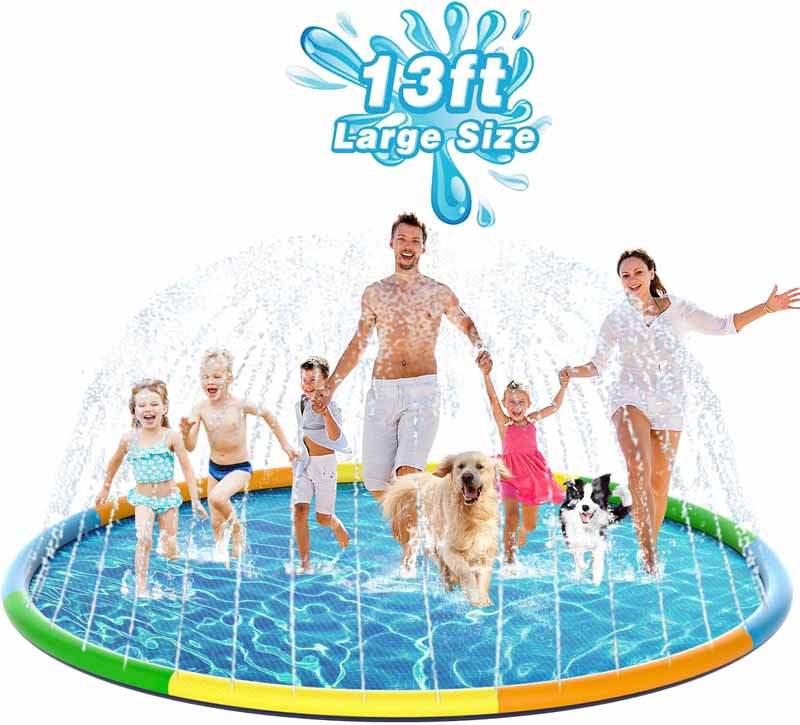
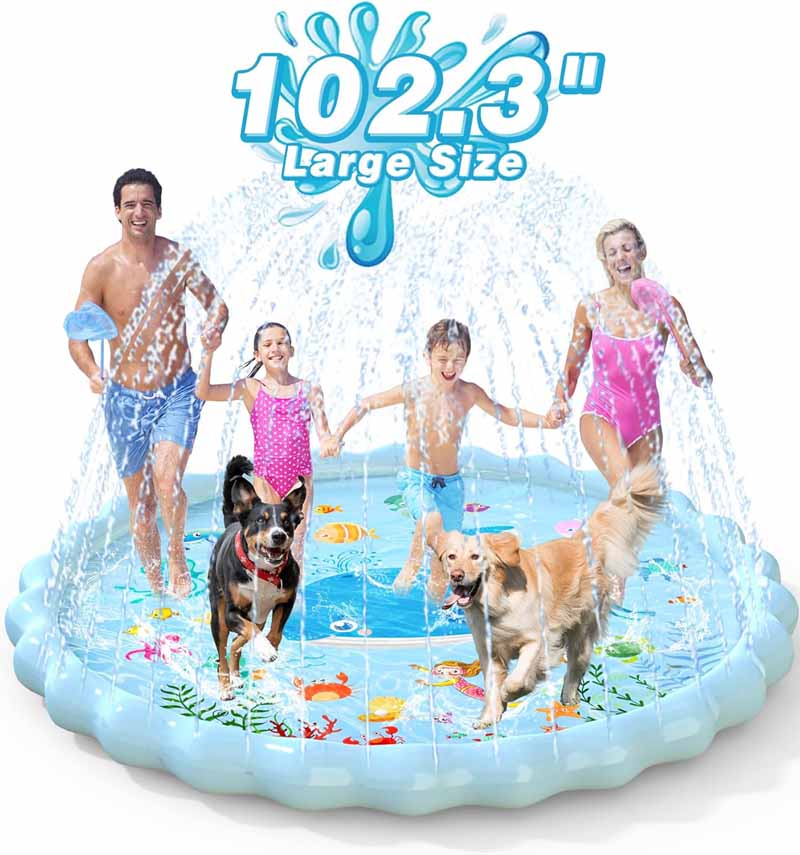
A round splash pad is the shape many families picture first. It has a soft outline, a centered play area, and an outer spray ring that usually directs water inward. For toddlers and younger children, the shape feels simple because there is no clear front, back, or corner.
Children can walk around the edge, sit near the center, touch the spray, or step in and out from any side. That makes a round splash pad suitable for gentle water play, short cooling sessions, and relaxed backyard afternoons.
Round shapes also look natural on grass. A round pad does not need to align with a fence, patio line, deck edge, or garden border. Parents can place it in the middle of the lawn, connect the hose, and create a quick water play area without much measuring.
The main limit is space efficiency. A round splash pad can look large online, but it does not use corner space. For example, a 100-inch round splash pad covers about 7,854 square inches of surface area. If the yard is narrow or rectangular, the curved sides may leave unused space around the pad.
A round splash pad is often better for:
- Open lawns
- Toddlers and younger children
- Gentle cooling play
- One or two children
- Dogs that prefer open access
- Families who want a softer backyard look
- Short summer play sessions
Square Splash Pad Shape
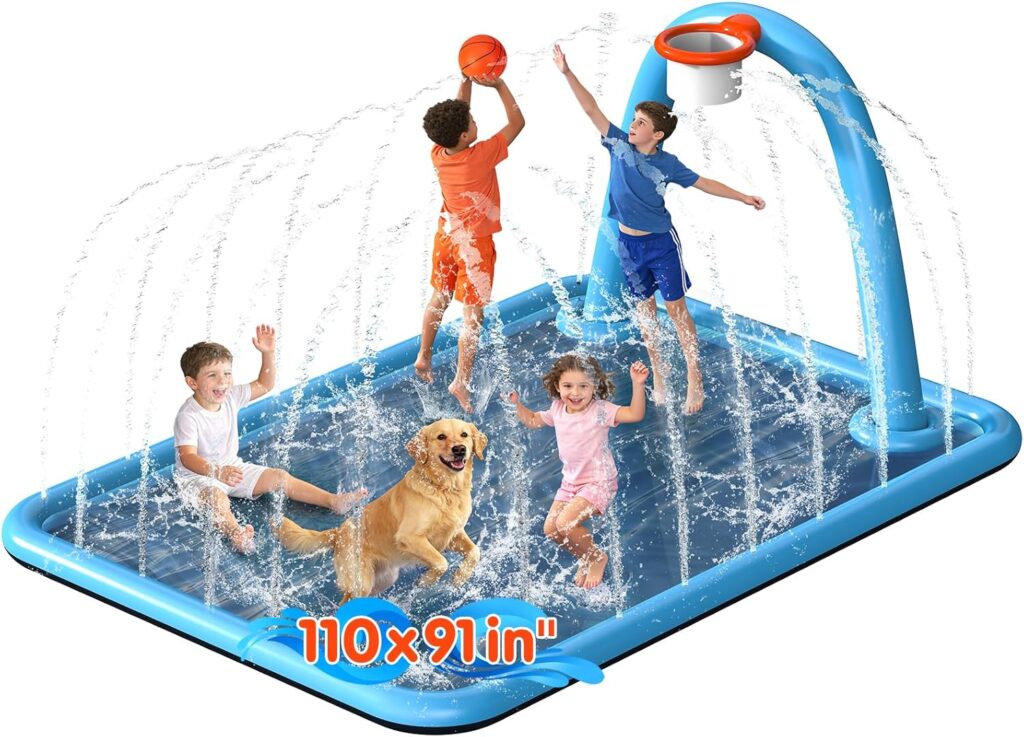
A square splash pad has a more practical footprint. It uses straight lines, defined corners, and a clearer play boundary. This makes it easier to place on patios, side yards, fenced areas, decks, and rectangular lawns.
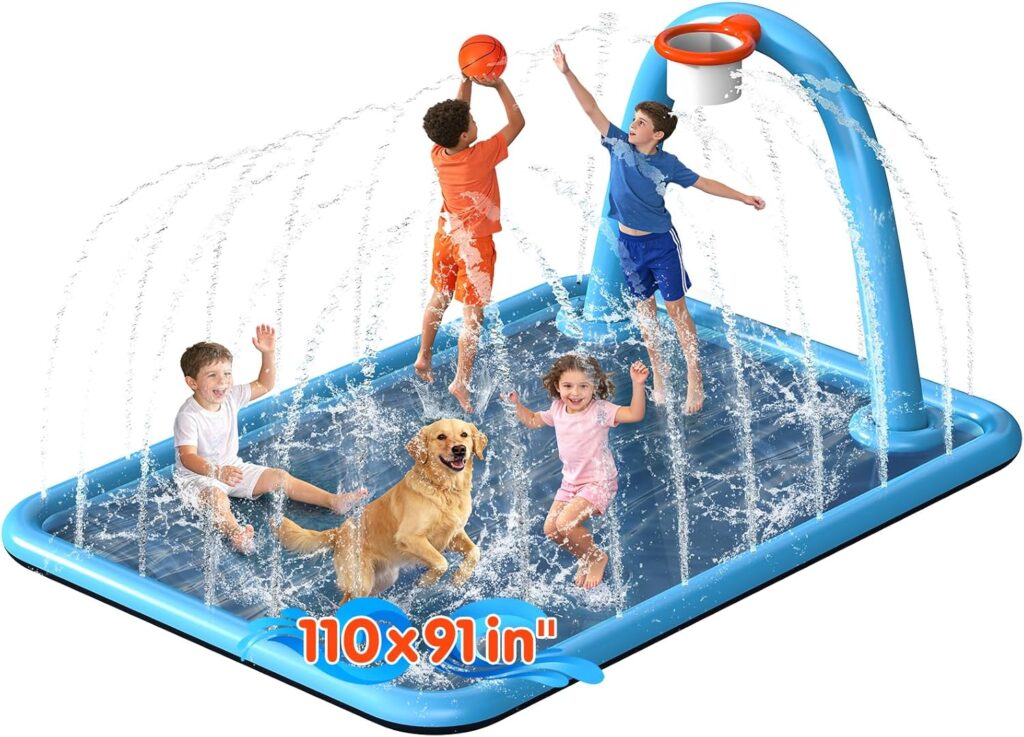
The biggest advantage is usable area. A 100-inch square splash pad covers 10,000 square inches, while a 100-inch round splash pad covers about 7,854 square inches. That means the square shape gives about 27% more surface area at the same listed width.
That extra area matters in daily use. Siblings can stand farther apart. A pet can step into one corner while children play near the spray. Parents have more flexibility when placing the pad near a patio, fence, or garden space.
A square splash pad is often better for:
- Patios and decks
- Narrow yards
- Rectangular lawns
- Siblings or playdates
- Kids and pets using the pad together
- Families who want more usable play area
- Homes where outdoor space needs careful measuring
The key point is corner quality. A square splash pad needs strong corner welding because corners often take more stress during folding, dragging, and water pressure changes. A larger square pad is useful only when the edges and corners are built well.
| Feature | Round Splash Pad | Square Splash Pad |
|---|---|---|
| Best Space | Open lawn | Patio, side yard, rectangular lawn |
| Play Feel | Softer and more relaxed | More structured and spacious |
| Same Listed Width | Less surface area | About 27% more surface area |
| Kids’ Movement | Easy circling and center play | Better for side-to-side movement |
| Pet Access | Easy entry from many angles | Better for controlled cooling areas |
| Setup Planning | Less exact placement needed | Easier to measure against straight spaces |
| Durability Focus | Edge welding and inlet area | Corner welding and edge stability |
For EPN, shape is only one part of splash pad design. A good backyard splash pad also needs stable PVC, reinforced edge welding, balanced spray holes, a secure garden hose connection, and a foldable structure that can handle repeated setup and storage. Round may look more playful, and square may feel more efficient, but the better choice is the one that fits the yard and holds up to real summer use.
Which Splash Pad Fits Grass?
A round splash pad usually fits open grass better because children and pets can enter from any side, and the shape looks natural in the center of a lawn. A square splash pad fits grass better when the lawn is narrow, rectangular, or close to a patio edge. For grass use, ground level, debris removal, hose placement, and drying habits matter as much as shape.

Round Splash Pad on Grass
A round splash pad is often the easiest choice for a wide, open lawn. It does not need to match a fence line, patio border, or garden edge. Parents can place it in the middle of the grass, connect the hose, and create a simple summer play area without much measuring.
The biggest advantage is access. Children can step in from any direction, and dogs can approach the water without needing a clear entry point. This makes round pads feel relaxed for younger children, nervous pets, and casual family play.
Round pads also encourage natural movement. Children walk around the spray ring, step into the center, sit in the shallow water, and move back out. For younger children, that movement pattern feels easy and not too busy.
The main limitation is usable area. If the lawn is narrow or rectangular, a round pad may leave unused grass around the curved sides. On a large lawn, that may not matter. In a smaller yard, it can decide whether two children have enough room to play comfortably.
A round splash pad works better on grass when:
- The lawn is open and not too narrow.
- One or two children will use it at a time.
- The main use is cooling, gentle splashing, or toddler play.
- Pets need easy access from different sides.
- The family wants a softer, more natural backyard look.
- There is at least 2–3 ft of walking space around the full pad.
Square Splash Pad on Grass
A square splash pad works well on grass when the yard has a clear rectangular area. If the lawn is long and narrow, next to a patio, or bordered by a fence, a square pad can make better use of the available space than a round one.
The straight sides make it easier to measure before setup. Parents can check the length and width of the grass area, leave enough walking space, and decide where the hose should sit. This is useful for smaller homes, townhouses, side yards, and gardens where every foot of space matters.
A square pad also gives more usable surface area at the same listed width. That extra space is helpful for siblings, playdates, and families using the pad with both children and pets. One child can stay near the spray, another can move across the center, and a dog can step into one corner without crowding everyone else.
The part that needs attention is the corner structure. On grass, families may drag the pad slightly when adjusting placement. During folding, the corners may also take more stress than the straight sides. A square splash pad should have stable edge welding and well-built corners so the shape does not twist, crease, or leak after repeated use.
Grass Setup Tips
Grass is softer than concrete, but it still needs preparation. A splash pad placed on rough or uneven grass can spray unevenly, collect water on one side, wear faster on the bottom, or become muddy around the edges.
Before placing any splash pad on grass, walk over the area and feel for stones, roots, sticks, dry mulch, seed pods, or hard bumps. These small objects may not look serious, but once water weight and foot traffic are added, they can press into the PVC from underneath.
Use this grass setup checklist:
| Setup Check | Recommended Detail | Why It Matters |
|---|---|---|
| Clear Space | Leave 2–3 ft around the pad | Gives kids room to step, turn, and exit safely |
| Ground Level | Choose the flattest grass area | Helps water spray and pool more evenly |
| Debris Removal | Remove stones, sticks, roots, and mulch | Reduces bottom abrasion and puncture risk |
| Hose Position | Keep hose away from running paths | Reduces tripping and connector stress |
| Water Pressure | Start low, then increase slowly | Prevents sudden high spray and edge strain |
| Grass Length | Short to medium grass is better | Helps the pad lie flatter |
| Drainage | Avoid areas where water flows toward doors | Keeps patios and entrances drier |
| Drying | Dry both sides before folding | Reduces odor and moisture buildup |
A common mistake is measuring only the pad size. A 100-inch splash pad is about 8.3 ft wide, but the actual activity zone should be larger. With 2–3 ft of clearance around it, families may need about 12–14 ft of usable grass space for comfortable movement.
For families planning lawn setup, learning more about how to use a splash pad on grass can help avoid uneven ground, hidden debris, and water pooling problems before the first summer play session.
Which Splash Pad Fits Patio?
A square splash pad usually fits patios better because most patios, decks, and paved backyard areas have straight edges. It is easier to measure, place, and keep away from furniture, doors, and walls. A round splash pad can still work on a patio, but it needs more open space around the full circle.
Square Splash Pad for Patio
A square splash pad is usually the more practical choice for patios. Most patios are built with straight lines, whether they are concrete slabs, outdoor tiles, wooden decks, or paved garden areas. A square pad can sit more naturally beside a fence, along a wall, near a deck edge, or in the center of a rectangular patio.
The biggest advantage is space control. Parents can measure the patio width and length, then check whether the pad leaves enough walking room around it. This is harder with a round pad because the curved sides may leave empty gaps in the corners while still taking up a wide footprint.
On a patio, the extra surface area of a square pad can make a clear difference. A 100-inch square splash pad provides about 10,000 square inches of surface area. A 100-inch round splash pad provides about 7,854 square inches. When patio space is limited, about 27% more area can make the play zone feel less crowded.
A square splash pad works better on patio when:
- The patio is rectangular or narrow.
- The pad needs to sit near a fence, wall, or deck edge.
- Two or more children may use it together.
- A pet may also step into the water.
- Parents want more usable surface area.
- The hose connection needs a fixed and easy-to-check position.
- The family wants to keep water away from furniture or doors.
The main point to check is corner strength. Patio surfaces are harder than grass, and moving the pad across concrete or tile can put more pressure on the corners. A square splash pad should have stable edge welding, reinforced corners, and enough PVC thickness to handle repeated setup and folding.
Round Splash Pad for Patio
A round splash pad can work well on a patio if the patio is wide, open, and free from nearby obstacles. The round shape feels softer and more playful, especially when placed in the center of a clean outdoor space. For one young child or relaxed summer cooling, it can still be a good choice.
The issue is usable patio space. A round pad does not align well with straight patio edges. If the patio is rectangular, the curved outline may leave unused corner space. The pad may also end up too close to outdoor furniture, steps, planters, or a sliding door because the full circle needs clearance on all sides.
A round splash pad also needs careful hose placement. If the hose pulls strongly from one direction, the round edge may shift slightly or stretch near the connection area. On grass, this movement may be less obvious. On a smooth patio, especially tile or sealed concrete, the pad may slide more easily when wet.
Round pads can look more relaxed, but they are not always the easiest patio choice. If the patio is small, narrow, or filled with furniture, a square splash pad usually gives better control.
Patio Safety Tips
Patio use needs more caution than grass use. A patio may look clean and flat, but once water starts flowing, the surface can become slippery. The harder ground also gives less cushioning if a child runs or falls.
Different patio materials behave differently:
| Patio Surface | Main Concern | Setup Advice |
|---|---|---|
| Smooth tile | Can become very slippery when wet | Use lower spray height and avoid running |
| Sealed concrete | May become slick with water and sunscreen | Keep towel area away from the wet zone |
| Rough concrete | Can scratch the bottom of PVC | Check surface texture before setup |
| Wooden deck | Water may collect between boards | Check drainage and avoid long standing water |
| Pavers | Gaps and raised edges may press into the pad | Choose the flattest area and clear debris |
| Stone patio | Uneven texture may create pressure points | Avoid sharp edges and rough joints |
A practical patio setup should include:
- At least 2–3 ft of walking space around the pad.
- A hose path that does not cross the main walking area.
- A dry towel area outside the spray zone.
- No sharp furniture legs near the PVC edge.
- No grills, fire pits, or electrical items nearby.
- A surface check for rough spots, stones, or raised tile edges.
- Lower water pressure for toddlers and pets.
- Adult supervision during use.
A common mistake is setting the splash pad too close to patio doors. When children run in and out, water can be tracked indoors quickly. Keeping the pad several feet away from doors and placing towels outside the water zone can make cleanup easier.
For EPN splash pads, patio use is an important part of product design because many families do not have large lawns. A good patio splash pad should connect securely to a standard garden hose, spray inward with control, lie flat on a clean surface, and fold away after drying.
How Does Shape Affect Spray?
Shape affects how water travels around the outer ring of a splash pad. A round splash pad usually creates a smoother inward spray pattern because water moves around a continuous curve. A square splash pad can give wider side-to-side coverage, but the corners need stronger water flow, balanced spray holes, and stable edge welding to keep the spray even.
Round Splash Pad Spray
A round splash pad usually has the most natural spray pattern. The outer ring forms a continuous circle, so water can travel around the edge and spray toward the center in a more even direction. When the hose pressure is stable and the spray holes are well spaced, the water often feels balanced from every side.
This is helpful for younger children. A round spray ring creates a simple play zone: water sprays inward, the center stays easy to understand, and children can move in and out without needing to follow a certain direction. Parents can lower the water pressure for toddlers or increase it slightly for older children who want taller spray.
Round spray also works well for relaxed cooling. The water surrounds the play area instead of pushing strongly from one side. For one or two children, that can feel comfortable and less chaotic.
The limitation is play variety. A round spray pattern can feel repetitive for older children who want more active games. They may run around the ring or gather near the center, but the shape does not naturally create long play lanes or separate activity zones.
Square Splash Pad Spray
A square splash pad creates a different water feel. The straight sides can produce longer spray lines, which may make the pad feel more open for side-to-side movement. Children can run across the middle, stand near different sides, or play in separate corners.
The biggest advantage is coverage. Because a square pad gives more surface area than a round pad at the same listed width, the water play area can feel larger when the spray is well balanced. This is useful for siblings, playdates, and families using the pad with both kids and pets.
The challenge is the corner area. Water does not move through corners the same way it moves around a smooth circle. If the spray hole layout is not designed well, one corner may spray lower, one side may spray higher, or water may collect unevenly. A square splash pad needs stable edge welding and carefully distributed spray holes to keep the water pattern consistent.
A larger square splash pad may also need stronger water flow. Since the spray ring covers a longer perimeter, weak household water pressure may result in lower spray height. This does not mean square splash pads are worse. It means size, water pressure, and spray hole design need to match.
Spray Pressure Check
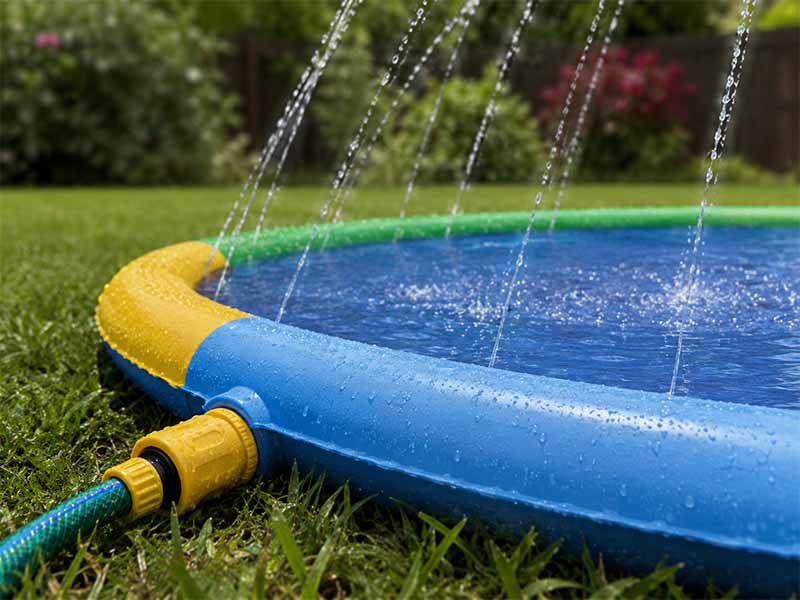
Many families think spray performance depends only on shape, but the real causes are usually water pressure, hose setup, spray hole layout, and ground level. A well-designed round pad with weak water pressure may spray poorly. A well-built square pad with balanced pressure can perform very well.
Water pressure should also match the user. High spray may look exciting in product photos, but it is not always better in real use. For toddlers, lower spray is often more comfortable. For pets, gentle spray can feel less stressful. For patios, lower spray helps control overspray and reduces the chance of water spreading toward doors or furniture.
| Spray Factor | What Customers Notice | What to Check |
|---|---|---|
| Household Water Pressure | Spray is too low or uneven | Start low, then increase slowly |
| Hose Length | Spray weakens with long hose use | Use a shorter hose when possible |
| Hose Connector | Water leaks near inlet | Tighten connection and check washer |
| Hose Kinks | One side sprays lower | Keep hose straight before use |
| Pad Size | Larger pads need more flow | Match size with available water pressure |
| Spray Hole Layout | Some areas spray higher than others | Look for evenly spaced spray holes |
| Edge Welding | Spray direction becomes unstable | Check if the edge holds shape when filled |
| Ground Slope | Water pools on one side | Place pad on flatter ground |
Many spray problems are connected to edge pressure, inlet stress, or weak seams. Families comparing spray performance may also find it useful to understand why some splash pads leak easily, especially when a product looks large but fails after repeated water pressure.
Which Shape Works for Kids?
A round splash pad usually works better for toddlers, younger children, and relaxed backyard cooling. A square splash pad usually works better for siblings, playdates, and active kids who need more usable room. For children, the best shape depends on age, number of kids, movement style, spray height, yard space, and how easy it is for parents to supervise.
Round Splash Pad for Kids
A round splash pad is often the easier shape for younger children. It feels open, soft, and simple. There is no clear front, back, corner, or entry point, so toddlers can step in from any side and move at their own pace.
The play pattern is usually calmer. Children may walk around the spray ring, sit near the center, touch the water streams, or step in and out of the pad. For parents who want a gentle cooling area instead of a high-energy water game, a round splash pad can feel easier to manage.
Round pads also help with supervision on open lawns. Because the play naturally gathers around the center, parents can sit nearby and keep the full pad in view. This is useful for children under 5, who may need closer watching around any water play area, even when the water is shallow.
The limitation is shared space. A round pad can feel smaller when more children join. If two or three kids stand near the center, they may crowd each other quickly. Older children may also find the movement pattern too simple after a while.
A round splash pad works better for kids when:
- The child is a toddler or preschool age.
- One or two children will use it at a time.
- The main goal is cooling and gentle splashing.
- Parents want easy supervision from one side.
- The lawn is open and has space around the full pad.
- The child prefers lower spray and slower play.
- The family wants a softer, less structured play area.
Square Splash Pad for Kids
A square splash pad usually works better when children need more room to move. The straight sides and corners create a clearer play boundary, which helps kids understand where the water area begins and ends. This is useful for siblings, playdates, and children who like more active movement.
The biggest advantage is usable surface area. At the same listed width, a square splash pad gives about 27% more play area than a round splash pad. That extra space can make a real difference when two or more children are playing.
Square pads also create natural zones. One child can stand near a corner, another can run across the middle, and another can sit near the spray edge. This helps reduce crowding, especially when children are different ages or have different play styles.
For older kids, square shapes can feel more fun because they support side-to-side games. Children can race across the pad, kick a soft ball through the spray, or create simple rules like “stay inside the square.” That kind of movement is harder to organize on a round pad.
The point to watch is edge and corner strength. Children often step on the edge, pull the pad slightly when moving, or run across the corners. A square splash pad should have stable welding and reinforced corners so the shape holds well during repeated summer use.
Kids Play Space
For children, splash pad size should not be judged by the product’s listed width alone. Parents need to think about the full activity space. A pad that looks large online may feel tight if it is placed too close to a fence, steps, patio furniture, or the garden hose.
A useful way to plan is to add 2–3 ft of open space around the splash pad. This gives children room to enter, turn, step away from the spray, and dry off without bumping into nearby objects.
| Child Age / Use | Better Shape | Spray Suggestion | Why |
|---|---|---|---|
| 1–3 years | Round | Low spray | Softer, calmer, easier entry |
| 3–5 years | Round or square | Low to medium spray | Depends on activity level |
| 5–8 years | Square | Medium spray | More movement and play space |
| Siblings | Square | Medium spray | Better zones and less crowding |
| Playdates | Square | Medium spray | More usable area |
| Quiet cooling | Round | Low spray | Relaxed, simple play |
| Active games | Square | Medium to higher spray | Better side-to-side movement |
Important comfort details include:
- Low-odor PVC for a better first-use experience
- Smooth surface feel for bare feet
- Reinforced edge to help the spray ring stay stable
- Inward spray to keep water focused in the play area
- Adjustable spray height through water pressure
- Foldable design for easier storage
- Stable hose connection to reduce leaks and sudden spray changes
EPN develops children’s splash pads around family use, not only shape. For kids’ water play, the focus includes low-odor material direction, stable spray, reinforced edge welding, and a foldable PVC structure suitable for repeated summer use.

Which Shape Works for Pets?
A round splash pad often works better for dogs that need easy entry from different sides, especially nervous pets or first-time water users. A square splash pad usually works better for patios, compact yards, larger dogs, and families who want a more controlled cooling zone. For pets, PVC thickness, nail contact, ground surface, cleaning habits, and edge strength matter more than shape alone.
Round Splash Pad for Dogs
A round splash pad can feel more inviting for dogs because there is no clear front, back, or corner. A dog can step in from any direction, walk around the spray ring, or enter only halfway if it feels unsure. This open access is helpful for pets that are new to water play or do not like being guided into a fixed space.
For nervous dogs, round shapes may feel less restrictive. Owners can place the pad on open grass, start with low water pressure, and let the dog explore naturally. The dog can sniff the edge, touch the shallow water, step away, and return again without feeling trapped by corners or barriers.
Round pads also suit relaxed cooling. After a walk, a dog may only need to cool its paws and belly for a few minutes. A round splash pad gives a soft, simple cooling area without making the setup feel too structured.
The limitation is movement control. Active dogs may circle the pad, turn quickly, or jump through the spray. If the dog is large or has long nails, the PVC may face more pressure in certain areas. A round shape gives easier access, but it still needs strong material and a clean surface underneath.
Square Splash Pad for Dogs
A square splash pad can be more practical for dogs in controlled spaces. The straight sides and corners make it easier to place the pad beside a fence, near a patio edge, or in a narrow backyard area. For families that do not have a large lawn, square often gives better space control.
The biggest advantage is usable area. At the same listed width, a square splash pad gives more surface area than a round splash pad. This matters for medium and large dogs because they need more room to turn around, step in, and lie down without pushing against the edge.
A square pad can also be useful when kids and pets share the same water play area. Children can stay on one side while the dog enters from another side or corner. The shape creates clearer zones, which can reduce crowding and make supervision easier.
Square pads are especially helpful on patios. A dog can enter from one corner, cool down, then step out toward the same side. This makes cleanup easier and helps keep water away from doors, furniture, or dry areas.
Pet Use Tips
Pet use is harder on a splash pad than child-only use. Dogs bring nails, paw pressure, dirt, grass, hair, and sudden movement into the play area. Shape helps with access and layout, but care habits decide how long the pad stays clean and usable.
Useful pet care habits include:
- Trim pet nails before frequent use.
- Use the pad on smooth grass or a clean patio.
- Avoid gravel, rough concrete, dry roots, and sharp ground.
- Start with low water pressure.
- Rinse mud, grass, and pet hair after play.
- Dry both sides before folding.
- Store away from heat and direct sunlight when not in use.
- Do not leave pets unattended with water play products.
| Pet Type | Better Shape | Suggested Use Style | Why |
|---|---|---|---|
| Small dog | Round or square | Low spray, short cooling | Weight pressure is lower |
| Nervous dog | Round | Gentle entry from any side | Feels less restrictive |
| Medium dog | Square | More room to turn | Better usable area |
| Large dog | Square | Controlled cooling area | More space and stronger layout |
| Two pets | Square | Separate zones | Less crowding |
| Dog and child together | Square | Shared but clearer play area | Easier supervision |
| First-time water play | Round | Slow introduction | Softer and more open |
| Patio pet cooling | Square | Fixed placement | Easier drainage control |
For pet families, PVC thickness and wear resistance matter more than shape alone. EPN splash pad designs may use PVC thickness around 0.35 mm–0.50 mm depending on size, use scenario, and product design. Pet-focused outdoor use often needs greater attention to reinforced edges, stable seams, and cleaning convenience.
Which Shape Lasts Longer?
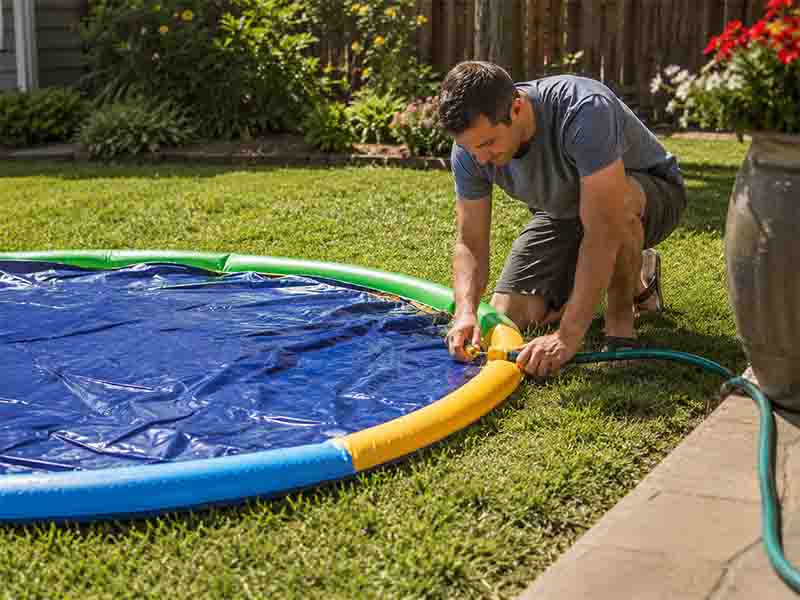
A round splash pad may have a small durability advantage because it has no corners, so edge stress can spread more evenly during folding, dragging, and water pressure changes. A square splash pad can still last very well if the corners are reinforced and the edge welding is strong. In real use, PVC thickness, seam quality, spray ring stability, hose connection, UV exposure, ground surface, and storage habits matter more than shape alone.
Round Splash Pad Durability
A round splash pad has one natural structural advantage: it does not have sharp corners. When the pad is filled with water, folded after use, or moved across the lawn, stress can spread more evenly around the circular edge. This may reduce the chance of corner-related creasing or pulling.
That makes round splash pads a good choice for families who want a simple, low-maintenance summer water toy. A round pad can be easier to fold, easier to place on open grass, and less likely to develop stress at a specific corner point. For younger children and lighter use, this can support a longer service life.
However, round shape does not automatically mean better durability. A round splash pad can still wear out quickly if the PVC is too thin, the hose inlet is weak, the spray holes stretch, or the pad is placed on rough ground. The most common problem areas are usually the inlet connection, outer spray ring, welded seams, and bottom layer.
Square Splash Pad Durability
A square splash pad has more usable area, but it also has four corners that need to be built well. Corners are the places where folding pressure, dragging force, and water pressure may concentrate. If the corners are weak, thin, or poorly welded, they may become the first areas to crease, leak, or lose shape.
That does not mean square splash pads are less durable. A well-made square pad with reinforced corners and stable edge welding can handle repeated family use very well. The square shape is especially useful for siblings, pets, patios, and smaller yards, but the construction needs to match that more active use.
The main durability question for a square splash pad is not only whether it has corners. It is how those corners are built. Strong corner welding, consistent edge sealing, and flexible PVC all help the pad keep its shape during setup, water flow, folding, and storage.
PVC Build Quality
PVC build quality has a larger impact on durability than shape. A thick, well-welded square splash pad can outlast a thin round one. A round splash pad with weak seams can fail faster than a reinforced square design. Shape affects stress distribution, but material and structure decide long-term performance.
Important durability factors include:
| Durability Factor | Why It Matters | What to Look For |
|---|---|---|
| PVC Thickness | Helps resist wear, folding stress, and pet contact | Around 0.35 mm–0.50 mm depending on size and use |
| Edge Welding | Supports the spray ring under water pressure | Smooth, stable, and consistent welded edges |
| Corner Strength | Critical for square splash pads | Reinforced corners with no weak creases |
| Hose Inlet | One of the highest-stress areas | Secure connector with stable surrounding material |
| Spray Holes | Small holes can stretch if material is weak | Evenly placed holes with stable edge structure |
| Bottom Surface | Takes friction from grass, patio, and movement | Smooth underside with no thin-feeling areas |
| UV Resistance | Helps reduce sun aging and brittleness | Material designed for outdoor summer use |
| Flexibility | Reduces hard creases during folding | PVC should fold without feeling brittle |
| Storage Habit | Prevents moisture odor and fold damage | Drain, dry, fold loosely, and store cool |
Families comparing long-term use may also want to look at what material is best for a splash pad, because PVC thickness, flexibility, and edge welding often matter more than shape alone.
For EPN splash pads, material matching is part of product development. Children’s splash pads need comfort, lower odor, and stable sun exposure performance. Pet splash pads need more attention to wear resistance and repeated paw pressure. Larger splash pads need stronger edge stability because the water ring carries more pressure and covers a wider area.
How to Choose Shape?
To choose the right round vs square splash pad shape, start with the actual space, not the product photo. Choose round if the yard is open, the child is younger, or the play style is gentle. Choose square if the space is narrow, patio-based, used by siblings, shared with pets, or needs more usable surface area.

Choose Round Splash Pad
A round splash pad is the better choice when the play area is open and the family wants a softer, more relaxed water play experience. It fits naturally in the middle of a lawn and gives children easy access from every side. For younger kids, that simple shape can feel less crowded and easier to understand.
Round also works well when the main goal is cooling rather than active games. A toddler may only want to walk through the spray, sit in the center, or touch the water streams. In that case, a square pad’s extra corners and larger usable area may not be necessary.
For pets, round can be helpful when a dog is new to water play. Since there is no fixed entry point, a nervous dog can approach from any side, step away, and come back when it feels comfortable.
Choose a round splash pad when:
- The yard has open grass space.
- One or two young children will use it.
- The main use is gentle cooling.
- The child prefers slow movement and lower spray.
- A small or nervous dog may join.
- The family wants quick setup with less measuring.
- The pad will not be placed against a wall or fence.
- A softer backyard look is preferred.
Choose Square Splash Pad
A square splash pad is the better choice when the family needs more usable play space and better layout control. It fits patios, side yards, rectangular lawns, and compact outdoor areas more efficiently than a round pad.
The most important advantage is surface area. At the same listed width, a square splash pad gives about 27% more usable area than a round splash pad. That difference becomes important when two children play together, when a dog steps in, or when parents want enough room for movement without crowding the center.
Square also works better when the outdoor space has straight lines. If the pad needs to sit near a fence, along a patio edge, or inside a measured backyard zone, square is easier to place. Parents can measure length and width, check walking space, and plan where the hose should run.
Choose a square splash pad when:
- The outdoor space is patio-based.
- The yard is narrow or rectangular.
- Two or more children will use it.
- Kids like running, stepping, or water games.
- A dog or pet may also use the pad.
- The family wants more surface area.
- The hose connection needs a planned position.
- Water should be kept away from doors or furniture.
- Parents want clearer play boundaries.
The key is construction quality. A square splash pad should have reinforced corners, stable edge welding, and PVC thick enough for repeated use. A larger play area is only useful if the corners and seams can handle daily summer movement.
Final Shape Guide
| Need | Better Shape | Practical Reason |
|---|---|---|
| Open lawn play | Round | Natural placement and easy entry |
| Small patio | Square | Better use of straight space |
| Narrow yard | Square | Less wasted area |
| Toddler play | Round | Calmer, softer movement |
| Sibling play | Square | More usable surface area |
| Dog cooling | Round for nervous dogs, square for larger dogs | Depends on pet size and confidence |
| Kids and pets together | Square | Better space separation |
| More play area | Square | About 27% more area at the same width |
| Easier folding | Round | Fewer corner stress points |
| Clear boundary | Square | Easier for kids to understand play area |
| Softer appearance | Round | More relaxed backyard look |
| Practical layout | Square | Easier to measure and place |
Shape helps decide fit, but families who want repeated summer use should also compare the details that help a splash pad last more than one summer, including PVC thickness, seam strength, water pressure control, and storage habits.
For most open lawns, round is the easier and softer choice. For patios, compact yards, and shared family play, square is usually more practical. For frequent use, the final decision should also include PVC thickness, reinforced edge welding, spray balance, hose connection, and storage routine.
EPN Splash Pad Options
EPN, under American Epsilon Inc., develops PVC and composite outdoor recreation products for family, pet, and seasonal use. The product range includes kids splash pads, pet splash pads, basketball splash pads, inflatable pools, pet pools, water slides, pool pillows, snow tubes, floats, and other outdoor water play products.
For family users, EPN focuses on practical backyard details:
- Easy connection to a garden hose
- Inward spray design for better water control
- Shallow water play for supervised summer use
- Foldable PVC structure for storage
- Reinforced edges for repeated water pressure
- Low-odor material direction for family comfort
- Size and shape options for different yards
For business customers, Epsilon can support branded orders and customized development. Round and square splash pads can be adjusted by size, color, print, packaging, label content, spray layout, and structure details according to project needs.
Epsilon’s development and supply support includes:
| Capability | Detail |
|---|---|
| R&D Team | 27 team members |
| Design Team | 18+ designers |
| Annual Testing | 500+ material and product performance tests |
| Annual Design Work | 1,500+ design projects |
| New Product Capacity | 1,000+ new products per year |
| Production Capacity | Up to 12 million pieces per year |
| Sample Support | 3–5 days for regular projects |
| Regular Production | About 20–30 days |
| Custom Support | OEM/ODM size, color, print, packaging, labels |
| Market Support | Packaging and documentation for multiple markets |
If you are choosing an EPN branded splash pad for summer sales, planning a round or square splash pad collection, or developing a custom PVC water play product for your market, Epsilon can provide product options, available stock details, sample support, quotation, and OEM/ODM project consultation.
Get A Fast quote
Here, bringing your inflatable concepts to life is no longer a challenge—it’s a collaborative journey where American Epsilon helps families, outdoor enthusiasts, and global brands transform creative ideas into safe, certified, and market-ready inflatable solutions.


Partner With Epsilon
Whether you are a family looking for safe backyard fun or a brand seeking large-scale OEM/ODM solutions, American Epsilon Inc. guarantees every inflatable is built with safety, durability, and excitement in mind. With flexible low MOQs, strategically placed warehouses in the U.S., Canada, U.K., and Germany, plus 24/7 professional support, we ensure smooth delivery and reliable service worldwide.
Ready to bring your inflatable ideas to life? Request free samples, fast prototypes, and customized designs today—your trusted inflatable journey starts here.