Skip to content
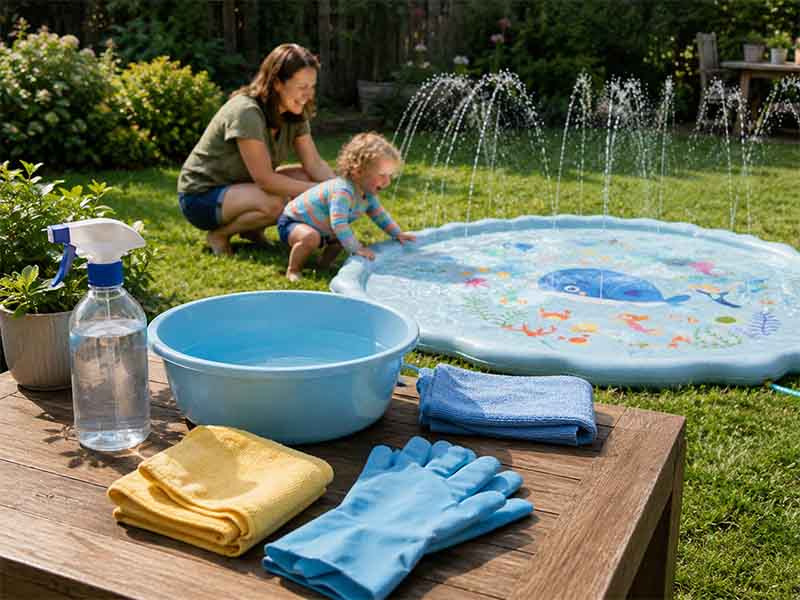
A big family needs more than a fun-looking backyard water toy. When several children want to run, splash, sit, chase toys, kick a ball, cool down, or invite friends over, a small splash pad can feel crowded within minutes. One child may stand in the strongest spray area. Another may step on the edge. A younger child may want to sit in the center. A family dog may suddenly join the play. In real backyard use, the best splash pad is not only the one with the brightest print or the largest product photo. It is the one that gives children enough room, keeps water play easy to manage, and stays practical after repeated summer setup.
The best splash pad for big families is a large, durable, non-slip backyard water play mat with enough open space for multiple children, balanced spray, reinforced PVC construction, and a simple hose connection. For many family backyards, a 10 ft to 13 ft splash pad gives better shared play space than a small toddler pad. Larger models are more suitable for mixed ages, playdates, pets, and backyard parties.
Parents often make their real judgment after the third or fourth use. Was the splash pad easy to unfold? Did the water spray evenly? Did the surface feel stable when several children moved at the same time? Was the edge strong enough? Did it dry and fold without becoming a problem? These details matter because big families tend to use outdoor toys harder and more often.
EPN, part of American Epsilon Inc., develops PVC and composite outdoor recreation products for family, pet, and seasonal use. Its product development looks at water pressure, spray balance, edge strength, low-odor material, storage, and repeated outdoor use. A good splash pad should make summer easier for the family, not create another item parents have to repair, replace, or clean for too long.
For families comparing outdoor water toys, it also helps to understand why some products fail early. Guides such as why some splash pads leak easily, what material is best for a splash pad, and how to choose a splash pad that lasts more than one summer can help parents look beyond color and size and focus on structure, material, and real use conditions.
What Size Splash Pad Works Best?
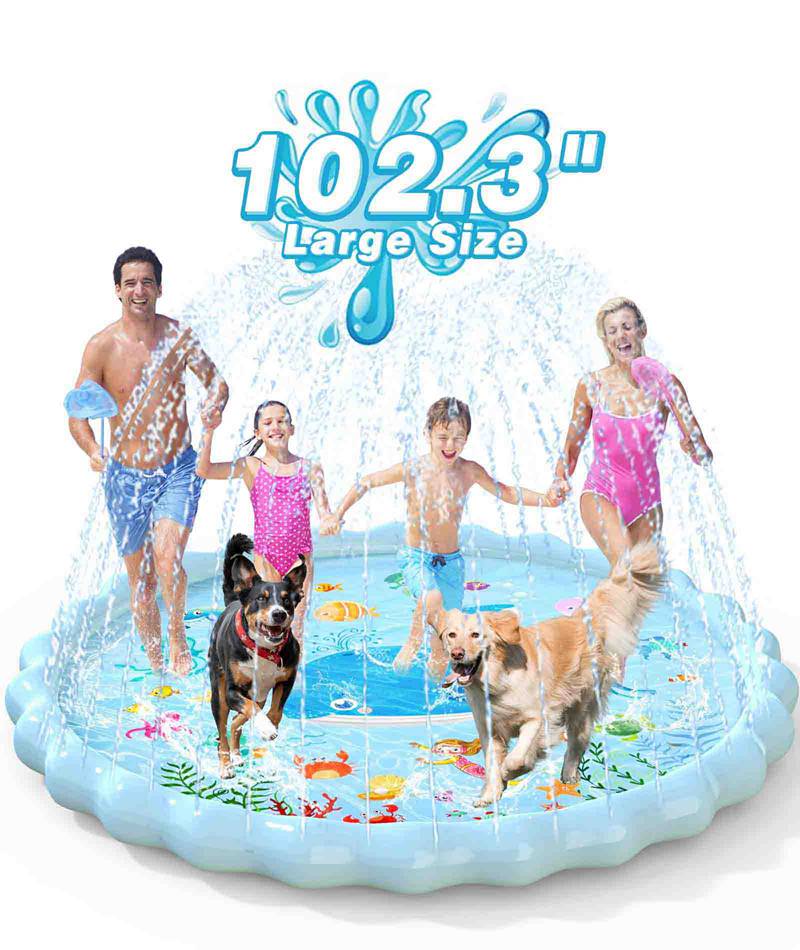
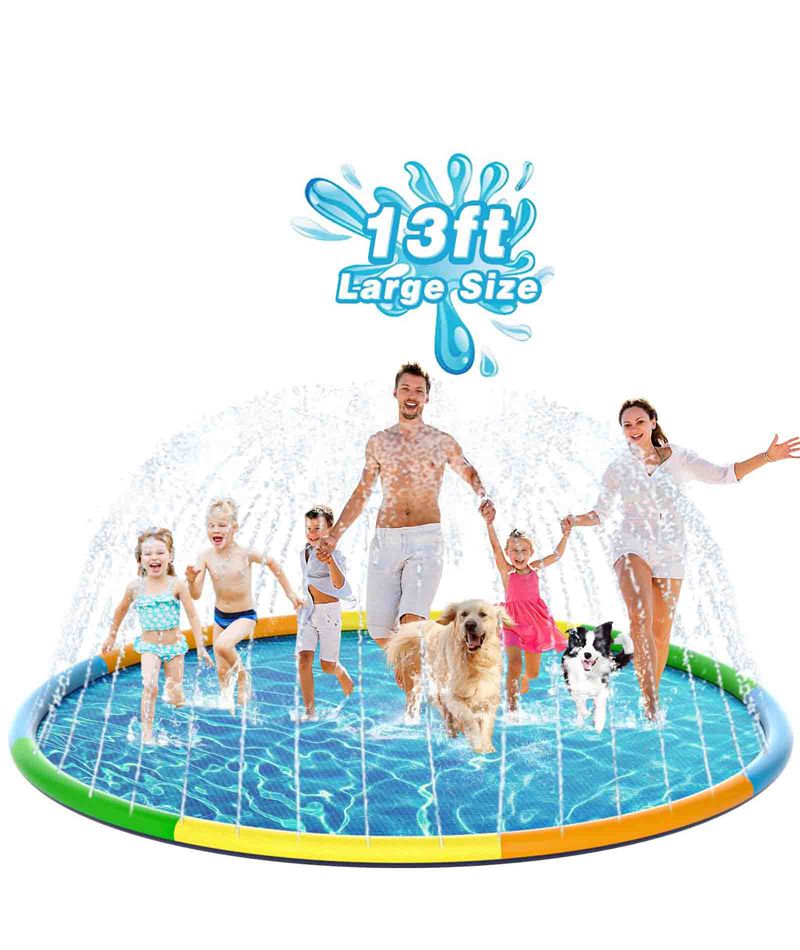
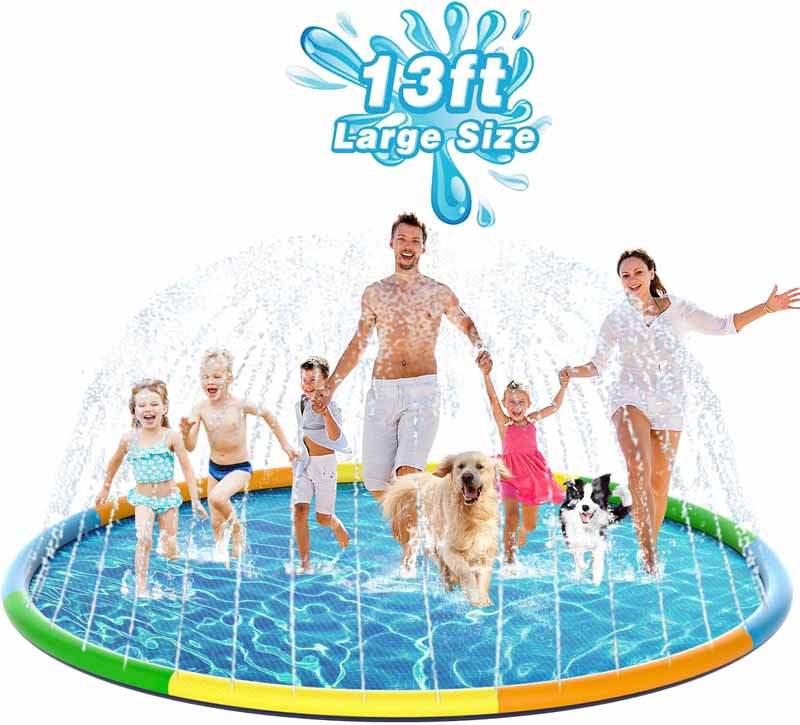
A big family usually needs a splash pad that gives children enough room to move, sit, splash, and enter or leave the play area without crowding each other. For most families with several children, a 10 ft splash pad is a practical starting point. A 13 ft or larger splash pad is usually a better choice for mixed ages, playdates, pets, or backyard parties.
Splash Pad Space for Kids
The right splash pad size depends less on the product photo and more on how many children will use it at the same time. A small splash pad may look fine when it is empty, but the space changes quickly once children start moving. One child may sit in the center, another may run through the spray, and a younger sibling may need extra room to step carefully.
For big families, the goal is not only to fit every child on the splash pad. The goal is to leave enough open space so children can move without bumping into each other or standing too close to the edge. This is especially important when younger and older children play together. Older children usually want more movement, while younger children often prefer to sit, crawl, or stay near the center.
A useful way to choose size is to think about active space, not just diameter. A 6 ft to 8 ft splash pad may work for one or two toddlers, but it can feel tight for several children. A 10 ft splash pad gives more shared room for everyday family use. A 13 ft or larger model is better when children invite friends over or when pets may join the water play.
| Family Situation | Better Splash Pad Size | Why It Works |
|---|---|---|
| 1 toddler or first water play | 67–79 in | Easy for gentle splashing and close supervision |
| 2 young children | 8–10 ft | Gives more room than a small toddler mat |
| 3–4 children | 10–13 ft | Better for shared play without heavy crowding |
| 4+ children or mixed ages | 13 ft or larger | Allows more movement and safer spacing |
| Playdates or birthday use | 13 ft or larger | Gives guests room to join without crowding |
| Kids and pets together | 10–13 ft or larger | Helps separate children from active pets |
Parents can also use a simple space check before buying:
- Imagine each child needing about 2 to 3 ft of personal movement space.
- Add extra space if older children like to run through the spray.
- Add extra space if pets may join.
- Add extra space for playdates, cousins, or birthday gatherings.
- Avoid choosing a size based only on the product image.
- Measure the real setup area before ordering.
Children will not stay inside neat circles, but the 2 to 3 ft rule gives a more realistic idea of whether the splash pad will feel comfortable. If the family has three children and often hosts friends, choosing a larger size is usually more practical than buying the smallest option and hoping it will work.

Splash Pad Size for Backyards
A large splash pad only works well if the backyard can support it. Before choosing a size, families should measure the flat area where the splash pad will actually be placed. This should be the open space available after removing patio furniture, garden tools, toys, grills, planters, dog bowls, and other backyard items.
Parents should also leave extra room around the splash pad. The play mat itself may be 10 ft or 13 ft wide, but children need space to step on and off safely. A good setup should leave about 2 to 3 ft of open walking space around the edge whenever possible. This helps reduce crowding and gives adults room to supervise, adjust the hose, or help younger children.
For grass setup, the area should be flat, soft, and free from sharp debris. Small stones, dry branches, exposed roots, and rough patches can affect the bottom of the PVC over time. For patio setup, the surface should be smooth enough to avoid scraping. If the backyard surface is uneven, a smaller splash pad placed on a safer flat area is usually better than a larger model placed on rough ground. Families planning lawn setup can also review whether a splash pad can be used on grass before deciding where to place it.
| Backyard Space | Splash Pad Fit | Practical Note |
|---|---|---|
| Small patio or narrow lawn | 67–79 in or 8 ft | Better for toddlers or 1–2 children |
| Medium family lawn | 8–10 ft | Suitable for regular family cooling |
| Open backyard area | 10–13 ft | Strong fit for several children |
| Large lawn or party space | 13 ft or larger | Better for playdates and group use |
| Long side yard | Rectangular splash pad | Makes better use of narrow space |
| Open center yard | Round splash pad | Easier shared play from all sides |
Families should also think about where the hose connection will sit. The best location keeps the hose out of the main walking path. If children need to cross over the hose repeatedly, they may trip or step on the connector. A good setup keeps the connector close to the water source while leaving the main play area open.
Splash Pad Shape Choices
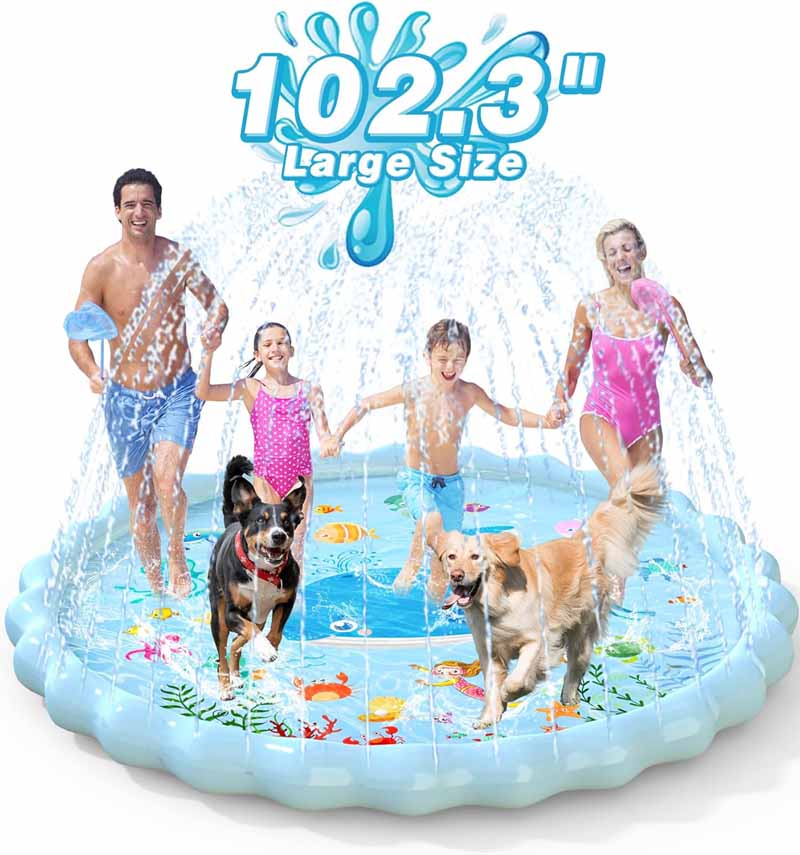
Shape affects how a splash pad feels during real play. Round splash pads are easy for families because children can enter from different sides and enjoy spray from the outer ring. The center stays open for sitting, toys, and calmer play. This shape works well for younger children and mixed-age families because it does not create one narrow play direction.
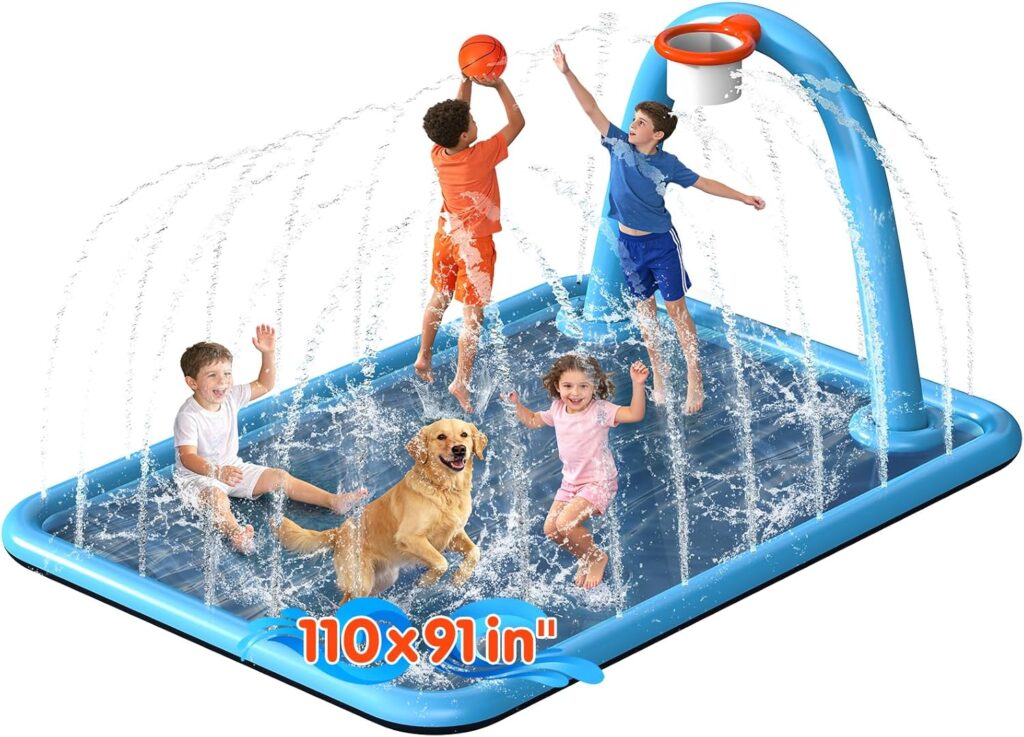
Square or rectangular splash pads can be better for certain backyards. If the yard is long and narrow, a rectangular splash pad may use the space more efficiently than a round one. It can also support more side-to-side movement, which is helpful for simple running games or sports-style play.
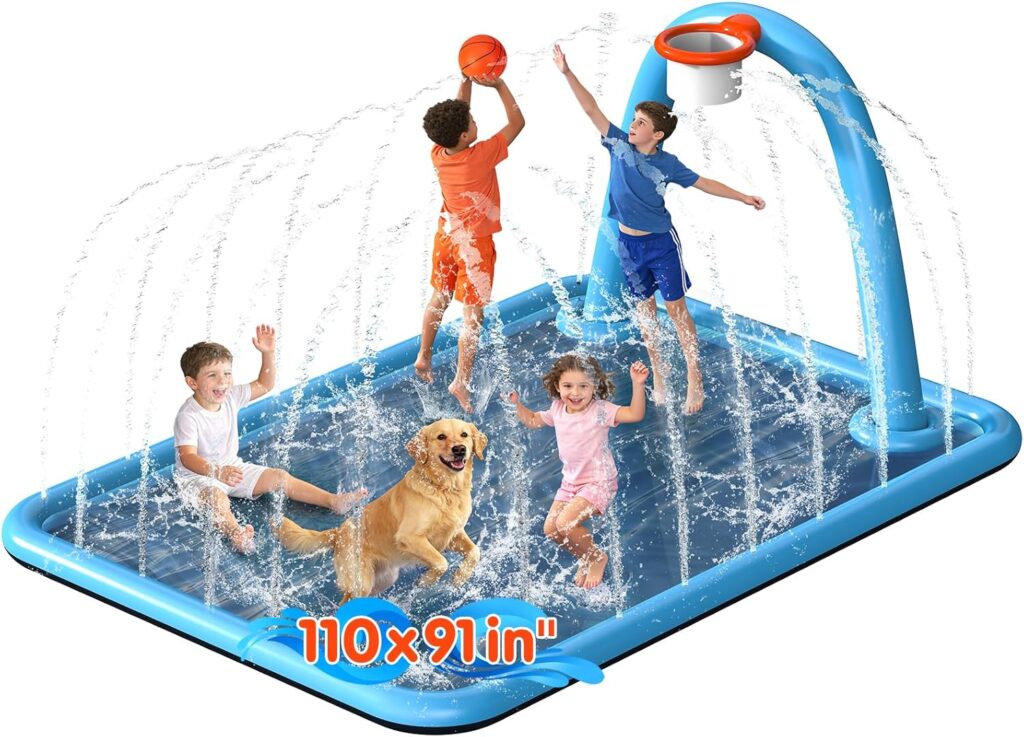
Themed splash pads can be useful for big families when they add real activity. A soccer splash pad, basketball splash pad, or game-style design gives older children something to do beyond standing in the spray. This can help keep children engaged longer and reduce crowding in one spot. The key is to choose a theme that still leaves enough open play area.
| Splash Pad Shape | Best For | What to Consider |
|---|---|---|
| Round splash pad | Younger kids, mixed ages, open lawns | Easy shared play and simple supervision |
| Square splash pad | Balanced backyard layouts | Good use of corner-to-corner space |
| Rectangular splash pad | Narrow yards or side yards | Better for movement in one direction |
| Themed splash pad | Older kids and active play | Should still leave enough open space |
| Pet-friendly splash pad | Kids and dogs together | Needs stronger surface and enough room |
For big families, the best shape is the one that matches both the yard and the way children play. A round splash pad may be easier for casual cooling. A rectangular or themed splash pad may work better for active kids. A larger pet-friendly design may be more practical if dogs often join outdoor water play.
EPN develops different splash pad formats for family, pet, and active backyard use. This includes kids splash pads, pet splash pads, sports-themed splash pads, sprinkler toys, and other PVC outdoor water products. For customers choosing ready-to-order models or businesses developing custom splash pad lines, size and shape can be matched to real family use instead of only visual style.
Which Splash Pad Feels Safer?
A safer splash pad for big families should have a non-slip play surface, adjustable water pressure, stable edge structure, soft PVC contact, and enough room for children of different ages to play without crowding. Adult supervision is still needed, but the right design can make backyard water play easier to manage and more comfortable for parents.
Splash Pad Non-Slip Surface
A non-slip surface is one of the first details parents should check when choosing a splash pad for a big family. Water play naturally creates movement. Children walk, turn, sit, kneel, stand up quickly, chase toys, and run toward the spray. When several children are playing together, a smooth surface can feel less stable, especially if grass, sunscreen, or dirt gets onto the mat.
For family use, the non-slip texture should cover the main play area, not only a small decorative section. Children do not stay in one place. A younger child may sit near the center, while an older child runs around the spray ring. A textured surface across a wider area helps support normal movement during play.
Parents should also look at how the surface feels under bare feet. A good splash pad should feel textured enough to improve grip, but not so rough that it feels uncomfortable for sitting, crawling, or kneeling. For toddlers and younger children, comfort matters because they often play closer to the surface.
| Check Point | What Parents Should Look For | Why It Matters |
|---|---|---|
| Surface texture | Light grip across the main play area | Helps reduce slipping during movement |
| Water level | Shallow water, no deep pooling | Easier for children to move safely |
| Ground surface | Flat grass or smooth patio | Reduces bumps and uneven footing |
| Edge area | Stable outer ring without twisting | Helps children step on and off more safely |
| Toys used | Soft, lightweight water toys | Reduces impact if children fall or bump |
| Footwear | Bare feet or soft water shoes only | Avoids hard soles damaging the surface |
A non-slip splash pad does not mean children can run without care. Parents should still set simple rules before turning on the water. “No pushing,” “walk near younger kids,” and “keep hard toys off the pad” are easy for children to understand. For big families, simple rules are often more useful than long warnings because children can remember them while playing.
Splash Pad Water Pressure
Water pressure has a direct effect on how safe and comfortable a splash pad feels. If the pressure is too low, children may lose interest quickly. If it is too high, the spray may become too strong for younger kids, the edge may fill unevenly, and the play area may feel harder to control. For big families, the best setting is usually a moderate spray that keeps children engaged without making the surface chaotic.
Parents should start with low water pressure and raise it slowly. This is especially helpful when toddlers, younger children, older children, and pets are using the splash pad together. A gentle start gives everyone time to adjust. Once children are comfortable, the spray can be increased slightly for more active play.
| Age or Use Group | Suggested Spray Style | Setup Tip |
|---|---|---|
| Toddlers | Low, gentle spray | Keep pressure soft and stay close |
| Ages 4–6 | Low to medium spray | Allow light walking and splashing |
| Ages 7+ | Medium spray | Better for active games and running through water |
| Mixed ages | Low start, gradual increase | Let younger children adjust first |
| Pets | Low spray at first | Avoid sudden high water jets |
| Parties | Medium, controlled spray | Keep adults nearby and limit rough play |
Water pressure also affects the outer edge of the splash pad. If the ring fills unevenly, one side may spray higher while another side stays weak. This can cause children to gather in one spot, increasing crowding. A balanced spray pattern helps spread children around the play area and makes supervision easier.
Parents should avoid turning the faucet fully open at the start. A slower start helps the ring fill more evenly and gives time to check the connector, spray holes, and play surface. If water leaks heavily near the hose connection or one side of the pad lifts strangely, the water should be turned off and the setup checked before children continue playing.
EPN splash pad development pays attention to water connection reliability, edge stability, and multi-point spray distribution because these details affect real backyard use. A splash pad does not need the highest spray to feel fun. For big families, a steady, adjustable spray is often more useful than an extreme water effect.
Splash Pad Rules for Mixed Ages
Big families often have children at different ages and comfort levels. A toddler may want to sit in the center and touch the water with their hands. A 5-year-old may enjoy walking through the spray. An older child may want to run, kick a soft ball, or create a backyard game. A safe splash pad setup should allow these play styles to happen without everyone crowding into the same space.
The easiest way to manage mixed ages is to create simple play zones. Younger children can stay closer to the center or near an adult. Older children can use the outer spray area for movement. If pets join, they should enter after children have settled into the water play, not during the first excited minutes.
| Play Zone | Best For | Parent Tip |
|---|---|---|
| Center area | Toddlers, sitting, gentle splashing | Keep toys soft and water pressure low |
| Middle area | Younger kids walking and splashing | Watch for sudden running |
| Outer spray area | Older kids and active movement | Set no-pushing rules |
| Hose side | Adults only when possible | Keep children from stepping on connector |
| Dry edge area | Entering and leaving | Keep clear of toys and clutter |
| Pet entry area | Dogs joining play | Introduce slowly with low spray |
Mixed-age play becomes safer when the rules are clear before the water starts. Children are more likely to listen before they are excited and wet. Parents can keep the rules short:
- Walk near toddlers.
- Do not push or chase younger kids.
- Stay away from the hose connector.
- Keep hard toys off the splash pad.
- Take turns with active games.
- Stop if someone falls or feels scared.
For big families, safety also depends on visibility. Parents should place the splash pad where the whole surface can be seen clearly from a nearby sitting or standing spot. Avoid setting it behind shrubs, large patio furniture, or yard equipment. The best location gives adults a clear view of the center, edge, hose connection, and entry area.
If pets are included, families should watch their behavior closely. Some dogs love water and may run suddenly. Others may become nervous when spray starts. Keeping the water pressure low at first and giving pets a clear entry path helps prevent sudden movement around younger children.
The safest splash pad experience does not come from one feature alone. It comes from a good surface, controlled water pressure, open spacing, clear family rules, and active adult supervision. When these details work together, a splash pad can feel more relaxed for parents and more enjoyable for children.
What Splash Pad Material Lasts Longer?
A longer-lasting splash pad usually uses thicker PVC, reinforced edges, stable heat-press bonding, low-odor material, and a surface that can handle repeated water pressure, folding, sunlight, and backyard ground contact. For big families, material quality matters because the splash pad faces more feet, more movement, more setup cycles, and more outdoor wear.

Splash Pad PVC Thickness
PVC thickness is one of the easiest material details for families to compare, but it should not be judged alone. A splash pad needs enough thickness to handle repeated stepping, water pressure, folding, and contact with grass or patio surfaces. At the same time, it should still feel soft enough for children to sit, kneel, and play comfortably.
For family splash pads, PVC thickness often falls around 0.40 mm to 0.55 mm, depending on the product size, structure, and intended use. A smaller toddler splash pad may not need the same material thickness as a large family splash pad. A splash pad designed for several children, active games, or pet use should usually have stronger material support.
Big families create more daily wear than a single-child setup. Several children may step on the pad at once. Older kids may run through the spray. Younger children may sit in the center. Parents may drag the pad slightly to adjust position. Pets may walk across the surface with nails. These actions are normal, but they place stress on the material over time.
| PVC Detail | What It Means for Families | Why It Matters |
|---|---|---|
| Around 0.40 mm | Lighter and easier to fold | Better for smaller splash pads or gentle use |
| Around 0.50 mm | Stronger surface feel | Better for repeated family play |
| Around 0.55 mm | More support for active use | Better for larger splash pads or pet-friendly designs |
| Softer PVC feel | More comfortable for sitting and kneeling | Better for toddlers and younger kids |
| Too thin | May wear faster on rough ground | Less suitable for heavy family use |
| Too stiff | Harder to fold and store | Less convenient for daily summer use |
Parents should also check how the PVC feels, not only how thick it is. A good family splash pad should feel flexible when unfolded, smooth enough for skin contact, and strong enough that it does not feel flimsy under foot. If the material feels overly thin, noisy, or easy to crease sharply, it may not be the best option for repeated use.
PVC quality also affects storage. A splash pad is usually folded many times during the season. If the material is too rigid, it may develop hard fold marks. If it is too soft and weak, repeated folding may stress the same lines. A balanced PVC formula helps the product stay easier to fold while still supporting outdoor play.
EPN develops splash pads and other PVC outdoor products with different material requirements for children, pets, pools, snow use, and seasonal storage. This gives the product team more experience in matching PVC thickness, softness, flexibility, and durability to real use conditions.
Splash Pad Edge Strength
The edge is one of the hardest-working parts of a splash pad. It carries water flow, spray holes, pressure changes, and frequent stepping. Children enter and leave across the edge. Parents may pull the pad slightly during setup. Pets may step directly on the outer ring. If the edge is weak, narrow, or poorly bonded, leaks and uneven spray may appear faster. Families comparing edge problems can also read why some splash pads leak easily to understand how weak seams and connection areas affect real use.
A stronger splash pad edge usually depends on three things: material thickness, bonding width, and spray hole placement. The outer ring should be wide enough to hold water flow evenly. The bonding area should be consistent. The spray holes should be placed in a way that allows water to spray inward without putting too much stress on one section.
Heat-press bonding is important because the edge must stay sealed while water moves through the spray ring. Poor bonding can lead to small openings, water gaps, or weak points near the connector. For a big family splash pad, the edge should be designed to handle repeated filling, draining, folding, and outdoor use.
| Edge Detail | What to Check | Why It Matters |
|---|---|---|
| Wider edge area | Edge does not look too narrow or thin | Helps support water flow |
| Clean bonding line | Seam looks even and consistent | Helps reduce weak points |
| Reinforced connector area | Hose section looks supported | Helps reduce leaks near the connection |
| Even spray holes | Holes are spaced consistently | Helps water spray more evenly |
| Stable ring shape | Edge fills without twisting badly | Makes play area easier to manage |
| Smooth edge feel | No sharp or rough seam edges | More comfortable for children stepping across |
Families should pay close attention to the hose connection area. This is where water enters the splash pad, so it often carries more pressure than other sections. If the connector pulls, twists, or leaks heavily, the rest of the splash pad may not spray properly. A stable connector area can make setup smoother and reduce water waste.
EPN focuses on reinforced seams, widened bonding areas, water connection reliability, and multi-point spray balance in splash pad design. These details may not look dramatic in product photos, but they affect whether the splash pad can handle repeated summer use.
Splash Pad Low-Odor Material
Low-odor material is an important comfort detail for family water toys. Children often sit, kneel, crawl, or lean close to the splash pad surface. If the product has a strong smell, it can make the first-use experience unpleasant, especially in hot weather. Warm sunlight can make material odor more noticeable, so low-odor PVC is more than a small bonus feature.
For big families, the splash pad may be opened and used many times during the season. A lower-odor material helps the product feel more comfortable each time it is unfolded. This matters for young children, pets, and parents who are close to the play area during setup and supervision.
Parents should still handle any new PVC product properly before first use. A simple rinse and short airing period can improve the first setup experience. After each use, the splash pad should be drained, rinsed, dried, and stored in a cool, dry place. Even good material can develop odor if it is folded while wet and stored in a warm area.
| Material Comfort Factor | Better Choice | What to Avoid |
|---|---|---|
| Odor level | Low-odor PVC | Strong chemical smell after opening |
| Surface feel | Smooth but not slippery | Sticky or overly plastic feel |
| Flexibility | Folds without sharp stress marks | Stiff material that cracks or creases sharply |
| Skin contact | Comfortable for sitting and kneeling | Rough seams or abrasive areas |
| Storage behavior | Dries and folds cleanly | Traps moisture easily |
| Warm-weather use | Stable feel under sunlight | Material that feels overly soft or tacky |
Low-odor material also matters for sellers and distributors. Customers often open summer water toys during warm weather and use them quickly. If the first impression is unpleasant, it can affect reviews, returns, and repeat purchases. A more comfortable material experience supports both end users and business customers.
For EPN, low-odor, flexible, and durable material selection is part of matching the product to real family use. Children’s water play products need comfort and stability. Pet water products need better wear support. Seasonal outdoor products need folding and storage performance. These different needs shape how materials are selected and tested.
Splash Pad Sun and Fold Resistance
A splash pad is not used only in water. It also sits under summer sun, touches grass or patio surfaces, gets folded after play, and may stay in storage between uses. These conditions can affect how long the product lasts. For big families, sun and folding performance are especially important because the splash pad may be used several times a week during hot months.
Sun exposure can affect PVC over time. A splash pad should not be left outside for days after use. Even if the material is designed for outdoor play, long-term direct sun exposure can speed up aging, fading, and stiffness. The best habit is to use the splash pad during play, rinse it, dry it, and store it away when not in use. For a deeper look at long-term use, families can also read how to choose a splash pad that lasts more than one summer.
Folding also matters. Many families fold the splash pad along the same lines every time. If the folds are forced too tightly, stress can build along the crease. Parents should avoid folding directly across the hose connector or pressing heavy items on top of the folded pad.
| Use Condition | Possible Material Stress | Better Habit |
|---|---|---|
| Direct sun for long periods | Faster aging or surface fading | Dry and store after play |
| Rough grass or stones | Bottom surface wear | Clear the ground before setup |
| Repeated tight folding | Crease stress | Fold loosely along natural lines |
| Wet storage | Odor and surface marks | Dry both sides before folding |
| Heavy objects on top | Pressure marks | Store flat or gently folded |
| Pet claws | Surface scratches | Trim nails and use on clean ground |
A durable material can still wear out faster if the splash pad is used on rough ground or stored wet. Product quality and daily care should work together. Families get better value when they choose a stronger splash pad and use it in a way that protects the material.
Splash Pad Material for Pets
If pets will use the splash pad, material strength becomes even more important. Dogs bring a different type of wear than children. Their nails can scratch the surface, their movement can be sudden, and larger dogs may place more pressure on the mat. A splash pad used by pets should have stronger PVC, stable seams, and enough space so children and dogs are not crowded together.
Not every splash pad is designed for active dog use. Families with large dogs should avoid rough play, chewing, and sharp ground surfaces. The dog’s nails should be trimmed, and the water pressure should start low so the pet can adjust. If the pet is nervous or overly excited, it may be better to let children play separately first.
For shared kids-and-pets use, parents should consider:
- Choose a larger splash pad to reduce crowding.
- Keep pet nails trimmed before water play.
- Start with low water pressure.
- Avoid rough chasing between kids and dogs.
- Set up on clean grass or a smooth surface.
- Rinse the splash pad after pet use.
- Check for surface scratches before folding.
EPN develops both children’s splash pads and pet water products, so pet movement, claw contact, and repeated stepping are important considerations in product development. For families that want one backyard water product for children and pets, choosing a stronger material and larger size is more practical than choosing based only on appearance.
Splash Pad Material Checklist
Before choosing a family splash pad, parents can use a simple material checklist. This helps compare products more clearly and reduces the chance of buying a splash pad that looks good online but feels weak after a few uses. For a more focused material guide, families can also review what material is best for a splash pad.
| Material Question | Why It Matters |
|---|---|
| Is the PVC thick enough for family use? | Several children create more surface stress |
| Does the pad feel flexible, not stiff? | Better for folding and storage |
| Are the edges reinforced? | Helps reduce leaks and uneven spray |
| Is the connector area supported? | Helps prevent water leakage near the hose |
| Does the surface have grip texture? | Supports safer movement |
| Is the material low odor? | Better first-use experience |
| Can it handle repeated folding? | Important for seasonal storage |
| Is it suitable for pets if needed? | Helps reduce damage from claws |
| Is the setup surface safe? | Ground contact affects material life |
| Are cleaning and drying easy? | Helps prevent odor and moisture marks |
A longer-lasting splash pad is not created by one feature alone. It comes from material thickness, edge design, bonding quality, spray structure, storage behavior, and the way families use it. For big families, the best choice is a splash pad that feels strong enough for active summer use but still easy enough to clean, fold, and bring out again.
How Easy Is Splash Pad Setup?
A family splash pad should be easy to unfold, connect, adjust, drain, clean, dry, and store without special tools. For big families, easy setup matters because the product may be used many times during summer. If parents can set it up in about 5 to 10 minutes and clean it without hassle, the splash pad is more likely to become part of regular backyard play.
Splash Pad Hose Connection
The hose connection is one of the most important setup details. A splash pad may have a large play area and a fun design, but if the hose connection leaks, twists, or feels hard to attach, the whole experience becomes frustrating before children even start playing.
Most backyard splash pads are designed to connect to a standard garden hose. Parents should check that the connector is aligned properly before turning on the water. The hose should sit flat enough that children are not stepping over it repeatedly. If the hose crosses the main play path, children may trip, pull the connector, or step on the attachment area.
A good first setup should start slowly. After the splash pad is unfolded and the hose is connected, parents should turn the faucet on at low pressure first. This allows the outer ring to begin filling evenly and gives time to check whether water is leaking near the connector. Once the spray holes begin working, the water pressure can be adjusted little by little.
| Setup Step | What to Do | Why It Matters |
|---|---|---|
| 1. Choose the location | Use flat grass or a smooth patio | Helps the splash pad fill and sit evenly |
| 2. Clear the ground | Remove stones, sticks, toys, and sharp debris | Protects the underside of the PVC |
| 3. Unfold fully | Spread the pad flat before connecting water | Reduces blocked water flow |
| 4. Smooth large folds | Gently flatten the edge and center | Helps spray ring fill more evenly |
| 5. Attach the hose | Connect securely without twisting | Helps reduce leaks near the connector |
| 6. Start low pressure | Turn the faucet on slowly | Prevents sudden high spray |
| 7. Adjust spray height | Increase water pressure gradually | Matches age, yard, and play style |
| 8. Check the edge | Look for uneven lifting or heavy leaks | Confirms setup is ready for play |
Parents should avoid opening the faucet fully at the beginning. Sudden high pressure can make the spray too strong, especially for toddlers or pets. It can also make it harder to notice whether the edge is filling evenly. A slow start gives parents more control and helps the splash pad settle into place.
For big families, connector placement is also important. The best setup keeps the hose and connector close to the water source but away from the busiest play path. If the splash pad has several children running around it, the hose side should be treated as an adult-access area whenever possible.
Splash Pad Cleaning Steps
Cleaning a splash pad should not feel like a separate project. Big families are more likely to reuse a splash pad when the after-play routine is simple. The main goal is to remove grass, dirt, sunscreen, pet hair, and leftover water before folding the product.
After play, parents should turn off the faucet and let the water drain from the spray ring. Some water may remain around the edge for a short time, so it helps to lift one side gently and guide the water away from the main play area. The splash pad should then be rinsed with clean water, especially if it was used on grass or by pets.
| Cleaning Step | What Parents Should Do | Practical Benefit |
|---|---|---|
| Turn off water | Stop the faucet before children leave the area | Prevents unnecessary water use |
| Disconnect hose | Remove gently without pulling the connector | Protects the attachment area |
| Drain the edge | Lift one side slightly if needed | Helps water leave the spray ring |
| Rinse surface | Use clean water to remove dirt and grass | Keeps the surface fresher |
| Wipe dirty spots | Use a soft cloth if needed | Removes sunscreen or mud marks |
| Flip if needed | Let the underside dry too | Reduces trapped moisture |
| Air dry fully | Dry before folding | Helps prevent odor and moisture marks |
Families should avoid folding the splash pad while it is still wet. This is one of the most common reasons PVC water toys develop odor during storage. Even if the top surface looks dry, the underside may still hold moisture from grass or patio contact. A few extra minutes of drying can make a big difference.
If the splash pad is used by pets, it should be rinsed more carefully. Dogs may bring dirt, grass, and hair onto the surface. Pet nails may also leave small surface marks, so parents should check the mat before folding. A quick inspection after use helps catch small issues before they become bigger problems.
For everyday summer use, a splash pad does not need harsh cleaning products. In most cases, clean water and a soft cloth are enough. Strong chemicals may affect the material or leave residue where children sit and play. The safest habit is to rinse, dry, and store the product properly after each use.
Splash Pad Storage Tips
Storage is where many families lose interest in a splash pad. If the product is hard to fold, stays wet for too long, or takes up too much space, parents may stop bringing it out. A well-designed family splash pad should fold into a manageable size and store easily in a garage, patio cabinet, storage bin, or seasonal toy area.
The most important storage rule is simple: dry before folding. Moisture trapped between PVC layers can lead to odor, surface marks, or a sticky feeling the next time the product is opened. Families should dry both the top and bottom surfaces before putting the splash pad away.
Parents should also avoid forcing sharp folds near the hose connector. The connector area carries more stress than other parts of the splash pad. Folding tightly across that point may weaken the area over time. It is better to fold along natural crease lines and keep the connector positioned where it is not heavily bent.
| Storage Situation | Better Practice | What to Avoid |
|---|---|---|
| Daily summer use | Dry, fold loosely, store in shade | Leaving wet on grass overnight |
| Weekend use | Rinse, dry fully, store in a bin | Folding with grass or dirt inside |
| Long-term storage | Clean thoroughly and keep cool/dry | Storing in direct sun or heat |
| Garage storage | Keep away from tools and sharp items | Placing heavy objects on top |
| Pet homes | Store away from chewing or scratching | Leaving accessible to dogs |
| Connector care | Avoid tight folds near the hose area | Pressing connector under heavy weight |
A splash pad that is stored well will usually feel easier to reuse. It opens cleaner, smells fresher, and requires less preparation before the next play session. For big families, this matters because summer water play often happens quickly. Parents may decide to set up the splash pad when children are already outside and the weather is hot. If the product is clean and ready, play can start faster.
Families can also separate short-term and seasonal storage. During the summer, the splash pad may be kept in an easy-to-reach outdoor storage box after drying. At the end of the season, it should be cleaned more carefully, dried completely, folded gently, and stored indoors or in a protected area.
Splash Pad Setup Time
Setup time matters more than many families expect. A product that takes too long to prepare may be used only once or twice. A splash pad that can be set up quickly is more likely to become part of normal summer afternoons.
For most families, a practical target is about 5 to 10 minutes for setup after the first use. The first setup may take longer because parents need to choose the location, check the hose connection, adjust the spray height, and learn how the product fills. After that, the process should become much faster.
| Task | First Use | Regular Use |
|---|---|---|
| Choose setup area | 3–5 minutes | Usually already known |
| Clear ground | 2–3 minutes | 1–2 minutes |
| Unfold and flatten | 2–4 minutes | 1–2 minutes |
| Connect hose | 1–2 minutes | About 1 minute |
| Adjust water pressure | 2–3 minutes | 1–2 minutes |
| Total setup time | 10–17 minutes | 5–10 minutes |
The setup becomes easier when the family uses the same safe location each time. Parents can also store the splash pad near the hose area during summer, as long as it is dry and protected. This reduces the effort needed to bring it out again.
For business customers and product developers, setup time is also an important selling point. Customers often remember whether a summer product feels easy to use. Clear instructions, simple connector design, and foldable storage can help reduce return concerns and improve repeat use.
Splash Pad Water Use
Water use is another practical concern for families. A splash pad does not need to run at full pressure to be fun. In many cases, moderate water pressure gives enough spray for children while reducing splashing outside the play area. Lower or medium pressure is also better for toddlers, pets, and smaller yards.
Parents can manage water use by turning the faucet on only when children are ready to play, adjusting the pressure based on age, and turning the water off during long breaks. If children leave the area to eat snacks or rest, the water can be paused. This keeps the backyard from getting overly wet and helps avoid unnecessary water use.
| Play Situation | Suggested Water Setting | Reason |
|---|---|---|
| Toddlers | Low pressure | Gentle spray and easier supervision |
| Ages 4–6 | Low to medium pressure | Enough fun without strong spray |
| Ages 7+ | Medium pressure | Better for active movement |
| Mixed ages | Start low, increase slowly | Lets younger children adjust |
| Pets joining | Low pressure first | Reduces sudden excitement or fear |
| Party use | Medium, controlled pressure | Keeps spray fun but manageable |
A splash pad should feel refreshing, not wasteful. Adjustable spray gives parents better control and makes the product more suitable for different family situations.
Splash Pad Setup Checklist
A simple checklist helps families avoid common setup problems. This is especially useful for big families, because children often become excited as soon as the splash pad appears. Having a routine makes setup faster and safer.
Before play:
- Choose a flat, clean area.
- Remove sticks, stones, toys, and sharp items.
- Keep the hose away from the main walking path.
- Unfold the splash pad fully.
- Check the connector before turning on water.
- Start with low water pressure.
- Watch how the edge fills.
- Adjust spray height slowly.
- Set simple play rules before children enter.
- Keep towels nearby for after play.
After play:
- Turn off the water.
- Disconnect the hose gently.
- Drain the spray ring.
- Rinse the surface.
- Wipe dirty spots if needed.
- Dry both sides.
- Fold without forcing sharp bends.
- Store in a clean, dry place.
This type of routine makes the splash pad easier to enjoy over and over. For big families, convenience is not a small feature. It is one of the main reasons a product gets used throughout the summer instead of being forgotten after one weekend.
EPN designs splash pads and other outdoor PVC products with repeated setup, drainage, folding, storage, and family use in mind. For ready-to-order products and custom OEM/ODM projects, practical setup details such as connector structure, foldable design, packaging instructions, and storage guidance can be developed to match different markets and customer needs.

Is a Splash Pad Better Than a Pool?
For big families, a splash pad can be better than a kiddie pool when parents want shallow water play, faster setup, easier drainage, more room for active movement, and simpler storage. A pool is better for sitting and soaking, but a splash pad is often easier for daily summer play, mixed ages, playdates, and quick backyard cooling.
Splash Pad vs Kiddie Pool
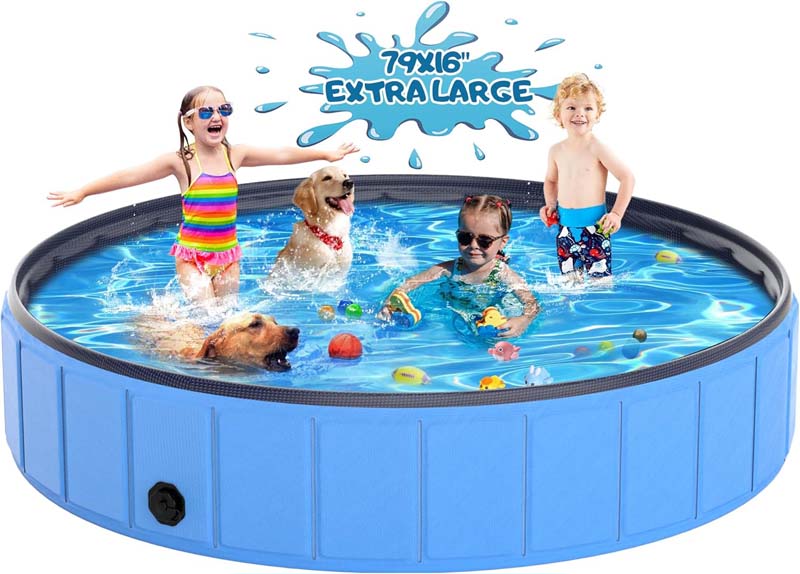
A splash pad and a kiddie pool are both popular backyard water toys, but they are not used in the same way. A kiddie pool holds standing water. Children can sit inside, play with floating toys, and cool down slowly. This can be enjoyable for toddlers and younger kids, but it also means parents need to think about water depth, filling time, drainage, cleaning, and close supervision.
A splash pad uses shallow moving water. Children can run through the spray, sit near the center, step in and out easily, and play with siblings without needing a deep water area. For big families, this makes a real difference. When several children want to play at once, a splash pad usually gives more flexible movement space than a small pool.
The best choice depends on how the family plans to use the product. If children mostly want to sit and soak, a kiddie pool may feel better. If children want to move, splash, cool down quickly, and play games together, a splash pad is usually more practical.
| Comparison Point | Splash Pad | Kiddie Pool |
|---|---|---|
| Water depth | Very shallow moving water | Holds standing water |
| Setup time | Usually faster | Takes longer to fill |
| Drainage | Easier to drain | Can be heavy or slow to empty |
| Play style | Running, splashing, games, cooling | Sitting, soaking, floating toys |
| Mixed ages | Easier to separate play zones | Can feel crowded in one space |
| Parent supervision | Open view across the surface | Requires closer attention to water depth |
| Storage | Folds flat after drying | Depends on pool type and structure |
| Pet sharing | Possible with suitable material | Wall strength may be a concern |
| Backyard space | Works on flat lawn or smooth patio | Needs enough room and stable ground |
| Daily reuse | Easier for short play sessions | More effort for quick use |
For many big families, the main advantage of a splash pad is convenience. It can be brought out for a short afternoon play session without the same effort needed to fill, monitor, empty, and clean a pool. That makes it more likely to be used often during summer.
Splash Pad for More Kids
A splash pad is often easier for several children because it allows more movement. In a small kiddie pool, children share the same limited sitting area. If one child kicks, splashes hard, or moves suddenly, everyone else feels it. This can lead to crowding, arguments, or younger children feeling overwhelmed.
On a splash pad, children can spread out. One child can sit in the center, another can walk through the spray, and an older child can move around the outer area. This makes the play more flexible for big families. It also helps parents guide children based on age and activity level.
For families with 3 or more children, the difference becomes clear. A larger splash pad gives children room to play at the same time instead of waiting for turns. It also works better for playdates because guests can join without everyone needing to squeeze into one small water space.
| Child Type | How They May Use a Splash Pad | Why It Helps Big Families |
|---|---|---|
| Toddlers | Sit near the center and touch the water | Keeps play gentle and easy to watch |
| Ages 4–6 | Walk through spray and play with cups | Gives light movement without deep water |
| Ages 7+ | Run, chase, kick soft balls, create games | Keeps older children more engaged |
| Shy children | Stay near the edge and adjust slowly | Allows gradual entry into water play |
| Active children | Move around the outer spray area | Gives energy a clear outlet |
| Friends or cousins | Join from different sides | Reduces crowding and waiting |
This flexibility is one reason splash pads can work well for birthdays, BBQs, weekend gatherings, and summer break afternoons. Children are not locked into one way of playing. They can move between calmer and more active play as the day goes on.
Splash Pad for Kids and Pets
Many big families include pets, and this is where a splash pad can be more flexible than a kiddie pool. Some dogs enjoy shallow moving water more than standing water. A splash pad allows pets to step in, cool their paws, move around, and leave easily. This can feel less intimidating than a pool with raised sides or deeper water.
That said, pet use depends on the product material and the dog’s behavior. Not every splash pad is made for active pets, especially large dogs with sharp nails. If children and dogs will use the splash pad together, families should choose a larger size, keep pet nails trimmed, start with low water pressure, and avoid rough chasing.
A good kids-and-pets setup should give everyone enough room. Dogs may run suddenly, shake water, or step near the edge. Younger children may sit low on the surface and need more calm space. A larger splash pad helps reduce crowding and makes shared play easier to manage.
Families should follow simple pet-use rules:
- Start with low water pressure.
- Let the dog enter slowly.
- Keep nails trimmed before play.
- Avoid rough chasing between kids and pets.
- Keep food and chew toys away from the splash pad.
- Rinse the surface after pet use.
- Check for scratches before folding.
- Stop play if the dog becomes too excited or nervous.
EPN develops both children’s splash pads and pet water products, so pet movement, claw contact, repeated stepping, and ground wear are important parts of product thinking. For families that want one backyard water product for children and pets, a stronger splash pad with enough size is usually more practical than a small pool.
Splash Pad Water Use
Water use is another reason many families compare splash pads with pools. A kiddie pool needs enough water to create a sitting or soaking depth. Depending on size, this can take time to fill and can feel wasteful if children only play for a short period. After play, the water also needs to be emptied safely.
A splash pad uses running water, but it does not need to be used at full pressure. Parents can adjust the faucet to create a lower or medium spray, which is often enough for children to cool down and play. For quick backyard sessions, this can feel more practical than filling a pool.
Water use depends on hose flow, pressure setting, play time, and splash pad size. Families can manage it by turning water on only when children are ready, lowering pressure for toddlers, and turning the faucet off during snack breaks or rest time.
| Use Situation | Better Water Setting | Practical Reason |
|---|---|---|
| Toddler cooling | Low pressure | Gentle spray and less splashing outside the pad |
| Mixed-age family play | Low start, medium later | Lets younger children adjust first |
| Active older kids | Medium pressure | Keeps spray fun without overdoing it |
| Pets joining | Low pressure | Helps pets feel more comfortable |
| Short afternoon play | Low to medium pressure | Enough cooling without heavy water use |
| Party use | Medium controlled pressure | Keeps play lively but easier to manage |
A splash pad should feel refreshing, not wasteful. Parents do not need to chase the highest spray height. A steady, moderate spray often works better for comfort, control, and repeated use.
Splash Pad Supervision
Both splash pads and kiddie pools require adult supervision, but they create different supervision needs. A kiddie pool holds standing water, so parents need to watch water depth, sitting children, toys, and how kids move in the pool. A splash pad usually has much shallower water, but children may move more actively, so parents need to watch running, slipping, crowding, and edge stepping.
For big families, visibility is important. A splash pad should be placed where the whole surface can be seen clearly. Avoid setting it behind tall patio furniture, shrubs, storage boxes, or playhouses. Parents should be able to see the center, the outer edge, the hose connector, and the entry area.
| Supervision Area | What to Watch |
|---|---|
| Center area | Younger children sitting or kneeling |
| Outer spray ring | Older kids running or stepping over the edge |
| Hose connection | Children pulling or stepping on the connector |
| Entry area | Slipping when getting on or off |
| Pet area | Dogs running suddenly or shaking water |
| Dry ground nearby | Toys, towels, or clutter creating trip risks |
A splash pad can feel easier to supervise when the layout is open and the spray is controlled. Parents can see children from different angles and adjust water pressure quickly. For big families, this open-view design is a practical advantage.
Splash Pad Storage and Cleanup
Storage is one of the clearest differences between a splash pad and a pool. Many kiddie pools take more space, especially rigid or framed designs. Some inflatable pools must be deflated, dried, and stored carefully. A splash pad usually folds flat after drying, which makes it easier for families with limited garage, patio, or shed space.
Cleanup is also simpler for many splash pads. After play, parents can turn off the water, drain the edge, rinse the surface, dry both sides, and fold it away. A pool often requires more effort because standing water needs to be emptied, and the bottom may collect dirt, grass, sunscreen, and small debris.
| After-Play Task | Splash Pad | Kiddie Pool |
|---|---|---|
| Stop water use | Turn off faucet | Stop filling or empty water |
| Drainage | Edge drains more easily | Water may be heavy to dump |
| Surface cleaning | Rinse and wipe | Clean bottom and walls |
| Drying | Dry both sides before folding | Dry inside and outside |
| Storage | Fold flat | Store inflated, deflated, or stacked |
| Daily reuse | Easy if dried well | May feel more time-consuming |
For big families, easy cleanup matters because parents already have towels, snacks, wet clothes, sunscreen, and tired kids to manage after play. A splash pad that cleans and stores quickly can be used more often without feeling like extra work.
Splash Pad Best Use Cases
A splash pad is not always better than a pool for every family. It depends on the situation. If a family wants children to sit and soak, a pool may feel better. If the goal is active cooling, shared movement, quick setup, and easy storage, a splash pad often fits better.
A splash pad works especially well for:
- Big families with several children.
- Mixed-age backyard play.
- Short afternoon cooling.
- Summer break screen-free activity.
- Playdates and birthday parties.
- Families with limited storage space.
- Homes with pets that enjoy water.
- Parents who want easier drainage.
- Yards where a large pool is not practical.
- Children who prefer running and games.
A kiddie pool may be better for:
- Children who want to sit in deeper water.
- Families with very young toddlers who prefer quiet soaking.
- Longer supervised water sessions.
- Floating toys and seated water play.
- Backyards with enough flat space for filling and draining.
For many big families, the best choice is not about which product is more popular. It is about which one fits daily life. A splash pad is often better when parents want water play that can be set up quickly, enjoyed by multiple children, cleaned without too much effort, and stored flat after use.
EPN offers splash pad and water play product development for family, pet, and outdoor use. For ready-to-order EPN products or custom OEM/ODM splash pad projects, size, shape, material, spray design, packaging, and market positioning can be adjusted for different family needs and sales channels.
Which Splash Pad Features Matter Most?
The most important splash pad features for big families are large usable play space, balanced spray, non-slip texture, reinforced PVC edges, secure hose connection, easy drainage, foldable storage, and a design that fits children of different ages. Fun prints can help attract kids, but the features that matter most are the ones that make the splash pad easier, safer, and more reusable.
Splash Pad Spray Pattern
Spray pattern is one of the first features children notice once the water turns on. A good splash pad should create an even, inward spray around the outer ring, leaving the center open for sitting, toys, and light movement. If the spray is too weak on one side and too strong on another, children may crowd around the better spray area, which can make the splash pad feel smaller than it really is.
For big families, balanced spray helps spread children around the play area. Younger children can stay closer to the center, while older children can move through the spray ring. Parents can also adjust the water pressure to match the age group and play style. A splash pad does not need extremely high spray to feel fun. In many family backyards, a moderate, steady spray is easier to manage and more comfortable for mixed ages.
Parents should look for spray holes that are evenly spaced and directed inward. The outer ring should fill without twisting badly or lifting unevenly. If the water only sprays well near the hose connection, the design may not distribute pressure evenly.
| Spray Feature | Better Design | Why It Matters |
|---|---|---|
| Spray direction | Inward spray toward the play area | Keeps water focused where children play |
| Spray height | Adjustable through faucet pressure | Works for toddlers, older kids, and pets |
| Spray hole spacing | Evenly distributed holes | Helps reduce weak or dry sections |
| Edge filling | Ring fills smoothly | Supports more stable water flow |
| Center space | Open and usable | Allows sitting, toys, and calmer play |
| Water control | Low to medium settings work well | Makes play easier to supervise |
For families with several children, a balanced spray pattern can make the splash pad feel more enjoyable for longer. Kids are less likely to gather in one corner, and parents can adjust the water to fit the day’s use, whether it is gentle toddler play, a quick cooling break, or a backyard party.
Splash Pad Play Area
The play area is more important than the printed size alone. A splash pad may be advertised as large, but if the center is crowded with raised parts, heavy graphics, or awkward shapes, the actual usable space may feel limited. For big families, the best play area should be open, easy to see, and flexible enough for several children to use in different ways.
Younger children may want to sit, crawl, or touch the water with their hands. Older children may want to run through the spray, kick a soft ball, or play simple games. A good family splash pad should allow both types of play without forcing everyone into the same small area.
Parents should think about how many children will use the pad at once and how they usually play. If the family has toddlers, the center should be comfortable and not too slippery. If older children are involved, there should be enough room for movement around the spray area. If pets may join, the splash pad should have extra space so dogs and children do not crowd each other.
| Family Need | Play Area Feature to Look For |
|---|---|
| Toddlers sitting and splashing | Open center area with gentle spray |
| Mixed-age siblings | Clear separation between center and outer spray area |
| Active kids | Larger surface with room to move |
| Playdates | Wider usable area, not just decorative size |
| Pets joining | Extra space near the edge and stronger surface |
| Parent supervision | Simple layout with clear visibility |
A good play area should also be easy for adults to supervise. If the design is too cluttered, it may be harder to see where younger children are sitting or where older children are running. Simple layouts often work better for big families because they reduce confusion and keep the full surface visible.
Splash Pad Non-Slip Texture
Non-slip texture should be treated as a key feature, not a small bonus. Water play naturally creates movement, and children rarely move slowly once the spray starts. A textured surface helps improve foot contact and makes the splash pad feel more stable under bare feet.
For big families, the texture should cover the main areas where children stand, sit, and move. If only a small section has grip, the rest of the surface may still feel too smooth during active play. Parents should also consider comfort. A good non-slip texture should provide grip without feeling harsh when children sit, kneel, or crawl.
This is especially important for families with toddlers or mixed ages. Younger children often play closer to the surface, while older children move more quickly around them. A comfortable textured surface helps support both play styles.
Parents can check these texture details before use:
- The surface should not feel overly slick when wet.
- The texture should cover the main play area.
- The surface should still feel comfortable for sitting.
- The pad should not have rough seam areas where children step.
- Water should not pool deeply in one section.
- Hard toys and shoes should be kept off the pad.
A non-slip surface does not remove the need for supervision, but it makes everyday backyard play easier to manage. For big families, that extra control can make the product feel more practical.
Splash Pad Edge Strength
The outer edge is one of the most important parts of a splash pad because it handles water pressure, spray holes, foot traffic, and hose connection stress. Children often step over the edge when entering or leaving the play area. Pets may step directly on the ring. Parents may pull the product slightly to adjust position. If the edge is weak, the splash pad may lose shape, leak, or spray unevenly.
A stronger edge should have clean bonding, stable shape, and enough width to carry water around the ring. The spray holes should be positioned consistently so water does not concentrate pressure in one area. The hose connection area should also feel supported because this is where water enters the splash pad.
| Edge Feature | What to Look For | Why It Matters |
|---|---|---|
| Wider edge ring | Not too narrow or flimsy | Helps support water flow |
| Clean seam line | Smooth, consistent bonding | Helps reduce weak points |
| Stable connector area | Hose attaches without heavy twisting | Helps reduce leaks |
| Even spray holes | Consistent spacing around the ring | Supports balanced spray |
| Smooth edge feel | No rough or sharp seam areas | More comfortable for children |
| Shape stability | Edge fills without major twisting | Easier to manage during play |
For big families, edge strength affects how long the product stays useful. A splash pad used by several children faces more stepping, dragging, filling, draining, and folding. Stronger edge construction can help reduce problems that appear after repeated use.
EPN pays attention to reinforced seams, widened bonding areas, water connection reliability, and spray distribution because these features affect real family use. They may not be as obvious as color or print, but they are often what parents notice after several weeks of summer play.
Splash Pad Hose Connection
The hose connection is easy to overlook, but it has a big effect on setup and daily use. A good splash pad should connect securely to a standard garden hose, fill the outer ring evenly, and allow parents to control spray height through water pressure. If the connector leaks heavily, twists, or pulls loose, the whole play session becomes harder to manage.
For big families, the hose side should be placed away from the busiest play path whenever possible. Children may run around the pad or step on and off quickly. If the connector sits where children constantly cross, it may get stepped on, pulled, or loosened.
A good hose connection should support:
- Simple attachment to the garden hose.
- Stable water flow into the spray ring.
- Less leaking around the connector during normal use.
- Easy pressure adjustment from the faucet.
- Clear setup instructions for parents.
- Less twisting when the hose is positioned correctly.
Parents should turn the water on slowly during setup. This allows the ring to fill evenly and gives time to check whether the connection is secure. If the spray is uneven or the connector leaks heavily, the water should be turned off and the setup should be checked before children continue playing.
Splash Pad Drainage
Drainage affects cleanup, storage, and long-term product condition. A splash pad that drains easily is more likely to be reused because parents do not have to spend too much time removing water after play. Big families already have wet towels, toys, sunscreen, snacks, and tired children to deal with. A simple drainage process makes the whole experience more practical.
After play, the water should be turned off and the edge should be allowed to drain. Parents may need to lift one side gently to guide water away. The surface should then be rinsed and dried before folding. If water stays trapped in the spray ring or between folded layers, odor and surface marks may develop over time.
| Step | What to Do | Why It Helps |
|---|---|---|
| Turn off faucet | Stop water flow first | Prevents extra pooling |
| Disconnect hose | Remove gently | Protects connector area |
| Lift one side | Guide water out | Helps drain the edge |
| Rinse surface | Remove grass and dirt | Keeps material cleaner |
| Dry top side | Let water evaporate | Reduces moisture before folding |
| Dry underside | Check grass or patio contact side | Prevents trapped dampness |
| Fold loosely | Avoid sharp bends | Helps protect material and connector |
Good drainage does not only make cleanup faster. It also helps protect the material. A splash pad that is stored dry will usually open cleaner and smell fresher the next time the family uses it.
Splash Pad Storage Design
Storage design matters because families do not use splash pads only once. During summer, the product may be brought out many times. If it is difficult to fold, heavy to move, or awkward to store, parents may stop using it even if children enjoy it.
A good splash pad should fold into a manageable size after drying. It should fit into a storage bin, garage shelf, patio cabinet, or seasonal toy area. The material should be flexible enough to fold without feeling brittle, but strong enough to avoid feeling thin or weak.
Parents should avoid tight folding near the hose connector. This area carries more stress than the rest of the splash pad. It is better to fold along natural lines and keep the connector from being crushed under heavy objects.
| Storage Feature | Why It Helps Big Families |
|---|---|
| Foldable PVC structure | Easier to put away after play |
| Manageable product weight | One adult can move it more easily |
| Flexible material | Reduces stress during folding |
| Dry surface before folding | Helps prevent odor |
| Connector protection | Reduces damage from tight folds |
| Compact storage size | Better for garages, sheds, and cabinets |
For business customers, storage design also affects customer satisfaction. Families are more likely to give positive feedback when a splash pad is easy to reuse, not just fun on the first day.
Splash Pad Family Value
Family value comes from how often the product gets used, not only how it looks on the first day. A splash pad with a low price but weak material, poor spray, difficult cleanup, or slippery surface may not be a good value if it is used only a few times. A better-value splash pad should support repeated use across summer.
For big families, the best value features are practical ones: enough size, stronger material, safer surface texture, reliable hose connection, easy drainage, and foldable storage. These features make the product easier for parents and more enjoyable for children.
| Feature | Immediate Benefit | Long-Term Value |
|---|---|---|
| Larger play area | More children can join | Better fit as children grow |
| Balanced spray | More enjoyable water play | Less crowding in one spot |
| Non-slip texture | More stable movement | Better for mixed ages |
| Reinforced edges | Stronger water ring | Lower leak risk over time |
| Secure hose connection | Easier setup | Less frustration during reuse |
| Thicker PVC | Stronger surface feel | Better for active family play |
| Easy drainage | Faster cleanup | Helps protect material |
| Foldable storage | Saves space | Encourages repeated use |
| Pet-friendly strength | More flexible family use | Better for homes with dogs |
Families should choose a splash pad based on how it will be used over the whole season. If it can support daily cooling, weekend playdates, birthday parties, pet water fun, and easy storage, it offers stronger value than a product that only looks good in photos.
EPN develops splash pads, pet water toys, inflatable pools, sprinkler toys, snow tubes, pool pillows, and other seasonal outdoor products. This broader product experience helps the team think beyond surface design and focus on real use details such as material strength, edge structure, water distribution, storage, packaging, and family-friendly setup.
Splash Pad Feature Checklist
A feature checklist helps families compare splash pads more clearly before ordering. It also helps sellers and distributors understand what customers are more likely to care about after the product arrives.
| Feature Question | Why It Matters |
|---|---|
| Is the splash pad large enough for several children? | Prevents crowding during group play |
| Does the spray pattern look balanced? | Helps children enjoy water from more areas |
| Is the surface textured? | Supports more stable movement |
| Are the edges reinforced? | Helps reduce leaks and shape problems |
| Is the hose connector easy to use? | Makes setup faster |
| Can water pressure be adjusted? | Works for different ages and pets |
| Does it drain easily? | Makes cleanup less stressful |
| Can it fold into a manageable size? | Helps with daily and seasonal storage |
| Is the material suitable for repeated use? | Better for big families |
| Does the design fit the yard shape? | Improves real backyard usability |
| Can pets use it if needed? | Important for dog-owning families |
| Is the product easy to explain in packaging? | Useful for retail and e-commerce sales |
The best splash pad features are not always the most decorative ones. For big families, practical details matter more because the product needs to support several children, repeated play, water pressure, outdoor surfaces, cleanup, and storage. A splash pad that handles these details well is more likely to become a summer favorite instead of a one-weekend toy.
Top 15 Splash Pads for Big Families: Comparison Guide
Choosing a splash pad for a big family is easier when parents compare products by real use, not only by color or price. The best options usually offer enough room for several children, controlled spray, a non-slip surface, stronger PVC, easy setup, and storage that does not become a problem after every play session. The list below compares 15 common splash pad choices for families with multiple children, mixed ages, pets, or frequent backyard gatherings.
Splash Pad Comparison for Big Families
| Rank | Splash Pad Type | Best For | Key Strength | What to Check Before Choosing |
|---|---|---|---|---|
| 1 | Extra-Large 13 ft+ Family Splash Pad | Large families, playdates, backyard parties | More open space for 4+ children | Needs a wide, flat yard and good water pressure |
| 2 | EPN Large Family Splash Pad | Families wanting size, structure, and repeat use | Balanced spray, PVC structure, edge support, and family-use design | Choose the right size and setup surface for your yard |
| 3 | Non-Slip Kids Splash Pad | Toddlers and mixed-age siblings | Better foot contact during wet play | Texture should cover the main play area |
| 4 | Kids and Dogs Splash Pad | Families with pets | Larger play area and stronger surface needs | Keep pet nails trimmed and start with low spray |
| 5 | 10 ft Backyard Splash Pad | Regular family cooling | Good balance of size and storage | May feel tight for 4+ active children |
| 6 | Sports-Themed Splash Pad | Older kids and active play | Gives children a clear game activity | Should still leave enough open play space |
| 7 | Round Splash Pad | Open lawns and younger children | Easy shared play from all sides | Needs enough space around the full circle |
| 8 | Rectangular Splash Pad | Long or narrow yards | Better fit for side yards and patios | Check if spray reaches evenly across the length |
| 9 | Toddler-Friendly Splash Pad | Younger children and first water play | Lower spray and calmer play area | May be too small for older siblings |
| 10 | Heavy-Duty PVC Splash Pad | Frequent summer use | Stronger material feel and better wear support | Material should still fold without feeling stiff |
| 11 | Low-Profile Splash Pad | Sitting, crawling, and gentle play | Comfortable center area for younger children | Not ideal for rough running games |
| 12 | Party Splash Pad | Birthdays, cousins, and summer gatherings | Larger play area and more visual fun | Needs close supervision with more children |
| 13 | Portable Foldable Splash Pad | Families with limited storage | Easier to dry, fold, and store | Check size before assuming it fits multiple kids |
| 14 | Adjustable Spray Splash Pad | Mixed ages and pets | Water height can be controlled by faucet pressure | Avoid starting with high water pressure |
| 15 | Budget Splash Pad | Short-term or occasional use | Lower entry cost | Check PVC thickness, edge strength, and connector quality |
A top choice for one family may not be the best choice for another. A family with toddlers may care more about low spray and a soft center area. A family with older children may need more space and stronger edge support. A family with dogs should look closely at material strength, surface texture, and how easily the splash pad can be rinsed after pet use.

Why EPN Ranks No. 2 for Big Families
EPN is placed near the top of this comparison because it is designed around practical family use rather than only seasonal decoration. For big families, the most useful splash pad is not always the flashiest one. It should offer a better mix of size, spray control, PVC material, edge strength, hose connection, drainage, and storage.
EPN splash pad development focuses on the details families notice after repeated use:
- The spray should be balanced enough for several children to enjoy the play area.
- The PVC should feel strong enough for active backyard use.
- The surface should support barefoot movement and sitting.
- The edge should handle repeated filling, draining, and folding.
- The hose connection should be easy for parents to set up.
- The product should dry, fold, and store without turning into a chore.
- The design should work for real summer routines, not only first-use photos.
For families, this means an EPN splash pad can fit daily backyard cooling, weekend playdates, mixed-age play, and pet-friendly water fun when used properly. For business customers, it also means EPN can support ready-to-order models, OEM/ODM customization, packaging adaptation, and seasonal product planning.
How to Choose from the Top 15 Options
Parents should not choose a splash pad only by rank. The better approach is to match the product to the family’s real backyard habits. A large family with 4 children, pets, and frequent playdates needs a different splash pad than a family with one toddler and a small patio.
| Family Need | Better Choice |
|---|---|
| 4+ children playing together | Extra-large 13 ft+ splash pad or EPN large family splash pad |
| Mixed ages | Non-slip splash pad with adjustable spray |
| Toddlers | Low-profile or toddler-friendly splash pad |
| Dogs joining play | Kids and dogs splash pad or stronger PVC splash pad |
| Narrow yard | Rectangular splash pad |
| Open lawn | Round splash pad |
| Older active kids | Sports-themed splash pad |
| Limited storage | Portable foldable splash pad |
| Daily summer use | Heavy-duty PVC splash pad |
| Occasional short use | Budget splash pad with basic safety checks |
The most practical splash pad is usually the one that matches three things at the same time: family size, backyard space, and repeat-use needs. A product that is large but hard to store may not be used often. A product that is easy to store but too small may disappoint children after the first few uses. A product that has fun graphics but weak edges may not hold up well through a busy summer.
For big families, EPN offers a strong middle ground: family-size design, PVC product experience, practical structure, and custom development support for different markets. That makes it a useful option for both families looking for reliable backyard water play and business customers planning seasonal splash pad products.

Why Choose an EPN Splash Pad?
An EPN splash pad is built for real family use, not only for product photos. EPN focuses on PVC material selection, edge strength, spray balance, hose connection, foldable storage, and repeated outdoor use. For families, this means a splash pad that is easier to set up and reuse. For business customers, it means stronger support for product development, packaging, testing, and seasonal supply.
Splash Pad Product Testing
A splash pad for big families needs to handle more than one sunny afternoon. It may be used by several children at once, placed on grass or patio surfaces, folded after play, stored between uses, and brought out again many times during summer. This is why product testing matters.
EPN, part of American Epsilon Inc., has a 27-person R&D team and more than 18 designers. The team works across material selection, structure design, mold development, children’s play behavior, pet use, packaging, graphics, and multi-language local market needs. Every year, EPN carries out more than 500 material and product performance tests and completes more than 1,500 design projects.
For splash pads, the test focus is close to daily family use. A product does not only need to look good when it is new. It should also keep stable spray, hold edge shape, connect properly to a hose, fold without unnecessary stress, and stay comfortable for children during repeated use.
| EPN Test Focus | What It Means for Customers | Why It Matters for Big Families |
|---|---|---|
| Water pressure stability | Spray stays more controlled during use | Helps support different ages and play styles |
| Edge bonding strength | Outer ring is checked for sealing performance | Helps reduce leak-related frustration |
| Hose connection reliability | Connector area is reviewed for water entry stability | Makes setup easier for parents |
| PVC flexibility | Material is checked for folding and handling | Helps with storage after play |
| Surface wear review | Product is considered for repeated stepping | Better for active children |
| UV exposure review | Outdoor use conditions are considered | Helps with summer backyard use |
| Low-odor material review | Material comfort is considered before use | Better for children sitting close to the surface |
| Pet-use wear review | Paw and claw contact are considered for pet products | Useful for families with dogs |
For families, these details reduce small problems that can ruin a play session. Weak spray, edge leaking, connector trouble, strong odor, or hard-to-fold material may not seem important in a product photo, but parents notice them quickly in real use. For business customers, testing also helps reduce after-sales pressure and supports better customer satisfaction during the summer season.
Splash Pad Structure Design
A practical splash pad is not just a flat PVC mat with spray holes. The structure decides how water moves, how the edge holds pressure, how children step on and off, and how the product behaves after folding. For big families, these details matter because the product faces more movement and more repeated use.
EPN pays attention to reinforced seams, widened bonding areas, edge stability, R-corner support, standardized water connection modules, and multi-point spray balance. These structural details help the splash pad feel more dependable during backyard play. A stronger outer ring can help maintain shape. A better connector area can reduce setup problems. A more balanced spray design can help children enjoy water from more areas instead of crowding in one spot.
A family splash pad should also feel comfortable. Children may sit, kneel, crawl, or walk barefoot on the surface. The material should be flexible enough for storage but strong enough for repeated water play. The edge should not feel rough where children step across. The spray should feel fun but not too aggressive for younger children.
| Structure Detail | Customer Benefit | Practical Use Scenario |
|---|---|---|
| Reinforced edge | Helps support repeated water flow | Several kids playing around the ring |
| Wider bonding area | Helps reduce weak seam points | Frequent filling and draining |
| Stable hose connector | Makes setup more reliable | Parent connects hose quickly before play |
| Inward spray design | Keeps water focused on play area | Children run through water without dry spots |
| Foldable PVC structure | Easier storage after drying | Summer daily use or weekend storage |
| Low-profile surface | More comfortable for sitting and walking | Toddlers and younger children using the center |
| Multi-point spray holes | Better water distribution | Reduces crowding in one spray area |
This kind of structure is especially important for larger splash pads. The bigger the splash pad, the more water must travel around the edge. If the ring does not fill evenly, one side may spray higher while another side stays weak. A well-planned spray system helps the product feel more consistent and easier for parents to manage.
Splash Pad Material Choices
Material choice affects how a splash pad feels, smells, folds, stores, and performs after repeated use. EPN works mainly with PVC and composite materials across outdoor water products, pet products, inflatable items, winter products, and pool accessories. This gives the team more experience with different use conditions, not just one summer product category.
For children’s splash pads, the material needs to feel comfortable against skin, support low-odor use, handle warm outdoor conditions, and remain flexible for folding. For pet-related water products, the material needs stronger wear support because paws and claws create different stress than children’s bare feet. For seasonal outdoor items, material performance under temperature changes and storage conditions also matters.
| Material Need | Why Customers Care |
|---|---|
| Suitable PVC thickness | Helps the product feel less flimsy under repeated use |
| Flexible surface | Makes folding and storage easier |
| Low-odor formula | Improves first-use comfort in warm weather |
| Comfortable touch | Better for sitting, kneeling, and barefoot play |
| Wear support | Useful for active kids and pet-friendly use |
| Sun-use consideration | Supports outdoor backyard play |
| Storage stability | Helps reduce stress from folding and seasonal storage |
EPN does not need every splash pad to use the same material. A small toddler splash pad, a large family splash pad, a sports-themed splash pad, and a pet-friendly splash pad may all need slightly different material choices. That flexibility is useful for customers who want to order existing models and for business customers who want to develop custom product lines.
Splash Pad Options for Families
Different families need different splash pads. A family with two toddlers may want a gentle, smaller water play mat. A family with four children may need a larger open play area. A family with pets may care more about wear support. A family hosting summer parties may prefer a sports-themed or activity-based splash pad.
EPN’s product range includes kids splash pads, pet splash pads, basketball splash pads, sprinkler toys, inflatable pools, children’s pools, pet pools, water floats, snow tubes, pool pillows, and other seasonal outdoor products. This wider product background allows EPN to think about family use from more than one angle.
| Family Need | EPN Product Direction |
|---|---|
| Several children playing together | Larger splash pad designs |
| Toddlers and younger children | Softer spray and open center play area |
| Active older kids | Sports-themed or game-style splash pads |
| Kids and pets sharing water play | Stronger surface and larger play area |
| Small backyard | Compact or shape-specific splash pad options |
| Playdates and parties | Larger models with more open movement space |
| Easy seasonal storage | Foldable PVC structure |
For families, the goal is simple: choose a product that fits the yard, the children’s ages, and the way the family actually plays. For business customers, the same idea applies at a larger scale. A good product line should match real customer needs instead of relying only on bright patterns.
Splash Pad OEM and ODM Support
EPN also supports OEM and ODM projects for brand owners, Amazon sellers, distributors, retailers, and seasonal product customers. This matters because the splash pad market is not one-size-fits-all. A seller targeting toddlers may need a different size, print, and packaging style than a retailer selling large backyard water toys for families with pets.
EPN can support adjustments in product size, shape, pattern, color, material direction, packaging, labels, instruction manuals, and local market presentation. This helps customers create products that fit different sales channels, including Amazon, Walmart, eBay, Temu, retail stores, and regional distribution.
| Custom Area | Possible Direction |
|---|---|
| Size | Small toddler pad, 10 ft family pad, 13 ft large pad, custom dimensions |
| Shape | Round, square, rectangular, sports-themed, pet-friendly |
| Summer theme, ocean theme, sports theme, animal theme, private-label artwork | |
| Material | Different PVC thickness or surface feel based on use case |
| Packaging | Retail box, mailer box, color box, platform-ready packaging |
| Labels | Barcode, warning labels, compliance labels, carton labels |
| Manual | Multi-language instructions and use guidance |
| Market fit | U.S., Canada, Europe, U.K., and other regional requirements |
For business customers, this can reduce the time needed to move from idea to sample. EPN usually supports sample development in about 3 to 5 days for standard projects. Regular production often takes about 20 to 30 days. Urgent projects may be arranged in about 14 days when the product type, packaging, and order scale match production conditions.
Splash Pad Packaging and Local Market Fit
Packaging is part of the customer experience. A family may first notice the product through an Amazon listing, retail shelf, or product image, but the packaging and instructions shape how confidently they set it up. Clear packaging helps customers understand size, use scene, age guidance, setup steps, storage method, and care instructions.
EPN supports packaging development and multi-language localization. This is useful for business customers selling into different markets. A splash pad sold in the U.S. may need different language, warning layout, and selling points than one sold in Germany, France, the U.K., or Canada. Good packaging should make the product easier to understand before and after purchase.
| Packaging Content | Why It Helps Customers |
|---|---|
| Product size | Helps families judge backyard fit |
| Setup steps | Reduces confusion before first use |
| Water pressure guidance | Helps parents adjust spray height |
| Surface and storage tips | Supports longer product life |
| Safety reminders | Helps families use the product properly |
| Material information | Builds trust in product quality |
| Pet-use notes if applicable | Helps prevent misuse |
| Brand contact information | Makes after-sales support easier |
For Amazon sellers and retail customers, clear packaging can also reduce unnecessary complaints. If customers understand how to connect the hose, adjust pressure, clean the product, dry it, and store it, they are more likely to have a smooth first-use experience.
Splash Pad Supply and Seasonal Planning
Splash pads are seasonal products. Demand often rises before and during hot-weather months, so timing matters. Families usually start buying backyard water toys when temperatures rise, but business customers need to prepare earlier. Product selection, sample confirmation, packaging approval, production, shipping, listing preparation, and inventory planning all take time.
EPN has experience serving B2C channels and business customers across different markets. The company’s sales network covers more than 180 countries and regions, and its product supply supports platforms such as Amazon, eBay, Walmart, Temu, Shopee, Lazada, and other channels. EPN also has warehouse support in the United States, Germany, and the United Kingdom, which can help with regional replenishment and project delivery.
| Planning Point | Why It Matters |
|---|---|
| Product selection | Large family, toddler, pet, or sports style positioning |
| Sample timing | Allows enough time for review and changes |
| Packaging approval | Prevents launch delays |
| Compliance review | Supports smoother market entry |
| Production schedule | Helps meet summer selling windows |
| Inventory planning | Reduces stockout risk during peak demand |
| Listing content | Helps explain size, material, setup, and use scenes |
| After-sales guidance | Reduces customer confusion after purchase |
For customers planning a new splash pad line, starting early is important. A product may sell in summer, but development should usually begin before peak season. This gives enough time to confirm product direction, test samples, adjust packaging, prepare listings, and plan inventory.
Splash Pad Customers EPN Supports
EPN supports both end-user needs and business development needs. For families, the focus is on products that feel safer, easier, stronger, and more practical for repeated summer use. For business customers, the focus is on product development, customization, quality consistency, packaging, delivery, and market fit.
EPN can support:
- Families looking for ready-to-order splash pad products.
- Pet owners looking for outdoor cooling and water play options.
- Amazon sellers developing summer water toy listings.
- Retailers planning seasonal backyard product lines.
- Distributors looking for multiple size and style options.
- Brand owners needing private-label splash pad products.
- Cross-border e-commerce sellers needing packaging and localization.
- Wholesale customers testing small batches before larger orders.
- Custom project customers needing OEM or ODM support.
This range of support matters because the splash pad market has different customer groups. Some customers want a simple family water toy. Others want a large splash pad for parties. Some need pet-friendly water play. Business customers may need a product that fits a certain price range, packaging size, compliance direction, or online listing strategy.
Splash Pad Ordering with EPN
Customers who want to order EPN splash pads or develop a custom splash pad project can contact Epsilon with a few basic details. The more specific the request, the easier it is to recommend the right product direction.
| Inquiry Detail | Example Information |
|---|---|
| Product type | Kids splash pad, pet splash pad, sports splash pad, large family splash pad |
| Target size | 8 ft, 10 ft, 13 ft, rectangular, custom size |
| Target market | U.S., Canada, U.K., Germany, France, or other region |
| Sales channel | Amazon, retail store, distributor, wholesale, independent website |
| Material preference | Standard PVC, thicker PVC, pet-friendly direction |
| Packaging need | Color box, mailer box, private label, multi-language packaging |
| Order plan | Sample, test order, small batch, bulk order |
| Timeline | Normal project or urgent seasonal launch |
| Brand need | EPN branded product or OEM/ODM customization |
For ready-to-order products, Epsilon can help customers review available EPN models, size options, and packaging details. For custom projects, Epsilon can support product development, sampling, design adjustment, packaging localization, production planning, and wholesale quotation.
A strong splash pad is not only about one product feature. It is about the full experience: how it looks, how it feels, how it sprays, how it stores, how it performs after repeated use, and how well it matches the target market. EPN’s role is to help families and business customers find or develop splash pad products that are practical, attractive, and suitable for real summer use.
Final Thoughts: A Better Splash Pad Makes Big Family Play Easier
Choosing the best splash pad for big families is not only about finding the largest size. A good family splash pad should give children enough room to move, keep water play easy to supervise, handle repeated summer use, and stay simple for parents to set up, clean, dry, and store. For families with several children, mixed ages, pets, or frequent backyard gatherings, details such as PVC thickness, reinforced edges, non-slip texture, balanced spray, and hose connection design can make a real difference.
A larger splash pad can turn a normal backyard into a flexible summer play space. Children can cool down, move around, play simple games, invite friends, and enjoy screen-free outdoor time without the setup work of a full pool. Parents get a water toy that feels easier to manage and more practical for daily summer use.
For retailers, Amazon sellers, distributors, and brand owners, big-family splash pads also represent a strong seasonal product direction. Customers are not only looking for fun patterns. They want products that feel safer, last longer, fit real backyards, and support more than one child at a time.
EPN, part of American Epsilon Inc., develops PVC and composite outdoor recreation products for family, pet, and seasonal use. With experience in splash pads, pet water toys, inflatable pools, sprinkler products, snow tubes, pool pillows, and custom outdoor products, EPN can support both ready-to-order branded splash pads and OEM/ODM splash pad projects.
If you are looking for EPN branded splash pad products or want to develop a custom large splash pad for your market, contact Epsilon to discuss available models, size options, material choices, packaging solutions, sample timelines, MOQ, and wholesale quotation support.