Skip to content
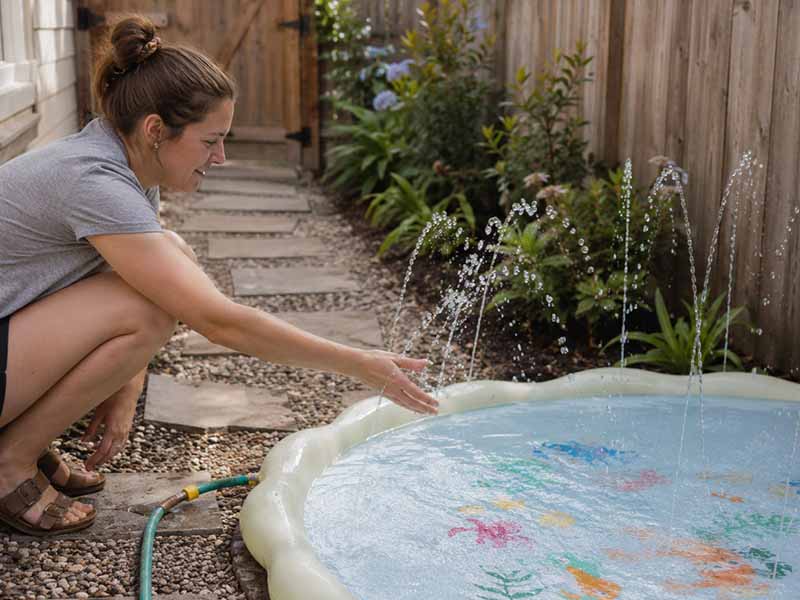
A good splash pad can turn a regular backyard into the place kids ask to visit again and again during summer. It does not require a permanent pool, a large installation, or a full afternoon of setup. Families can unfold the mat, connect a garden hose, adjust the water pressure, and create a simple water play area in minutes. For children, it feels like a small backyard water park. For parents, it is easier to supervise than deeper water play. For dogs, it can become a cool spot to step, splash, and rest during hot afternoons.
The best splash pad for summer backyard fun is a durable, easy-to-set-up water play mat with thick PVC, reinforced edges, inward spray, a non-slip surface, and enough space for real backyard movement. A strong choice should fit the yard, support kids and supervised pets, drain easily, fold properly, and hold up through repeated summer use.
The right splash pad is not always the largest or the cheapest one. A big mat may look exciting online, but it still needs flat ground, hose access, and drying space. A cheap mat may work once, then start leaking around the edge or connector after repeated folding. A better choice fits the way a family actually plays: a toddler touching gentle spray, siblings running around the edge, a dog cooling its paws, and parents setting it up without turning the afternoon into extra work.
What Makes a Splash Pad Fun?
A splash pad becomes fun when it gives children more than water on the ground. It should create movement, surprise, space, and comfort at the same time. The best splash pad for summer backyard fun lets kids run through gentle spray, sit in shallow water, make up games, cool down quickly, and keep playing without parents needing to reset the setup every few minutes.
For families, fun also depends on how easy it is to use. If the splash pad is difficult to connect, sprays unevenly, feels slippery, or becomes crowded after two children step on it, the excitement can disappear quickly. A strong backyard splash pad should feel simple for parents and open-ended for kids.
A good splash pad does not need to act like a full water park. In many homes, the most useful design is the one kids can enjoy for 20 to 40 minutes at a time, several days a week. That kind of repeated use is what turns a water toy into a real summer backyard favorite.
| Fun Factor | Why It Matters for Families | Better Detail to Look For |
|---|---|---|
| Gentle spray | Helps younger kids feel comfortable | Adjustable water pressure and inward spray |
| Open play space | Allows running, sitting, and group play | Medium or large diameter |
| Shallow center | Gives toddlers and pets a cooler area | Flat center with controlled water depth |
| Comfortable surface | Supports bare feet and sitting play | Soft PVC with light texture |
| Easy setup | Makes parents more willing to use it often | Hose connection in about 3–5 minutes |
| Repeat play value | Keeps children interested beyond one use | Spray, splash, pretend play, and games |
Easy Backyard Water Play
Easy backyard water play starts with a splash pad parents are willing to bring out often. If setup feels annoying, the mat may only be used once or twice. A better splash pad should feel like a quick backyard activity, not a project.
A family-friendly setup usually has three simple qualities. First, the mat should unfold flat without needing a pump or extra parts. Second, the hose connection should feel secure once attached. Third, the spray should begin gently and become stronger only when parents increase the water pressure. When these basics work well, a splash pad can fit into everyday moments such as after-lunch play, weekend family time, or a quick cool-down before dinner.
| Setup Detail | Why It Helps |
|---|---|
| Flat placement | Helps water fill the outer ring evenly |
| Clean ground | Reduces the chance of punctures from sticks or stones |
| Secure hose connection | Helps prevent leaking near the water inlet |
| Low starting pressure | Makes the first spray more comfortable for toddlers |
| Clear hose path | Reduces tripping risk around the play area |
This kind of setup usually takes about 3 to 5 minutes once the family knows the steps. That short setup time matters because summer play often happens between daily routines. Parents may not want to set up a large pool after lunch, but they may be willing to connect a splash pad while kids change into swimsuits.
A good splash pad should also keep the play area easy to supervise. The water stays low, the play zone is clearly defined, and children remain close to the backyard seating area. Parents can see whether a child is slipping, crowding the edge, or turning the hose pressure too high.
For younger children, a controlled play space helps build confidence around water. For older children, it gives them a clear area to invent games without needing a full swimming pool. Families comparing different outdoor water toys can also read more about backyard water toys for hot weather to match the activity to their yard size and summer routine.
Cool Summer Playtime
The best splash pad for summer backyard fun should cool children down without overwhelming them. Many product photos show tall spray, but very high water pressure is not always better for real family use. Younger children often prefer lower, softer spray that lands around their legs and arms instead of hitting their face.
A comfortable spray height depends on age, water pressure, and play style.
| User Group | Comfortable Spray Range | Better Play Style |
|---|---|---|
| Toddlers 1–3 | About 8–16 inches | Sitting, touching water, light splashing |
| Kids 4–6 | About 12–24 inches | Walking, running, simple games |
| Kids 7–9 | About 18–30 inches | Active play and group movement |
| Kids 10+ | About 24–36 inches | Running games and stronger spray play |
| Dogs | Low to medium spray | Supervised cooling and paw play |
These ranges help families understand why adjustable water pressure matters. A splash pad that only works well at high pressure may not be comfortable for toddlers. A splash pad that cannot create enough spray may feel boring for older kids. The better choice gives parents room to adjust.
Water distribution is just as important as spray height. If water sprays strongly from one side and weakly from another, children crowd the stronger side. A well-designed outer ring should send water inward from multiple points so the whole splash pad feels active.
Cooling also comes from the shallow water in the center. Children can sit, crawl, or step through the water while the spray continues around them. On hot days, this gives them a break from dry lawn play without requiring deep water.
More Than Sprinkler Fun
A lawn sprinkler can be exciting for a few minutes, but a splash pad usually gives children more ways to play. A sprinkler sprays water into open space. A splash pad creates a defined play area with spray around the edge and shallow water in the center.
That defined space changes how children use it. One child may run along the spray ring, another may sit in the center with cups, and a younger child may simply touch the water and step in and out. For families with pets, a supervised dog can join for short cooling play without needing a deeper pool.
| Play Style | How a Splash Pad Supports It |
|---|---|
| Running play | Edge spray gives kids a path to move around |
| Sitting play | Shallow center gives toddlers a calmer area |
| Pretend play | Printed designs can become roads, islands, oceans, or game zones |
| Group play | Larger sizes give siblings and friends more room |
| Pet cooling | Low water and open space allow supervised dogs to step in and out |
This matters because repeated summer use depends on variety. A water toy that only does one thing may feel exciting on the first day and less interesting by the third use. A splash pad with enough space, balanced spray, and a comfortable center gives children more room to create their own games.
For parents, the advantage is also practical. A splash pad can replace several separate summer items: a sprinkler, a shallow water mat, a cooling station, and a simple playdate activity. It is easier to set up than an inflatable pool and easier to supervise than deeper water play.
Which Splash Pad Size Works Best?
The best splash pad size depends on who will use it, how much flat yard space is available, and whether the family wants quiet toddler play or active group play. A small splash pad can be enough for one young child, but families with siblings, pets, or playdates usually need more room. For most backyards, a splash pad between 68 inches and 118 inches gives a better balance of fun, safety, and easy setup.
Many shoppers choose size by looking at the product photo, but that can be misleading. A large splash pad may look exciting online, yet it still needs open space around the edges, a safe hose path, and a flat surface underneath. A smaller splash pad may be easier to store, but it may feel crowded once two children or a dog join in.
| Splash Pad Size | Best For | Better Backyard Fit | Main Advantage | Possible Limit |
|---|---|---|---|---|
| 59–67 in | 1 toddler or small patio | Compact yard or shaded corner | Easy to place, drain, and store | Too small for active running |
| 68–85 in | 1–2 young children | Small to medium backyard | Good daily play size | May feel tight for pets |
| 86–95 in | 2–3 children | Medium backyard | Better space for movement | Needs flatter ground |
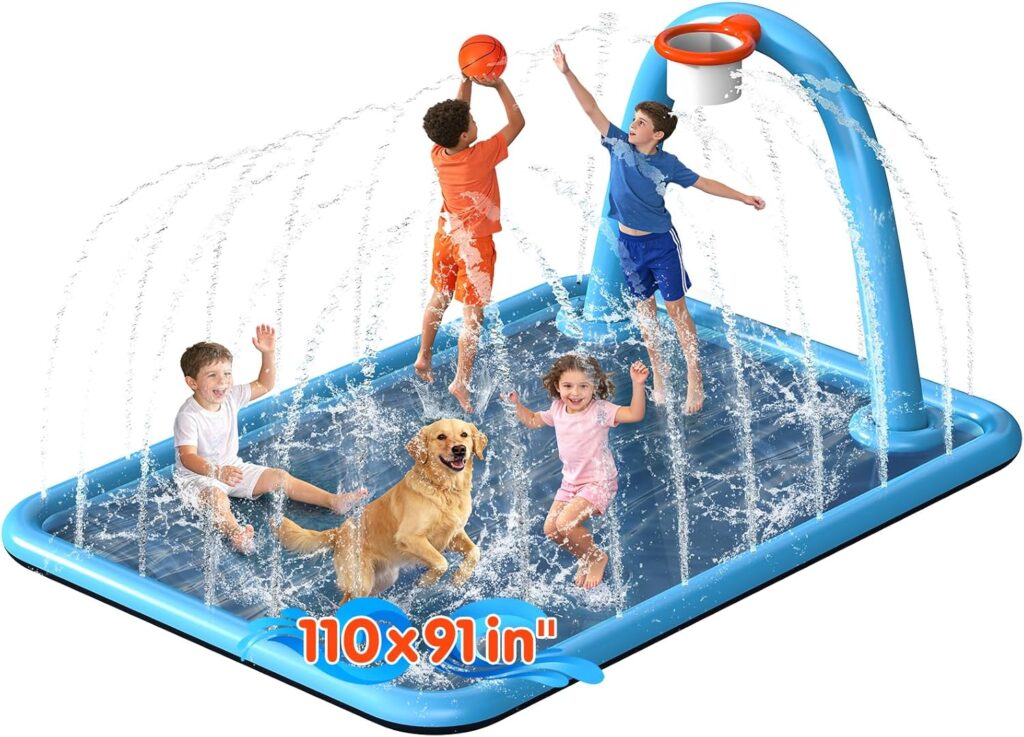
| 96–118 in | Siblings, pets, playdates | Medium to large backyard | More room for active play | Takes longer to dry and fold |
| 10 ft+ | Parties or large families | Large open lawn | Best for group play | Requires more storage space |

Small Backyard Splash Pads
Small backyard splash pads are a practical choice for toddlers, first-time water play, compact patios, and families who want something quick to use. A splash pad around 59 to 67 inches is usually easier to carry, unfold, drain, and store. For one young child, that may be enough space for sitting, touching the spray, filling cups, and cooling down on hot days.
The main advantage of a small splash pad is control. Parents can place it closer to a shaded area, near a seating spot, or in a small patch of flat lawn. The spray is easier to manage, the water drains faster, and cleanup usually feels less demanding.
Small size works best when the child mostly sits, crawls, or walks slowly. It is also useful when the yard has limited flat space, parents want quick 15 to 25 minute play sessions, or storage space is limited. In these situations, a compact splash pad can be a practical summer cooling choice.
The limit is growth and movement. Once kids start running, jumping, or playing with siblings, a small mat may feel crowded. If a dog joins, there may not be enough space for both the child and the pet to move comfortably.
A simple rule works well: if the splash pad is only for one toddler this season, small can work. If the family expects siblings, pets, or more active play, medium is usually a safer choice.
Large Family Splash Pads
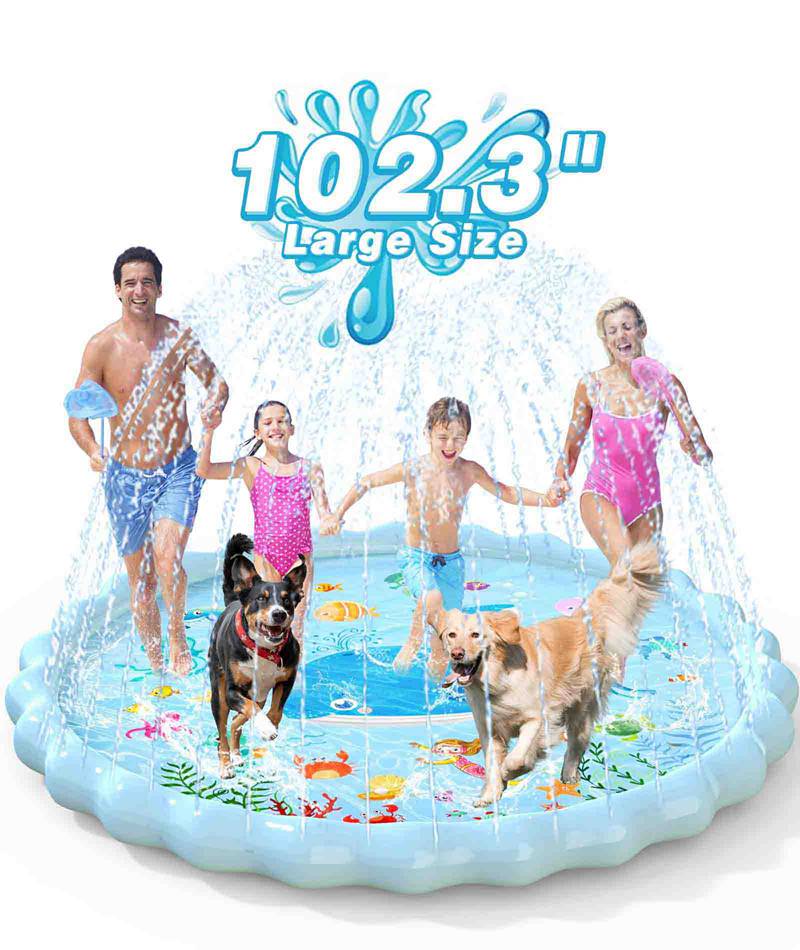
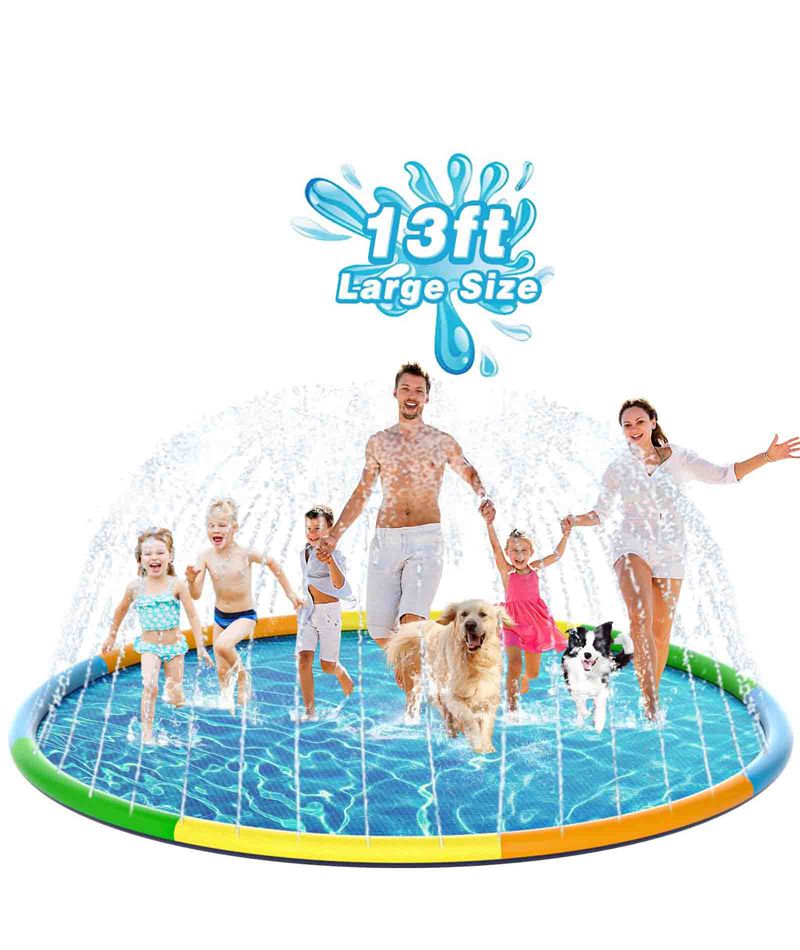
Large splash pads are better for families who want more than a quick toddler cooling mat. A size around 95 inches, 118 inches, or larger gives children room to run through spray, sit in the center, and play together without constantly bumping into each other.
The value of a large splash pad is not only the diameter. It is the usable play space. When the outer ring fills with water, children usually move around the edge and center. If the pad is too small, they step on the ring, crowd the spray area, or push into each other.
| Family Situation | Why a Larger Size Helps |
|---|---|
| Two or more children | Gives each child more room to move |
| Weekend playdates | Reduces crowding during group play |
| Medium or large dogs | Gives pets space to step in and out |
| Active play style | Supports running, turning, and games |
| Large flat lawn | Uses open backyard space more effectively |
Parents should also think about space around the splash pad. A 118-inch mat is almost 10 feet across, but the safe play area should be larger than that. Children need room to step on and off the mat. The hose should not cross the main running path. Adults should also be able to walk around the mat if they need to help a child.
For families choosing between round, square, or larger backyard water mats, the guide to round vs square splash pad shapes can help compare how shape affects movement and yard fit.
Room for Kids and Dogs
When kids and dogs share a splash pad, the size decision becomes more important. Children and pets move differently. Kids may run in circles, sit in the center, or chase the spray. Dogs may step heavily, turn quickly, shake water off, or lie down near the edge.
For pet households, a medium or large splash pad is usually the better choice. Small dogs may use a medium pad comfortably, while medium and large dogs need more room to enter, turn, and leave without stepping too close to children.
| Dog Size | Better Splash Pad Size | Use Notes |
|---|---|---|
| Small dogs under 20 lb | 68–85 in | Good for short cooling play with one child |
| Medium dogs 20–50 lb | 86–95 in | Better room for stepping and turning |
| Large dogs 50–80 lb | 96–118 in | More stable for supervised shared play |
| Extra-large dogs 80 lb+ | 10 ft+ or separate pet water area | Needs more space and close supervision |
Size alone does not protect the mat. Pet nails should be trimmed before use, and the splash pad should be placed on grass or another smooth surface. Gravel, rough concrete, sharp mulch, and dry sticks can damage the bottom of the mat.
For families who want one splash pad for kids and pets, the best choice is usually not the smallest option. A larger EPN splash pad with durable PVC, reinforced edges, and a comfortable surface can offer a better balance of play space, cooling comfort, and repeat summer use.
What Material Makes Splash Pads Last?
A splash pad lasts longer when the material, edge structure, spray holes, water inlet, and surface design work together. Thick PVC is important, but it is only one part of durability. A strong summer splash pad also needs reinforced seams, stable heat-pressed edges, balanced water pressure, a comfortable non-slip surface, and enough flexibility to handle folding after repeated use.
In real backyards, splash pads deal with more stress than many families expect. Kids step on the outer ring. Dogs may walk across the wet surface. The hose inlet holds water pressure every time the product is used. The bottom touches grass, dirt, small stones, or patio surfaces. Sunlight heats the PVC during play, and storage creates repeated fold lines.
| Material Detail | Why It Matters | What Families Should Look For |
|---|---|---|
| PVC thickness | Helps resist stretching, small scratches, and pressure stress | Around 0.40–0.55 mm PVC for stronger summer use |
| Reinforced edges | Reduces leak risk around the outer ring | Wider seam area with strong bonding |
| Water inlet area | Handles direct hose pressure | Secure connector and supported inlet structure |
| Spray holes | Control water direction and pressure release | Evenly placed inward spray holes |
| Surface texture | Improves footing when wet | Light non-slip texture |
| Flexibility | Affects folding and storage life | Soft enough to fold without hard creasing |
| Ground contact | Protects the bottom from outdoor surfaces | Use on grass or smooth ground |
Thick PVC for Summer Use
PVC thickness is one of the clearest details customers can compare before choosing a splash pad. A very thin splash pad may be lighter and easier to pack, but it often feels less stable under water pressure and active play. A thicker PVC splash pad usually gives better support around the outer ring, better resistance to light scratches, and a more solid feel under children’s feet.
For family summer use, many stronger splash pads use PVC in the range of about 0.40 mm to 0.55 mm, depending on product size and structure. This thickness range can offer a better balance between durability and flexibility.
| PVC Detail | What It Helps With |
|---|---|
| Stronger outer ring | Helps the ring keep shape when filled with water |
| More stable center | Reduces the flimsy feeling under bare feet |
| Better pet support | Helps with light paw movement during supervised play |
| Improved folding life | Handles repeated folding better than very thin material |
| Longer seasonal value | Supports repeat use when dried and stored correctly |
Still, thickness should not be judged alone. A thick PVC splash pad can still leak if the seams are poorly sealed. A thick mat can still be punctured if it is placed on gravel, sharp mulch, broken branches, or rough concrete. The most durable products combine material thickness with good edge construction and smart pressure control.
Strong Edges Prevent Leaks
Many splash pad leaks start at the edge, not in the middle of the mat. The outer ring carries water pressure every time the hose is turned on. It also gets stepped on, pulled, folded, dragged, and exposed to sunlight.
The edge has several jobs at the same time. It holds water inside the outer ring, supports spray holes around the perimeter, distributes hose pressure, keeps the mat shape stable, and protects the structure during folding and storage. If the edge is too weak, the splash pad may begin to leak even when the center material still looks fine.
| Common Leak Area | Why It Can Happen | What Helps Reduce Risk |
|---|---|---|
| Hose connector | Direct water pressure enters here | Stable inlet and careful hose connection |
| Outer ring seam | Carries water pressure during play | Wider heat-pressed bonding area |
| Folded corners | Repeated folds create stress | Loose folding after full drying |
| Spray holes | Pressure releases through small openings | Even hole placement and normal water pressure |
| High-traffic edge | Kids or pets step on it repeatedly | Reinforced edge and supervised play |
A strong edge needs more than a neat-looking line. The bonding area should be wide enough to handle pressure. The heat-pressed seam should be consistent. The shape should not create sharp stress points where the material bends too tightly.
Epsilon pays close attention to edge bonding, water inlet reliability, and pressure distribution because these details often decide whether a splash pad performs well through a full summer season.

Soft Surface for Backyard Play
A good splash pad should be soft enough for children to enjoy barefoot play, but not so thin that it feels unstable. Surface comfort is a major part of durability because kids do not use splash pads gently. They run, sit, crawl, turn, and sometimes step directly on the water-filled edge.
A lightly textured PVC surface can make wet play feel more secure. Overly smooth surfaces may become slippery when water spreads across the center. A rough surface, however, can feel uncomfortable for children sitting or crawling. The best balance is a soft surface with light grip.
Families can protect the surface with a few simple habits. Clear the ground before each use, avoid dragging the splash pad across rough surfaces, keep pet nails trimmed, and do not let dogs dig or chew the mat. After play, rinse off dirt when needed, dry both sides, and store the mat loosely instead of forcing sharp creases.
For customers who want to understand more about material choices, the guide to what material is best for a splash pad offers a deeper look at PVC, surface comfort, and outdoor durability.
How Safe Is a Backyard Splash Pad?
A backyard splash pad can be a safer and easier water play choice than a deep pool, but it still needs the right setup and close adult supervision. The best splash pad for summer backyard fun should have a shallow center, a non-slip surface, gentle spray, stable edges, and enough space for children to move without crowding.
Many families choose splash pads because they feel more manageable than inflatable pools. There is no deep water, the play area stays open and visible, and parents can usually set it up close to a seating area. That is a real advantage. Still, shallow water does not mean children can be left alone.
| Safety Point | Why It Matters | Better Practice |
|---|---|---|
| Adult supervision | Children can slip, trip, or fall even in shallow water | Stay close and keep the play area visible |
| Flat ground | Slopes can cause uneven water flow and slipping | Use level grass or a smooth outdoor surface |
| Non-slip surface | Wet PVC can become slippery if too smooth | Choose light texture and avoid rough running |
| Gentle spray | Strong spray may scare toddlers or hit faces | Start low and adjust slowly |
| Hose placement | A hose across the play path can cause tripping | Keep the hose behind or beside the mat |
| Pet use | Dogs may scratch, jump, or crowd children | Supervise and trim nails before use |
| Sun exposure | Hot surfaces and long play can cause discomfort | Use during cooler hours or partial shade |
| Storage care | Wet folding may cause odor or surface issues | Drain, dry, and fold after use |
Non-Slip Splash Pad Surface
A non-slip surface is one of the most important safety features for a backyard splash pad. Children do not usually walk slowly during water play. They run toward the spray, turn suddenly, sit down quickly, or step from wet grass onto the mat.
A better splash pad should have a lightly textured PVC surface. The texture should help improve footing without feeling rough on bare feet. This is especially important for toddlers and younger children who are still developing balance. It also helps dogs, because wet paws can slide more easily on smooth surfaces.
Before play, families can do a quick safety check:
| Quick Check | What to Look For |
|---|---|
| Ground feel | No sharp sticks, stones, or hard debris underneath |
| Mat position | Surface lies flat without curled edges |
| Hose path | Hose stays behind or beside the mat |
| Water pressure | Spray starts low before children enter |
| Play behavior | No pushing, rough chasing, or jumping onto the edge |
For younger kids, calm play is safer than fast running. A splash pad should encourage movement, but not rough play. Parents can guide children toward safer games, such as stepping through the spray, filling cups, following the water circle, or sitting in the center.
Gentle Spray for Kids
Gentle spray is safer and more comfortable for most family splash pad use. High spray can look exciting, but it is not always the best choice for toddlers, cautious children, or pets. Strong water pressure may hit children in the face, make the mat feel unstable, or cause the outer ring to become too firm.
Parents should always begin with low water pressure. Let the outer ring fill first, then slowly increase the water until the spray feels playful but not forceful.
| User Group | Better Spray Height | Why It Works |
|---|---|---|
| Toddlers 1–3 | About 8–16 inches | Gentle enough for sitting and touching water |
| Kids 4–6 | About 12–24 inches | Good for walking, running, and simple games |
| Kids 7–9 | About 18–30 inches | More exciting without feeling too harsh |
| Kids 10+ | About 24–36 inches | Better for active play if space allows |
| Dogs | Low to medium spray | Easier for pets to approach and cool down |
Spray comfort also depends on wind and hose pressure. On windy days, water may blow into children’s faces or outside the play area. In that case, lower pressure is usually better.
A good backyard splash pad should work well at normal garden hose pressure. It should not need extreme pressure to create fun. EPN splash pads are designed with inward spray and balanced water movement in mind, helping families create a playful water area without over-pressurizing the mat.
Pet-Friendly Summer Fun
A splash pad can be a great cooling option for dogs, but pet use needs extra care. Dogs add different movement and pressure compared with children. They may step heavily, turn quickly, shake water off, or scratch at the surface if they get too excited.
For safe pet use, families should think about three things: the dog’s size, the dog’s behavior, and the surface under the mat. A calm small dog may only need a medium splash pad for short cooling play. A large dog needs more room to enter, turn, and step out without crowding children. Dogs that bite or dig should not be left with any PVC water toy.
| Dog Size | Better Splash Pad Use | Safety Note |
|---|---|---|
| Small dogs under 20 lb | Medium splash pad can work well | Watch for slipping and nervous behavior |
| Medium dogs 20–50 lb | Medium to large splash pad is better | Give room to turn and step out |
| Large dogs 50–80 lb | Large splash pad is recommended | Avoid crowding with small children |
| Extra-large dogs 80 lb+ | Extra-large or separate pet water area | Strong supervision is needed |
Before play, trim pet nails and place the splash pad on grass or a smooth outdoor surface. Avoid gravel, sharp mulch, rough concrete, and hidden sticks underneath. During play, keep dogs supervised and remove them if they start biting, digging, or scratching hard. After use, rinse the mat if needed and dry it before storage.
Families planning regular pet use can also read more about how to choose a dog splash pad for pet size, nail care, surface placement, and durability tips.
How Easy Is Splash Pad Setup?
A splash pad is easy to set up when it works with a standard garden hose, lays flat on the ground, fills evenly, sprays inward, drains without trouble, and folds away after drying. For most families, the best splash pad for summer backyard fun should be ready in about 3 to 5 minutes after the first use, without tools, pumps, or complicated parts.
Setup matters because summer water play often happens quickly. A child may ask to play outside after lunch. A dog may need a short cooling break after a walk. A parent may want a simple backyard activity before dinner. If the splash pad takes too long to connect or clean up, it becomes less useful over time.
| Setup Step | What To Do | Time Needed | Why It Matters |
|---|---|---|---|
| Ground check | Remove stones, sticks, toys, and sharp debris | 1–2 minutes | Protects the bottom and reduces tripping risk |
| Unfold mat | Lay the splash pad flat and smooth the center | 1 minute | Helps water flow evenly |
| Hose connection | Attach a standard garden hose to the inlet | Under 1 minute | Creates the water-filled spray ring |
| Pressure adjustment | Start low, then raise slowly | 1–2 minutes | Controls spray height and seam stress |
| Play session | Supervise kids and pets during use | 15–40 minutes | Keeps play comfortable and safe |
| Drain and dry | Empty water and air-dry before folding | 10–30 minutes depending on weather | Helps prevent odor and storage issues |
| Fold and store | Fold loosely and keep in a dry place | 2–3 minutes | Protects seams and material life |

Quick Hose Connection
A quick hose connection is one of the biggest reasons families choose a splash pad instead of a larger water toy. Most splash pads are designed to connect to a standard garden hose. Once the hose is attached, water enters the outer ring and sprays inward through small holes around the edge.
The connection area is important because it carries direct water pressure. A weak or loose inlet can leak, twist, or spray water away from the play area. A better splash pad should have a secure inlet that stays in place during normal use.
A good setup starts before the hose is turned on. Place the splash pad on flat grass or a smooth outdoor surface, keep the inlet away from the main running path, connect the hose firmly without forcing the threads, and make sure the hose lies beside or behind the mat. After that, turn on the water slowly and watch the outer ring fill before increasing pressure.
This process helps reduce water leaks around the connector and lowers the chance of children tripping over the hose. Hose placement is especially important for active kids. If the hose crosses the main play path, children may step on it, pull the inlet, or fall while running through the spray.
Better Water Pressure Control
Water pressure affects almost every part of splash pad performance. It controls spray height, outer ring shape, water spread, and comfort. Too little pressure may make the spray weak. Too much pressure may cause the outer ring to bulge, make the spray uncomfortable, or place unnecessary stress on the seams.
| Water Behavior | Possible Cause | What To Do |
|---|---|---|
| Spray is very low | Water pressure is too weak | Increase hose flow slowly |
| Spray is too high | Pressure is too strong | Reduce water flow |
| One side sprays higher | Ground may be uneven | Move to flatter ground or smooth the mat |
| Outer ring bulges hard | Too much pressure inside the ring | Lower the water immediately |
| Water leaks at hose area | Connector may be loose or misaligned | Turn off water and reconnect |
| Spray goes outward | Ring may not be lying correctly | Reposition and flatten the outer ring |
| Center fills too much | Pressure may be high or ground may slope | Reduce pressure and check placement |
For toddlers, low to medium spray is usually more comfortable. Older children may enjoy stronger spray, but the splash pad should never feel overfilled or tense. A good rule is to adjust for comfort first, not height.
EPN splash pads are developed with balanced inward spray, helping families create enjoyable water movement without relying on extreme pressure. This makes setup easier for parents and more comfortable for children.
Easy Drain and Storage
Easy storage is just as important as easy setup. A splash pad that is difficult to drain, slow to dry, or awkward to fold may stop being used after a few weekends. Families are more likely to use a splash pad often when cleanup feels simple.
After play, turn off the water and disconnect the hose. Let the outer ring empty naturally, then gently lift one side of the mat to guide remaining water toward the edge. Avoid pulling hard on the inlet or dragging the mat across rough ground.
| Cleanup Step | Better Practice |
|---|---|
| Drain | Let the outer ring empty before lifting the mat |
| Rinse | Remove grass, mud, or pet hair if needed |
| Dry | Lay flat or hang over a clean surface |
| Flip | Turn over if the bottom is still wet |
| Fold | Fold loosely only after both sides are dry |
| Store | Keep in a cool, dry place away from sharp tools |
Drying time depends on weather. On a sunny, breezy day, the splash pad may dry in 10 to 20 minutes. In humid weather or shaded areas, drying may take 30 minutes or longer. The important point is not to fold it while wet.
Why Choose an EPN Splash Pad?
An EPN splash pad is a strong choice for families who want summer backyard water play that feels fun, easy to manage, and built for repeated use. Instead of focusing only on bright prints or large product photos, EPN pays attention to the details that matter after several weeks of real use: PVC strength, edge stability, spray direction, hose connection, surface comfort, pet-friendly play, and easy storage.
EPN belongs to American Epsilon Inc., a U.S.-registered company focused on PVC and composite products for family recreation, children’s water toys, pet supplies, outdoor leisure, and seasonal products. This background matters because a splash pad is not just a printed mat. It is a water-pressure product, an outdoor play product, and a seasonal family product at the same time.
| What Customers Care About | How EPN Supports It |
|---|---|
| Kids need comfortable water play | Gentle inward spray and soft PVC surface |
| Parents want easy setup | Hose connection and foldable structure |
| Families want repeat use | Reinforced edge design and durable material selection |
| Pet owners need stronger structure | Thicker PVC options and more stable surface design |
| Sellers need product options | Size, pattern, packaging, and label customization |
| Retailers need stable supply | Manufacturing, testing, packaging, and delivery support |
| Different markets need local materials | Multilingual packaging and compliance support |
Built for Backyard Fun
EPN splash pads are designed for real backyard use, not only for clean product photos. A family may use the splash pad on grass after lunch, during a weekend playdate, beside a patio, or as a quick cooling area for children and pets. That kind of repeated home use requires more than a cute design.
A good backyard splash pad should answer practical questions. Can children play without feeling crowded? Does the spray stay inside the play area? Can parents adjust the water pressure easily? Does the surface feel comfortable under bare feet? Can dogs step onto it under supervision? Can the mat be drained, dried, and folded without trouble?
EPN focuses on these everyday details. The spray is designed to move inward so the water play area feels more controlled. The PVC surface is intended to support wet play, sitting, stepping, and light running. The outer ring and edge structure help the splash pad hold water more steadily during use.
For families, the value of an EPN splash pad is that it can fit into ordinary summer routines. It can be used for a short 20-minute cool-down, a longer weekend play session, a backyard barbecue, or supervised pet water play.

Tested for Summer Use
A splash pad may look simple, but it goes through a lot during summer. Water pressure pushes against the outer ring. Children step on the center and sometimes the edge. Dogs may walk across the wet surface. The hose inlet is pulled, twisted, and connected repeatedly. The mat may sit under direct sunlight, then be folded and stored after use.
American Epsilon Inc. supports product development with 27 R&D staff, more than 18 designers, and an independent testing approach for PVC and composite products. The company carries out 500+ material and product performance tests each year across different product categories.
| Test Area | Real Customer Concern |
|---|---|
| Water pressure stability | Will the outer ring hold shape during play? |
| Leak resistance | Will seams or inlet areas leak after repeated use? |
| Spray distribution | Will water spray evenly around the pad? |
| Folding performance | Will the material handle repeated storage? |
| UV exposure | Will sunlight affect the PVC too quickly? |
| High-temperature aging | Will summer heat make the material less stable? |
| Surface wear | Will kids and pets wear down the play area? |
| Connector reliability | Will the hose area stay secure? |
| Pet movement simulation | Can the surface handle supervised paw traffic? |
This kind of testing is important because many splash pad problems appear after repeated use, not on the first day. A product may look fine when first unfolded, but after several weeks of water pressure, sun exposure, folding, and active play, weak edges or thin material can begin to show problems.
Made for Kids and Pets
Many households want one splash pad that works for both children and pets, but that does not mean simply making the mat larger. Children and dogs use water products in very different ways. Kids may run, sit, jump, splash, and invent games, while dogs may step more heavily, turn quickly, shake water off, or scratch the surface lightly when excited. A good family splash pad needs to balance comfort for children with stronger structure for supervised pet use.
EPN splash pads are designed with this shared backyard use in mind. The PVC surface is made to feel comfortable for bare feet, while the reinforced edge helps support water pressure during repeated summer play. The inward spray design keeps the water activity more controlled, so children can enjoy the spray without the play area feeling messy or scattered. For families with pets, thicker PVC options and stable surface texture can make the splash pad more suitable for dogs stepping in and out under supervision.
| Use Need | Why It Matters | What EPN Focuses On |
|---|---|---|
| Barefoot comfort | Children may sit, crawl, or run on the wet surface | Soft PVC with a comfortable play feel |
| Paw movement | Dogs may step harder than children | Stronger PVC options and stable surface texture |
| Water pressure support | The outer ring carries pressure during play | Reinforced edges and controlled spray flow |
| Shared play space | Kids and pets need room to move safely | Size options for different family and pet needs |
| Seasonal storage | Families need to drain, dry, and fold after use | Foldable structure for summer storage |
For pet use, families should also follow a few simple habits. Trim pet nails before water play, place the splash pad on grass or a smooth outdoor surface, and avoid gravel, sharp mulch, rough concrete, or hidden sticks underneath. Dogs should always be supervised during use. If a dog starts biting, digging, or scratching hard, it is better to pause play and remove the dog from the mat. After use, the splash pad should be rinsed if needed, dried fully, and folded only when both sides are dry.
This kind of design is helpful for families because the splash pad is not limited to one play style. It can work for a toddler’s first water play, an older child’s backyard games, a dog’s short cooling break, or a weekend family gathering. For business customers, this wider use also creates stronger market value. A splash pad that appeals to both families with kids and pet owners can support summer campaigns, pet cooling content, family backyard bundles, and outdoor toy collections.
Ready for Seasonal Sellers
EPN is also a strong choice for business customers who need summer water products with stable development, supply, and customization support. Splash pads are seasonal products, which means timing matters. Sellers need samples, packaging, listings, inventory, and shipping arranged before summer demand peaks.
American Epsilon Inc. supports OEM/ODM projects and can help with product size, color, pattern, packaging, labels, instructions, and market-specific requirements. For normal projects, samples can often be completed in about 3 to 5 days. Regular production is usually around 20 to 30 days, while urgent projects may be completed in about 14 days when product type, material, packaging, and order conditions allow.
| Business Need | Epsilon Support |
|---|---|
| Product development | Size, structure, material, and pattern adjustment |
| Private label projects | Brand logo, packaging, label, and instruction customization |
| Fast sampling | Sample development in about 3–5 days for many regular projects |
| Seasonal production | Normal production around 20–30 days depending on project details |
| Urgent orders | Faster delivery may be possible under suitable conditions |
| Multi-market sales | Packaging and documents for different regions |
| Online channels | Support for Amazon, Walmart, eBay, Temu, and other platforms |
| Retail projects | Packaging, carton labels, barcodes, and display requirements |
For B2B customers, choosing EPN is not only about buying one splash pad. It is about working with a supplier that understands PVC water products, seasonal timing, packaging needs, and market differences.
What Is the Best Splash Pad Choice?
The best splash pad choice is the one that fits the way a family actually uses the backyard in summer. A good splash pad should match the yard size, number of children, pet use, water pressure, storage space, and expected play frequency. The strongest option is not always the largest or cheapest one. It is the splash pad that feels easy to set up, safe to supervise, fun to repeat, and durable enough for regular summer use.
For most families, the best splash pad for summer backyard fun should include a medium-to-large play area, thick PVC material, reinforced edges, inward spray, a non-slip surface, a secure hose connection, easy drainage, and foldable storage. If dogs will join, the mat should also have stronger material, enough space for paw movement, and a surface that can handle supervised pet play.
| Family Need | Better Splash Pad Choice | Why It Works |
|---|---|---|
| One toddler | Small to medium size | Easier supervision and gentle spray |
| Two young children | Medium size | Better room without difficult storage |
| Multiple children | Large size | More open space for running and group play |
| Kids and dogs | Large, thicker PVC option | Less crowding and better pet support |
| Small patio | Compact splash pad | Easy setup and quick drainage |
| Large backyard | 96–118 in or larger | More active play and stronger summer value |
| Frequent summer use | Reinforced PVC splash pad | Better for repeated setup, drying, and storage |
| Seasonal retail project | Custom EPN/OEM option | Better size, packaging, and market fit |
Check Size and Space
The first step is to match the splash pad to the real backyard, not just the product image. Many families focus on diameter first, but usable space is more important. A 118-inch splash pad is almost 10 feet across, but the family needs more than 10 feet of open area. Children step on and off the mat, parents walk around it, and the hose needs a safe path.
A practical rule is to leave at least 2 to 3 feet of extra clearance around the splash pad when possible. This gives children more room to move and reduces the chance of tripping near fences, furniture, garden tools, or patio edges.
| Question | If Yes | Better Choice |
|---|---|---|
| Is the child under 3? | Gentle play is more important than size | Small to medium |
| Are there 2 or more children? | More movement space is needed | Medium to large |
| Will a dog join? | Extra room and stronger material matter | Large |
| Is the yard narrow? | Placement may be limited | Compact or medium |
| Will it be used for playdates? | Crowding can happen quickly | Large or extra-large |
| Is storage limited? | Bigger may become inconvenient | Medium |
Before choosing a final size, families should also check flat ground area, hose reach, shade availability, distance from sharp objects, room for adults to supervise, space for drying after use, and storage space after folding. These details often decide whether a splash pad feels easy to use or becomes difficult after the first few sessions.

Choose Durable Materials
Material is one of the strongest signs of long-term value. A splash pad may look good in photos, but the real test comes after repeated water pressure, stepping, folding, sun exposure, and storage. Families should look beyond color and pattern and pay attention to structure.
A durable splash pad should combine thicker PVC, reinforced edge sealing, a stable hose inlet area, even spray-hole placement, light non-slip surface texture, flexible folding structure, and enough strength for supervised pet use. Good drainage and drying performance also matter because a wet mat stored too quickly can develop odor or surface marks.
| Detail to Check | Why It Matters | Better Sign |
|---|---|---|
| PVC thickness | Affects strength and stability | Firm but flexible material |
| Edge sealing | Helps prevent leaks | Wide, even reinforced seam |
| Hose inlet | Handles direct pressure | Secure connection area |
| Spray holes | Controls water distribution | Even inward spray |
| Surface texture | Helps wet footing | Light grip, not overly smooth |
| Flexibility | Affects folding life | Folds without hard cracking |
| Bottom protection | Reduces ground damage | Use on grass or smooth surface |
For pet households, durable material becomes even more important. Dogs may step harder than children, and nails can create extra surface stress. Pet-friendly use should always be supervised, but a stronger PVC splash pad gives families more confidence for mixed backyard play.
Pick Summer-Ready Design
A summer-ready splash pad should be easy to use from the first setup to the last day of the season. It should not require tools, pumps, complicated cleaning, or permanent installation. The best design supports quick play, simple supervision, and proper storage.
| Use Frequency | Recommended Focus |
|---|---|
| Once or twice per month | Easy setup and basic size fit |
| Weekly use | Better PVC and reinforced edges |
| Several times per week | Strong material, easy drainage, quick drying |
| Kids and pets together | Larger size, thicker PVC, non-slip surface |
| Parties or playdates | Large area, stable spray, strong edge support |
| Retail or resale use | Product consistency, packaging, and market fit |
For families, the right splash pad should make hot days simpler. It should give kids a reason to go outside, help pets cool down under supervision, and reduce the need for larger water setups.
For business customers, the best splash pad choice may be an EPN ready-to-sell item or a customized Epsilon project. Epsilon can support different sizes, colors, themes, packaging, labels, instructions, and market-specific requirements. This is useful for Amazon sellers, independent website brands, retailers, distributors, and seasonal product programs.
Order EPN or Customize with Epsilon
For families, choosing an EPN splash pad means choosing a water play mat built around backyard summer use, kids, pets, and repeat play. For business customers, working with Epsilon means having access to product development, manufacturing, packaging, and delivery support for seasonal water products.
Epsilon supports ready-to-sell EPN splash pads, OEM/ODM splash pad development, custom sizes and shapes, kid-friendly and pet-friendly design directions, private label packaging, multilingual instructions and labels, low MOQ test orders when project conditions allow, seasonal production planning, and support for online and retail channels.
For retailers and cross-border sellers, timing matters because summer water products have a limited sales window. A splash pad needs to be ready before demand peaks. Sample speed, packaging readiness, production stability, and market fit can all affect sales results.
A strong splash pad should answer the questions customers ask after purchase: Was it easy to set up? Did the kids enjoy it more than once? Did the spray feel comfortable? Did it fit the yard? Was it easy to drain and store? Did the material feel strong enough? Could pets use it under supervision? Would the family use it again next summer?
EPN splash pads are built around these practical questions. They are made for families who want simple backyard fun and for business customers who need dependable seasonal water products.
If you are looking for a ready-to-sell EPN splash pad, Epsilon can help with product selection and order planning. If you want to create a custom splash pad for your own brand, Epsilon can support material selection, sample development, pattern design, packaging, labeling, and production. Contact Epsilon to request EPN splash pad options or start a customized backyard water play project for your market.