Skip to content
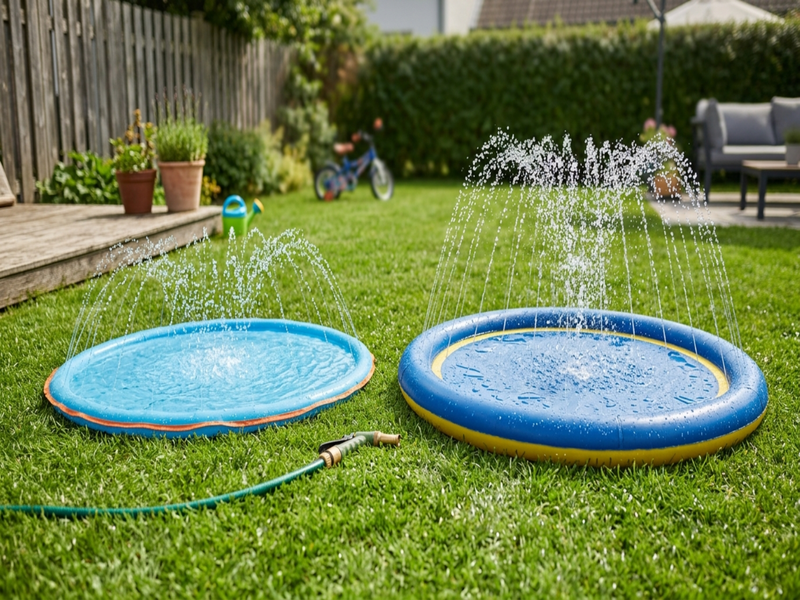
A dog pool can look generous in a product listing and feel surprisingly cramped after a large dog steps inside. A Labrador may stand in the center but have little room to turn. A German shepherd may fit across the diameter yet remain unable to lie flat. Two medium dogs may enter together, only to spend most of the session pressing against the walls. The problem often begins with labels such as Standard, Large, XL, and XXL, which do not follow one universal sizing system.
A standard dog pool is generally more practical for bathing, paw cooling, and short soaking sessions. A large dog pool is more suitable when a dog needs room to turn, sit, stretch out, play with toys, or share the water. Internal floor dimensions, wall height, filling depth, construction, drainage, and storage matter more than the size name printed on the packaging.
The largest model is not automatically the most useful. A wider pool needs more level ground, holds considerably more water, takes longer to clean, and places heavier loads on the walls, floor, seams, and drain. A smaller model is easier to manage but may never provide enough usable space. The right choice gives the dog room for natural movement while keeping filling, supervision, drainage, drying, and storage realistic for the household.
What Is the Difference Between Large and Standard Dog Pools?
A standard dog pool generally provides enough space for basic cooling, bathing, and calm soaking. A large dog pool offers more internal floor area for lying down, turning freely, playing, or sharing. Since manufacturers use different size labels, actual dimensions, usable floor area, wall height, filling depth, construction, folded size, and product weight provide a more dependable comparison.
Size Labels
There is no internationally accepted measurement that officially separates a standard dog pool from a large model. One product line may describe a 120 cm pool as Large, while another reserves the same label for a 160 cm design. Other ranges use XL, XXL, Jumbo, Extra Large, or Double Large without explaining how those names relate to internal dimensions.
A clearer comparison begins with measurable specifications. Compact foldable pools are often found between 80 and 100 cm in diameter. Models around 120 to 140 cm commonly serve small and medium dogs. Larger formats often range from 150 to 180 cm, while extra-large products may reach 190 to 200 cm or more.
These dimensions are practical comparison bands rather than official product classes. Wall thickness, internal support panels, folded joints, rounded transitions, and inward wall movement all reduce the area available to the dog. Two pools marked as 160 cm may therefore feel different after filling.
Shape also changes how space is used. A rectangular layout can provide more straight-line length for a long-bodied dog, while a round pool gives an active dog a smoother turning path. A useful product specification should include outer dimensions, internal floor dimensions, wall height, drain position, folded dimensions, product weight, and recommended filling depth.
| Size Category | Diameter Range | Common Wall Height | Suitable Use |
|---|---|---|---|
| Compact | 80–100 cm | 20–30 cm | Puppies, small dogs, paw cooling |
| Standard | 120–140 cm | 25–30 cm | One small or medium dog, bathing |
| Large | 150–180 cm | 30–40 cm | One medium or large dog, soaking |
| Extra Large | 190–200+ cm | 30–40 cm | Large breeds, multiple dogs, active play |
The category name should never replace the dimension drawing. Retail customers want to know whether their dog can turn and lie down. Distributors and product teams also need to know how the dimensions affect carton size, freight, warehouse handling, and final retail positioning. Clear measurements reduce misunderstandings at every stage.
Usable Floor Area
Diameter alone does not show how much additional room a larger pool creates. Floor area increases much faster than width. A 200 cm round pool is only 25 percent wider than a 160 cm model, yet it offers approximately 56 percent more theoretical floor area before wall thickness and inward movement are considered.
The same relationship affects water capacity. A pool that appears only moderately larger in a photograph can require hundreds of additional liters at the same filling depth. Dog owners and product teams should therefore compare floor area and practical capacity rather than treating every diameter increase as a small upgrade.
| Pool Diameter | Theoretical Floor Area | Water at 15 cm Depth | Water at 20 cm Depth |
|---|---|---|---|
| 100 cm | 0.79 m² | 118 L | 157 L |
| 120 cm | 1.13 m² | 170 L | 226 L |
| 140 cm | 1.54 m² | 231 L | 308 L |
| 160 cm | 2.01 m² | 302 L | 402 L |
| 180 cm | 2.54 m² | 382 L | 509 L |
| 200 cm | 3.14 m² | 471 L | 628 L |
The figures are planning estimates based on a round pool with straight walls. Actual capacity is usually lower because flexible walls do not form a perfect cylinder, the upper edge may move slightly, and owners normally leave space above the water.
Floor area becomes particularly important when a dog tries to lie down. A pool may be large enough for standing while remaining too narrow for the body to stretch naturally. The dog may press its shoulders against the wall, fold its legs beneath the body, or repeatedly change position without settling.
A comfortable pool should allow the dog to enter, turn, sit, lie down, stand again, and exit without stepping on the wall. For two dogs, additional clearance is needed because their movements overlap. The available space must accommodate changing positions rather than two perfectly still body outlines.
Wall Height and Water Depth
Wall height describes the vertical structure of the pool, while water depth describes the amount of water placed inside it. A pool with a 40 cm wall does not need to be filled to 40 cm. Most household sessions use only part of the available height to control water consumption, reduce overflow, and make entry easier.
For paw and lower-leg cooling, 5 to 15 cm of water may be enough. Medium and large dogs may benefit from 15 to 25 cm when lower-body soaking is desired. The suitable level depends on shoulder height, leg length, age, mobility, confidence around water, outside temperature, and supervision.
Higher walls can contain splashing and give owners more control over the water level, but they can also create a difficult entry step. Puppies, senior dogs, short-legged breeds, and dogs with joint limitations may hesitate at a tall wall. A wide pool with moderate entry height can offer more value than a deep model that the dog avoids.
Space should remain between the water surface and the upper edge. A large dog can displace a substantial amount of water when entering, sitting, or dropping its front body into the pool. Leaving approximately 8 to 15 cm above the water provides better control than filling close to the rim.

A standard dog pool is generally easier to carry, unfold, position, drain, dry, fold, and store. It contains fewer support panels and less PVC material, so the folded package is usually lighter and more compact. These advantages matter in apartments, small gardens, travel situations, and households with limited storage.
A large dog pool remains portable because it can be folded, but portability should not be confused with low weight. Greater diameter creates a larger floor sheet, a longer wall, more support sections, and more heat-sealed joints. After use, the wet structure may still be difficult for one person to turn over or move.
Panel width also affects handling. Narrower panels can produce a smaller folded footprint but create more joints and folding lines. Wider panels reduce the number of wall transitions but may form a thicker package. The folding layout should protect the drain and avoid repeatedly bending the same high-stress areas.
Open size should always be reviewed together with folded dimensions, net weight, carton size, and drying space. A pool can perform well during use but still create dissatisfaction when it cannot be cleaned easily, dried completely, or returned to its original package.
Which Dog Pool Size Fits Your Dog?
The correct pool size depends on body length, shoulder height, resting posture, movement pattern, mobility, and the number of dogs using the water. Weight alone cannot predict fit. A suitable pool should allow the dog to stand and turn without pressing against the wall, while a comfortable pool should also support sitting, lying down, stretching, and changing position.
Measure the Dog First
Breed categories such as small, medium, and large provide only a rough starting point. Dogs with similar weights can have completely different body shapes. A broad bulldog and a tall greyhound may weigh nearly the same amount but need different floor dimensions, wall heights, and entry arrangements.
Measure body length from the front of the chest to the base of the tail while the dog stands naturally. Measure shoulder height from the ground to the top of the shoulders. It is also useful to observe the floor space occupied when the dog lies in its preferred resting position.
For basic standing and cooling, the internal pool width should exceed the dog’s body length. Adding 20 to 30 cm may provide workable clearance for a calm dog. Adding 40 to 60 cm gives more room for turning, sitting, and lying down. Highly active dogs may require a larger margin.
Measurements should be compared with internal floor dimensions rather than only the stated outer diameter. Support panels, PVC sleeves, corner transitions, and inward wall movement reduce the usable area. When internal measurements are not listed, a dimension drawing or physical sample offers more reliable guidance than a broad statement such as “suitable for large dogs.”
| Dog Body Length | Workable Pool Diameter | More Comfortable Diameter | Suitable Activities |
|---|---|---|---|
| Around 50 cm | 80–100 cm | 100–120 cm | Paw cooling, bathing |
| Around 70 cm | 100–120 cm | 140–160 cm | Sitting, turning, soaking |
| Around 90 cm | 130–150 cm | 160–180 cm | Lying down, relaxed play |
| Around 110 cm | 150–170 cm | 190–200 cm | Large-breed soaking and play |
These ranges are planning references rather than fixed rules. Body width, leg length, age, confidence around water, pool shape, and preferred posture may shift the most suitable diameter upward or downward.
Match Body Shape
Body proportions matter more than a breed name printed on a sizing chart. Labrador retrievers, German shepherds, huskies, Rottweilers, Great Pyrenees, and Great Danes may all fall into a large-dog category, yet they occupy pool space in very different ways.
Long-bodied dogs need enough straight-line floor length to lie comfortably. Tall dogs may benefit from greater wall height and deeper lower-body water, although they still need a manageable entry point. Broad, heavy dogs place concentrated pressure on the floor and sidewall when turning. Short-legged dogs may need a lower wall even when their body length calls for a wide pool.
Resting posture provides another useful clue. Some dogs stand in the water and cool only their paws. Others sit, lie on one side, stretch their rear legs, or place the belly flat against the base. A pool selected only for standing may be disappointing when the dog attempts to relax.
Observe how the dog behaves on a dry floor. A dog that sleeps fully extended needs more straight-line room. A dog that circles several times before lying down needs more turning space. A cautious animal may prefer a moderate pool with an easy entry, while an energetic dog may need more clearance and stronger structural support.
Account for Movement
Activity level can influence size more than body weight. A calm 40 kg dog may stand quietly in a moderate pool, while an energetic 25 kg dog may jump, turn, splash, dig, chase toys, and lean against every wall section. Active movement requires open floor space and increases stress on the structure.
The dog should have a clear landing area after stepping or jumping inside. A cramped pool increases the chance of landing near a wall joint, drain fitting, panel transition, or folded corner. More clearance also allows toys to move without becoming trapped immediately against the edge.
Round pools generally offer smoother turning paths. Rectangular layouts provide more straight-line length for long-bodied dogs and can make better use of narrow patios. Oval or custom shapes may suit specific product ranges, but the floor layout must still match the dog’s natural movement.
A foldable dog pool should not be confused with a full swimming pool. Even a 200 cm model with a 40 cm wall is mainly suited to paddling, soaking, bathing, splashing, and supervised play. Continuous swimming strokes require far greater length and depth than a portable PVC pool normally provides.

A pool selected for two or more dogs needs more than the combined body length of the animals. Dogs change direction, compete for the same position, follow toys, and enter or leave at different times. Shared use therefore requires extra clearance rather than a simple addition of body measurements.
Two small dogs may share a 120 to 140 cm pool comfortably when their behavior remains calm. Two medium dogs often need 160 to 180 cm, especially when both want to sit or lie down. A 190 to 200 cm pool is more practical for two larger dogs or one large dog sharing with a medium companion.
Temperament matters as much as dimensions. Dogs that guard toys, dislike close contact, or become overstimulated around water may be safer in separate pools. Senior dogs can lose balance when bumped, while puppies may struggle to exit if a larger dog blocks the edge.
Groomers, pet resorts, daycares, breeders, and training facilities should consider several pool sizes rather than one oversized unit for every animal. Separate pools can improve hygiene, make supervision easier, and allow dogs to be grouped by body size, mobility, and activity level.
How Does the Intended Use Affect Pool Size?
Pool size should follow the planned activity. A standard model may be enough for paw cooling, bathing, and short soaking sessions. A larger model becomes more useful when a dog needs to lie down, turn repeatedly, chase toys, or share the water. The same dog may need a compact bathing pool and a much wider pool for active summer play.
Cooling and Heat Relief
Cooling usually needs less water and less floor area than play. Many dogs lower body temperature by standing in shallow water, wetting their paws, or resting the belly against a cool base. A standard pool can therefore work well for small and medium dogs when the main goal is supervised relief during warm weather.
The pool should still provide enough room for the dog to enter, turn, and leave without stepping on the sidewall. An extremely compact model can feel unstable or restrictive. A modest amount of clearance often improves confidence without adding the higher water demand of a large pool.
A depth of 5 to 15 cm is often sufficient for paw and lower-leg cooling. The level should be adjusted to the animal rather than based on a fixed percentage of wall height. Older dogs and short-legged breeds may need shallower water and an easier exit route.
Shade, surface temperature, and water temperature matter as much as size. Dark pool surfaces can become warm in direct sunlight, while fresh hose water may feel too cold. A shaded location, moderate filling depth, temperature checks, and supervised sessions provide more practical comfort than maximum capacity.
Bathing and Cleaning
Bathing favors reach, control, drainage, and a stable floor rather than maximum diameter. A pool that is too wide may force the owner or groomer to lean across the wall, making it harder to hold the dog, clean the paws, apply shampoo, or rinse the coat.
A standard pool often works well as an outdoor bathing station because it contains hair, dirt, and splashing while keeping the dog within reach. The wall should be high enough to limit overflow but low enough for comfortable entry and handling.
Drain placement becomes especially important during bathing. Hair, soil, shampoo residue, and loose debris collect near the lowest point. A drain positioned close to the floor allows dirty water to escape without requiring the pool to be lifted while it still holds considerable weight.
Floor stability is also important. Dogs often reposition during washing, especially when water reaches the neck, back, or head. A stable base, level installation surface, controlled water depth, and enough turning room can make a moderate-size pool more useful than an oversized model.
Soaking and Active Play
A dog that lies down needs far more floor area than a dog that stands for several minutes. Long-bodied breeds may require a pool 40 to 60 cm wider than their body length before they can rest without pressing against the wall.
Active play demands even more room because the dog is constantly moving. Turning, pawing at the water, chasing toys, digging at the base, and repeatedly entering the pool create higher loads and use more floor space than quiet soaking.
A larger pool reduces the chance that every movement pushes the dog’s claws or shoulders into the wall. It also gives toys enough room to float away from the edge and allows the dog to change direction without stepping across a panel.
Construction becomes increasingly important as activity rises. An excited dog may place both front paws on the wall, jump across one section, or lean against the upper edge. The support panels, PVC sleeves, heat-sealed connections, and floor-to-wall joint must cope with repeated concentrated pressure.

Household use usually prioritizes convenience. The pool should fit the yard, fill without excessive delay, drain away from doors and foundations, and dry within the available outdoor space. A large pool can be valuable in a spacious garden but frustrating on a narrow patio.
Commercial environments add different demands. Groomers need reach and controlled drainage. Pet daycares need durable floors, frequent cleaning, and safe group separation. Resorts and training facilities may need several sizes, clear operating procedures, and replacement products that remain consistent from order to order.
Water change frequency also rises in multi-dog settings because more hair, mud, saliva, and debris enter the pool. A single extra-large pool may appear efficient, but several smaller units can improve hygiene and simplify group management.
Retail product teams should define the intended activity before finalizing dimensions. A cooling pool, bathing pool, multi-dog pool, and active-play pool may share a foldable PVC structure, yet each requires a different balance of diameter, wall height, drainage, material, packaging, and price.
| Intended Use | Main Design Priority | Practical Water Depth | Size Direction |
|---|---|---|---|
| Paw cooling | Easy entry and low water use | 5–15 cm | Compact or standard |
| Outdoor bathing | Reach, drainage, stable floor | 10–20 cm | Standard |
| Full-body soaking | Resting space and comfort | 15–25 cm | Large |
| Active play | Open floor and wall strength | 15–25 cm | Large or extra large |
| Multiple dogs | Shared area and supervision | 10–25 cm | Large or extra large |
| Grooming or daycare | Hygiene, access, repeated cleaning | Based on dog group | Several controlled sizes |
Do Large Dog Pools Need Stronger Construction?
Large dog pools generally need stronger and more carefully balanced construction because they hold more water, use longer wall sections, and receive greater loads from heavier or more active dogs. Reliable performance depends on the complete structure: PVC properties, support panels, heat-sealed joints, floor design, drain reinforcement, folding layout, and production control. Material thickness alone cannot guarantee durability.
Wall Panels and Load
Water creates continuous outward pressure against the wall. As diameter and filling depth increase, the total load rises quickly. A 200 cm pool holding water at a depth of 20 cm contains an estimated 628 liters before allowing for flexible-wall movement. The wall must resist that load throughout the session.
Foldable dog pools commonly use rigid or semi-rigid support boards enclosed inside PVC wall sections. The boards allow the product to stand without inflation. Panel thickness, width, spacing, edge finish, and the surrounding PVC construction influence how well the pool remains upright.
Panels that are too flexible may bow outward. Panels with poorly finished edges can create concentrated wear after repeated folding. Wider boards may improve visual continuity but can increase folded bulk. Narrow boards create more fold points and more transitions that must be sealed consistently.
Dog movement adds loads that water calculations do not capture. A large dog may lean against the wall, place both front paws on the upper edge, step on a panel while entering, or push sideways while turning. Product evaluation should include realistic movement and leaning simulations rather than judging wall strength only from an empty sample.
PVC Selection
PVC thickness is easy to print on a product listing, but thickness alone does not explain flexibility, abrasion resistance, odor, heat-sealing behavior, UV stability, or performance after repeated folding. Two materials with the same nominal thickness can behave differently because of formulation, reinforcement, coating, and production consistency.
Pet-use products need a balance of toughness and flexibility. The wall must fold around support panels without cracking. The floor must withstand paw pressure, outdoor debris, movement, and repeated cleaning. Material that is too stiff can develop stress along folds, while material that is too soft may provide insufficient support.
Color and surface finish also affect ownership. Dark surfaces absorb more heat under direct sunlight. Highly glossy finishes show scratching and water marks more easily. Heavily textured surfaces may retain dirt and require more cleaning effort.
Material selection should consider product size, wall height, panel structure, folding frequency, intended climate, price position, cleaning method, and expected service conditions together. A single thickness figure cannot replace a complete structural review.
Joints, Floor, and Drain
The floor-to-wall connection is one of the most heavily loaded areas in a foldable pool. It experiences water pressure, dog movement, bending during drainage, and repeated folding during storage. Weakness may not appear during the first use and can develop after several filling and folding cycles.
Heat-sealed construction requires consistent temperature, pressure, dwell time, overlap width, and clean material surfaces. Insufficient heat or pressure may leave incomplete bonding. Excessive heat can distort the material or reduce flexibility around the joint.
Corners, support-panel transitions, fold lines, and drain openings deserve added attention because several stresses meet in those locations. Wider joining areas, local reinforcement, rounded transitions, and carefully positioned fold lines can reduce concentrated loading.
The drain should sit low enough to remove most of the water without lifting the pool. The surrounding PVC needs reinforcement because the rigid fitting interrupts the wall structure. A hose-compatible outlet can help direct hundreds of liters away from patios, doors, foundations, and neighboring areas.

A large pool should be assessed through repeated-use conditions rather than a single water-holding check. Relevant evaluations include long-duration water-pressure stability, floor abrasion, pet-claw simulation, repeated folding, drainage operation, wall leaning, joint inspection, high-temperature aging, and UV exposure.
EPN operates an independent laboratory and carries out more than 500 material and product performance tests each year across its PVC and composite-material product portfolio. Its testing work includes pressure and leakage checks, pet-claw abrasion simulation, long-duration water-pressure stability, UV exposure, high-temperature aging, and low-temperature brittleness evaluation.
Production control should also confirm dimensions, wall height, panel placement, seam appearance, drain operation, printing, accessories, packaging, and carton labels. An approved reference sample gives the manufacturing team and customer a shared standard for appearance, structure, specifications, and packing.
| Construction Check | What It Affects | Practical Verification |
|---|---|---|
| Wall-panel stiffness | Upright stability and resistance to bowing | Filled-wall and leaning simulation |
| Panel-edge finish | Wear around internal support sections | Repeated folding and visual inspection |
| PVC flexibility | Folding life and crack resistance | Folding cycles and temperature conditioning |
| Floor abrasion resistance | Paw and ground-contact durability | Paw-scratch and surface-abrasion simulation |
| Floor-to-wall seam | Water retention and service life | Long-duration water-pressure test |
| Drain reinforcement | Leakage and repeated handling | Opening, closing, pulling, and flow testing |
| UV and heat behavior | Outdoor appearance and flexibility | UV exposure and high-temperature aging |
| Packaging layout | Transport and storage condition | Carton-fit and packing verification |
EPN’s broader production system includes hot-press joining and forming equipment, automated cutting equipment, structural inspection stations, and airtightness-testing instruments. Material processing, accessory manufacturing, packaging printing, finished-product inspection, and shipment coordination are supported within a connected supply chain.
Is a Large Dog Pool Worth the Extra Space?
A large dog pool is worth the additional space when it solves a real fit, movement, or shared-use problem. It is valuable for large breeds, long-bodied dogs, active play, and multi-dog households. A standard pool usually offers better value for bathing, basic cooling, compact yards, lower water consumption, faster cleaning, and easier storage. The strongest choice balances comfort with daily ownership effort.
Water and Operating Space
Water capacity increases quickly as diameter grows. Moving from a 160 cm pool to a 200 cm pool at the same 20 cm filling depth adds approximately 226 liters. The extra volume affects filling time, water use, drainage, lawn saturation, and the amount of water that must be cleaned or replaced.
The additional water is worthwhile when it allows a large dog to lie down, gives two dogs room to move, or supports longer supervised play. It provides limited value when the dog only stands in shallow water for several minutes.
Yard space should be larger than the printed pool diameter. A 160 cm pool may need an operating area of approximately 220 to 250 cm once room for entry, owner access, drainage, and wet-dog movement is included. A 200 cm pool may be easier to use in an area measuring 260 to 300 cm across.
The ground must remain level and free from sharp objects. Grass can hide roots, stones, dry branches, or uneven soil. Concrete and tile are flatter but may cause abrasion when sand becomes trapped beneath the base. A flat protective layer can reduce wear as long as it does not introduce ridges or unstable folds.

Larger pools collect more dog hair, mud, grass, saliva, leaves, and insects because they expose a greater water and floor area. They often support longer sessions and more active use, which increases the amount of debris carried into the water.
Drainage should remove most of the water before cleaning begins. Remaining dirt can be guided toward the outlet with clean water and a soft cloth. Abrasive brushes, metal tools, and aggressive cleaners may damage PVC surfaces, printed areas, or heat-sealed edges.
Complete drying is necessary before folding. Moisture trapped around panel transitions and lower-wall folds can cause odor, staining, or surface growth during storage. A 200 cm pool may require considerably more drying area than a 120 cm pool, especially when both sides of the base need air exposure.
Standard pools are easier to turn over, wipe, dry, and place inside a cabinet or vehicle. Large pools can remain practical when the folding sequence is clear, the drain is protected, and the final package weight can be managed by the intended user.
Retail Range Planning
A product range does not need every available size. A focused range may perform better with one standard option, one large option, and one extra-large option, each connected to a clear use case rather than a vague weight claim.
A standard model can serve bathing, travel, and compact-yard demand. A large model can support medium and large dogs that need lying space. An extra-large model can target multi-dog households, pet services, and owners seeking a more permanent backyard setup.
Product differentiation should go beyond diameter. Wall height, panel stiffness, entry convenience, drain design, floor structure, colors, printed graphics, accessories, carton size, and instructions can create a more useful product without unnecessarily increasing the footprint.
Logistics should be reviewed before dimensions are finalized. A small increase in folded width or carton depth can affect fulfillment fees, pallet loading, shelf allocation, and warehouse handling. Product development must balance open comfort with packed efficiency.
Custom Development
Custom development becomes valuable when available market sizes do not match the intended customer group. A retailer may need a 180 cm pool with a lower wall for senior dogs, a 200 cm model with stronger support for multi-dog use, or a rectangular format for narrow patios.
The project can be adjusted around several connected decisions:
- Diameter, length, width, and wall height
- Internal support-panel dimensions and layout
- PVC and composite-material selection
- Floor texture and local reinforcement
- Drain size, position, and hose compatibility
- Color, printed graphics, and logo placement
- Retail box, carrying bag, manual, and outer carton
- Barcodes, warehouse labels, and multilingual packaging
- Market-oriented testing and documentation
Changing one specification can affect several others. A higher wall increases material use, folded volume, water capacity, and outward load. A thicker support panel may improve stiffness but increase weight and carton depth. A larger drain can shorten emptying time but needs stronger local reinforcement and controlled flow direction.
These relationships should be reviewed before the mold, cutting plan, artwork, and packaging are finalized. A physical sample should confirm dimensions, wall behavior, folding, drainage, appearance, accessories, and packing before production begins.
EPN belongs to American Epsilon Inc., a US-registered company focused on PVC and composite-material recreational products. Its product range covers household water play, pet products, outdoor recreation, seasonal sports, inflatable structures, water-filled products, snow tubes, pool pillows, floats, splash pads, and related categories.
Its development team includes 27 research personnel working across polymer materials, product structures, molds, pet-use behavior, sports, and ergonomics. More than 18 designers support product design, packaging, graphic development, and multilingual localization. The independent laboratory conducts more than 500 material and product tests each year, while the design team completes more than 1,500 new-product design projects annually.
Across the wider product portfolio, the manufacturing system supports annual output of up to 12 million units. Standard samples can often be completed within 3 to 5 days. Standard production commonly takes around 20 to 30 days, while qualified urgent projects may ship in approximately 14 days. Final timing depends on structure, artwork, packaging, testing, order volume, and material availability.
Factory management systems include ISO 9001, ISO 14001, and ISO 45001 certification. Materials and products can be developed toward RoHS, REACH, CPSIA, and ASTM requirements. FSC or PEFC packaging options can be discussed when relevant to the destination market and retail program.
The sales network covers more than 180 countries and regions, with warehouse support in the United States, Germany, and the United Kingdom. Online channels process more than 100,000 monthly orders across the wider product range, providing continuing information about packaging, delivery, installation, product use, and recurring customer concerns.
Companies planning a standard, large, or extra-large dog pool range can provide the target dimensions, dog-size group, intended activity, expected quantity, packaging channel, destination market, and compliance direction. EPN can then review the structural tradeoffs, prepare a sampling plan, confirm packaging requirements, and provide a quotation based on the actual project rather than a generic catalog size.