Skip to content
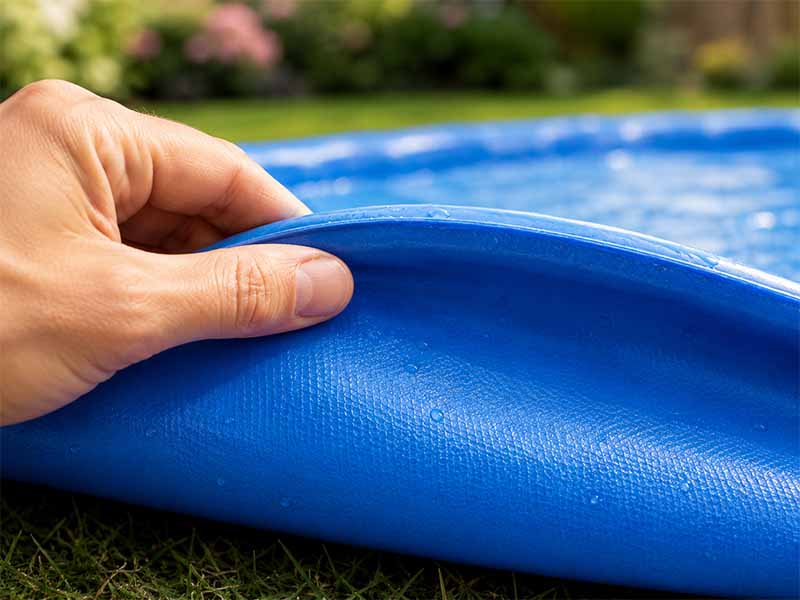
A dog pool can look strong in a product photograph and still fail when a wet dog turns sharply, pushes off the floor, leans against the wall, or climbs out through the same place every day. Thickness matters because every fraction of a millimeter adds material between the dog’s nails and the ground. However, sharp stones, narrow seams, weak wall panels, and poor drying can damage even a thick pool.
For most foldable household dog pools, approximately 0.50–0.60 mm PVC provides a practical balance of durability, flexibility, weight, and storage. Around 0.55 mm is a strong choice for regular use when combined with a textured floor and rigid internal wall panels. Large, active, or multiple dogs may benefit from reinforced floor areas in the 0.60–0.70 mm range.
The largest number on a product page does not always identify the most durable pool. A carefully constructed 0.55 mm model can outlast a poorly assembled 0.70 mm pool when its floor, seams, drains, support panels, and folding pattern are designed to work together. Understanding what the measurement describes makes it much easier to choose a pool that fits the dog, the yard, and the owner’s normal cleaning routine.
What Does Dog Pool Thickness Actually Mean?
Dog pool thickness usually refers to the flexible PVC sheet covering the floor and sidewalls. In foldable pools, it is sometimes confused with the rigid PP panels hidden inside the wall. These are separate measurements: flexible PVC is generally below 1 mm, while wall-support panels are commonly several millimeters thick and provide most of the standing structure.

The PVC layer keeps water inside, protects the internal structure, provides floor texture, and allows the pool to fold. The segmented sidewall usually contains polypropylene panels that supply most of the stiffness. A specification such as “0.55 mm PVC with 5 mm PP panels” therefore describes two materials performing different jobs within the same finished pool.
This distinction matters when products are compared. Thick PVC cannot fully correct weak or poorly fitted wall panels, while a rigid panel does not protect the floor from nails or rough ground. Selected EPN foldable dog pool designs use a 0.55 mm PVC body with built-in PP wall panels, allowing the waterproof layer and structural support to work as one system rather than relying on one material alone.
Nominal and Finished Thickness
PVC is normally controlled around a nominal value, such as 0.50, 0.55, or 0.60 mm. Small differences may appear because of production tolerance, embossing, coating, and the point where the material is measured. A textured floor can also produce slightly different caliper readings on raised and recessed areas of the same approved sheet.
Thickness should therefore be considered together with material weight, hardness, flexibility, surface finish, and approved tolerance. Two sheets that both measure 0.55 mm may perform differently if one becomes hard in cool weather or develops strong creases after folding. For product development, repeated filling, draining, folding, and surface-wear checks provide a more useful picture than one reading from a single sample.
| Pool Component | Common Reference | Main Function |
|---|---|---|
| Flexible sidewall PVC | 0.50–0.60 mm | Waterproofing and folding |
| Standard dog-pool floor | 0.55–0.60 mm | Paw contact and ground protection |
| Reinforced floor area | 0.60–0.70 mm or layered | Higher abrasion resistance |
| Internal PP panel | About 4.5–6 mm | Wall shape and stiffness |
| Drain area | Base material plus reinforcement | Load distribution and leak control |
What PVC Thickness Is Best for a Dog Pool?
Approximately 0.50–0.60 mm PVC suits many foldable household dog pools. Around 0.55 mm is a practical starting point for regular use, while 0.60–0.70 mm is better reserved for reinforced floors, active dogs, multiple-dog use, large pools, or areas exposed to frequent paw contact, repeated cleaning, and heavier seasonal use.

Material around 0.40–0.45 mm keeps a pool light and compact, but it leaves less protection between the dog’s nails and the ground. It is better suited to smaller dogs, brief cooling, occasional bathing, or use on a smooth protective surface. Around 0.50–0.55 mm provides a better balance for ordinary foldable pools because it handles regular filling, draining, and wet-paw movement without becoming excessively heavy.
A 0.60 mm floor offers more wear allowance for active use. Material approaching 0.70 mm is most useful in selected high-stress areas rather than across every part of a portable pool. Applying the heaviest sheet to the entire product can increase cost and stiffness without giving equal value to the upper walls and low-contact sections.
Match the Material to Real Use
A dog standing calmly in shallow water creates less stress than a dog chasing a sprinkler stream or jumping in and out. During a sharp turn, much of the dog’s weight may shift onto one or two paws while the nails move sideways. This combination of pressure and friction often causes more wear than standing weight alone.
For regular backyard play, a textured 0.55–0.60 mm floor, stable PP panels, and secure perimeter seams are a sensible combination. Grooming facilities, daycare settings, and multi-dog households should also consider how often the pool is filled, cleaned, moved, and folded. In these cases, reinforced high-contact zones and repeated-use testing matter more than choosing thickness from a single product claim.
| PVC Thickness | Suitable Use | Main Consideration |
|---|---|---|
| 0.40–0.45 mm | Small dogs and light use | Lower abrasion margin |
| 0.50 mm | Cooling and occasional bathing | Needs clean ground |
| 0.55 mm | Regular household dog pools | Balanced weight and flexibility |
| 0.60 mm | Active dogs and stronger floor contact | Heavier and slightly stiffer |
| 0.70 mm | Reinforced floors or wear zones | Often unnecessary everywhere |
Show three unbranded foldable dog pools in one natural backyard setting. Include a compact pool for a small calm dog, a medium reinforced pool for a Labrador, and a larger pool for two active dogs. Emphasize realistic textured floors, stable sidewalls, shallow water, and suitable turning space. Avoid captions, measurement graphics, logos, artificial damage, or exaggerated splashing.
How Does Dog Size Affect the Required Pool Thickness?
Larger dogs usually need stronger floor construction because they create greater total load and stronger turning forces. Body weight alone is not enough to select thickness, however. Nail shape, movement style, number of dogs, pool diameter, entry height, floor texture, and frequency of use can influence material stress just as much during everyday backyard play.
Weight, Paws, and Movement
A large dog’s weight is normally spread across four paws, but the load changes during entry, turning, and climbing out. At those moments, one or two paws may carry much of the body weight. Broad paws may distribute pressure better than narrow paws with long nails, so dogs of similar weight can create very different wear patterns.
For many large dogs, a 0.55–0.60 mm textured floor is a reasonable starting point. More active large breeds may benefit from reinforced sections approaching 0.60–0.70 mm around the entry, lower perimeter, and drain. A calm 70-pound dog may place less stress on a pool than a highly active 35-pound dog that repeatedly scratches at the water.
Pool Size and Multiple Dogs
A thick but undersized pool can receive more wall contact and scraping than a larger model with balanced material. Large dogs need enough diameter to turn without pressing tightly against the edge. Multiple dogs add more than their combined weight because they may bump each other, push against the wall, or enter from different directions.
For shared use, diameter, stable PP panels, reinforced flooring, and controlled water depth should be considered together. Senior dogs need a different balance: shallow water, a stable non-slip floor, and an easy exit can matter more than maximum thickness. Very stiff floors may form hard storage creases, so heavier material should still lie flat and remain comfortable under wet paws.
| Use Profile | Material Direction | Additional Priority |
|---|---|---|
| Small calm dog | About 0.50–0.55 mm | Low entry and protected ground |
| Medium active dog | About 0.55–0.60 mm | Textured floor and strong seams |
| Large dog | 0.55–0.70 mm in wear zones | More turning room |
| Two or more dogs | Reinforced floor system | Wider diameter and stable panels |
| Senior dog | Balanced textured construction | Shallow water and easy exit |

Is Thicker PVC Always Better for a Dog Pool?
Thicker PVC can improve abrasion resistance and make a pool feel more substantial, but it is not always better. Extra thickness also increases weight, folding stiffness, raw-material use, carton size, shipping cost, and heat-processing requirements. Stronger material should be placed where it solves a real wear problem rather than added uniformly to every surface.
Durability Versus Flexibility
A portable dog pool must be stable when full and flexible when stored. The material must tolerate water pressure and paw movement, then fold along planned panel joints without cracking or developing severe pressure lines. Increasing thickness can improve surface durability, but it may also make the flexible connections between panels harder to fold during normal seasonal storage.
PVC formulation and hardness influence this balance. A well-formulated 0.55 mm sheet may recover from folding more smoothly than a hard 0.70 mm sheet. Cool storage can also reduce flexibility, especially when the pool is unfolded before returning to room temperature. For this reason, repeated folding and unfolding tests should accompany static material tests when a new structure is evaluated.
Weight, Cost, and Handling
A small numerical increase becomes meaningful across a large circular floor and a complete ring of sidewalls. A two-meter circular floor alone covers more than 3 square meters before seams and walls are included. Increasing every surface from 0.55 mm to 0.70 mm can noticeably raise dry weight, packed volume, and normal handling effort.
A heavier pool is only useful when owners can still drain, rinse, lift, dry, and store it correctly. Products that are difficult to handle are more likely to be dragged while wet or folded before drying. EPN custom development can combine 0.55 mm sidewalls, approximately 5 mm PP panels, and reinforced high-wear floor sections, strengthening the most exposed areas without making the entire pool unnecessarily heavy.
What Matters Besides PVC Thickness?
Dog pool durability also depends on wall support, floor texture, seam width, local reinforcement, drain design, ground preparation, and maintenance. A balanced 0.55 mm construction can outperform a thicker pool when its PP panels, joints, entry area, fittings, and storage pattern are better suited to repeated pet use and regular seasonal handling.

Wall Support and Seams
The sidewall of a foldable pool does not stand upright because of PVC thickness alone. Internal PP panels create the segmented structure that resists water pressure and contact from the dog. Around 4.5–6 mm is a common reference range, although the correct panel depends on wall height, pool diameter, panel width, and spacing.
Seams must transfer force between the floor and wall without creating narrow stress points. Wider, even heat-pressed joints generally distribute load more effectively than irregular bonds. Entry areas and drains may need added material because dogs repeatedly climb over the same section and fittings concentrate force around relatively small openings during filling, use, drainage, and storage.
Texture, Ground, and Care
A textured floor improves wet-paw traction, but an extremely deep pattern can trap hair, mud, and cleaning residue. The surface should provide grip while remaining easy to rinse and dry. Selected EPN dog pool designs use a textured base and dual drainage positions, helping water leave efficiently without repeatedly tipping or dragging the pool during normal cleaning.
Even strong PVC needs a clean setup surface. Stones, roots, sticks, screws, rough concrete, and trapped grit can press upward and abrade the underside as the dog moves. Place the pool on a smooth, flat, water-resistant mat, drain it before moving, rinse away debris, and dry every fold completely before storage. Good handling often adds more service life than a small increase in material thickness.
| Construction Detail | What to Check | Warning Sign |
|---|---|---|
| Floor texture | Wet grip and cleaning ease | Glossy surface or deep dirt traps |
| PP panels | Stiffness and spacing | Walls remain bent after filling |
| Perimeter seam | Width and continuity | Narrow or lifting joints |
| Drain fitting | Reinforcement and fold position | Pulling or leakage |
| Ground surface | Flatness and sharp debris | Scratches matching objects below |
| Storage folds | Natural panel joints | Hard creases across rigid sections |
How Can You Choose the Right Dog Pool Thickness?
Choose thickness according to dog size, movement, number of users, pool diameter, floor structure, setup surface, use frequency, and storage needs. For regular household use, 0.55 mm PVC is a practical starting point. Demanding floors may need 0.60–0.70 mm material or targeted reinforcement rather than heavier PVC across the whole pool.

Compare the Full Specification
Look beyond broad terms such as “extra thick” or “heavy duty.” A useful specification should identify the PVC thickness, wall-support material, floor texture, dimensions, drain arrangement, and reinforced areas. It should also separate flexible PVC thickness from PP panel thickness because the two figures describe different parts of the pool and different performance needs.
When exact values are unavailable, examine the product weight, folded size, wall segmentation, seam width, floor close-ups, and fitting design. These details cannot replace formal material data, but they can show whether the product was developed as a complete structure or marketed around one impressive number without supporting construction details.
Match the Pool to Daily Use
The selection process becomes easier when it starts with the dog’s actual routine and the conditions in which the pool will normally be used. The following ranges provide a practical starting point rather than an absolute rule:
- Choose around 0.50–0.55 mm for smaller, calm dogs and occasional bathing on protected ground.
- Consider 0.55–0.60 mm for regular backyard cooling, medium or large dogs, and moderate activity.
- Add reinforced 0.60–0.70 mm floor zones for active large dogs, multi-dog play, grooming, or frequent use.
- Prioritize sufficient diameter, secure seams, stable PP panels, and a clean ground mat in every thickness range.
Private-label projects should define dog weight, pool diameter, side height, activity level, packaging limit, drainage, and intended retail position before choosing material. EPN can coordinate PVC thickness, PP support, texture, shape, sprinkler holes, inlets, dual drains, graphics, packaging, and sample testing within the same development process for a more balanced final structure.
Conclusion
For most foldable household dog pools, approximately 0.50–0.60 mm PVC provides a sensible working range, with 0.55 mm offering a dependable balance of flexibility, product weight, and regular pet-use durability. Large dogs, multiple pets, frequent play, and grooming environments may justify reinforced floor sections approaching 0.60–0.70 mm in the most exposed areas.
Thickness should never be evaluated alone. PP-supported walls, floor texture, seam width, drain reinforcement, available turning space, ground preparation, nail care, drying, and storage all influence service life. A well-engineered pool places stronger material where stress is highest while keeping the remaining structure flexible enough to clean, carry, fold, ship, and store without unnecessary difficulty.
Frequently Asked Questions
Is 0.5 mm PVC Thick Enough for a Dog Pool?
A 0.50 mm PVC pool can suit small or medium dogs, occasional cooling, and bathing on smooth protected ground. For regular active use or larger dogs, 0.55–0.60 mm material offers a more comfortable durability margin.
Is 0.55 mm PVC Good for Large Dogs?
Yes. A 0.55 mm PVC body can work well for large dogs when paired with a textured floor, secure seams, stable PP panels, and enough turning room. Active large dogs may need reinforced floor and entry areas.
Is a 0.7 mm Dog Pool Better Than a 0.55 mm Pool?
Not automatically. A 0.70 mm floor may resist abrasion better, but a uniformly thicker pool is heavier and stiffer. A balanced 0.55 mm body with reinforced wear zones may be more practical.
How Thick Should Dog Pool Support Panels Be?
Many foldable dog pools use PP panels around 4.5–6 mm, with approximately 5 mm serving as a common reference. The correct thickness depends on pool diameter, wall height, panel width, and folding structure.
Can Dog Nails Puncture Thick PVC?
Yes. No portable PVC dog pool is completely claw-proof. Trim the dog’s nails, discourage digging, use a protective mat, and remove sharp debris before filling the pool.
What Should Be Placed Under a Dog Pool?
Use a smooth, flat, water-resistant mat that extends beneath the entire pool floor. Avoid folded tarps, uneven foam, stones, roots, screws, and other raised pressure points.
Does a Thicker Dog Pool Last Longer?
It can, but thickness is only one factor. PVC formulation, seams, texture, PP support, ground conditions, drying, and storage often have an equally important effect on long-term performance.