Skip to content
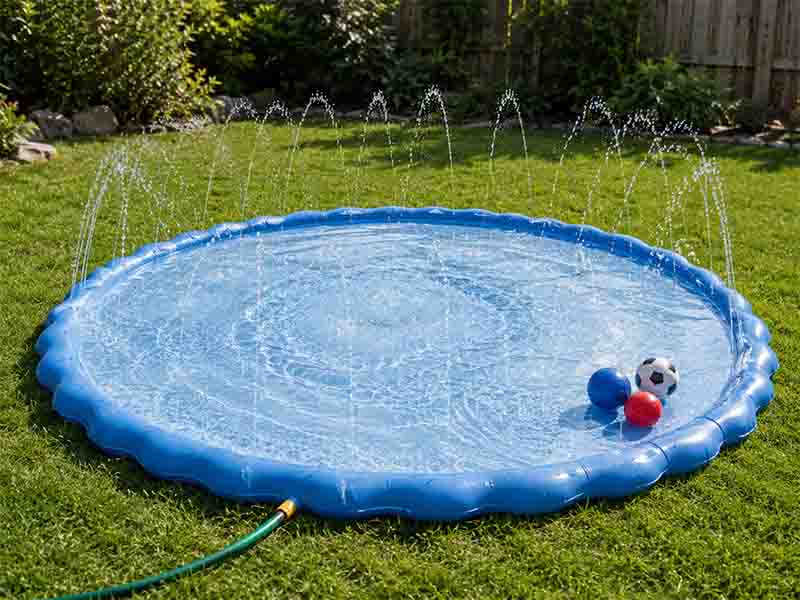
A splash pad can look perfectly normal when you unfold it, connect the garden hose, and turn on the water, yet begin leaking after only a few uses. Sometimes the problem is obvious: a small stone has punctured the floor. In other cases, there is no visible hole at all. Water may seep from the perimeter seam, drip around the hose connection, or escape from a section of the outer ring that suddenly stops holding its shape. That difference matters because not every leak has the same cause or the same solution.
Most splash pads leak because of a punctured or abraded PVC surface, a welded seam that begins to separate, a hose connection that does not seal correctly, or excessive stress around a high-load area. PVC thickness affects durability, but seam quality, connector construction, water pressure, ground preparation, folding, and repeated movement are equally important when determining how long a splash pad lasts.
The easiest mistake is to reduce every failure to “thin PVC.” Material thickness certainly matters, especially when children, pets, and rough outdoor surfaces are involved, but a splash pad is a complete water-carrying structure. The perimeter ring must fill evenly, dozens of spray holes must release water, welded seams must remain closed while the ring expands and contracts, and a relatively rigid hose fitting must stay attached to flexible material. The real question is therefore not simply where the water escaped. It is what combination of material, construction, pressure, surface condition, and use caused that particular area to become the first weak point.
What Causes a Splash Pad to Leak?
A splash pad usually leaks because the PVC has been punctured or worn, a welded joint has started separating, the hose fitting is not sealing correctly, or repeated stress has weakened a crease or high-load area. Finding the exact location of the escaping water is the best first step because a small floor puncture, an edge seam opening, and a connector leak require very different responses.
Punctures and Surface Wear
A puncture is the simplest leak to understand, although the object responsible may be almost invisible after the pad is installed. Flexible PVC normally spreads body weight over a relatively broad area, but a small stone, twig, thorn, sharp weed stem, deck splinter, landscaping clip, or raised concrete point changes the situation. When someone steps directly above that object, the PVC is trapped between a concentrated load from above and a hard point beneath it.
The condition underneath the pad is often more important than what the surface looks like from above. A lawn can feel soft under bare feet while still hiding gravel below the grass. Artificial turf can trap small stones between its fibers. A wooden deck can contain one slightly raised screw head, and a concrete patio may have rough aggregate that gradually rubs against wet PVC whenever the product moves during play.
Abrasion usually develops more slowly than a puncture. Instead of creating a clean hole immediately, friction repeatedly removes a very small amount of material from the same location. Early signs may include whitening, dull patches, light scuffing, rough texture, or a spot that feels thinner than the surrounding PVC. Dragging a partially filled splash pad across pavement is particularly hard on the underside because the water adds weight while the floor is sliding against an abrasive surface.
Pet use introduces another form of localized loading. A dog’s nails do not automatically damage a properly selected PVC surface, but fast turning, scratching, or pushing off repeatedly from the same spot can increase wear. The highest risk occurs when the nail presses the PVC against something hard underneath. This is why a suitable ground surface remains important even when a splash pad uses comparatively heavy PVC.
| What You Notice | Most Likely Cause | First Place to Check | Practical Response |
|---|---|---|---|
| One small stream from the floor | Puncture | Underside and ground below | Patch if nearby PVC is healthy |
| Damp, rough or whitened area | Abrasion | Ground-contact surface | Remove source of friction before repair |
| Water following the outer edge | Seam separation | Welded perimeter | Inspect the full nearby seam |
| Dripping around hose fitting | Seal or connector problem | Washer, O-ring and fitting | Re-seat and inspect connection |
| Leak repeatedly appears on a crease | Folding stress | Stored fold line | Change folding and storage method |
| Large opening during filling | Structural seam failure | Outer water chamber | Shut off water and inspect immediately |
Seam Separation
A leaking seam is fundamentally different from a puncture. Instead of an object penetrating the PVC, the bonded joint between two pieces begins to open. On a splash pad, that joint performs a structural role because the outer ring is continuously holding and distributing water while the hose is running. When the perimeter fills, the PVC layers move apart and place the welded region under load.
The load also changes every time someone touches the perimeter. A child stepping on one section compresses the water channel and pushes water toward neighboring sections. Once the child moves away, the material returns toward its previous shape. Normal play can create hundreds or thousands of these small pressure and deformation cycles during a season. A properly designed seam should accommodate them, but an inconsistent joint may gradually begin opening at its weakest point.
Several manufacturing variables influence seam consistency. Material overlap needs to remain properly positioned before welding, surfaces should be clean, the welding electrode must match the geometry, and process settings need to suit the specific material thickness and construction. Welding time, pressure, energy input, cooling, and tooling condition all contribute to the finished joint. A seam can look neat from above while still containing a localized area where the effective bond is weaker.
The shape of the leak often gives useful information. A small puncture typically remains concentrated around one point. A seam failure may follow the welded line and become longer as the ring continues filling. If water is escaping from an opening that grows along the edge, increasing the faucet flow to improve spray height can make the problem worse because the damaged joint is still carrying pressure.

Hose Connections and Seals
The garden-hose inlet may be one of the smallest parts of a splash pad, but it has several jobs to perform simultaneously. It needs to create a watertight seal, transfer water into the flexible perimeter chamber, tolerate repeated connection and removal, and resist pulling or twisting from a garden hose that becomes considerably heavier once it is filled with water.
A leak directly around the threaded fitting does not always mean the PVC has torn. The problem may be a flat washer, gasket, or O-ring that is missing, displaced, folded, dirty, worn, or incorrectly seated. These components work by compressing between mating surfaces and closing the small path through which water would otherwise escape. If the seal is not positioned correctly, tightening the connector harder may provide little improvement.
Mechanical load is the second issue. A hose that barely reaches the play area can remain under tension throughout use. A heavy loop hanging from the fitting can pull downward, while a sharp bend behind the connector can push sideways. Because the connector is more rigid than the surrounding PVC, repeated movement can concentrate stress near the point where those two materials meet.
The safest setup leaves enough hose slack for the final section to rest naturally on the ground. The fitting should screw together without cross-threading or aggressive force, and users should avoid moving the splash pad by pulling the hose. If leakage continues after the sealing component has been checked and correctly installed, the connector base and surrounding PVC should be inspected before further tightening.
Folding and Storage Stress
Portability is one of the main advantages of a PVC splash pad, which means folding is expected. Problems are more likely when the material is repeatedly compressed into the same sharp crease or stored while it is cold, wet, dirty, or heavily weighted. The result may not be an immediate hole, but repeated bending can gradually create a high-stress line that becomes more visible with use.
PVC flexibility depends on formulation, thickness, and temperature. Material that bends comfortably on a warm summer afternoon can feel noticeably firmer in a cold garage or shed. Forcing cold PVC into a tight fold can place greater strain along the crease, especially around printed areas, welded edges, or locations where several layers overlap.
Moisture and debris create another concern. Fine sand, dry grass, soil, and small particles can remain attached to a wet splash pad. If the product is folded immediately, those particles become trapped between PVC surfaces. During storage, compression and movement may cause the particles to rub against the material. Moist storage can also encourage unwanted odor, staining, or biological growth.
After use, allow the perimeter to drain as completely as possible, rinse away visible grit when necessary, and dry both sides before packing. Folding the product loosely instead of forcing extremely sharp creases reduces concentrated bending. Heavy storage bins should not remain on top of the packed splash pad for months, especially in locations exposed to large temperature changes.
Which Parts of a Splash Pad Fail First?
The first problems usually appear around the outer welded seams, hose inlet, spray-hole transitions, corners or curves, and ground-contact floor. These areas experience different combinations of hydraulic pressure, movement, bending, hose tension, and abrasion. Early failure normally occurs where several stresses meet, which is why the weakest point is not always the thinnest-looking part of the product.
Outer Perimeter Seams
The outer perimeter has a demanding job. It contains the water channel, supports the spray openings, defines much of the product’s shape, and receives repeated contact whenever children cross or sit near the edge. Even when water enters at a stable rate, the force acting on individual sections of the seam changes as the ring is compressed during normal play.
Imagine a child stepping onto one small section of the filled ring. The water occupying that space cannot remain there, so part of it moves into adjacent areas. Those sections temporarily expand and then return toward their original shape when the load disappears. With several children playing together, the pattern is constantly changing around the perimeter. This is one reason consistent seam construction across the entire product is more important than having one strong-looking sample section.
Geometry also changes how stress travels. A smooth round perimeter behaves differently from a square design with corners. A connector interrupts the continuity of an otherwise flexible channel. Changes in ring width, attachments, or decorative features can create local differences in stiffness. As splash pads become larger, water also needs to travel farther around the perimeter, making balanced channel geometry and spray distribution increasingly important.
Early warning signs include one portion of the ring becoming noticeably larger than the others, a thin lip beginning to lift along the welded edge, or moisture appearing directly on the seam while the surrounding PVC remains intact. These observations do not automatically confirm a manufacturing defect, but they provide a better diagnostic starting point than assuming every leak is a puncture.
Hose Inlet Areas
The hose connection has to manage internal water flow while resisting external mechanical force. This combination makes it a natural stress concentration point. A fitting may be perfectly watertight when held by hand but begin behaving differently once a long garden hose fills with water and starts pulling downward or sideways for an entire afternoon.
Three simple observations can reveal a developing problem. The connector should remain reasonably aligned after the hose is attached, the surrounding PVC should not wrinkle or stretch heavily, and the hose should be able to reach the fitting without pulling it toward the faucet. Water escaping from the threads suggests a sealing issue, while deformation around the connector base may point toward mechanical stress.
Users sometimes respond to a small drip by tightening the connection as hard as possible. That can be counterproductive. If a washer or O-ring is missing or folded, additional torque may distort the fitting without creating a reliable seal. Turning off the water, disconnecting the hose, inspecting the sealing surfaces, and reconnecting them squarely is usually a better first response.
For product development, connector placement deserves as much attention as the fitting itself. A connector located where the hose naturally approaches at an awkward angle may create unnecessary loading even when the component is otherwise well made. Reinforcement can help distribute force, but it should transition gradually into the surrounding flexible PVC rather than creating another abrupt stiffness change.
| Structural Zone | Primary Stress | Early Warning Sign | Key Durability Factor |
|---|---|---|---|
| Outer seam | Water pressure and stepping | Uneven expansion or edge lifting | Weld consistency |
| Hose inlet | Pressure, hose weight and twisting | Dripping or local distortion | Seal and reinforcement |
| Spray-hole line | Flow and local stretching | Irregular openings or uneven spray | Hole consistency |
| Floor | Foot traffic and abrasion | Whitening or surface scuffing | PVC and ground condition |
| Corners and curves | Directional loading | Local bulging | Geometry and seam continuity |
| Fold zones | Repeated bending | Permanent sharp crease | Flexibility and storage |
Spray Holes and Transitions
Every spray hole is an intentional opening in the perimeter, which means its shape and position matter. A clean, repeatable circular opening distributes local stress more predictably than one with an irregular notch or torn edge. If a spray hole sits too close to a seam or in a section that stretches significantly during filling, the surrounding material may experience more concentrated deformation.
The combined outlet area of all spray holes also influences the way the perimeter behaves. Incoming water must eventually leave through these openings. When flow into the pad is high relative to the total outlet capacity, the ring becomes firmer because water is being supplied faster than it can easily escape. When total outlet area is too large for available household flow, spray height may remain disappointing even with the faucet opened further.
This is particularly important when manufacturers develop larger versions of an existing splash pad. Increasing diameter changes channel length and internal water volume. Keeping exactly the same assumptions about connector flow, hole diameter, number, and spacing may produce uneven spray or different structural loading. A functioning water test is therefore far more informative than judging the enlarged prototype while it is lying flat.
Transitions such as corners, decorative attachments, changing ring widths, and connector zones deserve similar attention. Stress tends to concentrate where shape or stiffness changes abruptly. Good design avoids treating these areas as afterthoughts and instead considers how water, material movement, and user contact interact around the entire perimeter.

Ground-Contact Floor
The center floor usually carries much less internal water pressure than the perimeter chamber, but it faces continuous contact with the environment. Children walk and run across it, dogs may turn sharply on it, toys are dropped onto it, and the underside remains against grass, decking, paving, soil, or another outdoor surface throughout the session.
The largest flat areas are not necessarily the most vulnerable. Normal body weight can be distributed effectively across a broad surface. The problem appears when that load is concentrated over a tiny object underneath. A stone only a few millimeters across can become the point supporting much of a footstep for an instant, while a grainy concrete surface can slowly abrade a wet pad that shifts during active play.
Cleaning habits influence the floor as well. Sand, sunscreen, soil, grass, body oils, and pet hair can remain on the product after use. Folding the pad while those contaminants are still wet traps them between surfaces. Fine grit can then behave like abrasive material each time the folded product is handled or compressed.
Checking the underside several times during the season can identify problems before water begins escaping. Whitening, dull patches, scuffed printing, rough texture, or local thinning are all worth investigating. Early wear is easier to manage by changing the setup surface than waiting until the weakened location becomes a visible puncture.
How Do Materials and Construction Affect Leaks?
Splash pad durability depends on PVC and construction working as one system. A heavier PVC sheet can provide more resistance to puncture and abrasion, but it cannot compensate for an inconsistent seam, poorly supported connector, or badly balanced water path. Durable construction combines suitable material, reliable welding, adequate bonded areas, controlled spray openings, stable inlet design, and functional leak testing.
PVC Thickness
PVC thickness matters because additional material can increase the distance a sharp object must penetrate and provide a larger wear margin before abrasion becomes a leak. However, thickness also changes flexibility, welding behavior, material consumption, package weight, folding performance, and the feel of the product underfoot. For that reason, selecting the thickest possible sheet is not automatically the best engineering decision.
Portable recreational products typically need to remain flexible enough to fold into manageable packaging. Within this category, even relatively small thickness differences can change handling noticeably. A lightweight children’s splash mat used occasionally on clean grass does not necessarily need the same construction as a larger multi-user pad or a dog-oriented product expected to experience more concentrated paw movement.
The following ranges are useful as general design examples rather than universal standards. Exact specifications vary according to formulation, product dimensions, target use, seam structure, testing requirements, and manufacturing process.
| Illustrative PVC Range | Typical Design Character | Potential Advantage | Important Limitation |
|---|---|---|---|
| 0.25–0.30 mm | Lightweight recreational | Easy folding and lower product weight | Less margin against abrasion |
| 0.35–0.40 mm | General family recreational | Balance of flexibility and durability | Clean setup surface still essential |
| 0.45–0.55 mm | Heavier family or pet-oriented | Increased puncture and wear margin | Higher material use and weight |
| Above 0.55 mm | Specialized heavier construction | More material around wear zones | Does not correct weak seams by itself |
PVC is also a formulation rather than simply a thickness measurement. Plasticizer system, stabilizers, pigments, surface finish, temperature behavior, printing requirements, and other additives influence flexibility, odor, aging, and welding response. Two sheets measuring the same thickness can therefore behave differently when folded, heated, exposed outdoors, or joined through high-frequency welding.
High-Frequency Welded Seams
High-frequency welding is widely used for compatible flexible PVC because it can create a continuous bonded joint without stitching holes through the material. During the process, energy and pressure act on overlapping PVC layers, heating the joint area so that compatible surfaces fuse together before cooling under controlled pressure.
The important word is consistency. A large splash pad contains much more than one straight seam. The weld may travel through long curves, corners, connector areas, printed surfaces, and sections where the overlap is difficult to position. The material must remain correctly aligned while tooling, pressure, welding time, energy input, and cooling conditions remain appropriate for the selected construction.
Insufficient welding conditions can leave parts of the overlap incompletely fused. Excessive energy can deform or weaken the material near the edge of the joint. Inconsistent positioning may produce a seam that looks similar from above while the actual effective bonded width varies along the perimeter. Tooling wear or contamination can also create localized weaknesses that are difficult to identify without functional testing.
For users comparing splash pads, this explains why a thicker material does not always translate into better durability. If two heavy pieces of PVC are joined inconsistently, the seam may still become the first failure point. The strength of a flexible water-holding product depends on both the sheet itself and the quality of the joints transferring load between those sheets.
Seam Geometry and Load Distribution
Seam width has practical structural value because the bonded area transfers load between overlapping pieces of PVC. A wider effective bonding region can generally spread load across more material, but there is no universal seam width that guarantees performance for every splash pad. Material thickness, channel dimensions, pad size, expected water flow, geometry, and user behavior all influence the appropriate design.
A small children’s splash pad and a very large family pad may look similar in product photographs, yet their perimeters do not behave identically. The larger design contains a longer water channel, may hold more water, normally includes more spray openings, and can support several users simultaneously. Simply enlarging the artwork without reconsidering structural proportions can change how stress travels through the product.
Apparent seam width and effective bonded width are also not always the same. If PVC shifts slightly before welding, the actual fused overlap may be narrower in one section. A decorative impression on the surface can make a seam look substantial without showing exactly how much material has fused beneath it. Visual inspection is valuable, but functioning water tests provide a more realistic picture.
EPN’s development system combines polymer-material, structural, tooling, children’s recreation, pet-use, and ergonomics expertise within a 27-person R&D team. Its laboratory program carries out more than 500 material and product performance tests annually across PVC and composite recreational products. For splash pads, this type of testing is most useful when material choice, seam behavior, connector loading, flow distribution, and intended use are assessed together rather than as unrelated specifications.

Connector and Water-Flow Design
A splash pad functions as a simple water-distribution system. Water enters through one inlet, travels around a perimeter channel, and exits through many spray openings. Connector diameter, channel volume, ring width, spray-hole quantity, hole diameter, spacing, hose flow, and household supply all influence how efficiently that system works.
If incoming flow is high relative to the total outlet area, the perimeter may become increasingly firm as water accumulates. If the outlets provide too much combined area for the available supply, spray height may remain weak. Poor spacing can also produce stronger spray near one section and weaker output somewhere else. This is one reason users should not assume that opening the faucet fully will correct every uneven spray pattern.
Larger splash pads make water-path design more important. Increasing the diameter means water travels farther before reaching the farthest spray holes. Ring dimensions and outlet layout may need adjustment rather than simply increasing the number of holes. During sample development, observing a product under actual water flow can reveal deformation, uneven distribution, and local stress that cannot be identified while the product is empty.
Connector reinforcement follows the same principle. Making one small area extremely rigid is not necessarily ideal because stiffness can move bending stress toward the edge of the reinforcement. A better transition supports the fitting while distributing force gradually into surrounding flexible PVC. These structural details often have more influence on long-term complaints than decorative differences customers notice first.
Do Water Pressure and Ground Conditions Cause Leaks?
Yes. Excessive water flow can increase load on the perimeter chamber, connector, and existing weak seams, while stones, rough concrete, grit, or other debris can puncture or abrade the floor. These factors do not explain every failure, but they are among the easiest risks for families to control. Correct setup can significantly reduce avoidable stress on an otherwise sound splash pad.
Water Flow and Pressure
A splash pad needs sufficient water to fill the perimeter and create an enjoyable spray pattern, but maximum faucet flow is rarely the goal. Once the outer ring is properly shaped and water reaches the intended play area, additional flow mainly increases the hydraulic load that seams and connector areas must contain.
There is no single household faucet percentage or PSI figure that can responsibly apply to every splash pad. Water supply pressure varies between homes, while hose length, hose diameter, connector size, splash pad dimensions, channel volume, spray-hole number, and total outlet area all change the operating condition. A setting that works perfectly for one design may be unnecessarily high for another.
A practical approach is to start with low-to-moderate flow and allow the perimeter time to fill. Observe whether the ring rises evenly and whether all sides begin spraying. Increase the water gradually until the spray reaches a useful height. Once additional faucet movement produces little improvement, there is usually no reason to continue increasing the load.
Pay attention to the structure while adjusting. An outer ring that becomes unusually hard, a connector that twists, one zone that balloons much more than the rest, or a seam that visibly stretches deserves attention. Turning the water higher to compensate for a structural or flow-distribution problem is unlikely to produce a durable solution.
Ground Preparation
Ground preparation may be the simplest leak-prevention step in the entire process. A lawn that looks clean can still hide small stones, dry branches, roots, sharp weed stems, irrigation hardware, landscaping clips, and hard seed pods. Once the pad covers the area, these objects disappear from view but remain directly below the PVC throughout active play.
The inspected area should extend slightly beyond the product’s dimensions because the pad can move as children run across it and the perimeter fills or drains. Walking through the intended setup zone and removing anything hard or sharp takes only a few minutes but can prevent a puncture that would otherwise be blamed on poor material.
Concrete presents a different problem. The main risk is often abrasion rather than one sharp object. Rough aggregate, textured pavers, or fine sand trapped beneath the pad can slowly wear the underside if the product shifts repeatedly. Decking should be checked for raised screw heads, damaged boards, and splinters, while artificial turf can conceal small gravel beneath its fibers.
When a compatible ground sheet is permitted by the manufacturer’s instructions, it should lie smooth and flat. Thick folds or hard wrinkles underneath a protective layer can themselves become pressure points. Whatever surface is chosen, never drag a water-filled splash pad into position. Drain it first, lift it, and then move it to avoid combining high weight with abrasive sliding.
Kids and Pets
Splash pads are made for active outdoor play, so walking, splashing, light running, and ordinary movement should be considered normal use. The important difference is how force is applied. A child walking across the center places a very different load on the structure than someone repeatedly jumping directly onto one small section of the filled perimeter.
When the ring is compressed, water moves elsewhere inside the chamber. Repeated deliberate jumping on the same location creates sharper pressure changes than ordinary crossing. Several children sitting on the outer ring for extended periods can also create a sustained load that differs from the way the water channel normally operates.
Dogs create another type of movement. A dog chasing the spray may accelerate quickly, stop, and turn sharply, producing sideways force through its paws. On clean grass, the PVC can flex against a relatively forgiving surface. On hidden gravel or rough concrete, the same movement can press the material into hard points underneath. Keeping nails maintained and discouraging digging motions reduces unnecessary localized loading.
This is also why intended use matters when choosing a product. A small pad used by one toddler does not experience the same conditions as a large splash pad serving several older children or active dogs. Material, floor construction, seam design, and overall dimensions should make sense for the people or pets expected to use it.

Hose Routing
A filled garden hose can quietly become a significant external load on the inlet. Before the faucet is opened, the hose may seem lightweight and easy to position. Once full of water, several unsupported feet can pull down on the fitting for the entire play session, particularly if the connector sits slightly above the lawn.
Leave enough slack for the section nearest the splash pad to rest on the ground naturally. Avoid sharp bends immediately behind the fitting, and do not stretch the hose tightly between the faucet and product. Routing the line outside the main play path also reduces the chance that children or pets will trip over it and suddenly pull the connector.
Moving the splash pad by pulling the hose should be avoided. This places most of the moving force directly through the fitting instead of distributing it across the product. A partially filled pad is also much heavier than it appears, so the same movement can drag the floor over the ground and create abrasion at the same time.
Good hose routing will not repair a poorly manufactured connection, but it can prevent a sound connector from being exposed to unnecessary twisting and tension. It is one of those small setup details that costs nothing and can make a meaningful difference over repeated summer use.
How Can You Prevent Splash Pad Leaks?
Leak prevention combines product selection, careful setup, sensible water flow, routine inspection, and proper storage. Clear the entire ground area, inspect the floor and seams, check the hose seal, keep the hose relaxed, increase water gradually, and dry the pad before folding. When purchasing, look beyond broad “heavy-duty” claims and evaluate material, seams, connector design, instructions, and intended use together.
Check the Pad Before Use
A basic pre-use inspection takes only a few minutes and can identify developing problems before full water flow makes them larger. Start with the installation area, then inspect the underside of the pad while it is still easy to lift. Look for stones, twigs, sharp weeds, screws, grit, or other objects that could create concentrated contact points.
Follow the perimeter seam visually and with your fingers. A normally bonded edge should appear reasonably consistent without obvious lifting or an isolated section that looks unusually narrow or distorted. Inspect the floor for abrasion, cuts, or permanent creases, particularly if the product was used on concrete, decking, or another harder surface during the previous session.
At the inlet, confirm that the washer, gasket, or O-ring required by the connector is present and sitting properly. Connect the hose without forcing the threads. If it begins at an angle, disconnect and start again rather than tightening through resistance.
The first few minutes of filling are another inspection opportunity. Walk around the product while the ring expands. Watch for drips at the connector, uneven bulging, unusual seam stretching, or water appearing where there should be none. Problems found at moderate flow are much easier to investigate than the same problems after the perimeter is under greater load.
| When to Check | What to Inspect | Typical Time Needed |
|---|---|---|
| Before each use | Ground, underside, seams and connector | 1–3 minutes |
| Initial filling | Drips, uneven expansion and hose tension | First 1–3 minutes |
| After play | Scuffs, debris and complete drainage | 2–5 minutes |
| Before storage | Cleanliness and complete drying | Depends on weather |
| Several times per season | Fold lines and connector wear | About 5 minutes |
| Start of next season | Full inspection and low-flow water test | About 10 minutes |
Choose Construction, Not Just Claims
Product descriptions often use words such as “heavy-duty,” “premium,” or “thickened,” but those terms provide limited information unless they are supported by useful specifications. Material thickness can be helpful when clearly stated, especially when comparing splash pads designed for similar users, yet it should be considered together with seam construction, connector design, size, care instructions, and intended use.
Look for product information that explains dimensions, material specification, hose connection, water adjustment, recommended setup surface, age or pet suitability, storage, and available repair methods. Clear limitations can actually be more useful than exaggerated promises. Flexible outdoor PVC products are portable and waterproof, but no responsible manufacturer can guarantee that a recreational sheet will resist every sharp object, unlimited pressure, or every possible form of misuse.
Customer reviews can also be read more intelligently. Instead of counting every complaint containing the word “leak,” separate them into categories. A puncture underneath the floor tells a different story from a welded seam opening. A missing connector washer is different from the fitting tearing away from the PVC. Five reports describing the same structural location are much more informative than five unrelated complaints.
For brands, retailers, or organizations ordering customized splash pads, the same reasoning applies before mass production. Ask about material thickness, welding construction, connector support, spray-hole consistency, prototype testing, and quality checks. A supplier who can explain how these elements work together offers more useful information than one who only repeats a material thickness and unit price.
Test the Whole Water System
Meaningful leak control requires looking at the finished splash pad as a complete system. Material inspection can verify thickness and surface condition. Production checks can examine cutting, printing, alignment, welding, spray openings, and connector assembly. Finished-product evaluation then needs to determine whether those elements continue working together once water enters the perimeter.
This becomes especially important when a product size or structure changes. Enlarging a splash pad increases the water-channel length and changes internal volume. Changing PVC thickness can affect welding settings and flexibility. Moving the connector changes the direction in which hose load enters the structure. Adjusting spray-hole diameter or quantity changes how readily water can escape.
These relationships are why prototype water testing matters. A product may look perfectly symmetrical while empty but develop uneven expansion after filling. One section may spray more strongly than another, a connector may tilt under hose weight, or a corner may deform differently once users step near it. Those observations provide practical engineering information before a design reaches a large production run.
EPN’s 27-person R&D organization includes expertise in polymer materials, structures and tooling, children’s recreational products, pet-use behavior, and ergonomics. Across its PVC and composite product programs, the company reports more than 500 material and product performance tests annually. The value of that system is not simply the number of tests; it is the ability to connect material, structure, water behavior, and real use when a new splash pad or customized design is being evaluated.

Repair or Replace
A leak does not automatically mean the entire splash pad is unusable. Small isolated punctures in otherwise healthy PVC are often the most straightforward repair candidates. When a compatible repair method is supplied, the area should be cleaned and completely dried before the patch or adhesive is applied according to its instructions. Adequate curing time is important before the repaired area is exposed to water and movement again.
Structural damage requires more caution. A long seam separation, a connector base tearing from the surrounding PVC, or a joint that continues opening whenever the ring fills is carrying mechanical load. Covering the visible opening may temporarily stop water without correcting the force that caused the failure.
Location can matter more than the apparent size of the hole. A small puncture in the center floor may be relatively easy to isolate, while an equally small opening at the beginning of a perimeter seam may expand because the joint is continuously loaded during use. Inspect beyond the visible leak for stretching, whitening, deformation, or additional separation before deciding that only one point requires repair.
Repeated failure in the same location is particularly informative. If the same connector zone, corner, or seam repeatedly develops problems after repair, the issue may be structural rather than accidental. For families, replacement may then be more practical. For brands and manufacturers, repeated failures at one location should trigger investigation into material, geometry, welding, connector support, water flow, and test conditions instead of simply adding larger repair patches.
Conclusion
Splash pad leaks are rarely explained by one specification. Long-term durability comes from how PVC material, welded seams, the perimeter water channel, spray openings, connector hardware, water flow, setup surface, user movement, and storage work together. This is why two splash pads that appear nearly identical in photographs can behave very differently after weeks of backyard use.
The most useful troubleshooting method is to identify the exact failure zone first. A puncture points toward surface damage and ground conditions. A leak following a welded edge raises questions about seam integrity and load. Water around the inlet calls for inspection of the gasket, fitting alignment, hose tension, and surrounding PVC. A problem that appears only at very high flow may require pressure and water-distribution evaluation.
For families, careful setup and a short inspection before use can prevent many avoidable failures. For product developers and retailers, reliability begins much earlier with material selection, seam geometry, connector design, prototype water testing, and consistent production control. A good splash pad is not defined by one impressive thickness number or a “never leaks” slogan. It is the result of many small design and manufacturing details working correctly together.
Frequently Asked Questions
What is the most common reason a splash pad leaks?
There is no single cause behind every splash pad leak, but punctures, seam separation, and hose-connection problems account for many common failures. The leak location provides the best clue. A point leak in the floor usually suggests surface damage, while water following a welded edge or escaping around the inlet indicates a different structural or sealing problem.
Can high water pressure damage a splash pad?
Excessive flow can increase the load carried by the water-filled perimeter, connector, and seams, particularly when a weak point is already present. Because household supplies and product designs differ, there is no universal faucet setting for every pad. Start with moderate flow, let the ring fill, and increase gradually only until the spray pattern becomes stable and useful.
Is thicker PVC less likely to leak?
Thicker PVC generally provides more material against puncture and abrasion, but it does not guarantee a leak-free splash pad. Seam quality, material formulation, connector support, water-channel design, and ground conditions remain equally important. A well-engineered splash pad using an appropriate moderate thickness can perform better than a heavier product whose joints or connection areas are inconsistent.
Can a leaking splash pad seam be repaired?
A very small, stable opening may sometimes be repairable with a compatible PVC repair method, but long seam separations are more difficult because the joint continues carrying water pressure during use. If an opening grows whenever the ring fills, repeatedly fails after repair, or extends toward a connector or heavily loaded area, replacement is usually more practical than repeated patching.
What is the best surface for a splash pad?
A clean, level lawn or another smooth surface free from sharp debris is generally suitable for many recreational splash pads, provided it matches the manufacturer’s instructions. Remove stones, sticks, hard weeds, screws, and other objects first. Rough concrete and abrasive paving require extra care because wet PVC can move against the texture and gradually wear even without an obvious puncture.
How can I tell whether the leak is accidental damage or a construction problem?
Start by examining the shape and location of the failure. A small puncture directly above a stone suggests accidental contact, while a separation following a welded seam, repeated failure at an intact connector base, or an opening that develops during normal low-to-moderate filling may justify closer inspection of the product’s construction. Documenting the area before moving the pad can also help.
How should a splash pad be stored between seasons?
Drain the product fully, remove grass and grit, allow both sides to dry, and store it in a clean, dry location without severe compression. Avoid forcing cold PVC into extremely sharp folds or repeatedly creasing the same location. Before using the pad the following season, inspect the floor, seam, fold areas, connector, and sealing components before gradually applying water flow.