Skip to content
A splash pad can look almost maintenance-free while the water is running. Turn off the hose, however, and the part that determines how well the product survives repeated summer use has only just begun. Grass sticks to wet PVC, sunscreen and body oils remain on the play surface, moisture sits underneath the pad, and small amounts of water may remain inside the perimeter spray channel even after the center looks completely empty. Folding everything immediately may save a few minutes, but it can also trap the exact combination of moisture and residue that leads to musty odors, mildew, staining, stuck surfaces, and unpleasant surprises the next time the pad comes out of storage.
The best way to clean and store a splash pad is to drain it promptly, rinse away dirt and debris, use mild soap when a deeper clean is needed, rinse away all cleaner residue, dry the top, underside, perimeter, seams, and hose connection completely, then fold it gently and keep it in a clean, dry, protected location. Avoid storing it while damp or under prolonged sunlight, heavy pressure, or contact with sharp objects.
The sequence matters more than complicated cleaning products. A perfectly washed pad can still develop storage problems if its underside remains wet. A surface that feels dry may still hide water in the spray ring. Good care therefore means thinking about the whole product rather than only the colorful area children stand on. Once draining, cleaning, drying, inspecting, folding, and storing become part of one routine, the product becomes easier to manage and much more likely to be ready when the next hot weekend arrives.
How Do You Clean a Splash Pad?
Clean a splash pad by disconnecting the hose, draining standing water, removing grass and loose debris, rinsing the PVC surface, and wiping dirty areas with mild soap and a soft cloth or non-abrasive sponge. Rinse again until no cleaner remains. Routine cleaning should remove residue without unnecessarily exposing printed PVC, welded seams, spray holes, or hose fittings to strong chemicals or aggressive scrubbing.
What Should You Do After Play?
Cleaning is easiest when it begins shortly after play ends. A wet splash pad left on the lawn for several hours continues collecting grass, soil, pollen, insects, pet hair, and organic residue from the ground. Sunscreen, skin oils, snacks, and muddy footprints can also remain on the surface even when the PVC still appears reasonably clean. Once these materials dry into a textured surface, they usually take more effort to remove.
Start by turning off the water and disconnecting the garden hose. Let the center play area drain naturally, then lift portions of the perimeter gently so remaining water can move toward the connector or another low point. Remove visible leaves, grass, hair, and dirt before applying additional cleaning water. A large splash pad is much easier to handle after it has drained, and moving it while still full of water adds unnecessary weight.
Avoid dragging a wet product across gravel, rough concrete, exposed roots, or sharp garden debris. The underside experiences direct friction during dragging, while children normally spread their weight over a much larger area during play. A small stone under a water-heavy pad can therefore create much more concentrated abrasion than normal barefoot use.
The level of cleaning should match the condition of the pad rather than following the same routine every time.
| After-Use Condition | Appropriate Care | Areas to Check |
|---|---|---|
| Light grass or dust | Rinse and dry | Underside and outer edge |
| Mud or soil | Rinse, mild soap if needed | Texture and low areas |
| Sunscreen or body oils | Mild soap and soft wiping | High-contact zones |
| Pet hair or paw dirt | Remove debris, wash, rinse | Texture and spray perimeter |
| Food or sticky residue | Clean promptly with mild soap | Rinse until no film remains |
| Long-term storage planned | Full cleaning and complete drying | Connector, seams and underside |
The important distinction is between a pad that is clean enough for another play session later in the day and one that is clean enough to remain folded for several weeks or months. Longer storage deserves more careful cleaning because anything left between overlapping PVC layers will stay there until the product is opened again.
Which Cleaner Should You Use?
For routine home care, mild soap or a mild household detergent diluted with water is usually the best starting point, provided the product instructions allow it. A microfiber cloth, soft towel, or non-abrasive sponge provides enough cleaning action for common backyard residue without treating flexible PVC like a hard floor, deck, or swimming-pool wall.
Start with the gentlest method that removes the contamination. Clean water may be enough for fresh grass, pollen, or light soil. Sunscreen, body oils, and some sticky residues usually respond better to a small amount of mild soap. On large pads, wash one manageable area at a time so detergent does not dry on the surface before you can rinse it away.
This matters because soap residue can make a wet surface feel unusually slick during the next use. If the PVC still feels greasy or soapy after rinsing, repeat the clean-water rinse rather than assuming a stronger detergent is needed.
The U.S. Centers for Disease Control and Prevention distinguishes ordinary cleaning from sanitizing and disinfecting. For routine household cleaning, soap and water remove dirt, impurities, and many germs from surfaces. A backyard splash pad does not automatically require strong disinfection after every normal play session. More aggressive treatment should be reserved for situations where it is actually needed and where the product manufacturer confirms material compatibility.
A simple rule works well: use enough cleaner to remove the residue, but not so much that cleaning chemicals become another residue you have to remove.

How Do You Remove Dirt and Residue?
Different contaminants behave differently on PVC, so one cleaning technique does not fit every problem. Loose leaves and grass should be removed before washing because they can gather around spray holes, welded edges, and the hose connection. Dried mud becomes easier to lift after soaking briefly with clean water, while greasy sunscreen or body-oil residue usually benefits from mild soap.
When rinsing, work from cleaner areas toward dirtier edges so you do not repeatedly move soil across the center play zone. If the splash pad uses an embossed or textured surface, wipe in more than one direction. A single straight movement may pass over the raised pattern while leaving fine particles in the shallow grooves.
Products shared with pets need a slightly closer inspection. Dog hair, paw dirt, grass, and saliva can collect along the perimeter and in textured areas. Remove visible hair before rinsing so it does not accumulate near the connector or spray ring. If soap or pet shampoo reaches the pad, rinse thoroughly because these products can make wet PVC noticeably more slippery.
A good final cleanliness check should include both sight and touch. The pad should have no obvious debris, no sticky or oily film, no soap residue, and no accumulation around the hose connection. Printed areas can sometimes hide light dirt, while texture can hide residue that is easier to feel than see.
What Cleaners Should You Avoid?
Strong solvents, abrasive powders, scouring pads, stiff brushes, concentrated degreasers, and unapproved chemical mixtures are poor choices for most flexible splash pads. A product that cleans concrete or ceramic tile effectively may be far more aggressive than necessary on flexible PVC, printed graphics, welded joints, or molded hose fittings.
Bleach requires particular care. Although correctly diluted bleach is widely used for disinfection, not every splash pad uses the same PVC formulation, ink system, coating, or connector material. There is therefore no responsible universal bleach concentration that should be recommended for every product. When disinfection is necessary, follow both the splash pad manufacturer’s care instructions and the disinfectant label.
Pressure washers can also create unnecessary risk. Their narrow water jet applies far more concentrated force than the distributed pressure a splash pad normally receives from a garden hose. A strong jet aimed directly at a welded edge, printing, spray hole, or connector may damage a structurally sensitive area while attempting to remove ordinary dirt.
Portable backyard splash pads should also not be treated like municipal splash parks. Public splash facilities may use recirculation, filtration, chlorine or bromine, controlled pH, and water-quality monitoring because they serve many users and operate under a completely different system. A household PVC splash pad normally needs a much simpler care process centered on rinsing, mild cleaning, complete drying, and protected storage.
How Do You Dry a Splash Pad Completely?
Dry a splash pad by draining the perimeter water channel, exposing both the top and underside to airflow, and checking seams, connector areas, folds, and low points before storage. Do not judge dryness only by touching the center surface. The pad is ready to fold only when there are no visible droplets, damp patches, moving water, or moisture that will become trapped between overlapping PVC layers.
How Do You Drain the Water?
Drainage should happen before heavy lifting, folding, or extended cleaning. With hose-fed splash pads, the open center often looks empty quickly while water remains inside the outer spray channel. The larger the circumference, the more opportunities there are for small low points to retain water after the hose has been turned off.
Turn off the tap and let internal pressure fall naturally before disconnecting the garden hose. Raise one section of the perimeter gradually and allow gravity to move remaining water toward the connector or another low point. Reposition the pad when necessary instead of shaking it aggressively. Large models may be easier for two adults to handle once most of the water has drained.
If the design allows, orienting the hose connection lower than the surrounding perimeter during the final draining stage can help residual water escape. You may still need to lift different sections of the outer ring because a circular water channel can create several temporary low spots as the product rests on uneven ground.
Do not use high-pressure compressed air as a shortcut. Splash pads are designed around household garden-hose water flow, not uncontrolled pneumatic pressure. Forcing air into a sealed or semi-sealed spray channel can create loads that the welded structure and connector were not designed to experience.
The most effective drainage tools are simple: gravity, careful positioning, and enough time for the remaining water to move out.
How Do You Dry Both Sides?
The underside is one of the most frequently missed areas during cleanup. It may sit directly on damp grass or a wet patio while the upper printed surface receives sunshine and airflow. A family can wait until the top feels completely dry and still trap significant moisture when the product is folded.
After the bulk water is removed, spread the pad on a clean surface and use absorbent towels to remove obvious puddles if faster drying is needed. Once one side is dry, turn the pad over so the underside can air out. Large pads can also be draped over a broad, smooth support that exposes more surface area to moving air.
Avoid narrow metal rails, sharp corners, rough masonry, exposed nails, or similar supports. A large PVC sheet has considerable weight even when mostly dry, and concentrating that load onto a narrow edge can create avoidable stress.
The perimeter, hose connector, welded edges, and natural curves generally dry more slowly than the flat center. These areas deserve the final inspection.
| Area to Check | Ready for Storage When | Common Hidden Problem |
|---|---|---|
| Top surface | No visible droplets or damp film | Water remaining in texture |
| Underside | Dry across several zones | Moisture transferred from lawn |
| Perimeter channel | No water moving inside | Small internal low points |
| Hose connector | Opening and surrounding area dry | Residual channel water |
| Welded edges | Dry around the complete perimeter | Water sitting in curved areas |
| Fold zones | Completely dry before overlapping | Moisture sealed between layers |
Drying time should not be treated as a universal number. Temperature, humidity, wind, shade, ground moisture, pad diameter, and the amount of residual water can change the drying time substantially. The product itself is a better indicator than the clock.

Is Sun Drying Safe?
Moderate sunlight can help water evaporate, but leaving a PVC splash pad exposed to intense sunlight much longer than necessary is not an ideal drying strategy. Outdoor PVC products are designed for normal summer use, yet UV exposure and heat still contribute to the long-term aging of flexible plastics, printing systems, and some surface treatments.
The best approach is to use sunlight as one part of the drying process rather than as a storage method. Allow the pad to dry outdoors, turn it so both sides receive airflow, and move it into protected storage once the job is finished. On very hot days, a shaded area with good ventilation may provide a better balance than many hours of direct midday sun.
Avoid placing the pad on unusually hot surfaces such as dark metal, roofing material, or extremely hot asphalt. A backyard splash pad is designed for normal outdoor water-play conditions, not industrial heat exposure.
Indoor drying can also work when the weather is humid or rain is expected, provided the product is opened fully and enough air can circulate around it. A household fan may speed surface drying, but airflow cannot replace drainage. Water trapped inside the outer channel still needs to be moved out before the pad is folded.
How Do You Know It Is Dry?
A splash pad is ready for storage when the upper surface, underside, outer perimeter, connector, welded edges, and planned fold areas are all dry and there is no water moving inside the spray channel. Visual inspection alone is not always reliable because thin moisture films can be difficult to see on patterned or textured PVC.
Run a dry hand across several locations. A cool or slightly clammy patch compared with the surrounding material may indicate remaining moisture, particularly when humidity is high. Lift several sections of the perimeter and listen for water shifting inside. Check the hose fitting closely because even a small amount of retained water can become sealed inside once the pad is folded.
For long-term or winter storage, use a stricter standard than you would for leaving the product open overnight. A damp area that might naturally dry tomorrow can remain enclosed for months if it becomes trapped between several layers of PVC.
When you are uncertain, extending the drying period is usually the safer choice. The inconvenience may be another hour of drying space, while the benefit can be avoiding mildew, unpleasant odor, staining, sticky surfaces, and another full cleaning session before the next use.
How Do You Prevent Mold and Odor?
Prevent mold and musty odors by removing organic residue, draining water thoroughly, drying both sides and the spray perimeter before folding, and storing the pad where new moisture cannot reach it. Strong fragrances and frequent chemical treatment cannot compensate for damp storage. The most effective prevention is eliminating the combination of moisture, residue, limited airflow, suitable temperature, and time.
Why Does Mold Develop?
Mold problems usually begin with several ordinary conditions rather than one major mistake. A small amount of soil remains on the underside, a little water stays inside the perimeter channel, the pad is folded before completely drying, and the package sits in a warm storage area for several weeks. Each condition looks minor on its own, but together they create an environment where unwanted growth and musty odors become more likely.
Outdoor water-play products also collect more than clean tap water. Grass, pollen, lawn dirt, sunscreen, skin oils, food residue, pet hair, and material transferred from bare feet can all remain on the PVC. When these substances are folded together with moisture, the storage environment changes considerably compared with a clean, dry surface exposed to circulating air.
Folding reduces airflow dramatically. Open PVC may lose a small amount of moisture relatively quickly, while overlapping layers create enclosed spaces where evaporation becomes slow. This explains why a pad can look acceptable on the final day of summer and smell unpleasant when it is reopened weeks later.
Cleaning and drying should therefore be considered one process. Washing removes residue, while drying removes the moisture that allows problems to persist. Completing only one half of that process leaves a major part of the risk unchanged.
How Do You Prevent Mildew?
Consistency is more useful than occasional aggressive cleaning. A lightly used splash pad does not necessarily need detergent after every short play session, but wet debris should not be sealed into the product. The level of care should increase as contamination and storage duration increase.
After a short session on a clean lawn, removing debris, rinsing where necessary, and drying both sides may be enough. After muddy play, heavy sunscreen use, pet activity, or food spills, mild soap and a closer inspection are more appropriate. Before storage lasting several weeks or through the winter, perform the complete cleaning, drainage, drying, and inspection routine regardless of how clean the pad appears initially.
Do not use a sealed tote as a substitute for drying. A dry storage container is excellent for protecting a clean product from dust, insects, rodents, and sharp objects. The same container can also trap moisture very effectively when a damp product is placed inside.
The underside is the first area to inspect because it combines lawn moisture with dirt from the ground. The spray ring comes next because it can hold water that cannot be wiped directly. A dependable routine therefore follows five steps: remove residue, drain the water path, dry both surfaces, inspect hidden zones, and store only when the product is fully dry.

What If the Pad Smells?
A musty smell is a reason to reopen and inspect the splash pad rather than cover the odor with fragrance. Spread the product completely and check the upper surface, underside, folds, connector, and outer spray channel. Try to determine whether the odor comes from dampness, visible residue, staining, or material that remained wet for a prolonged period.
If the structure looks normal and the product instructions permit routine washing, clean the affected areas with mild soap and water, rinse thoroughly, and give the pad a longer drying period than usual. Good airflow becomes particularly important because odor that developed between folded layers may remain after only the visible surface has dried.
Persistent smell deserves more careful evaluation. Repeatedly increasing detergent strength does not guarantee better results and may introduce unnecessary material-compatibility concerns. Inspect the PVC for tackiness, cracking, permanent discoloration, seam lifting, or distorted areas.
A splash pad should be judged by its overall condition rather than simply by whether water still sprays from the holes. A product can remain mechanically functional while contamination or material deterioration has reached a point where continued use is no longer a sensible choice.
What If You Find Mold?
If you find suspicious spotting, first determine whether it is removable surface contamination, permanent staining, or a sign of a deeper problem. Open the splash pad in a well-ventilated area and follow the manufacturer’s approved cleaning method. Ordinary dirt should be removed before any compatible sanitizing or disinfecting step because cleaning gives those products direct access to the surface.
After cleaning, rinse thoroughly, dry the complete pad, and inspect it again in good light. If the marks disappear and the PVC remains flexible, smooth, securely welded, and free from persistent odor, the issue may have been limited to an accessible surface.
More caution is appropriate when contamination appears to originate inside an enclosed spray channel or when the material has become sticky, brittle, cracked, delaminated, or distorted. Seam lifting or obvious connector deterioration are also reasons to stop using the product until its condition can be evaluated.
Never mix household cleaning chemicals in an attempt to increase cleaning strength. Some combinations can produce hazardous gases, while others may damage the PVC or printed finish. Preventing moisture from being trapped during storage remains far easier than dealing with established mold later.
How Should You Store a Splash Pad?
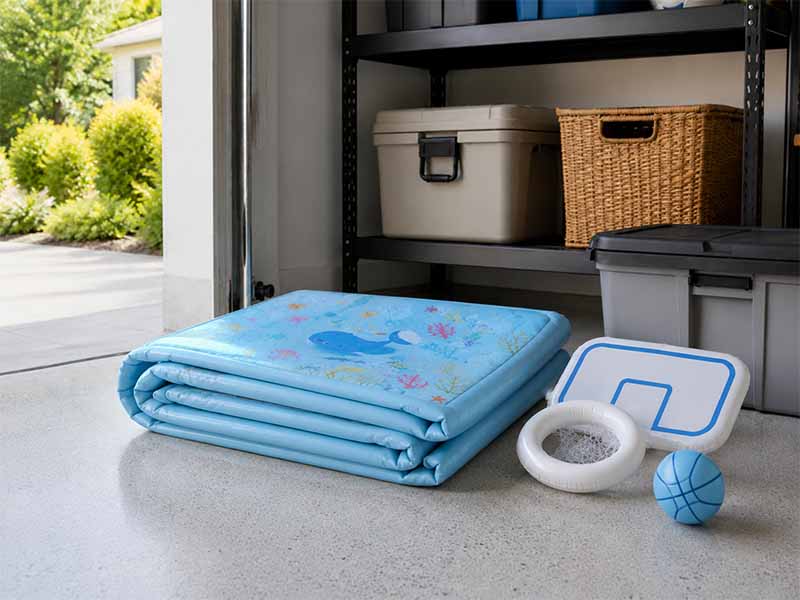
Store a splash pad only after cleaning, draining, and completely drying it. Fold the PVC in broad, relaxed sections, protect the hose fitting and welded perimeter from sharp creases, and place it in clean packaging or a dry storage container. Keep it away from standing moisture, prolonged sunlight, sharp tools, heavy compression, pests, and severe temperature extremes during longer storage.
How Should You Fold It?
Folding should start only after the pad passes the final dryness check. Folding is not a drainage technique. Stepping on a wet folded product or compressing it tightly to squeeze water out can add stress to welded edges and the connector while trapping moisture between the new layers.
Spread the product flat and locate the hose fitting before creating the first fold. Broad, relaxed folds are preferable to repeatedly forcing narrow creases through reinforced areas or the perimeter water channel. If the original packaging provides a recognizable folding pattern, reproducing that layout can be useful because the packaging was designed around the product’s geometry.
PVC thickness affects how a splash pad feels during folding. EPN splash pad development commonly uses approximately 0.40–0.55 mm PVC depending on product design and intended use, with referenced large round models around 0.5 mm. A heavier sheet may feel more substantial but also creates more folded volume, particularly on large family-size pads.
The smallest possible package is not always the best storage result. Saving a few centimeters in a tote is rarely worth creating extreme pressure around the hose fitting or forcing the same welded zone into a hard crease every season. A slightly larger, relaxed fold often makes more sense for long-term storage.
Where Should You Store It?
A good storage location is determined by its conditions, not its name. A dry garage shelf can work very well, while a garage floor beside wet gardening equipment may not. An indoor utility closet may provide excellent protection, while an outdoor deck box can experience condensation and high temperatures despite keeping direct rain away.
| Storage Location | General Suitability | Main Risk |
|---|---|---|
| Indoor utility shelf | Very good | Confirm the pad is fully dry |
| Dry garage shelf | Good | Heat, tools and pests |
| Clean plastic tote | Good for dry products | Moisture trapped inside |
| Original carton indoors | Good | Keep cardboard dry |
| Outdoor deck box | Conditional | Heat and condensation |
| Damp basement floor | Poor | Persistent humidity |
| Exposed patio | Poor | Rain, UV and temperature cycling |
| Tool shed floor | Conditional to poor | Sharp objects, pests and moisture |
Keep the package elevated from areas that may experience rainwater, plumbing leaks, or floor condensation. If you use a plastic tote, check the container itself before loading the pad. A tote that has been stored outside can contain moisture even when no standing water is visible.
Avoid prolonged direct contact with fuels, solvents, oily equipment, pesticides, or other strong household chemicals. A stored splash pad may remain in the same position for months, so cleanliness around the package matters more than it might during a normal afternoon of use.
For most homes, the formula is straightforward: make sure the product is dry, fold it gently, protect the connector, keep the package clean, and store it above a damp floor.

What Should You Keep Away?
Sharp objects are an obvious storage hazard, but garages and sheds contain many less obvious puncture risks. Garden shears, exposed screws, wire ends, shelf brackets, bicycle pedals, hand tools, and rough wooden corners can all damage a folded splash pad because multiple layers of PVC may be pressed against the same small point.
Heavy compression can create a different problem. Avoid placing dense boxes or equipment directly over a connector or thick welded area. Pressure that looks harmless over a few minutes can remain in exactly the same position for several months. The more rigid the component is compared with the surrounding PVC, the more carefully it should be protected from long-term loading.
Prolonged heat and sunlight should also be controlled. Splash pads are made for outdoor summer use, but leaving them continuously exposed while they are not being used provides no benefit. Very cold storage can temporarily make some flexible materials feel stiffer, so avoid aggressively unfolding a pad immediately after removing it from a very cold location.
Rodents and household pets deserve consideration as well. Cardboard boxes, quiet shelves, and folded flexible materials can attract nesting or chewing. Keeping the storage area clean and checking the package before the next season helps catch damage before the product reaches the lawn.
How Do You Store It for Winter?
Winter storage needs more care because the splash pad may remain folded for six months or longer. The final use of the season should therefore end with a maintenance inspection instead of simply folding the product once everyone is finished playing.
Drain the complete water path, remove grass, soil, sunscreen, pet residue, and other contamination, wash where necessary, rinse thoroughly, and dry both surfaces. Inspect the hose fitting, spray holes, welded perimeter, center play area, underside, and common fold lines before packing the pad away.
Look for punctures, cuts, unusual tackiness, seam lifting, or deformation. Any repair should use a method and material compatible with the product construction and should be completely cured before folding. Packing a recently repaired area too early can place unnecessary stress on the repair or cause adjacent surfaces to stick.
At the beginning of the next warm season, do not move directly from the storage box to maximum water pressure. Unfold the pad, allow cold material to return toward normal ambient temperature if necessary, inspect the folds and welds, rinse away storage dust, connect the hose, and increase water pressure gradually.
During the first minute, check the connector and outer perimeter. Water should exit through the intended spray holes rather than from a seam or fold that was damaged during storage. This short pre-season test gives you a chance to catch a small problem before children are already waiting to play.
How Does Splash Pad Design Affect Care?
Splash pad design affects maintenance because PVC thickness, texture, welded seams, spray channels, connector placement, overall size, and folding geometry determine where dirt collects, where water remains after use, and how easily the pad can be stored. Products designed around setup, play, drainage, cleaning, drying, folding, and reuse are generally easier for families to care for over an entire season.
Does PVC Thickness Matter?
PVC thickness matters, but it should not be treated as a single-number quality test. The performance of a splash pad depends on the entire construction, including material formulation, sheet thickness, weld consistency, seam geometry, printing, connector reinforcement, spray-channel layout, surface texture, ground preparation, and normal handling.
A thicker PVC sheet can feel more substantial and provides more material between the user and the ground, but additional thickness also affects stiffness, folded volume, manufacturing conditions, and packaging size. A thick product that is poorly welded or dragged repeatedly over gravel can still fail earlier than a well-engineered product used on properly prepared ground.
EPN splash pad development commonly works with PVC around 0.40–0.55 mm, while referenced larger round designs use approximately 0.5 mm material. These figures are useful product specifications rather than universal thresholds. The appropriate thickness depends on the diameter, intended users, expected pet contact, construction, foldability, packaging size, and the way the product is expected to be used.
| Design Factor | Maintenance Impact | Practical Consideration |
|---|---|---|
| PVC thickness | Changes handling and folded bulk | Match thickness to structure |
| Pad diameter | Changes washing and drying area | Larger pads need more drying space |
| Surface texture | Can retain fine residue | Rinse before dirt dries |
| Spray channel | Can retain water after use | Drain before folding |
| Connector position | Affects drainage and storage | Keep fitting away from hard folds |
| Weld geometry | Influences low points and durability | Inspect during cleaning |
| Print coverage | Can make fine dirt harder to see | Check by touch as well as sight |
For product selection, thickness should therefore be considered together with the ownership routine. A good specification is not simply one that looks impressive in a product description. It should also allow the splash pad to be cleaned, dried, folded, and reused without creating unnecessary difficulty.
Does Surface Texture Matter?
Surface texture affects both the experience during water play and the way the PVC needs to be cleaned afterward. An embossed surface can provide a different underfoot feel from completely smooth material, but shallow grooves may also hold grass particles, fine soil, sunscreen, and soap residue.
This does not make textured PVC a disadvantage. It simply means the cleaning method should match the surface. Rinse contamination while it is fresh and wipe in several directions rather than making one fast pass. A soft cloth or sponge can reach shallow patterns without relying on abrasive tools.
Texture should also be considered together with printing and color. A heavily printed pad can hide small areas of soil, while very light colors reveal dirt quickly. Users should therefore rely on touch as well as appearance. If a textured zone still feels greasy, sticky, or unusually slippery after rinsing, it probably needs additional cleaning.
No wet PVC surface should be treated as completely slip-proof. Water, sunscreen, soap residue, grass, water pressure, and user movement all influence traction. A textured splash pad still benefits from level placement, sensible water pressure, clean ground, and normal adult supervision.
For products used by both children and pets, scratch exposure and paw contamination also become part of the maintenance equation. Material, texture, and expected use should be considered together rather than in isolation.

Do Seams and Connectors Need Care?
Seams and connectors occupy a small portion of the total splash pad, but they deserve careful inspection because they are transition areas where water pressure, layered materials, repeated setup, and handling forces meet.
Do not reposition the pad by pulling sideways on a connected garden hose. Turn off the water, disconnect the fitting, and move the product itself. Side loading can introduce forces the connection does not experience during normal internal water flow.
During cleaning, remove dirt, hair, and grass from around the connector. During drying, position the fitting so remaining water can leave the perimeter when the product construction allows it. During folding, avoid placing the connector directly on a hard crease or underneath a heavy storage box.
Inspect welded edges as part of routine wiping. Look for localized lifting, cuts, unusual distortion, or water escaping somewhere other than an intentional spray hole. Finding a small problem during cleanup is far better than discovering it after the product has been stored for months or once another play session has already begun.
This is also an area where product design matters. Connector placement, spray-hole distribution, weld geometry, water-channel drainage, and fold direction all affect how easy the splash pad is to maintain once it reaches a backyard.
What Makes Storage Easier?
Easy storage begins before the pad is ever folded. A product becomes simpler to care for when residual water can leave the perimeter efficiently, the hose connector does not interfere with folding, the PVC remains flexible enough for its size, and the intended fold pattern does not repeatedly force welded areas into severe bends.
Size changes the maintenance workload significantly. A large family splash pad offers far more play space than a compact toddler design, but it also requires more room for rinsing, flipping, drying, and folding. Owners should consider whether they have a clean area large enough to dry both sides, particularly when choosing very large formats.
Drainability matters just as much. If the outer spray channel repeatedly retains water in several low points, the customer has to spend more time lifting and rotating the product. A well-positioned hose connection can make that process easier, while poor placement can make drainage unnecessarily awkward.
Instructions are part of product design as well. A simple sequence showing how to drain, dry both sides, inspect the connector, and fold the pad can prevent more maintenance mistakes than adding another paragraph about spray height.
EPN’s experience with foldable PVC splash pads includes attention to PVC thickness, surface texture, spray-hole position, spray zones, hose connection, dimensions, graphics, and packaging. Looking at these elements together matters because cleaning and storage convenience are largely designed into the product long before a family uses it for the first time.
A splash pad earns its place in the backyard not only through the fun it creates when the water is running, but through how easy it is to manage when the hose is turned off. The most effective care routine does not require expensive equipment or complicated chemicals. It depends on a consistent sequence: drain promptly, remove debris, clean gently when necessary, rinse thoroughly, dry both sides, inspect the perimeter and connector, fold without unnecessary stress, and store the product in a clean, protected location.
Those habits protect more than appearance. They reduce the conditions associated with mildew and musty odors, prevent sunscreen and dirt from remaining in textured areas, and provide repeated opportunities to notice damage around a seam or fitting before it becomes a larger problem. They also make seasonal setup easier because the product comes out of storage ready for inspection and use instead of needing an emergency cleaning on the first hot day of the year.
Material and construction influence this experience as well. PVC thickness, texture, spray-channel design, weld quality, connector location, and folding behavior all affect how easy or difficult maintenance becomes. For families, that means looking beyond color and spray height when choosing a splash pad. For product developers and retailers, it means recognizing that drainage, cleanability, and storage are part of product quality, not afterthoughts.
EPN’s experience with large foldable PVC water-play products reflects that practical approach. A well-designed splash pad should make sense throughout its full life cycle—from the moment the garden hose is connected to the moment the dry product is folded away at the end of summer. Give drying the same attention as cleaning and storage the same attention as setup, and the pad has a much better chance of returning fresh, manageable, and ready for another season of backyard water play.
Frequently Asked Questions
How Often Should You Clean a Splash Pad?
A splash pad does not need a deep detergent wash after every short play session, but dirt, grass, sunscreen, food residue, and pet contamination should be removed promptly. Rinsing and complete drying are more important after ordinary use, while a deeper clean is sensible after muddy play or before several weeks of storage.
Can You Leave a Splash Pad Outside Overnight?
Leaving a wet splash pad outside overnight is not ideal, especially on grass where the underside can stay damp and collect dirt or insects. If immediate storage is impossible, drain it and leave it spread open rather than folded. Dry both the upper surface and underside completely before packing it away.
Can You Use Dish Soap to Clean a Splash Pad?
A small amount of mild dish soap may be suitable for many PVC splash pads when the manufacturer’s care instructions permit mild detergent. Use a soft cloth or sponge, avoid aggressive scrubbing, and rinse thoroughly until the PVC no longer feels soapy or unusually slippery.
How Do You Get All the Water Out of a Splash Pad?
Turn off and disconnect the hose, allow the center to drain, and gradually lift different sections of the outer spray ring so residual water moves toward the connector or lowest point. Repositioning the pad may be necessary. Do not fold it while you can still hear or feel water moving inside the perimeter.
How Do You Keep a Splash Pad from Getting Moldy?
The most important steps are removing dirt, draining the perimeter, drying both sides completely, and storing the pad only when no moisture remains. A sealed tote protects a dry pad from dust and pests, but it can trap moisture very effectively if the splash pad is packed while still damp.
Should You Fold or Roll a Splash Pad for Storage?
Follow the manufacturer’s original instructions when available. For many large flexible PVC splash pads, broad relaxed folds are practical. Avoid forcing the hose connector, welded spray channel, or reinforced areas into sharp creases, and do not compress the pad simply to create the smallest possible storage package.
Where Is the Best Place to Store a Splash Pad in Winter?
A clean, dry indoor shelf, utility room, or protected garage shelf is generally preferable to outdoor exposure. Keep the folded pad away from damp floors, direct sunlight, sharp tools, rodents, heavy objects, and severe temperature extremes, and inspect it before reconnecting the hose the following season.