Skip to content


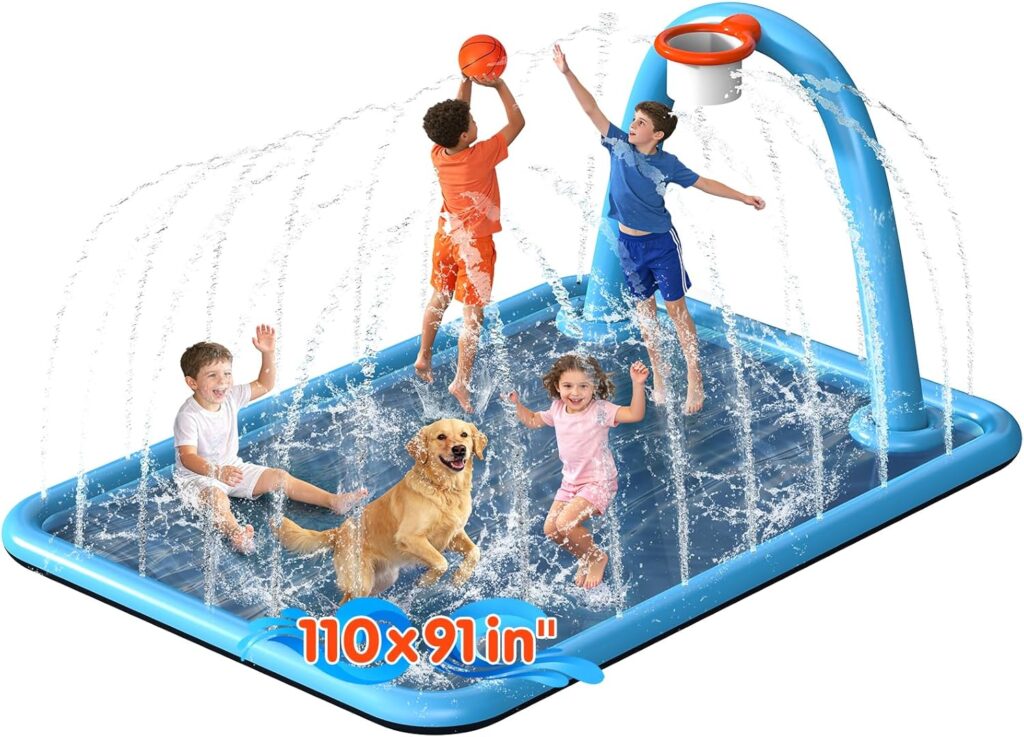
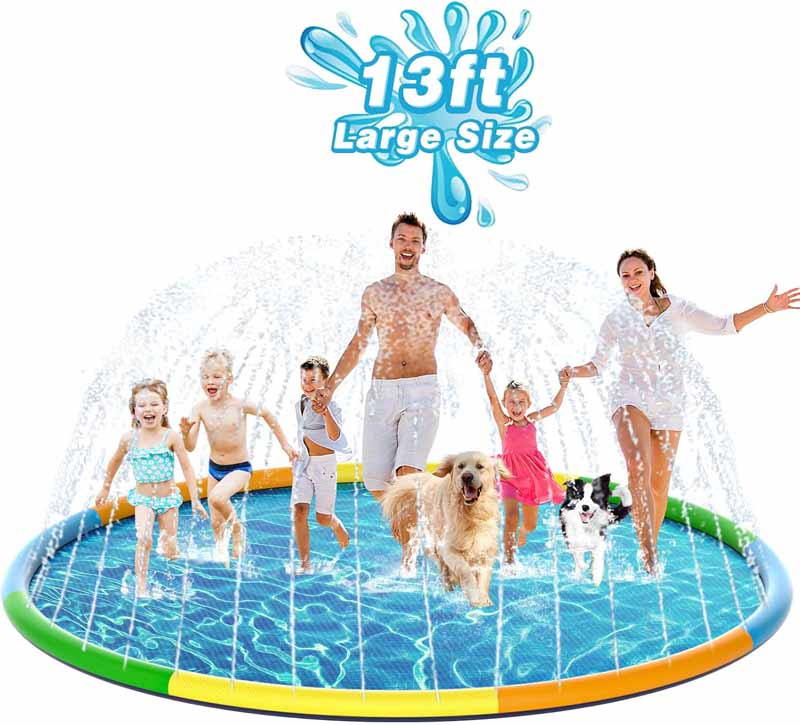
The best place for a kids’ splash pad is not always beside the outdoor faucet. A flat lawn may be 60 feet from the house, the shaded section of a backyard may sit beyond a patio, or the safest play area may require a hose to travel around landscaping instead of straight across the yard. In most homes, a distant faucet is a setup problem rather than a reason to give up on the location. The usual solution is a properly sized garden hose, or two compatible hoses connected together, followed by a simple water-flow test before children start playing.
Distance alone, however, does not predict how well a splash pad will spray. Water has to travel through the household plumbing, faucet, hose, couplings, valves, product connector, outer water chamber, and spray holes before it reaches the children. Hose length, inside diameter, elevation, kinks, leaking washers, partially closed valves, additional fittings, and simultaneous household water use can all change the available flow. A 100-foot hose may work well in one yard while another family sees weak spray over the same distance, so practical testing is more useful than an arbitrary “maximum hose length.”
This guide focuses on the decisions families actually have to make. It explains how to measure the real route, when a longer hose is enough, whether connecting two hoses is reasonable, how hose diameter influences flow, how to perform a simple bucket test, what to inspect when spray becomes weak, how to avoid creating a tripping hazard, and when moving the splash pad or creating a closer outdoor water point becomes more sensible. The goal is a setup you can understand, reproduce, and troubleshoot without turning a summer activity into a plumbing project.
Outdoor Faucet Too Far Away? Start With the Simplest Water Path
For a typical hose-powered portable splash pad, start with the least complicated arrangement capable of reaching the play area. In most cases, this means one garden hose long enough to reach comfortably. If the hose already at home falls short, adding a compatible second hose is also practical. You normally do not need an auxiliary pump or new plumbing merely because the faucet is on the opposite side of the yard.
A useful way to picture the system is to think of every component as part of one continuous water path. The simplest arrangement is outdoor faucet → garden hose → splash pad connector → splash pad. If an extension is necessary, the path becomes outdoor faucet → hose 1 → coupling → hose 2 → splash pad connector → splash pad. A shut-off valve, splitter, timer, or quick-connect fitting may be useful later, but troubleshooting is easier when unnecessary accessories are removed first.
Use the Shortest Practical Hose, Not Simply the Longest Hose Available
“Shortest practical” does not mean stretching the hose tightly between the house and the pad. The hose should reach the inlet without pulling sideways on the connector and should have enough slack to follow a safe route around the play space. At the same time, buying far more hose than the yard needs creates extra internal length, more weight, more storage work, and more opportunity for kinks or coils.
If the actual route measures about 58 feet, for example, a 25-foot hose is obviously insufficient and a 50-foot hose will probably be uncomfortable once obstacles are considered. A length with reasonable working margin is more useful than a hose barely reaching the inlet. By contrast, routing 150 feet of hose to solve a 60-foot problem rarely improves anything unless the hose is also needed for other parts of the property.
A Distant Faucet Does Not Automatically Mean Weak Spray
Water pressure at the wall is only one part of the system. Washington State University’s garden-hose calculator explicitly considers hose length, internal diameter, and supply pressure when estimating garden-hose flow. WSU also notes static pressures in many homes are commonly around 35–80 psi, while dynamic pressure can be lower once water is actually moving through the household piping and hose.
- Evidence / calculation tool: Washington State University — Garden Hose Flow Rate and Time. Use it to compare how hose size, supply pressure, and lengths such as 25, 50, 75, or 100 feet change estimated flow. It is a useful comparison tool rather than a predictor of exact splash-pad spray height.
| Situation at Home | Best First Move | What to Watch |
|---|---|---|
| Existing hose already reaches comfortably | Use it before buying anything | Kinks, leaks, safe routing |
| Existing hose is 10–30 ft short | Add a compatible extension | Extra coupling and washer |
| Faucet is roughly 50–100+ ft from the area | Measure the actual route first | Length, diameter, available flow |
| Long hose reaches but spray becomes weak | Simplify and compare setups | Kinks, fittings, leaks, flow |
| Faucet is inconvenient to reach during play | Consider local shut-off control | Do not add accessories before basic testing |
| Same remote area needs water frequently | Compare a semi-permanent solution | Cost and complexity versus simple hose use |

Measure the Real Hose Route Before Choosing a Hose Length
A common mistake is measuring from the outdoor faucet to the nearest edge of the lawn in a straight line. Real hoses rarely travel in perfect straight lines. A safer route may follow a wall, turn around a patio, avoid a flowerbed, pass behind furniture, and approach the splash pad from the side containing the connector. These detours can add meaningful distance, especially in smaller yards with many obstacles.
Start the measurement where the hose actually attaches to the faucet and finish at the product inlet, not at the center or nearest edge of the splash pad. Walk the path you expect the hose to follow. If you plan to keep the hose along a fence to avoid children running across it, measure that longer perimeter route from the beginning rather than buying based on the shortest geometric distance.
Add Useful Slack, but Avoid a Large Unused Coil
A completely taut hose can transfer movement directly into the product connector. If someone steps on the hose 30 feet away, moves a chair, or pulls the hose while gardening, the connection at the pad may receive unnecessary side load. A relaxed curve near the inlet is more forgiving. Large coils beside the splash pad, however, create extra hose in the active area and may become another obstacle.
A good route should allow an adult to walk from the house to the pad without repeatedly stepping over the hose. Children should also be able to enter and leave the main play area without crossing the water line. Planning for movement is particularly important when siblings, friends, or party guests are using the same splash pad because the play pattern becomes much less predictable than with one child.
Estimate the Distance Remotely When You Cannot Visit the Yard Yet
If the splash pad will be used at a vacation home, rental property, relative’s house, or another location you cannot measure immediately, an online map can provide a preliminary estimate. Google Earth allows users to measure distances and draw paths, which is more useful than simply estimating scale from a satellite image. Actual on-site measurement is still better because fences, stairs, furniture, landscaping, and hose-entry points may be difficult to identify accurately from aerial imagery.
- Planning tool: Google Earth — Measure Distance & Elevation. Use a multi-point path rather than a single straight line if the hose must follow a wall or fence. Confirm the result with a tape measure before purchasing a precisely sized hose.
Plan the Play Area and Hose Route Together
The closest patch of grass to the faucet is not automatically the best location. A splash pad should sit on a flat, clean area free from stones, branches, sharp debris, exposed roots, and other objects which could damage flexible PVC or interfere with children moving around the pad. If reaching the better surface requires another 15 or 20 feet of hose, the longer route may still be the more sensible arrangement.
From a product-design perspective, flexible PVC water-play products perform best when the base can lie flat and the perimeter water chamber is not twisted or pulled by the hose. Choosing the site and water route as one system is therefore more useful than optimizing hose length first and trying to force the product into whatever space remains.
Understand What Hose Length, Diameter, and Elevation Actually Change
Long garden hoses do not “use up” water pressure in a mysterious way. The important process is friction loss. As water moves along the inside of a hose, friction creates resistance. Increasing the distance gives this resistance more length over which to accumulate, and forcing a given amount of water through a smaller internal diameter generally creates greater resistance than carrying the same flow through a larger diameter.
Rain Bird’s irrigation design references provide friction-loss tables specifically because pressure losses due to water movement through pipes matter when designing a water-delivery path. Those tables address irrigation pipe rather than children’s splash pads, so their numerical values should not be copied directly into splash-pad product claims. The underlying principle, however, is the same: pipe or hose size, flow rate, and length influence friction loss.
- Technical evidence: Rain Bird — Friction Loss Charts. Useful for understanding the engineering principle behind pressure loss through a water-carrying line.
Hose Diameter Can Matter as Much as the Length Decision
Residential garden hoses commonly appear in nominal inside diameters such as 1/2 inch, 5/8 inch, and 3/4 inch. When comparing products, verify whether a listed dimension refers to actual inside diameter rather than outside hose size. A wider internal path can generally reduce frictional restriction at a comparable flow, which becomes more relevant as hose length and required flow increase.
This does not mean every splash-pad owner should buy a heavy 3/4-inch hose. A 5/8-inch hose may provide perfectly acceptable flow for a particular home and yard. Larger hoses are heavier, more expensive, and less convenient to store. The useful decision is whether the current setup is actually restricting performance, not whether a technically larger component exists.
Think in Terms of the Whole Water Path
Suppose two families both run 100 feet of hose. Family A uses a relatively large-diameter hose connected directly to a strong outdoor faucet with few fittings. Family B uses a smaller hose, a timer, a narrow quick connector, a Y-splitter, two couplings, and a section climbing uphill. The two setups have the same nominal distance but are not hydraulically equivalent.
This is why statements such as “a 100-foot hose will definitely work” and “anything over 50 feet is too long” are both too simplistic. The only reliable answer for an individual home combines basic hydraulic understanding with a real test under the conditions in which the splash pad will actually operate.
Elevation Deserves Attention in a Sloping Backyard
Water moving uphill experiences an elevation-related pressure reduction in addition to friction losses. Utah State University Extension gives a practical reference of about 0.433 psi per vertical foot, equivalent to approximately 1 psi for every 2.3 feet of elevation change. Going uphill reduces available pressure while going downhill increases it.
A 2-foot change across an ordinary lawn is unlikely to deserve the same concern as a hose climbing 20 vertical feet toward a raised terrace. The latter represents roughly 8.7 psi of pressure change from elevation alone before hose friction and fittings are considered. This figure is useful for understanding the scale of the effect, but it still does not predict an exact splash-pad spray height.
- Evidence source: Utah State University Extension — Maintaining and Improving Irrigation Application Uniformity. The article explains pressure variation caused by elevation and water-flow friction.
| Variable | If It Increases | What a Family May Notice |
|---|---|---|
| Hose length | Frictional loss usually increases | Less available flow at the far end under demanding conditions |
| Internal hose diameter | Restriction generally decreases as diameter becomes larger | Long runs may perform better if the previous hose was restrictive |
| Number of fittings | Additional local losses and leak points may increase | More places to inspect when spray weakens |
| Uphill elevation | Available pressure decreases | Spray may weaken on a substantial uphill run |
| Simultaneous household water use | Available dynamic pressure/flow can decrease | Splash level may change during showers, irrigation, or other use |
| Kinks or crushed sections | Effective flow area becomes smaller | Sudden or severe reduction in spray |

One Long Hose or Two Connected Hoses: Which Is More Practical?
One continuous hose is easier to understand and troubleshoot because there is one fewer connection between the faucet and splash pad. If you are purchasing equipment for a location used every week throughout summer, buying one appropriately sized hose can reduce setup steps. Fewer joints also mean fewer washers, coupling threads, and connections to inspect at the beginning of each season.
Two connected hoses, however, are completely reasonable when you already own them or only occasionally need additional reach. Standard garden-hose systems are specifically designed around compatible male and female couplings, and multiple hoses can be connected end-to-end. In North America, common garden-hose couplings use standard 3/4-inch hose-thread connections, although users should still verify the fittings on their actual equipment.
How to Connect Two Hoses Without Creating a Leak
Turn the outdoor faucet off before taking connections apart. Inspect the female coupling and confirm a sealing washer is present and in usable condition. Align the threads squarely instead of approaching at an angle, start the connection by hand, and tighten it until snug. The washer is important because ordinary garden-hose threads are designed differently from tapered plumbing threads; the washer normally provides the water seal.
Once connected, open the faucet slowly while watching the joint. A small leak is worth correcting before the splash pad is used. A persistent drip can soften the ground around the joint, waste water, and make troubleshooting more confusing because part of the supply is leaving the system before reaching the product.
- Video demonstration: How to Connect Two Hoses. This video demonstrates installing hose connectors and joining garden hoses with couplers. It is useful for families unfamiliar with the basic connection process; the exact splash-pad connector may differ, so the product instructions should still govern the final connection.
Quick Connectors Are for Convenience, Not for Creating Pressure
A quick-connect set can be convenient if the splash pad is repeatedly installed and removed. It allows the user to disconnect equipment without threading and unthreading the fitting each time. The tradeoff is one more component in the water path. Most good-quality fittings work without becoming a meaningful problem in ordinary use, but they should still be removed temporarily if you are diagnosing unexpectedly weak spray.
- Video demonstration: Dixon’s Garden Hose Quick Connects shows how a manufacturer’s quick-connect system is installed and operated. It is useful for understanding what these fittings do before deciding whether the convenience is worthwhile for a frequently used splash pad.
Do Not Solve a Shortfall With a Chain of Tiny Extensions
Using a 50-foot hose plus a 25-foot extension is sensible. Creating a 90-foot route from four or five short leftover hoses may work, but each added coupling gives you another washer, thread pair, potential restriction, and possible leak. The more complicated the water path becomes, the harder it is to isolate a weak-flow problem later.
If a temporary multi-hose arrangement works well, there is no technical requirement to replace it immediately. If the same setup is assembled every weekend and constantly needs attention, a single hose of suitable length may eventually be more convenient than repeatedly managing several short sections.

Test the Water You Actually Have Before Guessing About Pressure
Homeowners often describe a faucet as having “high pressure” because water shoots several feet from the hose with a nozzle attached. This observation does not tell you the actual flow available to the splash pad. Flow and pressure are related but are not interchangeable. A simple bucket test gives a practical measurement of how much water reaches the end of your selected hose configuration.
Use the exact route you plan to run whenever possible. If you intend to use 100 feet of hose, test at the far end of those 100 feet rather than directly at the faucet. Keep conditions consistent if you plan to compare two arrangements. For example, avoid performing one test while an irrigation system is operating and the second test when every other fixture is off.
How to Perform a Bucket Flow Test
Choose a container with a known volume, such as a 1-gallon container or 5-gallon bucket. Start with the hose empty of attachments so water exits freely. Open the faucet to the setting you want to evaluate, allow the flow to stabilize, and time how many seconds it takes to fill the known volume.
For U.S. gallons:
Flow rate in gallons per minute = bucket volume in gallons × 60 ÷ fill time in seconds
If a 5-gallon bucket fills in 50 seconds, the calculation is 5 × 60 ÷ 50 = 6 GPM. If the same bucket needs 75 seconds after a longer hose is added, the flow is 5 × 60 ÷ 75 = 4 GPM. The comparison shows the longer setup delivers less free-flow water under those test conditions; it does not automatically prove the hose is defective.
- Video demonstration: How to Check the Flow Rate of Your Water Source (GPH/GPM) demonstrates a straightforward gallon-bucket test with a stopwatch. Users can watch the method first and then repeat it at the far end of their own hose.
Do Not Convert a Bucket Result Into a Guaranteed Spray Height
A splash pad is not an open-ended hose. Once connected, water passes through an inlet, enters a flexible perimeter chamber, distributes around the ring, and exits from multiple spray holes. Hole count, hole size, water-channel geometry, ring dimensions, product position, and manufacturing tolerances all influence how the delivered water becomes spray.
For this reason, a result such as 5 or 6 GPM is most valuable as a comparison number, not a universal performance specification. If 75 feet produces 6 GPM while 125 feet produces 3.5 GPM at the same faucet setting, you have useful evidence of a water-delivery difference. Claiming either figure will produce a fixed three-foot or four-foot jet height would require specific controlled product testing.
When a Pressure Gauge Is Worth Using
A pressure gauge can help when the faucet itself appears abnormal or when you want to distinguish a whole-house supply issue from a hose issue. Attach a gauge designed for a hose bib to the outdoor faucet and measure according to its instructions. A static pressure measurement is taken when water is not flowing elsewhere through the tested outlet, while dynamic or residual conditions occur when water is moving.
WSU’s garden-hose calculator notes static household pressure is commonly 35–80 psi and explains dynamic pressure may be lower as flow increases because of losses in the plumbing feeding the hose bib. The useful lesson is not to chase one “ideal splash-pad psi,” but to understand whether your outdoor supply changes sharply when water begins flowing.
- Video demonstration: How To Measure Your Home’s Water Pressure shows a pressure gauge attached to a household hose bib and explains how to read the measurement. Use the video for the testing method rather than treating its example readings as a required splash-pad specification.
If the Spray Becomes Weak, Troubleshoot in a Fixed Order
Weak spray is easier to diagnose when the checks are performed in a repeatable sequence. Randomly changing the faucet, hose, adapters, and product position at the same time makes it impossible to know which change solved the problem. Start with visible restrictions, then simplify the water path, then compare a short and long route, and only afterward consider a household plumbing issue.
A useful diagnostic principle from years of working with flexible PVC water products is to separate the system into upstream supply and downstream product. If the product performs normally on a short direct hose but poorly at the distant location, the upstream water path deserves most of the attention. If performance remains weak close to the faucet, distance becomes less likely to be the main cause.
Step 1: Walk the Entire Hose and Remove Kinks
Do not look only at the section near the splash pad. Follow the hose from the faucet to the inlet. Check behind chairs, under gates, around corners, beside the hose reel, and where the hose crosses hard landscaping. A warm flexible hose can flatten where it makes a tight bend, and a section trapped under a furniture leg may be easy to miss.
Uncoil tightly looped sections during troubleshooting. The objective is to create the most open, relaxed water path you can. If the spray immediately improves after straightening one section, you have found a physical restriction without purchasing anything.
Step 2: Inspect Every Coupling for Leakage
Look at the faucet connection first, then every hose-to-hose joint, quick connector, valve, and the splash-pad inlet. A coupling can leak because the washer is missing or damaged, the fitting is cross-threaded, the mating surface is dirty, or the connector itself is cracked. Tightening harder is not always the correct solution.
If a joint leaks, turn the water off before disassembling it. Inspect and replace the sealing washer if needed, clean the mating surfaces, reconnect the fitting straight, and test again. Do not let children play around an actively leaking connection while you are repeatedly adjusting it.
- Video evidence: How to Fix a Leaky Hose Spigot | Ask This Old House demonstrates common hose-spigot leakage points and how a plumbing professional identifies them. It is especially useful when the leak appears to originate at the outdoor faucet itself rather than at the removable garden hose.
Step 3: Remove Unnecessary Fittings
Temporarily reduce the setup to faucet → hose → splash pad. Remove the timer, splitter, extra shut-off valve, and nonessential quick connectors. If two hoses are necessary to reach the test location, keep only the required coupling. Run the splash pad again.
Washington State University’s pipeline-pressure-loss material explains the general hydraulic principle behind this troubleshooting method: fittings produce additional friction losses and can be represented as additional equivalent pipe length in engineering calculations.
- Advanced calculation tool: WSU — Pipeline Pressure Loss Calculators. This is intended for irrigation calculations rather than a required household splash-pad test, but it helps technically minded readers understand how fittings add losses to a water path.
Step 4: Compare a Short Hose With the Long Route
Move the splash pad closer to the faucet temporarily if space allows. Connect a known short hose, use a similar faucet setting, and observe the overall spray. Then restore the long route and compare. The goal is not a laboratory test; it is a household A/B comparison capable of identifying whether distance and the long-hose configuration are major contributors.
If the short setup is clearly stronger, inspect the long hose diameter, fittings, physical condition, elevation, and leaks. If both are similarly weak, investigate the source faucet, household water demand, connector, spray ring position, and the product itself rather than continuing to shorten the hose.
Step 5: Check Whether Other Water Uses Are Running
Dynamic water availability can change when several fixtures draw from the same household supply. A lawn irrigation zone, washing machine, shower, another garden hose, or other high-flow use may cause the splash-pad spray to change. WSU specifically notes dynamic pressure at a hose bib can drop as flow rate increases because the piping leading to the bib also experiences losses.
If the splash pad is strong at 10 a.m. but consistently weak during the evening irrigation schedule, repeat the test with other large water uses temporarily off. This simple comparison is more informative than immediately buying a larger hose.
Step 6: Inspect the Splash Pad Itself
Once the upstream water path has been checked, make sure the flexible perimeter chamber is fully unfolded and not trapped beneath itself. A twisted outer ring can alter water distribution. Check the spray openings for visible dirt, grass, or debris. Make sure the connector is seated correctly and the hose is not pulling the inlet sideways.
| What You See | Most Useful First Check | Simple Comparison |
|---|---|---|
| All jets are lower after adding hose | Hose route and fittings | Short-hose test |
| Water leaks where two hoses meet | Washer and thread alignment | Reconnect with water off |
| Spray becomes weak only at certain times | Other household water use | Retest with major uses off |
| One section sprays differently | Pad position and spray openings | Flatten the perimeter ring |
| Spray is strong near faucet but weak far away | Long-route restriction | Compare hose diameter and fittings |
| Hose flow is weak even without the pad | Outdoor supply or hose itself | Test directly at faucet |
Make a Far-Away Faucet Easier to Control
Once a long hose works, convenience becomes the next issue. Walking 80 or 100 feet back to the wall every time you want to stop the water can be annoying, especially when an adult is supervising children and wants to remain beside the activity area. A small shut-off valve installed near the user end of the hose can move basic water control closer to the splash pad.
Orbit, for example, sells hose-end shut-off couplings specifically designed to adjust or stop flow at the hose end, reducing trips back to the spigot. This type of accessory is useful for convenience, but it does not increase the amount of water supplied by the home. If spray is already marginal, test with and without the valve to confirm it is not adding a meaningful restriction.
- Product-function evidence: Orbit — Elevated Shut-Off Coupling. The manufacturer describes adjusting or shutting off water flow at the hose end as the primary function. This reference illustrates the concept; it is not a requirement to use this specific product.
Use a Splitter Only When You Need Two Water Paths
A two-way splitter is convenient when the faucet also serves a garden, washing hose, or sprinkler. Most splitters include separate shut-off controls for each branch. Orbit’s standard garden-hose Y adapters, for example, convert one faucet into two controlled outlets.
If the splash pad spray becomes weak while another branch is open, close the second branch and retest the pad alone. A splitter divides access to the available supply; it does not create additional household flow. For troubleshooting, one active outlet provides a much clearer comparison.
- Video demonstration: How To Run 2 Hose Pipes From 1 Outside Tap shows a simple two-hose splitter arrangement and makes the concept easy to understand for users who have never divided an outdoor faucet.
Do Not Keep Adding Accessories to Compensate for Weak Flow
A timer can solve scheduling. A quick connector can simplify setup. A shut-off valve can make control easier. A splitter can create two branches. None of these components is intended to generate missing water pressure. When weak spray is the actual problem, solve the flow problem first and then add only the accessories which improve daily use.
This distinction keeps the water path understandable. It also prevents an easy troubleshooting mistake: installing several convenience fittings, noticing weaker spray afterward, and assuming the splash pad has deteriorated.

Route a Long Hose Safely Around a Kids’ Play Area
A hose capable of reaching the perfect lawn location can become a tripping line if it crosses the path children use to run from the house to the splash pad. The most useful route is therefore not always the mathematically shortest route. Moving the hose around the outside edge of the play zone may add several feet but can substantially reduce the number of times children encounter it.
Whenever possible, keep the hose beside a fence, patio border, landscaping edge, or exterior wall for most of its route. Make the final approach to the splash pad from the side least likely to become an entry path. Adults should be able to reach the hose connection and water control without stepping through the center of the children’s activity.
Treat Wet PVC as a Wet Play Surface
A standard flexible PVC splash-pad surface becomes wet by design. Unless a specific product has a tested and documented slip-resistant structure, it should not be described as “non-slip.” Children should move in a controlled manner, and adult supervision remains important regardless of the product’s size, pattern, or spray height.
Before setup, remove stones, branches, sticks, exposed roots, sharp objects, and hard toys from beneath and immediately around the pad. Flexible PVC can conform to small objects underneath it, so a piece of debris which seemed harmless on dry grass may become noticeable once children begin stepping and playing on the wet surface.
Use Outdoor Play-Safety Resources as General Guidance, Not Splash-Pad Standards
The U.S. Consumer Product Safety Commission’s playground materials are written for playground environments, not portable residential splash pads. They are still useful as a general reminder to inspect children’s outdoor activity areas for tripping hazards, protrusions, and other obvious environmental risks. The source should be presented honestly as broader play-area safety guidance rather than as a certification requirement for a hose-powered mat.
- Evidence source: U.S. Consumer Product Safety Commission — Home Playground Safety Checklist. Use it as general outdoor play-area reference material, especially when checking the surrounding yard for avoidable hazards.
- Downloadable reference: CPSC — Outdoor Home Playground Safety Handbook. This PDF provides a broader safety reference families can save or print. It is not a splash-pad operating manual.
Keep Slack Near the Connector Without Leaving Loops in the Running Area
Leave a gentle relaxed section of hose near the product inlet so normal movement does not pull directly on the fitting. At the same time, position excess hose outside the area where children circle, chase, or enter the pad. If extra length must be coiled, place the coil close to the faucet or outside the active zone rather than beside the product.
The same rule applies at parties or playdates with several children. More children means movement patterns become harder to predict, so a hose route which is acceptable for one supervised child may need to be moved farther from the activity when siblings and friends join.
Know When Moving the Splash Pad Is Smarter Than Adding More Hose
The best backyard location is a balance among ground condition, water supply, hose routing, drainage, shade, adult visibility, and child movement. If reaching one particular location requires several hose extensions, a path across a doorway, a run through the center of the yard, and multiple accessories, another suitable section of lawn may provide a better overall experience even if it is not the family’s original first choice.
A particularly useful decision test is to move the pad temporarily closer to the faucet and observe both water performance and play-area quality. If the closer site is flat, clean, easy to supervise, and produces much more stable spray, changing locations may solve several problems at once. If the distant location is substantially safer or more practical for children, improving the water route may be worth the effort.
Occasional Use Usually Favors a Hose Solution
For a family using a splash pad several weekends each summer, a properly routed longer hose is usually proportional to the need. Permanent plumbing work can cost far more, involves the house itself, and may need to consider freeze protection, backflow control, access to supply piping, and local plumbing requirements.
Keeping the solution proportional is an important part of user-centered product advice. A consumer should not be encouraged to modify the building simply because a seasonal PVC water-play product is 80 feet from the current faucet.
Frequent Year-Round Water Use May Change the Calculation
If the same remote section of the yard also needs water for gardening, pet washing, outdoor cleaning, irrigation, and other activities, a more permanent water point becomes a broader property improvement rather than a splash-pad accessory. In that situation, the convenience may justify discussing options with a qualified plumbing professional.
A permanent outdoor faucet is a different project from connecting another garden hose. The work may involve cutting into household water lines, penetrating an exterior wall, adding valves, creating freeze-resistant arrangements in cold climates, and following local requirements. Presenting this distinction helps families understand when a simple summer setup has become a real plumbing project.
A Quick Five-Minute Setup Check Before Play
Once the preferred hose route is established, most families do not need to repeat calculations each time. A consistent five-minute check is more useful. Inspect the hose condition, verify each connection, unfold the splash pad, clear the surface underneath, open the faucet gradually, and observe the entire perimeter before children step onto the wet PVC.
- Confirm the hose follows the planned safe route.
- Check every coupling for a washer and visible damage.
- Straighten kinks and remove tight coils.
- Place the pad on flat, clean ground.
- Keep children off during the initial water test.
- Open the faucet gradually.
- Watch every hose joint for leakage.
- Check the outer ring is fully unfolded.
- Adjust water flow to a comfortable spray level.
- Recheck the children’s entry path before play begins.
What PVC Product Design Can Improve—and What It Cannot Fix
A well-designed splash pad can improve how incoming water is distributed once it reaches the product. Designers can work with inlet geometry, perimeter chamber dimensions, hole size, hole spacing, hole orientation, PVC thickness, heat-sealed seam structure, and the overall diameter of the ring. These details influence how a hose-fed PVC product fills and how water exits around the perimeter.
The upstream household system still remains outside the product designer’s control. A manufacturer cannot responsibly guarantee an identical spray height in every home when household pressure, hose length, hose diameter, elevation, faucet condition, and water demand differ. A useful product specification therefore describes how the product connects and how spray can be adjusted through household water flow, while avoiding unrealistic promises such as a fixed jet height under all residential conditions.
Spray-Hole Design Is a Balance, Not Simply “More Holes Is Better”
Adding spray holes divides the available incoming water among more outlets. Making holes larger can change discharge characteristics. Changing the angle can influence where the water lands. Increasing the splash-pad diameter also changes the perimeter water path. These variables interact, so a custom design should be prototyped as a complete system instead of selecting hole count from appearance alone.
For brands developing custom PVC or composite-material water-play products, useful prototype testing can compare several controlled source conditions rather than testing only at maximum faucet flow. A product which produces an attractive spray under one unusually strong supply but becomes highly uneven with moderate household flow may need additional design work before mass production.
Connector Selection Deserves More Attention Than It Usually Gets
Consumers experience the hose connector every time the product is installed. A connector should be understandable, compatible with the intended market’s garden-hose system, positioned so the hose can approach without severely bending the product, and designed to minimize unnecessary restriction. Instructions should also tell users to connect with the water off and increase flow gradually after assembly.
For OEM or custom splash-pad development, this is an area where product engineering and consumer usability meet. Material choice, heat-sealed construction, connector geometry, spray pattern, graphics, packaging instructions, and target market should be developed as one system rather than treating the PVC body as the only meaningful specification.
The same principle applies to many PVC and composite-material outdoor products: successful customization is less about changing a color or logo and more about understanding how people will connect, fill, drain, fold, transport, store, and troubleshoot the finished product. For companies developing new water-play products, early discussion of these real-use details often prevents problems which would be expensive to correct only after tooling, printing, and mass production.
A Practical Decision Guide for 50, 75, 100 Feet and Beyond
Families often want a simple distance answer, so it is useful to translate the hydraulic principles into practical scenarios without pretending the distances are engineering pass/fail thresholds. Think of the figures below as points where additional checks become more valuable, not as guarantees.
For a relatively short 25- to 50-foot route, a normal residential hose connected directly to a functioning faucet often presents fewer distance-related concerns. You should still inspect kinks and leaks, but there is usually less accumulated hose friction than in a much longer arrangement. If the pad is weak even on this simple route, check the source, connector, hose condition, and product layout before assuming you need a larger-diameter hose.
At roughly 50 to 75 feet, hose size and condition become more worth checking, particularly if the hose is narrow, old, kink-prone, or connected through several accessories. A good existing setup does not need an upgrade simply because it crosses this distance. The practical test is whether flow and spray remain stable.
At around 75 to 100 feet, avoid selecting by length alone. Compare internal diameter, keep the route straight, minimize unnecessary fittings, and perform a bucket or short-hose comparison if performance is uncertain. WSU’s calculator conveniently includes 25-, 50-, 75-, and 100-foot length choices, making it easy to see why the same nominal hose length can give different estimated flows when supply pressure or internal diameter changes.
Beyond 100 feet, the same principles still apply, but the benefits of a better route, larger suitable hose, fewer fittings, lower elevation gain, or a closer water point deserve more consideration. Very long routes can work, but the decision should become increasingly evidence-based rather than assuming another extension will automatically provide satisfactory results.
| Approximate Route | Practical Mindset | Useful Check |
|---|---|---|
| 25–50 ft | Usually a straightforward residential run | Inspect hose and connections |
| 50–75 ft | Begin paying closer attention to hose condition and diameter | Compare free flow if spray seems weak |
| 75–100 ft | Treat length, diameter, fittings, and elevation as a system | Bucket test and short-hose comparison |
| 100+ ft | Evaluate whether the water route itself is still practical | Compare larger route changes or a closer play location |
These ranges are planning examples rather than manufacturer performance limits. A specific splash pad should be evaluated under its real household conditions.
Frequently Asked Questions About a Splash Pad Far From the Faucet
Can I Use a 100-Foot Garden Hose With a Splash Pad?
Yes, a 100-foot hose can be used with a hose-powered splash pad if the household water supply and the completed hose route deliver enough usable flow. There is no universal rule making 100 feet automatically too long. Internal hose diameter, fittings, elevation, faucet condition, kinks, and available dynamic flow all influence the result. The most useful approach is to run the 100-foot configuration, perform a bucket test if needed, and compare the splash pattern with a shorter hose before deciding whether distance is causing the problem.
Will a Longer Garden Hose Reduce the Splash Pad’s Water Pressure?
A longer hose creates more frictional resistance, so increasing length can reduce the pressure and flow available at the far end under otherwise comparable conditions. The amount of change depends strongly on hose diameter and flow rate, which is why a fixed statement such as “every 25 feet reduces pressure by X psi” would be misleading without specifying the rest of the system. If the splash pad operates normally at the desired distance, there is no need to change the hose merely because it is long.
Is a 5/8-Inch or 3/4-Inch Hose Better for a Long Splash-Pad Run?
A 3/4-inch hose generally offers a larger internal water path and can reduce frictional restriction compared with a smaller hose carrying a similar flow, which may be beneficial for a long and demanding run. A 5/8-inch hose remains very common for residential use and may be completely adequate. Larger hoses are heavier, bulkier, and often cost more, so the better choice depends on whether the existing setup actually has a flow problem rather than on diameter alone.
Can I Connect Two Garden Hoses Instead of Buying One Long Hose?
Yes. Connecting two compatible garden hoses is a practical solution, especially when you already own the hoses and only need the extra distance for occasional summer use. Check the female coupling washer, align the threads correctly, connect with the faucet off, and inspect the joint after slowly turning the water on. One continuous hose has fewer possible leak points, but two properly connected hoses can function well and may save the cost of buying a new long hose unnecessarily.
Why Does My Splash Pad Spray Lower After I Add an Extension Hose?
The extension changes several things at the same time: total length increases, another coupling is added, and the second hose may have a different internal diameter or physical condition. Walk the complete route for kinks, inspect the new coupling for leakage, temporarily remove accessories, and compare the pad with the original shorter hose. If performance returns with the short hose, the extended water route is a strong suspect. If both setups remain weak, investigate the faucet supply and splash-pad layout next.
Can I Use a Hose Splitter With a Splash Pad?
A splitter can be useful when the same faucet serves the splash pad and another outdoor task, but opening both branches means the available household supply must serve two water paths. If spray becomes weaker, shut the second outlet and test the splash pad alone before changing equipment. Keep the system simple during troubleshooting, then reconnect the second branch once you understand how the home’s available flow behaves under simultaneous use.
Should I Install Another Outdoor Faucet Closer to the Splash Pad?
For occasional seasonal splash-pad use, a longer hose is usually simpler and less invasive than altering household plumbing. A new outdoor faucet becomes worth considering when the remote area needs water frequently for several purposes throughout the year, such as gardening, cleaning, pet care, irrigation, and water play. At that point, evaluate the project as a permanent property improvement and consider local plumbing requirements, freeze conditions, backflow protection, and professional installation rather than treating it as a splash-pad accessory.
Conclusion
When the outdoor faucet is far from the splash pad, begin with the simplest solution capable of reaching the play area safely: a correctly sized garden hose or a sensible two-hose extension. Measure the real route, not merely a straight line across the yard, and leave enough slack to protect the connector without creating coils in the children’s running area. Once the hose reaches the pad, evaluate the entire water path rather than focusing on distance alone.
If spray is weaker than expected, use a repeatable process. Straighten the hose, inspect every washer and joint, remove unnecessary fittings, compare short and long routes, check other household water demand, and inspect the splash pad’s perimeter chamber. Hose length, internal diameter, elevation, fittings, and household dynamic flow all influence what eventually reaches the product, so a simple comparison at your own home is more useful than a universal distance rule.
The best setup is ultimately the one which delivers stable water while keeping the PVC play surface on suitable ground, the hose away from children’s main movement paths, and the water controls within practical reach of an adult. When the same distant area requires water for many activities throughout the year, a permanent outdoor water point can be considered separately. Until then, careful hose selection, clean connections, sensible routing, and a five-minute pre-play check solve most distant-faucet situations without turning backyard water play into a major home-improvement project.