Skip to content


Yes, a kids splash pad can generally work with well water, and many families who live outside municipal water systems can use a hose-fed backyard splash pad without changing the product itself. The important part is not whether the water comes from a city pipe or a private well. What matters is whether the source water is appropriate for children to contact, whether the well can provide enough sustained pressure and flow, and whether sediment, iron, hardness, or other water conditions could interfere with the spray system over repeated use.
This distinction is especially important because private wells are common in the United States. The U.S. Environmental Protection Agency reports that more than 23 million U.S. households rely on private wells for drinking water, and roughly 15% of the U.S. population uses private wells as a drinking-water source. Unlike public water systems, private domestic wells generally are not regulated federally under the Safe Drinking Water Act, so homeowners have much more responsibility for testing, maintenance, and understanding changes in their water.
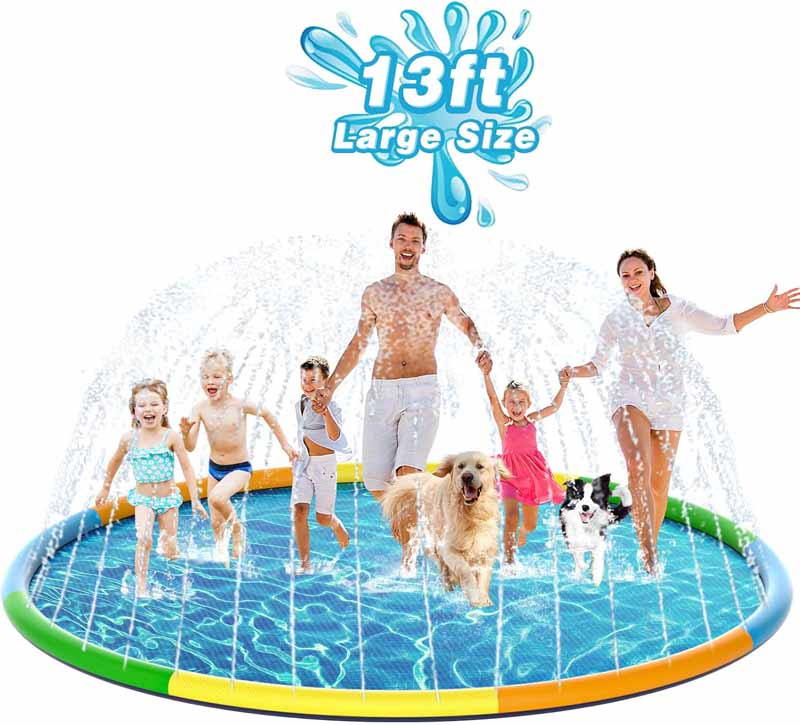
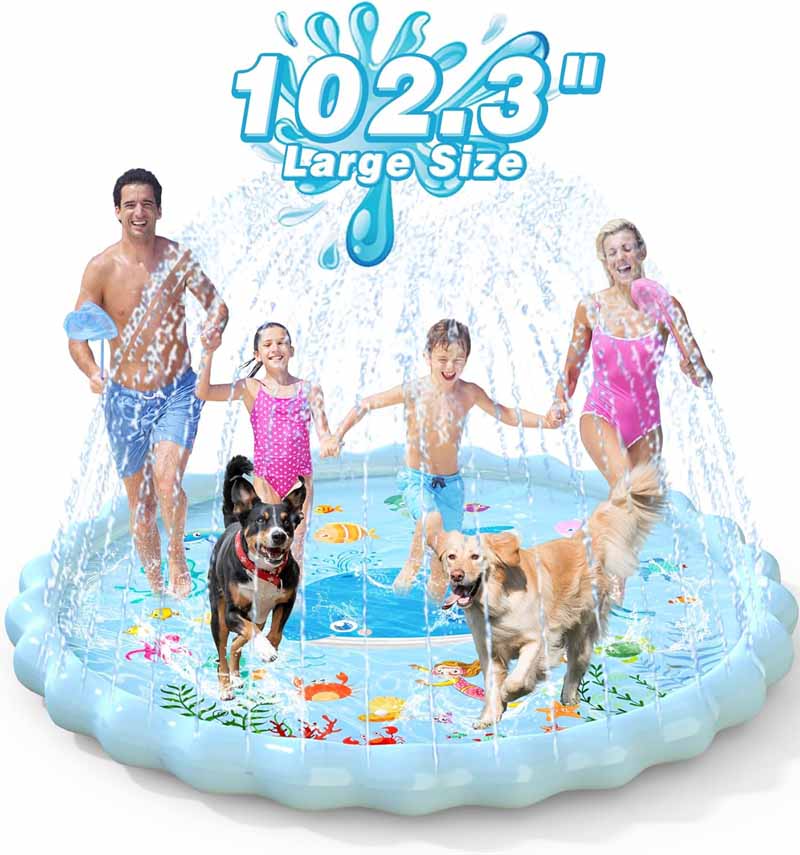
A splash pad adds a second question on top of water quality: can the home actually deliver enough water to make the product perform properly? Flexible PVC splash pads normally receive water from a garden hose and distribute it through an outer water channel containing multiple small openings. They generally do not contain a built-in pump that creates pressure. As a result, a perfectly functional splash pad can produce weak spray at one property and much stronger spray at another because the two homes have different pressure, available flow, hose lengths, fittings, pump systems, or simultaneous household water use.
For a family using well water, the best way to think about the problem is therefore to separate it into three decisions. First, determine whether the source water is appropriate for the intended child contact. Second, determine whether the well, pressure tank, plumbing, faucet, and hose can provide stable water delivery. Third, consider whether sediment and dissolved minerals may create maintenance problems around small spray openings. Once those three questions are answered, deciding whether a kids splash pad can work with your well becomes much easier.

Can a Kids Splash Pad Really Run on Well Water?
A typical backyard splash pad does not inherently require municipally treated water in order to operate mechanically. If sufficient water enters the garden-hose connection, fills the outer water channel, and reaches the spray openings under usable pressure, the product can spray regardless of whether the household source is municipal water or a private domestic well. However, mechanical operation is only one part of the decision, and it should never be used as proof that an untested source is suitable for children.
The Short Answer: Yes, If Three Conditions Are Met
For most households, a practical decision can be made by looking at three conditions rather than searching for a special “well-water splash pad” product category. The first condition is water quality: the well should have a known testing and maintenance history appropriate to the household. The second condition is water delivery: enough sustained flow and pressure should reach the garden hose. The third condition is water condition: excessive sediment, scale-forming minerals, or debris should not repeatedly obstruct the inlet or small spray openings.
| Home Water Situation | Likely Result | Practical Response |
|---|---|---|
| Routinely tested household well with stable flow | Usually a good starting condition | Connect the pad and observe sustained operation |
| Acceptable water but modest outdoor pressure | Pad may work with lower jets | Test actual hose flow and gradually adjust faucet |
| Visible sand, rust particles, or sediment | Pad may initially work but clogging risk rises | Investigate sediment before repeated use |
| Untested irrigation-only well | Spray may work, but suitability for kids is unknown | Test the source before routine child contact |
| Strong initial spray followed by major pressure loss | Stored pressure may be masking limited supply | Evaluate sustained flow and well behavior |
| Flood-affected or known contaminated well | Recreational use should wait | Follow local health guidance and retest |
“The Water Sprays” Does Not Mean “The Water Is Safe”
One of the easiest mistakes to make is assuming that clear, strong spray means the water is suitable for play. A splash pad is essentially a hydraulic distribution product. It cannot detect coliform bacteria, nitrate, arsenic, pesticides, volatile organic compounds, or other potential contaminants. Water can be clear, odorless, and mechanically excellent while still requiring testing. The opposite can also occur: water with an acceptable household testing history may produce disappointing spray simply because the outdoor plumbing delivers limited flow.
This separation between water safety and product performance should guide every troubleshooting step later in the article. If the jets are weak, investigate water delivery before assuming contamination. If the jets are tall and even, do not use their appearance as a substitute for a well-water test. Families who understand this difference are less likely to replace a working splash pad unnecessarily or overlook a private-well issue simply because the product appears to run normally.
Evidence note: EPA explains that private-well owners are responsible for delivering safe drinking water to their households and reports that about one in five wells in a USGS study contained at least one contaminant above a human-health benchmark. This does not mean every private well is unsafe; it explains why individual testing matters.
Is Your Well Water Safe Enough for Kids to Play In?
Private well water should never be treated as one uniform category. Water quality can differ between neighboring properties because well depth, geology, aquifer conditions, septic systems, agricultural activity, flooding, surface runoff, and well construction vary. A useful splash-pad guide therefore cannot simply say “well water is safe” or “well water is unsafe.” The better question is whether your specific source has a reasonable testing history and no current warning signs.
Tested Household Well vs. Untested Irrigation Well
A household well routinely used for drinking, cooking, bathing, and other domestic purposes gives a family far more useful information than a separate outdoor well used only for lawn irrigation. An irrigation source may deliver excellent pressure and perfectly clear water while having no recent testing history for human contact. The ability to water grass, trees, or crops does not by itself demonstrate suitability for a child who may get spray on the face, lips, hands, and skin.
Before connecting a splash pad, determine which plumbing system actually feeds the outdoor faucet. Some rural properties use the same domestic well throughout the home, while others have separate irrigation lines, storage tanks, reclaimed-water connections, or secondary wells. If the source is unfamiliar, do not guess based on hose location. Finding out where the water originates is a simple step that prevents a large amount of uncertainty later.
What Should a Private Well Owner Test?
The CDC currently recommends testing private well water at least once each year for total coliform bacteria, nitrates, total dissolved solids, and pH. It also advises contacting the local health or environmental department to learn which additional germs or chemicals are important in the area. Local conditions may justify testing for contaminants such as arsenic, lead, pesticides, volatile organic compounds, or other substances, depending on geology and nearby land use.
These recommendations are more meaningful than judging water by smell or appearance because some important contaminants may not create an obvious sensory change. A homeowner who cannot remember when the well was last tested has identified a useful action item before summer water play begins. The goal is not to turn splash-pad setup into a laboratory exercise, but to avoid relying on appearance alone when children will have repeated contact with the spray throughout the season.
Evidence note: CDC recommends at least annual testing for total coliform bacteria, nitrates, TDS, and pH, and recommends using a state-certified laboratory.
External tool — Find a Certified Drinking Water Laboratory: Homeowners who do not already have a laboratory can use EPA information to locate state laboratory certification programs and certified drinking-water testing resources rather than relying only on general-purpose home strips.
When Should You Test Again?
Annual testing is a baseline, not a reason to ignore meaningful changes between tests. The CDC recommends additional testing when there are problems near the well, including flooding or land disturbance, after well-system repair or replacement, when taste, color, or smell changes, and in several other circumstances. These events matter because contamination can enter a private well even when the water performed normally throughout previous seasons.
Flooding deserves special attention because surface water can introduce microorganisms and other contamination around or into a well. EPA provides specific post-flood guidance covering well and pump inspection, emergency disinfection, sampling, and testing. If a well has been flooded, a splash pad should not become an informal experiment to see whether the water “looks fine now.” Household water safety should be established first, and recreational use can follow later.
Evidence note — Flooded well guidance: EPA provides specific instructions for inspection, disinfection, sampling, and testing after a flood.
Video — Are You a Smart Well Owner?: This short educational video is useful for households new to private wells because it explains owner responsibility, well-water testing, and basic protection practices in straightforward terms.
Video — Private Well 101, Florida Well Owner Network: This longer UF/IFAS Extension webinar is useful for homeowners who want more depth on well-water quality, quantity, maintenance, and groundwater protection instead of treating the splash pad as an isolated appliance problem.
Does Your Well Have Enough Water Pressure and Flow?
Once the source water is reasonably understood, the next issue is hydraulic performance. Many splash-pad troubleshooting articles use “pressure” as a catch-all term, but a more accurate explanation separates pressure from flow. They influence each other, yet they describe different things. Understanding this distinction helps homeowners diagnose weak spray without immediately assuming either the well pump or the splash pad is defective.
Pressure and Flow Are Not the Same Thing
Pressure describes the force available to push water through the system and is usually expressed in PSI. Flow describes the amount of water moving through the plumbing over time and is commonly expressed in gallons per minute, or GPM. A splash pad needs enough pressure to create useful jets and enough flow to supply all of the openings simultaneously. Strong static pressure at the faucet does not guarantee high sustained flow once dozens of holes begin releasing water.
Imagine a pad with many small spray openings around a large perimeter. Every opening shares the same incoming water supply. If a narrow hose, restrictive connector, partially closed valve, or long plumbing run limits the available flow, opening more spray holes does not create more water. Instead, the available water is divided among them, and individual jets may remain low. This is why a pressure reading alone cannot fully explain real-world splash-pad performance.
What Low Water Supply Looks Like in Real Use
A household water-supply limitation often produces recognizable patterns. All jets may remain low even when the faucet is fully open. The section farthest from the inlet may spray less strongly than the nearby section. Spray height may drop sharply when someone starts a shower or washing machine. In a conventional well system, the pattern may also rise and fall as pressure moves between the pressure switch’s cut-in and cut-out settings.
Hose geometry is another major variable. Longer hoses create more friction loss than shorter ones, smaller internal diameters generally restrict flow more than larger ones, and hose reels, quick-connect fittings, splitters, shutoff valves, kinks, or partially crushed sections can become bottlenecks. A user may therefore improve splash height without changing anything at the well simply by testing a shorter, less restrictive hose path.
There Is No Universal PSI Number for Every Kids Splash Pad
It is tempting to publish one clean number such as “40 PSI required,” but doing so would create false precision. Splash pads differ in diameter, nozzle count, nozzle diameter, inlet size, internal water-channel cross-section, spray angle, and intended spray height. Two products of similar outside diameter may therefore respond differently at the same pressure. Manufacturer specifications, where available, are more useful than a generic number copied across unrelated products.
Residential well systems themselves also vary. Private Well Class describes examples in which low-end pressure settings can fall around 20–40 PSI and high-end settings around 40–60 PSI, depending on the installed system. Those figures help explain typical pressure-tank operation; they do not establish a universal operating requirement for splash pads.
External tool — Washington State University Garden Hose Flow Calculator: This tool estimates free-flowing hose delivery using hose size, supply pressure, and hose length. WSU clearly notes the calculation assumes an open hose end rather than a sprinkler, so it is best used to understand restrictions and compare setups, not to promise a specific spray height.
How to Test Your Well Before Connecting the Splash Pad
A family does not need an expensive flow meter to perform a useful first check. A bucket with a known volume, a stopwatch, the actual outdoor faucet, and the same hose intended for the splash pad can reveal a great deal. This does not replace a professional well-yield or pump test, but it gives the homeowner a practical baseline for comparing faucets, hoses, and changes in system performance.

Step 1 — Run a Bucket Flow Test
Start with the outdoor faucet you plan to use. Use a bucket with a known capacity, open the faucet to the normal position you would use for outdoor play, and measure how long it takes to fill the bucket. A common calculation is:
Flow in GPM = Bucket Volume in Gallons × 60 ÷ Fill Time in Seconds
For example, if a 5-gallon bucket fills in 60 seconds, the observed flow is approximately 5 GPM. If the same bucket fills in 30 seconds, the observed flow is approximately 10 GPM. If it fills in 20 seconds, the observed flow is approximately 15 GPM. These numbers describe the tested outlet under those conditions; they should not be turned into universal “pass” or “fail” splash-pad numbers.
Perform the test once at the faucet and, if practical, again through the actual garden hose. A large difference between the two results tells you the hose path is introducing substantial restriction. If changing to a shorter hose or removing a narrow fitting noticeably improves measured flow and spray performance, you have identified a hydraulic bottleneck without touching the pump or modifying the product.
Video — How to Check the Flow Rate of Your Water Source: This demonstration shows the bucket-and-stopwatch method in a way a homeowner can copy immediately. The technique is widely used in irrigation planning because it answers the same basic question a splash-pad user has: how much water is actually available at the outlet?
Video URL:
Step 2 — Test for Sustained Performance
Do not make the decision based only on the first few seconds after opening the faucet. A private-well pressure tank already contains water under pressure, so the initial spray may look excellent before the pump has been required to support continued demand. Let the pad run long enough to observe stable behavior and multiple normal system cycles rather than judging performance during the first burst.
While it runs, watch whether the spray remains reasonably consistent. A gradual collapse in height, interrupted flow, major pressure loss elsewhere in the house, or unusual pump behavior suggests something more important than the pad’s nozzle design. At that point, forcing the faucet farther open is not the best solution. Reducing recreational demand and evaluating the well or plumbing is more sensible.
Step 3 — Repeat the Test With Normal Household Demand
Real homes rarely use one faucet at a time. After establishing a baseline with major fixtures off, observe what happens when a shower, washing machine, or another normal water user is operating. The purpose is not to deliberately overload the well; it is to see whether a realistic household condition changes splash-pad performance dramatically. A small reduction may simply reflect shared flow, while a complete pressure collapse deserves more attention.
If your family frequently schedules outdoor water play during irrigation, laundry, or shower times, this comparison is especially useful. One of the simplest ways to improve splash performance may be to avoid stacking several high-demand uses together. This costs nothing, requires no modification to the PVC product, and reduces the chance that a low-yield well or smaller pressure system will be pushed unnecessarily.
Step 4 — Test the Exact Hose Setup You Plan to Use
Do not test with a short 10-foot hose and then expect identical performance through a 100-foot hose routed around a patio. Hose length, internal diameter, elevation change, fittings, reels, splitters, and kinks all change real delivery conditions. If the splash pad is intended for a lawn far from the house, use the real route during testing so the result reflects the environment children will actually experience.
From a product-development perspective, this is also a useful lesson for custom splash-pad design. A prototype should not be evaluated at only one ideal factory water source. Testing at several realistic flow conditions, hose lengths, and inlet pressures can reveal whether nozzle count, hole diameter, inlet geometry, and water-channel design provide acceptable spray uniformity across the types of residential conditions customers are likely to have.
Can a Splash Pad Overwork a Well Pump or Use Water Faster Than the Well Recovers?
A splash pad does not automatically “overwork” a properly designed well pump simply because it uses water continuously. The more useful question is whether the recreational demand fits the capacity and current condition of the specific well system. A high-yield well with an appropriate pump and pressure tank may handle summer water play easily, while a low-yield well may already be close to its practical limit during showers, irrigation, laundry, or dry-season use.
What the Pressure Tank Actually Does
A conventional pressure tank performs two important jobs: it stores usable water under pressure and reduces the need for the pump to start every time a small amount of water is used. As water leaves the tank, system pressure drops. When it reaches the pressure switch’s lower setting, the pump starts. When demand ends and the upper pressure setting is restored, the pump stops.
This explains why the splash pad may change height somewhat as the well system cycles. Normal pressure variation is different from rapid cycling every few seconds or a system that never seems to recover. Private Well Class notes that a waterlogged tank or related pressure-tank problem can lead to frequent pump cycling, which wastes energy and can be hard on the pump.
Video — How Does My Private Well Pressure Tank Work?: This Private Well Class video visually explains stored water, system pressure, pump cycling, and the role of the pressure tank. It is especially useful if spray height changes as the pump starts and stops and the homeowner wants to understand what is happening before calling the pad defective.
Well Yield Is Different From Hose Flow
Hose flow is what you measure at a faucet at a particular moment. Well yield describes how much water the well itself can sustainably provide or recover over time. A pressure tank can temporarily provide water faster than the well is producing it because the tank contains stored water. Once the stored volume is drawn down, however, the well and pump must keep up with the ongoing demand.
This is why a splash pad might run strongly for several minutes and then perform poorly on a low-yield system. The early period can be supported partly by stored water, while later operation depends more heavily on continued production. Families who already know their well has seasonal limitations or slow recovery should treat recreational water as a flexible use that can be shortened or scheduled around essential household demand.
What Pump and Well Warning Signs Matter?
The splash pad itself should not be used as a reason to ignore broader water-system symptoms. If outdoor play coincides with unusually rapid pump cycling, pressure collapsing throughout the house, water sputtering from faucets, new sand in the plumbing, long interruptions in supply, or a pump running continuously without normal recovery, stop the optional water use and investigate the well system rather than repeatedly restarting the pad.
Useful warning signs include:
- Household pressure falls dramatically while the splash pad runs
- Water flow becomes intermittent rather than simply lower
- Air begins sputtering from faucets
- The pump cycles on and off unusually rapidly
- The pump appears to run continuously without recovering normal pressure
- New sediment appears at several household fixtures
- The property is already experiencing drought-related well limitations
- Known low-yield conditions are becoming worse
Video — How Does My Private Well System Work?: This Private Well Class video explains the relationship among the well, pump, pressure tank, pressure switch, and household fixtures. It is valuable for users trying to understand why the same splash pad behaves differently while the pump cycles or while other fixtures are running.

Can Sediment, Iron, or Hard Water Clog a Kids Splash Pad?
Water quality affects more than health. Some private wells contain suspended particles or dissolved minerals that create aesthetic and maintenance problems. A flexible PVC splash pad may tolerate the water itself quite well while the smallest parts of the hydraulic path become vulnerable to accumulation. Connectors, screens, narrow channels, and spray openings are more likely to show symptoms before the broad PVC surface does.
Sand and Sediment Can Affect Small Spray Openings
Visible sand, silt, rust flakes, or other particles can pass through the garden hose and enter the splash pad. Large particles may stop at a screen or connector, while smaller material can move into the outer water channel and collect around spray openings. One blocked hole may create a noticeably different jet direction or height, while several partially blocked holes can make one section look weak even when overall supply pressure is reasonable.
A homeowner who routinely finds grit in faucet aerators, irrigation heads, hose nozzles, or appliance screens should consider the source-water condition before assuming the splash pad is unusually sensitive. Repeatedly pushing sharp tools into PVC spray holes is not a good repair strategy because enlarging the openings changes hydraulic balance and may damage the surrounding material. Gentle rinsing and upstream sediment control are safer first steps.
Iron and Manganese May Leave Visible Staining
Iron-rich well water can produce rusty coloration, sediment, and reddish or orange staining, while manganese can produce darker staining. EPA lists 0.3 mg/L for iron and 0.05 mg/L for manganese as secondary drinking-water standards associated mainly with aesthetic effects such as color, staining, taste, and deposits. Those secondary values are useful for understanding nuisance conditions but should not be misrepresented as a universal splash-pad damage threshold.
If orange staining already appears around toilets, sinks, outdoor faucets, irrigation fittings, or hose ends, similar deposits may appear around a light-colored splash pad’s spray holes and folds. This does not automatically mean the PVC is deteriorating. It often indicates the same dissolved or particulate iron issue appearing wherever water evaporates. The better long-term solution is to understand the well-water condition rather than repeatedly scrubbing the pad with aggressive cleaners.
Hard Water Can Create Scale Without Visible Sediment
Hard water differs from sand and sediment because the minerals are dissolved in the water and may not be visible while the water is flowing. After evaporation, calcium- and magnesium-related deposits can form white or pale scale on fixtures and small openings. A sediment filter designed to capture particles does not remove dissolved hardness simply because both conditions can produce deposits.
For splash pads, scale becomes most relevant where the water path narrows. A light layer on the broad floor may be largely cosmetic, while buildup around small spray openings can gradually change jet shape or reduce flow. Complete drainage and drying after use, plus periodic inspection of the holes, can catch the problem before enough scale accumulates to change overall spray distribution.
Evidence note: EPA advises private-well owners to test annually for several basic indicators and provides additional information on contaminants and nuisance conditions that may affect household water quality.
Do You Need a Filter for a Splash Pad on Well Water?
Not every well-water splash pad needs an additional filter. If the household already has appropriate treatment, the outdoor faucet receives clean water, no recurring particle problem exists, and hose equipment does not clog, installing another filter simply because the source is a well may add cost and pressure loss without solving a real problem. Filtration should respond to a known condition rather than become an automatic requirement.
When a Sediment Filter Makes Sense
A sediment filter may be helpful when sand, silt, rust particles, or similar suspended solids repeatedly reach outdoor fixtures. In this situation, filtering before the splash pad can reduce the amount of material entering small spray openings. Filter selection should consider particle size and water demand because finer filtration generally creates more resistance, especially as the filter loads with debris.
A useful way to judge whether filtration is helping is to repeat the same bucket-flow test before and after installation and again as the filter ages. If a new filter removes visible particles while maintaining useful outdoor flow, it is doing something valuable. If an excessively restrictive cartridge causes splash height to collapse while the underlying well continues producing sediment, the system needs a better overall solution rather than simply a finer cartridge.
Filtration Is Not the Same as Water Safety
A sediment filter captures certain physical particles. It does not automatically remove bacteria, nitrate, arsenic, dissolved metals, pesticides, volatile organic compounds, or every other possible well contaminant. Likewise, a water softener addresses hardness but does not function as universal disinfection. Carbon, ultraviolet systems, oxidation, ion exchange, reverse osmosis, and other technologies solve different problems and require correct design.
For this reason, testing should generally come before treatment decisions when water quality is uncertain. The appearance of orange stains may suggest iron, but a laboratory analysis provides much more useful information than selecting equipment based only on color. Homeowners who already have laboratory results can also use educational interpretation tools to understand the meaning of the numbers before deciding whether professional treatment advice is needed.
External tool — CWI Water Quality Interpretation Tool: This tool allows users to enter drinking-water, irrigation, or livestock laboratory results and receive an interpretation against relevant thresholds. It can help a homeowner understand a report, but it should complement local health guidance rather than replace it.
Do Not Treat a Hose-Fed Backyard Pad Like a Commercial Recirculating Splash Park
This distinction is important because “splash pad” describes several very different systems. Some public facilities collect sprayed water in a reservoir, filter and disinfect it, and send it back through the jets. Other installations operate as single-pass systems in which water passes through the plumbing once and then drains away. CDC’s outbreak research explicitly distinguishes recirculating and single-pass splash pads.
A simple family PVC splash pad connected directly to a household hose typically behaves much more like a small single-pass outdoor water toy than a municipal recirculating aquatic facility. Public-facility guidance about automated disinfectant control, recirculation, filtration turnover, and chemical monitoring should therefore not be copied blindly into a backyard setup. Parents should not improvise chlorine or bleach dosing inside a hose-fed pad unless the product was specifically designed and instructed for such treatment.
How to Set Up a Kids Splash Pad Safely With Well Water
Once the well source and water-delivery conditions look reasonable, careful setup can improve both safety and spray performance. The product should sit on a clean, flat area, the hose path should be as free of restrictions as practical, and the water should be increased gradually. These simple steps also make troubleshooting easier because the family starts from a controlled setup rather than changing several variables at the same time.
Prepare the Surface Before Connecting Water
Flexible PVC products perform best when the ground beneath them does not contain sharp stones, sticks, irrigation hardware, landscaping fasteners, or rough debris. Water and children’s movement press the material against whatever lies underneath, so something harmless-looking before filling can become a concentrated pressure point during use. A quick sweep of the lawn is often more valuable for durability than adding unnecessary thickness to the product.
Choose an area where runoff can move away without creating a muddy hole beneath the pad. A splash pad may release many gallons during a play session, and poorly draining soil can become soft enough to make the surface uneven. Avoid placing the hose where children repeatedly trip over it, and check the adapter before opening the water so a small connection leak does not waste flow the spray ring needs.
Open the Faucet Gradually
Connect the hose securely, then open the faucet slowly and allow the water channel to fill. Watch the jets develop around the perimeter before increasing flow. A well-designed pad should allow users to adjust spray height over a useful range by changing incoming water delivery, although the exact response depends on product geometry and the household system.
Gradual adjustment also makes the experience more comfortable for younger children. The tallest possible spray is not automatically the best operating point. If the jets are reaching well beyond the play area and substantial water is running off unused, lowering the faucet can conserve water while maintaining enjoyable spray. Families with low-yield wells may benefit especially from finding the lowest flow setting that still produces a stable play pattern.
Keep Spray Water Out of Children’s Mouths and Noses
Even when the source is the same private well used for household drinking water, a splash pad should be treated as recreational water rather than as a drinking fountain. During play, water contacts feet, hands, grass, dirt, toys, and surrounding surfaces. CDC recommends that splash-pad users do not swallow the water and do not allow water to go up the nose, and it advises people with diarrhea to stay out of recreational water.
The CDC’s national review covering 1997 through 2022 identified 60 reported waterborne disease outbreaks associated with splash pads, resulting in 10,611 reported cases. Most of those data relate to public facilities and should not be used to claim an identical risk level for a family’s once-through backyard pad. They do show why simple hygiene behaviors remain sensible whenever children play in sprayed recreational water.
Evidence note — CDC Splash Pad Guidance: CDC recommends not swallowing splash-pad water, not allowing water to go up the nose, taking bathroom breaks, and keeping people with diarrhea out of the water.
Video — CPSC Pool Safely: This U.S. Consumer Product Safety Commission water-safety video gives parents a simple visual reminder about active supervision and safer behavior around children’s water activities. Although a shallow splash pad is different from a swimming pool, supervision habits still apply whenever young children are playing around water.
Video URL:
Why Is My Splash Pad Spraying Low or Unevenly on Well Water?
Low or uneven spray should be diagnosed systematically instead of automatically blaming “bad well pressure.” A splash-pad water path contains several potential restrictions: the home plumbing, outdoor faucet, hose, hose reel, splitter, shutoff valve, adapter, product inlet, internal water channel, and individual openings. The most efficient troubleshooting process begins upstream and moves toward the pad, checking the simplest causes first.
| What You See | Possible Cause | First Check |
|---|---|---|
| Every jet is low | Limited flow, low pressure, restrictive hose | Bucket-test the faucet and hose |
| One side is weaker | Local blockage, fold, or flow imbalance | Flatten pad and inspect nearby openings |
| Spray drops when a shower starts | Competing household demand | Test again without the second fixture |
| Spray rises and falls repeatedly | Normal or excessive well-system cycling | Observe pump and pressure behavior |
| Jets weaken after repeated use | Sediment or mineral buildup | Inspect openings and connector |
| Orange residue appears | Iron-related staining | Review household water analysis |
| White scale forms | Hardness/mineral deposits | Check household fixtures for similar scale |
| Strong initial spray fades badly | Limited sustained supply | Observe longer-duration well performance |
Start at the Faucet and Work Forward
First confirm the outdoor faucet itself is delivering normal water. Next inspect the hose for kinks, a collapsed section, a restrictive reel, narrow quick connectors, or unnecessary splitters. If possible, compare a short direct hose against the usual long setup. A large improvement immediately points toward the hose path rather than the splash pad’s internal construction.
Then examine the product inlet and visible spray openings. Remove loose grit gently and straighten any folded section of the water channel. Avoid using needles, drills, scissors, or other sharp objects to enlarge holes because changing even a few nozzle diameters can alter the hydraulic balance of the entire ring. More water may escape from the enlarged holes, leaving less available for the remaining openings.
Compare Conditions Instead of Guessing
Controlled comparisons are often more informative than one pressure reading. Test the same splash pad at two faucets, or test two hose lengths from the same faucet. Observe the product when major household fixtures are off and again when one normal fixture operates. If performance changes immediately with water-delivery conditions, the pad is responding to the supply rather than behaving randomly.
This approach also helps families avoid unrealistic comparisons with product videos. A demonstration filmed at a property with high outdoor flow, a short large-diameter hose, and no competing household use may show taller jets than a rural home using a long hose from a modest pressure system. The product can still be operating correctly in both locations, only at different points on its usable flow range.
When a Product Design Issue Becomes More Likely
If supply flow is stable, the hose path has been checked, sediment is absent, the product lies flat, and the same specific group of openings remains weak every time, an internal flow-distribution issue becomes more plausible. In that case, the inlet position, welded channel shape, nozzle pattern, or a local internal restriction may deserve inspection under the manufacturer’s troubleshooting process.
For PVC product development, this is one reason prototype testing should measure spray uniformity, not only maximum height. Designers can compare multiple inlet pressures, flow rates, hose lengths, nozzle diameters, and hole spacing patterns. A pad that looks spectacular only under unusually high factory water delivery may create more customer frustration than a design optimized for a broader range of real residential conditions.

How Should You Clean and Store a Splash Pad After Using Well Water?
Well water does not require an entirely different storage routine, but sediment and mineral-rich water make good drainage and inspection more valuable. The biggest mistakes usually occur when a wet pad is folded immediately, stored with grit inside the folds, or repeatedly allowed mineral deposits to dry around small openings without inspection. A few minutes of maintenance after play can prevent many problems that later look like manufacturing defects.
Rinse Visible Sediment Before It Dries
After shutting off the faucet, disconnect the hose and allow pressure to release. If grit, orange residue, or visible deposits are present, rinse the affected area before everything dries into a harder layer. Use a soft cloth or other cleaning method compatible with the product rather than aggressive abrasive pads that may scratch printing or damage surface treatments.
Pay particular attention to the connector and spray openings because those are the narrowest points in the system. If one opening has accumulated sediment, flush loose material rather than mechanically enlarging it. A homeowner who must clean the same debris every session should investigate the incoming well water, because repeatedly treating the symptom at the splash pad will not solve the upstream cause.
Drain the Water Channel Completely
The outer spray ring or channel can hold water even after the faucet is shut off, especially when the pad remains perfectly flat. Lifting sections gradually and allowing water to move toward the inlet or drainage path can help empty the product. Do not force-fold a water-filled ring because trapped water increases weight and puts unnecessary stress on welded seams.
For custom product development, drainage is an underrated design detail. Connector position, channel geometry, seam layout, and the location of low points determine how easily a large pad empties. A product that drains predictably is easier to dry and store, which can reduce user frustration far more effectively than simply adding another decorative feature.
Dry Before Folding and Storing
Allow both sides of the material to dry before long-term storage. Moisture trapped inside folds can encourage odor, transfer dirt between surfaces, and make mineral residue more difficult to identify. Drying is particularly important when the product has been placed on wet grass, because the underside may remain damp long after the top looks dry.
Flexible PVC and similar composite materials are useful for seasonal water-play products because they can combine waterproofing, welded construction, printability, foldability, and compact storage. Durability, however, depends on more than material thickness. Repeated sharp folding at the same location, rough ground, prolonged UV exposure, unsuitable cleaners, stressed seams, and improper storage can all shorten service life even when the base material itself is robust.
When Should You Not Use Well Water for a Kids Splash Pad?
Most households with a maintained private domestic well do not need to turn every splash-pad session into a risk assessment. However, there are situations where recreational use should clearly wait. These generally fall into two categories: water-quality uncertainty and well-system distress. Recognizing those categories allows parents to respond calmly rather than assuming every mineral stain is dangerous or ignoring an important contamination warning because the spray still looks normal.
Stop and Check the Water First If the Source Has Changed
Do not continue routine water play when a known contamination issue exists, a flood has affected the well, the water suddenly changes color or smell, unusually heavy sediment appears, or the outdoor source is specifically designated non-potable and has no appropriate testing history. These are not situations where running the splash pad longer provides useful evidence.
CDC recommends testing after several types of changes or events, including flooding, well-system repairs, and changes in taste, color, or smell. EPA also emphasizes that runoff and other environmental pathways can introduce contaminants into private wells.
Stop and investigate before use if:
- The well has never been tested and its history is unknown
- A flood has reached or surrounded the well
- A current laboratory result identifies a problem requiring action
- Local authorities have issued a relevant advisory
- Water suddenly changes color, odor, or clarity
- Heavy sediment appears without a known explanation
- The outdoor source is an untested irrigation or non-potable line
- A recent repair has not yet been followed by recommended testing
Stop and Check the Well System If Water Delivery Becomes Abnormal
A separate set of symptoms indicates a mechanical or supply issue. If operating the splash pad causes household pressure to collapse, the pump runs continuously without recovery, water becomes intermittent, or rapid pump cycling begins, reducing optional water demand should come before troubleshooting spray height. The household water supply is more important than maintaining recreational use.
This becomes particularly relevant during drought or with known low-yield wells. A system may behave perfectly during spring and become more limited later in a dry summer as groundwater conditions change. The correct response is not to increase the faucet opening indefinitely. It is to recognize the changing water-supply condition and adjust optional outdoor use accordingly.
A Five-Minute Pre-Use Check
Once the well has a normal testing and maintenance routine, families can reduce the daily process to a quick check. Look for changes rather than trying to recreate a laboratory test. Confirm that the source is the expected household well, water appearance is normal for the property, the hose has stable flow, the pump behaves normally, and no serious buildup is visible around the product’s spray openings.
| Check | Green — Ready to Play | Yellow — Check First | Red — Do Not Use Yet |
|---|---|---|---|
| Well test history | Current routine testing | Testing history is old or uncertain | Known contamination issue |
| Recent events | No unusual well event | Major storm nearby | Flood affected the well |
| Water appearance | Normal for household | New minor staining | Strong color, odor, or sediment change |
| Hose flow | Stable | Lower than usual | Intermittent or collapsing |
| Pump behavior | Normal cycling | Behavior seems different | Severe rapid cycling or failure to recover |
| Splash pattern | Stable and reasonably even | Lower than expected | Major loss linked to household pressure failure |
| Spray holes | Clear | Minor deposits | Repeated serious clogging |
| Child use | Supervised | Extra attention needed | Water suitability is not established |
A green result means the water source is understood, no current warning is present, the water system behaves normally, and the product delivers stable spray. A yellow result identifies something worth checking, such as an outdated test, unusual deposits, or lower-than-normal flow. A red condition means optional recreational use should stop while the underlying water-quality or mechanical issue is addressed.
External downloadable resource — Private Well Class Assessment Tools: These tools provide a more systematic process for evaluating private wells, springs, site conditions, construction factors, nearby land use, and potential public-health risks. They are useful when a splash-pad question reveals that the homeowner needs a broader review of the well itself.
Conclusion: Well Water Can Work, but Know the Source and the System
A kids splash pad can work very well with private well water, and there is no general rule requiring families to have municipal water simply to use a hose-fed backyard pad. The reliable decision comes from combining three separate checks: understand the water quality, confirm stable pressure and flow, and manage sediment or mineral conditions that may affect small spray openings. Treating those as separate questions makes the entire topic much easier to troubleshoot.
For most families, the practical routine is straightforward. Keep the domestic well on an appropriate testing schedule, know which source feeds the outdoor faucet, measure hose flow when performance is uncertain, observe the system during sustained use, and inspect the pad after play. If a problem appears, work from the faucet toward the product rather than immediately assuming the PVC body or spray ring has failed.
For manufacturers and brands developing PVC or composite-material water-play products, private-well households also highlight an important design lesson. Real customers do not operate products under one perfect laboratory pressure. Product development should consider realistic hose lengths, moderate residential flow, nozzle distribution, connector restrictions, drainage, sediment tolerance, seam quality, material flexibility, and repeat folding. Designing around a broad range of real household conditions often creates more practical value than chasing the tallest possible spray in a controlled demonstration.
The simplest takeaway is therefore not merely “yes, well water works.” A more useful answer is: yes, a kids splash pad can usually work with a properly maintained private well when the water is suitable for child contact, the system can supply stable flow and pressure, and sediment or mineral conditions are managed appropriately. When those conditions are understood, families can spend less time wondering about the water source and more time using the product safely and comfortably.
Frequently Asked Questions
1. Can well water damage a kids splash pad?
Well water does not automatically damage flexible PVC or similar splash-pad materials. The more common concerns are sediment entering the spray openings, iron leaving orange or reddish stains, and dissolved minerals forming scale after water evaporates. These effects are usually maintenance issues rather than proof of material failure. If identical staining or scale already appears on household faucets and showerheads, the source water is a more likely explanation than a defect in the splash pad.
2. How much water pressure does a kids splash pad need?
There is no universal PSI requirement that applies to every kids splash pad. Required performance depends on outside diameter, nozzle count, individual hole size, inlet diameter, hose length, internal water-channel design, and desired spray height. Residential well systems may operate across several common pressure-switch ranges, but those household pressure values should not be converted into a generic splash-pad specification. Follow the manufacturer’s stated requirement where available and verify real performance using the actual faucet and hose.
3. How can I tell whether my well provides enough water for a splash pad?
A simple bucket test is a practical starting point. Measure how many seconds the outdoor faucet takes to fill a bucket with a known volume, then calculate approximate gallons per minute. Repeat the measurement through the actual garden hose if practical. Afterward, run the splash pad long enough to observe normal pump cycling. Stable performance over time is more useful than a strong spray during the first few seconds when stored pressure in the tank may temporarily support the demand.
4. Should I install a sediment filter before using a splash pad with well water?
A sediment filter may help when the well repeatedly produces visible sand, silt, rust flakes, or other suspended particles that clog hose equipment or small spray holes. It is not automatically necessary for every private well. The filter must also be selected carefully because very fine or dirty filters can restrict flow and reduce spray performance. Most importantly, sediment filtration does not turn an unknown water source into tested water and does not remove every dissolved chemical or microorganism.
5. Can children drink water from a splash pad if the private well is safe to drink from?
Children should still be discouraged from intentionally drinking splash-pad water or placing their mouths directly over spray jets. Water may begin as household drinking water but then contact feet, grass, hands, toys, soil, and surrounding surfaces during play. CDC specifically advises users not to swallow splash-pad water and not to allow the water to go up the nose. Normal supervision and simple hygiene practices are appropriate even when the original household source has a good testing history.
6. Can a splash pad make a private well run dry?
A healthy well with adequate yield may support recreational water use without difficulty, but a low-yield or drought-stressed well can struggle when demand exceeds the rate at which water is available. A pressure tank can temporarily supply stored water and make initial performance look stronger than the long-term supply really is. If spray weakens substantially over time while household water pressure also falls, stop the optional use and evaluate sustained well performance rather than simply increasing the faucet opening.
7. Why does my splash pad spray lower at home than it did somewhere else?
The difference may come from the entire water-delivery system rather than the product itself. Well pressure settings, available GPM, hose diameter, hose length, fittings, elevation, household water demand, pump cycling, and sediment can all influence jet height. Compare the product using a shorter hose, test flow at the outdoor faucet, remove unnecessary restrictions, and observe performance while other large water users are off. If those changes noticeably improve the spray, the pad is responding normally to different hydraulic conditions.