Skip to content


A cheap kids splash pad and a premium-looking model can appear almost identical when you scroll through product photos. Both may have bright graphics, a circular PVC play surface, a garden-hose connection, and a ring of sprinkler holes around the edge. One might cost noticeably more than the other, yet the price alone tells you surprisingly little about the parts most likely to affect family use. Materials, welded construction, usable play space, water distribution, hose connections, storage requirements, repair options, and reliable safety information matter far more than a “premium” badge printed on a product image.
Families also use splash pads in very different ways. One parent may want an easy water activity for a single preschooler on a few hot weekends, while another household may have several siblings playing outside every week throughout the summer. Some families have a large, flat lawn and strong outdoor water flow; others have a small backyard, a long garden hose, limited storage, or a vacation property where water pressure is unpredictable. These differences are among the recurring practical concerns identified for families considering backyard splash pads.
From the perspective of a product specialist familiar with long-term PVC and welded recreational-product development, the most useful comparison is therefore not cheap versus expensive. It is specification versus real-world value. A higher price makes sense only when it pays for a measurable difference your household will actually benefit from. A lower-priced model can be an excellent purchase when its construction, size, setup, and expected use are appropriate. A more expensive model can still be poor value if most of the added cost is tied to decorative features or vague marketing language.
What Are You Really Paying For?
The most important rule is simple: price is a signal, not a specification. When a splash pad costs more, look for evidence of what changed. Did the manufacturer use a different material construction? Is the pad substantially larger? Were the seams or sprinkler ring redesigned? Is there a specific surface treatment? Does the connector work more reliably? Is repair support provided? Has the brand clearly documented applicable safety compliance? If you cannot identify a meaningful improvement, the extra cost may not improve your family’s experience.
| Your Main Use | What Matters Most | Is Paying More Likely to Help? |
|---|---|---|
| Occasional play for one child | Correct age range, suitable size, simple setup | Often unnecessary |
| Weekly summer use | Construction, seams, connector, repairability | Often worth checking |
| Several siblings | Usable area, water distribution, supervision space | More likely |
| Parties and playdates | Size, predictable setup, manageable spray level | Often useful |
| Limited storage | Easy draining, folding, drying | Depends on design |
| Safety-conscious purchase | Verifiable compliance and instructions | Price alone proves nothing |
| Long-term value | Realistic uses, repair potential, care requirements | Compare cost per use |
The rest of this guide explains how to make those comparisons without needing laboratory equipment or becoming a plastics engineer. It also shows how to check your yard, measure household water flow, estimate cost per use, identify common failure points, and separate genuine construction information from claims such as “extra thick,” “ultra durable,” or “100% non-slip.”
1. Cheap vs Premium Splash Pads: Where Can the Extra Money Actually Go?
The term premium has no standardized technical meaning in this category. A manufacturer can use it to describe material, artwork, packaging, size, accessories, or simply market positioning. The same limitation applies to phrases such as “heavy duty,” “upgraded,” “extra strong,” or “commercial quality.” These expressions may help communicate a product concept, but none tells a parent exactly how the splash pad was built or how it will behave on a lawn.
A genuine cost difference can come from using more material, changing PVC film specifications, enlarging the product, modifying the welded perimeter, increasing printing complexity, using additional tooling, changing spray-hole geometry, adding connectors or adapters, upgrading packaging, including repair materials, or performing additional quality and compliance work. Some of these changes can noticeably improve everyday usability. Others mainly affect appearance, merchandising, or production cost without making a significant difference to the way children actually play.
When I evaluate a splash pad specification, I therefore start by replacing adjectives with questions. “Extra large” becomes “What is the fully expanded diameter?” “Premium PVC” becomes “What material specification is documented?” “Non-slip” becomes “What physical surface structure creates additional traction?” “Adjustable spray” becomes “How does the adjustment work?” “Heavy duty” becomes “Which part of the construction was changed?” This process prevents a common buying mistake: paying for language instead of paying for a feature.
For brands or retailers developing a custom splash pad, the same principle should be applied before sampling. A useful specification can define overall size, shape, artwork, Pantone color, sprinkler-hole layout, hose-connector position, PVC thickness, surface requirements, packaging, instructions, and accessories. Structural changes should then be evaluated for their effect on welds, water distribution, material usage, manufacturing consistency, and testing requirements. The manufacturer fact library supporting this guide specifically treats size, spray layout, connector position, PVC thickness, surface construction, packaging, and accessories as variables requiring project-level evaluation rather than automatic upgrades.
That approach is especially important when a proposed design moves away from a proven welded-PVC platform or introduces a different laminated, coated, or composite construction. Materials with similar appearances are not automatically interchangeable. Welding behavior, stiffness, foldability, printing compatibility, water resistance, seam design, and test methods can change. A responsible custom project should therefore be evaluated, sampled, tested, and confirmed before any new specification is described as superior.

2. Seven Splash Pad Specifications Worth Checking Before the Price
Most families do not need to understand every production variable inside a PVC factory, but seven areas are worth checking because they connect directly to common backyard problems. These include material construction, welded seams, surface design, actual dimensions, hose connection, water-distribution behavior, and repair or after-sales support. None of these factors works in isolation, which is one reason simplistic product comparisons often reach misleading conclusions.
| Specification | What It Helps You Understand | What It Cannot Guarantee |
|---|---|---|
| PVC construction or thickness | Material amount, flexibility, handling | Fixed lifespan or puncture-proof use |
| Welded seams | How water-carrying sections are joined | Permanent leak prevention |
| Surface structure | Whether a specific texture exists | Zero slipping on a wet surface |
| Expanded dimensions | Overall product footprint | Exact child capacity |
| Hose connector | How water enters the pad | Identical performance on every hose |
| Spray layout | How water is distributed | Fixed jet height at every home |
| Repair and support | How minor problems may be handled | Protection against every type of damage |
PVC Thickness Is Useful Information, but It Is Not a Durability Score
PVC thickness is measurable, so it naturally attracts attention. If two otherwise similar products use noticeably different material specifications, the thicker sheet usually contains more PVC per unit area and may feel stiffer or heavier. Depending on the formulation and construction, thickness can influence folding behavior, local puncture tolerance, abrasion resistance, and how easily the material is deformed during use.
The mistake is turning one number into an entire quality verdict. A thick PVC mat can still be punctured by a sharp stone, thorn, metal edge, broken branch, or hard toy. A thicker sheet can also be connected by a poorly designed weld or combined with a weak connector. Conversely, a moderately specified sheet used on a clean lawn with appropriate welding and careful storage may provide perfectly reasonable seasonal service. Real durability is better understood as material + welding + design + ground conditions + handling + storage.
This is also why responsible product pages should not casually claim “puncture-proof.” Flexible PVC recreational products are designed to resist ordinary use within their intended conditions, but a flexible sheet is still a material that can be cut or punctured. A more credible product description explains the intended surface, advises the user to remove sharp debris, and provides repair guidance when appropriate.
Heat-Sealed Construction Matters at the Water-Carrying Edge
Many kids splash pads use heat-sealed or welded PVC sections to create the outer ring. Water enters this ring and builds enough internal pressure to form the perimeter before exiting through sprinkler openings. The welded area therefore has to do more than hold two decorative sheets together. It helps define the water channel, maintain the ring shape, and tolerate repeated filling, draining, stepping nearby, folding, and unfolding.
A heat-sealed seam is still not an automatic “never leaks” feature. Weld quality depends on compatible material, correct process conditions, adequate seam geometry, clean surfaces, consistent tooling, and sensible stress distribution. Repeatedly forming a hard crease through the same welded point or dragging the product while it is full of water can also place avoidable strain on the structure.
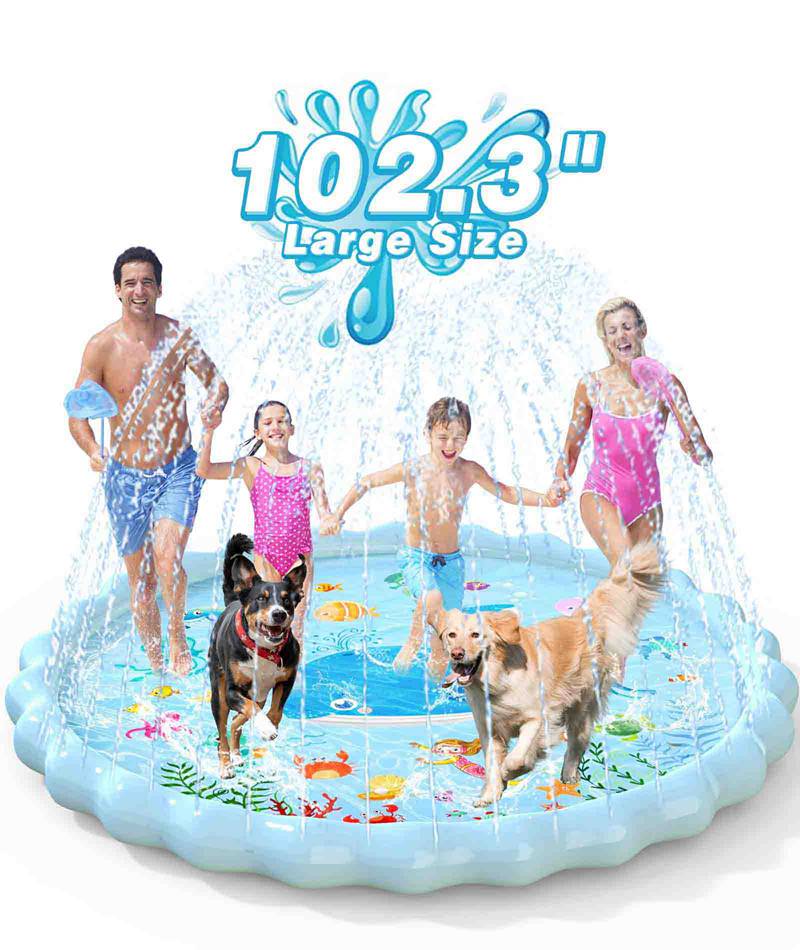
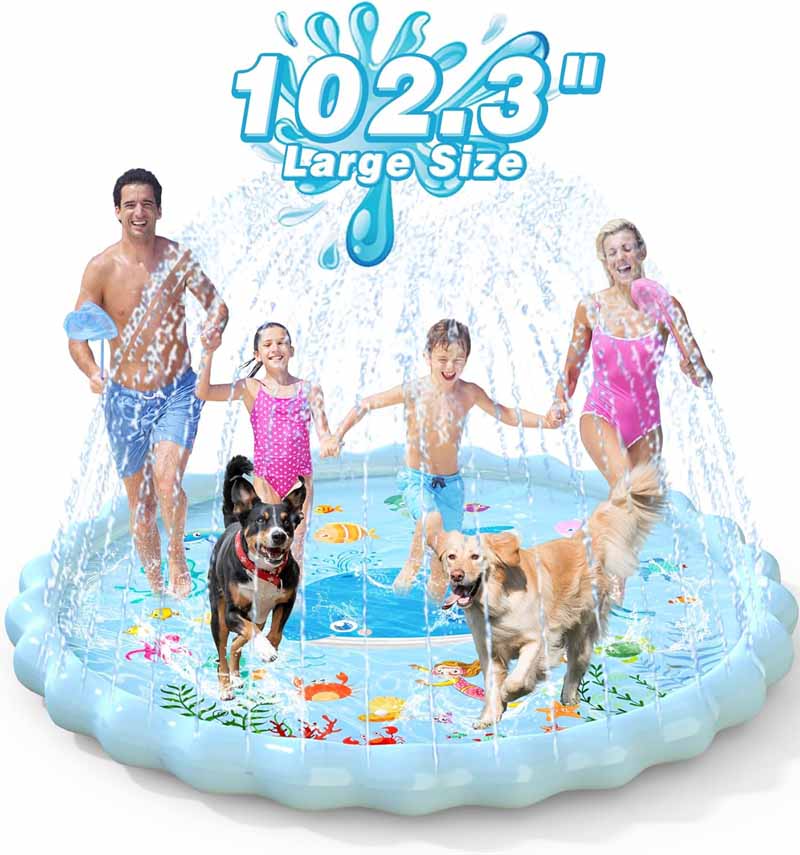
The EPN 102.3-inch whale splash pad provides a useful example of careful claim discipline. Its confirmed product documentation states that the outer sprinkler structure uses heat-sealed construction, while also making clear that this process should not be expanded into claims such as permanently leak-free, completely puncture-proof, or impossible to damage.
Surface Construction Should Be Described Exactly
Wet PVC can become slippery, so the presence or absence of a dedicated texture matters. Some splash pads use a designed texture or grip-oriented pattern, while others have a normal smooth PVC water-play surface. A higher retail price does not automatically mean a dedicated anti-slip structure exists, and even a textured wet surface should never be presented as eliminating all slip risk.
Parents should look for specific language describing the actual surface rather than simply trusting a “non-slip” icon. If the product does not identify a texture, the safer assumption is that normal wet-play behavior applies: use a flat clean lawn, encourage walking rather than uncontrolled running, remove nearby obstacles, and keep active adult supervision throughout the session.
The whale splash pad used later in this guide is a helpful factual example because its technical library specifically identifies the surface as a standard PVC water-play surface without a dedicated anti-slip texture or structure. Its recommended consumer guidance focuses instead on a flat clean lawn, supervised play, orderly movement, and reasonable spray adjustment.
The Hose Connector Deserves More Attention Than It Usually Gets
A hose connector represents a small fraction of the material in a splash pad, but it can control a large part of the setup experience. A product with attractive artwork and good PVC can still frustrate families if the connection sits crooked, leaks heavily, loosens during play, or places excessive sideways force on the perimeter.
Before deciding that a splash pad body has failed, switch off the water and inspect the connection. Make sure the fitting is properly aligned, confirm any supplied adapter is installed in the correct direction, inspect the garden hose washer when relevant, remove hose kinks, and reconnect without cross-threading. Leave a small amount of slack in the hose near the pad so children or adults do not pull the connection sideways.
For product developers, connector position should also be treated as an engineering variable rather than a last-minute detail. Moving an inlet can change hose routing, stress around the welded area, packaging geometry, and the way users interact with the perimeter. Platform-based customization therefore normally requires another sample and functional review whenever structural elements such as connectors, spray layout, PVC thickness, or welded sections are changed.
Spray Distribution Is More Important Than Maximum Jet Height
A dramatic product image may show high water streams, but higher spray is not always a better user experience. A splash pad for young children often works best when the water forms a consistent perimeter at a comfortable height. The more useful engineering question is whether the sprinkler ring makes sensible use of the water supplied to it, not whether one promotional photograph shows the tallest jets.
Spray behavior depends on several variables working together: household water pressure, actual flow rate, hose diameter, hose length, kinks, faucet position, inlet restriction, outer-ring geometry, and sprinkler-hole size and distribution. This is why the same splash pad may produce gentle streams at one home and a stronger sprinkler effect at another.
Repairability Can Change the Economics of the Product
A small puncture does not necessarily need to end the useful life of a flexible PVC product. When the damage is in a repairable location and the manufacturer supplies appropriate instructions or patches, a minor problem may be manageable. A cheap product with no repair support can become expensive if it is repeatedly replaced, while a slightly higher-priced model with practical repair information may offer better long-term value.
Before purchasing, check whether the manufacturer explains how the surface should be cleaned and dried before patching, whether repair material is included or available, and which types of damage are unsuitable for home repair. A welded seam failure and a tiny flat-surface puncture are different problems and should not automatically be treated with the same method.
Warranty and Product Support Affect Financial Risk
Warranty coverage does not make PVC stronger, but it can reduce the financial consequences of a manufacturing defect. Look past simple “satisfaction guaranteed” graphics and check the actual conditions. Is accidental damage excluded? Is a receipt required? How long is coverage provided? Does the company distinguish a manufacturing issue from misuse or puncture damage?
For brands commissioning custom splash pads, this principle extends upstream. A credible manufacturer should be able to explain what is already proven, what is being modified, what must be tested again, and what remains outside its current manufacturing scope. The supporting company fact library defines a project as appropriate only when it can be evaluated, prototyped, tested, and reproduced reliably in bulk production, rather than assuming every PVC concept is automatically manufacturable.
3. What Usually Fails First on a Kids Splash Pad?
When someone says, “I want a splash pad that lasts,” the concern usually comes from a short list of familiar failure points: punctures in the center sheet, leaking around the perimeter, a hose connection that will not seal properly, uneven spray, blocked openings, or a pad that develops damage after being folded and stored. These problems have different causes, so they need different prevention and troubleshooting steps.
Ground Punctures Often Start Before the Water Is Turned On
A flat lawn can still contain surprisingly sharp objects. Small gravel, woody stems, landscape staples, thorns, dried branches, broken plastic, hidden sprinkler components, or hard roots can concentrate a child’s weight into a small section of PVC. Once water is added and children begin stepping, kneeling, sitting, or jumping, those concentrated points can create much more local stress than the same product experiences on clean grass.
Use a quick ground-preparation routine before every session:
- Walk the full footprint where the splash pad will sit.
- Remove stones, branches, thorns, hard toys, and sharp plant material.
- Check for exposed irrigation hardware or landscape edging.
- Smooth obvious depressions and avoid large roots when possible.
- Unfold the pad instead of dragging it across concrete or rough paving.
- Do not reposition the product by pulling it while the outer ring is full.
This preparation costs nothing and can matter more than a small increase in material thickness. A family buying an “extra thick” pad but repeatedly using it over sharp debris may experience more damage than another family using a moderate material specification on a carefully prepared lawn.
A Leak Near the Edge Is Not Always the Same Failure
If water appears around the perimeter, identify its source before deciding the splash pad is defective. Water may be coming from a designed sprinkler opening, from the hose connection, through a puncture, or from an unintended opening in a welded section. Turn off the supply, dry the area enough to inspect it, and identify the precise location before attempting repair.
If the leak is at the connector, first reseat the connection. If it is a tiny flat-surface puncture, follow the manufacturer’s repair process. If it is within a structural welded seam, contact the manufacturer or seller for the recommended solution instead of applying an unsuitable adhesive automatically.
More Faucet Pressure Is Not a Universal Fix
Families sometimes see low jets and immediately open the faucet as far as possible. If low spray is being caused by a kinked hose, restricted connector, poor household flow, or partially blocked holes, adding more upstream pressure may not solve the underlying problem. It can simply place more load on the outer ring or produce a play experience stronger than younger children need.
A better troubleshooting order is:
- Straighten the garden hose.
- Check the connection.
- Confirm the outer ring is forming evenly.
- Inspect sprinkler holes for visible debris.
- Test household flow.
- Increase the faucet gradually.
- Stop when the spray is appropriate for the children using it.
Cleaning and Drying Influence Seasonal Storage
Many splash-pad problems appear months after the last play session rather than during use. Folding a product while debris is trapped inside, placing heavy items on top of it, storing it near sharp tools, or leaving moisture between folded PVC layers can create avoidable problems. Drain as much water as practical, remove dirt or grass, rinse when necessary, and allow the product to dry according to its instructions before long-term storage.
CDC guidance for small inflatable or plastic kiddie pools and water slides recommends removing debris, rinsing dirt with fresh water, and allowing the product to air dry after emptying. A hose-fed splash mat is not identical to a kiddie pool, so the manufacturer’s specific instructions remain the primary reference. The broader hygiene and storage principle—remove debris and allow water-play equipment to dry—is still useful.
For families visiting vacation homes or relatives, drying becomes even more important because a wet pad may need to go into a vehicle shortly after use. The user research behind this guide identifies differences in destination water pressure, lawn conditions, hose availability, luggage space, and drying time as common concerns for families taking splash pads between locations.

4. Size vs. Usable Play Space: Bigger Does Not Automatically Mean Better
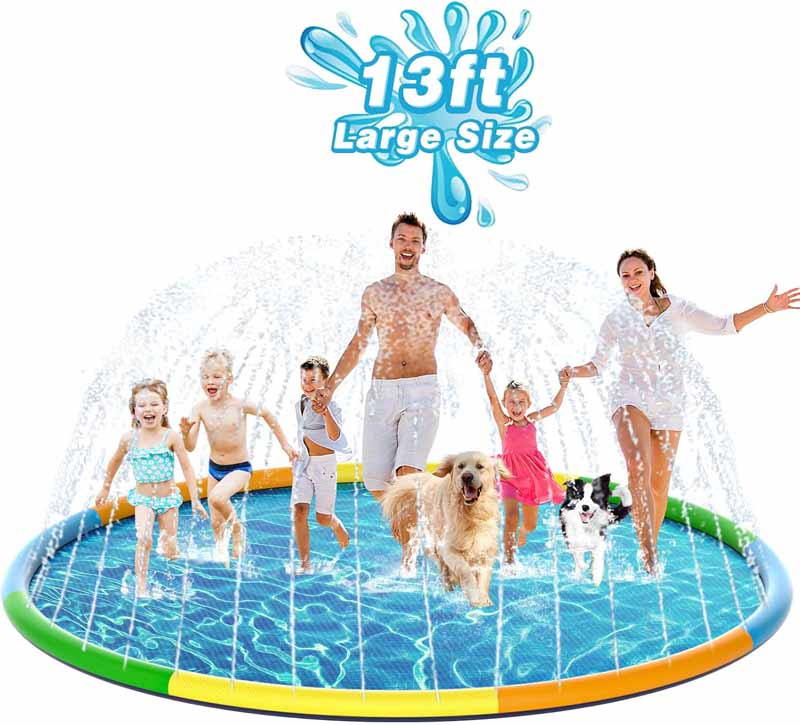
Size is one of the easiest numbers to compare, but it is also one of the easiest to misread. A round splash pad listed as 8 feet, 10 feet, or 13 feet is normally describing the overall expanded diameter. Part of this area is occupied by the perimeter water channel and sprinkler zone, so the quoted diameter should not be interpreted as identical to the clear central area where children move.
The mathematical effect of diameter is larger than many shoppers expect because the area of a circle increases with the square of its radius. A six-foot circular footprint covers about 28 square feet, while an 8.5-foot circular footprint covers roughly 57 square feet. The second product is only around 42% wider across, but its total circular footprint is approximately twice as large. This is useful for backyard planning, although it still does not tell you how many children should use the pad.
A product’s diameter also should not be converted into a fixed child capacity unless a manufacturer has a real basis for the claim. Three small children sitting and catching water use space differently from three older children running between sprinkler jets. Age, play style, activity level, adult supervision, and the actual central play area all matter. This is why responsible wording such as “room for siblings and friends” is often more accurate than promising a specific number of children.
How to Measure Your Yard Before Ordering
You can check whether a splash pad will fit with an ordinary tape measure. Start with the manufacturer’s fully expanded size, not the folded package measurement. Mark the diameter on the lawn, then step back and look at the space as an activity zone rather than simply an empty circle. The hose needs a clear route, adults need a place to supervise, and children need separation from steps, grills, hard landscaping, or furniture.
Use this quick setup check:
- Mark the full product diameter on the ground.
- Leave additional space around the outside sprinkler zone.
- Confirm the hose reaches without becoming tight.
- Keep the play area away from steps and sharp landscaping.
- Check whether an adult can see the entire surface clearly.
- Plan where wet shoes, towels, and clothing will go.
- Identify a nearby area where the product can drain and dry afterward.
If you are comparing circular models and want to estimate their overall footprint, a circle calculator is more useful than mentally comparing diameter numbers. The CalculatorSoup tool accepts diameter and provides radius, circumference, and area using the standard equation (A = r^2).
As a practical example, the confirmed EPN whale splash pad measures approximately 102.3 inches across, equivalent to about 8.5 feet or 260 cm when fully expanded. Using the circle formula, the theoretical full footprint is roughly 57 square feet. Its technical documentation correctly avoids turning this dimension into a precise child-occupancy promise and instead describes the product as suitable for shared water play among siblings and friends.
For a household with one child, buying the largest possible splash pad may create extra storage, water-distribution, and drying demands without significantly improving play. For several siblings or frequent playdates, increased usable space can become one of the more defensible reasons to spend more. The upgrade is valuable because it solves a real space problem, not because “extra large” sounds premium.

5. Water Pressure and Spray Height: The Same Pad Can Behave Differently at Two Homes
Water performance is one of the strongest examples of a product feature being influenced by the home around it. The splash pad controls the outer channel, openings, connector, and geometry, while the property controls water supply. Hose-fed sprinkler products can therefore behave differently at two houses even when the products are identical.
The main variables include static water pressure, available flow, hose diameter, hose length, kinks, partially closed valves, fittings, restrictions, and how far the outdoor faucet is opened. These conditions also explain why families bringing a splash pad to a vacation property may see different spray behavior from what they see at home. The user-group research supplied for this article identifies destination water pressure and hose conditions as a recurring uncertainty for traveling families.
Understand PSI and GPM Before Troubleshooting
Pressure and flow are related but different. PSI describes pressure; GPM, or gallons per minute, describes how much water moves during a period of time. A household can show adequate static pressure while a long or restricted hose still delivers less flow than expected. Looking at both measurements provides much better information than saying, “My faucet feels strong.”
This Old House demonstrates this distinction when planning an automatic sprinkler system. The process checks water pressure at a hose bib and separately calculates water flow by measuring how long it takes to fill a five-gallon bucket. Those sprinkler-system requirements are not splash-pad specifications, but the measurement technique is a useful household diagnostic method.
- Video 1 — This Old House, “How to Install an Automatic Sprinkler System”: Watch the early planning section to see how a pressure gauge and timed five-gallon bucket test are used to evaluate an outdoor water source. You do not need to follow the irrigation installation portion for splash-pad troubleshooting.
How to Run a Simple Bucket Flow Test
Use a container of known volume and a stopwatch. If you use a five-gallon bucket, open the outdoor faucet under the same general hose condition you expect to use for the splash pad and record how many seconds the bucket takes to fill. The basic calculation is:
GPM = gallons collected ÷ seconds to fill × 60
For example, if five gallons take 60 seconds, the measured rate is approximately 5 GPM. If five gallons take 30 seconds, it is approximately 10 GPM. These are measurements of your tested supply condition; they are not recommendations for what a particular splash pad needs.
If you would rather avoid doing the arithmetic manually, Omni Calculator provides a water-flow tool where you enter volume and time and receive the calculated flow rate. Its documentation defines GPM as liquid flow in gallons per minute and uses the basic relationship flow = volume ÷ time.
Use a Pressure Gauge When Supply Problems Are Suspected
If the splash pad is weak and other outdoor fixtures also appear weak, a simple hose-bib pressure gauge can help identify whether the issue begins with the household supply. This Old House recommends attaching a gauge to an outdoor faucet, turning off other water-using fixtures, opening the faucet fully, and reading the gauge. Its household plumbing guidance describes roughly 40–60 PSI as a useful diagnostic range for many homes, but this is not a recommended splash-pad operating pressure unless the product manufacturer specifically states one.
- Video 2 — This Old House, “How To Improve Water Pressure on City Water”: The relevant section demonstrates how a simple hose-bib gauge is used to determine whether weak performance comes from the household supply or from a more localized restriction.
For actual play, begin with lower water flow and increase it gradually. The correct setting is the one that forms the sprinkler ring and creates an enjoyable spray for the children present. Younger children may prefer shorter, gentler streams. Older children may enjoy a stronger ring. Maximum height is not an engineering objective in itself, and higher water flow should not be treated as proof of a premium product.
6. Safety: A Premium Price Does Not Prove a Splash Pad Is Safer
Safety deserves its own comparison because it is easy for commercial language to become misleading. A high price cannot prove a product is safer, just as a low price cannot prove it is unsafe. Parents should look for the intended age range, instructions, relevant target-market compliance, understandable warnings, physical condition, appropriate setup, and active supervision.
For children’s toys in the United States, CPSC states that toys intended primarily for children 12 years old and younger must be third-party tested and certified in a Children’s Product Certificate for applicable children’s product safety rules. CPSC’s toy-safety guidance identifies 16 CFR Part 1250, incorporating the applicable ASTM F963 toy standard, as a core requirement and notes that the manufacturer or importer is responsible for identifying which provisions apply to its particular product.
CPSC also states that covered children’s toys must not contain more than 0.1%, or 1,000 ppm, of any regulated phthalate in an accessible plasticized component covered by the rule. This does not mean parents need to become chemical-regulation experts. It means phrases such as “premium PVC,” “eco material,” or “non-toxic” should not be treated as replacements for applicable product compliance and testing information.
Supervision Is More Important When Several Children Are Playing
Backyard splash pads are shallow, open water-play products, but wet surfaces, excited movement, hoses, and groups of children still require supervision. Several adults being present does not automatically mean someone is actively watching. In fact, larger family gatherings can create a responsibility gap because each adult assumes another person is supervising.
The U.S. CPSC’s Pool Safely campaign repeatedly recommends designating a specific adult Water Watcher whose job is to supervise children without reading, texting, or using a smartphone. Much of Pool Safely’s material addresses pools and spas, which present different hazards from a shallow hose-fed mat, but the principle of clearly assigned, undistracted supervision is highly relevant to any organized children’s water activity.
- Video 3 — Pool Safely, “Ask the Experts” Water Watcher guidance: The American Red Cross segment in this series explains the value of clearly designating an adult Water Watcher instead of assuming supervision is already covered during a family gathering.
For birthday parties, supervision works better when responsibilities are divided before children start playing. One adult can focus on the water-play zone while another manages food, towels, clothing changes, indoor traffic, or other party activities. When the Water Watcher changes, make the handoff explicit rather than assuming the nearest adult understands the responsibility.
Pool Safely’s collaboration with Tia Mowry demonstrates this approach in a family party context. The resource emphasizes active supervision and formally designating a Water Watcher as part of broader water-safety planning for children.
- Video 4 — Pool Safely, “Water Safety with Tia Mowry”: Useful for parents planning summer birthdays or playdates because the safety discussion is framed around preparing for a children’s gathering rather than a technical training session.
Teach Children Simple Rules Before the Water Starts
Children are more likely to remember a few simple instructions than a long safety lecture. Before opening the faucet, explain where they may play, remind them to walk rather than push or chase on the wet mat, and show them where towels and shoes belong. If several ages are present, younger children may need a quieter zone or a gentler water setting.
Pool Safely’s Kids’ Corner provides child-focused educational videos and activities, including the Pool Safely Song, which uses simple repetition to reinforce water-safety behaviors. The specific content focuses on pool safety, but the format is useful for families who want to discuss basic water habits with children before outdoor water play begins.
- Video 5 — Pool Safely Song and Kids’ Corner: A child-friendly option families can watch before summer water activities to reinforce the idea that water play comes with simple safety rules.
A second CPSC public-service video, What if Kids Had Gills and Fins?, uses a memorable visual idea to emphasize that children do not have automatic water skills and still need supervision and safety layers. Again, the PSA focuses broadly on water safety rather than splash mats specifically, so it should be used as a supervision resource rather than proof of product-level safety.
- Video 6 — CPSC Pool Safely, “What if Kids Had Gills and Fins?”: A short visual reminder for caregivers explaining why confidence around water should never replace adult attention.
Families, schools, and small activity groups wanting printable water-safety material can also use the Pool Safely educational catalog. It contains consumer brochures, portable-pool tips, Water Watcher materials, posters, and video resources that can be used alongside family rules or summer-event planning.
- Downloadable resource library — Pool Safely Educational Materials
- Downloadable campaign video files and media resources — Pool Safely Press Kit

7. The Real Cost: Compare Cost per Use, Not Only Checkout Price
A $20 splash pad is not automatically cheaper in practical terms, and a $50 splash pad is not automatically the better investment. Value depends on how many times the product is realistically used, whether damage can be repaired, how much effort setup and storage require, and whether the features you paid for solve an actual family problem.
A simple cost-per-use calculation is one of the most useful ways to avoid misleading price comparisons. Divide the total relevant ownership cost by the number of realistic sessions. Do not assume a premium model lasts three summers unless you have evidence supporting that assumption, and do not assume a budget model lasts only one summer merely because it costs less.
| Illustrative Scenario | Purchase Price | Assumed Actual Uses | Purchase Cost per Use |
|---|---|---|---|
| Budget example | $20 | 10 | $2.00 |
| Mid-price example | $35 | 25 | $1.40 |
| Higher-price example | $50 | 40 | $1.25 |
| Higher-price but rarely used | $50 | 8 | $6.25 |
These figures are mathematical examples, not product-lifespan claims or industry averages. They demonstrate an important point: usage frequency can matter more than purchase price. A $50 splash pad used forty times would represent $1.25 in purchase cost per session. The same $50 product used eight times represents $6.25 per session. A $20 product used ten times represents $2.00 per session.
The Calculator Academy cost-per-use tool uses the same basic formula, total cost divided by number of uses, and also discusses an adjusted version that can include maintenance or recurring costs. For a seasonal backyard product, you can decide whether to include replacement patches, special accessories, or other costs that are genuinely relevant to your household.
Water Use Can Be Estimated From Your Own Flow Rate
If water usage matters to your household, avoid using generic statements such as “a splash pad uses X gallons per hour.” Different faucets and settings produce different flow. Instead, use the GPM measurement from your bucket test and multiply it by the number of minutes the water remains on.
Estimated gallons used = measured GPM × minutes of operation
If your actual setup measures 5 GPM and children play for 30 minutes, the arithmetic estimate is approximately 150 gallons. If the faucet is reduced to 3 GPM and the session lasts 20 minutes, the estimate is approximately 60 gallons. These examples show the calculation only; they are not claims about typical splash-pad consumption.
EPA WaterSense reports that the average American family uses more than 300 gallons of water per day at home and that, nationally, outdoor water use accounts for roughly 30% of household use, with substantially higher proportions possible in dry regions. Most outdoor household water is associated with landscaping rather than children’s splash pads, but the figures provide useful context for treating outdoor water as a real resource rather than a cost-free input.
A practical family habit is to use the lowest faucet setting that creates a suitable sprinkler effect. When children stop for food, change activities, or go indoors, switch off the water instead of allowing the perimeter to continue spraying unattended. This reduces unnecessary water use and also prevents the surrounding lawn from becoming wetter than needed.
Replacement Cost Is Often More Important Than a Few Dollars of Purchase Price
If one product costs $10 more but includes realistic repair support and clear care instructions, the difference may be worthwhile for a household expecting frequent use. If the higher-priced product offers only special graphics or packaging, the added cost may have no long-term economic value. This is why “cheap versus premium” should always be converted into problem solved versus money spent.
8. Which Price Tier Makes Sense for Different Families?
A single recommendation cannot serve every household because usage conditions are too different. The best way to choose is to identify what will put the most stress on the product: frequency, number of children, storage, travel, ground conditions, or setup time. Paying more for a feature that solves your highest-stress condition makes more sense than paying for a package of upgrades you do not need.
| Family Situation | Prioritize | You May Not Need to Pay Extra For |
|---|---|---|
| One child, occasional use | Correct age, suitable size, clear instructions | Maximum size or many accessories |
| Siblings, frequent use | Usable area, seams, connector, repairability | Decorative packaging |
| Playdates and parties | Space, clear supervision area, manageable spray | Maximum jet height |
| Small backyard | Accurate dimensions, simple hose routing | Oversized footprint |
| Busy parents | Quick setup, easy draining and storage | Complex accessory systems |
| Vacation-home use | Portability, drying, flexible water adjustment | Fixed-location features |
| Gift purchase | Age, size, hose requirement, storage | Specs unrelated to recipient’s home |
One Child and Occasional Summer Use
A family expecting only a few hot-weather sessions may not gain much from buying the largest or most heavily specified product available. The better choice can be a well-documented budget model with suitable dimensions, simple garden-hose setup, age-appropriate instructions, and realistic care guidance.
This is an important counterbalance to “buy once, buy premium” advice. Spending twice as much does not produce twice the value when the added capability goes unused. If one preschooler will play for twenty minutes on a few summer weekends, convenience and appropriate scale may matter far more than maximum material thickness or enormous footprint.
Several Siblings and Frequent Use
Multi-child households create a different load pattern. The pad is stepped on more frequently, more people move around the sprinkler ring, sessions may last longer, and the product may be unfolded and folded repeatedly throughout the season. The user research behind this guide identifies crowding, different preferred spray levels, disputes over play space, and increased supervision difficulty as recurring issues for these households.
Here, paying more for genuinely larger usable area, clearly documented construction, practical repair options, and reliable connector design can be rational. The extra cost has a defined purpose: supporting repeated shared use rather than simply producing a more expensive product.
Birthday Parties and Playdates
A splash pad can work well as an open-ended party activity because children do not need to learn complicated rules before joining. However, the host needs to think beyond the pad itself. Wet clothing, towels, shoes, access to the house, adult supervision, water use, and children of different ages can all make a simple activity more complicated during a busy event.
The best party-oriented purchase is therefore not necessarily the product with the highest jets. A large enough play area, easy setup, easy faucet adjustment, clear visibility for adults, and simple cleanup may contribute more to the event. The host should also establish the Water Watcher role before the activity begins rather than trying to organize supervision after several children are already wet and excited.
Busy Parents
Ease of use can justify a higher price because time is a real household resource. A splash pad requiring no air pump, no lengthy assembly, a simple hose connection, straightforward draining, and foldable storage can be more useful to a busy parent than a lower-priced model requiring several extra preparation steps.
The EPN whale splash pad used in the product example later in this guide reflects this simple product format: unfold the PVC mat, connect the supplied interface to a standard garden hose, open the faucet gradually, and control the sprinkler effect through water flow. It does not require an air pump for the main play structure.
Vacation Homes and Family Visits
Portable seasonal products are appealing for travel, but destination conditions may be unknown. A relative’s yard can be smaller, the hose can be shorter, water pressure can differ, and the family may need to pack the product before it is fully dry. Before taking a splash pad on a trip, confirm the destination has an outdoor faucet, an appropriate hose, a flat play area, and enough time for drying.
The “best” product in this situation may be the one that folds compactly and tolerates different water-flow settings rather than the one with the most elaborate sprinkler design. Again, value is created by solving a specific family problem.
9. A 60-Second Splash Pad Comparison Checklist
After looking at several listings, stop reading adjectives and compare facts in the same order. This static checklist does not need a quiz, recommendation engine, chatbot, or interactive product matcher. You can copy it into a note on your phone and use it while comparing Amazon, Walmart, Target, independent brands, or manufacturer websites.
Product Facts to Check
- Fully expanded dimensions
- Intended age range
- Material or PVC construction
- Actual thickness if publicly specified
- Welded or seam construction
- Surface texture, if one genuinely exists
- Hose-connector method
- Method used to change sprinkler intensity
- Repair instructions or included patches
- Warranty terms
- Draining and drying instructions
- Package size if storage matters
Claims to Treat Carefully
- “Premium PVC” without a measurable explanation
- “Extra thick” without a disclosed specification
- “Puncture-proof” for flexible PVC
- “Never leaks” for a welded water-carrying product
- “100% non-slip” on a wet play surface
- A fixed number of children without a credible capacity basis
- A fixed spray height without explaining household water conditions
- “Safer because premium” without relevant safety evidence
Backyard Conditions to Check
- Flat lawn or other manufacturer-approved surface
- No stones, roots, thorns, branches, or sharp debris
- Adequate hose reach with some slack near the connector
- Clear adult sightline across the whole play area
- Distance from steps, grills, furniture, and hard edges
- Space for towels, shoes, and clothing
- Drainage and drying area after use
- Appropriate seasonal storage space
This checklist represents the basic philosophy behind a genuinely useful product comparison: a strong specification gives the user something to verify. If a claim cannot be converted into a dimension, construction detail, operating method, test, instruction, or clearly described feature, it deserves less weight in the buying decision.
10. Real-World Example: How to Read a Splash Pad Listing Without the Marketing Hype
A real product example helps show how specification-based evaluation works without turning the article into an advertisement. Consider the EPN Kids Splash Pad, model SPW001. Its product fact library identifies it as a round whale- and ocean-themed splash pad for ages 3 years and older, with a fully expanded diameter of approximately 102.3 inches, equivalent to about 8.5 feet or 260 cm.
The product uses flexible PVC construction and a heat-sealed perimeter sprinkler ring. Water enters through a garden-hose connection and flows around the outer ring before exiting through the surrounding spray openings. An air pump is not required for the main splash-pad structure. Spray intensity is controlled by adjusting household water flow, so actual height can vary with the property’s water pressure, flow, hose, and faucet setting.
Its internal product specification records a PVC thickness of 0.28 mm, but the consumer fact guidance does not position this measurement as a “premium thickness” advantage. This is a good example of how a technical number should be handled responsibly. The number is useful for manufacturing, quality control, and specification management; it should not automatically be converted into a durability promise or used to imply superiority without relevant comparative testing.
The same factual discipline applies to its surface. The product uses a standard PVC water-play surface and does not have a dedicated non-slip texture or anti-slip structure. A credible page should therefore focus on flat lawn setup, removal of ground debris, active adult supervision, and orderly movement in wet conditions rather than borrowing “non-slip” language from another model.
Its 102.3-inch size can reasonably be described as spacious enough for shared backyard water play and room for siblings or friends, but it should not automatically become a fixed “fits four kids” or “fits six kids” statement unless a specific capacity basis exists. The same principle applies to spray height: the product allows adjustment through water flow, but a single exact height should not be promised across all homes.
This example is valuable because the product is not being presented as the automatic winner of a cheap-versus-premium contest. Instead, it demonstrates what a transparent listing should allow a family to understand: what the product is, how large it is, how it works, what material and construction are used, how spray is controlled, what its surface actually is, and which claims should not be made.
The Same Method Should Be Used for Any Brand
When you open another listing, repeat the process. Separate exact dimensions from “giant.” Separate documented PVC construction from “premium material.” Separate a real grip structure from a generic “non-slip” badge. Separate water-flow adjustment from a guaranteed jet height. Separate heat-sealed construction from a no-leak guarantee. Separate large play space from an unsupported occupancy promise.
For brands considering a custom splash pad, this approach is equally useful during product development. A manufacturer experienced with welded PVC recreational products can review artwork, size, shape, PVC specification, spray layout, connector location, surface treatment, packaging, and accessories within an established platform. Changes affecting welding, water pressure, structural behavior, material use, packaging volume, or safety should be sampled and tested again rather than assumed to work because a similar product exists.
Custom development is most valuable when it turns a real customer problem into a measurable product decision. Examples include increasing usable area for family play, changing sprinkler distribution for a different experience, moving a connector for easier hose routing, developing new artwork for a retail program, modifying packaging for a particular channel, or evaluating a different PVC specification. Projects involving unfamiliar pressure levels, safety-critical applications, or structures outside an established product platform require a separate feasibility review rather than a quick cosmetic customization.
Conclusion: Pay for Problems Solved, Not for the Premium Label
Cheap versus premium is useful only as the beginning of a comparison. A lower-priced splash pad can be the right choice when one child uses it occasionally, the yard is suitable, setup is simple, and the product provides clear instructions. A more expensive splash pad can make sense when the additional money buys usable space, documented construction, a better connector, realistic repair support, or another feature that solves a real household problem.
The strongest buying question is therefore not “Which splash pad costs more?” It is “What measurable difference am I getting for the extra money, and will my family actually use it?” This single question prevents several common mistakes: paying for vague premium language, assuming thicker automatically means indestructible, assuming a larger diameter guarantees a specific child capacity, or believing a higher price automatically proves safety.
Material and construction still matter. So do the welded edge, sprinkler layout, hose connection, ground surface, water supply, cleaning, drying, and storage. A long useful life usually comes from several factors working together, not from one headline specification. Families who understand those relationships are better equipped to choose a product that fits their real summer routine rather than simply choosing the cheapest or most expensive listing on the screen.
For parents, the final priority remains straightforward: choose an age-appropriate product, prepare a flat clean play area, adjust the water to a comfortable level, supervise children actively, maintain the product according to its instructions, and store it properly when the season ends. Those habits cost little, yet they can contribute more to a good backyard experience than many features marketed as premium.
Frequently Asked Questions About Cheap vs Premium Kids Splash Pads
Are expensive kids splash pads actually better?
An expensive splash pad can be better if the additional price corresponds to measurable improvements such as a more useful size, different material construction, stronger or better-designed welded areas, a more reliable connector, practical repair support, or better-documented product compliance. Price alone is not evidence. If two listings show similar specifications and the higher-priced model mainly adds artwork, packaging, or vague “premium” terminology, the added cost may not produce a meaningful improvement in backyard use.
Is thicker PVC always better for a splash pad?
Thicker PVC means more material thickness, but it does not automatically make a splash pad better in every respect. Durability also depends on material formulation, welding, geometry, ground preparation, connector design, how children use the product, and how it is folded and stored. A thick sheet can still be punctured by sharp debris or combined with weak construction. Thickness is useful evidence when comparing similar products, but it should be treated as one variable rather than a complete durability score.
How much should I spend on a kids splash pad?
There is no universal ideal price because value depends on how the product will be used. A household with one child using a splash pad a few times per summer may be well served by a straightforward budget model. Several siblings playing every weekend can make extra usable area, repairability, and repeated-use construction more important. Estimate how many sessions you realistically expect, compare cost per use, and pay extra only for specifications related to problems your household is likely to experience.
How long should a kids splash pad last?
A responsible lifespan cannot be stated as a fixed number of summers without controlled durability data for a specific product. Service life can be influenced by PVC construction, seam quality, stones or thorns under the mat, water pressure, frequency of use, folding, drying, storage temperature, and accidental punctures. Instead of looking for a guaranteed number of seasons, look for clear construction information, repair guidance, care instructions, and storage recommendations that help reduce avoidable damage.
Does a larger splash pad automatically fit more children?
A larger overall diameter normally creates a larger footprint and can provide more room for shared play, but it does not automatically establish a safe or tested child capacity. The sprinkler ring takes up part of the space, and children use the central area differently depending on age and activity level. Several children sitting and catching water require a different amount of space from several children running around the perimeter. Use the diameter for yard planning, not as an automatic occupancy rating.
Does a premium splash pad use less water?
A premium price does not mean lower water consumption. For a hose-fed splash pad, water use is influenced primarily by the flow supplied through the household faucet and how long the water remains on. A practical estimate is measured GPM multiplied by minutes of operation. Product design can influence how effectively the available water is distributed, but consumers should not assume an expensive model is automatically water-efficient unless the manufacturer provides meaningful evidence.
How can I tell whether a splash pad is safe for my child?
Start with the manufacturer’s intended age range, instructions, physical condition, target-market compliance information, and the environment where the product will be used. Clear the lawn of sharp debris, place the product away from hard obstacles, adjust water flow to a suitable level, establish simple play rules, and maintain active adult supervision. In the United States, applicable children’s toy safety requirements and certification information provide more meaningful evidence than a “premium,” “non-toxic,” or “safe PVC” marketing badge alone.