Skip to content


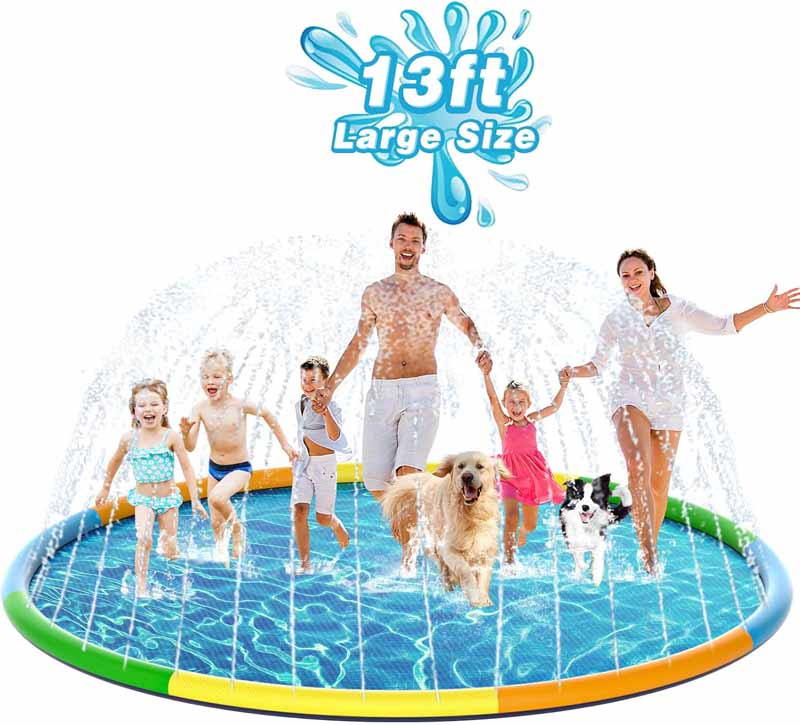
A splash pad can look impressively large when its product page says 80 inches, 95 inches, or more than eight feet across. Once it is laid out in the backyard, however, a parent may notice something unexpected: the children are not actually playing inside one completely open circle matching the advertised diameter. Part of the footprint may belong to the perimeter sprinkler channel, hose connection, seams, raised structures, or areas children mostly cross rather than use for free movement.
This is where splash pad diameter and usable play space become two different measurements. Diameter usually describes how wide the complete product is from one outside edge to the opposite outside edge. Usable play space describes how much of the layout children can practically use while sitting, standing, turning, walking through spray, carrying toys, moving around siblings, and entering or leaving the pad. The two values are related, but they should never be treated as automatically identical.
This difference matters most when families are comparing sizes for siblings, playdates, birthday parties, grandparents’ yards, or limited backyard spaces. A larger diameter can create substantially more total area because circular area increases with the square of the radius. At the same time, two products carrying the same advertised diameter can feel very different if one uses a wide sprinkler ring or several raised features while another keeps most of its center open.
The most useful way to compare splash pads is therefore not to ask only, “Which one has the largest number?” A better process is to separate the overall product diameter, open center, practical movement area, spray zone, and total setup space, then measure the real backyard where the pad will be used. This guide explains each measurement, shows how to estimate what can actually be calculated, and identifies the information best left unknown when a listing does not provide enough evidence.
Splash Pad Diameter vs. Usable Play Space
What Splash Pad Diameter Actually Measures
For a circular splash pad, the diameter is the straight-line distance from one outside edge of the circle to the opposite outside edge, with the line passing through the center. Radius is half of the diameter. An 80-inch circular product therefore has an outside radius of 40 inches, while a 102.3-inch product has an outside radius of approximately 51.15 inches. These measurements are useful for understanding the physical footprint and calculating the theoretical area of the complete outer circle.
The key phrase is complete outer circle. On a typical hose-powered sprinkler pad, the measurement line normally crosses the perimeter water channel as well as the central floor. If the outside ring is several inches wide, those inches are already included inside the advertised diameter. The same principle applies to other built-in structures occupying part of the footprint. An outside measurement tells you where the product ends; it does not automatically identify where unrestricted play space begins.
This distinction is easy to miss because online stores often place one large number beside a lifestyle photograph. A customer sees “80-inch splash pad” and naturally imagines an 80-inch open circle. In manufacturing drawings, however, a flexible PVC product is divided into functional zones: perimeter channels, sealing paths, connectors, decorative panels, spray openings, and open floor sections. A single overall dimension cannot communicate all of those internal relationships.
- Video evidence — Khan Academy: Radius, Diameter, Circumference & π. This visual explanation shows exactly where a circle’s diameter and radius are measured, making it useful before comparing round splash pad dimensions.
What Usable Play Space Means
Usable play space is better understood as a functional area rather than a universal factory specification. It includes the parts of the product children can reasonably use while sitting, standing, kneeling, collecting water, moving through sprays, carrying small toys, changing direction, passing another child, and moving into or out of the wet area. A simple wide-open splash pad may offer a high proportion of usable space, while a feature-heavy design may intentionally devote more room to interactive structures.
This is also why usable play space should not be treated as a synonym for inner diameter. Inner diameter is a valuable geometric measurement when a product provides one, because it can describe the open circle inside the perimeter ring. Practical play involves more than geometry, however. A child may use part of the ring, avoid the hose connector, gather near one spray stream, or repeatedly move outside the central floor. Functional space changes according to how people use the product.
Parents comparing splash pads for several children should pay particular attention to movement rather than simply asking how many children can stand on the material. Three children may physically fit inside a relatively small circle, yet the same layout can feel crowded when they start turning, chasing water, carrying buckets, or approaching the same spray point. Standing capacity and comfortable play capacity are not the same concept.
Keep These Measurements Separate
The most reliable way to understand product size is to separate each spatial question before making a decision. A diameter measurement is excellent for determining whether the product can physically fit on the lawn. An inner measurement helps describe central floor space. Practical play space reflects how children actually move. Total setup space extends outside the PVC because a functioning backyard setup also includes access, water supply, supervision, and surrounding activity.
| Measurement | What It Describes | The Question It Answers |
|---|---|---|
| Overall Diameter | Full outside-edge-to-outside-edge width | How much ground does the product occupy? |
| Open Center Diameter | Central width remaining inside the perimeter structure | How wide is the open center? |
| Practical Usable Play Space | Space children can realistically use while moving and sharing | Will normal play feel crowded? |
| Spray Zone | Area reached by water during operation | Where will the wet activity extend? |
| Total Setup Space | Product plus access, hose, adult approach and nearby activity | Does the complete setup work in this yard? |
A useful rule to remember throughout the rest of this guide is therefore: overall diameter is not automatically open-center diameter; open-center diameter is not automatically practical play space; and the PVC footprint is not automatically the complete backyard activity zone. Each number becomes useful only when it is matched with the question it can actually answer.
Why Advertised Diameter Is Not All Play Space

The Perimeter Sprinkler Ring Occupies Real Area
Most circular hose-powered splash pads need a perimeter structure to distribute water around the product. On many flexible PVC designs, two layers of material are heat sealed to create a channel. Water enters through a hose connector, fills this channel, and reaches small openings positioned around the perimeter. The channel has real width, so it occupies part of the area inside the product’s outer diameter.
This is not a defect or wasted material. The perimeter chamber performs an important function by carrying water and supporting the spray pattern. Problems begin only when shoppers interpret the outer diameter as if every inch inside it were an unobstructed central floor. Product pages offering both an outside and an inside measurement make the distinction much easier to understand.
A useful real-world example is a FUNBOY splash pad specification published by BARK. The listing states an approximate 64-inch overall diameter, a 5-inch outer tube, and a 54-inch inner diameter. This is a particularly clear example because the geometry can be checked directly: the outer structure occupies approximately five inches on each side of the central circle, leaving a smaller open diameter inside the complete footprint.
- Product specification evidence — FUNBOY Splash Pad. The published measurements provide a real example of overall diameter and inner diameter being different values rather than interchangeable descriptions.
A Small Reduction in Diameter Can Remove More Area Than Expected
A reduction from 64 inches of total diameter to 54 inches of inner diameter may sound modest because the numerical difference is only 10 inches. Circular area does not change linearly, however. A theoretical 64-inch circle contains approximately 22.3 square feet, while a theoretical 54-inch circle contains approximately 15.9 square feet. In this specific example, the smaller center circle represents about 71 percent of the complete outer circular area.
The remaining percentage should not be interpreted as “unusable,” because children may still step across, sit near, or interact with the perimeter. The calculation is valuable for another reason: it shows how easily a consumer can overestimate unrestricted central space when comparing only advertised diameters. Ten inches removed across a diameter does much more than remove one narrow 10-inch strip; it changes the boundary around the entire circle.
| Example Measurement | Diameter | Approx. Theoretical Area | What It Represents |
|---|---|---|---|
| Complete product circle | 64 in | 22.3 sq ft | Total theoretical outer footprint |
| Inner circular area | 54 in | 15.9 sq ft | Theoretical inner circle |
| Difference | 10 in in diameter | 6.4 sq ft | Area associated with the annular difference between the two circles |
The 71-percent relationship belongs only to this particular set of measurements. It should never be copied onto an 80-inch, 95-inch, or 102-inch product without knowing its perimeter width. A different splash pad may use a narrower water channel, a wider reinforced edge, an irregular perimeter, or a completely different internal construction. There is no scientifically defensible universal “usable-space percentage” for all splash pads.
Seams and Connectors Also Matter
Flexible PVC water-play products are assembled around functional geometry. Heat-sealed seam paths define where water can travel, while the inlet connector must occupy a physical location near the edge. Some layouts include a noticeably larger connector section, additional reinforcement, or a locally wider water channel around the inlet. Children may still walk near these sections, but they do not always behave like an uninterrupted central floor.
From more than two decades of experience with PVC and composite-product structures, one practical lesson remains consistent: the outer dimension, seam geometry, channel width, component location, and intended function should be evaluated together. When a product is being customized, enlarging the outside diameter without reviewing the water channel and spray layout can produce a larger product without creating the expected increase in open play space.
For custom splash pad development, a better specification drawing identifies at least the outside dimensions, central floor dimensions, water-channel width, sealing path, connector position, spray-hole distribution, and any raised feature footprint. This approach helps a factory develop the physical structure correctly and later gives consumers clearer size information instead of forcing them to interpret one oversized “XL” claim.
Raised Features Change Movement Routes
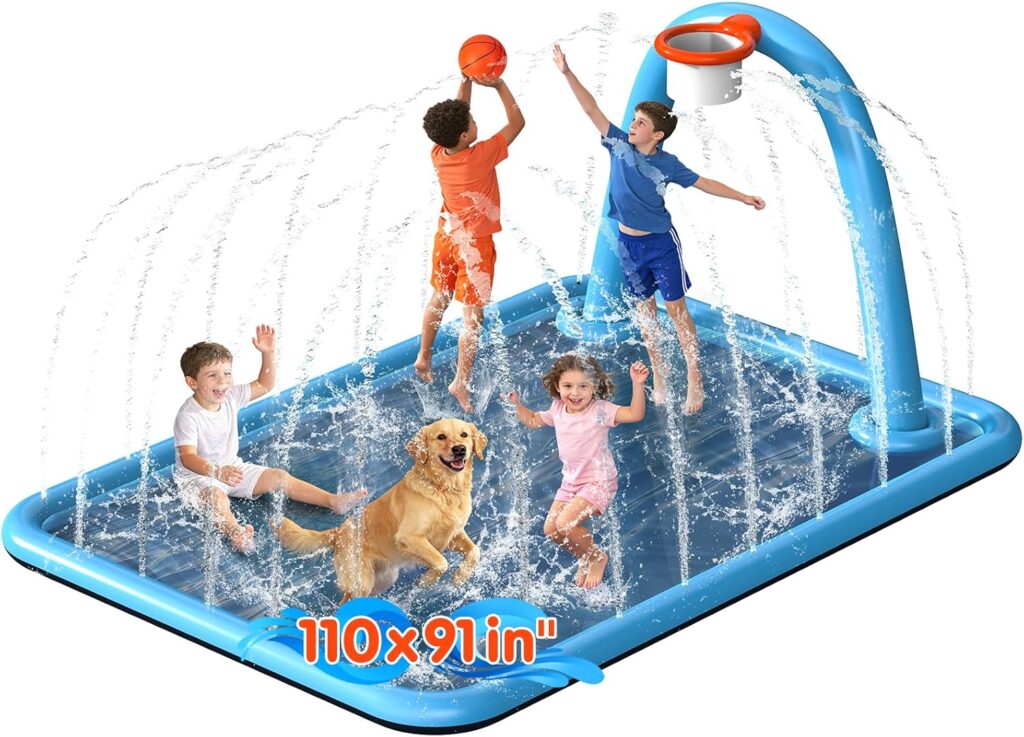
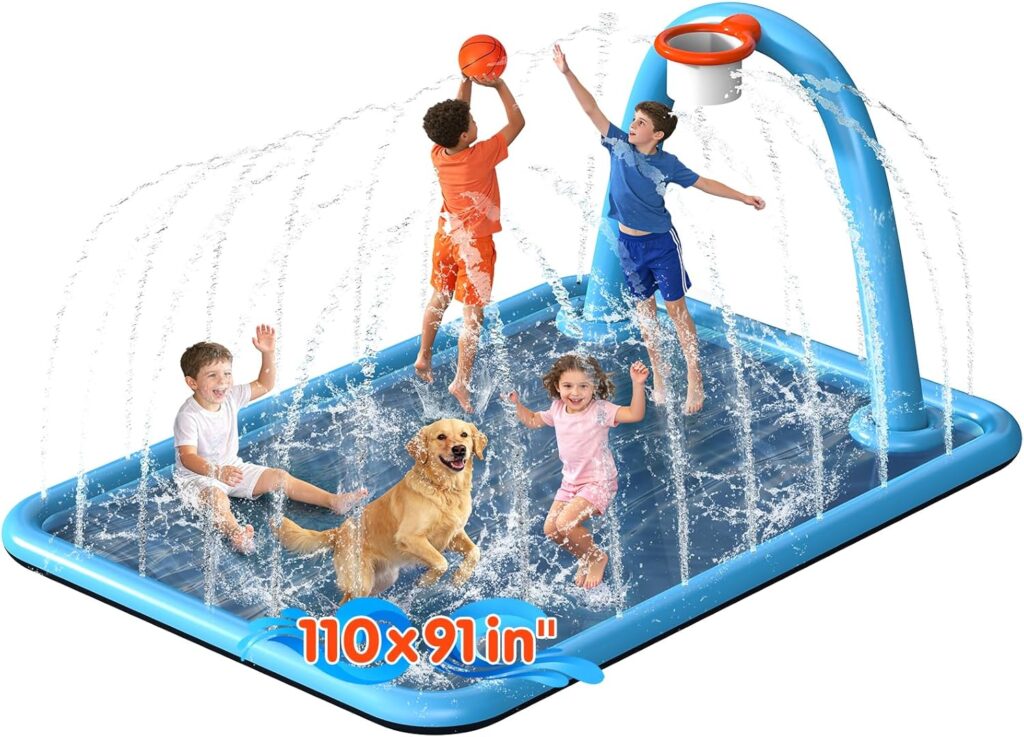
Two splash pads can share an identical 80-inch outside diameter and still provide noticeably different experiences. One may consist of a broad central floor surrounded by a narrow sprinkler channel. Another may contain a hoop, fountain, arch, animal-shaped sprayer, or central feature. The second design may provide more variety, but children naturally gather around those features and move through a smaller number of routes.
A feature is not automatically wasted space. If children enjoy throwing balls through a hoop or standing beneath an arch, the structure is part of the activity value. The important distinction is between feature space and free-movement space. Parents looking for a pad for several energetic children may prioritize a more open layout, while a family looking for focused water games may accept a smaller unrestricted center in exchange for interactive features.
Lifestyle Photos Should Never Replace Measurements
A lifestyle photograph provides useful information about design, color, product theme, and general interaction, but camera perspective can distort perceived scale. A smaller child placed near the center makes a product look wider. A low camera angle can stretch the apparent depth. Wide-angle lenses expand background space, while cropping can hide the distance between the pad and nearby obstacles.
When technical dimensions and photographs appear to tell different stories, treat the numerical specification as the starting point and use photographs to understand layout rather than exact scale. If the inner diameter is not published, record “inner diameter not disclosed” instead of estimating a precise measurement from a photograph. An honest missing value is more useful than an attractive calculation built on an uncertain visual estimate.
How to Estimate the Open Center Without Guessing
Step 1: Confirm the Fully Expanded Product Size
The first measurement to find is the product size in its operating or fully laid-out state. Flexible PVC can fold into a compact package, so carton measurements may be dramatically smaller than deployed dimensions. A splash pad more than eight feet across can still fit into a relatively small retail box. Both measurements can be accurate, but they answer completely different questions.
Look for terms such as overall diameter, expanded diameter, unfolded size, assembled dimensions, laid-flat size, or product dimensions. If several sizes are grouped together on one ecommerce page, check the selected variation before recording any number. A dimension graphic, review video, or customer photograph may belong to another size in the same parent listing, particularly on marketplaces where content is shared across variations.
A sensible measurement record should therefore include both the number and its context. Writing “102.3 inches” is less useful than writing “102.3-inch fully expanded overall diameter, selected circular variation.” This small habit prevents package dimensions, older product versions, and neighboring variations from entering later calculations.

Step 2: Find the Width of the Outer Water Channel
If a manufacturer provides the perimeter-ring width, record it directly. If the product is already available, measure from the outside edge inward to the point where the central floor begins. Because flexible water channels can change cross-sectional shape as they fill, note whether the measurement was taken dry, partially filled, or operating under normal household water flow.
For products with a nearly uniform circular ring, measure at several positions around the circumference and compare the readings. The connector area may be wider than other sections. A shaped design can also have sections where the ring widens or narrows. If measurements vary noticeably, do not force the whole product into one artificially precise ring-width number. Recording a range can be more accurate.
- Video evidence — Lowe’s: How Do You Use a Tape Measure? This short demonstration covers basic tape-measure handling and accurate measurement technique, making it useful before measuring a yard, perimeter channel, or central play area.
Step 3: Estimate Inner Diameter Only When the Structure Allows It
For a reasonably circular product with a perimeter channel of consistent width, an inner-diameter estimate can be calculated using a simple formula:
Estimated Open Center Diameter = Overall Diameter − (2 × Perimeter Ring Width)
The perimeter value is multiplied by two because a diameter crosses the water channel twice: once when entering the central circle and once again before reaching the opposite outside edge. If an 80-inch product has a verified five-inch perimeter channel on each side, its estimated central diameter is approximately 70 inches.
This formula becomes unreliable when the design is irregular, the ring width changes considerably, or large structural elements occupy part of the center. A basketball hoop base, central fountain, arch leg, or decorative element may reduce functional movement even when the mathematical inner circle remains large. In those cases, the calculation should be described as an estimated geometric center, not as certified usable play space.
Step 4: Convert Inner Diameter Into Area
When a reliable circular inner diameter is available, the area can be estimated using the standard formula:
Area = π × radius²
The radius is half of the diameter. For example, a confirmed 70-inch inner diameter has a radius of 35 inches. Converting 35 inches into feet gives approximately 2.92 feet, and applying the formula produces an estimated central-circle area of about 26.7 square feet.
The result is useful when comparing two products with documented inner dimensions because area makes the practical scale difference easier to see. It should still be labeled carefully. The phrase “estimated open-center circular area” is more defensible than “usable play area” because children may use some perimeter space and avoid some sections of the calculated center depending on the design.
- Video evidence — Khan Academy: Area of a Circle. This lesson demonstrates how to convert a diameter into a radius and use (A = πr²), matching the calculation used for circular splash pad footprints.
- External calculation tool — Calculator.net Circle Calculator. Users can enter a confirmed diameter or radius and independently calculate circle area, circumference, and related values.
Step 5: Keep Measurement Precision Realistic
A flexible outdoor product should not always be discussed with the same precision as a machined steel part. PVC can relax, wrinkle, stretch slightly under tension, change shape as a water channel fills, or lie differently on uneven grass. Temperature can also influence how flexible vinyl behaves. A home measurement of 79.6 inches on one setup and 80.1 inches on another does not automatically indicate a meaningful manufacturing problem.
For consumer comparison, excessive decimal places usually add the appearance of precision without improving the decision. If a manufacturer specifies 80 inches, reporting an estimated home measurement as “about 80 inches” is often more useful than presenting 79.83 inches as if it were a laboratory-controlled value. When exact dimensional tolerance matters for a custom program, measurement condition and tolerance should be defined in the technical specification before production.
When “Unknown” Is the Correct Result
Suppose an online listing provides only “80-inch diameter,” several lifestyle images, and the phrase “extra large,” but gives no ring width, central dimension, or technical drawing. You can calculate the theoretical 80-inch outer-circle area, but you cannot scientifically calculate the exact inner open area. The missing measurement should be recorded as unknown until a reliable source becomes available.
This distinction separates useful analysis from fabricated precision. A mathematical formula can be completely correct while the result remains misleading because one of the inputs came from a guess. Good product research should therefore maintain three categories: confirmed measurements, derived calculations based on confirmed measurements, and unknown values requiring additional evidence.
Why Extra Inches Can Create Much More Area
Circular Area Does Not Increase One Inch at a Time
Diameter grows in a straight numerical sequence, but area does not. An 80-inch circle has an outside radius of 40 inches, while a 95-inch circle has a radius of 47.5 inches. The diameter increases by 18.75 percent, yet the theoretical complete area increases from roughly 34.9 square feet to roughly 49.2 square feet, a gain of about 41 percent.
The reason is simple geometry: the radius is squared in the area formula. Additional radius extends around the complete circumference, so every extra inch contributes to a larger ring around the outside of the circle. This is why increasing a splash pad from roughly six and a half feet to nearly eight feet across can feel like a larger change in real backyard footprint than the diameter figures initially suggest.
| Overall Diameter | Approx. Feet | Approx. Theoretical Full-Circle Area | Relative Meaning |
|---|---|---|---|
| 68 in | 5.67 ft | 25.2 sq ft | Compact family footprint |
| 80 in | 6.67 ft | 34.9 sq ft | About 38% more theoretical area than 68 in |
| 95 in | 7.92 ft | 49.2 sq ft | About 41% more theoretical area than 80 in |
| 102.3 in | 8.53 ft | 57.1 sq ft | About 16% more theoretical area than 95 in |
Every value in the table describes the theoretical complete outside circle. It does not subtract a water channel, fitting, hoop, fountain, or other structure. The numbers are therefore best used to compare backyard footprint and understand how rapidly area grows with diameter. They should not be copied into a listing as “usable play space” without supporting internal measurements.
Convert Everything Into the Same Unit Before Comparing Products
Splash pad specifications commonly appear in inches on U.S. marketplaces, centimeters in metric markets, and occasionally feet in marketing copy. Comparing “8.5 FT” with “260 CM” by visual instinct makes the process harder than necessary. NIST identifies the standard length relationship 1 inch = 2.54 centimeters, while one foot equals 30.48 centimeters.
For example, a confirmed 102.3-inch diameter converts to approximately 259.8 centimeters, which is reasonably described as about 260 cm. It also converts to approximately 8.525 feet, often rounded to 8.5 ft for consumer-friendly communication. Keeping the original specification beside the converted value helps prevent cumulative rounding errors, particularly when the converted number will later be used in an area calculation.
- Evidence and conversion reference — NIST: Approximate Conversions from U.S. Customary Measures to Metric.
- Downloadable file resource — NIST SP 365 Metric Conversion Card. The printable PDF provides common length, area, mass, volume, and temperature conversion factors and can be saved for repeated product comparisons.
Do Not Round Too Early
If several calculations are being performed, keep the original diameter until the final step. Converting 102.3 inches immediately to “8.5 feet” and then using 8.5 feet to calculate area loses some precision compared with calculating from 102.3 inches first. The final consumer-facing value can still be rounded to a practical level, but the underlying calculation will be more consistent.
This is particularly helpful for product-development work involving several sizes. A custom line may contain 68-inch, 80-inch, 95-inch, and 102-inch models with different perimeter-channel widths. Recording the native dimensions and calculating each center independently prevents a rounded marketing measurement from becoming an accidental engineering input.
How Much Play Space Do Children Actually Need?
Avoid Fixed “Diameter Equals Number of Kids” Charts
A chart claiming “60 inches for one child, 80 inches for two children, and 100 inches for four children” looks useful at first glance, but it implies a level of certainty rarely supported by actual play testing. Children are not equally sized stationary objects. They move at different speeds, sit and stand, carry toys, reach across one another, gather near popular spray points, and frequently move beyond the central section.
A more responsible approach evaluates age, activity level, internal layout, toys, and movement routes together. A 102-inch open-style pad may feel comfortable for several children during relaxed sensory play, while a smaller feature-rich pad can become crowded with fewer children if everyone wants access to the same hoop or fountain. Capacity should be described as a practical observation unless a manufacturer has completed and defined a specific capacity test.

Younger and Older Children Use Space Differently
Toddlers and younger preschool children often spend longer sitting, crouching, touching spray streams, filling containers, or walking slowly around the center. Older children may cross the pad more frequently, change direction quickly, create chasing games, kick or throw balls, and repeatedly enter and leave the water. The same geometric area can therefore support very different experiences depending on age and play style.
Mixed-age siblings add another layer. A smaller child may remain seated near the center while an older sibling runs around the perimeter, creating overlapping movement zones even when both children technically have enough square footage. Families should plan around the most active realistic use rather than the quietest photograph displayed on a product listing.
Toys Can Reduce Free Movement Surprisingly Quickly
Buckets, watering cans, balls, toy boats, cups, foam toys, and water blasters each occupy only a small amount of floor area, but their effect on movement can be larger than their physical footprint. Children gather around them, leave them in walking routes, carry them from one spray stream to another, and repeatedly bend down to retrieve them. A clear center can become cluttered after only a few minutes.
For shared play, one useful strategy is to keep part of the toy collection immediately outside the wet zone and rotate items rather than placing everything inside at once. This does not create more material area, but it preserves circulation and can make the same splash pad feel noticeably less crowded. Layout management is often a more practical improvement than simply searching for another few inches of advertised diameter.
Perform a Dry Movement Test Before Water Play
Families who are uncertain about size can recreate the planned footprint on the lawn before purchasing. Mark the outside circle, then let the children who normally play together move inside it while the area remains dry. Ask them to walk toward the center, pass each other, turn around, sit, stand up, bring in their normal toys, and approach the area from different directions.
The purpose is not to simulate every second of real play. It is to identify obvious bottlenecks before water, slippery surfaces, spray streams, and excitement are added. If two children repeatedly block one another inside a dry marked circle, the real setup will not gain extra movement space once the garden hose is turned on.
A practical dry test can follow these steps:
- Mark the confirmed outside diameter on the lawn.
- Mark the inner circle separately if a reliable inner dimension is available.
- Let the normal users enter from different directions.
- Ask children to walk across one another’s routes.
- Add the toys normally used during water play.
- Check whether sitting children block common crossing paths.
- Make sure adults can approach the play area without stepping over the hose.
- Observe the most active normal play pattern rather than a staged standing position.
- Reduce simultaneous users if repeated collisions or blocking appear during the test.
Recognize Functional Crowding Instead of Counting Bodies
| Observation During Play | What It Suggests | Practical Response |
|---|---|---|
| Children can turn, cross and sit without repeatedly blocking one another | Comfortable functional space | Current layout is likely workable |
| Occasional contact occurs but clear routes remain available | Mild crowding | Remove unnecessary toys or spread activities out |
| Children repeatedly stop because another child blocks the route | Significant crowding | Reduce simultaneous use or consider more open space |
| Children push past others, collide frequently, or repeatedly leave the intended area to move around | Poor functional fit | Reconsider layout, size or play pattern |
The table intentionally avoids assigning an exact number of children to a specific diameter. A practical observation of movement provides more useful evidence than a generic capacity claim because it reflects the product, users, toys, and backyard at the same time.
Space Planning and Water Supervision Belong Together
Size planning should not be mistaken for safety certification. A larger pad can reduce crowding, but additional square footage does not replace active adult supervision. The U.S. Consumer Product Safety Commission emphasizes assigning a responsible Water Watcher when children are near water, while Nicklaus Children’s Hospital similarly stresses focused adult supervision and avoiding distractions around aquatic environments.
These resources focus broadly on pool and water safety rather than providing a household splash-pad sizing standard. They are still useful because the supervision principle transfers to backyard water play: adults should be able to see the children clearly and reach the activity area easily. This is one more reason total setup space should include an adult access route rather than squeezing the PVC product against every available boundary.
- Video evidence — U.S. CPSC: Pool Safety | Anatomy of a Water Watcher. The 2026 safety video explains the role of a focused adult Water Watcher and the importance of avoiding divided attention near water.
- Video evidence — Nicklaus Children’s Hospital: Pool Safety for Children. The video concerns pool safety, so it should be introduced as a general water-supervision reference rather than a splash-pad installation standard.
- Downloadable safety resource — CPSC Pool Safely Tip Card. The official page provides an English/Spanish safety card suitable for saving or printing when families organize water activities.
Measure Your Backyard Before You Buy
Measure the Clear Placement Zone, Not the Property Line
A backyard may look large in total square footage yet contain only a small uninterrupted section suitable for a splash pad. Patios, trees, planters, play structures, raised garden beds, air-conditioning units, drains, retaining walls, steps, furniture, exposed roots, and sloped areas can all reduce the practical placement zone. The important measurement is therefore the continuous clear width and length where the product will actually sit.
Start by identifying a reasonably level location where the product instructions permit use. Walk the area rather than measuring from a distant patio edge. Remove obvious sharp objects and identify fixed obstacles before deciding which diameter can fit. A 102-inch circle needs a clear diameter of roughly 8.5 feet for the material alone; the complete activity setup normally requires more room for access and the garden hose.
Mark the Real Diameter on the Lawn
Numbers become much easier to understand when they are transferred from a product page onto the ground. For a circular pad, divide the outside diameter by two to find the radius. Choose the proposed center point, measure the radius outward in several directions, and mark each point with temporary lawn-safe markers, small towels, or other visible objects.
For a 102.3-inch product, the radius is about 51.15 inches, or roughly 4.26 feet. Measuring approximately 4.26 feet from the same center in several directions produces a visual outline of the complete 8.53-foot circle. A garden hose or soft rope can then be placed around the marks to make the footprint easy to see.
This simple exercise often changes purchase decisions more effectively than another page of product photographs. A parent may discover an eight-foot product comfortably fits with room to walk around it, or may notice its edge lands directly beside a step, planter, or busy walkway. Either result is useful because it is based on the real yard rather than an imagined scale.

Check the Hose Route Before Finalizing the Position
A splash pad connected to household water needs more than enough grass for the PVC. The garden hose must reach the inlet without creating an awkward route through the main play area. Ideally, children should not have to repeatedly cross or step over the hose to enter and leave the pad. Connector location therefore matters when choosing both the product orientation and yard position.
The same idea applies to customized products. Moving a connector from one side of a structure to another may look like a minor design change, but it can affect hose routing, seam layout, printing, user orientation, and packaging folds. Product development works best when connector position is reviewed together with the expected real-world setup instead of being added as an isolated component decision.
Leave Room for Adults and Dry Supplies
There is no universal evidence-based rule saying every household splash pad must have exactly three feet, four feet, or five feet of clearance on every side. Product designs and yards vary too much for one arbitrary number to fit every case. A more useful approach is to reserve enough surrounding room for children to enter and leave, an adult to approach quickly, the hose to remain out of the main route, and towels or dry belongings to stay away from the busiest wet section.
The largest splash pad that mathematically fits inside a lawn is therefore not always the best fit. If the perimeter leaves almost no practical pathway, a slightly smaller product can create a better overall activity area. Think of the backyard as a system containing the pad, people, water connection, supplies, and movement—not simply as an empty rectangle waiting to be filled.
Calculate Square Footage When It Adds Useful Context
For a rectangular clear area, length multiplied by width provides approximate square footage. This can help compare a yard zone with the theoretical footprint of a circular splash pad. It should not be used as the only fit test because two shapes containing the same area may not fit inside one another. A narrow rectangular lawn can contain more total square footage than a large circle requires while still being too narrow for the circle’s diameter.
Irregular yards can be divided into simpler rectangles for approximate area calculations, but the final placement should still be checked using actual length and width. Lowe’s provides a short instructional video covering basic square-footage measurement, which can be useful for families unfamiliar with translating physical dimensions into area.
- Video evidence — Lowe’s: How to Calculate Square Footage. Useful for measuring a simple backyard section and understanding the difference between linear dimensions and total area.
Use Satellite Measurement for Early Planning, Not Final Installation
When planning a gift for relatives, a vacation property, or a party location you cannot visit immediately, a satellite map can provide a rough first estimate. Google Maps supports measuring distance between selected points on desktop, allowing users to estimate the visible distance across a yard or patio before traveling to the location.
Satellite imagery cannot show every condition relevant to final placement. A root, recent landscaping change, small step, drainage slope, furniture arrangement, hose bib, overhead branch, or surface irregularity may not be visible or current. Map measurement should therefore be used to answer “Is this potentially workable?” Physical inspection should answer “Is this actually the right location?”
- External planning tool — Google Maps Measure Distance instructions. Use the official instructions to estimate visible yard distances before visiting the location, then verify with a physical tape measure before setup.
Same Diameter Can Mean Different Play Space
Compare the Perimeter Before Comparing the Label
Suppose two circular splash pads both advertise an 80-inch diameter. Product A uses a relatively narrow water channel and a broad open center. Product B uses a wider perimeter chamber. Both outside measurements can be completely accurate, yet Product A will have a larger central diameter if all other design features are equal.
The difference becomes more significant when converted into area. If one hypothetical 80-inch product had a 5-inch uniform ring, its estimated inner diameter would be 70 inches and its theoretical inner-circle area would be about 26.7 square feet. If another used an 8-inch uniform ring, its estimated inner diameter would fall to 64 inches, with a theoretical inner area around 22.3 square feet. The outside label remains 80 inches in both examples.
These are geometric examples, not claims about specific commercial products. They illustrate a simple point: same overall diameter does not guarantee same internal geometry. A useful product comparison should therefore look for inner dimensions, perimeter width, or a scaled technical drawing whenever those details are available.
Compare Feature Footprints and Gathering Points
A product can offer a large total area while directing most children toward one small section. A hoop, fountain, target, waterfall arch, or prominent central sprayer creates a gathering point. If several children want to use the same feature at the same time, functional crowding can occur even when plenty of unused material remains elsewhere.
This is why product photographs are still valuable after the numerical measurements have been confirmed. Use a top-down image to identify the activity layout. Look for where children are likely to gather, which paths remain open, whether one structure divides the floor, and whether the connector sits near the main entrance route. The photo answers spatial-behavior questions; the dimension drawing answers scale.
Round, Square and Irregular Products Need Different Comparisons
An 80-inch-diameter circle and an 80-by-80-inch square do not contain equal area. The theoretical circular footprint is approximately 34.9 square feet, while an 80-by-80-inch square covers about 44.4 square feet. A novelty-shaped product may distribute its area even less evenly because its maximum width can occur at only one part of the outline.
When shapes differ, record both maximum length and maximum width rather than ranking products by whichever single number appears largest in the title. A top-down technical drawing becomes especially helpful for irregular splash pads because it shows whether the full width is maintained across most of the product or exists only around a decorative extension.
Internal Design Matters in Custom Product Development
For a customized PVC splash pad, defining only “make it 100 inches” leaves many important design questions unanswered. A useful development brief should identify the target outer footprint, desired open-center dimensions, approximate channel width, spray direction, connector orientation, structural features, intended age range, expected play pattern, artwork zones, material construction, folding method, and packaging limits.
A larger outer diameter may require review of water distribution and perimeter geometry rather than simple proportional enlargement. Increasing circumference increases the distance water travels around the channel, and changes in spray-hole count or spacing can influence the final water effect. Structural sampling is therefore especially useful when moving from a smaller proven design to a substantially larger custom format.
This is also an area where experienced PVC and composite-material engineering adds real value without changing the customer-facing purpose of the product. The most useful customization discussion is not “How large can we make it?” but “How should overall size, open space, water distribution, structure, user movement, and shipping requirements work together?”
Play Space, Spray Coverage and Setup Space Are Different
Physical Pad Area
Physical pad area is simply the ground covered by the material inside the outside boundary. For a clean circular design, it can be estimated from the outside diameter using the circle-area formula. This number is valuable for comparing total footprint, planning how much lawn must be cleared, and understanding how dramatically different diameters change the amount of PVC spread over the ground.
The physical footprint says nothing by itself about where children will spend most of their time. The outer ring may be physically part of the pad but not part of the completely open center. A hoop may occupy physical area while also providing activity value. For this reason, physical square footage is an objective geometric number, while practical play space is partly a function of layout and behavior.
Practical Movement Area
Practical movement area includes the regions children actually use comfortably while sitting, walking, turning, passing one another, collecting water, or interacting with features. Some portions of the sprinkler ring may still function as play area, so it is overly restrictive to say only the central floor “counts.” Other sections inside the center may temporarily become difficult to cross when toys or several children gather there.
A useful article or product guide should therefore avoid presenting “usable area” as a laboratory-style specification unless the measurement method is clearly defined. Terms such as open-center area, theoretical inner area, and practical movement space communicate more honestly because readers can understand what was measured and what was observed.
Spray Coverage Is a Water-Behavior Measurement
Spray coverage refers to the area reached by water, not the dimensions of the material. Household water pressure, faucet opening, hose characteristics, perimeter-channel geometry, spray-hole placement, and spray direction can change the visual water envelope even though the product remains exactly the same physical size.
A splash pad with tall inward-curving sprays may appear to create a large active zone over the center, while another uses shorter vertical sprays concentrated near the edge. Neither visual effect automatically tells you which PVC product has a larger diameter. Water videos should be used to judge spray behavior, while technical dimensions should be used to judge physical scale.
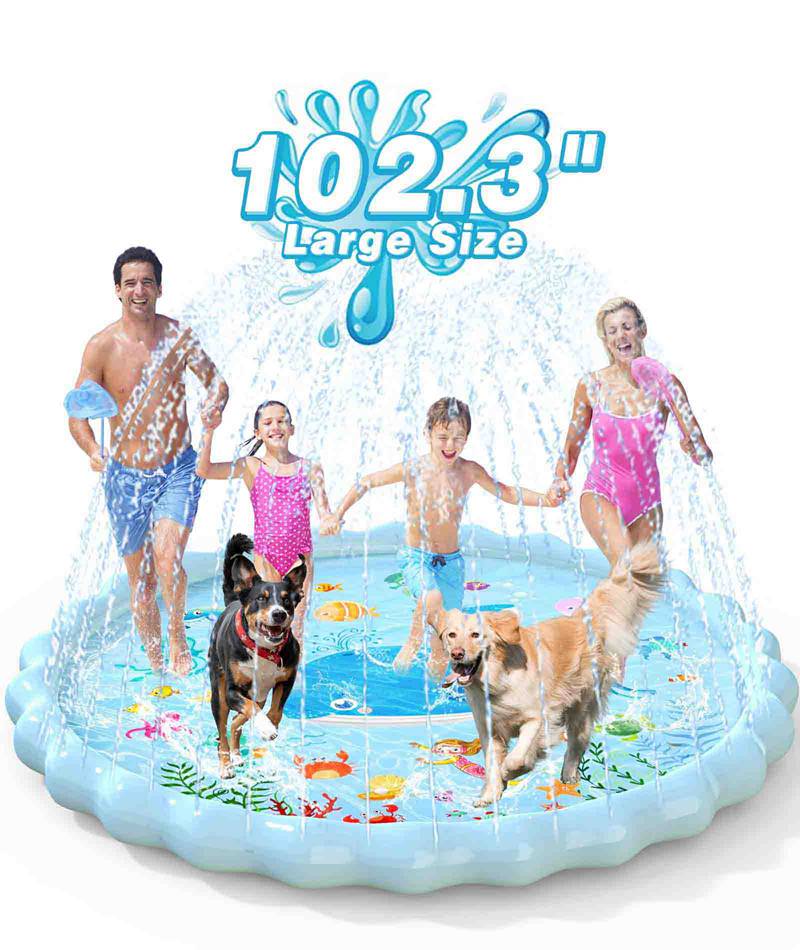
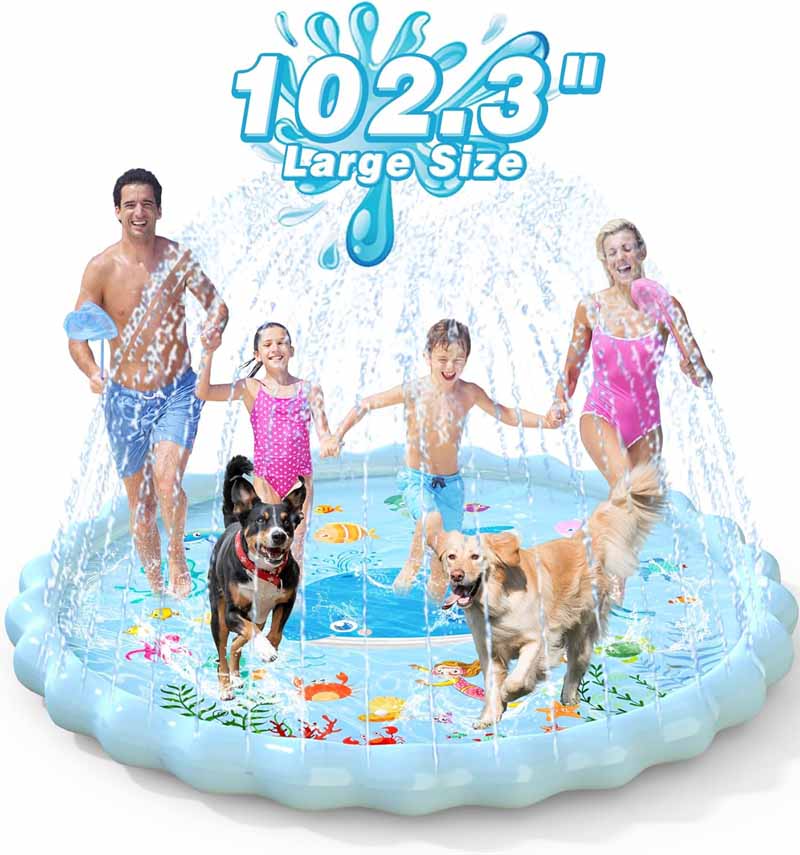
For the confirmed 102.3-inch product used later in this article, the documented structure consists of a central water-play area, perimeter water-filled spray ring, spray openings, and garden-hose connection. Water intensity can be adjusted through the household supply, so the water effect is not a fixed extension of the physical diameter. The product footprint remains approximately 102.3 inches even when the spray height changes.
Total Activity Space Extends Beyond the Product
The true backyard activity zone can include wet grass near the perimeter, children approaching the pad, an adult supervising nearby, a garden hose, towels, shoes, toys, and a dry area where children enter or leave. This wider zone is often what families really need to plan, even though no single ecommerce measurement describes it.
For a birthday party or playdate, surrounding circulation becomes even more important because children may repeatedly move on and off the pad. The same splash pad can function comfortably in an open lawn and feel constrained in a narrow space between a patio and fence. The product has not changed; the relationship between product footprint and activity space has.
A 102.3-Inch Splash Pad Measurement Example
What the 102.3-Inch Specification Tells Us
A confirmed circular splash pad with an approximate 102.3-inch fully expanded diameter provides a useful real-world example. The measurement converts to about 8.53 feet or approximately 260 centimeters. The confirmed construction includes a central water-play area, an outer water-filled sprinkler structure, perimeter spray openings, and a garden-hose connection.
These facts allow several reliable geometric calculations without making assumptions about the exact width of the perimeter ring:
- Overall diameter: 102.3 in
- Approximate diameter: 8.53 ft
- Approximate metric diameter: 260 cm
- Outside radius: 51.15 in
- Approximate radius: 4.26 ft
- Theoretical complete circular footprint: 57.1 sq ft
- Approximate metric footprint: 5.30 m²
These numbers are most useful for comparing overall scale and reproducing the product footprint in a real yard. A parent can mark an 8.53-foot circle before purchase and immediately see whether the pad leaves enough room for normal access. The approximately 57.1-square-foot value is also useful when comparing total material footprint with smaller circular sizes.
What 57.1 Square Feet Does Not Mean
The calculated 57.1 square feet describes the theoretical area inside a complete 102.3-inch circle. It should not automatically be described as 57.1 square feet of open or usable play space. The perimeter sprinkler structure occupies part of the circle, and the confirmed outside diameter alone does not reveal the exact central diameter.
A careful product article should therefore use wording such as:
“A 102.3-inch outside diameter corresponds to a theoretical full-circle footprint of approximately 57.1 square feet before accounting for the perimeter sprinkler structure.”
This wording may sound less dramatic than simply announcing “57 square feet of play space,” but it is far more useful. It allows customers to understand precisely what has been calculated instead of turning a mathematically valid outer-area figure into an unsupported functional claim.
What Cannot Be Derived From the Outside Diameter
The 102.3-inch measurement alone cannot establish the exact inner diameter, exact operating ring width, precise percentage of usable play area, or a fixed number of children who can play comfortably. Those questions require additional dimensional information or defined user testing. An outside diameter is a strong piece of evidence for footprint, but it does not contain hidden information about every internal zone.
This is an important principle for product content generally. A specification should be used only for the claim it directly supports. A PVC thickness value does not prove puncture resistance under every condition. A diameter does not prove child capacity. A spray-height photograph does not establish fixed water coverage under every household pressure. Separating evidence from interpretation makes product guidance more trustworthy.
How to Recreate 102.3 Inches Before Purchase
A family can physically rehearse the footprint using nothing more complicated than a tape measure and a soft marker line. Select a center point, measure approximately 51.15 inches outward in multiple directions, mark those positions, and connect them using a garden hose or soft rope laid loosely on the lawn. The resulting outline represents the approximate outside boundary.
Next, run the actual garden hose from the faucet toward the likely connector position, place a few typical toys inside the circle, and identify where an adult would stand. If children will regularly use the pad together, let them perform the dry movement test. This process produces no automatic “recommended product” result; it simply gives the family enough spatial evidence to make its own decision.
How to Read Splash Pad Size Claims Before Buying
Treat “Large,” “XL” and “Family Size” as Descriptions, Not Measurements
Marketing terms such as large, extra large, giant, XXL, family size, and party size are not standardized geometric units. They can describe a product’s position within one brand’s range, but they should not be used to compare products from different manufacturers. One company’s “extra large” product may be physically smaller than another company’s standard option.
The numerical dimension should always take priority. Record the outside diameter or length and width, product shape, expanded dimensions, and any published internal dimensions. If a page uses several enthusiastic size descriptions but does not clearly disclose the actual operating measurements, the consumer still lacks the information needed for a serious comparison.
Separate Shipping Size From Playing Size
Flexible PVC products can be folded into compact packages, so a listing may contain both a small package measurement and a much larger deployed dimension. These numbers are not contradictory. The package measurement answers questions about storage and delivery, while the expanded measurement answers questions about outdoor placement.
For the confirmed 102.3-inch example discussed above, the retail package is far smaller than the opened product. Consumers comparing listings should label each measurement as package, folded, expanded, or operating size before putting numbers into a spreadsheet. Mixing those categories is one of the easiest ways to create an incorrect comparison.
Check the Selected Variation Before Trusting a Diagram
Marketplace listings frequently combine several colors, sizes, and designs. Reviews, customer videos, infographics, and older product descriptions can sometimes relate to a different variation from the one currently selected. A review saying “perfect size for our patio” has limited value if the reviewer bought the 68-inch version and the shopper is considering a 102-inch version.
The evidence becomes stronger when the dimension can be tied directly to the exact SKU or variation. A manufacturer specification or size-specific technical drawing normally deserves more weight than an unlabeled lifestyle image. If the product page makes variation attribution unclear, record the uncertainty instead of quietly assuming every image applies to every option.
Use Reviews to Identify Questions, Not Manufacture Measurements
A customer review saying “the middle was smaller than expected” can be valuable. It tells you what to investigate next: perhaps the perimeter channel is wide, the lifestyle images created an oversized impression, or the customer interpreted total diameter as open-center diameter. The review does not by itself prove the published outside measurement is incorrect.
A practical evidence hierarchy looks like this:
| Evidence Level | Typical Source | What It Can Reliably Support |
|---|---|---|
| Strong | Size-specific technical drawing, manual, verified direct measurement | Detailed dimensional comparison |
| Moderate | Confirmed overall diameter with no internal dimensions | Overall footprint comparison |
| Contextual | Top-down photographs and videos | Layout, feature positions and general proportions |
| Exploratory | Customer comments such as “small” or “huge” | Questions requiring further verification |
| Weak | “XL,” “giant,” or unlabeled lifestyle images | Marketing impression only |
The goal is not to ignore customer experience. Reviews are often excellent at exposing hidden questions, especially around crowding, setup, water pressure, or product scale. Their best use is to guide verification rather than replace objective measurements.
Use a Static Pre-Purchase Size Checklist
A useful splash-pad article does not need an interactive questionnaire or recommendation generator. A static checklist gives families enough structure to gather the information themselves while remaining easy to print, copy, or save. It also prevents users from forgetting non-product factors such as hose routing and adult access while focusing on diameter.
Splash Pad Size Check Before Purchase
- Confirm the exact product variation.
- Record the fully expanded outside diameter or length × width.
- Record whether the product is circular, square, rectangular, or irregular.
- Separate package measurements from operating measurements.
- Look for a published inner diameter.
- Look for the perimeter-channel width.
- Note hoops, fountains, arches, or central features.
- Convert competing products into the same measurement unit.
- Calculate theoretical area only from confirmed measurements.
- Mark the actual footprint on the intended lawn.
- Check the garden-hose route.
- Check adult access around the wet area.
- Include normal toys in the dry movement test.
- Record missing measurements as unknown instead of estimating them from photographs.
The checklist can also be adapted into a downloadable spreadsheet or one-page PDF by site operators. Useful fields include product name, variation, outside diameter, ring width, inner diameter, outer-circle area, inner-circle area, yard width, yard length, hose position, user ages, normal toy load, obstacles, dry-test observations, and unknown measurements. Because the worksheet is static, users remain in control of the decision and no conversational generator is required.
Common Measurement Mistakes to Avoid
Mistake 1: Treating the Advertised Diameter as an Open Floor
This is the most important mistake addressed by the entire article. A published diameter can be accurate while the open central floor remains smaller because the product includes a functional perimeter structure. Before comparing two listings, determine whether each number describes the outer product, inner floor, or another dimension.
The solution is not to distrust all advertised dimensions. It is to interpret them correctly. Outside diameter is extremely useful when planning backyard footprint. Problems arise only when it is silently transformed into a claim about unrestricted play area without supporting internal measurements.
Mistake 2: Subtracting the Perimeter Width Only Once
If an 80-inch pad has a five-inch ring around its full perimeter, the central diameter is not 75 inches. A diameter passes through the ring on both sides, so the basic estimate is 80 − 5 − 5 = 70 inches. Forgetting the second side is a simple arithmetic error capable of substantially overstating inner area.
The same rule can be visualized by drawing one straight line through the center of the pad. Starting from the outside edge, the line first crosses the near-side ring, continues across the center, then crosses the far-side ring before reaching the opposite outside edge. Both perimeter sections belong inside the 80-inch total.
Mistake 3: Comparing Diameter Differences Instead of Area Differences
A 15-inch diameter increase can create much more than a 15-inch “strip” of additional space. Because circular area is based on radius squared, extra radius adds area around the entire circumference. The earlier 80-inch and 95-inch example demonstrates this clearly: an 18.75-percent diameter increase corresponds to roughly a 41-percent increase in theoretical outer-circle area.
This does not mean the larger product has 41 percent more usable play space. Internal geometry still matters. The calculation tells us only how the overall circular footprint changes, making it a helpful starting point rather than a complete functional comparison.
Mistake 4: Using Photos to Estimate Inches
Photographs are useful for understanding design, but they are unreliable rulers. Different focal lengths, viewing angles, child ages, cropping, and camera distances can make one product look dramatically larger than another. Even a perfectly honest lifestyle image is created to show people enjoying the product rather than to replace a technical drawing.
Use photos to ask questions such as “Where is the connector?” or “Does the hoop occupy the middle?” Use verified dimensions to answer “How many inches wide is it?” Keeping those roles separate makes visual content more helpful instead of less trustworthy.
Mistake 5: Choosing the Largest Pad the Lawn Can Barely Hold
A product can technically fit while the complete activity setup does not. If every outside edge sits inches from a patio, planter, fence, or busy walkway, children may have nowhere comfortable to enter and leave. The hose may cross the main route, and an adult may have difficulty approaching the center without stepping over equipment.
Backyard planning should therefore start with functional fit, not maximum possible diameter. The better setup is the one leaving enough room for the product and its surrounding activity, even when another option offers a larger headline dimension.
Conclusion: Measure the Experience, Not Just the Product
Splash pad diameter is an important and useful measurement, but it answers one specific question: how wide is the complete product from outside edge to outside edge? Usable play space asks a different question: how much room can children practically use once the perimeter water channel, built-in features, toys, movement patterns, and other users are considered? A third question—how much total backyard space is needed—extends beyond the product completely.
A careful comparison begins with confirmed dimensions, uses simple geometry only where the inputs are reliable, and leaves missing measurements unknown instead of filling the gaps with guesses. Parents can then mark the real footprint on their lawn, rehearse movement before water is turned on, check the hose route, consider the ages and play styles of regular users, and look at internal design rather than relying on “XL” or “family size” labels.
For product teams developing custom PVC or composite-material splash pads, the same thinking should begin before sampling. Overall size, central play dimensions, water-channel width, seam paths, spray-hole distribution, connector orientation, feature positions, expected activity, material construction, and packaging should be developed as one connected system. Clear dimensional documentation helps factories build more consistently and gives the final customer a much easier product to understand.
The most useful rule is also the simplest: do not ask one number to answer every size question. Use outside diameter to understand footprint, inner dimensions to understand central geometry, observation to understand functional play, and actual yard measurement to understand fit. Once those pieces are separated, comparing splash pads becomes much more practical and far less dependent on marketing impressions.
Frequently Asked Questions About Splash Pad Diameter and Play Space
Does Splash Pad Diameter Include the Sprinkler Ring?
For many circular hose-powered splash pads, the published overall diameter measures from the far outside edge on one side to the far outside edge on the opposite side, so the perimeter water channel is included. The published 64-inch FUNBOY example discussed earlier clearly separates a 64-inch overall measurement from a smaller inner diameter. Listing terminology is not universal, however, so a size diagram or manufacturer specification should be checked before assuming how any specific product was measured.
Does an 80-Inch Splash Pad Have 80 Inches of Usable Play Space?
Usually, you should not make this assumption from the outside diameter alone. An 80-inch product may include a perimeter sprinkler channel, seams, connector zone, hoop, fountain, or other structures inside the complete footprint. If an inner measurement is unavailable, the scientifically sound conclusion is simply that the product has an 80-inch overall diameter while its exact open-center diameter remains unconfirmed.
How Do I Calculate the Inner Play Area of a Splash Pad?
If the overall diameter and a consistent perimeter-ring width are both reliably known, estimate the inner diameter by subtracting twice the ring width from the overall diameter. Divide the resulting diameter by two to find the radius, then use A = πr² to estimate the circular inner area. Label the result as an estimated open-center area rather than automatically calling it usable play space, since movement and built-in features can still affect practical use.
How Many Children Can Fit on a Splash Pad?
There is no reliable universal formula converting splash pad diameter into a fixed number of children. Age, body size, activity level, toys, internal design, central dimensions, and surrounding clearance all influence comfort. A dry movement test using the children who normally play together provides more practical information than a generic chart claiming a particular diameter always supports a specific number of users.
Is a Bigger Splash Pad Always Better?
A larger circular diameter can provide substantially more theoretical area, but it is not automatically a better fit. An oversized product can leave too little room for the garden hose, adult access, children entering and leaving, or nearby dry supplies. Internal layout matters as well. A somewhat smaller product with a broad open center may provide better movement than a larger design filled with structures.
How Much Extra Space Should I Leave Around a Splash Pad?
There is no single universal clearance number suitable for every residential splash pad, backyard, and play pattern. Plan enough surrounding room for children to enter and leave naturally, keep the hose away from the busiest route, allow an adult to approach easily, and account for local obstacles. Physically marking the full product footprint on the intended lawn is more reliable than applying an arbitrary clearance rule.
What Should I Do When a Listing Does Not Provide the Inner Diameter?
Record the value as not disclosed. Check the product manual, technical diagram, manufacturer specifications, or other size-specific documentation. If the product is already available, measure the central section directly under a clearly defined condition. Avoid estimating exact inches from a lifestyle photograph because camera perspective, product orientation, and child size can make visual proportions unreliable. An unknown measurement is preferable to a precise-looking number without evidence.