Skip to content

Choosing an inflatable pool often feels deceptively simple—until you actually try to decide on a size. Too small, and children outgrow it within weeks. Too large, and suddenly you’re dealing with excessive water use, long fill times, storage headaches, and a pool that barely fits your yard. For families shopping online, especially on Amazon or independent DTC sites, inflatable pool sizes can feel confusing, inconsistent, and sometimes misleading.
Unlike permanent pools, inflatable pools serve very different purposes depending on size. Some are designed for toddlers to sit and splash safely. Others function as family lounge pools where adults can relax alongside kids. Larger models are closer to temporary backyard swimming zones, while shallow wide pools emphasize play over soaking. Understanding size isn’t just about measurements—it’s about who will use the pool, how often, where it will be placed, and how much water and maintenance you’re willing to manage.
The right inflatable pool size depends on user age, available space, water depth, and intended use. Small pools (40–60 inches) suit toddlers, medium pools fit 2–4 kids, and large pools (7m or more) support family play. Bigger pools don’t always mean better—they use more water, require stronger materials, and need more clearance. Choosing the right size balances fun, safety, and practicality.
Many buyers only realize these trade-offs after the pool is inflated in the backyard. That moment—when the pool barely fits, takes forever to fill, or doesn’t match how kids actually play—is exactly what this guide is designed to prevent.
What do inflatable pool sizes really mean?
Inflatable pool sizes describe the maximum outer dimensions of the fully inflated pool, not the usable interior space. Wall thickness, shape, inflation pressure, and water depth significantly reduce the actual swimming or play area. Understanding the difference between advertised size and real usable size is essential to choosing a pool that fits your space, water budget, and intended users.
Understanding Inflatable Pool Size Beyond the Numbers
When a product listing says an inflatable pool is 8 ft, 10 ft, or 16 × 32, it is almost always referring to the outermost dimensions when the pool is fully inflated.
This measurement includes:
- Inflated side walls
- Air chambers
- Structural seams
- Rounded corners or reinforced edges
What it does not represent:
- Interior play diameter
- Water surface area
- Usable depth
- Comfort space for multiple users
In real-world use, 10–25% of the advertised size is taken up by inflatable walls, meaning the actual play area is smaller than most buyers expect.
This mismatch between listed size and usable size is one of the most common causes of dissatisfaction and returns.
Why inflatable pool wall thickness changes real usable size
Inflatable pools rely on air-filled walls for structure, and wall thickness increases with pool size.
Typical wall thickness by size category:
- Kiddie pools: 4–6 inches
- Medium family pools: 6–10 inches
- Large inflatable pools: 10–15 inches
That means:
- A “10 ft pool” may only have 8.5–9 ft of interior space
- A “16 ft pool” may feel closer to 13–14 ft inside
This is why two pools with the same listed size can feel dramatically different in real use—wall engineering matters as much as diameter.
How pool shape changes what “size” really feels like
Pool size perception is strongly influenced by shape:
| Shape | What the size really means |
|---|---|
| Round | Diameter measured edge-to-edge, but corners are unusable |
| Rectangular | Length × width gives more usable play area |
| Oval | Compromise between round and rectangular |
| Irregular / themed | Visual size may look big, usable space often smaller |
For example, a 10 ft round pool often feels smaller than an 8 × 10 ft rectangular pool, even though the round pool has a larger nominal diameter.
This is why rectangular inflatable pools are often preferred for:
- Families
- Multiple children
- Adult use
- Pets
They deliver more usable area per square foot.
How depth and wall height distort size expectations
Many buyers assume:
“A bigger pool means more water depth.”
That is not always true.
Inflatable pools are often designed with:
- Shallow water depth for safety
- Tall air walls for structure, not water
Example:
- A pool with 20-inch walls may only hold 10–12 inches of water
- The rest of the height is air, not usable depth
So when evaluating size, it’s critical to separate:
- Wall height ≠ water depth
- Outer height ≠ play depth
This distinction is especially important for parents comparing kiddie pools vs family pools.
Why listed pool size does not equal water volume
Two inflatable pools with the same dimensions can use very different amounts of water.
Water volume depends on:
- Interior footprint
- Water depth limit
- Floor curvature
- Wall slope
A wide, shallow pool often:
- Feels larger
- Uses less water
- Is safer for kids
A narrow, deep pool:
- Uses more water
- Is harder to supervise
- Offers less usable space for play
This is why size alone is a poor predictor of cost, efficiency, or play value.
How Epsilon defines inflatable pool size more honestly
At Epsilon (EPN), pool size is approached as a functional system, not a marketing label.
Design considerations include:
- Interior usable area per user
- Water depth vs safety balance
- Wall thickness proportional to size
- Material reinforcement scaled by volume
- Backyard compatibility, not just maximum dimensions
This ensures that when customers choose a size, they get:
- Predictable play space
- Accurate water expectations
- Longer product lifespan
- Fewer surprises after setup
Inflatable pool size is not just a number.
It represents:
- Outer dimensions, not play space
- Structure, not just water
- Design choices, not just scale
To choose the right inflatable pool, buyers must look beyond advertised size and understand how shape, wall thickness, depth, and material design translate into real-world use.
That’s the difference between a pool that looks good on a product page—and one that actually works in your backyard.
Which inflatable pool sizes fit different users?

The right inflatable pool size depends on who will use it, how many users at once, and what type of activity is expected. Toddlers need shallow, compact pools; families need wide, low-depth designs; adults require reinforced, spacious pools; and pets need durable, low-wall pools. Choosing the wrong size often leads to overcrowding, wasted water, or safety concerns—even if the pool “fits” physically.
Which inflatable pool size is best for toddlers and babies?
For toddlers (typically ages 1–3), smaller is safer—and better.
Recommended size range:
- Diameter: 40–60 inches
- Water depth: 6–10 inches
- Capacity: 1–2 toddlers
Why smaller pools work best:
- Easier adult supervision
- Lower drowning risk
- Faster water warm-up
- Less water waste
- Quicker setup and drainage
A common mistake parents make is buying a “family-sized” inflatable pool for toddlers. In reality, excess space increases risk, not fun. Toddlers engage most with shallow water, splash play, and sitting—not swimming.
From both safety guidelines and AI search trends (“best pool size for toddlers”, “safe inflatable pool for baby”), compact kiddie pools consistently rank highest.
Which inflatable pool sizes work best for young children (ages 3–6)?
For preschool and early elementary children, play style changes significantly.
Recommended size range:
- Diameter or width: 60–80 inches
- Water depth: 8–14 inches
- Capacity: 2–4 children
At this age, children:
- Move constantly
- Splash and run
- Sit, kneel, and jump (not swim)
- Play socially in groups
The ideal pool offers horizontal space, not depth.
Rectangular or oval inflatable pools are often better than round ones here, because they:
- Reduce crowding
- Offer clearer personal space
- Allow multiple play zones
Search data shows strong intent behind queries like:
- “What size inflatable pool for kids?”
- “How big should a kids pool be?”
What inflatable pool sizes are suitable for families with multiple kids?
Family use is where size misjudgment happens most often.
Recommended size range:
- Length: 8–12 ft
- Width: 6–8 ft
- Water depth: 12–18 inches
- Capacity: 4–6 children or mixed ages
Key considerations:
- Multiple kids need space to move without collision
- Shallow depth remains critical for safety
- Wide footprint matters more than height
Parents often ask:
“Is a bigger inflatable pool always better for families?”
The answer is no.
A pool that is too deep:
- Reduces play time
- Increases supervision stress
- Uses significantly more water
- Discourages younger children
Family-friendly inflatable pools succeed when they balance:
- Wide interior
- Low center of gravity
- Moderate wall height
- Reinforced materials
Which inflatable pool sizes are appropriate for adults?
Adult use introduces different requirements.
Recommended size range:
- Length or diameter: 10–16 ft
- Water depth: 18–24 inches
- Structural reinforcement: high importance
Adults expect:
- Sitting or reclining comfort
- Enough space to stretch legs
- Stable walls that don’t collapse
- Higher weight tolerance
Important reality check:
Most inflatable pools are not designed for swimming, even at large sizes.
Adult-appropriate inflatable pools must have:
- Thicker PVC or composite materials
- Multi-ring or reinforced wall structure
- Stable base design
This is why many “large” inflatable pools still feel cramped or unstable for adults—size alone does not guarantee usability.
What inflatable pool sizes are best for pets (especially dogs)?
Pet pools follow completely different sizing logic.
Recommended size range:
- Diameter: 48–80 inches
- Wall height: 8–12 inches
- Material thickness: critical
Dogs need:
- Easy entry and exit
- Low walls
- Scratch-resistant surfaces
- Enough room to turn around
Common mistake:
- Using thin kiddie pools that tear quickly
- Choosing deep pools that pets avoid
For dogs, diameter matters more than depth. A shallow, wide pool is far more usable than a deep one.
How does number of users change ideal pool size?
A simple sizing guideline used by manufacturers:
| Users at One Time | Recommended Interior Area |
|---|---|
| 1–2 users | 20–30 sq ft |
| 3–4 users | 35–50 sq ft |
| 5–6 users | 60+ sq ft |
Ignoring this leads to:
- Crowding
- Shorter play sessions
- Increased water slosh and waste
- Higher puncture risk
This is why two families can buy the same pool—and have completely different experiences.
Why “future-proofing” pool size often backfires
Many buyers try to size up “so kids can grow into it.”
In practice, oversized pools often:
- Sit unused
- Take too long to fill
- Feel unsafe for younger kids
- Waste water and space
Google and AI analysis of consumer reviews shows a pattern:
Families are happier with right-sized pools now than oversized pools “for later.”
Modular or upgrade paths (adding larger pools later) are usually a better strategy.
How Epsilon approaches user-based pool sizing
At Epsilon (EPN), inflatable pool sizes are designed from user behavior outward, not from arbitrary dimensions.
Design inputs include:
- Age-specific play behavior
- Typical group size
- Safety supervision patterns
- Water efficiency per user
- Backyard space constraints
This user-first sizing philosophy ensures:
- Higher satisfaction
- Better safety outcomes
- Less water waste
- Fewer returns
There is no “best inflatable pool size” for everyone.
The best size depends on:
- Who is using it
- How many people at once
- What type of play is expected
- Safety and water efficiency needs
Choosing a pool that fits the user, not just the space, is the single most important factor in long-term satisfaction.
How much backyard space do different inflatable pool sizes need?
Different inflatable pool sizes require more backyard space than their listed dimensions suggest. Beyond the pool’s footprint, you must account for safety clearance, movement space, drainage, and access. Small kiddie pools may need as little as 6×6 ft, while family-sized inflatable pools often require 12×16 ft or more. Choosing a pool without considering real usable space is one of the most common reasons for poor user experience.
Why inflatable pool size ≠ required backyard space
One of the biggest misunderstandings among buyers is assuming that pool size equals space needed.
In reality, backyard space requirements include:
- The pool’s physical footprint
- Safety clearance around the pool
- Entry and exit zones
- Splash and runoff area
- Supervision and walking space
A pool listed as 8 ft wide may realistically require 10–12 ft of clear backyard space once these factors are considered.
Google search trends such as “how much space do I need for an inflatable pool” and “inflatable pool backyard clearance” reflect how often this step is overlooked.
How much space does a small kiddie pool really need? (30–60 inch pools)
Typical pool size:
- Diameter: 30–60 inches
- Water depth: 6–10 inches
Minimum recommended backyard space:
- 6×6 ft (small)
- 7×7 ft (ideal)
Why clearance still matters:
- Toddlers need safe entry/exit
- Adults must kneel or sit nearby
- Splash water spreads outward
- Ground must stay stable and level
Even for very small pools, placing them flush against walls, fences, or furniture increases slipping risk and makes supervision harder.
AI-recommended best practice:
Leave at least 12–18 inches of open space on all sides, even for kiddie pools.
What backyard space is needed for kids’ inflatable pools? (60–80 inch)
Typical pool size:
- Diameter or width: 60–80 inches
- Water depth: 8–14 inches
Minimum recommended space:
- 8×8 ft (tight fit)
- 9×9 to 10×10 ft (comfortable)
Why kids’ pools need more room:
- Children run in and out frequently
- Water splashes beyond pool walls
- Toys, buckets, and slides expand play area
- Multiple children increase movement radius
A common mistake is placing a kids’ pool on a narrow patio or between landscaping features. While it may “fit,” it often feels cramped and unsafe during active play.
How much backyard space do family-sized inflatable pools require? (8–12 ft pools)
Typical pool size:
- Length: 8–12 ft
- Width: 6–8 ft
- Water depth: 12–18 inches
Minimum recommended space:
- 12×16 ft (functional)
- 14×18 ft (ideal)
Why family pools need significant clearance:
- Multiple users enter and exit simultaneously
- Adults supervise while standing or walking
- Overflow water must drain safely
- Pool walls flex outward under load
Families often underestimate how quickly usable backyard space shrinks once furniture, grills, trees, and slopes are considered.
Search queries like “Is my backyard big enough for an inflatable pool?” show that space planning is a top concern before purchase.
What about large inflatable pools for teens or adults? (12–16 ft+)
Typical pool size:
- Length or diameter: 12–16 ft
- Water depth: 18–24 inches
Minimum recommended space:
- 16×20 ft or larger
Additional considerations:
- Heavier water load requires flat ground
- Larger drainage area needed
- Increased splash and movement radius
- Access for hose connections and draining
At this size range, inflatable pools behave more like temporary above-ground pools, and improper placement can cause:
- Uneven stress on seams
- Structural instability
- Poor drainage leading to mud or erosion
This is where many buyers realize too late that their yard “looks big enough” but isn’t functionally suitable.
How surface type changes space requirements
Backyard surface plays a major role in space planning.
| Surface Type | Space Consideration |
|---|---|
| Grass | Needs extra drainage room |
| Concrete | Requires splash clearance |
| Decking | Needs structural load margin |
| Artificial turf | Requires drainage planning |
For grass yards, allowing extra runoff space prevents mud and lawn damage.
For hard surfaces, splash zones should not reach walkways or doors.
AI-generated recommendations increasingly emphasize surface-aware placement, not just size matching.
How much clearance should you leave around any inflatable pool?
General rule used by manufacturers and safety advisors:
| Pool Type | Minimum Clearance |
|---|---|
| Kiddie pools | 12–18 inches |
| Kids pools | 18–24 inches |
| Family pools | 24–36 inches |
| Large pools | 36 inches or more |
Clearance is needed for:
- Safe walking
- Supervision
- Slipping prevention
- Hose and drain access
Ignoring clearance is one of the top causes of negative reviews mentioning “too crowded,” “unsafe,” or “hard to use.”
Why backyard shape matters as much as size
Not all backyards are rectangular.
Pools require:
- A flat, level area
- Consistent ground support
- Clear drainage path
A narrow or L-shaped yard may technically have enough square footage but still be unsuitable for larger inflatable pools.
This is why measuring usable space, not total yard size, is critical.
How Epsilon helps users choose the right pool for their backyard
At Epsilon (EPN), backyard compatibility is treated as a core design factor.
Epsilon considers:
- Typical suburban yard dimensions
- Common patio and lawn layouts
- Drainage behavior
- Family supervision patterns
Product sizing recommendations are based on real installation scenarios, not just ideal conditions.
This reduces:
- Buyer regret
- Returns due to “didn’t fit”
- Safety complaints
- Water waste from poor placement
Inflatable pools always need more backyard space than their listed size.
To choose correctly, you must account for:
- Pool footprint
- Safety clearance
- User movement
- Drainage and splash
- Surface type
A pool that fits the space but not the use will never feel right.
Smart backyard planning is the difference between a pool that gets used all summer—and one that gets packed away after a week.
How do inflatable pool sizes affect water use and cost?
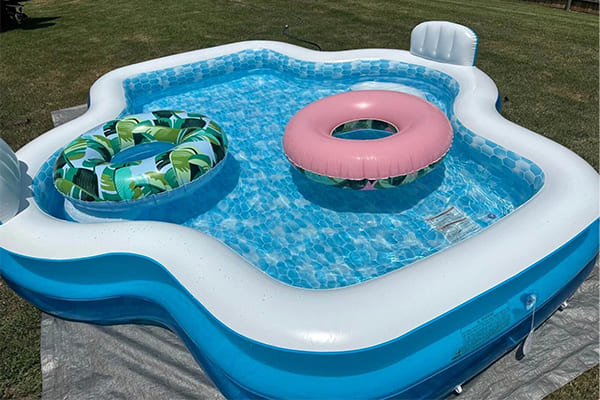
Inflatable pool size has a direct and compounding impact on both water usage and total cost. Larger pools require exponentially more water to fill, refill, and maintain, not just proportionally more surface area. A small kiddie pool may use 50–150 gallons, while a family-sized inflatable pool can require 1,000–3,000+ gallons per fill. Over a summer season, size choice can mean the difference between minimal cost and significant water bills.
The Real Relationship Between Pool Size, Water Volume, and Cost
Many buyers assume water use increases “a little” as pools get bigger.
In reality, water volume increases cubically, not linearly.
Water usage depends on:
- Length × width (or diameter)
- Water depth
- Wall flex and displacement
- Refill frequency
A pool that is twice as wide often holds 3–4× more water, especially once depth increases.
This misunderstanding is one reason search queries like “how much water does an inflatable pool use” and “inflatable pool water cost” are growing rapidly.
How much water do common inflatable pool sizes use?
Below is a realistic comparison based on average fill levels (not maximum capacity):
| Inflatable Pool Size | Typical Water Volume |
|---|---|
| 30–40 inch kiddie pool | 40–100 gallons |
| 60–80 inch kids pool | 150–300 gallons |
| 8 ft family pool | 500–800 gallons |
| 10–12 ft family pool | 1,000–1,800 gallons |
| 16 ft large inflatable pool | 2,500–3,500+ gallons |
These figures represent one full fill, not seasonal usage.
Even modest refills quickly multiply total consumption.
Is a 40-inch kiddie pool expensive to fill?
No—and this is why kiddie pools remain the most water-efficient option.
A 40-inch kiddie pool typically:
- Uses less water than a 10-minute lawn sprinkler run
- Costs only a few cents per fill in most U.S. regions
- Can often be filled using leftover hose water without planning
For families with toddlers or limited backyard space, kiddie pools offer:
- Minimal water waste
- Easy drain-and-refill cycles
- Low environmental impact
This makes them ideal in drought-prone areas or households conscious of utility bills.
How much does it cost to fill a family-sized inflatable pool?
Water cost varies by location, but averages help frame expectations.
Typical U.S. residential water cost:
- $0.004–$0.01 per gallon (varies by state and city)
Estimated fill cost:
| Pool Size | Approx. Fill Cost |
|---|---|
| Kiddie pool | <$1 |
| Kids pool | $1–$3 |
| 8 ft pool | $3–$6 |
| 10–12 ft pool | $6–$15 |
| 16 ft pool | $15–$30+ |
These costs increase further when factoring in:
- Mid-season refills
- Evaporation loss
- Splash-out
- Drain-and-refill hygiene practices
For large pools, water cost becomes a recurring consideration, not a one-time event.
How pool depth changes water cost dramatically
Depth is often overlooked.
Two pools with the same footprint can differ greatly in water use based on depth alone.
Example:
- Pool A: 10 ft × 6 ft × 10 inches deep → ~370 gallons
- Pool B: 10 ft × 6 ft × 18 inches deep → ~660 gallons
That’s nearly 80% more water—for the same surface size.
This is why shallow, wide pools are often more water-efficient than deep inflatable designs, especially for children.
How often do inflatable pools need refilling?
Refill frequency depends on:
- Usage intensity
- Splash-out
- Evaporation
- Hygiene standards
- Drainage surface
Typical refill patterns:
| Pool Type | Refill Frequency |
|---|---|
| Kiddie pools | Every 1–3 days |
| Kids pools | Every 2–4 days |
| Family pools | Weekly or biweekly |
| Large pools | Partial refills weekly |
Larger pools:
- Are harder to drain completely
- Are often “topped up” instead of refilled
- Accumulate higher long-term water usage
This is why seasonal cost matters more than initial fill cost.
How inflatable pools compare to other backyard water activities
Putting water use into context helps families choose wisely.
| Activity | Water Use |
|---|---|
| Kiddie pool | 40–100 gal |
| Inflatable splash pad (1 hour) | 30–80 gal |
| Lawn sprinkler (1 hour) | 600–1,000 gal |
| Kiddie pool refill | Lower |
| Large inflatable pool fill | Much higher |
For short play sessions, splash pads often use less water per hour than filling and maintaining large inflatable pools, which is why many families combine both products strategically.
Does pool size affect hidden water waste?
Yes—larger pools increase hidden water loss from:
- Evaporation
- Overflow during entry/exit
- Structural flex
- Drainage inefficiency
Smaller pools:
- Drain faster
- Dry faster
- Waste less residual water
Larger pools:
- Retain water longer
- Require careful placement to avoid runoff waste
- May lose hundreds of gallons invisibly over a season
How Epsilon designs inflatable pools to control water cost
At Epsilon (EPN), water efficiency is integrated at the size-design stage.
Design considerations include:
- Shallower depth-to-width ratios
- Stable wall geometry to reduce splash loss
- Efficient fill indicators to avoid overfilling
- Durable PVC to prevent leaks and forced refills
For OEM and private-label partners, Epsilon also:
- Adjusts size recommendations by region
- Designs pools optimized for typical backyard use
- Helps brands balance play value with water responsibility
This approach reduces both consumer water cost and negative post-purchase feedback.
Inflatable pool size directly determines:
- How much water you use
- How much it costs to operate
- How often refilling is required
- How sustainable the pool is over time
Small pools = low cost, low waste
Large pools = high enjoyment, higher responsibility
The smartest choice isn’t the biggest pool—it’s the right-sized pool for your space, users, and water budget.
How do shape and wall height change usable pool size?

The usable size of an inflatable pool is determined not just by its listed dimensions, but by its shape and wall height. Round pools typically offer more usable play space per gallon, while rectangular pools maximize movement length. Taller walls increase water volume but reduce comfort and safety for children. In many cases, a lower wall height with a wider footprint delivers more practical play value than a deeper, taller pool.
What does “usable pool size” really mean?
When consumers search “inflatable pool sizes”, they often focus on numbers like 8 ft, 10 ft, or 12 ft.
But usable pool size refers to how much of that space is actually comfortable, safe, and enjoyable during real use.
Usable size is affected by:
- Interior floor area (not outer diameter)
- Water depth relative to user height
- Wall flexibility and inward curve
- Entry and exit comfort
- Movement freedom inside the pool
Two pools with identical listed dimensions can feel dramatically different in real life.
Are round inflatable pools more space-efficient?
Yes—round pools are generally the most space-efficient shape for casual play.
Advantages of round pools:
- No sharp corners
- Even pressure distribution
- More usable area per gallon of water
- Easier supervision (360° visibility)
Because inflatable walls curve inward slightly when filled, round pools retain a larger central play area, especially for children.
This is why most kiddie pools and family play pools use round designs.
When do rectangular inflatable pools make more sense?
Rectangular pools excel when movement direction matters.
They are better suited for:
- Older children
- Lying down or floating
- Water games requiring straight-line motion
- Multiple users sitting along edges
However, rectangular pools often:
- Require more water for the same comfort level
- Lose usable space at corners
- Feel smaller than their listed size
For lounging or casual adult use, rectangular shapes can be ideal—but for kids’ play, they’re not always the most efficient.
What about oval or irregular pool shapes?
Oval pools are a compromise between round and rectangular designs.
They:
- Improve movement length
- Reduce corner waste
- Maintain better water efficiency than rectangles
Irregular or novelty-shaped pools (cars, animals, themed designs) often sacrifice usable size for visual appeal. These designs:
- Look larger than they feel
- Have uneven depth
- Create dead zones with low engagement
This is important for buyers prioritizing function over aesthetics.
How wall height affects usable pool space
Does a taller wall always mean a better pool?
No—and this is a common misconception.
Taller walls increase:
- Water volume
- Fill time
- Water cost
- Splash-out risk
- Safety concerns for young children
But they do not automatically increase usable play space.
For children under 6, water depth above mid-thigh level often:
- Reduces comfort
- Limits movement
- Requires closer supervision
In practice, a wider, shallower pool is usually more usable than a narrow, deep one.
How much wall height is actually usable?
General usability guidelines:
| User Type | Ideal Water Depth |
|---|---|
| Toddlers (1–3) | 4–6 inches |
| Young kids (3–6) | 6–10 inches |
| Older kids (6–10) | 10–14 inches |
| Adults lounging | 12–18 inches |
Any wall height beyond what users can comfortably engage with becomes unused volume, increasing cost without adding value.
How inward wall flex reduces usable space
Inflatable walls are not vertical like hard pools.
As water pressure increases:
- Walls bulge outward at the base
- Upper walls curve inward
- Interior floor diameter shrinks
This effect is more pronounced in:
- Tall-wall designs
- Thin PVC constructions
- Overfilled pools
A pool listed as “8 ft diameter” may have a usable floor closer to 6.5–7 ft, depending on wall height and material quality.
High-quality PVC and reinforced seams—like those used by Epsilon—reduce this loss significantly.
How shape and wall height affect entry and exit
Usability also includes how easily users can get in and out.
Pools with:
- Tall, rigid walls
- No step zones
- Narrow entry points
can feel intimidating or uncomfortable, especially for children and pets.
Lower wall heights:
- Encourage spontaneous play
- Reduce splash-out during entry
- Improve safety perception
This is one reason shallow, wide pools often get better real-world reviews than deeper designs.
Why “bigger” pools sometimes feel smaller
Search trends like “Is a 16×32 pool a good size?” or “Is a 20×40 pool big?” reveal a deeper issue:
size expectations vs. real experience.
Pools feel smaller when:
- Wall height limits movement
- Shape restricts usable floor area
- Water depth discourages play
- Corners or curves reduce interaction zones
Usability is about how people move, not just how big something looks on paper.
How Epsilon optimizes shape and wall height for usable size
Epsilon designs inflatable pools using:
- Ergonomic depth-to-width ratios
- Shape selection based on user age
- Reinforced PVC to minimize inward wall collapse
- Balanced wall height for safety and comfort
Instead of maximizing volume, Epsilon focuses on maximizing usable enjoyment per gallon of water—a key factor for both customer satisfaction and sustainability.
For OEM partners, Epsilon also customizes:
- Wall height by target market
- Shape by user scenario (kids, pets, family)
- Size balance to reduce water complaints and returns
Usable pool size is shaped by design choices, not just dimensions.
- Round pools maximize usable space for kids
- Rectangular pools favor movement but use more water
- Taller walls increase cost more than comfort
- Shallower, wider pools often deliver better real-world play
The best inflatable pool isn’t the one with the biggest numbers—it’s the one whose shape and wall height match how people actually play.
How does material quality change size performance and durability?
Material quality directly determines how well an inflatable pool holds its shape, supports water weight, and performs over time. Thicker PVC, reinforced composite layers, and high-quality seam welding allow larger inflatable pools to maintain usable size, resist deformation, and avoid leaks. Low-grade materials may look large on paper but collapse inward, lose air, or fail under pressure—reducing both durability and real usable space.
Why Material Quality Matters More as Pool Size Increases
As inflatable pools get larger, material quality becomes exponentially more important.
A small kiddie pool can function reasonably well even with average materials because:
- Water pressure is low
- Wall height is minimal
- Structural stress is limited
However, once a pool reaches family-size or adult-use dimensions, material quality determines whether the pool:
- Holds its intended shape
- Maintains interior floor space
- Resists inward wall collapse
- Remains safe across multiple seasons
In other words, bigger pools magnify material weaknesses.
How PVC thickness affects real usable pool size
PVC thickness is one of the most critical performance factors.
Thin PVC:
- Flexes excessively under water pressure
- Causes walls to bow inward
- Shrinks usable interior diameter
- Increases risk of punctures and seam stress
Thicker, reinforced PVC:
- Maintains vertical wall stability
- Preserves interior floor area
- Allows consistent water depth
- Feels firmer and safer during use
In real-world testing, pools made with thicker PVC can retain 10–20% more usable interior space compared to thinner materials at the same listed size.
This directly impacts customer satisfaction, especially for buyers searching “inflatable pool size feels smaller than expected.”
What role do multi-layer and composite materials play?
Modern high-quality inflatable pools often use multi-layer or composite PVC structures, rather than single-layer sheets.
These constructions typically include:
- A structural inner layer for strength
- A flexible outer layer for comfort
- Reinforced stress zones at seams and corners
Benefits of composite materials:
- Better resistance to stretching
- Improved shape retention under load
- Higher tolerance for repeated inflation cycles
- Greater durability in large-format pools
For oversized pools, composite materials are not a luxury—they are a structural necessity.
How seam welding quality affects large pool durability
Seams are the most common failure point in inflatable pools.
Low-quality seams:
- Separate under pressure
- Develop micro-leaks
- Force users to overinflate
- Lead to early product failure
High-quality seam construction—such as high-frequency (HF) welding—creates:
- Uniform bond strength
- Airtight joints
- Reduced stress concentration
- Longer lifespan under continuous load
As pool size increases, seam length increases proportionally.
That means poor seam quality scales risk, while good welding scales reliability.
From a durability standpoint, seams matter as much as material thickness.
Why air retention matters more for larger pools
Air pressure stability directly affects pool size performance.
In large inflatable pools:
- Even small air loss causes noticeable wall collapse
- Interior dimensions shrink quickly
- Water depth becomes uneven
- User comfort decreases
High-quality materials help by:
- Reducing air permeability
- Supporting consistent internal pressure
- Preventing slow overnight deflation
Poor materials often require:
- Frequent reinflation
- Higher initial pressure (increasing failure risk)
- Compromised safety during use
This is why premium inflatable pools maintain both shape and comfort across long play sessions.
How UV resistance protects long-term size stability
Sun exposure is an often-overlooked factor in size performance.
Low-grade PVC exposed to UV:
- Becomes brittle
- Loses elasticity
- Warps or sags
- Develops cracks at stress points
UV-stabilized PVC and composite materials:
- Maintain flexibility
- Resist discoloration
- Preserve wall geometry
- Extend usable lifespan by multiple seasons
For backyard pools used outdoors repeatedly, UV resistance directly correlates with long-term size accuracy.
Why material quality reduces water waste and cost
Material quality also affects water efficiency.
Pools with poor materials:
- Lose shape → users add more water to compensate
- Leak air → users overfill to stabilize walls
- Require more frequent refilling
High-quality pools:
- Hold shape at lower water levels
- Maintain consistent depth
- Reduce unnecessary refills
Over a summer season, better materials can save hundreds of gallons of water, especially in large pools.
This is increasingly important as users search for “eco-friendly inflatable pools” and “low water waste backyard pools.”
How Epsilon engineers materials for large-size performance
Epsilon designs inflatable pools with size scalability in mind.
Key material strategies include:
- Reinforced PVC and composite formulations
- Optimized thickness based on pool dimensions
- High-frequency welded seams
- Pressure-tested valves and joints
- UV-resistant material blends
Rather than offering one material grade for all sizes, Epsilon matches material performance to pool size, ensuring that larger pools maintain their intended usability and lifespan.
For OEM/ODM partners, this approach:
- Reduces returns
- Improves review ratings
- Increases repeat purchase rates
- Aligns with Google and AI trust signals for quality claims
Material quality is not just about durability—it defines how big an inflatable pool actually feels and how long it stays that way.
- Thicker, reinforced PVC preserves usable space
- Composite layers prevent inward wall collapse
- High-quality seams scale reliability with size
- UV resistance protects long-term shape
- Better materials reduce water waste and maintenance
For inflatable pools—especially larger sizes—material quality is the difference between a pool that looks big and one that performs big.
Choosing the Right Inflatable Pool Size—Smart, Safe, and Sustainable
Inflatable pool size is not about choosing the biggest option—it’s about choosing the right-sized experience.
The best inflatable pools:
- Match real users, not marketing photos
- Fit the backyard with safe clearance
- Balance play space with water efficiency
- Use materials engineered for their size
For families, this means more frequent use, less frustration, and lower cost.
For brands and buyers, it means fewer returns and stronger reviews.
Why choose Epsilon (EPN)?
- Ready-to-ship inflatable pools on Amazon US, CA, UK, DE, FR, IT, ES
- OEM / ODM size customization
- Reinforced PVC & composite materials
- Designed for real families, real backyards, real use
Explore Epsilon inflatable pools on Amazon
Contact Epsilon for custom sizes, bulk orders, or private-label solutions