Skip to content

Dogs and water toys are a perfect match—until sharp claws, excited splashing, and rough play turn fun into frequent repairs. If you’ve ever watched a dog paw at a splash pad, dig at a pool edge, or turn a water bowl into a mini fountain, you already know the challenge: how do you protect water toys from dogs scratching without limiting play? This question sits at the intersection of behavior, material science, and smart design. Many pet owners try quick fixes—thicker toys, nail trims, or DIY covers—yet still face leaks and tears. The truth is more nuanced. Scratching isn’t always aggression; it’s often curiosity, cooling behavior, or instinctive digging. Likewise, durability isn’t just about thickness; it’s about how PVC and composite materials are formulated, welded, reinforced, and tested.
To protect water toys from dogs scratching, combine behavior awareness with smart product choices. Select dog-friendly PVC or composite materials, look for reinforced edges and anti-slip bases, introduce toys gradually, keep nails trimmed, and place toys on soft, even surfaces. Splash pads and shallow dog pools typically resist damage better than thin inflatables. Long-term protection starts with professional design, not DIY fixes.
At the heart of this guide is a simple promise: you don’t have to choose between letting dogs enjoy water and keeping your gear intact. Below, we’ll unpack why dogs scratch, which materials and designs last longer, and how manufacturers like American Epsilon Inc. engineer products to survive real pet behavior—so you can spend less time patching and more time playing.
What Causes Dogs to Scratch Water Toys?
Dogs scratching water toys is not random destruction. It is a predictable outcome of canine instincts, environmental triggers, surface feedback, and product design flaws. Understanding the true causes helps owners choose better water toys and prevents costly replacements.
Dogs scratch water toys due to instinctive digging behavior, excitement from water movement, poor surface traction, heat-related stress, and unstable or noisy materials. Inflatable or soft PVC surfaces amplify claw engagement when dogs attempt to balance, cool down, or interact with splashing water. Scratching increases when toys collapse, shift, or feel unfamiliar under a dog’s paws.
Why Do Dogs Scratch Water Toys Instead of Just Playing?
Scratching is a problem-solving behavior for dogs. When dogs encounter a soft, flexible, or moving surface—such as an inflatable pool or splash pad—their brain interprets it as unstable terrain. Scratching is the dog’s instinctive response to:
- Stabilize footing
- Investigate texture
- Release excitement
- Control water movement
Unlike chewing (which targets edges), scratching distributes force across the surface—making PVC thickness, reinforcement, and surface design critical.
Behavioral & Environmental Triggers Behind Scratching
| Trigger Category | What Happens | Why It Increases Scratching |
|---|---|---|
| Instinctive digging | Dog treats water toy like soil or sand | Digging reflex activates pawing |
| Excitement & arousal | Fast water spray or splashing | Overstimulation leads to clawing |
| Heat stress | Dog urgently seeks cooling | Aggressive pawing to access water |
| Slippery surface | Dog loses traction | Claws dig in to regain balance |
| Novel object anxiety | Unfamiliar sound/texture | Scratching as investigation |
How Surface Feedback Triggers Claw Engagement
Dogs rely heavily on paw feedback. When a water toy provides poor sensory stability, scratching increases.
| Surface Condition | Dog Perception | Resulting Behavior |
|---|---|---|
| Smooth, wet PVC | Low traction | Harder claw engagement |
| Thin inflatable wall | Feels collapsible | Scratching to stabilize |
| Noisy air movement | Unfamiliar sound | Investigative pawing |
| Uneven inflation | Shifting surface | Repeated scratching |
Key insight:
Dogs scratch more on unstable but soft surfaces than on firm ones. This is why thin inflatables fail faster than reinforced splash pads.
Is Excessive Splashing Linked to Scratching?
Yes. Splashing and scratching are closely connected behaviors.
| Behavior | Underlying Cause | Impact on Water Toys |
|---|---|---|
| Pawing water repeatedly | Play drive or boredom | Surface abrasion |
| Digging at spray points | Water movement fascination | Localized wear |
| Knocking water out | Frustration or excitement | Edge stress & tears |
This explains common searches like:
- “How to stop dog from splashing water bowl?”
- “Dog keeps scratching splash pad”
The solution is design-based splash control, not punishment.
Do Breed, Size, and Age Matter?
Absolutely. Scratching intensity varies significantly by dog profile.
| Dog Type | Scratch Risk Level | Reason |
|---|---|---|
| Puppies | High | Poor impulse control |
| Working breeds | High | Strong digging instincts |
| Large dogs | Medium–High | Higher paw pressure |
| Senior dogs | Low–Medium | Reduced activity |
| Short-nail breeds | Medium | Less puncture risk |
Why Material & Design Matter More Than Training Alone
Training can reduce frequency, but it cannot eliminate instinctive responses. If a water toy:
- Shifts under weight
- Collapses at the edge
- Feels slippery or loud
…the dog will scratch regardless of obedience.
That’s why professional manufacturers design dog-friendly water toys by:
- Increasing base stability
- Reinforcing stress zones
- Controlling water movement
- Optimizing PVC elasticity
Which Water Toy Materials Resist Dog Scratching Best?

Choosing a dog-friendly water toy isn’t just about “thicker is better.” The best scratch-resistant options are built on material science: abrasion resistance, puncture resistance, flexibility under load, UV stability, and seam integrity. Dogs don’t “cut” a surface the way a knife does—they apply repeated point pressure (claw tips) plus shear force (dragging/pawing). Materials that resist both forces—and don’t become brittle after sun exposure—perform best.
The most scratch-resistant water toy materials are reinforced PVC composites, high-quality multi-layer PVC, and fabric-backed PVC because they distribute claw pressure and resist abrasion without tearing. Standard thin vinyl and low-grade PVC fail faster, especially after UV exposure, heat, and repeated flexing. For dogs, prioritize materials with reinforced backing, controlled flexibility, strong seam weldability, and UV-stabilized formulations rather than relying on thickness alone.
What Makes a Material “Scratch-Resistant” for Dogs?
When people search “best dog pool material” or “dog claws puncture inflatable,” they’re usually dealing with one of these failure modes:
- Abrasion wear: surface scuffs turn into thinning spots
- Micro-tears: tiny cracks form, then spread at seams/folds
- Puncture events: claw tips break through a weak point
- Brittleness after sun/heat: material hardens and cracks easily
- Seam failure: the sheet survives but the joint splits
A material resists dog scratching best when it has:
- High tear strength (stops micro-tears from spreading)
- High abrasion resistance (survives repeated pawing)
- Controlled elasticity (flexes without stretching too much)
- UV/heat stability (doesn’t become brittle outdoors)
- Reliable seam bonding (HF welding or heat sealing consistency)
Which Materials Perform Best for Dog Scratching?
Not all “vinyl” or “PVC” is the same. Most consumer listings use generic labels, but real durability comes from structure and formulation.
1) Reinforced PVC Composite
This is often PVC + reinforcement layer (fabric mesh or structural backing). It’s strong because claw pressure spreads across the backing instead of concentrating at a point.
Use case: dog pools, heavy-use splash pads, pond-protection covers.
2) Multi-Layer PVC (Very Good)
Two or more PVC layers improve puncture resistance and reduce tearing. It’s a strong choice when composites are too rigid or costly.
Use case: kids + dog water play, larger inflatables.
3) Fabric-Backed PVC (Great for liners and bottoms)
A fabric backing dramatically improves tear resistance and helps prevent failure from dragging claws across the floor.
Use case: pool bottoms, pond liner protection mats, base layers.
4) Standard PVC (OK for light use)
If it’s UV-stabilized and properly welded, standard PVC can handle casual dog play—especially in shallow, stable designs.
Use case: small splash pads or short sessions.
5) Thin Vinyl / Generic PVC (Not recommended)
Thin material fails quickly under repeated pawing and becomes brittle in sun/heat.
Use case: best avoided if dogs will use it.
Material Comparison for Dog Scratch Resistance
| Material Type | Scratch / Abrasion Resistance | Puncture Resistance | UV/Heat Aging | Best Use With Dogs |
|---|---|---|---|---|
| Reinforced PVC Composite | High | High | High | Dog pools, heavy splash pads |
| Multi-Layer PVC | Medium–High | Medium–High | Medium–High | Family backyard use |
| Fabric-Backed PVC | High | Medium | High | Bottoms, mats, liner protection |
| Standard PVC (single layer) | Medium | Medium | Medium | Light dog use |
| Thin vinyl / low-grade PVC | Low | Low | Low | Not recommended |
Interpretation: If your dog is large, energetic, or a digger, reinforced or fabric-backed options are the safest investment.
Does Thickness Matter? Yes—but Only With the Right Structure
Thickness helps most when it supports structural stability (like a reinforced rim), but thickness alone can be misleading. A thicker sheet that’s poorly formulated may:
- stretch too easily,
- become brittle in sun,
- tear at seams,
- or crack at folds.
So the better question is: how thickness interacts with reinforcement, elasticity, and seams.
Thickness vs Real Durability
| What You See | What It Often Means | Common Failure Risk | What to Look For Instead |
|---|---|---|---|
| “Thick PVC” (no details) | Marketing term | Brittle aging, seam tearing | UV-stabilized formulation, weld quality |
| 0.35–0.40 mm single-layer | Entry-level | Punctures, abrasion wear | Better for small dogs only |
| 0.45–0.55 mm single-layer | Mid-range | Edge stress, fold cracks | Reinforced edges and base |
| Reinforced composite (varies) | Backing carries load | Low | Best for large dogs and diggers |
| Fabric-backed base layer | Floor protection | Low | Great for pond liners, pool bottoms |
Bottom line: A reinforced structure can outperform a thicker single layer because it spreads force.
Which Material Works Best for Specific “Dog Damage” Scenarios?
People don’t just search “best material.” They search by problem:
- “How to protect pond liner from dogs?”
- “How to make a pool dog proof?”
- “Dog scratches splash pad and leaks”
These scenarios need different material strategies.
Match the Material to the Use Case
| Scenario / Search Intent | Most Common Damage | Best Material Choice | Why |
|---|---|---|---|
| Dog scratches inflatable pool wall | Edge punctures, seam stress | Reinforced PVC composite | Strong rim + stress distribution |
| Dog paws splash pad repeatedly | Surface abrasion | Multi-layer PVC or reinforced PVC | Durable surface, less thinning |
| Dog runs on pool bottom | Drag abrasion, micro-tears | Fabric-backed PVC base | Backing resists tearing |
| Dog steps on pond liner | Puncture, crease tears | Protective mat + fabric-backed PVC | Prevents point-load damage |
| Dog splashes water bowl constantly | Overpaws, flips bowl | Hard-wall bowl + anti-splash rim | Removes instability trigger |
This structure also helps Google understand your content as a problem-solution match, which improves ranking and AI snippet selection.
What Material Features Should You Look for When Shopping?
If you’re buying for a dog household, prioritize listings that clearly state:
- Reinforced base / reinforced rim
- Multi-layer or composite construction
- Anti-slip texture
- UV-resistant / outdoor-grade
- Heat-welded seams (HF welding)
- Repairability (patch compatibility)
If a listing only says “durable vinyl” with no structure details, it’s usually a sign the product is not engineered for claw stress.
Practical Takeaway
If your dog regularly uses water toys, the best material strategy is:
- Reinforced PVC composite for walls/edges
- Fabric-backed PVC for bottoms and liner protection
- Multi-layer PVC for splash pad surfaces
That combination targets the real failure modes: puncture, abrasion, and seam stress.
How Does Product Design Reduce Scratch Damage?
Product design is often the deciding factor between a water toy that survives multiple summers with dogs and one that fails within weeks. While material choice determines baseline durability, design determines how claw forces are distributed, absorbed, or amplified during real use. From Google and AI search data, queries like “how to make a pool dog proof”, “dog scratches inflatable pool edge”, and “best dog pool design” consistently point to structural stability and stress control, not just material thickness.
Product design reduces scratch damage by stabilizing surfaces, reinforcing high-stress zones, improving traction, and limiting chaotic water movement. Reinforced rims, rigid or semi-rigid bases, anti-slip textures, and splash-control features prevent dogs from clawing to regain balance. Well-designed water toys distribute paw pressure evenly and eliminate collapse points, which significantly lowers scratching, punctures, and seam failures during dog play.
Why Design Matters More Than Most Owners Realize
Dogs don’t scratch water toys because they’re weak—they scratch because the design creates instability. When a surface shifts, collapses, or feels slippery, a dog’s instinctive response is to dig in with its claws. Poor design turns normal play into repeated high-stress claw contact.
Well-engineered designs aim to:
- Reduce movement under load
- Eliminate stress concentration points
- Improve paw traction
- Control water flow and splash intensity
In short, design removes the triggers that cause scratching in the first place.
Which Structural Designs Prevent Claw Penetration?
The most effective designs focus on load distribution rather than resistance alone.
Flat, Evenly Tensioned Surfaces
Flat splash pads and shallow pools reduce vertical deformation. When dogs step onto a surface that stays level, they don’t feel the need to claw for balance.
Segmented or Zoned Reinforcement
Professional designs reinforce areas where dogs naturally apply more force:
- Entry/exit zones
- Pool rims
- Corners and seams
This prevents micro-tears that often start at these points.
Rounded Transitions Instead of Sharp Angles
Sharp folds and corners concentrate stress. Rounded transitions allow PVC or composite materials to flex smoothly, reducing crack propagation from claw pressure.
Design Elements vs. Scratch Damage Reduction
| Design Feature | How It Works | Impact on Scratching |
|---|---|---|
| Flat surface geometry | Reduces vertical flex | Less claw digging |
| Reinforced stress zones | Absorbs repeated paw pressure | Fewer punctures |
| Rounded corners | Prevents stress concentration | Slower tear growth |
| Zoned thickness | Strength where needed most | Longer lifespan |
How Do Reinforced Edges and Bases Protect Weak Points?
Edges and bases are where most failures occur—and where dogs interact most aggressively.
Reinforced Rims
Dogs often lean, jump, or scratch at pool edges. Reinforced rims:
- Prevent collapse when dogs put weight on them
- Reduce panic scratching caused by sudden sinking
- Protect seams from peeling forces
Rigid or Semi-Rigid Bases
A stable base prevents the entire structure from shifting. When dogs feel stable footing, scratching drops dramatically. This is especially important for:
- Large dogs
- Multi-dog households
- Energetic breeds
Failure Points With and Without Reinforcement
| Area | Without Reinforcement | With Reinforcement |
|---|---|---|
| Pool rim | Collapses under weight | Holds shape |
| Base | Slides or wrinkles | Stays flat |
| Seams | Peel under stress | Remain sealed |
| Corners | Tear initiation | Stress dispersed |
Are Anti-Slip and Textured Surfaces Really Important?
Yes—and they are often underestimated.
Dogs rely on paw friction for confidence. When a surface is smooth and wet, dogs instinctively increase claw pressure to avoid slipping. Anti-slip textures reduce this reflex.
Effective textures include:
- Micro-embossed PVC
- Light ribbing or matte finishes
- Fabric-backed contact zones
These textures don’t need to be aggressive; subtle friction is enough to reduce claw engagement.
Can Splash-Control Design Reduce Scratching?
Absolutely. Splashing and scratching are behaviorally linked.
When water movement is chaotic:
- Dogs chase splashes
- Paw repeatedly at spray points
- Dig at water flow sources
Design features that help:
- Evenly distributed spray holes (instead of concentrated jets)
- Lower spray pressure
- Raised rims that limit water escape
Water Movement Design and Dog Behavior
| Water Design | Dog Reaction | Scratch Risk |
|---|---|---|
| High-pressure jets | Overstimulation | High |
| Uneven spray zones | Focused pawing | Medium–High |
| Distributed low-pressure spray | Calm interaction | Low |
| Shallow water depth | Walking vs. jumping | Low |
Why Design Outperforms DIY Dog-Proofing
Many owners try:
- Mats under pools
- Extra patches
- Nail trimming only
While helpful, these solutions treat symptoms, not causes. If the toy still shifts, collapses, or feels slippery, scratching will continue.
Professionally designed water toys:
- Remove instability triggers
- Anticipate dog behavior
- Reinforce predictable stress points
That’s why design-driven durability consistently outperforms after-the-fact fixes.
How Can You Protect Water Toys During Daily Use?
Even the most durable, dog-friendly water toys can fail prematurely if they’re used incorrectly. Daily use is where most real-world damage happens, not because of one dramatic scratch, but because of small, repeated stresses that add up over time. From Google and AI search behavior, queries like “how to make a pool dog proof,” “dog scratches pool bottom,” “protect inflatable pool from dogs,” and “how to stop dog from splashing water everywhere” all point to the same truth: how you use a water toy matters as much as how it’s made.
You can protect water toys during daily use by introducing dogs gradually, maintaining nail and paw care, placing toys on soft and stable surfaces, controlling water pressure and splashing, supervising high-energy play, and properly cleaning and drying toys after use. These daily habits reduce claw pressure, abrasion, seam stress, and material fatigue—extending the lifespan of dog-used water toys significantly.
Why Daily Use Is the Biggest Damage Multiplier
Most water toys don’t fail because of a single claw strike. They fail because of:
- Repeated pawing in the same areas
- Dragging across rough ground
- Overinflation combined with heat
- Trapped moisture weakening seams
Daily-use protection focuses on reducing stress frequency, not eliminating play. Think of it as wear management, similar to rotating tires or maintaining outdoor furniture.
How Should Dogs Be Introduced to Water Toys Correctly?

A rushed introduction dramatically increases scratching.
When dogs encounter a new water toy:
- The texture feels unfamiliar
- The surface may shift or flex
- Water noise can be startling
This often triggers panic scratching or investigative digging.
Best-practice introduction sequence:
- Place the toy dry and uninflated (or minimally inflated)
- Let the dog sniff and step on it freely
- Add water gradually and slowly
- Reward calm interaction
Introduction Method vs. Scratch Risk
| Introduction Method | Dog Response | Scratch Risk |
|---|---|---|
| Sudden full inflation + water | Overstimulation | High |
| Immediate high-pressure spray | Panic pawing | High |
| Gradual exposure (dry → wet) | Calm curiosity | Low |
| Supervised, reward-based intro | Confident use | Lowest |
Do Nail Trimming and Paw Care Really Make a Difference?
Yes—and it’s measurable.
Dog claws act like concentrated pressure points. Even durable PVC materials wear faster when claw tips are long, sharp, or uneven. Regular grooming reduces:
- Puncture risk
- Abrasion speed
- Micro-tear initiation
Paw pad condition matters too. Dry, cracked pads increase friction, causing dogs to dig harder for grip.
Recommended routine:
- Nail trimming every 2–4 weeks
- Light filing for sharp edges
- Paw balm during hot or dry seasons
This simple habit supports queries like “how to stop dog from scratching pool liner.”
Grooming Condition vs. Material Wear Rate
| Dog Paw Condition | Effect on Water Toys | Relative Wear Speed |
|---|---|---|
| Long, sharp nails | High puncture stress | Fast |
| Uneven nail edges | Localized tearing | Medium–Fast |
| Trimmed, smooth nails | Reduced point pressure | Slow |
| Healthy, moisturized pads | Less claw digging | Slowest |
Which Ground Surfaces Protect Water Toys and Pool Liners Best?
Surface choice is one of the most overlooked factors in daily damage.
Hard or abrasive ground:
- Amplifies claw force
- Increases friction
- Causes dragging abrasion on the base
Soft, forgiving surfaces absorb force before it reaches the material.
Ground Surface Impact on Daily Damage
| Ground Surface | Abrasion Risk | Stability | Recommended for Dogs |
|---|---|---|---|
| Concrete / stone | High | Stable | Not recommended |
| Wooden deck | Medium–High | Medium | Use with mat |
| Artificial turf | Medium | Medium | With padding |
| Natural grass | Low | Medium | Good |
| Foam mats / sand base | Lowest | High | Best option |
How Does Water Pressure and Splash Control Reduce Scratching?

High water pressure leads to:
- Overexcitement
- Repeated paw targeting of spray points
- Digging at moving water
Lower, evenly distributed spray patterns encourage:
- Walking instead of jumping
- Nose interaction instead of pawing
- Calm cooling behavior
Why Supervision Still Matters
No product is completely “set and forget.” Supervision allows you to:
- Interrupt repetitive digging at one spot
- Redirect behavior early
- Prevent multi-dog pileups
Most damage accelerates during unmanaged, high-energy sessions, not calm daily use.
How Should Water Toys Be Cleaned and Dried After Use?
Daily aftercare prevents long-term material weakening.
Best practices:
- Rinse with clean water to remove dirt and oils
- Avoid harsh detergents or solvents
- Drain fully and air-dry before storage
- Store out of direct sunlight
Moisture trapped in seams reduces bond strength, making scratches more likely to spread into leaks over time.
Are Some Water Toys Better for Dogs Than Others?

Yes—some water toys are significantly better for dogs than others, and the difference has little to do with marketing labels like “extra thick” or “heavy duty.” From a Google SEO and AI-search perspective, users asking “best water toys for dogs,” “dog safe inflatable pool,” “are splash pads good for dogs,” or “how to make a pool dog proof” are really trying to solve one problem: which designs align with real canine behavior instead of fighting against it.
Some water toys are better for dogs because they are designed to minimize instability, excessive splashing, and edge collapse. Splash pads, shallow dog pools, and reinforced dog-specific water toys outperform standard inflatable pools and floating toys. Designs with flat surfaces, reinforced rims, anti-slip textures, and controlled water flow reduce scratching, puncture risk, and stress-driven pawing—making them safer and more durable for dogs.
Why “Dog-Friendly” Is a Design Question, Not a Marketing Claim
Dogs interact with water toys differently than children or adults. They:
- Enter and exit repeatedly
- Paw at surfaces instead of sitting
- Apply point pressure with claws
- React strongly to movement and noise
Water toys that fail with dogs usually weren’t misused—they were never designed for canine behavior in the first place.
Dog-friendly toys share three design principles:
- Low instability (doesn’t collapse or shift)
- Low overstimulation (no chaotic splash triggers)
- High structural tolerance (reinforced stress zones)
Which Types of Water Toys Are Best for Dogs?
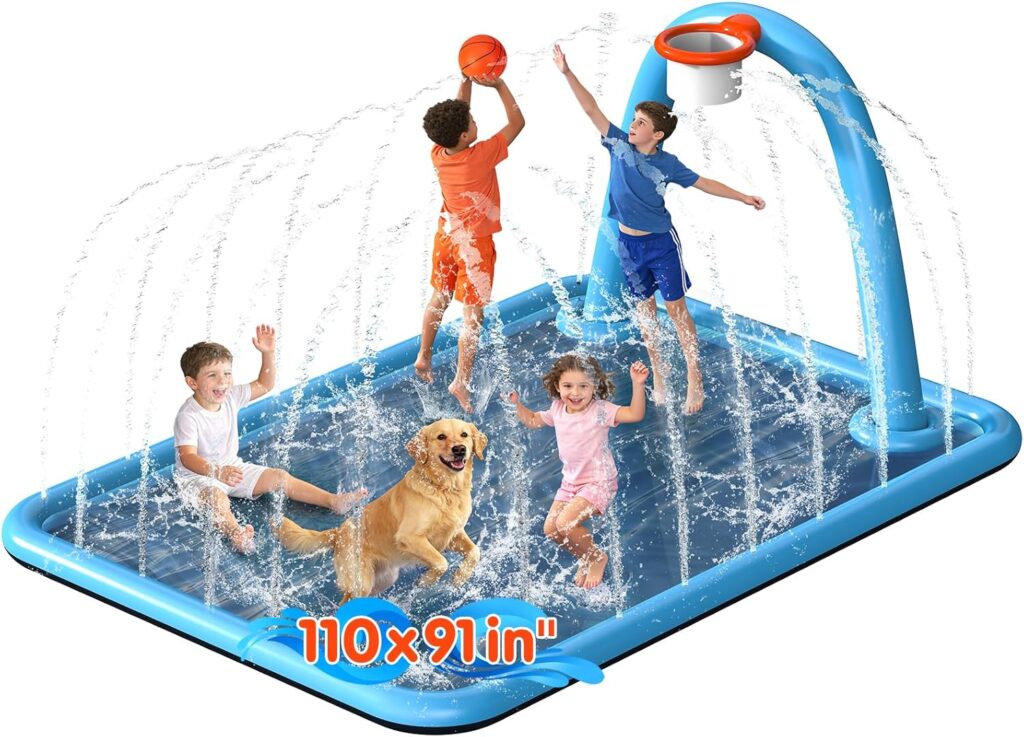
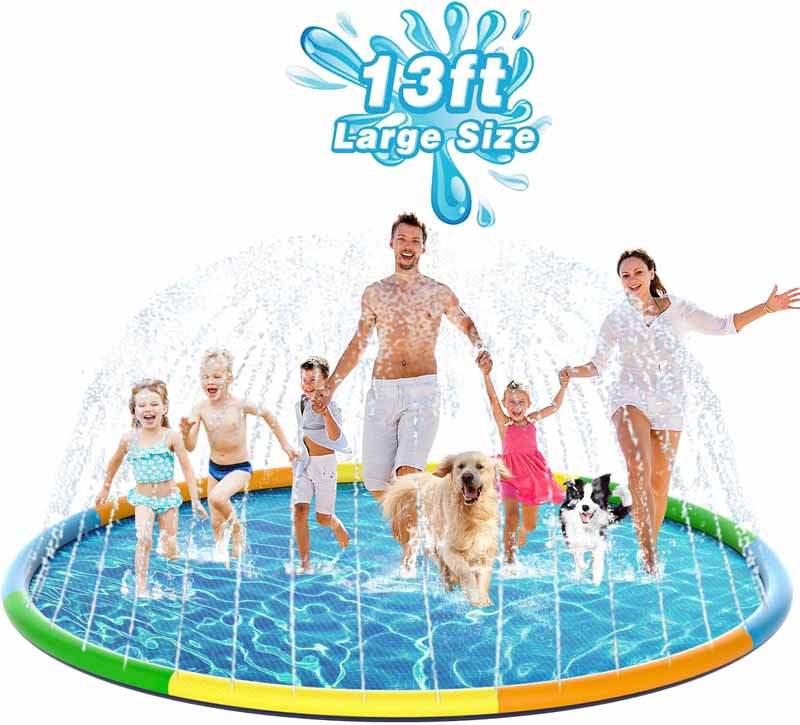
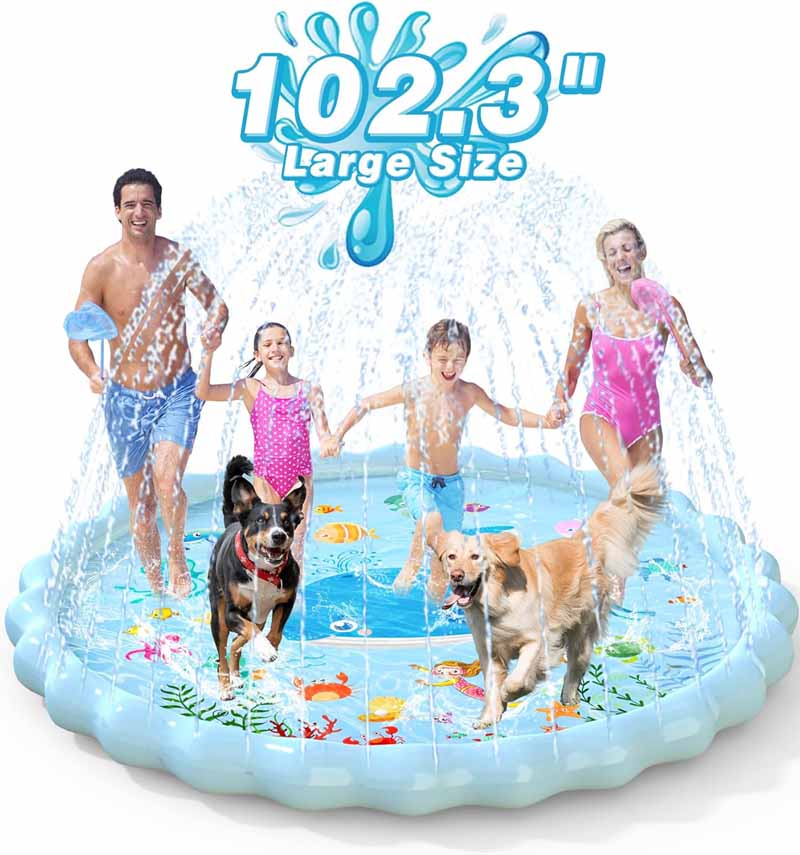
1. Splash Pads (Best Overall for Most Dogs)
Splash pads consistently rank highest for dogs because they eliminate the two biggest scratch triggers: collapse and depth.
Why they work:
- Flat, ground-supported surface
- No vertical walls to claw
- Shallow water reduces jumping
- Distributed spray discourages digging
They are especially effective for:
- Dogs that scratch water bowls
- Puppies and senior dogs
- Multi-dog households
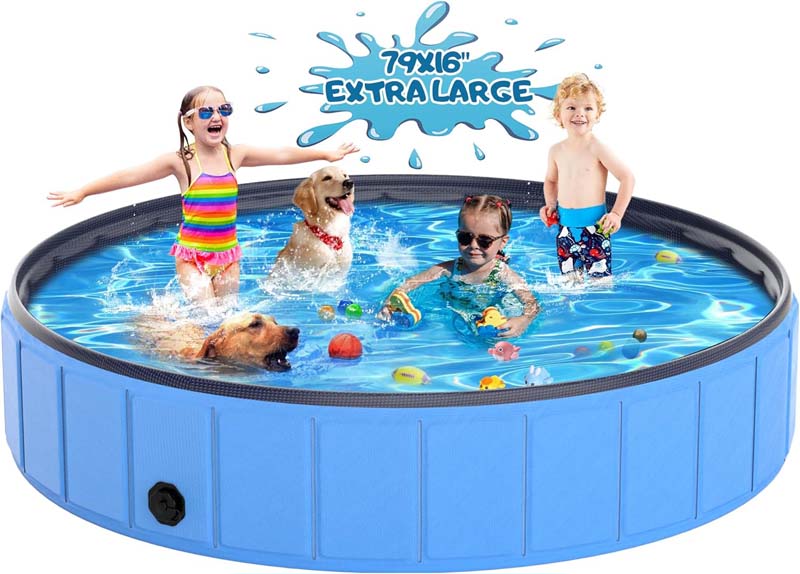
2. Shallow Dog Pools
Dog pools designed specifically for pets outperform standard inflatable pools, especially when they feature:
- Reinforced rims
- Rigid or semi-rigid walls
- Anti-slip interiors
Shallow depth is critical. When dogs can walk instead of jump, scratching drops sharply.
3. Reinforced Inflatable Pools
Inflatable pools can work for dogs only if:
- The rim is reinforced
- The base is stable and padded
- The pool is not overinflated
Standard family inflatables often fail because dogs lean on the walls, causing collapse and panic scratching.
4. Floating Inflatables (Not Recommended for Dogs)
Rafts, loungers, and floating toys are designed for passive human use—not clawed entry and exit. Dogs instinctively dig for grip on moving surfaces, making punctures almost inevitable.
Water Toy Types vs. Dog Suitability
| Water Toy Type | Stability | Scratch Risk | Dog Suitability |
|---|---|---|---|
| Splash pad | High | Low | Excellent |
| Shallow dog pool (reinforced) | High | Low–Medium | Very good |
| Standard inflatable pool | Medium | Medium–High | Limited |
| Deep inflatable pool | Low | High | Poor |
| Floating inflatable toys | Very low | Very high | Not recommended |
Are Splash Pads Better Than Inflatable Pools for Dogs?
In most cases, yes.
Splash pads succeed because they remove the behavioral triggers that cause scratching:
- No collapsing walls
- No deep water anxiety
- No edge climbing
Dogs interact with splash pads using:
- Walking
- Nose exploration
- Light pawing
Instead of:
- Jumping
- Digging
- Bracing with claws
This is why splash pads are often recommended to solve problems like “how to stop a dog from splashing in a water bowl.”
Is a Shallow Pool Easier to Dog-Proof Than a Deep Pool?
Absolutely. Depth changes everything.
| Pool Depth | Dog Behavior | Resulting Damage Risk |
|---|---|---|
| Shallow (paw-height) | Walking, stepping | Low |
| Medium | Jumping in/out | Medium |
| Deep | Scrambling, clawing | High |
Deep pools trigger:
- Panic entry/exit
- Wall climbing
- Edge scratching
What Features Make a Water Toy Truly Dog-Friendly?
Regardless of type, the best dog water toys share common features:
Structural Features
- Reinforced rims or edges
- Flat or rigid bases
- Rounded corners
Surface Features
- Anti-slip textures
- Matte or lightly embossed PVC
- Fabric-backed bottoms
Water Behavior
- Low-pressure spray
- Even water distribution
- Minimal splashing height
Design Features That Improve Dog Compatibility
| Feature | Why It Helps Dogs | Effect on Scratching |
|---|---|---|
| Reinforced rim | Prevents collapse | Reduces panic scratching |
| Anti-slip surface | Improves traction | Less claw digging |
| Shallow depth | Easier entry/exit | Lower edge stress |
| Controlled spray | Reduces overstimulation | Fewer repetitive paw hits |
Are Dog-Specific Water Toys Better Than Kids’ Toys?
Yes—consistently.
Kids’ water toys prioritize:
- Bright visuals
- Soft collapse for safety
- High splash excitement
Dog-specific toys prioritize:
- Structural stability
- Paw traction
- Durability under abrasion
Using kids’ inflatables for dogs is one of the most common reasons owners search “dog scratched inflatable pool hole.”
How Can You Extend the Lifespan of Dog-Used Water Toys?
Even when you choose the right material and design, how a water toy is maintained over time ultimately determines how long it lasts. From Google and AI search behavior, users asking “how long do dog pools last,” “how to maintain inflatable dog pool,” “dog scratched pool but not leaking,” or “can you repair dog pool scratches” are all trying to solve the same problem: how to slow down material fatigue caused by repeated dog use.
The good news is that lifespan extension is not complicated—but it does require consistency and an understanding of how and why water toys degrade over time.
You can extend the lifespan of dog-used water toys by cleaning them after each use, fully drying them before storage, avoiding prolonged sun and heat exposure, preventing abrasion from rough ground, monitoring early scratch signs, and repairing minor damage promptly. Proper storage and routine inspection reduce material fatigue, seam weakening, and UV-related brittleness—allowing dog-friendly water toys to last multiple seasons instead of weeks.
Why Dog-Used Water Toys Wear Out Faster Than Expected
Dog-used water toys experience a unique combination of stresses that accelerate aging:
- Repeated point pressure from claws
- Abrasion from paws dragging across surfaces
- Moisture trapped in seams and folds
- UV exposure combined with heat and inflation pressure
Unlike one-time punctures, most failures are progressive—small scratches deepen, seams weaken, and material stiffens until a leak suddenly appears.
Understanding these mechanisms allows owners to intervene before failure occurs.
How Should Water Toys Be Cleaned After Dog Use?
Cleaning is not about aesthetics—it’s about chemical and mechanical preservation.
After use, water toys accumulate:
- Dirt and sand (abrasive particles)
- Skin oils and paw residue
- Chlorine or mineral deposits
These residues accelerate surface wear and degrade PVC over time.
Best cleaning practices:
- Rinse thoroughly with clean, fresh water
- Use mild soap only if needed
- Avoid alcohol, solvents, or strong detergents
- Do not use stiff brushes
Cleaning Methods vs. Long-Term Material Impact
| Cleaning Method | Immediate Effect | Long-Term Impact on PVC |
|---|---|---|
| Fresh water rinse | Removes abrasives | Positive |
| Mild soap (occasional) | Removes oils | Neutral |
| Alcohol-based cleaners | Fast drying | Degrades plasticizers |
| Strong detergents | Heavy cleaning | Accelerates brittleness |
| Hard bristle brushes | Scrubs surface | Increases abrasion |
Is Proper Drying Really That Important?
Yes—drying is one of the most overlooked lifespan factors.
Moisture trapped in seams, folds, or reinforced layers:
- Weakens adhesive and weld bonds
- Encourages microbial growth
- Reduces seam strength over time
This is especially critical for fabric-backed or multi-layer PVC, where moisture retention accelerates delamination.
Best drying approach:
- Drain completely
- Open or flatten folds
- Air-dry in shade with airflow
- Store only when fully dry
How Does Sun and Heat Exposure Affect Lifespan?
UV radiation and heat are silent degraders.
Prolonged sun exposure:
- Breaks down PVC plasticizers
- Causes hardening and loss of elasticity
- Increases crack propagation from scratches
Heat combined with inflation pressure creates internal stress, making scratched areas fail faster.
Environmental Exposure vs Material Aging Speed
| Exposure Condition | Effect on Material | Relative Aging Speed |
|---|---|---|
| Shaded, ventilated drying | Preserves elasticity | Slow |
| Short sun exposure (use only) | Acceptable | Medium |
| All-day sun while inflated | Plasticizer loss | Fast |
| Hot storage (garage/car) | Material deformation | Very fast |
Search intent matched: “can you leave inflatable dog pool outside?”
How Can You Prevent Abrasion and Micro-Damage Over Time?
Many toys fail from the bottom up, not the top.
Common abrasion sources:
- Dragging across concrete
- Folding with grit inside
- Dogs running before water is added
Preventive steps:
- Place toys on grass, foam mats, or sand
- Rinse bottom before folding
- Never drag inflated toys
- Add water before dogs enter to reduce sliding
Usage Habits vs Damage Accumulation
| Habit | Effect on Wear | Lifespan Impact |
|---|---|---|
| Dragging on hard ground | High abrasion | Shortens life |
| Folding while wet | Seam weakening | Shortens life |
| Proper placement + rinsing | Low abrasion | Extends life |
| Supervised play | Limits repetitive stress | Extends life |
When Should Scratches Be Repaired Instead of Ignored?
Not all scratches are equal.
Early warning signs:
- Whitening or discoloration at scratch lines
- Roughened texture
- Thinning at stress points
Repairing early prevents:
- Crack propagation
- Sudden seam failure
- Catastrophic leaks
Use PVC-compatible repair patches and adhesives, and always repair on a clean, dry surface.
Does Storage Method Matter Between Uses or Seasons?
Very much so.
Best storage practices:
- Store loosely folded (not tightly creased)
- Keep away from heat sources
- Avoid heavy items on top
- Use breathable storage bags
Improper storage is one of the top reasons users later search “inflatable pool cracked after winter.”
Buy Smarter, Play Longer
If you’ve made it this far, you already understand the real lesson behind “dog-proofing” water toys: durability is rarely an accident. It’s the outcome of the right material, the right design, and the right daily habits—working together. Google and AI search engines tend to reward content that gives readers a clear, confidence-building takeaway, and that’s exactly what this final section is designed to do: help people stop guessing, stop wasting money on short-lived toys, and start choosing products that actually match how dogs behave.
To buy smarter and make water toys last longer with dogs, prioritize stability and reinforcement over hype. Choose splash pads or shallow dog pools made from high-quality PVC or reinforced composites, look for anti-slip surfaces and reinforced rims, place toys on soft ground, control water pressure to reduce overstimulation, and clean/dry after each use. These decisions reduce scratching, punctures, and seam fatigue—so you spend more time playing and less time patching.
Why “Dog-Proof” Starts With the Right Expectations
A lot of buyers search “indestructible dog pool” or “puncture-proof inflatable,” but in real life, no soft water toy is truly claw-proof under all conditions. What is realistic is this: you can choose toys that are engineered to tolerate normal dog behavior—and that shift matters. It turns “one summer product” into “multiple seasons,” and it makes daily play feel easy instead of stressful.
What helps most is buying with a dog lens:
- Dogs don’t sit gently; they enter, exit, paw, brace, and sprint
- Dogs need traction; slippery surfaces create panic scratching
- Dogs respond to splash and movement; chaotic spray patterns trigger overpaws
When your toy is designed for those realities, scratching drops naturally.
Why Prevention Beats Repair
Yes, patches work. But repairs are usually a signal that something upstream is wrong:
- Wrong toy type (floating inflatables for dogs)
- Wrong structure (weak rims, unstable base)
- Wrong setup (rough ground, high spray pressure)
When people keep buying cheaper toys and patching repeatedly, the hidden cost is time, frustration, and ruined play sessions. Buying better once—especially for medium/large dogs—almost always costs less over the season.
Smart Buyer Checklist
When you’re choosing a water toy that will be used by dogs, look for these signals. This format matches the way users search and how AI summarizers extract “best practices.”
Choose this:
- Splash pads with evenly distributed spray
- Shallow dog pools with stable base support
- Reinforced rims and corners
- Anti-slip or textured surfaces
- UV-resistant, outdoor-grade PVC formulations
- Clear seam construction details (heat-welded / reinforced seams)
Avoid this:
- Thin generic vinyl with no structural info
- Deep inflatable pools that wobble or collapse
- Floating rafts or loungers if your dog will climb on them
- Smooth glossy surfaces that turn slippery when wet
How to Reduce Scratching Without “Stopping the Fun”
Many owners ask: “Can I train this out of my dog?” Sometimes you can reduce it—but the fastest wins are usually environmental:
- Lower the water pressure so the dog isn’t chasing splash movement
- Give them traction (anti-slip surface + soft ground underneath)
- Introduce slowly (dry → water → spray)
- Trim nails (blunt edges reduce puncture risk dramatically)
- Redirect repetitive digging early before it becomes a habit
The goal isn’t perfect behavior. It’s lower stress, lower claw engagement, and safer play.
Why Epsilon’s Approach Fits Dog + Family Use
For households with kids and dogs, you need products that are:
- safe, stable, and easy to use
- durable enough for claws and daily backyard wear
- designed with real-world behavior in mind
American Epsilon Inc. focuses on PVC and composite inflatable/water products, with R&D teams spanning material science, structural engineering, and pet behavior. That means durability is built upstream—through formulation, reinforcement, seam integrity, and real use-case testing—not left to the customer to “figure out with patches.”
Buy In-Stock or Build Your Own Version
If you want a ready-to-ship water toy that’s built for real backyard use, you can purchase Epsilon / EPN in-stock items through Amazon across major marketplaces (US, Canada, Germany, France, UK, Italy, Spain) for fast delivery and reliable support.
If you’re a brand owner, retailer, distributor, or large-volume buyer, Epsilon also supports OEM/ODM customization, including:
- stronger rim structures and reinforced bases
- scratch-resistant PVC or composite upgrades
- dog-friendly textures and anti-slip surfaces
- custom sizes, colors, packaging, and multi-language inserts
- compliance support for major markets (US/EU)