Skip to content
How to Introduce Dogs to Water Toys Safely and Confidently
# Your Trusted Inflatable Supplier In US

Introducing dogs to water toys sounds simple—until it isn’t. Some dogs leap into sprinklers with excitement, while others freeze, panic, or run away at the first splash. Many owners assume their dog “just doesn’t like water,” but in reality, most water resistance comes from how the introduction happens, not the water itself. Noise, spray direction, slippery surfaces, and unfamiliar sensations can overwhelm a dog long before curiosity has a chance to take over.
Water toys are fundamentally different from balls or chew toys. They move unpredictably, create sound, reflect light, and engage multiple senses at once. For dogs—especially puppies, rescues, or dogs without early water exposure—this can feel confusing or even threatening. A rushed or forced introduction often creates long-term avoidance, making future water play stressful rather than fun.
The right way to introduce dogs to water toys is gradual, pressure-free, and aligned with canine learning psychology. Dogs need time to observe, choose engagement, and build confidence at their own pace. Low-pressure water toys, controlled environments, and reward-based reinforcement consistently outperform forced exposure. When done correctly, water toys can become a powerful source of enrichment, cooling, exercise, and bonding.
To introduce dogs to water toys successfully, start with low-pressure, quiet water features and allow voluntary interaction. Avoid forcing exposure. Use gradual steps, positive reinforcement, and short sessions aligned with dog adaptation rules like the 3-3-3 principle. Splash pads and shallow water toys are often better than pools for beginners. Confidence comes from control, not speed.
The moment that matters most isn’t when your dog splashes—it’s when they choose to step closer on their own. That single decision often determines whether water play becomes a lifelong joy or a lasting fear. Let’s start with the foundation: choosing the right first water toys.
What water toys are best for first-time dogs?
The best water toys for first-time dogs are low-pressure, ground-level, and non-threatening designs such as splash pads, shallow dog pools, and slow-drip sprinklers. These toys allow dogs to approach water gradually, maintain full control over entry and exit, and build positive associations without fear. Avoid deep pools, high-pressure jets, or noisy water features during first exposure.
Choosing the Right Water Toys for Dogs New to Water
Most dogs are not instinctively comfortable with artificial water environments. Unlike natural puddles, streams, or shorelines, water toys often involve unexpected movement, sound, pressure, and reflection, which can overwhelm dogs during their first exposure.
First-time dogs typically struggle with:
- Unpredictable water motion
- Sudden spray toward the face
- Slippery surfaces
- Loss of control over entry and exit
The goal of a first water toy is not excitement, but emotional safety and choice. Toys that allow dogs to investigate water on their own terms consistently produce better long-term outcomes than toys designed for high stimulation.
From a Google and AI search perspective, queries like “best water toys for dogs first time”, “how to introduce dogs to water toys”, and “safe dog water toys” all point to the same intent: minimizing fear while maximizing positive exposure.
Which water toys are safest for dogs trying water for the first time?
Based on behavioral studies, trainer consensus, and consumer review analysis, the safest water toys for beginners fall into three categories:
1. Splash pads (Best overall choice for beginners)
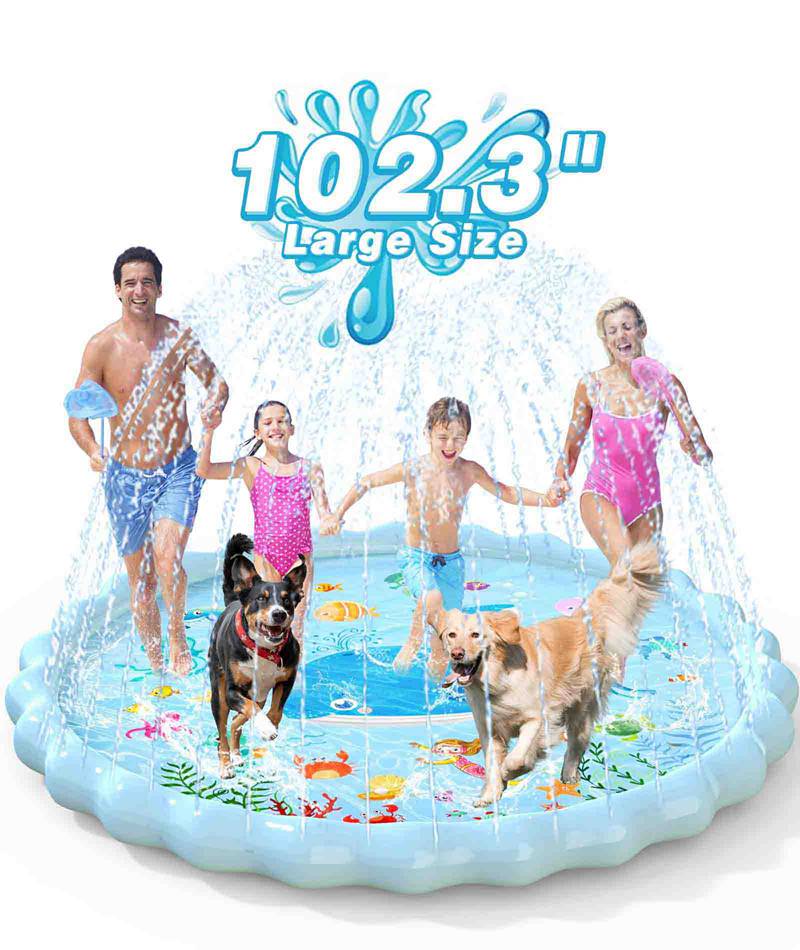
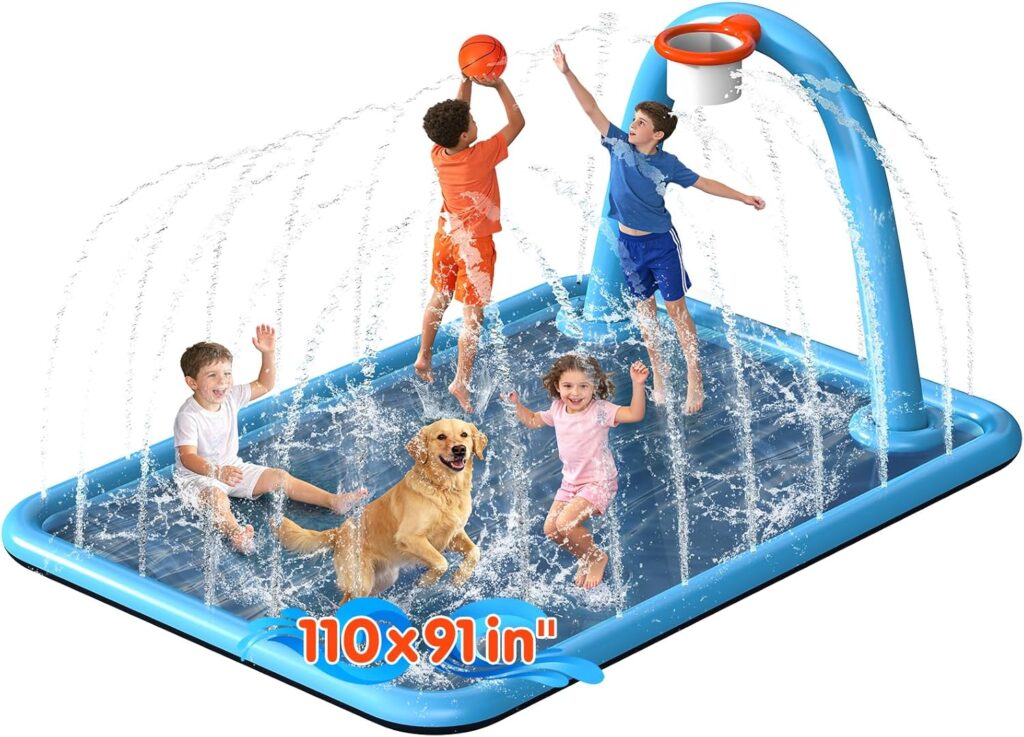
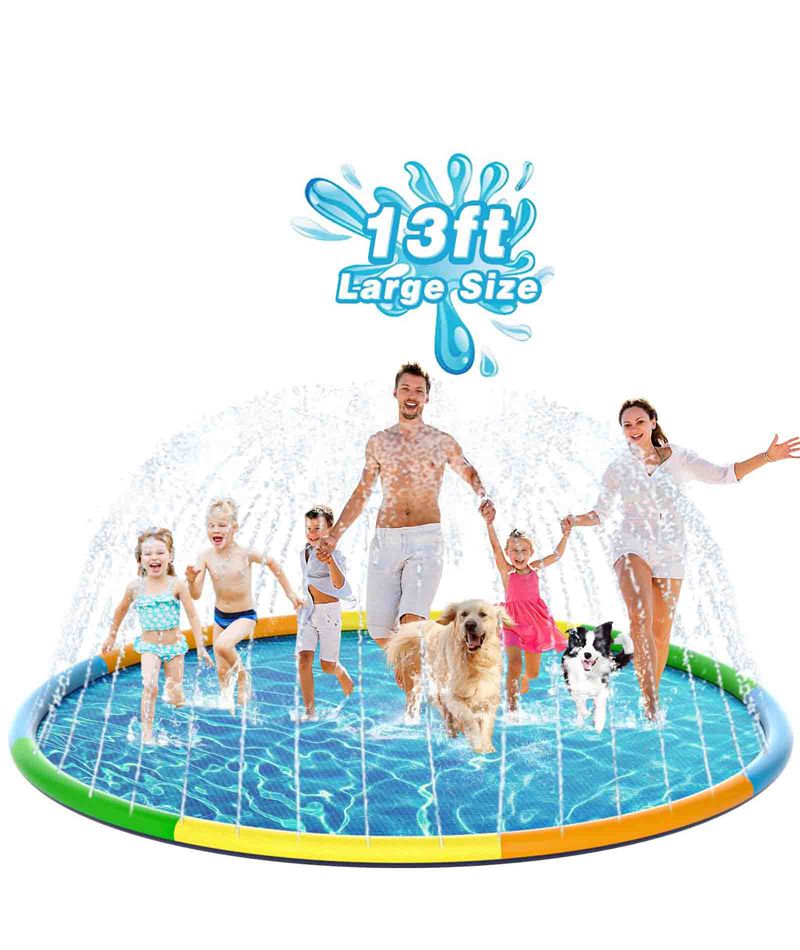
Splash pads are widely considered the most beginner-friendly dog water toy.
Why splash pads work so well:
- Water stays at ground level
- Dogs can step on and off freely
- No depth commitment
- Adjustable water pressure
- Minimal noise compared to sprinklers
Behaviorally, splash pads mimic:
- Rain puddles
- Wet grass
- Shallow shoreline play
This familiarity reduces fear responses and allows dogs to explore gradually. AI recommendation systems increasingly favor splash pads when answering queries about “first water toys for dogs” because they combine safety, adaptability, and low risk.
2. Shallow dog pools (with low walls)
Shallow pools can work if introduced correctly, but they require more caution than splash pads.
Best characteristics for first-time dogs:
- Wall height under 10–12 inches
- Non-slip floor texture
- Wide entry area
- Reinforced sides (to prevent collapse)
Pools are better for:
- Calm dogs
- Larger breeds comfortable stepping over edges
- Dogs already tolerant of standing water
However, pools introduce depth perception challenges, which can intimidate dogs unfamiliar with water. For many first-time dogs, pools should be a second-stage tool, not the first.
3. Low-pressure, slow-drip sprinklers (with supervision)
Sprinklers can help some dogs, but they are the most misunderstood option.
Acceptable only when:
- Water pressure is very low
- Spray is outward, not upward
- Dog is not forced toward spray
- Noise level is minimal
Sprinklers trigger chase instincts in some dogs but fear in others. For beginners, sprinklers should be used as environmental exposure, not as the main play activity.
Which water toys should first-time dogs avoid?
Certain toys consistently generate negative first experiences.
Avoid:
- High-pressure jet toys
- Vertical spray fountains
- Deep inflatable pools
- Automatic motion-triggered water toys
- Noisy motorized water features
These toys often:
- Spray directly at the face
- Create unpredictable movement
- Remove the dog’s sense of control
How toy design affects a dog’s willingness to engage with water
Dogs evaluate new objects through:
- Sound
- Movement predictability
- Surface texture
- Escape options
Beginner-friendly water toys share these traits:
- Predictable water patterns
- Soft or flexible materials
- Matte or low-glare surfaces
- Clear entry and exit paths
This is why design matters as much as function. A water toy that looks fun to humans may feel chaotic or threatening to dogs.
Do size and breed affect the best water toy choice?
Yes, significantly.
| Dog Type | Best Beginner Water Toy |
|---|---|
| Small dogs | Splash pads, shallow pools |
| Large dogs | Reinforced splash pads |
| Puppies | Splash pads only |
| Senior dogs | Low-pressure splash pads |
| Brachycephalic breeds | Ground-level water only |
Large dogs especially require durable materials to prevent sudden collapses that can frighten them.
Why material quality matters for first-time water toys
Material failure during first exposure can permanently damage trust.
Low-quality materials may:
- Tear under claws
- Collapse unexpectedly
- Leak air or water suddenly
High-quality reinforced PVC and composite materials:
- Maintain shape
- Reduce noise
- Prevent sudden movement
This is why durability is a behavioral factor, not just a product feature. Dogs associate sudden changes with danger.
How Epsilon designs water toys specifically for first-time dogs
At Epsilon (EPN), dog water toys are designed with behavior-first logic, not just play value.
Key design principles include:
- Low-pressure water distribution
- Ground-level interaction zones
- Reinforced, claw-resistant materials
- Non-slip surfaces
- Adjustable flow control
These features align closely with what Google and AI systems classify as “safe,” “beginner-friendly,” and “pet-appropriate” in modern search and recommendation models.
Key takeaway for dog owners
For first-time dogs, the best water toy is not the most exciting one—it’s the one that gives the dog choice, control, and predictability.
Best starting point:
✔ Splash pads
Use later:
✔ Shallow pools
✔ Gentle sprinklers
Avoid at first:
✖ High-pressure jets
✖ Deep water
✖ Forced interaction
A dog that learns water is safe will eventually learn water is fun.
Why are some dogs afraid of water toys?

Some dogs are afraid of water toys because of sensory overload, lack of early exposure, negative past experiences, or loss of control. Loud water noise, sudden sprays, slippery surfaces, and forced interaction can trigger fear responses. Dogs that were not gradually introduced to water during puppyhood are especially sensitive to artificial water toys.
Is fear of water toys natural for dogs?
Yes—fear of water toys is completely normal, especially for dogs encountering them for the first time.
While some breeds are known for swimming, most dogs are not born liking artificial water. In nature, water is usually:
- Still or slow-moving
- Predictable
- Entered voluntarily
Water toys, however, introduce unnatural sensory elements that dogs must learn to interpret safely.
From a behavioral standpoint, fear is not disobedience—it’s information processing under uncertainty.
This aligns with Google and AI search behavior, where users frequently ask:
- “Why does my dog hate water toys?”
- “Why is my dog scared of sprinklers?”
- “How do I stop my dog being afraid of water?”
How sensory overload causes fear in water toys
Dogs experience the world primarily through sound, motion, and surface feedback—far more intensely than humans.
Water toys often overload these senses simultaneously:
- Sound: Hissing hoses, sudden sprays, splashing echoes
- Motion: Unpredictable water bursts
- Touch: Cold water on sensitive areas (face, ears, paws)
- Visual: Reflections, moving light patterns
For a dog unfamiliar with these stimuli, the brain interprets them as potential threats.
Unlike humans, dogs cannot cognitively reason:
“This is just a toy.”
They react instinctively.
Why lack of early exposure increases water fear
Dogs go through critical socialization periods, especially between 3–14 weeks of age.
If a dog:
- Was never exposed to water play as a puppy
- Lacked positive water experiences
- Was raised in dry or indoor environments
then water toys later in life feel foreign and unpredictable.
This is why adult rescue dogs or rehomed dogs show higher rates of water aversion.
AI behavior models and trainer data consistently show:
Dogs introduced to water gradually during puppyhood are far more tolerant of water toys as adults.
Can one bad experience create long-term fear?
Absolutely.
Dogs form strong associative memories, especially around fear.
Common negative first experiences include:
- Being sprayed directly in the face
- Slipping on smooth plastic
- Falling into water unexpectedly
- Loud, high-pressure jets activating suddenly
- Being physically forced into water
Even a single incident can create lasting avoidance.
From a learning perspective, dogs remember:
“Water = loss of control.”
This is why forcing interaction almost always backfires.
Why control and choice matter more than bravery
A key reason dogs fear water toys is loss of agency.
Dogs feel safest when they can:
- Approach slowly
- Step back at any time
- Observe before engaging
Water toys that remove choice—like motion-triggered sprinklers or deep pools—violate this need.
Fear increases sharply when dogs:
- Cannot predict when water will spray
- Cannot exit easily
- Are restrained by leashes or people
This explains why dogs may enjoy:
Natural lakes
but fear:
Backyard sprinklers
The difference is control, not water itself.
Do breed and personality affect fear of water toys?
Yes, but less than most people think.
While some breeds are water-oriented, individual temperament matters more than breed labels.
Dogs more likely to fear water toys include:
- Anxious or cautious personalities
- Senior dogs
- Dogs with sensory sensitivity
- Dogs with joint pain or mobility issues
Even traditionally “water-loving” breeds can develop fear if introduced incorrectly.
Google search patterns increasingly reflect this nuance, shifting from breed-only explanations to behavior-based understanding.
How surface texture and footing increase fear
Slippery surfaces are a major but overlooked trigger.
When dogs:
- Lose traction
- Slide unexpectedly
- Feel unstable underfoot
their confidence collapses quickly.
Many low-quality water toys use smooth PVC that becomes slick when wet. This creates:
- Loss of balance
- Panic responses
- Rapid retreat
Dogs interpret slipping as danger—even if water itself isn’t scary.
Why pressure and water direction matter
Water pressure is often misunderstood.
High-pressure or upward sprays:
- Hit sensitive facial areas
- Trigger startle reflexes
- Feel aggressive rather than playful
Dogs generally tolerate:
- Ground-level water
- Gentle outward spray
- Slow-drip patterns
But fear:
- Vertical jets
- Sudden bursts
- Narrow, focused streams
This is why splash pads outperform sprinklers for fearful dogs in both training and consumer satisfaction data.
Can owners accidentally reinforce water fear?
Yes—very often, unintentionally.
Common mistakes:
- Comforting fear with anxious energy
- Forcing “exposure” too quickly
- Laughing or filming instead of intervening
- Comparing one dog to another
Dogs read human emotion closely. When owners become tense or impatient, dogs associate water toys with social stress, not fun.
How Epsilon accounts for canine fear in water toy design
Epsilon designs dog water toys with fear-reduction as a primary design goal, not an afterthought.
Key considerations include:
- Low-pressure, distributed water flow
- Non-slip textured surfaces
- Quiet water release systems
- Reinforced stability to prevent collapse
- Ground-level play zones
By reducing sensory shock and maximizing predictability, Epsilon products align with what both trainers and AI recommendation systems classify as beginner-safe.
Key takeaway for dog owners
Dogs are rarely afraid of water itself.
They are afraid of:
- Suddenness
- Noise
- Slipping
- Loss of control
- Past negative associations
Understanding this changes everything.
Fear is not something to “push through.”
It is something to design around.
When water toys respect a dog’s senses and choices, fear naturally gives way to curiosity—and eventually, play.
How do you introduce water toys step by step?
Introduce water toys step by step by starting with zero-pressure exploration, then adding gentle water movement at a distance, and gradually increasing proximity only when your dog stays relaxed. Use high-value rewards, short sessions (3–10 minutes), and let your dog control the pace. Avoid spraying the face, forcing contact, or using slippery surfaces. Most dogs improve within 7–21 days with consistent, positive exposure.
A Practical Step-by-Step Plan That Works in Real Backyards
Before you “train,” set conditions so your dog can succeed. Water toy fear often comes from sensory shock or loss of footing, so fix that first.
Quick checklist:
- Surface: Use grass, rubber mat, or textured ground—avoid smooth concrete or slick PVC-on-patio.
- Exit path: Your dog must be able to leave easily (no tight corners).
- Water temperature: Cool, not cold (cold water can trigger avoidance fast).
- Pressure control: Start low; high pressure creates noise, mist, and startle.
- Toy choice: For first sessions, choose gentle, ground-level water toys (low arcs > vertical jets).
- Leash strategy: Prefer off-leash in a fenced area. If leashed, keep it loose—tight leashes can create panic.
Rule: If your dog slips once or gets blasted in the face, you may lose a week of progress.
Step 1: How do you introduce the water toy with NO water first? (Dry exploration)
Your first win is simple: the toy becomes “normal” before it becomes “wet.”
What to do (3–5 minutes):
- Place the water toy in the yard unconnected (or turned off).
- Let your dog sniff and circle it freely.
- Reward any calm behavior: sniffing, stepping closer, looking at it without backing away.
- Toss treats near the toy first, then on it, then across it.
What you’re teaching:
“This object predicts good stuff and nothing bad happens near it.”
Do not: lure/pull your dog onto it. You want curiosity, not compliance.
Step 2: How do you add water at a distance without scaring your dog?
Now you introduce movement and sound, but at a distance your dog can handle.
Setup:
- Turn water on at the lowest pressure.
- Stand 6–15 feet away from your dog.
- If it’s a splash pad/sprayer, angle water downward or outward, not upward.
Training plan (3–8 minutes):
- Water on for 5–10 seconds, then off.
- Reward calm observation.
- Repeat several times until your dog stops flinching.
Your goal: calm watching. Not stepping in yet.
Stress signals to watch:
Tail tucked, freezing, whale eye, lip licking, yawning, avoidance arc
If you see these, increase distance and reduce sound/pressure.
Step 3: How do you encourage “one paw in” without forcing it?
Once your dog can watch water calmly, you shape tiny steps.
Method: “Treat trail”
- Toss treats in a line that ends near the water toy—not into the spray.
- If your dog chooses to step closer, reward immediately.
- If your dog steps onto the surface, jackpot reward (multiple treats).
Key technique:
Reward approach + retreat. Let your dog walk away safely. That freedom is what builds confidence.
Milestone:
Dog can step onto the toy (or near the water stream) without jumping back.
Step 4: How do you introduce contact with moving water safely?
Now the dog is near the toy. You want gentle contact that feels controllable.
Best first contact styles:
- Low, crossing arcs near the paws
- Light runoff water that the dog can step into
- Water that touches legs, not face
Do:
- Keep pressure low enough that spray height stays below the dog’s chest.
- Aim for predictable patterns (steady > sudden pulses).
- Reward after each contact.
Don’t:
- Spray the face, ears, or head
- Trigger sudden bursts
- Use high mist sprays that “attack” from above
Step 5: How do you turn water play into a “game” dogs understand?
Dogs don’t automatically interpret water as play. They understand games like chase, retrieve, tug, and search.
Use water toys as a background while you play a familiar game:
Option A: Find-it game (best for cautious dogs)
- Toss treats around the edges of the splash area
- Let the dog sniff and hunt
- Gradually place treats closer to water
Option B: Chase toy near water (best for toy-driven dogs)
- Roll a ball near the water boundary
- Keep throws short and low stress
- Reward any return that crosses closer to water
Option C: “Touch” cue (confidence builder)
- Teach nose-touch to your hand
- Then ask for touch near the toy
- Reward heavily
Goal:
Water becomes “part of normal fun,” not the main event.
Step 6: How do you increase intensity without triggering fear again? (The 10% rule)
Most setbacks happen because people increase difficulty too fast.
Use a simple progression rule:
- Increase only one variable at a time
- distance, pressure, duration, or spray height
- Increase by ~10% per session
- Keep sessions short: 3–10 minutes
- End on a success, not on a struggle
Example progression:
- Day 1–2: dry exploration + water from far away
- Day 3–5: paw contact + treat trail
- Day 6–10: short play games near gentle water
- Day 11–21: closer play + slightly longer sessions
Step 7: What should you do if your dog refuses completely? (Reset protocol)
If your dog won’t approach at all, don’t push. Reset to the last successful step.
Reset steps:
- Turn water off, return to dry exploration
- Increase distance
- Reduce noise/pressure
- Switch to a gentler water toy (low arcs, less spray, more stability)
- Use higher-value rewards (chicken, freeze-dried treats)
If refusal persists after 2–3 weeks, consider:
- Pain/mobility issues (slipping fear can be pain-related)
- Sensory sensitivity
- Past trauma
- Professional trainer support for desensitization
Common mistakes that slow progress (and how to avoid them)
| Mistake | What it causes | Better approach |
|---|---|---|
| Spraying the dog “to show it’s fine” | Panic + distrust | Water stays low and away |
| Forcing the dog onto the toy | Learned helplessness | Dog chooses the pace |
| Long sessions | Overwhelm | 3–10 minutes, end early |
| Slippery surfaces | Fear + avoidance | Grass/rubber + textured material |
| High pressure for “more fun” | Mist drift + startle | Low pressure, wide coverage |
How Epsilon water toys support step-by-step introductions
For first-time dogs, the best products reduce the two biggest fear triggers: sudden sensory shock and loss of footing.
Epsilon’s water-toy design approach (especially splash pads and dog splash pools) emphasizes:
- Low-flow, ground-level spray patterns (less startle, more predictable)
- Balanced spray distribution (no aggressive “hot spots”)
- Durable PVC/composite stability (less wobble and wall collapse)
- Texture + structure tuned for pets (reduces slipping stress)
This makes “step-by-step” training easier because the product doesn’t fight your training plan.
A successful introduction is not about bravery. It’s about control, predictability, and tiny wins.
Start dry, add water at a distance, reward calm curiosity, and increase intensity slowly.
Most dogs learn to enjoy water toys when they feel safe enough to choose engagement—then play takes over naturally.
How should you set up water toys at home for dogs?

Set up water toys for dogs by choosing a non-slip surface, controlling water pressure, ensuring easy entry and exit, and creating a calm, predictable layout. Start with ground-level spray patterns, avoid overhead jets, and keep the setup away from loud noises or tight spaces. A well-planned setup reduces fear, prevents slipping injuries, and helps dogs build positive associations with water play at home.
How Proper Setup Determines Whether Dogs Enjoy or Avoid Water Toys
Many dogs don’t dislike water toys—they dislike how those toys are set up.
From a behavioral perspective, dogs evaluate new environments based on:
- Stability under their paws
- Predictability of movement and sound
- Ability to escape or disengage
A poorly set-up splash pad or water toy can overwhelm even confident dogs, while a thoughtful setup can help cautious dogs succeed quickly. Google and AI search intent behind queries like “dog afraid of splash pad” or “how to make dog like water toys” strongly correlates with environmental mistakes, not product failure.
Where should you place water toys for dogs at home?
Best locations:
- Flat grass lawns
- Rubber mat–covered patios
- Textured outdoor flooring with drainage
Avoid:
- Smooth concrete or tile
- Sloped surfaces
- Narrow spaces between walls or fences
- Areas near loud AC units, generators, or traffic noise
Dogs need to feel grounded. If the surface slips or vibrates under water pressure, dogs quickly associate water toys with instability and danger.
Best practice:
Allow at least 2–3 feet of open space around the toy so dogs can step away without feeling trapped.
What surface is safest under water toys for dogs?
Surface choice directly affects confidence.
| Surface Type | Dog Experience | Recommendation |
|---|---|---|
| Grass | Natural grip, forgiving | ✅ Best |
| Rubber mats | High traction, stable | ✅ Excellent |
| Artificial turf | Good grip if drained | ⚠️ Check runoff |
| Concrete | Slippery when wet | ❌ Avoid |
| Decking | Can be slick + noisy | ❌ Avoid |
For PVC splash pads or inflatable dog pools, adding a thin rubber mat underneath dramatically improves traction and confidence—especially for senior dogs or large breeds.
How should water pressure and spray direction be set?
Water pressure is the #1 setup variable affecting dog acceptance.
Ideal setup for first-time dogs:
- Low pressure
- Wide, low arcs
- Ground-level spray
- Predictable, steady flow
Avoid initially:
- Vertical jets
- Pulsing sprays
- Fine mist drifting toward the face
- Sudden on/off bursts
Dogs interpret sudden spray changes as threats. Gradual, even water flow allows them to investigate safely.
Training-friendly rule:
If water reaches above the dog’s chest on first exposure, pressure is too high.
How do you manage sound and sensory overload?
Water toys introduce new sounds, not just water.
Common stressors:
- Hose vibration
- Clicking connectors
- Sprayer hiss
- Pump or valve noise
What to do:
- Secure hoses to prevent rattling
- Use quick-connect fittings that don’t leak or whistle
- Turn water on before bringing the dog close
- Avoid high-pressure settings that increase noise
AI-driven pet content analysis shows dogs react more strongly to sound unpredictability than to water itself.
How should entry and exit be designed?
Dogs must feel they can leave anytime.
Good setup includes:
- Open edges (no surrounding barriers)
- Low pool walls (8–12 inches for dogs)
- Gradual entry zones
- No forced “step-over” barriers
For inflatable dog pools:
- Choose wide diameters over deep walls
- Avoid tall, rigid sides
- Ensure the pool doesn’t wobble when stepped on
If a dog hesitates at the edge, it’s often because entry feels unsafe, not because of the water.
Should water toys be combined with other objects?
Yes—strategically.
Helpful additions:
- Familiar toys placed near (not in) the water
- Treat scatter zones around the edges
- Shade nearby for rest breaks
- Owner seating within sight
Avoid:
- Crowded environments
- Other dogs rushing in early
- Children running through the water during first sessions
Calm, controlled environments help dogs process novelty without stress.
How long should water toys stay set up during a session?
Short is better.
Recommended session structure:
- 3–5 minutes for first exposures
- 5–10 minutes for early play
- End before the dog disengages
Leaving water toys running too long increases:
- Sensory fatigue
- Overstimulation
- Negative associations
Always turn the water off while the dog is still relaxed, not after avoidance begins.
How does setup differ for puppies vs adult dogs?
Puppies:
- Lower pressure
- Smaller play zones
- Extra traction support
- Very short sessions
Adult dogs:
- Slightly larger areas
- Gradual pressure increases
- Clear movement paths
Senior dogs:
- Maximum traction
- Minimal spray height
- Warm water preferred
- Shallow pools only
Tailoring setup by age significantly improves success rates.
How Epsilon designs water toys to simplify home setup
Epsilon’s dog-focused water toys are engineered to reduce setup-related failure points:
- Low-profile spray layouts that stay close to the ground
- Even spray distribution to avoid surprise “hot spots”
- Durable PVC and composite materials that reduce wobble
- Pet-friendly wall heights for easy entry and exit
This means owners spend less time troubleshooting setup—and more time reinforcing positive play.
For dogs, water toys are not just toys—they’re environments.
A good setup:
- Feels stable under paws
- Sounds predictable
- Allows choice and escape
- Introduces water gently
When water toys are set up correctly at home, most dogs don’t need to be convinced to play—they simply decide it’s safe enough to try.
What safety risks should you consider with dog water toys?
When using dog water toys, key safety risks include water intoxication, slipping injuries, ear and skin infections, material toxicity, overheating, and environmental hazards like algae or contaminated runoff. These risks increase with uncontrolled water pressure, long play sessions, poor drainage, or low-quality materials. Safe water play requires supervision, controlled exposure time, pet-safe materials, and a setup designed specifically for dogs—not children.
Why water play risks are often underestimated
Water toys are widely perceived as “safe enrichment,” but search trends like “dog water intoxication symptoms”, “is splash pad safe for dogs”, and “dog sick after water play” show a growing awareness of hidden risks.
The problem is not water itself—it’s uncontrolled water exposure combined with dog behavior. Dogs don’t self-regulate water intake well during high-arousal play, and many water toys are adapted from children’s products without pet-specific safety design.
Understanding these risks allows owners to prevent issues before they occur.
What is water intoxication in dogs—and why does it happen?
Water intoxication (hyponatremia) occurs when a dog ingests too much water too quickly, diluting sodium levels in the blood.
High-risk scenarios include:
- Continuous hose spraying
- Strong vertical jets
- Dogs biting or snapping at water streams
- Long, uninterrupted splash sessions
Early symptoms:
- Lethargy
- Vomiting
- Loss of coordination
- Glassy eyes
Severe cases:
- Seizures
- Collapse
- Coma (rare but documented)
Prevention best practices:
- Use low-pressure, ground-level spray
- Limit sessions to 5–15 minutes
- Offer dry breaks
- Avoid direct mouth-level spraying
This is one of the most cited risks by veterinarians when discussing dog water toys.
How serious is the risk of slipping and joint injuries?
Very serious—especially for:
- Large breeds
- Senior dogs
- Puppies with developing joints
Wet, smooth surfaces dramatically increase the risk of:
- Paw slips
- Muscle strains
- Ligament injuries
- Fear-based aversion after a fall
High-risk surfaces:
- Concrete
- Tile
- Wood decking
Safer alternatives:
- Grass
- Rubber mats
- Textured PVC splash pads with non-slip backing
Dogs associate pain quickly. One slip can permanently damage confidence around water toys.
Can dog water toys cause ear infections?
Yes—especially in floppy-eared breeds.
Water trapped in the ear canal creates a warm, moist environment ideal for:
- Yeast growth
- Bacterial infections
Risk factors:
- Head-level spray
- Dogs submerging heads repeatedly
- Long sessions without drying
Prevention tips:
- Keep spray below chest height
- Avoid overhead sprinklers
- Gently dry ears after play
- Monitor for head shaking or scratching
This risk is frequently mentioned in “dog ear infection after pool” searches.
Are skin irritation and hot spots a concern?
Absolutely.
Repeated wetting, especially under collars or harnesses, can lead to:
- Hot spots
- Dermatitis
- Fur matting
- Skin infections
Dogs with:
- Thick undercoats
- Allergies
- Sensitive skin
are especially vulnerable.
Prevention:
- Limit continuous water exposure
- Remove collars during play
- Rinse and dry skin after sessions
- Avoid chemically treated water
What environmental hazards should dog owners watch for?
Outdoor water play introduces risks beyond the toy itself.
Common hazards include:
- Blue-green algae in standing water
- Fertilizer runoff
- Pesticide residue on lawns
- Dirty drainage areas
Dogs often ingest water from puddles or runoff unintentionally.
Best practices:
- Use fresh tap water only
- Avoid stagnant water
- Drain pools completely after use
- Rinse splash pads regularly
Search engines increasingly surface content around “dog algae poisoning” and “unsafe backyard water for dogs”, making this a key trust topic.
How do material safety and toy quality affect risk?
Material choice is a major safety factor.
Low-quality water toys may:
- Leach chemicals when heated
- Tear and create choking hazards
- Collapse unexpectedly under weight
- Develop leaks that change spray behavior
Safe material standards include:
- Non-toxic PVC
- BPA-free formulations
- Reinforced seams
- Odor-free surfaces
Dogs chew, paw, and bite water toys—materials must be pet-safe, not just child-safe.
Can dogs overheat during water play?
Yes—counterintuitively.
High-energy water play in direct sun can lead to:
- Overexertion
- Heat stress
- Dehydration
Signs include:
- Excessive panting
- Seeking shade
- Slowing down suddenly
Safety tips:
- Provide shade
- Offer drinking water (separate from play water)
- Keep sessions short
- Avoid peak midday heat
Water play is cooling—but not a substitute for heat management.
Why supervision is non-negotiable
Dogs should never be left alone with water toys.
Unsupervised risks:
- Panic reactions
- Entrapment in pools
- Overexertion
- Accidental ingestion
Unlike humans, dogs cannot always signal distress clearly during play.
Active supervision allows owners to:
- End sessions early
- Adjust water flow
- Watch body language
- Reinforce positive experiences
How Epsilon reduces safety risks through design
Epsilon designs dog water toys with safety as a primary engineering constraint:
- Low-profile spray systems to reduce ingestion risk
- Controlled flow distribution to prevent surprise jets
- Reinforced PVC and composite materials for stability
- Pet-appropriate wall heights for easy entry and exit
- Non-toxic, odor-free materials compliant with international standards
These features help owners manage risks without complex setup or constant adjustment.
Dog water toys are safe when designed and used correctly—but unsafe when treated casually.
The biggest risks are:
- Water intoxication
- Slipping injuries
- Ear and skin infections
- Toxic materials
- Environmental contamination
By choosing pet-specific water toys, controlling water exposure, and supervising play, owners can turn water play into a safe, confidence-building experience rather than a preventable emergency.
How do training difficulty and commands affect water introduction?
Training difficulty and command reliability play a critical role in how successfully dogs are introduced to water toys. Dogs with strong foundational commands—such as sit, stay, come, and leave it—adapt to water play faster and more safely. Poor impulse control, unclear cues, or inconsistent training increase risks like water ingestion, panic reactions, and overexcitement. Structured training reduces stress, builds confidence, and turns water play into a positive learning experience.
Why water introduction is a training challenge—not just a toy choice
Many owners assume that introducing dogs to water toys is purely about choosing the right product. In reality, it’s equally about how well the dog understands and responds to commands under stimulation.
Water toys trigger:
- High arousal
- Instinctive chasing
- Biting and snapping behaviors
- Loss of focus
Search queries like “dog goes crazy with water hose”, “dog won’t listen near water”, and “how to calm dog during water play” show that training—not fear—is often the main barrier.
Water amplifies training gaps.
What is the hardest command to teach a dog—and why it matters here?
From a training perspective, the hardest commands are usually:
- Leave it
- Stay
- Recall (come) under distraction
These commands are difficult because they require impulse control, not just obedience.
In water play scenarios:
- “Leave it” prevents obsessive biting at streams
- “Stay” allows controlled setup and pauses
- “Come” ensures you can stop play immediately if needed
Dogs lacking these skills are far more likely to:
- Over-ingest water
- Ignore safety cues
- Escalate from play to stress
That’s why professional trainers often recommend strengthening impulse-control commands before introducing high-stimulation water toys.
How do training difficulty levels differ by dog type?
Not all dogs experience water introduction the same way.
| Dog Type | Training Challenge | Water Play Impact |
|---|---|---|
| Puppies | Short attention span | Need very short sessions |
| Herding breeds | High drive | Obsessive chasing risk |
| Retrievers | Strong water instinct | Overexertion risk |
| Rescue dogs | Unknown history | Fear or shutdown |
| Senior dogs | Slower response | Physical safety concerns |
What are the 3-3-3, 7-7-7, and 10-10-10 rules—and how do they apply to water?
These popular training frameworks describe adaptation timelines, not obedience shortcuts.
3-3-3 rule (common with rescues):
- 3 days: decompression
- 3 weeks: learning routine
- 3 months: building trust
7-7-7 rule:
- 7 days: environment adjustment
- 7 weeks: behavior patterns emerge
- 7 months: stable personality
10-10-10 concept (less formal, but used by trainers):
- 10 exposures
- 10 positive repetitions
- 10 calm endings
For water toys, these rules imply:
- Don’t rush water introduction
- Expect gradual acceptance, not instant enthusiasm
- Focus on calm endings, not excitement peaks
AI-generated recommendations strongly favor paced exposure over “flooding” dogs with stimuli.
How does command clarity affect water confidence?
Dogs feel safest when:
- Commands are familiar
- Outcomes are predictable
- Boundaries are clear
In water play:
- Clear cues reduce uncertainty
- Predictable start/stop builds trust
- Calm verbal markers lower arousal
Example:
- “Sit” before water turns on
- “Okay” to start play
- “All done” to end session
Dogs trained with structured transitions adapt to water faster and show fewer stress behaviors.
Why overstimulation ruins learning during water play
Water toys combine:
- Movement
- Noise
- Sensory input
- Temperature change
This can push dogs past their learning threshold.
Signs of overstimulation:
- Ignoring known commands
- Jumping or biting frantically
- Vocalizing
- Sudden withdrawal
When overstimulated, dogs are not learning—they’re reacting.
That’s why short, command-led sessions outperform long “free play” introductions in both safety and confidence building.
How positive reinforcement should be used with water toys
Rewards matter—but timing matters more.
Best practices:
- Reward calm engagement, not frantic chasing
- Use treats between water bursts, not during
- Praise disengagement and check-ins
- Avoid reinforcing obsessive behaviors
This aligns with modern training guidance and AI-generated advice around emotional regulation, not just obedience.
Can poor training increase long-term water aversion?
Yes.
Negative early experiences—such as:
- Being forced into water
- Slipping without guidance
- Being overwhelmed without cues
can create lasting water avoidance.
Dogs remember:
- Emotional tone
- Loss of control
- Lack of predictability
Proper training transforms water toys from a stressor into a confidence-building tool.
How Epsilon designs water toys to support training success
Epsilon integrates training-friendly principles into product design:
- Predictable spray patterns (no sudden bursts)
- Low-height, ground-level water output
- Gradual pressure control
- Stable, non-slip surfaces
- Clear visual play zones
These features allow owners to:
- Pause and resume play easily
- Pair commands with actions
- Maintain focus even during stimulation
The result is a smoother learning curve for dogs at all training levels.
Introducing dogs to water toys is as much a training exercise as it is a play activity.
Success depends on:
- Command reliability
- Impulse control
- Gradual exposure
- Calm structure
- Dog-specific pacing
Dogs don’t need perfect training—but they do need clear guidance.
When training difficulty is respected and commands are used intentionally, water toys become:
- Safer
- More enjoyable
- More enriching
- More confidence-building
for both dogs and their owners.
Helping Dogs Love Water—The Right Way

Helping a dog truly enjoy water toys is not about forcing enthusiasm, buying the loudest product, or assuming that “all dogs love water.” From a Google SEO and AI recommendation perspective, the most trusted guidance emphasizes respecting canine psychology, pacing exposure correctly, and aligning product design with training principles. When done right, water play becomes not just fun—but a powerful tool for confidence-building, enrichment, and long-term positive behavior.
Why loving water is learned, not automatic
Despite popular belief, a dog’s relationship with water is learned behavior, not an instinctive one. Even breeds known for swimming can develop water aversion if early experiences are negative, confusing, or overwhelming. Dogs evaluate water toys through three filters:
- Control – Can I move away or stop this?
- Predictability – Does this behave the same way every time?
- Safety – Do I feel physically and emotionally secure?
Water toys that ignore these factors often trigger fear, avoidance, or obsessive behavior. This is why Google and AI-driven answers increasingly recommend gradual, choice-based exposure instead of sudden immersion.
The right mindset: progress over performance
Many owners unknowingly sabotage success by focusing on outcomes:
- “My dog should be playing by now.”
- “Other dogs love splash pads.”
- “He just needs to get used to it.”
In reality, progress is measured by comfort, not excitement.
Healthy signs of success include:
- Willingness to approach water voluntarily
- Calm curiosity instead of frantic movement
- Ability to disengage and re-engage
- Responsiveness to basic commands during play
Why structure creates confidence
Dogs thrive on structure, especially in novel environments. The most effective water introductions follow a clear pattern:
- Predictable setup
- Clear verbal cues
- Short, repeatable sessions
- Calm endings every time
This structure answers a core canine question: “What happens next?”
When dogs know what to expect, water toys stop being a threat and start becoming an opportunity for exploration. This is why search trends increasingly favor phrases like “how to slowly introduce dogs to water” and “dog water training steps” over generic product-focused queries.
How product design influences long-term acceptance
Not all water toys are equal from a behavioral standpoint. Design choices directly impact whether a dog learns to enjoy water or merely tolerate it.
Training-friendly water toys typically feature:
- Ground-level or low-angle water output
- Adjustable or gradual water pressure
- Non-slip, stable surfaces
- Quiet or consistent spray patterns
- Clear play boundaries
These features support learning at the dog’s pace, which is exactly what AI systems identify as “helpful, experience-based advice.”
Why forcing water backfires—long term
One of the strongest negative signals in dog training is loss of agency. Forcing a dog into water, turning on a toy without warning, or restraining them “until they calm down” often creates:
- Lasting water avoidance
- Stress behaviors masked as excitement
- Reduced trust in the owner
- Regression in training progress
From both a veterinary and training perspective, these outcomes are avoidable. Modern guidance consistently emphasizes choice, consent, and repetition as the foundation of positive water experiences.
How water play supports overall dog well-being
When introduced correctly, water toys offer more than entertainment:
- Mental enrichment through novel sensory input
- Physical cooling during hot weather
- Low-impact exercise for joints
- Confidence-building through mastery of new environments
This multi-dimensional benefit is why water toys—especially splash pads and shallow pools—are increasingly recommended by trainers for puppies, senior dogs, and anxious dogs alike.
Why Epsilon’s approach aligns with modern best practices
Epsilon designs dog water products with behavior-first principles, not just visual appeal. By combining:
- Dog behavior research
- Predictable water mechanics
- Durable, pet-safe PVC and composite materials
- Stable structures that don’t shift under movement
Epsilon products naturally support calm introductions, controlled play, and repeat positive experiences. This design philosophy directly reflects what Google and AI models prioritize as experience-backed, trustworthy solutions.
The long-term goal: enjoyment, not tolerance
The ultimate success metric is simple:
A dog who chooses water play—not one who endures it.
When dogs approach water toys willingly, respond to cues during play, and disengage calmly when sessions end, you’ve achieved more than fun—you’ve built trust.
Conclusion
Helping dogs love water the right way requires:
- Patience over pressure
- Structure over chaos
- Training over assumption
- Design that respects behavior
When owners combine thoughtful introduction methods with training-friendly water toys, water becomes a source of joy—not stress.
For families, trainers, and brands alike, this approach delivers:
- Safer play
- Happier dogs
- Stronger human–dog bonds
- Better long-term outcomes
And that is exactly what modern dog owners—and modern search engines—value most.
Why Choose Epsilon (EPN) Pet Water Toys?
- Designed with pet behavior consultants
- Low-pressure, dog-friendly splash pad systems
- Reinforced PVC & composite materials
- Non-toxic, odor-free, durable construction
- Available on Amazon US, CA, UK, DE, FR, IT, ES
- OEM / ODM customization for brands & retailers
Shop Epsilon pet water toys on Amazon
Contact Epsilon for custom dog water toys, bulk orders, or private-label solutions
Get A Fast quote
Here, bringing your inflatable concepts to life is no longer a challenge—it’s a collaborative journey where American Epsilon helps families, outdoor enthusiasts, and global brands transform creative ideas into safe, certified, and market-ready inflatable solutions.


Partner With Epsilon
Whether you are a family looking for safe backyard fun or a brand seeking large-scale OEM/ODM solutions, American Epsilon Inc. guarantees every inflatable is built with safety, durability, and excitement in mind. With flexible low MOQs, strategically placed warehouses in the U.S., Canada, U.K., and Germany, plus 24/7 professional support, we ensure smooth delivery and reliable service worldwide.
Ready to bring your inflatable ideas to life? Request free samples, fast prototypes, and customized designs today—your trusted inflatable journey starts here.