Skip to content
Do Dogs Like Splash Pads:Safety, Behavior, and Training
# Your Trusted Inflatable Supplier In US

If you’ve ever turned on a splash pad for a dog, you already know the truth: dogs don’t respond like kids. One dog will sprint into the spray like it’s the best thing that’s ever happened in the backyard. Another will stand still, stare, and act like the water is “suspicious.” That difference isn’t random. It’s your dog doing real-time math: Is this surface stable? Is the water predictable? Can I step away if I don’t like it?
Here’s the direct answer most owners want:
Most dogs can enjoy splash pads, especially when water is shallow, pressure is gentle, and the surface has solid traction. Dogs often accept splash pads more easily than pools because they can cool down while staying grounded. Dogs that dislike splash pads usually react to specific triggers—slippery footing, noisy jets, face-level spray, or sudden pressure changes—rather than “hating water” as a personality trait.
Now the part people miss: your dog’s first splash pad session is not a “test of whether they like it.” It’s a first impression. If that first impression feels safe and controllable, many dogs build confidence fast—sometimes in minutes, sometimes over a few short sessions. And once a dog connects splash pads with comfort (cool paws, cool belly, no slipping), it stops being a novelty and starts becoming a summer habit.
Do Dogs Like Splash Pads by Nature?
Dogs are not born “loving” splash pads in the way people sometimes expect.
What dogs are born with is something more practical: a strong drive to avoid slipping, manage body temperature, and stay in control of unfamiliar situations.
This distinction matters. Because whether a dog ends up enjoying a splash pad depends far less on personality labels like “water dog” or “non-water dog,” and far more on how the first few interactions feel to the dog’s body.
From a real-world usage perspective, most dogs fall into one of three initial reaction groups:
- Dogs that step in quickly but cautiously
- Dogs that hesitate and observe before engaging
- Dogs that avoid stepping on at first
Only a small minority react with immediate excitement or panic. And importantly, initial hesitation is not rejection. It is information-gathering.
Can dogs like splash pads safely?
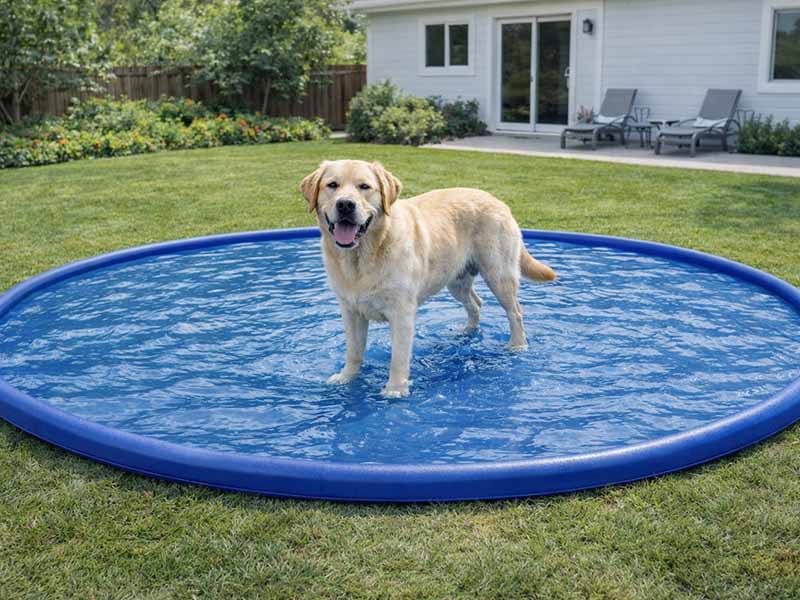
For the majority of healthy dogs, splash pads are a low-risk cooling option when basic conditions are met. Unlike pools, splash pads do not require swimming ability, jumping, or balance on steps. Dogs remain grounded at all times, which significantly reduces risk.
From owner-reported use patterns and veterinary guidance, splash pads are generally considered appropriate when:
- The dog can stand and walk comfortably on the surface
- Water depth stays shallow (paw-level or lower)
- Water does not spray directly into the face or ears
- The dog can step on and off freely
In everyday terms, this means splash pads work best as cooling zones, not endurance play areas.
Session length matters more than people expect.
Many dogs regulate heat efficiently within 5–10 minutes of paw and belly cooling. Longer sessions are not automatically better and may increase fatigue or overexertion, especially for large or flat-faced breeds.
Situations where extra caution is advised:
- Dogs with mobility issues or poor traction on smooth surfaces
- Dogs with chronic ear problems if spray reaches the head
- Very young puppies or senior dogs during peak midday heat
Used correctly, splash pads are closer to a functional cooling surface than a high-risk water activity.
Do dogs naturally want to interact with splash pads?
Dogs do not instinctively seek out sprinklers or manufactured water toys. What they do instinctively seek are:
- Cool ground when body temperature rises
- Stable footing under their paws
- Environments they can exit without stress
Splash pads succeed when they align with these instincts.
When water flows gently across a firm, non-slip surface, many dogs treat the splash pad as an extension of cool ground. This explains a behavior many owners find surprising: dogs that stand still or lie down instead of playing.
That behavior is not boredom. It is a sign the dog has found relief.
Dogs that appear “uninterested” but remain on the pad are often using it exactly as intended—cooling the paws and belly while staying alert and balanced.
Why do many dogs prefer splash pads over pools?
From a dog’s perspective, pools introduce several challenges at once:
- Depth uncertainty
- Loss of ground contact
- Need to climb in and out
- Higher risk of slipping at entry points
Splash pads remove all of these.
Dogs can:
- Test the surface with one paw
- Step away instantly if unsure
- Control how wet they become
- Re-enter without assistance
This sense of control changes behavior dramatically. Dogs that refuse kiddie pools often return to splash pads repeatedly because the experience never forces a commitment.
In multi-dog households, splash pads also reduce tension. There is no “inside vs outside” competition—dogs can share space without crowding or blocking exits.
Do all dogs respond to splash pads the same way?
No—and they shouldn’t be expected to.
Dogs vary in:
- Body size and weight distribution
- Paw sensitivity
- Joint comfort
- Heat tolerance
- Past experiences with slipping or falling
What matters is not whether a dog shows excitement, but whether the dog chooses to re-engage.
Common positive engagement patterns include:
- Stepping in, stepping out, then returning
- Standing still with relaxed posture
- Slow pacing or repositioning
- Lying down briefly to cool
Cautious dogs often need multiple short exposures to build confidence. Dogs rarely need encouragement; they need time.
One of the most consistent real-world observations is this:
When dogs experience stable footing and predictable water, acceptance usually increases—not decreases—over repeated sessions.
Practical indicators that a dog is becoming comfortable
Owners often notice subtle but meaningful changes over time:
| Early Sessions | Later Sessions |
|---|---|
| sniffing, hesitant steps | walking on confidently |
| quick exits | longer stays |
| circling edges | stepping directly onto pad |
| frequent checking back | relaxed posture |
| standing only | lying down briefly |
These shifts usually happen without training or correction, simply through repeated neutral or positive exposure.
What this means for owners and product choice
Dogs don’t decide whether they like splash pads based on novelty or fun factor. They decide based on:
- How stable the surface feels
- Whether the water behaves predictably
- How easily they can step away
When these conditions are met, many dogs—across sizes, ages, and personalities—accept splash pads naturally, even if they were unsure at first.
This is why design and material quality matter far more than appearance when choosing a splash pad for dogs.
Why Do Dogs Like Splash Pads?
Most dogs don’t like splash pads because they are “fun toys.”
They like them because splash pads solve several very practical problems dogs face in hot weather—overheating, joint strain, and loss of footing—all at the same time.
When a splash pad is designed and used properly, many dogs experience it less as play and more as relief. That’s why you’ll often see dogs standing still, slowly pacing, or lying down on a splash pad instead of running through it. From the dog’s point of view, the splash pad is doing its job.
Dogs like splash pads because they cool the body where it matters most
Dogs regulate heat differently than people. They don’t sweat through their skin. Most heat leaves a dog’s body through:
- Panting
- Paw pads
- The belly and inner thighs
Splash pads directly support two of these three cooling paths.
When cool water flows across the paws, blood vessels close to the surface release heat efficiently. This is why many dogs show visible relief within minutes of stepping onto a splash pad.
Real-world observation from dog owners:
Most dogs that use splash pads for cooling show signs of comfort within 3–7 minutes, even without active play.
Signs a dog is cooling effectively:
- Panting slows
- Mouth closes more often
- Body posture relaxes
- Dog chooses to remain on the wet surface
This is also why splash pads work well for dogs that dislike swimming. They get cooling benefits without the stress of floating or paddling.
Splash pads feel safer than pools because dogs stay grounded
One of the strongest reasons dogs accept splash pads is simple: their paws stay on the ground.
From a dog’s perspective, deep water introduces multiple risks:
- Loss of balance
- Uncertain footing at entry and exit
- Continuous effort to stay afloat
Splash pads remove these risks completely.
Dogs can:
- Step on with one paw
- Step off immediately
- Control how wet they become
- Pause without slipping
This ability to control exposure matters more than excitement. Dogs that feel physically secure are more likely to engage calmly and return voluntarily.
Owner insight that shows comfort:
Dogs that step away and return on their own are almost always more comfortable than dogs that stay because they are blocked or restrained.

Many dogs use splash pads as “cool ground,” not as a toy
Owners often expect running, jumping, or chasing water. In reality, many dogs use splash pads quietly.
Common behaviors that indicate comfort—not boredom:
- Standing still in the spray
- Slow walking in small circles
- Lying down briefly on the wet surface
- Sitting near the edge with paws on the pad
These behaviors mirror what dogs do on naturally cool surfaces, such as damp grass or shaded concrete. Splash pads replicate that experience, with the added benefit of moving water.
This is especially true for:
- Large dogs
- Dogs with thick coats
- Senior dogs
- Heat-sensitive breeds
For these dogs, splash pads are closer to a cooling station than a play zone.
Predictable water makes dogs more comfortable than “surprise” spray
Dogs are highly sensitive to sudden sensory changes. Water that turns on abruptly, pulses in pressure, or sprays unpredictably often causes hesitation.
Dogs tend to prefer:
- Even, continuous water flow
- Low spray height
- Outward or ground-level spray
Dogs tend to avoid:
- Upward jets
- Face-level spray
- Loud splashing noise
This explains why many dogs refuse hoses or handheld sprayers but accept splash pads. The water on a splash pad behaves the same way every second, which allows dogs to relax.
Small change, big difference:
Lowering water pressure or redirecting spray away from the face often changes a dog’s response within a single session.
Splash pads reduce joint strain compared to other cooling options
Another reason many dogs prefer splash pads is reduced physical demand.
Compared to pools or running through sprinklers:
- No jumping is required
- No climbing in or out
- No sustained swimming effort
This makes splash pads especially useful for:
- Senior dogs
- Dogs with arthritis
- Large dogs prone to joint stress
- Dogs recovering from mild injuries
Standing or lying on a splash pad allows cooling without impact, which is something few other summer water options provide.
Dogs are more likely to return when they feel in control
One of the clearest signs that a dog “likes” a splash pad is voluntary return.
Dogs that feel forced may stay temporarily, but dogs that feel safe will:
- Step off and come back
- Return after breaks
- Choose the splash pad over dry ground
From repeated owner use reports, dogs are most likely to return when:
- The splash pad is large enough to turn around
- Edges don’t collapse
- Water pressure stays consistent
- The dog can exit freely
Control builds trust. Trust builds repeat use.
Quick comparison: why dogs choose splash pads over other water options
| Cooling Option | Why Dogs Accept It | Why Dogs Avoid It |
|---|---|---|
| Splash pad | Stable footing, shallow water | Poor traction, strong spray |
| Kiddie pool | Full-body cooling | Entry fear, slippery walls |
| Hose | Targeted water | Startling pressure |
| Sprinkler | Movement & noise | Unpredictable spray |
| Wet ground | Familiar surface | Limited cooling |
What this means for choosing the right splash pad
Dogs don’t care about color, graphics, or novelty. They care about:
- Stability under their paws
- Water behavior they can predict
- Space to move or rest
When these conditions are met, many dogs naturally choose splash pads as part of their summer routine—even if they were unsure at first.
That’s why splash pad design, size, and material quality matter far more than gimmicks when the goal is real dog use.
Which Dogs Like Splash Pads Most?
There is no single “type” of dog that likes splash pads.
What matters is whether the splash pad matches the dog’s body size, heat sensitivity, mobility, and confidence level.
In real household use, splash pads tend to work best for dogs that benefit from shallow, stable cooling without the need to jump, swim, or balance on edges. When those needs are met, dogs across many categories willingly use splash pads—even dogs that avoid pools or hoses.
Below is how different dogs typically respond, based on size, age, and physical condition.
Small dogs: comfort depends on surface quality and water temperature
Many small dogs accept splash pads quickly, but they are also the most sensitive to setup problems.
Because small dogs have:
- Lower body weight
- Smaller paw contact area
- Faster heat loss
they react strongly to slippery surfaces and cold water.
What works well for small dogs:
- Firm, non-slip surface with minimal flex
- Low spray height (paw-level)
- Moderate water temperature (not ice-cold)
- Space to step fully off the pad
Small dogs often don’t “play” on splash pads. Instead, they:
- Step in and out
- Stand briefly to cool paws
- Sit near the edge with front paws on the pad
This behavior indicates comfort, not hesitation.
What causes rejection in small dogs:
- Thin material that wrinkles under light weight
- Sudden pressure bursts
- Water spraying upward toward the face
When surface traction and water control are right, small dogs are often more consistent users than people expect.

Large dogs: splash pads often work better than pools
Large dogs are among the most reliable splash pad users, especially in hot weather.
Large dogs:
- Retain heat longer
- Generate more joint stress when jumping
- Apply significant force to surfaces
Splash pads remove many of the challenges large dogs face with pools:
- No climbing over rigid walls
- No unstable inflatable edges
- No requirement to swim
Instead, large dogs tend to use splash pads in a functional way:
- Standing still to cool down
- Slow pacing
- Lying down briefly
Critical requirement for large dogs: size and structure.
Undersized or thin splash pads fail quickly under large dogs. When the pad collapses at the edge or shifts underfoot, confidence drops immediately.
What large dogs need:
- Wide diameter to turn comfortably
- Reinforced seams and thicker material
- Stable edges that don’t fold inward
When these conditions are met, large dogs often return to splash pads repeatedly during hot days, even without encouragement.

Puppies: curiosity is high, tolerance is low
Puppies are naturally curious but easily overstimulated. Splash pads can be a positive early experience with water—but only if intensity stays low.
Why splash pads can work well for puppies:
- No depth fear
- No forced immersion
- Full control to step away
How puppies typically interact:
- Short bursts of stepping and retreating
- Pawing at water
- Watching movement before entering
Because puppies have limited temperature regulation and developing joints, sessions should be short.
Recommended approach for puppies:
- Very low water pressure
- Sessions under 5 minutes
- Frequent breaks
- No chasing or forcing
Early positive exposure helps puppies build confidence around water that often carries into adulthood.

Senior dogs: splash pads as low-impact cooling tools
Senior dogs are one of the most overlooked groups when it comes to splash pads—but they often benefit the most.
As dogs age, many:
- Avoid jumping
- Lose flexibility
- Develop joint stiffness
- Overheat more easily
Pools become harder to access, and hoses can feel too intense.
Splash pads allow senior dogs to:
- Cool paws and belly
- Stand or lie down comfortably
- Avoid impact and climbing
Common senior-dog behavior on splash pads:
- Standing quietly
- Slow repositioning
- Lying down briefly to cool
These behaviors indicate effective use, not lack of interest.
For older dogs, splash pads are best viewed as cooling support, not play equipment.

Heat-sensitive dogs: splash pads as prevention, not play
Some dogs overheat quickly even with minimal activity. These include:
- Thick-coated breeds
- Dark-colored dogs
- Brachycephalic breeds (with caution)
For these dogs, splash pads work best as early cooling tools, used before heavy panting begins.
Owners often report that:
- 5–10 minutes of splash pad use reduces panting
- Dogs choose shade or rest afterward
- Recovery time after outdoor activity improves
In these cases, splash pads act as a preventive measure rather than a reaction to overheating.

Dogs that tend to struggle with splash pads
Splash pads are not ideal for every dog in every situation.
Dogs that may need extra caution:
- Dogs with severe mobility or balance issues
- Dogs with strong aversion to water sounds
- Dogs with active ear infections if spray reaches the head
These dogs may still tolerate splash pads with adjustments, but expectations should be realistic.
Practical guide: which dogs benefit most
| Dog Type | Likelihood of Enjoying Splash Pads | Key Setup Requirement |
|---|---|---|
| Small dogs | Moderate–High | Strong traction, gentle water |
| Large dogs | High | Large size, reinforced structure |
| Puppies | Moderate | Very low pressure, short sessions |
| Senior dogs | High | Stable surface, easy access |
| Heat-sensitive dogs | High | Early use, shade nearby |
| Water-shy dogs | Moderate | Gradual exposure, exit freedom |
What this means for owners choosing a splash pad
Dogs don’t “like” splash pads because of personality labels.
They like splash pads when the experience fits their body and comfort needs.
Matching splash pad size, structure, and water behavior to the dog makes far more difference than breed reputation or marketing claims.
When the fit is right, many dogs across ages and sizes use splash pads naturally—sometimes quietly, sometimes playfully, but consistently.
What Makes Dogs Dislike Splash Pads?
When dogs avoid splash pads, it is almost never because they “don’t like water.”
In real use, dogs reject splash pads because something about the experience feels physically unsafe, uncomfortable, or out of their control.
Dogs make decisions based on what they feel through their paws, joints, ears, and balance—not on novelty or appearance. When any of those inputs feel wrong, avoidance is a sensible response.
Understanding why dogs disengage is far more useful than trying to convince them otherwise.
Slippery or unstable surfaces break trust immediately
The most common reason dogs refuse splash pads is poor footing.
Dogs rely heavily on paw feedback to judge safety. When a surface shifts, wrinkles, collapses, or feels slick, dogs interpret it as unstable ground.
Common surface problems that trigger avoidance:
- Smooth plastic that becomes slippery when wet
- Thin material that flexes under weight
- Wrinkles or air pockets that move unexpectedly
- Collapsing edges when dogs step near the border
Dogs often show early warning signs:
- placing one paw, then pulling it back
- spreading legs wider for balance
- constant foot repositioning
- stepping off after a brief slip
Once a dog slips or loses balance, confidence drops sharply. Even if nothing “bad” happens, dogs remember instability and approach more cautiously—or refuse entirely—during future sessions.
For dogs, surface stability matters more than water features.
Water pressure that feels unpredictable or invasive
Water behavior plays a major role in acceptance.
Dogs tend to dislike:
- Sudden bursts when water is turned on
- Pulsing or uneven pressure
- Jets spraying upward
- Water hitting the face, ears, or eyes
Dogs tend to tolerate or enjoy:
- Low, even water flow
- Ground-level or outward spray
- Consistent pressure
What owners often miss is that pressure sensitivity scales with dog size:
- Small dogs feel pressure more intensely
- Puppies startle more easily
- Senior dogs dislike strong spray on joints
Many dogs that “hate splash pads” will step onto the same pad willingly once pressure is reduced.
Loud water noise and vibration cause sensory overload
Sound is another underestimated factor.
Splash pads connected to certain hoses or fittings can create:
- Sharp splashing noise
- Vibrations transmitted through the pad
- Clicking or pulsing sounds from water flow
Dogs with noise sensitivity may avoid the pad entirely, even if water contact itself is mild.
Signs noise is the problem:
- dog avoids pad before touching water
- ears pulled back
- head turning away
- hesitation even when surface is dry
Quiet, evenly flowing water dramatically improves acceptance for these dogs.
Water temperature that feels uncomfortable
Cold water can feel refreshing to humans but shocking to dogs.
Dogs are especially sensitive to temperature changes on:
- Paw pads
- Belly
- Inner thighs
Very cold water often causes:
- immediate stepping off
- paw lifting
- shaking
In real use, many dogs prefer cool, not cold water. Water that has warmed slightly in the hose (but is not hot) is often better tolerated than ice-cold water straight from the tap.
Splash pads that are too small or too crowded
Space matters more than people expect.
Dogs dislike splash pads that:
- don’t allow turning around
- force dogs into constant spray
- have no dry edge to pause on
This is especially true for:
- large dogs
- multi-dog households
- dogs new to water
When dogs feel trapped, stress increases. When dogs can step partially off the pad, confidence improves.
Being forced onto the splash pad
One of the fastest ways to create long-term dislike is physical forcing.
Dragging, lifting, or blocking exits teaches dogs that:
- the environment is not safe
- they have no control
Dogs that are forced may comply briefly but often refuse future sessions.
Dogs that are allowed to:
- approach on their own
- step off freely
- return voluntarily
are far more likely to accept splash pads over time.
Health and physical factors owners sometimes overlook
Some dogs avoid splash pads for reasons unrelated to behavior.
These include:
- sore joints or arthritis
- minor paw injuries
- ear infections
- skin sensitivity
In these cases, avoidance is protective. Dogs should never be pressured to continue if discomfort is suspected.
How to tell why your dog dislikes a splash pad
Owners often see avoidance but don’t know the cause. The table below helps identify likely reasons:
| Dog Behavior | Most Likely Cause | What to Adjust |
|---|---|---|
| Steps on briefly, steps off | Surface feels unstable | Improve traction, flatten pad |
| Avoids when water turns on | Pressure or noise | Reduce pressure, quiet flow |
| Shakes paws repeatedly | Water too cold or slick | Adjust temperature, surface |
| Circles edge, won’t enter | Needs control | Increase pad size, allow exits |
| Avoids entirely after slip | Loss of confidence | Reset with water off |
| Freezes or stiff posture | Overwhelmed | Shorter sessions, less spray |
How to Help Dogs Like Splash Pads More
Dogs don’t need to be convinced to like splash pads.
They need a setup that feels safe, predictable, and optional.
In real households, most dogs that end up enjoying splash pads did not do so on the first try. They became comfortable because owners adjusted how the splash pad was introduced—not because the dog was pushed to “get used to it.”
Helping dogs like splash pads is about reducing uncertainty, not increasing stimulation.
Start with the splash pad as a dry surface
The biggest mistake many owners make is turning the water on immediately.
For dogs, the splash pad itself is already something new:
- a different texture
- a different smell
- a different surface underfoot
Adding water too early stacks unfamiliar sensations.
What works better:
- Lay the splash pad flat on the ground
- Leave the water completely off
- Let the dog sniff, step on, and step off freely
Many dogs will only place one paw at first. That’s normal. That single step is how dogs test safety.
Good sign:
The dog steps on briefly, steps off, and then returns to sniff again.
What not to do:
- Don’t lift the dog onto the pad
- Don’t block exits
- Don’t “cheer” or crowd the dog
Calm, neutral exposure builds trust faster than excitement.
Introduce water slowly and away from the dog’s face
Once the dog is comfortable standing on the dry pad, add water at the lowest possible setting.
Where the water goes matters more than how much there is.
Dogs are far more comfortable when:
- Water sprays outward or along the ground
- Spray stays below chest level
- Pressure is steady, not pulsing
Dogs are more likely to resist when:
- Water suddenly sprays upward
- Spray hits the face, ears, or eyes
- Pressure changes without warning
A small adjustment here often makes the difference between refusal and acceptance.
Practical tip many owners find helpful:
Turn the water on before the dog steps onto the pad, so there’s no surprise burst.
Keep first sessions short—shorter than you think
Many dogs form opinions quickly.
Long first sessions increase the chance of overstimulation or fatigue.
In real-world use, most dogs show meaningful comfort signals within 3–5 minutes.
Recommended starting pattern:
- First session: 3–5 minutes
- Second session (same day or next day): 5–8 minutes
- Later sessions: increase only if the dog stays relaxed
Ending the session while the dog is still calm is far more effective than “pushing a little longer.”
A reliable rule:
If the dog chooses to step back onto the pad after a break, you’re on the right track.
Let the dog step off—and don’t call them back
This is one of the most important but hardest rules for owners.
Dogs build confidence when they know they can leave.
When dogs step off:
- Don’t call them back
- Don’t pull them
- Don’t reposition them
Many dogs return on their own within seconds or minutes once they realize:
- nothing bad happens
- the pad isn’t chasing them
- the water stays the same
Dogs that return voluntarily almost always become consistent users over time.
Adjust setup based on the dog’s size and age
Helping dogs like splash pads is not one-size-fits-all.
For small dogs:
- Lower water pressure than you think
- Slightly warmer water
- Strong surface grip
For large dogs:
- Larger pad with room to turn
- Reinforced structure that doesn’t flex
- Stable edges
For puppies:
- Very short sessions
- Minimal spray
- No chasing behavior encouraged
For senior dogs:
- Focus on standing or lying, not play
- Avoid cold water
- Ensure easy step-on, step-off access
Matching setup to the dog’s body reduces resistance dramatically.
Watch behavior changes, not excitement
Owners often look for running or jumping as signs of success.
That’s not how many dogs show comfort.
Signs a dog is becoming more comfortable:
- Stays on the pad longer each session
- Stops constantly checking the edges
- Stands still without tension
- Lies down briefly
- Returns after stepping off
Signs the setup needs adjustment:
- Frequent paw lifting
- Repeated stepping off without returning
- Stiff posture
- Avoidance when water turns on
Behavior trends matter more than any single session.
Use rewards correctly
Rewards can help—but only when used well.
Effective use:
- Calm praise when the dog steps on
- Treats delivered off the pad after calm interaction
Less effective:
- Luring the dog onto the pad with treats
- Rewarding frantic movement
- Using toys that increase arousal
The goal is comfort, not excitement.
What works better than correction or pressure
Correcting or forcing dogs to stay on a splash pad almost always creates long-term resistance.
Dogs don’t learn:
“This water is safe.”
They learn:
“I lose control here.”
What works better:
- Environmental changes (pressure, surface, space)
- Shorter sessions
- Repetition across days
Most dogs that end up liking splash pads do so within 3–7 low-pressure sessions, not in one forced attempt.
Common mistakes that slow progress
| Mistake | Why it backfires | Better alternative |
|---|---|---|
| Turning water on full blast | Startles dog | Start low and steady |
| Lifting dog onto pad | Removes control | Let dog choose |
| Long first session | Overwhelms | End early |
| Small pad for big dog | Feels trapped | Size up |
| Cold water | Causes avoidance | Cool, not cold |
Conclusion: Choosing the Right Splash Pad for Dogs
Dogs don’t judge splash pads by color or novelty. They judge them by how safe they feel standing on them.
When splash pads offer:
- Stable footing
- Predictable water flow
- Enough space
- Materials that stay firm and cool
Dogs across sizes and ages are far more likely to accept — and repeatedly use — them.
This is exactly the philosophy behind Epsilon (EPN) pet water products.
As a U.S.-based manufacturer specializing in PVC and composite material engineering, Epsilon designs splash pads and pet pools with:
- Reinforced structures for real dog weight
- Non-slip surfaces tested under wet conditions
- Controlled water distribution
- Long-term durability for daily summer use
Whether you are:
- A pet owner seeking a reliable, dog-friendly splash pad
- A retailer or brand sourcing high-quality pet water products
- A business looking for OEM/ODM customization
Epsilon provides brand-ready products, custom development, and scalable manufacturing for global markets.
To order EPN branded products or request custom splash pad development, contact Epsilon directly for pricing, samples, and production timelines.
Get A Fast quote
Here, bringing your inflatable concepts to life is no longer a challenge—it’s a collaborative journey where American Epsilon helps families, outdoor enthusiasts, and global brands transform creative ideas into safe, certified, and market-ready inflatable solutions.


Partner With Epsilon
Whether you are a family looking for safe backyard fun or a brand seeking large-scale OEM/ODM solutions, American Epsilon Inc. guarantees every inflatable is built with safety, durability, and excitement in mind. With flexible low MOQs, strategically placed warehouses in the U.S., Canada, U.K., and Germany, plus 24/7 professional support, we ensure smooth delivery and reliable service worldwide.
Ready to bring your inflatable ideas to life? Request free samples, fast prototypes, and customized designs today—your trusted inflatable journey starts here.