Skip to content
How to Choose a Dog Splash Pad
# Your Trusted Inflatable Supplier In US

A dog splash pad looks simple at first glance: unfold it, connect a garden hose, turn on the water, and let the dog play. The buying decision becomes more complicated when products that appear almost identical behave very differently after an energetic dog begins running across them. A pad may be large enough according to the package but feel cramped during active play, use thick PVC yet develop problems around poorly constructed seams, or produce impressive sprays that a cautious dog refuses to approach. The best choice rarely comes down to one specification.
To choose a dog splash pad, match the usable play area to your dog’s body size and activity level, evaluate PVC construction and seam quality, choose a textured surface for better wet traction, and look for adjustable inward spray. The pad should also fit your yard, water pressure, drainage conditions, drying space, and storage routine. Active or multiple dogs generally need more space and stronger construction.
Imagine two 60-pound dogs on the same summer afternoon. One walks calmly through low streams and lies on the cool surface, while the other races around the perimeter, jumps through the spray, and paws repeatedly at moving water. Both dogs technically fall into the same general size category, yet they place completely different demands on a splash pad. Choosing well starts with understanding how your dog will actually use the product rather than selecting the biggest diameter or the boldest durability claim.
Which Size Fits Your Dog?
Choose a dog splash pad according to usable center space rather than relying only on the outside diameter printed on the package. Your dog should be able to stand, turn, lie down, approach the spray, and leave comfortably. Larger, longer-bodied, highly active, or multiple dogs usually need more open floor area, while yard dimensions, hose access, drainage, and drying space should also affect the final size.
How Much Space Does Your Dog Need?
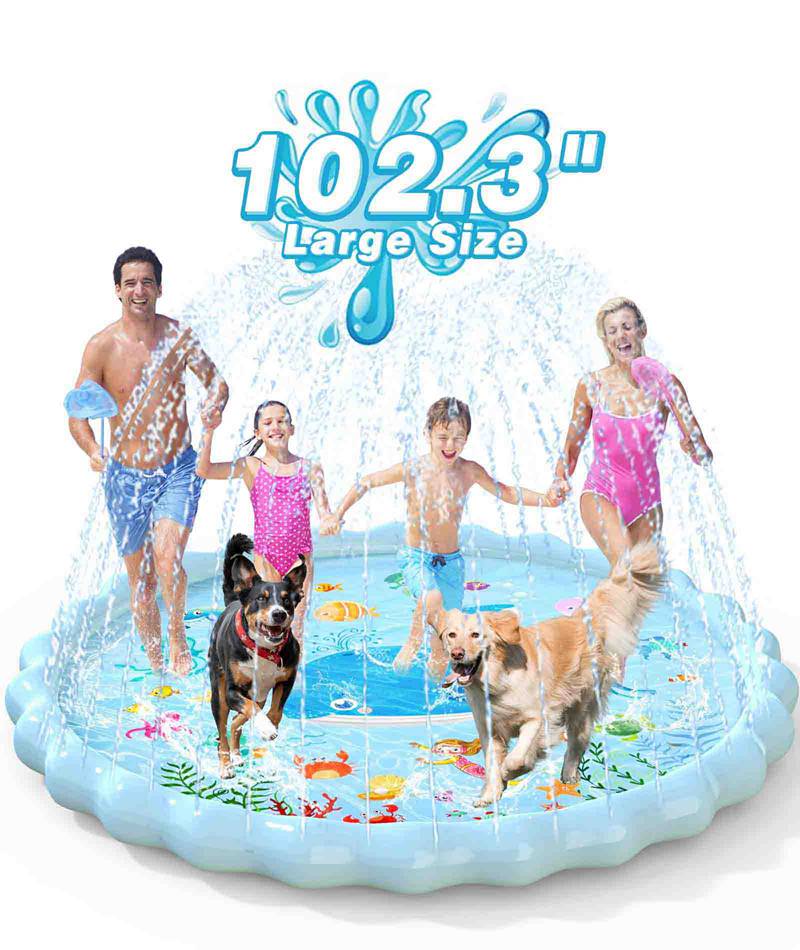
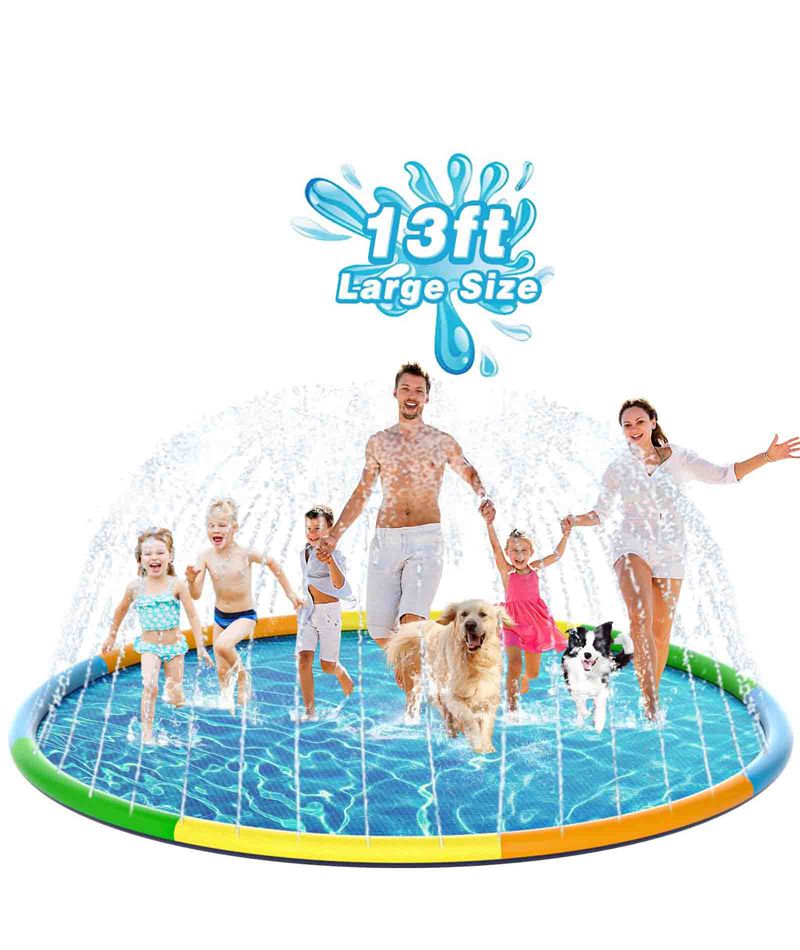
The listed diameter of a splash pad includes the outside sprinkler ring, which means the actual flat area available for standing and moving is smaller. That distinction becomes particularly important with medium and large dogs. A 67-inch pad, for example, does not necessarily provide a 67-inch uninterrupted center because part of the diameter is occupied by the raised water channel around the perimeter.
A useful starting point is your dog’s body length from the front of the chest to the base of the tail. Once you know that measurement, think about movement rather than static fit. Dogs turn in an arc, shift their rear legs outward, lower their bodies while playing, and approach water streams from different directions. A pad that barely accommodates a standing dog can become surprisingly restrictive when the dog begins turning, pouncing, or chasing spray.
For calm dogs that mainly stand or lie on the wet surface, the center only needs to provide comfortable body clearance. Energetic dogs need noticeably more room because running, spinning, and changing direction quickly consume available space. Long-bodied breeds can also require more floor area than their weight suggests, while compact breeds may sometimes use a smaller pad comfortably despite weighing more.
| Dog or Use Pattern | Practical Size Priority | Main Point to Check |
|---|---|---|
| Small dog under about 25 lb | Compact to medium | Easy entry and moderate spray |
| Medium dog about 25–55 lb | Medium to large | Turning and lying space |
| Large dog over about 55 lb | Large usable center | Stride and body length |
| Long-bodied dog | Extra center length | Do not rely on weight alone |
| Highly active dog | Additional movement room | Turning clearance |
| Two or more dogs | Larger shared center | Crossing paths and simultaneous play |
These categories are practical starting points rather than strict rules. A calm 70-pound senior dog may need less movement space than a highly energetic 40-pound adolescent. Breed shape, confidence around water, mobility, and play habits can all be more informative than weight alone when judging whether a particular splash pad will feel comfortable.
Do Active Dogs Need Larger Pads?
Active dogs generally benefit from more usable center area because they interact with a splash pad through movement. Instead of remaining in one place, they chase individual streams, jump through the spray curtain, turn suddenly, leave the mat, and return from another direction. These movements consume space quickly and increase contact with the raised perimeter.
A larger center does not automatically make a product safer, but it allows more movement to take place on the flatter portion of the pad rather than directly across the sprinkler ring. This can be especially useful for dogs that repeatedly spin or pounce at moving water. Activity level can therefore be more relevant than a generic small, medium, or large breed label.
Movement also changes the mechanical demands placed on the product. A lively 40-pound dog that runs continuously can produce more repeated stress on PVC and seams than a heavier dog that mostly lies down. For highly active dogs, size should be considered together with material thickness, surface traction, seam construction, and stable placement.
If your dog already enjoys chasing a garden hose or running through lawn sprinklers, moving one practical size above the minimum fit can provide a better play area when the yard allows it. The surrounding ground should also remain clear because fast dogs often leave the pad at speed before circling back into the water.

What Size Works for Multiple Dogs?
Two dogs need more than enough area to simply place both bodies inside the splash pad at the same time. Dogs sharing moving water often face one another, cross paths, compete for a particular stream, or enter and leave from opposite sides. A pad that appears large enough when both dogs are standing still can feel crowded almost immediately during active play.
One practical test is to imagine both dogs lying down in the center without overlapping. If their bodies already occupy most of the usable area, the pad is unlikely to provide much freedom once they stand and move. Two medium dogs generally benefit from a noticeably larger center than a single medium dog, while combinations of large and small dogs need enough room for the smaller animal to move away comfortably.
Temperament changes the calculation. Two relaxed dogs can share a moderate-size splash pad more easily than two playful littermates of identical weight. Owners should also consider whether the dogs chase each other during water play because the required activity area extends beyond the physical footprint of the product.
Multiple dogs also create more repeated paw pressure and more opportunities for one animal to step on the perimeter while another is turning. Durable PVC, consistent seams, reliable wet traction, and a stable hose connection become increasingly important as the intensity and frequency of use rise.
Is Bigger Always Better?
A larger splash pad provides more freedom, but oversizing can introduce practical problems. Large pads require more yard space, contain longer water channels, need more room for drying, and can be more awkward to fold and store. The ideal size is therefore not automatically the largest model available.
Water performance may also change as diameter increases. Larger perimeter channels generally contain more spray openings, and all of these holes share the available household water supply. When water pressure is limited, an oversized pad can produce lower or less consistent streams than a smaller design. Hole size, spacing, hose length, channel dimensions, and household pressure all influence final spray behavior.
Storage is another factor that buyers often overlook. A household may have enough lawn to operate a large pad but no practical area to spread it out and dry both sides afterward. If the product is inconvenient to dry, owners are more likely to fold it while damp or leave it exposed outdoors between uses.
Think about the complete routine before choosing. There should be enough room for the pad, a safe route for the hose, suitable clearance around the perimeter, a drainage path, and adequate space to clean and dry the PVC. The best size is the largest practical play area that comfortably fits the dog and the way the household intends to use it.
What Materials Last Longer?
A durable dog splash pad depends on the complete construction rather than PVC thickness alone. Material thickness, flexibility, welded seams, sprinkler-channel design, surface texture, hose connections, ground preparation, and dog behavior all influence service life. Thicker PVC can improve resistance to scratching and puncture, but even substantial material can fail when placed over sharp debris, exposed to repeated digging, or joined with weak seams.
Which PVC Thickness Is Better?
PVC thickness is one of the easiest specifications to compare because it can be expressed with a measurable value, but the number should not be treated as a complete quality score. Heavier-duty pet splash pads may use PVC in roughly the 0.4–0.6 mm range in important structural areas, although actual construction varies among manufacturers and models. Center panels, perimeter channels, connection zones, and reinforcement areas may not always use identical material structures.
Greater thickness generally provides more material between a dog’s claws and the opposite surface, which can improve resistance to light puncture, surface abrasion, and repeated handling. It can also give the pad a more substantial feel when unfolded. For large or highly active dogs, this added material margin can be useful because paw loading is repeated many times during a single play session.
Thickness also creates tradeoffs. More PVC increases weight and folded volume, while tight creases may become more pronounced in substantial material. Formulation therefore matters alongside nominal thickness. Two sheets with the same 0.55 mm specification can behave differently if one has greater flexibility, better folding performance, or a formulation more appropriate for outdoor recreational use.
Measured specifications are generally more informative than claims such as “extra thick” or “three times thicker” unless the seller clearly identifies the comparison baseline. A well-designed pet splash pad should balance material thickness with flexibility, welding quality, surface texture, handling, and intended dog activity rather than maximizing a single number.
| Material Factor | What It Can Improve | What It Cannot Guarantee |
|---|---|---|
| Greater PVC thickness | Puncture margin and abrasion resistance | Strong seams |
| Flexible formulation | Folding and repeated setup | Resistance to sharp debris |
| Textured center | Better wet-paw traction | Protection from long claws |
| Reinforced connection area | Reduced local stress | Even spray distribution |
| Consistent heat welding | Water-channel integrity | Correct water pressure |
| Smooth underside | Better ground contact | Safety on gravel |
How Do Dog Claws Damage Splash Pads?
Dog claws create concentrated pressure because part of the animal’s weight is transferred through a much smaller contact area than the paw pad. During calm standing, that load may be relatively modest. During running, spinning, pouncing, or digging, the claw can press more sharply into the surface or drag across the PVC, increasing the likelihood of scratches and localized damage.
Several factors usually work together. Nail length, body weight, speed of movement, PVC thickness, material flexibility, ground condition, and debris underneath the pad all affect risk. This explains why the same product can perform well for one large dog yet experience more rapid wear with a lighter dog that repeatedly digs at moving streams.
The underside deserves as much attention as the top. A small stone, twig, metal fragment, thorn, or landscaping staple beneath the pad can create a hard pressure point. When the dog’s paw lands directly above it, the PVC is compressed between the dog and the object underneath, making puncture more likely.
Regular nail maintenance and careful ground preparation are therefore part of splash-pad durability. Owners should also discourage persistent chewing or digging at the outer sprinkler ring. A dog splash pad is intended for supervised water play rather than sustained digging or chewing, regardless of how thick or heavy the PVC feels.

Do Reinforced Seams Matter?
The seams around a splash pad are structural components because the perimeter functions as a shallow pressurized water chamber. Once a garden hose is connected, water pushes outward against the welded PVC layers while dogs simultaneously step on, bend, and occasionally jump across those same areas.
High-frequency welding is commonly used with compatible flexible PVC because controlled radio-frequency energy can fuse material layers into a consistent joint. Reliable welding depends on several manufacturing variables, including PVC formulation, weld width, tooling, alignment, pressure, energy input, and cycle control. A thick center panel cannot compensate for a poorly formed joint.
The hose connection deserves particular attention because it concentrates force into a relatively small area. Dragging a filled pad by the connector, sharply bending the hose at the inlet, or repeatedly pulling the supply line sideways can place unnecessary load on the surrounding material. Better designs account for this stress through suitable geometry, reinforcement, and controlled assembly.
For customized products, the relationship between weld lines, spray holes, cut lines, artwork, and inlet position should be considered before production begins. Experienced PVC manufacturers can coordinate cutting, printing, high-frequency welding, assembly, and leakage checks within one development process so the structure is designed around real pet use rather than simply adapting graphics from another category.
Are Thicker Pads Always More Durable?
A thicker pad is not automatically a more durable pad. Thickness describes how much material exists in a certain area; it does not tell you about weld quality, inlet reinforcement, PVC formulation, spray-hole placement, folding behavior, or structural balance.
Consider a pad using 0.55 mm PVC but inconsistent perimeter welds and a poorly supported hose connection. A slightly thinner alternative with controlled seams, an appropriately reinforced inlet, flexible material, and balanced water pressure may perform better over repeated use even though its headline thickness is lower.
The environment can also outweigh modest differences in material gauge. Clean, flat grass generally causes less underside abrasion than coarse concrete or gravel. A thick splash pad dragged repeatedly across rough pavement can show wear faster than a slightly thinner pad that is carefully positioned and lifted.
Storage habits also influence service life. Flexible PVC can tolerate folding, but repeatedly crushing the material into sharp creases at the same locations adds unnecessary stress. Cleaning the product, drying it thoroughly, and storing it without severe compression can contribute meaningfully to long-term performance.
Durability is therefore better understood as the result of material thickness, formulation, welding, reinforcement, pressure management, dog activity, nail condition, ground preparation, and care. A balanced construction system is more useful than one impressive specification.
Which Safety Features Matter?
Important safety features include a textured wet-grip surface, stable placement, shallow water, controllable spray, smooth finished edges, secure hose connections, and clear material information. No dog splash pad is completely slip-proof or damage-proof, so supervision remains important. Ground preparation, reasonable water pressure, maintained nails, and a stable entry and exit area also contribute to safer use.
Is a Non-Slip Surface Important?
Wet traction matters because dogs move across a surface very differently from people. Their four paws make contact independently and at changing angles, so one paw losing grip during a turn can affect the dog’s balance before the other legs compensate. The issue becomes more noticeable when an excited dog is chasing spray, spinning, or entering the wet mat from dry ground.
A textured PVC center can improve traction by creating more interaction between the paw pads and the material than a completely smooth wet sheet. It is still more accurate to describe the result as slip-resistant rather than impossible to slip on. Mud, algae, soap residue, oils, excessive water, and worn texture can all reduce traction.
Activity level changes how important the surface becomes. A dog standing calmly under a low stream produces relatively little lateral force. A dog sprinting or changing direction quickly places significantly more sideways load through its paws. Large dogs can generate especially noticeable horizontal force when stopping or turning.
The surrounding ground matters as well. Smooth tile, muddy grass, wet decking, or polished concrete can become more slippery than the splash pad itself. A good setup includes at least one stable approach and exit route while keeping the center and nearby ground reasonably clean.
Owners should avoid leaving cleaning residues on the PVC, inspect older products for worn surface texture, and moderate high-speed play when surrounding areas become excessively wet.
How Deep Should the Water Be?
A dog splash pad is primarily designed for shallow interactive water play rather than swimming. Water spreads across the center while the outer perimeter produces moving streams, creating a cooling play surface for dogs that enjoy chasing water, wetting their paws, moving through spray, or lying briefly on the damp PVC.
Dogs that prefer sitting or lying with the chest and abdomen more deeply submerged may be better suited to a traditional foldable dog pool. Understanding this distinction prevents a common mismatch in expectations. A splash pad should not be selected simply because a promotional photo makes the center resemble a shallow swimming pool.
Owners should avoid intentionally blocking drainage or modifying the structure to create deeper water unless the product was specifically designed for that use. Additional retained water can change structural loading, hygiene, traction, and the way the mat lies on the ground.
For first-time users, begin with low water pressure and allow only a shallow film of water to develop across the center. Let the dog approach voluntarily rather than placing it directly into strong spray.
Ground temperature should also be checked before use. Patios, concrete, and driveways can become very hot under direct sunlight before the water begins cooling the area, so both the splash pad and surrounding walking surface should be comfortable for paws.

Are Materials Safe for Dogs?
Material safety should be supported by specific product information rather than broad labels such as “eco-friendly,” “safe,” or “non-toxic” without context. Flexible PVC is manufactured from resin together with components that help achieve softness, color, processing performance, stability, and outdoor durability. Pigments, printing inks, plasticizers, stabilizers, and other additives can vary among formulations.
For consumers, useful information includes the identified material, intended use, care instructions, and relevant testing where applicable. For retailers and private-label programs, test requirements should be evaluated according to the target market and actual product category rather than assuming that one certificate or laboratory report applies everywhere.
Standards commonly discussed in recreational PVC products, including REACH, CPSIA, ASTM, and EN 71, address different regulatory or testing areas and should not be treated as interchangeable. Requirements for a pet product can differ from those for a children’s toy, and testing may depend on product classification, market, claims, age grading, materials, and distribution channel.
A splash pad should also not be treated as a chew product. Dogs may naturally lick water during play, but persistent chewing of the PVC body, hose fitting, or connection components should be discouraged.
For customized programs, product-specific material traceability and relevant testing provide stronger evidence than adding unrelated compliance claims simply to make a specification sheet appear more comprehensive.
Do Puppies and Senior Dogs Need Different Features?
Puppies and senior dogs often benefit from moderate spray, good traction, low entry height, and straightforward access, although the reasons are different. Puppies are frequently curious but physically uncoordinated, while older dogs may move more slowly or have reduced strength and balance.
A puppy encountering moving water for the first time may jump backward suddenly, bite at individual streams, or dig at the perimeter. Low initial pressure and short supervised sessions make it easier to observe the animal’s response and gradually build confidence. The objective should be comfortable voluntary interaction rather than producing the highest possible jets.
Senior dogs can benefit from the low-profile design because there is generally no high side wall to step over. However, a wet surface still requires reliable traction, and the route from dry ground onto the pad should remain stable. A clear and uncomplicated exit can be particularly valuable for dogs that move cautiously.
Age alone is not a complete indicator. A healthy older dog may be extremely confident around water, while a young adult dog may dislike sprinklers. Owners should adjust the setup to individual mobility, behavior, confidence, and temperature tolerance.
Dogs with known orthopedic, neurological, cardiovascular, respiratory, skin, or temperature-regulation concerns may require individualized veterinary advice before strenuous outdoor activity.
How Should the Spray Perform?
Good spray performance means water reaches the usable play area consistently and can be adjusted to a level the dog enjoys. Tall jets are not automatically better. A well-designed splash pad should provide controllable inward spray, reasonable distribution around the perimeter, and stable operation under ordinary household hose conditions rather than relying on unusually high water pressure.
How High Should the Water Spray?
There is no single ideal spray height because dogs respond to moving water differently. A confident retriever may happily run through streams approaching shoulder height, while a smaller or cautious dog may prefer water that rises only a short distance from the surface.
The most useful height is one that encourages voluntary interaction. A dog that repeatedly approaches the streams, walks through them, paws at moving water, or returns after leaving is demonstrating greater comfort than an animal that remains outside the splash pad or repeatedly backs away.
Several physical variables affect spray height. Household water pressure is one of the most important, but hose length, hose diameter, connection restrictions, number of spray holes, hole diameter, wind, and perimeter geometry all change the final result.
| Factor | Typical Influence on Spray |
|---|---|
| Higher faucet flow | Usually raises spray |
| Lower household pressure | Reduces height |
| Long or narrow hose | May restrict flow |
| Kinked hose | Can weaken or destabilize spray |
| More spray holes | Divides available flow among outlets |
| Larger holes | Changes pressure and flow balance |
| Wind | Moves taller streams away from target |
| Uneven ground | Can change ring shape and direction |
Promotional photographs showing very tall streams should therefore not be treated as a guaranteed result. Moderate, controllable spray is often more practical because the same product can then accommodate dogs with different body sizes and confidence levels.
Can You Adjust the Water Pressure?
Most garden-hose splash pads allow spray adjustment through the outdoor faucet. Begin with low flow so the perimeter channel fills gradually, then increase the water supply until the spray reaches a height the dog accepts comfortably.
This gradual approach provides several advantages. It avoids suddenly startling the dog, reduces abrupt pressure changes inside the sprinkler channel, and makes it easier to see whether the spray pattern becomes reasonably even as the structure fills.
When jets remain weak, inspect the complete water path before assuming that the pad is defective. A partially closed faucet, kinked hose, restrictive adapter, long narrow hose, low household pressure, folded perimeter channel, or blocked spray opening can all reduce output.
Excessive flow should not be treated as a performance target either. Making the water ring extremely firm or producing unusually tall streams can place additional stress on the channel while providing little additional benefit to the dog.
Good product development treats hole count, hole diameter, channel dimensions, inlet construction, and expected residential water supply as one hydraulic system. Simply adding more spray holes to make a product appear more impressive can actually reduce usable performance when the available flow is divided among too many outlets.

Should the Spray Point Inward?
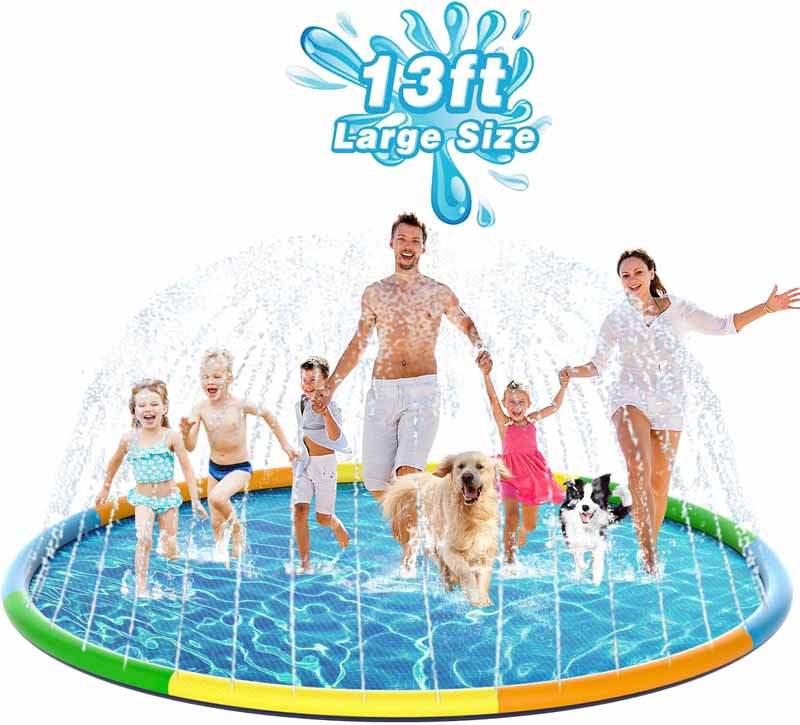
Inward-directed spray generally makes better use of a dog splash pad because the usable play area lies inside the perimeter. Water aimed slightly toward the center creates an interactive spray curtain around the dog and reduces the amount of water landing on nearby furniture, walkways, doors, or landscaping.
The correct angle depends partly on product diameter. A pattern that works well on a compact splash pad may not provide useful coverage on a much wider model. Larger pads can require changes in hole angle, spacing, total hole count, and jet height to maintain useful water distribution.
Spray directed too steeply toward the exact center can cause streams to converge in a narrow zone, leaving areas near the perimeter less active. Spray aimed too shallowly may barely clear the outer water channel. Good performance comes from balancing these variables rather than simply pointing every opening inward.
Important design factors include overall diameter, usable center width, perimeter-channel size, hole position, spacing, expected water pressure, and intended dog size.
For private-label or customized pet splash pads, spray geometry is one of the areas where product-specific development can create a noticeable difference. Manufacturers such as EPN can adjust spray layouts together with PVC dimensions, graphics, perimeter geometry, and other structural details instead of using one identical spray pattern across every size.
What Causes Uneven Spray?
Uneven spray can result from setup, water supply, temporary blockage, product geometry, or manufacturing variation. Small differences among individual streams are normal and often have little effect on play, while large dead sections or a perimeter that never fills correctly deserve closer inspection.
Begin by unfolding the splash pad completely and flattening major creases. A strongly folded section of the water channel can temporarily restrict flow. Allow the perimeter time to fill and settle before deciding whether the spray is genuinely uneven.
The hose should also be checked for kinks, partial restrictions, or poorly fitted adapters. If only a small number of openings produce weak streams, dirt or mineral residue may be involved. Cleaning should follow the manufacturer’s instructions because inserting oversized needles or other tools can permanently enlarge holes and disrupt pressure distribution.
Water enters the perimeter from a specific point and then travels around the entire channel. Hole number, hole diameter, channel width, inlet position, total circumference, and welding consistency all influence how pressure is distributed.
The important question is not whether every stream reaches exactly the same height. A better measure is whether most of the usable center receives consistent, comfortable water coverage without large dry areas, severe leakage, or excessive outward spray.
How Do You Match the Pad to Your Yard?
Choose a flat, clean outdoor area with enough room for the full splash pad, dog movement, hose routing, overspray, drainage, drying, and storage. Grass and smooth patios can both work when carefully prepared. The location should reduce puncture risk, direct runoff away from doors and electrical areas, and provide the dog with stable routes for entering and leaving.
Which Surface Is Best?
Clean, level grass is often one of the most forgiving surfaces because it provides cushioning and generally offers better surrounding traction than polished hard flooring. Grass does require careful inspection, however. Stones, dry branches, thorns, hard seed pods, landscaping staples, and other small objects can remain hidden beneath the blades and create pressure points underneath the PVC.
Patios are easier to inspect and clean. Smooth concrete or pavers can provide a consistent base, but rough concrete may abrade the underside when the splash pad shifts beneath an active dog. Polished tile presents a different problem because the surrounding area can become slippery as overspray accumulates.
Decks may also work when the surface can tolerate repeated wetting and drainage is appropriate. Driveways often provide generous open space but can become very hot under direct summer sun. Dark pavement should be checked before the dog walks across it, even when the splash pad itself is about to be filled with cool water.
| Surface | Main Advantage | Main Concern | Preparation |
|---|---|---|---|
| Grass | Soft, comfortable base | Hidden debris and mud | Inspect carefully |
| Smooth concrete | Flat and easy to clean | Abrasion and runoff | Sweep before setup |
| Patio pavers | Stable surface | Raised joints | Check edges and gaps |
| Deck | Convenient near the home | Water accumulation | Confirm drainage |
| Driveway | Large open area | Heat and rough texture | Check temperature |
| Gravel | Good drainage | High puncture risk | Avoid direct placement |
Gravel and decorative stone are generally unsuitable for direct placement because point loads are concentrated underneath flexible PVC. The best location is usually the cleanest and flattest available surface with practical drainage and enough room for safe movement around the product.
How Much Yard Space Do You Need?
The usable yard area should be larger than the nominal splash-pad diameter. A product that technically fits between a fence and patio furniture can still leave too little room for dogs to enter, people to move around the edge, the hose to connect properly, or overspray to land without creating problems.
Think of the setup as an activity zone rather than a product footprint. A six-foot splash pad squeezed into a six-foot-wide corridor provides almost no functional clearance. Even one or two additional feet along frequently used sides can make entry, supervision, and hose routing significantly easier.
Active dogs require more surrounding room because they may leave the splash pad at speed. A clear area around the perimeter gives them space to slow down before reaching steps, furniture, walls, landscaping, or another pet.
Nearby vertical objects should also be considered. A pad may fit perfectly on the ground yet still be poorly positioned when taller spray reaches an open doorway, outdoor electrical outlet, grill, window, or frequently used walkway.
Before purchasing, measure the full product footprint, practical clearance, distance to the outdoor faucet, natural drainage direction, drying area, and intended storage location. In smaller yards, a moderate-size pad with efficient inward spray can provide more useful play space than an oversized model that occupies nearly every available inch.

Is Setup and Drainage Easy?
Convenient setup directly affects how often a splash pad is actually used. A straightforward hose-fed design should involve only a few main steps: inspect the ground, unfold the PVC, flatten major creases, connect the garden hose securely, introduce low water flow, and adjust the spray to the dog’s comfort.
Position the pad before filling the perimeter. Dragging a pressurized, water-filled product by the hose connector or one edge can create unnecessary stress because the water adds weight to the structure. If the location needs to change, reducing the flow and repositioning the product is more sensible than pulling it across the ground while full.
Drainage should also be considered before play begins. Lawns can become saturated when a splash pad operates repeatedly in the same location, potentially creating mud. Patios can direct runoff toward doors, stairs, drainage channels, or neighboring areas depending on their natural slope.
After use, turn off the water and allow the perimeter to empty according to the product design. Hair, grass, soil, and other residue are easier to remove while the PVC remains unfolded.
Dry both surfaces before long-term storage. The visible upper surface may feel dry while moisture remains against the underside or within folds, so airflow and repositioning can be more effective than simply wiping the top.
How Easy Is It to Store?
Flexible PVC makes splash pads substantially easier to store than rigid outdoor water-play equipment, but proper storage still begins with drainage and drying. Grass, pet hair, grit, or trapped moisture between folded layers can create odors and make the next setup less pleasant.
After emptying the perimeter channel, clean the surface and allow both sides to dry adequately. Avoid forcing the PVC into the smallest possible package. Repeatedly forming tight creases in exactly the same locations can place unnecessary localized stress on the material, while a looser folding pattern is generally easier on the structure.
Heavy tools, sharp gardening equipment, metal shelf edges, and rodents can damage PVC during storage. The folded product should be kept in a dry, protected place rather than underneath heavy objects or beside items that may puncture the material.
Households that use a splash pad several times per week may prefer a larger storage container or shelf that allows the product to remain loosely folded. Convenient storage often improves real-world service life because owners are less likely to leave the pad exposed outdoors between sessions.
For seasonal storage, drain the pad thoroughly, remove dirt and pet hair, dry both surfaces, inspect the seams and connector, fold without severe compression, and keep the product away from excessive heat and puncture hazards until the next season.
Is a Splash Pad Better Than a Dog Pool?
A splash pad and dog pool serve different styles of water play, so neither is universally better. Splash pads are better suited to dogs that enjoy moving water, chasing spray, cooling their paws, walking through streams, and entering or leaving without stepping over a raised side wall.
Dog pools hold deeper standing water and are generally more suitable for animals that prefer sitting, soaking, lying down, bathing, or cooling more of their body at once. Watching what your dog already enjoys often gives a better answer than comparing specification sheets alone.
A dog that runs toward lawn sprinklers or tries to catch water from a garden hose is a strong candidate for a splash pad. A dog that immediately lies down in shallow ponds, tubs, or pools may receive more value from a water-retaining pool.
| Feature | Dog Splash Pad | Dog Pool |
|---|---|---|
| Main activity | Chasing spray and active shallow play | Soaking and standing water |
| Entry height | Very low | Raised side wall |
| Water movement | Continuous spray | Mostly still water |
| Water supply | Usually runs during play | Filled before use |
| Best suited to | Active, spray-loving dogs | Dogs that prefer soaking |
| Storage | Flat flexible format | Foldable wall structure |
| Typical water depth | Shallow | Deeper |
Water use also differs. A pool consumes most of its water during filling and can remain available for a period, while a splash pad normally requires continued hose flow while the sprinkler is operating. Some households benefit from both formats because different dogs, weather conditions, and activities call for different types of cooling.
Choosing the right dog splash pad becomes much easier once you stop looking for a single feature that proves a product is the best. Size determines how naturally a dog can move, PVC construction and welding influence durability, surface texture affects wet traction, spray design changes how the dog interacts with the water, and the yard determines whether the product is practical enough to use regularly.
Start with the dog rather than the product listing. Consider body length, activity level, confidence around moving water, age, mobility, and whether one or several dogs will share the pad. Then compare those needs with the available yard space, surface condition, hose supply, drainage direction, drying area, and storage routine.
For pet brands and retailers developing their own water-play products, the same principles apply at a larger scale. Dimensions, PVC structure, spray-hole geometry, welding, artwork, packaging, and quality control should be based on a defined use scenario rather than selected independently. A well-developed product should make the owner’s routine straightforward while giving the dog enough space, traction, and controllable water play to keep returning willingly.
A splash pad is most successful when the dog wants to use it again and the owner is happy to set it up again. That combination of comfortable play, practical durability, and manageable maintenance is a more meaningful measure of product quality than any single number printed on the package.
Frequently Asked Questions
What Size Dog Splash Pad Should I Buy?
Choose a splash pad that provides enough usable center space for your dog to stand, turn, lie down, and approach the spray without constantly stepping onto the outer sprinkler ring. Small dogs may be comfortable with compact or medium pads, while large, long-bodied, highly active, or multiple dogs generally benefit from larger centers. Remember that the listed outside diameter includes the perimeter channel, so actual flat play space is smaller.
Are Dog Splash Pads Safe for Large Dogs?
Dog splash pads can work well for large dogs when they offer adequate space, textured traction, suitable PVC construction, secure seams, and stable placement on clean ground. Large dogs generate more mechanical force during running and turning, so surface grip and construction deserve additional attention. Supervised use, maintained nails, reasonable water pressure, and avoiding gravel or sharp debris underneath the product can further reduce preventable risks.
How Thick Should a Dog Splash Pad Be?
There is no universal minimum thickness that guarantees durability, although heavier-duty pet splash pads may use PVC around roughly 0.4–0.6 mm in important areas. Thickness should be evaluated alongside material formulation, weld quality, inlet reinforcement, surface texture, and intended dog activity. A slightly thinner product with strong construction can perform better than a thicker pad with weak seams, poor welding, or unsuitable material.
Can Dog Nails Puncture a Splash Pad?
Dog nails can damage flexible PVC, particularly when they are long or sharp and the dog runs, digs, spins, or changes direction aggressively. Risk also increases when stones, sticks, or other hard debris are trapped underneath the mat. Keeping nails maintained, preparing the ground carefully, discouraging digging, and selecting appropriate material and seam construction can reduce unnecessary puncture and abrasion risk.
Do Dog Splash Pads Use a Lot of Water?
Water consumption depends on household flow rate, spray height, and how long the sprinkler operates. Unlike a dog pool that is filled and then holds water, a splash pad usually needs continued hose flow during active play. Reducing the faucet to a comfortable spray height can avoid unnecessary water use, especially for smaller or cautious dogs that do not need tall streams.
Is a Dog Splash Pad Better Than a Dog Pool for Summer?
A splash pad is generally better for dogs that enjoy moving water, chasing streams, and entering or leaving freely, while a dog pool works better for dogs that prefer sitting, soaking, or lying in deeper water. Neither format is universally superior. The more practical choice depends on your dog’s play behavior, mobility, outdoor space, preferred cooling style, water availability, and the amount of setup and maintenance you want to manage.
Can I Put a Dog Splash Pad on Concrete?
A dog splash pad can be used on suitable concrete when the surface is clean, relatively smooth, level, and free from sharp objects. Rough concrete can abrade the underside when the pad shifts, while overspray can make surrounding hard surfaces slippery. Check the ground temperature during hot weather, sweep the area before setup, provide a stable entry and exit route, and make sure runoff will not collect near doors, stairs, or electrical equipment.
Get A Fast quote
Here, bringing your inflatable concepts to life is no longer a challenge—it’s a collaborative journey where American Epsilon helps families, outdoor enthusiasts, and global brands transform creative ideas into safe, certified, and market-ready inflatable solutions.


Partner With Epsilon
Whether you are a family looking for safe backyard fun or a brand seeking large-scale OEM/ODM solutions, American Epsilon Inc. guarantees every inflatable is built with safety, durability, and excitement in mind. With flexible low MOQs, strategically placed warehouses in the U.S., Canada, U.K., and Germany, plus 24/7 professional support, we ensure smooth delivery and reliable service worldwide.
Ready to bring your inflatable ideas to life? Request free samples, fast prototypes, and customized designs today—your trusted inflatable journey starts here.