Skip to content
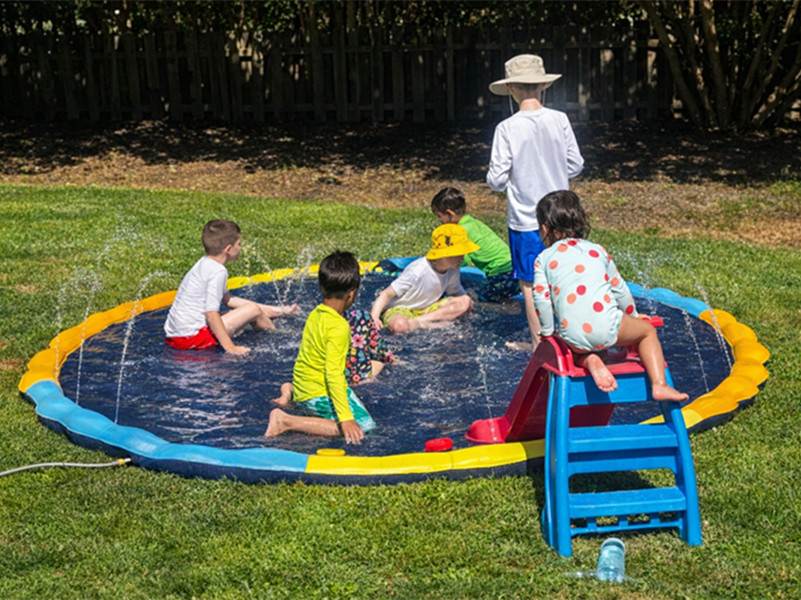
Most families don’t think about splash pad maintenance—until they unfold it next summer and notice a sour smell, dark spots along the seams, or a sticky surface that wasn’t there before. Mold doesn’t appear overnight. It forms quietly inside folded layers, hidden spray rings, and reinforced seams where moisture lingers longer than expected.
In most cases, mold isn’t a “dirty pad” problem—it’s a “stored too soon” problem. Even high-quality PVC can develop odor or mildew if it’s folded while damp or stored without airflow. On the other hand, overly aggressive cleaning—strong bleach, abrasive scrubbing, or high-heat drying—can weaken materials and shorten the pad’s usable life.
To clean and store a splash pad without mold, rinse it immediately after use, wash with mild soap or diluted vinegar if needed, dry it completely on both sides—especially seams—and store it loosely folded in a breathable bag in a cool, dry place. Avoid sealing it in plastic containers while damp, and never store it before it is fully dry.
A splash pad behaves more like outdoor equipment than a flat mat: seams, edges, and folds need airflow to dry properly. The difference between a splash pad that lasts one season and one that lasts five often comes down to a few overlooked habits. Here’s exactly how to keep yours clean, dry, and mold-free.
Why Do Splash Pads Get Moldy?
Splash pads develop mold when moisture remains trapped in seams, spray rings, and fold lines after use. Even if the surface feels dry, hidden water can stay inside reinforced PVC layers for several hours. When a damp splash pad is folded and stored—especially in warm or sealed environments—mold and odor can begin forming within 24–48 hours. Complete drying and breathable storage are the most effective ways to prevent it.

What Causes Mold on a Splash Pad?
Mold growth requires three basic elements: moisture, warmth, and organic residue. Splash pads naturally encounter all three during normal use.
After play, small particles remain on the surface—even when it looks clean. These can include soil, grass dust, sunscreen oils, spilled drinks, and pet dander. While invisible to the eye, these residues provide nutrients for microbial growth.
Moisture is the real trigger. In humid environments (above 60% relative humidity), mold can begin developing within 24–48 hours if surfaces remain damp. Splash pads are made of layered PVC with reinforced welding lines, and those structural areas dry more slowly than flat surfaces.
If the pad is folded before those zones are fully dry, moisture becomes trapped in low-ventilation pockets. Over time, that creates ideal conditions for mildew.
Why Are Seams, Spray Rings, and Fold Lines High-Risk Areas?
Most visible mold does not start on the center surface. It begins where airflow is weakest.
The most common high-risk areas include:
- Reinforced welded seams
- The outer spray ring
- Hose connector joints
- Deep fold creases
The outer spray ring is continuously exposed to flowing water. While that movement helps rinse during play, it also keeps the material saturated longer than the central area. Spray holes can retain debris and mineral buildup, slowing evaporation.
Fold lines are another critical point. When PVC is folded tightly, the inner crease can stay damp noticeably longer than exposed flat sections—especially in humid weather. That slight internal moisture is enough to trigger bacterial growth.
Regular inspection of these areas significantly reduces mold risk.
Why Does a Splash Pad Smell Before Mold Becomes Visible?
Odor usually appears before visible mold. A sour or musty smell often indicates bacterial growth in trapped moisture.
In typical summer temperatures—especially around 77°F–95°F (25°C–35°C)—odor can develop quickly if moisture remains inside folds, sometimes within a day. Importantly, odor does not mean the material is defective. It typically signals incomplete drying or poor storage ventilation.
Addressing the issue early—before visible spotting—makes cleaning far easier and helps prevent long-term staining.
Do Storage Conditions Make Mold Worse?
Storage environment plays a major role in whether mold develops.
Two common mistakes:
- Sealing a slightly damp splash pad in an airtight plastic bin
- Storing it in a non-ventilated garage or shed
Temperature fluctuation creates condensation. For example, if daytime temperatures reach 90°F (32°C) and drop to 65°F (18°C) overnight, condensation can form inside sealed containers. Even a dry pad can absorb that moisture.
Concrete garage floors also retain ground humidity. Placing a folded splash pad directly on concrete increases exposure to moisture.
A breathable storage setup—fabric bag, ventilated shelving, indoor closet—reduces risk significantly.
How Can You Keep a Splash Pad from Molding?
Preventing mold is not complicated. It comes down to routine habits:
- Rinse off organic residue after each use
- Allow both sides to air-dry fully
- Pay attention to seams and spray rings
- Confirm dryness by touch (no cool sensation)
- Fold loosely rather than compress tightly
- Store in a breathable, low-humidity area
Material thickness also influences maintenance. Splash pads made from 0.5mm–0.55mm PVC maintain structural stability better than ultra-thin materials, reducing micro-crease moisture traps. However, no material is mold-resistant if stored wet.
The difference between a splash pad lasting one season and several seasons often depends more on drying and storage habits than on cleaning products.
How Do You Clean a Splash Pad After Each Use?
To clean a splash pad after each use, rinse it thoroughly with fresh water to remove dirt, sunscreen, and debris. Use mild soap if needed, gently wipe the surface and spray ring, then allow it to dry completely on both sides before folding. Daily rinsing prevents residue buildup and significantly reduces the risk of mold and odor formation.

Why Is Rinsing Immediately After Use So Important?
The most effective splash pad maintenance step happens within minutes of turning off the hose.
When water play ends, residues remain on the surface—even if you don’t see them. Common buildup includes:
- Sunscreen oils
- Grass particles
- Sand and soil
- Pet hair
- Sweat and organic debris
Sunscreen is particularly important. Many formulas contain oils and mineral compounds that leave a thin film on PVC surfaces. That film traps dirt and moisture, increasing bacterial activity.
In warm conditions (above 77°F / 25°C), microbial activity ramps up quickly on damp, residue-coated surfaces. A simple rinse removes the “food source” before it becomes a problem.
Rinsing takes less than two minutes but prevents weeks of frustration later.
What Is the Proper Way to Rinse a Splash Pad?
After disconnecting the hose:
- Allow excess water to drain naturally
- Spray the entire surface with clean water
- Focus on edges and spray holes
- Tilt slightly to encourage runoff
Avoid pressure washers. High-pressure streams can stress welded seams and shorten product lifespan.
Instead, use moderate hose pressure. The goal is debris removal—not force.
If your splash pad has an anti-slip textured base, gently wipe across it. Textured surfaces can hold fine dust and sunscreen film more than smooth PVC.
Consistency matters more than intensity.
When Should You Use Soap Instead of Just Water?
Water alone is enough for light daily cleaning. Soap becomes necessary when:
- The surface feels slightly sticky
- You see visible dirt buildup
- There is sunscreen residue
- Pets frequently use the pad
Use mild dish soap diluted in warm water. A soft cloth or sponge is sufficient. Avoid:
- Abrasive brushes
- Undiluted bleach
- Alcohol-based cleaners
- Solvent-based products
PVC contains plasticizers that maintain flexibility. Harsh chemicals can degrade those over time, causing stiffness or cracking.
A simple 1–2% soap solution is typically enough to break down oils without harming material.
How Do You Clean Spray Holes and Reinforced Edges?
The outer spray ring is the most commonly overlooked maintenance area.
Because water flows continuously through this ring, debris can accumulate inside small spray openings. Over time, this can reduce spray consistency and trap moisture.
Use a soft brush or cloth to gently wipe:
- Along the spray ring
- Around hose connectors
- Along reinforced seam lines
Inspect spray holes visually. If water flow becomes uneven, mineral buildup or debris may be present.
Clearing spray holes early helps prevent stagnant moisture pockets.
How Does Daily Cleaning Reduce Long-Term Mold Risk?
Many families assume mold prevention requires deep scrubbing. In reality, prevention depends on habit.
If residue is removed daily:
- Moisture evaporates more evenly
- Bacterial growth is reduced
- Odor formation is delayed or prevented
- Deep cleaning becomes less frequent
Skipping even 2–3 sessions in a row can allow residue layering. Once residue accumulates, drying becomes less effective because moisture clings to those organic films.
A quick rinse + proper drying is the simplest way to keep a splash pad clean all season.
Practical Comparison: Daily Care vs. Neglect
| Routine Habit | Long-Term Outcome |
|---|---|
| Rinse + dry every use | Lower odor risk, longer material life |
| Fold slightly damp | Higher mold probability |
| Store in breathable bag | Reduced condensation risk |
| Seal in plastic bin | Increased moisture retention |
Small habits create big differences over a full summer.
How Do You Remove Mold or Odor Safely?
To remove mold or odor from a splash pad, clean the affected area with diluted vinegar or a mild bleach solution (1:10 ratio), gently scrub with a soft cloth, rinse thoroughly, and allow the pad to dry completely before storage. Avoid harsh chemicals or high concentrations that can weaken PVC. Early treatment helps prevent staining and long-term material damage.

When Is It Mold — and When Is It Just Odor?
Before using any cleaning solution, identify the issue.
A sour or musty smell without visible dark spots usually indicates early-stage bacterial growth, not established mold. This often happens when the splash pad was folded slightly damp.
Visible mold appears as:
- Small black or gray spots
- Powdery residue along seams
- Darkening in fold lines
If addressed within the first 24–72 hours of odor detection, treatment is usually straightforward. The longer moisture remains trapped, the deeper staining may set into textured surfaces.
Early action reduces the chance of permanent discoloration.
Is Vinegar Safe for Cleaning Splash Pad Mold?
White vinegar is effective for mild mold and odor because of its natural acidity (pH around 2–3). It disrupts surface microbial growth without damaging properly formulated PVC when diluted.
Recommended mixture:
1 part white vinegar : 3 parts water
Steps:
- Spray lightly on the affected area
- Let sit 10–15 minutes
- Wipe gently with a soft cloth
- Rinse thoroughly
Vinegar works best on early-stage mold or odor. It is not ideal for heavy staining that has penetrated textured surfaces.
Always rinse after treatment to avoid leaving residue on the material.
When Should You Use a Diluted Bleach Solution?
For more visible mold, diluted bleach can be effective—but only when used correctly.
Recommended dilution:
1 part household bleach : 10 parts water
(typically ~0.5%–0.6% sodium hypochlorite)
Stronger mixtures increase the risk of:
- PVC discoloration
- Seam weakening
- Surface brittleness over time
Apply with a soft cloth rather than pouring directly onto the pad. Allow contact for 5–10 minutes, then rinse thoroughly with clean water.
Never mix bleach with vinegar or other cleaners.
Bleach should be a controlled intervention—not a routine cleaning method.
Why Thorough Rinsing Is Critical
After any disinfectant treatment, rinsing is essential.
Chemical residue left on PVC can:
- Accelerate UV degradation
- Cause surface stickiness
- Attract dirt more quickly
- Affect flexibility over time
Rinse both the treated area and surrounding surface. Then proceed with full drying on both sides.
Moisture + chemical residue + heat is a rough combination for long-term PVC longevity.
How Do You Prevent Mold from Returning?
Removing mold once is not enough if the root cause remains.
After treatment:
- Dry the splash pad completely (including seams)
- Avoid folding until fully neutral to the touch
- Improve storage ventilation
- Increase daily rinsing frequency
In warm climates (above 80°F / 27°C), microbial growth can restart quickly if moisture is reintroduced.
Prevention is less about stronger chemicals and more about eliminating trapped moisture.
Surface Mold vs. Embedded Stains: What to Expect
If mold has been present for extended periods, staining may remain even after cleaning. This does not always indicate active mold. PVC texture can retain discoloration even after spores are neutralized.
In those cases:
- Confirm odor is gone
- Confirm the surface is dry
- Monitor over several days
If no new growth appears, the issue has been resolved.
Safe Cleaning Comparison
| Cleaning Method | Effective For | Risk Level |
|---|---|---|
| Fresh water rinse | Daily residue | Very low |
| Mild soap solution | Oil & dirt buildup | Low |
| Vinegar (1:3) | Light mold / odor | Low |
| Bleach (1:10) | Visible mold spots | Moderate (if overused) |
| Undiluted bleach | Not recommended | High |
Using the correct strength makes all the difference.
A Practical Reminder
Strong chemicals do not equal better results.
Most splash pad mold problems are caused by:
- Incomplete drying
- Poor ventilation
- Tight storage
Treat the source, not just the symptom.
With proper care, a quality PVC splash pad can remain odor-free and mold-free season after season.
How Do You Dry a Splash Pad Completely?
To dry a splash pad completely, lay it flat in a well-ventilated area, flip it to dry both sides, and allow extra time for seams and fold lines to air-dry fully. Surface dryness is not enough—hidden moisture inside reinforced edges can remain for several hours. Only fold and store the splash pad once it feels fully dry to the touch, including all seams.

Why Surface Dryness Is Not Enough
Many mold issues happen because the splash pad looks dry.
PVC surfaces can dry quickly—sometimes within 30–60 minutes in warm weather. But reinforced seams, spray rings, and fold creases dry much slower. These areas can stay damp noticeably longer than flat sections.
In humid climates (above 60% relative humidity), evaporation slows significantly. Even if the top surface feels dry, seams can remain damp for hours.
A common mistake is folding the splash pad as soon as the visible water disappears. That traps internal moisture in low-airflow pockets, creating ideal conditions for bacterial growth.
If there is one step that determines whether mold forms or not, it’s this one.
How Long Should a Splash Pad Air Dry?
Drying time depends on:
- Ambient temperature
- Humidity level
- Airflow
- Material thickness
Approximate drying ranges:
| Condition | Estimated Dry Time |
|---|---|
| Hot & dry (85–95°F / 30–35°C, low humidity) | 2–3 hours |
| Mild weather (70–80°F / 21–27°C) | 3–5 hours |
| Humid environment (60%+ RH) | 6+ hours |
Thicker PVC (0.5mm–0.55mm) maintains structural stability better but still requires proper airflow around seams.
Rushing this step saves minutes but can cost an entire season.
Should You Flip the Splash Pad While Drying?
Yes. Always dry both sides.
When a splash pad is laid flat, water collects underneath. The bottom surface—especially where it contacts grass or concrete—dries last.
Best practice:
- Lay flat and allow the top surface to dry
- Flip over after initial drying
- Expose underside and seams
- Allow additional airflow time
If possible, lift slightly off the ground using patio chairs or a clean railing to increase airflow beneath.
Air circulation is more important than direct heat.
Is Direct Sunlight Good for Drying?
Short exposure to sunlight helps evaporate surface moisture. However, prolonged direct sun can gradually weaken PVC over time.
UV radiation breaks down plasticizers and may lead to:
- Fading
- Reduced flexibility
- Surface chalking
Anti-UV treated PVC performs better, but even high-quality material benefits from moderate exposure rather than extended “baking” in full sun.
The ideal drying environment:
- Warm
- Shaded or partially shaded
- Well-ventilated
Air movement is the key factor—not extreme heat.
How Do You Check If It Is Truly Dry?
The simplest test is tactile.
Run your hand slowly along:
- Reinforced seams
- Spray ring edges
- Fold lines
- Hose connector areas
If the surface feels cool compared to surrounding air, moisture may still be present. True dryness feels neutral—not cool or damp.
Another practical tip: wait an additional 30–60 minutes after you believe it’s dry. That margin reduces risk significantly.
When in doubt, allow more drying time.
Can You Hang a Splash Pad to Speed Up Drying?
Yes, vertical drying can be effective.
Hanging allows gravity to help drain residual water from seams and edges. Ensure weight is distributed evenly to avoid stress on specific weld points.
Avoid hanging in a way that creates sharp creases.
Vertical drying works especially well in humid climates where airflow is limited near ground level.
The Real Difference Between a 1-Season Pad and a 5-Season Pad
From a maintenance perspective, drying habits matter more than cleaning products.
Most premature mold complaints are linked to:
- Folding while slightly damp
- Skipping underside drying
- Storing in sealed containers
Drying properly adds a few hours to your routine—but can extend usable life by years.
For families who use splash pads frequently during peak summer heat (80°F–95°F / 27°C–35°C), thorough drying becomes even more important because microbial activity increases significantly within that temperature range.
In short:
Cleaning removes residue.
Drying removes risk.
How Do You Store a Splash Pad for Winter?
To store a splash pad for winter, make sure it is completely dry, fold it loosely along natural panel lines, and place it in a breathable storage bag in a cool, dry area. Avoid sealing it in airtight plastic bins or storing it directly on damp concrete floors. Proper ventilation and moisture control during storage prevent mold, seam stress, and material deformation.

Why Winter Storage Matters More Than You Think
Most splash pads are damaged during storage—not during use.
When a splash pad sits unused for 3–6 months, small storage mistakes become long-term problems. Slight residual moisture can slowly develop into mildew. Tight compression can create permanent crease stress. Temperature swings can cause condensation inside sealed containers.
PVC remains flexible in moderate temperatures but can stiffen in cold conditions (below 50°F / 10°C). If material is tightly folded and compressed while cold, stress points can form along fold lines.
The condition of your splash pad next summer is largely determined by how you store it this winter.
How Should You Fold a Splash Pad for Long-Term Storage?
Avoid folding tightly into small, compact bundles.
Instead:
- Fold loosely along natural seam lines
- Avoid sharp 90-degree creases
- Do not roll too tightly around the spray ring
- Leave slight air space between folds
PVC has material memory. Extended compression under weight can weaken welded areas over time.
If you store the splash pad under heavy items (boxes, tools, storage bins), you increase the risk of seam distortion.
Loose folding reduces stress and allows minor air circulation within the folds.
Why Breathable Storage Is Better Than Sealed Containers
Airtight plastic bins may seem protective—but they often create moisture traps.
When daytime temperatures rise and fall overnight, condensation forms inside sealed containers. For example:
- Day: 75°F (24°C)
- Night: 55°F (13°C)
That temperature drop can create internal condensation even if the splash pad was fully dry when stored.
Breathable options include:
- Fabric storage bags
- Mesh carry bags
- Ventilated shelving
Airflow allows micro-moisture to escape rather than accumulate.
Moisture + darkness + still air is the ideal environment for mildew.
Should You Store It in the Garage or Indoors?
It depends on the environment.
Garage risks:
- Concrete floors retain ground humidity
- Poor ventilation
- Large temperature fluctuations
- Exposure to pests
If storing in a garage:
- Place the splash pad on a shelf or pallet (not directly on concrete)
- Keep it away from exterior walls
- Avoid areas near water heaters or washing machines
Indoor closets or climate-controlled storage areas offer more stable humidity levels (ideally below 60% relative humidity).
Stability matters more than location.
Do You Need Moisture Absorbers?
In humid climates (coastal regions, southern states, tropical environments), moisture absorbers can add protection.
Desiccant packs or dehumidifier containers help reduce trapped humidity. However, they are not substitutes for breathable storage.
Never combine moisture absorbers with fully sealed plastic bins containing slightly damp material. That combination can still trap condensation.
Good airflow remains the primary defense.
What About Rodents and Pests?
Splash pads stored in sheds or garages may attract rodents seeking nesting materials.
To reduce risk:
- Use sealed fabric storage bags
- Avoid storing near pet food
- Inspect before unfolding next season
Material damage from pests often appears as small punctures along edges.
Proper storage is not only about moisture—it’s also about protection.
Seasonal Storage Checklist
Before winter storage:
Rinse thoroughly
Dry both sides completely
Confirm seams are fully dry
Fold loosely
Store in breathable bag
Elevate off concrete floors
Avoid airtight plastic containers
These steps reduce the most common off-season issues:
- Mold growth
- Odor buildup
- Seam stress
- Material brittleness
The Long-Term Impact of Proper Storage
Families often replace splash pads because of mold, odor, or seam weakening—not because the product wore out from play.
Proper winter storage can extend usable life by multiple seasons.
In practical terms:
- Good drying + breathable storage = reduced microbial risk
- Loose folding = reduced structural stress
- Stable humidity = preserved flexibility
Storage is not complicated—but it is decisive.
How Often Should You Deep Clean a Splash Pad?
Deep clean a splash pad every 2–4 weeks during regular summer use, and more frequently if it is used daily or by pets. While rinsing after each use removes surface debris, periodic deep cleaning eliminates built-up sunscreen residue, organic matter, and bacteria. If odor, stickiness, or discoloration appears, clean immediately rather than waiting.

Why Rinsing Alone Is Not Always Enough
Daily rinsing removes visible dirt, but it does not fully break down oil-based residue such as sunscreen, body oils, or pet-related organic matter.
Sunscreen films are particularly stubborn. Oil-based residues can remain bonded to PVC even after a water rinse. Over time, this thin layer traps dust and moisture, slows evaporation, and increases microbial buildup.
In warm conditions—especially between 77°F and 95°F (25°C–35°C)—microbial activity accelerates quickly on damp, residue-coated surfaces. Even if mold is not visible, buildup may begin.
Deep cleaning resets the surface before that buildup becomes a long-term issue.
How Does Usage Level Affect Cleaning Frequency?
Cleaning frequency should match usage intensity.
| Usage Pattern | Recommended Deep Clean Frequency |
|---|---|
| Light use (1–2 times/week) | Every 3–4 weeks |
| Moderate use (3–4 times/week) | Every 2–3 weeks |
| Daily heavy use | Weekly |
| Pet use (large dogs) | Weekly or bi-weekly |
Why pets matter: pet paws carry soil and bacteria that increase organic load on the surface. Larger dogs also apply more pressure along edges, potentially trapping residue in seams.
If the splash pad is used at camps, daycare centers, or group events, sanitation frequency should increase accordingly.
What Are the Signs It’s Time to Deep Clean?
Do not rely solely on a calendar. Pay attention to surface signals:
- Slight stickiness when dry
- Dull or hazy appearance
- Uneven water spray pattern
- Faint sour smell
- Darkening along seams
Odor often appears before visible mold. Addressing the issue early makes cleaning easier and reduces the risk of staining.
If you detect any of these signs, perform a mild soap or vinegar-based cleaning rather than waiting for scheduled maintenance.
Does Climate Influence Cleaning Needs?
Yes. Humidity and temperature significantly affect maintenance frequency.
In regions where relative humidity exceeds 60%, evaporation slows. In warm coastal or southern climates, microbial growth cycles accelerate.
For example:
- Dry inland climate (low humidity): deep cleaning every 3–4 weeks may be sufficient
- Humid coastal climate: every 2 weeks may be safer during peak summer
High UV exposure can degrade residues faster, but that does not replace cleaning.
Environmental conditions should guide routine adjustments.
What Is the Safest Way to Deep Clean?
For most households:
- Use mild dish soap diluted in warm water (1–2%)
- Gently wipe the entire surface, including the spray ring
- Rinse thoroughly
- Dry completely on both sides
For light odor or early-stage mold, diluted vinegar (1:3) works well.
Bleach (1:10 dilution) should only be used when visible mold appears and not as routine maintenance.
Excessive chemical use can shorten PVC lifespan. Deep cleaning should protect the material—not stress it.
Preventive Maintenance vs. Reactive Cleaning
It’s easier to maintain than to repair.
| Preventive Habit | Result |
|---|---|
| Rinse every use | Reduces residue buildup |
| Deep clean on schedule | Prevents microbial accumulation |
| Fully dry before storage | Stops mold formation |
| Loose winter storage | Preserves structural integrity |
A splash pad that receives consistent light maintenance often lasts significantly longer than one that receives occasional aggressive cleaning.
The goal is balance: regular care without overusing harsh chemicals.
Long-Term Perspective
Most splash pad complaints about odor or discoloration trace back to two causes:
- Infrequent deep cleaning during heavy summer use
- Storing slightly dirty or damp material for long periods
Deep cleaning every few weeks adds 20–30 minutes to your routine but can extend the product’s usable life across multiple seasons.
In the long run, maintenance is far less costly than replacement.
Does Material Quality Affect Mold Prevention?
Yes, material quality significantly affects mold prevention. Thicker PVC, reinforced seam welding, and proper material formulation reduce deformation and hidden moisture retention. While no splash pad is mold-proof if stored wet, higher-quality construction dries more evenly, resists stress creasing, and maintains structural stability over time—making long-term maintenance easier and more reliable.

Why Thickness Matters More Than Most People Realize
PVC thickness directly affects how a splash pad performs over time.
Common splash pad thickness ranges:
- Budget models: 0.25mm–0.35mm
- Mid-range: 0.4mm–0.45mm
- Heavy-duty: 0.5mm–0.55mm
Thinner PVC folds easily but is more prone to sharp creasing. Sharp creases create micro-indentations where moisture can accumulate and dry slowly.
Thicker PVC:
- Maintains flatter folding memory
- Reduces micro-crack formation
- Resists deformation under pressure
- Dries more evenly across reinforced areas
However, thickness alone does not prevent mold. It reduces moisture traps caused by deformation.
How Do Reinforced Seams Influence Mold Risk?
Seam construction plays a major role in moisture behavior.
High-frequency welded seams (commonly used in quality splash pads) fuse material layers together under controlled pressure and heat. Proper welding creates a smooth internal bond without gaps.
Lower-quality manufacturing may result in:
- Uneven seam bonding
- Minor internal voids
- Slight edge lifting over time
These imperfections can trap micro-moisture.
Reinforced edges also affect drying speed. Well-designed seam geometry allows water to run off rather than pool along weld lines.
Seam integrity is not just about leak prevention—it influences long-term hygiene.
Does UV Resistance Affect Mold and Odor?
Indirectly, yes.
PVC exposed to strong UV radiation (common in regions with high summer temperatures above 90°F / 32°C) gradually loses plasticizer stability. This can cause:
- Surface chalking
- Reduced flexibility
- Micro-surface roughness
Rougher surfaces hold residue more easily.
UV protection won’t prevent mold by itself, but it helps the surface stay smoother over time—so residue rinses off more easily and drying stays more consistent.
How Do Anti-Slip Textures Affect Maintenance?
Many splash pads include anti-slip textures for safety. These micro-patterns improve grip but can also retain water slightly longer than smooth PVC.
Quality texture design balances:
- Safety
- Cleanability
- Drainage efficiency
Poorly designed textures may create deeper grooves that hold debris.
When evaluating material quality, texture depth and surface finish consistency matter. Better-engineered textures reduce residue adhesion while maintaining traction.
What Role Do Safety Standards and Testing Play?
Material compliance does not directly prevent mold—but it reflects manufacturing discipline.
Reputable manufacturers typically test for:
- Material consistency
- Tensile strength
- Weld durability
- Plasticizer stability
- Chemical safety (CPSIA, ASTM, REACH standards)
Facilities operating under ISO 9001 quality systems tend to maintain tighter production tolerances.
Consistent formulation reduces long-term material breakdown, which supports predictable drying and easier maintenance.
Is Higher Quality Worth It for Long-Term Maintenance?
From a practical standpoint, yes.
Consider this simplified comparison:
| Factor | Lower-Grade PVC | Reinforced PVC (0.5mm+) |
|---|---|---|
| Fold memory | Sharp creases | Flatter folds |
| Seam stability | Higher deformation risk | Stronger weld retention |
| UV resistance | Faster aging | Slower surface degradation |
| Cleaning ease over time | Declines faster | More consistent |
Families often replace splash pads due to persistent odor, seam distortion, surface brittleness, or mold recurrence. These issues are frequently linked to material fatigue rather than cleaning habits alone.
Better construction does not eliminate the need for proper care—but it reduces the margin for error.
The Real Balance: Material + Maintenance
Even the highest-quality PVC splash pad will develop mold if:
- Stored damp
- Sealed in airtight bins
- Left folded while wet
Likewise, perfect drying habits cannot compensate for severely under-engineered material.
Long-term performance depends on both:
✔ Proper cleaning routine
✔ Complete drying
✔ Breathable storage
✔ Durable material construction
When these factors align, a splash pad can remain structurally stable and odor-free for multiple seasons.
Ready to Choose the Right Splash Pad?
If you’re looking for a splash pad that is:
- Stable on grass and patios
- Designed for even, all-around spray
- Easy to connect and adjust
- Built for kids, pets, and repeated seasonal use
You can explore our current splash pad collection here:
Splash Pads for Active Play
- Kids Splash Pad (Amazon US)
- Large Splash Pad for Pets (Amazon US)
- Square Splash Pad (Amazon US)
- Soccer Splash Pad (Amazon US)
Pet-Friendly Water Play Add-Ons
For Retailers, Distributors & OEM Buyers
If you’re sourcing splash pads for:
- Private label programs
- Seasonal retail distribution
- Pet product lines
- Backyard recreation collections
We support:
- Custom size & structure development
- Spray layout engineering
- PVC thickness upgrades
- Packaging & branding customization
- Regional compliance support
Request OEM / ODM Information
Whether you’re purchasing for your own backyard or developing products for your market, the right splash pad starts with smart setup—and the right structure behind it.
Explore More Water-Play Categories
If you’re planning a broader seasonal catalog or expanding beyond splash pads, these pages may be useful: