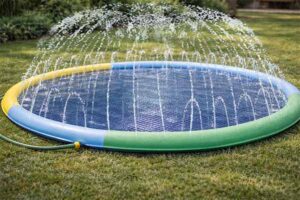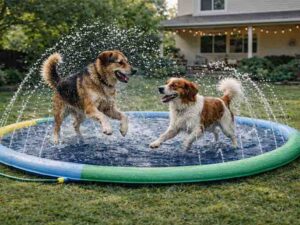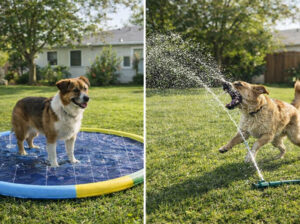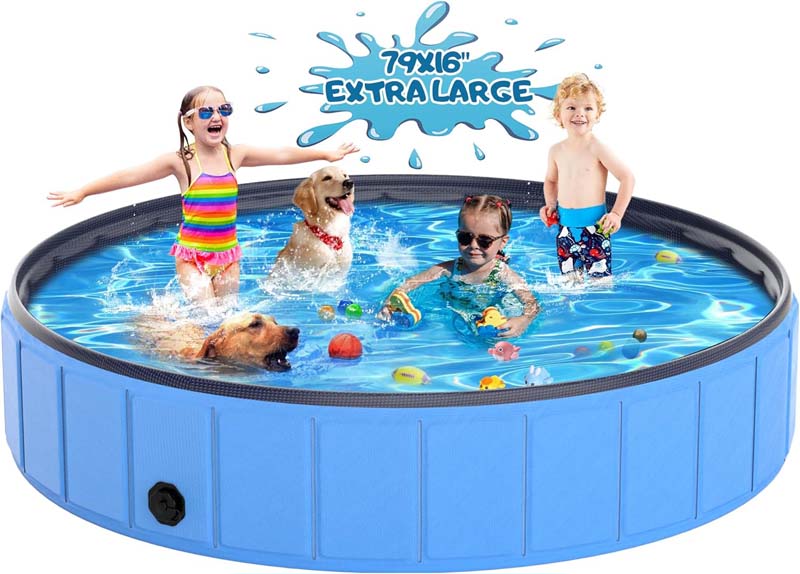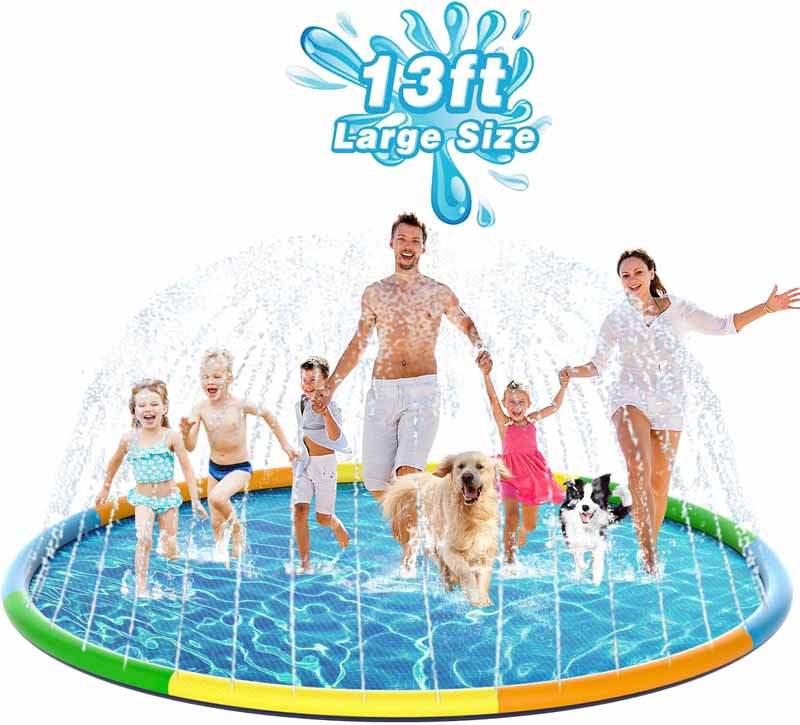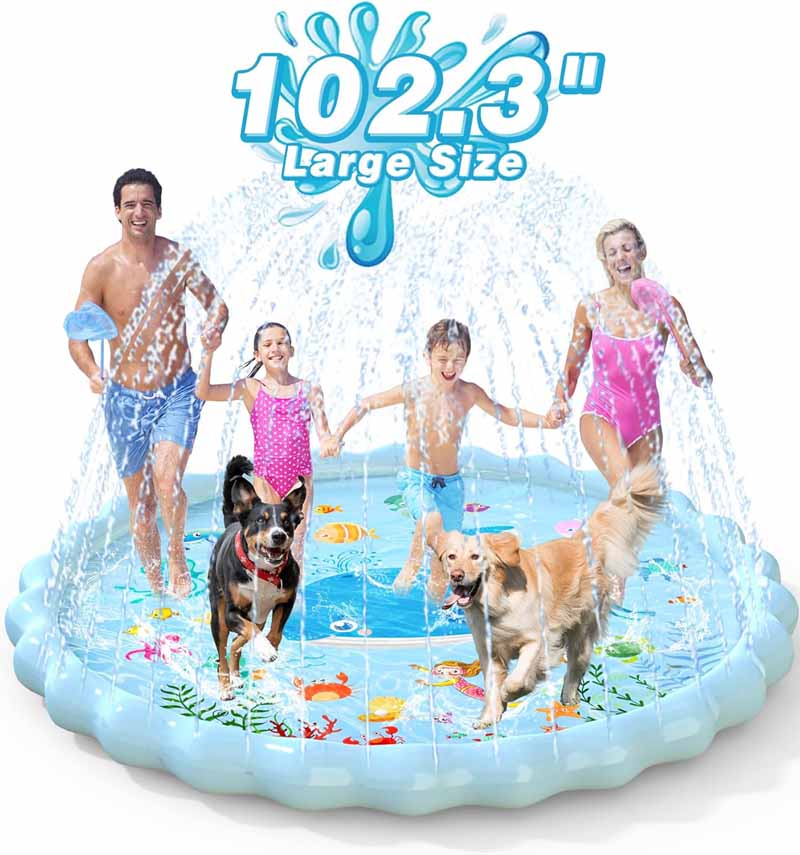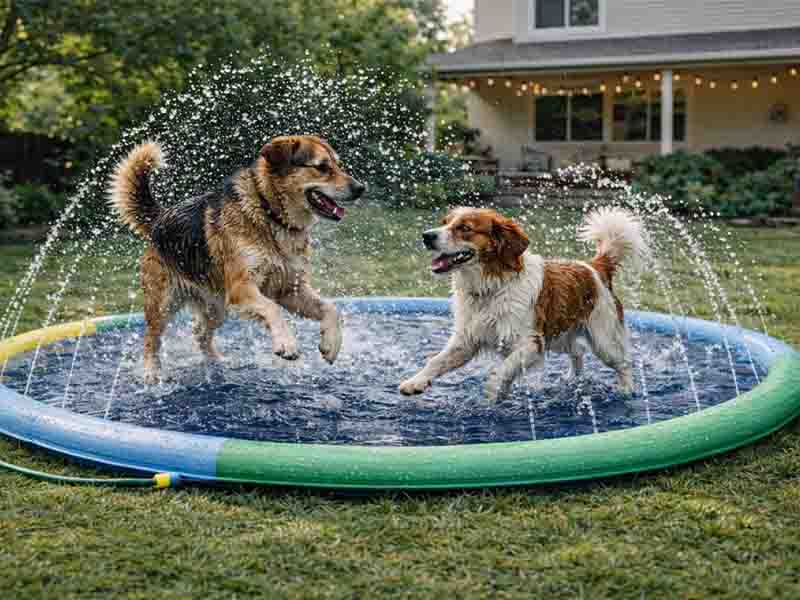
A dog splash pad should feel simple. Your dog steps on, cools down, turns naturally, and keeps playing without constantly losing balance. But real backyard use often looks different. Many owners see the same pattern: the dog runs toward the water, then suddenly shortens its stride, slides in a turn, hops sideways when the spray gets stronger, or keeps stepping off the pad to reset. When that starts happening, the issue usually is not that the dog is clumsy. It is that the surface, spray, paw condition, and setup are no longer working together.
In most homes, slipping is not caused by one major flaw. It comes from several smaller factors stacking together: a wet surface that gets slicker as water builds, spray pressure that creates reactive movement, tight turning space, long fur under the paws, nail length that affects landing, or ground underneath the pad that is less stable than it looks. Change only one of those and you may see some improvement. Change three or four at the same time and the difference is often immediate. The dog moves with more confidence, stays on the pad longer, and uses it more like a cooling spot instead of a surface it has to keep negotiating.
That is what makes this topic more important than it first appears. A splash pad is not successful just because it sprays water or looks playful in a product image. It is successful when it still works once the whole surface is wet, the dog starts moving at speed, and the weather is warm enough that the dog truly wants to stay on it. If the dog loses trust in the footing, repeat use drops fast. If the footing feels reliable, the splash pad becomes part of the regular summer routine.

Dog Slipping on Splash Pads: Why It Happens
Dogs usually slip on splash pads because several small traction problems happen at once. The surface gets wetter, the dog speeds up, the paws do not make ideal contact, and the ground under the pad may add instability. Once those factors overlap, even a healthy, active dog can start sliding.
Dog Slipping on Splash Pads: Wet Surface
The first issue is straightforward. Once a splash pad is fully wet, the dog is no longer stepping on only PVC or composite material. The dog is stepping on a thin layer of water sitting on top of that material. That changes how the paws grip, especially during push-off, braking, and turning.
This is why some dogs look fine in the first minute and then start slipping later. At the beginning, the surface may only be lightly wet. A few minutes later, water has spread across most of the play area, and the footing feels different. The material did not change, but the contact condition did.
The problem gets worse when water does not behave evenly. Some areas shed water more smoothly, while others hold a slightly slicker film. A dog stepping across those zones gets inconsistent feedback from one paw to the next. One step feels secure, the next feels uncertain. That inconsistency leads to hesitation, and hesitation often turns into awkward movement.
This is also why touching the splash pad with your hand before the hose is on tells you very little. Dry feel is not the real test. The real test is how the surface behaves after several minutes of water flow, repeated paw movement, and turning at speed.
Dog Slipping on Splash Pads: Fast Turns
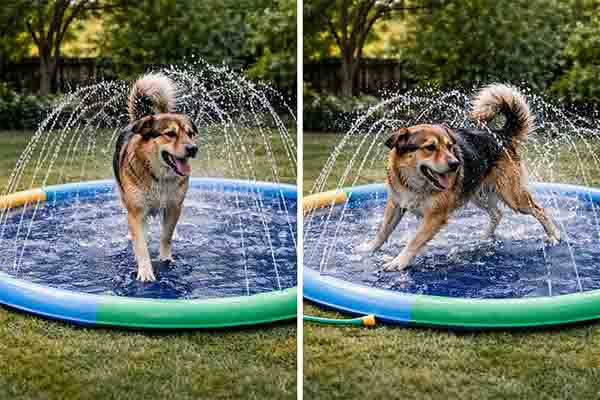
Most dogs do not slip while standing still. They slip when they do what splash pads naturally invite them to do: run toward the spray, stop suddenly, bounce away from a stronger jet, then rush back in again.
Straight-line movement is usually the easy part. Turning is where traction gets tested. In a turn, the paws are not simply landing. They are also controlling momentum, supporting body weight, and redirecting the whole dog in one motion. That is why a dog can walk across a wet splash pad without trouble, then slide during the first excited pivot.
This becomes more obvious when the usable play area is too small. Tight space forces tight turns. Tight turns increase sideways pressure on the paws. That matters even more for medium and large dogs, because they carry more weight and more momentum into every stop and direction change.
Spray pressure adds another layer. When the water hits harder, many dogs stop moving naturally and start reacting to the spray itself. They hop away, twist their shoulders, or rush into fast corrective turns. Once movement becomes reactive instead of controlled, slipping becomes much more likely.
Dog Slipping on Splash Pads: Paw Condition
Paw condition is one of the biggest hidden reasons dogs slip. Owners often focus on the splash pad itself and forget that the paws are the final contact point. If the feet are not in good shape, even a better-designed splash pad will feel harder to use.
The first issue is excess fur under or between the paw pads. When that fur gets long, it reduces direct contact with the wet surface. Instead of the pad skin pressing firmly against the splash pad, part of the contact becomes hair. On a dry surface that may not matter much. On a wet splash pad, it matters a lot more.
The second issue is nail length. Nails that are too long can change the angle of landing and make stopping or turning less stable. The third issue is over-trimming, because dogs still need a natural, balanced foot shape to move well. The fourth issue is dry, worn, or rough pad skin. If the pads are uncomfortable, many dogs stop committing fully to each step, which makes them more likely to slip during turns or re-entry.
This is why paw care should be treated as part of splash pad preparation, not as a separate grooming topic. If the feet are not ready, the dog will not get the full benefit of better material, better spray control, or better setup.
Dog Slipping on Splash Pads: Small Problems Add Up Fast
One of the biggest mistakes owners make is looking for one single cause. They ask whether the splash pad is too slippery, whether the dog is too excited, or whether the paws need more care. In practice, the answer is often all of them at once.
A dog with slightly long paw fur may still do fine on a flatter splash pad with low spray and stable ground. That same dog may struggle quickly on a smaller pad with stronger jets and uneven lawn underneath. A dog with healthy paws may still slip if the play area is cramped and the water pressure is too high. A cautious dog may become much more stable simply by lowering the spray and giving it more room to turn.
That is why slipping can seem inconsistent from one day to the next, even with the same product. You are not looking at one variable. You are looking at a system. Surface, spray, paws, space, and ground all affect one another. When the system improves, movement improves.
| Factor | What the dog experiences | What owners usually notice | Best first move |
|---|---|---|---|
| Fully wet smooth surface | Less predictable grip | Shorter steps, hesitation, sliding in turns | Lower spray and check wet-surface feel |
| Strong water pressure | Startle and reactive movement | Hopping back, side slipping, quick spin turns | Reduce hose pressure |
| Tight turning space | More sideways load on the paws | Scrambling while changing direction | Give the dog more open movement room |
| Long fur under paws | Reduced direct contact | Slipping even at lower speed | Trim paw fur |
| Nail issues | Poorer landing stability | Unsteady starts and stops | Improve nail maintenance |
| Uneven ground below the pad | Inconsistent support | Wrinkling, shifting, uneven stepping | Move the pad to flatter ground |
Dog Slipping on Splash Pads: What Helps
The best results usually do not come from one miracle fix. They come from improving three things together: wet-surface control, water behavior, and structural stability. When those improve, many dogs move better within one session.
Dog Slipping on Splash Pads: Better Texture
If you want to make a splash pad less slippery, surface texture is one of the first things to think about. This does not mean the pad should feel rough or abrasive. Dogs do not need a harsh surface. They need a surface that still feels controlled once it is fully wet.
A good way to think about this is not rough versus smooth, but readable versus slick. A readable surface gives the dog more predictable feedback when the paw lands and body weight shifts forward. That helps the dog feel more secure during walking, turning, and re-entry into the spray.
This matters because many splash pads are compared by color, size, spray height, or visual design, while the most important question gets ignored: how does the surface behave after the whole pad is wet and the dog starts moving at normal play speed? That is the real-use condition.
Better texture helps in three practical ways. Dogs often step on with more confidence, waste less energy correcting small slips, and stay willing to use the splash pad day after day instead of becoming cautious after one awkward session. For brands building dog-friendly splash pads, this is not a secondary feature. It is part of the product’s core function. That is also why EPN approaches splash pad development from the perspective of material behavior, structure, and long-term usability, not just appearance.
Dog Slipping on Splash Pads: Softer Spray
Many owners accidentally make a splash pad harder to use by turning the hose too high. Stronger spray may look more exciting, but more force is not always better for dogs.
Once the spray becomes too aggressive, the dog often stops moving naturally and starts reacting to the water itself. That leads to backward hopping, side-steps, shoulder twists, and messy stop-start movement. All of those increase slipping risk. The dog is no longer just playing on the surface. It is trying to manage both the surface and the spray at the same time.
A softer spray usually helps for two reasons. First, it gives the dog more time to understand the footing. Second, it keeps the dog from becoming too reactive too early in the session. This is especially important for first-time users, larger dogs, older dogs, and dogs that get excited quickly.
A splash pad should encourage steady cooling play, not frantic movement. In real use, many dogs do better with a lower starting spray and more room to move than with dramatic jets right away.
Dog Slipping on Splash Pads: Flat Design
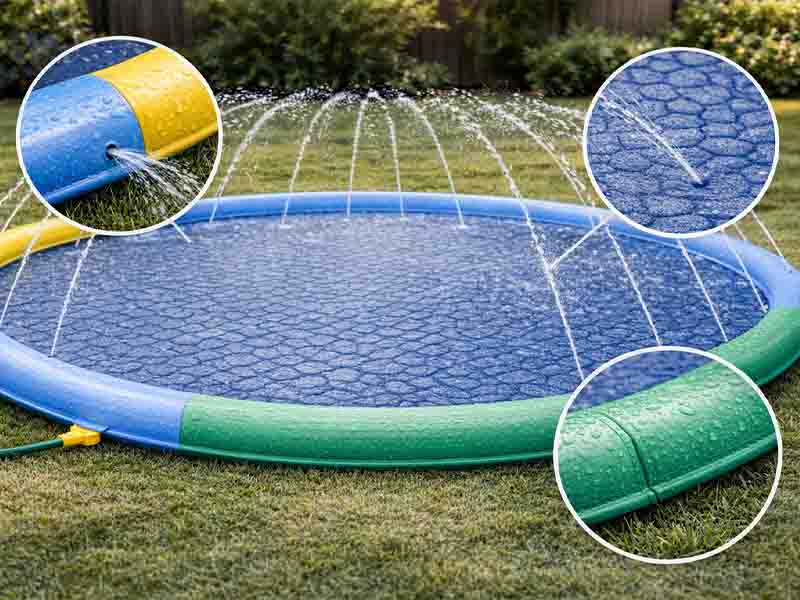
Flatness is one of the most underrated parts of splash pad performance. A splash pad can use decent material and still feel slippery if the structure under the dog keeps changing.
If the pad wrinkles, lifts, bunches, or shifts during play, the dog has to manage two separate problems at once: wet traction and unstable underfoot shape. Even small raised zones can interrupt stride rhythm. On a wet surface, that is often enough to trigger awkward corrections or hesitation.
A flatter design helps because it keeps the play area easier to read. The dog does not have to keep adapting to shape changes under the paws. This matters even more for medium and large dogs, because their step length and body force reveal structure problems faster.
For everyday use, flatter design often matters more than dramatic spray height. A pad that stays open, even, and consistent usually becomes more useful through the whole season than one that looks exciting at first but becomes harder to trust once the dog starts moving.
Dog Slipping on Splash Pads: Enough Room Changes Movement Quality
Space deserves more attention than it usually gets. Space is not only a size feature. It is a movement feature.
The more room a dog has to step, turn wider, and re-enter the spray naturally, the less likely it is to make panic turns or sudden overcorrections. This does not automatically mean the biggest splash pad is always best. It means the usable area needs to match the dog’s body size and play style.
A smaller calm dog may do fine on a moderate-size pad with a simpler layout. A larger active dog usually needs more turning room, not just more visual area. If the dog keeps making tight loops on a cramped wet surface, slipping becomes much more likely. Give that same dog more open space and calmer spray, and movement often improves right away.
| Product factor | Why it matters for dogs | What customers should look for |
|---|---|---|
| Wet-surface feel | Affects confidence during turning and braking | Surface that does not feel overly slick once soaked |
| Spray control | Changes how reactive the dog becomes | Gentler, more even water behavior |
| Flat structure | Keeps steps predictable | Less bunching, less lifting, less shape change |
| Open movement area | Reduces tight pivots and panic turns | Enough room for wider turns and easier re-entry |
| Material stability | Supports repeat use | Stronger construction that stays consistent over time |
Dog Slipping on Splash Pads: Better Setup
Even a well-made splash pad can become hard to use if the setup is poor. In many homes, the fastest improvement comes from setup rather than replacement. Better ground, lower spray force, smoother placement, and a quick pre-play check can change the whole session.
Dog Slipping on Splash Pads: Make It Less Slippery
If you want to make a splash pad less slippery right away, focus on the things you can change in the next five minutes.
Start with the hose. If the spray is strong enough to make the dog hop away from the jets, it is probably too strong as a starting point. Lower it. Then check the pad itself. Smooth out folds, raised edges, or bunching. After that, look at the ground below. If the base is soft, sloped, or uneven, move the splash pad before the next session.
Next, check the paws. If the fur is too long, the nails need attention, or the paw pads look dry and rough, those issues are part of the slipping picture too. Finally, slow the whole session down. Do not go straight into chase play. Let the dog walk in, test the surface, and rebuild confidence.
This works because slipping is rarely just one problem. In many homes, three or four smaller issues are stacked together. Remove even half of them and the dog often looks much steadier.
Dog Slipping on Splash Pads: Pick the Right Ground
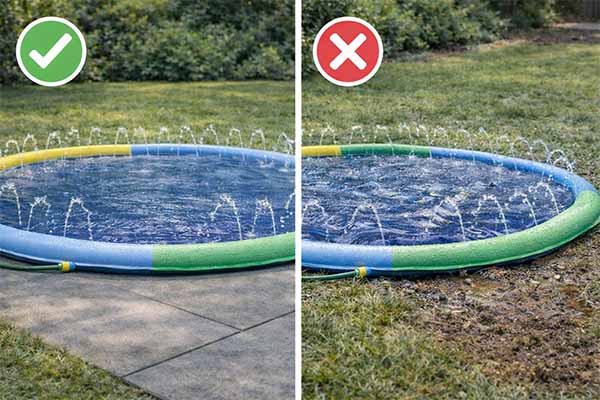
The ground under the splash pad matters more than many owners expect. The dog is not only reacting to the surface of the pad. It is reacting to the full support system underneath it.
A splash pad placed on firm, level ground usually feels much more predictable than the same pad placed on soft mud, loose gravel, patchy lawn, or hidden dips. If the base below shifts or compresses unevenly, the dog loses consistency with every step. That leads to shorter strides, cautious movement, and more instability in turns.
For many families, the best setup area is a flatter section of lawn or a smoother patio surface that does not overheat. The wrong setup usually reveals itself quickly. The pad wrinkles more, water distribution becomes less even, and the dog starts moving more carefully after only a minute or two.
Good ground does two jobs at once. It helps keep the splash pad flatter, and it helps the dog trust that each step will respond the same way.
Dog Slipping on Splash Pads: Lower the Water
Lowering the water setting is one of the fastest and most effective changes most owners can make. A gentler spray allows the dog to focus on footing first.
Many people worry that lower spray will make the splash pad less fun. In practice, it often makes it more usable, and usable usually leads to more total play. A dog that can step, turn, and re-enter the water without panic will often stay engaged longer than a dog that gets overstimulated by strong jets and starts slipping.
This is especially true for larger dogs, older dogs, cautious dogs, and first-time users. These dogs do not need a dramatic first session. They need a successful one. Once they trust the footing, you can always test a bit more spray later.
A simple rule works well here: start low, observe, then adjust. If the dog keeps a normal stride length, turns without scrambling, and returns to the splash pad willingly, the water level is probably helping rather than hurting.
Dog Slipping on Splash Pads: Quick Grip Check
A quick grip check before each session can prevent a lot of bad starts. This does not need to be complicated. Look at five things: the ground, the splash pad shape, the spray level, the paws, and the dog’s energy.
If even two of those look off, slipping becomes much more likely. Uneven ground is one weak point. Long paw fur is another. Aggressive spray is another. An already overexcited dog is another. One issue may be manageable. Four together usually create a poor session.
This is why routine matters. Real-world splash pad performance is always a mix of product and setup. A strong product performs much better when the owner understands how to place it, pace it, and read the dog’s movement early.
| Check point | Good sign | Warning sign |
|---|---|---|
| Ground | Flat, firm, even | Sloped, muddy, soft, shifting |
| Pad shape | Open and flat | Wrinkled, bunched, lifted |
| Spray level | Gentle to moderate | Forceful, startling, chaotic |
| Paw condition | Clean, trimmed, healthy | Long fur, nail issues, dry pads |
| Dog state | Calm and curious | Overexcited, rushing, already tired |
Dog Slipping on Splash Pads: Check the Paws
A splash pad can only feel as stable as the paws using it. Many owners spend time comparing material thickness, spray height, and pad size, but the dog’s feet are still the final contact point. If the paws are not in good condition, even a better splash pad will feel harder to use. That is why paw care is not a side issue here. It is part of traction.
Dog Slipping on Splash Pads: Keep Pads Steady
If you want to keep dog pads from sliding, start with the most basic question: is the dog landing on the paw pads the way it should?
Many dogs, especially longer-coated breeds, grow extra fur between and underneath the pads. That fur may not seem important in daily life, but on a wet splash pad it can make a real difference. Instead of the pad skin pressing directly onto the surface, some of the contact gets softened by hair. That reduces clean traction and makes the dog more likely to scramble in a turn or hesitate when stepping back into the spray.
Nail length matters just as much. When nails get too long, the foot often stops settling onto the ground as naturally as it should. The dog may adjust its landing angle, shift weight unevenly, or lose stability more easily when stopping. At the same time, the goal is not to cut nails as short as possible. Good traction comes from a balanced foot, not from over-correcting it.
Pad condition also changes stability. Dry, rough, or worn pads do not always look severe, but dogs can still feel the difference. If the pad skin is uncomfortable, some dogs stop putting full pressure into each step. On a wet surface, that small hesitation is often enough to create slipping during turns, stop-start play, or fast re-entry.
For most homes, better paw stability comes from consistency, not dramatic changes. Cleaner pad contact, better nail maintenance, and healthier paw skin usually improve movement more than owners expect.
Dog Slipping on Splash Pads: Add Paw Grip
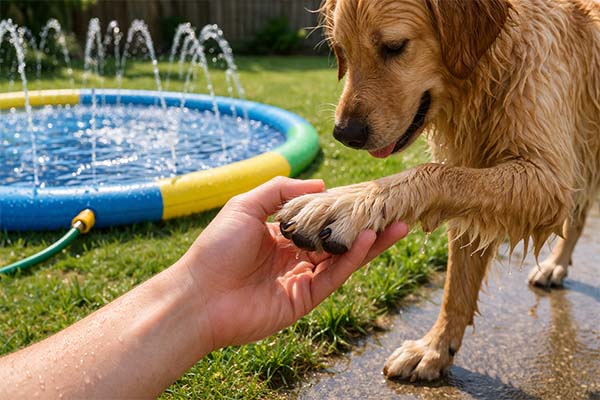
Once the paws are in better shape, the next step is to improve grip in a practical way without making the dog move unnaturally.
The first level is always natural grip support. That means trimming excess paw fur, keeping the nails in a healthy range, and making sure the paws are clean before play. Mud, lawn residue, dust, and dried dirt can all affect how the paw meets the splash pad surface. A dog with cleaner paw contact and better foot shape often becomes more confident on the same splash pad within one or two sessions.
The second level is supportive traction tools. These are most useful when the dog still struggles after grooming and setup have already been improved. Older dogs, heavier dogs, dogs with weaker balance, and dogs that have already lost confidence on slick surfaces may benefit from extra support. In practical use, that usually means anti-slip boots or another traction aid that the dog can tolerate comfortably.
The key is to match the support to the actual problem. If the dog is slipping because the hose is too strong and the session is too chaotic, added gear will not solve the main issue. If the dog is slipping because the paws are overgrown, grooming comes first. If the dog is slipping because age or reduced stability is now part of normal movement, external support may help more.
Most owners get the best result when they improve grip in stages: first the paws, then the setup, then supportive products only if needed.
Dog Slipping on Splash Pads: What to Put on Paws
This is one of the most common questions owners ask: what can I put on my dog’s paws to stop slipping?
The answer depends on what the weakness really is. If the paw pads are dry, worn, or slightly rough, a pet-safe paw balm or conditioning wax can help support healthier skin. This is most useful when the paws have been stressed by hot pavement, rough yard surfaces, or heavy summer activity. Healthier paw pads often help the dog step more normally, which can improve confidence on the splash pad.
If the pads are already healthy but the dog still needs more traction, products applied to the paws are usually less useful than products worn on the paws. In other words, if the issue is skin condition, conditioning products help. If the issue is grip, anti-slip boots usually do more than balm alone. A good boot can help some dogs hold footing better on wet surfaces, especially if the dog is older or already struggling with balance.
That said, not every dog accepts boots well. Some move more awkwardly in footwear than they do on the splash pad itself. In those cases, the better answer may be calmer spray, flatter setup, and shorter sessions rather than forcing the dog into gear it dislikes.
Dog Slipping on Splash Pads: What Not to Use
Just as important as knowing what may help is knowing what can make the problem worse.
The first thing to avoid is anything greasy, slick, or not designed for dog paws. Some owners reach for household lotions, oils, or general moisturizers, hoping to soften the skin. But on a wet splash pad, that kind of product can reduce grip instead of improving it. Softer skin is not the same thing as better traction.
The second mistake is applying too much paw balm right before active water play. A light conditioning product used between sessions can be helpful. A thick, fresh layer right before the dog starts running on wet PVC usually is not. If the paw feels coated instead of naturally grippy, the contact point may become less stable.
The third mistake is skipping the basics because a product sounds easier. If the real issue is long fur under the paws, unstable ground, or strong spray pressure, no balm or boot can fully solve the problem on its own. Those basics still need to be addressed.
The best approach is to avoid shortcuts. Better splash pad use usually comes from better contact, better setup, and better pacing, not from layering products onto a weak routine.
| Paw issue | What it changes | What owners often notice | Best first action |
|---|---|---|---|
| Long fur under pads | Reduces direct surface contact | Scrambling during turns | Trim paw fur |
| Long nails | Changes landing angle | Slipping during stops and push-off | Improve nail care |
| Dry or rough pads | Reduces comfortable loading | Hesitation entering the pad | Use paw conditioning care |
| Dirty paws | Lowers clean contact | Uneven stepping | Rinse and dry before play |
| Weak paw confidence | Reduces commitment to movement | Dog steps on and off repeatedly | Slow the session down |
Dog Slipping on Splash Pads: Which Dogs Slip More
Not all dogs experience a splash pad the same way. One dog may run onto a wet surface and keep moving confidently. Another may shorten its stride after two steps, struggle during turns, or avoid the strongest spray entirely. That difference is not random. Some dogs are simply more likely to slip because of age, body weight, balance, energy level, or heat response.
Dog Slipping on Splash Pads: Senior Dogs
Senior dogs are one of the most common groups to struggle with splash pad traction. The issue is not that older dogs cannot enjoy water play. Many still do. The problem is that aging often brings quieter changes in balance, coordination, joint comfort, and recovery speed.
An older dog may still seem eager and alert, but that does not mean it can correct a small slide as easily as before. A wet surface that feels manageable to a young dog may feel less forgiving to a senior dog, especially during turns or sudden stops. This is why many owners first notice the change in subtle ways. The dog stands wider. It slows before turning. It avoids the strongest spray. It steps off the pad sooner than it used to.
For senior dogs, the best splash pad setup is usually calmer rather than more dramatic. Lower spray, flatter structure, shorter sessions, and more space for steady walking often matter far more than water height. The goal is not to make the dog passive. It is to remove avoidable instability so the dog can still cool down comfortably.
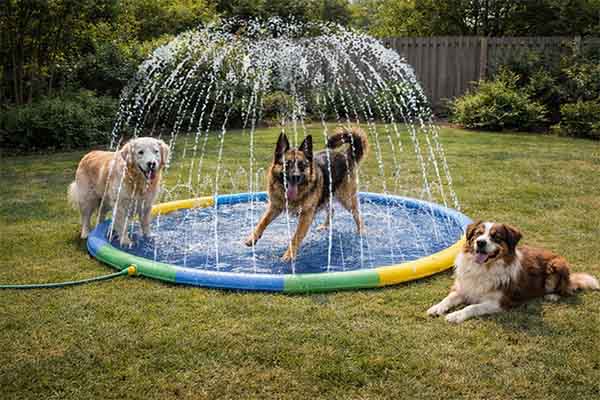
Dog Slipping on Splash Pads: Big Fast Dogs
Large and high-energy dogs slip for a different reason: they bring more force into every movement.
A bigger dog carries more body momentum into each stop, turn, and push-off. That means the paws need more grip to control the body once it starts changing direction. On a wet splash pad, this becomes most obvious during front-end loading. The dog runs, braces, tries to pivot, and the front paws suddenly have to handle a lot of force at once.
That is why larger dogs often look fine in straight-line movement but slide more during turns. The issue is not always that the splash pad is too slippery in a general sense. It is that the dog is asking more from the surface in a smaller amount of space. Small decorative splash pads may still work for a light calm dog, but a larger active dog usually needs more open movement room, flatter structure, and better spray control.
Fast dogs also tend to react more strongly to the water itself. They chase spray, cut sideways quickly, and treat the splash pad like an activity zone instead of only a cooling spot. That can be fun, but it also raises the traction demand. For these dogs, a calmer first setting usually works better than maximum spray from the start.
Dog Slipping on Splash Pads: Heat and Balance
Heat changes movement quality. Even dogs that look strong and excited at the beginning of a session can become less coordinated once they heat up, get overstimulated, or stay active too long.
This is one reason slipping often gets worse later in the session instead of right away. At first the dog is fresh, curious, and balanced. Ten minutes later, the dog may still be enthusiastic, but the movement gets sloppier. Turns become tighter, landings heavier, and recovery gets slower.
Some dogs are affected more than others. Overweight dogs, older dogs, lower-stamina dogs, and dogs that already struggle in warm weather usually lose balance sooner in active summer play. In these cases, the splash pad should be used as a cooling tool first, not as a high-intensity exercise zone.
Dog Slipping on Splash Pads: Confidence Changes Movement
There is another factor owners sometimes miss: confidence. A dog that trusts the surface usually moves more smoothly. A dog that is unsure about the surface often becomes choppy, cautious, and harder to stabilize.
Confidence changes stride length, turning style, and willingness to re-enter the spray. It also affects how much of the splash pad the dog uses. A confident dog may move through the whole area naturally. A cautious dog may stay on the edge, avoid the middle, or keep stepping off and back on.
That is why calmer introductions, shorter sessions, and better early success matter so much. Good traction is not only about surface physics. It is also about whether the dog believes the surface is safe to use.
| Dog type | Why slipping risk is higher | Better setup choice |
|---|---|---|
| Senior dogs | Lower stability and slower recovery | Lower spray, shorter sessions, flatter surface |
| Large dogs | More load during turns and stops | Larger usable area, stable structure |
| Very active dogs | Reactive movement and sharp pivots | Open layout, moderate spray |
| Overweight dogs | More force on paws and joints | Cooling-focused sessions, more breaks |
| Heat-sensitive dogs | Control drops faster in warm weather | Shade, shorter play, gentler water |
Dog Slipping on Splash Pads: Start the Right Way
A lot of splash pad success is decided in the first few sessions. If the first experience feels too slippery, too chaotic, or too intense, the dog may remember the surface as something uncertain. If the first experience feels easy and controlled, most dogs build confidence much faster.
Dog Slipping on Splash Pads: Start Dry
One of the simplest ways to reduce slipping is to let the dog meet the splash pad before the water starts.
A dry introduction gives the dog time to read the surface without also processing spray, sound, movement, and excitement at the same time. The dog can step on, sniff, circle, step off, and return on its own terms. That sounds basic, but it lowers uncertainty right away. Instead of learning the surface and the water at the same time, the dog learns the pad first.
This works especially well for cautious dogs, older dogs, rescue dogs, and dogs that do not like sudden sensory changes. Even confident dogs usually do better when they get a low-pressure first look at the pad.
Dog Slipping on Splash Pads: Build Confidence
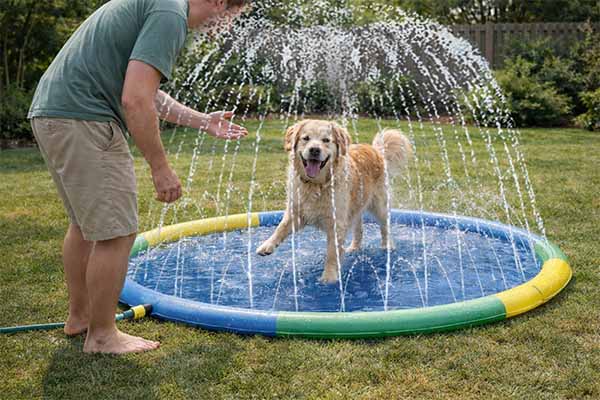
Once the dog is comfortable standing on the splash pad, turn on a low spray and keep the movement easy.
The first goal should not be high-energy play. The first goal should be clean, successful movement. Let the dog step through the water. Let it pause. Let it leave and come back. Guide it through short, straight paths instead of encouraging frantic loops or constant chase. A dog that learns it can move there safely is much more likely to start playing naturally later.
This is where owners often create problems without realizing it. They bring out the favorite toy too early, turn the hose too high, or try to make the moment more exciting before the dog has built enough trust in the surface. That usually creates reactive movement instead of real confidence.
Dog Slipping on Splash Pads: Keep Sessions Short
A shorter session usually works better than a longer one, especially at the beginning.
Many owners stop only when the dog looks tired, but by then coordination may already be dropping. That means the last part of the session is often the least stable part. If the dog slips more at the end, it may leave the splash pad with a worse overall impression than the beginning suggested.
A better approach is to stop while the dog still looks balanced and interested. That keeps the session positive and makes the next one easier. Over several days, a series of short, successful sessions usually builds much stronger trust than one long, overly active one.
Dog Slipping on Splash Pads: Read the First Five Minutes
The first five minutes tell you a lot about whether the setup is working.
If the dog steps in willingly, keeps a normal stride, turns without scrambling, and returns to the spray on its own, the setup is probably supporting good movement. If the dog shortens its stride, keeps stepping off, avoids the strongest spray, or starts slipping during early turns, the setup needs adjustment before the session goes further.
A smart first-five-minute check helps prevent that. Lower the spray, reset the splash pad, widen the movement space, or pause and check the paws. Small changes made early often prevent a much worse session later.
| Stage | What to do | What you want to see |
|---|---|---|
| 1. Dry intro | Let the dog inspect the pad with no water | Calm curiosity |
| 2. Low spray | Turn on gentle water flow | Steady steps, no panic |
| 3. Simple movement | Guide the dog in short straight paths | Smooth walking and re-entry |
| 4. Light play | Allow relaxed interaction with the water | Confidence, not chaos |
| 5. Stop early | End before balance drops | Dog leaves the pad comfortably |
Dog Slipping on Splash Pads: What to Buy
Once you understand why dogs slip, choosing the right splash pad becomes much easier. The best option is not simply the one with the biggest spray, the brightest print, or the lowest price. For dogs, the better product is the one that still feels usable after the surface is fully wet, the paws are moving at speed, and the session has moved past the first few minutes.
Dog Slipping on Splash Pads: Look for Grip
Grip should be one of the first things you judge, because it influences almost every other part of the experience. If the wet surface does not feel dependable, the dog’s confidence drops quickly. Once confidence drops, stride length shortens, turns become messier, and the dog spends more energy correcting movement than enjoying the water.
A stronger splash pad surface usually gives the dog a more predictable response from step to step, reduces the number of small slips that force constant correction, and helps the dog keep using the whole pad instead of avoiding part of it. These differences matter most during turns, because that is where poor wet-surface control usually shows up first.
Dog Slipping on Splash Pads: Look for Control
Control is what allows one splash pad to work for more than one dog type. Some dogs step in slowly and only want a cooling zone. Some chase water at speed. Some need low pressure every time. Others can handle a stronger setting once they trust the surface. A better splash pad gives the owner room to control that experience instead of forcing every dog into the same play pattern.
The biggest part of control is water behavior. A splash pad with gentler, more even spray is often easier for dogs to understand than one with more forceful or uneven jets. Stronger water is not always better. Very reactive spray often creates exactly the kind of quick, awkward movement that leads to slipping.
Dog Slipping on Splash Pads: Look for Space
Space is one of the most underestimated buying factors, but it changes movement quality more than many people expect.
A dog with enough usable area can step into the spray, turn wider, move out, and re-enter without constantly making tight pivots. A dog on a smaller or more cramped play surface is forced into sharper corrections. That usually means more slipping, especially for medium and large dogs.
If your dog is active, large, or likely to share the pad with another dog or child, more open usable space is usually the safer and more practical choice.
Dog Slipping on Splash Pads: Look for Structure
Structure matters because the dog is not only reacting to the surface finish. The dog is reacting to how the whole splash pad behaves under motion.
A splash pad that wrinkles, lifts, bunches, or shifts under repeated use will always feel harder to trust. Even when the material itself is decent, unstable structure changes the underfoot experience enough to affect turning, stopping, and re-entry.
For customers, this means looking beyond print and diameter. The more useful questions are whether the pad stays flatter during movement, whether the seams feel dependable, whether the water spreads in a more balanced way, and whether the overall design looks made for repeated outdoor use rather than short-term novelty.
Dog Slipping on Splash Pads: Look for Real Use
Real use is where product quality becomes obvious. A splash pad should not only look appealing on day one. It should still perform after repeated setup, repeated folding, repeated exposure to summer heat, and repeated wet play under real paws.
That is why material build, structural stability, and development quality matter so much. A dog splash pad is not just a summer novelty item. It is a functional outdoor product that needs to balance cooling, movement, stability, and durability.
For brands looking to source ready-to-sell products or develop custom designs, EPN’s broader strength in PVC and composite product development matters because the final user experience depends on all of those details working together.
| Buying factor | Why it matters | What stronger products usually offer |
|---|---|---|
| Wet-surface feel | Affects footing during turns and braking | More controlled feel once soaked |
| Water behavior | Changes how reactive the dog becomes | Gentler, more even spray |
| Usable area | Reduces tight pivots and crowding | More open room for natural movement |
| Structural stability | Keeps footing predictable | Less wrinkling and less bunching |
| Material build | Affects repeat use over time | Stronger PVC or composite construction |
| Product development quality | Affects consistency and real use | Better testing and production control |
Dog Slipping on Splash Pads: FAQ
Most owners ask the same questions once slipping starts. They usually want to know whether the issue is the splash pad, the paws, the setup, or the dog. In real use, it is often a mix of all four.
Dog Slipping on Splash Pads: Make It Less Slippery
To make a splash pad less slippery, start with the fastest corrections first. Lower the water pressure. Move the pad to firmer, flatter ground. Smooth out wrinkles or lifted areas. Check the dog’s paw fur, nails, and pad skin. Then restart the session more calmly.
Dog Slipping on Splash Pads: Stop Paw Sliding
To keep dog pads from sliding, focus on cleaner foot contact. Trim extra fur under and between the pads. Keep nails in a healthy range. Check whether the pad skin looks dry, rough, or uncomfortable. A dog that is not landing well at foot level will usually struggle more on any wet surface.
Dog Slipping on Splash Pads: Add More Grip
The best way to add more grip is to begin with the natural fixes first. Better paw maintenance, calmer spray, flatter ground, and slower early sessions solve a lot of the problem in many homes.
If the dog still struggles after that, added traction support may help, especially for senior dogs, heavier dogs, dogs with lower balance, and dogs that continue to lose footing even after the setup improves.
Dog Slipping on Splash Pads: Paw Products
Paw products work best when matched to the real issue. If the paw pads are dry or worn, a pet-safe conditioning product can support healthier skin. If the real weakness is traction on a wet surface, anti-slip boots or another traction aid usually help more than balm alone.
Dog Slipping on Splash Pads: Lower Water Pressure
Yes, lowering water pressure is usually one of the fastest improvements you can make. A gentler spray reduces startle, lowers reactive movement, and gives the dog more time to understand the footing.
Dog Slipping on Splash Pads: Anti-Slip Boots
Anti-slip boots can help some dogs, but they should be used for the right reason. They are most useful when the dog still needs extra traction after grooming, setup, and water level have already been improved.
Dog Slipping on Splash Pads: Is a Bigger Splash Pad Better?
Often, yes, especially for medium and large dogs. More usable space gives the dog more room to make wider turns and move more naturally.
Dog Slipping on Splash Pads: When Should You Stop the Session?
Stop the session when movement quality starts to drop. That usually looks like shorter stride length, messier turns, repeated stepping off the pad, overreaction to the spray, or more frequent small slips.
| Question | Short answer |
|---|---|
| Is the splash pad too slippery or is it my dog? | Usually both the setup and paw condition play a role |
| Does lower water pressure really help? | Yes, especially for confidence and balance |
| Should I use paw balm before play? | Only when the pads need conditioning, and not too heavily right before active play |
| Do larger dogs need different splash pads? | Yes, they usually need more usable space and calmer starting spray |
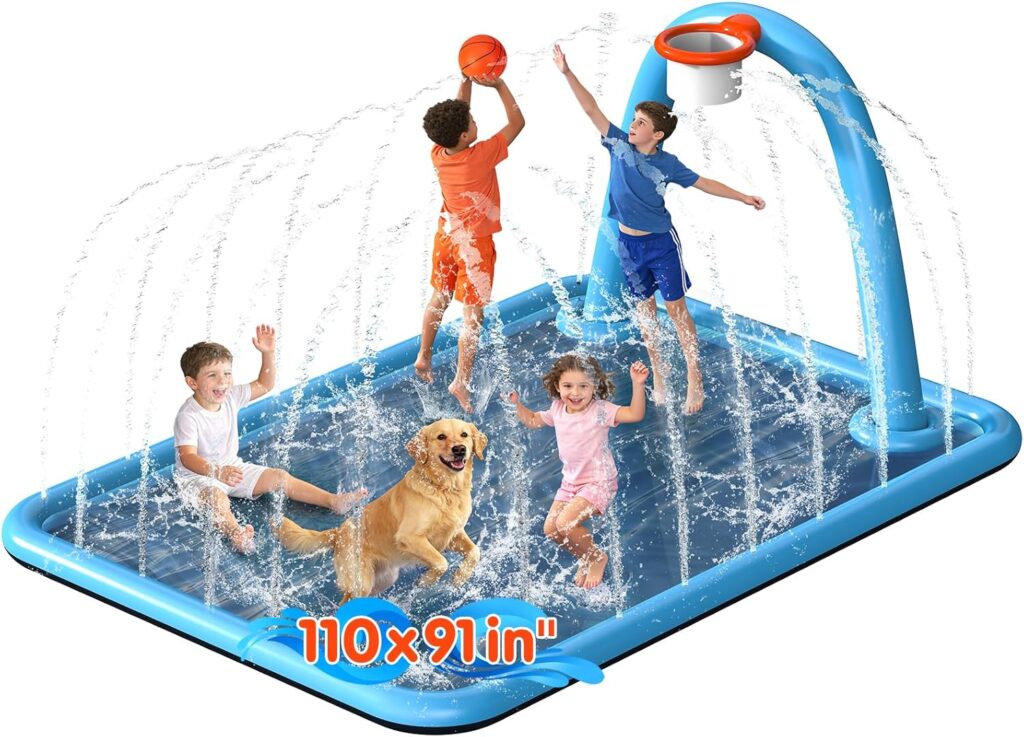
| Can one splash pad work for kids and dogs? | Yes, if the surface, structure, and water behavior are suitable for both |
| Is slipping always a product problem? | No, grooming, ground choice, pacing, and dog type matter too |
Conclusion
A dog splash pad should do more than spray water. It should create a space where a dog can cool down, step confidently, turn without panic, and keep wanting to come back. That is what separates a fun-looking product from a genuinely useful one.
The reasons dogs slip are usually clear once you watch closely. Wet-surface behavior matters. Water pressure matters. Paw condition matters. Ground choice matters. Space matters. Structure matters. The dog’s age, size, and movement style matter too. Most slipping problems improve when those factors are handled together instead of one by one.
For families, that means a better experience starts with smarter setup and a better product match. For retailers, sellers, and sourcing teams, it means the most valuable splash pad is the one that performs well in real outdoor use, not just the one that looks exciting on first impression. Products that support steadier movement, calmer cooling, and repeat daily use are the ones that usually create better satisfaction over time.
EPN supports both branded product supply and custom development for splash pads and other PVC and composite water-play products. Whether the goal is a ready-to-sell product, a seasonal pet line, or a custom design with your own size, color, packaging, and performance direction, a clearer brief leads to a better result.