Skip to content

A splash pad looks simple until you have to choose one. Two models may use similar PVC construction, connect to the same garden hose, and advertise nearly identical widths, yet one is round and the other square. That difference can affect much more than appearance. Shape changes how much of the footprint becomes usable floor, how naturally the pad fits a lawn or patio, how several children share the space, and how easily the perimeter can be arranged around the way your family actually plays.
Neither round nor square splash pads are universally better. Round pads usually suit open lawns, access from every direction, and circular movement, while square pads make more efficient use of rectangular spaces and provide more geometric floor area at the same maximum width. The better choice depends on usable interior size, yard layout, number and age of children, water distribution, and overall construction quality.
Consider two splash pads that are both advertised as 67 inches wide. At first glance they seem comparable. Yet a 67-inch square covers considerably more geometric area than a 67-inch-diameter circle before either product’s raised perimeter is deducted. That difference may be almost irrelevant in a large open lawn, but it can completely change the experience in a narrow backyard where two children, a garden hose, outdoor furniture, and an adult all need room. Shape is only one specification, but it is one worth understanding before summer begins.
What Is the Difference Between Round and Square Splash Pads?
Round and square splash pads mainly differ in how they use available space and organize movement. Round models create a continuous perimeter with easy access from every direction, while square models use straight sides and corners to occupy rectangular areas more efficiently. Actual performance also depends on usable interior dimensions, perimeter width, spray-hole layout, PVC construction, seam quality, and how the product behaves after water pressure enters the outer chamber.
How Shape Changes the Layout
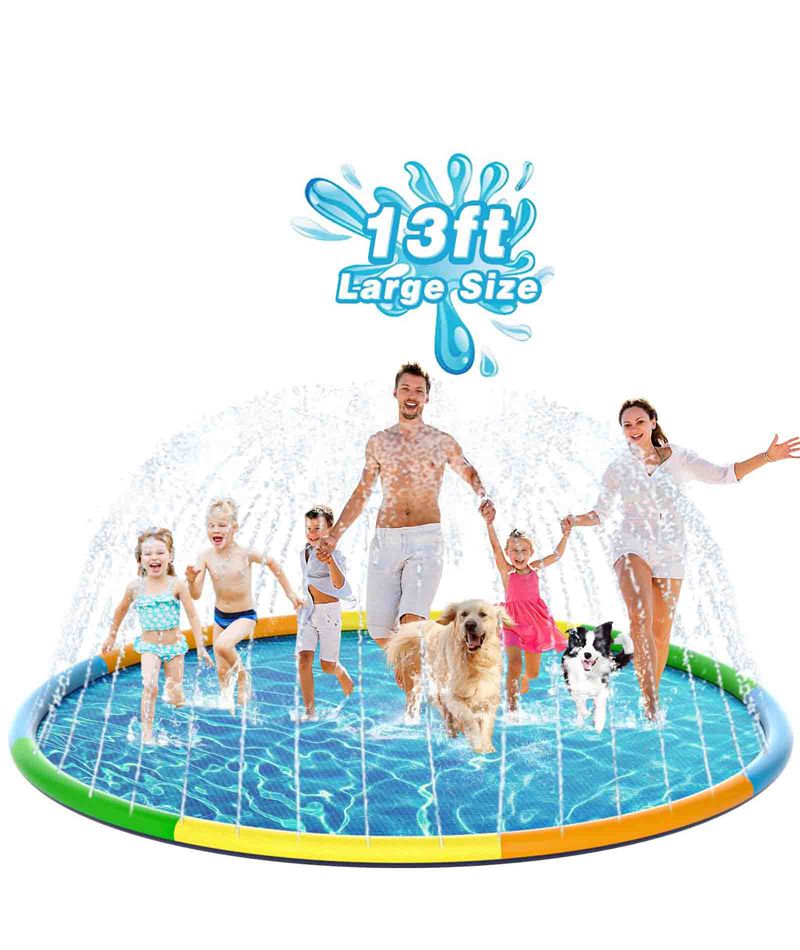
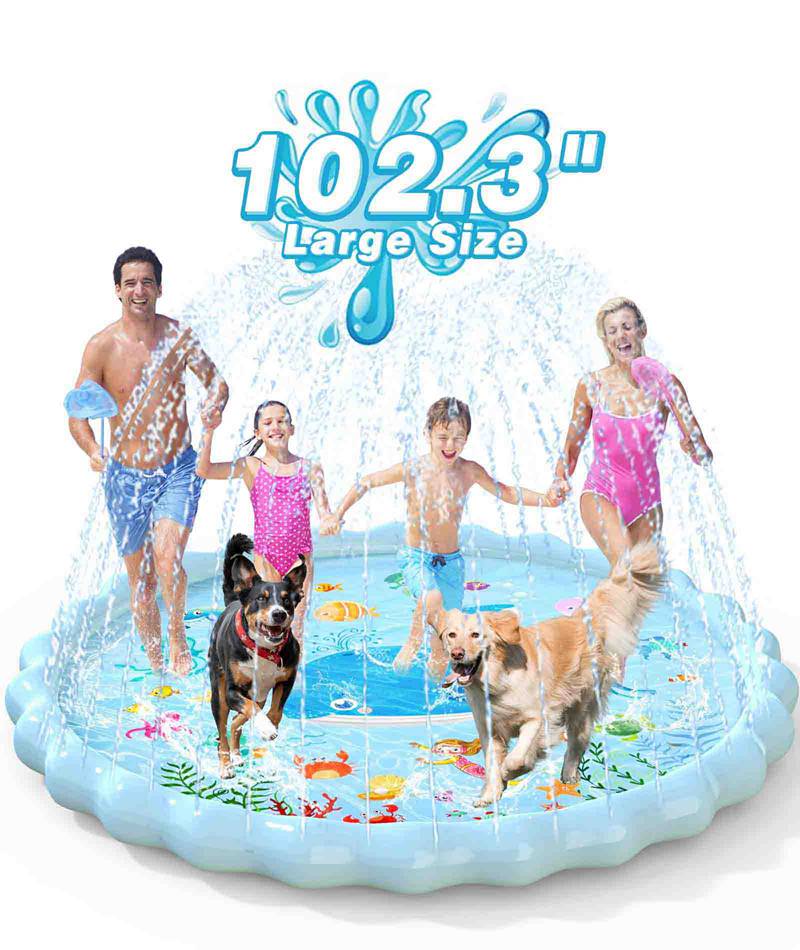
A round splash pad naturally creates a central play area surrounded by an uninterrupted curved boundary. There is no obvious front or back, so children can approach from almost any direction. On an open lawn, this makes the layout feel intuitive. Kids can move around the outer edge, cross through the center, change direction freely, or follow another child around the perimeter without repeatedly encountering a corner.
That type of movement can make a round pad feel surprisingly spacious even when its calculated floor area is smaller than an equally wide square. Movement does not always follow mathematical boundaries. A child running in a loop can use a continuous circular path efficiently, while another child sitting near the center remains relatively easy for an adult to see.
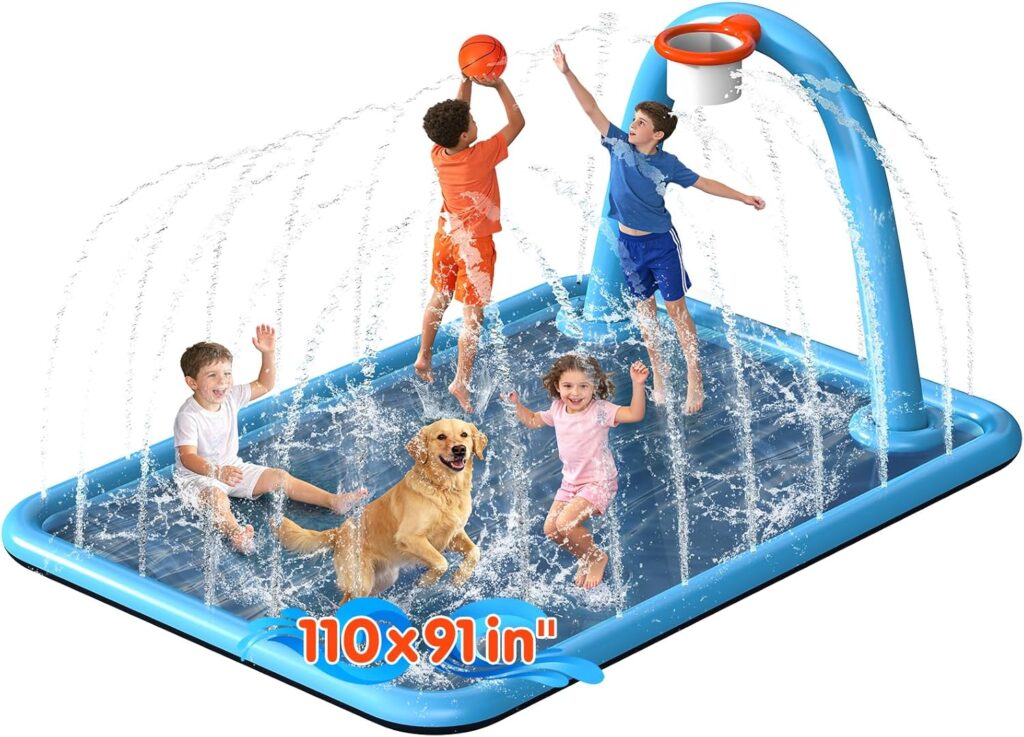
A square splash pad organizes the area differently. Four straight sides line up more naturally with patios, fences, decks, walls, garden borders, and rectangular patches of lawn. The corners also remain part of the footprint. In real family use, those corners often become secondary play areas where children place buckets, cups, small water toys, or sit away from the strongest spray.
Neither layout should automatically be considered superior. A circle often works better when the surrounding space is open and flexible. A square tends to become more valuable when the yard itself has strong rectangular boundaries and the family wants to make use of as much available ground as possible.
Are Equal Sizes Really Equal?
Equal advertised widths do not provide equal geometric floor areas. When a square splash pad has the same side length as the diameter of a round splash pad, the square covers about 27.3% more geometric area before the perimeter and other structural features are deducted.
| Outside Width | Round Geometric Area | Square Geometric Area | Difference |
|---|---|---|---|
| 60 in | 2,827 sq in | 3,600 sq in | Square +27.3% |
| 67 in | 3,526 sq in | 4,489 sq in | Square +27.3% |
| 90 in | 6,362 sq in | 8,100 sq in | Square +27.3% |
| 102 in | 8,171 sq in | 10,404 sq in | Square +27.3% |
These figures are geometric references rather than product capacity ratings. A finished splash pad does not provide every square inch shown in the calculation because the water-filled perimeter occupies part of the total footprint. Decorative features, separate air chambers, reinforcement areas, and structural seams can reduce usable floor space further.
This is why consumers should be cautious when comparing only the largest measurement in a product title. A 90-inch round pad and a 90-inch square pad may sound like equivalent sizes, but the experience inside them can be noticeably different.
A more useful comparison considers the full outside size together with approximate interior dimensions. Product photos showing children actually using the pad can also help establish scale, particularly when the manufacturer provides an overhead or wide-angle view instead of an isolated product rendering.
How the Rim Changes Play Space
The raised edge of a hose-fed splash pad normally performs several jobs at once. It forms the outer boundary, carries incoming water around the product, supports the spray holes, and helps keep those holes facing toward the intended play area. That means the perimeter cannot be treated as fully usable center space.
Imagine, only as an illustrative example, a 67-inch splash pad with an approximately 4-inch-wide water chamber around the outside. Because the rim occupies space on both sides, the open interior span could be closer to 59 inches. Exact dimensions vary considerably by product, but the example demonstrates why an advertised outside measurement should not be confused with actual interior play width.
A wider perimeter is not necessarily bad design. Additional chamber width can help a splash pad maintain its shape and provide sufficient water volume for multiple spray holes. A perimeter that is extremely narrow may leave more center floor, yet it can become more sensitive to folding, twisting, or unstable spray direction if the structure has not been properly engineered.
For families, the practical lesson is straightforward: examine how much of the product is devoted to the raised edge. For manufacturers, the challenge is more technical. The design must balance usable floor area, water flow, seam strength, folding behavior, and spray stability rather than maximizing one dimension at the expense of everything else.

Which Differences Matter Most?
Shape is the easiest difference to notice, but many performance differences come from details that are harder to see in an online listing. Flexible PVC consistency, seam quality, hose fitting reinforcement, spray-hole placement, perimeter chamber width, floor construction, and manufacturing tolerances all affect how the product performs after repeated use.
Round perimeter chambers have the advantage of a continuous curved path. Water does not need to negotiate four distinct corner transitions, and spray holes can often be arranged at relatively consistent intervals around the circumference. This simplifies some parts of product development, although it does not guarantee good performance.
A square structure requires careful attention at the corners. Water moving through a straight chamber must turn into the next side without the PVC folding excessively or restricting the channel. Heat-weld consistency and corner geometry become particularly important when the product fills under pressure.
Experienced PVC manufacturing therefore treats shape as only one variable in a larger system. A properly engineered square splash pad can be more reliable than a poorly constructed round product, just as a well-made round pad can outperform a square one that was designed primarily around appearance.
For shoppers, shape should help determine which layout fits the home. Construction quality should determine which product within that layout deserves serious consideration.
Which Shape Gives More Usable Play Space?
Square splash pads generally provide more geometric area than round pads with the same maximum width, but usable play space depends on much more than geometry. The raised perimeter, internal features, number and age of children, toys, spray direction, and movement patterns all influence how spacious a product feels. Families should compare interior dimensions and actual play behavior rather than judging capacity only from the outside measurement.
Measure the Interior, Not Just the Box
Large numbers attract attention on product pages. A splash pad advertised at 90 inches immediately sounds more impressive than one listed at 80 inches, yet outside dimensions alone reveal surprisingly little about how much room children will actually use.
Every splash pad loses part of its footprint to its perimeter structure. If the raised edge is relatively wide, several inches can disappear around every side of the open floor. On smaller products, this loss represents a larger percentage of the entire surface. On larger pads, the same perimeter width may be much less noticeable.
The relationship between outside and inside dimensions matters particularly when comparing two different designs. A visually substantial border, decorative inflatable structure, raised obstacle, or unusually wide water chamber may make a product look larger while reducing the center area available for sitting and movement.
When specifications are available, compare both outside and inside dimensions. When they are not, look carefully at overhead photographs and pictures showing children inside the pad. Consider how much distance remains between the child and the outer edge.
Terms such as “large,” “XL,” and “family size” are useful marketing descriptions, but they should not replace measurements. The interior floor is where children actually play.
How Much Space Do Kids Need?
There is no dependable rule that assigns a fixed number of square feet to every child because children use water-play space differently at different ages. A toddler may sit in one position for several minutes pouring water between cups. An older child may cross the entire surface repeatedly while running through spray streams and chasing a sibling.
Activity level therefore matters as much as headcount. Two active school-age children can require more movement room than three toddlers who spend most of their time sitting. A mixed-age family can be even more demanding because a younger child may remain stationary while older children move quickly around them.
| Typical Use | Main Space Need | Shape Consideration |
|---|---|---|
| 1–2 toddlers | Stable open center | Either shape can work |
| 2–3 young children | Room to spread out | Square can add useful floor |
| Active siblings | Clear movement routes | Larger overall size matters |
| Frequent playdates | Separation and circulation | Square or larger round |
| Water toys and buckets | Edge storage areas | Corners can be useful |
| Kids with pets | Separation and stronger surface | Construction matters most |
This table should be treated as a planning aid rather than a rated capacity chart. Actual suitability depends on the specific product, manufacturer guidance, child age, surrounding environment, and level of adult supervision.
When comparing sizes, imagine the children moving rather than standing still for a photograph. If several kids can technically fit but every route crosses the same central point, the splash pad may feel crowded once play becomes active.

Why Corners Can Be Useful
The extra floor provided by a square is concentrated partly in four corner regions that do not exist inside an equally wide circle. Those corners may appear insignificant when the product is empty, yet they can become surprisingly useful once children begin playing.
One child may sit near a corner with cups or a small bucket while another runs through the middle. Toys that would otherwise occupy the center can remain closer to a straight edge. A child who prefers gentler water can move into a less active corner without leaving the pad completely.
This does not mean the corners make square splash pads automatically better for groups. Round models provide another kind of space efficiency: movement continuity. Children can follow the outer perimeter without reaching an endpoint or making repeated sharp direction changes. On a large enough round surface, that continuous pathway can make active play feel natural and uncrowded.
The distinction is useful when thinking about a particular family. If children mainly sit, build small water games, and spread toys around, corner floor area may be valuable. If they primarily run and chase one another, smooth circulation may be more important.
That is why usable space should be understood as functional space rather than simply calculated square inches.
When More Area Is Not Better
The largest splash pad that fits on paper is not necessarily the best size for a real backyard. The product itself is only one part of the activity zone. Children move beyond the edge, spray travels outside the perimeter, adults need access, and the garden hose has to reach the connector without creating an awkward route.
A pad that occupies nearly the entire available surface can leave children too close to furniture, steps, fences, grills, landscaping, or other hard objects. It can also make supervision more difficult if an adult cannot comfortably walk around the product.
Water performance should also be considered. Larger perimeter chambers and additional spray holes place greater demands on the available water flow. Household pressure varies, and a long hose, narrow fitting, splitter, or another fixture operating at the same time can reduce the water reaching the pad.
A larger splash pad under weak flow may therefore produce shorter or less consistent spray than a smaller, well-matched design. The exact relationship depends on chamber dimensions, hole count, hole diameter, and the available water supply.
Instead of buying the largest number available, first determine the usable backyard zone. Leave comfortable space around it, consider typical group size, and then choose dimensions that fit the activity rather than merely fitting the ground.
Which Shape Fits Your Backyard Better?
Round splash pads usually work best in open lawns where children and adults can approach from multiple directions. Square splash pads tend to use rectangular patios, narrow side yards, fenced spaces, and straight boundaries more efficiently. Good placement should also provide room for overspray, drainage, hose routing, adult movement, and children entering or leaving the wet area without immediately encountering obstacles.
Round Pads on Open Lawns
An open lawn is one of the easiest environments for a round splash pad because there is little need to align the product with existing boundaries. The pad can be rotated so its connector faces the nearest faucet while the overall footprint remains unchanged.
This flexibility can simplify setup. Children can approach from several directions, adults can walk around the product, and the circular perimeter naturally defines where the main wet-play area begins and ends. On sufficiently large grass areas, the unused space outside the curve is rarely a concern.
Round pads also suit active movement. A child can follow the perimeter continuously, another can cross through the center, and a third can approach from the opposite side without everyone being directed toward one primary entrance.
The disadvantage becomes noticeable when available width is limited. A circle placed inside a narrow rectangular yard leaves unused areas around its curved edges. Those areas may technically remain available as lawn, but they do not increase the splash pad’s interior play space.
For a family with a generous open backyard, this inefficiency may be insignificant. In a compact side yard where every foot matters, it can be the reason an equally wide square feels considerably more spacious.

Square Pads in Defined Spaces
Many residential outdoor areas are built around straight lines. Patios are rectangular, fences run in straight sections, decks follow structural edges, and side yards are often long and narrow. A square splash pad fits naturally within this type of environment.
Suppose a family has a rectangular paved space between a house and a garden border. A square pad can use more of the width and length without leaving the four curved gaps created by a circular product. This can provide additional internal play area without increasing the maximum width.
That does not mean the product should be pushed against the nearest fence just because the measurements allow it. Water spray often extends beyond the PVC floor, and children rarely remain perfectly inside the boundary. They step out, run around the edge, bend down near the perimeter, and move toward adults or toys.
Hard walls, patio furniture, garden tools, steps, decorative stones, and other obstacles should remain outside the immediate movement zone. Adults also need enough room to reach the hose connection, help younger children, and inspect the pad during use.
A square pad can therefore make better use of a defined space, but the goal should be efficient placement rather than maximum possible coverage.
How Much Clearance Is Practical?
Portable residential splash pads vary considerably in spray height, user age, and dimensions, so one clearance measurement cannot serve every product. For household planning, however, it is sensible to think beyond the PVC footprint and reserve a usable buffer whenever space allows.
A practical planning range of roughly 18 to 36 inches around the outside can help families visualize walking access, overspray, and child movement. This is not a universal safety standard. More room may be appropriate around stronger sprays, active older children, hard surfaces, or nearby fixed objects.
| Area to Check | Practical Question |
|---|---|
| Product footprint | Does the full outside size fit comfortably? |
| Walking zone | Can an adult move around the pad? |
| Spray zone | Where does water land beyond the edge? |
| Hose route | Does the hose cross a running path? |
| Drainage | Where will water flow during and after use? |
| Obstacles | Are hard or sharp objects nearby? |
| Supervision | Is the whole play area clearly visible? |
One of the simplest ways to evaluate a potential size is to mark the outline on the ground before purchasing. Rope, garden stakes, or washable chalk can create a realistic footprint. Place the garden hose where it would actually run, then walk around the marked area.
This small exercise often reveals that a product that technically fits leaves very little practical room for the people using it.
Grass, Patio, and Drainage
The surface under the splash pad can influence comfort, drainage, floor stability, and product durability regardless of whether the product is round or square.
Flat grass is popular because the surrounding area remains relatively soft for children moving in and out of the pad. Grass can also allow water to spread over a larger area instead of immediately forming a broad slick surface. Before setup, the ground should still be checked carefully for stones, sticks, sharp roots, metal pieces, or other debris that could concentrate pressure against flexible PVC.
A patio provides a flatter and more predictable base but requires greater attention to water outside the product. Wet paving can become slippery, and even a slight slope can cause runoff to move toward one side of the yard.
Drainage direction deserves consideration before the faucet is opened. Water should not be encouraged to accumulate next to doors, low building openings, electrical equipment, frequently used steps, or areas where repeated saturation may create problems.
Shape affects how well the product occupies the available footprint. Surface preparation determines whether that footprint works comfortably once water is actually involved.
How Does Shape Affect Water Play?
Shape can influence spray-hole arrangement and the way children move through water, but it does not determine spray quality by itself. Round pads provide a continuous curved water chamber, while square designs move water through straight sections and corner transitions. Water pressure, chamber dimensions, hole size, hole angle, connector design, seam consistency, and manufacturing quality often affect spray height and distribution more than shape alone.
Round Spray Distribution
A round perimeter provides a continuous path for water to travel around the splash pad. From a product-development perspective, this makes it relatively straightforward to place spray holes at repeated intervals and direct them toward a common central play zone.
When the perimeter fills consistently, the result can be an attractive ring of inward-facing water streams. Children approaching from different directions encounter a similar layout, and there is no visually dominant side of the product.
That symmetry should not be mistaken for a guarantee of perfectly equal spray. Small differences in spray-hole diameter or punching angle can change individual streams. A fold in the PVC can alter water flow through one area, while uneven ground can change the way the perimeter sits. A restricted connector or kinked hose can lower overall performance.
A good round splash pad therefore relies on manufacturing consistency as much as circular geometry. Spray holes need controlled positioning, seams need to remain stable, and the perimeter must hold its intended orientation after water pressure is introduced.
Consumers evaluating a product should look for consistent inward spray across the full circumference rather than assuming every circular product will automatically behave the same way.

Square Spray Distribution
A square splash pad introduces four corner transitions into the water path. Each corner connects two straight sections of the perimeter chamber, and the flexible PVC must maintain a usable channel as water changes direction.
This is manageable when the product is developed carefully. Chamber width, corner geometry, heat-weld placement, spray-hole spacing, and hole orientation can all be adjusted during prototyping. Holes close to a corner may need a slightly different angle from those positioned in the middle of a straight side because the intended landing point changes with location.
Water testing matters because a splash pad can look perfectly symmetrical when lying flat and behave differently once its outer chamber becomes pressurized. The structure needs to be evaluated in the condition customers will actually use it.
For custom PVC water-play products, EPN considers shape together with spray-hole layout, seam consistency, connector position, perimeter structure, and material specification rather than treating the outline as a graphic design choice.
That approach is particularly important for larger square products. As side length increases, consistent water distribution and stable corner construction become more noticeable parts of the user experience.
How Water Pressure Changes Play
Household water conditions can make two families experience the same splash pad very differently. The amount of water reaching the product depends not only on the faucet but also on hose length, internal hose diameter, fittings, splitters, elevation, and whether other fixtures are using the same supply.
As flow increases, the water chamber normally becomes firmer and spray height rises. Lowering the flow generally reduces the height and intensity of the streams. This can be useful for younger children who prefer gentle water play rather than tall jets reaching their face.
Maximum spray height should not automatically be treated as the ideal setting. Excessive flow can send streams beyond the intended play area and consume more water without improving the way children actually use the pad. The appropriate level is usually the one that keeps the perimeter stable while directing water comfortably toward the usable center.
A sensible setup routine is to begin with relatively low flow, allow the perimeter to take shape, check the connector and surface, and then increase the faucet gradually.
If one area sprays noticeably lower than the others, first check for folds, hose restrictions, twisting, or uneven placement. Shape may contribute to the pattern, but it is rarely the only factor.
How Kids Move Through Each Shape
Children experience shape through movement rather than geometry. A round splash pad naturally supports looping paths. Kids can move along the circumference, cross through the center, turn gradually, and continue around another part of the edge. This type of flow can be particularly enjoyable for active siblings who like chasing games.
A square pad creates more directional movement. Children may travel from side to side, cut diagonally between corners, or occupy separate parts of the surface. One child can remain near a corner playing with a bucket while another uses the stronger spray closer to the middle.
Neither movement pattern is better for every age. Toddlers commonly spend more time sitting, reaching, pouring, and exploring individual streams. Older children generally use more of the available surface and travel through it at higher speed.
This is why product size and shape should be considered together. A compact round splash pad may provide excellent toddler play but feel crowded for several older children. A medium square may provide additional separation without requiring a greater maximum width.
Watch how the children in your family normally play outdoors. Their behavior often provides a better answer than the product outline alone.
Which Splash Pad Shape Should You Choose?
Choose a round splash pad when you have an open lawn, want easy access from every direction, and expect children to enjoy continuous circular movement. Choose a square splash pad when floor-area efficiency, multiple play zones, or fitting a rectangular patio or narrow yard matters more. In either case, interior dimensions, child age, water pressure, materials, seam quality, spray consistency, and surrounding clearance should influence the final decision.
Which Is Better for Toddlers?
For toddlers, shape is rarely the first specification parents should prioritize. A manageable play area, controllable spray, stable surface, appropriate product age guidance, easy adult access, and close supervision matter more than whether the boundary is circular or square.
Round pads can work particularly well when placed in the middle of a lawn. The play area is visually clear, and an adult can approach from multiple directions. Square pads can be just as practical, especially when the family has a patio or small yard and wants extra corner space for cups and simple water toys.
The interaction between different ages deserves special attention. A toddler may remain seated while an older sibling runs through the center. In that situation, providing additional usable space can be more important than selecting one particular shape.
Water flow can also be adjusted to match the child’s comfort. Beginning with gentler spray allows younger users to explore the water without immediately creating the most intense setting the product can produce.
Regardless of shape or shallow water depth, attentive adult supervision remains essential whenever young children are playing around water and wet surfaces.
Which Is Better for Big Families?
Families with several children should focus on the relationship between interior space and movement. A square splash pad provides more geometric area when its maximum width matches the diameter of a circle, while a large round pad provides continuous routes around its perimeter.
If children tend to sit with buckets, cups, balls, and other small water toys, the corners of a square can provide useful separation. One child can occupy a quieter edge while another moves through the main spray zone.
If the family’s play is much more active, the continuous perimeter of a round pad can be equally valuable. Children who chase each other and repeatedly circle the edge may use that movement path more effectively than they would use extra stationary corner space.
Age mix also matters. Several active elementary-age children can require considerably more movement room than a group of younger children who mostly sit and splash. A simple statement such as “fits four kids” therefore tells only part of the story.
For families that regularly host playdates, moving up to an appropriately larger size often produces a bigger improvement than switching shape. The product should be large enough to support the way the group moves, not merely large enough for everyone to stand inside it at the same time.
Which Is Better for Small Backyards?
Square splash pads often have a practical advantage in small rectangular yards because straight sides use the available footprint efficiently. Corners that would sit outside a circle become part of the playable surface, which can be useful when maximum width is limited by a fence, patio edge, wall, or garden border.
A round pad can still be the smarter option when the center of the yard is open but access around the edges is restricted. A slightly smaller circular product with comfortable surrounding clearance can deliver a better experience than a larger square pushed too close to fixed obstacles.
| Backyard Situation | Round | Square |
|---|---|---|
| Large open lawn | Excellent | Very good |
| Rectangular patio | Good | Excellent |
| Narrow side yard | Fair to good | Excellent |
| Several seated children | Very good | Excellent |
| Circular running play | Excellent | Good |
| Maximum floor at equal width | Good | Excellent |
| Access from all directions | Excellent | Very good |
| Tight rectangular footprint | Fair | Excellent |
The table describes common layout tendencies rather than fixed rules. A particular product’s perimeter width, internal design, and surrounding environment can outweigh the general advantage associated with its outline.
Measure the actual activity zone before choosing. If the product fits only when the hose crosses the main walking route or children step directly into furniture when leaving the pad, moving down a size is usually a better decision.

Do Materials Matter More Than Shape?
For durability, materials and construction can matter considerably more than the outline. Shape determines how efficiently the splash pad occupies space, but flexible PVC formulation, film thickness, welding consistency, hose connector reinforcement, floor design, spray-hole accuracy, and perimeter stability affect how reliably the product performs over repeated summers.
Flexible PVC needs to balance several properties. It should fold compactly for storage while remaining resistant to normal household handling. Welded seams need enough strength to tolerate water pressure without becoming excessively rigid. The perimeter must remain stable enough for spray holes to maintain their intended direction as the chamber fills.
Material thickness alone is not a complete quality measure. A relatively thick PVC film combined with inconsistent welding can still produce weak seams or deformation. Conversely, an appropriately specified material with controlled welding parameters and carefully designed stress areas can perform reliably without simply maximizing thickness.
This is where manufacturing experience becomes important. When EPN develops customized splash pads, the shape can be coordinated with dimensions, PVC specification, spray-hole layout, graphics, hose connection, packaging, and the intended age or market instead of being selected independently.
For household shoppers, the principle is simpler: choose the shape that fits the yard, then compare construction quality among products that already meet that requirement.
Is Round or Square Better Overall?
Neither shape wins in every situation. Round splash pads are particularly well suited to open lawns, continuous movement, and access from several directions. Square splash pads are especially useful where floor-area efficiency, straight boundaries, or additional separation between several users is important.
A practical decision can be made in five steps:
- Measure the real outdoor area rather than estimating from photographs.
- Reserve room for walking, spray, drainage, and the garden hose.
- Compare usable interior dimensions instead of only outside measurements.
- Consider the number, age, and activity level of the children who will use it.
- Compare PVC construction, seams, connector design, and spray consistency before making the final choice.
If two products have comparable construction quality and both fit comfortably, the decision becomes much easier. An open lawn with children who enjoy running around the perimeter naturally favors a round model. A compact rectangular yard where siblings spread out with toys naturally favors a square model.
The right question is therefore not simply whether round or square is better. It is which shape turns the space your family already has into the most comfortable and usable play area.
Conclusion
Round and square splash pads can both provide excellent backyard water play, but they solve slightly different space problems. A round model works naturally in an open lawn where children can enter from many directions and move continuously around the center. A square model usually makes better use of straight boundaries and can provide more floor area when maximum width is limited.
The best decision comes from looking beyond shape alone. Measure the real yard, consider the raised perimeter rather than only the advertised outside dimensions, think about how many children normally play together, and pay attention to hose routing, drainage, spray behavior, PVC construction, and seam quality.
A product that is slightly smaller but leaves comfortable walking room can be a better choice than a larger pad squeezed between obstacles. Likewise, a square with more calculated floor area is not automatically better than a round model if the family values open circular movement more than corner space.
For families, the goal is straightforward: choose a splash pad that fits the yard and the way children actually play. For retailers and brands developing their own PVC water-play products, the same principle applies at a deeper level. Shape, dimensions, material specification, spray distribution, graphics, packaging, and intended user group should work together rather than being treated as separate decisions.
When those details are properly matched, children never need to think about geometry, pressure distribution, welding, or PVC structure. They simply turn on the water and start playing—which is exactly how a good splash pad should feel.
FAQ
Is a square splash pad bigger than a round splash pad of the same width?
When a square’s side length equals a circle’s diameter, the square has about 27.3% more geometric area. The real usable difference will be smaller or larger depending on perimeter width, internal structures, and the specific product design, so outside dimensions should always be compared with the open center area.
Is a round or square splash pad better for multiple kids?
A square can provide useful additional floor and corner zones for several children, while a large round pad can provide smoother circulation for active play. The number and age of children, their activity level, toys, and usable interior dimensions matter more than shape alone when several kids will share the pad.
What splash pad shape is best for a small backyard?
Square designs often use narrow or rectangular areas efficiently because their straight edges match patios, fences, and side yards. A smaller round pad can still be the better option when it leaves more comfortable clearance around furniture, obstacles, hose routes, and areas where adults need to walk.
Does splash pad shape affect water pressure?
Shape can influence how water moves around the perimeter, especially through the corners of a square design, but household water flow, hose length, chamber dimensions, hole size, spray-hole layout, connector design, and manufacturing consistency usually have a greater effect on actual spray height and balance.
Are round splash pads better for toddlers?
Not necessarily. Toddlers benefit more from a manageable play area, stable floor, gentle adjustable spray, easy adult access, and close supervision than from a particular outline. Both round and square splash pads can work well when their size, construction, and water flow suit younger children.
How can I tell how much usable space a splash pad has?
Start with the outside dimension, then estimate how much width is occupied by the raised water-filled perimeter. Interior measurements, overhead photographs, and images showing children at realistic scale provide a better indication of usable floor than labels such as “large,” “XL,” or “family size.”
What matters more, splash pad shape or PVC quality?
Shape mainly affects layout, movement, and space efficiency, while PVC formulation, seam quality, perimeter stability, hose connections, and spray-hole consistency strongly influence durability and performance. The strongest choice combines a shape suited to the backyard with reliable construction rather than treating either factor as the only priority.
Get A Fast quote
Here, bringing your inflatable concepts to life is no longer a challenge—it’s a collaborative journey where American Epsilon helps families, outdoor enthusiasts, and global brands transform creative ideas into safe, certified, and market-ready inflatable solutions.


Partner With Epsilon
Whether you are a family looking for safe backyard fun or a brand seeking large-scale OEM/ODM solutions, American Epsilon Inc. guarantees every inflatable is built with safety, durability, and excitement in mind. With flexible low MOQs, strategically placed warehouses in the U.S., Canada, U.K., and Germany, plus 24/7 professional support, we ensure smooth delivery and reliable service worldwide.
Ready to bring your inflatable ideas to life? Request free samples, fast prototypes, and customized designs today—your trusted inflatable journey starts here.