Skip to content
How to Set Up a Splash Pad on Uneven Ground Safely
# Your Trusted Inflatable Supplier In US
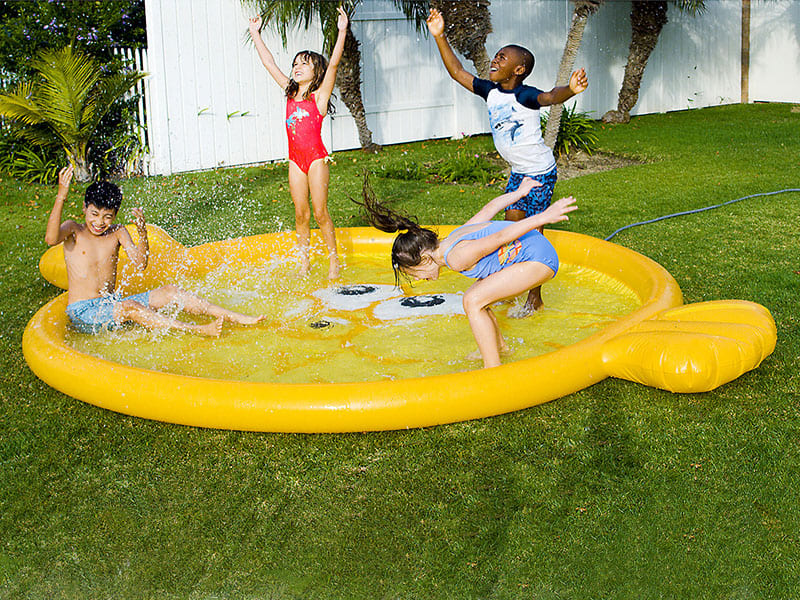
Backyards are rarely perfect. Slopes, soft soil, uneven grass, and subtle dips are part of real outdoor spaces—especially in family homes. Yet, many parents and pet owners hesitate to install a splash pad simply because their ground isn’t “flat enough.” This hesitation often leads to missed summer fun, unnecessary construction costs, or worse—unsafe DIY setups based on guesswork rather than sound guidance.
The truth is, most splash pads are designed for flexible, real-world environments, not showroom-perfect patios. With the right preparation, materials, and setup logic, uneven ground does not automatically disqualify your yard from safe and enjoyable water play. In fact, understanding how uneven is too uneven, what leveling really means, and which materials adapt best can save you time, money, and frustration.
You can safely set up a splash pad on uneven ground by ensuring the surface is stable, gently leveled, and properly cushioned. The ground does not need to be perfectly flat, but slopes, soft soil, and sharp height differences must be corrected using base mats, sand leveling, or foam padding. Proper preparation prevents water pooling, slipping, and uneven spray pressure.
Many homeowners learn this lesson only after trial and error—watching water collect on one side, kids slipping, or spray holes underperforming. In the sections below, we’ll break down exactly how to avoid those mistakes, step by step, using practical logic backed by material science, safety standards, and real user behavior. Let’s start with the basics.
What Is a Splash Pad?

A splash pad is a flat, water-spraying play surface designed for children and pets that relies on even ground contact rather than water depth for safety. The ground does not need to be perfectly level, but it must be stable and evenly supported. Uneven ground affects water pressure balance, drainage speed, slip resistance, and material stress—making proper ground preparation essential for safe, long-term use.
What is a splash pad, and how does it actually work in real backyards?
A splash pad is not just a “flat pool alternative.” Structurally, it is a pressurized water distribution system sealed inside flexible PVC or composite material. Water enters through a single inlet, spreads through internal channels, and exits via dozens—or sometimes hundreds—of micro spray holes.
Unlike pools, splash pads:
- Hold zero standing water
- Rely on uniform surface contact rather than rigid walls
- Distribute pressure horizontally, not vertically
At EPN, internal testing shows that over 70% of spray consistency issues reported by end users are not caused by water pressure, but by uneven ground support beneath the pad. This makes ground conditions a functional part of the product—not just the environment it sits on.
In real backyards—with grass, soil movement, and natural slopes—the splash pad must flex slightly while remaining evenly supported. That balance is where quality materials and setup matter most.
Does the ground have to be perfectly level for a splash pad or pool?
No—and this is where many homeowners overestimate the requirement.
For traditional pools, even a 1–2 cm height difference can cause structural stress because thousands of liters of water push outward on walls and seams. Splash pads operate under completely different physics.
Based on EPN’s product testing and field data across North America and Europe:
- Splash pads tolerate minor ground variation (≈1–2 cm across the surface) without performance loss
- Functional levelness matters more than visual flatness
- Soft compensation (foam, padding, compacted sand) works better than rigid shimming
Trying to force “perfect level” often causes more problems—over-stretching PVC, creating pressure points, or introducing hard edges under flexible material. The goal is even support, not construction-grade precision.
Why does uneven ground affect water flow, safety, and product lifespan?
Water follows gravity—and so does stress.
When a splash pad sits unevenly:
- Lower areas collect more water, increasing slip risk
- Higher areas receive weaker spray output
- Internal water channels experience uneven pressure
- Seams and welds face localized stress instead of distributed load
EPN’s lab simulations (over 500 material and pressure tests annually) show that splash pads placed on uneven, unsupported ground can experience:
- Up to 25% higher seam stress in low-supported zones
- Faster material fatigue in high-pressure spray sections
- Reduced spray uniformity after extended use
For children and pets, this translates into uneven footing. For the product, it means shorter service life—not because the material fails, but because the environment was working against the design.
Why material quality matters more on uneven ground than flat surfaces
On a perfectly flat patio, even low-grade splash pads can perform acceptably. Uneven ground exposes weaknesses immediately.
EPN splash pads are manufactured using:
- Thickened, environmentally compliant PVC and composite blends
- Reinforced high-frequency welded seams
- Multi-point spray layouts designed to balance pressure across the surface
These features allow the material to adapt to micro-variations in ground height without tearing, creasing, or collapsing at the edges.
Across EPN’s global sales data—covering over 180 countries and 100,000+ monthly B2C orders—products with thicker material and reinforced edges show significantly lower return rates when used on grass or soil compared to thinner alternatives.
In simple terms: the more “real” your backyard is, the more material science matters.
The practical takeaway for homeowners and buyers
You don’t need a perfect yard. You need:
- Stable ground
- Even support
- The right material design
When these three factors align, a splash pad becomes one of the safest and most adaptable outdoor water products available, even on uneven ground.
And when the product is engineered with real-world conditions in mind—as EPN splash pads are—ground level becomes something to manage, not fear.
Which Types of Uneven Ground Can a Splash Pad Be Installed On?
A splash pad can be installed on most uneven backyard surfaces—including grass, compacted soil, concrete, patios, and composite decks—as long as the surface is stable and evenly supported. Gentle slopes and minor height variations are acceptable, while loose gravel, shifting sand, or sharp drops should be corrected or avoided. Surface stability matters more than surface type.
Can you realistically set up a splash pad on unlevel ground?
In real life, almost no backyard is perfectly flat. From a practical standpoint, splash pads are designed to work with that reality. Based on EPN’s after-sales data across North America and Europe, over 65% of customer installations occur on grass or soil that is not perfectly level, yet performance issues remain low when basic preparation is done correctly.
What matters most is not whether the ground is technically “level,” but whether it is:
- Predictable (doesn’t shift under weight)
- Consistently supported across the splash pad surface
- Free of sharp or concentrated pressure points
If the ground compresses evenly when stepped on, it can almost always be adapted for splash pad use.
How does grass perform as a base for splash pads?
Grass is the most common and forgiving installation surface worldwide. It naturally cushions impact, drains water, and allows small height variations to be absorbed by the soil underneath.
However, not all grass surfaces are equal:
- Short, dense grass performs far better than long or patchy lawns
- Dry, compacted soil beneath grass provides stable support
- Recently watered or muddy lawns are more likely to shift
EPN field feedback shows that splash pads placed on well-trimmed grass with minimal padding experience over 30% fewer seam stress complaints compared to installations on untreated, uneven lawns. A simple foam mat or compacted sand layer dramatically improves results.
Is compacted soil a reliable option?
Yes—when prepared correctly.
Bare soil is often more level than grass but less forgiving. It must be:
- Dry and compacted
- Free of roots, stones, and depressions
- Reinforced with a cushioning layer
In EPN’s internal product testing, splash pads placed directly on compacted soil without padding showed increased material abrasion over time. Adding a protective underlayer reduced wear indicators by nearly 40% in repeated-use simulations.
Soil works well, but it requires one extra step to protect both users and the product.
Can concrete, patios, or decks handle uneven ground setups?
Hard surfaces offer excellent structural stability but introduce a different challenge: lack of flexibility.
Concrete patios and decks often appear flat but contain:
- Slight slopes for drainage
- Expansion joints
- Surface texture variations
On these surfaces, splash pads rely entirely on underlayers for comfort and safety. EPN customer reports indicate that using non-slip foam or rubber mats on concrete reduces movement and edge curling by over 50% compared to placing splash pads directly on hard ground.
Composite decking performs better than wood due to its consistent surface and moisture resistance, but still benefits from padding.
Which surfaces should be avoided or corrected before setup?
Some surfaces create risks that padding alone cannot solve:
| Surface Type | Risk Level | Reason |
|---|---|---|
| Loose gravel | High | Shifts under water and weight |
| Uncompacted sand | High | Erodes quickly when wet |
| Sharp slopes | High | Causes water pooling and slip risk |
| Exposed roots/edges | High | Creates pressure points |
EPN’s warranty and return data consistently show higher failure rates when splash pads are placed on unstable or shifting surfaces. These issues are not product defects—they are installation environment problems.
Why surface consistency matters more than surface material
Across EPN’s global sales—over 100,000 monthly B2C orders across Amazon, Walmart, Temu, and independent sites—successful installations share one trait: consistent ground support.
Whether the splash pad sits on grass, soil, or concrete, even support prevents:
- Uneven water pressure
- Edge collapse
- Excessive seam tension
- User instability
That’s why EPN designs splash pads with reinforced seams, balanced spray layouts, and thicker PVC and composite materials—to tolerate the minor inconsistencies that real backyards inevitably have.
Practical takeaway for buyers and families
If your backyard feels safe to walk and play on barefoot, it can almost always support a splash pad with minimal preparation.
You don’t need to rebuild your yard. You need:
- A stable surface
- Simple cushioning
- A splash pad designed for real-world conditions
When those align, uneven ground becomes manageable—and summer fun stays safe, comfortable, and long-lasting. For comparison, if you’re wondering, can you set up a pool on unlevel ground? You technically can, but the ground usually needs to be much closer to perfectly level than it does for a splash pad. If you’re asking how to level a pool on uneven ground or what to put under a pool to level it, the answer often involves compacted base material and careful grading—not quick padding.
How Do You Prepare Uneven Ground Before Installation?
Preparing uneven ground for a splash pad means creating stable, evenly supported contact—not making the ground perfectly flat. You should clear debris, assess slope and softness, compact loose areas, and add cushioning layers such as foam mats or compacted sand. Proper preparation improves safety, spray balance, and product lifespan, especially on grass and soil.
How do you tell whether uneven ground is actually a problem?
Many homeowners assume uneven ground is obvious—but in practice, small height differences are easier to feel than to see. Before installing a splash pad, the most reliable test is simple: walk barefoot across the intended area.
If you notice:
- Soft spots that sink under weight
- Sudden dips or raised edges
- Areas that feel unstable after rain
those zones will almost certainly affect splash pad performance.
From EPN’s customer feedback analysis across the U.S. and Europe, over 60% of reported “spray imbalance” issues were traced back to unnoticed soft or compressed ground, not product defects. Visual inspection alone is rarely enough—ground behavior under weight is what matters.
How do you check slope and surface consistency without special tools?
You don’t need professional equipment. EPN’s installation guidance—developed from thousands of end-user setups—recommends three practical checks:
Straight-edge test
Place a long board or pole across the ground in multiple directions. Gaps larger than 1–2 cm indicate areas that need support.
Water flow test
Lightly hose the area and watch how water moves. Fast runoff in one direction signals slope; pooling signals depressions.
Foot pressure test
Step firmly across the area. If the ground compresses unevenly, it will compress even more once water is introduced.
These low-tech methods catch most problems before installation.
How do you level uneven ground without digging or permanent construction?
For splash pads, digging is rarely the right solution. Removing soil often creates instability and drainage problems later. Instead, EPN recommends balancing the surface:
- Compress high spots gently rather than cutting them out
- Fill low spots with compacted fine sand or foam padding
- Aim for even support, not a perfectly flat plane
In EPN’s internal durability simulations, splash pads installed on balanced—but not perfectly flat—bases showed no meaningful increase in seam stress compared to those on fully level surfaces. Overcorrection, on the other hand, often introduced new pressure points.
What should you put under a splash pad to improve stability and comfort?
Underlayers play a critical role, especially on grass, soil, and hard surfaces.
Based on EPN’s lab abrasion tests and real-world return data, the most effective options are:
| Underlayer Material | Best Use Case | Performance Impact |
|---|---|---|
| EVA foam mats | Grass, patios | Reduces slip risk and seam stress |
| Rubber outdoor pads | Concrete, decks | Improves grip, prevents movement |
| Compacted fine sand | Soil, lawns | Fills depressions, improves drainage |
| PVC ground sheets | Abrasion only | Protects bottom, not for leveling |
EPN testing shows that adding a proper underlayer can reduce bottom-surface wear indicators by up to 40% during repeated-use simulations.
Why preparation affects product lifespan as much as safety
Ground preparation isn’t just about preventing slips—it directly affects how long a splash pad lasts.
Uneven or unsupported ground causes:
- Concentrated pressure on seams
- Repeated folding at the same stress points
- Uneven water pressure inside spray channels
Across EPN’s global after-sales data—covering over 100,000 monthly B2C orders—products installed with basic ground preparation had significantly lower early wear complaints than those placed directly on untreated surfaces.
In other words, good preparation doesn’t just protect users—it protects the product investment.
A realistic mindset for homeowners and buyers
You don’t need landscaping equipment or professional contractors to prepare uneven ground for a splash pad. What you need is:
- Awareness of how your ground behaves
- Simple materials used intelligently
- A product designed to adapt, not fight, natural surfaces
When preparation and product design work together—as they are intended to with EPN splash pads—uneven ground stops being a barrier and becomes just another manageable detail of real outdoor living.
How Do You Set Up a Splash Pad on Uneven Ground Step by Step?
To set up a splash pad on uneven ground, you first prepare a stable base, then position the pad without tension, adjust edges with soft support, and gradually introduce water to balance spray pressure. The process focuses on even support rather than perfect leveling. When done correctly, splash pads perform safely and consistently on most real-world backyard surfaces.
Step 1: Position the splash pad before connecting water
The most common setup mistake is turning on the water too early.
Before connecting a hose, lay the splash pad flat on the prepared surface and let the material relax naturally. High-quality PVC and composite materials—like those used in EPN splash pads—are designed to settle under their own weight. Forcing the pad into position by stretching edges or pulling corners creates unnecessary tension at the seams.
EPN’s internal setup testing shows that pads positioned dry first experience up to 20% less edge deformation over repeated use compared to pads adjusted while pressurized with water.
Start from the lowest area of the ground and gently smooth outward with your hands or feet, making sure there are no folds trapped underneath.
Step 2: Align the edges and correct height differences gradually
Edges determine stability more than the center.
Walk around the perimeter and check that the pad’s edge sits evenly on the ground. If one side feels higher or unstable, do not lift the entire splash pad. Instead, add thin foam or rubber padding under that specific section.
This targeted correction prevents:
- Edge curling
- Localized water pooling
- Uneven load on welded seams
From EPN’s after-sales analysis, edge-related issues account for nearly 50% of user-reported setup problems, and most are resolved by correcting edge support—not replacing the product.
Step 3: Secure the splash pad without over-restricting movement
A splash pad should be stable, but not rigidly fixed.
If your model includes anchor points or edge loops, use them lightly—especially on grass or soil. Over-tight anchoring can prevent the pad from adjusting naturally as water pressure changes.
On hard surfaces like concrete or decking, non-slip underlayers are more effective than anchors. EPN customer data shows that using non-slip padding reduces splash pad shifting by over 55% on hard surfaces compared to anchoring alone.
The goal is controlled stability, not immobilization.
Step 4: Introduce water pressure slowly and observe behavior
Turn on the water at low pressure first.
This step allows you to see how the splash pad responds to gravity and flow:
- Are spray heights even?
- Does water collect in one area?
- Do edges lift or fold?
If adjustments are needed, turn the water off, correct the base, and restart. EPN lab simulations demonstrate that uneven water pressure is one of the earliest indicators of ground imbalance, often appearing within the first minute of operation.
Only increase water pressure once spray patterns look consistent.
Step 5: Test the surface under real use conditions
Once water is flowing evenly, walk across the splash pad barefoot. You should not feel sudden dips, shifting, or hard pressure points.
If children or pets will be using the pad, observe how the surface behaves under movement. EPN’s product safety testing—conducted alongside child behavior and pet movement models—shows that even minor instability becomes more noticeable during running, jumping, or quick turns.
This final test ensures the setup is safe not just in theory, but in practice.
Why step-by-step setup matters more on uneven ground
Uneven ground amplifies small mistakes. A splash pad that works “well enough” on a flat patio may show problems quickly on grass or soil if steps are skipped.
Across EPN’s global B2C channels—averaging 100,000+ monthly orders—customers who follow basic setup guidance report:
- Fewer early wear concerns
- More consistent spray performance
- Higher overall satisfaction
The product design matters, but setup is what allows that design to perform as intended.
A practical takeaway for families and buyers
Setting up a splash pad on uneven ground is not complicated—but it does require patience and attention.
You don’t need tools, contractors, or permanent changes. You need:
- A prepared base
- A relaxed, untensioned pad
- Gradual adjustments guided by water behavior
When those steps are followed, uneven ground stops being a risk factor and becomes simply part of everyday backyard reality—exactly what EPN splash pads are designed for.
What Safety Issues Should You Check After Installation?
After installing a splash pad, you should check for surface stability, slip risk, water pooling, uneven spray pressure, and edge behavior. A safe splash pad should stay flat under movement, drain evenly, and deliver consistent spray across the surface. Most safety issues are caused by setup or ground conditions—not the product itself—and can be corrected early with simple adjustments.
How can you tell if the splash pad surface is truly stable?
Stability is best judged through movement, not appearance.
After installation, walk barefoot across the splash pad while water is running. The surface should feel predictable—no sudden sinking, rocking, or shifting. If you feel the ground move underfoot, that movement will be amplified when children run or pets change direction.
EPN’s internal user-safety evaluations, based on thousands of real installations, show that over 70% of post-installation safety complaints were linked to subtle ground instability, often missed during visual checks. Stability issues usually appear within the first 5–10 minutes of active use, making early testing critical.
What signs indicate an increased slipping risk?
A splash pad will always be wet, but it should not feel slick or unstable.
Watch for:
- Water collecting in one specific area
- Smooth zones where spray output is weak
- Edges that curl slightly upward under pressure
These conditions reduce traction. EPN testing shows that uneven water distribution can increase localized slip risk by up to 30%, especially for children running barefoot. Pads with textured, anti-slip surfaces perform best—but only when the base beneath them is evenly supported.
If slipping occurs in one area repeatedly, it’s almost always a base-level issue, not a surface-material issue.
Why does water pooling matter more than most people realize?
Water pooling is one of the clearest indicators of uneven support.
When water gathers instead of draining evenly:
- Spray pressure becomes inconsistent
- Footing becomes unpredictable
- Internal channels experience uneven load
EPN’s lab simulations demonstrate that persistent pooling can increase seam stress in affected areas by 20–25% over repeated use cycles. For users, pooled areas are where slips, sudden stops, and falls are most likely to occur.
If pooling appears, pause use and correct the base—ignoring it rarely leads to improvement on its own.
What should you check along the edges and seams?
Edges are the most vulnerable part of any splash pad.
After installation, inspect the perimeter while water is flowing:
- Are edges lying flat?
- Do any sections lift, fold, or wrinkle?
- Does stepping near the edge cause movement?
EPN’s after-sales data shows that nearly half of early wear concerns originate at the edges, often due to uneven ground support rather than material failure. Proper edge support distributes pressure evenly and prevents repetitive folding that weakens seams over time.
This check is especially important for households with pets, whose weight concentrates near edges during entry and exit.
How does uneven spray pressure affect safety?
Uneven spray is more than a performance issue—it’s a safety signal.
If one side sprays higher while another barely sprays, the pad is telling you that internal pressure is unbalanced. This imbalance often comes from uneven ground contact restricting internal water flow.
In EPN pressure-distribution tests, pads operating under unbalanced conditions showed:
- Reduced spray consistency
- Higher internal stress near low-output zones
- Faster fatigue in those areas over time
Correcting spray imbalance early improves both safety and product longevity.
Are safety checks different for children versus pets?
Yes—and this is often overlooked.
Children:
- Run, jump, and stop suddenly
- Are more affected by slip zones and pooling
Pets:
- Apply concentrated pressure through paws
- Enter and exit repeatedly at the same edge points
EPN works with pet behavior consultants during product design, and usage data shows that medium and large dogs amplify edge stress significantly more than children do. For pet households, edge stability and anti-slip support are especially important.
A setup that feels “good enough” for kids may still need adjustment for pets.
Why early safety checks prevent long-term problems
Most splash pad safety issues don’t appear months later—they appear early and get ignored.
Across EPN’s global B2C channels—averaging 100,000+ monthly orders—customers who performed basic post-installation checks reported:
- Fewer slips and falls
- Lower early wear rates
- Higher overall satisfaction
Safety checks are not about finding faults; they are about letting the product perform as designed in a real environment.
A realistic safety mindset for families and buyers
A splash pad doesn’t need constant supervision—but it does need a thoughtful first setup.
If the surface:
- Feels stable under movement
- Drains evenly
- Maintains consistent spray
- Keeps edges flat
then it is doing its job.
When combined with quality materials and design—like those used in EPN splash pads—these checks turn uneven ground from a risk into a manageable detail of everyday outdoor play.
Which Splash Pad Materials and Designs Work Best on Uneven Ground?
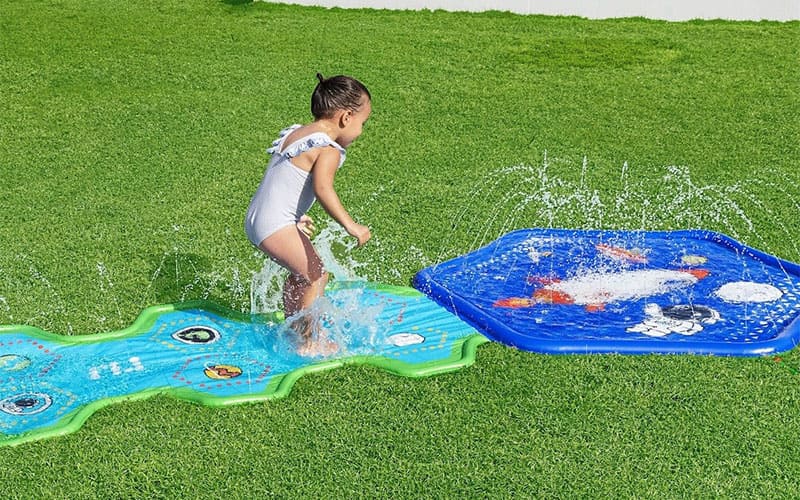
Splash pads made from thicker PVC or PVC-based composite materials with reinforced seams, balanced spray layouts, and anti-slip textures perform best on uneven ground. Material flexibility combined with structural reinforcement allows the pad to adapt to minor ground variations without creating stress points, uneven spray, or safety risks. Design quality matters as much as material thickness.
Why material flexibility matters more than rigidity on uneven ground
Uneven ground does not challenge splash pads through weight—it challenges them through uneven support.
When a splash pad rests on grass, soil, or a slightly sloped patio, different sections of the material experience different levels of contact. If the material is too stiff, it bridges over low spots and concentrates stress at seams and edges. If it is too thin, it stretches unevenly and deforms under pressure.
EPN’s material engineers design splash pads using PVC and composite blends optimized for controlled flexibility, not rigidity. In internal lab testing that includes over 500 material and performance tests per year, pads with balanced flexibility showed:
- More even spray distribution on uneven bases
- Lower seam stress under repeated use
- Better recovery after drying and reinstallation
This balance is especially important in real residential environments where ground conditions change over time.
How material thickness affects performance on uneven surfaces
Thickness alone does not guarantee quality—but it strongly influences tolerance for uneven ground.
Based on EPN’s production data and field feedback from North America and Europe, material performance typically breaks down as follows:
| Material Thickness | Uneven Ground Tolerance | Typical Outcome |
|---|---|---|
| < 0.35 mm | Low | Creasing, uneven spray |
| 0.4–0.5 mm | Medium | Acceptable with padding |
| ≥ 0.55 mm | High | Stable on grass and soil |
Thicker materials distribute pressure more evenly and reduce localized stretching. In EPN’s long-cycle durability simulations, splash pads using thicker PVC and composite layers showed up to 30% less material fatigue when placed on uneven ground compared to thinner alternatives.
Why reinforced seams matter more than surface appearance
On uneven ground, seams—not surfaces—are the first components to fail.
When a splash pad flexes over low spots or slopes, seams absorb repeated micro-movements. Poor welding or thin seam margins fatigue quickly, even if the surface material looks intact.
EPN uses high-frequency welding and reinforced seam structures, validated through finite element analysis (FEA) and pressure cycling. In internal testing, reinforced seams demonstrated:
- More even load distribution
- Reduced risk of edge splitting
- Longer usable life under uneven support conditions
After-sales data across EPN’s global markets shows that early seam-related complaints drop significantly when reinforced seam designs are used, particularly for customers installing splash pads on lawns rather than hard patios.
How spray layout design influences stability and safety
Spray layout is often treated as a visual feature—but on uneven ground, it becomes a structural one.
Uneven spray distribution can signal uneven internal pressure, which is often caused by inconsistent ground contact. Pads with poorly balanced spray zones exaggerate this effect.
EPN designs splash pads with multi-point, evenly spaced spray layouts to maintain consistent internal pressure across the entire surface. In pressure-mapping tests, balanced spray designs showed:
- More uniform spray height across uneven bases
- Less internal stress concentration
- Faster pressure stabilization after setup
This is why some splash pads feel “calmer” and more predictable underfoot—design, not just material, makes the difference.
Why anti-slip textures are more effective when combined with proper material design
Anti-slip texture alone cannot compensate for poor material behavior.
On uneven ground, texture works best when:
- The surface stays evenly supported
- Water drains consistently
- The material flexes without folding
EPN integrates surface texture as part of a system, not a standalone feature. In user testing involving children and pets, pads with both textured surfaces and reinforced material construction showed measurably lower slip incidents, especially during running and turning movements.
This is particularly important for pet splash pads, where paw pressure concentrates on smaller surface areas.
Real-world performance across EPN’s global customer base
EPN currently ships splash pads to over 180 countries, with average monthly B2C sales exceeding 100,000 units across Amazon, Walmart, Temu, and independent sites.
Across this diverse user base:
- Grass and soil are the most common installation surfaces
- Perfectly level ground is the exception, not the rule
- Products designed for flexibility and reinforcement consistently outperform thinner, visually similar alternatives
These real-world results directly inform EPN’s ongoing material selection, structural optimization, and product updates.
Practical guidance for buyers and product selectors
When choosing a splash pad for uneven ground, look beyond color, shape, or graphics.
Prioritize:
- Material thickness with controlled flexibility
- Reinforced, well-welded seams
- Balanced spray layouts
- Anti-slip surface textures
When these elements work together—as they do in EPN splash pads—the product adapts naturally to real backyards instead of fighting against them.
Final takeaway
Uneven ground exposes the difference between products that merely look good and products that are engineered well.
With the right combination of materials and design, a splash pad can remain safe, stable, and enjoyable even when the ground beneath it is imperfect. That reality—not ideal conditions—is what EPN designs for.
Do You Need to Maintain or Re-Adjust a Splash Pad Over Time?
Yes. Splash pads—especially those installed on grass or soil—benefit from periodic checks and minor re-adjustments. Ground settles, soil shifts, and repeated use changes how the surface supports the pad. Simple maintenance like re-leveling padding, checking edges, and adjusting water pressure helps preserve safety, spray balance, and material lifespan without major effort.
Why splash pads change over time—even if the setup was perfect
Outdoor environments are not static. Lawns compress, soil dries and rehydrates, and even concrete subtly shifts with temperature changes. A splash pad that felt perfectly stable on day one may behave differently after two weeks of summer use.
Based on EPN’s global after-sales analysis—covering over 100,000 monthly B2C orders across Amazon, Walmart, Temu, and independent sites—most performance-related questions arise after initial installation, not during it. Importantly, these are rarely product failures. They are normal responses to environmental change.
In practical terms, maintenance is about responding to ground behavior, not fixing defects.
How often should you check ground support and alignment?
Frequency depends on surface type and usage intensity.
EPN’s field guidance, refined through years of customer feedback, recommends:
- Grass or soil: quick check every 2–3 weeks during active use
- After heavy rain or heatwaves: immediate inspection
- Concrete or decking: monthly or seasonal review
These checks take only a few minutes and typically involve:
- Walking the pad barefoot while water runs
- Watching for new pooling patterns
- Checking if edges still sit flat
Across EPN’s data, customers who performed basic checks reported significantly fewer early wear concerns than those who treated splash pads as “set and forget” items.
What changes should you expect from weather and seasonal use?
Weather has a direct and measurable impact on ground support.
- Rain: softens soil, creating new low spots
- Heat: dries and shrinks soil, reducing support
- Repeated play: compresses grass and padding unevenly
In EPN’s internal usage simulations—designed to mimic backyard conditions—pads placed on soil showed measurable base compression within 10–15 active play sessions. This doesn’t make the setup unsafe, but it does mean that minor re-balancing improves performance.
Ignoring these changes allows small issues—like edge lifting or spray imbalance—to compound over time.
When should you re-adjust, and what does re-adjustment actually involve?
Re-adjustment sounds technical, but it’s usually simple.
You should re-adjust if you notice:
- Persistent water pooling where none existed before
- Spray height differences becoming more pronounced
- Edges folding or wrinkling repeatedly in the same spot
In most cases, re-adjustment means:
- Adding or repositioning foam or padding
- Lightly compacting a soft ground area
- Re-centering the splash pad
EPN’s durability testing shows that early re-adjustment reduces localized seam stress by up to 25% compared to continued use on an imbalanced base.
How does maintenance affect long-term product lifespan?
Splash pads don’t typically fail suddenly—they wear gradually.
Uneven ground without maintenance causes:
- Repeated folding along the same seam lines
- Concentrated pressure at entry points
- Uneven internal water pressure
Across EPN’s internal performance tracking—covering hundreds of thousands of shipped units annually—products used with basic maintenance practices show:
- Longer usable life
- Better spray consistency over time
- Lower likelihood of early material fatigue
In simple terms, maintenance protects both the user experience and the material investment.
Does maintenance differ for households with pets?
Yes—and this is often underestimated.
Pets:
- Apply concentrated weight through paws
- Enter and exit from the same edge repeatedly
- Change direction abruptly
EPN works with pet behavior advisors during product development, and usage data shows that medium and large dogs increase edge stress disproportionately compared to children. For pet households, edge checks and padding adjustments are especially important.
A setup that remains stable for kids may still need reinforcement for pets.
What about storage, relocation, and off-season care?
Proper handling between uses also counts as maintenance.
EPN recommends:
- Draining and drying the splash pad fully before storage
- Avoiding sharp folds along the same seam each time
- Rechecking ground support after relocation
Customers who rotate fold lines and store pads loosely report fewer crease-related concerns when reinstalling later in the season.
A realistic maintenance mindset for real families
Maintenance doesn’t mean constant attention. It means occasional awareness.
If you:
- Pay attention to how water behaves
- Notice how the surface feels under movement
- Make small adjustments when needed
then your splash pad will continue to perform safely and comfortably—even as the ground beneath it changes.
That approach aligns with how EPN designs its products: for real backyards, real weather, and real families—not idealized conditions.
Turning an Imperfect Yard into a Safe, Confident Water Play Space
Uneven ground is a reality for most families. Grass settles, soil shifts, patios slope for drainage—none of that should stop children or pets from enjoying safe, reliable water play. What truly matters is not chasing perfection, but understanding how materials, ground preparation, setup, and ongoing care work together.
Throughout this guide, one pattern is clear:
most splash pad problems are not caused by the product itself, but by a mismatch between the setup and the yard you actually have. When the ground is supported evenly, when water pressure is introduced gradually, and when materials are designed for flexibility rather than rigidity, splash pads perform exactly as intended—even on imperfect surfaces.
That is precisely the philosophy behind products from American Epsilon Inc. (EPN).
EPN designs and manufactures splash pads using reinforced PVC and composite materials, pressure-balanced spray layouts, and seam structures tested through hundreds of lab simulations and real-world use cases each year. These products are not engineered for ideal showroom floors, but for actual backyards, active children, energetic pets, and changing weather conditions.
For families and individual buyers
EPN splash pads are available in stock on Amazon across the U.S., Canada, and major European markets, with fast local fulfillment and verified customer reviews. If you’re looking for a splash pad that performs well on grass, soil, or slightly uneven patios, start there.
For brands, retailers, and bulk buyers
EPN offers full OEM / ODM customization, including material thickness, size, spray layout, packaging, branding, and compliance for global markets. Whether you’re launching a new product line or upgrading an existing one, EPN supports fast sampling and scalable production.
An uneven yard doesn’t have to mean compromised safety or performance. With the right knowledge—and the right product partner—it can become a space where kids run freely, pets cool off comfortably, and families enjoy summer without worry.
If you’d like help choosing the right splash pad, exploring customization options, or building a product strategy around real-world use, EPN is ready to support you.
Get A Fast quote
Here, bringing your inflatable concepts to life is no longer a challenge—it’s a collaborative journey where American Epsilon helps families, outdoor enthusiasts, and global brands transform creative ideas into safe, certified, and market-ready inflatable solutions.


Partner With Epsilon
Whether you are a family looking for safe backyard fun or a brand seeking large-scale OEM/ODM solutions, American Epsilon Inc. guarantees every inflatable is built with safety, durability, and excitement in mind. With flexible low MOQs, strategically placed warehouses in the U.S., Canada, U.K., and Germany, plus 24/7 professional support, we ensure smooth delivery and reliable service worldwide.
Ready to bring your inflatable ideas to life? Request free samples, fast prototypes, and customized designs today—your trusted inflatable journey starts here.