Skip to content
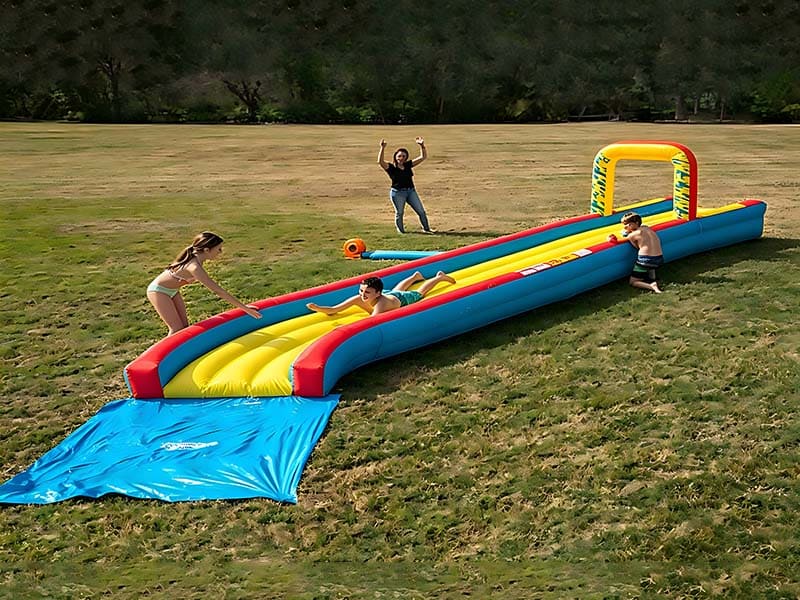
A lot of people think an inflatable water slide is basically a big colorful air toy. That sounds reasonable until the product actually gets used. Then the real questions show up fast. Why does one slide stay firm and smooth through heat, water, and heavy summer play, while another starts leaking, sagging, or wearing out much earlier than expected? Why do two slides that look similar online feel completely different in real life? In most cases, the answer is not the color, the blower, or even the size. It is the material.
Inflatable water slides have to deal with more abuse than many people realize. They are exposed to sun, water, weight shifts, friction during sliding motion, repeated climbing, and pressure concentrated in the same high-contact zones over and over. Materials that work for a light dry inflatable do not always work well for a wet slide. The outer surface has to stay slick enough for sliding, strong enough to resist tearing, and stable enough to hold shape under load. That is why material choice is not a technical side note. It is the foundation of product performance.
Most inflatable water slides are made from PVC-based materials, especially PVC-coated polyester or reinforced laminated PVC. These materials are widely used in inflatable structures due to their PVC material properties, including waterproof performance, flexibility, and strong resistance to outdoor wear. Higher-quality slides use thicker, stronger, waterproof material with welded seams and reinforcement in high-stress areas. Some lower-cost inflatables use lighter fabric-based materials, but for real water use, PVC is usually the preferred option because it handles water, wear, and pressure better.
That difference matters more than many buyers expect. A family may only notice the pattern and price at first. A retailer may focus on carton size and margin. But once the slide is wet, inflated, and full of motion, the hidden material decisions start showing up everywhere. That is why this question deserves a closer look before anyone buys, sources, or custom-develops a product.
What Are Inflatable Water Slides Made Of?
Inflatable water slides are usually made from PVC-based inflatable material, not from ordinary plastic sheeting. In better products, the material is closer to a technical composite: a polyester fabric base for strength, coated or laminated with PVC for waterproofing, flexibility, and air retention. This is why a well-made slide can stay inflated, hold shape, and handle repeated wet use, while a weaker one may wrinkle, soften, or fail much sooner. Suppliers of inflatable fabrics consistently describe PVC-coated polyester as a standard material for inflatable structures because it offers airtightness, tensile strength, UV stability, and outdoor durability.
For customers, the material question matters because it affects nearly every part of ownership. It influences how the slide feels underfoot, how smooth the slide lane stays when water is running, how well the seams hold air, how fast the product dries after use, and how many seasons it is likely to last. It also affects shipping weight, carton size, repair difficulty, and return risk. In other words, when people ask what inflatable water slides are made of, they are really asking a bigger question: what is this product built to survive?
What Materials Are Inflatable Water Slides Made Of?
Most inflatable water slides in the market fall into three broad material directions. The first is PVC-coated polyester, which is the most common for serious water-use inflatables. The second is laminated reinforced PVC, often used when extra durability is needed. The third is coated woven fabric, such as Oxford fabric, which is lighter and cheaper but usually less suitable for repeated wet sliding. Industry material suppliers describe PVC inflatable fabric as a combination of polyester and PVC that provides waterproofness, flexibility, and durability in outdoor use.
A practical way to understand this is to separate core strength from surface performance. The inner polyester layer helps resist stretching and tearing. The PVC outer layers create the waterproof, smooth, and weldable surface that makes the product function as an inflatable water slide rather than just a coated textile. That layered structure is important because a water slide does not face only air pressure. It also faces body weight, running water, friction from climbing and sliding, and repeated folding after use.
Here is a useful material breakdown for customers comparing products:
| Material direction | What it usually includes | Water use suitability | Main advantage | Main limitation |
|---|---|---|---|---|
| PVC-coated polyester | Polyester base + PVC coating | High | Strong, waterproof, weldable | Heavier |
| Laminated reinforced PVC | Multi-layer PVC with reinforcement | Very high | Better wear and pressure resistance | Higher cost |
| Oxford-type coated fabric | Woven fabric with coating | Medium to low | Lighter, lower cost | Less durable for repeated wet use |
From a customer point of view, this helps explain why two slides that look similar online can perform very differently after a few weekends in the backyard.
Are Inflatable Water Slides Made of PVC?
In most better-performing water slides, yes. PVC is the material most buyers should expect to see because it solves several product problems at the same time. It is waterproof, it can be heat-welded into airtight chambers, it supports printed graphics, and it holds up better than lighter coated fabrics in wet outdoor use. Material suppliers for inflatable structures repeatedly highlight PVC-coated fabrics for high tensile strength, UV stability, and long-term outdoor performance.
PVC also matters because of how inflatable slides are joined. A good slide depends heavily on seam quality. PVC panels can be connected using high-frequency welding or related thermal bonding methods, which gives manufacturers a stronger and more sealed connection than simple stitched construction. That is especially important in water slides because the product is not only inflated; it is also wet, slippery, under shifting weight, and repeatedly stressed in the same zones. Commercial-slide sources also note that PVC is the dominant material in this category because it balances durability, manufacturability, and cost reasonably well.
For families and retailers, the practical advantages of PVC usually show up in these areas:
- better resistance to continuous water contact
- smoother sliding surface
- easier cleaning after outdoor use
- stronger support for reinforced patches
- better seam performance in inflatable chambers
A simple comparison makes the point clearer:
| Feature | PVC-based inflatable material | Why it matters |
|---|---|---|
| Waterproof surface | Strong | Water is running across the product continuously |
| Welded seam compatibility | Strong | Better air retention and lower leak risk |
| UV resistance potential | Better | Outdoor use is hard on weak materials |
| Abrasion resistance | Better | Slide lanes and steps wear faster than people expect |
| Print quality | High | Helps branding and retail presentation |
So while not every product listing explains it clearly, PVC is usually the material behind the slides that perform more reliably.
Do Inflatable Water Slides Use Fabric?
Yes, but this is where many buyers get confused. PVC water slide material often already includes fabric inside it, usually polyester. That fabric is a strength layer and is part of the composite structure. The more important question is whether the product uses PVC-based inflatable fabric or relies more on coated Oxford-style fabric as the main body material. Those are not the same thing. Sources comparing PVC tarpaulin and Oxford fabric consistently describe PVC as the stronger and more water-resistant option, while Oxford is lighter and more budget-oriented.
Oxford fabric can make sense in lighter, lower-cost inflatables, especially where weight and portability matter more than long-term wear. But inflatable water slides are demanding products. Water is constantly flowing. Children climb up the same ladder repeatedly. Feet and knees press hard into the steps. The landing area takes repeated impact. In this setting, lighter fabric-based construction often reaches its limits sooner.
This is the practical difference most customers care about:
| Question | PVC-based inflatable fabric | Oxford-type coated fabric |
|---|---|---|
| Better for wet sliding use | Yes | Less ideal |
| Better for welded airtight chambers | Yes | Usually no |
| Better for repeated backyard use | Yes | Depends on duty level |
| Easier to carry and fold | Less | More |
| Better for long-term value | Usually yes | Often only for light use |
So the short answer is this: inflatable water slides do use fabric in many cases, but the stronger products usually use that fabric as a reinforced core under PVC, not as a lightweight substitute for proper PVC slide construction. That distinction matters a lot once the product is actually outside, wet, inflated, and under load.

Which Inflatable Water Slides Material Is Better?
The better material for inflatable water slides is usually the one that matches the way the product will actually be used. This sounds obvious, but it is where many poor purchases begin. A family sees a lower price and assumes all inflatable water slides are basically made the same way. A retailer compares photos and dimensions but does not compare material grade. A distributor focuses on carton cost first and only discovers the material gap after complaints start coming back. In real use, material is not a small detail. It affects slide feel, durability, water performance, repair rate, and how long the product keeps its shape.
For most inflatable water slides, the real comparison is not “plastic versus fabric” in a simple sense. It is more often reinforced PVC-based inflatable material versus lighter coated fabric construction. For water play, stronger PVC-based construction usually performs better because it handles wet conditions, air pressure, friction, and structural stress more consistently. That does not mean every thick material is automatically good or every lighter material is automatically bad. It means the right question is not just “Which material is best?” but “Best for what kind of use?”
Which Inflatable Water Slides Material Is Best?
If the goal is longer service life, fewer problems, and better performance in wet outdoor use, reinforced PVC is usually the better material choice. It gives manufacturers more control over seam quality, surface smoothness, pressure stability, and reinforcement in high-stress zones. For water slides, that matters because the product is not sitting still. It is constantly dealing with climbing force, body weight shifts, moving water, friction, and sun exposure.
From a customer point of view, the “best” material usually depends on these questions:
- How often will the slide be used?
- Will it stay outdoors for long periods?
- Is it for light home use or heavier resale/rental use?
- How important is low return risk?
- Is the goal lowest price or best long-term value?
A helpful way to judge material is to look at the product by use level instead of marketing language:
| Use level | Better material direction | Why it usually works better |
|---|---|---|
| Occasional home use | Standard reinforced PVC | Good balance of cost and durability |
| Frequent family use | Mid-to-heavy PVC construction | Better wear resistance in slide and step zones |
| School, event, or rental use | Heavy reinforced PVC | Better seam life, shape retention, and stress resistance |
| Budget seasonal use | Light coated material or thin PVC | Lower cost, but often shorter usable life |
For many customers, the best material is not the cheapest one. It is the one that still performs well after repeated weekends, repeated inflation, and repeated exposure to water and sun.
Are PVC Inflatable Water Slides Better for Water Use?
In most cases, yes. PVC-based inflatable water slides are usually better for water use because they handle three core demands at the same time: water resistance, air retention, and surface durability. This combination is especially important in inflatable slides because water is constantly running over the product while users are climbing and sliding on it. A material that looks fine when dry may behave very differently once it is wet for hours and under pressure.
For real users, PVC usually brings practical benefits that show up fast:
- the slide surface stays smoother
- the material dries more easily after use
- the structure is less likely to soften or sag from water exposure
- welded seams are usually more dependable than simple stitched construction
- reinforced patches bond more effectively in high-stress zones
This is especially important in the parts of the slide that wear first:
| High-stress area | What happens there | Why stronger PVC helps |
|---|---|---|
| Slide lane | Constant body friction | Slower surface wear |
| Climbing steps | Repeated foot pressure | Better shape and tear resistance |
| Landing area | Impact and water pooling | Better base durability |
| Side walls | Structural support under movement | Better pressure stability |
A lot of low-quality problems begin in these exact areas. When the material is too light, the customer may first notice softening, wrinkling, seam stress, or faster wear. So for water-based play products, PVC is usually the safer choice when performance matters more than saving a little on initial cost.
Are Commercial Inflatable Water Slides Different?
Yes, and the difference is much bigger than many people expect. A commercial inflatable water slide is not just a larger version of a home-use product. It is usually built with a different material strategy, stronger reinforcement, and a more conservative safety margin. Even when two slides look similar in photos, the internal structure and material grade can be very different.
Commercial products are normally designed to handle:
- more users per day
- heavier repeated loading
- more transport, folding, and setup cycles
- stricter durability expectations
- higher risk if material failure happens
Because of that, commercial slides usually use:
- thicker PVC
- stronger internal support structure
- more reinforcement on steps and slide zones
- more seam protection
- more durable anchor and stress-point construction
Here is the difference in a practical way:
| Feature | Home-use water slide | Commercial-style water slide |
|---|---|---|
| Material focus | Lower weight and lower cost | Strength and durability first |
| Thickness strategy | Often more basic | Often heavier and more selective by zone |
| Reinforcement | Limited or moderate | Extensive in stress areas |
| Lifespan expectation | Seasonal family use | Repeated heavy use |
| Return risk if underbuilt | Moderate | High |
This matters for brands too. Many sellers assume consumer customers only care about price, but in categories like inflatable water slides, material problems often turn into negative reviews, returns, replacements, and damaged trust. That is why many experienced suppliers would rather build a slightly stronger product than chase the lowest possible factory cost. In this category, better material usually means fewer problems later.
Overall, if the question is “Which inflatable water slides material is better?” the practical answer is this: for real water use, reinforced PVC is usually the better choice, especially when durability, safety, and long-term value matter. Coated fabric may have a place in lighter-duty inflatables, but when the product needs to stay smooth, strong, waterproof, and dependable through repeated summer use, stronger PVC-based construction is usually the material customers end up trusting more.

How Strong Are Inflatable Water Slides?
The strength of inflatable water slides depends much more on material grade, seam construction, and reinforcement layout than on appearance alone. In real use, a slide has to handle air pressure, moving water, climbing force, landing impact, and repeated friction in the same few zones. Commercial-grade inflatable slide sellers repeatedly point to the same factors: heavier PVC, reinforced seams, and extra support in high-stress areas are what separate stronger units from the ones that wear out early. Some commercial listings and guides now describe 15 oz PVC as a common commercial baseline, with 18–20 oz PVC used for heavier-duty water-slide construction.
For customers, “strong” does not just mean hard to puncture. It means the slide keeps its shape when kids climb up the same ladder 50 times, the landing area does not soften too quickly, the side walls stay supportive, and the seams do not start leaking after a short period of seasonal use. That is why a useful strength discussion should cover not only thickness, but also where the material is thicker, how the seams are built, and how long the structure can hold up under repeated use.
How Thick Are Inflatable Water Slides?
Material thickness is one of the clearest signals of overall strength, but it only helps when buyers know how to interpret it. In the commercial inflatable market, published specs often describe 15 oz PVC as common commercial vinyl, while more demanding slip-and-slide style products are marketed at 18–20 oz PVC for stronger long-term performance. One recent commercial guide frames 18–20 oz PVC with heat-welded seams as the target range for heavier-duty applications and contrasts that with cheaper residential-grade materials that wear out faster.
That does not mean every family needs the heaviest material possible. It means thickness should match the job. For a backyard family slide used occasionally, lighter construction may be enough. For frequent summer use, stronger mid-to-heavy PVC is usually the safer long-term choice. For rental or high-turnover use, heavier PVC becomes much more important because the product is folded, transported, inflated, and used far more often. A good way to think about it is this:
| Construction level | Material range often seen in market | Best fit |
|---|---|---|
| Light residential | below heavy commercial range | occasional family use |
| Strong residential / light commercial | around 15 oz PVC | frequent home use, stronger retail products |
| Commercial heavy-duty | 18–20 oz PVC | rental, event, high-use operation |
The more useful question for customers is not just “how thick is the slide?” but which parts are thickest? A smart product will put more strength where the wear is real: on the climbing steps, slide lane, landing zone, and base contact areas.
Do Inflatable Water Slides Have Strong Seams?
Yes, strong inflatable water slides should have strong seams, but seam quality varies a lot. This is one of the biggest hidden differences between products that look similar in photos. Commercial inflatable sellers increasingly call out seam construction because it directly affects maintenance, lifespan, and structural safety. One recent commercial slip-and-slide guide says seam method matters just as much as material thickness and specifically recommends documented seam construction such as triple stitching plus heat-welding for heavier-duty use. Another supplier highlights double to quadruple stitching, extra reinforcement patches, and webbing strips in high-stress areas.
From a real-use standpoint, seams are where several different forces meet at once:
- air pressure pushing outward
- body weight shifting during climbing and sliding
- water flow increasing slickness and movement
- folding stress during storage and transport
When seam quality is weak, the first problems often appear as slow leaks, distortion, or small failures around corners, steps, slide transitions, and splash-pool joins. When seam construction is stronger, the product usually holds pressure better, needs fewer repairs, and stays safer under repeated use. This is why stronger slides often include more than one reinforcement method at once:
| Seam feature | Why it matters |
|---|---|
| Heat-welded seam | improves sealing and air retention |
| Double or triple stitching | helps distribute stress |
| Reinforcement patches | protects corners and heavy-use joins |
| Webbing strips in stress zones | adds structural support where pulling force is highest |
For customers, seam quality is often the hidden reason a product feels “solid” for multiple seasons instead of becoming a repair project too early.
How Long Do Inflatable Water Slides Last?
The lifespan of inflatable water slides depends on construction quality, use frequency, UV exposure, storage habits, and maintenance. Commercial sources discussing stronger inflatable construction now commonly describe 5–10 years as a reasonable range for well-built commercial-grade equipment, while cheaper residential materials may last closer to 1–2 years under tougher use. One commercial guide directly contrasts 5–10 years for stronger 18–20 oz PVC construction with much shorter life for cheaper residential material. Another manufacturer notes outdoor warranties of 2 years and shorter coverage for heavier-use indoor environments, which also shows how strongly usage intensity affects expected life.
For ordinary customers, useful lifespan estimates are usually better understood by use pattern:
| Use pattern | Reasonable lifespan expectation |
|---|---|
| Light family use with good storage | a few seasons or more |
| Frequent summer family use | shorter, especially in hot sun |
| Rental or event use | depends heavily on commercial construction and repair discipline |
| Low-cost thin construction | often much shorter usable life |
The main life-shortening factors are predictable:
- strong UV exposure
- rough ground contact
- repeated folding while still damp
- overloaded use
- weaker seams or underbuilt stress zones
This is why strength should always be discussed as cost over time, not just first purchase price. A stronger inflatable water slide often costs more upfront, but if it resists seam failure, needs fewer repairs, and stays presentable for longer, the long-term value can be much better. That matters to families trying to avoid disappointment and to brands trying to avoid returns, replacements, and poor reviews.

Are Inflatable Water Slides Safe?
Inflatable water slides can be very safe, but only when the product is built correctly and used the right way. This is where many buyers make a mistake. They often judge safety by color, size, or whether the product “looks thick enough” in photos. In real use, safety depends on much more practical things: whether the slide stays inflated properly, whether the climbing area gives enough grip, whether the side walls hold shape during movement, whether the landing area is stable, and whether the material and seams can handle repeated stress without suddenly weakening.
For families, safety usually means one simple question: Can my children use this without constant worry? For retailers and brands, the question becomes broader: Will this product create avoidable complaints, injuries, or returns? In both cases, the answer is closely tied to structure, materials, and design details. A water slide is not just a soft toy. It is an air-supported structure under pressure, with moving water, body weight, climbing force, and sliding speed all happening at once. That is why small construction details matter so much.
A safer inflatable water slide usually includes:
- strong PVC-based material that keeps its shape under load
- reinforced seams that reduce leak risk
- stable side walls that help guide the user
- anti-slip climbing zones
- a landing area that is soft but not overly thin
- clear size and user recommendations
Safety is rarely about one feature alone. It comes from how the whole product performs when children actually climb, slide, sit, bounce, and move around on it.
How Safe Are Inflatable Water Slides?
Inflatable water slides are generally safe for home and recreational use when they are matched to the correct age group, inflated properly, installed on suitable ground, and supervised during play. Most real safety problems do not come from normal sliding. They usually come from one of four situations:
- the product is underbuilt for the way it is being used
- the slide is installed incorrectly
- too many users are on it at once
- the surface or structure has already been damaged
A strong inflatable water slide should stay firm during use, without sagging badly in the climbing area or collapsing at the side walls. When a slide loses shape too easily, users lose control more easily too. Children may slip awkwardly on the ladder, lean into soft side walls, or land in an unstable area that no longer feels supportive.
The table below shows what families and product teams should look at first:
| Safety factor | Why it matters | What to check |
|---|---|---|
| Air stability | Keeps the structure firm | Slide should stay upright and full during use |
| Climbing grip | Reduces slipping on the way up | Textured or anti-slip step area |
| Side wall support | Helps guide the user safely | Walls should feel firm, not floppy |
| Landing zone | Softens the end of the slide | Base should feel cushioned and stable |
| Seam condition | Prevents sudden air loss | No visible pulling, gaps, or stress marks |
For most households, the safest purchase is not the biggest or cheapest one. It is the one that feels stable, age-appropriate, and well built in the areas children actually use hardest.
Are Inflatable Water Slides Waterproof?
Yes, inflatable water slides are supposed to be waterproof, but buyers should think about this in a more practical way. The real question is not only “Does water stay outside the material?” The better question is: Can this slide handle repeated wet use without becoming weak, heavy, dirty, or unstable?
A proper water slide has to deal with constant water flow, splash-back, pooling in low areas, wet feet grinding dirt into the surface, and repeated drying and refolding. Better PVC-based materials perform well here because they do not absorb water, they dry faster, and they are easier to wipe down after use. This helps with both hygiene and long-term safety.
If a material dries too slowly or holds moisture badly, several problems can follow:
- slippery dirt buildup
- odor from damp storage
- mildew risk
- weaker feel after repeated soaking
- surface aging in wet folds or creases
The practical safety link is simple: cleaner, more stable, faster-drying material usually creates a better user experience and fewer problems during repeated summer use.
Here is a quick way to judge waterproof performance from a user point of view:
| Question | Why it matters for safety |
|---|---|
| Does the surface dry reasonably fast? | Helps reduce odor, mildew, and dirty buildup |
| Does the slide stay smooth under water flow? | Helps users slide more predictably |
| Do wet areas stay structurally firm? | Helps prevent unstable footing |
| Is the material easy to clean? | Reduces slippery residue and hygiene issues |
So yes, waterproofing matters, but real safety comes from how the whole product handles water over time, not just on day one.
Do Inflatable Water Slides Handle Sun and Wear?
This is one of the most important safety questions because many water slides do not fail all at once. They slowly become less safe as sunlight, friction, and repeated use wear them down.
Outdoor water slides spend long hours in the sun. Over time, heat and UV exposure can make weaker material fade, stiffen, lose flexibility, or become more likely to crack. At the same time, the same few areas keep taking abuse:
- the top platform
- the climbing steps
- the slide lane
- the landing or splash area
- the bottom base touching the ground
This repeated friction matters more than many buyers realize. A slide can still look attractive in product photos while being underbuilt in the zones that wear first. That is why stronger slides often use thicker or reinforced material in the most heavily used sections.
The table below shows how wear affects safety in real use:
| Stress source | What happens over time | Why it becomes a safety issue |
|---|---|---|
| Sun exposure | Material can age and harden | Reduced flexibility can lead to cracking or weakness |
| Slide friction | Surface gradually wears down | Rougher or thinner areas can reduce performance |
| Step pressure | Repeated foot force stresses the material | Weak steps can feel unstable |
| Ground abrasion | Base rubs against the surface below | Thin bottoms can wear faster and lose support |
For families, this means regular inspection matters. For brands and importers, it means durability is directly connected to safety reputation. A product that wears too fast becomes a safety problem even if it started out looking fine.
A safer inflatable water slide is not just one that works when it is brand new. It is one that still behaves predictably after repeated exposure to water, sun, and active play. That is the standard customers should really care about.

How Are Inflatable Water Slides Made?
Inflatable water slides are made through a sequence of very practical manufacturing steps: material selection, panel cutting, printing, welding or stitching, reinforcement, hardware installation, inflation testing, and final inspection. What matters to customers is not the factory jargon. What matters is how these steps affect the finished product. A slide that is cut accurately, welded cleanly, reinforced in the right places, and pressure-tested well will usually hold air better, wear more slowly, and create fewer problems after sale. A weaker slide often fails for the opposite reasons: material choice was too light, seams were underbuilt, reinforcement was missing in stress areas, or testing was too basic. Commercial suppliers repeatedly point to the same pattern: thickness, seam construction, and reinforcement strategy are what separate short-life inflatables from stronger long-use products.
From a customer point of view, “how it is made” connects directly to cost, lifespan, and complaint rate. A family buyer feels this as ease of use and reliability. A retailer feels it as return rate. A distributor feels it as replacement cost and reputation risk. That is why this section matters. The factory process is not just background information. It explains why two water slides with similar size and photos can perform very differently once they are wet, inflated, and used repeatedly. Commercial inflatable sources now commonly call out heavier vinyl, reinforced seams, and inspection standards because those details have a direct effect on real-world durability.
How Are Inflatable Water Slides Cut and Welded?
The process usually starts with PVC material rolls being checked, measured, and cut into individual panels. These panels become the slide lane, side walls, climbing section, splash area, base, and support chambers. In better production environments, the cutting stage is done with controlled templates or automated cutting equipment so the parts line up correctly during assembly. That matters because even a small mismatch at this stage can create seam tension later, and seam tension often turns into leaks or shape problems after repeated use.
Once the panels are ready, the factory joins them. In stronger inflatable water slides, the most important joining method is heat-based sealing, often described commercially as heat-welding or heat-sealing. Some suppliers also combine this with multiple rows of stitching for added strength. Commercial inflatable guidance increasingly highlights this point: stronger products usually rely on heat-welded seams together with double, triple, or even quadruple stitching, rather than depending on one simple seam method alone. One recent commercial slip-and-slide guide says the stronger setup for heavy use is high-grade PVC combined with triple or quadruple stitching plus heat-welding.
For customers, the manufacturing meaning is simple:
| Factory step | What it does | Why customers should care |
|---|---|---|
| Panel cutting | Shapes each section of the slide | Better fit reduces seam stress |
| Heat-welding | Bonds PVC panels together | Better air sealing and water resistance |
| Multi-row stitching | Adds mechanical reinforcement | Better seam life under repeated load |
| Alignment control | Keeps the structure balanced | Better shape retention when inflated |
This is why seam language in product specs matters more than many buyers think. A slide does not fail because one giant panel suddenly gives up. It more often fails where two or more pieces meet.
Where Are Inflatable Water Slides Reinforced?
Not every part of an inflatable water slide takes the same level of abuse, so good factories do not treat every panel the same way. They reinforce the zones that wear fastest and carry the most stress. Commercial product guidance repeatedly identifies the same critical areas: climbing steps, slide lanes, high-traffic landings, anchor areas, corners, and major seam intersections. Suppliers discussing durable inflatables often mention reinforced seams, webbing strips, and extra patching in these exact locations.
In real use, these are the parts that need the most attention:
- Climbing steps: concentrated foot pressure and repeated upward force
- Top platform: users pause, pivot, and put uneven weight on this area
- Slide lane: constant body friction plus water flow
- Landing or splash zone: repeated impact and pooled water
- Base contact area: rubbing against the ground during setup and use
- Anchor points and stress corners: pulling force and shape retention
Factories usually reinforce these areas by using one or more of the following:
- thicker PVC in targeted zones
- extra PVC patch layers
- reinforced webbing or strips over stress seams
- multi-layer seam construction
- stronger attachment points and backing material
That matters because it improves durability without making the whole product unnecessarily heavy. This targeted approach is one reason a better-made slide can feel stronger even when the overall design looks similar.
| Reinforced area | Main risk without reinforcement | Common reinforcement approach |
|---|---|---|
| Steps | early wear and instability | thicker tread panels, extra patches |
| Slide lane | surface wear from friction | double-layer or heavier lane surface |
| Base | abrasion from ground contact | heavier bottom layer |
| Stress corners | seam pulling and distortion | patch reinforcement and webbing |
| Anchors | tearing under tension | backed anchor construction |
For families, this usually shows up as fewer weak spots and a slide that still feels solid later in the season. For brands, this usually shows up as fewer complaints and better long-term product reviews.
How Are Inflatable Water Slides Tested?
After assembly, stronger factories do not go straight to packing. They test the slide. Testing is one of the clearest differences between a product that only looks good in photos and a product that holds up in real use. Commercial inflatable guidance now puts heavy emphasis on air retention, seam inspection, material strength, and safety-related checks before equipment is sold. Recent commercial sources also stress certification and inspection because underbuilt products can fail sooner and cost much more over time through repairs and replacements.
A solid testing process usually includes:
- Inflation hold test to check air loss over time
- Seam inspection to find weak joins or pulling points
- Material surface check for damage, misprints, or coating issues
- Anchor and hardware check to confirm attachment reliability
- Water-flow check to confirm the slide performs correctly when wet
- Load or structure check to see whether the shape stays stable when used
Some commercial-oriented suppliers also point to UV resistance, flame resistance, mold resistance, and certification-related checks as part of the higher-grade evaluation process, especially for units meant for rental or public-facing use.
This is where manufacturing quality becomes very practical for customers:
| Test focus | What it helps prevent |
|---|---|
| Air retention | unexpected sagging and leak complaints |
| Seam inspection | early seam separation |
| Surface inspection | sliding problems and coating defects |
| Load check | poor shape under active use |
| Water-flow test | weak play performance and poor drainage |
In short, inflatable water slides are not just “printed, sewn, and boxed.” The better ones are carefully cut, strongly joined, selectively reinforced, and tested before shipment. That is what gives the finished product a better chance of surviving real outdoor use instead of just looking good on the listing page.
Which Inflatable Water Slides Should You Choose?
The right inflatable water slide is not simply the biggest one, the cheapest one, or the one with the most colorful design. The right choice depends on who will use it, how often it will be used, how much space is available, and how strong the material and structure need to be. This is where many buyers go wrong. They compare size and price first, but overlook the details that decide whether the product will actually feel safe, last through the season, and create a good user experience.
For families, the best slide is usually the one that feels manageable, stable, and age-appropriate. For brands and retailers, the best slide is usually the one that reduces returns, performs consistently, and fits the target market clearly. For importers and distributors, the best slide is often the one that balances material quality, shipping efficiency, and long-term reliability. So the choice is never only about the slide itself. It is about the full use scenario around it.
A good purchasing decision normally starts with five practical questions:
- Who will use the inflatable water slide?
- How many users will be on it at the same time?
- How often will it be inflated and used?
- Is it for family use, resale, or commercial rental?
- Is the goal lowest upfront cost or better long-term value?
The table below helps simplify the decision:
| Use case | Best slide direction | Why it usually works better |
|---|---|---|
| Small family backyard use | Moderate-size reinforced PVC slide | Easier setup, lower space pressure, better daily use fit |
| Frequent home summer use | Stronger PVC slide with reinforced steps and lane | Better wear resistance and lower failure risk |
| Retail / e-commerce resale | Mid-to-high quality consumer-grade slide | Better reviews, fewer complaints, better repeat sales |
| Event / rental / institutional use | Commercial-grade reinforced slide | Better lifespan under repeated heavy use |
A good inflatable water slide should match the user’s real routine, not just their first impression.
Which Inflatable Water Slides Are Good for Families?
For families, the best inflatable water slide is usually one that is safe, stable, easy to manage, and sized correctly for the children who will actually use it. A very large slide may look exciting on a product page, but if it overwhelms the backyard, takes too long to dry, or feels too advanced for younger children, it may not be the best purchase in practice.
Family buyers usually benefit most from these features:
- reinforced PVC rather than very thin lightweight material
- side walls that stay firm during play
- climbing steps with grip or texture
- a landing area that feels soft but supported
- a size that matches both the users and the yard
Space matters more than many people expect. A large slide may need more room around it than the listed product size suggests because families also need walking space, hose placement, blower position, and a safe clear area around the base.
A useful family checklist looks like this:
| Family concern | What to look for |
|---|---|
| Younger children | Lower height, easier climb, stable landing area |
| Multiple kids playing | Stronger material, wider lane, better side support |
| Limited backyard | Moderate footprint, simpler setup, easier storage |
| Frequent summer use | Reinforced slide lane and stronger step area |
| Easier maintenance | PVC surface that dries and wipes down more easily |
For most families, the better choice is often one step stronger than the cheapest option, because that extra strength usually improves both safety and lifespan.
Which Inflatable Water Slides Are Good for Brands?
For brands, the best inflatable water slide is not necessarily the one with the lowest factory cost. It is the one that fits the target customer clearly and performs well enough to protect the brand after the sale. That means thinking beyond the first shipment and focusing on things like return rate, customer complaints, product reviews, and consistency across batches.
Brands usually need to decide what kind of category they want to serve:
- budget impulse-buy category
- stronger family-use category
- premium outdoor play category
- commercial or institutional category
Each one needs a different product strategy. A budget line may accept lighter construction, but if the product becomes too weak, the savings disappear through replacements and refund pressure. A stronger family-use line often performs better long term because customers notice stability, better material feel, and fewer early failures.
For brands, the most important questions usually are:
- Is the material strong enough for the promised use level?
- Are the stress zones reinforced properly?
- Is the packaging right for e-commerce shipping?
- Can the design stand out without sacrificing durability?
- Will the product create confidence after the first few uses?
This comparison helps:
| Brand goal | Better product direction |
|---|---|
| Lower entry price | Simpler design, controlled specs, but avoid underbuilt material |
| Better reviews | Reinforced consumer-grade PVC and stronger seam construction |
| Lower return risk | More stable structure, better stress-zone reinforcement |
| Premium positioning | Better finish, stronger material, better packaging and graphics |
For most brands, the best-performing product is usually the one that gives customers fewer surprises after unboxing. A slide that looks good online but feels weak in real use often creates the worst kind of product feedback.
How to Source Inflatable Water Slides?
Sourcing inflatable water slides well means asking better questions before production starts. Too many buyers only compare photos, size, and price. That is not enough for a product category where performance depends so heavily on material, seam construction, and reinforcement.
A better sourcing process usually includes checking:
- what material is being used
- how thick the main panels are
- whether the seams are welded, stitched, or both
- where the slide is reinforced
- how the product is tested before shipment
- whether the supplier understands the target market
A useful sourcing checklist is below:
| What to ask the supplier | Why it matters |
|---|---|
| What is the main material? | Confirms whether it is proper PVC-based slide construction |
| What are the key thicknesses? | Helps judge real durability |
| Which areas are reinforced? | Reveals whether the design is built for real use |
| How are the seams made? | Strong seams reduce leak and repair risk |
| What tests are performed? | Shows whether quality is controlled before shipment |
| Can you support custom graphics and packaging? | Important for brand-building and resale |
For businesses, good sourcing is not only about finding a manufacturer. It is about finding a supplier that can match material, structure, packaging, and production logic to the actual market need. A family-focused retail product should not be built exactly like a rental unit, and a rental unit should not be sourced like a low-cost seasonal toy.
In simple terms, the inflatable water slide you should choose is the one that best matches the real workload it will face. Families should choose a slide that feels safe, manageable, and durable enough for repeated summer use. Brands should choose a slide that protects reviews and reduces returns. Distributors should choose a slide that holds up across batches and shipping cycles. When the product matches the real use case, everything works better after the sale.
Work With Epsilon for Inflatable Water Slides
For businesses looking to develop or source inflatable water slides, working with an experienced manufacturer can significantly simplify the process and reduce long-term risk.
American Epsilon Inc. focuses on PVC and composite inflatable product manufacturing, with strong experience in water-based recreational products such as splash pads, inflatable pools, and outdoor play equipment.
Instead of focusing only on appearance, Epsilon emphasizes:
- material durability for real outdoor use
- structural stability under repeated stress
- consistent production quality across large orders
Epsilon supports both ready-to-sell product lines and custom development projects, including:
- inflatable water slide design and structure development
- reinforced PVC material selection
- custom graphics and branding
- packaging solutions for global markets
- prototype sampling and scalable production
For brands, retailers, and distributors, this means faster development, more reliable quality, and better long-term product performance.
If you are planning to develop custom inflatable water slides or expand your outdoor product line, you can contact the Epsilon team to:
- discuss product specifications
- request samples for evaluation
- receive a quotation for OEM production
With strong material expertise and manufacturing capability, Epsilon helps transform product ideas into reliable inflatable products used in real-world environments.
Work With Epsilon for Inflatable Water Slides
For brands, retailers, and distributors, developing inflatable water slides requires more than just visual design. Product durability, structural stability, and long-term outdoor performance are critical for real-world use.
American Epsilon Inc. specializes in PVC and composite inflatable product manufacturing, with strong experience in water-based recreational products such as splash pads, inflatable pools, and outdoor play equipment.
Instead of focusing only on appearance, our development process emphasizes:
- material durability for outdoor environments
- structural stability under repeated use and water pressure
- consistent production quality across large-scale orders
Epsilon supports both custom development projects and scalable OEM production, including:
- inflatable water slide structure design
- reinforced PVC material selection
- custom graphics, branding, and visual design
- packaging solutions for global retail markets
- prototype sampling and mass production
For businesses, this means faster product development, more stable supply, and reliable product performance in real use scenarios.
Get Custom Inflatable Water Slide Solutions
If you are planning to develop custom inflatable water slides, private label outdoor products, or branded water recreation equipment, our team can support you from concept to production.
Contact Us for Custom Water Slide Solutions
Request Product Samples
Before placing bulk orders, evaluating product samples helps you understand:
- material thickness and durability
- structural stability
- real user experience
Request a Product Sample
Explore More PVC Inflatable Products by Epsilon
If you are sourcing inflatable water recreation products, you may also be interested in the following manufacturing solutions: