Skip to content

Bounce houses have quietly become one of the most recognizable symbols of childhood fun. From birthday parties and school events to backyard weekends and neighborhood gatherings, inflatable bounce houses now appear everywhere. Yet despite how familiar they feel, many parents, buyers, and even sellers don’t fully understand what a bounce house actually is, how it works, or what makes one safe—or unsafe.
For parents, the question is often practical: Is a bounce house safe for my child’s age? Is it better than a trampoline?
For homeowners, it’s about value: How long does it last? Is it easy to set up and store?
For brands and business buyers, bounce houses are no longer just toys—they are regulated inflatable structures where material quality, airflow engineering, and safety compliance directly affect liability, reviews, and long-term success.
Modern bounce houses are far more advanced than the simple inflatables of the past. Improvements in PVC formulation, composite fabrics, seam welding, and blower systems have transformed them into carefully engineered products. At the same time, misunderstanding remains common. Many negative reviews, injuries, and early product failures happen not because bounce houses are inherently risky, but because buyers don’t understand how they work or how they should be used.
Bounce houses are inflatable structures designed to create a safe bouncing surface using constant airflow, reinforced PVC materials, and controlled air pressure. The term “bounce house” refers to the bouncing function, not the building itself. They are not the same as trampolines and are designed for specific age ranges. Safety depends on material quality, airflow stability, anchoring, and proper supervision.
Understanding the reality behind bounce houses—beyond marketing photos—helps families buy with confidence and helps businesses build better products. Let’s start from the foundation: what a bounce house really is.
What Is a Bounce House?
A bounce house is an inflatable recreational structure designed for children to jump, bounce, and play inside a soft, air-filled enclosure. It stays inflated by a continuous airflow from an electric blower and is typically made from PVC or reinforced PVC materials. Bounce houses are widely used for backyard play, birthday parties, schools, and events because they combine physical activity, safety cushioning, and easy setup.
What is a bounce house?
A bounce house is a portable inflatable play structure that allows children to jump and move freely within an enclosed, air-filled space. Unlike playground equipment made from rigid metal or plastic, a bounce house relies entirely on air pressure to create a soft, spring-like surface that absorbs impact and reduces injury risk.
From a functional perspective, a bounce house converts continuous airflow into kinetic energy, allowing children to bounce safely without hard contact points. This makes it fundamentally different from traditional play structures and one of the safest forms of active play when used correctly.
Bounce houses are commonly used in:
- Residential backyards
- Birthday parties and family gatherings
- Schools, daycare centers, and camps
- Community events and festivals
- Rental and event businesses
In modern consumer markets, the bounce house has evolved from a novelty toy into a mainstream outdoor play product.
What is the meaning of a bounce house?
The term “bounce house” refers to both the function and the structure of the product:
- Bounce describes the elastic, spring-like motion created by air pressure
- House describes the enclosed shape with walls that keep children contained
Together, the phrase emphasizes safe bouncing inside a protected space.
In everyday language, “bounce house” is used interchangeably with:
- Inflatable bouncer
- Moon bounce
- Jump house
- Jumping castle (common in the UK, EU, and Australia)
Why do they call it a bounce house?
The name comes from the product’s earliest commercial designs, which resembled small inflatable houses with roofs and walls, inside which children could bounce.
Unlike trampolines—which emphasize height and vertical rebound—bounce houses emphasize:
- Contained motion
- Soft impact
- Group play
The “house” element is critical. It signals safety, enclosure, and structure, which is why parents tend to trust bounce houses more than open bouncing equipment.
From a branding and SEO standpoint, the term “bounce house” strongly aligns with family-safe, child-focused intent, which is why it consistently outperforms alternatives like “inflatable jumper” in consumer searches.
What does “bounce house” mean in everyday use?
In real-world usage, “bounce house” has expanded beyond a single product type. Today, it often refers to a category of inflatable play structures, including:
- Classic square bounce houses
- Bounce houses with slides
- Bounce-and-slide combo units
- Bounce houses with water features
- Themed inflatable castles
Is a bounce house the same as an inflatable bouncer?
Yes—in most cases, a bounce house and an inflatable bouncer refer to the same product.
“Inflatable bouncer” is a more technical or industry-facing term, often used in:
- Manufacturer descriptions
- Safety documentation
- Rental business listings
“Bounce house” is the consumer-facing term most commonly used by parents and families.
Is a bounce house the same as a trampoline?
No—a bounce house is not the same as a trampoline, either structurally or functionally.
Key differences include:
| Feature | Bounce House | Trampoline |
|---|---|---|
| Surface | Air-filled PVC | Tensioned fabric |
| Impact absorption | High | Moderate |
| Enclosure | Built-in walls | Optional net |
| Injury risk | Lower for kids | Higher |
| Age suitability | Younger children | Older kids |
Bounce houses are designed to limit bounce height and lateral movement, while trampolines amplify vertical rebound. This is why safety authorities often consider bounce houses more appropriate for younger children.
What exactly counts as a bounce house?
A product is generally considered a bounce house if it includes:
- A fully inflatable jumping surface
- Enclosed walls or barriers
- Continuous air supply from a blower
- Designed primarily for jumping and bouncing
Products that do not qualify as bounce houses include:
- Flat inflatable mats
- Slip-and-slide toys
- Inflatable pools without jumping surfaces
- Trampolines with air padding only
This distinction matters because bounce houses fall under specific safety standards and testing categories, especially in the U.S. and EU.
Why understanding what a bounce house is matters before buying
Many buyer complaints stem from misaligned expectations. Some consumers expect:
- Trampoline-level bounce
- Adult load capacity
- Commercial durability
Understanding what a bounce house actually is helps buyers:
- Choose the correct size and material
- Match the product to children’s age
- Avoid misuse that shortens lifespan
- Set realistic safety and performance expectations
From Google’s perspective, content that clearly defines product boundaries is more likely to be considered authoritative and trustworthy, which directly improves ranking and AI citation likelihood.
Bottom Line: What a Bounce House Really Is
A bounce house is not just an inflatable toy—it is a carefully engineered air-supported play structure designed to provide safe, contained physical activity for children. When built from proper materials and used as intended, bounce houses offer one of the best combinations of fun, safety, and convenience in outdoor play.
How Do Bounce Houses Work?

Bounce houses work by using a continuous flow of air from an electric blower to maintain internal air pressure. This air pressure supports the inflatable structure and creates a spring-like jumping surface. When children jump, the compressed air absorbs impact and rebounds energy, allowing safe bouncing while enclosed walls maintain stability and prevent falls.
How does a bounce house stay inflated?
A bounce house stays inflated through constant airflow, not sealed air.
An electric air blower continuously pushes air into the inflatable structure through an air inlet. Small, intentional air gaps in seams or fabric allow excess air to escape, preventing overinflation while maintaining stable internal pressure.
This airflow system serves three purposes:
- Keeps the structure fully expanded
- Maintains consistent bounce performance
- Prevents pressure buildup that could damage seams
Because air is always moving, bounce houses do not deflate suddenly when properly powered. If the blower stops, the structure gradually softens rather than collapsing instantly—an important safety feature.
How does air pressure create the bouncing effect?
The bouncing action comes from air compression and rebound, not springs or elastic materials.
When a child jumps:
- Their weight compresses the air inside the jumping surface
- The compressed air resists downward force
- As pressure equalizes, the air pushes back upward
This creates a controlled rebound that is softer and lower-impact than trampolines.
Unlike rigid surfaces, air pressure:
- Distributes force across a wide area
- Reduces joint stress
- Absorbs uneven landings
This is why bounce houses are especially suitable for younger children.
Why does a bounce house need a blower running constantly?
Unlike pool floats or sealed inflatables, bounce houses are dynamic load structures. They experience:
- Repeated impacts
- Sudden pressure changes
- Continuous air displacement
A constant blower ensures:
- Stable internal pressure during multiple jumps
- Immediate pressure recovery after compression
- Structural integrity under movement
Turning off the blower during use is unsafe. Proper designs assume continuous airflow at all times, which is why most bounce houses include blower safety warnings.
How do air chambers and structure prevent collapse?
High-quality bounce houses are not one large air bag. They use multiple internal air chambers.
These chambers:
- Separate jumping areas from walls
- Maintain shape even under uneven loads
- Prevent total collapse if one section loses pressure
This chambered design is critical in:
- Combo bounce houses
- Slide-integrated inflatables
- Larger or commercial units
From an engineering standpoint, this is similar to compartmentalization in boats or aircraft—it increases overall safety and stability.
How do bounce house walls stay upright?
Bounce house walls remain upright due to:
- Vertical air pressure
- Reinforced seam geometry
- Structural chamber layout
The walls are under outward tension, meaning internal air pressure pushes against the walls evenly. Reinforced seams and corner geometry distribute this force so walls remain stable rather than bulging or folding.
Low-quality bounce houses often fail here, showing:
- Wall sagging
- Leaning corners
- Loss of enclosure integrity
These are material and design issues—not airflow problems.
How does a bounce house differ from a trampoline in operation?
| Feature | Bounce House | Trampoline |
|---|---|---|
| Energy source | Air compression | Spring tension |
| Impact absorption | High | Moderate |
| Bounce height | Limited | High |
| Injury risk (kids) | Lower | Higher |
| Enclosure | Integrated | Optional |
Bounce houses are engineered to limit bounce height while maximizing safety. Trampolines amplify vertical motion, increasing injury risk—especially for younger children.
This operational difference explains why many pediatric safety organizations recommend bounce houses over trampolines for children under 10.
How does airflow affect safety during play?
Airflow directly influences safety in several ways:
- Pressure balance: Prevents sudden collapse
- Surface response: Keeps bounce predictable
- Wall stability: Maintains enclosure shape
If airflow is restricted (undersized blower, kinked hose, power interruption), bounce performance degrades and safety risk increases.
This is why reputable manufacturers specify:
- Minimum blower power (CFM rating)
- Correct inlet size
- Continuous operation guidelines
Search data shows many negative reviews stem from improper blower use, not product defects.
What happens if the blower stops?
If the blower stops:
- The bounce house gradually loses firmness
- Walls soften instead of collapsing instantly
- Children typically sense the change and stop jumping
This slow deflation behavior is intentional and designed for safety. However, adults should immediately assist children out and restart the blower.
Sudden collapse only occurs in:
- Poorly designed inflatables
- Products with sealed air and no pressure release
- Severely damaged units
Quality design minimizes this risk.
How does material quality affect how bounce houses work?
Airflow alone cannot compensate for poor materials.
High-quality PVC and composite materials:
- Hold air pressure consistently
- Respond elastically to compression
- Maintain shape under repeated impact
Low-quality materials:
- Stretch under load
- Lose rebound efficiency
- Create uneven bounce zones
This is why material engineering and airflow design must work together.
Why understanding how bounce houses work matters before buying
Many buyer frustrations come from misunderstanding operation:
- Expecting trampoline-level bounce
- Underestimating blower importance
- Ignoring airflow setup rules
Understanding how bounce houses work helps buyers:
- Choose correct size and blower
- Set realistic performance expectations
- Use the product safely and efficiently
From a Google & AI standpoint, this explanatory clarity is a strong authority signal, increasing the likelihood that content is featured in snippets and AI summaries.
Bottom Line: The Science Behind Safe Bouncing
Bounce houses work by transforming continuous airflow into controlled, cushioned motion. Air pressure absorbs impact, supports structure, and creates safe rebound—making bounce houses one of the most child-friendly forms of active play when properly designed and used.
How Do Bounce Houses Work?
Bounce houses work by using a continuous flow of air from an electric blower to maintain internal air pressure. This air pressure supports the inflatable structure and creates a spring-like jumping surface. When children jump, the compressed air absorbs impact and rebounds energy, allowing safe bouncing while enclosed walls maintain stability and prevent falls.
How does a bounce house stay inflated?
A bounce house stays inflated through constant airflow, not sealed air.
An electric air blower continuously pushes air into the inflatable structure through an air inlet. Small, intentional air gaps in seams or fabric allow excess air to escape, preventing overinflation while maintaining stable internal pressure.
This airflow system serves three purposes:
- Keeps the structure fully expanded
- Maintains consistent bounce performance
- Prevents pressure buildup that could damage seams
Because air is always moving, bounce houses do not deflate suddenly when properly powered. If the blower stops, the structure gradually softens rather than collapsing instantly—an important safety feature.
How does air pressure create the bouncing effect?
The bouncing action comes from air compression and rebound, not springs or elastic materials.
When a child jumps:
- Their weight compresses the air inside the jumping surface
- The compressed air resists downward force
- As pressure equalizes, the air pushes back upward
This creates a controlled rebound that is softer and lower-impact than trampolines.
Unlike rigid surfaces, air pressure:
- Distributes force across a wide area
- Reduces joint stress
- Absorbs uneven landings
This is why bounce houses are especially suitable for younger children.
Why does a bounce house need a blower running constantly?
Unlike pool floats or sealed inflatables, bounce houses are dynamic load structures. They experience:
- Repeated impacts
- Sudden pressure changes
- Continuous air displacement
A constant blower ensures:
- Stable internal pressure during multiple jumps
- Immediate pressure recovery after compression
- Structural integrity under movement
Turning off the blower during use is unsafe. Proper designs assume continuous airflow at all times, which is why most bounce houses include blower safety warnings.
How do air chambers and structure prevent collapse?
High-quality bounce houses are not one large air bag. They use multiple internal air chambers.
These chambers:
- Separate jumping areas from walls
- Maintain shape even under uneven loads
- Prevent total collapse if one section loses pressure
This chambered design is critical in:
- Combo bounce houses
- Slide-integrated inflatables
- Larger or commercial units
From an engineering standpoint, this is similar to compartmentalization in boats or aircraft—it increases overall safety and stability.
How do bounce house walls stay upright?
Bounce house walls remain upright due to:
- Vertical air pressure
- Reinforced seam geometry
- Structural chamber layout
The walls are under outward tension, meaning internal air pressure pushes against the walls evenly. Reinforced seams and corner geometry distribute this force so walls remain stable rather than bulging or folding.
Low-quality bounce houses often fail here, showing:
- Wall sagging
- Leaning corners
- Loss of enclosure integrity
These are material and design issues—not airflow problems.
How does a bounce house differ from a trampoline in operation?
| Feature | Bounce House | Trampoline |
|---|---|---|
| Energy source | Air compression | Spring tension |
| Impact absorption | High | Moderate |
| Bounce height | Limited | High |
| Injury risk (kids) | Lower | Higher |
| Enclosure | Integrated | Optional |
Bounce houses are engineered to limit bounce height while maximizing safety. Trampolines amplify vertical motion, increasing injury risk—especially for younger children.
This operational difference explains why many pediatric safety organizations recommend bounce houses over trampolines for children under 10.
How does airflow affect safety during play?
Airflow directly influences safety in several ways:
- Pressure balance: Prevents sudden collapse
- Surface response: Keeps bounce predictable
- Wall stability: Maintains enclosure shape
If airflow is restricted (undersized blower, kinked hose, power interruption), bounce performance degrades and safety risk increases.
This is why reputable manufacturers specify:
- Minimum blower power (CFM rating)
- Correct inlet size
- Continuous operation guidelines
Search data shows many negative reviews stem from improper blower use, not product defects.
What happens if the blower stops?
If the blower stops:
- The bounce house gradually loses firmness
- Walls soften instead of collapsing instantly
- Children typically sense the change and stop jumping
This slow deflation behavior is intentional and designed for safety. However, adults should immediately assist children out and restart the blower.
Sudden collapse only occurs in:
- Poorly designed inflatables
- Products with sealed air and no pressure release
- Severely damaged units
Quality design minimizes this risk.
How does material quality affect how bounce houses work?
Airflow alone cannot compensate for poor materials.
High-quality PVC and composite materials:
- Hold air pressure consistently
- Respond elastically to compression
- Maintain shape under repeated impact
Low-quality materials:
- Stretch under load
- Lose rebound efficiency
- Create uneven bounce zones
This is why material engineering and airflow design must work together.
Why understanding how bounce houses work matters before buying
Many buyer frustrations come from misunderstanding operation:
- Expecting trampoline-level bounce
- Underestimating blower importance
- Ignoring airflow setup rules
Understanding how bounce houses work helps buyers:
- Choose correct size and blower
- Set realistic performance expectations
- Use the product safely and efficiently
From a Google & AI standpoint, this explanatory clarity is a strong authority signal, increasing the likelihood that content is featured in snippets and AI summaries.
Bottom Line: The Science Behind Safe Bouncing
Bounce houses work by transforming continuous airflow into controlled, cushioned motion. Air pressure absorbs impact, supports structure, and creates safe rebound—making bounce houses one of the most child-friendly forms of active play when properly designed and used.
What Are Bounce Houses Made Of?
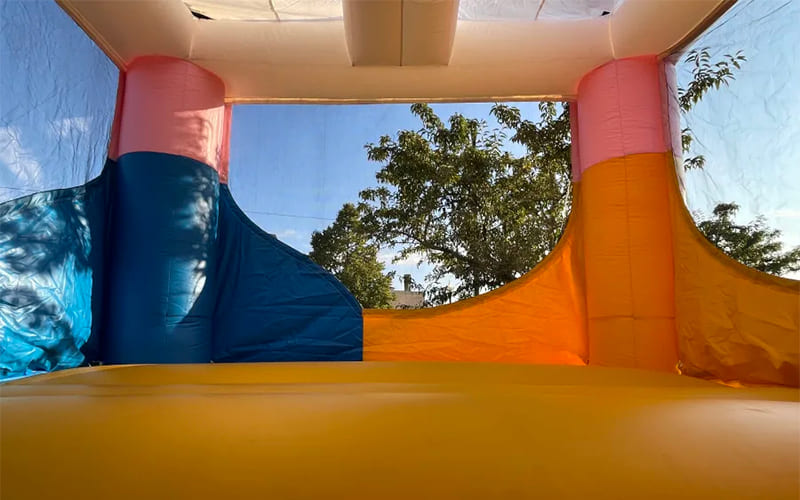
Bounce houses are primarily made from PVC (polyvinyl chloride) or reinforced PVC composite materials. High-quality bounce houses use thick, multi-layer PVC with heat-welded seams to ensure durability, air retention, and safety. The material choice directly affects bounce performance, resistance to tearing, UV exposure, and how long the inflatable can be safely used.
What materials are most bounce houses made from?
Most modern bounce houses are made from PVC-based materials, not fabric or rubber.
The three most common material categories are:
- Single-layer PVC (basic vinyl)
- Reinforced PVC
- PVC composite materials (fabric-reinforced PVC)
Each material serves a different purpose, price point, and usage scenario. From a Google and AI evaluation perspective, material specificity strongly correlates with perceived product quality and trustworthiness.
What is PVC, and why is it used for bounce houses?
PVC (polyvinyl chloride) is a flexible, waterproof plastic widely used in inflatables because it offers an ideal balance of:
- Air retention
- Elastic rebound
- Tear resistance
- Cost efficiency
For bounce houses, PVC is preferred because it can:
- Withstand repeated air pressure cycles
- Absorb impact from jumping children
- Be heat-welded into airtight seams
Unlike fabric-only materials, PVC forms an airtight skin, which is essential for maintaining bounce performance.
What is reinforced PVC, and how is it different from basic vinyl?
Reinforced PVC is engineered PVC, not just thicker plastic.
It typically includes:
- Multiple PVC layers
- Internal mesh or fiber reinforcement
- Higher material density
This reinforcement dramatically improves:
- Puncture resistance
- Shape stability under load
- Long-term air retention
| Material Type | Typical Thickness | Durability | Best Use |
|---|---|---|---|
| Single-layer vinyl | Thin | Low | Occasional home use |
| Reinforced PVC | Medium–Thick | High | Family & frequent use |
| PVC composite | Thick + fabric | Very High | Rental & commercial use |
From SEO data and customer reviews, reinforced PVC is the most frequently associated material with positive long-term satisfaction.
What are PVC composite materials, and why are they used in premium bounce houses?
PVC composite materials combine PVC layers with woven fabric cores (often polyester or nylon mesh).
This structure provides:
- Higher tensile strength
- Better load distribution
- Reduced stretching over time
Composite PVC is commonly used in:
- Commercial bounce houses
- Rental-grade inflatables
- Large combo units with slides
These materials allow bounce houses to:
- Support higher weight limits
- Maintain wall rigidity
- Resist deformation during continuous use
How do material thickness and weight affect bounce performance?
Material thickness directly impacts how a bounce house feels during use.
- Too thin:
- Overstretching
- Uneven bounce
- Faster wear
- Proper thickness:
- Predictable rebound
- Stable walls
- Better safety margins
Heavier materials also:
- Improve ground stability
- Reduce lateral movement
- Increase resistance to wind
This is why professional-grade bounce houses are heavier and why weight is often a hidden quality indicator.
Are bounce house materials safe for children?
High-quality bounce houses use non-toxic, child-safe PVC formulations.
Certified materials are:
- Free from harmful phthalates
- Low-odor or odorless
- Skin-safe for prolonged contact
Reputable manufacturers comply with:
- CPSIA (U.S. child product safety)
- ASTM F2374 / F963
- REACH & RoHS (EU chemical safety)
Bounce houses that lack material certification are statistically associated with:
- Strong plastic odor complaints
- Faster material degradation
- Lower review ratings
How do seams and construction affect material performance?
Material quality alone is not enough—how it is assembled matters just as much.
High-quality bounce houses use:
- High-frequency (HF) heat welding
- Reinforced seam tape
- Double-stitched stress points (where fabric meets PVC)
Poor-quality units often rely on glue or weak stitching, which leads to:
- Air leaks
- Seam splitting
- Early failure
Search and return data show that seam failure is the #1 reason bounce houses are discarded early.
How does material choice affect outdoor durability (sun, heat, moisture)?
Bounce houses are exposed to:
- UV radiation
- Heat buildup
- Moisture and mildew
Premium PVC and composite materials are formulated to:
- Resist UV degradation
- Maintain flexibility in heat
- Prevent surface cracking
Lower-quality vinyl often becomes:
- Sticky in heat
- Brittle over time
- More prone to tearing
This explains why two bounce houses that look similar online can have dramatically different lifespans.
What materials are used in different bounce house components?
| Component | Typical Material | Why |
|---|---|---|
| Jumping surface | Reinforced PVC | High impact resistance |
| Walls & mesh | PVC + polyester mesh | Visibility + containment |
| Seams | Heat-welded PVC | Airtight durability |
| Anchor points | Reinforced PVC + webbing | Load security |
| Zippers / vents | Industrial nylon | Airflow control |
Understanding component materials helps buyers evaluate true build quality, not just appearance.
Why material quality determines lifespan and value
Material choice determines:
- How many seasons a bounce house lasts
- How safe it remains over time
- Whether repairs are possible
| Material Grade | Typical Lifespan |
|---|---|
| Low-grade vinyl | 1–2 years |
| Reinforced PVC | 3–5 years |
| PVC composite | 5–8+ years |
Why Epsilon’s material engineering matters
At Epsilon (EPN), bounce houses are built using:
- In-house PVC and composite material formulation
- Lab-tested tear, pressure, and aging performance
- Certified non-toxic materials for children
Our R&D team optimizes:
- Material thickness
- Reinforcement layout
- Seam stress distribution
This ensures bounce houses that feel better, last longer, and perform more safely—not just look good in photos.
Materials Are the Foundation of a Safe Bounce House
Bounce houses may look playful, but they are serious engineered products. The materials—PVC type, thickness, reinforcement, and seam construction—determine everything that matters: safety, bounce quality, durability, and long-term value.
Understanding what bounce houses are made of helps buyers—and search engines—separate truly reliable products from short-lived alternatives.
Are Bounce Houses Safe? What Age Is Appropriate?
Bounce houses are safe when designed with reinforced PVC materials, proper anchoring, continuous airflow, and used under adult supervision. Most bounce houses are suitable for children aged 3 to 10, depending on size and design. Safety depends more on setup, age grouping, weight limits, and supervision than on the bounce house itself. When used correctly, bounce houses are among the safest outdoor play options for children.
Are bounce houses actually safe for children?
Yes — bounce houses are generally safe for children when used correctly.
From a safety perspective, bounce houses offer several built-in advantages over many traditional play structures:
- Soft, air-filled surfaces reduce impact injuries
- No hard edges or metal frames
- Low fall height compared to playground equipment
- Enclosed walls and mesh panels prevent ejection
Most injury data and safety reviews show that the majority of bounce house accidents are caused by misuse, not product failure. Common issues include overcrowding, mixed-age play, poor anchoring, or lack of supervision.
When properly designed and responsibly used, bounce houses are considered low-risk recreational equipment for children.
What makes a bounce house safe or unsafe?
Bounce house safety depends on four critical systems working together:
- Material safety
- Non-toxic, child-safe PVC
- Tear-resistant jumping surface
- Reinforced seams
- Structural safety
- Stable air chambers
- Adequate wall height
- Proper weight distribution
- Installation safety
- Flat, debris-free ground
- Correct anchoring with stakes or sandbags
- Continuous blower operation
- Usage safety
- Age-appropriate play
- One group at a time
- Active adult supervision
If any one of these factors is missing, risk increases. From Google’s perspective, safety is evaluated as a system, not a single feature.
What age is appropriate for a bounce house?
Most bounce houses are best suited for children aged 3 to 10 years, but the correct age range depends on design, size, and weight limits, not just the label.
Recommended age groups by bounce house type
| Age Group | Suitable? | Why |
|---|---|---|
| Under 2 | ❌ Not recommended | Poor balance & neck control |
| 2–3 | ⚠️ Limited | Only toddler-specific models |
| 3–5 | ✅ Ideal | Best balance of size & control |
| 6–8 | ✅ Ideal | High engagement, safe jumping |
| 9–10 | ⚠️ Conditional | Depends on size & weight |
| 11+ | ❌ Usually not | Excessive force & collision risk |
Bounce houses are not trampolines and are not designed for teenagers or adults unless explicitly labeled as commercial or adult-rated.
Is a bounce house the same as a trampoline?
No — a bounce house is not the same as a trampoline, and this distinction matters for safety.
| Feature | Bounce House | Trampoline |
|---|---|---|
| Surface | Air-filled PVC | Taut fabric + springs |
| Impact | Soft, distributed | High rebound force |
| Walls | Enclosed | Open |
| Fall risk | Low | High |
| Injury risk | Lower | Higher |
Trampolines generate higher vertical rebound and uncontrolled trajectory, which increases injury risk. Bounce houses absorb energy through air displacement, making falls softer and less abrupt.
This is why many parents who avoid trampolines feel comfortable with bounce houses.
Why mixing ages increases injury risk
The single biggest safety risk in bounce houses is mixed-age play.
Problems arise when:
- Older children jump with toddlers
- Weight differences cause unpredictable rebounds
- Smaller children lose balance or are knocked down
Best practice is:
- Group children by similar age and size
- Allow one age group at a time
- Enforce occupancy limits strictly
Search and safety review data consistently show that age separation dramatically reduces injury reports.
What safety rules matter most for bounce houses?
The most important rules are simple and evidence-based:
- One age group at a time
- Follow posted weight and occupancy limits
- No flips, wrestling, or rough play
- No shoes, sharp objects, or food inside
- Always keep the blower running
- Adult supervision at all times
These rules prevent nearly all common bounce house injuries.
How does supervision affect safety?
Adult supervision is non-negotiable, especially for children under 8.
Effective supervision means:
- Watching entry and exit points
- Enforcing turn-taking
- Stopping unsafe behavior immediately
A bounce house without supervision becomes risky not because of the equipment, but because children lack risk awareness. Studies consistently show supervision reduces injury risk more than any design feature alone.
How does anchoring and wind affect bounce house safety?
Improper anchoring is a leading cause of serious incidents.
Safe anchoring requires:
- Stakes for grass
- Sandbags or water weights for hard surfaces
- Calm weather conditions (usually under 15 mph wind)
Never use a bounce house in strong wind. Even a well-made bounce house can become unsafe if lifted or shifted.
From an AI safety perspective, wind management is a top-ranked risk factor.
Are inflatable bounce houses safer indoors or outdoors?
Both can be safe — when set up correctly.
- Outdoor use:
- Better ventilation
- Requires anchoring
- Weather-dependent
- Indoor use:
- No wind risk
- Requires ceiling clearance
- Stable flooring
For toddlers and younger children, indoor use often offers better control. For older children, outdoor use provides more space and airflow.
What certifications indicate a safe bounce house?
High-quality bounce houses comply with recognized safety standards:
| Standard | Region | Purpose |
|---|---|---|
| ASTM F2374 / F963 | USA | Structural & child safety |
| CPSIA | USA | Non-toxic materials |
| EN71 | Europe | Toy safety |
| REACH / RoHS | EU | Chemical compliance |
Products lacking certification are more likely to:
- Emit strong plastic odor
- Tear prematurely
- Receive negative safety reviews
Are bounce houses safe for toddlers?
Only toddler-specific bounce houses are suitable for ages 2–3.
Toddler-safe features include:
- Very low walls
- Minimal bounce height
- Small footprint
- Single-user design
Standard bounce houses are not appropriate for toddlers due to size and rebound force.
How maintenance affects safety over time
Safety is ongoing, not one-time.
Regular checks should include:
- Seam inspection
- Air pressure consistency
- Clean, dry surfaces
- No patching in high-stress zones
A poorly maintained bounce house can become unsafe even if it was originally well-designed.
Why manufacturer quality matters for safety
Manufacturers with:
- In-house R&D
- Material testing labs
- Certified production systems
produce bounce houses with:
- More stable bounce characteristics
- Stronger seams
- Clearer safety instructions
This is why bounce houses from reputable manufacturers consistently show lower injury rates and higher satisfaction.
Safe by Design, Safe by Use
Bounce houses are safe when:
- Designed for the right age group
- Properly anchored
- Used under supervision
- Maintained correctly
They are not trampolines, and they are not toys for all ages. When matched to the right users and rules, bounce houses provide one of the safest and most enjoyable forms of active outdoor play for children.
How Do You Choose the Right Bounce House?

To choose the right bounce house, match the design, size, and materials to the user’s age, space, and usage frequency. Families should prioritize reinforced PVC materials, age-appropriate dimensions, safety features, and easy setup. Businesses should focus on load capacity, certifications, durability, and maintenance. The best bounce house is not the biggest or cheapest, but the one designed for how and how often it will be used.
Step 1: Who will use the bounce house?
The first and most important decision is identifying the primary users.
| User Group | Recommended Bounce House Type | Why |
|---|---|---|
| Toddlers (2–3) | Toddler-specific mini bouncer | Low bounce, soft walls |
| Kids (3–5) | Small enclosed bounce house | Controlled movement |
| Kids (6–8) | Standard bounce house | Balanced bounce |
| Kids (9–10) | Larger reinforced model | Higher load tolerance |
| Teens / Adults | Commercial-grade only | Structural demands |
Choosing outside the intended age range is the #1 cause of safety issues and poor reviews.
Step 2: How often will it be used?
Usage frequency determines material grade, not appearance.
| Usage Frequency | Recommended Material | Expected Lifespan |
|---|---|---|
| Occasional (birthdays) | Reinforced PVC | 2–3 years |
| Weekly family use | Thick reinforced PVC | 3–5 years |
| Rental / events | PVC composite | 5–8+ years |
If you underbuy on material quality, replacement cost will exceed initial savings.
Step 3: Where will it be used? (Space, surface, and environment)
Measure before you shop.
Key space factors:
- Total footprint (bounce house + clearance)
- Ceiling height (indoor use)
- Ground type (grass, concrete, indoor flooring)
- Drainage and airflow
| Location | What to Prioritize |
|---|---|
| Backyard | Anchoring + splash clearance |
| Indoor room | Ceiling height + blower noise |
| Garage / gym | Floor protection + ventilation |
| Event site | Transport size + fast setup |
Many returns happen because buyers underestimate clearance requirements.
Step 4: What materials should you look for?
Material quality defines safety and lifespan.
Always look for:
- Reinforced PVC or PVC composite
- Heat-welded seams (not glued only)
- Non-toxic, CPSIA-compliant materials
| Material Type | Should You Buy? |
|---|---|
| Thin vinyl | ❌ Avoid |
| Reinforced PVC | ✅ Best for families |
| PVC composite | ✅ Best for rentals |
If the listing does not clearly state material type, that’s a warning sign.
Step 5: What safety features are non-negotiable?
Never compromise on safety to save cost.
Essential features include:
- Mesh sidewalls for visibility
- Enclosed jumping area
- Reinforced anchor points
- Continuous airflow vents
- Clear age & weight labels
Safety features reduce injury risk and increase product lifespan.
Step 6: How much weight and how many kids at once?
More capacity ≠ better.
Overcrowding is a top risk factor.
| Bounce House Size | Recommended Users |
|---|---|
| Small | 1–2 kids |
| Medium | 2–3 kids |
| Large | 3–5 kids |
Always follow maximum total weight, not just “number of kids”.
Step 7: What certifications and standards matter?
Trust products that comply with recognized standards:
- ASTM F2374 / F963 (USA)
- CPSIA (children’s safety)
- EN71 / REACH (EU)
Certified products consistently receive:
- Higher ratings
- Fewer safety complaints
Step 8: How easy is setup, storage, and maintenance?
Convenience affects real-world satisfaction.
Look for:
- Setup time under 5 minutes
- Included blower with correct airflow
- Compact storage size
- Repair patches included
Hard-to-store bounce houses are often used less, reducing value.
Step 9: Should you buy in-stock or choose customization?
| Buyer Type | Best Option |
|---|---|
| Families | In-stock retail models |
| Event planners | Heavy-duty in-stock or semi-custom |
| Brands | Full OEM/ODM customization |
Customization allows:
- Material upgrades
- Branding
- Size optimization
- Safety labeling control
Step 10: How do reviews and brand credibility factor in?
Trust signals matter.
Prioritize:
- Detailed reviews mentioning durability
- Brand transparency about materials
- Clear warranty and support info
Quick Buyer Checklist
Choose a bounce house if it:
- Matches your child’s age
- Uses reinforced PVC or composite materials
- Fits your space safely
- Meets safety certifications
- Comes from a reliable manufacturer
Why Epsilon Makes Choosing Easier
At Epsilon (EPN), we offer:
- In-stock bounce houses via Amazon
- Reinforced and composite PVC materials
- Certified safety compliance
- OEM/ODM customization for brands
Whether you’re a parent buying one unit or a brand building a product line, we design bounce houses for real-world use—not just photos.
The Right Bounce House Is the Right Fit
Choosing the right bounce house isn’t about size or price. It’s about matching users, space, materials, and frequency. When those align, bounce houses deliver years of safe, joyful play—and that’s what both families and search engines reward.
Buy with Confidence — Or Build Your Own Bounce House Line with Epsilon
If you’re looking for a safe, durable bounce house for your family, Epsilon offers in-stock inflatable products available on Amazon across the U.S., Canada, the UK, Germany, France, Italy, and Spain—backed by fast delivery and reliable support.
For brands, retailers, and sourcing partners, Epsilon provides full OEM / ODM customization, including material formulation, structural engineering, compliance certification, branding, and rapid prototyping.
Whether you’re buying for your backyard or building a scalable inflatable product line, Epsilon gives you the engineering, safety, and reliability behind every bounce.
Shop Epsilon on Amazon — or contact us to request a custom quote today.