Skip to content
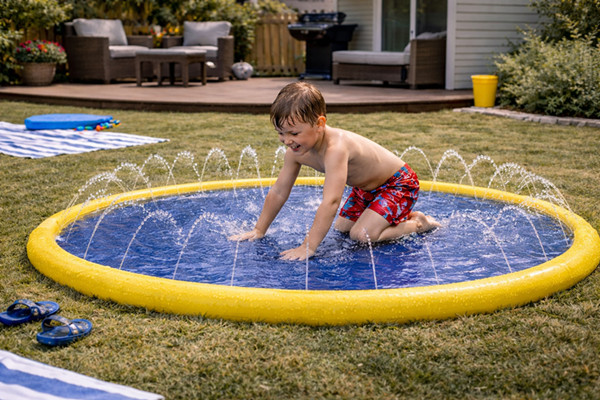
Most people think they are choosing a splash pad by size, print, or price. In real use, the material usually decides whether the product feels soft and dependable or thin and disappointing after only a few weekends. Two splash pads can look almost the same online and still perform very differently once they are opened in a backyard. One stays flat, sprays evenly, and still feels good after repeated folding and sun exposure. The other wrinkles at the ring, feels too light underfoot, or starts showing stress near the hose area much sooner than expected.
For most family-use and retail splash pads, the best material is a well-matched flexible PVC system combined with the right thickness, seam strength, edge support, and outdoor-use stability. PVC remains the strongest all-around choice because it balances softness, durability, sealing performance, print quality, and cost better than most alternatives. The real answer is not just material alone, but how well the material and structure work together.
That is where product quality starts to separate. Parents care about comfort and peace of mind. Pet owners care about wear resistance. Sellers care about returns, complaints, and repeat sales. If a splash pad is going to spend its life in summer sun, under hose pressure, on grass, patios, or concrete, then material is not a small detail. It is the foundation of the whole experience.

What Is the Best Splash Pad Material?
For most splash pads, flexible PVC is still the best all-around material because it gives the most balanced combination of comfort, durability, sealing performance, print quality, and cost. TPU can make sense in more premium projects, and lighter low-cost film structures can work in entry-level items, but for mainstream family and retail use, properly matched PVC is still the most dependable choice.
A splash pad looks simple, but it has to handle more stress than many customers expect. It gets unfolded, dragged into place, connected to a hose, stepped on from every angle, left in the sun, folded while damp, and packed away again. The best material is the one that handles all of that without making the product feel stiff, weak, or short-lived.
This is one reason flexible PVC remains the most practical choice in the category. It gives manufacturers room to balance several things at once: softness for barefoot family use, enough support to help the ring hold shape, good sealing performance for better seam reliability, and a cost range that still works for retail and e-commerce. That balance matters more than a material label that sounds premium but creates higher cost without solving the problems customers actually notice.
A splash pad also needs to look good while doing its job. Good graphics, a cleaner finish, and a surface that feels more polished all affect whether the product feels worth the price. PVC works well here too, because it supports printing and color presentation in a way that suits family and seasonal products.
| Material option | How it usually feels in use | Main strengths | Main trade-offs | Best fit |
|---|---|---|---|---|
| Flexible PVC | Soft, balanced, stable when well built | Good comfort, good sealing, good printability, broad cost range | Quality varies if formulation is weak | Family splash pads, retail programs, branded products |
| TPU | Softer premium feel, more upscale positioning | Cleaner premium story, flexible finish | Higher cost | Premium custom projects |
| Light low-cost film structures | Lightweight, less substantial | Lower entry cost | Thinner feel, lower confidence in use | Entry-level seasonal items |
| Composite builds | Depends on project design | Can be matched to specific needs | More development complexity | OEM / ODM projects |
What Is a Splash Pad Made Of?
A splash pad is usually made from more than one simple layer. In practical terms, it is a combination of the main body material, printed or colored surface layers, seam areas, a water inlet section, an outer spray ring, and the spray-hole pattern that controls water flow. That matters because stress is not evenly distributed across the whole product.
The center area mainly handles foot traffic and body contact. The ring handles water flow and shape stability. The inlet area handles one of the most concentrated forms of force in the product. The seam zones deal with repeated bending, folding, and pressure changes over time. That is why splash pads rarely fail in the middle first. The edge, seam, and connection areas usually tell the real story.
Is PVC the Best Splash Pad Material?
For most commercial splash pads, yes. PVC is still the strongest overall choice when the goal is to build a product that feels soft enough for family use, seals well during production, prints clearly, and stays inside a workable cost range.
The biggest advantage of PVC is not that it wins every category. It is that it performs well across most of them at the same time. A splash pad is not a decorative item. It is a repeat-use outdoor product. It has to survive setup, play, sunlight, pressure changes, folding, and storage. PVC remains popular because it handles that mix more effectively than most alternatives in broad-market products.
Are TPU and PE Better for a Splash Pad?
Sometimes, but not automatically.
TPU can make sense when a brand wants a more premium material story, a softer upscale feel, or a more differentiated product line. But a premium material is not always the better answer for a mainstream family splash pad. If the customer mostly wants comfort, stability, and reasonable price, TPU can increase cost without creating enough visible value.
Lower-cost film structures can work in more budget-driven projects, but they often feel less supportive and less confidence-inspiring once the splash pad is set up. That can be acceptable for some low-price seasonal items. It is usually less attractive for products expected to earn better reviews and repeat trust.
Does Splash Pad Design Matter More?
In many complaints, yes.
Customers often think they received a weak material when the real problem is weak construction. If the outer ring is too narrow, the seam is underbuilt, the spray-hole layout is unbalanced, or the hose connection area lacks support, the splash pad can feel unstable even when the base material is acceptable.
Design changes how material performs. Ring stability, spray balance, edge support, seam width, and hose-area reinforcement all affect how the splash pad behaves over time. That is why two splash pads made from similar PVC can still perform very differently in actual use.
Is PVC Safe for a Splash Pad?
PVC can be a suitable splash pad material when the formulation, finish, odor control, and construction are handled properly. The more useful question is not simply whether a splash pad uses PVC. It is whether the product feels appropriate for children’s use, whether it stays comfortable in summer conditions, and whether the structure remains stable during repeated real-life use.
When parents ask whether PVC is safe, they are usually asking several questions at once. They want to know whether the splash pad smells too strong, whether it feels too plastic-like, whether it gets uncomfortably hot in the sun, whether the seams feel harsh, and whether the product will hold up without quickly looking worn or damaged.
The first thing to understand is that PVC is a broad material category, not a guarantee of either quality or poor quality by itself. A poorly controlled material can create trust problems immediately. A better-controlled material, paired with a smoother finish and stronger structure, can feel much more comfortable and dependable in family use.
Families judge splash pads quickly. They notice the smell when they open the package. They notice whether the surface feels smooth or harsh. They notice whether the ring looks stable or flimsy. They notice whether the seam edge feels manageable or sharp. Those first impressions shape trust before the splash pad is even connected to water.
A better splash pad usually supports that trust in several practical ways:
- lower odor when opened
- smoother, more comfortable surface feel
- stronger edge and ring stability
- more confidence in seam areas
- better resistance to heat, sunlight, and repeated folding
- easier everyday use for parents and children
| Customer concern | What they are really asking | What a better splash pad should deliver |
|---|---|---|
| “Does it smell strong?” | Is the material family-ready? | Lower odor and cleaner finish |
| “Does it feel safe?” | Is it comfortable for children? | Softer touch and better edge stability |
| “Will it get too hot?” | Can it handle real summer use? | Better outdoor-use material matching |
| “Will it break too fast?” | Is it built for repeated use? | Better seams, reinforcement, and structure |
| “Is it okay for my child?” | Does it feel appropriate for family use? | Better formulation and overall product control |
What Does Phthalate-Free Splash Pad Mean?
For most customers, “phthalate-free” really means, “I want a material I feel more comfortable using around children.” What matters most is not the phrase alone, but whether the splash pad was developed with suitable material control and a cleaner overall product feel.
In practical terms, products with better material control usually smell milder, feel better from the first touch, and create fewer concerns during unboxing. These are small details, but they strongly affect whether a parent feels comfortable setting the product up for family use.
Does Splash Pad Safety Testing Matter?
It matters a lot because splash pads do not fail in only one way.
A product can pass a simple pressure check and still disappoint later if it handles folding badly, ages too quickly in summer conditions, or wears too fast around stress points. That is why better product development looks beyond a single check and pays attention to how the splash pad performs under repeated use.
The most useful testing logic in this category usually looks at:
- repeated folding and storage stress
- seam and ring performance under repeated use
- abrasion in high-contact areas
- sunlight and heat exposure over time
- hose connection reliability
- general shape stability during water pressure changes
Can You Get Sick From a Splash Pad?
This concern is usually about water hygiene, not the base material itself. A splash pad made from suitable material can still feel less safe to a family if the product is awkward to rinse, slow to dry, or difficult to keep clean.
For home use, the most practical answer is simple: the splash pad should be easy to rinse, easy to dry, and easy to store properly after use. Parents do not separate “material quality” and “daily care experience” as much as brands often think. They experience both together.
How Should a Splash Pad Feel and Smell?
A good splash pad should feel flexible, smooth, and comfortable enough for barefoot family use. It should not feel greasy, scratchy, overly stiff, or overly thin. It should also avoid a heavy chemical smell that creates doubt as soon as the package is opened.
This matters because families judge splash pads with both logic and instinct. They are not only asking whether the product works. They are asking whether it feels comfortable enough for children, easy enough to trust, and appropriate enough to keep using through the season.

How Thick Should a Splash Pad Be?
For most family-use splash pads, the best thickness is usually a balanced middle range rather than the thinnest or heaviest option available. A splash pad that is too thin often feels unstable and wears faster at the edge. A splash pad that is too thick can lose flexibility and become less comfortable in everyday use. The right thickness should match the user, the surface, and the level of repeated stress.
Thickness is one of the most misunderstood parts of splash pad quality. Many customers assume thicker always means better. In real use, that is not always true. Thickness only creates value when it works together with the right softness, seam strength, ring stability, and overall structure.
What customers actually notice is not the number itself. They notice whether the splash pad feels solid enough to trust, soft enough for bare feet, and stable enough to hold shape once water starts flowing. That is why thickness should always be judged as part of the full build.
| Thickness range | How it usually feels | Best fit | Main risk |
|---|---|---|---|
| 0.20–0.25 mm | Very light and soft | Low-cost seasonal items | Often feels flimsy and less stable |
| 0.25–0.30 mm | Light and flexible | Entry-level family splash pads | Lower confidence on harder surfaces |
| 0.30–0.40 mm | More balanced and supportive | Mainstream family products | Needs strong seams and ring design |
| 0.40–0.50 mm | Heavier and more durable | Better family pads, mixed-use pads | Can feel less flexible if poorly matched |
| 0.50 mm+ | More heavy-duty feel | Pet splash pads, tougher-use projects | May feel bulky for standard family use |
What Splash Pad Thickness Is Best for Kids?
For children’s splash pads, the best thickness is usually one that feels soft and stable at the same time. It should not feel so thin that the product looks weak after a few uses, but it also should not feel too rigid for sitting, crawling, or direct skin contact.
A better children’s splash pad usually gives parents confidence in a few specific ways:
- the surface feels soft enough for bare legs and feet
- the ring looks controlled instead of floppy
- the splash pad lays reasonably flat once water is on
- the product folds without feeling brittle
- the whole build feels suited to repeated family use
What Splash Pad Thickness Is Best for Dogs?
Dog splash pads need a different thickness strategy because the stress pattern is different. Dogs create more point pressure through nails, repeated stepping, shifting body weight, and faster movement. A thickness that works well for small children may not hold up the same way when used by medium or large dogs.
For pet splash pads, a stronger build usually helps. That does not mean the splash pad should feel rigid. It means the product should have more support and more wear margin, especially around the outer ring and high-contact areas.
Do Splash Pad Seams Affect Leaks?
Yes, and in many cases seams matter more than thickness alone.
Splash pads usually do not fail because the middle of the sheet suddenly gives up. Problems tend to appear where stress is concentrated: along the seam, around the edge ring, or near the water connection area. If the seam is narrow, poorly aligned, or not supported properly, even a thicker splash pad can show weakness earlier than expected.
Does Splash Pad Edge Width Matter?
It matters a great deal because the outer ring is not just a border. It is one of the hardest-working parts of the product.
The edge area supports water flow, spray balance, ring shape, and a large part of the splash pad’s structural feel. If the edge is too narrow or underbuilt, the product may look unstable, wrinkle more easily, and place too much force on the seam or hose connection.
How Long Can a Splash Pad Last?
A splash pad can last one short season or several strong summer cycles, depending on material quality, seam construction, UV resistance, surface conditions, and how it is stored after use. In most cases, lifespan is shaped less by how many times the product is used and more by how well it handles sunlight, folding, friction, and repeated daily stress.
Customers often think splash pad lifespan is mostly luck. It usually is not. Products that age well tend to share the same strengths: better material matching, better seam and edge structure, better resistance to sunlight and repeated folding, and better overall care after use.
| Use pattern | Lower-built splash pad | Better-built splash pad |
|---|---|---|
| Occasional weekend use on grass | May last through the season | Often holds condition longer |
| Frequent family use | More visible wear at seams and ring | Better long-term shape and stability |
| Repeated folding and storage | Fold stress appears earlier | Maintains flexibility longer |
| Hot sun exposure | Faster fading or stiffening | Better outdoor stability |
| Mixed child and pet use | Stress builds quickly | Better wear margin |
Does UV Damage Affect a Splash Pad?
Yes. UV exposure is one of the most common reasons a splash pad begins to lose quality over time.
Outdoor water-play products spend much of their life under direct summer sunlight. That means the material needs to stay flexible, visually acceptable, and structurally dependable after repeated exposure. When UV stability is weak, the splash pad may feel drier, less soft, and more tired much sooner than customers expect.
Can Folding Damage a Splash Pad?
Yes, especially when the same areas are folded over and over again while the splash pad is still damp or tightly compressed for storage.
Folding is not the problem by itself. Repeated fold stress at the same points is the problem. Over time, some areas become fatigue zones, especially in thinner builds or splash pads with weaker seam layouts.
Does Water Pressure Wear Out a Splash Pad?
Not by itself. Normal hose pressure should not ruin a well-made splash pad. What water pressure really does is expose weak points faster.
If the inlet area is underbuilt, pressure changes create concentrated stress there. If the spray-hole layout is poor, the ring may behave unevenly. If the edge structure is weak, the splash pad may wrinkle or twist more once water begins to move through it.
Which Splash Pad Material Lasts Longer?
For most broad-market splash pad projects, a well-made flexible PVC structure usually delivers the best overall life for the money. That does not mean it wins every theoretical material comparison. It means it gives one of the best real-world balances of durability, comfort, production consistency, and commercial practicality.
Long-lasting splash pads are almost never the result of one single factor. They last because material quality, thickness, seam strength, ring stability, UV resistance, and surface compatibility were matched correctly from the start.

Where Should You Use a Splash Pad?
A splash pad should be used on a flat, clean, stable, and low-abrasion surface. For many homes, level grass is one of the best options because it stays cooler, feels softer underfoot, and is generally gentler on the product. Smooth patios can also work well. Rough concrete, gravel, uneven ground, and sharp stone create more discomfort, more wear, and a higher chance of early product damage.
Surface choice affects splash pad performance more than many customers expect. The product may be the same, but the experience changes depending on what is underneath it. A splash pad that feels soft and enjoyable on a lawn may feel much harsher and less durable on a rough patio.
| Surface type | Comfort level | Wear risk | Everyday use value |
|---|---|---|---|
| Level grass | High | Low to medium | Excellent for family backyard use |
| Smooth sealed patio | Medium to high | Medium | Good if kept clean and cool |
| Smooth concrete | Medium | Medium to high | Usable, but harder underfoot |
| Rough concrete | Low | High | More likely to wear the product faster |
| Gravel or stone | Very low | Very high | Poor choice for splash pads |
| Uneven ground | Low | Medium to high | Often reduces stability and comfort |
What Surfaces Are Best for a Splash Pad?
The best surfaces are the ones that protect both the user and the product. In most homes, that means flat grass, smooth patio areas, or other clean surfaces without sharp texture, raised joints, or abrasive debris.
A better surface improves comfort immediately and often extends product life at the same time. It helps the splash pad lay flatter, reduces unnecessary bottom wear, and makes the whole setup feel more controlled.
Is Grass Best for a Splash Pad?
For many families, yes. Grass is often the most comfortable and forgiving option.
A good lawn usually stays cooler than hard paving, feels softer for children, and places less abrasive stress on the splash pad bottom. It also tends to make the product feel more natural and family-friendly once it is set up. Still, the lawn should be level, clear of stones and debris, and well-drained enough not to turn muddy too quickly.
Can You Put a Splash Pad on Concrete?
Yes, but the condition of the concrete matters a lot.
Smooth, even, clean concrete can work for splash pads, especially where lawn space is limited. But concrete creates more pressure on the product than grass does. It also becomes hotter in the sun and less forgiving under bare feet. If the surface is rough, cracked, or highly textured, wear risk rises quickly.
What Surface Is Best for a Pet Splash Pad?
For pet splash pads, the best surface is usually flat, cool, and low-abrasion, such as level grass or a smooth patio. Dogs create more concentrated pressure through nails, repeated stepping, and shifting weight, so the ground underneath matters even more than it does in standard family use.
How Do You Choose the Right Splash Pad?
The right splash pad is not simply the one with the biggest size, the boldest print, or the lowest price. It is the one that matches the user, the surface, the season, and the level of repeated use. A splash pad that works well for a toddler on a soft lawn may not be the right choice for a family with older children, a dog, and a concrete patio.
Most customers do not regret buying a splash pad because the color was slightly different from the image. They regret it because the product felt weaker than expected, smelled too strong, sprayed unevenly, or started looking tired too early in the season. That is why choosing the right splash pad has much more to do with product fit than with one headline feature.
A better selection process usually starts with five practical questions:
- Who will use the splash pad most often?
- What kind of surface will it sit on?
- How often will it be used, folded, and stored?
- What quality level does the customer expect at this price?
- Is the product meant for resale, brand building, or custom development?
| Selection factor | What families usually care about | What sellers and brands usually care about |
|---|---|---|
| Material feel | Softness, comfort, odor | Quality consistency and lower complaint risk |
| Thickness | Whether the splash pad feels thin or dependable | Cost balance and return control |
| Edge and seam build | Whether the product looks stable | Durability and lower defect pressure |
| Surface match | Whether it works well in the yard or patio | Fewer misuse complaints and better guidance |
| Packaging | Easy opening and storage | Shelf appeal, shipping efficiency, market fit |
| Overall positioning | Safe, easy, fun to use | Conversion, reviews, repeatability |
What Should Parents Check in a Splash Pad?
Parents usually make better decisions when they focus on what they can realistically notice and use. A better family splash pad should feel soft, stable, and practical. It should look controlled once set up, not overly flimsy or messy.
Parents should ask:
- Will this splash pad go on grass, patio, or concrete?
- Is it mainly for toddlers, mixed-age children, or family use with pets too?
- Will it be folded and stored often?
- Is comfort more important than the absolute lowest price?
What Should Brands Check in a Splash Pad?
Brands need to look deeper than end customers do because they are not only choosing a product. They are choosing future reviews, return rates, customer service pressure, and product reputation.
A strong supplier should be able to explain not only what the splash pad is made from, but how it is built to perform. Material fit, seam reliability, odor control, testing depth, packaging support, and sample revision speed all matter. Based on your company information, Epsilon is well positioned here with dedicated R&D, design support, broad PVC and composite experience, large annual production capacity, and OEM / ODM flexibility.
How Can a Better Splash Pad Reduce Returns?
Returns usually happen when the delivered product does not match the customer’s expectation.
The customer expected something durable, but it felt too thin. They expected something family-ready, but the smell was stronger than expected. They expected stable play, but the ring looked weak or the spray felt patchy. Most of those return triggers are preventable when the product is matched better from the beginning.
| Common return trigger | How a better product helps prevent it |
|---|---|
| “It felt cheap” | Better material feel and more balanced thickness |
| “It leaked too soon” | Stronger seams, better edge build, stronger inlet support |
| “The smell was too strong” | Better material control and cleaner finish |
| “It didn’t work well on our patio” | Clearer surface-use guidance and better product fit |
| “It didn’t last” | Better UV stability, wear resistance, and structure |
| “It wasn’t what I expected” | More accurate positioning and stronger product planning |
Which Splash Pad Material Fits Your Market?
The best splash pad material depends heavily on the market you want to serve.
A family splash pad sold through broad online channels usually needs a balanced PVC structure that feels soft enough for children, stable enough in regular use, and affordable enough to remain competitive. A pet splash pad usually needs a stronger build with better wear resistance. A premium private-label project may need a cleaner finish and stronger packaging presentation. A value-driven seasonal item may accept a lighter build, but only if the positioning is realistic.
| Market type | Recommended material direction | What matters most |
|---|---|---|
| Mainstream family retail | Balanced flexible PVC | Comfort, price balance, stable quality |
| Pet-focused line | Stronger PVC build | Abrasion resistance and support |
| Premium private label | Upgraded PVC or matched premium solution | Finish, feel, packaging presentation |
| Entry-level seasonal item | Value-focused lighter build | Cost control and realistic expectations |
| OEM / ODM project | Material matched to use case | Development support and customization |

Final Thoughts
The best material for a splash pad is usually not the one with the most impressive-sounding label. It is the one that makes the product feel right in real use. For most family and retail splash pads, that still points to a well-made flexible PVC structure with the right thickness, stronger seams, a stable outer ring, and a better balance of comfort and durability.
That answer becomes even more useful when it is matched to the actual user. Families need comfort and confidence. Pet owners need stronger wear resistance. Sellers need consistency and fewer complaints. Private-label projects need product development support and a structure that fits the target market from the beginning.
If you want ready-to-order splash pad products, Epsilon can support stable supply across family, pet, and seasonal water-play categories. If you want to develop a custom splash pad, Epsilon can support OEM and ODM work in material selection, thickness planning, size adjustment, artwork, packaging, and label adaptation.