Skip to content
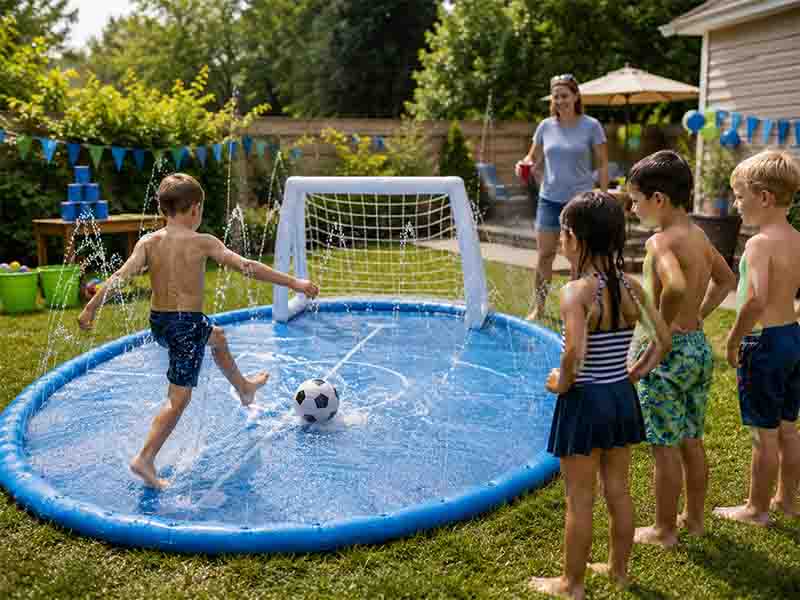
A colorful water toy can look like an easy summer purchase, yet the difference between a splash pad and a kids sprinkler becomes obvious as soon as children begin to play. A splash pad creates a visible wet area where children can step in gradually, sit, carry toys, and share the space. A sprinkler turns the surrounding lawn into an active game of running, jumping, chasing, and reacting to moving streams. Neither format is better for every family.
A splash pad is usually better for toddlers, cautious children, mixed-age siblings, and families that prefer a defined play area. A kids sprinkler often works better for confident, active children who enjoy running through direct or changing water streams. The final choice should reflect age, coordination, available space, ground conditions, hose flow, supervision needs, cleaning time, storage capacity, and product construction.
The most exciting product photograph does not always lead to the best backyard experience. One child may spend an hour pouring water across a printed mat, while another may ignore the mat and race around the highest jet. A closer look at play style, spray behavior, materials, and everyday maintenance makes it much easier to choose a water toy that will return to the lawn throughout summer instead of returning to storage after two afternoons.
What Is the Difference?
A splash pad concentrates water and play on a flat surface, while a kids sprinkler sends water into an open area that children move around or through. A sprinkler splash mat combines both formats. The clearest comparison looks at the usable play zone, movement pattern, spray direction, pressure dependence, surrounding space, and whether the product remains enjoyable when household water flow is moderate.
How Does a Splash Pad Work?
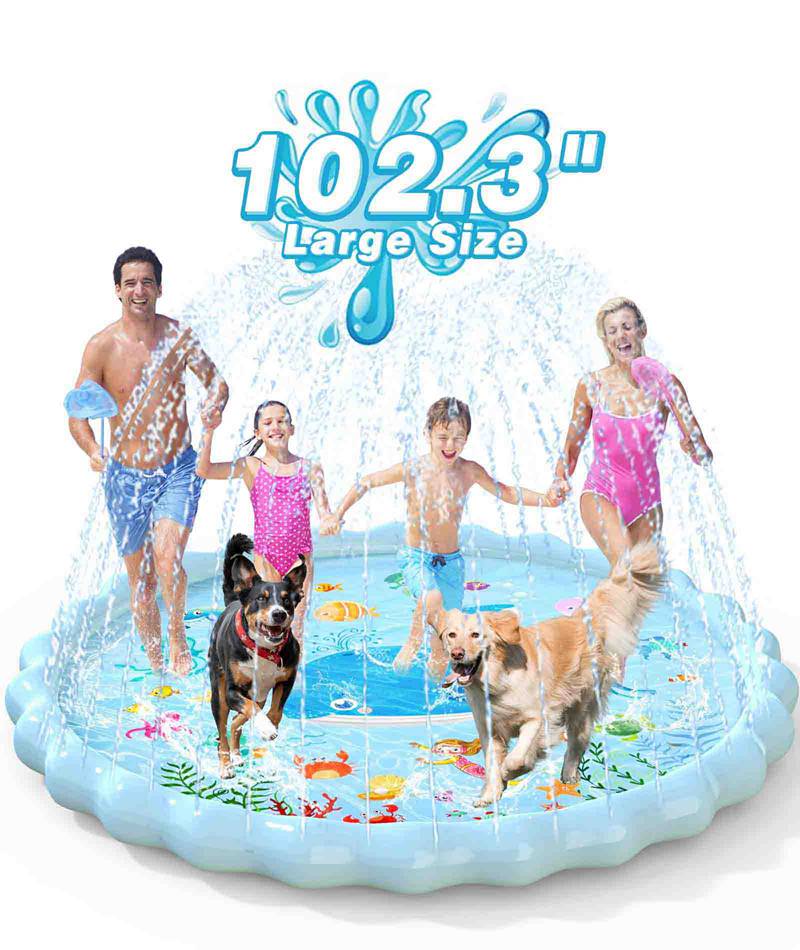
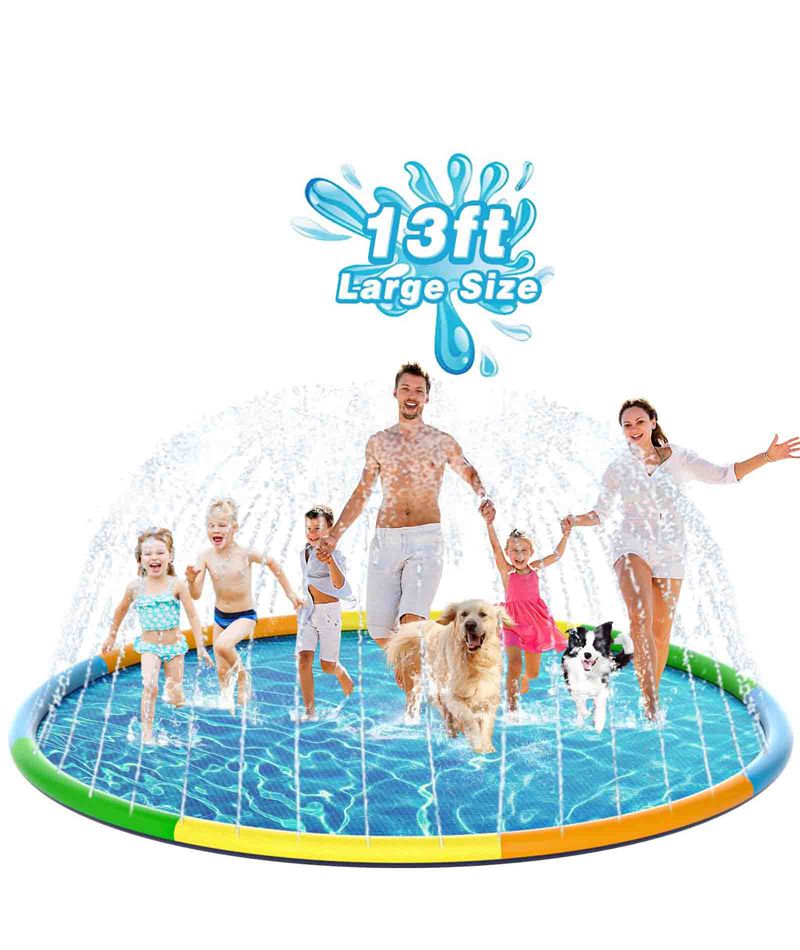
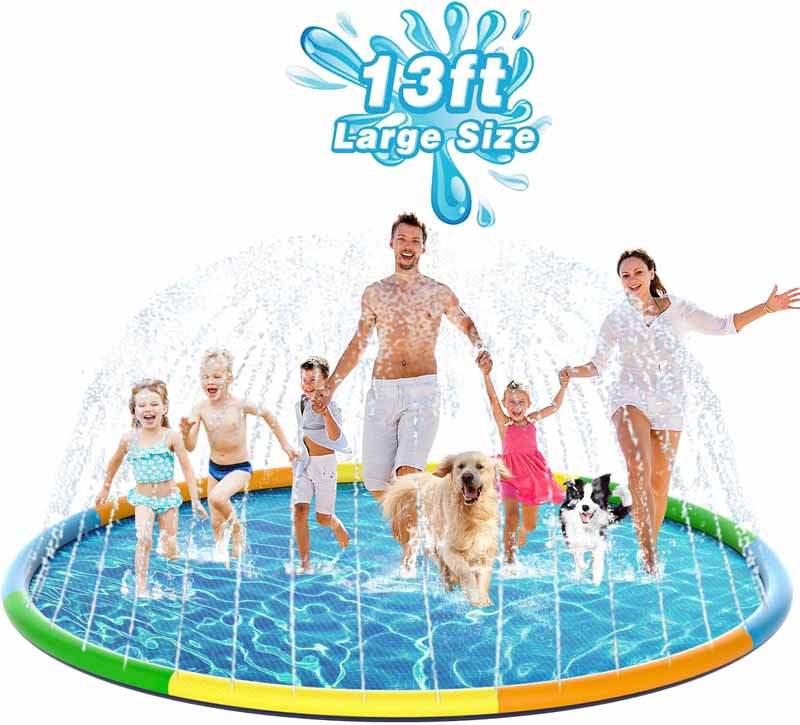
A residential splash pad usually connects directly to a garden hose. Water enters a sealed perimeter channel, travels around the edge, and exits through a row of small openings. As the channel fills, the outer ring may rise slightly and create low arcs, vertical jets, or inward streams. Spray height depends on flow, while spray consistency depends on inlet position, channel width, seam quality, hole diameter, hole angle, and whether the mat lies flat.
The central surface is part of the activity rather than a simple base. Children can sit in the middle, walk between the streams, move cups and balls through shallow water, follow printed games, or remain near a quieter edge. A child who does not like water on the face can still participate without entering the strongest spray. That flexibility often makes a splash pad easier to share among children with different ages and confidence levels.
A large diameter does not guarantee better performance. Uneven filling can make one side rise more than another, while a twisted edge can direct water outside the play area. An inlet without enough support may pull against the surrounding seam when a water-filled hose moves. A well-developed structure distributes pressure around the perimeter, keeps the edge stable, and produces useful spray without requiring the faucet to remain fully open.
Families usually notice even water distribution and a comfortable central area before they notice small differences in listed size. Controlled inward spray also reduces unnecessary overspray, helps keep play within a visible boundary, and gives adults more control when younger children enter the activity.
How Does a Kids Sprinkler Work?
A kids sprinkler releases water from a compact base, rotating head, inflatable shape, arch, spray arm, or collection of flexible tubes. Children play by crossing the streams, jumping over low jets, chasing moving water, timing their runs, or inventing games around getting wet and avoiding the spray. The device may occupy little ground, but the real activity zone extends beyond its physical footprint.
Spray is normally the main attraction. If water flow is too low to rotate a head, raise flexible tubes, or form a visible arc, the product may offer little alternative play. Performance can change when a hose is long, narrow, kinked, partly blocked, or connected through several adapters. Indoor water use may also reduce the flow reaching the outdoor faucet.
Sprinklers often suit children who enjoy energetic and unpredictable movement. The same qualities can make them uncomfortable for toddlers or children who dislike sudden facial spray. A rotating jet may reach a child who expected the water to remain in one direction, while fast-moving tubes can feel more intense as pressure increases.
Setup involves more than placing the device on the lawn. The hose should remain outside the main running path, and the surrounding area should be free from patios, steps, garden tools, furniture, fences, and other hard obstacles. A small sprinkler can require more usable space than a large splash pad because children need room to approach, turn, run, and slow down safely.
Are Sprinkler Splash Mats Different?
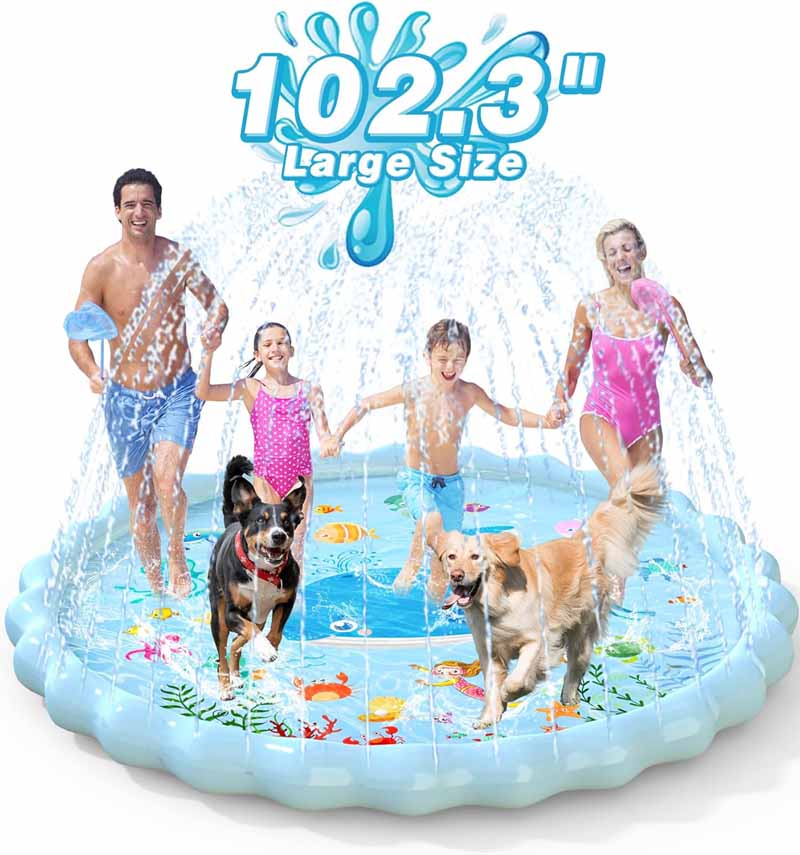
A sprinkler splash mat combines a flat PVC play surface with perimeter or built-in jets. Similar products may be sold as splash pads, sprinkler mats, spray pools, water play mats, or kids sprinkler pools. The names overlap because many designs sit between a quiet water mat and an active sprinkler rather than fitting neatly into one category.
The central area reveals how the product behaves. Some mats retain a shallow layer of water and remain enjoyable at low pressure. Others drain quickly and depend almost entirely on elevated spray. A child expecting to sit and splash may lose interest in a mat that offers little activity once the jets are reduced.
Spray direction also changes the amount of space required. Inward-facing holes keep more water over the mat and create a clearer activity boundary. Outward-facing holes increase the wet radius and may reach paths, furniture, or nearby doors. Mixed angles can create varied play, but poor spacing may allow most of the pressure to escape through the openings closest to the inlet.
Clear dimensions, spray direction, central water behavior, connection instructions, and recommended ground help families understand the product before use. Accurate descriptions also reduce the gap between what a package appears to promise and what the product delivers after connection.
| Feature | Splash Pad | Kids Sprinkler | Sprinkler Splash Mat |
|---|---|---|---|
| Main play area | On the central mat | Around the spray device | On and around the mat |
| Common movement | Walking, sitting, splashing | Running, jumping, dodging | Mixed movement |
| Reliance on spray height | Moderate | High | Moderate to high |
| Space requirement | Product size plus a wet edge | Small base plus a wide running zone | Mat size plus overspray |
| Strongest advantage | Controlled, shared play | Energetic movement | Several play styles |
| Main setup concern | Flat ground and even filling | Hose routing and open clearance | Mat stability and spray direction |
| Lower-pressure use | Often remains engaging | May lose movement or height | Depends on central mat design |
| Common family fit | Toddlers and mixed ages | Confident, active children | Families wanting a middle ground |
Which Is Better by Age?
Splash pads generally suit toddlers and cautious preschoolers because children can approach the water gradually and remain outside the strongest jets. Kids sprinklers often suit older children who enjoy running and direct spray. Recommended ages are only a starting point. Coordination, confidence, sensory comfort, movement speed, group size, and the ability to follow simple rules also shape the experience.

Toddlers often approach water in stages. One child may walk into the spray immediately, while another may stand outside, watch the streams, touch the wet surface, and enter only after the movement feels predictable. A splash pad supports that process because the central mat can be used without standing directly under the strongest water.
Low, stable arcs are generally easier for young children to understand than rotating heads or flexible tubes that change direction. Adults can begin with a partly opened faucet, observe where the water lands, and increase the flow slowly. A product that works only at maximum pressure gives families less control over facial spray, edge stability, and overspray.
A child who avoids direct jets may still enjoy cups, pouring games, soft balls, floating toys, and printed activities. Those options allow play to continue while the child gains confidence. Gentle spray is not a weaker experience when the child remains interested and comfortable for longer.
Size should be considered alongside the full activity. A very small mat can become crowded once toys and an adult’s feet enter the area. A much larger mat offers more room but needs flatter ground, greater water distribution, longer drying time, and more storage space. For one or two toddlers, a mid-size pad with a clear center and controlled inward spray often offers a practical balance.
Close and continuous supervision remains necessary whenever young children are near water. The CDC notes that drowning can happen quickly and quietly, and swimming ability does not replace active supervision.
Which Suits Active Older Kids?
School-age children often turn water into a challenge. They may race through streams, jump across low jets, kick a ball through the spray, follow printed targets, or create rules around reaching the opposite side without getting wet. A freestanding sprinkler can suit that style because the entertainment comes from movement, timing, and reaction.
Higher spray may look exciting, but excessive pressure does not always improve play. Water that strikes the face too strongly can shorten the session, while uncontrolled overspray can soak paths and hard surfaces. A stronger design gives children several participation levels. They can cross the main stream, remain near the edge, or add the water to a broader game.
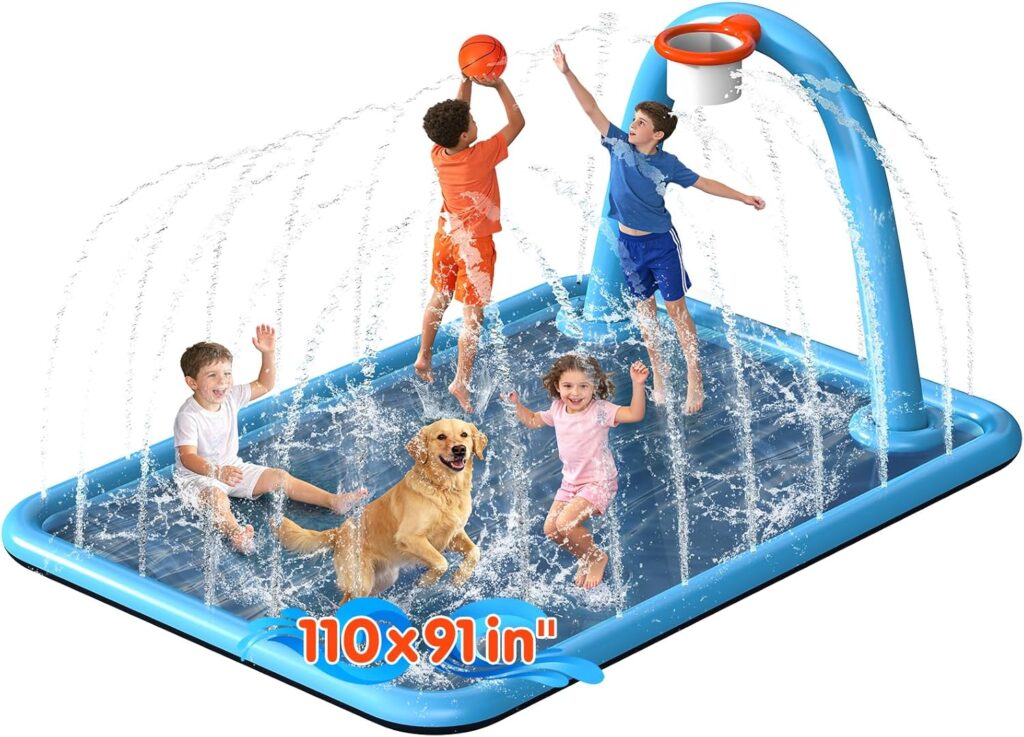
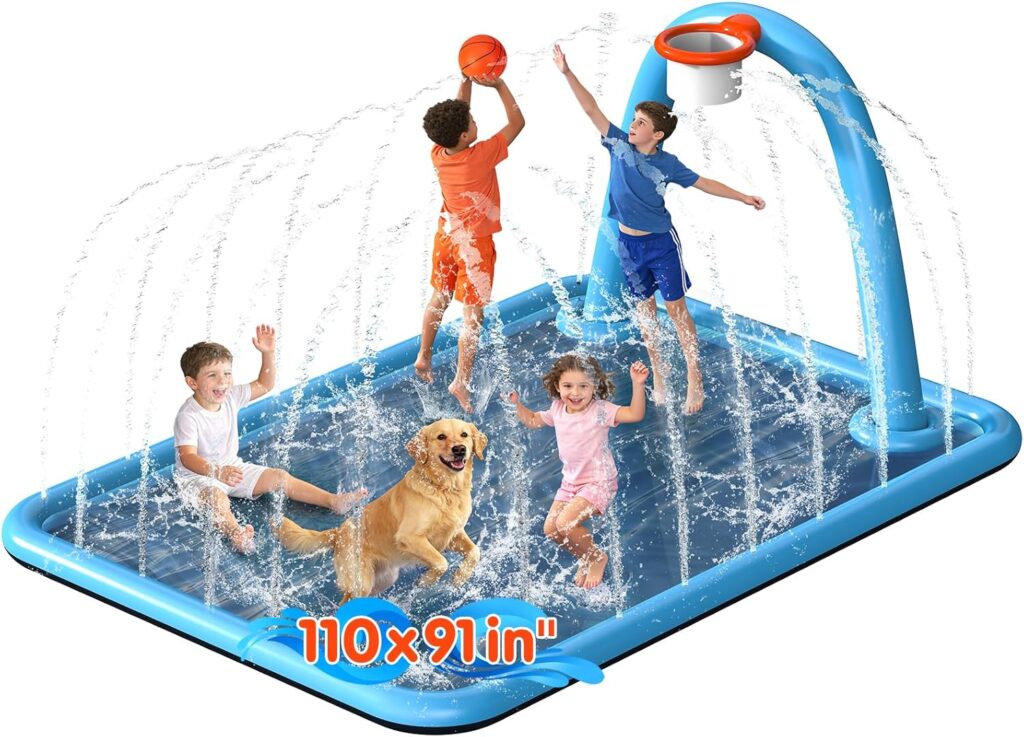
Large splash pads can also work well for older children when they include targets, sports graphics, arches, water walls, or several spray zones. Product naming matters less than activity design. A basic mat may feel too simple, while a large activity pad can support ball games and group challenges for much longer.
Older children also require greater movement clearance. Three children aged seven or eight can use far more space than three toddlers because they run faster, turn more sharply, and extend their arms during games. Product diameter should never be treated as a direct measure of safe group capacity.
What Works for Mixed Ages?
Mixed-age families need a product that supports quiet and active play at the same time. A younger child may sit near the center while an older sibling follows the perimeter, uses a ball, or runs through higher streams. A broad splash pad or balanced hybrid often handles those differences better than a small device built around one intense spray feature.
Adjustable flow is especially useful when ages and confidence levels vary. Adults can begin with low arcs while younger children settle into the activity, then raise the flow when older children want more movement. Several spray angles may create informal zones, leaving a calmer center and stronger water near selected edges.
Usable area should be judged realistically. A mat that comfortably holds two toddlers can become crowded when an older child begins running or turning. Larger formats provide more separation but also need more even ground, stronger water distribution, larger cartons, longer drying time, and greater storage space.
The lowest recommended age on packaging cannot explain how every child will behave. A three-year-old and an eight-year-old may both meet the age statement but differ greatly in speed, body size, balance, and expectations. A product offering several ways to participate usually serves mixed ages longer than a product relying on one dramatic effect.
| Child Profile | Strong Starting Option | Helpful Features | Main Concern |
|---|---|---|---|
| Cautious toddler | Low-pressure splash pad | Predictable inward spray and clear center | Close supervision and wet edges |
| Confident preschooler | Splash pad or hybrid mat | Adjustable flow and room for toys | Crowding and face-level spray |
| Active child aged 6–8 | Sprinkler or activity pad | Moving water, targets, open play | Running clearance and hose route |
| Older child seeking games | Larger activity sprinkler | Varied streams and challenge features | Repetitive play if movement never changes |
| Mixed-age siblings | Large splash pad or hybrid | Several spray heights and broad center | Separating fast and quiet play |
| Child avoiding facial spray | Splash pad at low flow | Low arcs and easy edge access | Sudden rotating or flexible jets |
| Small group of similar ages | Either format | Enough open area and adjustable flow | Children competing for one feature |
| Children using water toys | Splash pad | Flat central area and shallow water | Loose toys becoming trip hazards |
Which Is Safer for Kids?
Neither product is automatically safer. Splash pads create a visible activity boundary, while sprinklers may leave less standing water on a central mat, but both can cause slips, trips, collisions, facial spray, and hose hazards. Safer use depends on the child’s ability, ground condition, water flow, product stability, surrounding clearance, equipment inspection, and continuous adult supervision.

Every wet surface can become slippery, including textured PVC. Surface patterns may improve traction under some conditions, but water, sunscreen, mud, grass clippings, soap residue, wrinkles, and sudden movement can still reduce grip. A non-slip claim should never be interpreted as a guarantee that a child cannot fall.
The ground beneath the pad has a strong effect on stability. Short, level grass is generally more forgiving than polished tile, smooth concrete, timber decking, or a sloped patio. Stones, sticks, roots, and hard soil can create raised points beneath flexible PVC. Uneven ground may also form folds that catch toes or direct water toward one side.
The mat should be unfolded fully before the faucet is opened. When the perimeter fills around a twisted or folded center, the product may not settle evenly. Jets can point outside the intended zone, and water may collect in low areas. Beginning with moderate flow gives adults time to reposition the pad before children enter.
The wet area outside the mat deserves equal attention. Overspray can create mud on grass or reduce traction on nearby paving. Steps, furniture, tools, glass doors, grills, and pool equipment should remain beyond the activity zone. Water shoes may improve comfort on rough ground, but they do not replace ground inspection or close supervision.
Do Sprinklers Increase Fall Risks?
Kids sprinklers often encourage running, sudden turning, backward movement, jumping, and competition around a water feature. Children may watch the spray instead of the ground, especially when a rotating head or moving tube changes direction. The real hazard zone therefore includes every wet path used while approaching, crossing, and leaving the water.
Hose placement has a major influence on risk. The hose should enter from the side with the least foot traffic, while spare length should stay outside the activity area rather than forming loops near the sprinkler. Fittings and adapters should not sit where children gather or change direction.
Flexible tubes, rotating heads, and inflatable structures need additional attention at stronger flow. Tubes may move rapidly, a rotating stream can reach a face unexpectedly, and an inflatable base may shift when filling is uneven. Raising the pressure should be gradual so adults can observe the full movement pattern.
A small sprinkler is not always the best format for a small yard. Although the base may occupy little room, the running circle can extend toward patios, steps, walls, or garden furniture. A controlled inward-spraying mat may be easier to manage where boundaries are close.
How Much Supervision Is Needed?
Both products require active adult supervision from the moment water begins flowing until play ends and the equipment has been drained. Shallow water does not remove the possibility of falls, water inhalation, collisions, loose connections, or children leaving the designated area.
The supervising adult should remain close enough to intervene immediately. Watching from a window or checking periodically is not sufficient for toddlers and young children. During group play, one adult should clearly accept responsibility rather than assuming another person is watching.
Equipment should be inspected before every session. Look for seam separation, punctures, loose fittings, blocked openings, unusual bulges, sharp damage, or a connector that shifts when flow increases. Stop the water and reset the product if the perimeter twists, the base moves, or the spray changes direction unexpectedly.
Hygiene also belongs in the routine. The CDC advises keeping children with diarrhea out of splash-pad water, discouraging children from swallowing the water, and preventing children from sitting or standing directly on jets. Home hose-fed products do not use the same recirculating system as many public facilities, but clean use habits remain sensible.
| Risk Area | Splash Pad | Kids Sprinkler | Practical Control |
|---|---|---|---|
| Slipping | Wet PVC and shallow pooled water | Wet grass or nearby hard ground | Use level ground and moderate flow |
| Tripping | Folded edges, toys, raised ring | Hose, fittings, sprinkler base | Keep travel paths clear |
| Facial spray | Inward jets may reach eye level | Moving streams may change direction | Begin with low flow and observe |
| Collision | Children may crowd the mat | Children may compete around one jet | Limit users and define boundaries |
| Product movement | Twisted or uneven perimeter | Unstable base or inflatable body | Stop and reposition before continuing |
| Connector failure | Hose weight may pull on the inlet | Base may move with the hose | Keep the hose supported and untangled |
| Hygiene | Water and residue remain on the mat | Mud enters the wet activity zone | Rinse, drain, and dry completely |
| Supervision | Young children may sit or fall | Children may run beyond the device | Maintain continuous adult attention |
How Do Setup and Care Compare?
A small sprinkler may be faster to place, while a splash pad usually takes longer to spread, fill, drain, and dry. Real convenience covers the entire routine rather than the first hose connection. Ground preparation, available space, household flow, hose routing, cleaning, hidden moisture, folding, and seasonal storage determine whether a water toy feels practical throughout summer.

A splash pad needs a flat area close to its stated dimensions, together with clearance for access, overspray, and supervision. A kids sprinkler may use a smaller base, but children often need a larger running circle around it. The full wet and movement zone is therefore more useful than package dimensions when planning a setup.
A practical space check includes the product footprint, wet perimeter, child movement, adult supervision position, hose route, and distance from hard objects. A ten-foot-wide lawn does not provide ten feet of safe play when one side contains steps and another borders furniture or a garden bed.
Drainage affects whether a location works for repeated sessions. Using a water toy in the same spot can saturate soil, flatten grass, and create mud. Moving the product between uses may reduce lawn damage. Patios and raised areas need drainage that keeps water away from doors, electrical outlets, neighboring property, and lower floors.
A splash pad with inward spray may work well in a compact yard because the mat creates a visible boundary. A freestanding sprinkler is often easier to enjoy on a broad lawn where children have enough room to run without crossing the hose or reaching a hard surface before slowing down.
How Does Water Pressure Affect Play?
Water pressure and flow affect jet height, spray direction, rotation, edge inflation, and distribution. The pressure available at an outdoor faucet is not always the same as the pressure reaching the product. Hose length, internal diameter, kinks, adapters, elevation, debris, and simultaneous household water use can reduce flow at the connection.
The faucet should be opened gradually. Allow the perimeter channel or sprinkler body to fill, check the shape, and raise the flow in small steps. When a splash pad sprays mainly outward, inspect the edge for twisting before adding more water. When a rotating sprinkler remains still, check the hose and nozzle for restrictions rather than immediately opening the faucet fully.
Families can estimate flow with a bucket and timer. Collect water for a measured number of seconds, convert the amount into gallons per minute, and use the figure to estimate session consumption. The figures below illustrate water use at several flow levels; actual performance depends on the home, hose, connector, and product.
An older EPA reference notes that a garden hose may deliver around 50 gallons in five minutes, equal to approximately 10 gallons per minute. Hose performance varies considerably, so direct measurement at the outdoor faucet gives a more useful result for a specific home.
| Measured Flow | 10-Minute Session | 20-Minute Session | 30-Minute Session | Possible Play Result |
|---|---|---|---|---|
| 2.5 gal/min | 25 gal | 50 gal | 75 gal | Low arcs or limited moving parts |
| 5 gal/min | 50 gal | 100 gal | 150 gal | Moderate spray for many home products |
| 7.5 gal/min | 75 gal | 150 gal | 225 gal | Higher streams and broader overspray |
| 10 gal/min | 100 gal | 200 gal | 300 gal | Strong flow that may exceed basic needs |
Which Is Easier to Clean and Store?
Small freestanding sprinklers are often easier to carry and place on a shelf, but rotating components, inflatable chambers, and narrow tubes can retain water. Splash pads have larger wet surfaces and sealed perimeter channels, so they normally require more room and time to drain.
After play, shut off the faucet before disconnecting the hose. Let pressurized areas empty naturally, then lift the product carefully to guide remaining water toward the outlet. Dragging flexible PVC across concrete, decking, or rough paving can create scratches that later become weak points.
Grass, soil, sunscreen, food residue, and pet hair should be rinsed away using a method allowed by the care instructions. The underside requires the same attention as the printed surface because moisture and dirt often remain trapped between the mat and the ground.
Dry the top, underside, connector, seams, folds, and internal channel. Turning a mat over partway through drying can expose hidden moisture. Store the product loosely folded in a cool, dry place away from sharp tools, pests, heavy objects, and prolonged heat. Ease of drying has a strong effect on whether a family uses the product regularly.

PVC thickness matters, but thickness alone cannot predict service life. Material formulation, softness, odor level, seam width, water-channel balance, spray-hole placement, inlet reinforcement, printing, folding pattern, and storage conditions all influence how a splash pad handles pressure and repeated use.
Many consumer water mats use flexible PVC selected according to product size, target age, construction, retail position, and destination market. A heavier sheet may improve puncture resistance, but it cannot correct a narrow seam or an unsupported inlet carrying the weight and movement of a water-filled hose.
Stress often concentrates near the inlet, along folded edges, at sharp structural transitions, and where children repeatedly step on a pressurized ring. Wider joining areas, local reinforcement, rounded stress transitions, reinforcement strips, standardized inlet modules, and balanced multi-hole layouts can improve performance when they are matched to product size and intended use.
Useful evaluation goes beyond a short leak check. EPN’s documented development process includes pressure and leakage tests, long-duration water-pressure testing, repeated inflation and deflation cycles, simulated child jumping and dragging loads, UV exposure, heat aging, and low-temperature brittleness testing. Splash-pad development also focuses on spray distribution, edge stability, inlet reliability, and integrity after sunlight, folding, and repeated handling.
For products sold as children’s toys in the United States, applicable ASTM F963 requirements depend on product design and classification. The CPSC explains that not every section applies to every toy, so companies need to identify the clauses relevant to the specific product and intended age group.
| Construction Area | What to Examine | Why It Matters |
|---|---|---|
| PVC material | Flexibility, thickness, odor, surface finish, UV needs | Affects handling, comfort, print quality, and outdoor use |
| Perimeter seam | Width, consistency, corners, transitions | Carries internal water pressure |
| Water inlet | Reinforcement, position, hose support | Receives pulling and twisting loads |
| Spray openings | Hole size, angle, spacing, balance | Controls spray direction and pressure distribution |
| Central mat | Flatness, texture, print placement | Affects comfort, drainage, and play |
| Folding points | Crease position and packaging method | Repeated sharp folds may weaken material |
| Quality checks | Leak, pressure, spray, visual, and packing checks | Helps identify defects before shipment |
| Care instructions | Draining, drying, storage, pressure guidance | Supports longer and more consistent use |
Which One Should You Choose?
Choose a splash pad for gradual water contact, a defined shared area, and flexible play for toddlers or mixed-age children. Choose a kids sprinkler for active running games when children enjoy direct spray and enough open space is available. The best option should fit the yard, household flow, cleanup routine, number of users, storage space, and expected frequency of use.
What Fits a Small Backyard?
Control usually matters more than maximum spray height in a small backyard. A compact splash pad with inward-facing openings keeps more water within a visible boundary and reduces the distance children need to move. A small freestanding sprinkler may appear space-efficient, yet outward streams and running can extend beyond the safe part of the yard.
Begin by mapping where water can travel without reaching steps, grills, electrical outlets, glass doors, garden tools, or polished surfaces. The supervising adult also needs a clear position and a dry route into the activity. A flexible mat does not provide meaningful impact protection on concrete, so traction and drainage still require careful attention on patios.
Printed roads, animals, targets, numbers, or sports markings can add play value without increasing the wet radius. In compact spaces, a design that remains engaging at gentle pressure often works better than one built mainly around tall streams. A visible central area also helps children understand where to play.
Families with very limited ground should compare the total movement zone rather than choosing the smallest package. A moderately sized pad may require less practical space than a narrow sprinkler that encourages children to run several feet in every direction.
Which Works Better for Groups?
Splash pads often work well for groups because children can spread across the mat and use the water in different ways. One child may follow the spray ring, another may sit with cups, and another may use a ball or printed target. A single-feature sprinkler concentrates attention around one device, which can create competition for the strongest stream.
Capacity should be described carefully because no single diameter guarantees room for a fixed number of children. Age, body size, movement speed, toys, and the chosen game all affect usable space. Three toddlers standing and pouring water need much less room than three older children running and turning.
Larger mats create better separation but also require more even ground, stronger water distribution, longer drying time, and larger packaging. Adults should reduce the group size or use shorter turns when children begin crossing paths, pushing, stepping repeatedly on the pressurized edge, or running across the hose.
For retail programs, wording such as “designed for shared family water play” is more realistic than promising an exact number of users without defining age and activity. Instructions should explain suitable ground, adult supervision, pressure adjustment, and safe spacing.

Long-term value comes from successful repeat use rather than purchase price alone. A low-cost sprinkler used twice may provide less value than a larger splash pad opened every weekend. Setup effort, water consumption, cleaning, drying, storage, repair options, durability, and the child’s continuing interest all contribute to the ownership experience.
Splash pads often support more activities because children can add cups, balls, floating toys, printed games, and imaginative play. Sprinklers can create stronger excitement for active children, yet a single unchanging pattern may lose attention sooner. Storage can reverse the result when a compact sprinkler is much easier for a family to reach, drain, and put away.
Construction quality also affects cost per session. Balanced water channels, reinforced inlets, consistent seams, controlled spray direction, clear instructions, and repair guidance can prevent early replacement. More PVC does not automatically produce more value when the structure has not been designed around water pressure, movement, folding, and the intended age range.
The strongest choice is the product that fits the family’s normal routine closely enough to be used, cleaned, dried, and stored without unnecessary frustration.
What Should You Check Before Buying?
Start with the intended users rather than the most dramatic product photograph. Confirm age, coordination, preferred play style, confidence around facial spray, and whether the product will normally be used alone or with siblings. Measure the yard and include space for overspray, running, supervision, hose access, and safe entry.
Clear dimensions, connection instructions, flow adjustment, spray direction, recommended ground, drainage method, and storage guidance are more useful than broad claims such as giant, heavy-duty, or high spray. Product information should explain how the water toy behaves under ordinary home conditions.
Material should be evaluated alongside construction. PVC specification, seam design, inlet reinforcement, print durability, pressure balance, warnings, age grading, and applicable testing all influence performance. Retailers, importers, distributors, and private-label companies also need to review packaging language, barcodes, carton labels, fulfillment requirements, and destination-market documentation.
| Main Priority | Better Starting Option | Features to Look For | Possible Trade-Off |
|---|---|---|---|
| Toddler comfort | Splash pad | Low inward spray and clear central space | More drying area |
| Active running games | Kids sprinkler | Stable base and varied water movement | Larger surrounding safety zone |
| Mixed-age siblings | Large splash pad or hybrid | Adjustable flow and several play areas | Higher storage volume |
| Small backyard | Controlled splash pad | Inward jets and compact footprint | Less room for running |
| Large open lawn | Kids sprinkler | Wide spray and clear hose route | More overspray |
| Easy storage | Compact sprinkler | Simple body and good drainage | Fewer play options |
| Group activities | Large activity pad | Broad center, targets, several jets | More setup and drying time |
| Long seasonal use | Well-built pad or sprinkler | Reinforced inlet, stable seams, clear care instructions | Higher initial cost may be justified |
What Matters in a Custom Product Program?
A custom splash pad or kids sprinkler should begin with a clear use case rather than artwork alone. The destination market, intended ages, target dimensions, play style, hose connection, spray direction, estimated order volume, packaging format, testing requirements, and delivery schedule all affect the final structure.
A toddler-focused product may need gentle inward spray, a broad central zone, soft visual elements, and straightforward drying instructions. A sports-themed product for older children may need targets, wider movement areas, reinforced stress points, and a stronger activity concept. A retail range sold across several markets may also require different warnings, languages, labels, and documentation.
EPN operates under American Epsilon Inc. and develops PVC and composite-material recreational products. Documented resources include 27 research and development staff, more than 18 designers, an independent laboratory conducting over 500 material and product tests each year, and design capacity exceeding 1,500 new product projects annually.
The manufacturing operation supports material processing, accessories, packaging printing, finished-product coordination, heat-sealed construction, automated cutting, structural inspection, and airtightness testing. Annual production capacity is documented at up to 12 million units. OEM and ODM options can cover size, color, graphics, packaging, labels, and selected structural changes.
Suitable projects may reach the sample stage in approximately 3–5 days, while standard production is generally listed at around 20–30 days. Expedited shipment may be possible in about 14 days when product complexity, packaging, order volume, and production conditions allow. EPN also supports multilingual packaging, ISO 9001, ISO 14001, and ISO 45001 management systems, market-related documentation, and warehouse coordination in the United States, Germany, and the United Kingdom.
Companies preparing a new splash pad, sprinkler mat, or children’s water-play range can request a feasibility review and quotation by sharing the destination market, intended age range, preferred dimensions, artwork concept, estimated quantity, packaging requirements, testing plan, and required delivery window. A complete brief allows water distribution, inlet position, material selection, seam layout, sampling, inspection, carton planning, and production timing to be reviewed before tooling or mass production begins.