Skip to content


A splash pad with accessories often looks more exciting at first glance. The box may show cups, rings, balls, hoops, spraying characters, or several activity zones, while a basic splash pad may appear to offer little more than a circular water-spray area. In real family use, however, accessory count is a weak shortcut for judging value. A simpler pad can provide more usable space, faster setup, easier cleanup, and fewer pieces to lose, while a thoughtfully designed accessory model can make shared play easier and give children more ways to use the same backyard space over a summer.
The better choice depends on how children actually play, how many children usually share the pad, how much time adults are willing to spend setting it up, and whether the extra features remain useful after the first few sessions. From a PVC and composite-product development perspective, the comparison should begin with the water-play product itself: size, flexible material construction, seam design, water channel, spray behavior, hose connection, drying, storage, and practical durability. Accessories should be judged only after those fundamentals have been checked, because a box full of toys cannot compensate for a splash pad that is poorly matched to the family’s yard, water supply, or routine.
This guide compares both options from the point of view of everyday family use rather than package presentation. It also explains how parents can estimate usable space, understand household water-flow differences, evaluate repeat play value, control accessory clutter, and decide whether buying a better basic pad and adding a few toys later may actually be the most sensible solution. The goal is not to declare one category universally superior, but to help families spend money on the features they are most likely to use repeatedly.
1. Kids Splash Pad with Accessories vs Basic: The Quick Answer
For families wanting quick backyard cooling, simple movement, and easy setup, a basic splash pad is often enough. Many younger children do not need a complicated game system to stay engaged with water. Stepping through spray, catching streams with their hands, sitting near the center, filling a cup, pouring water, following printed animals, or simply moving around the sprinkler ring can create several activities from one uncomplicated product. The fewer separate parts involved, the easier it is for adults to move from storage to active play and then back to drying and storage.
A splash pad with accessories becomes more attractive when the included features create genuinely different activities rather than simply increasing the number of pieces listed on the package. A hoop can support aiming games, several age-appropriate cups can support filling and pouring, soft balls can create passing or target activities, and integrated water features can change the way children move through the pad. These differences become more useful in households with siblings, regular playdates, or children who enjoy games with simple rules rather than only free movement through water.
| Family Situation | Better Starting Point | Practical Reason |
|---|---|---|
| One younger child | Basic splash pad | Simple spray and open-ended water play may already provide enough variety |
| Two or more children | Accessory pad or spacious basic pad plus toys | More activities can reduce waiting and competition for one feature |
| Busy weekday use | Basic splash pad | Fewer setup, cleanup, and storage steps |
| Regular playdates | Accessory model | Multiple activities can help distribute children across the play area |
| Limited storage | Basic splash pad | Fewer wet parts to dry and organize |
| Child loses interest quickly | Depends on activity value | Useful play options matter more than accessory count |
| Tight budget | Better core pad first | Size, construction, spray, and usability should come before extras |
| Family unsure what the child prefers | Basic pad plus later add-ons | Interests can be observed before spending on extra features |
The most useful buying rule is simple: mentally remove every loose toy from both packages and compare the splash pads again. Look at the intended age, outside dimensions, central usable area, setup method, hose connection, water adjustment, seam construction, drying routine, and storage. If one model is clearly better in those areas, it usually deserves priority. Accessories should become a deciding factor only when the underlying pads are reasonably comparable and the extra features clearly create activities the children are likely to repeat.
2. What Actually Counts as a Splash Pad Accessory?

Loose Play Accessories
Loose accessories include cups, small buckets, suitable soft balls, toss rings, scoops, floating toys, and other pieces children can move independently from the splash pad. These are flexible because they can support several games and can often be replaced inexpensively if lost. Their presence in a package should still be judged carefully. Six nearly identical pieces may add only one meaningful activity, while three different objects may support pouring, catching, sorting, pretend play, and cooperative games.
Parents can get a clearer sense of value by counting new activities rather than individual pieces. If five included toys all perform essentially the same function, the package may look rich without adding much repeat play. If a small number of components can be combined in several ways, the activity value may be stronger. This distinction also matters in product development because every additional molded, sewn, welded, or packaged component can add manufacturing, inspection, packing, replacement, and inventory complexity without necessarily improving the final play experience.
- Evidence resource — NAEYC, “Sparking Playful Learning with Your Child”: NAEYC notes that open-ended materials can have many uses and identifies water among examples that can support flexible, child-led play. This is useful context for understanding why a small number of adaptable water-play items may be more valuable than a large package of single-purpose pieces.
Built-In Interactive Features
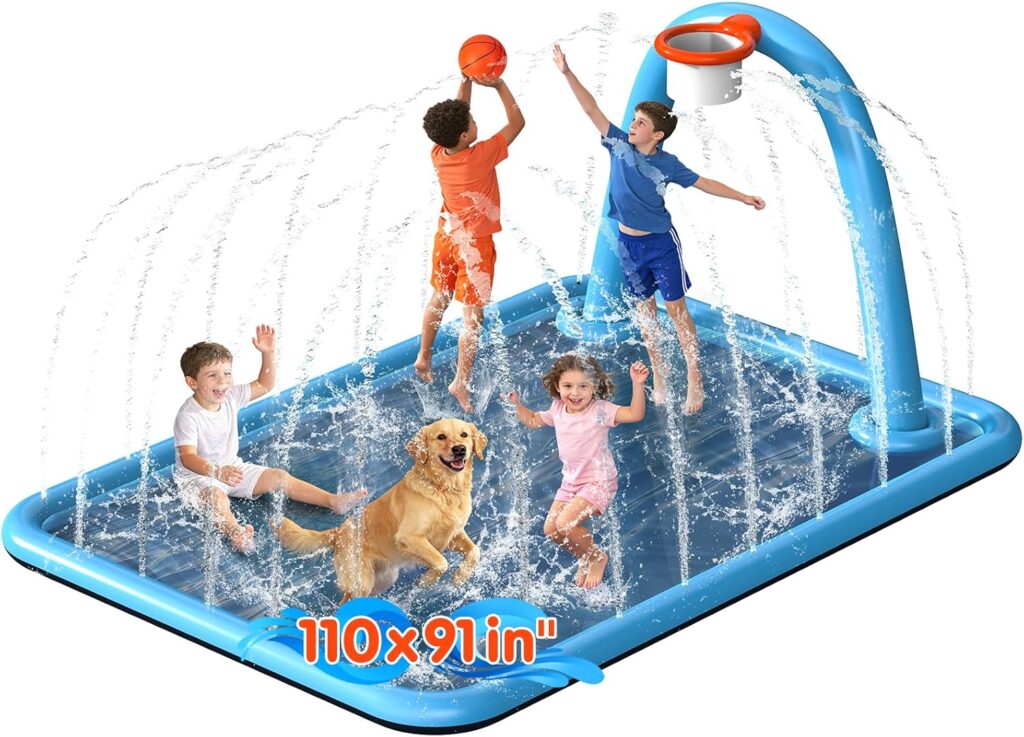
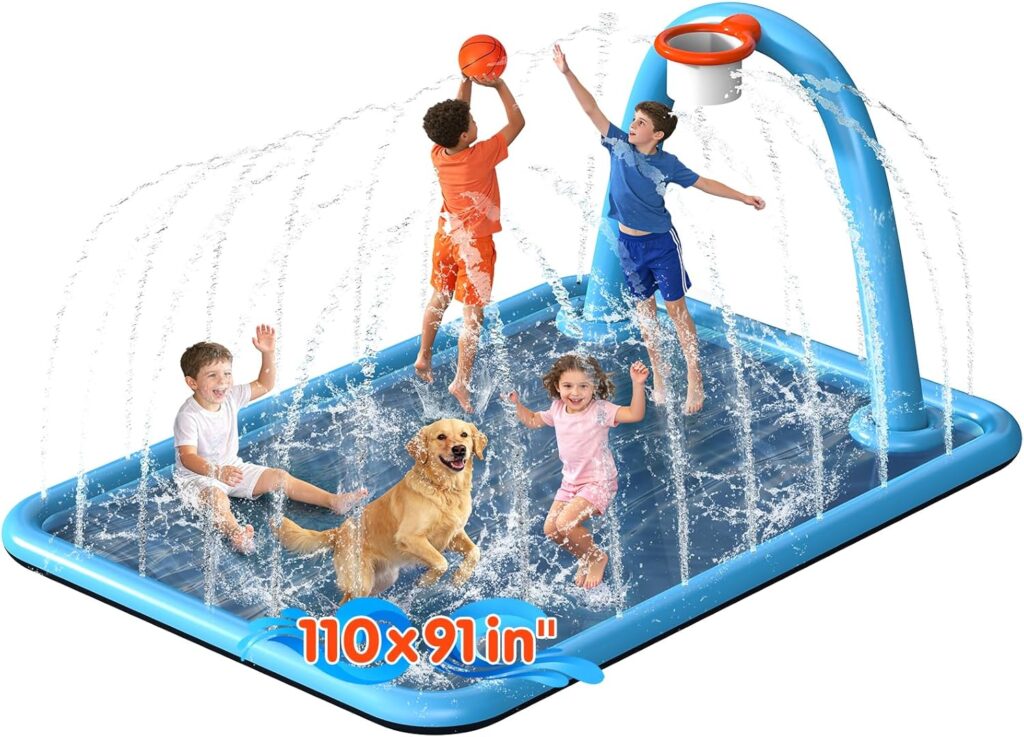
Built-in features should be judged separately from loose toys because they are part of the splash pad’s structure. Examples may include a basketball hoop, water target, spraying animal, sprinkler arch, center sprayer, raised game area, or multiple spray zones. These features can genuinely change how children use the product, but they can also occupy space that would otherwise remain open for movement. A feature is most useful when it creates a distinct activity without turning the center into a crowded obstacle zone.
This is one reason outside diameter alone can be misleading when comparing two splash pads. Two products may both be advertised as approximately eight feet across, yet one may devote a large part of the center to an inflatable structure while the other leaves most of the center open. The first model may offer more structured play, while the second may provide better movement space for several children. Families should therefore ask how much of the listed size is actually available for standing, stepping, sitting, and moving once all fixed features are in place.
Practical Accessories
Some of the most valuable accessories are functional rather than entertaining. Hose connectors, clear instructions, repair material, storage bags, spare fastening parts, or other maintenance-related items can reduce frustration even though children may never notice them. These pieces influence whether the product is easy to connect, organize, dry, transport, or continue using after a small service issue. Practical accessories deserve a different type of value rating from toys because they improve ownership convenience rather than play variety.
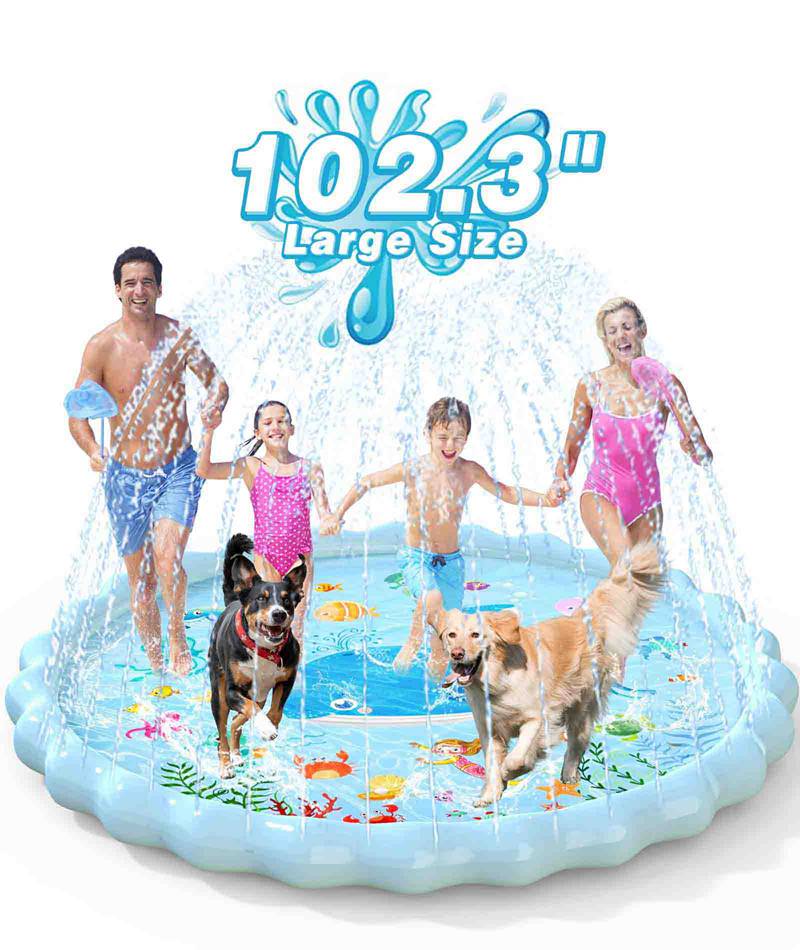
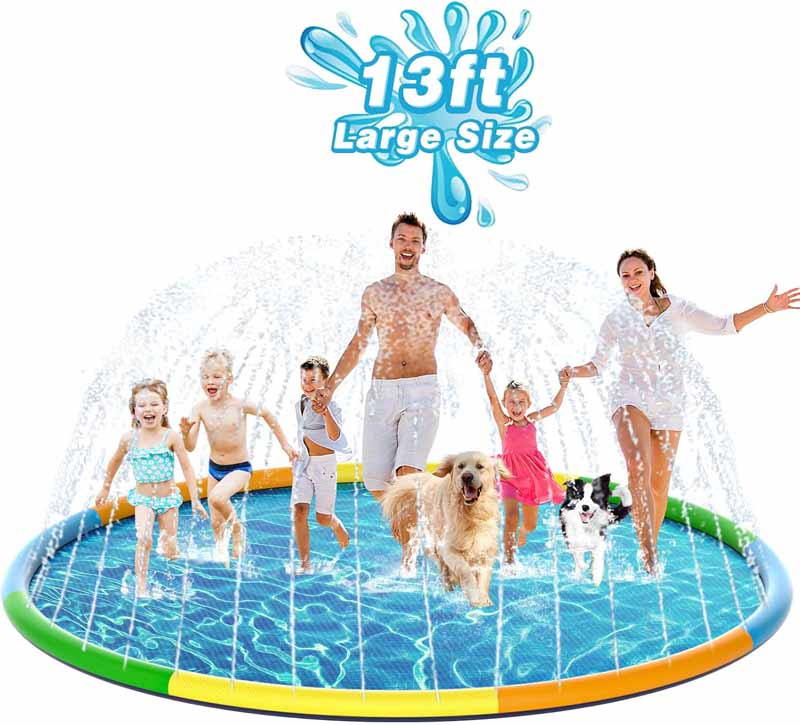
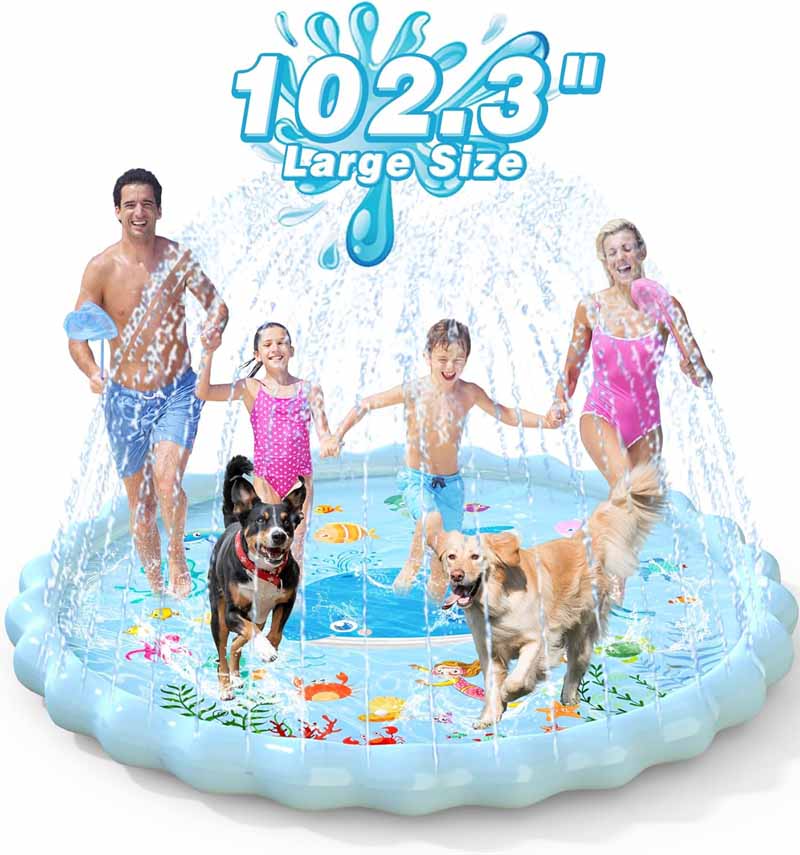
A current 102.3-inch round PVC splash-pad design provides a useful example of this distinction. Its core setup is a flexible PVC pad with an outer water-fed sprinkler ring connected to a standard garden hose, and no separate air pump is required for normal use. A hose connector is part of the functional setup, while cups, buckets, balls, or other toys shown in a family-play scene should be treated as optional add-ons unless the specific package listing confirms otherwise. Keeping this distinction clear prevents marketing images from being mistaken for a complete package specification.
3. Do Accessories Really Keep Kids Playing Longer?
More Activities Can Help, but First-Day Excitement Is Not Repeat Play
Parents often assume a splash pad with more features will automatically hold a child’s attention longer, but play duration cannot be predicted reliably from accessory count. Children differ in temperament, age, interests, social setting, and preferred play style. A child may be fascinated by a new hoop for one afternoon and largely ignore it after a week, while another child may spend much longer repeating simple pouring and catching activities with ordinary containers because the rules can change every time.
The American Academy of Pediatrics describes outdoor play as supporting physical activity, curiosity, creativity, focus, and social experience, while its broader play guidance connects play with social-emotional, cognitive, language, and self-regulation development. These findings support creating opportunities for active, varied play, but they should not be converted into a claim that an accessory-heavy splash pad is medically or developmentally superior to a basic design. The more responsible conclusion is that children benefit from meaningful play opportunities, and different products can support those opportunities in different ways.
- Evidence resource — American Academy of Pediatrics / HealthyChildren, “Playing Outside: Why It’s Important for Kids”: This article is useful for understanding the broader value of outdoor play while keeping product claims realistic and evidence-based.
Open-Ended Play Can Create More Variety Than It First Appears
A basic splash pad should not be viewed as a single-activity toy. Water naturally supports many forms of experimentation. Children can catch it, redirect it, compare streams, fill containers, empty containers, move around spray, create pretend scenarios, follow printed graphics, and invent simple cooperative rules. NAEYC specifically describes open-ended materials such as water as having many possible uses rather than a single correct use, which helps explain why a simple water-play environment can remain interesting without a large built-in game system.
For younger children, this matters because adults sometimes overestimate how much equipment is needed to create useful play. A cup can become a filling tool, pouring tool, catching tool, measuring object, pretend cooking item, or part of a race. A printed whale can become a search target, story character, color prompt, or counting point. The value comes from the number of ways an activity can change, not from how complicated the accessory looks in a product photograph.
- Downloadable resource — NAEYC, “Harnessing the Joy of Open-Ended Materials with Your Child”: The page includes a downloadable PDF and practical guidance for families on using simple materials in multiple ways. It is especially useful for parents considering a basic splash pad plus a few flexible add-ons rather than a large prebuilt accessory package.
Harvard’s Center on the Developing Child also provides age-based play resources showing how simple activities can change as children grow. The material focuses on interaction, attention, working memory, and self-control rather than expensive toys. For splash-pad decisions, the practical takeaway is straightforward: children do not necessarily need a large number of specialized components to create meaningful play. A flexible environment paired with a few suitable activities can often be adjusted more easily as interests and abilities change.
- Downloadable resource — Harvard Center on the Developing Child, “Brain-Building Through Play”: This page provides age-specific downloadable activity handouts for toddlers, young children, older children, and teens, helping parents understand how play needs evolve instead of assuming one feature set fits every age.
Use a Repeat-Play Test Before Paying More
The most useful way to judge accessories is to imagine the fifth or tenth backyard session rather than the unboxing. Ask whether children can change the rules, use the pieces in multiple ways, play independently without waiting for one central feature, and continue using the splash pad if a loose component disappears. An accessory that remains useful only when every piece is present may have lower long-term value than a simple open-ended item that can be substituted easily.
Parents can use this practical repeat-play checklist:
- Does the accessory create a genuinely new activity?
- Can it be used in more than one way?
- Can two children use different activities at the same time?
- Does the splash pad remain fully usable if the item is lost?
- Can the game become easier or harder as the child grows?
- Does the feature still make sense after the first-week novelty fades?
- Is the extra setup effort reasonable compared with the play it creates?
- Video resource 1 — American Red Cross, “Do Your Part, Be Water Smart”: This lesson includes an animated video and family safety materials that can be watched before backyard water play. It is useful for establishing simple water rules before introducing games or accessories.
4. Match the Splash Pad to Age, Play Style, and Number of Children
Younger Children Often Need Less Complexity
Chronological age matters because products and accessories have age guidance, but age should not be the only factor used to decide between basic and accessory designs. Two children of the same age may play very differently. One may happily repeat stepping, pouring, and splashing activities for a long time, while another may prefer targets, rules, role play, or cooperative games. The product should first be appropriate for the child’s age, then the family can refine the decision according to ability, interests, and how the child usually plays.
CPSC guidance encourages families to choose toys based on age, interests, and abilities and emphasizes the importance of small-parts rules for younger children. This becomes especially relevant in homes with mixed-age siblings. A toy selected for an older child can still end up within reach of a younger child, so accessory suitability needs to be judged for every child sharing the yard, not only the age printed on the splash pad package.
- Evidence resource — CPSC Small Parts Guidance: This source explains small-parts requirements and provides useful background when parents are considering adding loose balls, game pieces, or other accessories around younger children.
One Child and Several Children Create Different Design Problems
With one child, a simple open center may be perfectly practical because there is no need to divide activities or prevent competition for one feature. With two or more children, the layout changes. Children may want the same spray position, cup, hoop, or central game at the same time. Several simple activities can help distribute attention, but this does not necessarily require a complicated accessory model. A spacious basic pad plus duplicate low-cost items can sometimes solve the same problem more efficiently.
A fixed number of children should not be promised from splash-pad diameter alone. Age, body size, movement style, supervision, fixed structures, and central open area all influence how crowded the space feels. A 102.3-inch circular pad measures about 8.525 feet across. If treated as a perfect full circle, the geometric area is about 57.1 square feet, but the outer water-fed ring occupies part of that footprint, and any fixed structures reduce the open area further. The geometric number is useful for planning the yard, not for claiming a guaranteed child capacity.
| Play Situation | Main Design Need | Useful Accessory Strategy |
|---|---|---|
| One younger child | Simple movement and easy supervision | One or two flexible pouring items may be enough |
| Two siblings close in age | Shared access and fewer bottlenecks | Duplicate cups or several separate activities |
| Siblings with a larger age gap | Different challenge levels | Open pad plus age-appropriate toys for each child |
| Several children at a playdate | Space, movement flow, supervision | Multiple independent activities rather than one central attraction |
| Child prefers pretend play | Flexible graphics and open-ended items | Cups, figures, themes, storytelling prompts |
| Child prefers rule-based games | Targets and turn-taking | Hoops, suitable balls, or built-in game features |

Multi-Child Play Works Better When Activities Are Distributed
A common mistake in accessory design is placing all play value into one dramatic feature. This may look strong in advertising but can create a bottleneck when several children want the same feature. A better multi-child setup often spreads activities across the surface: one child catches spray, another pours water, two children use a target, and another follows a printed game. Distributed activity can reduce waiting and give children different ways to participate at the same time.
The same principle is useful for product customization. When a brand is developing a multi-child PVC splash pad, the design discussion should include not only outside dimensions and artwork but also movement paths, activity zones, spray-hole distribution, feature placement, and whether several activities can operate without crowding one small area. Adding a large central accessory can improve visual impact while reducing usable movement space, so the structure and play pattern should be evaluated together rather than separately.
- Video resource 2 — American Red Cross, “Swim as a Pair with a Lifeguard There”: Although the lesson addresses broader water-safety situations rather than home splash mats specifically, the animated video reinforces the importance of companions and adult water supervision, which is useful context for siblings and group water play.
5. Setup, Water Pressure, Cleanup, and Storage Affect Real-World Value
Parent Effort Often Determines How Often the Product Gets Used
A splash pad may be affordable and entertaining, but repeated setup can determine whether it becomes a weekly summer activity or something used only a few times. Families should picture the full routine rather than the first ten minutes: carry the pad outside, check the ground, unfold it, connect the hose, arrange any accessories, adjust the spray, supervise play, turn off the water, disconnect, drain, rinse away debris, dry the pad, collect loose pieces, and return everything to storage.
Basic garden-hose splash pads often keep this routine relatively simple because the same water supply fills the outer structure and feeds the spray openings. Accessory models vary widely. Some remain almost as simple, while others add inflatable features, removable hoops, balls, separate sprayers, or several components that need cleaning and drying. The right question is not whether extra assembly is objectively “bad,” but whether the family will consider the extra work worthwhile after repeating the process many times through the season.
Water Pressure Can Matter More Than Another Toy
Household water delivery is one of the most overlooked variables in splash-pad use. Spray performance is influenced by the faucet opening, available pressure, hose length, hose inside diameter, kinks, restrictions, fittings, and the water pathway inside the product. This is one reason responsible manufacturers should avoid promising one universal spray height unless it has been validated under clearly defined test conditions. A product that produces tall spray in one test setting may behave differently in another home.
Washington State University provides a residential garden-hose calculator that estimates free-flow output using hose size and supply pressure. WSU lists the calculator specifically as a way to estimate garden-hose flow rate and application time. The result remains an educational reference rather than a splash-pad performance predictor because a connected sprinkler product creates additional restrictions and flow paths not represented by a free-flowing hose calculation.
- External tool — Washington State University Garden Hose Flow Rate Calculator: Families can use this tool to understand how hose diameter, pressure, and length influence theoretical hose flow. Do not use the result to promise a specific splash-pad spray height.
A more reliable home setup method is to begin with a moderate faucet opening and adjust gradually while watching the real spray. If the spray looks uneven, first inspect basic conditions before assuming the product is defective. Check the hose for kinks, make sure the connector is seated correctly, fully unfold the pad, and see whether part of the water-fed ring is twisted or folded. If the spray is too strong for a younger child, reduce the water rather than treating maximum height as the goal.
A practical setup sequence is:
- Choose a flat, clean location close enough to a suitable hose connection.
- Remove stones, sticks, toys, sharp roots, tools, and other hard debris.
- Unfold the pad fully and smooth obvious folds before introducing water.
- Route the hose away from the main movement area.
- Connect the hose according to the product instructions.
- Open the faucet gradually instead of immediately using maximum flow.
- Observe the spray and adjust it to suit the children and the space.
- Recheck the ground after it becomes wet because footing may change during play.
- Video resource 3 — American Red Cross, “First Look Around: Is the Scene Safe and Sound?”: This lesson includes an animated video focused on checking the environment before entering or playing around water. It fits naturally with the setup step of inspecting the yard before turning on the hose.
Ground Preparation Matters with Flexible PVC
Flexible PVC follows the surface beneath it much more closely than a rigid playground component. This flexibility is useful because the product can fold for transport and storage, but it also means the ground becomes part of the experience. A small stone, branch, uneven paving edge, exposed root, or forgotten hard toy under the sheet can create a pressure point. Preparing the area before every session is one of the simplest ways to reduce unnecessary material stress and improve comfort.
Consumers should also be cautious with blanket “non-slip” claims. A splash pad should only be marketed as having a specialized slip-resistant surface when the actual construction and supporting evidence justify that statement. A standard smooth printed PVC surface becomes wet during use, and nearby grass or paving can also change under water. Practical supervision, reasonable movement, and a clear play area are more dependable than assuming a product label eliminates wet-surface behavior.
HealthyChildren’s backyard safety guidance advises adults to supervise children closely outside and to check outdoor play environments for hazards. Although the article covers broader backyard play rather than splash pads alone, the same common-sense habit applies well here: prepare the area before the activity begins instead of reacting to hazards after several children are already running through water.
- Evidence resource — HealthyChildren, “Playing Outside in the Yard: 8 Tips to Keep it Fun & Safe for Kids”: This article provides practical backyard supervision and environment-checking guidance that can be applied alongside the splash pad’s own instructions.

Drying and Storage Are Part of Product Use, Not an Afterthought
After use, families should shut off the water, disconnect according to the instructions, drain the pad as fully as possible, remove visible soil or grass, and allow surfaces to dry before long-term folding. A flexible PVC product that is repeatedly stored while wet and dirty can become unpleasant to reopen because moisture and organic debris may remain trapped between folded layers. Drying takes time, but it is still much easier to manage when there are only a few components.
Accessory count therefore affects storage more than many families expect. Ten wet pieces may require ten items to find, rinse, dry, count, and pack. If three pieces are missing at the end of a playdate, an adult may spend more time searching the yard. A basic pad plus two or three deliberately chosen toys can offer a much simpler ownership routine. Families planning frequent summer use should place cleanup effort alongside purchase price when deciding what “better value” means.
6. What Matters More Than Accessories When Comparing Splash Pads?
Size and Usable Play Area Come First
Outside dimensions are one of the easiest specifications to compare, but they should be translated into real backyard space. A circular splash pad measuring 102.3 inches across is approximately 8.525 feet in diameter. The mathematical area of a full circle at that diameter is roughly 57.1 square feet. This does not mean the child has 57.1 square feet of unobstructed movement space because the sprinkler ring, seams, graphics, and fixed features occupy part of the product.
Before buying, families can mark the listed diameter on the lawn with a tape measure, rope, garden stakes, or temporary markers. Then walk around the circle and think about the adult supervision position, hose route, nearby walls, furniture, doors, fences, landscaping, and whether surrounding grass will become wet. This simple exercise is often more useful than comparing lifestyle images, which may use wide-angle lenses or different camera positions that make one product appear larger than another.
- External tool — Omni Calculator, Circumference and Area of a Circle: Enter the stated diameter to estimate the product’s geometric footprint. Use the result for yard planning only; it does not determine safe clearance or the number of children a product can hold.
Material Thickness Is Only One Part of Product Construction
Consumers frequently compare PVC products by thickness because the number is simple and easy to display. Thickness matters, but it is only one variable. A splash pad also depends on seam design, weld consistency, printing, water-channel geometry, connector placement, edge shape, spray-hole layout, panel cutting, and the way the product is folded and used. A thicker sheet does not automatically guarantee better performance when the rest of the construction is poorly executed.
A factual example helps illustrate the point. One 102.3-inch children’s splash-pad specification uses approximately 0.28 mm flexible PVC with heat-sealed construction. The responsible way to communicate this is to state the material and construction method. It would be inappropriate to turn one material number into claims such as “puncture-proof,” “indestructible,” or “guaranteed never to leak.” Experienced PVC product development is usually more conservative: material, geometry, seam paths, intended use, and manufacturing control are considered together.
Heat-Sealed Construction Depends on the Whole Design
Heat-sealed or welded PVC construction joins flexible sheets along designed seam paths. In a sprinkler pad, those seams help create the outer water-fed ring and separate it from the central play surface. The quality of the finished structure depends on more than the presence of welding. Seam width, process stability, sheet consistency, cut accuracy, print position, connector reinforcement, and water-path design all contribute to the final product.
For custom splash-pad development, this becomes especially important when accessories are integrated into the structure. Adding a hoop, arch, spraying animal, multi-zone water channel, or raised feature can change panel geometry, tooling, assembly sequence, water distribution, packing volume, inspection points, and child movement. A useful custom feature should therefore be discussed during structural development rather than treated as a decoration added after the basic pad has already been finalized.
| Feature to Check | What to Look For | What Not to Assume |
|---|---|---|
| Intended age | Clear age guidance and appropriate play style | Cartoon graphics mean suitable for every toddler |
| Outside size | Measured dimensions in inches or feet | Lifestyle images show scale accurately |
| Usable center | Space remaining after rings and fixed features | Outside area equals open movement space |
| PVC construction | Flexible material and appropriate seam design | Thickness alone determines durability |
| Seam layout | Clean, consistent water-channel construction | Heat sealing means permanently leak-proof |
| Hose connection | Clear connection method and practical routing | Every household produces identical spray |
| Water adjustment | Spray can be tuned through water flow where applicable | One fixed spray height applies everywhere |
| Ground use | Flat, clean, debris-free placement | A wet PVC surface is automatically non-slip |
| Cleanup | Clear drain and dry routine | Foldable means it should be stored wet |
| Accessories | Useful activities created per component | More pieces automatically mean better value |
Core Quality Should Be Compared Before Accessory Count
A practical comparison order is age fit, yard fit, usable area, material construction, seam design, hose connection, spray behavior, cleanup, storage, and then accessories. This sequence protects families from a common shopping bias: the most visually exciting features are often the easiest ones to notice, while the structural details that affect every use are less dramatic in photographs.
This same sequence is valuable to private-label and custom PVC product programs. When a brand wants an accessory-rich splash pad, engineering discussions are more productive if the team first confirms dimensions, material specification, water-path structure, spray distribution, connector requirements, print zones, and intended use. Accessories can then be added where they improve the experience without interfering with manufacturing reliability or central play space. This approach tends to produce a product that feels simpler for the consumer even though more technical planning happens behind the scenes.
7. Are Splash Pad Accessories Worth the Extra Cost?
Compare Cost per Use, Not Only Purchase Price
Sticker price is important, but a lower purchase price does not automatically create better value. A simple way to evaluate seasonal products is to divide total purchase cost by a realistic estimate of how many times the family will use them. This “cost per use” calculation does not measure safety, construction quality, or developmental value, but it helps families compare two products when one costs more but may be used more frequently.
For example, imagine a $30 basic splash pad that is used eight times during the summer. The purchase cost works out to $3.75 per use. A $45 accessory model used twenty-five times works out to $1.80 per use. The higher-priced model is cheaper per session in this example because it is used more often. If the accessory version is used only seven times, its cost per use becomes much higher. The calculation depends almost entirely on realistic usage rather than the product category.
| Hypothetical Product | Purchase Price | Realistic Uses | Purchase Cost per Use | What the Example Shows |
|---|---|---|---|---|
| Basic Pad A | $30 | 8 | $3.75 | Low price does not guarantee low cost per session |
| Basic Pad B | $35 | 20 | $1.75 | A simple product can deliver strong repeat value |
| Accessory Pad A | $45 | 25 | $1.80 | Higher initial price can still be reasonable |
| Accessory Pad B | $50 | 7 | $7.14 | Expensive extras are poor value when rarely used |
These figures are only examples, not typical market averages. Families should enter their own prices and make a conservative estimate of use. If they normally use outdoor water toys twice a week for two summer months, the estimate may be very different from a household that uses them only during birthdays or heat waves. Overestimating future use makes any product appear better on paper, so it is more useful to think about last summer’s actual habits than an idealized plan for next summer.
- External tool — Cost Per Use Calculator: Calculator Academy provides a simple tool based on total cost divided by number of uses. It can also account conceptually for recurring costs, but for a splash pad the basic purchase-price comparison is often enough for a first pass.
Pay More for Useful Activities, Not Packaging Volume
An accessory premium makes more sense when the feature changes what children can actually do. A functional target, integrated sprayer, or well-designed game structure may create an activity a family could not reproduce easily with an ordinary cup. The same premium is harder to justify when most of the added cost comes from generic loose toys that can be purchased separately or that duplicate items already at home.
Parents can evaluate the premium with four questions:
- Does the accessory create a new activity?
- Can several children use the activity without long waits?
- Will the item probably still be used later in the season?
- Is the splash pad itself still competitive in size, construction, and convenience?
If the answer is “no” to most of these questions, the accessory package is probably not the strongest reason to spend more. If the extra feature creates repeatable shared play while the underlying pad remains practical, a higher purchase price may be justified.
8. A Basic Splash Pad Can Be Upgraded Later

Adding Toys Later Can Be More Efficient Than Buying Them All Up Front
Families do not actually face only two choices. The third option is often overlooked: purchase the better basic splash pad first and add a small number of toys after observing what the children enjoy. This approach is especially useful when parents do not know whether the child prefers pouring, targets, role play, collecting, racing, or simply moving through spray. A few real sessions reveal those preferences more accurately than guessing from a product photograph.
Simple additions might include:
- Age-appropriate cups for catching and pouring.
- Small buckets for filling and pretend play.
- Suitable soft balls for passing or target games.
- Scoops or containers without inappropriate small parts.
- Waterproof figures appropriate for the age group.
- Simple color, shape, or animal prompts based on graphics already printed on the pad.
Rotating activities can also reduce clutter. Instead of putting twelve items onto the splash pad every time, families can use cups and buckets one day, a target activity on another day, and an animal-search game on another. The same pad then feels different without requiring a large storage container full of wet pieces. Rotation also helps adults notice which toys children repeatedly ask for, which is a much stronger indicator of value than the number included in a box.
Printed Graphics Can Support Simple Play Without Making Educational Claims
Artwork can be part of the activity without being marketed as a formal educational system. A whale, fish, ocean animal, number, color, or geometric shape can become the starting point for a search game, story, movement instruction, or simple counting activity. Parents can ask a child to find the blue fish, stand beside the whale, count three animals, or invent a short ocean story while moving through the spray.
This type of interaction fits naturally with open-ended play guidance because the adult provides a prompt without forcing one correct result. NAEYC discusses how water play can involve filling containers, predicting quantities, observing flow, and cooperating with other children, showing how ordinary water activities can become richer through conversation and shared exploration. The splash pad does not need to be called an “educational product” for parents to use it in thoughtful ways.
- Evidence resource — NAEYC, “Talking with Parents about Play and Learning”: This source gives concrete examples of water-table play involving flow, filling containers, prediction, motor activity, and cooperation, making it useful support for simple water-play ideas.
Use Accessories to Solve a Real Play Problem
A good accessory should solve something visible in real family use. If siblings keep arguing over one cup, provide two. If children want a challenge, add a suitable target. If they are interested in pouring, add containers of different shapes. If they mainly enjoy free movement, extra toys may only create clutter. This problem-first method is more reliable than choosing an accessory package because the product photo looks busy.
For custom PVC product programs, the same principle can guide development. A brand considering a new accessory should define the play problem before engineering the component. Is the goal to improve multi-child participation, add a target game, create a new water pattern, support themed storytelling, or improve practical setup? Once the purpose is clear, size, geometry, attachment method, water path, material, testing, and packaging can be developed around the real use case instead of adding parts without a clear consumer benefit.
Added Toys Need Their Own Safety Check
Parents adding toys later should review the accessory as a separate product. Check the intended age, small-part risk, physical condition, and whether the item makes sense for wet outdoor use. This matters especially in mixed-age families because a toy selected for an older sibling may still be handled by a younger child. Damaged accessories with broken edges, detached parts, or missing components should be removed rather than kept in the play area simply because they originally belonged to the set.
- Video resource 4 — CPSC Toy Safety Video, “Your Child Has Some Questions for You About Toy Safety”: This official CPSC video provides a simple reminder about checking toy safety and age suitability, making it a useful resource before families add separate accessories to a basic splash pad.
9. Safety Does Not Improve Just Because a Splash Pad Has More Features
Adult Supervision Remains the Most Important Control
A household splash mat should not be treated as identical to a swimming pool, and pool drowning statistics should not be presented as if they measure splash-pad risk. At the same time, young children are still playing around water on a wet surface, and close adult supervision remains sensible. CPSC’s June 2026 report states that an average of 376 children under age 15 died each year in pool- or spa-related incidents from 2021 through 2023, with nearly 80% of the victims under age five. Those numbers relate to pools and spas, but they reinforce the broader need for focused water supervision.
CPSC also promotes the idea of a designated Water Watcher: a responsible adult focused on supervising children around water rather than reading, texting, or becoming distracted. A home splash pad is a different environment from a swimming pool, but the attention principle is still practical. One adult should know they are responsible for the activity, remain close, keep the play area in view, and avoid leaving children outside while going indoors to collect towels, drinks, or toys.
- Video resource 5 — CPSC, “Pool Safety | Anatomy of a Water Watcher”: This 2026 official video explains the role of focused adult supervision around water. The pool context should remain clear, while the distraction-control principle is still useful for backyard water play.
https://www.cpsc.gov/node/66725
Wet Surfaces and Crowding Need Plain, Practical Rules
Accessory-rich splash pads can create more objects in the play zone. A ball can roll underfoot, children may rush toward one target, and hoses or detachable pieces can cross movement paths. A basic pad can also become crowded when several children run through the same spray area. The safest approach is not to assume one design solves these problems automatically but to create simple household rules suited to the number and age of children.
Useful rules may include:
- No pushing or rough chasing.
- Keep hard objects away from the pad.
- Keep the hose route outside the main play path.
- Slow down when several children are sharing the center.
- Stop play if an accessory breaks or creates a sharp edge.
- Recheck the ground if water makes surrounding soil muddy or uneven.
- Keep adult supervision active throughout the session.
- Video resource 6 — American Red Cross, “Play It Smart At Your Home, Pool or Park”: This lesson includes an animated video and activity resources about water safety around home and recreational settings. It works well as a family reference before backyard summer activities.
Public Splash Pads and Garden-Hose Splash Mats Are Not the Same System
Search results often mix public splash parks with household PVC splash pads, but their water systems can be very different. CDC explains that public splash pads may use once-through water or recirculated systems where sprayed water is collected, filtered, disinfected, and reused. Public-health concerns such as disinfectant control, filtration, and microbial management apply to those aquatic venues and should not be copied mechanically into advice for a home garden-hose splash mat.
For home use, practical hygiene is simpler. Children should not be encouraged to swallow sprayed water, families should avoid shared water play when a child is ill, visible dirt should be removed, accessories should be cleaned when needed, and the pad should be drained and dried before extended storage. The specific manufacturer’s instructions remain important because product structures, connectors, materials, graphics, and water pathways vary.
- Evidence resource — CDC, “What You Can Do to Stay Healthy at Splash Pads”: This page is useful for understanding public splash-pad water systems and hygiene. Read it with the distinction between public aquatic venues and home garden-hose splash mats clearly in mind.
10. A Practical Family Decision Guide
The final decision does not require a quiz, chatbot, or interactive generator. A family can usually make a sound choice by checking the same information in the same order. Start with the children, then the yard, water connection, setup routine, expected frequency, storage, and only then accessory value. This process prevents product photography and package count from dominating the decision.
Choose a Basic Splash Pad When…
- The main goal is simple cooling and backyard water play.
- The child enjoys open-ended movement, pouring, and splashing.
- Parents want the fastest practical setup.
- Storage space is limited.
- Fewer wet pieces are easier to manage.
- The family already owns suitable water-play toys.
- The child’s long-term interests are not yet clear.
- The basic model provides more usable open area for the same budget.
Choose a Splash Pad with Accessories When…
- Two or more children regularly play together.
- The features create several genuinely different activities.
- Children enjoy targets, rules, throwing, role play, or cooperative games.
- The pad will be used for frequent playdates.
- Integrated features would be difficult to add later.
- Adults are comfortable with additional setup and cleanup.
- The underlying pad still offers competitive size, construction, and water performance.
- Losing one loose accessory will not make the entire product unusable.
Choose a Better Basic Pad and Add Toys Later When…
- The family is unsure which activities the child will repeat.
- The basic model has a better layout or larger open center.
- Most accessories in the alternative package are generic loose pieces.
- Mixed-age siblings need different age-appropriate toys.
- Parents prefer rotating a small number of activities.
- Storage simplicity matters.
- The family wants to observe actual play before paying for specialized features.
Measure the Yard Before Ordering
If the product is round, mark its real diameter on the ground. A 102.3-inch model spans a little more than 8.5 feet from edge to edge. Then look beyond the circle. Where will the supervising adult sit or stand? Can the hose reach without crossing a walkway? Will a patio door still open? Are there sharp landscaping edges nearby? Will the surrounding lawn remain usable after the area gets wet?
Measuring first also helps families compare two products with similar listed sizes but very different layouts. If one uses a large center feature, sketch or estimate how much open area remains around it. A product may technically fit the yard but still feel crowded once multiple children, accessories, and a supervising adult are added. Real-space planning is one of the easiest ways to avoid a purchase that looks large online but feels cramped at home.
Use a Ten-Point Purchase Check
Before buying either type, confirm:
- The intended age range.
- The actual outside dimensions.
- Approximate usable open area after fixed structures.
- Whether the product needs only a hose or additional inflation and assembly.
- How spray strength is adjusted.
- The material and seam description.
- A suitable flat, debris-free location.
- How the pad and accessories will be drained and dried.
- A realistic estimate of how often the family will use it.
- The number of distinct activities created by the accessories.
For brands developing a custom splash pad, the same list can become an early product brief. Target age, overall dimensions, play-zone size, water channel, spray pattern, seam geometry, artwork, hose connection, accessory function, packaging, and test plan can all be confirmed before sampling. This is a more reliable path than choosing a visual concept first and trying to make the structure work later.
11. Final Verdict: Choose the Splash Pad First, Then the Accessories
There is no universal winner between a kids splash pad with accessories and a basic splash pad. The accessory model is stronger when its features create meaningful repeat activities, help several children share the space, suit the intended age group, and remain practical to set up, dry, and store. The basic design is stronger when simplicity, open movement, lower clutter, easier maintenance, or better core construction matters more than receiving a larger package of toys.
The most dependable comparison order is age fit → yard fit → usable area → PVC construction → seam and water-channel design → hose and spray behavior → setup and drying → expected frequency of use → accessories. Keeping the accessories near the end of the list helps families avoid paying for visible extras while overlooking the parts of the product they experience every single time the hose is turned on.
From a long-term PVC product-development perspective, the same principle applies to customized designs. A useful accessory should create a clear new activity, improve shared play, solve a practical setup problem, or support a meaningful theme. It should not exist only to increase the item count. Material selection, seam geometry, water distribution, connector design, print layout, accessory integration, inspection, packaging, and storage all need to function as one system if the finished product is expected to feel straightforward for families.
For most households, the best value will be the version they can realistically use repeatedly. If a good basic splash pad already fits the children, yard, hose setup, supervision routine, and storage space, there is no strong reason to chase a longer accessory list. If an accessory model preserves those fundamentals and gives siblings or frequent users several additional ways to play, the extra cost may make sense. The best splash pad is ultimately the one the family will set up comfortably, supervise responsibly, dry properly, and still want to use after the first-week excitement has passed.
Frequently Asked Questions
Are Splash Pad Accessories Worth It for Younger Kids?
Accessories can be useful for younger children, but they are not automatically necessary. Many young children enjoy repeating simple activities such as touching spray, catching water, pouring between containers, following colorful graphics, or moving around the edge of the sprinkler area. Begin with the product’s intended age and the child’s actual interests. If toys are added separately, check their age guidance and small-part suitability rather than assuming every water toy is appropriate for every child.
Is a Basic Splash Pad Enough for Two Kids?
A basic splash pad can work well for two children when the open center provides enough room and both children can share the spray area comfortably. Diameter alone cannot determine a fixed child capacity because age, body size, movement style, outer-ring width, fixed structures, and adult supervision all influence crowding. If children compete for one activity, adding duplicate cups or several simple toys may solve the problem without replacing the entire splash pad.
Can I Add My Own Toys to a Basic Splash Pad?
Yes, provided the toys are suitable for the children’s ages, abilities, and wet outdoor use. Cups, small buckets, scoops, suitable soft balls, and other flexible items can create several activities without changing the basic pad. Check each item before use for damage, detached pieces, or inappropriate small parts, particularly when younger siblings are present. Adding toys gradually also helps families learn which activities children actually repeat before purchasing more equipment.
Do More Accessories Make a Splash Pad Safer?
No. Accessory count is a play-value characteristic rather than a safety rating. Families still need age-appropriate use, active adult supervision, a clean and reasonably flat setup area, sensible movement on wet surfaces, appropriate toy selection, and routine inspection of the pad and accessories. In some situations, more loose pieces can create additional clutter or items to trip over, so organization and supervision remain important regardless of how many accessories are included.
Does Higher Water Pressure Always Make a Splash Pad Better?
No. Higher household flow may increase spray on many water-fed designs, but maximum spray height is not always the most comfortable setting for younger children or a smaller backyard. Actual performance can vary with available pressure, faucet opening, hose diameter, hose length, restrictions, fittings, and the product’s own water channels. Start with moderate flow and adjust based on the real spray rather than treating maximum faucet opening as the default goal.
What Should I Check Before Buying a Splash Pad as a Gift?
A gift purchaser should check more than the artwork and the child’s age. Confirm whether the household has suitable outdoor space, access to a garden hose, enough storage, and adults who are comfortable with the setup and drying routine. When the child’s play preferences are unknown, a good basic pad can sometimes be easier to adapt with later accessories than a highly specialized design chosen mainly because its package looks more impressive.
How Should a Splash Pad Be Stored After Use?
Turn off the water, drain the product according to its instructions, remove visible grass or dirt, and allow the PVC surfaces to dry before extended folding and storage. Loose accessories should also be dried and organized separately so moisture is not trapped between layers. Store the product away from sharp tools and conditions that may damage the material. A foldable design reduces storage volume, but foldable should not be interpreted as meaning the pad should be packed away immediately while still wet.