Skip to content


A round splash pad can look perfectly at home in the middle of a wide green lawn, while a square model may seem like the obvious answer beside a patio, fence, or narrow side yard. Once you transfer the dimensions from a product page to a real backyard, however, the decision becomes less about which outline looks better and more about geometry, usable play space, hose access, water runoff, child movement, adult supervision, and how much clear ground remains around the product after it is fully operating.
For most families, round splash pads fit broad, open lawns naturally, while square splash pads often use narrow, rectangular, patio-side, and fence-side spaces more efficiently. Neither shape is automatically larger, safer, stronger, easier to maintain, or better for children. A large round pad can provide considerably more room than a small square product, while two pads with similar outside dimensions can have very different central play areas because the perimeter water chamber, seams, spray holes, connectors, and decorative structures occupy real space. The useful question is therefore not simply “Which shape is better?” but “Which shape allows the entire backyard setup to work better for this family?”
Families also need to think beyond the product footprint. Children do not stand still inside a perfect geometric boundary. They enter from the house, move toward interesting spray streams, carry cups and toys, pass siblings, sit down, stand up, and step outside the wet area before coming back. A garden hose has to reach the inlet without becoming the main thing everyone steps over, while an adult needs a clear position from which the whole play area can be seen and quickly approached. The supplied family-use research identifies crowding, water pressure, backyard condition, drainage, setup, and storage as recurring practical concerns when several children share one splash pad.
This guide approaches those decisions from the practical perspective used in long-term PVC and welded flexible-product development. Instead of treating round and square as styling choices, it looks at measurable footprint efficiency, central activity space, water-channel behavior, hose loading, heat-sealed structures, ground preparation, runoff, repeated folding, and normal family movement. The result is a decision process a family can actually carry into the yard with a tape measure rather than a comparison built around vague claims such as “extra large,” “family size,” or “best shape.”
1. Round vs Square Splash Pads: The Quick Answer
Round and square splash pads solve slightly different space-planning problems. A round pad is usually easiest to place where the lawn is broad enough to surround the product on several sides, because the circle does not need to line up with a particular wall, fence, patio border, or deck edge. A square becomes especially useful when available width is limited or when straight yard boundaries already define the play zone. The advantage is geometric rather than a universal product-quality advantage, and it becomes more noticeable as backyard space gets tighter.
Consider a side yard with nine feet of usable width. An eight-foot round pad and an eight-foot square pad can both fit inside the same maximum width, but the curved circle leaves portions of the rectangular yard outside the product footprint while the square occupies those corner areas. In a twenty-five-foot-wide open lawn, the difference may not matter because both products already have generous surrounding space. In the smaller yard, every square foot may affect child movement and adult access, so shape deserves much more attention.
| Yard or Family Situation | Round Splash Pad | Square Splash Pad | Main Decision Point |
|---|---|---|---|
| Wide open lawn | Excellent fit | Excellent fit | Geometry matters less when space is generous |
| Narrow rectangular yard | Good if dimensions fit | Often stronger fit | Straight edges use fixed width efficiently |
| Patio-side placement | Good with enough clearance | Often easier | Square sides align with straight boundaries |
| Central lawn play area | Strong choice | Good choice | Round layout supports entry from several directions |
| Several children | Depends on actual size | Often efficient at equal width | Usable play area matters more than label |
| One younger child | Either shape | Either shape | Age guidance and real activity space come first |
| Fence-side position | Can work | Often easier | Inlet, spray direction, and access still need checking |
| Large unrestricted yard | Excellent | Excellent | Construction and practical features may decide |

Round Works Best When the Yard Gives It Room
A round splash pad makes sense when the outdoor play zone is open and families want flexible orientation. Because a circle has no front, back, or preferred straight side, the inlet can often be rotated toward the water source while the central play space remains visually balanced. Children can approach from several directions rather than being encouraged toward one particular edge. This can work especially well when towels, chairs, shade, and adult supervision are distributed around an open lawn rather than concentrated along one narrow boundary.
The circular outline also works naturally with the common PVC sprinkler-pad structure in which a water-filled chamber follows the perimeter and spray openings send water toward the central play zone. The shape itself does not guarantee a uniform spray curtain, because hole size, spacing, angle, inlet position, channel width, household flow, and heat-seal consistency still influence performance. Round should therefore be understood as a placement advantage in open space, not as proof of superior hydraulic performance.
Square Works Best When Space Has Straight Limits
A square product becomes more useful as the site becomes more constrained. If a family wants to place a splash pad between a fence and patio, within a rectangular strip of lawn, or inside a paved courtyard with predictable boundaries, straight sides can use the available footprint more completely. This becomes particularly relevant for families comparing products with similar maximum width, because square geometry occupies the corner regions a same-width circle leaves outside its footprint.
Still, “square for small yards” is only a starting point. A seven-foot square covers less geometric area than an eight-foot circle, so actual dimensions can easily reverse the apparent shape advantage. A product with a wide structural perimeter can also provide less open central space than a differently designed product with a smaller outside footprint. Always compare finished unfolded dimensions and real internal layout, not shape names alone.
Do Not Reduce the Choice to “Round for Grass, Square for Patio”
Grass does not require a round splash pad, and a patio does not require a square one. Both shapes can work on many outdoor surfaces when the specific product manufacturer allows the application and the site is suitable. Shape affects how efficiently the outline sits inside the available space; surface condition affects abrasion, stability, water movement, and normal use. Those are separate questions and should remain separate during product selection.
From a PVC product-engineering standpoint, this distinction matters because a splash pad is not merely a piece of printed sheet material. It is a joined water system containing flexible PVC, heat-sealed boundaries, an inlet, a pressurized water channel, spray holes, folds, and areas exposed to repeated movement. Shape helps determine the pattern, but site fit and construction determine whether the design performs well in real backyard use.
2. Measure the Usable Yard, Not the Whole Property
A common planning mistake is knowing the approximate backyard size while never measuring the continuous section where a splash pad could actually operate. A property can contain hundreds or thousands of square feet and still have only one modest section which is relatively level, visible from the patio, close to a faucet, free from trees, clear of an air-conditioning unit, and not occupied by outdoor furniture or garden beds. Splash-pad fit should be based on this usable activity zone, not the total lawn area shown on a property plan.
University of Minnesota Turfgrass Science recommends physical measurement with a tape measure or measuring wheel and explains how complicated lawn areas can be divided into rectangles, squares, triangles, and other manageable sections before their areas are added. The same method works well for splash-pad planning because families are not performing a legal land survey; they are identifying the largest continuous area capable of holding a known product footprint while leaving sensible access around it.
- Evidence — University of Minnesota lawn-measurement guidance: The university recommends measuring real lawn dimensions and breaking irregular areas into simpler geometric sections for area calculations.
Step 1: Draw the Yard Before Measuring the Product
Start with a rough overhead sketch of the part of the property used for family activities. Mark the house, deck, patio, fence, steps, trees, planting beds, playset, outdoor furniture, grill, utility equipment, shed entrance, and outdoor faucet. Accuracy to the inch is not necessary at this stage. The purpose is to separate genuinely open space from areas which may look empty in a property photograph but cannot reasonably support a wet play product.
Next, mark the route children normally take from the house to the lawn and the position from which an adult is likely to supervise. A location may have enough mathematical area for a large splash pad yet create a poor family layout if a garden table blocks one side or if the only adult route to the far edge passes over the hose. Planning movement at this early stage keeps the decision focused on the whole activity rather than the PVC footprint alone.
Step 2: Measure the Narrowest Usable Width
Use a physical tape measure for the dimensions most likely to limit the product. Record the longest uninterrupted length and, more importantly, the narrowest clear width through which the complete splash pad must fit. Do not measure through a tree trunk, raised planter, permanent barbecue, retaining edge, sprinkler head, exposed root, furniture item you do not plan to move, or a path which needs to remain available for normal family traffic.
Write those dimensions down rather than relying on memory. Differences of six or twelve inches can feel trivial while looking at a lawn, but they become meaningful when a large flexible product is fully spread out and its water-filled perimeter occupies the ground. If two candidate products are close to the measured limit, mark their outlines physically before ordering instead of assuming a nominal “eight-foot” area is automatically enough for any eight-foot product.
Video Resource: See How Irregular Lawn Shapes Are Measured
GreenThumb’s lawn-measurement guide contains separate short videos for straightforward rectangular areas and more awkward shapes involving triangles, curves, circles, and multiple sections. The resource is useful for families whose backyard contains planting beds or curved boundaries, because it demonstrates the same “divide the complicated space into manageable sections” logic used in practical splash-pad planning rather than assuming every lawn is a perfect rectangle.
Step 3: Use Google Earth as a First Estimate, Not the Final Measurement
For irregular yards or large properties, Google Earth provides a convenient way to draw measurement points around an outdoor area and calculate the resulting distance or polygon area. Google’s official guidance also warns that measurements may not be completely accurate, particularly where 3D terrain and buildings affect the scene, and recommends using a top-down view for the best results. This makes satellite measurement valuable for planning but unsuitable as the only evidence when a product will fit with only a few inches to spare.
A useful workflow is to trace the general usable zone digitally, identify the likely best placement area, and then go outside to confirm the limiting dimensions with a tape measure. If Google Earth shows a fifteen-foot-wide lawn and the proposed product is eight feet across, the estimate already answers the broad question. If the map shows 8.7 feet and the pad is 8.5 feet across, physical verification is essential because normal mapping uncertainty is too large for such a tight fit.
- External Tool — Google Earth: Use the polygon and measurement functions to estimate irregular lawn or patio space before confirming it physically.
- Official Tool Instructions — Google Earth Measure
Step 4: Mark the Candidate Footprint on the Ground
Once the product dimensions are known, transfer them to the lawn before purchase whenever possible. For a square, use four temporary markers and a tape measure to create the outside edges. For a circle, locate the center and measure the radius outward in several directions. A garden hose, string, lightweight rope, or small lawn-safe markers can help visualize the outline without needing any special equipment.
After marking the footprint, do something most product pages cannot show: walk around it. Enter the proposed play zone from the house, carry a towel to the supervision area, bring the hose from the faucet, and walk to the opposite side as if a child needed help. The supplied usable-space research specifically recommends this kind of dry movement test because the largest product which mathematically fits between two boundaries is not always the product which makes the whole backyard easiest to use.
3. Same Width Does Not Mean the Same Play Area
One of the most useful differences between round and square shapes comes directly from geometry. When both products have the same maximum outside width, a square covers more theoretical ground area because it occupies the four corner regions outside the circle. This is not a marketing interpretation or a splash-pad industry statistic. It follows from basic formulas: square area equals side × side, while circular area equals π multiplied by the radius squared.
An eight-foot square has 64 square feet of geometric area. An eight-foot-diameter circle has a four-foot radius and an area of approximately 50.3 square feet. The square therefore covers around 13.7 additional square feet, which is approximately 27.3% more geometric area than the same-width circle. This ratio remains essentially the same when the maximum width changes because a circle occupies about 78.5% of the area of a square whose side equals the circle’s diameter.
| Maximum Width | Round Geometric Area | Square Geometric Area | Additional Square Area |
|---|---|---|---|
| 6 ft | ≈28.3 sq ft | 36 sq ft | ≈7.7 sq ft |
| 8 ft | ≈50.3 sq ft | 64 sq ft | ≈13.7 sq ft |
| 10 ft | ≈78.5 sq ft | 100 sq ft | ≈21.5 sq ft |
| 12 ft | ≈113.1 sq ft | 144 sq ft | ≈30.9 sq ft |
Understand Diameter Before Comparing the Numbers
Round products are generally described by diameter, while square products are described by side length. The radius of a circle is one-half of its diameter, so an eight-foot circular pad has a four-foot radius. Using the full diameter as the radius would make the calculated area four times too large. This simple error can dramatically distort a comparison and is one reason a reliable article should always show the calculation rather than present a mysterious area figure without explanation.
Khan Academy’s area-of-a-circle lesson demonstrates the standard formula A = πr² and specifically explains how to find area when the known measurement is diameter. The lesson is useful here because it gives families an independent way to verify the geometry instead of accepting a commercial article’s calculation on trust.
- Video — Khan Academy, Area of a Circle: The 4-minute lesson explains diameter, radius, and the circle-area calculation used when comparing a round pad with a square of the same maximum width.Video URL: https://www.khanacademy.org/math/geometry-home/geometry-area-perimeter/circum-area-circles/v/area-of-a-circle
Use an Area Calculator When Comparing Several Sizes
Families comparing several diameters do not need to repeat the calculation manually. Enter a circular product’s known radius or diameter into a circle-area calculator and compare the result with a square whose side dimension is listed in the same units. Keep feet with feet or inches with inches, and remember that the calculator is finding geometric footprint, not certified child capacity or guaranteed open-center space.
Geometric Area and Usable Play Space Are Different Measurements
A real splash pad contains more than empty floor. A hose-powered design often uses an outer water chamber, heat-sealed margins, spray-hole zone, connector area, and sometimes raised sprinklers, arches, hoops, or decorative features. Those structures occupy a portion of the theoretical footprint. Consequently, an eight-foot square may mathematically contain 27.3% more area than an eight-foot circle while providing a much smaller advantage—or possibly no useful advantage at all—if its perimeter and internal structures consume more of the floor.
The distinction is important enough to record explicitly. Outside footprint answers “Will the whole product fit?” while usable play space answers “How much room will children realistically have for movement?” The supplied size-analysis material recommends keeping those measurements separate and treating unavailable inner dimensions as unknown rather than inventing a precise center measurement from lifestyle photography.
Product Photos Should Not Replace Dimensions
Wide-angle photography can make a splash pad look much larger than it feels at normal standing height. A smaller child placed near the center makes the surrounding material appear expansive, while a taller child close to the edge makes the same product look compact. Camera height, lens choice, cropping, nearby furniture, and lawn scale can all change perception without changing the product by a single inch.
When comparing round and square designs, give more weight to technical dimensions, top-down diagrams, manuals, and known internal measurements than to lifestyle imagery. If the retailer publishes only the outside dimensions, record the open-center measurement as unknown. That may feel less satisfying than filling a spreadsheet with estimated numbers, but a documented unknown is more useful than a precise-looking assumption which later creates a poor yard-fit decision.
4. Match the Shape to the Yard You Actually Have
The easiest way to apply the geometry is to treat the backyard like a room being furnished. A round dining table and a square table can share the same maximum width yet create different walking paths and leave different gaps beside walls. Splash pads behave similarly, except the layout also contains moving children, spray, a garden hose, wet ground, towels, adult supervision, and runoff. The shape which works best is therefore the one which preserves the entire backyard routine rather than the one which simply covers the most square feet.
| Yard Layout | Round Fit | Square Fit | Main Planning Question |
|---|---|---|---|
| Broad central lawn | Excellent | Excellent | Which actual product layout suits family use better? |
| Long narrow lawn | Good | Often excellent | How much usable width can be occupied? |
| Fence-side strip | Good with clearance | Often efficient | Can the inlet and outer edge still be reached? |
| Rectangular patio | Possible if approved | Often efficient | Is the surface suitable and where will water drain? |
| Irregular landscaped yard | Often flexible | Depends on obstacles | What is the largest continuous clear zone? |
| Small backyard | Depends on dimensions | Often efficient | Which real product leaves useful surrounding room? |
| Large unrestricted yard | Excellent | Excellent | Construction may matter more than geometry |
Open Lawn: Round Is Often the Simplest Placement
A round pad works especially naturally in a broad central lawn because it does not need to align with a visual boundary. The family can position the hose inlet toward the nearest faucet, leave towels on the patio side, and maintain an adult supervision position from another direction without making the product itself appear incorrectly oriented. Multiple entry directions can also reduce the tendency for every child to use one narrow access point.
When space is generous, however, families should stop over-optimizing geometry. If both shapes leave comfortable room around the product, compare the details which affect daily ownership: central activity space, spray behavior, ease of hose connection, ground requirements, material construction, cleaning, drying, fold size, and how frequently the family realistically expects to set the product up.
Long or Narrow Yard: Square Geometry Becomes More Valuable
A long rectangular yard makes maximum width the limiting measurement. Imagine a clear zone measuring nine feet by eighteen feet. An eight-foot round and eight-foot square product can both fit within the width, but the square uses 64 square feet of theoretical footprint while the same-diameter circle uses about 50.3 square feet. If both designs devote a comparable percentage of their footprint to the perimeter water channel, the square has more geometric room available for central activity and movement.
The calculation does not mean families should automatically buy the square. An eight-foot circle still provides more theoretical area than a seven-foot square, for example. The comparison demonstrates the proper order of decisions: measure the yard, compare the actual product dimensions, then use shape efficiency as one part of the final judgment. Starting with shape before checking the dimensions reverses the process and can easily lead to the wrong product.
Fence-Side Placement: Straight Lines Help, but Access Still Matters
A square can be visually easy to position parallel to a fence, deck, or patio border, but placing the PVC too tightly against a boundary may create new problems. The inlet can become difficult to inspect, a corner may be trapped behind furniture, spray may hit the fence, children may lose one side as an entry route, or water may accumulate where lawn meets hardscape. A tidy overhead drawing does not automatically become a functional setup.
Leave enough practical room to reach the perimeter and follow the specific manufacturer’s instructions. If an outer chamber twists, the hose needs adjustment, or dirt becomes trapped beneath one side, an adult should be able to reach the area without climbing through the active water zone. This is a good example of functional fit being more important than physical fit.
Irregular Landscaped Yard: Search for the Largest Clear Shape
Trees, curved beds, retaining walls, outdoor kitchens, and built-in seating can create a large yard with surprisingly little continuous splash-pad space. Break the open area into smaller shapes, identify the largest uninterrupted section, and test both candidate footprints inside it. In some landscaped yards, round geometry can fit naturally between curved obstacles; in others, a square fills the only rectangular open zone between two fixed features.
Do not assume the product must occupy the visual center of the property. A slightly offset location with better hose access, flatter ground, clearer adult visibility, and more sensible drainage can produce a better family setup. The goal is not to create a catalog photograph. The goal is to create a water-play zone which is easy enough to use repeatedly.
5. Think About How Children Move, Not Just How Many Fit
Online product pages often encourage families to ask how many children a splash pad “fits,” but a fixed headcount can be misleading without a defined test. Children differ greatly in age, height, activity level, toys, and play style. Two young children calmly sitting and filling cups create a completely different space requirement from two older children running repeatedly through a spray stream. The relevant question is not how many bodies can physically stand inside the boundary; it is whether the activity remains workable when normal movement begins.
The supplied family-use research describes several realistic concerns when siblings or friends share a water-play area: crowding around a favored spray zone, different preferences for water height, children crossing one another’s paths, toys occupying floor space, and the additional supervision required when several people are moving on wet PVC. Those issues explain why usable space and movement patterns are more valuable than a simple “for 2–4 kids” marketing claim.
One Child: Shape Usually Matters Less
For one child, the difference between circle and square may have little practical importance if both options fit comfortably. More useful questions include whether the manufacturer’s age guidance is appropriate, whether the center provides enough room for normal play, whether spray can be adjusted to a comfortable level, whether the supervising adult has a clear view, and whether the family is willing to dry and store the product properly after use.
A single-child household may therefore choose a round model because it sits neatly on an open lawn or choose a square one because it fits a small patio-side zone. Neither decision needs a universal rule. When fewer users share the space, geometry often becomes less important than the overall experience.
Several Children: Perform a Dry Movement Test
Before choosing the largest option, mark the proposed product outline on the lawn and have the children walk through a simple dry simulation. Ask them to enter from the normal direction, move toward the middle, turn around, approach the perimeter, pass each other, sit briefly, stand up, and exit. Add the small buckets, balls, cups, or other toys they normally bring outside. You are not testing perfect choreography; you are looking for repeated conflicts and obvious bottlenecks.
The supplied usable-space guide recommends this kind of simulation because toys and movement can change the experience long before the water begins. A bucket becomes a gathering point, a ball moves unpredictably, and several small toys create stepping obstacles. If the dry outline already feels crowded, extra internal water-play features are unlikely to solve the space problem.
A Bigger Outside Number Does Not Guarantee Better Group Play
Suppose two products both have an outside width near eight feet. One uses a broad perimeter chamber plus a central fountain, while the other has a relatively simple structure and more open floor. The first may look more feature-rich yet leave less space for siblings to pass one another. A family mainly interested in active shared movement may find the simpler layout more useful, even when both products occupy almost identical yard footprints.
For this reason, look at the location of the interesting water zones. If every visible jet concentrates children in one narrow section, the rest of the mat may remain underused. Distributed spray or a broad center can create a different movement pattern. Shape can influence the layout, but spray-hole distribution and internal design are the more direct factors.
Do Not Invent an Exact Child Capacity
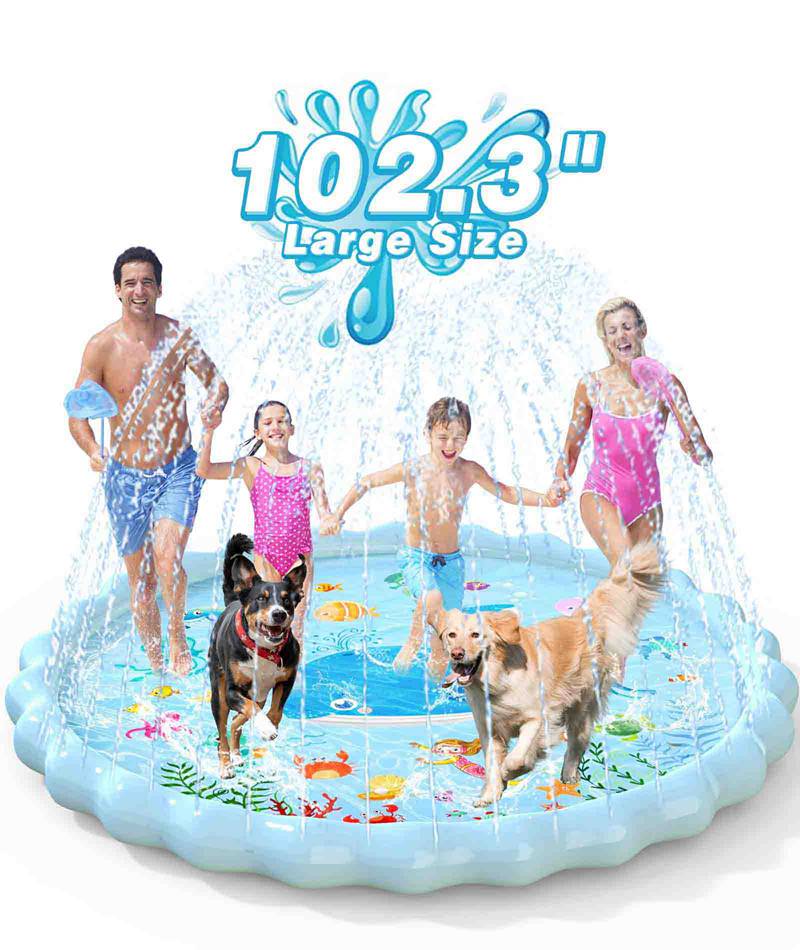
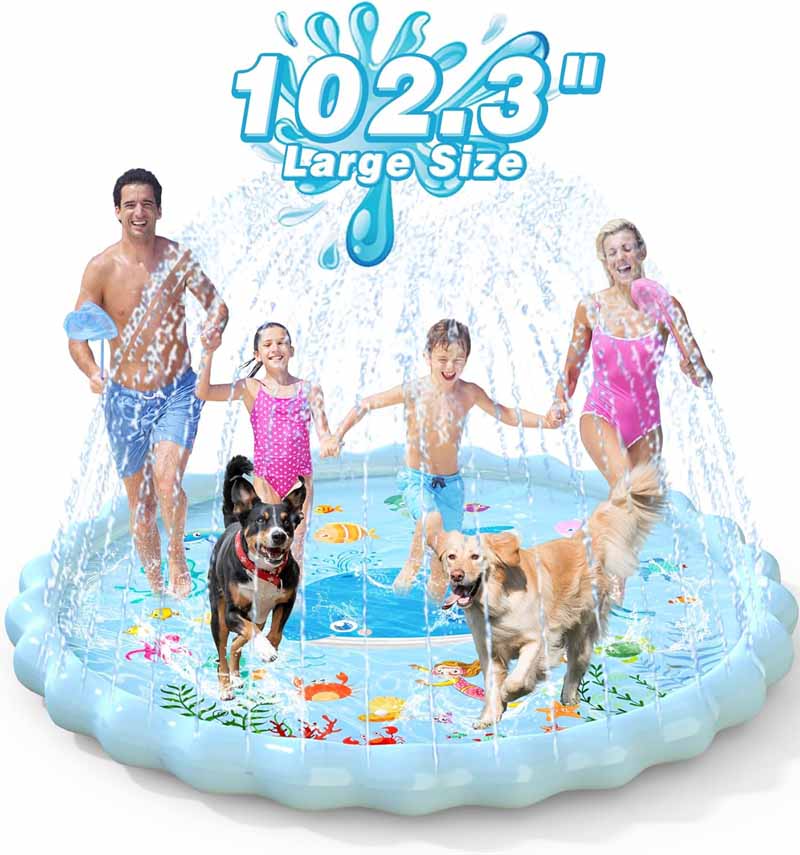
The documented 102.3-inch round EPN example provides a good model for responsible wording. Its diameter, circular shape, central play zone, perimeter sprinkler chamber, garden-hose operation, and suitability for shared sibling or friend play can be described objectively, but the product fact material avoids promising an exact number of children without a dedicated capacity test.
This is a useful standard for any product comparison. Dimensions can be measured repeatedly. A statement such as “comfortably fits four children” depends on an undefined combination of child ages, body sizes, activity level, toys, water behavior, and personal comfort unless the brand publishes a specific testing method. Treat unexplained headcounts as marketing shorthand rather than precise engineering data.

6. Shape Does Not Determine Water Pressure or Spray Height
Families often see one product photo with tall water arcs and another with lower streams and assume the difference comes from round versus square geometry. Shape can influence the length of the water channel and the positions available for spray holes, but spray height is a hydraulic result, not a shape specification. Household pressure, faucet opening, hose length, hose internal diameter, kinks, connector restriction, channel size, hole count, hole diameter, inlet position, and simultaneous water use elsewhere in the home can all change the result.
The documented round product example uses a garden-hose connection to feed the outer sprinkler chamber, and the resulting spray can be adjusted through household water flow. Its fact material correctly avoids guaranteeing one universal spray height because home water conditions vary. This is a more technically defensible approach than promising every family a particular number of inches simply because a marketing photograph shows tall jets.
Round and Square Water Channels Behave Differently, but Neither Automatically Wins
A round design gives engineers one continuous curved perimeter, while a square design creates four straight sections connected through corner transitions. Those geometries affect how the water path is drawn, but they do not determine the finished performance by themselves. A well-developed square design can distribute water evenly through properly sized channels and controlled corner geometry, while a poorly balanced circular channel can still produce a weak far side.
Spray-hole count deserves similar caution. More holes do not automatically produce a better sprinkler curtain. When the available household flow remains unchanged, adding openings divides the water among more exits and can reduce the strength of individual streams. Fewer openings can create stronger jets but poorer distribution. Water-play development therefore needs to balance hole number, diameter, direction, channel geometry, material behavior, and expected household conditions rather than maximizing one specification. This system-based approach is reflected in the supplied PVC development material.
Use a Bucket Test to Understand Your Outdoor Faucet
A simple flow test cannot predict the exact spray height of a particular splash pad, but it can help determine whether one outdoor faucet supplies substantially less water than another. Use a container with a known volume, time how long the faucet takes to fill it, and convert the result into volume per minute. Utah State University Extension describes this same bucket-and-stopwatch method for measuring available outdoor water flow in irrigation planning.
For example, if a five-gallon bucket fills in 30 seconds, the free-flow rate at the test point is approximately ten gallons per minute because 5 gallons ÷ 30 seconds × 60 seconds equals 10 GPM. Do not interpret this result as the amount flowing through the finished splash pad; the hose and product create additional restrictions. Use it as a baseline. If another faucet takes 90 seconds to fill the same bucket, the difference is useful diagnostic information.
Video Resource: Measuring Household Pressure and Flow
Rain Bird’s homeowner guide explains how water pressure and flow are different measurements and includes videos showing how to check static pressure with a gauge and how to determine available flow. The page is written for irrigation systems rather than children’s splash pads, so its sprinkler-head PSI specifications should not be copied as recommended splash-pad pressure. The useful part is the measurement method and the principle that pressure and available flow both influence sprinkler performance.
- Video Resource — Rain Bird Pressure and Flow Measurement:Video URL: https://www.rainbird.com/homeowners/how-many-sprinklers-can-be-used-zone-or-valve
Start Low Instead of Chasing the Tallest Spray
For actual family use, unfold the product completely, remove obvious twists, connect the hose straight, and introduce water gradually. Watch whether the perimeter fills consistently and whether most intended openings begin spraying before increasing the faucet further. If one section appears weak, inspect for a folded channel, twisted edge, low spot, leaking connection, or kinked hose before assuming the household needs more pressure.
The tallest possible spray is not automatically the best setting. Younger children or first-time users may prefer lower water, while higher flow can increase runoff outside the play zone. A gradual start also makes it easier to notice an abnormal leak or twisted chamber before the product is under its highest normal operating load.
7. Ground Condition, Drainage, and Hose Routing Can Change the Answer
A splash pad can fit beautifully on a yard plan and still perform poorly on the ground. Flexible PVC follows the surface beneath it, so stones, branches, roots, hard seed pods, rough paving edges, sprinkler heads, or deep depressions create local stress and uneven support. Water also has to leave the play zone somehow, and the hose must reach the product without being stretched, twisted, or placed across the main child route. These factors apply to both shapes and often matter more than a small difference in geometric efficiency.
Clear the Entire Footprint Before Covering It
Walk the full proposed area and remove sticks, stones, hard plant stems, wire fragments, broken plastic, gravel, toys, and other concentrated pressure points. Do not inspect only the perimeter. Once a large PVC mat is spread over the center of the lawn, hidden debris becomes difficult to see, and repeated foot pressure can force flexible material against an object which seemed harmless while uncovered.
The supplied product facts for the referenced kids splash pad call for a flat, clean setup area and removal of sharp or rough debris. They also establish an important claim boundary: its standard PVC play surface should not be marketed as inherently “non-slip,” “anti-slip,” or “slip-resistant” without supporting surface evidence. Families should therefore treat ordinary wet PVC as a surface requiring sensible movement and active supervision rather than depending on an unsupported shape or grip assumption.
Check Where Water Naturally Travels
Run a modest amount of hose water over the intended area before installing the pad and watch where it moves. A small slope may help water leave the activity zone, while a depression may turn one side into a muddy collection point. Water moving directly toward the house, basement entrance, patio door, electrical equipment, or neighboring property is a reason to reconsider the location rather than assuming the splash pad itself will control drainage.
Penn State Extension’s lawn-establishment guidance explains the broader landscape principle: ground should generally be graded to allow surface water to drain away from buildings, and where possible it describes a 1–4% slope away from foundations as a lawn-grading reference. This is not a splash-pad installation standard, but it is useful evidence for the practical rule of avoiding play locations which intentionally direct additional water toward the building.
Think About Runoff Beyond the Edge
The play area does not end where the PVC ends. Water can continue into grass, across paving, toward a drain, or into a low spot. The U.S. Environmental Protection Agency’s household yard guidance discusses reducing runoff and encouraging water to soak into appropriate landscape areas rather than simply sending it across hard surfaces. Although the EPA resource is not written for splash pads, the underlying landscape-management principle helps families think about where repeated summer water use will go.

Route the Hose Before Unfolding the Product
Stretch the garden hose from the outdoor faucet to the proposed inlet position before laying out the pad. Leave enough slack so the hose does not apply constant sideways force to the connector, but avoid leaving a large loop across the place children naturally use to enter and exit. A tightly stretched hose can pull on the rigid-to-flexible inlet transition even when the threaded connection itself is assembled correctly.
This step can change the shape choice. A square may use the yard more efficiently on paper but position its inlet in an inconvenient location on the available model. A round product may be easier to rotate until its inlet faces the faucet, or the opposite may be true depending on the specific design. Connector location is a product specification, not a universal feature of either geometry.
8. Neither Round Nor Square Is Inherently the “Safe Shape”
It is tempting to describe a round product as safer because it has no visual corners, or a square product as safer because it creates a more organized layout. Neither conclusion is supported by geometry alone. A flexible splash pad’s real water-play risks relate more directly to adult supervision, wet-surface behavior, crowding, product condition, water accumulation, ground preparation, hose placement, child age, and adherence to the manufacturer’s instructions.
Water-play content also needs proportionality. A hose-connected splash pad is not the same product as a swimming pool, and broad pool requirements should not be copied mechanically into a flat sprinkler-mat article. At the same time, trusted water-safety organizations consistently emphasize active adult supervision anywhere young children have access to water. That principle remains highly relevant even when the play product itself is shallow.
Close, Constant Supervision Matters More Than Shape
CDC states that drowning can happen in seconds and is often silent, and recommends a responsible adult supervise children closely and constantly when they are in or near water while avoiding distracting activities such as reading or using a phone. Current CDC data identify drowning as the leading cause of death for U.S. children ages 1–4 and the second-leading cause of unintentional injury death for ages 5–14. These are broad drowning statistics rather than splash-pad-specific incident data, so they should be used to support supervision—not to imply a flat sprinkler mat has the same risk profile as a swimming pool.
Video Resource: Assign a Water Watcher
The U.S. Consumer Product Safety Commission’s 2026 “Anatomy of a Water Watcher” video explains the role of one responsible adult whose attention is specifically focused on children near water. CPSC notes that drowning can happen quickly and quietly and presents the Water Watcher as a practical way to keep supervision intentional rather than assuming every adult at a family gathering is watching at the same time.
- Video — CPSC, Anatomy of a Water Watcher
Wet PVC Should Be Treated as Potentially Slippery Unless Evidence Says Otherwise
Do not infer slip resistance from shape, bright graphics, material thickness, or a product photo. A standard PVC water-play surface can become wet and should be used accordingly. The referenced product fact material explicitly identifies the existing surface as standard PVC and prohibits unsupported claims such as “non-slip,” “anti-slip,” or “slip-resistant.” This is a good general lesson in reading water-toy listings: specific performance words deserve specific evidence.
Families can take practical measures regardless of the product: clear the setup surface, avoid sharp debris, manage the water flow, discourage pushing and uncontrolled running, keep the hose out of the main path, and maintain an adult position with a clear view of the entire play area. Those steps are more meaningful than assuming one geometric outline solves wet-surface behavior.
Video Resource: Review Basic Family Water-Safety Layers
CPSC’s Pool Safety multimedia guidance covers active supervision, swimming skills, barriers for pools, drain safety, and CPR preparedness. Several items are specifically intended for swimming pools and spas and do not become splash-pad requirements merely because they appear in a water-safety video. The useful takeaway for backyard splash play is the layered mindset: adults should not depend on a single feature or assumption when children are around water.
Downloadable Safety Resource for Families
CPSC also provides a two-page Portable Pool Safety PDF which families can download and keep with other seasonal water-safety materials. The document is directed at portable pools, not splash pads, so its pool-specific fencing and covering advice should remain in its original context. Its emphasis on supervision, removing access when equipment is not in use, swimming skills, and CPR makes it a useful supplementary household water-safety resource.
9. Durability Depends More on Construction and Use Than Shape
From a flexible-PVC product-development perspective, round and square designs create different engineering details but neither outline is inherently durable or fragile. A round pad contains a continuous curved perimeter, while a square introduces straight water-channel sections and corner transitions. Both still need reliable heat-sealed boundaries, suitable material behavior, controlled spray-hole locations, a mechanically sensible inlet, and a folding pattern which does not repeatedly force rigid components into damaging positions.
This is the point where marketing comparisons often become too simple. “No corners” does not mean “cannot leak,” and “reinforced square corners” do not automatically prove long service life. A product can fail at the connector, at a seam, around a spray hole, at an abrasion point, or after repeated poor storage regardless of its outline. Construction should be judged as a system.
PVC Thickness Is Only One Part of the Durability Story
Flexible PVC is widely suited to sprinkler mats because it can be printed, cut, heat sealed, folded, and formed into low-pressure water chambers. More material thickness can add physical margin in some conditions, but thickness by itself does not explain formulation flexibility, weld compatibility, fold recovery, print adhesion, abrasion behavior, odor, or local reinforcement around fittings. A thick sheet paired with a poor inlet design can still develop problems where the garden hose repeatedly pulls on one small area.
The supplied comparison and PVC-development materials emphasize the same system logic: examine sheet material together with heat-sealed seams, water-channel geometry, spray holes, connector design, repeated folding, instructions, and actual functional testing. For brands developing custom products, material selection should therefore happen alongside structural and hydraulic development rather than being used as a single “heavy duty” marketing number.
Round Seams and Square Corners Need Different Attention
A circular sprinkler ring needs a consistent curved heat-seal path. Local narrowing, wrinkles, distortion near the inlet, or inconsistent chamber width can influence how the perimeter fills. A square pad introduces corner transitions where the water path changes direction, so the pattern, weld geometry, and hole placement around those corners need thoughtful development. Neither condition is automatically problematic; they simply place design attention in different areas.
During custom sampling, a useful inspection goes beyond looking at a dry product on a white table. Fill the water channel at realistic household flow, observe whether the complete perimeter stabilizes, check the far side from the inlet, examine corners or curved transitions, watch for unintended leakage, and repeat the connection and folding routine. Product-development experience with welded PVC shows why this functional cycle matters more than a shape label alone.
The Hose Inlet Deserves Special Attention
The inlet is a transition between a relatively rigid connector and flexible PVC. It experiences household water pressure, hose weight, twisting during installation, pulling when the hose moves, and repeated handling across the product’s life. A strong main sheet cannot completely compensate for an undersized connector base, poorly distributed local load, incorrect washer arrangement, or a hose left under constant sideways tension.
When comparing products online, look for a clear close-up showing how the connector joins the mat, whether the required adapter and sealing components are included, and whether setup instructions explain how the hose should be attached. A splash pad listing with detailed material claims but no clear inlet information leaves out one of the most mechanically important areas of the product.
Clean, Dry, Then Fold
After play, turn off the water, disconnect the hose according to the instructions, allow the perimeter to drain, remove loose dirt and grass, rinse as appropriate for the product, and let the material dry before long-term folding. CDC’s guidance for small plastic water-play equipment similarly recommends removing debris, rinsing dirt with fresh water, and allowing equipment to air dry after emptying. The CDC page is written for small pools and water slides rather than every splash pad, so the product’s own maintenance instructions still take priority.
Long seasonal storage deserves more care than a quick afternoon pause. Visible moisture trapped inside repeated folds can contribute to odor and unwanted biological growth, while folding around a rigid connector can create a concentrated hard point. Store the product in a dry place away from sharp objects, and avoid using the connector itself as a place to force a tight crease.
Video Resource: Visual Example of Vinyl Cleaning and Drying
Magic Jump’s cleaning guide is designed for commercial bounce-house inflatables, not household splash pads, so its cleaners, disinfectants, lubricants, and commercial maintenance procedures should not automatically be copied onto a children’s sprinkler mat. The useful visual principle is the sequence: remove debris, use product-compatible cleaning methods, allow the vinyl to dry completely, inspect the item, and then store it.
- Video Resource — Cleaning and Maintaining a Vinyl Inflatable
10. Use a 102.3-Inch Round Pad as a Real Yard-Planning Example
A known product size is useful because it turns the geometry into something families can physically mark on the lawn. The documented EPN kids splash pad is circular and expands to approximately 102.3 inches in outside diameter, which is about 8.53 feet or 260 centimeters. Its construction includes a central water-play surface, surrounding water-filled sprinkler chamber, perimeter openings, and a garden-hose connection. The diameter describes the complete unfolded product rather than a separately verified open-center diameter.
Using the standard circle-area formula, a 102.3-inch outside diameter gives a radius of approximately 51.15 inches and a theoretical full-circle footprint of about 8,219 square inches, or roughly 57.1 square feet. The word “theoretical” matters. The outer sprinkler chamber is included within those 57.1 square feet, so it would be inaccurate to advertise the entire calculated number as verified unobstructed child play space. The supplied product-size material makes the same distinction between full footprint and practical central activity area.
Mark 8.53 Feet Before Imagining It From a Photograph
Go outside and identify the proposed center point. Measure approximately 4.26 feet outward in several directions and place temporary markers. Connect the idea of those points visually with string or a garden hose if useful. Then bring the real garden hose toward the approximate inlet location, place a chair where supervision would occur, and walk from the patio to both sides of the marked circle.
This quick test answers more questions than a lifestyle photograph. Does the eight-and-a-half-foot circle block the route to the shed? Does a planter reduce one side to a narrow passage? Can an adult reach the far edge? Is the outdoor faucet close enough without stretching the hose? If the marked area feels tight before any PVC or water arrives, the finished setup will not become more spacious after the sprinkler chamber fills.
Compare the Real Round Size With a Real Square Size
Suppose a family compares the 102.3-inch round example with a square product also measuring 102.3 inches on each side. The square would cover approximately 72.7 square feet versus about 57.1 square feet for the circle, because the square occupies the corner regions. This is a valid geometric comparison, but it still cannot answer which product has the larger open child-play zone until the two perimeter structures are examined.
If the square under consideration measures only seven feet, its geometric footprint would be 49 square feet and the 102.3-inch round product would actually have the larger overall footprint. This simple comparison demonstrates why “square uses space more efficiently” and “square is always larger” are very different statements. The first is mathematically true when maximum width is equal. The second is not.
What a Product Specification Can Tell You—and What It Cannot
A confirmed 102.3-inch diameter tells a family how much outside width needs to fit in the yard. It supports unit conversion, radius calculation, theoretical full-circle area, and a physical lawn-marking exercise. It does not reveal an exact center diameter unless perimeter width is known, does not create a certified usable-square-foot value, and does not establish a fixed number of children who will play comfortably at the same time.
Likewise, knowing a product uses a garden hose tells a family what type of water source is involved, but does not prove a universal spray height. Knowing the material is PVC does not establish slip resistance, puncture-proof performance, or permanent leak immunity. Good product content separates measurable specification from inference instead of turning one confirmed fact into several unsupported promises.
For Custom Product Development, Start With the Yard Problem
For companies developing a private-label PVC water-play product, the most useful brief is not simply “make a square version” or “make the round pad larger.” Start by describing the use environment: maximum available yard width, preferred child activity, desired open-center zone, target spray behavior, water inlet direction, artwork, folded package limit, intended age grading, destination market, and the surfaces the instructions will permit.
Within an established welded-PVC development platform, product variables can include round or square outline, size, graphics, spray-hole distribution, water-channel geometry, connector position, selected play features, material direction, instructions, and packaging. The strongest custom design solves a real yard or family-use problem instead of treating geometry as a cosmetic variation.
11. Final Round vs Square Yard-Fit Checklist
A good final decision should be possible without an interactive recommendation engine. The family already has the most important inputs: the usable yard dimensions, the product’s real unfolded footprint, the normal number and ages of children, the outdoor faucet, the hose, the ground condition, and the likely runoff direction. Putting those facts in one static checklist produces a more reliable result than asking a generic generator to guess from “small yard” or “large family.”
The final check below deliberately includes several items unrelated to shape. If those items are unresolved, choosing circle or square first is premature. A product which fits geometrically but blocks adult access, pulls on its connector, sits over sharp debris, or sends water toward the house is not a good yard fit merely because all four corners—or the full diameter—fit inside the property boundary.
| Final Check | What to Confirm | If the Answer Is No |
|---|---|---|
| Usable dimensions measured | Narrowest width and clear length are known | Measure before ordering |
| Full product footprint fits | Use unfolded outside dimensions | Choose another size or location |
| Adult access remains clear | At least one practical route to all areas | Reposition or reduce footprint |
| Hose route works | Hose reaches without major tension or path conflict | Rotate or change location |
| Ground is suitable | Flat enough and cleared of sharp debris | Prepare or relocate |
| Runoff is acceptable | Water does not collect beside sensitive areas | Change location or drainage plan |
| Child movement feels workable | Dry test does not show repeated crowding | Compare larger/opener design |
| Spray conditions are understood | Flow can be introduced gradually | Test hose/faucet first |
| Construction is credible | Material, seams, inlet, and water channel are visible | Look for better documentation |
| Storage plan exists | Product can drain, dry, fold, and remain protected | Resolve storage before purchase |
Choose Round First When…
- The usable lawn is broad and open.
- The pad can sit away from straight walls or narrow boundaries.
- Entry from several directions is useful.
- The actual diameter leaves comfortable surrounding space.
- The hose inlet can be rotated toward a sensible route.
- The family prefers a central play zone with a circular perimeter.
- Both round and square choices otherwise have comparable quality.
Choose Square First When…
- The available space is strongly rectangular or narrow.
- Straight boundaries define the usable zone.
- Maximizing area at a comparable maximum width matters.
- Several children may benefit from additional geometric floor area.
- The real side dimensions fit without blocking adult movement.
- Connector position remains practical after the product is aligned.
- The product’s corner and water-channel construction is well documented.
Do Not Choose Either Shape Yet When…
- You know the property size but not the usable play-zone size.
- The product dimensions come only from lifestyle photography.
- The central activity area is important but its structure is unclear.
- The hose would cross the main child entry route.
- The only available ground contains sharp debris or obvious depressions.
- Water naturally runs toward the house or an unsuitable area.
- You are assuming “square” automatically means larger.
- You are assuming “round” automatically means safer or stronger.
- You are relying on an unsupported exact child-capacity claim.
- You have no realistic plan for drying and seasonal storage.
Conclusion
There is no universal winner between round and square kids splash pads. Round designs generally fit broad, open lawns naturally because they can be centered easily and approached from several directions. Square designs often use narrow, rectangular, fence-side, and patio-side spaces more efficiently because straight edges occupy a same-width rectangular footprint more completely. The geometric difference is real: at equal maximum width, a square has about 27.3% more theoretical area than a circle. The practical decision, however, begins rather than ends with this calculation.
A real splash pad contains a water channel, seams, spray holes, connector, folds, and possibly other play structures. A real backyard contains furniture, trees, landscaping, a faucet, a hose, slopes, runoff, child routes, toys, and adult supervision positions. This creates three rules worth remembering: same width does not mean the same area; geometric area does not automatically equal usable play space; and physical fit does not automatically equal functional fit. Measure the continuous clear zone, mark the candidate footprint, add the hose, perform a dry movement test, observe drainage, and only then decide whether round or square solves the space better.
If both shapes fit comfortably, stop trying to win the geometry contest. Compare the factors which are more likely to determine repeat use: real open activity space, spray distribution, water-flow adjustability, material behavior, heat-sealed construction, connector design, ease of cleaning, drying, folding, and storage. For families, the best splash pad is the one which makes ordinary summer play practical enough to set up again next weekend. For product developers, the best shape is the one designed around a clearly defined yard and use case rather than a cosmetic change on a specification sheet.
Frequently Asked Questions
Is a Square Splash Pad Bigger Than a Round Splash Pad?
A square is not automatically bigger because products come in different dimensions. When a square and circle have the same maximum width, the square does have more geometric area. An eight-foot square covers 64 square feet, while an eight-foot-diameter circle covers about 50.3 square feet, meaning the square has approximately 27.3% more theoretical area. A larger round product can still be bigger than a smaller square, and real usable play space depends on perimeter structures and internal features rather than outside geometry alone.
Which Shape Is Better for a Small Backyard?
A square often makes efficient use of a small rectangular or narrow backyard because straight edges occupy corner space a same-width circle leaves open. A round pad may be the better fit when the small yard has one broad central area, curved landscaping, or several important walking routes around the play zone. Measure the narrowest continuous width and mark both candidate footprints before ordering. A slightly smaller product which leaves useful surrounding space can work better than the largest one which technically fits.
Which Shape Gives Two or Three Kids More Room to Play?
At comparable maximum widths, square geometry provides more theoretical area, which can be useful when several children share the same product. The number alone does not determine how spacious the activity feels. A wide water-filled perimeter, central fountain, hoop, arch, or concentrated spray zone can reduce practical movement space and encourage children to gather in one section. Compare the central layout and perform a dry movement simulation rather than relying on an unexplained “fits three kids” or “family size” label.
Is a Round Splash Pad Better for Toddlers?
Round is not inherently more suitable for toddlers. A younger child’s experience depends more on manufacturer age guidance, water-flow control, central activity space, surface condition, supervision, and the individual child’s comfort with spray. A circular pad can provide a simple central zone on an open lawn, but a well-sized square can work equally well. Start with gentle flow, remain close, and use the specific product according to its instructions rather than treating geometry as an age or safety classification.
Does a Square Splash Pad Need More Water Pressure?
Not simply because it is square. Spray performance depends on the complete hydraulic system, including perimeter length, channel size, hole count, hole diameter, hole direction, inlet location, garden-hose restrictions, household water pressure, and available flow. A well-developed square product can perform at normal household conditions just as a round product can. If spray is weak, first check the faucet, hose, connector, kinks, product folds, and water-channel filling behavior before assuming the outline is responsible.
Can Round and Square Splash Pads Be Used on Grass or Patios?
Either shape can potentially work on grass or an appropriate patio when the specific manufacturer permits the surface and the site is suitable. Grass should be checked for stones, branches, hard roots, holes, and drainage problems. Hard surfaces need their own inspection for rough joints, abrasive edges, slope, runoff, and wet walking routes. Square geometry may align more efficiently with a rectangular patio, but alignment alone does not establish surface suitability or safety.
Are Round Splash Pads More Durable Because They Have No Corners?
No. Round and square designs place structural demands in different locations. Round products require consistent curved heat-seal paths and water-channel behavior, while square products introduce corner transitions which need appropriate pattern and welding control. Overall durability depends more on PVC material behavior, seam construction, connector reinforcement, spray-hole placement, ground preparation, abrasion, hose loading, cleaning, drying, folding, and storage. A well-engineered square product can outperform a poorly developed round one, and the reverse is equally possible.