Skip to content


Choosing a kids sprinkler can become surprisingly confusing once you start comparing real products. One model may be 48 inches across, another 68 inches, another more than 100 inches, while an inflatable sprinkler may be described by height and width instead of diameter. Those measurements matter, but they do not tell you how much room children actually have to move, whether siblings can play comfortably together, or how much clear backyard space the sprinkler will require once the hose and surrounding play area are included.
For most families, the right kids sprinkler is the smallest size that still gives children comfortable room to play. Around 40–60 inches can work well for compact spaces and simple one-child play, 60–80 inches suits many everyday family situations, and 80–100 inches or larger is more practical for several children, active games, playdates, and larger yards. Product age guidance should always take priority.
The most useful way to shop is therefore to stop treating size as one isolated number. A 70-inch splash pad with a broad water-filled perimeter can have less usable center space than another model with the same outside diameter. A seven-foot inflatable arch can require far more than seven feet of lawn because children run toward it, underneath it, and beyond it. Once you start looking at usable space instead of headline dimensions, choosing the right size becomes much easier.
What Size Kids Sprinkler Do You Need?
For most households, a 40–60 inch sprinkler is a practical starting point for compact play, 60–80 inches provides more flexible family space, and 80–100 inches or larger becomes useful when several children regularly play together. These ranges are shopping references rather than official safety classifications, so always follow the specific product’s labeled age range, instructions, setup requirements, and supervision guidance.
The first mistake many shoppers make is comparing outside dimensions without looking at how the product uses that space. Two splash pads can both be listed as 72 inches across while offering noticeably different center areas because one has a much wider water-filled perimeter. Decorative inflatable characters, raised structures, and hose fittings can reduce the area available for standing and movement even further.
Sprinkler type changes the meaning of size as well. A round splash mat concentrates most activity inside its diameter, while an inflatable arch encourages children to approach from several feet away and continue running after passing through the spray. A rotating sprinkler may have a tiny physical base but create an activity zone several times larger than the device itself. The number printed on the package should therefore be treated as the beginning of the comparison rather than the final answer.
| Approximate Size | Typical Use | Common Household Fit | Main Limitation |
|---|---|---|---|
| 40–60 in | Simple splash and sensory play | 1 younger child, compact yard | Limited room for active movement |
| 60–80 in | Everyday family water play | 1–2 children, average yard | Can feel crowded with several active users |
| 80–100 in | Shared active play | 2–4 children, open lawn | Requires more setup and drying space |
| 100+ in | Group play and gatherings | Several children, larger yard | More material, handling, and storage |
| 6–8+ ft inflatable | Run-through water play | Active children, open lawn | Activity area exceeds structure size |
These ranges work best as a quick way to narrow your options. They should not be interpreted as guaranteed capacity ratings because age, body size, activity level, product geometry, and actual usable space can all change how large a sprinkler feels once children begin playing.
Is a 40–60 Inch Sprinkler Big Enough?
A 40–60 inch sprinkler can be more than adequate when one younger child will use it most of the time. Children who sit, crouch, pour water into cups, step through low spray, or explore the jets with their hands do not need the same amount of movement space as older children who run, chase each other, or repeatedly move on and off the product.
Compact sprinklers are especially practical in smaller yards where patio furniture, planters, fences, hose reels, grills, play equipment, or garden borders already take up part of the available space. A smaller diameter leaves more room around those obstacles and can make it easier for an adult to stay close to the child without standing on the wet surface.
There is also a convenience advantage that shoppers often underestimate. Smaller PVC splash pads generally contain less material and a smaller water channel, which makes them easier to move, drain, dry, fold, and store after play. If the sprinkler will be used several times per week during summer, a manageable product that can be set up quickly may deliver more value than an oversized model that feels like work every time it comes out of storage.
The better question is not simply whether the child fits inside the diameter. Ask whether the child can sit, turn, reach for toys, walk naturally, and enjoy the spray without constantly stepping onto the perimeter. If the answer is yes, moving to a much larger size may not add much practical benefit.
Is a 60–80 Inch Sprinkler a Good Family Size?
For many families, the 60–80 inch range offers the most useful balance between play space and everyday convenience. One active child has enough room to move around, while two younger children can usually occupy different parts of the surface without repeatedly competing for the same spray stream. It also leaves more space for cups, balls, buckets, or other small water toys.
A medium-size pad is often easier to fit into a normal residential yard than an extra-large version. A 72-inch circular product is six feet across, which is large enough to feel substantial while still leaving families a reasonable chance of creating open space around it. That makes this range attractive when the lawn has to accommodate other uses such as seating, a grill, landscaping, or outdoor toys.
Usable center area still matters more than the headline number. If one 72-inch sprinkler has a thick perimeter and another uses a narrower ring, the second product may provide more practical room even though both carry the same outside dimension. Looking at overhead photos can help reveal how the space is divided between the spray channel, center play area, and decorative features.
For everyday sibling use, a medium size is often easier to live with than jumping directly to the largest product available. It provides meaningful extra room without greatly increasing drying, folding, and storage demands.

When Should You Buy a Larger Sprinkler?
A larger sprinkler becomes more useful when several children regularly use it, when play involves running rather than mostly sitting or standing, or when the sprinkler will often be part of playdates and family gatherings. Group activity changes the way space is used because children do not remain evenly separated. They gather around the same spray, copy one another, chase toys, and repeatedly cross paths.
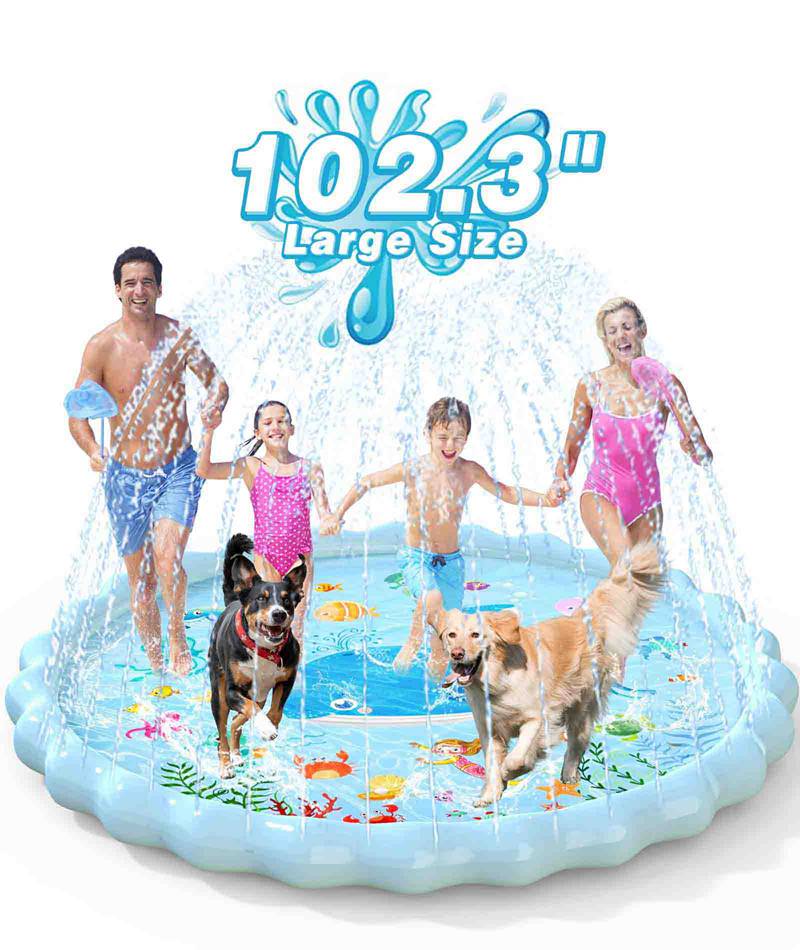
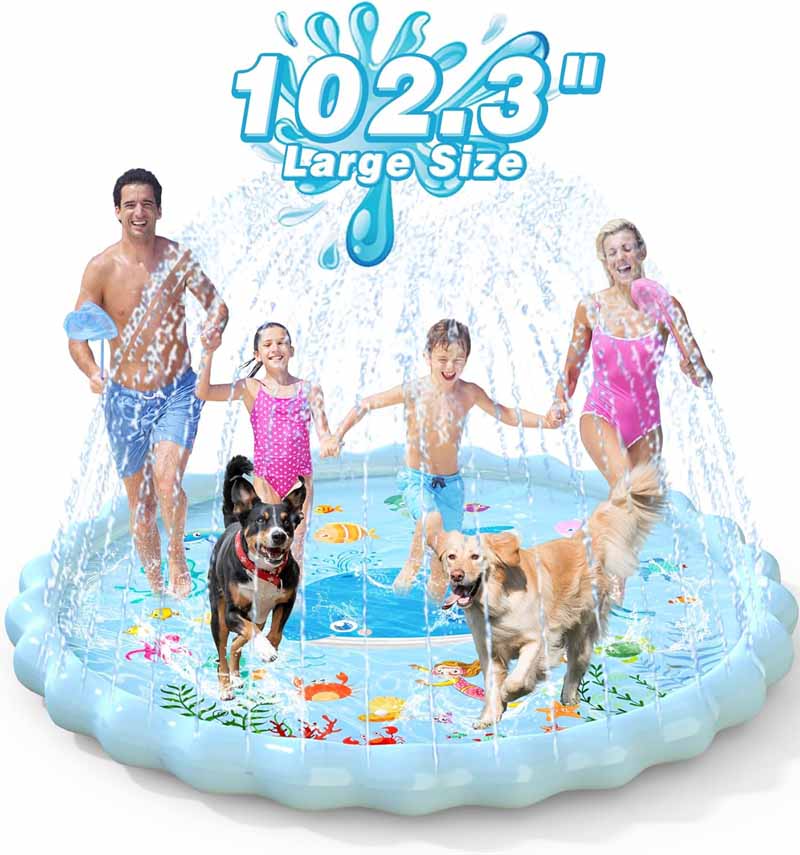
An 80–100 inch splash pad can offer more breathing room for this kind of activity. A 100-inch circular product measures about 8.3 feet across before any surrounding movement space is added. That can be a good fit for a large open lawn, but the measurement also shows why families should check their yard carefully before buying. Once children step off the perimeter and move around the product, the practical activity zone can easily exceed ten feet.
Larger products also require more handling. More PVC surface has to be spread out, filled, drained, cleaned, dried, folded, and stored. Families who use the sprinkler frequently should think about whether they are comfortable repeating that routine throughout summer rather than judging the product only by how impressive it looks when fully set up.
A useful rule is to buy for the busiest situation that happens regularly. If two children normally play together and four guests visit only once a year, a manageable medium-large size may be more sensible than choosing an extra-large product around that rare occasion.
Is Bigger Always Better?
Bigger is better only when additional space solves a genuine problem. Once children already have enough room to move comfortably, more diameter can add inconvenience without improving the experience very much. A larger splash pad takes up more lawn, produces a larger wet area, contains more material to dry, and occupies more storage space after it is folded.
Water distribution also becomes more important as perimeter length increases. Water entering through one hose connection has to travel around the internal channel before leaving through multiple spray holes. Hole diameter, spacing, angle, inlet design, channel geometry, and household water flow all affect whether the spray remains reasonably consistent around the product. More holes or a larger diameter do not automatically produce better performance.
This relationship is familiar in PVC recreational product development. Increasing a sprinkler from a medium family size to a large group-play size can require more than enlarging the artwork. Welding layout, stress points, spray-hole distribution, inlet placement, folding pattern, package volume, and drainage behavior may all need to be reconsidered.
For families, the same principle leads to a simpler decision. Choose enough space to prevent crowding and support the intended activity, but do not pay for dimensions that make ordinary use unnecessarily difficult.
How Does Age Affect Sprinkler Size?
Age affects sprinkler size mainly because children use outdoor space differently as they grow. Toddlers often sit, squat, and stay close to one part of the sprinkler, while older children run, jump, chase spray, and move far beyond the wet surface. Age is therefore useful for estimating play behavior, but the product’s labeled age range and the individual child’s abilities should always guide the final decision.
Two children of the same age may still need different amounts of space. One five-year-old may spend most of the session playing with cups and water toys, while another immediately begins running around the entire yard. That is why age ranges are better treated as a starting point than as a fixed formula.
A useful comparison combines developmental stage, movement style, number of children, and product type. The ranges below describe common play patterns rather than safety certifications or universal requirements.
| Age or Stage | Common Play Pattern | Practical Size Starting Point | Main Consideration |
|---|---|---|---|
| 1–3 years | Sitting, stepping, sensory play | 40–60 in | Close supervision and simple layout |
| 4–6 years | Walking, jumping, sibling play | 60–80 in | More movement and center space |
| 7+ years | Running, chasing, games | 80 in+ or moving sprinkler | Full activity footprint |
| Mixed ages | Different speeds and behaviors | Medium to large | Separation and usable space |
These ranges should always be checked against the instructions and age labeling of the actual product. Spray intensity, attachments, surface design, hose placement, and the child’s individual abilities can be more important than diameter alone.
What Size Works for Ages 1–3?
For younger children, a compact splash-style sprinkler is often more practical than a very large product because most activity happens within a small area. Toddlers may spend long periods sitting, squatting, touching individual water streams, filling containers, or taking only a few steps at a time. A 40–60 inch product can provide plenty of room for these activities when the specific model is designed and labeled for the child’s age.
Parents should look beyond diameter when comparing toddler-friendly products. Spray intensity, surface texture, raised decorative features, small attachments, hose positioning, and the overall complexity of the design can affect the experience more than another foot of width. A simple layout can also make it easier for an adult to remain close and maintain a clear view of the entire play area.
The setup surface deserves equal attention. A compact sprinkler placed on clean, reasonably level grass can be more practical than a much larger product squeezed between furniture and hard landscape features. Young children need active adult supervision during water play regardless of how shallow the water appears or how small the product may be.
The goal at this stage is not maximum size. It is creating an easy-to-manage space where simple water exploration feels comfortable and predictable.
What Size Works for Ages 4–6?
Children around four to six often start using sprinklers in a noticeably more active way. Instead of remaining near one jet, they may jump through streams, run around the perimeter, chase siblings, bring several toys into the water, and repeatedly move between the sprinkler and the surrounding lawn. The amount of useful movement space therefore becomes much more important.
A 60–80 inch splash pad can be a practical starting category for one or two children at this stage, assuming the product’s own age guidance is appropriate. The extra width provides room for turns and short runs without forcing children immediately onto the edge. It also allows water-play accessories to share the surface without making every movement feel crowded.
This is also the stage where the difference between outside diameter and usable center space becomes much easier to notice. A wide perimeter that looks substantial in marketing images may leave a relatively small flat center. Parents comparing products should examine proportions carefully and consider whether the layout supports the way their children actually play.
A slightly larger model can make sense for siblings, but there is little value in oversizing simply because the children are getting older. Movement style should continue to drive the decision.

What Size Works for Ages 7 and Up?
Older children generally create a wider activity zone because their stride is longer, their movement is faster, and they are more likely to turn the sprinkler into a game. They may prefer running through spray, chasing moving water, dodging jets, or competing with siblings rather than remaining inside one defined splash area for long periods.
For these users, an 80-inch or larger splash pad can offer useful room, but the product type may matter even more than diameter. A compact rotating sprinkler can create a large play zone across an open lawn even though the device itself occupies very little space. Likewise, a tall inflatable arch may become the center of a running game whose real footprint extends far beyond the structure.
Families should therefore think in terms of activity area. If an older child runs five or six feet beyond the product every time they follow the spray, that surrounding lawn is part of the sprinkler experience even though it does not appear in the listed dimensions.
Older children do not always need the largest pad available. A smaller product that creates more varied movement can sometimes deliver a better experience than an extra-large static surface.
Should You Size Up as Kids Grow?
Buying slightly above the minimum size needed today can be sensible when the sprinkler is expected to serve the family for several summers. A medium-size pad purchased for one younger child may later accommodate a sibling, extra toys, or more active play without immediately feeling too small. This kind of modest sizing margin can improve long-term usefulness.
Buying dramatically larger than current needs is less convincing. A very large sprinkler may require a bigger setup area, more drying room, and more storage capacity for several seasons before the family receives much benefit from the extra dimensions. If the inconvenience makes the product harder to use now, theoretical future value does not help very much.
Durability and care are also part of long-term value. Proper seam construction, sensible inlet placement, reliable drainage, and correct drying and storage can influence how well a PVC sprinkler holds up over repeated seasons. A well-designed medium product that is used and cared for regularly may offer more value than an oversized model that spends most of its life folded away.
Choose enough room for the next stage of play without turning today’s simple backyard activity into an unnecessarily complicated setup.
How Many Kids Will Use the Sprinkler?
The number of children helps narrow sprinkler size, but movement matters just as much as headcount. One active school-age child can use as much space as two toddlers who mostly sit and play. A compact or medium pad can work well for one child, 60–80 inches is a useful starting point for two younger children, and 80–100 inches or more becomes increasingly useful for regular group play.
Capacity should therefore be interpreted carefully. A product may technically hold several children, but fitting several bodies onto a surface is very different from giving those children enough room to move naturally. Group play requires circulation space because children repeatedly cross paths rather than occupying fixed positions.
They also tend to gather around whatever looks most interesting. A stronger jet, floating toy, colorful graphic, or sibling’s activity can pull several children toward the same part of the sprinkler. That behavior can make even a large surface feel crowded when the design concentrates activity into only one small zone.
What Size Works for One Child?
When one child uses the sprinkler, the family can focus more on play style and yard shape than on capacity. A 40–60 inch splash pad can provide plenty of room for a younger child who enjoys simple sensory play, while a more active older child may appreciate a medium pad or a different sprinkler format that spreads activity across the lawn.
Water toys can affect the space surprisingly quickly. Several cups, balls, buckets, and small floating toys may occupy a meaningful part of a compact surface. If the child enjoys bringing many accessories into the sprinkler, choosing slightly more usable center area can make the product feel much less cluttered.
The shape of the available yard should also influence the decision. A round splash pad works naturally in an open square lawn, while a long narrow strip of grass may be better suited to a directional or run-through design. A single user does not need maximum dimensions simply because the yard can accommodate them.
The goal is to match the product to the way that child actually plays. Enough space for comfortable movement matters, but unused extra diameter adds little value.
What Size Works for Two Kids?
Two children need enough room not only to occupy the sprinkler but also to move past one another. Siblings may begin on opposite sides, yet they usually end up following the same water stream, swapping toys, copying each other’s movements, and crossing the center repeatedly. That makes shared movement space important.
For two younger children, a 60–80 inch pad is a sensible range to consider. Older or particularly active siblings may feel more comfortable with a larger play area. The outside diameter should still be checked against the usable center because a wide perimeter can reduce the room available for both children.
For example, an approximately 72-inch pad with a perimeter eight inches wide on each side would leave a center diameter closer to 56 inches. The exact dimensions vary by product, but the example shows how quickly usable space can differ from the number displayed on the package.
Age differences matter as well. A toddler and an older sibling may use the same sprinkler at very different speeds. Some extra space can allow calmer play to happen on one part of the surface while the faster child moves through another area without constantly interfering.
What Size Works for Three or More Kids?
Three or more children change the sizing problem because a sprinkler now needs genuine circulation space. The goal is no longer simply making sure everyone can stand on the surface. Children need room to turn, cross paths, reach toys, move toward different spray points, and step on or off without constantly bumping into someone else.
This is where 80–100 inch and larger splash pads can become more useful. A 100-inch circular product is approximately 8.3 feet across, but part of that space is usually occupied by the outer water channel. The center available for actual movement can therefore be considerably smaller than the outside specification suggests.
Spray distribution can also influence perceived capacity. If most of the water is concentrated in one attractive area, children naturally cluster there regardless of how large the overall pad is. Designs that distribute spray more evenly around the perimeter can encourage children to spread out instead.
For regular family gatherings, camps, childcare activities, or several siblings, consider both size and layout. A thoughtfully arranged medium-large sprinkler can sometimes support group play better than a larger product whose usable area and water features are poorly distributed.

Which Size Works for Playdates?
For occasional playdates, buying around the absolute maximum number of visitors can result in an unnecessarily large product for everyday use. If one or two children normally use the sprinkler and several friends join only a handful of times each summer, a medium-large option may offer a better balance between shared space and routine convenience.
A product somewhere around the 70–90 inch range can be worth considering for occasional groups, while 90–100 inches and larger becomes more attractive when gatherings are frequent and the sprinkler is one of the main activities. These ranges remain general references because age and activity level can change space needs considerably.
It is also worth remembering how real playdates work. Not every child is usually on the sprinkler at the same moment. Some may be playing elsewhere, eating, resting, or using another toy. Families may therefore need less capacity than a simple guest count suggests.
For birthday parties, camps, or situations where the sprinkler is intended to be the central attraction, a larger surface becomes more valuable because more children are likely to use it simultaneously.
How Much Backyard Space Do You Need?
Your backyard should provide more usable space than the sprinkler’s listed footprint because children need room to approach, leave, turn, and move around it. A 100-inch pad already measures about 8.3 feet across before surrounding movement is considered. Furniture, fences, trees, landscaping, steps, uneven ground, and the garden hose can all reduce the amount of suitable setup space.
One of the simplest ways to avoid buying the wrong size is to measure the actual clear area before ordering. Families often know the total dimensions of their lawn but forget that a large portion may already be occupied by patio furniture, play equipment, trees, raised beds, or pathways.
Converting inches into feet can also make product listings easier to understand. A 60-inch sprinkler is five feet across, a 72-inch model is six feet, an 84-inch model is seven feet, and a 100-inch product is roughly 8 feet 4 inches. Marking those sizes on the lawn with a garden hose or rope is often more revealing than looking at a dimension diagram online.
| Product Size | Approximate Footprint | Practical Space Question |
|---|---|---|
| 48 in | 4.0 ft diameter | Can an adult easily reach the play area? |
| 60 in | 5.0 ft diameter | Is there open space beyond the perimeter? |
| 72 in | 6.0 ft diameter | Does the hose cross the main entry path? |
| 84 in | 7.0 ft diameter | Are hard edges and furniture comfortably away? |
| 100 in | 8.3 ft diameter | Is there room for several children to move around it? |
| 7 ft inflatable | About 7 ft structural span | How much extra approach and running space is needed? |
These measurements help visualize scale, but they do not represent universal clearance rules. The required surrounding area varies with the sprinkler type, instructions, children’s activity level, and layout of the yard.
How Should You Measure the Play Area?
Begin with the flat, usable part of the yard rather than the total property dimensions. Measure between the objects that actually limit the setup: fences, trees, furniture, garden beds, grills, steps, play equipment, or other permanent and semi-permanent features. A fifteen-foot lawn does not provide fifteen feet of usable sprinkler space if several feet are already occupied.
Once you know the clear area, reproduce the approximate sprinkler footprint on the ground before buying. A rope, garden hose, or several towels can mark out a five-, seven-, or eight-foot circle surprisingly well. Seeing the dimensions at full scale often changes a family’s perception of what “large” means.
Then imagine children moving through the outline instead of standing neatly in the middle. Consider where they enter, where the hose connects, and what they reach if they step off the wet surface. A sprinkler fits properly only when normal activity fits around it as well.
This simple measurement process takes only a few minutes and can prevent one of the most common purchasing problems: choosing a product that technically fits the lawn but leaves no comfortable space for actual play.
How Much Clearance Should You Leave?
There is no single clearance measurement that works for every kids sprinkler because movement patterns vary widely between products. A younger child sitting on a small splash mat may remain close to the center, while children using an inflatable arch may run several feet before and after passing underneath it. A rotating sprinkler can create an even wider activity zone.
Instead of trying to apply one fixed number, look for enough unobstructed space that normal play does not end directly against hard, sharp, unstable, or breakable objects. Children stepping from a wet surface should not immediately encounter stone edging, furniture legs, steps, fencing, tools, or similar hazards.
Hose placement is another part of effective clearance. Ideally, the garden hose approaches from a lower-traffic side of the product rather than crossing the path children use most often. This can make the setup feel much more natural and reduce unnecessary obstacles around the wet area.
The ground itself should also be checked before setup. Sticks, stones, sharp debris, exposed hardware, and rough objects can be uncomfortable for children and may create avoidable abrasion or puncture risks for a PVC base.
Which Size Fits a Small Yard?
Small yards generally benefit from sprinklers that use their footprint efficiently. A 40–60 inch splash pad can often fit into spaces where a large family model would leave little room around the perimeter. Because the activity remains mostly inside a defined circular area, parents can also predict more easily how the product will interact with furniture and landscaping.
A larger product can still work if the yard contains one open section, but dimensions should be checked carefully. An inflatable arch may appear narrow at its base yet require considerably more running room than a wider-looking splash pad because children approach and leave the structure at speed.
Storage and drying become especially important in smaller homes. A large sprinkler may fit comfortably on the lawn but become inconvenient if there is nowhere practical to spread it out after use. Limited garage, balcony, or utility space can make an oversized product harder to maintain than expected.
For compact outdoor areas, convenience is often the best guide. A smaller sprinkler that takes only a few minutes to set up and put away may be used far more often than a much larger version that requires rearranging the yard every time.
Which Size Fits a Large Yard?
A large yard gives families more freedom, but it should not automatically lead to the largest sprinkler available. If one or two children prefer simple splash play, a medium product may still provide all the space they need. Extra lawn becomes most useful when the family wants active running games, multiple users, or larger inflatable and moving-spray products.
An 80–100 inch pad can make sense for siblings and group play when there is plenty of open grass around it. Inflatable arches and rotating sprinklers can also take advantage of a larger yard because their real activity zones extend well beyond their physical footprints.
Ground quality remains important even when space is plentiful. An apparently open lawn may contain exposed tree roots, stones, irrigation hardware, drainage dips, or sloping sections. A slightly smaller but flatter and cleaner setup area can be a much better choice than the widest part of the yard.
PVC recreational products generally benefit from being used on surfaces free of sharp debris and excessive roughness. Choosing the right location can reduce unnecessary wear while also making the play area more comfortable for children.
Which Kids Sprinkler Type Should You Choose?
Choose the sprinkler type before making your final size comparison because different designs use yard space in different ways. Splash pads keep most play inside a defined footprint, inflatable sprinklers create run-through areas around a three-dimensional structure, and rotating sprinklers can generate a broad activity zone despite having a small base. Physical dimensions alone cannot be compared directly across every format.
The phrase “kids sprinkler” covers products with very different layouts. A circular mat may be described almost entirely by diameter, while a character sprinkler may list height, width, and depth. A rotating model might be physically compact even though the spray encourages children to move across a large section of lawn.
The most useful question is therefore not simply which format is biggest. Consider where the water goes and how children are likely to react to it.
| Sprinkler Type | Typical Size Description | Real Play Area | Common Use |
|---|---|---|---|
| Splash pad | Diameter, often 40–100+ in | Mainly on and around pad | Defined splash play |
| Inflatable arch | Width × height | Structure plus running path | Run-through games |
| Character sprinkler | Height and overall dimensions | Around visible spray points | Themed family play |
| Rotating sprinkler | Small base dimensions | Wider moving spray zone | Chasing and active play |
| Directional sprinkler | Body size plus spray area | Mainly in spray direction | Open-lawn games |

Is a Splash Pad Right for Your Yard?
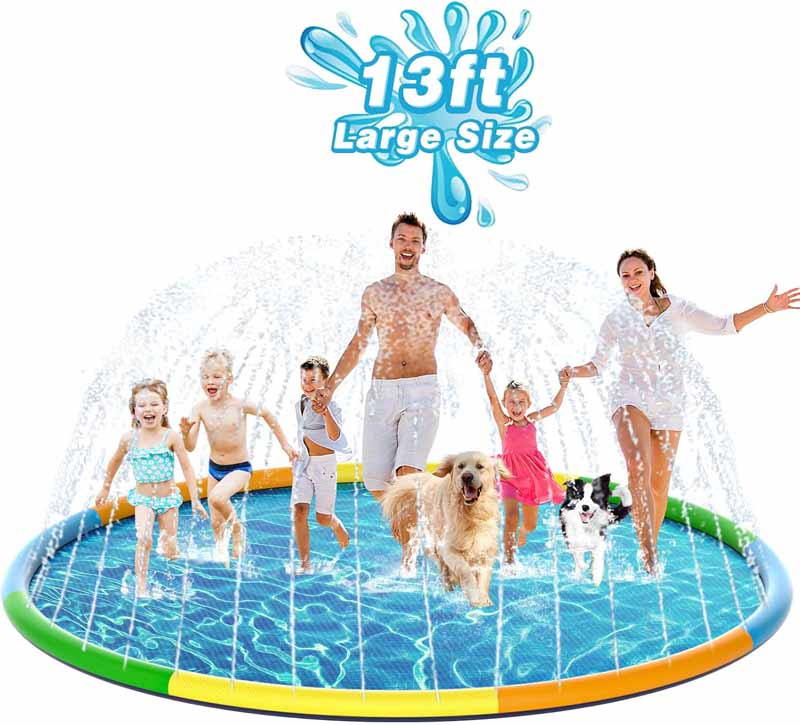
Splash pads are among the easiest sprinkler formats to plan because most of the activity is concentrated around a clearly visible footprint. If a product is 72 inches in diameter, you know it occupies roughly six feet of ground before additional movement space is considered. That makes it easier to compare the product with a real section of backyard.
This format is particularly useful for families who prefer contained water play. Younger children can stay within one visible area, while siblings can share different sections of a medium or large pad. The outer PVC channel usually carries water from the hose around the perimeter, where multiple openings create inward or upward spray.
The width of that channel affects both structure and usable center space. A large perimeter may create a strong visual appearance and serve an important functional purpose, but it also reduces the flat area inside. Hole diameter, spacing, angle, inlet design, and internal channel geometry can also influence spray performance.
For shoppers, the most meaningful comparison combines diameter, center area, and spray layout. A slightly smaller pad with well-used space can sometimes feel larger in practice than a product whose dimensions are dominated by the outer structure.
Is an Inflatable Sprinkler Better?
Inflatable sprinklers work particularly well when children enjoy moving through and around a visual structure rather than remaining inside one defined wet area. Rainbows, animals, arches, tunnels, and other character shapes can turn the sprinkler into both a water toy and a centerpiece for backyard play.
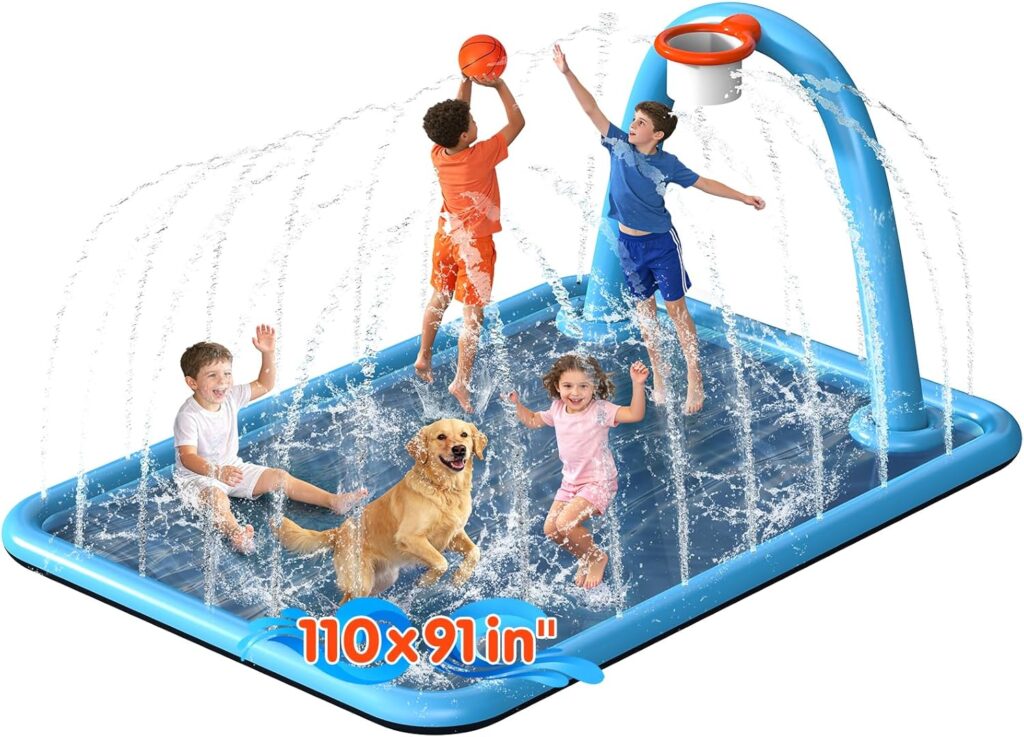
Their space requirements are less obvious than those of a flat splash pad. A seven-foot-wide arch may occupy seven feet structurally, but children can begin running several feet before reaching it and continue several feet after passing through the spray. The practical play zone can therefore be significantly larger.
Height should also be considered. Trees, branches, awnings, umbrellas, and low rooflines can interfere with tall products even when the ground footprint fits perfectly. Measuring vertical clearance is useful for large inflatable structures.
From a manufacturing perspective, increasing the scale of a PVC inflatable can affect chamber geometry, base stability, seam placement, valve position, material specification, and packaging volume. For custom projects, EPN evaluates those factors together with intended use rather than simply enlarging a smaller design. The same principle helps consumers: choose the structure around the available environment, not around visual impact alone.
Are Rotating Sprinklers Better for Older Kids?
Rotating sprinklers can be particularly engaging for children who enjoy chasing, dodging, and reacting to changing water patterns. The physical unit may be small, but the effective play area can be much larger because children follow the moving spray rather than remaining close to the device.
This means base dimensions are often less useful than the activity zone. A compact rotating sprinkler placed in an open lawn may create more movement than a much larger static splash pad. Older children can find that style more entertaining because the changing water pattern naturally encourages games and repeated movement.
Available water flow can affect spray reach and rotation behavior, so families should operate the product according to its instructions instead of trying to maximize distance with excessive pressure. Stronger or farther spray is not automatically better, especially when younger siblings may also use the area.
When evaluating this type, imagine where the children will run rather than where the sprinkler itself will sit. That movement path is the space the yard truly needs to provide.
Which Type Needs the Most Space?
The largest-looking sprinkler does not always require the largest practical activity area. A 100-inch splash pad occupies a significant footprint, but most play stays relatively close to the mat. A small rotating sprinkler can generate movement over a wider section of lawn, while an inflatable arch can require substantial approach and exit space despite having a narrower base.
For splash pads, the main considerations are diameter, usable center area, and surrounding clearance. For inflatables, width, depth, height, and running paths matter. For rotating and directional designs, the spray zone and the way children follow it are part of the true footprint.
This distinction also matters when developing new PVC recreational products. Starting with an impressive target dimension can produce a design that uses space inefficiently. A stronger approach begins with the intended activity, typical number of users, available environment, and desired spray behavior, then establishes physical dimensions around those needs.
Families can use exactly the same logic. Decide how children will play first, and choose the product type and size second.
What Should You Check Before Buying?
Before buying a kids sprinkler, check usable play area, water-flow behavior, PVC construction, hose connection, drainage, drying, and storage alongside the outside dimensions. A well-sized product should be manageable through the entire cycle of setup, play, cleanup, and storage. If a sprinkler is inconvenient to handle after every use, extra diameter may quickly become a disadvantage.
Size receives most of the attention because it is easy to compare, but two products with the same diameter can perform very differently. One may devote more space to the center, another may create a more even spray pattern, and another may be easier to drain or fold. Practical design details can therefore have as much influence on satisfaction as total dimensions.
Material thickness is another specification that should be viewed in context. A thicker PVC sheet does not automatically make a better sprinkler if seam quality, geometry, inlet design, or repeated folding behavior are poor. Good performance comes from several elements working together.
Does Water Pressure Affect Sprinkler Size?
Water flow can influence sprinkler performance, especially on larger perimeter-style products where water must travel a long distance before exiting through many openings. As diameter increases, designers may change the number, size, spacing, or direction of spray holes in order to maintain useful coverage around the product.
That does not mean a larger sprinkler should automatically be operated at unusually high pressure. Users should follow the manufacturer’s instructions and adjust ordinary hose flow within the intended operating conditions. More pressure is not always better, and trying to force unusually high jets can change the way the product behaves.
From a design standpoint, several variables work together: inlet diameter, internal channel volume, total hole count, individual hole diameter, spacing, spray angle, and seam consistency. Increasing only one element can affect the entire pattern. For example, adding many more openings without adjusting the rest of the system can reduce flow at each individual jet.
For consumers, the useful question is whether the sprinkler provides a suitable and reasonably consistent spray under normal household conditions rather than whether it can produce the tallest possible water streams.

How Much Usable Play Space Do You Get?
Usable play space can be considerably smaller than the headline dimensions. Imagine an 80-inch circular splash pad with an outer water channel about eight inches wide on each side. The remaining center diameter would be closer to 64 inches before any raised characters, decorative structures, or other features are included.
That does not mean the wider perimeter is poorly designed. The ring may help direct spray, hold its shape, support artwork, or serve another structural purpose. The important point is that shoppers should understand what portion of the dimensions becomes real play area.
Overhead photographs can be particularly useful. Look at the relationship between the outer channel and the center, check where the hose connection sits, and notice whether decorative elements extend into the area where children are expected to stand or move.
This becomes even more important when several children share the product. Losing several inches around the full circumference can reduce the center area noticeably. A product with slightly smaller outside dimensions but a more efficient layout may therefore feel more spacious during actual use.
Does PVC Construction Matter More on Larger Sizes?
PVC construction becomes more important as products grow because larger sprinklers contain more material, longer welded seams, and a greater area that has to be moved, filled, drained, dried, folded, and stored. Every increase in size adds handling demands that do not appear when a product is simply lying flat in a photograph.
Material thickness is only one part of durability. High-frequency welded seam consistency, seam width, corner geometry, inlet construction, printing compatibility, local stress points, and repeated fold lines all contribute to how a recreational PVC product behaves in real use.
Increasing material thickness without considering those other factors does not automatically create a more reliable product. A well-designed structure uses an appropriate material specification together with consistent processing and geometry that suits the intended application.
For larger custom splash pads and inflatable sprinklers, product development should therefore consider dimensions, water or air chambers, spray layout, artwork, folding pattern, packaging, and expected use together. This integrated approach is also useful for consumers: look for a product whose overall construction appears practical and well resolved rather than judging quality from one isolated specification.
Is the Sprinkler Easy to Drain and Store?
Drainage and storage are easy to overlook because product listings naturally emphasize the fun part of ownership. In daily use, however, a sprinkler may provide an hour of play and then require draining, drying, folding, and storage for several days. Larger products make every one of those steps more noticeable.
A 100-inch splash pad is more than eight feet across when laid flat, so families should think about where it will dry after use. The lawn may have enough room for play while a narrow patio, garage, or storage area makes handling the same product much more difficult.
Follow the manufacturer’s cleaning and storage instructions and allow the sprinkler to dry properly before longer storage. Residual moisture trapped inside folds or channels can make the next setup unpleasant and may make routine care more difficult.
For frequent summer use, convenience often produces more real value than maximum dimensions. A family that can easily set up and put away a 70-inch product may use it far more often than a 110-inch sprinkler that gradually stays in storage because every session requires too much work.
The right kids sprinkler size is ultimately the one that fits your children, your yard, and your routine at the same time. Compact 40–60 inch products can be excellent for one younger child or a limited outdoor space, 60–80 inches covers a wide range of ordinary family use, and 80–100 inches or larger becomes increasingly useful for several children and more active group play.
Those numbers should remain guides rather than rules. The product’s shape, usable center area, spray pattern, labeled age range, yard layout, and play style can all change what feels comfortable. A seven-foot inflatable and a seven-foot splash pad may require completely different amounts of real backyard space even though one measurement appears similar.
Before buying, measure the actual setup area, think about how children normally move, and consider what happens after the water is turned off. A sprinkler that is easy to set up, enjoyable to use, straightforward to drain, and manageable to store is more likely to become part of the family’s regular summer routine. The best size is not the largest number on the product page. It is the size that makes water play easy enough that everyone wants to use it again.
Frequently Asked Questions
What Size Splash Pad Is Best for Two Kids?
For two younger children, a splash pad around 60–80 inches in diameter is a practical range to consider because it can provide enough room for children to occupy different parts of the surface and still move around one another. Older or particularly active siblings may benefit from additional space. Compare usable center area as well as overall diameter because broad water-filled perimeters and decorative features can significantly reduce the space available for actual play.
Is a 60-Inch Splash Pad Big Enough?
A 60-inch splash pad measures about five feet across and can be a useful size for one younger child or two small children whose activity is relatively calm. It also fits more easily into compact residential yards than larger family models. If the children are older, frequently run across the surface, or regularly use the pad with siblings and friends, moving toward a larger 70–80 inch model may provide more comfortable movement space.
Is a 100-Inch Splash Pad Too Big for a Backyard?
A 100-inch splash pad measures approximately 8.3 feet across, so it can fit comfortably in many open residential lawns but may dominate a compact backyard. The yard also needs room beyond the product for children to enter, leave, and move around it. Before purchasing, mark an eight-foot-plus circle on the intended setup area and check nearby furniture, landscaping, hose routing, drainage, and the space children will actually use around the perimeter.
What Size Sprinkler Is Best for Toddlers?
A compact 40–60 inch splash-style sprinkler can provide plenty of room for many toddlers who mainly sit, step through gentle spray, and play with cups or small water toys. Size should never replace the product’s labeled age guidance, however. Choose a model intended for the child’s age, follow its setup instructions, use an appropriate surface, and maintain active adult supervision throughout water play regardless of how shallow or contained the sprinkler appears.
How Big Should a Splash Pad Be for Three Kids?
For three children, 80–100 inches is a useful practical range to consider when the users are active enough to need room to cross paths. The exact requirement depends on age, body size, play behavior, and the proportion of the pad devoted to the outer spray channel. Three toddlers can use much less circulation space than three school-age children, so compare the usable center area rather than assuming the outside diameter automatically represents comfortable capacity.
Do Bigger Splash Pads Need More Water Pressure?
A larger splash pad does not automatically require unusually high water pressure, but water distribution becomes more important as the perimeter grows and more spray openings are added. Inlet dimensions, internal channel geometry, hole size, spacing, and normal household water flow all influence the final spray pattern. Users should follow the manufacturer’s instructions and adjust normal hose flow within the intended range rather than using excessive pressure simply to create taller jets.
Which Is Better: a Splash Pad or an Inflatable Sprinkler?
A splash pad is generally easier to fit into a defined backyard area because most activity happens on or around the mat, while an inflatable sprinkler can create more active run-through play around a three-dimensional structure. Neither type is automatically better. The more suitable choice depends on the children’s ages, preferred play style, yard dimensions, available storage space, water setup, and how much surrounding movement room the design needs.