Skip to content


A kids splash pad can look nearly perfect in a product listing. The photos usually show even arcs of water, a clean lawn, plenty of room around the children, and a product lying perfectly flat. Reviews are where the picture becomes more complicated. One family may say the pad became the favorite outdoor activity of the summer, while another reports weak spray, a leaking hose connection, a seam opening after several uses, or less usable space than expected. Neither review should automatically decide your purchase. The useful question is whether each review provides enough evidence to understand what actually happened and whether the same conditions are likely to exist in your own yard.
From the standpoint of long-term PVC water-play product development, a splash pad should never be judged from one specification or one dramatic comment. Flexible PVC, heat-sealed sections, hose connections, sprinkler-hole layout, household water supply, lawn condition, folding habits, storage moisture, child count, and play style all affect the final experience. A review becomes genuinely useful when it tells you where a problem occurred, when it appeared, how the product was being used, and whether other independent users describe the same pattern. This article turns those details into a practical pre-purchase method you can use on Amazon, Walmart, Target, brand websites, retailer pages, videos, and other review sources.
The goal is not to find a splash pad with zero negative reviews. For a seasonal outdoor product sold at scale, isolated complaints, unusual setups, personal preferences, shipping problems, and misuse can appear beside genuine design or manufacturing concerns. A more realistic goal is to identify the problems most relevant to your family before you spend money. Parents with several children may care most about usable play area and crowding. Busy families may care about setup, drainage, and drying. Gift shoppers may need to confirm age, yard size, and hose access. Families using a vacation home may need to know whether different water supplies produce noticeably different spray performance.
1. Read the Reviews in the Right Order
Most people begin with the average rating because it is the largest number on the page. A 4.7-star rating feels reassuring, while a 4.1-star rating may create immediate doubt. The problem is that the average combines completely different experiences into one figure. A customer who dislikes the color, a customer who receives damaged packaging, a customer whose hose washer is missing, and a customer whose heat-sealed seam repeatedly opens can all reduce the same average rating. Those problems do not deserve equal weight when you are trying to judge whether the splash pad will perform reliably in your backyard.
The Federal Trade Commission recommends reading reviews with a critical eye, checking multiple sources, looking at recency and reviewer history, and avoiding overreliance on star ratings alone. This is especially relevant for a splash pad because reviews often mix comments about the seller, shipping, product dimensions, children’s enjoyment, water pressure, material condition, and actual structural performance. A better reading order is to begin with the reviews most likely to contain trade-offs, then deliberately search for repeated failures, and finally examine detailed positive reviews for evidence of repeated successful use.
Start With Three- and Four-Star Reviews
Three- and four-star reviews are often a productive starting point because many describe both a benefit and a limitation. A parent may explain that the children enjoyed the sprinkler effect but the hose fitting needed reseating, the spray was lower with a long hose, drying took longer than expected, or the center area felt smaller once several children began moving around. These comments are not automatically more truthful than five-star reviews, but they frequently contain useful context because the reviewer is trying to explain why the experience was good without being perfect.
Do not look only for negative sentences. Pay attention to the conditions around them. A comment such as “good spray after opening the faucet more, but the adapter dripped until we repositioned the washer” is valuable because it distinguishes two different issues. A review saying “great size for my two children, ages four and six, but crowded when their cousins visited” gives you more practical information than a simple statement such as “very large.” The best mid-rating reviews help you see where the product fits well and where expectations need adjustment.
Scan Low-Star Reviews for Failure Candidates
Once you understand the common trade-offs, move to one- and two-star reviews and search for specific functional words. Useful terms include leak, seam, split, tear, hole, puncture, connector, hose, washer, spray, low pressure, uneven, outward, slippery, drain, dry, fold, smell, stick, and size. Your purpose is not to count how angry people sound. Your purpose is to find physical or practical problems you can investigate across several independent reviews.
A low-star review saying “worst thing ever” gives almost no diagnostic information. A review saying “water started leaking along the same outer seam during the third weekend of use” identifies a location, a timeline, and a failure type. Another saying “the hose fitting sprayed water sideways even after reconnecting it” identifies a different component. A third saying “all jets were low while using a 100-foot hose” introduces a household supply variable. Those comments belong in different categories, even if all three reviewers assign one star.
Use Five-Star Reviews to Confirm Long-Term Strengths
Five-star reviews become much more useful when they contain time and repetition. Look for phrases such as “used every weekend,” “still working after a month,” “used throughout summer,” “used for a birthday party and several playdates,” or “stored and set up again without a problem.” A five-star review written ten minutes after unboxing can confirm appearance and initial setup, but it cannot provide strong evidence about seam durability, connector wear, repeated folding, or storage behavior.
A detailed positive review can also help you understand conditions under which the product performs well. If several families report good results on clean, level grass with normal garden hoses, moderate faucet settings, and proper drying between uses, those observations establish a more useful performance context than a generic “kids loved it.” Positive evidence should be held to the same standard as negative evidence: duration, conditions, specificity, and repetition all matter.
| Review Example | Information Value | What You Can Learn |
|---|---|---|
| “My kids love it!” | Low | Confirms initial enjoyment only |
| “It is huge.” | Low | Size is subjective without child count or measurements |
| “The spray was weak.” | Medium | Needs hose, flow, pressure, and leak context |
| “Used eight times over three weeks on level grass; no seam leaks.” | High | Adds duration, surface, repetition, and structural evidence |
| “Connector leaked after repeated refitting, and several recent reviews describe the same issue.” | Very high | Identifies a component, recurrence, and a current pattern |
Video evidence — FTC: Online Reviews and Recommendations – Consumer Tips. This short official video explains why positive opinions may not tell the whole story, how reviewer relationships can affect credibility, and why shoppers should compare information from multiple sources before purchasing.
2. Decide Which Reviews Deserve More Weight
Review credibility is not a simple choice between “real” and “fake.” A review can come from a genuine purchaser and still be almost useless if it contains no details. Another review may involve a disclosed free sample yet provide careful measurements, photos, setup conditions, and observations after repeated use. Instead of attempting to label every comment with certainty, assign more weight to reviews containing specific evidence, relevant use conditions, recent dates, matching variants, and repeatable observations.
A practical credibility check begins with five questions. Does the reviewer identify the exact size or version? Does the review explain how long or how often the product was used? Does it mention the children’s ages, number of users, ground surface, water source, or hose conditions? Are photos or videos consistent with the written claim? Does another independent reviewer describe the same issue? A review becomes more useful as more of these questions can be answered, even though no single answer proves the reviewer is completely correct.
Treat “Verified Purchase” as Context, Not a Quality Guarantee
A verification badge can help show that a transaction is connected with the reviewer, but it does not tell you how carefully the product was tested. A verified purchaser may post immediately after opening the package. Another family may receive the item as a birthday gift and use it repeatedly without carrying the same badge. Verification is therefore one useful piece of context rather than a substitute for reading the actual experience.
The FTC also advises consumers to consider where a review is posted, who wrote it, the reviewer’s history, and whether an incentive may have been involved. It specifically warns against assuming you can reliably detect fake reviews simply by reading their tone. Some false reviews may sound realistic, and deceptive reviews can be positive or negative. A more defensible method is to weigh evidence rather than trying to become a fake-review detective.
Understand Incentivized Reviews Without Automatically Rejecting Them
A review written after receiving a free or discounted product should be read with the disclosure in mind, but “incentivized” does not automatically mean “false.” The important questions remain whether the experience is specific, whether the relationship is disclosed, and whether independent customers report similar results. The FTC’s current Consumer Reviews and Testimonials Rule addresses fake or false reviews, undisclosed insider relationships, review suppression, and incentives conditioned on a required positive or negative sentiment.
For shoppers, this distinction matters because review pages may contain several forms of participation. A disclosed sample review can still reveal useful measurements or setup details, while an ordinary purchaser can still misunderstand the product or write before meaningful use. Give more weight to a review when its observations survive comparison with independent sources. If one sample reviewer praises durability after a single afternoon while several later purchasers describe the same seam failure after repeated use, the longer-term pattern should carry more weight.
Evidence note — FTC Consumer Reviews and Testimonials Rule. The rule took effect in October 2024 and addresses fake reviews, sentiment-conditioned incentives, certain undisclosed insider reviews, review suppression, and other deceptive review practices.
3. Look for Patterns, Not One Bad Review
A single negative review can be emotionally powerful, especially when it includes photographs of a tear, leak, or disappointed child. One review, however, does not tell you the failure rate of the entire product. A small stone under the PVC, a missing washer, an unusually long hose, a damaged shipment, or rough play can create an isolated experience. The signal becomes stronger when multiple independent reviewers describe the same failure, at the same location, after similar use.
A useful screening method is the three-review check. When you find a meaningful complaint, search for the same problem and try to locate at least two more detailed reviews describing something similar. Three is not a scientific threshold and should never be presented as proof of a manufacturing defect. Its value is behavioral: it prevents one dramatic story from controlling your decision while forcing you to investigate important problems rather than dismissing them as “just one review.”
Search by Component Instead of Scrolling Randomly
Review pages become much easier to analyze when you divide search terms into groups. For structure, use seam, split, edge, ring, hole, puncture, tear, weld, seal, and leak. For water performance, search spray, pressure, flow, weak, low, uneven, outward, jet, and fountain. For connections, search hose, fitting, connector, adapter, washer, and thread. For ownership, search drain, dry, clean, fold, smell, mold, stick, and store. For surface use, search slippery, wrinkle, trip, grass, concrete, patio, and uneven.
This technique is more useful than reading the first twenty reviews displayed by the platform because sorting algorithms may prioritize helpful votes, recency, rating, or other factors you cannot see. Searching a specific physical symptom creates a mini evidence set. If “seam” produces only one vague complaint but “connector” produces many detailed recent reports, you have learned which component deserves further investigation.
Compare Frequency With Severity
Not every repeated complaint deserves the same response. Twenty reviews saying the blue color looks darker than expected may establish a real appearance pattern, but it usually matters less than four recent reviews describing a heat-sealed edge opening after several normal uses. Frequency tells you how often a complaint appears in the review sample; severity tells you how much the issue would affect function, usability, or safety if it happened to your family.
A helpful mental ranking is to place cosmetic preferences at the lowest level, ownership inconvenience in the middle, and repeated structural or safety-related problems at the highest level. Drying time, folding difficulty, and minor connector drips may still affect whether a product fits your routine, especially if you are a busy parent or transporting the splash pad to another location. The ranking is not about dismissing inconvenience; it is about preventing dozens of low-impact comments from obscuring a smaller but more important failure pattern.
Evidence note — FTC Online Marketplace Guidance. The FTC recommends checking several sources, reading recent customer comments, reviewing seller information, and avoiding reliance on star ratings alone.
4. Check How Long the Product Was Used and Which Version Was Reviewed
Time is one of the strongest pieces of context in a PVC splash pad review. Flexible water-play products go through repeated cycles of unfolding, filling, wet use, drainage, drying, folding, and storage. A product can look perfect after the first setup yet reveal different behavior after several cycles. Heat-sealed seams, hose connections, fold areas, printed surfaces, and sections repeatedly handled during cleanup all become easier to judge after actual repeated use.
When reviewing comments, distinguish calendar ownership from use frequency. “Owned for two months” is weak durability evidence if the family used it once. “Used ten times over six weeks” provides much more information. Search for phrases such as “second weekend,” “fifth use,” “used every Saturday,” “after a month,” “all summer,” and “stored and used again.” These phrases help you identify reviewers who have actually tested the product through the kinds of cycles a seasonal backyard toy normally experiences.
Separate First-Impression Reviews From Experience Reviews
First-impression reviews are still useful. They can tell you whether the package arrived complete, whether the artwork and size looked as expected, whether the connector was included, whether instructions were understandable, and whether the splash pad began spraying during initial setup. They are simply weak evidence for longer-term durability. A parent saying “five stars, easy to connect and the kids played for an hour” has answered a setup question, not a seasonal durability question.
Experience reviews become more valuable when they include both repetition and conditions. “Used six times on a level lawn with two children, dried after every use, no leaks so far” provides several pieces of evidence. “Seam started separating during the fourth weekend despite use on clean grass” provides another type of evidence. Neither alone establishes a population-wide failure rate, but both are far more useful than a rating without context.
Confirm the Review Matches the Exact Size or Variant
Marketplace listings frequently combine several sizes, colors, patterns, or versions under one review pool. This creates a common interpretation mistake. A review attached to a smaller splash pad may complain about crowding, while another attached to a larger version praises the family space. If you are considering a model around 102 inches across, a review of a 67-inch version should not be treated as evidence of the larger version’s usable space.
Variant matching also matters for structure. A larger perimeter means a longer water path and longer heat-sealed edges. A revised version may use another connector or spray-hole arrangement. The differences may be small or large, but you should not assume they are irrelevant. Whenever the platform shows size, color, style, or model information beside a review, record it mentally before accepting the comment as evidence for the version in your cart.
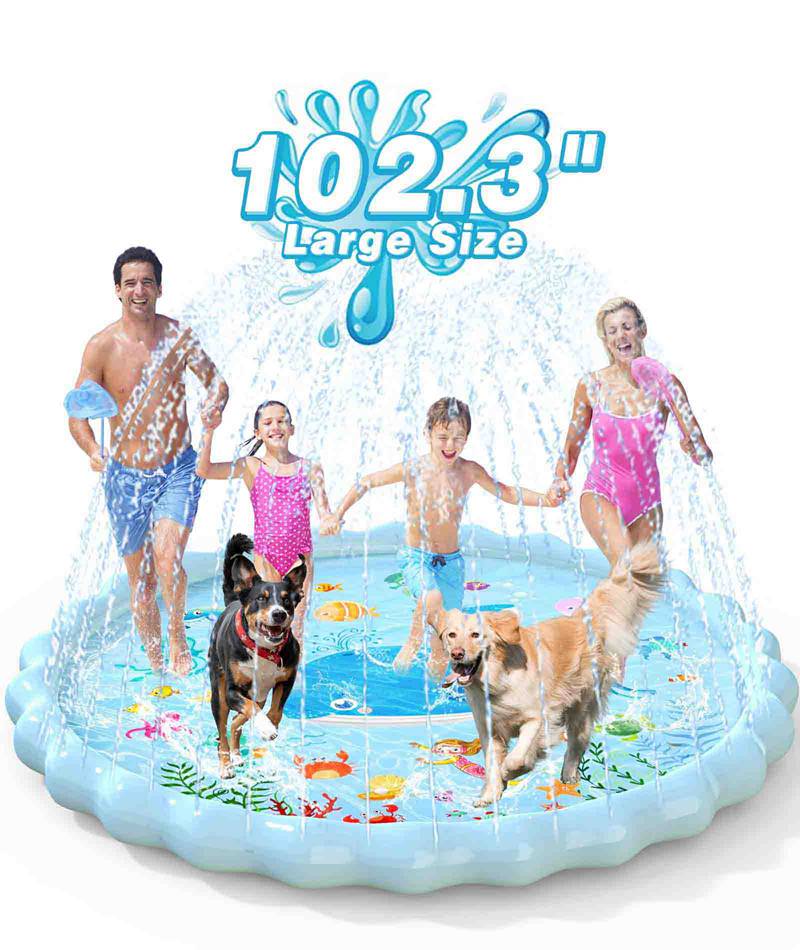
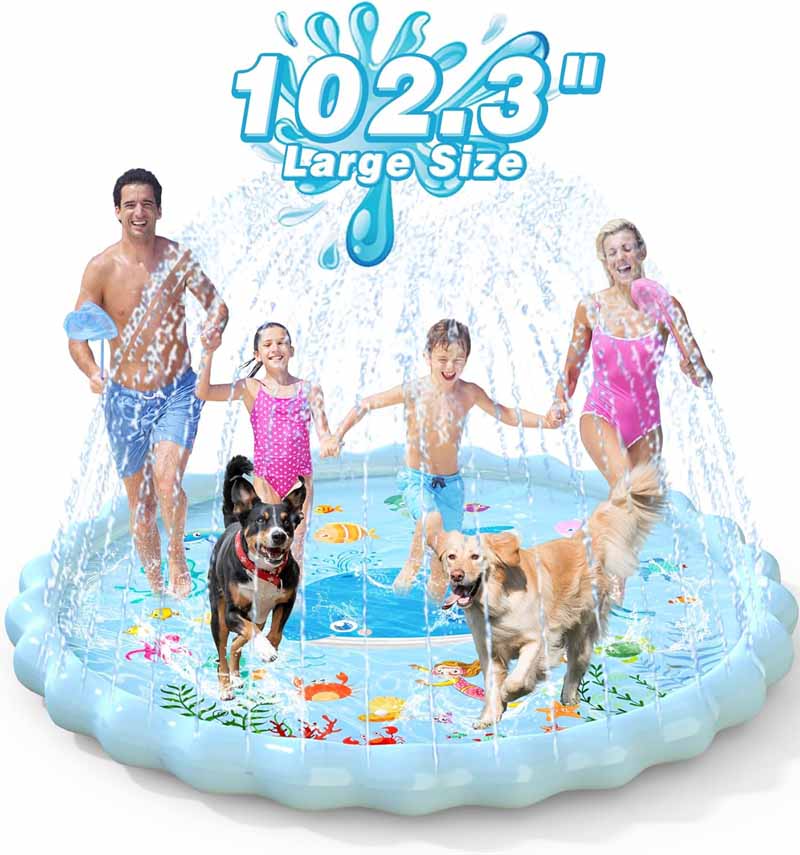
For one example of a large family-style splash pad, a 102.3-inch diameter equals approximately 8.5 feet or 260 centimeters when fully opened. Those figures describe the overall product footprint, not a guaranteed capacity for a fixed number of children. Age, movement, activity style, outer sprinkler-ring width, and how much space children need around one another all affect the real family experience. Good reviews describe the users and play conditions instead of converting diameter directly into an occupancy promise.
5. Read Leak and Durability Comments Like a Product Technician
“Leak” is probably the most important word to investigate in splash pad reviews, but it is also one of the least precise. A reviewer may use the word for a heat-sealed seam opening, a puncture through the PVC sheet, a hose connector dripping, water escaping around an adapter, or even normal sprinkler water leaving the intended play area. Before treating any leak review as evidence of poor product durability, identify the exact location, timing, and operating conditions.
A typical hose-connected PVC splash pad uses a central play surface surrounded by a water-filled outer structure. PVC sections are joined through heat-sealing or a related welding process, while water enters from a garden-hose connection and exits through arranged spray openings. These functional areas behave differently. A seam holds joined material together. A connector transfers water into the product while also experiencing hose movement. The center sheet contacts the ground. Spray holes intentionally release water. A useful review tells you which zone is involved.

Ask Where the Water Appeared
If water emerges along a heat-sealed edge, check whether several reviewers identify the same edge or same stage of use. If it sprays from the hose fitting, look for washer, threading, or adapter information. If a small hole appears in the floor, find out what surface was underneath. If the outer ring gradually loses shape, investigate supply flow, connection loss, punctures, and seams rather than assuming only one possible cause.
| Review Description | First Area to Investigate | What Would Make the Signal Stronger |
|---|---|---|
| Water appears along a heat-sealed edge | Seam integrity | Several independent recent reviews identify the same area |
| Water sprays at the hose connection | Washer, threads, adapter, connector | Leakage continues after correct refitting |
| Small hole appears in center PVC | Ground debris or puncture | Similar punctures appear during normal use on clean surfaces |
| Outer ring slowly loses shape | Supply flow, connector, seam, puncture | Review gives enough detail to isolate the cause |
| Split develops after several uses | Seam path, flex zone, repeated loading | Similar timing and location appear in other reviews |
| One spray section remains weak | Local filling or spray-hole condition | Other reviewers show the same uneven section |
Ground Conditions Change the Meaning of a Puncture Review
Flexible PVC conforms closely to whatever is underneath it. A small stone, thorn, twig, rough patio edge, sharp toy, or piece of garden debris can concentrate force into a very small area when a child steps on the mat. For this reason, a puncture reported after use on gravel or an unprepared rough surface does not provide the same evidence as repeated seam separation occurring on clean, level grass.
Before buying, check whether the instructions and reviews repeatedly mention ground preparation. A sensible setup includes removing stones, sticks, sharp plant material, tools, and other hard debris before unfolding the splash pad. This is particularly important for families using vacation houses or relatives’ yards because ground conditions may differ substantially from home. A reviewer who includes surface information gives you much more useful evidence about material performance.
Do Not Reduce Durability to a Single PVC Thickness Number
Material thickness matters, but it is only one variable in a welded PVC product. Seam width, welding consistency, material formulation, panel geometry, reinforcement around the connector, fold locations, print system, spray-ring shape, user loading, and ground condition can all change performance. Two splash pads with similar PVC thickness can behave differently if their structures, seam paths, or production controls differ.
From a product-development perspective, material claims become useful only when connected with finished-product behavior. A thicker material can still fail at a poorly controlled seam, while an appropriately selected thinner material can perform well in a simple low-pressure structure when welding and geometry are consistent. Consumer reviews should therefore be read for actual failure mode rather than used to create a simplistic “thicker always equals better” ranking.
For private-label or customized PVC splash pad programs, repeated review complaints can be translated into development requirements. Seam failures can trigger review of welding paths and process consistency; connector complaints can justify attachment-cycle testing and reinforcement review; outward spray complaints can lead to revised hole orientation; crowding feedback can inform size development; and storage complaints can influence folding geometry and instructions. Custom development is most useful when reviews become testable engineering questions, not when their wording is copied directly into marketing claims.
6. Separate Water-Pressure Complaints From Product Problems
A comment saying “the spray is too low” sounds simple, but a hose-connected splash pad does not create its water supply independently. Household faucet conditions, available flow, water pressure, hose diameter, hose length, kinks, elevation changes, partially closed valves, connector leakage, and the number of spray holes all influence visible performance. Because homes differ, one universal spray height should not be treated as a guaranteed specification unless the manufacturer has clearly defined the test conditions.
It is also useful to separate pressure from flow. Pressure describes force per unit area, commonly expressed as PSI in household water discussions. Flow describes the quantity of water delivered over time, such as gallons per minute. A bucket-and-stopwatch test measures flow rather than pressure. It cannot tell you exactly how high a particular splash pad will spray, but it does give you a practical baseline for comparing two faucets, two homes, or two hose setups.
Read the Shape of the Complaint
If every spray jet is low, supply conditions deserve attention first. If one small section performs poorly while the rest of the ring sprays normally, a local hole or filling issue becomes more plausible. If the water clearly shoots outward rather than toward the intended activity zone, spray-hole orientation matters more than overall pressure. If a large amount of water escapes at the connector, the visible spray may be lower simply because part of the available flow is being lost before it reaches the ring.
This distinction is important because several completely different problems can produce the same sentence in a review: “spray is weak.” A technically useful review explains whether increasing the faucet changed the result, whether all jets were affected, whether the connection leaked, and what hose arrangement was used. When multiple reviewers with different household setups report the same uneven section or spray direction, the evidence begins to point more strongly toward the product itself.

Run a Simple Bucket Flow Test Before Blaming the Pad
A basic flow test takes only a bucket of known capacity and a stopwatch. Place the bucket under the outdoor faucet or hose outlet, open the water to the intended operating position, record the number of seconds required to fill the bucket, and calculate the result using:
GPM = Bucket Volume in Gallons ÷ Filling Time in Seconds × 60
For example, if a 5-gallon bucket fills in 30 seconds, the calculated flow is approximately 10 gallons per minute. This does not predict an exact sprinkler height because the splash pad’s geometry and pressure conditions still matter, but it gives you a real number instead of relying on “our water pressure seems normal.”
External tool — Drip Depot Flow Rate Calculator. Enter the container volume and fill time to calculate gallons per minute or gallons per hour. This is useful when comparing your home setup with a reviewer who reports unusually low or high spray.
Video evidence — How to Check the Flow Rate of Your Water Source. This demonstration shows the bucket-and-stopwatch method visually, which makes it useful for parents who have never measured outdoor water flow before.
Compare Hose Setups Before Comparing Reviews
Hose length and diameter matter because water loses pressure through friction while moving through the hose. The effect depends on the hose, flow rate, fittings, and other conditions, so it is not responsible to assign one simple percentage loss to every setup. A reviewer using a short, wide hose near the faucet may see a different spray pattern from another family using a much longer hose with several couplings.
When reviewers complain about weak spray, check whether they mention hose length, kinks, adapters, splitters, reels, or other restrictions. If your faucet is close to the play area and their setup involved a very long hose, the complaint may be less relevant to you. If many families using ordinary short garden hoses still describe the same low or uneven section, investigate the product more closely.
7. Check Size Against Your Real Family and Yard
“Large” and “small” are subjective words. A grandparent buying for one preschool child may describe an eight-foot splash pad as enormous, while a family with four active school-age children may find the same footprint crowded. A useful size review therefore needs context: listed dimensions, number of children, approximate ages, and the kind of play occurring. Without those details, “perfect size” is mostly a statement about one family’s expectations.
The advertised diameter is also not the same as fully usable running space. A round splash pad includes its outer water-filled sprinkler structure, while the central activity zone occupies the area inside it. Children may also need space to enter, step around one another, reach cups or toys, and move away from spray. Adults need an unobstructed area nearby for supervision. For these reasons, no responsible review or product page should turn a diameter into a guaranteed fixed child capacity without relevant testing and context.
Match Reviews to Child Number and Age
A comment saying “three children fit comfortably” becomes more useful when it adds “ages three, four, and six.” The play pattern of three preschoolers can be very different from three older children running, chasing, or competing for the same spray area. Age influences body size, movement speed, coordination, preferred spray intensity, and how much personal space children need during active play.
Families planning birthday parties or frequent playdates should pay particular attention to reviews mentioning group use. A product can still be useful at a party without holding every guest at once. Families often rotate children through activities rather than treating one splash pad as the only attraction. Reviews describing eight children “using it at the party” do not necessarily mean all eight were safely and comfortably playing simultaneously.
| Review Context | Better Interpretation |
|---|---|
| “Perfect size” with no details | A personal impression with limited transferability |
| “Two children ages 3 and 5 had room to splash and move around” | Highly relevant to a similar household |
| “Crowded with six older children running at once” | Useful for party planning and group expectations |
| “Overall diameter was large, but center area felt smaller than expected” | Prompts comparison between total footprint and usable play zone |
| Photo shows product beside furniture or adults | Helpful visual scale, but actual dimensions should still be measured |

Measure the Actual Yard Before Buying
When possible, take a tape measure outside and mark the product’s approximate footprint with small objects or temporary markers. Do not measure only the diameter. Consider where the hose approaches the product, where adults can sit or stand, whether children will cross a patio or steps while wet, and whether trees, furniture, grills, garden borders, walls, or other obstacles limit the surrounding movement area.
Gift shoppers face a harder problem because they may not know the recipient’s backyard dimensions. An online mapping tool can help with early planning, although it should not replace an on-site measurement. Google Earth allows users to measure distances and areas, while Google notes that measurements may not be 100% accurate, especially around 3D terrain and buildings. Use the feature for approximate planning, then confirm the actual placement area before use.
External tool — Google Earth Measurement. Search the property, switch to a top-down view, use the Measure tool to estimate the open area, and compare it with the product footprint.
Convert Measurements Correctly
U.S. product listings frequently use inches and feet, while international households or product-development teams may work in centimeters and meters. For reference, 1 inch equals exactly 2.54 centimeters, and 1 foot equals 30.48 centimeters. NIST publishes standard conversion references and a downloadable Metric Conversion Card for quick approximate calculations.
Downloadable reference — NIST Metric Conversion Card, SP 365. The official 2024 publication includes quick conversions for length, area, mass, volume, and temperature.
This type of measurement check is especially useful when reviews contain conflicting comments such as “much larger than expected” and “smaller than the photos.” Both reviewers may be describing genuine personal expectations. Physical measurements give you a stable reference point. Once you know the footprint, you can judge whether the size comments come from households similar to yours rather than treating subjective adjectives as specifications.
8. Give Safety and Wet-Surface Reviews Extra Weight
Children’s water-play reviews need a different priority system from reviews of ordinary décor or household accessories. A color mismatch may be disappointing, but a repeated comment involving tripping, an unstable hose route, damaged PVC, a raised connector, or uncontrolled movement on a wet surface deserves more attention. Safety-related reviews should be investigated even when the average rating remains high, because severity matters independently of frequency.
A splash pad is a wet environment by design. Do not assume every PVC splash pad has a dedicated slip-resistant texture simply because it is sold for children. Standard PVC water-play surfaces become wet, and actual footing can also be affected by wrinkles, uneven ground, sunscreen, soap residue, algae or dirt, footwear, water accumulation, and child behavior. Unless a product specifically substantiates a dedicated surface treatment or slip-resistance claim, “non-slip” should not be treated as a generic property of the category.
Read “Slippery” Reviews in Context
When a reviewer reports slipping, ask what the children were doing and how the product was placed. Was it laid flat on a clean lawn? Was the ground sloped? Were several children chasing one another? Was a corner wrinkled? Was water pooling because the surface underneath was uneven? Did multiple families report similar experiences during ordinary supervised play? These details do not make a slip irrelevant; they help you understand whether the review describes a repeatable product condition, a setup issue, or risky play behavior.
For households with several children, review comments about pushing, collisions, crowding, or running deserve additional attention. Even a large product can become congested when children of different ages move unpredictably through the same spray area. A parent reading reviews should therefore judge not only whether “multiple kids can fit,” but whether the activity area makes supervision and orderly play practical for the specific group.
Keep Product Reviews Separate From Adult Supervision
A shallow or open splash pad should not be described as eliminating the need for water supervision. Current CDC information states that drowning is the leading cause of death for U.S. children ages 1–4 and can happen quickly and silently. Those statistics cover water safety broadly and should not be misused to claim that a backyard splash pad has the same risk profile as a swimming pool. The relevant lesson is simpler: whenever young children are around water, product features do not replace close adult attention.
Evidence source — CDC Summer Swim Safety. The CDC recommends close and constant supervision around water and explains that drowning can occur quickly and silently.
Video evidence — CPSC: Anatomy of a Water Watcher. This 2026 video explains the role of assigning a responsible adult to focus on children around water rather than assuming everyone nearby is watching.
Weight Safety Problems by Their Practical Consequence
If several reviews mention a hose running through the main entry path, imagine your own setup before dismissing the issue. Your faucet may allow the hose to approach from another direction, or your yard may create the same problem. If a connector is described as lifting when the hose is pulled, consider whether your hose will lie in a relaxed curve or remain under tension. If the product bunches on sloped ground, check whether you actually have a level area large enough to place it.
These small practical questions are often more useful than a general claim such as “safe for kids.” Safety is created by product design, condition, placement, water management, adult supervision, and child behavior working together. Reviews can reveal parts of this system, but no single star rating can certify it.
Video evidence — CPSC: 5 Pool Safety Tips for Water Safety Month. Although some recommendations are specific to pools and spas, the video’s messages on watching children and preparing for water emergencies provide useful context for any family water-play activity.
Video evidence — American Academy of Pediatrics: How to Keep Children Safe in and Around Pools. Pediatric safety guidance helps parents place product reviews inside the larger context of supervision and household water-safety habits.
Video evidence — CPSC: CPR Saves Lives in Water Emergencies. This 2026 safety resource encourages caregivers to learn CPR before an emergency occurs; it is useful background when reviewing any child water-play product.
9. Read Setup, Connector, Drainage, and Storage Reviews
Parents often research the fun part of a splash pad and underestimate the ownership part. A typical session includes clearing the ground, unfolding the product, connecting a garden hose, turning on the water gradually, adjusting the spray, supervising play, shutting off the water, draining the perimeter, rinsing dirt or grass, drying both surfaces, folding the PVC, and putting it away. A product can provide enjoyable play yet still become frustrating if one of these steps is consistently difficult.
This matters most for busy parents, grandparents, families planning quick after-school play, and people taking seasonal toys to vacation homes. A review saying “easy to use” is useful only when you understand what the reviewer considers easy. Look for actual setup details: no pump required, standard garden-hose connection, number of adapters, whether a washer stays in place, whether the hose threads smoothly, how quickly the outer ring fills, and whether water flow needs frequent adjustment.
Separate Setup Difficulty From Connector Failure
A person unfamiliar with hose fittings may describe the first connection as difficult even when the hardware works normally. Another reviewer may describe a connector physically cracking, leaking despite correct assembly, or pulling away from the PVC. Those are different categories. Check whether the reviewer tried reseating the washer, tightening by hand, checking thread alignment, or removing hose tension before concluding the fitting itself failed.
The hose can also apply mechanical force to the product. A stiff, tightly stretched, twisted, or badly routed hose may pull on the connection area and lift part of the outer ring. A better setup allows the hose to approach from outside the play area in a relaxed path rather than crossing where children enter. If several reviews mention the connector being dragged or twisted, consider whether the problem relates partly to layout.
From a custom product-development perspective, connector complaints are valuable because they can be converted into measurable checks. A private-label splash pad can be evaluated for washer retention, repeated attachment cycles, leakage during operation, hose-pull direction, reinforcement around the fitting, and accessibility during setup. A small connector redesign may improve ownership more than adding another decorative feature because every user interacts with the fitting at each setup.

Pay Attention to Drainage and Drying
PVC is foldable, which helps seasonal storage, but folding also creates places where moisture can remain if the product is packed away too quickly. Reviews mentioning trapped water, sticky folds, odor after storage, difficulty drying the underside, or water remaining inside an outer ring deserve attention. They reveal how much work happens after the children finish playing, which matters greatly to families who expect a quick weekday activity.
There is no universal drying time. Temperature, humidity, airflow, product size, shade, amount of residual water, and whether both sides are exposed all change the result. Be cautious with reviews claiming a splash pad “always dries in 20 minutes” unless the conditions are explained. A better review describes the routine: drained after use, rinsed, turned over, left open until both sides felt dry, then folded and stored.
Read Storage Reviews Against Your Own Lifestyle
A garage owner may barely notice the folded package size. Someone living in a smaller home, driving to grandparents’ houses, or packing for a summer weekend may care a great deal. Gift shoppers should also consider whether the receiving family has space to dry and store a seasonal water toy. Reviews describing how compactly the pad folds, whether it fits back into its box, and whether the material sticks after storage can be highly relevant even though they do not affect spray performance.
A well-designed review process therefore treats ownership as part of quality. The product does not stop being your responsibility when the faucet is turned off. If repeated reviews describe easy setup but consistently frustrating drainage, you should decide whether the trade-off fits your family. A low-maintenance family toy should not require perfect laboratory conditions to clean and store, but some basic drying and surface care are normal for flexible PVC water-play products.
10. Cross-Check Reviews Before You Trust the Pattern
A single retailer’s review section is a useful starting point, not the entire evidence base. The FTC recommends checking customer reviews across a wide variety of review and retailer sites, search engines, and social platforms while considering where the review appears, who wrote it, and whether the source may be sponsored. Cross-checking is particularly useful when a problem can be confused with setup conditions, such as water pressure, connector leakage, or size expectations.
Instead of repeatedly searching “best splash pad,” use the exact model name or number together with the issue you are investigating. Searches such as “model name seam leak,” “model name connector leak,” “model name low spray,” “model name slippery,” “model name review after summer,” or “model name size for three kids” produce more diagnostic results. This is often the fastest way to find long-form experiences, videos, retailer reviews, support discussions, and independent references addressing the same uncertainty.
Treat Photos and Videos as Supporting Evidence, Not Automatic Proof
Visual reviews are particularly useful for scale, spray direction, uneven water distribution, connector leakage, wrinkles, and real family use. A video can show whether one side of the sprinkler ring remains noticeably lower. A photo can reveal whether “large enough for three kids” means three toddlers sitting calmly or older children moving actively. Visual evidence is strongest when it directly shows the issue described in the text.
At the same time, a photograph can distort size through perspective, and a short video may show only the best or worst moment. Water settings can be changed before recording. A manufacturer demonstration can show intended operation but does not prove every customer unit performs identically. The strongest evidence remains a combination of specific text, relevant images or video, matching product version, and repetition across independent users.
Check Seller Terms and Recalls Separately
Reviews cannot replace transaction research. Before ordering, confirm the current seller, product variant, included components, return period, refund terms, and warranty information on the actual listing. Seasonal products may be purchased weeks before a birthday or warm weather arrives, so the return window may matter more than expected. Gift shoppers should be especially careful because a product can remain unopened until the event date.
For children’s products in the United States, official recall information should also remain separate from review sentiment. A high rating does not override an official recall, while one injury report does not by itself establish a recall. Search the Consumer Product Safety Commission database using the brand, model, and product category when you want to verify recall status.
Official safety resource — U.S. Consumer Product Safety Commission Recall Search. Use the brand or product name to check formal recall notices and affected models.
Do Not Let Review Research Turn Into Endless Searching
There is a point where more reviews stop adding meaningful information. You do not need to read 500 comments if the first 40 detailed recent reviews already establish consistent performance and you have checked the important failure terms. Likewise, a product with thousands of reviews may still leave a specific question unanswered if most comments are vague first impressions.
Stop when you can answer the important questions for your household: Are repeated serious failures present? Does the exact size fit the yard? Are the children’s ages and number similar to those described by useful reviewers? Does your water setup resemble successful use conditions? Can you route the hose safely? Are setup, drying, and storage realistic for your routine? If you can answer those questions confidently, another hour of scrolling may not improve the decision.
11. Use a Final Review Checklist Before You Buy
After reading dozens of comments, people tend to remember the most emotional story rather than the most representative evidence. A simple static checklist prevents this problem by making you evaluate every product in the same order. One useful framework is R.E.A.D.: Repetition, Evidence, Applicability, and Duration. It is deliberately simple and should not be turned into an artificial 87/100 score or “AI quality rating.” Its purpose is to organize observations, not manufacture precision.
R — Repetition asks whether several independent people report the same functional problem. E — Evidence asks whether the review includes useful conditions, photos, video, measurements, or a clear failure location. A — Applicability asks whether the reviewer’s children, yard, hose, product version, and usage pattern resemble yours. D — Duration asks whether the opinion comes from a first setup, several weekends, or long-term seasonal use. Reviews meeting several of these criteria deserve more weight.
Review Credibility Checklist
- [ ] Check recent reviews before relying heavily on older feedback.
- [ ] Confirm the review applies to the same size, style, or current version.
- [ ] Look for actual usage details rather than only emotional reactions.
- [ ] Note disclosed free products, incentives, or reviewer relationships.
- [ ] Give more weight to specific photos or videos showing the issue discussed.
- [ ] Compare meaningful claims with independent sources.
Construction and Durability Checklist
- [ ] Search seam, leak, split, tear, puncture, hole, ring, connector, and edge.
- [ ] Separate seam leakage from hose-connection leakage.
- [ ] Check whether failures occur on first use or after repeated use.
- [ ] Read ground-surface information before judging punctures.
- [ ] Do not use PVC thickness as the only durability measure.
- [ ] Pay more attention when several recent reviews identify the same location.
Water-Performance Checklist
- [ ] Check whether low spray affects every jet or only one section.
- [ ] Look for hose length, faucet setting, kinks, adapters, or visible connection loss.
- [ ] Separate spray height from spray direction.
- [ ] Separate pressure complaints from uneven spray-pattern complaints.
- [ ] Run a simple flow test if your household supply is uncertain.
- [ ] Avoid expecting one guaranteed spray height across different homes.
Family and Yard Checklist
- [ ] Measure the real product footprint before ordering.
- [ ] Do not convert diameter directly into a guaranteed child capacity.
- [ ] Prioritize reviews from families with similar child ages and numbers.
- [ ] Plan a clear hose route outside the main activity path.
- [ ] Check for level ground and remove stones, branches, or sharp debris.
- [ ] Consider adult supervision space as part of the setup.
Ownership Checklist
- [ ] Read setup reviews instead of assuming “easy” means the same thing to everyone.
- [ ] Check whether connection complaints involve setup or actual component failure.
- [ ] Look for drainage and trapped-water comments.
- [ ] Check how reviewers dry both sides before storage.
- [ ] Consider folded storage size for your home, car, or vacation use.
- [ ] Confirm return terms before buying far ahead of a birthday or summer trip.
Once the checklist is complete, place the evidence into one of four practical outcomes. Avoid calculating a precise numerical score unless you have a validated scoring model, because the apparent precision can hide subjective assumptions. A simple decision category is easier to explain and use.
| Decision | Evidence Pattern | Sensible Next Step |
|---|---|---|
| GO | Detailed recent reviews are generally consistent and no relevant repeated severe failures appear | Confirm current size, seller, return terms, and setup conditions |
| INVESTIGATE | A repeated concern exists but may depend on hose, flow, ground, setup, or variant | Measure or test the relevant condition and search the exact problem |
| SKIP | Multiple independent recent reviews describe the same serious structural or safety-related concern under conditions similar to yours | Compare another product or design |
| NOT ENOUGH DATA | Most reviews are vague, first-use comments, or refer to other variants | Avoid treating the star rating as strong evidence |
This same framework has value beyond household shopping. Brands, retailers, and private-label teams developing a new PVC splash pad can treat review patterns as early product-research data. If connector leakage appears repeatedly across a category, the sample plan can include repeated attachment and hose-load checks. If families consistently complain about outward spray, hole direction becomes a development variable. If drying is a common problem, drainage paths, fold geometry, instructions, and packaging guidance deserve review. If families repeatedly misinterpret overall diameter as usable child capacity, product photography and dimensional communication should become clearer.
A focused welded-PVC manufacturing program can support development within established low-pressure splash pad platforms through changes such as artwork, Pantone colors, size, shape, spray-hole layout, connection position, selected PVC specifications, surface options, packaging, instructions, and compatible structural modifications. More substantial changes should be evaluated through prototypes and appropriate testing because altering size, spray zones, texture, connectors, or structural elements can change more than appearance. The most responsible custom development does not promise every requested feature immediately; it turns real usage problems into measurable sample requirements and verifies them before stable production.
Conclusion
Reading kids splash pad reviews well is less about finding the happiest customers and more about reconstructing real use. A useful review tells you what happened, where it happened, how often the product had been used, which version was involved, what surface was underneath, how the hose was connected, how many children were playing, and whether other independent users experienced the same thing. Once those details are visible, many apparently contradictory reviews begin to make sense.
Before buying, follow a consistent sequence: begin with balanced three- and four-star reviews, search low ratings for specific repeated failures, use detailed positive reviews to confirm repeated successful use, verify the current variant, separate seam and connector problems, test your own water flow when necessary, measure the real yard, give safety comments extra weight, and check ownership issues such as drainage and drying. The goal is not perfect certainty. The goal is a decision grounded in conditions that actually resemble your family.
A strong purchase decision should leave you able to explain your choice without referring to the average star rating. You should be able to say, for example, that recent reviews of the correct size show no repeated seam problem, families with children similar in age report adequate space, your yard can accommodate the footprint, your hose route is practical, your outdoor flow is suitable, and cleanup fits your routine. When you can explain the decision at this level, reviews have stopped being entertainment and started becoming useful product evidence.
Frequently Asked Questions
1. What should I look for first in kids splash pad reviews?
Start with detailed three- and four-star reviews because they often describe useful trade-offs instead of only enthusiasm or frustration. Look for the selected product version, number and ages of children, number of uses, ground surface, hose conditions, spray behavior, connector performance, seam condition, drainage, and storage. Then search low-star reviews for repeated physical problems such as leaks, seam separation, connector failures, tears, or uneven spray. Finish by checking detailed positive reviews for evidence of repeated successful use rather than relying on first-day excitement.
2. How many splash pad reviews should I read before buying?
There is no scientifically correct number because review quality matters more than raw quantity. Ten highly detailed recent reviews can reveal more useful information than fifty comments saying “kids love it.” A practical method is to read several balanced reviews, search low-star comments using specific failure words, investigate any important complaint until you can see whether it repeats independently, and compare the pattern with another source. Stop when the important questions about durability, water performance, size, safety, setup, and storage are reasonably answered for your own household.
3. Should I avoid a splash pad if reviewers say it leaks?
Not automatically. First identify where the leak occurs. Water appearing around the garden-hose fitting can involve a washer, threading, adapter, or connector, while water escaping along a heat-sealed edge points toward a different structural issue. A small puncture in the floor also needs ground-condition context. The concern becomes much stronger when several independent recent reviewers using the same product version describe the same failure location under normal setup conditions. Repetition, location, timing, and use conditions are more informative than the word “leak” by itself.
4. Why do splash pad spray-height reviews vary so much?
Hose-connected splash pads depend partly on the household water system. Available flow, water pressure, faucet opening, hose diameter, hose length, kinks, splitters, adapters, connection leakage, product size, and sprinkler-hole arrangement can all influence the visible spray. A review saying “weak spray” is therefore incomplete unless it explains the setup. If every jet is low, supply conditions may deserve investigation. If one section is consistently weak or water points in an unexpected direction across several households, the product design becomes a stronger possibility.
5. How can I tell whether a splash pad is big enough for multiple kids?
Use the listed dimensions as a footprint, not a guaranteed child-capacity rating. Measure the same diameter or shape in your yard and compare reviews from families with a similar number and age range of children. Three preschoolers sitting and stepping through water use space differently from three older children running or chasing one another. Also remember that the outer sprinkler ring occupies part of the overall footprint. Photos can help with scale, but a tape measure and age-matched reviews give you a more reliable picture of usable family space.
6. Are verified purchase reviews always more trustworthy?
A verified-purchase indicator provides useful transaction context, but it does not prove a review is detailed, unbiased, or based on long-term use. A verified purchaser can still post after ten minutes, misunderstand the setup, or describe conditions unlike yours. Another genuine user may have received the product as a gift. Give the greatest weight to reviews with a matching variant, specific use conditions, meaningful duration, photographs or video when relevant, and observations repeated by independent reviewers. Verification is one signal in the credibility assessment rather than the final answer.
7. Are kids splash pads supposed to be non-slip?
Do not assume every PVC splash pad has a dedicated slip-resistant surface. Many use standard flexible PVC water-play surfaces, which naturally become wet during operation. Actual footing also depends on wrinkles, ground slope, water accumulation, dirt or residue, footwear, sunscreen, and how children move. If slip resistance matters to your purchase, check whether the specific product makes and supports a defined surface claim rather than assuming the entire category is “non-slip.” Regardless of surface treatment, active adult supervision and orderly play remain necessary in wet areas.