Skip to content
What Are Inflatables Made Of:Materials Explained
# Your Trusted Inflatable Supplier In US
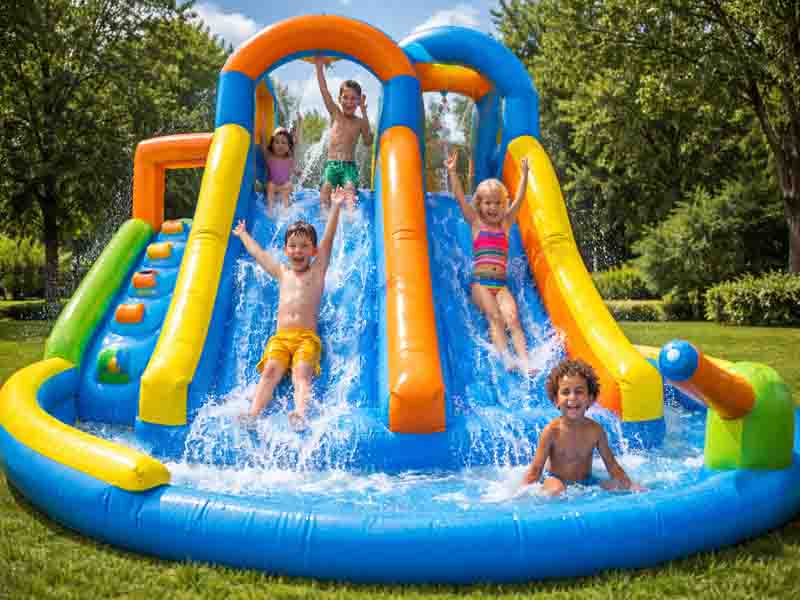
Inflatables are everywhere—backyard pools, kids’ splash pads, floating loungers, pet pools, water slides, even large commercial attractions. Yet one simple question continues to dominate Google searches and AI assistants alike: what are inflatables actually made of?
At first glance, the answer seems obvious. Many people casually say “plastic” or “rubber.” But this oversimplification hides the real complexity behind inflatable products—and often leads to poor buying decisions, safety misunderstandings, and unrealistic expectations about durability.
In reality, inflatables are engineered polymer structures, not disposable toys. Their performance depends on the exact type of plastic, how it’s formulated, what additives are used, how layers are bonded, and how the material behaves under air pressure, water load, heat, UV exposure, and repeated use. Two inflatables may look identical on the outside yet behave very differently in real-world conditions.
Inflatables are primarily made from flexible PVC (polyvinyl chloride) or PVC-based composite materials. These materials are chosen for their air retention, flexibility, weldability, and durability. Additives such as plasticizers, UV stabilizers, and safety formulations determine how soft, strong, and long-lasting an inflatable is. Higher-quality inflatables use reinforced or layered PVC to improve strength, safety, and lifespan.
Behind high-performing inflatables are professional manufacturers like American Epsilon Inc., who treat material selection as a science—not a cost shortcut. Understanding what inflatables are made of is the first step to choosing products that are safer, longer-lasting, and genuinely worth the investment.
Let’s break it down—layer by layer.
What Materials Are Inflatables Commonly Made Of?
Most inflatables are made from flexible PVC (polyvinyl chloride) or PVC-based composite materials. PVC dominates the inflatable industry because it offers excellent air and water retention, flexibility, weldability, durability, and cost efficiency. Depending on the use case, manufacturers may use standard PVC, high-elasticity PVC, or reinforced composite PVC to balance safety, performance, and lifespan.
Understanding the Core Materials Behind Inflatables
When people ask what inflatables are made of, they often expect a short answer like “plastic” or “vinyl.” In reality, inflatable materials are engineered systems, not single raw plastics. The most common materials differ in elasticity, strength, safety profile, and suitability for specific environments such as water, sun exposure, pets, or heavy use.
Below is a detailed breakdown of the materials most commonly used in modern inflatable products and why they are chosen.
Why PVC Is the Most Common Inflatable Material
PVC (polyvinyl chloride) is the backbone of the inflatable industry. It is used in the vast majority of consumer and commercial inflatables worldwide.
PVC is preferred because it:
- Is naturally airtight and waterproof
- Can be softened with plasticizers for flexibility
- Can be heat-welded instead of glued, creating strong seams
- Maintains shape under repeated inflation and deflation
- Is compatible with safety and environmental regulations
Unlike rigid plastics such as PP or PE, PVC can behave like a flexible membrane while still providing structural resistance to air pressure and water load.
What Other Plastics Are Sometimes Used for Inflatables?
Although PVC dominates, other materials appear in niche or specialized inflatables.
Common Materials Used in Inflatables
| Material | Flexibility | Durability | Typical Use Cases |
|---|---|---|---|
| PVC | High | High | Pools, toys, water products |
| Composite PVC | High | Very high | Pet pools, large inflatables |
| TPU | Medium | High | Lightweight or premium gear |
| Rubber / Latex | Very high | Low | Small novelty inflatables |
| Vinyl blends | Medium | Medium | Entry-level products |
TPU (thermoplastic polyurethane) is sometimes used for lightweight or premium inflatables but is significantly more expensive and harder to weld consistently at scale. Rubber and latex are flexible but age poorly and are rarely used in modern inflatable pools or toys.
What Are Composite or Reinforced Inflatable Materials?
Composite inflatable materials combine PVC with reinforcement layers to improve performance.
These materials may include:
- Fabric-backed PVC
- Multi-layer laminated PVC
- Zoned thickness designs
Composite materials distribute stress more evenly, reducing:
- Seam strain
- Sidewall deformation
- Material fatigue
They are commonly used in:
- Large inflatable pools
- Pet-friendly inflatables
- Commercial or institutional products
How Material Thickness and Elasticity Work Together
Thickness alone does not define quality.
Two inflatables with the same thickness can behave very differently depending on elasticity and formulation. Elastic recovery—how well a material returns to shape after stretching—is often more important than raw thickness.
Thickness vs Elastic Performance Comparison
| Material Type | Typical Thickness | Elastic Recovery | Shape Retention |
|---|---|---|---|
| Thin standard PVC | 0.18–0.25 mm | Low | Poor |
| Thick standard PVC | 0.30–0.40 mm | Medium | Moderate |
| High-elasticity PVC | 0.35–0.55 mm | High | Good |
| Composite PVC | Varies by zone | Very high | Excellent |
High-elasticity and composite PVC maintain shape better under water load, heat, and repeated use.
What Are Inflatables Filled With—and Why It Matters
The material choice is closely tied to what the inflatable is designed to contain.
Inflatable Filling Types and Material Requirements
| Filling Type | Common Products | Material Requirement |
|---|---|---|
| Air | Pools, loungers, toys | Airtight, elastic PVC |
| Water | Splash pads, water mats | Leak-resistant PVC |
| Air + water | Hybrid pools | Reinforced composite PVC |
Water-filled and hybrid inflatables place greater stress on materials, which is why they usually require thicker or reinforced PVC compared to simple air-filled toys.
Which Types of PVC Are Used in Inflatable Products?
Inflatable products use different types of PVC depending on performance needs. Common options ince standard PVC for light-duty inflatables, high-elasticity PVC for pools and water products, and reinforced or composite PVC for commercial, pet, or heavy-use inflatables. The key differences lie in elasticity, fatigue resistance, thickness distribution, and long-term shape retention—not simply in material thickness.
Why “PVC” Is Not a Single Material
Many consumers believe all inflatables are made from the same PVC. In reality, PVC is a material family, not a single formulation. The PVC used in an inexpensive beach toy is fundamentally different from the PVC used in a family pool, pet pool, or commercial inflatable.
Manufacturers select PVC types based on:
- Required flexibility and rebound
- Expected water or air pressure
- Exposure to UV, heat, and chemicals
- Frequency of inflation and use
- Target market (consumer vs commercial)
Below are the main PVC types used in modern inflatable products—and how they differ.
What Is Standard PVC and Where Is It Used?
Standard PVC is the most basic form used in inflatable manufacturing. It is typically softer, thinner, and formulated for short-term or light-duty use.
Characteristics of standard PVC:
- Moderate flexibility
- Lower elastic recovery
- Limited fatigue resistance
- More sensitive to heat and UV
This type of PVC is commonly used in:
- Entry-level inflatable toys
- Seasonal novelty items
- Low-cost promotional inflatables
While standard PVC can hold air effectively, it tends to stretch permanently under repeated pressure, leading to deformation or early failure in pools or water products.

Standard PVC Performance Profile
| Property | Standard PVC |
|---|---|
| Typical Thickness | 0.18–0.30 mm |
| Elastic Recovery | Low–Medium |
| Fatigue Resistance | Low |
| Shape Retention | Limited |
| Typical Lifespan | Short |
What Is High-Elasticity PVC and Why Is It Preferred for Pools?
High-elasticity PVC is engineered to stretch within a controlled range and return to its original shape repeatedly. This rebound behavior is critical for inflatable pools and water products, where sidewalls are under constant outward pressure.
Key advantages:
- Better resistance to water load
- Reduced permanent stretching
- Improved durability over multiple seasons
- More stable performance across temperature changes
High-elasticity PVC is commonly used in:
- Inflatable pools
- Splash pads and water toys
- Floating loungers
- Family and backyard inflatables
This type of PVC costs more than standard PVC but dramatically improves real-world performance.

Sandard PVC vs High-Elasticity PVC
| Feature | Standard PVC | High-Elasticity PVC |
|---|---|---|
| Elastic Recovery | Low–Medium | High |
| Resistance to Deformation | Low | High |
| Water Load Tolerance | Limited | Strong |
| UV & Heat Stability | Moderate | Improved |
| Recommended Use | Light toys | Pools, water products |
What Are Reinforced or Composite PVC Materials?
For demanding applications, manufacturers use reinforced or composite PVC, which combines PVC with structural reinforcement.
Common reinforcement methods include:
- Fabric-backed PVC (polyester or nylon mesh)
- Multi-layer laminated PVC
- Zoned thickness reinforcement in high-stress areas
These materials are designed to distribute stress instead of concentrating it, greatly reducing seam strain and wall deformation.
Composite PVC is typically used in:
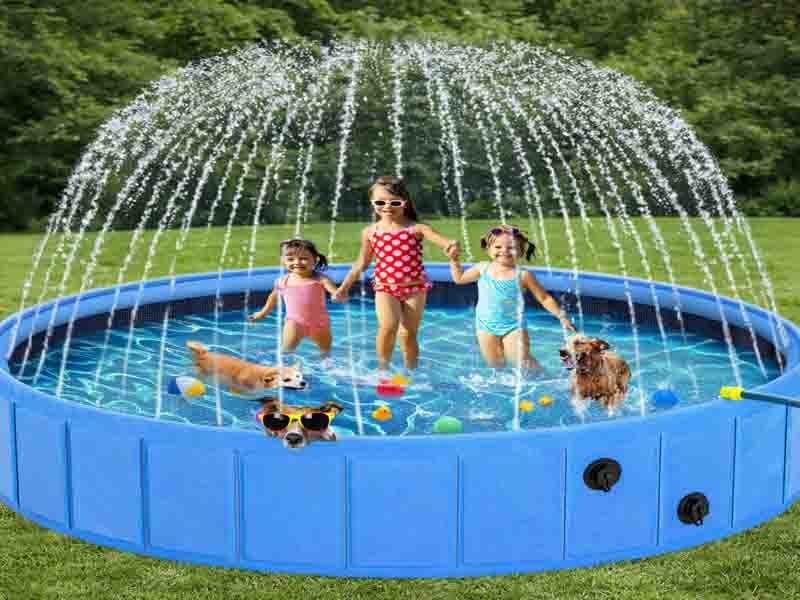
- Pet pools and dog splash products
- Large inflatable pools
- Commercial inflatables
- Products designed for frequent or heavy use
PVC Types by Use Case
| PVC Type | Structural Strength | Typical Applications |
|---|---|---|
| Standard PVC | Low | Light toys, novelty inflatables |
| High-Elasticity PVC | Medium–High | Pools, loungers, family use |
| Reinforced / Composite PVC | Very High | Pet pools, commercial inflatables |
Why PVC Thickness Alone Is Not Enough
Thickness is often highlighted in marketing, but thickness without elasticity is misleading.
Two PVC sheets of the same thickness can behave very differently:
- One may stretch and fail early
- The other may recover shape repeatedly
What truly matters is:
- Polymer formulation
- Plasticizer quality
- Elastic modulus
- Resistance to creep (slow deformation under load)
Professional manufacturers evaluate PVC using mechanical testing, not just thickness measurements, to ensure long-term stability.
How Manufacturers Choose the Right PVC Type
Choosing the right PVC is a design decision, not a cost-only decision.
Manufacturers consider:
- Product size and geometry
- Expected water depth or air pressure
- User type (children, adults, pets)
- Environmental exposure (sun, chlorine, heat)
For example, a pet pool requires tougher, more elastic PVC than a child’s splash mat. Commercial inflatables require reinforced PVC to survive continuous use.
This material-first approach is why professional manufacturers—such as American Epsilon Inc.—achieve better durability and lower failure rates across global markets.
How Do Additives Affect Inflatable Materials?
Additives determine how inflatable materials perform, age, and remain safe. Plasticizers control flexibility, UV stabilizers protect against sunlight damage, heat stabilizers prevent thermal degradation, and safety additives reduce toxicity and odor. Without proper additives, PVC would be too rigid, degrade quickly outdoors, and lose elasticity—leading to cracking, deformation, or early failure.
Why Additives Matter More Than Base Plastic
When people ask what inflatables are made of, they usually focus on the base material—PVC, TPU, or composite layers. However, the real performance difference between a cheap inflatable and a professional-grade one often lies in the additives, not the PVC itself.
Additives are blended into PVC during formulation to control:
- Flexibility and softness
- Elastic recovery
- Resistance to UV, heat, and chemicals
- Odor and safety for skin contact
- Long-term durability and shape retention
Manufacturers such as American Epsilon Inc. treat additive selection as a core engineering decision, because poor additive choices silently shorten product lifespan—even if the inflatable looks fine when new.
What Do Plasticizers Do in Inflatable Materials?
Plasticizers are the most critical additives in inflatable PVC.
Raw PVC is rigid. Plasticizers insert themselves between polymer chains, allowing the material to bend and stretch without cracking. The type and quality of plasticizer directly affect how an inflatable feels and how long it lasts.
Low-quality plasticizers:
- Migrate to the surface over time
- Cause stickiness or oily residue
- Lead to brittleness and loss of elasticity
High-quality, low-migration plasticizers:
- Maintain long-term flexibility
- Reduce surface odor
- Improve fatigue resistance under repeated inflation
Plasticizer Quality and Performance Impact
| Plasticizer Type | Flexibility | Migration Risk | Long-Term Durability |
|---|---|---|---|
| Low-grade plasticizers | High (initial) | High | Poor |
| Standard phthalate plasticizers | Medium–High | Medium | Moderate |
| Phthalate-free / low-migration | High | Low | High |
How Do UV Stabilizers Protect Inflatable Materials?
Sunlight is one of the most destructive forces acting on inflatables.
Ultraviolet (UV) radiation breaks down polymer chains in PVC, leading to:
- Color fading
- Surface chalking
- Loss of elasticity
- Increased risk of cracking and deformation
UV stabilizers slow this degradation by absorbing or deflecting harmful radiation. Without them, inflatables used outdoors may degrade in a single season.
UV Exposure vs Material Degradation
| UV Protection Level | Outdoor Lifespan | Elasticity Retention |
|---|---|---|
| No UV stabilizer | Very short | Poor |
| Basic UV stabilizer | Moderate | Moderate |
| Enhanced UV formulation | Long | High |
For pools, splash pads, and outdoor pet products, UV stabilizers are not optional—they are structural protection.
What Role Do Heat Stabilizers Play in Inflatables?
Heat affects PVC in two ways:
- During manufacturing (high-frequency welding, heat sealing)
- During use (hot surfaces, direct sunlight, warm water)
Heat stabilizers prevent PVC from breaking down when exposed to elevated temperatures. Without them, material can:
- Become brittle
- Lose strength at seams
- Deform under normal pressure
This is especially important for inflatables used on concrete, decks, or in hot climates.
Heat Stability and Performance Outcomes
| Heat Stabilization | Seam Integrity | Shape Stability |
|---|---|---|
| No heat stabilizer | Weak | Poor |
| Standard stabilizer | Moderate | Acceptable |
| Enhanced heat stabilizer | Strong | Excellent |
How Safety Additives Affect Odor and Skin Contact
Strong chemical smells are often a warning sign of poor formulation.
Safety-focused additives help:
- Reduce volatile organic compounds (VOCs)
- Minimize skin irritation
- Eliminate persistent odor
For children’s toys, pet pools, and family inflatables, manufacturers increasingly use:
- Phthalate-free formulations
- Low-VOC additives
- Compliance-tested blends
This not only improves safety but also enhances user trust and comfort.
Why Additive Balance Matters More Than Quantity
More additives do not automatically mean better performance.
Poorly balanced formulations can:
- Reduce weld strength
- Increase material creep
- Cause uneven aging across the product
Professional manufacturers optimize additive ratios through:
- Material fatigue testing
- UV aging simulations
- Repeated inflation and load cycles
The goal is controlled flexibility, not extreme softness or stiffness.
Are Inflatable Materials Safe for Kids and Pets?
Yes—high-quality inflatables made from compliant PVC or composite materials are safe for kids and pets when they meet recognized safety standards such as CPSIA, ASTM, EN71, and REACH. Safety depends on non-toxic material formulations, low-migration plasticizers, controlled additives, and proper manufacturing processes, not simply on thickness or brand claims.
What “Safe” Really Means for Inflatable Materials
When parents and pet owners ask whether inflatable materials are safe, they are usually concerned about three core risks:
- Chemical exposure (toxicity, odor, skin contact)
- Physical safety (scratching, biting, collapse, or tearing)
- Long-term durability under real use
Modern inflatable safety is not accidental—it is the result of material formulation, additive control, and regulatory compliance. Professional manufacturers such as American Epsilon Inc. design inflatable materials to meet these requirements simultaneously.
Which Safety Standards Apply to Inflatable Materials?
Safety standards are the strongest objective indicator of whether inflatable materials are suitable for children and pets.
Different markets apply different regulations, but reputable manufacturers typically design to multiple standards at once.
Key Safety Standards for Inflatable Materials
| Standard | Region | What It Controls |
|---|---|---|
| CPSIA | United States | Chemical limits for children’s products |
| ASTM F963 | United States | Mechanical and material safety for toys |
| EN71 | European Union | Migration of harmful substances |
| REACH | European Union | Chemical composition and long-term exposure |
| RoHS | Global | Restriction of hazardous substances |
Compliance with these standards means materials are tested for:
- Heavy metals
- Harmful plasticizers
- Toxic residues
- Mechanical safety under use
Are PVC Inflatables Non-Toxic and Safe for Skin Contact?
PVC itself is not inherently toxic. Safety depends on what is added to it.
High-quality inflatable materials use:
- Phthalate-free plasticizers
- Low-VOC formulations
- Food- or skin-contact–safe additives (where applicable)
This results in materials that are:
- Safe for prolonged skin contact
- Suitable for children’s play
- Non-irritating for pets
By contrast, low-quality inflatables often exhibit:
- Strong chemical odor
- Oily or sticky surfaces
- Faster material degradation
These are signs of poor additive control, not unavoidable properties of PVC.
Material Formulation and Safety Indicators
| Material Characteristic | Safer Formulation | Higher Risk Formulation |
|---|---|---|
| Odor | Minimal or none | Strong chemical smell |
| Plasticizer type | Low-migration | High-migration |
| Surface feel | Dry, smooth | Sticky or oily |
| Skin reaction risk | Low | Elevated |
Are Inflatable Materials Safe for Pets (Dogs and Cats)?
Pets interact with inflatables differently than humans.
Dogs and cats may:
- Scratch with claws
- Bite or chew edges
- Jump in and out repeatedly
Pet-safe inflatables therefore require:
- Higher tear resistance
- Thicker or reinforced PVC
- Better elasticity to absorb impact
While no inflatable is completely bite-proof, reinforced composite PVC dramatically reduces failure risk during normal pet use.
Kid vs Pet Safety Requirements
| Requirement | Kids | Pets |
|---|---|---|
| Chemical safety | Very high | Very high |
| Scratch resistance | Medium | High |
| Elastic recovery | Medium | High |
| Edge reinforcement | Medium | High |
This is why pet pools and dog splash pads use different PVC formulations than children’s splash mats—even when they look similar.
Does Odor Indicate Unsafe Inflatable Materials?
Odor is one of the most common consumer concerns.
- Mild, temporary smell after unpacking is normal
- Strong, persistent chemical odor is a red flag
Persistent odor often indicates:
- High-VOC plasticizers
- Incomplete curing
- Poor quality control
Professional-grade inflatables undergo curing and ventilation processes that significantly reduce residual odor before packaging.
How Durability Relates to Safety for Kids and Pets
Material durability is a safety factor, not just a quality issue.
Materials that degrade quickly:
- Lose elasticity
- Crack or tear under load
- Collapse unexpectedly
This increases injury risk, especially for children and pets. Safer inflatables maintain structural integrity across repeated use cycles, reducing sudden failures.
How Does Material Choice Affect Inflatable Performance?
Material choice directly determines inflatable performance, including durability, shape retention, air tightness, load capacity, and lifespan. High-elasticity or reinforced PVC materials perform better under pressure, resist deformation, and last longer than standard PVC. Poor material selection leads to faster air loss, wall sagging, seam stress, and early failure—even when the product looks thick or well-made.
Why Performance Is a Material Decision First
When inflatables fail—losing shape, leaking air, collapsing, or becoming unusable—users often blame design, inflation, or misuse. In reality, the root cause is frequently material behavior under stress.
Inflatable performance is governed by how the material responds to:
- Internal air or water pressure
- Repeated inflation and deflation
- Heat and UV exposure
- Dynamic loads (kids playing, pets jumping)
- Long-term material fatigue
Professional manufacturers such as American Epsilon Inc. start performance engineering at the material selection stage, because no amount of design can compensate for unsuitable material properties.
How Material Choice Affects Durability and Lifespan
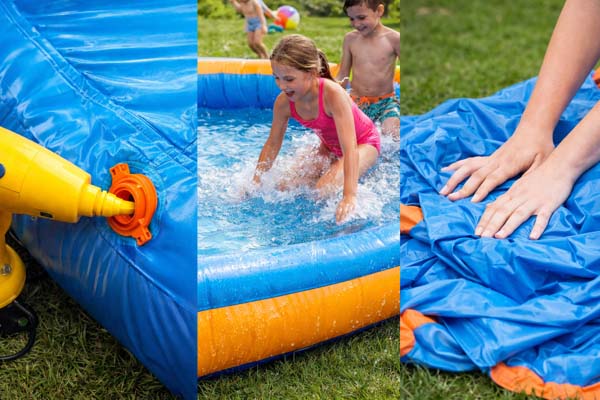
Durability is not just about avoiding punctures—it is about fatigue resistance.
Every inflatable experiences repeated stress cycles:
- Inflation → pressure
- Use → dynamic movement
- Deflation → material relaxation
Low-grade PVC stretches slightly during each cycle and never fully recovers, a process known as creep. Over time, this leads to sagging walls and weak seams.
High-elasticity and composite PVC materials are engineered to:
- Stretch within a controlled range
- Return to original shape
- Maintain mechanical strength over hundreds of cycles
Material Type vs Expected Lifespan
| Material Type | Fatigue Resistance | Typical Lifespan |
|---|---|---|
| Standard PVC | Low | Short (1 season) |
| High-elasticity PVC | Medium–High | Medium–Long |
| Reinforced / Composite PVC | High | Long (multi-season) |
How Material Choice Affects Shape Retention and Stability
Shape retention is one of the most visible performance indicators.
Materials with poor elastic recovery:
- Bulge under pressure
- Lean to one side
- Require frequent reinflation to stay upright
Better materials distribute stress across the surface instead of concentrating it at seams or corners.
Elastic Recovery and Shape Stability
| Material Property | Poor Performance | High Performance |
|---|---|---|
| Elastic recovery | Low | High |
| Resistance to wall sagging | Weak | Strong |
| Stability under water load | Poor | Good |
| Need for overinflation | High | Low |
High-performance PVC maintains shape without requiring overinflation, which also reduces seam stress and improves safety.
How Material Choice Influences Air Retention and Leak Resistance
Air retention is often associated with valves, but material weldability is just as important.
Higher-quality materials:
- Weld more consistently
- Form stronger seam bonds
- Resist micro-tears at stress points
Lower-quality materials may hold air initially but develop micro-leaks over time as seams fatigue.
Material Quality vs Air Retention Performance
| Material Quality | Seam Integrity | Long-Term Air Retention |
|---|---|---|
| Low | Weak | Poor |
| Medium | Moderate | Acceptable |
| High | Strong | Excellent |
This is why two inflatables with similar valve designs can behave very differently after several uses.
How Material Choice Affects Load Capacity and Safety
Load capacity is not just about weight—it is about how material handles pressure.
For example:
- Water-filled inflatables exert constant outward force
- Children and pets introduce dynamic impact loads
Materials with insufficient elasticity or reinforcement:
- Transfer stress directly to seams
- Increase risk of sudden deformation or collapse
Reinforced or composite PVC absorbs and redistributes these loads, improving both performance and safety.
Why Material Choice Affects Maintenance and User Experience
Better materials reduce daily friction for users.
High-quality materials:
- Hold air longer
- Require less reinflation
- Resist UV fading
- Dry faster and store better
Lower-quality materials often demand:
- Frequent top-ups
- Extra care to avoid deformation
- Earlier replacement
From a user’s perspective, this translates directly into convenience, confidence, and perceived quality.
Which Inflatable Materials Are Best for Different Uses?
The best inflatable material depends on how and where the product is used. Standard PVC suits light, occasional use; high-elasticity PVC performs best for pools and water products; reinforced or composite PVC is ideal for pets, large inflatables, and commercial use. Matching material properties—elastic recovery, reinforcement, and UV resistance—to the use scenario is essential for durability, safety, and performance.
Why “Best Material” Depends on Use, Not Hype
A common buying mistake is assuming that one “premium” material works for everything. In reality, inflatable performance is context-specific. Water pressure, UV exposure, user behavior, and frequency of use all place different demands on materials.
Below is a practical, scenario-based breakdown to help users—and buyers—choose correctly.
What Materials Are Best for Inflatable Pools and Water Products?
Inflatable pools and water toys face constant outward pressure plus prolonged moisture exposure. The material must stretch slightly without permanent deformation.
Best choices:
- High-elasticity PVC for sidewalls and chambers
- UV-stabilized formulations for outdoor exposure
- Optional composite reinforcement for larger pools
Why this works:
- High elastic recovery prevents wall sagging
- Better fatigue resistance supports repeated filling and draining
- UV additives slow aging in sunlight
Pool & Water Use — Material Recommendation
| Use Scenario | Recommended Material | Key Benefits |
|---|---|---|
| Kiddie pools | High-elasticity PVC | Shape retention, comfort |
| Family pools | High-elasticity PVC (thicker) | Load stability |
| Splash pads | Leak-resistant PVC | Moisture durability |
| Large pools | Composite PVC | Reduced seam stress |
What Materials Are Best for Kids’ Toys and Light Home Use?
Children’s inflatables prioritize chemical safety and softness over extreme strength.
Best choices:
- Standard to mid-grade PVC
- Phthalate-free, low-VOC additives
- Moderate thickness with good surface finish
Why:
- Lighter weight improves safety and handling
- Softer feel reduces impact risk
- Compliance with CPSIA / EN71 ensures chemical safety
However, standard PVC should be reserved for short-duration or seasonal use, not repeated heavy loading.
What Materials Are Best for Pet Inflatables?
Pet inflatables face unique mechanical stress: claws, jumping, uneven weight distribution.
Best choices:
- Reinforced or composite PVC
- Higher tear resistance
- Improved elastic recovery
Why:
- Reinforcement distributes claw pressure
- Better rebound reduces cracking
- Thicker edges resist chewing and scratching
Kid vs Pet Use — Material Requirements
| Requirement | Kids’ Inflatables | Pet Inflatables |
|---|---|---|
| Chemical safety | Very high | Very high |
| Scratch resistance | Medium | High |
| Elastic recovery | Medium | High |
| Reinforcement | Optional | Strongly recommended |
This is why pet pools are not just “kids’ pools with dog pictures”—they are materially different products.
What Materials Are Best for Commercial or Heavy-Duty Inflatables?
Commercial inflatables (events, rentals, institutions) must survive continuous use and minimal downtime.
Best choices:
- Reinforced composite PVC
- Fabric-backed layers
- Zoned thickness design
Why:
- Handles high cycle counts
- Resists creep and seam fatigue
- Supports larger sizes and higher loads
Material Selection by Use Intensity
| Use Intensity | Typical Users | Best Material |
|---|---|---|
| Low | Occasional home use | Standard PVC |
| Medium | Families, pools | High-elasticity PVC |
| High | Pets, large pools | Composite PVC |
| Very high | Commercial use | Reinforced composite PVC |
What Materials Are Best for Outdoor and Sun-Exposed Use?
Outdoor inflatables degrade fastest due to UV and heat.
Best choices:
- UV-stabilized PVC
- Heat-stabilized formulations
- Darker or UV-resistant pigments
Materials without UV protection may:
- Fade quickly
- Lose elasticity
- Crack or deform within a season
Outdoor durability is largely a formulation issue, not just material thickness.
How Can You Identify High-Quality Inflatable Materials Before Buying?
You can identify high-quality inflatable materials by checking elastic rebound, surface finish, seam quality, odor level, and compliance with recognized safety standards. Look for consistent thickness, strong heat-welded seams, low odor, clear material specifications, and certifications such as CPSIA, ASTM, EN71, or REACH. Material transparency and manufacturing standards are stronger indicators than thickness or price alone.
Most shoppers don’t have access to lab tests—yet you can still make reliable material judgments with the right framework. High-quality inflatables reveal themselves through physical cues, documentation transparency, and performance signals long before long-term use.
Professional manufacturers like American Epsilon Inc. design materials so these cues are consistent and easy to verify—because quality that can’t be recognized creates mistrust.
Below is a step-by-step way to evaluate inflatable materials before you buy.
What Physical Signs Indicate Better Inflatable Materials?
Start with what you can see and feel.
High-quality materials typically show:
- Even thickness across panels (no thin patches)
- Elastic rebound when pressed—firm but springy, not floppy
- Smooth, dry surface without oily residue
- Strong heat-welded seams (flat and uniform, not bulky glue lines)
Poor materials often feel soft at first but lack rebound, which signals low elastic recovery and a higher risk of deformation under load.
Visual & Tactile Indicators of Material Quality
| Indicator | High-Quality Material | Lower-Quality Material |
|---|---|---|
| Surface feel | Smooth, dry | Sticky or oily |
| Elastic rebound | Fast recovery | Slow or weak recovery |
| Thickness consistency | Uniform | Uneven |
| Seam appearance | Flat, wide welds | Narrow or glued seams |
How Does Odor Reveal Material and Additive Quality?
Odor is one of the fastest quality signals—and often overlooked.
- Mild, temporary smell after unpacking is normal
- Strong, persistent chemical odor is a red flag
Persistent odor often indicates:
- High-migration plasticizers
- Elevated VOC levels
- Incomplete curing or rushed production
High-quality inflatables are formulated with low-VOC, phthalate-free additives and are properly cured before packaging.
Odor Level and Material Risk
| Odor Level | Likely Cause | Risk Assessment |
|---|---|---|
| None / very mild | Proper formulation | Low |
| Mild, fades quickly | Acceptable additives | Low–Moderate |
| Strong, persistent | Poor additives | High |
What Should You Look for in Material Specifications?
Clear specifications signal confidence and accountability.
Reliable sellers typically disclose:
- PVC type (standard, high-elasticity, composite)
- Thickness range (not vague claims)
- Intended use (pool, pet, commercial)
- Safety compliance (CPSIA, ASTM, EN71, REACH)
Vague language like “premium plastic” or “extra thick” without data is a warning sign.
Specification Transparency Checklist
| Specification | Trust Signal | Red Flag |
|---|---|---|
| PVC type listed | Yes | Not mentioned |
| Thickness range | Specific | “Extra thick” only |
| Use scenario | Clearly defined | Generic |
| Safety standards | Listed | Missing |
Why Manufacturing Standards Matter More Than Marketing Claims
Material quality is not just about formulation—it’s about consistency.
Manufacturers operating under certified systems:
- Control material batches
- Test elasticity, seams, and aging
- Reduce variability across production runs
Look for evidence of:
- ISO-certified quality systems
- Batch testing
- Compliance reports
These signals strongly correlate with predictable material performance, especially across seasons and climates.
How Reviews and Use Cases Reveal Material Truth
User reviews often expose material behavior quickly.
Positive material indicators in reviews:
- “Holds shape well”
- “Doesn’t need constant reinflation”
- “No strong smell”
- “Still firm after weeks of use”
Negative patterns to watch:
- “Walls sag after filling”
- “Strong chemical smell”
- “Needs air every day”
When many users report the same material issue, it’s rarely coincidence—it’s formulation.
Why Inflatable Materials Matter More Than Price
Inflatable materials matter more than price because material formulation determines safety, durability, shape retention, and lifespan. Cheaper inflatables often fail early due to low-grade PVC and poor additives, while high-quality materials maintain elasticity, resist UV and fatigue, and perform reliably over time. In real use, material quality—not initial cost—decides value, safety, and long-term satisfaction.
Price Is What You Pay, Materials Are What You Live With
When people shop for inflatables, price is usually the first comparison point. That’s understandable—many inflatables look similar on the surface. But as this guide has shown, what an inflatable is made of has far more impact on your experience than how much it costs upfront.
Materials determine whether an inflatable:
- Holds its shape after repeated use
- Needs constant reinflation or not
- Smells strongly or remains skin-safe
- Survives one season or several
- Stays safe for kids and pets under real-world conditions
A lower price often reflects compromises in PVC formulation, additive quality, reinforcement, or testing. Those compromises may not be visible on day one, but they surface quickly—through sagging walls, air loss, odor, cracking, or sudden failure.
Why “Cheap” Inflatables Often Cost More Over Time
A key mistake is evaluating inflatables by purchase price instead of lifecycle cost.
Lower-priced inflatables commonly lead to:
- Shorter usable lifespan
- More frequent replacements
- Higher maintenance effort
- Greater safety risk from deformation or collapse
Higher-quality materials—such as high-elasticity or reinforced composite PVC—reduce these issues by design. Over multiple seasons, they often cost less per use, even if the initial price is higher.
Why Materials Are Also a Safety Decision
For families with children or pets, material quality is not just about durability—it’s about risk management.
Better materials mean:
- Lower chemical exposure (phthalate-free, low VOC)
- More predictable structural behavior under load
- Reduced chance of sudden tearing or collapse
Safety standards (CPSIA, ASTM, EN71, REACH) only work when the underlying material formulation is sound. Price alone does not guarantee this—materials and manufacturing discipline do.
What Smart Buyers and Brands Have in Common
Whether you are a consumer, a brand owner, or a retailer, the most reliable decision-makers share one habit:
they ask material-first questions, not price-first questions.
They want to know:
- What type of PVC is used?
- How elastic and fatigue-resistant is it?
- Are additives designed for outdoor, kid, or pet use?
- Is the product built for its actual use scenario?
This mindset is exactly how professional manufacturers like American Epsilon Inc. design and evaluate inflatable products—starting from material science, not cost shortcuts.
Inflatables are not disposable plastics. They are engineered products, and materials are the foundation of everything that follows—performance, safety, comfort, and lifespan.
If you remember one thing from this guide, let it be this:
Price is temporary. Material quality stays with you every time you inflate, use, and store the product.
Choosing better materials means choosing fewer problems, better safety, and real long-term value.
Ready to Make a Better Choice?
For Consumers:
Explore EPN inflatable products available on Amazon (US, CA, EU)—designed with high-quality PVC, reinforced structures, and safety-focused formulations.
For Brands & Retailers:
Partner with American Epsilon Inc. for OEM / ODM inflatable development, including:
- Custom PVC and composite material formulation
- Kid- and pet-safe designs
- Reinforced structures for long-term durability
- Global compliance for US, EU, and international markets

Contact Epsilon today to request samples, pricing, or technical consultation—and build inflatable products where material quality truly matches user expectations.
Get A Fast quote
Here, bringing your inflatable concepts to life is no longer a challenge—it’s a collaborative journey where American Epsilon helps families, outdoor enthusiasts, and global brands transform creative ideas into safe, certified, and market-ready inflatable solutions.


Partner With Epsilon
Whether you are a family looking for safe backyard fun or a brand seeking large-scale OEM/ODM solutions, American Epsilon Inc. guarantees every inflatable is built with safety, durability, and excitement in mind. With flexible low MOQs, strategically placed warehouses in the U.S., Canada, U.K., and Germany, plus 24/7 professional support, we ensure smooth delivery and reliable service worldwide.
Ready to bring your inflatable ideas to life? Request free samples, fast prototypes, and customized designs today—your trusted inflatable journey starts here.