Skip to content
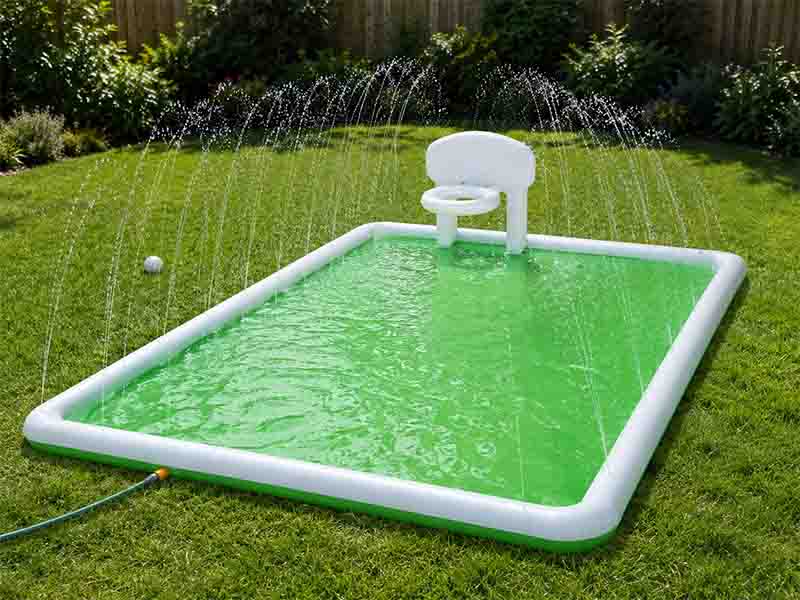
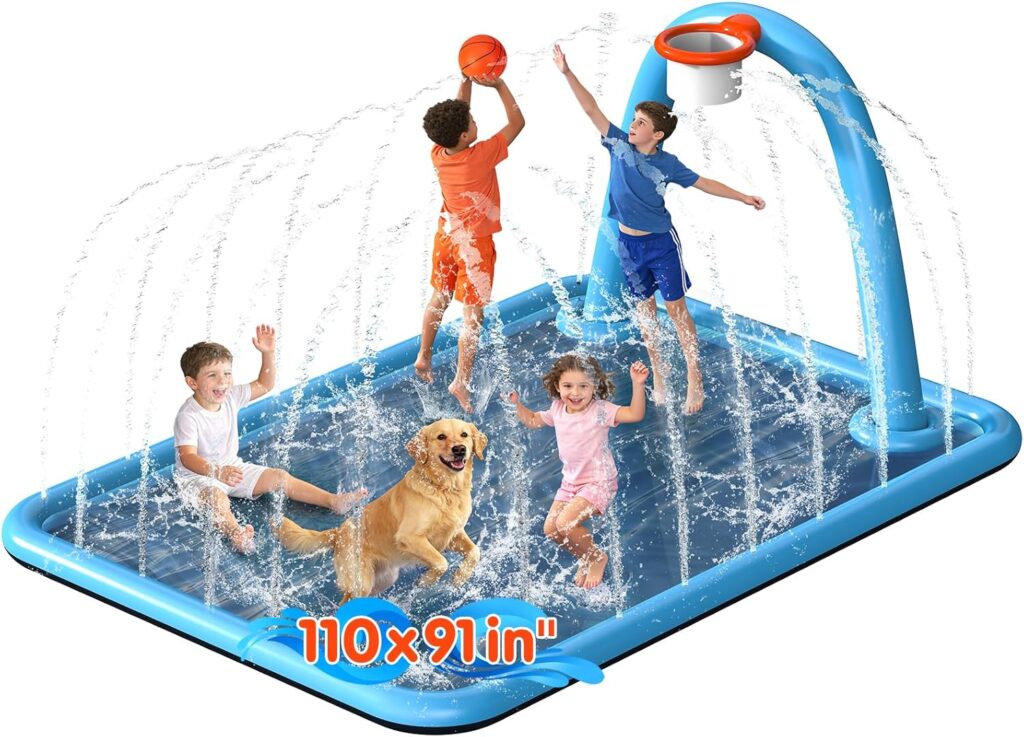
A splash pad with basketball hoop can turn a normal backyard into a small summer play court. Kids get water, movement, and a simple goal to aim for. Parents get a water toy that does not require filling a deep pool or setting up a large inflatable structure every afternoon. It sounds easy, but the right choice depends on more than the hoop design. Size, PVC thickness, spray direction, water pressure, surface feel, and storage all affect how often the family will actually use it.
A good splash pad with basketball hoop should give children enough open space to move, a stable hoop for light shooting games, inward water spray for better cooling, and a PVC base strong enough for repeated outdoor use. For many homes, a 60–70 inch mat works for one or two toddlers, while an 80–90 inch or larger design is better for siblings and active backyard play.
The difference becomes clear after a few uses. A weak splash pad may look fun on day one, then start to feel frustrating when the hoop leans, spray becomes uneven, or cleanup takes too long. A better-designed basketball splash pad becomes part of the summer routine: connect the hose, adjust the spray, let kids play for 20–30 minutes, drain it, dry it, and fold it away for the next hot day.
What Is a Basketball Splash Pad?
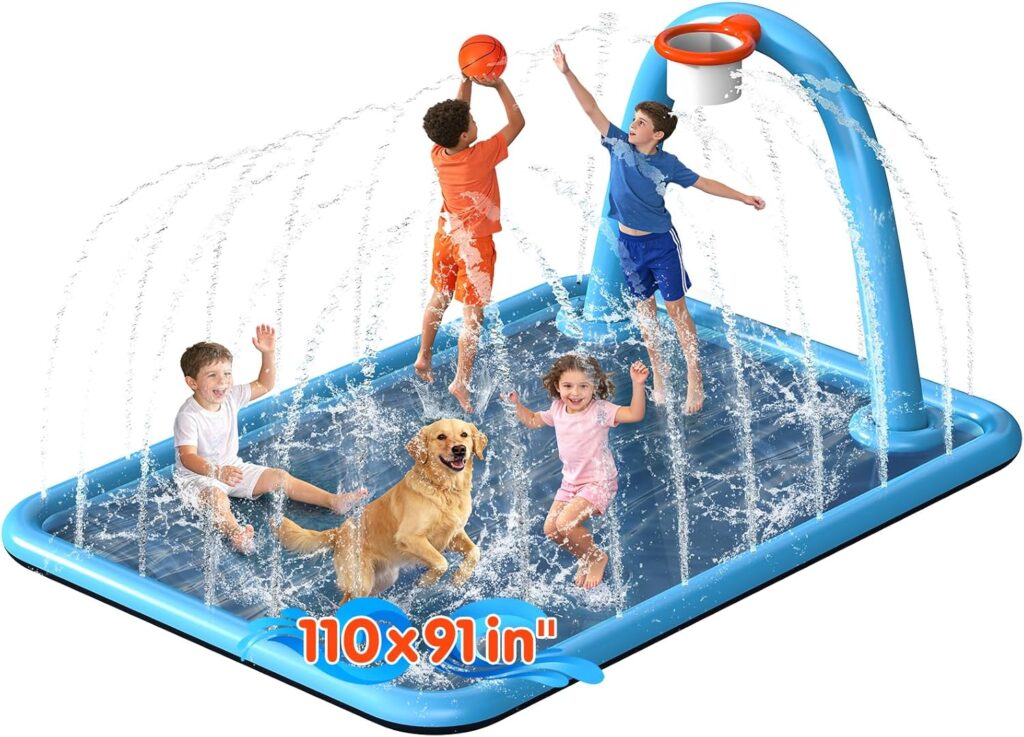
A basketball splash pad is a shallow outdoor water play mat with a built-in or attached hoop for shooting games. It connects to a garden hose, sprays water through the edge, and gives kids a cool play space where they can splash, move, aim, and take turns. Compared with a regular splash pad, it adds a clear activity that can keep children engaged longer.

How It Works
A basketball splash pad usually works with a standard garden hose. Once the hose is connected and the faucet is turned on, water fills the edge channel of the mat. As pressure builds, water sprays through small holes around the border. Better designs direct the water inward, so the spray lands closer to the center play area instead of shooting too far across the lawn.
The hoop is usually inflatable or supported by a soft structure. Children can stand inside the splash area and toss a lightweight ball into the basket. The setup is simple, but the play pattern is more active than a plain sprinkler mat. Kids can splash, shoot, retrieve the ball, and try again.
For family use, the whole layout should feel connected:
- The hoop should stay upright during light shooting.
- The spray should reach the play area without hitting too harshly.
- The center should stay open enough for children to move.
- The hose connection should not leak heavily or pull the mat out of shape.
- The PVC base should stay flat enough for safe standing and turning.
| Feature | Why It Matters |
|---|---|
| Inward spray | Keeps water closer to the play area |
| Stable hoop | Reduces interruptions during play |
| Open center space | Gives kids room to stand and move |
| Soft PVC surface | Feels more comfortable under wet feet |
| Reinforced edge | Helps manage water pressure |
| Easy hose connection | Makes setup faster for parents |
EPN develops basketball splash pads with the full use routine in mind: water entry, edge pressure, spray direction, hoop placement, children’s movement, and storage after play. These details decide whether the mat feels easy enough to use several times a week.
Why Kids Like It
Kids enjoy basketball splash pads because the hoop gives water play a purpose. A regular sprinkler mat cools them down, but the play can become repetitive. A hoop gives them something to aim at. That small goal changes the rhythm of play.
A child can run through the spray, pick up the ball, toss it toward the basket, laugh when it misses, and try again. Siblings can take turns. Parents can create simple games without needing extra equipment.
It works especially well for:
- Children who get bored with plain sprinklers quickly
- Siblings who need a shared backyard activity
- Families that want more movement than sitting in a pool
- Short summer play sessions before dinner
- Backyard parties where kids need a simple water station
- Children who like ball games but still want to cool off
| Family Situation | How It Helps |
|---|---|
| One child at home | Creates a simple solo water game |
| Siblings | Encourages turn-taking and shared play |
| Backyard parties | Works as an easy activity station |
| Hot afternoons | Helps kids cool down while staying active |
| Short play sessions | Works well for 20–30 minutes of play |
| Small family yards | Gives water fun without filling a deep pool |
The hoop also supports basic coordination. Kids practice aiming, tossing, bending, reaching, and moving through water. It should not be treated as formal sports training, but it does help make outdoor play more active and less passive.
Splash Pad vs Pool
A basketball splash pad is different from a pool. It is designed for shallow water play, movement, and cooling. A pool is better for sitting, soaking, or floating. A basketball splash pad is better when the goal is quick setup, active play, and easier storage.
For many families, the choice comes down to daily convenience. Filling a pool can take time and water. Cleaning and deflating it can also feel like a chore. A splash pad connects to a hose, sprays while in use, then drains quickly after play.
| Comparison Point | Basketball Splash Pad | Inflatable Pool |
|---|---|---|
| Main use | Splashing, shooting, moving | Sitting, soaking, floating |
| Water depth | Very shallow | Deeper |
| Setup time | Usually faster | Usually longer |
| Water use | Easier to control for short sessions | Higher when filled |
| Storage | Folds more compactly | Bulkier after deflation |
| Best age fit | Toddlers to young kids | Depends on depth and size |
| Play energy | More active | More relaxed |
| Adult supervision | Always required | Always required |
A basketball splash pad can also feel less intimidating for children who are not comfortable in deeper water. They still get summer water play, but they remain on a shallow surface. Parents still need close supervision because wet surfaces can be slippery, but the overall setup is lighter than many pool options.
Families comparing backyard water toys may also find it helpful to read more about how to choose a splash pad that lasts more than one summer, especially when durability and repeated use matter.
What Size Works Best?
The best size for a splash pad with basketball hoop depends on child age, number of players, yard space, and how much open center area remains after the spray edge and hoop base are included. For one or two toddlers, a 60–70 inch round pad can be enough. For siblings or active shooting games, 80–90 inches or a larger rectangular design usually feels more comfortable.
Toddler Play Size
For toddlers, the right splash pad should feel open, gentle, and easy to understand. A very large mat may look exciting, but it is not always more useful for young children. Toddlers usually need a simple play space where they can stand, sit briefly, reach for the ball, and move without feeling surrounded by too much spray.
A round basketball splash pad around 60–70 inches often works well for one or two toddlers under close adult supervision. This size is usually easier to place on grass, easier to control with low water pressure, and easier for one adult to drain after play. It also gives parents a clear view of the whole mat.
The most important measurement is not only the outer diameter. The real play zone is smaller once the water channel, edge ring, and hoop base are included.
For toddler use, check these points before choosing a size:
- Can the child stand and turn without stepping on the edge ring?
- Is the hoop low enough for close-range tossing?
- Can the spray be kept low and gentle?
- Can one adult move, drain, and dry the mat easily?
- Is there enough clean ground around the mat?
| Toddler Size Factor | Recommended Choice |
|---|---|
| Outer size | Around 60–70 inches |
| Number of children | 1–2 toddlers |
| Spray height | Low to medium-low |
| Hoop height | Easy for close-range tossing |
| Best surface | Clean grass or smooth patio mat |
| Setup weight | Easy for one adult to handle |
| Play time | Short sessions of 15–30 minutes |
For toddlers, comfort matters more than maximum size. A smaller splash pad that is easy to control may be used more often than a large one that takes longer to place, drain, and dry.

Sibling Play Space
When two or more children play together, size becomes more important. A basketball splash pad is not a still water mat. Kids step forward to shoot, bend down to pick up the ball, turn around, and move around each other. If the mat is too small, children crowd near the hoop and the game feels less comfortable.
For siblings, an 80–90 inch splash pad usually gives a better balance between play space and convenience. It allows children to take turns without standing too close together. It also gives more distance between the hoop and the spray edge.
A rectangular basketball splash pad can work especially well because it creates a clearer direction of play. The hoop can sit near one side, while children shoot from the center or opposite side. That layout feels more like a small backyard game area.
| Number of Children | Better Size Choice | Why It Works |
|---|---|---|
| 1 toddler | 60–70 inch round pad | Simple and easy to manage |
| 2 toddlers | 67–75 inch round pad | Enough space for light play |
| 2 young kids | 75–87 inch round pad | More room for turns |
| 2–3 active kids | 87 inch or larger pad | Better movement around hoop |
| 3+ kids | Large rectangular design | Clearer shooting direction |
| Backyard party | Oversized open-center design | Reduces crowding |
For families with siblings, the best splash pad is often the one that leaves enough empty center space. A colorful border and large hoop may look attractive, but if they take away too much play room, the product may feel smaller than expected.
Yard Space Check
Before choosing a size, parents should measure the real outdoor area. A splash pad may fit on paper, but kids need space around it. The hose must reach without pulling. Adults need room to walk near the mat. Water needs somewhere safe to drain.
A useful rule is to leave at least 2–3 feet of clear space around the splash pad when possible. This buffer helps keep kids away from fences, patio furniture, grills, planters, garden tools, steps, and hard corners.
| Yard Factor | What to Check Before Setup |
|---|---|
| Clear area | Product size plus 2–3 feet around it |
| Hose reach | Hose connects without stretching |
| Ground condition | Flat, clean, and free from sharp debris |
| Drainage direction | Water flows away from doors and steps |
| Sun exposure | Shade nearby for longer play sessions |
| Adult view | Clear line of sight from seating area |
| Nearby objects | No grills, tools, sharp furniture, or hard corners |
| Storage path | Easy to carry away after draining |
Grass is usually the most forgiving surface because it feels softer and drains better. Still, the lawn should be checked before each use. Small rocks, sticks, pinecones, thorns, or sharp mulch can press into the PVC from below. For more surface-specific guidance, see can you use a splash pad on grass.
The right size is not always the largest size available. It is the size that fits the yard, gives children enough movement space, and still allows parents to drain, dry, and store the product without extra work.
Which Material Feels Better?
The best material for a splash pad with basketball hoop should feel soft enough for barefoot play, strong enough for repeated outdoor use, and stable enough to hold water pressure around the edge. PVC is commonly used because it is flexible, waterproof, foldable, and suitable for summer water toys. For family use, the better choice is a balanced material with good flexibility, low odor, reinforced seams, and a comfortable wet surface.
Thicker PVC Base
PVC thickness matters because it affects comfort, durability, and ground resistance. Many splash pad designs use PVC in the 0.35 mm to 0.50 mm range, depending on size, structure, and use scenario. A thicker base can feel more solid underfoot and may better handle grass friction, light dragging, folding, and active movement.
Still, thickness is not the only quality signal. If PVC is too thin, the mat may feel flimsy. If it is too stiff, it may be harder to fold and less comfortable for children. A good basketball splash pad needs both strength and flexibility.
A basketball design creates more movement than a plain splash mat. Kids are not only standing in water. They step forward, turn, bend, shoot, and retrieve the ball. The base needs to handle wet feet, light twisting, and repeated contact with outdoor surfaces.
| PVC Factor | Better Choice | Why It Matters |
|---|---|---|
| Thickness range | Around 0.35–0.50 mm for many water play mats | Balances strength and flexibility |
| Flexibility | Soft enough to fold without hard creases | Helps with storage and comfort |
| Bottom durability | Resistant to light outdoor friction | Useful for grass and patio use |
| Low odor | Better first-use experience | More comfortable for family play |
| UV stability | Handles normal summer sun exposure better | Supports repeated outdoor use |
| Edge support | Works with reinforced seams | Helps manage water pressure |
EPN uses PVC and composite material matching based on product type and use scene. For children’s water play, the focus is usually on low odor, flexible feel, sunlight stability, and repeat-use performance. Customers comparing PVC options can also read what material is best for a splash pad for a deeper look at material choices.

Softer Play Surface
A basketball splash pad should feel comfortable when children stand, step, kneel, or sit briefly on it. Because the surface is always wet during use, comfort and grip both matter. The best surface should feel smooth enough for bare feet but not so slick that children lose balance easily.
No wet water toy surface should be treated as completely slip-proof. Water, sunscreen, grass, and fast movement can all increase slipping risk. Surface feel should work together with simple play rules: no hard running, no pushing, no jumping onto the hoop, and close adult supervision.
A good play surface should support daily family routines:
- Comfortable under wet feet
- Easy to rinse after use
- Not overly glossy when wet
- Not rough on knees or hands
- Flat enough for light movement
- Simple to dry before folding
| Surface Detail | Customer Concern | Better Design Direction |
|---|---|---|
| Wet feel | Will kids slip easily? | Smooth but stable surface |
| Barefoot comfort | Will it feel rough? | Soft PVC touch |
| Cleaning | Will dirt stick? | Easy-rinse surface |
| Heat | Will it feel hot? | Use with water flow and shaded breaks |
| Movement | Can kids shoot and turn? | Open center with fewer raised parts |
| Safety | Can children run freely? | Supervised play with simple rules |
Water shoes can help, especially on patios or when children are very active. They protect feet from hot ground around the splash pad and provide better traction when stepping in and out of the wet area.
Stronger Edge Seams
The edge seam is one of the most important parts of a splash pad with basketball hoop. It holds the water channel, controls spray performance, and takes pressure every time the hose is turned on. If the edge seam is weak, leaks may appear near the spray ring, the hose inlet, or the folded corners after repeated use.
A basketball splash pad places extra stress on the edge because play is more active. Children may step near the border, pull slightly on the mat while moving, or chase the ball toward the hoop area. The edge has to stay stable while water pressure builds inside it.
Families can make the edge last longer by using the product correctly:
- Start with low water pressure and increase slowly.
- Do not use maximum pressure if the edge bulges too much.
- Place the mat on flat ground.
- Do not drag the filled splash pad.
- Keep the hose relaxed, not stretched.
- Dry the edge fully before folding.
- Avoid folding sharply through the same seam line every time.
| Edge Detail | What to Look For | Why It Matters |
|---|---|---|
| Wider welded seam | Clean, even edge bonding | Helps manage water pressure |
| Reinforced inlet | Stronger hose connection area | Reduces leak risk near water entry |
| Balanced spray holes | Even spacing around border | Supports smoother spray |
| Stable edge shape | No heavy bulging at medium pressure | Better play comfort |
| Smooth seam surface | No rough or peeling areas | Safer for children’s feet |
| Fold tolerance | Edge does not crack easily | Better seasonal storage |
EPN focuses on edge stability, water distribution, and inlet reliability when developing splash pads. The goal is not only to prevent early leaks, but also to keep spray performance consistent after repeated use. Families who have dealt with edge leaks may find why some splash pads leak easily useful before comparing products.
How Stable Is the Hoop?
The hoop should stay upright during normal shooting, light contact, and repeated play. A stable splash pad with basketball hoop depends on hoop base width, air pressure, attachment position, ball weight, and how much open space children have around the basket. The best hoop is not the tallest one. It is the one that feels soft, balanced, easy to inflate, and suitable for the child’s age.
Upright Hoop Design
The hoop is the main reason families choose a basketball splash pad instead of a regular sprinkler mat. If the hoop keeps falling, leaning, or folding into the play area, the product quickly loses its value. Children may still enjoy the water, but the basketball feature becomes frustrating.
A stable hoop should stand upright after inflation and stay balanced during normal play. It does not need to handle hard basketball shots like a real outdoor court. It needs to handle light tosses, close-range shooting, and children retrieving the ball around the basket.
| Hoop Design Detail | Better Choice | Why It Matters |
|---|---|---|
| Base width | Wide enough to support the hoop | Reduces leaning during play |
| Hoop height | Low to medium height for young kids | Makes shooting easier and safer |
| Hoop material | Soft inflatable or cushioned structure | Reduces hard contact risk |
| Hoop position | Near one side or edge area | Leaves more open center space |
| Basket opening | Easy for lightweight balls | Keeps the game fun for kids |
| Connection point | Stable and not twisting the mat | Helps the whole splash pad stay flat |
The base should be wide enough to support the hoop without taking over the play area. If the hoop base is too narrow, the basket may lean forward after a few shots. If it is too bulky, it may take too much space from the center.
Easy Hoop Inflation
Hoop inflation affects stability more than many families expect. If the hoop is underinflated, it may bend, lean, or collapse when the ball touches it. If it is overinflated, the seams may feel too tight, especially under summer heat.
A practical rule is simple: inflate the hoop until it stands upright and holds its shape, then stop before it feels hard or stretched. The hoop should not look wrinkled or weak, but it also should not feel like it is under high tension. On hot days, air inside inflatable parts may expand. Leaving a little softness can help reduce stress on the material.
| Inflation Check | Good Condition | Problem Sign |
|---|---|---|
| Hoop shape | Upright and balanced | Leaning or folding |
| Surface feel | Firm but slightly soft | Rock-hard or overstretched |
| Valve | Fully closed and easy to reach | Slow air loss or hard to seal |
| Base shape | Stable and flat | Twisted or lifting the mat |
| Heat response | Still slightly flexible in sun | Feels overly tight |
| Deflation | Air releases without force | Hard to fold or trapped air remains |
Parents should avoid folding the hoop while it is still inflated. Releasing air first protects the valve area and reduces sharp crease stress.

Safe Shooting Distance
The shooting area should give children enough room to aim, toss, retrieve the ball, and step back without bumping into each other. A basketball splash pad is shallow, but the surface is wet, so play distance still matters.
For toddlers, the shooting distance should be short. They should be able to stand close to the hoop and make a basket without throwing hard. For children around 4–8 years old, a little more distance can make the game more exciting.
Parents can set simple rules before play begins:
- One child shoots at a time.
- Use a lightweight ball only.
- No hard throws at another child.
- No climbing or hanging on the hoop.
- No jumping onto the hoop base.
- Walk instead of running across the wet mat.
- Step off the mat carefully when leaving.
| Child Age | Shooting Style | Hoop Stability Need |
|---|---|---|
| 2–3 years | Close tossing with help | Low hoop, soft structure |
| 3–5 years | Short-range basket play | Stable base and open center |
| 5–7 years | Turn-taking games | Better hoop support |
| 7+ years | More active shooting | Larger mat and stronger layout |
| Mixed ages | Simple shared rules | Clear space around basket |
The goal is not competitive basketball. It is safe, active water play. A hoop that supports light shooting and steady turn-taking is better than a tall hoop that looks exciting but tips easily.
Ball Weight Matters
The ball can affect hoop stability. A basketball splash pad should be used with a lightweight inflatable or soft plastic ball. A heavy ball may knock the hoop forward, stress the attachment area, or make play less safe for younger children.
| Ball Type | Better for Hoop Stability? | Notes |
|---|---|---|
| Lightweight inflatable ball | Yes | Best for most splash pad hoops |
| Soft foam-style ball | Often yes | Good for younger children if water-safe |
| Small hard ball | Not ideal | May hit too forcefully |
| Regular basketball | Not recommended | Too heavy for many inflatable hoops |
| Oversized ball | Not ideal | Harder for young kids to control |
A stable hoop is not only about the hoop itself. It also depends on using the right ball and keeping play age-appropriate.
How Good Is the Spray?
The spray quality of a splash pad with basketball hoop depends on water direction, spray hole layout, hose pressure, edge structure, and connector stability. A good design should create an even inward spray around the play area, not a few harsh jets in random directions. For most families, medium water pressure gives the best balance between fun, comfort, safety, and water control.
Inward Water Spray
Inward spray is one of the most important features to look for in a splash pad with basketball hoop. When the water sprays inward from the outer edge, it creates a cooling play zone around the center of the mat. Children can stand, shoot, move, and retrieve the ball while staying inside the water area.
Outward spray may look big in pictures, but it is often less practical in a real backyard. It can wet patio chairs, nearby walkways, garden areas, or dry lawn space without improving the play experience.
| Spray Direction | Play Experience | Practical Result |
|---|---|---|
| Inward spray | Keeps kids inside the cooling zone | Better water control |
| Vertical spray | Creates height but may feel strong | Works better at lower pressure |
| Outward spray | Looks wide but wastes more water | Can wet surrounding areas |
| Uneven spray | One side feels stronger than another | May need pressure or surface adjustment |
| Low spray | Gentle for toddlers | Good for first-time water play |
| Medium spray | Best for most family use | Balanced fun and control |
For EPN basketball splash pads, inward spray is treated as part of the full play layout. The hoop, open center space, and spray ring should work together so the product feels like a complete backyard game area.
Adjustable Spray Height
Spray height is usually controlled by water pressure from the garden hose. A higher faucet flow creates taller spray, while a lower flow creates gentler spray. This simple adjustment is useful because children of different ages respond differently to water height.
Toddlers often prefer low spray. Children around 4–8 years old may enjoy medium spray because it feels more exciting while still staying comfortable. Older children may like higher spray, but only if the edge remains stable and the spray does not become too forceful.
| Spray Height | Best For | Parent Check |
|---|---|---|
| 6–12 inches | Toddlers or first use | Gentle, less intimidating |
| 12–24 inches | Daily family play | Comfortable and visible |
| 24–36 inches | Older kids on hot days | Check edge stability |
| Over 36 inches | Use carefully | May waste water or feel too strong |
| Uneven height | Needs adjustment | Check hose, ground, and pressure |
Parents should increase water slowly during the first setup. Start low, let the edge fill, then raise the faucet flow little by little. This helps the spray become even and gives children time to adjust.
Better Hose Connection
The hose connection is a small part, but it has a large effect on spray quality. If the connector leaks, twists, or does not seal well, water pressure may drop before it reaches the spray ring. That can lead to weak spray, uneven water flow, or water pooling near the inlet.
| Hose Issue | What It May Cause | Practical Fix |
|---|---|---|
| Loose connector | Dripping or pressure loss | Reconnect and tighten gently |
| Twisted hose | Uneven spray | Straighten hose before use |
| Hose pulled tight | Stress near inlet | Use a longer hose |
| Bent hose | Low spray height | Remove sharp bends |
| Dirty connector | Weak flow | Rinse before attaching |
| High faucet pressure | Edge bulging | Lower water flow |
The hose should rest naturally on the ground. If it is stretched tightly from the faucet to the splash pad, it may pull on the inlet area and create stress. If the hose bends sharply near the connector, water flow may become weaker.
Water Use and Backyard Control
Many families also care about water use. A splash pad with basketball hoop uses running water, so play time and spray height both affect total water use. The product should feel fun without requiring excessive flow.
Short sessions often work well. A 20–30 minute play period can be enough for children to cool down, shoot baskets, and enjoy outdoor movement. Families can turn off the water during breaks, then restart when play continues.
| Water Control Tip | Why It Helps |
|---|---|
| Use medium pressure | Balances fun and water use |
| Keep sessions around 20–30 minutes | Good for daily play |
| Turn off water during breaks | Reduces waste |
| Place on grass when possible | Better drainage |
| Move the mat between uses | Helps protect lawn areas |
| Use lower spray on patios | Reduces slippery surroundings |
| Drain away from doors | Prevents water problems near the house |
A good basketball splash pad should make water feel controlled. It should cool the play area, support the hoop game, and keep cleanup manageable.
Is It Easy to Store?
A splash pad with basketball hoop should be easy to drain, dry, deflate, fold, and store after play. The easiest designs have a shallow water surface, a soft inflatable hoop, a flexible PVC base, and a structure that does not trap too much water around the edge or hoop area. For most families, proper drying matters more than fast folding.
Fast Drain Design
A basketball splash pad should not feel difficult to clean up after every play session. Since it is designed for shallow water play, draining should be simple: turn off the faucet, disconnect the hose, let the water flow away, and gently lift one side of the mat if needed.
The hoop can affect drainage. If the hoop base is too bulky or the mat has too many raised sections, water may collect around the basket area. A better design allows water to move across the surface without creating deep pockets.
| Step | What to Do | Why It Helps |
|---|---|---|
| 1 | Turn off the faucet first | Reduces water pressure in the edge |
| 2 | Disconnect the hose gently | Protects the inlet area |
| 3 | Let surface water run off | Makes lifting easier |
| 4 | Lift one side slowly | Guides water away without dragging |
| 5 | Rinse dirt or grass | Keeps the surface cleaner |
| 6 | Wipe around the hoop base | Removes trapped water |
| 7 | Move to a drying area | Prevents the bottom from staying wet |
The mat should not be dragged while full of water. A water-filled splash pad is heavier than it looks, and dragging can stress the bottom layer, edge seams, and hose connection.
Dry Before Folding
Drying is the most important step before storage. Folding a wet splash pad may save a few minutes at first, but it can create problems later. Moisture trapped between PVC layers may cause odor, sticking, mildew marks, or surface discoloration, especially if the mat is stored in a warm garage or closed storage bin.
After draining, leave the splash pad flat in a clean area. The top surface may dry quickly, but the bottom can stay wet longer because it was pressed against grass, concrete, or patio tiles. Flip the mat once so both sides can dry.
| Drying Area | What to Check |
|---|---|
| Top surface | No visible water film |
| Bottom surface | No wet grass marks or damp patches |
| Hoop base | No trapped water around seams |
| Hose connector | Dry before folding inward |
| Edge ring | Wipe along the spray channel |
| Fold lines | Avoid trapping moisture inside folds |
| Storage bag or box | Must also be dry |
For more care details, families can also read how to store a splash pad, especially before end-of-season storage.
Hoop Deflation
The basketball hoop needs its own storage care. If the hoop is inflatable, it should be deflated before the splash pad is folded. Folding the mat while the hoop is still full of air can stress the valve, bend the hoop shape, and create hard creases around the base.
A good hoop storage routine:
- Deflate the hoop fully before folding.
- Do not twist the hoop base.
- Keep the valve clean and dry.
- Avoid folding directly across the valve.
- Do not place heavy items on top of the hoop area.
- Store the ball with the splash pad so it does not get lost.
| Hoop Storage Issue | Possible Result | Better Practice |
|---|---|---|
| Folded while inflated | Hard creases and valve stress | Deflate first |
| Valve left wet | Odor or dirt buildup | Wipe dry |
| Sharp fold across hoop base | Shape distortion | Fold loosely |
| Heavy box placed on top | Pressure marks | Store on top shelf or in bin |
| Ball stored separately | Missing accessory next season | Keep parts together |
The hoop is what makes the splash pad special, so protecting its shape matters. A stable hoop next summer starts with careful deflation today.

Off-Season Storage
When summer ends, the splash pad should be cleaned more carefully before long-term storage. Small amounts of dirt, grass, sunscreen, or moisture may not seem like a big problem after one play session, but they can become unpleasant after several months in a closed space.
| Off-Season Storage Point | Best Practice |
|---|---|
| Cleaning | Rinse dirt, grass, and sunscreen residue |
| Drying | Fully dry both sides before folding |
| Hoop | Deflate gently and avoid sharp creases |
| Folding | Loose folds, not tight compression |
| Temperature | Cool, dry storage area |
| Sunlight | No long-term direct UV exposure |
| Weight | Do not stack heavy items on top |
| Accessories | Store ball, adapter, patch, and instructions together |
At the start of the next season, inspect the splash pad before full play. Check the hose connection, edge seams, hoop, valve, and spray holes. A quick pre-season check helps avoid surprises when children are ready to play.
Why Choose EPN?
EPN, under American Epsilon Inc., develops PVC and composite outdoor products for family recreation, children’s water play, pet use, and seasonal sports. For a splash pad with basketball hoop, EPN focuses on material quality, spray structure, hoop usability, seam strength, packaging, and real outdoor use.
EPN Product Focus
A basketball splash pad should not be designed only for shelf appeal. It needs to handle real backyard behavior: children stepping on it, water pressure changing, sunlight exposure, folding after play, and repeated summer setup.
EPN’s product development is built around these conditions. The company works with a 27-person R&D team covering polymer materials, product structure, molds, children’s entertainment, pet behavior, sports use, and ergonomic needs. More than 18 designers support product design, packaging design, graphics, and multilingual localization.
Each year, the team completes more than 500 material and product performance tests and over 1,500 new product design projects.
| Product Area | EPN Focus |
|---|---|
| PVC base | Flexible, durable, low-odor material |
| Edge structure | Wider seams and pressure stability |
| Spray design | Inward spray and balanced distribution |
| Hoop design | Soft, upright, easy-to-inflate structure |
| Hose area | Reliable water entry and connection support |
| Surface feel | Comfortable play surface |
| Storage | Drain, dry, fold, and reuse |
EPN’s goal is to make products that fit real family routines, not only first-use excitement.
Testing and Durability
Outdoor water toys face several types of stress. Sunlight can age materials. Water pressure can stress seams. Children’s movement can create friction. Folding and storage can create creases. A product that seems fine on day one may perform differently after repeated use.
Epsilon conducts testing that is closer to real use. This can include pressure and leak checks, long water-flow stability testing, sunlight exposure, high-temperature aging, folding and use simulations, and material performance checks.
| Test Area | What It Helps Evaluate |
|---|---|
| Water pressure stability | Whether spray stays balanced |
| Leak resistance | Whether seams and inlet hold properly |
| UV exposure | How material responds to sunlight |
| Folding simulation | How PVC handles repeated storage |
| Surface wear | How the base handles outdoor friction |
| High-temperature aging | How material performs in hot conditions |
| Spray distribution | Whether water flows evenly |
This type of testing helps improve reliability. Families want a splash pad that can handle more than one afternoon. Retail and private-label customers need products that can perform through a summer sales season with fewer quality complaints.
Custom Project Support
Epsilon also supports OEM and ODM projects for retailers, distributors, Amazon sellers, and private-label brands. For a splash pad with basketball hoop, customization may include size, color, shape, pattern, hoop style, packaging, instructions, labels, and market-specific requirements.
Available support can include:
- Product size adjustment
- PVC thickness matching by use scene
- Spray hole layout adjustment
- Hoop shape and color design
- Graphic pattern development
- Retail box design
- Multilingual instruction manuals
- Barcode and shipping label support
- Low-MOQ trial orders
- Small-batch testing before larger production
Regular projects can often move from sample to production efficiently. Sample development may take around 3–5 days for suitable projects. Regular mass production commonly takes about 20–30 days. Urgent projects may ship in about 14 days when conditions match, depending on product complexity, packaging, order size, and production schedule.
Ready to Order or Customize?
Choosing a splash pad with basketball hoop is not only about color, shape, or price. The details that matter most are size, material, hoop stability, water spray, hose connection, drainage, and storage. When those parts work together, the product becomes easy for families to use again and again.
For families, an EPN basketball splash pad can turn a backyard into a summer play area without the setup work of a large pool. Children get water, movement, and a simple game in one product. Parents get a lighter option that can be drained, dried, folded, and stored after use.
For retailers, distributors, Amazon sellers, and private-label brands, Epsilon can support both ready-to-order EPN branded products and custom splash pad projects. The company can help with product structure, PVC material matching, size planning, hoop design, spray layout, packaging, instructions, and local market adaptation.
If you are looking for a splash pad with basketball hoop for family use, seasonal retail programs, cross-border e-commerce, or private-label development, Epsilon can help turn the product idea into a practical outdoor water play solution.
Contact Epsilon to explore EPN basketball splash pads, request current product options, or discuss a custom summer water play project for your market.