Skip to content
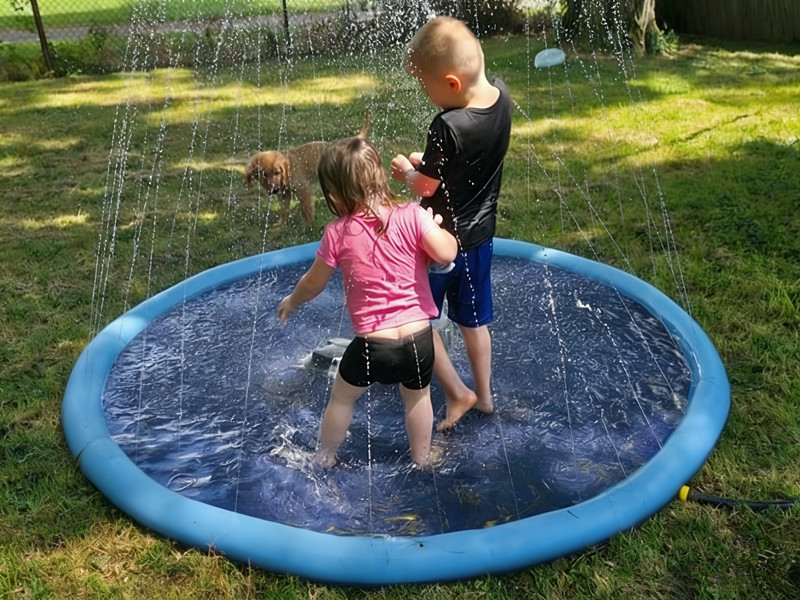
A splash pad should be one of the easiest ways to turn an ordinary backyard into a fun summer play area. You connect a hose, turn on the faucet, and within seconds kids can run through cool spray while pets jump in and out of the water. That is the expectation. The frustration starts when the water barely lifts off the surface, only one side sprays properly, or the whole pad feels more like a damp mat than a real water toy. At that point, many families assume the splash pad is faulty. In most cases, it is not.
Low water pressure on splash pads is usually caused by a few simple issues: low faucet pressure, long or narrow hoses, reduced flow rate, splitters or timers that restrict water, clogged spray holes, or small leaks that quietly bleed pressure away. Most residential splash pads work best at about 30–50 PSI, with enough water flow to keep the outer ring evenly filled. When those conditions are in place, spray becomes higher, more even, and much more enjoyable.
A very common real-life example is surprisingly simple: a large splash pad connected to a 100-foot, 1/2-inch hose through a splitter often sprays weakly, while the same pad connected directly to a 25-foot, 5/8-inch hose can look almost like a different product. That kind of change is why understanding the water path matters so much. Once you know where pressure is being lost, fixing the problem becomes much easier.
What Causes Low Water Pressure on Splash Pads?
Low water pressure on splash pads is usually caused by supply-side restrictions rather than a defect in the splash pad itself. In most home setups, weak spray comes from low faucet PSI, hose friction loss, low water flow, splitters, worn washers, clogged spray holes, or competing water use inside the house. The fastest way to improve performance is to identify where water pressure is being reduced before it reaches the spray ring.
A splash pad works in a very simple way: household water enters the perimeter ring, pressure builds inside that ring, and water exits through the spray holes. If pressure or flow is lost anywhere along that path, the spray gets weaker. That is why two families using the same splash pad model can have completely different results. One may get strong, playful arcs of water. Another may get flat, uneven spray. The difference is usually not the pad. It is the setup.
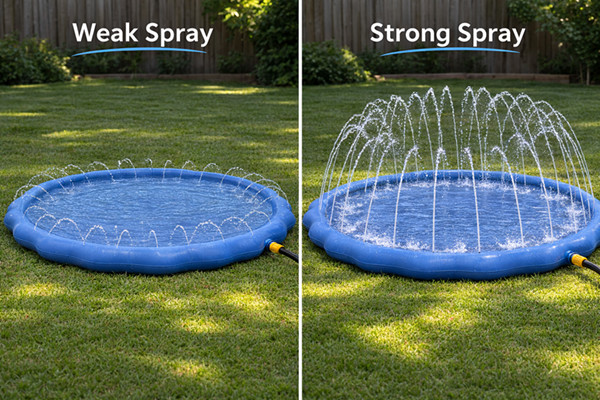
What Is the Most Common Cause of Low Water Pressure?
The most common cause of low water pressure on splash pads is an inefficient hose setup. That includes hoses that are too long, too narrow, or attached through splitters, timers, or adapters that reduce flow. Many users focus only on faucet strength, but the bigger loss often happens after the water leaves the faucet.
A splash pad may start with acceptable faucet pressure, then lose a large share of that pressure before the water even reaches the product. The most common reasons are easy to overlook because they are part of normal backyard use: a spare splitter left on the faucet, a long hose stretched across the yard, or a low-cost connector with a narrow internal opening.
In practical terms, the “most common cause” is usually not one dramatic problem. It is one small restriction layered on top of another. A hose loses pressure. A splitter reduces flow. A washer leaks slightly. Then the splash pad receives less water than it needs, and the spray becomes weak.
The table below shows how common pressure-loss factors affect backyard splash pad performance.
| Common Cause | Typical Impact on Spray | Likelihood in Home Setups |
|---|---|---|
| Long or narrow hose | High | Very common |
| Splitter or timer attached | Medium to high | Very common |
| Faucet PSI below 30 | High | Common |
| Low flow rate | High | Common |
| Small leak at connection | Medium | Common |
| Clogged spray holes | Medium | Common in hard water areas |
| Uneven surface placement | Low to medium | Common |
This is why a direct faucet test matters so much. If the splash pad performs better when connected directly with a short hose and no accessories, the problem is already pointing to the setup rather than the product.
Is Your Faucet Water Pressure Too Low?
Outdoor faucet pressure is the first place most people should check, especially if the spray is weak even with a direct hose connection. In the United States, many residential systems operate within a range of about 40–60 PSI. That range is generally suitable for backyard splash pads. But not every home falls into that range. Older plumbing systems, rural water sources, and houses fitted with pressure-reducing valves can all deliver much lower pressure outdoors.
When faucet pressure drops below about 30 PSI, splash pad spray height usually falls enough for users to notice. Water may still come out, but it will often look flat, low, or uneven. On larger pads, low PSI is more obvious because the water has to travel farther around the perimeter before exiting through the holes.
Here is a simple reference for how outdoor faucet PSI affects splash pad performance.
| Faucet Pressure | What You Usually See |
|---|---|
| 40–60 PSI | Strong, even spray across most pads |
| 30–40 PSI | Usable spray, but lower height on larger pads |
| 25–30 PSI | Noticeably weak arcs, uneven distribution possible |
| Below 25 PSI | Very low spray, often only mist or surface-level spray |
There is also a size effect. A small splash pad may still feel acceptable at around 30 PSI, while a large 11–13 foot pad may feel underpowered at the same pressure. This is because larger pads require more internal pressure stability and more water volume to keep the whole ring evenly charged.
If a family complains that the splash pad “works, but not like the photos,” low faucet PSI is often part of the reason. A simple hose bib pressure gauge can answer this question in minutes and prevent unnecessary returns or frustration.
Do Hoses Reduce Water Pressure on Splash Pads?
Yes, and in many cases they reduce it more than people expect. Every hose creates resistance as water travels through it. That resistance is called friction loss. The longer the hose, the greater the loss. The smaller the diameter, the greater the loss. This is why hose choice can completely change how a splash pad performs.
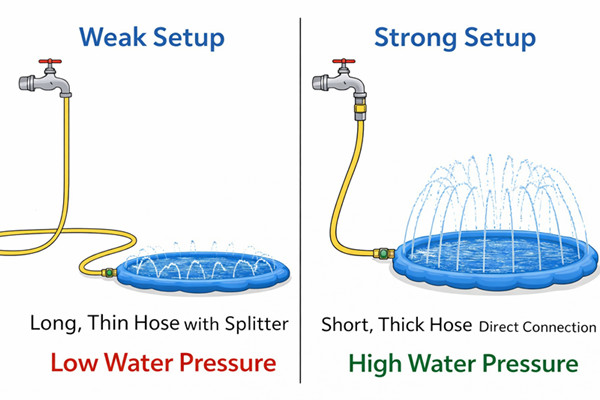
A 25-foot 5/8-inch hose usually preserves pressure well enough for most splash pads. A 100-foot 1/2-inch hose, by contrast, can reduce effective pressure enough to turn strong spray into weak spray. This becomes even more important when the splash pad is large or has many spray holes.
The table below gives a practical comparison.
| Hose Setup | Estimated Pressure Loss | Likely Effect on Splash Pad |
|---|---|---|
| 25 ft, 5/8-inch | 2–4 PSI | Strong performance if faucet pressure is decent |
| 50 ft, 5/8-inch | 5–8 PSI | Usually acceptable for small to medium pads |
| 75 ft, 1/2-inch | 8–15 PSI | Noticeably weaker spray |
| 100 ft, 1/2-inch | 10–20+ PSI | Often weak spray and uneven water output |
For example, if the faucet supplies 45 PSI and the hose setup loses 12 PSI, the splash pad may only receive 33 PSI. That may still work, but the spray height will be lower and more sensitive to any additional restrictions. Add a splitter or a partially clogged hole, and performance can drop quickly.
This is one of the easiest places to improve results. Changing the hose often costs less than replacing the splash pad, and the result is immediate. For many households, the best setup is simple: a direct faucet connection, no splitter, and a 5/8-inch hose under 50 feet.
Can Leaks or Splitters Cause Low Water Pressure?
Yes. Small leaks and accessories are responsible for many weak-spray complaints. They may look minor, but splash pads depend on stable pressure. Any component that reduces water volume or allows pressure to escape makes spray less consistent.
Splitters are especially common. Many families leave a splitter attached because it is convenient for switching between watering tools, pet pools, sprinklers, and splash pads. The problem is that even when only one side is in use, the splitter itself may have a narrower internal opening than the faucet. That creates a bottleneck. Timers and quick-connect adapters can do the same thing.
The same applies to small leaks. A loose hose fitting, flattened washer, or cracked connector may only drip a little, but pressure loss is cumulative. If the splash pad already has borderline pressure, even a small leak can be enough to make spray noticeably lower.
Common leak and restriction points include:
| Component | Typical Problem | Effect on Performance |
|---|---|---|
| Splitter | Narrow internal opening | Reduced flow and spray height |
| Timer | Flow restriction | Lower pressure reaching pad |
| Quick connector | Poor internal diameter or seal | Reduced flow, possible leaks |
| Worn washer | Dripping at connection | Pressure loss |
| Loose threads | Air and water leakage | Unstable spray |
For customers troubleshooting weak spray, one of the best diagnostic steps is to remove everything and test the splash pad with the simplest possible setup: faucet → hose → splash pad. If the spray improves, the issue is not mysterious. It is somewhere in the accessories.
Can Clogged Spray Holes Reduce Splash Pad Pressure?
Clogged spray holes do not reduce faucet pressure, but they do reduce effective spray performance. In a splash pad, the small perimeter holes control how water exits the ring. If some of those holes are narrowed by mineral buildup or debris, the spray becomes uneven. Some jets may spray normally while others barely rise.
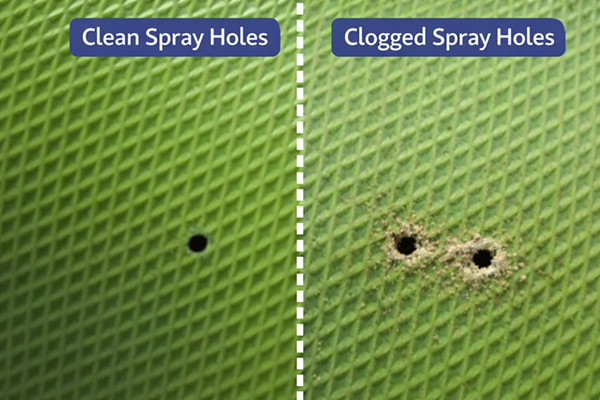
This is especially common in areas with hard water. Over time, calcium and mineral residue collect around the spray openings. Even a small narrowing changes how the water exits. The effect becomes more noticeable as the product ages or if it is left outside and used frequently during summer.
Typical signs of clogged spray holes include:
- One section of the pad sprays higher than another
- The spray pattern looks uneven or distorted
- Performance declines slowly over weeks or months rather than all at once
This type of problem can be confusing because the splash pad may still receive normal pressure and flow from the hose. The issue is not in the supply. It is at the exit points.
Regular maintenance helps. A gentle flush with clean water, along with careful clearing of the holes using a non-metal tool or soft pick, can restore much of the original spray pattern. For many families, this is one of the easiest and cheapest fixes, especially if the splash pad worked well at first and only gradually became weaker.
What Other Factors Can Lower Splash Pad Pressure?
Not every pressure problem comes from hoses or fittings. A few less obvious factors can also affect splash pad spray.
One is shared household water demand. If someone is showering, a washing machine is running, or lawn irrigation is active, outdoor faucet pressure may drop temporarily. The splash pad then receives less pressure and less flow, even though nothing in the setup has changed.
Another factor is ground placement. If the splash pad sits on a slope, water may collect unevenly around the ring, which can affect spray appearance. This is not always a true pressure problem, but it looks like one to the user because one side sprays better than the other.
There is also the issue of pressure-reducing valves in the home plumbing system. Some homes are intentionally set to lower PSI to protect indoor pipes and fixtures. That can help plumbing longevity, but it may also reduce outdoor splash pad performance if the system is set too low.
Finally, distance and elevation can matter in borderline cases. If the splash pad is far from the main source or significantly above it, some pressure loss may occur before the water reaches the hose outlet.
All of these issues reinforce the same point: weak splash pad spray is usually fixable, but only if the setup is examined as a whole rather than assuming the product is at fault.
How Much Water Pressure Do Splash Pads Need?
Most splash pads perform best at about 30–50 PSI, with enough flow to match the size of the pad. Smaller splash pads can often work reasonably well at 25–35 PSI, while larger splash pads usually need pressure closer to 40–50 PSI and stronger flow to maintain even spray across the full perimeter.
The right pressure is not the highest possible pressure. It is the pressure that produces even, comfortable, stable spray without overstressing seams or materials.
Pressure is only one half of the equation. Flow rate matters just as much. A splash pad needs enough water volume to keep the ring filled while water exits through all of the spray holes. This is why some homes show “good PSI” on a gauge but still get weak spray in real use.
What PSI Is Best for a Splash Pad?
For most residential splash pads, the ideal operating range is 30–50 PSI. Within that range, spray is usually high enough to feel fun and refreshing without becoming uncomfortably forceful. Below that range, spray often looks weak. Above that range, spray height may increase, but seam stress also increases.
A simple rule of thumb works well for most users:
| PSI Range | Performance Result |
|---|---|
| Under 25 PSI | Too weak for most splash pads |
| 25–30 PSI | Works for small pads, weak for large pads |
| 30–40 PSI | Good for most home setups |
| 40–50 PSI | Best overall range |
| 50–60 PSI | Strong spray, but should be monitored |
| Above 60 PSI | Not ideal for long-term use |
Families often assume stronger is always better, but that is not really how splash pads work. The best user experience comes from a balanced spray pattern around the whole perimeter, not from pushing one side of the pad to the highest possible arc.
For children and pets, comfort matters too. Spray that is too forceful can feel harsh, especially on younger children. In practical backyard use, the 35–50 PSI range is often the sweet spot.
Does Splash Pad Size Affect Water Pressure?
Yes. Splash pad size changes how much pressure and water flow the product needs. A larger pad has a longer perimeter ring and more spray holes. That means more water must travel farther while still maintaining even output. If pressure or flow is only borderline, the problem becomes much more visible on large pads than on small ones.
The table below shows a practical size guide.
| Splash Pad Size | Recommended PSI | Recommended Flow Rate | Typical Spray Result |
|---|---|---|---|
| 5–7 ft | 25–40 PSI | 3–5 GPM | Light to moderate spray |
| 8–10 ft | 30–45 PSI | 5–7 GPM | Moderate to strong spray |
| 11–13 ft | 40–50 PSI | 7–10 GPM | Strong, even perimeter spray |
A customer with a small splash pad may be satisfied at 30 PSI because the ring is short and easier to fill. A customer with a 13-foot soccer splash pad may find the same 30 PSI disappointing because the far side of the ring does not stay fully pressurized.
This is also why some reviews seem inconsistent. One person says the splash pad sprays great, another says it feels weak, and both may be telling the truth. They may simply be using different sizes under different water conditions.
Is Household Water Pressure Enough for Splash Pads?
In many homes, yes. Standard municipal water systems often provide enough pressure for splash pads, especially if the hose setup is efficient. But “household water pressure” is not always the same as “usable splash pad pressure.”
What matters is the pressure and flow that actually reach the splash pad after losses from plumbing, hose length, connectors, and simultaneous water use.
Most homes fall into one of these rough categories:
| Home Water Situation | Likely Splash Pad Performance |
|---|---|
| 40–60 PSI, short hose, direct connection | Usually very good |
| 35–45 PSI, medium hose, no splitter | Usually acceptable |
| 30–35 PSI, long hose, splitter attached | Often weak |
| Under 30 PSI | Usually poor without optimization |
The good news is that many homes that seem to have “bad water pressure” actually just have inefficient setup. Improving hose diameter, shortening hose length, and removing splitters can make a major difference without touching the plumbing.
Do Splash Pads Filter Water?
Most home splash pads do not filter or recirculate water. They are direct-flow products. Water comes from the hose, moves through the ring, sprays outward, and drains away. That means the splash pad depends completely on your faucet pressure and water flow.
This is different from commercial splash pads in parks, which often use pumps, underground plumbing, and filtration systems. Home splash pads are much simpler, which makes them easy to use but also means they cannot compensate for poor household water supply.
That direct-flow design has a few advantages:
- Easy setup
- No pump required
- No filter maintenance
- Fresh water entering continuously
But it also means there is no hidden system inside the product boosting performance. If household water pressure is weak, the splash pad will reflect that immediately. Understanding this helps customers troubleshoot more realistically and choose a setup that gives the product the best chance to perform well.
Why Do Pressure and Flow Need to Work Together?
Pressure gets most of the attention, but flow is just as important. Pressure determines how strongly water exits the holes. Flow determines whether there is enough water volume to keep the ring evenly supplied while that spraying continues.
This is why two homes with similar PSI readings can still produce different results. If one home has stronger flow, the splash pad will usually perform better.
A larger splash pad with many spray holes may need solid flow even if the PSI reading looks acceptable. Without enough volume, one side of the ring may stay stronger than the other, creating uneven spray. This is often why users notice strong jets near the hose inlet and weaker jets farther away.
For customers, the practical takeaway is simple: do not judge splash pad performance by PSI alone. A good setup requires both decent pressure and enough water volume to match the pad size.
How Do You Test Water Pressure for a Splash Pad?
Testing water pressure for a splash pad is straightforward and can usually be done in less than ten minutes. Most homeowners only need two simple tools: a hose pressure gauge and a standard bucket. Measuring both pressure and water flow gives a complete picture of whether your water system can support a splash pad properly. Many performance issues become obvious once these two numbers are known.
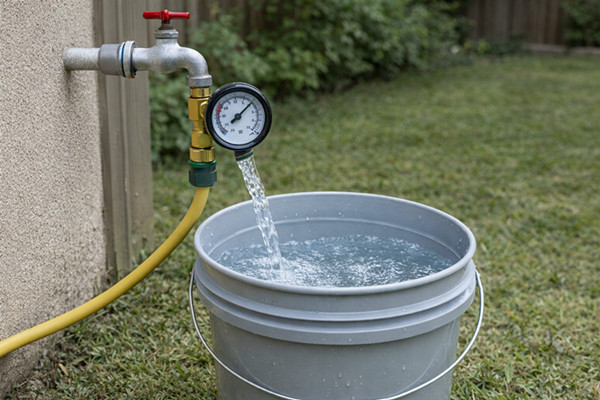
When people skip this step, they often misdiagnose the problem. A splash pad that appears weak may actually be receiving adequate pressure but insufficient flow. In other cases, the faucet may produce strong pressure, but hose restrictions reduce what reaches the splash pad. Testing helps identify exactly where the limitation occurs.
How Do You Measure Faucet Water Pressure?
Water pressure at an outdoor faucet is measured using a hose pressure gauge, sometimes called a hose bib gauge. This inexpensive tool connects directly to the faucet and provides a quick reading of PSI.
First, make sure no other water fixtures are running inside or outside the house. This ensures the measurement reflects the maximum available pressure. Next, remove any hose, splitter, or timer from the faucet and attach the gauge directly to the spigot. Turn the faucet fully on and read the PSI value displayed on the dial.
Typical results look like this:
| PSI Reading | Interpretation for Splash Pads |
|---|---|
| 45–60 PSI | Excellent pressure for most splash pads |
| 35–45 PSI | Good pressure, usually adequate |
| 30–35 PSI | Borderline, performance depends on hose setup |
| Below 30 PSI | Likely to produce weak spray |
If the reading is within the 40–50 PSI range, the faucet itself is probably not the problem. Attention should then shift to hose configuration, connectors, or flow rate. If the reading is below 30 PSI, the home’s plumbing system may be limiting pressure, and adjustments to hose setup alone may only partially improve performance.
Another useful step is measuring pressure with the hose attached. If the gauge reading drops significantly after connecting the hose, friction loss within the hose is the cause.
How Do You Test Water Flow with a Bucket?
Water flow rate is measured in gallons per minute. Flow determines how much water volume the splash pad receives while spraying. Even if pressure is strong, low flow can lead to uneven spray patterns because the splash pad ring cannot remain fully supplied with water.
A simple bucket test can estimate flow rate without specialized equipment. Start by placing a standard five-gallon bucket under the outdoor faucet. Turn the faucet fully on and use a stopwatch or phone timer to measure how long it takes to fill the bucket completely.
The following table provides a quick interpretation of results:
| Fill Time for 5 Gallons | Approximate Flow Rate | Suitability for Splash Pads |
|---|---|---|
| 30 seconds | 10 GPM | Excellent for large splash pads |
| 45 seconds | ~6.7 GPM | Good for medium splash pads |
| 60 seconds | 5 GPM | Acceptable for small to medium pads |
| 75 seconds | ~4 GPM | Borderline performance |
| Over 90 seconds | Under 3.5 GPM | Likely weak spray |
Most splash pads between eight and ten feet require at least five gallons per minute for consistent spray. Larger splash pads may perform better with seven to ten gallons per minute.
If the bucket fills slowly, the splash pad may struggle to maintain strong spray across all holes. Improving hose diameter or removing restrictions can sometimes increase effective flow.
What Spray Patterns Show Low Water Pressure?
Observing the spray pattern itself can reveal valuable clues about pressure and flow problems. A well-functioning splash pad produces evenly spaced arcs of water around the entire perimeter. The arcs usually rise to similar heights and maintain steady flow without pulsing.
When pressure or flow is insufficient, the spray pattern changes noticeably. Some of the most common visual signs include uneven arcs, weak spray on one side of the pad, or intermittent bursts of water.
The table below summarizes common spray symptoms and their likely causes.
| Spray Pattern | Likely Cause |
|---|---|
| Strong spray near hose connection, weak opposite side | Low flow rate or internal pressure drop |
| Entire pad sprays low and weak | Low faucet pressure |
| Spray pulses on and off | Flow instability or air entering connection |
| Some jets strong, others weak | Clogged spray holes |
| Spray improves when other water fixtures stop | Shared household water demand |
These patterns help narrow down the problem quickly. For example, if the spray is strongest near the hose inlet, the splash pad is receiving enough pressure initially but losing it as water travels around the ring. That often indicates insufficient flow or excessive hose friction.
How Do Hose Setup and Accessories Affect Pressure Tests?
Testing pressure with and without hose accessories often reveals hidden restrictions. Many outdoor faucets are connected to multiple tools through splitters, timers, or quick-connect fittings. Each additional component narrows the water path slightly and may reduce flow.
For accurate testing, begin with the simplest configuration possible: faucet connected directly to the gauge or hose. Once the baseline pressure and flow are known, accessories can be reattached one at a time to observe their impact.
Consider the following comparison.
| Configuration | Pressure Effect |
|---|---|
| Direct faucet connection | Full pressure available |
| Faucet + hose | Small pressure drop |
| Faucet + splitter + hose | Moderate pressure reduction |
| Faucet + splitter + timer + hose | Significant pressure reduction |
In many cases, users discover that removing just one splitter or timer improves splash pad performance noticeably. Testing makes these hidden restrictions visible and prevents unnecessary troubleshooting elsewhere.
Quick Diagnosis Table
If you want to identify the issue quickly before making changes, use this simple guide.
| What You See | Most Likely Cause | What to Check First |
|---|---|---|
| Spray is weak everywhere | Low faucet PSI | Test faucet pressure |
| Strong near inlet, weak far side | Low flow or hose loss | Test GPM and hose length |
| Some holes spray, some do not | Mineral buildup | Clean spray holes |
| Spray gets weaker when other fixtures run | Shared demand | Test with other water off |
| Spray improves without splitter | Accessory restriction | Remove splitter or timer |
This kind of fast diagnosis helps customers make practical fixes without guessing.
How Do You Fix Low Water Pressure on Splash Pads?
Once the cause of low water pressure is identified, improving splash pad performance usually requires only a few practical adjustments. Most fixes involve improving how water travels from the faucet to the splash pad rather than modifying the splash pad itself.
The goal is to preserve as much of the faucet’s original pressure and flow as possible while minimizing restrictions along the path.
Is It Possible to Fix Low Water Pressure?
In most residential setups, low water pressure affecting a splash pad can be improved significantly. Only a small percentage of cases are caused by plumbing systems that genuinely cannot deliver enough pressure. More often, the issue comes from the way water is delivered to the splash pad.
Typical improvements include replacing narrow hoses, shortening hose length, tightening connectors, and removing accessories that restrict water flow. Even minor changes can increase effective pressure by several PSI, which may be enough to transform weak spray into strong arcs.
Another common improvement involves addressing small leaks. A worn rubber washer inside a hose connector may appear harmless, but that small leak represents pressure escaping before the water reaches the splash pad. Replacing the washer often restores stable spray.
How to Fix Low Water Pressure for Sprinklers?
Many of the solutions used to fix low pressure for lawn sprinklers also apply directly to splash pads. Both systems rely on hose pressure and water flow rather than mechanical pumps.
Some of the most effective improvements include:
- Using a shorter garden hose
- Switching from a 1/2-inch hose to a 5/8-inch hose
- Removing hose splitters and timers
- Cleaning blocked nozzles or spray holes
- Checking and tightening all connections
For example, replacing a 100-foot hose with a 50-foot hose can reduce pressure loss dramatically. When the diameter also increases from 1/2 inch to 5/8 inch, the improvement becomes even greater. These changes often restore several PSI of pressure and significantly increase spray height.
Which Hose Setup Improves Splash Pad Pressure?
The hose configuration used with a splash pad has a major impact on its performance. An efficient setup allows water to travel with minimal resistance, preserving the faucet’s original pressure.
An effective splash pad hose setup typically includes the following characteristics:
| Hose Feature | Recommended Setup |
|---|---|
| Hose length | Under 50 feet |
| Hose diameter | 5/8 inch |
| Connection | Direct faucet connection |
| Accessories | None if possible |
When the hose path is simple and direct, water reaches the splash pad quickly and with minimal pressure loss. This allows the perimeter ring to fill evenly and produce balanced spray.
Conversely, a long hose combined with splitters, timers, or narrow connectors often creates several small pressure losses that accumulate into a noticeable reduction in spray performance.
Do You Need a Booster Pump for Water Pressure?
Most homes do not need a booster pump to run a splash pad. Booster pumps are typically used only when the entire household water system has low pressure, such as in certain rural well systems.
If faucet pressure measures below 25 PSI even with no hose attached, a booster pump may help increase overall household pressure. However, this solution should be considered carefully because excessively high pressure can damage hoses or splash pad seams.
For most users, optimizing hose setup and eliminating restrictions is enough to improve performance. Booster pumps are usually unnecessary once these adjustments are made.
Another point to consider is safety. Splash pads are designed for comfortable water play, especially for children and pets. Increasing pressure far beyond recommended levels may create forceful jets that are less comfortable and could reduce the lifespan of the product.
Maintaining pressure within the typical residential range of 30–50 PSI provides the best balance between spray height, comfort, and durability.
What Fixes Usually Work Fastest?
If you want the fastest improvement with the least effort, start with the fixes below in this order:
| Fix | Why It Works | Typical Result |
|---|---|---|
| Remove splitter or timer | Eliminates restriction | Better flow and spray height |
| Switch to 5/8-inch hose | Reduces friction loss | Stronger, more stable spray |
| Shorten hose length | Preserves pressure | Higher arcs |
| Tighten fittings and replace washers | Stops pressure leaks | More consistent spray |
| Clean spray holes | Restores even outlet flow | Balanced spray pattern |
These changes solve a large percentage of weak-spray complaints without any need for plumbing work.
Why Do Some Splash Pads Have Better Water Pressure?
Two splash pads connected to the same faucet can produce very different spray results. One may create high, even arcs of water, while the other produces weak or uneven spray. The difference often comes from the product’s engineering rather than the water supply. Design structure, material stability, spray hole layout, and manufacturing precision all influence how efficiently a splash pad converts household water pressure into consistent spray.
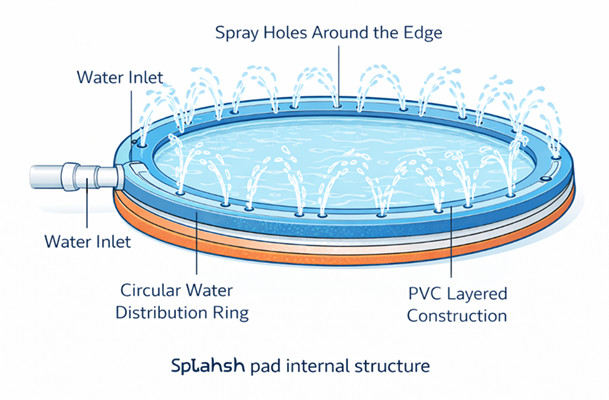
A well-designed splash pad distributes incoming water evenly through the perimeter ring so that each spray hole receives similar pressure. If the internal structure or materials are poorly optimized, pressure may drop as water moves around the ring, producing weaker jets farther from the hose connection. Understanding these design factors helps explain why certain splash pads perform better and maintain stable spray over time.
How Does Splash Pad Design Affect Water Pressure?
Inside every splash pad is a circular distribution channel that carries water from the hose inlet around the outer edge. The geometry of this channel determines how evenly pressure is maintained. If the channel narrows, bends sharply, or has inconsistent weld compression, water encounters resistance as it travels around the perimeter. That resistance lowers pressure on the far side of the splash pad and creates uneven spray.
High-quality splash pads are engineered so the internal channel maintains a consistent width and depth around the entire ring. This allows water to circulate smoothly before exiting through the spray holes. Balanced channel design ensures that each section of the splash pad receives similar water pressure.
In large splash pads, the perimeter can exceed thirty feet in total length. Over that distance, even minor internal restrictions can cause noticeable pressure drop. Careful design minimizes these losses and maintains stable distribution. The result is a more uniform spray pattern that looks visually balanced and feels more enjoyable for users.
Another design factor is the inlet orientation. A well-aligned inlet allows water to enter the channel smoothly. If the connection angle forces water to turn sharply immediately after entering, turbulence can reduce effective pressure. Engineers typically position the inlet to allow gradual directional flow into the perimeter ring.
Does PVC Thickness Affect Splash Pad Pressure?
Material thickness plays an important role in maintaining stable water pressure. Splash pads are usually made from PVC or composite PVC materials. When water fills the outer ring, internal pressure pushes outward against the walls. If the material is too thin or overly flexible, the ring may expand slightly. When that happens, part of the water pressure is lost before it reaches the spray holes at full force.
Many durable splash pads use reinforced PVC in the range of 0.45–0.55 millimeters thickness. This thickness provides a good balance between flexibility and structural stability. The ring maintains its shape under pressure, allowing water to exit the spray holes at consistent velocity.
Material quality also influences long-term performance. Over repeated use, thin materials can gradually stretch or soften under sunlight and heat. When that happens, the internal channel may become less stable, leading to reduced spray height. Reinforced PVC with UV-resistant additives helps prevent this degradation.
The table below summarizes how material characteristics affect performance.
| Material Property | Effect on Spray Performance |
|---|---|
| Thin PVC | May expand under pressure, reducing spray force |
| Reinforced PVC | Maintains channel shape and stable pressure |
| UV-resistant formulation | Preserves flexibility and durability |
| Multi-layer composite material | Improves structural stability |
For customers choosing a splash pad, material thickness is often one of the clearest indicators of durability and consistent performance.
How Do Spray Holes Control Splash Pad Water Pressure?
The spray holes around the perimeter determine how water exits the splash pad. Their diameter, spacing, and angle all influence the final spray pattern. If holes are too large, water exits too quickly and pressure inside the ring drops rapidly. If holes are too small, flow becomes restricted and spray height may decrease.
Manufacturers typically calibrate hole diameters carefully so that the total opening area balances the incoming water supply. Even small differences in diameter can affect spray height. A variation of only a few tenths of a millimeter can change the velocity of the water jet.
Spacing also matters. Evenly distributed holes create a uniform circular spray pattern. When spacing is inconsistent, some areas may release more water than others, causing pressure imbalances.
Angle control is another important detail. Slightly angled holes allow water jets to arc inward toward the center of the pad, creating the familiar circular spray effect. If the angle is too steep or inconsistent, jets may spray outward or remain too low.
Together, hole diameter, spacing, and angle determine how efficiently water pressure is converted into visible spray.
Why Do Well-Made Splash Pads Spray Better?
High-quality splash pads combine several engineering elements that work together to maintain strong and consistent spray. These include reinforced materials, balanced internal channels, precision welding, and carefully calibrated spray holes. When these factors are optimized, water pressure remains stable across the entire perimeter.
Manufacturers often perform testing during development to confirm performance. Typical evaluations include pressure retention testing, leak detection, and spray distribution analysis. These tests simulate real backyard conditions and help ensure the product performs reliably.
| Engineering Factor | Contribution to Spray Quality |
|---|---|
| Balanced water channels | Even pressure distribution |
| Reinforced PVC material | Structural stability |
| Precision welding | Airtight seams and consistent channel width |
| Calibrated spray holes | Uniform spray pattern |
| Quality testing | Reliable real-world performance |
Customers often notice the difference immediately. A well-engineered splash pad produces evenly spaced arcs of water that remain stable even as children run through the spray. Poorly designed products may spray unevenly or lose pressure after a short time.
Bringing Everything Together
Splash pad performance depends on a combination of water supply conditions and product engineering. Strong faucet pressure alone does not guarantee strong spray. Efficient hose setup, adequate flow rate, stable internal design, durable materials, and clean spray holes all contribute to the final result.
When homeowners experience weak spray, the cause is usually one of several practical issues:
- Restricted hoses
- Low flow
- Splitters or timers
- Small leaks
- Clogged spray holes
- Uneven setup conditions
Once these problems are corrected, the splash pad can usually perform as intended.
The most useful way to think about splash pad pressure is this: the product can only work with the pressure and flow it actually receives. That is why setup matters so much, and that is why design quality matters just as much once the setup is correct.
Choosing a Splash Pad That Performs Better
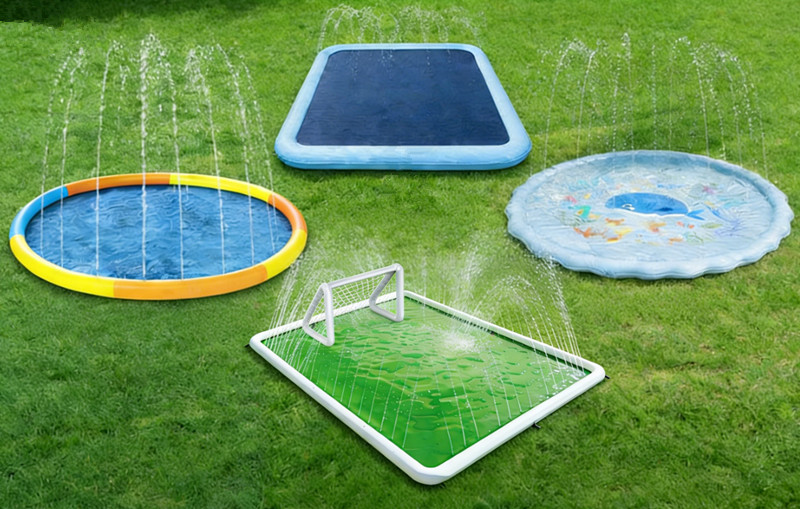
Families who enjoy backyard water play usually want the same things: easy setup, reliable spray, durable materials, and a product that still performs well after repeated summer use. Splash pads made from reinforced PVC with balanced spray channels generally perform better because they maintain more stable pressure across the entire perimeter.
When choosing a splash pad, it helps to look for:
- Reinforced PVC construction
- Even spray-hole layout
- Stable welded seams
- Clear hose connection design
- Structures that support balanced perimeter flow
These details matter even more for larger splash pads, where even distribution is harder to maintain.
If you are ready to choose a splash pad designed for everyday backyard use, the following products may be a good place to start.
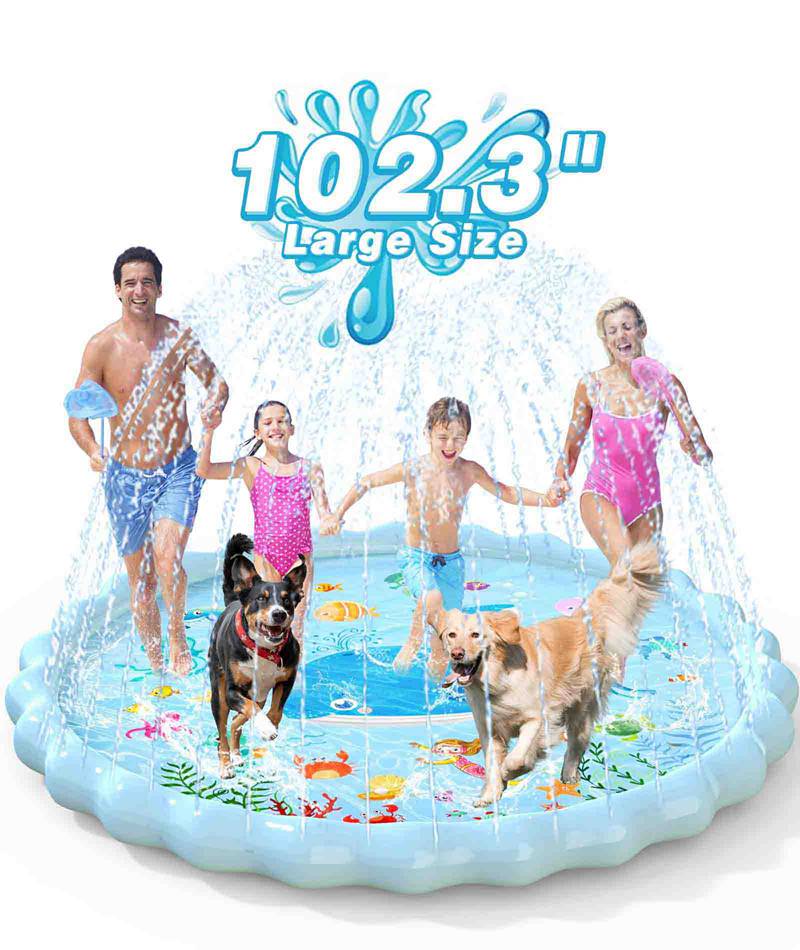
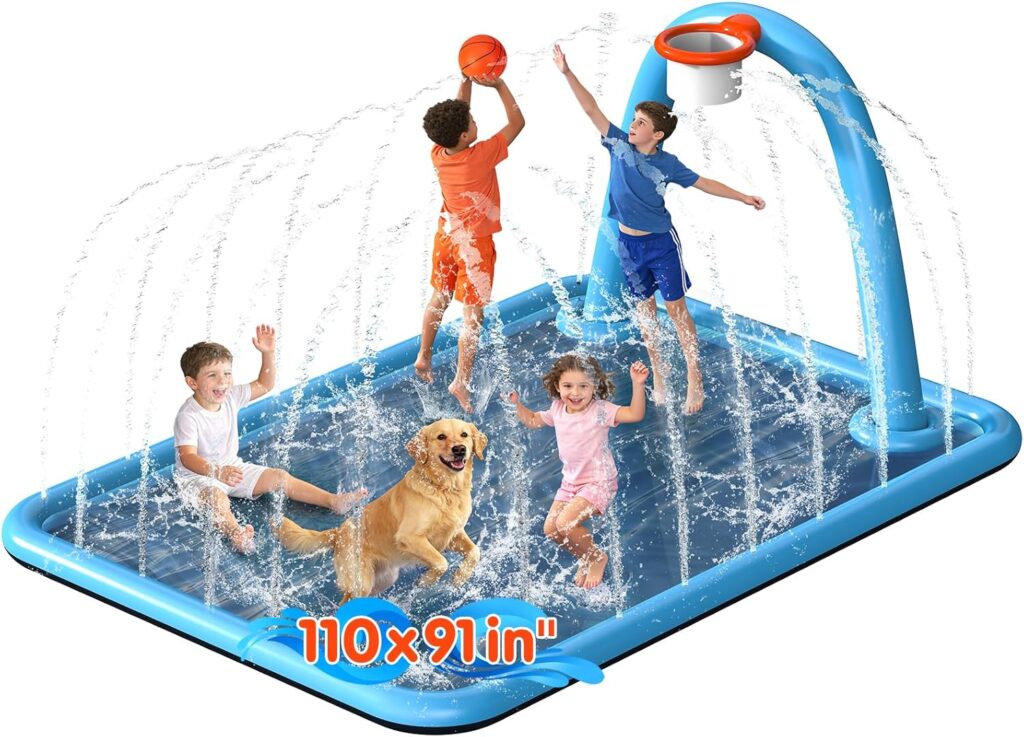
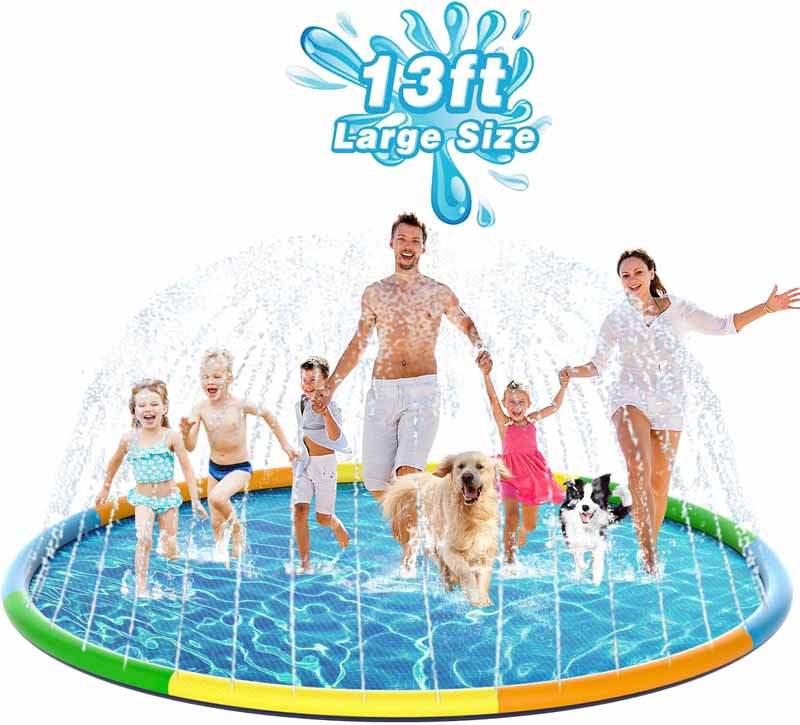
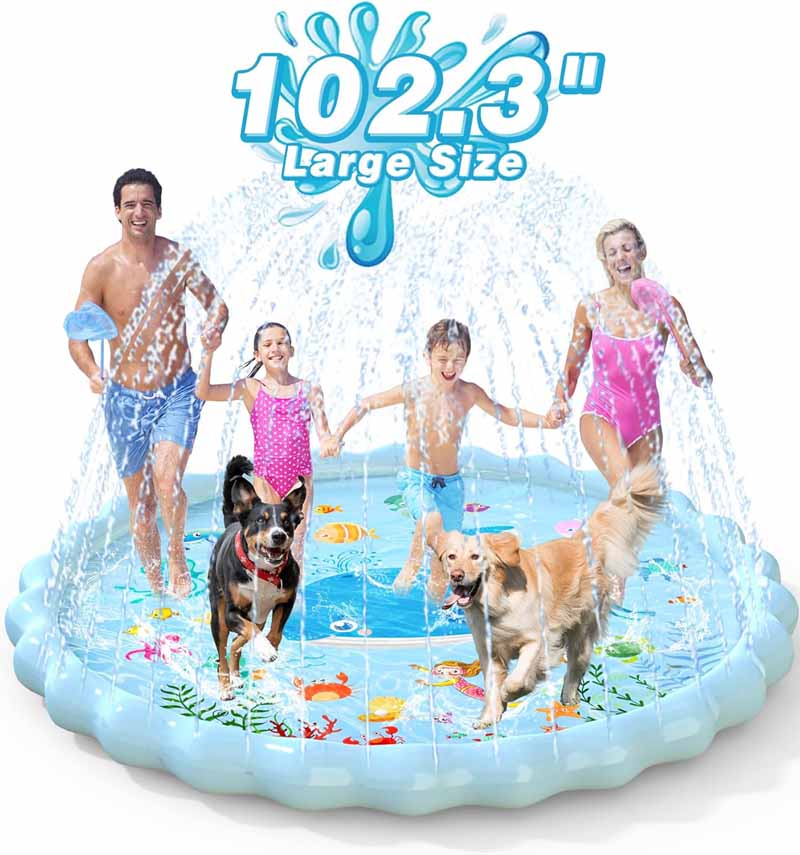
Splash Pads for Kids and Family Play
A good everyday choice for family backyards. This type of splash pad is best suited for households with stable residential water pressure and a simple direct-hose setup.
A square layout can work especially well for compact backyard spaces, patios, and more structured play areas where even edge coverage matters.
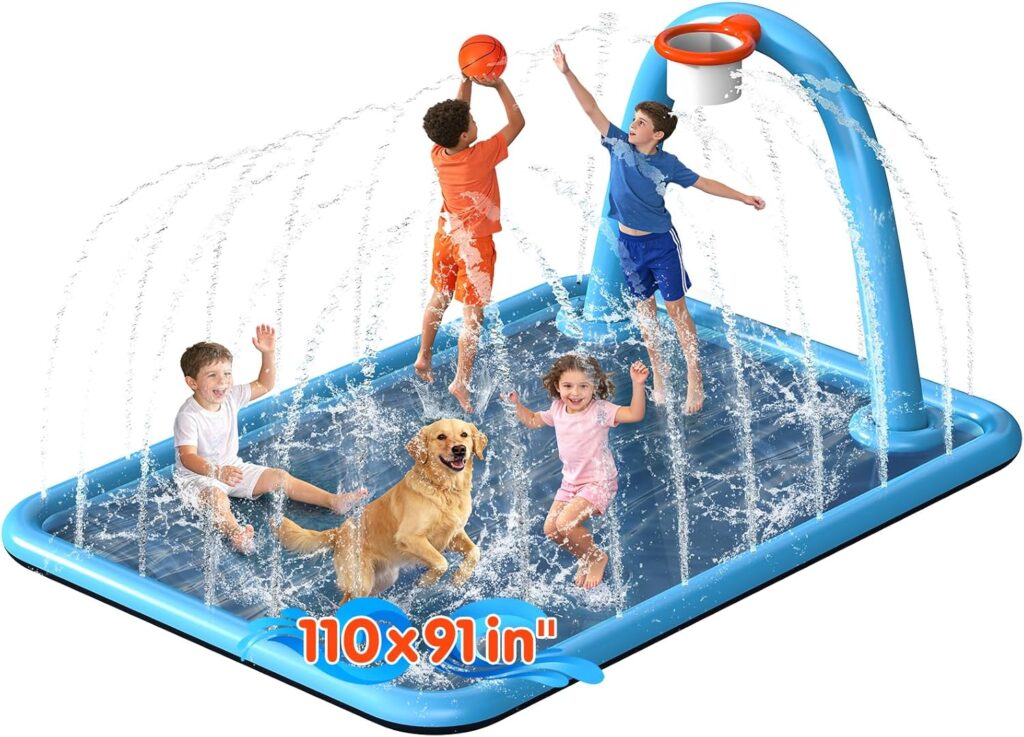
A better fit for families looking for more interactive outdoor play. Larger activity-focused splash pads benefit even more from balanced hose setup, stable PSI, and good water flow.
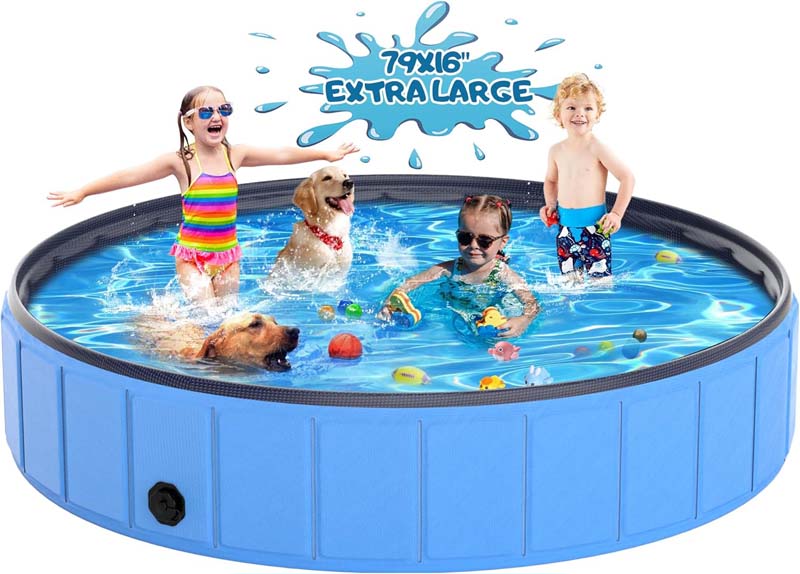
Splash Pads and Water Play for Pets
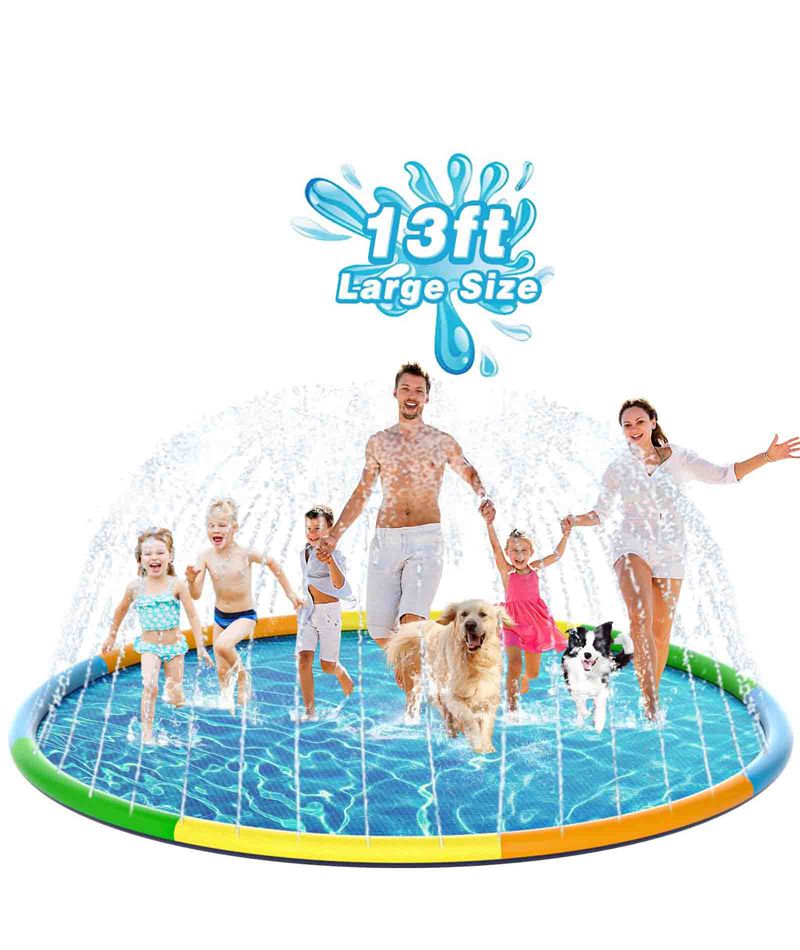
For pet families, especially those with medium or large dogs, a reinforced splash pad can provide a better balance of cooling, durability, and day-to-day use.
A good add-on for homes that want both spray play and a deeper cooling zone for pets during hot weather.
For users comparing pet-specific cooling products, this option works well in backyards where dogs prefer low-profile water play and easy access.
Epsilon Splash Pads and Water Play Products
American Epsilon Inc., operating under the EPN brand, designs and manufactures a wide range of PVC and composite water play products for families, pets, and outdoor recreation. The focus is not only on visual design, but also on structural performance, material durability, and reliable everyday use.
Epsilon splash pads are designed with:
- Reinforced PVC materials
- Balanced perimeter spray layouts
- High-frequency welded seams
- Pressure-stable structures suitable for normal household water conditions
These features help the products maintain consistent spray distribution across a wide range of backyard setups.
In addition to splash pads, Epsilon also develops related seasonal and outdoor products that can support a broader product lineup or a more complete backyard water-play setup.
Explore More Water-Play Categories
These category pages are useful for families planning a broader seasonal purchase, and for retailers or distributors evaluating adjacent outdoor and recreational product lines.
OEM and Custom Splash Pad Development
In addition to finished retail products, American Epsilon Inc. provides OEM and ODM manufacturing services for brands, retailers, and distributors worldwide. This is especially useful for businesses looking to launch their own splash pad line, upgrade an existing product, or develop a more differentiated water-play category.
Customization options can include:
- Product size and structure
- Spray layout engineering
- Reinforced PVC thickness options
- Custom graphics and color schemes
- Private-label branding
- Packaging design
- Support for regional compliance standards
For buyers and brand owners, the benefit is not just manufacturing capacity. It is also the ability to improve performance through design choices that directly affect spray consistency, durability, and long-term user satisfaction.
If you are sourcing for retail, seasonal promotions, private label programs, or pet product expansion, Epsilon can support both ready-made products and custom development.
Whether you are looking to order a splash pad for your own backyard, expand a seasonal retail category, or develop a custom product for your market, the right solution starts with the right combination of water setup and product design.