Skip to content
Best Dog Splash Pad: Safe, Durable Cooling for Dogs
# Your Trusted Inflatable Supplier In US

On a hot summer afternoon, most dogs don’t need more toys—they need relief. Heat stress in dogs isn’t just uncomfortable; it can quickly become dangerous, especially for large breeds, thick-coated dogs, puppies, and seniors. While many owners turn to kiddie pools, hoses, or shaded rest areas, these solutions often fall short. Pools can be slippery, deep, and hard to clean. Hoses can overwhelm or scare dogs. And shade alone doesn’t actively cool the body.
That’s why dog splash pads have rapidly moved from a novelty item to a serious pet care solution. But here’s the problem: not all dog splash pads are actually designed for dogs. Many are thin, inflatable, made for kids, or built with materials that tear under claws, collapse under weight, or become slick and unsafe when wet.
The real question isn’t whether a dog splash pad is useful—it’s which one is actually the best for dogs, based on safety, durability, comfort, and real-world use.
The best dog splash pad is one made from thick, non-toxic PVC, with a non-slip surface, reinforced edges, and stable water pressure. It should match the dog’s size, resist claws and movement, drain easily for cleaning, and stay flat without inflation. High-quality dog splash pads are designed specifically for pet behavior—not adapted from children’s water toys.
Many dog owners learn this lesson the hard way—after replacing torn pads, dealing with muddy messes, or watching their dog hesitate on a slippery surface. Understanding what truly separates a good splash pad from a bad one can save money, frustration, and most importantly, protect your dog’s safety. Let’s break it down properly.
What Is a Dog Splash Pad and Why Do Dogs Need One?
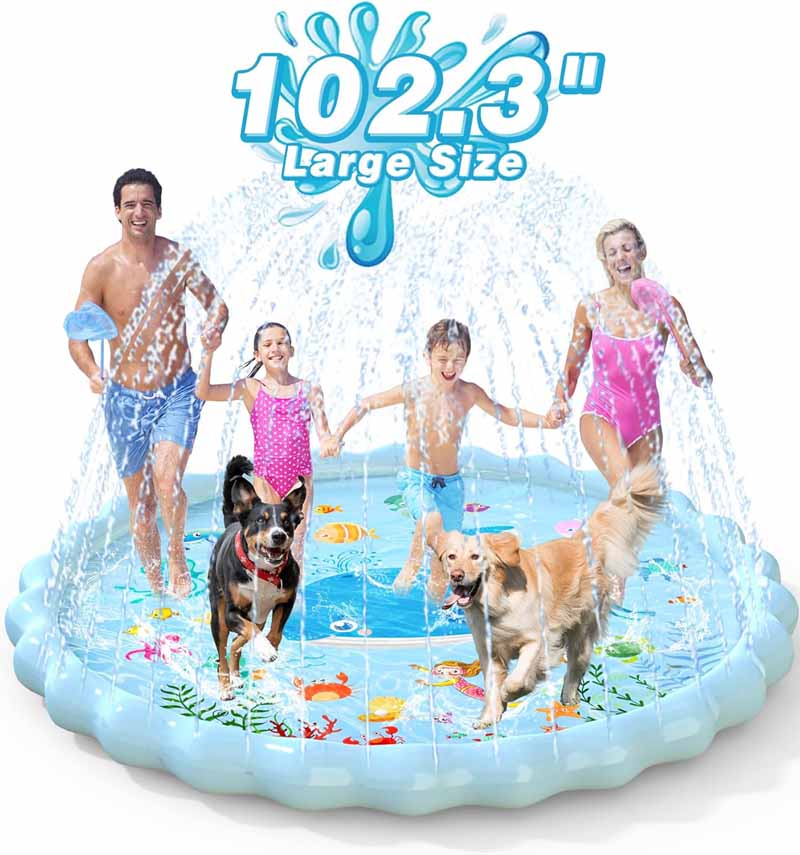
A dog splash pad is a shallow, ground-level water cooling surface designed specifically for dogs to walk, stand, or lie on while gentle water spray helps regulate body temperature. Dogs need splash pads because they cool the body safely without deep water, reduce heat stress, and support natural movement. Compared to pools or hoses, splash pads provide better traction, hygiene, and confidence for dogs of all ages.
What problems do dog splash pads solve in hot weather?
Dogs are far more vulnerable to heat than most owners realize. Unlike humans, dogs cannot sweat through their skin. They rely mainly on panting and limited heat release through their paw pads. In hot weather, especially on hard backyard surfaces like concrete, artificial turf, or dry grass, dogs absorb heat faster than they can release it.
A dog splash pad directly addresses this imbalance. By maintaining a thin, continuously refreshed layer of water on the surface, splash pads cool dogs through contact cooling and evaporation, two of the most effective passive cooling methods. This helps lower skin temperature without forcing dogs into deep water or intense activity.
Importantly, splash pads allow dogs to self-regulate. Dogs can step on, off, or lie down as needed—something not possible with hoses or fixed pools. This autonomy reduces stress and prevents overheating caused by overexertion.
How is a dog splash pad different from a dog pool?
The key difference is water depth and behavior support.
Dog pools are water containers. They require dogs to climb in, balance on slippery walls, and often sit or swim in standing water. For many dogs—especially seniors, large breeds, or dogs with joint issues—this creates hesitation, instability, or even injury risk.
Dog splash pads, by contrast, are flat and ground-level. There is no climbing, no deep water, and no pressure to swim. Dogs interact with splash pads the same way they interact with cool ground: by standing, pacing, stretching, or lying down.
From a hygiene standpoint, splash pads also outperform pools. Flowing water reduces stagnation, odor buildup, and bacterial growth. Combined with bottom drainage, splash pads are easier to rinse clean after use, especially when dogs track in dirt or relieve themselves during play.

Are splash pads suitable for all dog breeds and sizes?
Yes—but only when the splash pad is designed for dogs, not adapted from children’s toys.
Small dogs need gentle water pressure, predictable spray patterns, and surfaces that feel stable under light paws. Large dogs need more space, thicker materials, reinforced edges, and pads that won’t curl or collapse when stepped on.
Problems arise when owners use thin, inflatable, or kid-focused splash pads. These products often fail to support dog movement, leading to slipping, edge collapse, or outright tearing. Dogs sense this instability immediately and may refuse to use the pad altogether.
Breed-appropriate splash pads take into account weight distribution, stride length, confidence levels, and paw traction. When these factors are respected, splash pads can be safely used by puppies, adult dogs, and seniors alike.
Which Features Matter Most When Choosing the Best Dog Splash Pad?
The most important features of the best dog splash pad are material safety, structural durability, anti-slip surface texture, balanced water spray, and proper sizing. A high-quality dog splash pad must resist claws and weight, stay stable when wet, cool effectively without deep water, and remain easy to clean. Features designed for dog behavior—not children’s play—are what determine long-term safety and usability.
What is the best splash pad for dogs based on material and structure?
When it comes to dog splash pads, material and structure are not separate choices—they work together. Dogs apply uneven pressure when they walk, jump, turn, or step on edges. Unlike children, they also introduce claws, body weight, and sudden directional movement.
The best splash pads for dogs are made from thick, flexible, non-toxic PVC or reinforced composite PVC, not thin vinyl or inflatable materials. Thickness improves tear resistance, while flexibility allows the pad to absorb impact instead of cracking or warping.
Equally important is non-inflatable structural design. Inflatable splash pads rely on air chambers that collapse under concentrated pressure, especially when dogs step on the rim. Dog-specific splash pads stay flat and stable without air, allowing dogs to move confidently without triggering surface deformation that can cause slipping or fear.
From an engineering perspective, the “best” splash pad is one that remains visually unremarkable during use—no curling edges, no bulging, no sudden shifts. Stability is what dogs trust.
What material is safest and most durable for dog splash pads?
Safety starts at the chemical level. Dogs lie on splash pads, lick water from the surface, and sometimes chew edges. That makes material formulation far more important than appearance.
The safest dog splash pads use low-odor, non-toxic PVC that complies with CPSIA (U.S.), REACH (EU), and ASTM standards. These formulations avoid BPA, phthalates, and heavy metals while maintaining flexibility under heat and UV exposure.
Cheap splash pads often use high-plasticizer PVC to reduce cost. While this makes the material soft initially, it becomes brittle, slippery, or sticky over time—especially in direct sunlight. High-quality PVC maintains surface grip and elasticity across temperature changes, which directly affects both durability and dog confidence.
In real-world terms: if a splash pad smells strongly out of the box or feels slick when wet, it’s already failing the safety test.

Which thickness and structure prevent tearing and collapse?
Thickness is one of the clearest predictors of lifespan. Splash pads below approximately 0.3 mm are prone to punctures and seam failure when used by dogs. Pads in the 0.45–0.6 mm range perform significantly better under repeated stress.
However, thickness alone is not enough. Structural reinforcement around edges, hose connectors, and spray holes is critical. These are the areas where pressure concentrates and where failures usually begin.
Well-designed dog splash pads distribute water pressure evenly, preventing bulging or distortion. They also maintain edge integrity when dogs step or lean on the perimeter—one of the most common real-world stress scenarios.
The result is a splash pad that doesn’t just survive first use, but remains functional and safe across multiple seasons.
How does anti-slip design improve safety for dogs?
Water and smooth plastic are a dangerous combination without traction. Dogs that slip once may hesitate permanently, especially puppies and senior dogs.
The best dog splash pads use molded, non-abrasive anti-slip textures integrated directly into the PVC surface. These textures provide grip under wet paws without irritating sensitive pads.
Anti-slip design serves two purposes:
- It prevents sudden slips that strain joints or cause panic.
- It helps dogs feel stable, which increases voluntary use and enjoyment.
Equally important is the underside grip. A splash pad that shifts on grass, concrete, or decking creates unpredictable movement—something dogs instinctively avoid. Stability underneath supports confidence on top.
Why water spray distribution matters for dog comfort and behavior?
Water pressure is not just a plumbing issue—it’s a behavioral one. Dogs react strongly to sudden or uneven spray. Harsh jets, inconsistent pressure, or inward-facing holes can overwhelm dogs and turn cooling into stress.
The best splash pads use evenly spaced, outward-angled spray holes that create a low-pressure cooling zone rather than a chaotic spray pattern. This keeps water refreshing without startling the dog.
Balanced distribution also prevents puddling, which can make surfaces slippery or trap dirt and hair. Gentle, consistent water flow supports longer, calmer use—exactly what cooling solutions should provide.
How Do You Know If a Dog Splash Pad Is Safe?
A dog splash pad is safe when it uses certified non-toxic materials, provides reliable traction when wet, controls water spray to avoid startling dogs, and supports easy cleaning to prevent bacteria and odor. Look for compliance with standards like CPSIA, REACH, and ASTM, a non-slip textured surface, reinforced seams, stable hose connection, and quick drainage. Safety also depends on correct sizing and supervised use—especially for puppies and senior dogs.
Are dog splash pads made with non-toxic PVC?
Not automatically—and this is where many “pet splash pads” quietly fail. Dogs don’t just stand on splash pads; they lie down on them, lick water off the surface, and may chew edges. That means the safest splash pad materials must be non-toxic by formulation, not just “advertised as safe.”
Look for language that indicates compliance with CPSIA (commonly referenced for U.S. children’s product chemical safety), REACH (EU chemical restrictions), and ASTM (consumer safety standards). These signals matter because they imply restrictions on harmful substances such as phthalates, heavy metals, or other unsafe additives.
Practical safety clues also help: strong chemical odor out of the box, oily surface feel, or “sticky” texture under heat are common signs of low-grade PVC plasticizer use. High-quality PVC designed for family/pet use is typically low-odor, stable under sunlight, and remains flexible without becoming slick.
If your dog frequently licks surfaces, material quality becomes even more important than splash performance.
What safety standards should dog splash pads meet?
There isn’t one single universal “dog splash pad standard,” so the smartest approach is to look for standards that cover what a splash pad actually risks: chemical exposure, mechanical failure, and user safety.
- CPSIA (U.S.) is widely used as a benchmark for chemical restrictions in products that may contact skin or be mouthed.
- REACH (EU) is a strong indicator of reduced harmful chemical content and broader compliance practices.
- ASTM standards (for consumer products) signal attention to durability, performance, and safety testing expectations.
Beyond named standards, a safety-first manufacturer usually has a repeatable QC process: batch testing, seam inspection, pressure testing, and surface traction evaluation. These are not “marketing extras”—they’re the reasons some splash pads last for years while others deform or tear after a few sessions.
In short: safety is less about a single badge and more about whether the product was engineered and verified for real use.
How does design reduce the risk of slipping or joint stress?
Most injuries from splash pads aren’t dramatic—they’re subtle. A slip that twists a joint, a sudden edge collapse that startles a dog, or repeated awkward footing that causes a dog to avoid the pad entirely. Dogs, especially older ones, are extremely sensitive to surface stability.
The safest splash pads include:
- Non-slip texture on the top surface that provides grip under wet paws
- Grip-friendly underside that keeps the pad from shifting on grass, concrete, or decking
- Flat, non-inflatable structure so edges don’t roll or collapse when stepped on
- Low-profile design to eliminate jumping in/out (reducing joint impact)
This matters most for puppies, senior dogs, and large breeds that carry more load on hips and elbows. A stable surface doesn’t just prevent falls—it helps dogs feel confident enough to use the splash pad voluntarily, which is the whole point of a cooling solution.
Can puppies and senior dogs safely use splash pads?
Yes—when the splash pad is designed for stability and traction, and when use is supervised. Puppies can be hesitant with water and may react unpredictably to sudden spray. Seniors may have reduced balance and joint mobility. Both groups benefit from gentle water pressure, predictable spray direction, and a non-slip surface.
For puppies: start with low water pressure and let them explore at their own pace. A stable pad helps build confidence without forcing interaction.
For seniors: prioritize traction and avoid high spray or unstable edges. Many older dogs prefer lying down on a cool surface rather than active play, and a splash pad supports that behavior well.
A good rule: if your dog hesitates, slips, or avoids the surface, it’s not a “training problem”—it’s usually a stability or surface design problem.
What is the best surface for dogs to pee on during splash pad use?
From a hygiene and safety standpoint, the best surface is non-porous PVC with fast drainage. Dogs sometimes pee during cooling or play—especially puppies and excited dogs. A non-porous surface prevents urine absorption, staining, and lingering odors, while quick drainage makes cleanup simple: rinse, drain, done.
Avoid pairing splash pads with absorbent surfaces like foam tiles or fabric mats, which trap moisture and bacteria. If the splash pad has a smooth inner surface and drains efficiently, it’s much easier to keep sanitary without harsh chemicals.
Quick Safety Checklist
Use this as a fast decision filter:
| Safety Factor | What to Look For | Why It Matters |
|---|---|---|
| Material safety | CPSIA / REACH / ASTM compliance, low odor | Reduces chemical exposure risk |
| Traction | Non-slip top + stable underside | Prevents slipping and joint strain |
| Structure | Non-inflatable, reinforced edges | Stops collapse and sudden movement |
| Water control | Even, gentle spray | Reduces fear and stress reactions |
| Hygiene | Quick drainage, easy rinse | Prevents odor and bacteria buildup |
What Size Dog Splash Pad Is Best for Small, Medium, and Large Dogs?
The best dog splash pad size depends on the dog’s body size, weight, movement style, and whether multiple dogs will use it together. Small dogs need moderate-sized pads with gentle spray, while large dogs require wider diameters, thicker materials, and reinforced edges to stay stable. Choosing the correct size improves safety, comfort, cooling effectiveness, and long-term durability.
What is the best dog splash pad for large dogs?
Large dogs place unique mechanical stress on splash pads. Their weight, stride length, and tendency to step or lean on the edge mean that undersized pads fail quickly—or worse, become unsafe.
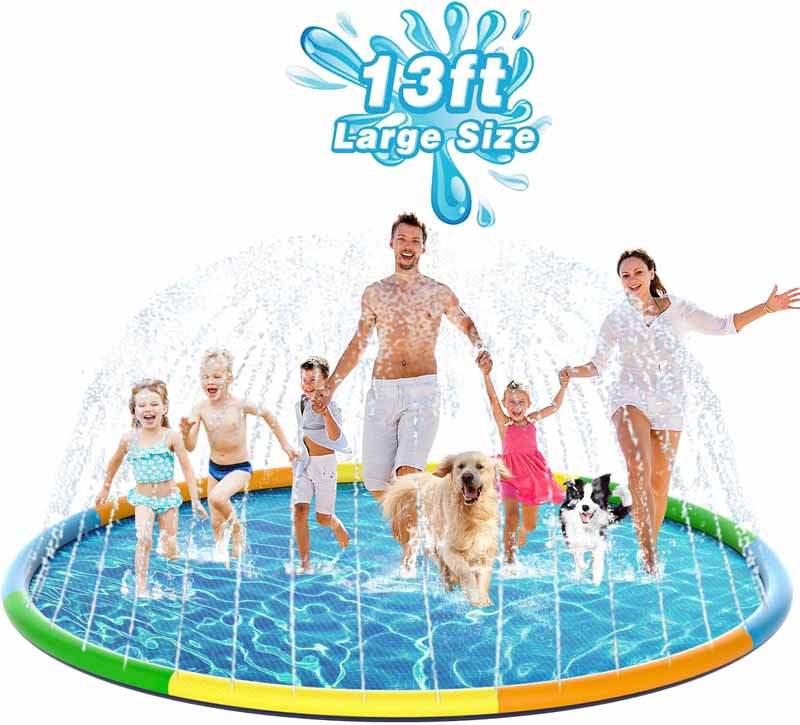
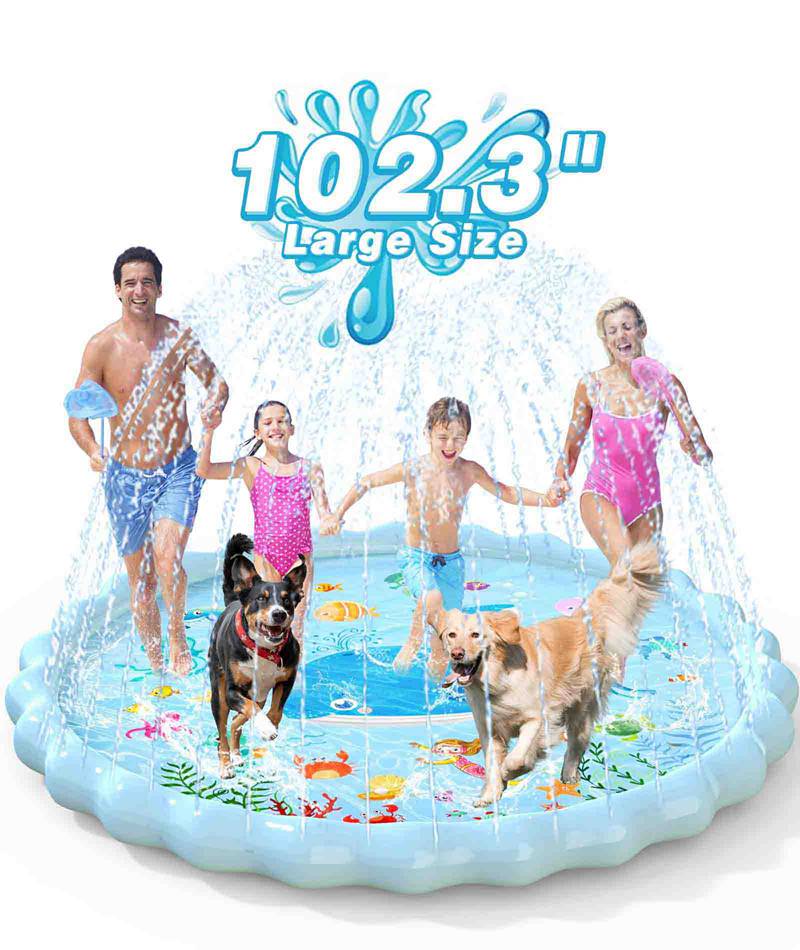
For large breeds (generally 50 lbs and up), the best splash pads typically measure 70–100 inches or more in diameter. This provides enough surface area for turning, stretching, and lying down without forcing the dog to stand on the edge. Edge stepping is one of the most common causes of collapse or curling in low-quality pads.
Material strength becomes even more critical at larger sizes. Thick, non-inflatable PVC with reinforced perimeter seams prevents the pad from warping under pressure. A properly sized pad spreads the dog’s weight across a wider surface, reducing stress on any single point and maintaining even water distribution.
If a large dog looks “crowded” on a splash pad, the pad is undersized—regardless of what the product listing claims.

What is the best dog splash pad for small dogs?
Small dogs have very different needs. While weight stress is lower, confidence and water sensitivity play a much bigger role.
For small breeds (under 20 lbs), splash pads in the 40–60 inch range are usually ideal. These sizes feel manageable rather than overwhelming, while still allowing free movement. Oversized pads with aggressive spray can actually discourage use by smaller or timid dogs.
The most important factors for small dogs are:
- Gentle, evenly distributed water spray
- A surface that feels stable and predictable under light paws
- Quick drainage to avoid puddles that can cause hesitation
Importantly, “small dog” does not mean “cheap material.” Thin PVC may seem acceptable due to lower weight, but it still degrades quickly in sunlight and becomes slippery over time. Small dogs benefit just as much from durable, non-toxic materials as large dogs do.

How much space does a dog need to play comfortably?
A practical sizing guideline is to choose a splash pad with a diameter at least 2 to 3 times the dog’s body length (nose to tail base). This allows dogs to turn, pace, or lie down without crowding.
Below is a general sizing reference that aligns well with real-world use:
| Dog Size | Weight Range | Recommended Splash Pad Diameter |
|---|---|---|
| Small | ≤20 lbs | 40–60 inches |
| Medium | 20–50 lbs | 60–70 inches |
| Large | 50–90 lbs | 70–90 inches |
| Extra Large | 90+ lbs | 90–100+ inches |
This table reflects functional comfort, not just marketing size labels.
Are larger splash pads better for multi-dog households?
Yes—almost always. When two or more dogs share a splash pad, size directly affects behavior. Limited space increases bumping, competition, and stress, especially between dogs of different sizes.
Larger pads allow dogs to self-space, move independently, and choose their own interaction level with water. This reduces conflict and makes cooling sessions calmer and safer.
For multi-dog homes, it’s generally better to size up rather than try to “fit” multiple dogs into a single-dog pad. Extra space also improves durability by spreading out wear and pressure.
How does size affect stability and water pressure?
Size influences more than just space—it affects how the splash pad behaves when in use.
Smaller pads concentrate water pressure into fewer spray holes, which can increase spray intensity and cause puddling. Larger pads distribute pressure more evenly, resulting in gentler, more consistent cooling.
From a stability perspective, larger pads—when properly reinforced—are less likely to shift or curl because weight and water are spread across a wider area. This makes them feel calmer and more predictable, which dogs strongly prefer.
How Durable Are High-Quality Dog Splash Pads Compared to Cheap Ones?
High-quality dog splash pads are significantly more durable than cheap alternatives because they use thicker non-toxic PVC, reinforced seams, and tested structures designed for dog behavior. Cheap splash pads—often repurposed from children’s toys—frequently tear, warp, or collapse under claws, weight, and sun exposure. Durability depends on material formulation, construction quality, and real-use testing, not price or appearance.
Why do cheap dog splash pads fail so quickly?
Most low-cost dog splash pads are not actually designed for dogs. They are typically children’s splash pads or inflatable mats relabeled for pet use. This mismatch in design intent is the root cause of early failure.
Dogs introduce stress factors that children do not:
- Concentrated weight on small contact points (paws)
- Claws that scratch and grip surfaces
- Sudden directional movement and edge stepping
- Repeated exposure to direct sunlight and outdoor surfaces
Cheap splash pads often use thin PVC or vinyl (commonly under 0.3 mm), minimal seam reinforcement, and weak hose connectors. Under real dog use, these materials stretch, crease, or puncture easily. Once a pad deforms—even slightly—dogs lose confidence, stop using it, or cause further damage through uneven pressure.
In practice, many “budget” splash pads fail not because they leak immediately, but because they become unstable, slippery, or misshapen within weeks.
How do high-quality materials improve durability over time?
Durability starts at the material formulation level, not just thickness. High-quality dog splash pads use reinforced, UV-resistant PVC or composite PVC blends engineered to remain flexible under heat while resisting tearing and surface degradation.
Better materials deliver three long-term advantages:
- Tear resistance – thicker, elastic PVC absorbs claw pressure instead of cracking
- Shape stability – the pad stays flat even when dogs step on edges
- Surface consistency – anti-slip texture remains effective after repeated wet/dry cycles
Cheap materials often rely on heavy plasticizers to feel soft initially. Over time, these plasticizers migrate, causing the surface to become slick, brittle, or sticky—exactly the conditions that reduce safety and lifespan.
A durable splash pad feels boringly consistent after months of use. That consistency is a sign of quality, not lack of features.
Why does structural design matter as much as material thickness?
Thickness alone does not guarantee durability. Structural design determines how stress is distributed across the splash pad during use.
High-quality dog splash pads typically include:
- Reinforced perimeter seams to handle edge stepping
- Pressure-balanced spray hole layouts to prevent bulging
- Strengthened hose connection zones to avoid tearing
- Non-inflatable construction to eliminate air-chamber collapse
Cheap splash pads often fail at seams or connectors first, not in the middle of the surface. Once a seam stretches or a connector loosens, water pressure accelerates the failure.
In contrast, well-designed splash pads are built so that no single area becomes a failure point, even under uneven dog movement.
What kind of testing separates premium splash pads from disposable ones?
One of the biggest differences between premium and cheap splash pads is testing discipline.
High-quality manufacturers typically perform:
- Repeated pressure cycling to simulate real hose use
- UV aging tests to evaluate sun exposure damage
- Abrasion and scratch resistance tests for claws
- Seam and connector pull-strength testing
Cheap products often skip this entirely, relying instead on visual inspection or short-term water testing. The result is unpredictable performance—some pads last weeks, others fail immediately.
Testing doesn’t make a splash pad exciting—but it makes it reliable.
How many seasons should a durable dog splash pad realistically last?
A properly designed, high-quality dog splash pad should last multiple summer seasons with normal use and basic care. For many households, that means several years of consistent performance.
If a splash pad tears, warps, or becomes unsafe after a single season, it is not “normal wear”—it is a design or material failure. Over time, replacing cheap splash pads often costs more than investing once in a durable option.
From a long-term value perspective, durability isn’t about avoiding replacement—it’s about avoiding disruption, safety concerns, and wasted purchases.
Durability Comparison Snapshot
| Factor | High-Quality Dog Splash Pad | Cheap Splash Pad |
|---|---|---|
| Material | Thick, UV-resistant PVC | Thin vinyl / soft PVC |
| Structure | Reinforced seams, non-inflatable | Inflatable or weak seams |
| Stability | Stays flat under dog movement | Curls, collapses, shifts |
| Lifespan | Multiple seasons | Weeks to one season |
| Real dog use | Designed for claws & weight | Repurposed from kids’ toys |
How Easy Is It to Use, Clean, and Store a Dog Splash Pad?
A high-quality dog splash pad is extremely easy to use, clean, and store. It requires no inflation or tools, connects directly to a standard garden hose, drains quickly after use, and folds flat for compact storage. Easy maintenance is essential for frequent use, especially in homes with dogs that track dirt, shed hair, or relieve themselves during play.
How easy is it to set up a dog splash pad for daily use?
Ease of setup determines whether a splash pad becomes a daily summer solution—or a one-time novelty. The best dog splash pads are non-inflatable and tool-free, meaning setup typically takes less than a minute.
The process is simple:
- Unfold the splash pad on a flat surface
- Connect a standard garden hose
- Turn on the water and adjust pressure
There are no pumps, no valves to monitor, and no waiting for air chambers to fill. This matters because dog owners often use splash pads spontaneously—after walks, during playtime, or when temperatures spike unexpectedly.
In contrast, inflatable pads require setup time, pressure checks, and frequent re-inflation. Many owners stop using them simply because the effort outweighs the benefit. Convenience isn’t a luxury feature—it’s what makes regular use realistic.
How do you clean a dog splash pad after use?
Dogs bring dirt, hair, and sometimes urine into splash pads. A splash pad that’s hard to clean quickly becomes unpleasant to use.
The best dog splash pads are designed with smooth, non-porous surfaces and low-point or bottom drainage. After use, owners can simply rinse the surface with a hose, allowing water to carry away debris naturally. No scrubbing, soaking, or harsh cleaners are required.
This is especially important for hygiene. Porous materials, foam mats, or fabric-lined pads trap moisture and bacteria. Non-porous PVC does not absorb liquids, making it far easier to keep sanitary with routine rinsing.
In real-world terms: if cleaning takes more than a few minutes, most people won’t do it consistently.
How does drainage design affect convenience and hygiene?
Drainage is one of the most overlooked features—and one of the most important.
Splash pads with integrated drainage at the lowest point allow water to exit smoothly without lifting or tipping the pad. This prevents muddy spills and reduces strain, especially with larger sizes.
Good drainage also prevents standing water from lingering after use. Stagnant water leads to odor, algae growth, and surface slickness. A well-draining splash pad dries faster, stores cleaner, and stays safer between sessions.
Poor drainage doesn’t just add inconvenience—it shortens the product’s usable life.
Can dog splash pads be folded and stored easily?
Yes—when they’re designed correctly. Non-inflatable dog splash pads fold flat once drained, taking up minimal space. Most can be stored in a closet, garage shelf, or car trunk without special storage bags or accessories.
This portability is important for seasonal products. Owners are far more likely to reuse a splash pad year after year if storage doesn’t feel like a hassle.
Inflatable pads, by contrast, often trap air, retain moisture, and require careful folding to avoid creases or mold. Over time, that discourages reuse.
Are dog splash pads practical for travel, camping, or RV use?
High-quality splash pads are surprisingly travel-friendly. Because they’re lightweight, flexible, and quick to set up, many owners bring them along for:
- Camping trips
- RV travel
- Visits to vacation homes
- Backyard gatherings or dog playdates
All that’s required is access to a standard hose connection. For dogs that overheat easily or struggle with long outdoor days, this portability adds real value.
A splash pad that’s easy to pack is a splash pad that actually gets used.
Ease-of-Use Comparison
| Feature | High-Quality Dog Splash Pad | Low-End / Inflatable Pad |
|---|---|---|
| Setup | <1 minute, no tools | Inflation required |
| Cleaning | Quick hose rinse | Scrubbing or soaking |
| Drainage | Built-in, low-point | Requires lifting |
| Storage | Folds flat | Bulky, traps air |
| Reusability | High, daily-friendly | Often abandoned |
Why Are Professional Manufacturers Better Than Generic Dog Splash Pads?
Professional manufacturers produce safer and more durable dog splash pads because they control material formulation, structural design, and quality testing in-house. Unlike generic splash pads—often repurposed from children’s toys—professionally engineered pads are designed for dog behavior, weight, and outdoor use. This results in better stability, longer lifespan, consistent safety, and predictable performance across seasons.
How does in-house R&D improve dog splash pad design?
The biggest difference between professional manufacturers and generic sellers is intentional design. In-house R&D teams don’t start with a finished toy—they start with a use case. For dog splash pads, that means studying how dogs move, where pressure concentrates, and how water interaction affects behavior.
Professional R&D teams test variables like PVC thickness, flexibility under heat, spray hole spacing, and edge reinforcement. They evaluate how pads respond when dogs step on the perimeter, scratch the surface, or lie down for extended cooling. These insights directly influence design choices that are invisible to buyers but immediately noticeable to dogs.
Generic splash pads skip this step entirely. They reuse existing molds meant for children’s play, changing colors or labels without reengineering the product. The result may look similar online, but it behaves very differently under real dog use.
Why does material formulation matter more than appearance?
Two splash pads can look identical and perform completely differently. The reason lies in material formulation, not graphics or shape.
Professional manufacturers develop or select PVC formulations that balance:
- Chemical safety (low odor, non-toxic additives)
- Flexibility under high temperatures
- Resistance to UV degradation
- Surface traction when wet
These formulations are tested repeatedly to ensure consistency across production batches. Generic products often rely on off-the-shelf PVC mixes optimized for cost, not performance. They may feel soft initially but degrade quickly—becoming slick, brittle, or misshapen over time.
How do pet behavior insights influence product safety?
Dogs interact with products differently than humans. They test edges, avoid unstable surfaces, and react instantly to unexpected movement or spray. Professional manufacturers incorporate pet behavior insights into design decisions that reduce risk and increase adoption.
Examples include:
- Lower-profile edges to avoid tripping or joint strain
- Stable, flat structures that don’t shift under sudden movement
- Gentle, outward-facing spray patterns that don’t startle dogs
Generic products often ignore these factors, leading to hesitation, avoidance, or unsafe use. A splash pad that dogs refuse to step on is not a training problem—it’s a design failure.
What advantages do vertically integrated factories provide?
Vertically integrated manufacturers control the full production chain: material sourcing, processing, welding, testing, and packaging. This integration enables consistent quality and faster improvement cycles.
When issues arise—such as seam stress or connector wear—integrated factories can adjust materials or tooling immediately. Resellers relying on third-party factories often lack this feedback loop, resulting in slow fixes or inconsistent batches.
Companies like American Epsilon Inc., which operate with in-house R&D, material labs, and ISO-certified production systems, exemplify how vertical integration translates into safer, longer-lasting pet products—whether for retail buyers or OEM partners.
Why quality control and testing separate professionals from resellers?
Testing is where professional manufacturers clearly outperform generic sellers. Beyond basic water checks, professionals conduct:
- Pressure and spray endurance testing
- UV aging simulations
- Seam and connector stress tests
- Surface traction evaluations
These tests simulate weeks or months of real use before products ever reach customers. Generic splash pads often skip formal testing entirely, relying on short-term functionality rather than long-term reliability.
From a buyer’s perspective, testing is the invisible feature that prevents returns, replacements, and safety concerns.
Professional vs. Generic
| Area | Professional Manufacturer | Generic Splash Pad Seller |
|---|---|---|
| Design intent | Built for dog behavior | Repurposed from kids’ toys |
| Materials | Tested, consistent PVC blends | Cost-driven PVC |
| Structure | Reinforced, non-inflatable | Inflatable or weak seams |
| Testing | Multi-stage, in-house | Minimal or none |
| Reliability | Predictable, multi-season | Inconsistent, short-term |
Are Dog Splash Pads Worth It Compared to Other Cooling Solutions?
Yes, dog splash pads are worth it for most households because they provide safer, cleaner, and more consistent cooling than traditional options like kiddie pools, hoses, or shade alone. Splash pads reduce heat stress without deep water, support natural dog movement, and are easier to maintain. When designed specifically for dogs, they offer better long-term value, usability, and safety than most alternative cooling methods.
Are dog splash pads better than kiddie pools for dogs?
For many dogs, splash pads are a better choice than kiddie pools—especially when safety, hygiene, and ease of use are considered.
Kiddie pools hold standing water, which can become slippery, dirty, and difficult to drain. Dogs must step over raised edges, balance on smooth surfaces, and often sit or stand in water that quickly warms and stagnates. For large dogs, seniors, or dogs with joint issues, this can increase the risk of slipping or strain.
Splash pads eliminate these issues by staying flat, shallow, and continuously refreshed. Dogs can walk on and off freely, lie down comfortably, and cool their bodies without being submerged. From a behavioral perspective, this aligns far better with how most dogs naturally interact with water.
Do dog splash pads cool dogs more effectively than hoses or sprinklers?
Hoses and lawn sprinklers provide momentary cooling, but they lack consistency and control. Sudden spray can startle dogs, while uneven pressure makes it difficult for them to regulate exposure.
Dog splash pads offer steady, predictable cooling. Water spreads evenly across the surface, allowing dogs to choose how much contact they want—standing, walking, or lying down. This self-regulation reduces stress and prevents overheating caused by forced or chaotic water exposure.
In short, splash pads turn cooling into a passive, low-effort process, rather than an active intervention that requires constant supervision.
How do splash pads compare to shade, cooling mats, and fans?
Each cooling method has value, but they serve different roles:
- Shade reduces heat exposure but does not actively cool the body
- Cooling mats rely on limited heat absorption and warm quickly outdoors
- Fans move air but don’t lower body temperature effectively in high heat
Splash pads actively remove heat through contact cooling and evaporation, making them far more effective during peak summer temperatures. They also combine cooling with movement and enrichment, rather than encouraging complete inactivity.
For dogs that enjoy being outside, splash pads offer a rare balance between cooling and engagement.
Do splash pads support enrichment and healthy activity?
Yes—and this is one of their most overlooked benefits.
Splash pads encourage gentle movement, exploration, and play without high-impact activity. Dogs can step, turn, stretch, or lie down as they cool off. This makes splash pads particularly valuable for:
- Dogs that overheat quickly
- Senior dogs needing low-impact activity
- Dogs prone to boredom during hot weather
Unlike forced exercise or high-energy water play, splash pads allow dogs to participate at their own pace. This supports both physical comfort and mental well-being.
Are dog splash pads cost-effective over time?
When viewed as a long-term solution, splash pads are often more cost-effective than they appear.
Cheap alternatives—like thin kiddie pools or inflatable mats—often need frequent replacement due to tearing, warping, or hygiene issues. Repeated purchases add up quickly. In contrast, a well-made dog splash pad designed for durability can last multiple seasons with minimal maintenance.
More importantly, splash pads reduce the risk of heat-related stress and injuries, which can lead to expensive vet visits. From both a financial and care perspective, they represent a smart investment rather than a disposable summer toy.
Cooling Solutions Comparison
| Cooling Option | Effectiveness | Safety | Maintenance | Dog Acceptance |
|---|---|---|---|---|
| Dog Splash Pad | High | Very High | Easy | Very High |
| Kiddie Pool | Medium | Medium | Moderate | Medium |
| Hose / Sprinkler | Low–Medium | Medium | Easy | Variable |
| Cooling Mat | Low | High | Easy | Medium |
| Shade Only | Low | High | None | High |
Buy or Customize with Epsilon
If you’re looking for ready-to-ship dog splash pads, Epsilon products are available across multiple Amazon marketplaces, offering fast local fulfillment and proven durability.
For brands, retailers, and distributors seeking OEM / ODM dog splash pad solutions, American Epsilon Inc. provides:
- Custom sizes, colors, patterns, and packaging
- Non-toxic, certified PVC formulations
- Rapid prototyping and scalable production
- Global logistics and local warehousing support
Whether you’re purchasing for your own dog—or building a pet product line—Epsilon combines engineering, safety, and real-world usability into splash pads designed to perform.
Explore available products on Amazon or contact Epsilon for custom quotations today.
To further evaluate dog splash pad availability, sizing, and suitability, EPN maintains a dedicated dog splash pad overview page for decision support.
Get A Fast quote
Here, bringing your inflatable concepts to life is no longer a challenge—it’s a collaborative journey where American Epsilon helps families, outdoor enthusiasts, and global brands transform creative ideas into safe, certified, and market-ready inflatable solutions.


Partner With Epsilon
Whether you are a family looking for safe backyard fun or a brand seeking large-scale OEM/ODM solutions, American Epsilon Inc. guarantees every inflatable is built with safety, durability, and excitement in mind. With flexible low MOQs, strategically placed warehouses in the U.S., Canada, U.K., and Germany, plus 24/7 professional support, we ensure smooth delivery and reliable service worldwide.
Ready to bring your inflatable ideas to life? Request free samples, fast prototypes, and customized designs today—your trusted inflatable journey starts here.