Skip to content
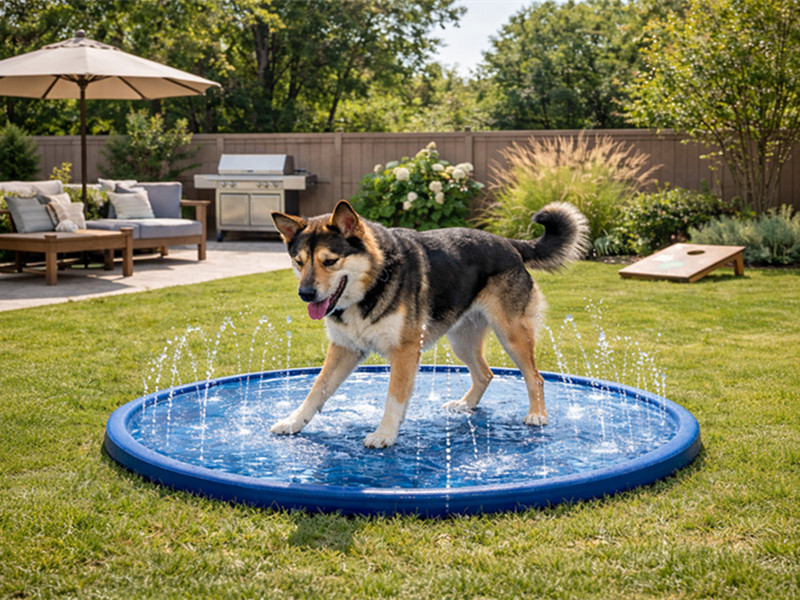
A dog splash pad is one of those products that feels almost effortless at first. Connect the hose, adjust the spray, let your dog cool off, and enjoy an easier summer routine. The hard part usually begins after the fun is over. Many owners assume the pad is ready to store as soon as the center looks dry, but that is rarely where the real moisture problem lives. Water often stays trapped in the spray ring, around the seams, inside the folds, and on the underside that was pressed against the ground. Those damp areas are easy to miss, and they are exactly where odor, mildew, and mold tend to begin.
The right way to dry a dog splash pad is to remove all standing water, clear moisture from the outer edge and underside, keep the pad fully open until both sides are dry to the touch, and store it only when it feels and smells completely clean. Quick drying helps, but complete drying matters more. A pad that looks dry on top but still feels cool, damp, or slightly slick around the edge is not ready to be folded away.
That difference has a direct effect on how long the product lasts and how enjoyable it remains to use. A splash pad that never fully dries often starts to smell stale, pick up surface residue more easily, and feel less pleasant for both dogs and owners. Over time, small drying shortcuts turn into bigger maintenance issues. A better post-use routine protects the product, improves storage, reduces replacement frequency, and helps keep your dog’s paws in better condition at the same time. Once you understand where water hides and how to deal with it properly, the whole product becomes easier to own.
Why Dog Splash Pads Get Mold
Dog splash pads get mold because moisture stays trapped in areas that do not always look wet at first glance. The center of the pad often dries first, which makes it easy to assume the whole product is ready to store. In reality, the higher-risk areas are usually the outer spray ring, the underside, the seams, the thicker edges, and any folds created during cleanup. These zones hold water longer, dry more slowly, and become problem areas when the pad is stored too early.
In real home use, mold usually starts as a routine issue rather than a sudden product failure. A pad is put away a little damp once. Then it happens again the next day. Then it gets folded into a humid garage or deck box. Nothing dramatic happens immediately, which is exactly why the problem is easy to underestimate. By the time odor or mildew becomes obvious, the real cause has often been repeating for days or weeks.
This is why it helps to think beyond visible water. The more useful question is not “Does it look dry?” but “Where is the remaining moisture likely to be hiding?” On a dog splash pad, hidden dampness matters much more than surface appearance.
| Area of the splash pad | Why it stays wet longer | Why it matters |
|---|---|---|
| Outer spray ring | Holds water inside the perimeter channel | Common source of mildew and odor |
| Underside | Limited airflow against grass, patio, or deck | Often still damp after the top looks dry |
| Seams and reinforced edges | Thicker construction slows evaporation | Traps moisture near bonded areas |
| Fold lines | Close in moisture once stored | Increases odor and repeat mold risk |
| Textured surface | Holds a fine water film in low points | Slows final-stage drying |
Where Dog Splash Pads Hold Water
Most owners check the most visible part of the splash pad first. That usually means the center play area. The problem is that the center is often the least useful place to judge storage readiness. It gets the most sunlight, the most airflow, and the least structural buildup. The places that stay wet are the ones that matter later: the perimeter channel, the hose-side edge, the underside, and the thicker seam areas.
Even a small amount of leftover moisture can become a problem when it is trapped inside a closed fold. That is why a splash pad may look almost dry in the yard and still smell musty when it is opened again the next day. The product was not fully dry when it was stored. It was only partially dry in the easiest-to-see areas.
A better check is physical rather than visual. Touch the outer ring. Press a towel into the edge. Lift one side and feel the bottom surface. A section that still feels cool, heavier, slick, or darker than the rest is still holding moisture. That is the part that decides whether the splash pad stays fresh or starts developing odor.
Why Dog Splash Pads Stay Damp
A dog splash pad stays damp when one or more of three things happen: the water does not drain completely, the underside does not get enough airflow, or the product is folded before the final moisture has evaporated. In most homes, the problem is not just one of these. It is a combination.
Incomplete draining is common on uneven lawns, patios with a slight slope, or splash pads with a raised perimeter that holds water a little longer. Limited airflow is common when the underside stays flat against grass or decking. Early storage is common because the top looks dry and the owner wants to finish cleanup quickly. Together, these create the exact conditions that mold and mildew need.
Humidity makes the issue worse. A splash pad that dries quickly in sun and breeze may take much longer in still air, evening shade, or a humid garage. That is why owners often feel like the exact same routine gives different results on different days. The product has not changed. The environment has.
From a product-use perspective, this is also why ease of drying should be treated as part of product quality. A splash pad that lies flat, drains well, and wipes clean easily will always fit daily use better than one that traps water and needs extra effort after every session.
When Dog Splash Pads Mold Faster
Dog splash pads mold faster in a small group of very common situations. The highest-risk conditions usually include evening use, shaded yards, daily repeat use without a full dry-down, humid weather, and storage in closed or damp spaces. The risk also rises when residue stays on the surface, such as dirt, dog hair, saliva, grass clippings, and fine mud from paws.
This matters because mold risk is not always obvious in the moment. A splash pad used at sunset may still look clean enough to store before bed. A pad used two days in a row may still feel usable. A deck box may seem convenient and tidy. But once moisture and residue combine, drying becomes slower and odor builds faster.
That is why two owners can have very different results with similar products. One drains, wipes, flips, and stores the pad correctly in a dry place. The other leaves it on damp grass, folds it early, and stores it in a humid corner. The product may be the same, but the outcome will not be.
| Use condition | Drying difficulty | Risk of mold later |
|---|---|---|
| Sunny yard with breeze | Low | Low |
| Sunny yard, no towel, quick fold | Medium | Medium |
| Shaded yard, repeated use | Medium to high | High |
| Humid weather, underside not checked | High | High |
| Stored slightly damp in garage or storage box | Very high | Very high |

How to Dry a Dog Splash Pad
The best way to dry a dog splash pad is to follow a simple sequence instead of relying on guesswork. Drain first. Remove surface moisture second. Expose both sides to air third. Store only when the whole product feels dry. This sounds straightforward, but it is exactly where most real-life maintenance mistakes happen.
A splash pad that still has water in the perimeter is not ready for toweling. A splash pad that has only been dried on top is not ready for folding. A splash pad that looks clean but still smells slightly damp is not ready for storage. Drying becomes much easier once the routine is handled in the right order.
What makes a splash pad feel convenient over the long term is not just how it sprays during use. It is how manageable it feels after use. A repeatable drying routine makes a bigger difference than many buyers expect.
| Drying step | What to do | Why it works |
|---|---|---|
| 1 | Turn off the water and disconnect the hose | Stops additional water from entering the ring |
| 2 | Drain all visible standing water | Reduces the main moisture load immediately |
| 3 | Press out water from the perimeter | Clears hidden water from the highest-risk area |
| 4 | Towel dry top surface and edge | Speeds up early-stage drying |
| 5 | Flip or lift the pad | Helps the underside release moisture |
| 6 | Leave open until fully dry by touch | Prevents damp storage and stale odor |
How to Drain a Dog Splash Pad
Good drying starts with good draining. If the splash pad is still holding water, the drying stage has not really begun. The most effective way to drain it is to keep the product open, disconnect the hose, and guide the remaining water toward the lowest side instead of bunching or folding the material too early.
For smaller splash pads, one person can often lift one side gradually and let gravity move the water out. For larger splash pads, two people usually make the process smoother because the structure stays flatter and the water exits more evenly. The goal is not to squeeze the pad hard or twist it into shape. The goal is to help the water leave without creating new folds that trap moisture.
The outer ring usually deserves more attention than owners expect. It often contains more residual water than the center area once the session ends. Pressing around that edge with your hands or a dry towel helps release water that would otherwise keep reappearing during the drying stage. This one habit often saves the most time later because it prevents the “why is this still wet?” problem that happens after the surface has already been wiped once.

How to Dry a Dog Splash Pad Fast
Fast drying is not about rushing. It is about removing moisture efficiently. The most effective quick routine is usually a combination of draining, toweling, airflow, and enough open time for both sides to finish properly. Sunlight helps, but sunlight alone is not always reliable. Towels help, but towels alone rarely finish the job. The best results usually come from combining methods.
In practical use, a splash pad may look dry much sooner than it is actually ready to store. The center often dries fast, especially on warm days, but the edge, underside, and textured zones usually lag behind. That is why fast drying should still include a final touch check.
A good routine for frequent users is simple:
drain the splash pad fully, towel the center, towel the perimeter carefully, flip or lift the product, then let moving air finish the job. This kind of process is easy to repeat, easy to teach to others in the home, and much more reliable than guessing based on appearance alone.
| Drying setup | Surface looks dry | Actually ready to store |
|---|---|---|
| Sun only | Sometimes fast | Not always |
| Towel only | Better than nothing | Often incomplete |
| Towel + sun | Good | Usually reliable in dry weather |
| Towel + fan | Very good | Reliable in humid or shaded areas |
| Towel + sun + airflow on both sides | Best | Most dependable result |
How Dog Splash Pad Use Affects Paw Pads
Splash pad care is not just about the product. It is also about the dog’s paws. A clean, comfortable splash pad can be a helpful cooling surface during hot weather. A dirty, damp, or poorly placed splash pad can create the opposite effect by combining water, grit, heat, and surface friction in ways that stress the paws instead of helping them.
Dog paw pads are naturally resilient, but they still respond to the conditions around the splash pad. Hot patio edges, rough decking, trapped dirt, and repeated wet-to-dry cycles can all affect comfort. In many cases, the problem is not the splash pad itself. It is the environment around it and the care routine after play.
A useful post-play habit is to glance at the paws, wipe off visible dirt, and dry between the toes if needed. This is especially important for dogs playing on rough surfaces or in hot weather. Dogs that lick their paws repeatedly, hesitate before stepping back onto the splash pad, or seem uncomfortable after play are often reacting to surface feel or heat around the setup rather than to the water spray itself.
How Long to Air-Dry a Dog Splash Pad
There is no single drying time that works for every splash pad, because size, humidity, airflow, weather, texture, and edge design all influence the result. In many home-use settings, the center of the splash pad may appear dry within 15 to 30 minutes on a warm day, but that does not mean the product is ready to store.
The more useful standard is not time alone. It is condition. A splash pad is ready when the top feels dry, the outer ring no longer feels cool or slick, the underside is dry to the touch, and the product smells neutral rather than damp. That smell check is easy to skip, but it is one of the best indicators of whether hidden moisture is still present.
| Drying condition | What owners often notice first | What is actually happening |
|---|---|---|
| Full sun and breeze | Top dries quickly | Often close to fully dry |
| Full sun, little airflow | Looks ready early | Rim and underside may still lag |
| Shade in warm weather | Slower surface drying | Hidden moisture lasts longer |
| Humid air | Surface seems acceptable | Underside stays damp longer |
| Covered area with fan | Moderate speed | Often more even and dependable |

Best Ways to Dry Dog Splash Pads
The best drying method is the one that works consistently in real use. Most owners do not need a complicated system. They need a routine that is fast enough to repeat, thorough enough to prevent mold, and simple enough to follow at the end of an active day outdoors.
That is why the best method is rarely just one thing. It is usually a short sequence: remove the water, dry the high-risk areas first, expose both sides to airflow, then store only when the splash pad feels fully dry. This approach works because it matches how the product actually behaves.
| Drying method | Speed | Reliability | Best for |
|---|---|---|---|
| Towel only | Medium | Medium | Quick post-use cleanup |
| Sun only | Medium | Low to medium | Dry climates with steady airflow |
| Fan only | Medium | High | Garages, patios, humid weather |
| Towel + sun | Fast | High | Normal summer use |
| Towel + fan + open air | Very fast | Very high | Humid climates or frequent repeat use |
Do Towels Help Dog Splash Pads
Yes, and often more than people expect. Towels remove the obvious water that slows everything else down. On splash pads with texture or reinforced edges, this matters even more because those structures hold a thin layer of moisture that is easy to miss but slow to evaporate.
The best use of a towel is not just wiping the middle. The higher-value zones are the outer ring, the hose-side edge, the seams, and the underside perimeter after flipping the pad. These are the areas most likely to stay damp and create odor later.
For families using the splash pad several times a week, a couple of absorbent towels near the door or patio can improve the whole ownership experience. They reduce drying time, make the final air-dry stage shorter, and help keep paws cleaner at the same time.
Do Fans Help Dog Splash Pads
Yes. Fans are one of the most reliable ways to improve drying when the weather is humid, the yard is shaded, or the splash pad needs to be dried under a covered area. Moving air matters because it helps moisture leave the surface more steadily, especially from the underside and the edge zones that naturally dry slower.
Fans are particularly useful when the splash pad is used in the evening or in backyards where direct sun is limited. In these situations, owners often think the product is “taking too long” to dry, when the real issue is simply weak airflow. Once airflow improves, drying becomes much more predictable.
This predictability is valuable because it makes the splash pad easier to manage. A product that dries reliably keeps getting used. A product that always feels like it might still be damp quickly becomes less appealing to set up again.
Can You Hang a Dog Splash Pad
Yes, but hanging only works well when it helps the splash pad stay open enough to drain and breathe. If the pad folds sharply over itself while hanging, moisture can remain trapped inside those fold lines. That means hanging is useful only when the pad is supported in a way that allows drainage and airflow at the same time.
A broad support surface usually works better than a narrow one. Draping the splash pad over a wide rail or large drying rack is often more effective than hanging it from a small hook or thin line. Narrow support points create deeper folds, which trap water and can place more stress on seams over time.
In practice, hanging works best as a finishing step after the pad has already been drained and towel-dried. Used this way, it helps clear the last moisture instead of trying to solve the whole cleanup process alone.

How Dog Splash Pads Stay Mold-Free
Dog splash pads stay mold-free when drying, cleaning, and storage work together as one routine. Mold prevention is not about one deep-clean day. It is about making sure the product does not spend too much time in a partly damp, partly dirty condition between uses.
The owners who get the best long-term results usually do the same small things every time. They dry after each session. They check the edge and underside. They clean before residue builds up. They store the pad in a place that stays dry. None of those actions is complicated, but together they make the biggest difference.
| Habit | Immediate benefit | Long-term effect |
|---|---|---|
| Drying after every use | Removes leftover moisture | Lower mold risk |
| Checking rim and underside | Catches hidden dampness | Fewer odor problems |
| Regular cleaning | Removes residue film | Faster drying over time |
| Dry storage | Preserves completed dry-down | Fresher next use |
| Folding while slightly damp | Saves time now | Creates future maintenance issues |
Should You Dry Dog Splash Pads Daily
Yes. If the splash pad was used that day, it should be dried that day. A splash pad is not designed to sit in a semi-wet condition between uses, even if the next session is close. Once the product is folded or stacked while damp, the wetter sections stay closed in and become harder to recover properly.
Daily drying does not have to be complicated. On some days it may only mean draining, wiping, flipping, and leaving the splash pad open. The key is consistency. One rushed cleanup may not create a visible issue right away. Repeating that rushed cleanup several times usually does.
Do Dog Splash Pads Leave Paw Pads Dry
Not usually during the play session itself. The bigger issue is the full environment around the splash pad: hot patio surfaces, rough concrete, grass chemicals, sand, dust, and repeated wiping after play. Healthy paw pads should finish the session clean and comfortably dry, not soggy, flaky, or irritated.
That is why post-play care should focus on balance rather than over-drying. A quick towel-dry, a check for grit, and a look at how the dog moves afterward are usually enough to catch small issues early.
| Paw condition after use | What it may mean | What to do next |
|---|---|---|
| Clean and normal | Good setup and healthy routine | Continue regular care |
| Slightly soft | Temporary water exposure | Dry paws and recheck later |
| Flaky or rough | Too much friction or heat | Reduce surface stress |
| Red or irritated | Surface or environment issue | Pause and inspect the setup |
| Licking or limping | Discomfort or injury risk | Stop use and address paw condition |
How Often to Clean Dog Splash Pads
A dog splash pad should be rinsed lightly after each use and cleaned more thoroughly on a regular schedule. For many homes, a rinse plus full dry-down after every session and a deeper wash every one to two weeks works well. Heavier use, muddy yards, multi-dog households, or dusty outdoor conditions may require more frequent cleaning.
Residue matters because it changes how the splash pad dries. Hair, dirt, saliva, grass clippings, and fine mud all hold moisture against the surface. Over time, that buildup makes the pad slower to dry, easier to smell, and less pleasant to use. Regular cleaning keeps the surface fresher and makes the drying routine easier, not harder.
Why Dog Splash Pad Storage Matters
Storage matters because it preserves the result of the drying routine. A splash pad that has been cleaned and dried correctly can still reopen with odor if it is stored in a place that traps moisture. Closed plastic bags, damp garages, wet deck boxes, and poorly ventilated corners all work against the product.
Good storage gives the splash pad a stable resting condition between uses. That means dry air, decent ventilation, and a fold or roll that does not trap unnecessary stress or hidden dampness. For long-term product use, storage is not just the last step. It is part of maintenance.
How to Clean Mold on Dog Splash Pads
If mold has already appeared, the goal is not just to remove the visible marks. The goal is to bring the splash pad back to a clean, dry condition that still feels safe and dependable. Some owners throw the pad away too quickly. Others keep using it even though it smells stale and feels questionable. The better approach is to judge the condition realistically.
Light surface mildew can often be cleaned if the material is still stable and the odor disappears after washing and complete drying. Repeated mold, a sticky surface, trapped odor, or seam weakness usually means the issue is no longer superficial.
| Mold condition | What it usually means | Best response |
|---|---|---|
| Light spotting on the surface | Early moisture issue | Clean promptly and dry fully |
| Musty smell with little visible mold | Hidden dampness in rim or folds | Wash, dry open, review storage |
| Mold near seams or outer edge | Repeated trapped moisture | Clean carefully and inspect structure |
| Sticky feel plus odor | Residue and moisture buildup | Full wash and full dry-down |
| Mold keeps returning | Product or storage condition is failing | Consider replacement |
Is a Moldy Dog Splash Pad Safe
A moldy dog splash pad should not be treated as normal wear. Even minor spotting suggests that the product has been staying damp too long in one or more places. Dogs do more than stand on the surface. They may lie on it, sit on it, or lick their paws afterward. That makes surface condition more important than it would be on a product with less direct pet contact.
The simplest rule is practical rather than technical: if the splash pad smells musty, feels slimy, or makes you question whether your dog should be using it, stop using it until it has been fully cleaned and reassessed.
How to Wash Dog Splash Pads
The best washing method is staged cleaning. Open the pad completely. Rinse off loose dirt, hair, and debris. Wash with mild soap and water using a soft cloth, sponge, or soft-bristle brush. Focus on the outer ring, seams, underside, and any area where odor or mildew is strongest.
Rinse thoroughly after washing. Leftover cleaner can create its own residue and make the surface feel tacky. Once the wash is done, the splash pad still needs a full dry-down on both sides. Washing is only half the job. Drying completes the cleanup.
| Cleaning step | What to do | Why it matters |
|---|---|---|
| 1 | Open the pad fully | Gives access to every high-risk area |
| 2 | Rinse off dirt and hair | Removes debris that traps moisture |
| 3 | Wash with mild soap and water | Lifts buildup without over-stressing material |
| 4 | Scrub seams, edge, underside | Targets the areas mold prefers |
| 5 | Rinse thoroughly | Prevents cleaner residue |
| 6 | Dry both sides completely | Stops the issue from restarting |
When to Replace Dog Splash Pads
A splash pad should be replaced when cleaning no longer restores it to a fresh, usable condition. That usually means the odor keeps returning, mold reappears after proper care, seams are starting to weaken, or the surface feels sticky, rough, or unreliable.
At that point, the question is not only whether the splash pad still works. It is whether it still feels clean, safe, and easy enough to trust in normal use. When the answer becomes uncertain too often, replacement is usually the better option.

How to Store Dog Splash Pads
A dog splash pad should only be stored after it is fully dry, and it should be kept in a place that stays clean, dry, and reasonably ventilated. Storage protects all the effort spent on draining and drying. Done well, it keeps the product fresh. Done poorly, it reintroduces moisture and shortens product life.
| Storage method | Space efficiency | Freshness protection | Recommended |
|---|---|---|---|
| Loose fold on a dry shelf | Good | Good | Yes |
| Gentle roll in ventilated space | Good | Very good | Yes |
| Tight fold in sealed plastic bag | Very good | Poor | No |
| Outdoor storage box in dry climate | Medium | Medium | Sometimes |
| Humid garage corner or damp shed | Easy | Very poor | No |
Should You Fold Dog Splash Pads
Yes, but only after the entire product is completely dry. Tight folds save space, but they also create deeper pressure points and trap any leftover moisture more easily. A looser fold is usually better for long-term maintenance. For some designs, rolling works even better because it creates fewer sharp crease lines.
Where to Keep Dog Splash Pads
The best storage place is dry, shaded, and ventilated. A shelf, a raised storage rack, a dry garage cabinet, or a utility room with airflow usually works well. Keeping the splash pad off damp floors is a smart habit, especially in spaces where condensation can form.
How Dog Splash Pads Avoid Odor
Odor prevention is really moisture prevention plus residue control. A splash pad avoids odor when it is drained fully, wiped carefully, dried on both sides, and stored only after it smells neutral. Once stale odor begins, a quick rinse rarely fixes the problem. The product usually needs a proper wash and a proper dry-down.
How Dog Splash Pad Play Toughens Paw Pads
Splash pad play does not harden paw pads by itself, but regular outdoor activity can help paws become more resilient over time when the surfaces are reasonable and the exposure is gradual. The goal is not rougher paws. The goal is durable, comfortable paws that are not cracked, irritated, or overheated.
Final Thoughts
A dog splash pad stays easier to own when drying, cleaning, paw care, and storage are treated as one connected routine. Most problems in this category do not begin with dramatic product failure. They begin with small things that seem harmless in the moment: a damp edge, a rushed fold, a humid storage corner, or a surface that looks clean enough but is not really clean.
Once those weak points are handled properly, the whole ownership experience improves. The splash pad feels fresher, stores better, lasts longer, and stays more comfortable for dogs to use. That is what customers care about after purchase.
For brands and sellers, this also points clearly to what matters in product development: clean drainage, easy-dry construction, durable PVC or composite material, practical edge design, and packaging that supports repeat seasonal use. EPN focuses on PVC and composite water-play products and supports both ready-to-sell brand orders and custom development for businesses that want to improve structure, performance, packaging, and market positioning. Based on the company information you shared, this positioning fits both branded product supply and OEM/ODM pet splash pad projects.

Related Reading:
Dog Splash Pad Size Guide (By Breed)