Skip to content


A kids sprinkler looks simple until you compare how different designs behave in a real backyard. Some create a soft ring of water that younger children can approach at their own pace. Others send fast-moving jets in several directions, which may be much more exciting for older children but overwhelming for a cautious preschooler. Inflatable arches, splash pads, spinning sprinklers, animal-shaped designs, and basketball-style water toys can all deliver fun, yet the features that make them enjoyable are not always the features that stand out first on a product page.
The features that matter most in a kids sprinkler are age-appropriate spray behavior, controllable water flow, stable construction, durable materials, reliable seams and hose connections, suitable play-area size, and easy setup and storage. Decorative shapes and game features can improve play value, but they work best when the basic sprinkler remains comfortable, practical, and easy for families to use repeatedly.
That difference becomes obvious after the first few minutes of play. A huge sprinkler with dramatic water jets may attract attention immediately, but the product children keep asking to use is often the one that feels comfortable, gives them room to move, works reliably with the household hose, and does not turn cleanup into a long project.
What Makes a Kids Sprinkler Safe?
A safer kids sprinkler combines age-appropriate water intensity, stable construction, secure components, a suitable play surface, and enough clear space for normal movement. Safety depends on the whole setup rather than one feature alone. Parents should consider age guidance, spray behavior, hose placement, ground conditions, surrounding obstacles, weather, product condition, and supervision before deciding whether a sprinkler fits their family.
Which Ages Need Gentler Spray?
Age affects how children respond to water intensity, movement, noise, and unpredictability. A younger child may enjoy walking slowly toward a low ring of water but immediately back away from a fast jet that changes direction. Older children are often more comfortable chasing rotating sprays, running through arches, or playing games that involve stronger and less predictable water movement.
The U.S. Consumer Product Safety Commission recommends following age guidance on toy packaging and choosing products that match the child’s abilities. The American Academy of Pediatrics also emphasizes that age recommendations help parents judge whether children can safely understand and use a toy at their developmental stage.
That does not mean every child in the same age group needs the same type of sprinkler. Confidence around water, coordination, previous experience, and sensitivity to facial spray vary considerably. Age labels should therefore be treated as an important starting point rather than a substitute for observing the individual child.
A useful practical comparison is:
| Typical User | Spray Characteristics Often Easier to Manage | Main Consideration |
|---|---|---|
| Toddlers | Low, gentle, predictable spray | Close supervision and easy entry or exit |
| Preschoolers | Low-to-medium spray with adjustable flow | Avoid unnecessarily harsh facial spray |
| Early school-age children | Medium arcs and multiple spray areas | Allow more room for movement |
| Older children | More active spray, arches, targets, games | Provide generous open space |
These are general use patterns, not official age classifications. The manufacturer’s stated age range and product instructions should always take priority. A cautious six-year-old may prefer a gentle splash zone, while another child of the same age may enjoy running through a taller arch. The best choice is the sprinkler that fits both the age recommendation and the way the child actually likes to play.
Independent testing also suggests that stronger spray is not automatically more enjoyable. BabyGearLab found that some high-pressure designs could sting at close range, while lowering the water flow made them more comfortable. Their testing also observed that younger children often preferred more predictable spray patterns.
How Does Ground Surface Affect Safety?
The surface beneath a sprinkler matters almost as much as the sprinkler itself. Children do not stay perfectly inside the product footprint. They run toward the water, turn quickly, step off the wet area, retrieve balls, and move around siblings. That means the entire surrounding play zone should be considered before the hose is turned on.
A level lawn is often a practical location because it offers some cushioning and absorbs part of the water. Even so, parents should inspect the area for stones, sticks, exposed roots, irrigation heads, garden stakes, toys, sharp mulch, and uneven holes. These hazards become easier to miss once children are wet, excited, and focused on the spray.
Hard patios and paved surfaces can provide a flat base, but they offer much less cushioning during a fall and may become slippery when continuously wet. A sloping lawn can also create problems. Water may collect toward one side of a splash-style sprinkler, while taller inflatable structures can sit unevenly or begin leaning as the surrounding ground becomes softer.
The garden hose should also be treated as part of the setup. A hose running directly through the main activity zone creates an avoidable trip point. Whenever possible, route it from the side or rear of the sprinkler and keep loose sections away from the areas where children are most likely to run.
A good sprinkler setup therefore starts before the product is inflated or connected. Clear the ground, look at where the water will travel, identify where children are likely to enter and leave the play area, and make sure nearby furniture, steps, fences, grills, garden borders, and other hard obstacles leave enough room for normal movement.
What Safety Details Should Parents Check?
A pre-use inspection does not need to be complicated. Before starting the water, look at the sprinkler as a complete structure. Inflatable chambers should appear properly filled according to the instructions, valves should be closed, and the product should sit in its intended position without obvious twisting or leaning. Check visible seams, fittings, and attached accessories for signs of damage before children begin playing.
The hose connection should thread smoothly without requiring excessive force. If a fitting immediately feels crooked or unusually tight, loosen it and realign it instead of forcing the threads. Where a washer or gasket is part of the fitting, confirm that it is seated correctly because a missing or displaced seal can create leakage even when the connector itself is undamaged.
Once the hose is connected, begin with moderate water flow and watch the product briefly before children enter the play area. Look for uneven spray, unstable sections, leaking fittings, or inflatable parts that begin changing shape as water pressure increases. Gradually raising the flow makes it easier to find a comfortable operating point.
For toys intended primarily for children 12 years of age or younger in the United States, applicable children’s toy requirements include third-party testing and certification responsibilities. The CPSC also notes that age grading, labeling, lead, phthalates, small parts, and other requirements may apply depending on the product.
That regulatory framework is important, but compliance does not replace normal supervision or correct use. Families should still follow the instructions provided with the specific sprinkler, respect the recommended age range, and stop using a product if a seam, connector, valve, or structural component becomes damaged.
Water play also takes place in summer conditions when heat and sun exposure matter. CDC guidance advises caregivers to keep children hydrated, provide shade and breaks when practical, and pay attention to heat conditions during outdoor activity.

Is Higher Water Pressure Safer or Better?
Higher water flow does not automatically produce a better experience. The most useful setting is the one that creates comfortable coverage while allowing the sprinkler to remain stable and predictable. Two homes can connect the same product to similar garden hoses and still see different spray behavior because plumbing systems, hose length, elevation, faucet opening, and simultaneous household water use can all affect the final flow.
Maximum spray height should therefore not be treated as a quality score. A stream that looks impressive in a photograph may feel unpleasant when a child stands close to it. BabyGearLab’s hands-on testing found examples where full water pressure produced stinging spray, while lowering the water supply made the product more comfortable to use.
The practical approach is straightforward: begin at lower flow and increase gradually. Watch both the children and the product. If children consistently turn their faces away, avoid a particular area, or stay at the outer edge of the sprinkler, the water may be stronger than necessary. If the structure begins distorting or the spray extends well beyond the intended area, reducing the flow may also improve performance.
A well-designed sprinkler should be enjoyable without requiring the outdoor faucet to be fully open. Spray-hole size, internal water channels, outlet direction, inlet position, and the shape of the water chamber all influence how the product behaves. For families, however, the most important measure is not the plumbing theory behind it. It is whether the water feels comfortable and creates a usable play area.
Which Spray Features Matter Most?
The spray features that matter most are controllable intensity, suitable height, even distribution, predictable direction, and enough coverage for the intended style of play. The best sprinkler does not necessarily produce the tallest jet. It should create a water pattern children can comfortably approach and enjoy while continuing to perform well as normal household water flow changes during use.
How Do Spray Height and Pattern Change Play?
Spray height changes the type of activity a sprinkler naturally creates. Low perimeter jets encourage children to step through the water, touch it with their hands, circle the product, or sit nearby. Medium-height arcs invite more movement across the play area. Overhead arches create a clear run-through path, while rotating or changing spray patterns encourage chasing and dodging.
Pattern matters just as much as height. Two products can reach a similar maximum height but feel completely different because of the number of outlets, hole size, spray angle, spacing, and the way water is distributed through the structure. A wide ring with many outlets spreads the available water across a broader area, while a design with only a few narrow outlets can concentrate more flow into individual streams.
BabyGearLab’s hands-on comparison found noticeable differences between predictable, rain-like patterns and more erratic high-energy sprinklers. Their testers reported that younger children generally responded better to predictable spray, while older or more adventurous children were more likely to enjoy random patterns and faster movement.
That makes spray pattern a useful way to think about play style rather than simply product performance. A family choosing for a cautious preschooler may value soft, visible water movement. A family with older siblings may prefer a sprinkler that invites running and games. Neither design is universally better; the question is whether the pattern matches the people using it.
When comparing products online, phrases such as “high spray,” “360-degree water,” or “maximum coverage” tell only part of the story. More useful questions are whether the water reaches the play area evenly, whether children can enter and leave comfortably, and whether the spray remains usable when the faucet is adjusted rather than operating well at only one setting.
Is Adjustable Water Flow Worth It?
Adjustable flow is one of the most useful practical characteristics of a hose-powered sprinkler because it allows the same product to adapt to different children, yards, and play situations. A softer setting can keep the water closer to the product for a younger child, while more flow may expand the active zone when older siblings or friends join.
Flow control also helps families manage limited outdoor space. A sprinkler that sends water well beyond a small lawn may repeatedly soak patio doors, furniture, pathways, or neighboring areas. Reducing the flow can often bring the spray back into a more manageable zone without changing the basic product.
The relationship between faucet position and spray height is not perfectly predictable. Water must move through the hose, inlet, internal channels, and individual outlets before it reaches the air. Changing one part of that system affects the rest, which is why two sprinklers with similar dimensions can respond very differently to the same household water supply.
For manufacturers, this makes spray testing at more than one flow level useful during product development. The nearest outlet should not become excessively strong while distant outlets remain weak, and a product should not rely on unusually high flow simply to achieve an acceptable pattern.
For parents, there is no need to calculate any of those variables. The sprinkler should respond naturally when the faucet is adjusted. If turning the flow slightly higher creates a wider but still comfortable spray, that flexibility is useful. If the product goes directly from barely functioning to excessively strong, it may be more difficult to adapt to different users.
Which Spray Style Works for Groups?
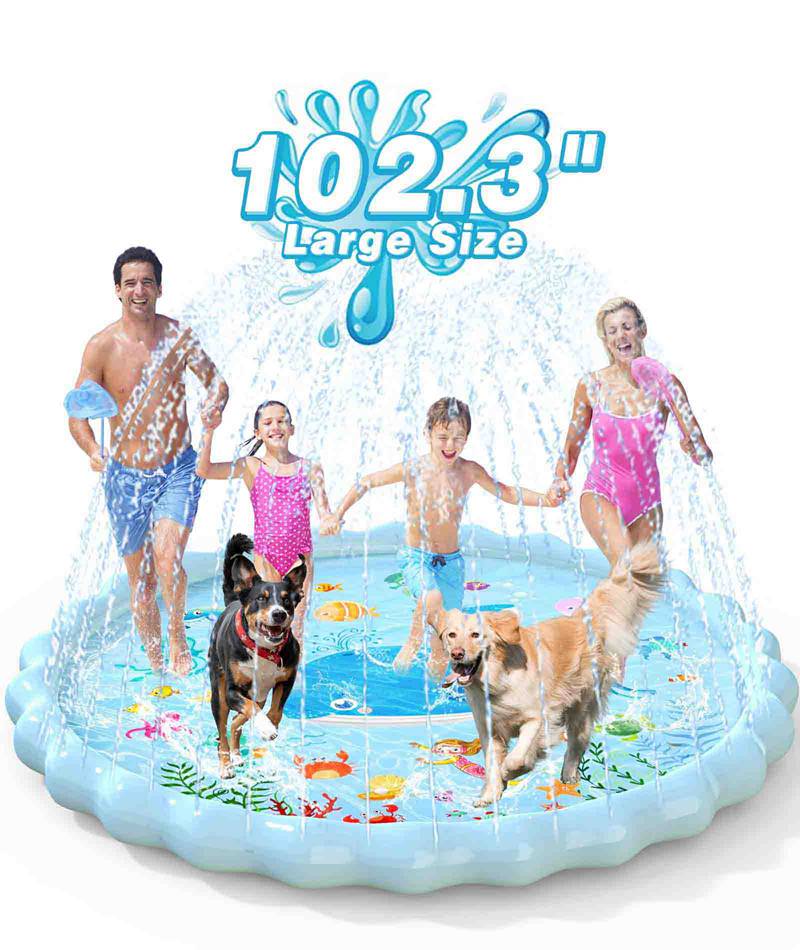
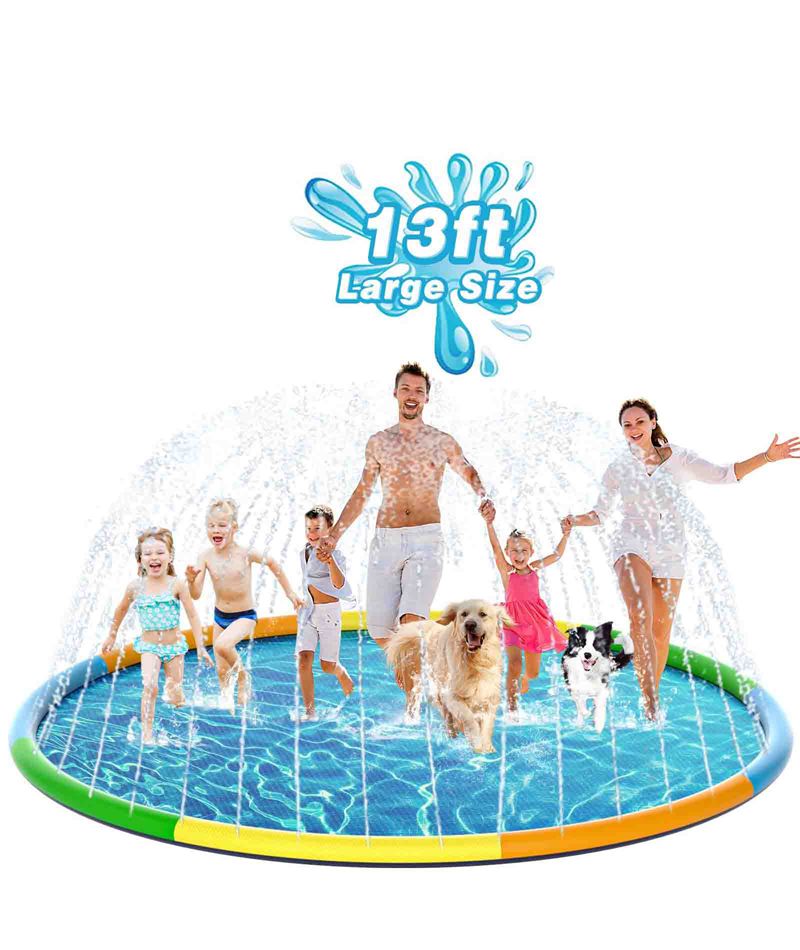
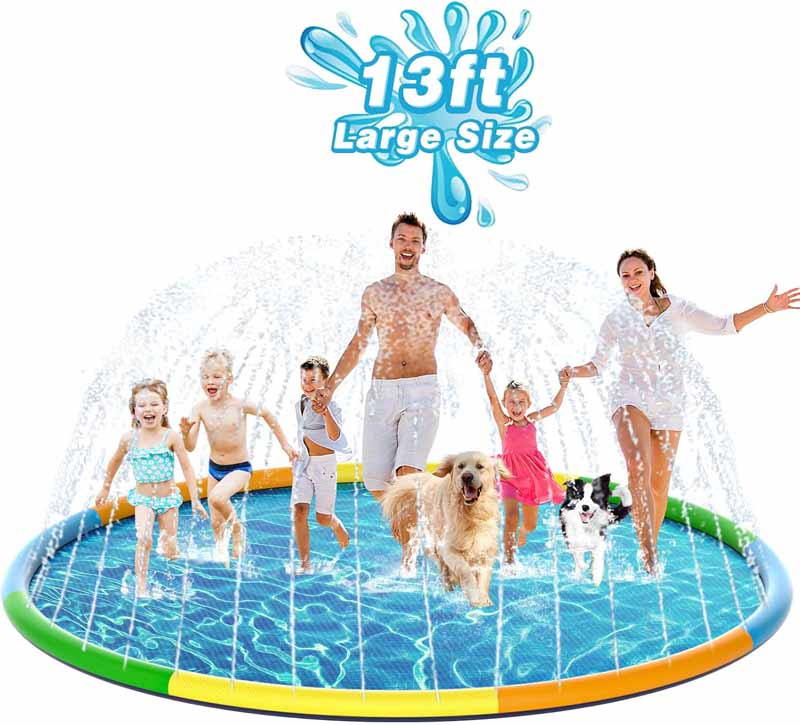
When several children play together, usable coverage is usually more valuable than one exceptionally tall stream. A single central jet can become a crowding point because everyone has to approach the same location. Wider patterns or several activity zones allow children to spread out and move through the water from different directions.
Different sprinkler styles encourage different behavior:
| Spray Style | Typical Play Pattern | Where It Often Works Well |
|---|---|---|
| Perimeter jets | Stepping, circling, gentle water play | Younger children and calmer play |
| Multi-point splash zone | Free movement around a wide area | Several children sharing one space |
| Run-through arch | Repeated movement through a defined lane | Active family play |
| Rotating spray | Chasing and dodging | Children who enjoy unpredictable movement |
| Basketball or target spray | Turn-taking and simple games | Small groups and party activities |
| Central fountain | Running around one focal area | Open lawns with good clearance |
This table describes play behavior rather than formal capacity. Actual suitability depends on product dimensions, age guidance, spray reach, and the amount of open space surrounding the sprinkler.
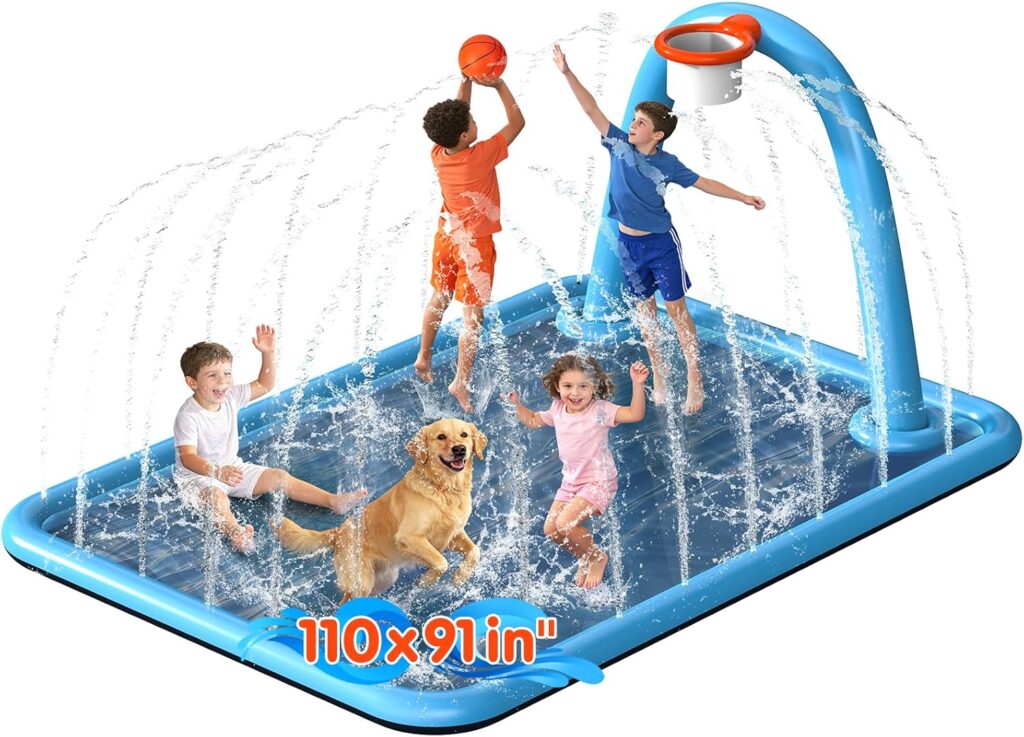
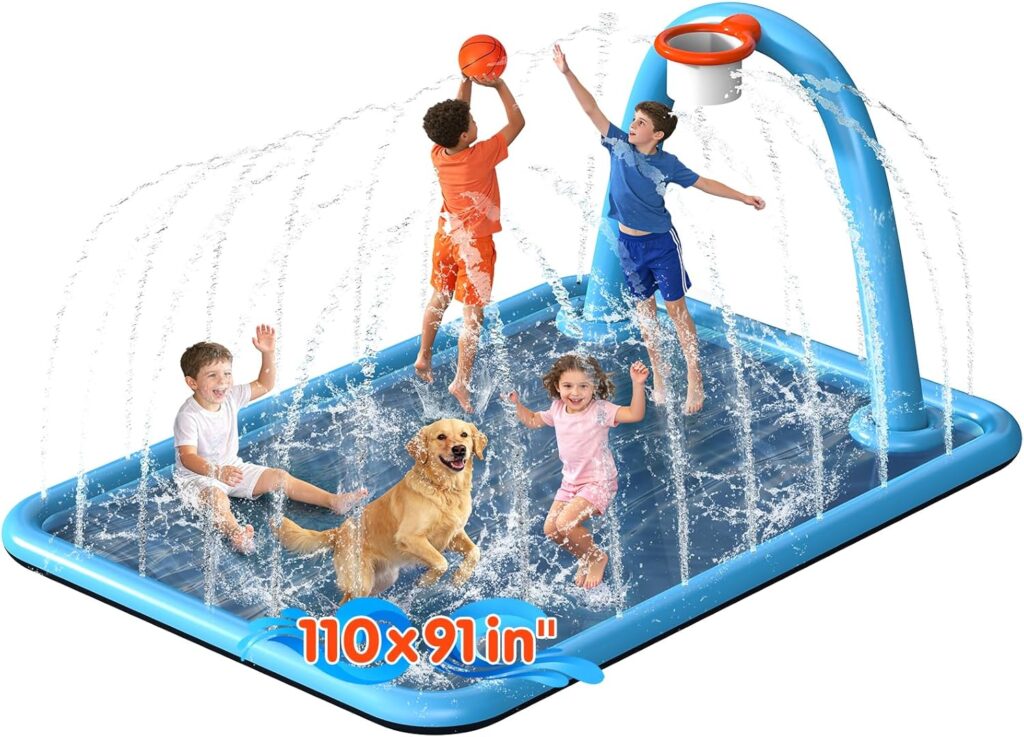
Group play becomes easier when the design gives children more than one reason to move. A basketball sprinkler can create a shooting area while other children retrieve the ball or play around the spray. A splash pad can allow several children to approach from different sides. An arch creates a natural route through the structure rather than bringing everyone into one small circle.
The strongest group designs therefore do not simply increase the number of spray holes. They organize the activity. Children should be able to understand where to run, where to stand, and how to participate without constantly competing for the same wet spot.

Do More Spray Holes Mean Better Performance?
Not necessarily. The number of spray holes is only one part of the water-distribution system. Hole diameter, outlet angle, internal channel width, product shape, inlet location, and available flow all influence how much water reaches each point.
Adding many outlets without considering the available flow can produce weak or uneven spray. Water may leave strongly from the openings nearest the inlet while distant holes perform less effectively. The opposite problem can occur when a product uses only a few very small openings: individual jets may become sharper and more concentrated than families expect.
The shape of an inflatable sprinkler also affects distribution. Water moving around a circular splash-pad ring behaves differently from water moving up a tall arch or through a long decorative structure. Corners, narrow sections, changes in chamber width, and distance from the inlet can all influence the pattern.
This is one area where manufacturing experience matters more than a simple marketing number. During custom development, EPN can adjust outlet spacing, direction, water-channel geometry, and structural shape together rather than treating the number of spray holes as an isolated feature.
For consumers, counting holes is rarely helpful. A better visual test is whether the sprinkler produces a balanced active zone without large dead areas or a few unexpectedly harsh streams. Even distribution and comfortable play matter more than the highest outlet count printed in a product description.
How Do Materials Affect Durability?
Material selection affects flexibility, puncture resistance, seam performance, printing, folding, and how a sprinkler handles repeated wet-and-dry use. PVC thickness can be useful information, but it is not a complete measure of durability. Long-term performance also depends on welded seams, reinforced stress points, valves, hose connections, structural geometry, ground conditions, and how the product is dried and stored after use.
Which Materials Handle Outdoor Use Better?
Flexible PVC is widely used in inflatable water-play products because it can form sealed air or water chambers, accept colorful printing, fold into compact packaging, and be welded into shapes ranging from flat splash pads to large arches and animal-style sprinklers. Those properties make it practical for seasonal backyard products that need to balance flexibility, visual design, weight, and storage.
The important point is that the material should match the structure. A low-profile splash product experiences different stresses from a tall inflatable arch. A basketball sprinkler adds a raised component that may place more load around attachment points. A decorative animal shape can contain narrow transitions or elevated sections that require different structural support than the flat base below it.
This is why a single material-thickness number should not be treated as a complete quality ranking. A heavier film changes product weight, folding behavior, manufacturing conditions, packaging volume, and cost. Using more material everywhere does not automatically solve problems caused by poor geometry, weak attachment points, or an inadequately supported inlet.
From a product-development perspective, material selection should follow the expected loads and play pattern. Ground-contact areas, water chambers, tall air chambers, attachment points, and decorative sections may all have different functional demands even though they belong to the same sprinkler.
Consumers may not see those decisions when looking at a finished product, but they experience the result through how well the sprinkler stands, folds, resists ordinary contact with the lawn, and maintains its shape throughout repeated use.
How Do Seams and Connectors Affect Leaks?
Stress in an inflatable sprinkler is rarely distributed perfectly evenly. Areas where the structure changes direction or components join together often deserve more attention than the middle of a large flat PVC panel. Common examples include welded corners, air valves, hose inlets, raised attachments, handles, decorative features, hoop supports, and transitions between a wide base and a narrower upright section.
The hose connection is especially important because several forces meet there. The user twists the fitting during installation, the filled hose adds weight, the hose may move as children run nearby, and water pressure acts from inside the product. If the surrounding structure does not support those loads properly, a small area can experience far more stress than the rest of the sprinkler.
Welded seams must also be consistent. The goal is not simply to create the widest possible weld. Shape, placement, transition geometry, and the direction of the load all matter. A well-positioned seam can distribute force smoothly, while a poorly planned corner can concentrate stress at one point.
Useful quality-control checks can include inflation observation, leak inspection, water-flow testing, visual seam review, repeated setup and deflation, and evaluation of high-stress connection areas. These practical tests reveal more about the finished product than a material specification considered alone.
For families, the lesson is simpler. Look carefully around valves, inlets, attachments, and seams when inspecting a sprinkler because these locations usually work harder than decorative areas that experience little structural loading.
What Material Details Should Buyers Compare?
Consumers and sourcing teams often see material descriptions that sound impressive but provide limited context. “Thick PVC,” “heavy duty,” and “reinforced” can be useful when they describe a real construction choice, but those terms do not by themselves explain how the entire product will perform.
A more practical comparison looks at several details together:
| Product Detail | What It Can Tell You | What It Cannot Prove by Itself |
|---|---|---|
| PVC material specification | Basic information about the film or construction | Overall product durability |
| Reinforced hose area | Added support at a common stress point | Quality of all other seams |
| Separate air chambers | How the structure is divided and supported | That every chamber will behave equally |
| Repair patch included | Minor punctures may be repairable | That punctures cannot occur |
| Fabric reinforcement | Added abrasion resistance in selected areas | That all inflatable parts are protected |
| Welded seams | A standard construction method for many inflatables | Consistency without inspection or testing |
Printing and surface finish can also matter in real use. A large inflatable product may be folded repeatedly along graphic areas, exposed to wet grass, handled with sunscreen-covered hands, and used in strong sunlight. Appearance over time depends on more than whether the air chamber remains functional.
For private-label development, it is therefore more useful to ask how the material, seams, printing, connections, and structure have been tested together than to focus on one specification. The same principle helps consumers evaluate marketing claims: construction details are more meaningful when they explain a practical benefit rather than simply adding another superlative.
EPN’s custom PVC water-product development can address material choice, structural geometry, printing, water distribution, and packaging together, which is more useful than changing only the artwork on an existing sprinkler shape.

What Causes Early Wear?
Some early wear comes from product defects, but ordinary handling can also shorten the useful life of a sprinkler. One of the easiest ways to damage flexible material is dragging it across concrete, rough paving, sharp gravel, or garden edging. A product that is designed for use on a lawn may experience very different abrasion when repeatedly pulled across a hard patio.
Small stones, sticks, pet claws, metal garden hardware, and sharp mulch can also create punctures. These hazards are easy to overlook because many are hidden underneath the product after it has been positioned. Checking the area before setup protects both children and the bottom surface of the sprinkler.
The hose connection is another common stress point. Pulling the entire sprinkler into position by the attached hose transfers the force directly into the inlet. It is better to move the product itself and let the hose follow without tension.
Storage habits matter as well. Folding a sprinkler while moisture remains trapped between layers can create odor, staining, or residue. Repeatedly forcing extremely tight creases into the same areas may also be harder on flexible material than folding it naturally.
A practical care routine includes:
- Clear the ground before setup.
- Carry the sprinkler instead of dragging it.
- Avoid moving the product by pulling the garden hose.
- Begin with moderate water flow and increase only as needed.
- Drain internal water after play.
- Let hidden folds and seams dry before packing.
- Avoid forcing sharp creases during storage.
- Keep the product away from sharp tools and unnecessary long-term heat exposure.
Good engineering should make these habits easier. Accessible valves, sensible drainage paths, stable connection points, and a foldable shape reduce the amount of effort families need to care for the product correctly.
How Easy Should Setup Be?
A kids sprinkler should be simple enough that setup and cleanup do not become barriers to regular use. Basic models may only need positioning and a garden-hose connection, while larger inflatable designs require additional inflation. Good usability comes from accessible valves, straightforward fittings, predictable water adjustment, effective drainage, reasonable drying effort, and a structure that can be stored without unnecessary difficulty.
Do Hose Connections Fit Easily?
The hose connection is a small part of the sprinkler, but it has a large effect on everyday usability. A good fitting should align naturally, tighten without excessive force, seal correctly, and remain accessible after the product is fully positioned. When a connector is hidden underneath a large inflatable section or requires awkward twisting, setup becomes more frustrating than it needs to be.
Plastic fittings should be aligned carefully before tightening. If the connector immediately feels crooked or unusually resistant, forcing it can damage the threads. Where a washer or gasket is included, it should sit properly because the seal may be just as important as the threaded connection itself.
Inlet location also influences hose routing. A connector placed toward the side or rear of the play structure often allows the hose to leave the active zone more naturally. One facing into the main running area can create unnecessary interference with children’s movement.
Independent sprinkler testing has shown that these small usability differences are noticeable in practice. BabyGearLab found simple screw-on designs among the easiest products to prepare, while some inflatable models required additional setup steps. Their testers also encountered one hose connection that was difficult enough to remove that tools were needed.
For custom product development, connection placement should therefore be considered during structural design rather than added as an afterthought. The ideal fitting does its job so smoothly that families hardly notice it.
How Fast Should Setup and Drainage Be?
There is no single ideal setup time because sprinkler types serve different purposes. A compact sprinkler intended for short weekday play should be quick to prepare. A large inflatable arch or game-based structure used for weekend gatherings may reasonably require more inflation and positioning because it creates a larger play environment.
The useful question is whether the effort feels proportionate to the experience. A small ground sprinkler may only require placement, hose connection, and water adjustment. A tall inflatable product may require an air pump, separate chamber inflation, positioning, connection to the hose, and final water adjustment before children can begin playing.
Cleanup should be evaluated the same way. Water remaining inside a large inflatable structure can add considerable weight, which makes poor drainage frustrating. Families should not have to lift, shake, and repeatedly reposition a heavy wet product simply because water has no practical route out.
Accessible air valves, clear separation between air and water sections, and sensible drainage paths all improve the full ownership experience. A product can be very entertaining once assembled and still become unpopular if parents know they will spend a long time putting it away afterward.
This is one reason simpler products sometimes receive more regular use even when they have fewer decorative features. Convenience affects frequency. A sprinkler that can realistically be set up on an ordinary afternoon may deliver more value over the summer than a much larger design that only comes out for special occasions.

How Should a Sprinkler Dry and Store?
Drying begins before the product is folded. After play, disconnect the hose and allow water to leave the internal channels as fully as the product design permits. Deflate the appropriate air chambers according to the instructions, and reposition larger products if necessary so water trapped in low sections, folds, or around valves can escape.
An inflatable can appear dry on the visible outer surface while moisture remains between overlapping layers. Laying the product out on a clean surface and exposing both sides to moving air helps reduce trapped moisture. Complex shapes may need to be turned because raised sections and recessed folds can retain water longer than flat areas.
Proper drying is not only about structural durability. Moisture sealed between folded layers can create unpleasant odors, marks, or surface residue that make the product less appealing the next time it is opened.
Storage should also protect valves, fittings, and folded material. Avoid placing heavy or sharp objects directly on top of the sprinkler. The goal is compact storage, not maximum compression. Forcing a complex inflatable into an unnecessarily tiny package can create sharp creases around valves or structural transitions.
If the product includes repair patches, adapters, plugs, or other small accessories, storing them with the sprinkler is useful. Families often need those parts months later, when remembering where a tiny repair patch was placed becomes much harder than repairing the actual puncture.
Does More Complicated Mean Higher Quality?
No. Complexity and quality are different things. A large inflatable animal with several chambers, game features, and multiple spray zones may be an excellent product, but every extra chamber, attachment, valve, and structural transition also creates another part that must be manufactured, tested, dried, folded, and stored properly.
Additional features are worthwhile when they improve the experience. A separate support chamber may help a tall arch remain upright. A basketball hoop creates a repeatable game rather than simple standing under water. A wider base can improve stability. Several well-positioned spray zones may allow children to spread out instead of crowding together.
Complexity adds less value when the feature mainly makes the product look larger in a photograph. A decorative inflatable extension that children never interact with still increases material and introduces additional seams. A complicated chamber that traps water may make cleanup harder without improving play.
Experienced product development often involves removing unnecessary elements as well as adding new ones. The most useful question for each feature is whether it improves play, stability, spray behavior, convenience, or durability.
For families, that same test works when comparing products online. A simpler sprinkler with balanced spray, a reliable connection, good drainage, and easy storage can be a better choice than a feature-packed design that requires far more work without giving children a meaningful new activity.
Which Size and Design Fit Best?
The right sprinkler size depends on yard space, child age, number of users, spray reach, hose placement, and the movement encouraged by the design. Product dimensions alone do not show how much space a family needs. Children normally move beyond the physical footprint, so the real setup should include room for water coverage, running paths, obstacles, supervision, and entering or leaving the play area.
How Much Yard Space Do You Need?
The physical dimensions shown on a product page are only one part of the space calculation. A sprinkler that measures several feet across does not keep all of its water or activity inside that footprint. Jets extend beyond the edge, children run outside the wet area, and the garden hose needs to reach the product without cutting through the busiest route.
A useful way to evaluate a backyard is to think about four overlapping areas: the product footprint, the spray zone, the children’s movement area, and the surrounding space needed for the hose and adult supervision. The amount of room required depends heavily on the style of sprinkler, which is why a single clearance number is not appropriate for every design.
A compact splash-style product encourages different movement from a spinning sprinkler. An arch creates repeated movement through a lane. A basketball sprinkler adds ball retrieval and side-to-side motion. A tall inflatable character can send water well outside the dimensions of its base.
Before buying, families can mentally place the product in the intended location and look beyond the empty patch of grass. Consider fences, steps, patios, furniture, grills, trees, garden borders, play equipment, and doors. Also think about where the hose will run and where an adult can stand or sit while still seeing the whole active area.
A smaller product with comfortable clearance can create better play than a larger design squeezed into an unsuitable yard. The best size leaves room for the activity, not merely room for the inflatable itself.
Which Size Fits One Child or a Group?
Size should be chosen according to usable play space rather than the largest advertised dimension. A huge sprinkler may add unnecessary inflation, drying, and storage effort for one young child. When several children play together, however, a narrow active zone can lead to crowding because everyone repeatedly moves toward the same spray.
Different play situations tend to favor different layouts:
| Play Situation | Useful Design Direction | Main Space Consideration |
|---|---|---|
| One younger child | Compact, gentle spray zone | Easy supervision and simple access |
| Two children | Wider perimeter or multi-jet layout | Room to move beside each other |
| Small group | Multi-zone splash or arch design | Access from more than one direction |
| Mixed ages | Adjustable flow and varied play areas | Different comfort levels within one setup |
| Party use | Larger interactive structure | Generous surrounding clearance |
| Compact yard | Controlled, lower-profile spray | Limit overspray and hose interference |
| Open lawn | Wider spray or run-through play | Use available space for movement |
These are design principles rather than occupancy ratings. The actual number of users should remain consistent with the manufacturer’s instructions and the amount of space available.
Shape can matter as much as total area. A circular splash zone lets children approach from several directions. An arch organizes movement through a defined route. A basketball feature creates a focal game and changes where children stand. A rotating sprinkler may require more open space because its water movement is less predictable.
Families should think about the most common situation rather than the biggest party they might host once a year. A product that suits normal family play will usually be used more often than an oversized model chosen primarily for occasional gatherings.

Are Interactive Features Worth Choosing?
Interactive features can be valuable when they give children something meaningful to do after the novelty of running through water fades. A basketball hoop introduces aiming, scoring, turn-taking, and ball retrieval. An arch creates a repeated run-through challenge. Targets can turn spray into a game, while several water zones encourage children to explore different parts of the product.
The feature needs to fit the intended users. A hoop placed too high for younger children may look attractive in product photography without adding much real play value. An arch should provide appropriate space for the intended age group. A target needs to be positioned where children can realistically use it.
Interactive features also affect product structure. A raised hoop adds weight and leverage above the base. A tall arch needs enough support to remain upright. Decorative shapes introduce additional welded areas, while water outlets need to be positioned so they support the activity rather than constantly spraying children in the face while they try to play the game.
This is where thoughtful customization can make a product genuinely different rather than simply visually different. EPN can adjust dimensions, structure, spray placement, colors, graphics, activity features, and packaging around a defined use case. A basketball sprinkler for younger children, for example, does not have to use the same proportions and water behavior as one designed for older children.
The best interactive feature earns its place by creating repeatable play without making the basic sprinkler harder to set up, less stable, or unnecessarily difficult to store.
Does Bigger Always Mean Better?
Bigger creates visual impact, but it also brings trade-offs. Larger inflatable products normally contain more material and air volume, occupy more storage space, need more room to dry, and may include more seams and structural transitions. These disadvantages can be perfectly acceptable when the additional size creates useful play space for several children.
The problem appears when size becomes the goal rather than the result of a clear use case. A huge sprinkler placed in a small yard may force families to reduce water flow to control overspray, move furniture every time they use it, or route the hose through an awkward area. The impressive dimensions then make the product less convenient rather than more enjoyable.
Large structures can also change the setup routine. More air volume means longer inflation unless an appropriate pump is used. More surface area means more material to dry before storage. A complex shape may take longer to deflate and fold than a low-profile splash product.
That does not make large sprinklers a poor choice. They can be ideal for open lawns, groups of children, parties, and activities that depend on tall arches or large game features. The point is that size should follow the intended experience.
A compact sprinkler that comes out several times during a week can provide more practical family value than an enormous product used once because preparation feels inconvenient. On the other hand, a family that regularly hosts several children may find a larger multi-zone design much more useful. The right size is the one that fits how the sprinkler will actually be used.
A good kids sprinkler is easy to understand once children start playing with it. They do not think about water-channel geometry, seam placement, inlet reinforcement, or storage design. They simply notice whether the spray feels good, whether they can move freely, whether there is something fun to do, and whether they want to play again.
Parents experience the product differently. They notice whether it stays in place, whether the hose is easy to connect, whether water intensity can be adjusted, how much room it takes up, and whether putting it away feels manageable. Those practical details often determine whether a sprinkler becomes a regular part of summer or remains folded in storage.
That is why the most important features work together rather than competing for attention. Age suitability, comfortable spray, balanced coverage, stable construction, appropriate materials, reliable fittings, sensible dimensions, useful interactive features, and straightforward cleanup all contribute to the same goal: water play that fits naturally into family life.
For product developers and retailers, the same principle applies. Start with the people and the activity rather than the longest feature list. Decide who will use the sprinkler, what they should be able to do with it, where it will normally be used, and how it will be set up and stored. Then build the materials, structure, water distribution, and interactive elements around that experience.
Frequently Asked Questions
What is the most important feature in a kids sprinkler?
There is no single feature that matters in every situation, but age-appropriate spray behavior and stable construction are good places to start. A sprinkler should create water children can comfortably approach while remaining stable on the intended surface. Adjustable flow, reliable hose connections, adequate play space, and simple setup become important immediately afterward because they affect how easily the product fits into everyday family use.
Are inflatable sprinklers better than regular kids sprinklers?
Inflatable sprinklers are not automatically better, but they can create larger arches, animals, sports features, and other interactive structures that are difficult to make with simple rigid sprinklers. The trade-off is additional inflation, drying, and storage. A basic hose-connected sprinkler may be better for frequent short play sessions, while an inflatable design may offer more activity for groups, parties, or themed backyard play.
How much water pressure does a kids sprinkler need?
There is no single pressure setting that suits every kids sprinkler because products and household water systems differ. Follow the manufacturer’s instructions, start with a lower faucet setting, and increase the flow gradually until the product creates comfortable coverage. If the spray feels harsh, reaches far beyond the intended area, or causes the structure to behave unusually, lowering the flow may provide a better experience.
What material is commonly used for inflatable kids sprinklers?
Flexible PVC is commonly used because it can form sealed inflatable and water-carrying structures, accept colorful graphics, and fold for storage. Material specification alone does not determine durability. Weld quality, valves, hose inlets, structural shape, ground contact, and care after use also affect performance. Consumers should therefore consider the complete construction rather than relying only on claims such as “thick” or “heavy duty.”
How big should a sprinkler be for several children?
Look at usable activity space rather than choosing by diameter or height alone. Several children benefit from designs with more than one approach point, such as broad splash zones, arches, or interactive layouts. The surrounding yard also needs enough open space for children to move beyond the physical product. Manufacturer guidance, product dimensions, spray reach, and the actual backyard layout should all be considered together.
Are basketball hoops and other sprinkler game features worth it?
They can add meaningful value when they create a game children can repeat. A basketball hoop introduces aiming, scoring, retrieving, and turn-taking, while an arch encourages repeated movement through the spray. Interactive features are less useful when they mainly add visual complexity or make the structure unstable. The strongest features add play without making setup, drainage, or storage noticeably more difficult.
How should a kids sprinkler be stored after use?
Disconnect the hose, allow internal water to drain, deflate the appropriate chambers according to the instructions, and let the product dry before folding it. Pay attention to seams, valves, and overlapping areas where moisture can remain after the outer surface appears dry. Store the sprinkler away from sharp objects and avoid crushing valves or connectors under heavy items. Keep repair accessories with the product so they remain easy to find.