Skip to content
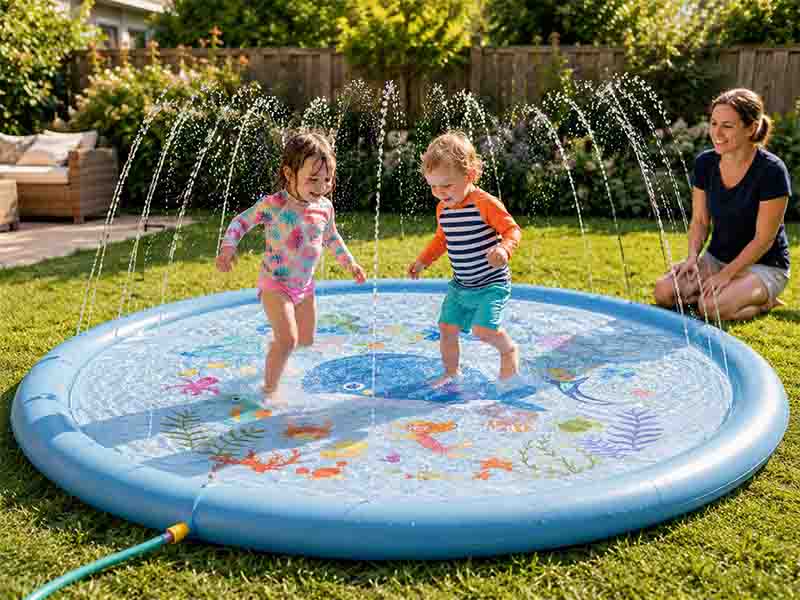
A kids splash pad is often judged by size, color, cartoon graphics, or whether the water looks high in photos. Parents usually notice the spray pattern only after the hose is connected. That is when the real experience begins. One pad may create a soft ring of water that children run through happily. Another may shoot water into a toddler’s face, spray too far outside the play area, or leave half of the mat almost dry.
Spray pattern matters because it decides how water moves across the splash pad, how comfortable children feel, how much of the play area is actually usable, and how evenly water pressure is released through the edge. A well-designed spray pattern helps create softer water contact, better center coverage, safer movement, lower pressure stress, and a more enjoyable backyard play experience.
For families, the spray pattern can decide whether a splash pad becomes a favorite summer activity or something that stays folded in the garage. For retailers and private-label teams, it can affect customer reviews, return rates, product complaints, and repeat seasonal sales.
The difference may look small on a product page, but it becomes obvious in the backyard. A child steps onto the mat, waits for the water to rise, and reacts within seconds. If the spray feels friendly, they move closer. If it feels sharp, loud, or unpredictable, they step away. That first reaction is why spray pattern deserves attention before the first play day begins.
What Makes Spray Pattern Fun?
A fun spray pattern gives children water they can see, chase, touch, run through, and sit near without feeling overwhelmed. It should create movement around the splash pad, keep the center play area wet, and let parents control the spray height through hose pressure. The best spray pattern feels exciting to kids but still calm enough for parents to trust.
Why Spray Pattern Feels Better
For children, water play is not only about getting wet. It is about how the water feels when it touches the skin, how predictable the spray looks, and whether the child feels confident enough to move closer. A splash pad with a soft, even spray pattern usually feels more inviting than one with sharp, random jets.
Toddlers and younger children are especially sensitive to spray direction. Water that looks low to an adult may reach a toddler’s face or chest. If the spray shoots too directly into the eyes, the child may step away, cry, or avoid the splash pad completely. A better spray pattern rises from the outer ring and falls gently toward the center, giving children the choice to sit, stand, crawl, or run through the water.
Spray height should match the child’s age and confidence level. For many younger children, a lower spray height of about 6–14 inches is enough to create fun without pressure. Preschool children may enjoy around 12–24 inches when the water remains soft. Older children may prefer a more active spray, often around 18–36 inches, as long as the water does not blast sideways or land far outside the pad.
| Child Age | Better Spray Feeling | Practical Spray Height |
|---|---|---|
| 1–2 years | Soft, low, and gentle | 6–10 inches |
| 2–4 years | Light inward spray | 8–18 inches |
| 4–6 years | More active but controlled | 12–24 inches |
| 6–8 years | Higher and more energetic | 18–36 inches |
| Mixed ages | Start low, increase slowly | Based on youngest child |
A good spray pattern gives children room to decide how brave they want to be. That small feeling of control often keeps them playing longer.
For EPN kids splash pads, spray comfort is not treated as a visual effect only. It connects with PVC flexibility, welded edge structure, spray-hole placement, and hose connector design. These details work together to create a water pattern that feels soft enough for family use but active enough for summer play.
How Spray Pattern Creates Play
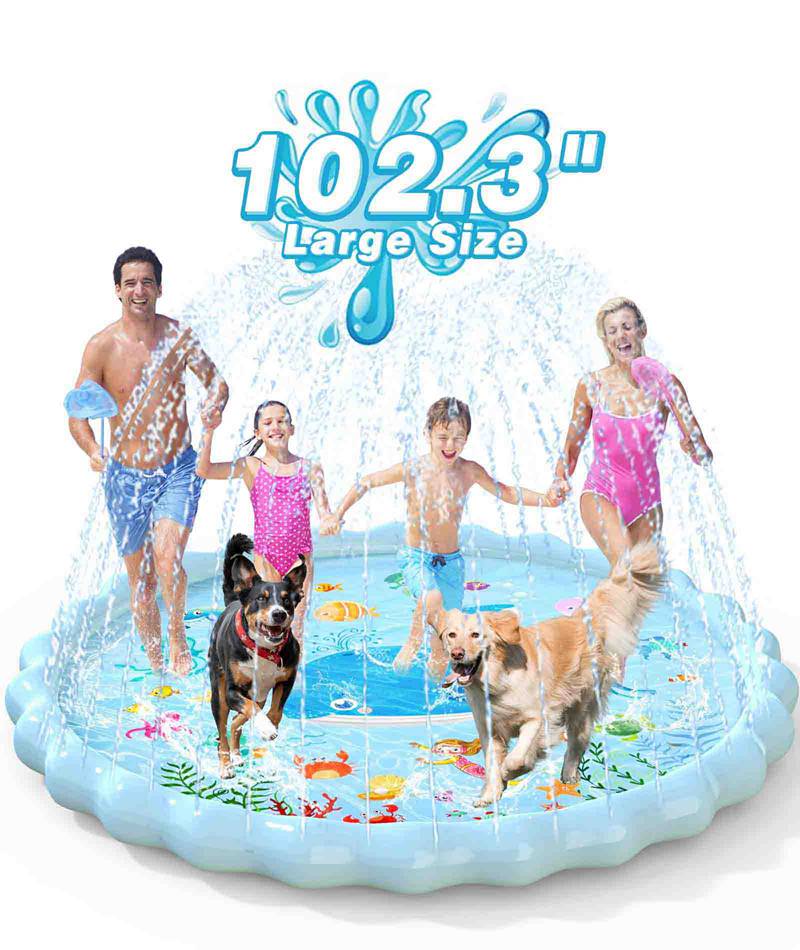
A kids splash pad becomes more fun when the spray pattern creates different play zones. Children do not all play the same way. Some sit in the middle and splash with their hands. Some run around the edge. Some jump through the water streams. Some bring small cups, floating toys, or summer balls into the play area.
If the spray only works strongly on one side, children naturally gather in that area. The pad may look large, but the usable play space becomes much smaller. This can be frustrating when two or more children are playing together. One child may block the best spray area while another gets very little water.
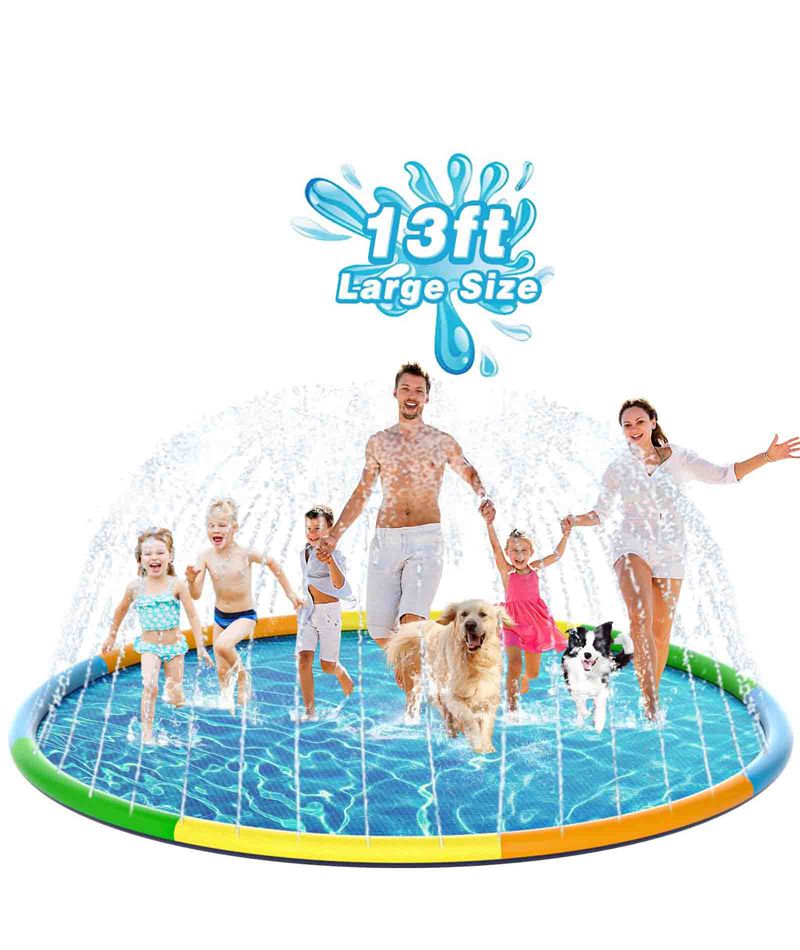
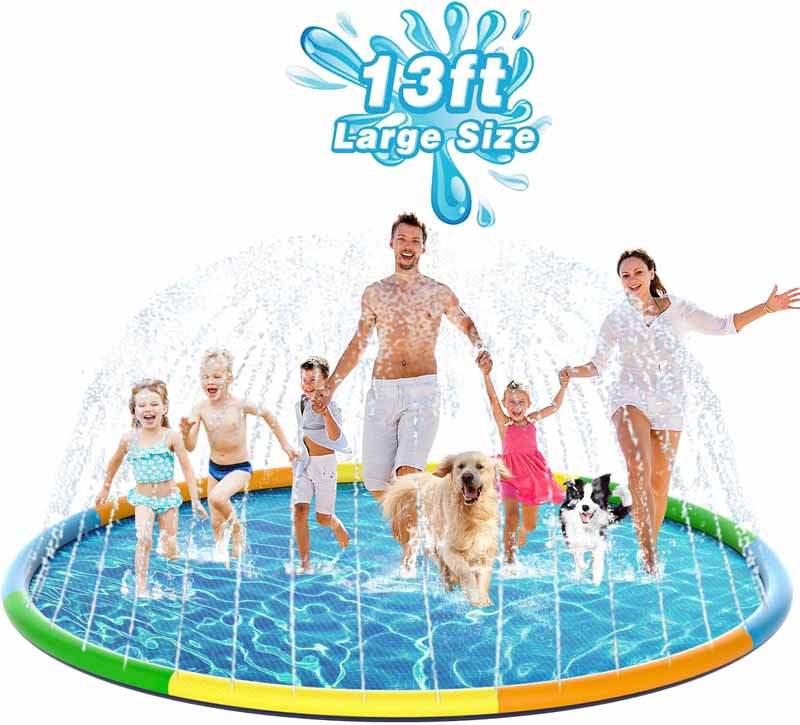
A full-edge spray pattern creates a better play rhythm. Water comes from the outside, falls toward the center, and gives children more ways to interact with it. The outer ring becomes the running path. The falling water becomes the chasing area. The center becomes the sitting and cooling zone.
| Splash Pad Area | How Kids Use It | What the Spray Pattern Should Do |
|---|---|---|
| Outer edge | Run, step, circle, and enter | Stay stable without harsh side spray |
| Falling spray zone | Reach, jump, chase, and laugh | Create soft moving water |
| Center area | Sit, crawl, splash, and cool down | Stay wet without deep puddles |
| Hose side | Parent adjusts water flow | Avoid strong connector-side blasting |
This is why spray distribution matters as much as splash pad size. A 68-inch pad with weak water coverage may feel less useful than a smaller pad with a cleaner spray pattern. Parents are not only buying diameter; they are buying active play space.
Parents comparing material, structure, and water performance can also read what material is best for a splash pad before choosing a PVC water mat for summer use.
When Spray Pattern Gets Too Strong
A strong spray pattern may look exciting in a product photo, but it can be too much in real backyard use. Children may not enjoy water that hits their face, sprays into their ears, or lands outside the mat. Parents may also notice water wasting quickly, soaking nearby patio areas, or making the ground around the pad slippery.
The most common cause is opening the faucet too much at the start. When the hose sends water into the edge ring too quickly, the spray may jump higher than needed before the pad settles into a stable shape. If the water is landing outside the splash pad, the pressure is usually too high for comfortable play.
A fun spray pattern should be adjustable. Parents should be able to begin with low pressure, let the child watch the water rise, and increase the flow only when the child feels ready. This is especially important for first-time use. A child who gets surprised by strong spray in the first minute may be harder to bring back to the pad later.
Signs that the spray pattern is too strong include:
- Children covering their face or stepping away
- Water landing far outside the splash pad
- One side spraying much higher than the rest
- The edge ring feeling overly tight
- The play surface becoming slick too quickly
- Younger children avoiding the center area
The goal is not to create the tallest spray possible. The goal is to create the right amount of water for the child using it. A controlled spray pattern keeps the fun active without making the play area feel chaotic.
How Does Spray Pattern Affect Safety?
Spray pattern affects safety because it changes how water lands, how children move, where puddles form, and how easy it is for parents to watch the play area. A safer spray pattern should be gentle, even, inward-facing, and adjustable. It should avoid sharp face-level jets, sudden water bursts, slippery uneven wet zones, and strong spray that pushes children away from the center.
How Spray Pattern Controls Splash
Splash control is one of the most overlooked safety details in a kids splash pad. Parents may focus on material thickness or product size first, but once the hose is turned on, the way water moves becomes just as important.
A controlled spray pattern sends water upward from the outer ring and lets it fall inward toward the center. This keeps most of the water inside the play area and makes the splash zone easier to understand. Children know where the water is coming from, and parents can clearly see where children are standing, sitting, or running.
When the spray pattern is poorly controlled, water may shoot sideways, land outside the pad, or hit children directly in the face. This can create two problems at the same time. First, children may feel surprised or uncomfortable. Second, the wet area expands beyond the splash pad, making nearby grass, patio, or walkways slippery.
For younger children, face-level spray is one of the biggest comfort and safety concerns. A toddler may be only 30–38 inches tall, so water that looks medium height in a product photo may reach the child’s face in real use. If the spray keeps hitting the eyes, nose, or ears, the child may cover their face, turn quickly, or step backward without looking.
| Safety Point | Better Spray Pattern | Risky Spray Pattern |
|---|---|---|
| Water direction | Falls inward toward the center | Shoots outward or sideways |
| Spray feeling | Soft and steady | Sharp, sudden, or uneven |
| Child reaction | Moves closer with confidence | Steps back, covers face, or avoids water |
| Wet area | Mostly stays inside the pad | Spreads to nearby walking areas |
| Parent view | Easy to see child movement | Hard to track through scattered spray |
A good kids splash pad does not need to create the highest spray possible. It needs to create water that children can enjoy without feeling pushed, startled, or blinded by the spray.
Why Spray Pattern Reduces Surprise
Children often lose balance when they react suddenly. In splash pad play, surprise usually comes from water that is too strong, too sharp, or too unpredictable. A spray jet that shoots higher than the rest may cause a child to twist away quickly. A sudden burst near the hose side may make a toddler step back without checking their footing.
A safer spray pattern reduces surprise by making the water behavior predictable. Children can see the ring of water, understand the direction, and decide how close they want to get. This is especially important for children who are new to water play or sensitive to water on the face.
Predictability also helps parents. When the spray height and direction remain steady, parents can focus on child movement instead of constantly adjusting the hose or moving children away from strong water zones.
Water pressure changes can happen during normal backyard use. A long hose, a bent hose, a faucet opened too quickly, or changes in household water flow can all affect spray height. A well-balanced spray-hole layout helps reduce sudden changes because water pressure is released through many points around the edge rather than a few overloaded holes.
| Child Reaction | What It May Mean | Parent Response |
|---|---|---|
| Smiling and moving closer | Spray feels comfortable | Keep pressure steady |
| Covering eyes or face | Spray may be too high or direct | Lower water pressure |
| Running away from one side | One spray zone may be too strong | Check spray balance |
| Sitting only in dry areas | Center coverage may feel weak or uneven | Adjust pressure slowly |
| Slipping while turning | Water may be pooling unevenly | Pause and check surface |
| Avoiding the pad after first contact | Spray may feel too sudden | Restart at lower pressure |
A safe first minute matters. Parents should not turn the faucet fully open while children are already standing on the pad. A better routine is to start the water low, let the edge fill, watch the spray pattern stabilize, and then invite children to step in.
When Spray Pattern Causes Slipping
A splash pad is wet by design, so slipping risk can never be removed completely. However, spray pattern can make the surface easier or harder to manage.
The biggest issue is uneven water distribution. If one side sprays strongly and another side stays weak, the play surface may develop wet and dry patches. Children may run from a drier area into a slicker area and lose traction because the surface changes suddenly. Strong side spray can also push water quickly across the pad, making the center feel more slippery than expected.
Uneven puddling can also happen when the pad is placed on sloped grass or uneven ground. If the spray pattern sends more water to the lower side, children may gather there because it feels wetter and more fun. That area may then become crowded and slippery.
| Setup Surface | Safety Advantage | What to Watch |
|---|---|---|
| Flat grass | Softer underfoot and more forgiving | Remove sticks, stones, roots, and pet toys |
| Smooth patio | Easy to see debris | Can become slippery quickly |
| Concrete | Stable surface | Hard falls and faster water movement |
| Slight slope | Not recommended | Water collects on one side |
| Gravel or rough ground | Not recommended | High puncture and trip risk |
For most family use, flat grass is the better choice. It provides a softer base, helps water drain around the pad, and reduces the impact if a child sits or falls. Rough concrete, gravel, broken patio areas, exposed roots, and sharp mulch should be avoided.
Parents who are unsure about yard setup can read can you use a splash pad on grass before placing a PVC water mat on the lawn.

Group play brings more safety concerns than solo play. Two or three children may run in different directions, chase the same spray area, or sit close together in the center. The spray pattern can either spread them out or pull them into one crowded zone.
A splash pad with uneven spray often creates a favorite side. Children naturally move toward the strongest water area. This may look fun at first, but it can lead to crowding, pushing, sudden turns, and collisions. A full-edge spray pattern gives every side of the pad some water activity, which helps children move more evenly around the space.
For families with mixed ages, the youngest child should set the starting water pressure. Older children can handle more active spray, but toddlers may not. Starting low protects the younger child and gives parents time to see how everyone moves.
| Number of Children | Spray Pattern Need | Parent Focus |
|---|---|---|
| 1 child | Gentle center coverage | Comfort and confidence |
| 2 children | Even edge spray | Avoid crowding on one side |
| 3 children | Wider active area | Watch running and turning |
| Mixed ages | Adjustable low-to-medium spray | Youngest child first |
| Playdate use | Predictable full-edge pattern | Clear rules before play |
For retailers and custom product projects, this matters because families often buy splash pads for siblings, weekend playdates, daycare water days, or backyard parties. A product that looks fine for one child may not perform well when several children use it at the same time.
Which Spray Pattern Fits Kids?
The right spray pattern depends on a child’s age, height, balance, water confidence, and play style. Younger children usually need a lower and softer spray, while older children may enjoy higher and more active water movement. For most families, the best choice is an adjustable full-edge spray pattern that can start gentle and become more energetic as children feel comfortable.
Which Spray Pattern Fits Toddlers
Toddlers need a spray pattern that feels soft, low, and easy to approach. At this age, the goal is not big water height. The goal is comfort. A toddler may be only 30 to 38 inches tall, so water that looks moderate in a photo can easily reach the face, eyes, or ears in real backyard use.
For children around 1 to 3 years old, a lower spray height of about 6 to 14 inches is often enough to create fun. The water should rise from the outer edge and fall gently into the center. It should not shoot directly across the mat or blast upward in narrow, sharp streams.
Toddlers often sit, crawl, squat, or stand still in the center area. That means center coverage matters. If the middle of the splash pad stays dry, the child may not get much cooling effect. If the spray is too strong, the child may avoid the center completely. A good toddler-friendly pattern gives light falling water across the middle without creating deep puddles.
| Toddler Need | Better Spray Pattern | What Parents Should Avoid |
|---|---|---|
| Gentle first contact | Low inward spray | Sudden high spray |
| Face comfort | Soft falling water | Direct eye-level jets |
| Sitting play | Light center coverage | Dry center or deep puddles |
| Confidence building | Slow water increase | Full faucet pressure at start |
| Parent control | Adjustable hose pressure | Spray that only works when strong |
For toddler-focused splash pads, EPN pays attention to soft water feel, low-odor PVC options, smooth surface contact, and balanced spray-hole layout. The product should feel friendly from the first use, not only look colorful in packaging.
Which Spray Pattern Fits Preschool Kids
Preschool children are more active than toddlers but still need controlled water. They may run short distances, jump over small streams, sit in the center, or play with cups and floating toys. A spray pattern that is too weak may feel boring, but one that is too strong may still cause discomfort.
For children around 3 to 5 years old, a spray height of about 10 to 24 inches often works well. This range gives enough water movement for play without making the pad feel chaotic. The best pattern is a full-edge inward spray that lets children move around the whole pad instead of crowding near one strong spray area.
At this age, children begin to create games from water movement. They may chase the spray, pretend it is rain, run in circles, or sit under the falling water. A balanced spray pattern gives them more ways to play. When only one side sprays well, children naturally move toward that side, which reduces usable space and may cause bumping.
| Preschool Play Style | Spray Pattern Need | Better Product Detail |
|---|---|---|
| Running in circles | Even full-edge spray | Stable perimeter water flow |
| Sitting and splashing | Wet center area | Gentle inward spray angle |
| Playing with toys | Predictable water direction | No harsh side jets |
| Sibling play | Wider water coverage | Fewer weak spray zones |
| First-time water play | Lower starting pressure | Easy hose adjustment |
A preschool-friendly splash pad should feel lively but not overwhelming. The product should let children become braver gradually.
Which Spray Pattern Fits Older Kids
Older children usually want more energy from a splash pad. They may run faster, jump higher, and ask parents to turn up the water. For this age group, the spray pattern needs more coverage and stronger activity, but it still needs to stay controlled.
For children around 5 to 8 years old, a spray height of about 18 to 36 inches can make the splash pad feel more exciting. Some children may enjoy higher spray when the water pressure is strong, but taller spray is only useful if it still falls back into the play area. If water shoots outside the pad, it wastes water and makes the surrounding ground slippery.
Older kids also place more stress on the splash pad. They step harder, run more often, and may drag toys across the surface. This means the spray pattern should work together with stronger welded seams, stable PVC, and a reinforced connector area. If the spray holes release pressure unevenly, one part of the edge may become tighter than another, which can increase seam stress over time.
| Older Kid Need | Better Spray Pattern | Why It Matters |
|---|---|---|
| More excitement | Medium-to-high spray | Keeps play active |
| Running space | Full-edge coverage | Uses more of the pad diameter |
| Jumping play | Stable water direction | Reduces sudden surprise |
| Group play | Even spray zones | Helps spread children out |
| Repeat use | Balanced pressure release | Supports seam durability |
EPN splash pad development considers the difference between light toddler use and more active older-child play. A larger splash pad for older kids may need stronger edge structure, better pressure balance, and a spray pattern that can stay stable under higher water flow.
Which Spray Pattern Fits Mixed Ages
Many families do not buy a splash pad for only one child. Siblings, cousins, neighbors, and playdate friends may all use the same item. This is where spray adjustability becomes important.
For mixed-age play, the safest and most practical rule is to start with the youngest child. If a toddler is playing with older children, begin with low water pressure and let everyone adjust to the spray. The water can be increased slowly if the youngest child remains comfortable.
A mixed-age splash pad should not depend on maximum water pressure to work. It should create a visible spray at lower pressure and become more active as the faucet is opened further. This allows one pad to support different age groups without making younger children feel overwhelmed.
| Family Situation | Better Spray Pattern | Setup Advice |
|---|---|---|
| Toddler + older sibling | Low-to-medium adjustable spray | Start with toddler comfort |
| Two preschool children | Even medium spray | Keep both sides active |
| Three or more children | Wide full-edge spray | Avoid crowding |
| Playdate use | Predictable water circle | Set simple movement rules |
| Small backyard | Controlled inward spray | Keep water inside the pad area |
For families, mixed-age flexibility adds value. A splash pad that only suits one age range may be outgrown quickly. A more adjustable spray pattern can support several summers of use as children grow.
Do Spray Pattern Holes Matter?
Spray pattern holes matter because they control how water leaves the splash pad, where the spray lands, how high the water rises, and how evenly pressure moves around the edge ring. If the holes are poorly sized, unevenly spaced, blocked, or cut at the wrong angle, the splash pad may spray too weakly, too sharply, or unevenly from one side to another.

Spray pattern holes are the small openings around the outer edge of a kids splash pad. Once the garden hose sends water into the edge ring, pressure builds inside the chamber. The water then exits through these holes and creates the spray pattern children play under.
The holes may look like a small detail, but they decide much of the real backyard experience. If the holes release water smoothly around the full edge, the spray feels balanced and playful. If the water escapes too quickly near the connector or only sprays strongly from one section, the pad feels uneven even when the surface size looks large.
A good splash pad needs the spray holes to work together as a system. The hose connector brings water in. The edge ring carries water around the pad. The spray holes release that water in a controlled direction. If one part of that system is weak, the whole spray pattern can suffer.
| Spray-Hole Function | What It Controls | What Customers Notice |
|---|---|---|
| Water release | How pressure exits the edge ring | Spray height and strength |
| Spray direction | Where the water lands | Inward spray or sideways spray |
| Pressure balance | How evenly the edge works | One side strong, one side weak |
| Water coverage | How much of the pad gets wet | Usable play area |
| Comfort | How soft or sharp the water feels | Child reaction to spray |
For EPN kids splash pads, spray-hole design is not treated as decoration. It is part of the product structure. The goal is to help water move evenly, land in the right area, and stay comfortable for children during normal backyard use.
Why Spray Pattern Hole Size Matters
Spray-hole size affects spray height, water softness, and pressure release. If the holes are too large, water may escape too quickly. The spray may look low, weak, or flat, especially if the home water pressure is not strong. If the holes are too small, the spray may become sharp, uneven, or easier to clog.
This is why bigger holes are not always better, and smaller holes are not always more refined. The right hole size depends on the splash pad diameter, edge ring volume, expected hose pressure, and target age group. A toddler splash pad does not need the same water release as a larger play pad for older children.
Small differences can change the experience. A hole that releases too much water may lower pressure before water reaches the far side of the ring. A hole that releases too little water may keep pressure trapped inside the edge, which can stress seams and create sharp water streams.
| Hole Size Issue | Likely Result | Customer Complaint |
|---|---|---|
| Too large | Low spray height | “The water barely sprays up.” |
| Too small | Sharp or thin spray | “The water hits too hard.” |
| Inconsistent size | Uneven water height | “Only one side works well.” |
| Easily blocked | Weak or missing spray | “Some holes stopped spraying.” |
| Poor angle with size mismatch | Water shoots outside the pad | “The spray goes everywhere.” |
For retailers, this detail can directly affect reviews. Customers rarely say “hole size mismatch” in a review. They usually say the splash pad has weak spray, uneven water, or poor quality. Behind those comments, spray-hole control is often one of the real causes.
Parents who have dealt with early leaking or weak spray can also read why some splash pads leak easily to better understand how seams, pressure, and daily use affect product life.
How Spray Pattern Hole Spacing Changes Coverage
Hole spacing decides how full and complete the spray pattern feels. Even spacing helps water appear around the full edge, while uneven spacing can leave gaps in the spray circle. For kids, those gaps matter because they reduce the amount of active play space.
A splash pad with evenly spaced spray holes creates a more complete water ring. Children can run around the edge, sit in the center, or play from different sides without one area feeling empty. When holes are clustered too closely in one area, that section may spray strongly while another area feels inactive.
Spacing also affects pressure balance. If too many holes are placed near the hose inlet, water may escape before it travels around the full edge ring. The side near the connector may spray high, while the far side may spray low. If holes are too far apart, the spray may look broken and the center may not receive enough water.
| Hole Spacing Pattern | Play Result | Best Use Condition |
|---|---|---|
| Even full-edge spacing | Balanced water circle | Family backyard play |
| Holes too close together | Strong local spray | May cause uneven pressure |
| Holes too far apart | Gaps in water coverage | Less active play area |
| More holes near connector | Strong hose-side spray | Higher risk of uneven flow |
| Poor far-side coverage | Weak opposite-side spray | Common customer complaint |
EPN focuses on full-edge water coverage because families do not only buy the printed diameter of a splash pad. They buy the usable wet area. If the spray holes do not support full play coverage, the item feels smaller than it looks.
Why Spray Pattern Hole Angle Matters
Spray-hole angle controls where the water goes after it leaves the edge ring. Customers cannot always see the hole angle before use. But once the water is turned on, the difference becomes obvious.
A good kids splash pad usually needs an inward-facing spray pattern. Water should rise from the outer ring and fall toward the center. This creates a soft fountain effect and keeps more water inside the play area. If the holes point too far outward, water may spray onto the lawn, patio, or walking area. If they point too directly upward, the water may rise but fail to cover the center. If they point too sharply inward, the spray may hit children too directly.
Hole angle also affects comfort. A soft angled stream feels like falling water. A direct stream may feel like a small hose jet. For toddlers, this difference is especially important because their faces are closer to the spray height.
| Hole Angle | Water Behavior | Customer Experience |
|---|---|---|
| Slight inward angle | Water falls into center | Comfortable and playful |
| Too outward | Water leaves the pad | Wet surrounding ground |
| Too vertical | Water rises but center stays dry | Less cooling effect |
| Too sharp inward | Water hits body or face | Children may avoid spray |
| Mixed angles | Random spray direction | Messy and uneven play |
For product development, hole angle must match the pad shape, edge height, and expected water pressure. A round pad, square pad, and themed play pad may all need different spray-hole planning.
Why Spray Pattern Holes Clog
Spray pattern holes can clog because a splash pad is used outdoors. Grass clippings, dirt, sand, small leaves, hard-water residue, and storage dust can all collect around the spray openings. Even a few blocked holes can change the full spray pattern.
Parents often notice clogging when one area suddenly sprays lower than before. Sometimes a few streams spray sideways or stop completely. The edge ring may still fill with water, but the spray does not look even. This does not always mean the pad is broken. In many cases, the spray holes need cleaning.
The risk of clogging increases when the splash pad is placed on dirty ground, dragged across grass, stored while wet, or folded before debris is rinsed away. Hard water can also leave mineral residue over time, especially if the pad is used often and not rinsed after play.
| Cause of Clogging | What It Looks Like | Prevention |
|---|---|---|
| Grass clippings | Several weak spray spots | Set up on clean grass |
| Dirt or sand | Sideways or blocked jets | Rinse after use |
| Hard-water residue | Gradual spray weakening | Wipe and dry before storage |
| Wet storage | Odor and blocked holes | Fully dry before folding |
| Debris in hose | Uneven spray from first use | Flush hose briefly before connecting |
Parents should avoid using sharp metal tools to clear holes because this can enlarge the holes or damage the PVC. A gentle rinse, clean water flow, and careful inspection are safer.
How Can Spray Pattern Last Longer?
A spray pattern lasts longer when the splash pad is used with controlled water pressure, cleaned after play, dried before storage, and built with balanced spray holes, reinforced seams, stable PVC, and a reliable hose connector. Long-lasting spray performance is not only about material thickness. It depends on how water pressure, spray-hole design, seam strength, daily care, and storage habits work together.
Why Spray Pattern Needs Balance
Spray pattern balance is one of the most important details for long-term performance. When water enters the edge ring of a splash pad, it should move around the full perimeter before exiting through the spray holes. If pressure escapes too quickly near one area, the rest of the pad may spray weakly. If pressure stays trapped in one zone, the edge may become overly tight and place stress on the seams.
A balanced spray pattern helps the splash pad work more consistently over time. It allows water to release through many spray holes instead of pushing too much force through a few openings. This creates a softer, more even water arc and reduces the chance that one side of the edge ring carries more pressure than the others.
Parents often describe spray imbalance in simple ways. They may say one side stopped spraying, the water only comes out near the hose, or the spray was good the first time but weaker later. These complaints may come from water pressure, clogged holes, uneven ground, or poor internal water distribution.
| Spray Balance Issue | What Customers Notice | Possible Cause |
|---|---|---|
| Hose side sprays too high | Water shoots hard near connector | Pressure exits too early |
| Far side sprays weakly | Half of the pad feels inactive | Poor water distribution |
| Edge feels too tight | Pad looks swollen or stressed | Water pressure too high |
| Spray becomes uneven after use | Some holes stop spraying | Debris or residue buildup |
| Center stays dry | Water does not fall inward | Poor hole angle or low pressure |
For EPN splash pads, pressure balance is considered during structure planning. The spray holes, edge ring, hose inlet, welded seams, and PVC flexibility all need to work together. This helps the spray pattern stay comfortable, even, and reliable through repeated summer use.

The edge seam is one of the hardest-working parts of a kids splash pad. It holds the water chamber together while children step, sit, run, and move across the surface. Spray pattern affects seam life because it controls how pressure is released inside the edge ring.
If the spray holes are well balanced, water exits evenly and pressure does not stay concentrated in one area. If the spray pattern is uneven, some seam sections may carry more force than others. Over time, this can increase the chance of small leaks, edge distortion, or connector-area failure.
Many customers think leaks are only caused by thin material. Material thickness matters, but seam pressure matters too. A thicker PVC splash pad can still fail if the pressure is poorly distributed. A well-designed pad should combine proper PVC thickness, clean welding, stable spray-hole layout, and controlled water flow.
| Structure Detail | How It Helps Spray Life |
|---|---|
| Reinforced hose connector | Reduces inlet leakage and twisting |
| Wider welded edge | Gives seams more holding strength |
| Even spray-hole spacing | Releases pressure around the full edge |
| Stable PVC flexibility | Helps the edge keep its shape under water |
| Smooth edge ring shape | Reduces pressure concentration |
| Controlled spray angle | Keeps water inside the play area |
For children’s water toys, durability should be measured by repeated use, not only first-day performance. A splash pad may look fine when opened, but real quality shows after multiple setups, drying cycles, folding, and sunny backyard play days.
Families looking for stronger seasonal use can also read how to choose a splash pad that lasts more than one summer before comparing PVC thickness, seam structure, and spray-hole design.
How Spray Pattern Handles Pressure
Water pressure has a direct impact on how long the spray pattern stays stable. Too little pressure may make the pad look weak. Too much pressure may make the spray harsh, push water outside the pad, and overload the edge ring.
Parents often open the faucet fully because they want the spray to look exciting. This can be risky, especially for smaller splash pads or toddler-friendly products. High pressure may create a tall spray, but it can also stretch the edge chamber, stress the seams, and make children less comfortable.
The better setup method is to start low and increase slowly. The spray should rise evenly and fall back into the center. If water is landing far outside the splash pad, the pressure is too high. If the edge feels extremely tight, the pressure should be reduced immediately.
| Water Behavior | What It May Mean | Better Action |
|---|---|---|
| Spray barely rises | Low flow, long hose, or blocked holes | Check hose and connector first |
| Spray is weak on one side | Uneven ground or pressure imbalance | Flatten pad and adjust flow |
| Spray hits face height | Water pressure too high for young kids | Lower the faucet |
| Water lands outside the pad | Spray too strong or angle not suitable | Reduce pressure |
| Edge feels hard and swollen | Internal pressure is too high | Turn off and restart lower |
| Spray changes during play | Hose bend or debris near holes | Check hose path and spray holes |
For long-term spray performance, moderate pressure is usually better than maximum pressure. A stable, medium spray can give children enough fun while reducing stress on seams and holes.
How Cleaning Helps Spray Pattern Last
Cleaning is one of the easiest ways to protect spray performance. Spray holes are small, and they can be affected by grass, dirt, sand, leaves, hard-water residue, or dust from storage. Even a few blocked holes can change the full spray pattern.
Parents may notice that the splash pad worked well during the first few uses, then slowly became uneven. This does not always mean the item is defective. In many cases, residue or small debris is affecting the spray holes.
A simple cleaning routine after each use can help keep the spray pattern clear:
| Cleaning Step | Why It Matters |
|---|---|
| Drain water fully | Prevents trapped dirty water inside the edge |
| Rinse the surface | Removes grass, soil, and outdoor debris |
| Wipe the spray-hole area | Helps prevent blocked jets |
| Check the connector | Clears dirt near the water inlet |
| Dry before folding | Reduces odor and residue buildup |
| Store away from sharp tools | Protects PVC and spray holes |
Parents should avoid using sharp objects to poke the spray holes. A needle, knife tip, or metal tool may enlarge the holes or damage the PVC. If a hole seems blocked, it is safer to rinse the area, gently wipe it, and restart water flow at low pressure.
How Drying and Storage Affect Spray Pattern
Drying and storage have a bigger impact on spray pattern than many parents expect. A splash pad is often folded quickly after play, especially when children are tired or the yard needs to be cleaned. But folding the pad while wet can trap moisture, grass, and residue around the spray holes.
Wet storage may cause odor, sticky surfaces, blocked spray holes, or material stress at fold lines. If the pad is folded the same way every time, certain areas may crease repeatedly. Over time, those creases can affect how the edge ring fills and how the spray holes point.
The best storage method is simple. Drain the pad, rinse off debris, let it dry in a shaded or well-ventilated area, then fold it loosely. Avoid placing heavy objects on top of the folded pad. Keep it away from garden tools, pet claws, rough shelves, or sharp corners.
| Storage Habit | Effect on Spray Pattern |
|---|---|
| Folding while wet | May trap residue and block holes |
| Storing with grass or dirt | Can cause uneven spray later |
| Tight folding at same crease | May affect edge shape |
| Heavy objects on top | Can deform spray-hole direction |
| Sharp objects nearby | May puncture PVC or damage holes |
| Dry, loose storage | Helps maintain shape and spray flow |
Sun exposure should also be managed. A splash pad is designed for outdoor play, but leaving it under strong sunlight for long periods when not in use may speed up material aging. After play, drying is good. Long-term exposure for no reason is not.
How Should Spray Pattern Be Checked?
Spray pattern should be checked before children start active play. Parents should place the splash pad on flat, clean ground, connect the hose securely, start with low water flow, and watch whether water rises evenly around the edge. A good check takes about 60–90 seconds and can help prevent strong face spray, uneven puddles, slipping, water waste, and early pressure stress on the splash pad.
First Setup Check
The first setup is the best time to understand how a kids splash pad really performs. Product photos may show bright colors and high water, but the real test starts when the hose is connected in a normal backyard.
Parents should not open the faucet fully right away. A sudden water burst can make the edge ring fill too quickly, causing high spray, uneven pressure, or water that shoots outside the pad. The better method is to start low, let the edge ring fill gradually, and watch how the spray develops.
A good first check should include the ground, hose, connector, edge ring, spray height, and child reaction. If the pad is not lying flat, the spray pattern may look uneven even when the item itself is fine. If the hose is twisted or pulling on the connector, one side may spray weaker or the inlet area may leak.
| First Setup Step | What to Do | What Good Looks Like |
|---|---|---|
| Lay the pad flat | Smooth the surface by hand | No folds or twisted edge |
| Check the ground | Remove sticks, stones, roots, and toys | Clean and level play area |
| Connect the hose | Attach firmly without pulling | Connector sits straight |
| Start low | Turn water on slowly | Edge begins filling evenly |
| Watch the spray | Look around the full edge | Water appears around most sides |
| Adjust slowly | Increase pressure little by little | Spray falls into the center |
| Invite children in | Wait until spray is stable | Child enters comfortably |
The first minute should feel calm. If children are already standing on the pad when the faucet is opened fully, they may be surprised by strong water. Letting the spray pattern stabilize first gives parents more control and gives children a better first impression.

Grass is one of the most common surfaces for kids splash pads, but not all grass areas are equally suitable. A soft lawn can make water play more comfortable, while uneven grass can change how the spray pattern behaves.
Before placing the splash pad, parents should walk the area and check for hidden objects. Small stones, sharp sticks, pet bones, garden tools, thorns, roots, or hard clumps of soil can damage PVC or create unstable footing. Long grass can lift parts of the pad and change the spray angle. A slope can cause water to collect on one side, making that area wetter and more slippery.
A good spray pattern on grass should rise from the edge and fall inward toward the center. If the spray is much lower on one side, the first thing to check is not always the pad. The ground may be uneven, the pad may be pulled by the hose, or the edge may not be fully flattened.
| Grass Condition | Effect on Spray Pattern | Better Action |
|---|---|---|
| Flat short grass | Supports even spray | Best choice for family use |
| Long grass | Can lift edge areas | Trim or choose another spot |
| Sloped lawn | Water collects on one side | Move to flatter ground |
| Roots or stones | Can distort pad shape | Clear area before setup |
| Wet muddy grass | Makes footing unstable | Avoid active running |
| Dry sharp grass | May scratch underside | Check and clean first |
Flat grass is usually more forgiving than hard patio or concrete. It feels softer under children’s feet and helps reduce impact if a child sits down quickly. However, parents still need to watch slipping, especially when several children are running around the pad.
Hard Surface Check
Some families use splash pads on patios, decks, or smooth concrete because those areas are flat and easy to access. A hard surface can work in some cases, but it needs more caution.
The biggest issue with hard surfaces is slipping. Water spreads faster on concrete or tile than on grass. If the spray pattern shoots outside the pad, the surrounding area can become slippery within minutes. Children running in and out may lose traction before parents notice.
Hard surfaces also provide less cushioning. If a child falls, the impact is stronger than on grass. For toddlers and younger children, this matters a lot. Parents should avoid rough concrete, gravel, broken patio areas, sharp deck screws, or surfaces that become extremely hot in the sun.
| Hard Surface Issue | What to Watch | Safer Setup Choice |
|---|---|---|
| Smooth concrete | Can become slippery fast | Keep pressure low |
| Patio tiles | Water may collect between tiles | Watch footing closely |
| Wooden deck | Surface may become slick | Avoid running games |
| Rough concrete | Can wear underside | Use another area if possible |
| Hot surface | Can heat the pad | Test by hand first |
| Nearby walkway | Wet traffic area risk | Keep water inside the pad |
For product teams and retail programs, hard-surface use is also important for instructions. Clear warnings and setup guidance can reduce misuse and complaints. EPN can support packaging and instruction customization so brands can explain suitable surfaces more clearly for different markets.
Pressure Check
Water pressure is one of the main reasons a spray pattern looks different from one backyard to another. A splash pad may spray gently in one home and much higher in another. Hose length, faucet strength, connector fit, and household water flow can all affect the result.
Parents should check pressure by watching how the water behaves, not by guessing from the faucet position. The right pressure is the point where water rises evenly and falls back into the play area without hitting children too hard.
For younger kids, lower spray height is usually better. For older children, the spray can be higher if it remains controlled. The spray should never need to be uncomfortably strong to look fun.
| Child Age | Better Starting Spray Height | What to Avoid |
|---|---|---|
| 1–2 years | 6–10 inches | Face-level water |
| 2–4 years | 8–18 inches | Sharp direct jets |
| 4–6 years | 12–24 inches | Water outside the pad |
| 6–8 years | 18–36 inches | Over-tight edge ring |
| Mixed ages | Start with the youngest child | Opening faucet fully at once |
If the spray barely rises, parents should check the hose first. A long hose, kinked hose, loose connector, or blocked spray holes can reduce water flow. If the spray is too strong, the faucet should be turned down slowly. If the edge ring feels hard, swollen, or overly tight, the pressure is too high and should be reduced immediately.
Evenness Check
Evenness is one of the clearest signs of spray pattern quality. A good splash pad should not spray strongly only near the hose connector while the far side stays weak. The water should appear around most of the edge and create a balanced play zone.
Parents can check evenness by standing back and looking at the full pad from above or from a slight distance. The spray does not need to be perfectly identical at every point, but it should feel balanced enough that children can use the full area.
Uneven spray can come from several causes. Some are setup-related, while others may be structure-related. A twisted hose, sloped ground, blocked holes, or low water flow can all make the pattern look uneven. If the same side stays weak after adjusting the ground, hose, and pressure, the spray-hole layout or internal water distribution may be the issue.
| Spray Problem | Possible Cause | What to Check First |
|---|---|---|
| Strong near connector only | Water exits too early | Hose angle and pressure |
| Weak far side | Low flow or poor distribution | Flatten pad and increase slowly |
| One section missing spray | Blocked holes | Rinse spray area |
| Random side jets | Hole angle or debris | Check holes and lower pressure |
| Dry center | Low spray angle or weak pressure | Adjust water flow |
| Water outside pad | Pressure too high | Turn faucet down |
For retail sample review, this check is very important. A sample should be tested with real water, not only checked for print quality. A short video from above can show whether the full spray circle works. This can help brands avoid future customer complaints about weak spray or uneven coverage.
Child Comfort Check
A spray pattern is not successful just because it looks high. The child’s reaction is the real test. If children move toward the water, laugh, touch the spray, or sit comfortably in the center, the setup is working. If they cover their face, step away, cry, or refuse to return, the water may be too strong or too direct.
Parents should watch the first few minutes closely. Younger children may need time to get used to water movement. Some toddlers prefer to stand outside the pad first and touch the falling water with their hands. Some preschool children may enjoy running right away. A good splash pad should allow both reactions.
| Comfort Factor | Better Result |
|---|---|
| Spray height | Matches child age and confidence |
| Spray direction | Falls inward instead of hitting face |
| Water sound | Feels playful, not aggressive |
| Center coverage | Lets children sit and cool down |
| Pressure control | Can be lowered quickly |
| Surface feel | Smooth enough for bare feet |
| Group spacing | Children are not crowded into one wet area |
The youngest child should guide the setup. If a toddler and an older sibling are playing together, start with the toddler’s comfort level. Older children can enjoy more water later, but a younger child may avoid the pad after one bad first experience.
How Should Parents Choose One?
Parents should choose a kids splash pad by checking spray pattern, PVC strength, hose connection, surface comfort, age fit, and ease of storage. A good pad should offer controlled spray, stable edge seams, low-odor material, simple setup, and enough usable play area for the child’s age and backyard space.
Check the Spray Layout
The spray layout should be clear before purchase. Parents should look for signs that water sprays around the full edge rather than from a few random points. A full-edge inward spray is usually more useful for children because it creates a complete play zone.
Avoid judging only by the tallest water shot. Tall spray may look exciting, but daily use depends on comfort and coverage. The more useful question is whether the spray falls where children actually play.
For toddlers, choose a layout that can stay gentle at low pressure. For older children, look for a layout that still remains even when pressure increases. For mixed ages, adjustability matters most.
A strong spray layout should show:
- Water rising from most of the perimeter
- Water falling toward the center
- No single overloaded spray side
- No harsh connector-side blasting
- Enough center coverage for sitting play
- Spray height that can be adjusted through hose pressure
For business clients, layout also affects positioning. A toddler splash pad may need softer spray and calmer visuals. A larger outdoor family pad may need wider coverage and stronger play appeal. EPN can customize spray layout, size, artwork, packaging, and structure based on sales channel and target age group.

PVC material affects how a splash pad feels, folds, holds water pressure, and survives repeated use. A very thin material may feel light but can be more vulnerable to wear, punctures, and edge stress. A stronger material can improve durability, but it still needs good welding and correct spray-hole design.
For kids splash pads, material choice should balance comfort and strength. The surface should not feel harsh under small feet or hands. It should also hold up to stepping, sitting, folding, drying, and outdoor storage.
| Parent Concern | What to Look For |
|---|---|
| Strong smell after opening | Low-odor PVC material options |
| Easy tearing | Better thickness and reinforced seams |
| Leaking near edge | Wider welded structure |
| Weak connector | Reinforced hose inlet |
| Hard folding | Flexible PVC balance |
| Sun exposure | UV-stable material options |
| Repeated summer use | Pressure and fatigue testing |
EPN works with PVC and composite material systems across different outdoor categories. For children’s water toys, EPN pays attention to low odor, softness, water-pressure stability, and sunlight exposure. For pet products, the company focuses more on abrasion and stepping resistance. For winter products, low-temperature flexibility becomes more important. These category insights can support stronger splash pad development.
Check Daily Use Details
Daily use decides whether a splash pad becomes a favorite summer item. Parents want a product that can be set up quickly, adjusted easily, cleaned without frustration, and stored without creating odor.
The best splash pad is not always the biggest one. It is the one that fits the yard, the child’s age, and the parent’s routine.
| Daily Use Detail | Why Customers Care |
|---|---|
| Easy hose connection | Saves setup time and reduces leaks |
| Adjustable spray height | Works for toddlers and older kids |
| Even spray pattern | Keeps children engaged longer |
| Quick drainage | Helps drying after play |
| Smooth surface feel | Better sitting and crawling comfort |
| Clear instructions | Fewer setup mistakes |
| Foldable storage | Easier to use again |
| Cleanable spray holes | Maintains water performance |
For families, these details create convenience. For retailers, they reduce complaints. For private-label brands, they support better ratings and stronger seasonal sales.
Practical Spray Pattern Checklist
A quick spray pattern check can improve the play experience before children step onto the splash pad. Parents should check the ground, hose, water pressure, spray height, edge stability, and child reaction. The goal is simple: make sure the water feels fun, controlled, and suitable for the child’s age.
Spray Pattern Setup Check
Before play starts, parents can use a simple one-minute routine. It does not require tools or technical knowledge.
| Check Point | Good Result | Warning Sign |
|---|---|---|
| Ground | Flat, clean, and soft | Slope, rocks, roots, gravel |
| Hose | Straight and securely connected | Twisted hose or leaking inlet |
| Water start | Low pressure first | Faucet opened fully at once |
| Spray circle | Even around most of the edge | One side much higher or weaker |
| Spray height | Comfortable for child age | Face-level spray for toddlers |
| Center area | Light water coverage | Dry center or deep puddle |
| Edge ring | Stable shape | Bulging, twisting, or over-tight |
| Child response | Curious and comfortable | Avoiding, crying, or covering face |
The child’s reaction is one of the most valuable checks. If the spray looks impressive but the child avoids it, the setup is not right yet. Lower the pressure, let the child approach slowly, and keep the experience positive.
Spray Pattern Care Tips
A good spray pattern can weaken if the pad is stored wet, dragged across rough ground, or left dirty after play. Simple care habits help maintain performance.
After each use, parents should drain the pad fully, rinse away grass or dirt, wipe the connector area, and let the pad dry before folding. Folding while wet can trap moisture, create odor, and leave residue near the spray holes.
Storage should be dry, cool, and away from sharp objects. Heavy tools, garden equipment, or pet claws can damage folded PVC. If the pad will not be used for several weeks, it should be fully dry before storage.
Good care habits include:
| Care Step | Recommended Action |
|---|---|
| After play | Drain and rinse the pad |
| Before folding | Let surface and edge dry |
| Spray holes | Check for grass or debris |
| Connector | Wipe and inspect for residue |
| Storage | Keep dry and away from sharp items |
| Next use | Start water flow slowly |
A splash pad is a seasonal item, but good care can help it stay reliable through more summer play days.
Why EPN Pays Attention to Spray Pattern
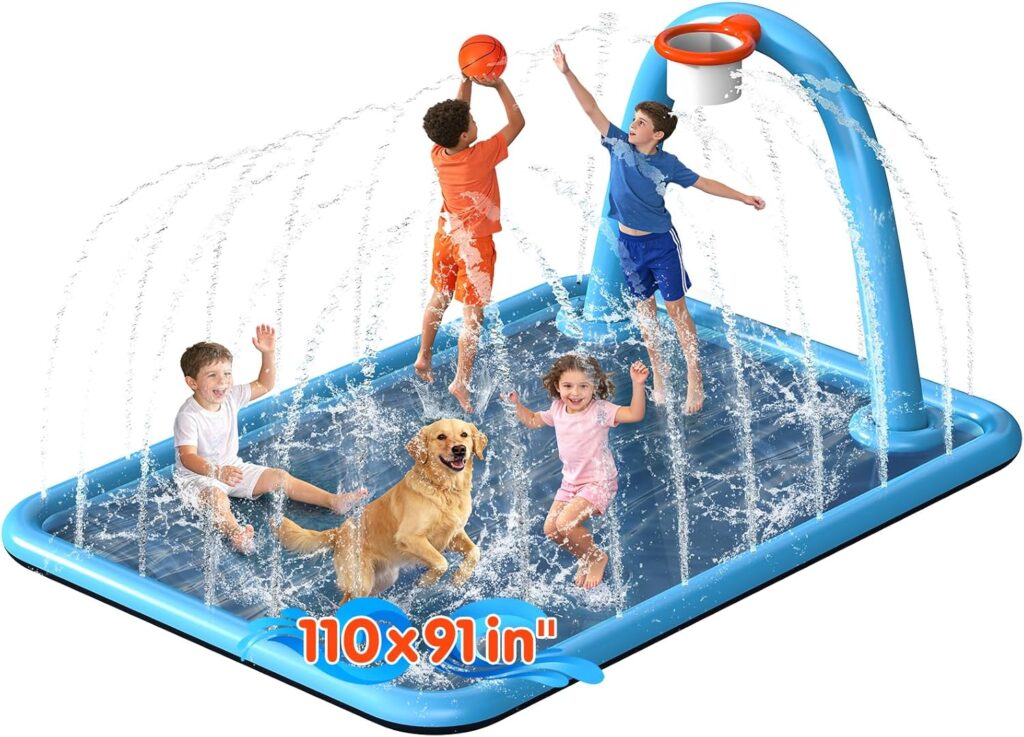
EPN, under American Epsilon Inc., develops PVC and composite-material products for family entertainment, children’s toys, pet products, outdoor recreation, and seasonal sports. The product range includes kids splash pads, pet splash pads, basketball splash pads, water slides, inflatable pools, pet pools, pool floats, snow tubes, pool pillows, and other outdoor water and air products.
Spray pattern is important to EPN because it connects product design with real customer experience. A splash pad does not succeed only because it looks colorful. It needs to perform well after the hose is connected, after children step onto it, and after families use it many times in warm weather.
EPN’s product development system includes 27 R&D team members, more than 18 designers, independent testing support, and over 500 material and product performance tests each year. The company’s design team completes more than 1,500 new product design projects annually, and the broader manufacturing system supports large-scale PVC and composite product production.
For splash pads, EPN focuses on details such as:
| EPN Focus Area | Customer Value |
|---|---|
| Spray distribution | More even water play |
| Edge stability | Better pressure control |
| Reinforced welding | Lower leak risk |
| Hose connector design | Easier setup and fewer inlet issues |
| Low-odor PVC options | Better first-use experience |
| Material flexibility | Easier folding and storage |
| UV and aging consideration | Better outdoor performance |
| Packaging localization | Easier retail and e-commerce launch |
For business clients, EPN can support OEM and ODM projects with size customization, artwork design, spray-hole layout, PVC thickness selection, packaging, labels, instructions, and market adaptation. Sample development can usually move quickly depending on project complexity, and regular production planning can support seasonal launch schedules.
This matters because kids splash pads are highly seasonal. Delays, quality issues, unclear instructions, or weak spray performance can affect an entire selling window. A more mature supply chain helps reduce that risk.
FAQ
What Spray Pattern Is Best for Kids?
The best spray pattern for kids is even, gentle, and inward-facing. It should rise from the outside edge and fall toward the center so children can run, sit, and play without being hit by sharp water jets. A good spray pattern should also be adjustable through hose pressure.
How Does Spray Pattern Affect Water Pressure?
Spray pattern affects how water pressure is released through the edge ring. If the holes are evenly spaced and properly sized, pressure spreads more smoothly. If the holes are uneven or blocked, one side may spray higher while another side stays weak.
Is High Spray Pattern Better?
A high spray pattern is not always better. Tall spray may look fun in photos, but younger children often prefer lower and softer water. Even coverage, comfort, and control are usually more important than maximum height.
Why Is My Spray Pattern Uneven?
Uneven spray may happen because of low water pressure, too much pressure, clogged holes, uneven ground, a twisted hose, or poor spray-hole distribution. Parents should check the ground, connector, hose position, and spray holes before assuming the pad is damaged.
Can Spray Pattern Cause Slipping?
Yes, spray pattern can affect slipping. Uneven water flow may create wet and dry patches, sudden puddles, or slick movement across the surface. A balanced spray pattern helps make the play area more predictable, but adult supervision and safe setup are still needed.
How Should I Clean Spray Pattern Holes?
Turn off the water, drain the splash pad, and rinse the spray-hole area with clean water. Remove visible grass, dirt, or debris gently. Avoid sharp tools because they can enlarge the holes or damage the PVC. Dry the pad before storage.
Can Spray Pattern Work on Grass?
Yes, a kids splash pad can work well on grass when the ground is flat, clean, and free from sharp objects. Grass is often more forgiving than hard concrete. Parents should remove sticks, stones, pet toys, and garden debris before setup.
What Should Retailers Check in a Splash Pad Sample?
Retailers and private-label teams should test spray pattern at low, medium, and higher water flow. They should check full-edge spray, center coverage, connector leakage, edge stability, PVC feel, folding quality, packaging clarity, and instruction accuracy.
Order EPN Splash Pads or Request Custom Production
A kids splash pad should do more than look bright in a summer photo. It should create a spray pattern that children enjoy, parents can control, and retailers can sell with confidence. The water should feel comfortable, the edge should stay stable, the spray holes should work evenly, and the item should be easy to set up, dry, and store.
EPN offers branded splash pad products for family backyard play and supports custom OEM/ODM splash pad development for brands, retailers, distributors, and e-commerce sellers.
Custom options can include:
| Custom Option | Available Direction |
|---|---|
| Size | Toddler, family, large backyard, group play |
| Shape | Round, square, themed, activity-based |
| PVC thickness | Adjusted by age group and sales channel |
| Spray pattern | Gentle, active, full-edge, customized layout |
| Print design | Brand artwork, seasonal theme, character style |
| Packaging | Color box, mailer box, retail packaging |
| Instructions | English, German, French, Spanish, and more |
| Compliance support | Market-based documentation preparation |
| Carton planning | E-commerce and retail shipment needs |
For ready-to-sell products, EPN branded kids splash pads can support seasonal summer demand. For differentiated product lines, Epsilon can help develop custom splash pad projects from concept and sampling to packaging and production.
Contact Epsilon to request current splash pad options, confirm specifications, discuss private-label needs, or start a custom splash pad quotation.