Skip to content
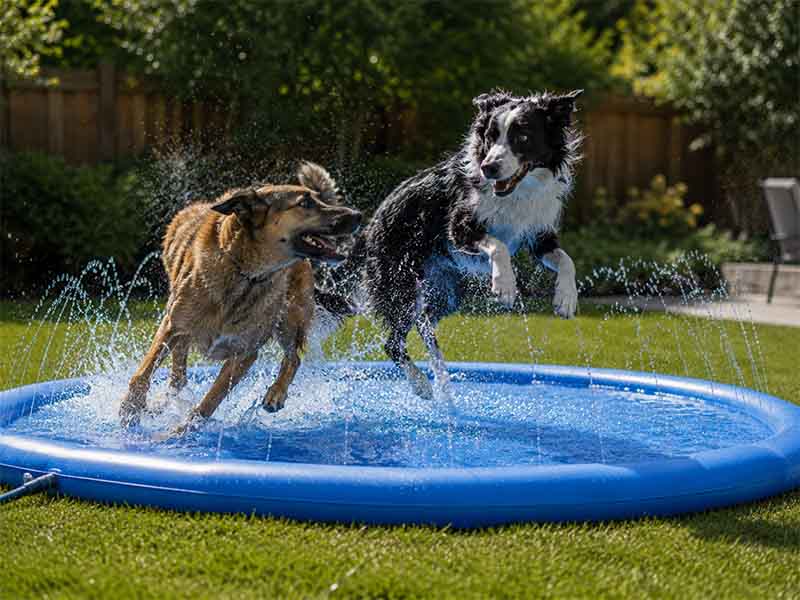
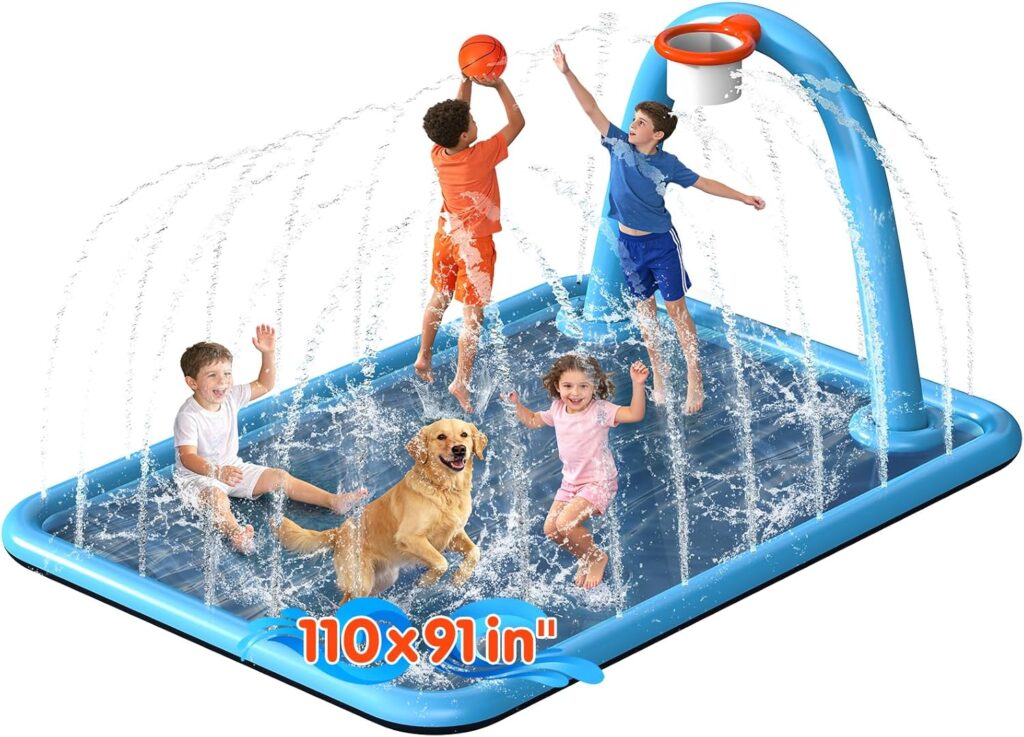
A dog pool with sprinkler and a dog splash pad can look almost interchangeable when viewed in a summer shopping search. Both connect to outdoor water play, both can help a dog feel more comfortable in warm weather, and both are available in sizes for puppies through large adult dogs. Once they are placed in the yard, however, the experience changes quickly.
A dog pool gives the dog enough standing water to stop, sit, turn, or lie down. A splash pad keeps the center shallow and surrounds the dog with moving streams. That difference affects how the dog enters, how much of its body stays wet, how active the play becomes, how much water is used, and how much cleaning remains afterward.
A dog pool with sprinkler is generally better for dogs that enjoy standing, sitting, or resting in water. A dog splash pad is often better for puppies, senior dogs, active dogs, and dogs that prefer shallow moving water. Body size, mobility, water confidence, yard space, drainage, and daily maintenance all influence which option will work better.
Imagine two dogs in the same backyard. One steps into a shallow pool, turns twice, and settles with its belly in the water. The other refuses to cross the pool wall but immediately follows the first low stream rising from a splash pad. Neither response is unusual. The dogs simply have different ideas about what makes water enjoyable.
What Makes Each Dog Water Toy Different?
A dog pool holds several inches of water and supports slower soaking. A dog splash pad uses a nearly flat center and a water-filled outer ring to create moving spray. Water depth, wall height, hose operation, and play style create the main differences. Those details influence cooling, entry, cleaning, water use, and how much pressure the structure carries.
The clearest comparison appears when daily use is considered rather than appearance alone.
| Comparison Point | Dog Pool With Sprinkler | Dog Splash Pad |
|---|---|---|
| Main water experience | Standing water with optional spray | Shallow water with continuous spray |
| Common water depth | About 2–6 inches | Usually less than 1–2 inches |
| Entry style | Requires stepping over a wall | Nearly flat access from every side |
| Common dog behavior | Sitting, soaking, and resting | Walking, chasing, and crossing streams |
| Main body contact | Paws, legs, belly, and lower chest | Paws, legs, belly, and outer coat |
| Hose use | Can often be turned off after filling | Usually remains on during play |
| Setup speed | Slower because the basin must fill | Usually ready within 1–3 minutes |
| Cleaning effort | Standing water collects more debris | Flat surface is often faster to rinse |
| Folded storage | Bulkier | Flatter and more compact |
| Best suited to | Dogs that enjoy still water | Dogs that prefer movement and easy entry |
The pool offers more stationary water contact, while the splash pad removes the wall and makes water easier to approach. That difference shapes nearly every later decision, from dog age to yard drainage.
How Does a Dog Pool Work?
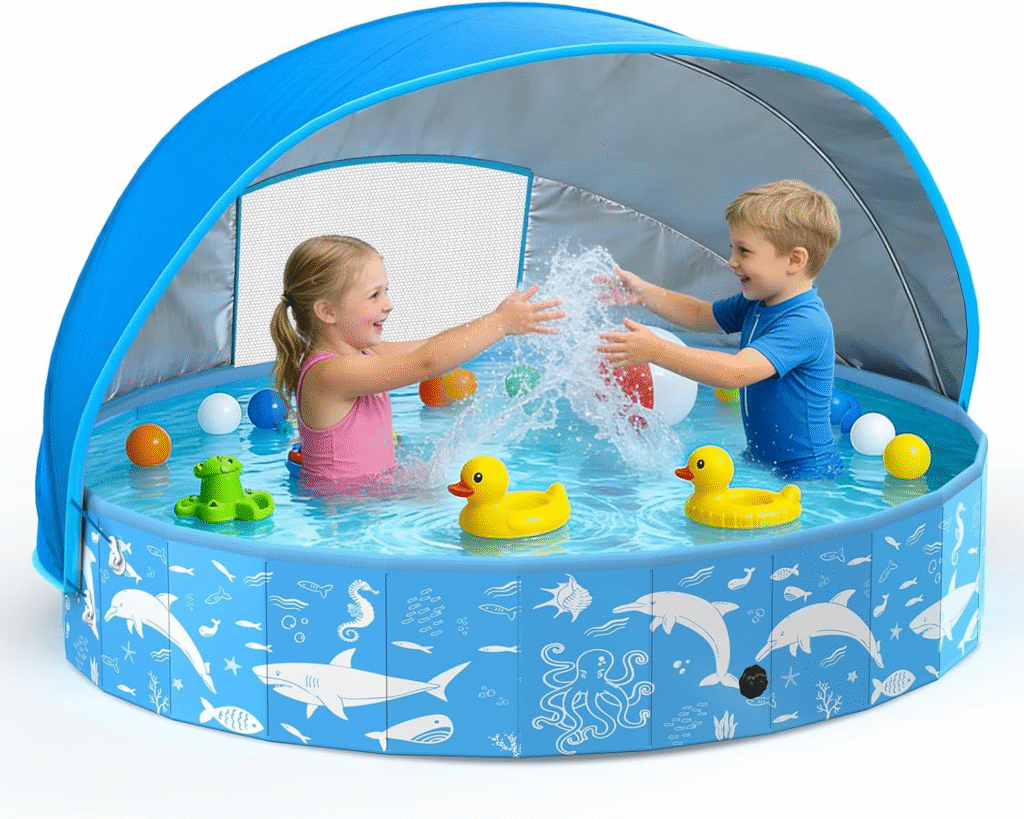
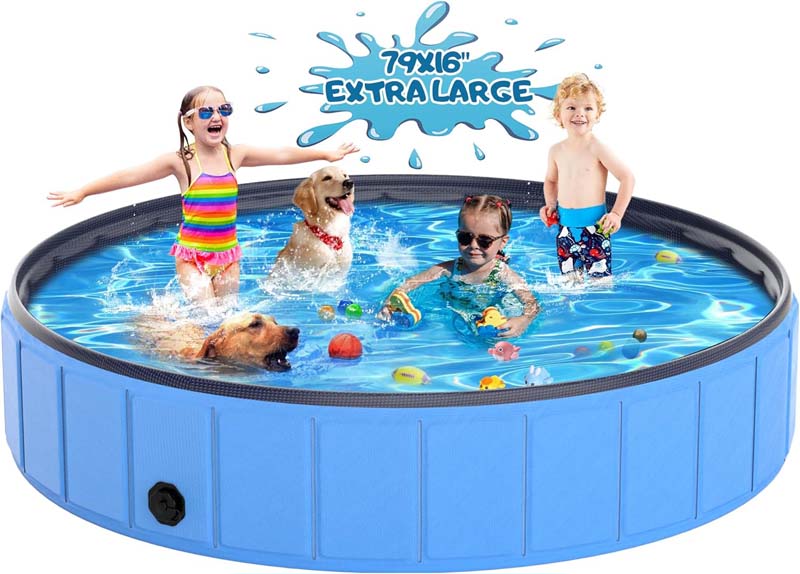
A dog pool creates a contained basin with enough water for the dog to remain in one place. Foldable models often use vertical support panels inside the walls, allowing the pool to stand without an air pump. Other designs rely on inflatable chambers, foam inserts, or flexible walls that become more stable as water is added.
For backyard cooling rather than swimming, the pool rarely needs to be filled to the top. One or two inches may be enough for a puppy or short-legged dog to explore. Medium and large adult dogs may prefer three to six inches, especially when they like to sit or lie down.
The dog should always be able to stand normally. Water deep enough to force swimming changes the safety requirements and can make entry intimidating for inexperienced dogs. A shallower pool is easier to supervise, faster to fill, and less difficult to drain.
A sprinkler feature may add streams around the rim, but standing water remains the defining feature. Even after the spray is reduced or turned off, the dog still has a wet area where it can pause and rest.
Wall height often determines whether the pool is actually used. A four-inch edge may be easy for a healthy Labrador but high for a Dachshund or an older small dog. A taller wall may hold more water, yet it can make independent entry and exit harder.
Usable inner space matters more than the outside measurement printed on the packaging. A pool advertised as 63 inches wide loses some floor area to its walls and rounded shape. A dog should be able to turn without stepping on the edge and lie down without pressing tightly against the sides.
How Does a Dog Splash Pad Work?
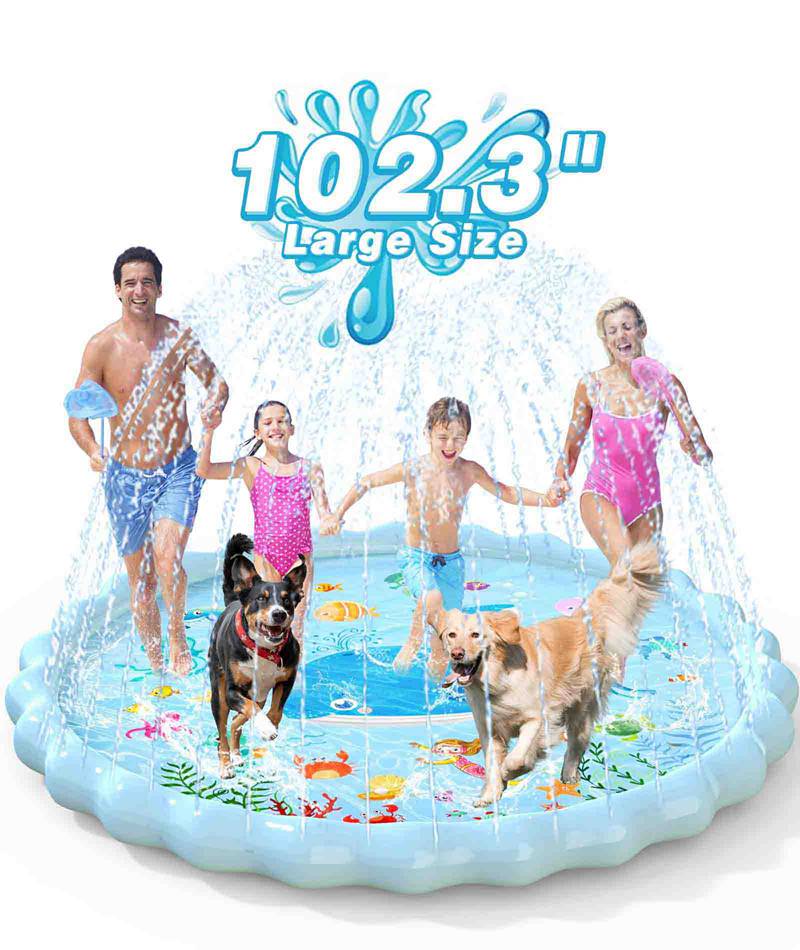
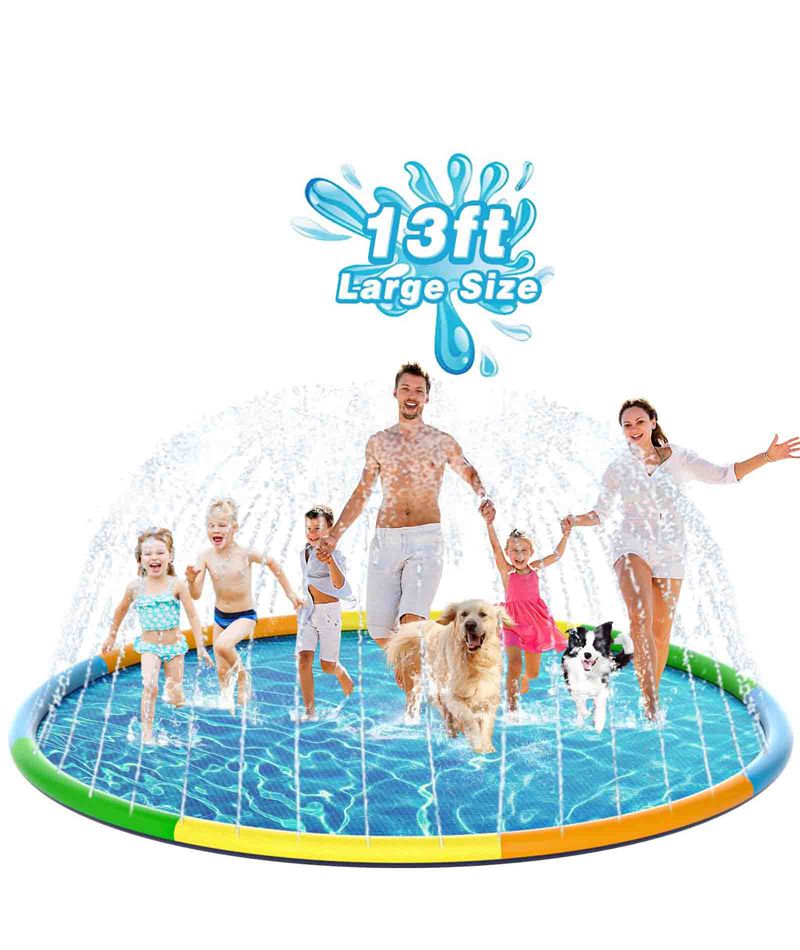
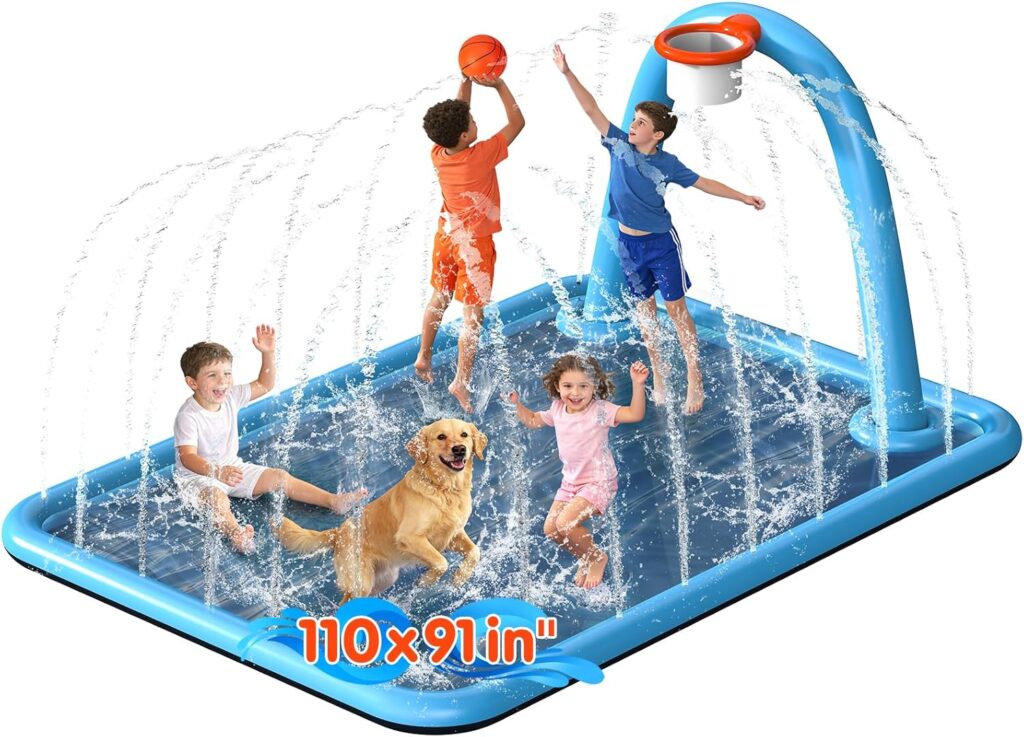
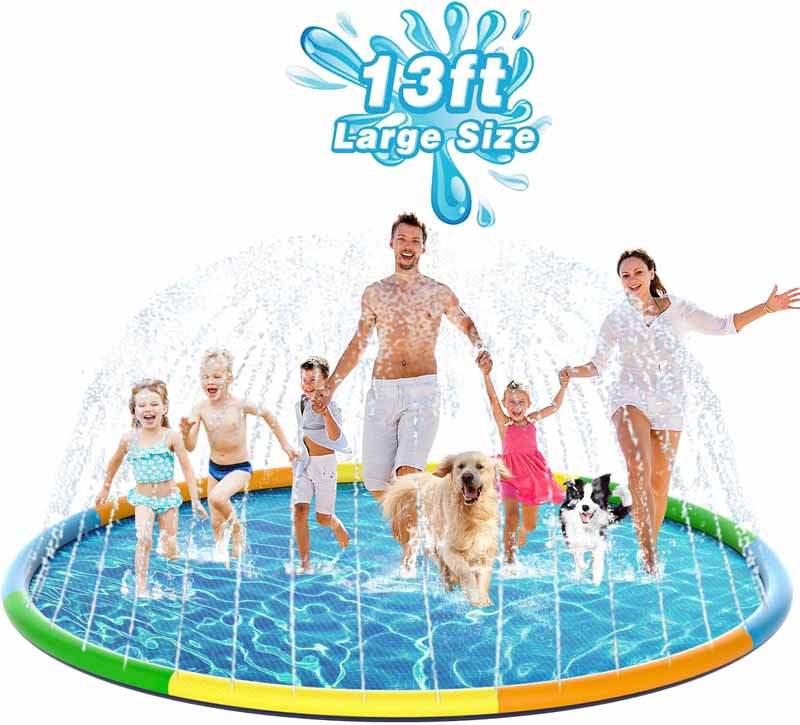
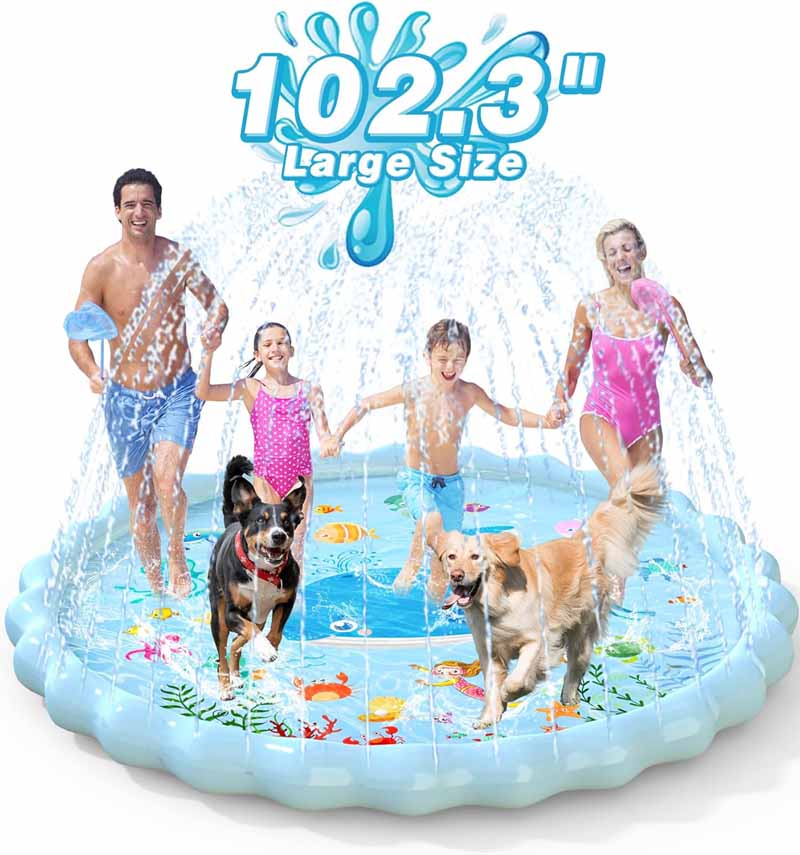
A dog splash pad connects to a garden hose. Water enters the outer ring, travels around the perimeter, and leaves through small spray holes angled toward the center.
The ring becomes firmer as pressure increases, while the center remains nearly flat. Water spreads across the surface rather than forming a deep basin. A dog can walk onto the pad from any side and step away without crossing a wall.
This easy entry is one reason splash pads often work well for puppies, senior dogs, and dogs that are unsure about standing water. The dog can investigate a single stream without feeling enclosed.
Spray height is controlled through the faucet. A lower setting usually creates a quieter, more approachable play area. Strong pressure can send water into the dog’s face, push spray beyond the center, and place more force on the connector and perimeter seams.
Balanced spray is more useful than very tall spray. When the holes are evenly spaced and similar in size, the water rises consistently around the ring. If several holes are partly blocked or uneven, one area may spray strongly while another remains low.
The hose fitting deserves close attention because it handles twisting during setup and pulling when the hose moves. Moisture around the fitting, uneven fountains, or a ring that loses firmness may indicate a pressure or connection problem. Owners dealing with these symptoms may find additional guidance in why some splash pads leak easily.
How Does the Play Experience Change?
A dog pool generally creates slower behavior. A dog may walk in, circle once, paw at the water, and settle. Some dogs remain in the same position for several minutes because the standing water itself is the attraction.
A splash pad creates more movement. Dogs may follow streams, cross the center repeatedly, turn toward new fountains, or try to catch the spray. This can make the pad more interesting for active dogs, but it also increases fast turning, scratching, and water swallowing.
The same amount of visible water can create a very different physical experience. A dog lying quietly in a pool receives steady contact around the legs and underside. A dog running across a splash pad becomes wet but also produces more body heat through exercise.
The dog’s normal water habits give the strongest clue. A dog that lies in shallow streams may enjoy a pool. A dog that follows lawn sprinklers may prefer a splash pad. A dog that avoids both should be introduced slowly rather than placed directly into the wet area.
Which Dogs Prefer a Dog Pool?
A dog pool often suits dogs that already enjoy standing water, need enough room to lie down, or prefer calmer play. Large dogs and thick-coated dogs may appreciate the greater water contact, but size and coat are only part of the decision. The dog must also cross the wall comfortably, keep its balance, and remain relaxed inside a contained area.

Large dogs often gain more from a wide pool because they need enough room to turn and rest. They do not necessarily need deeper water. A broad, shallow basin is usually more practical than a narrow pool with tall walls.
Body length is a useful starting point. Measure from the nose to the base of the tail while the dog is standing naturally, then allow approximately 8–12 inches for turning and repositioning.
A dog under 24 inches long may fit comfortably in a pool with 40–48 inches of usable inner space. A dog measuring 24–32 inches may need 48–63 inches. Dogs measuring 32–40 inches often need 63–71 inches, while very long breeds may need a usable diameter above 71 inches.
These measurements are not fixed rules. A long, narrow Greyhound uses floor space differently from a broad Bulldog. Dogs that lie fully stretched need more room than dogs that naturally curl up.
Weight affects structure as well. A large dog stepping quickly into the pool concentrates force beneath each paw. When it pushes against the wall to leave, the top edge and support panels take another load. Wider seams, stable wall panels, a textured base, and reinforced drain areas become more important as dog size increases.
A large pool should not automatically be filled deeply. Four to six inches may be enough to wet the legs, belly, and lower chest while keeping entry manageable.
Which Water-Loving Dogs Enjoy Pools?
Dogs that voluntarily enter streams, bathtubs, lakeshores, or shallow family pools are more likely to understand a dog pool immediately. They already recognize standing water as a place to pause rather than an obstacle.
A pool may suit a dog that seeks wet grass, lies in puddles, carries toys into water, or becomes calmer after stepping into a basin. These habits suggest that the dog enjoys steady water contact without needing a moving target.
Water confidence does not guarantee swimming ability. A dog may enjoy several inches of water and still panic when its paws no longer touch the floor. For backyard cooling, there is rarely a reason to make the water deeper than the dog can comfortably stand in.
The first introduction should feel ordinary. The dog can inspect the empty pool before a small amount of water is added. A familiar toy near the entrance may encourage exploration without pressure.
When the dog stiffens, leans away, refuses to approach, or repeatedly tries to leave, adding more water is unlikely to improve the experience. A splash pad with low spray may provide a less enclosed introduction.
Are Pools Better for Thick-Coated Dogs?
A pool can provide steady water contact around the paws, legs, belly, and lower chest, where the coat may be less dense than along the back and shoulders. When the dog lies down, the wet surface reaches more of the underside than occasional spray usually can.
A heavy-coated dog may also benefit from calmer activity. Running through fountains produces heat, while standing or lying in a shallow pool allows the dog to remain relatively still.
Water play should still be part of a wider warm-weather routine. Shade, fresh drinking water, rest, and shorter outdoor activity remain important. A wet coat alone does not show whether the dog feels comfortable.
Dense fur can hold moisture for a long time. After the session, the underside, chest, armpits, paws, and ears should be checked and dried. Dogs that frequently develop skin irritation or ear problems may need shorter sessions.
Which Dogs May Not Enjoy Pools?
A pool can be difficult for short-legged dogs, puppies, seniors with stiff joints, dogs with reduced vision, and dogs that dislike contained areas. The wall may become a greater problem than the water itself.
A dog should not need to jump into a shallow cooling pool. When the top edge reaches high on the leg or chest, entering and leaving may require more movement than the dog can manage comfortably.
Dogs with poor balance may struggle when stepping over the wall onto a wet floor. A dog that panics in standing water may also feel trapped because it cannot leave from every direction.
Behavior can make a pool unsuitable even when the dimensions are correct. Repeated digging concentrates force on the base. Biting the wall can puncture flexible material quickly. A dog that jumps in and out may damage the entry edge and increase its own chance of slipping.
The following comparison helps connect physical needs and water habits with a useful starting option.
| Dog Profile | Better Starting Option | What Matters Most |
|---|---|---|
| Large dog that lies in water | Dog pool | Wide usable floor and stable walls |
| Thick-coated calm dog | Dog pool | Enough room to sit or lie down |
| Dog that dislikes moving spray | Dog pool | Quiet, predictable water |
| Short-legged dog | Splash pad or low-wall pool | Entry height below the chest |
| Dog with poor balance | Low-wall pool or shallow pad | Stable footing and easy exit |
| Dog that digs or chews | Neither without close supervision | High puncture and seam risk |
A pool is most useful when the dog enters voluntarily, settles comfortably, and leaves without assistance.
Which Dogs Prefer a Dog Splash Pad?
A splash pad often works well for dogs that need easy access, prefer moving water, or use water in short active sessions. Puppies, senior dogs, small breeds, and cautious dogs may find the nearly flat entrance less intimidating. Active dogs may enjoy the spray, although their play must remain controlled enough to reduce slipping, digging, and exhaustion.
Are Splash Pads Good for Puppies?
A splash pad allows a puppy to explore water in small steps. It can approach from dry ground, touch the damp surface, investigate one low stream, and leave immediately.
The first introduction is often easier when the pad is dry. The puppy can walk across it, sniff the connector, and become familiar with the surface before the hose is attached.
During the first wet session, the faucet should be opened slowly. Spray around three to six inches high is often enough to create interest without directing water toward the eyes and nose.
The session does not need to last long. Two or three calm minutes may be enough on the first day. Once the puppy becomes comfortable, play can gradually extend to five minutes or slightly longer, followed by a dry rest period.
A relaxed puppy walks, sniffs, pauses, and returns voluntarily. Frantic circling, repeated slipping, biting the connector, scratching one spray hole, or swallowing water continuously are reasons to stop.
Ending while the puppy is still calm usually creates a better association than waiting until it becomes tired or overstimulated.

A nearly flat entrance can make a splash pad easier for dogs with reduced hip, knee, or shoulder movement. The dog does not have to lift its body over a wall and can step off from any side.
The surface still needs careful preparation. Wet PVC may become slippery when covered with mud, loose fur, grass clippings, or residue. Texture can improve grip, but no wet surface is completely slip-proof.
Level grass is often more forgiving than a polished patio. Slopes should be avoided because the dog may lose stability while turning downhill. Rough concrete can wear the underside of the pad and may also be uncomfortable for paws.
Senior dogs generally do not need tall fountains. Low spray reaching the paws and lower legs may be enough. A dry resting mat and shaded area should remain within a few steps.
Three to five minutes of slow standing or walking may be more appropriate than a long active session. Shaking, dragging a paw, worsening panting, repeated slipping, or difficulty rising means the dog should stop.
Additional setup guidance for older or less stable dogs is available in how to keep dogs from slipping on a splash pad.
Do Timid Dogs Prefer Shallow Spray?
A cautious dog may find a splash pad easier because it is not surrounded by a wall. It can investigate a single stream and retreat without crossing an edge.
Moving water can still create stress. The hose sound, sudden pressure changes, splashing near the face, and moving shadows may be more concerning than the shallow water itself.
A slow introduction usually works better than switching on the full spray. The dog can first approach the dry pad, then a damp surface, followed by low streams during a later session.
Comfort appears through loose body movement, curiosity, normal breathing, and voluntary return. A tucked tail, rigid posture, avoidance, or repeated attempts to hide suggest that the water is moving too quickly for the dog.
Not every timid dog will learn to enjoy spray. Some prefer still water in a shallow pool. The goal is to establish a comfortable routine rather than make the dog accept one particular format.
Can Active and Large Dogs Use Splash Pads?
Active dogs often enjoy moving streams because the spray changes direction and creates something to follow. Retrievers, terriers, young mixed breeds, and some herding dogs may remain interested longer than they would in still water.
They also need more usable space. A small pad forces sharp turns near the edge and repeated stepping on the outer ring.
| Dog Profile | Better Starting Option | Setup Detail to Check |
|---|---|---|
| Puppy new to water | Dog splash pad | Low spray and short sessions |
| Senior with stiff joints | Dog splash pad | Flat entry and textured surface |
| Timid dog | Low-pressure splash pad | Easy retreat from every side |
| Active sprinkler chaser | Large splash pad | Wide center and controlled spray |
| Large active dog | 71–79 inches or larger | Enough room to slow and turn |
| Two active dogs | Oversized pad or separate sessions | Collision and crowding risk |
A dog weighing under 20 pounds may use a 40–48-inch pad comfortably. Dogs between 20 and 45 pounds may need 48–63 inches, while dogs above 45 pounds often benefit from 63–79 inches or more.
The advertised outside diameter is not the true movement area. A wide ring removes several inches from the center. Large dogs should be able to take several steps and turn without constantly landing on the perimeter.
Five minutes of chasing followed by a shaded break is generally more useful than prolonged high-speed play. Excitement can hide fatigue, so enthusiasm should not be mistaken for unlimited stamina.
Spray below chest height encourages more controlled movement than tall fountains. A soft toy placed in the center may slow the pace, while hard toys with sharp edges should remain off the pad.
Which Cools Better: Dog Pool or Dog Splash Pad?
A dog pool normally gives more direct water contact because the dog can remain partly submerged while standing, sitting, or lying down. A splash pad provides lighter contact through wet paws, legs, belly, and moving spray. Cooling depends heavily on behavior: quiet soaking usually produces less body heat, while energetic chasing can partly offset the benefit of getting wet.
| Cooling Factor | Dog Pool | Dog Splash Pad |
|---|---|---|
| Water contact | Continuous lower-body contact | Repeated light contact |
| Best behavior | Standing, sitting, or lying down | Slow walking and short play |
| Activity level | Usually low | Often moderate to high |
| Strongest benefit | More belly and chest contact | Easier participation for hesitant dogs |
| Main limitation | Dog may refuse to enter | Running may create additional heat |
| Better in humid conditions | Often stronger for calm direct contact | Useful only when movement stays controlled |
| Active period | Often 5–10 minutes | Often 3–10 minutes |
| Follow-up need | Shade, rest, and fresh water | Shade, rest, and fresh water |
A pool has the stronger physical cooling potential when the dog rests in it. A splash pad may still work better in practice when the dog refuses standing water but willingly walks through low spray.
Does a Pool Cool More of the Body?
A shallow pool can keep the paws and lower legs in continuous contact with water. When the dog sits or lies down, the belly, lower chest, and sides may also become wet.
For many small dogs, two or three inches is enough. Medium dogs may use three or four inches, while large dogs may be comfortable with four to six inches. Puppies, senior dogs, and cautious dogs should begin with less.
These figures are starting points rather than fixed requirements. Two dogs of the same size may respond very differently.
The strongest cooling benefit appears when the dog remains calm. Repeated jumping in and out creates more movement and less continuous contact.
Water temperature matters as well. A pool left in full sun may become warm, particularly when the base is dark. Partial shade helps keep the water and surface more comfortable.

A splash pad wets the dog repeatedly as it crosses the center. The paws, legs, underside, and coat may receive water from several directions.
This can be valuable for a dog that refuses to sit in a pool. The dog actually uses the water rather than standing beside a full basin.
The challenge is controlling activity. A dog that sprints continuously can produce more heat even while becoming soaked. Lower spray and slower play often create a more useful cooling routine than tall fountains and constant chasing.
The dog should be allowed to stop on the wet center, move into shade, and drink from a separate bowl. Water play works better when short active periods are separated by calm rest.
In EPN’s development work with PVC pet water products, balanced inward spray and moderate operating pressure receive as much attention as fountain height. Even distribution keeps more water inside the usable play area and reduces the need for excessive faucet pressure.
How Do Weather and Dog Health Change the Result?
Warm, humid air can make cooling more difficult because moisture evaporates more slowly. A dog may appear thoroughly wet while its breathing continues to become harder.
In humid conditions, a calm pool session may provide more useful direct contact than fast splash-pad play. A splash pad can still help when the spray remains low and the dog moves slowly.
Puppies, senior dogs, overweight dogs, flat-faced breeds, thick-coated dogs, and dogs with breathing or heart limitations often need shorter sessions. Several minutes of water play followed by a longer shaded break may be more appropriate than one continuous session.
Watch the dog rather than relying on a fixed schedule. Heavy or worsening panting, weakness, poor coordination, vomiting, confusion, or collapse are reasons to stop immediately and seek veterinary help. Backyard water play is intended for ordinary comfort, not for treating serious overheating.
Which Uses Water More Efficiently?
A pool uses a larger amount at the beginning, but the faucet can usually be turned off once the desired depth is reached. A splash pad uses water throughout the session.
Water use changes with pool diameter, fill depth, hose pressure, and session length. A short splash-pad session may use less water, while a longer session may use more than filling a shallow pool once.
| Setup | Approximate Water Use | Time at 5 GPM |
|---|---|---|
| 48-inch pool at 3 inches deep | 24 gallons | About 5 minutes |
| 48-inch pool at 4 inches deep | 31 gallons | About 6 minutes |
| 63-inch pool at 4 inches deep | 54 gallons | About 11 minutes |
| 63-inch pool at 6 inches deep | 81 gallons | About 16 minutes |
| 71-inch pool at 4 inches deep | 69 gallons | About 14 minutes |
| Splash pad running 5 minutes | Up to 25 gallons before restriction | 5 minutes |
| Splash pad running 10 minutes | Up to 50 gallons before restriction | 10 minutes |
| Splash pad running 20 minutes | Up to 100 gallons before restriction | 20 minutes |
Actual splash-pad flow is often lower because the connector and spray holes restrict the hose. Families can estimate their own flow by timing how long it takes to fill a five-gallon bucket at the same faucet setting.
For a short session, a splash pad may use less water than filling a large pool. During a longer session, a pool may be more efficient because it does not require continuous flow.
Which Is Easier: Dog Pool or Dog Splash Pad?
A splash pad is usually quicker to prepare, empty, and fold. A pool requires more filling time and collects more standing debris, but it may be easier during longer play because the hose can be turned off. Daily convenience depends on ground preparation, drainage, drying space, session length, and how often the family plans to use it.
| Daily Task | Dog Pool With Sprinkler | Dog Splash Pad |
|---|---|---|
| Setup | Unfold, shape walls, and fill | Unfold, connect hose, and adjust pressure |
| Time before play | Often 5–20 minutes | Usually 1–3 minutes |
| Supervision focus | Entry, depth, and wall stability | Spray height, footing, and chasing |
| Water during use | Can remain after hose is turned off | Requires continued flow |
| Drainage | Slower; drain position matters | Faster after disconnection |
| Cleaning | More fur and debris in standing water | Easier to rinse across a flat surface |
| Drying | Walls, base, seams, and drain | Both sides and inner ring |
| Storage | Larger and thicker | Flatter and more compact |
| Better routine | Planned longer sessions | Short frequent sessions |
| Common mistake | Moving while still full | Folding with water trapped inside |
The splash pad is usually easier for a ten-minute weekday session. The pool becomes more convenient when the dog wants to remain in water longer and the family prefers to turn the hose off after filling.
Which Sets Up Faster?
A splash pad can often begin spraying within one to three minutes after the ground is checked and the hose is attached.
A pool takes longer because the basin must fill. At approximately five gallons per minute, 25 gallons takes about five minutes, 50 gallons takes ten minutes, and 100 gallons takes twenty minutes.
The pool does not need to reach the top of the wall. Filling only to the depth the dog uses saves time and water.
Walls should be straightened as the pool fills. When the ground is uneven, water may collect on one side and place more force against the lower wall.
A splash pad also needs gradual adjustment. Opening the faucet fully at the start may create sudden tall spray and unnecessary stress around the connector.
How Much Ground Preparation Is Needed?
Both products need clean, level ground. A dog pool creates more constant downward pressure because water is heavy. One gallon weighs approximately 8.34 pounds, so an 80-gallon pool contains about 667 pounds of water before the dog enters.
A small stone or exposed root under that weight can become a concentrated pressure point. Splash pads carry less standing water, but paw impact from running and turning can press debris into the material.
Grass is often more forgiving than rough concrete, although hidden stones, roots, irrigation fittings, and thorny plants still need to be removed. Families choosing a permanent setup area may find more detail in whether a splash pad can be used on grass.
A protective ground mat should extend beneath the entire pool or pad and remain flat when wet. A mat covering only part of the base can create a raised pressure line.
The area also needs to be level. A slope changes water distribution, wall pressure, spray direction, and the dog’s balance.
Which Is Easier to Clean and Drain?
A splash pad usually releases most of its water after the hose is disconnected. The center can be rinsed, lifted, and turned over. Water may remain inside the ring, so the connector should be held downward while the opposite side is lifted gently.
The pad should not be twisted or wrung. Twisting places stress on the perimeter seam and spray holes.
A pool should be drained through its outlet before being moved. An 80-gallon fill weighs more than 650 pounds. Pulling one wall outward while the pool is full can damage seams and support panels.
Standing water collects fur, mud, grass, leaves, and saliva. A pool used by several dogs may need to be emptied after every session. A splash pad often rinses faster because debris remains spread across a flatter surface.
After draining, both sides need to dry. The underside can remain wet against grass even when the upper surface feels dry.
Which Fits a Small Yard?
The product needs more room than its listed diameter. A dog must be able to approach, leave, turn, shake off water, and slow down.
A 40-inch pool or pad generally needs a clear area around seven feet wide. A 48-inch model may need about eight feet, a 63-inch model around nine feet, and a 71-inch model close to ten feet.
A pool requires room for walking around the walls and directing drainage. A splash pad needs additional space for spray and movement beyond the ring.
The hose should not cross the dog’s main route. Electrical items, steps, open doors, grills, dry bedding, and slippery walkways should remain outside the wet area.
Repeated use in the same lawn location may saturate the soil and create mud. Moving a splash pad between two or three areas can help protect the grass.
Which Stores More Easily?
A splash pad usually folds flatter, making it easier to place in a shelf bin or small storage area. A foldable pool remains bulkier because of its side panels, drain, and thicker wall structure.
Neither should be folded while damp. Trapped moisture can cause odor, stains, sticking, and mildew around fabric or packaging parts.
Broad folds are better than repeatedly pressing the PVC along a sharp line. The product should be stored away from heavy boxes, sharp tools, rodents, chemicals, and direct heat.
PVC that has become stiff in cold storage should be allowed to warm before unfolding. Very hot PVC should cool before being folded.
Which Lasts Longer: Dog Pool or Dog Splash Pad?
Neither format is automatically more durable. A pool must carry standing water, wall pressure, dog weight, and repeated entry. A splash pad must handle hose pressure, paw movement, spray-hole stress, and frequent folding. Material thickness helps, but seams, fittings, ground conditions, behavior, drying, and storage usually determine how long the item remains usable.
| Durability Area | Dog Pool Risk | Dog Splash Pad Risk |
|---|---|---|
| Ground contact | Heavy water pressure over stones or roots | Paw impact over hidden debris |
| Dog movement | Jumping over walls and leaning on panels | Running, turning, and scratching |
| Main structural point | Base-to-wall seam and drain | Hose connector and perimeter seam |
| Water pressure | Outward pressure against the walls | Continuous pressure inside the ring |
| Claw damage | Digging into the floor | Scratching around spray holes |
| Storage damage | Moisture between wall panels | Water trapped inside the ring |
| Sun exposure | Wall and floor flexibility may decline | Fold lines and printed areas may age |
| Easier repair | Small flat floor puncture | Small flat center puncture |
| Harder repair | Drain or long seam separation | Connector or perimeter separation |
The pool carries more static weight, while the splash pad receives more repeated movement and internal pressure. Neither construction is automatically stronger; the longer-lasting option is usually the one that matches the dog’s behavior.

Many pet water products use PVC around 0.40–0.55 mm, depending on structure and intended use. A thicker sheet may resist abrasion and small punctures better, but it cannot compensate for narrow seams, weak connectors, uneven welding, or rough handling.
Two products with the same thickness can perform differently. One may use wide welded seams and reinforcement around fittings. Another may have a thick floor joined to a weaker perimeter.
Flexibility matters as much as thickness. PVC that is too soft may stretch around a connector. Material that becomes too stiff may develop crease marks after repeated folding, especially in cold conditions.
A dog pool needs stable wall panels, a reinforced drain area, a strong base-to-wall seam, and a floor that tolerates repeated paw pressure. A splash pad needs a reinforced hose fitting, even spray-hole distribution, a stable outer ring, and flexible folded edges.
A more detailed explanation of thickness, welding, reinforcement, and flexibility is available in what material is best for a splash pad.
How Do Dog Claws Affect Lifespan?
No flexible PVC pool or splash pad should be treated as completely puncture-proof.
Normal standing spreads weight across the paw pads and several nails. Digging concentrates force at the nail tips. A smaller dog that scratches one area repeatedly may cause more damage than a large dog lying quietly.
Long or sharp nails increase the chance of catching the material. Dewclaws may hook a pool wall or raised splash-pad ring as the dog steps across it.
Regular trimming and smoothing help, but behavior remains the larger factor. Biting the outer wall, chewing the connector, or attacking spray holes can damage PVC quickly.
Repeated scratching should be interrupted rather than treated as harmless play. Lowering the spray or ending the session may prevent a small mark from becoming a leak.
How Do Ground and Sun Exposure Affect Durability?
Grass provides some cushioning, but hidden debris still matters. Rough concrete can gradually abrade the underside, while smooth concrete may become slippery.
A protective mat can reduce contact with hard ground, provided it lies flat and covers the full base.
Sunlight and heat gradually affect flexible materials. A dark pad or pool can become hot before water is added. Partial shade improves comfort and reduces direct exposure.
Drying in mild sunlight for a short period is different from leaving the item outside for weeks. Continuous exposure to weather, lawn equipment, animals, and standing moisture shortens useful life.
EPN evaluates pet water products by considering material thickness together with seam stability, fitting strength, folding resistance, abrasion, pressure distribution, and outdoor use. These combined factors describe durability more accurately than one thickness claim.
Can Small Leaks Be Repaired?
A small puncture in a flat PVC area is often easier to repair than damage near a seam, drain, connector, or deep fold.
The surrounding area must be clean and completely dry. A patch should extend beyond the visible damage on every side. Adhesive also needs its full curing time before water pressure returns.
Repairs are less dependable when a fitting is separating, a seam has opened across several inches, or the material has become brittle. Repeated patching around a structural area may not provide a reliable result.
The earliest sign is not always a visible hole. Uneven spray, a soft ring, a slowly falling pool level, or dampness around a fitting may appear first.
Ground preparation, moderate pressure, complete drying, and loose folding are discussed further in choosing a splash pad that lasts more than one summer.
Which Fits Better: Dog Pool or Dog Splash Pad?
A dog pool fits dogs that want deeper contact and calmer soaking. A splash pad fits dogs that need flat access or prefer moving water. The final decision should connect the dog’s behavior with the family’s available space, water use, cleaning time, and storage. A well-matched water toy should be easy for the dog to approach, use, and leave independently.
When Is a Dog Pool the Better Fit?
A pool makes sense when the dog voluntarily lies in shallow water, remains calm once wet, and can cross a low wall comfortably.
It often suits large dogs that need room to rest, thick-coated dogs that benefit from steady underside contact, and dogs that become overstimulated by moving spray.
A pool also works well for households that want to fill once and turn off the hose. The tradeoff is longer setup, more standing debris, slower drainage, and greater drying space.
The dog should use the pool often enough to justify that work. A large basin ignored after one visit is less practical than a smaller splash pad used regularly.
When Is a Splash Pad the Better Fit?
A splash pad makes sense when the dog follows sprinklers, avoids deeper standing water, or needs a nearly flat entrance.
It often works well for puppies learning about water, seniors with reduced mobility, small breeds facing tall pool walls, and active dogs that respond to gentle moving streams.
Setup is quick and storage is compact. The hose normally remains on throughout the session, and active dogs may require closer supervision to prevent slipping, water biting, and repeated scratching.
Short sessions of five to fifteen minutes usually suit the format better than prolonged continuous running.

A splash pad usually suits quick weekday cooling after a walk. It can be unfolded, used briefly, rinsed, and hung to dry.
A pool fits planned backyard sessions when there is enough time to fill, supervise, empty, clean, and dry a larger structure. It may be more convenient when the dog wants to remain in water for twenty or thirty minutes and the family does not want the hose running throughout that time.
Small storage areas favor splash pads. Larger yards with reliable drainage can accommodate wider pools more easily.
Multi-dog households need additional room whichever format they choose. Two calm dogs may share a wide pool, while active dogs chasing the same streams may collide on a pad. Dogs that guard space or toys should use the water area separately.
How Should the Final Choice Be Made?
The decision becomes clearer when the household’s main priority is placed beside the dog’s normal behavior.
| Main Priority | Better Choice |
|---|---|
| Dog likes lying in water | Dog pool |
| Dog prefers sprinklers and moving streams | Dog splash pad |
| Puppy needs gradual water introduction | Dog splash pad |
| Senior dog needs flat access | Dog splash pad |
| Large dog needs room to rest | Dog pool |
| Hose should be turned off during play | Dog pool |
| Setup must take only a few minutes | Dog splash pad |
| Storage space is limited | Dog splash pad |
| Several calm dogs will share | Large dog pool |
| Dog becomes too excited around spray | Dog pool |
| Yard has limited drainage | Smaller splash pad |
| Family wants longer cooling sessions | Dog pool |
When several priorities point in the same direction, the decision is usually straightforward. When they conflict, the dog’s voluntary behavior should carry more weight than product size or spray height.
The clearest sign appears after the first excitement fades. A good match allows the dog to return willingly, keep its footing, use the water without panic or frantic digging, and leave comfortably.
Frequently Asked Questions
Can Large Dogs Use a Dog Splash Pad?
Large dogs can use a splash pad when the usable center provides enough room for several steps and a comfortable turn. The dog should not need to stand constantly on the outer ring. A reinforced connector, wide seams, visible surface texture, and moderate water pressure are especially important for heavier dogs.
Are Dog Pools Safe for Puppies?
A shallow pool can be suitable when the wall is low enough for independent exit and an adult remains nearby. Begin with one or two inches of water and let the puppy enter voluntarily. A puppy that cannot climb out easily needs a flatter option.
Do Splash Pads Need High Water Pressure?
No. Moderate pressure is usually more comfortable and puts less strain on the connector and welded perimeter. Open the faucet slowly until the ring becomes stable and the spray reaches a suitable height.
Can Dog Claws Puncture PVC?
Yes. Thick or reinforced PVC can reduce risk but cannot make a flexible surface puncture-proof. Digging, sharp nails, rough ground, chewing, and repeated landing in one place create the greatest stress.
Are Dog Splash Pads Slippery?
Any wet surface can become slippery. Texture may improve grip, but mud, algae, fur, fast turns, and sloped ground still increase risk. Level placement and controlled play are important.
How Deep Should a Dog Pool Be?
For ordinary cooling, many dogs need only two to six inches. Small dogs, puppies, senior dogs, and cautious dogs may need less. The dog should always be able to stand normally and leave without swimming.
How Often Should a Dog Pool Be Cleaned?
Fur, mud, leaves, grass, and saliva should be removed after use. Water that becomes warm, cloudy, dirty, or contaminated should be drained. A pool shared by several dogs may need cleaning after every session.
Can a Splash Pad Stay Outside?
It can remain outside briefly during frequent use, but extended exposure to sunlight, weather, lawn equipment, animals, and trapped moisture may shorten its life. Drying and indoor storage are better when practical.
Dog Pool or Dog Splash Pad: Final Choice
A dog pool with sprinkler is usually better for dogs that enjoy quiet soaking, need broader lower-body water contact, and can cross a low wall without help. It often suits large dogs, calm water lovers, and longer planned backyard sessions.
A dog splash pad is generally easier for puppies, senior dogs, smaller breeds, cautious dogs, and active dogs that enjoy sprinklers. Its flat entrance, quick setup, and compact storage make it practical for shorter and more frequent use.
Neither option is automatically cooler, safer, or more durable. The result comes from matching the dimensions and structure to the dog, preparing the ground correctly, controlling water pressure, and drying the item completely after use.
EPN develops dog splash pads, sprinkler pools, foldable pet pools, and related PVC outdoor water products for household and seasonal use. Families can contact EPN for available sizes, material details, product specifications, and current ordering information.
American Epsilon Inc. also supports retailers, distributors, online sellers, and private-label brands with OEM and ODM development. Custom projects may include adjusted dimensions, PVC or composite materials, wall height, spray-hole arrangements, reinforced fittings, custom colors, printed graphics, packaging, labels, multilingual instructions, and market-specific documentation.
Suitable sample projects may be completed in approximately 3–5 days. Standard production commonly takes around 20–30 days, while qualifying expedited projects may be completed in about 14 days depending on structure, materials, packaging, and order quantity.
Brands and retail partners can contact American Epsilon Inc. to request EPN product ordering details, discuss a customized dog pool or splash pad, confirm minimum order quantities, or receive a project quotation.