Skip to content

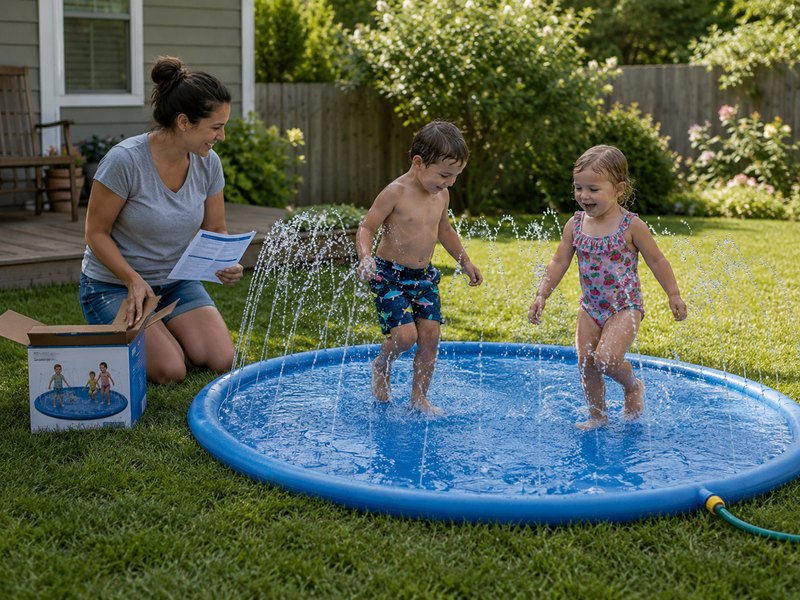
Buying a kids splash pad usually feels low-risk. It is a seasonal backyard product, it connects to a garden hose, and the setup appears much simpler than a pool. The awkward part often arrives only after the package has been opened. A family may unfold the PVC mat, connect the hose, run water through the perimeter, and then notice a seam opening, a leaking inlet, a weak spray section, a missing fitting, or a size that does not work in the intended yard. At that moment, the words “30-day returns” or “1-year warranty” suddenly need much more explanation.
The most useful protection is not simply the longest return period or the longest warranty. A careful purchase checks when the return clock begins, what condition the product must remain in, whether opening or water testing affects eligibility, what the written warranty covers, which types of damage are excluded, who handles the claim, what evidence is required, who pays the return freight, and what remedy is actually offered. The FTC advises consumers to read written warranties before purchase because the coverage can be broad or narrow, and the details matter more than the presence of the word “warranty.”
Kids splash pads deserve a slightly different approach from ordinary dry toys because their function cannot be fully checked inside the box. A typical hose-fed PVC splash pad uses a water-filled outer channel, heat-sealed boundaries, spray openings, and a hose inlet. Water flow is needed before many functional problems become visible. Product-development references for this category also show how size, hose connection, perimeter structure, household water supply, surface preparation, drainage, drying, and storage all influence normal use. The practical goal of this guide is therefore simple: help families understand the policy before the first water test and know exactly what to record if something goes wrong.

Return Policy vs Warranty: What Does Each One Actually Protect?
A return policy and a product warranty can both help after a purchase, but they answer different questions. A return policy asks whether the transaction can be reversed or exchanged under the retailer’s rules. A warranty asks whether a specific product failure qualifies under written coverage. During the first few weeks, the two protections may overlap, but a family should never assume one automatically extends or replaces the other. This distinction becomes particularly important when a splash pad has already been opened and tested with water.
| Question | Return Policy | Product Warranty |
|---|---|---|
| Main purpose | Determines whether an eligible purchase may be returned | Addresses qualifying defects or failures |
| Typical timing | Short period after purchase, delivery, or pickup | Defined warranty period |
| Product condition | Often very important | Cause and type of failure are important |
| Common handler | Retailer or marketplace seller | Manufacturer or named warrantor |
| Typical evidence | Order, receipt, returned item and parts | Receipt, photos, video, model, defect description |
| Possible remedy | Refund, exchange, replacement | Repair, parts, replacement, refund, or another stated remedy |
A Return Window Protects the Purchase Decision
A return policy is usually most useful when the issue is discovered quickly. The wrong model may arrive, the package may be damaged, the product may not fit the yard, an accessory may be missing, or a defect may appear during an early setup test. The number of days matters, but the condition rules matter just as much. A 90-day return policy may be less useful for a water-play product if an ordinary return requires the item to remain unused, while a shorter policy may have a clearer pathway for merchandise reported defective.
Current U.S. retailer policies show how much the details can vary. Amazon states that most eligible products may be returned for a refund or replacement within 30 days of delivery when they are in original or unused condition. Target states that most unopened products sold by Target in new condition have a 90-day window, while most unopened Target Plus items in new condition have a 30-day window. Walmart states that most merchandise generally has a 90-day return period, while most Marketplace items use a 30-day period. These numbers illustrate retail-policy differences; they should not be treated as universal splash-pad rules.
- Evidence — Target Return Policy:
- Evidence — Walmart Standard Return Policy:
- Evidence — Walmart Marketplace Return Policy:
A Warranty Protects Against Defined Failures, Not Every Disappointment
A warranty is more technical. It normally defines a period, the covered product or components, qualifying defects, exclusions, who can make a claim, what documentation is needed, and what the company may do when a claim is approved. A one-year warranty does not automatically mean a family has one year to return the product for any reason. It may apply only to defects in material or workmanship, and the remedy may be a replacement rather than a refund.
A useful warranty document should therefore answer several concrete questions. Does the coverage apply to the PVC body, heat-sealed joints, inlet fitting, sprinkler structure, or included accessories? Does it exclude punctures, misuse, modification, improper storage, normal wear, or commercial use? Does the company require an original receipt? Will it replace the whole product, send a part, repair the item, or refund the purchase? Reading those terms before checkout is more valuable than simply choosing the product displaying the biggest warranty badge.
- Evidence — FTC Consumer Guide to Warranties:
- Downloadable official reference — FTC Magnuson-Moss Warranty Act interpretation PDF:
Extended Protection Plans Are a Third Layer
An extended warranty or service contract should be evaluated separately from the retailer’s return policy and the manufacturer’s included warranty. The FTC recommends comparing paid protection with the coverage already provided because an additional contract may duplicate benefits instead of adding meaningful protection. For a relatively simple seasonal PVC water toy, the value depends on the product price, likelihood of a covered failure, accidental-damage provisions, deductibles, exclusions, and how easy the claim process is.
Who Handles the Problem: Retailer, Marketplace Seller, or Manufacturer?
Modern e-commerce can put several businesses between the family and the physical product. The website displaying the splash pad may not be the actual seller. A marketplace seller may own the listing, another company may fulfill the shipment, and a separate manufacturer may provide the warranty. Before ordering, identify the seller name and locate the manufacturer’s support or warranty information. Saving those two details can prevent a frustrating loop in which every company tells the family to contact someone else.
Start With the Exact Order When the Problem Appears Early
If a splash pad arrives damaged, incomplete, incorrect, or obviously defective while the normal return option is still active, the exact retail order is usually the logical first place to check. Order-level return pages often show the actual deadline, available replacement or refund choices, drop-off methods, shipping-label instructions, and item-specific exceptions. General policies help explain the rules, but the information attached to the individual transaction is more useful when deciding what to do next.
For seasonal products, take a screenshot of the return deadline shortly after delivery. Policies and account interfaces can change, and families often buy summer items weeks before first use. An order screenshot gives a clear record of the date you were shown and reduces reliance on memory. It can be especially useful when the splash pad is a birthday gift or is purchased during an early-season sale.
Move to the Written Warranty When the Ordinary Return Period Has Ended
If the normal retail return period has expired, locate the warranty supplied by the manufacturer or warrantor. Compare the actual symptom with the language in the document rather than assuming every failure qualifies. An opening along a heat-sealed seam during an early normal-use test may deserve evaluation as a potential workmanship issue. A hole directly above a thorn, stone, or sharp patio edge points toward a very different failure mechanism.
A useful real-world example is the WOW Kids’ 10’ Giant Splash Pad currently listed by Target. The product page identifies PVC construction and a one-year limited warranty. The retailer’s return rules remain a separate protection. The listing therefore illustrates exactly why a family should read both pieces of information rather than interpreting the warranty period as an extension of the retailer’s return window.
Use a Simple Escalation Sequence
When a problem appears, keeping the process in order reduces unnecessary messages and conflicting instructions. Do not begin by contacting several companies with different versions of the story. Check the purchase, understand the policy, document the product, and then follow the route provided by the retailer or warranty holder.
- Open the exact order
- Record the return deadline
- Confirm the seller name
- Locate the written manufacturer warranty
- Photograph the full product
- Record the specific problem
- Identify whether the issue appeared before or after normal use
- Check the available return or warranty remedy
- Submit the requested evidence
- Save screenshots of the case, return authorization, and tracking
Check These Return Details Before You Buy
A large “Free Returns” label or a simple number of days can hide several practical conditions. Flexible PVC products are unusual because opening, unfolding, wetting, and outdoor placement can change the physical condition quickly. Grass sticks to wet PVC. Dirt can transfer from the lawn. Tight retail folds may be difficult to reproduce. Water can remain in a perimeter channel. An accessory can be misplaced. These details explain why reading the actual condition requirements before first setup is more useful than checking the deadline alone.
| Detail | What to Record | Why It Matters for a Splash Pad |
|---|---|---|
| Return period | Number of days | Seasonal products may sit unopened |
| Start date | Purchase, delivery, or pickup | Determines the real deadline |
| Opened-item rule | Whether packaging may be opened | Dry inspection requires unfolding |
| Water-test rule | Whether testing changes eligibility | Many functional issues need water to appear |
| Required condition | New, unused, resalable, etc. | Lawn and water can change condition |
| Packaging | Required or recommended | A large flexible mat can be difficult to repack |
| Included components | Connector, washer, manual, accessories | Missing pieces can affect acceptance |
| Return shipping | Free, prepaid, or consumer-paid | Freight may change the real cost of returning |
| Restocking fee | Fixed or percentage | An accepted return may still cost money |
| Defect exception | Separate treatment for faulty products | Defect handling may differ from preference returns |
Find Out When the Clock Starts
The first calculation should be simple: identify the date named in the policy and add the permitted number of days. Target states that online return windows begin when an item is received through delivery, Shipt delivery, or pickup. Amazon commonly describes its standard eligible period from delivery. A family ordering in April for a June birthday should therefore not assume the return clock waits until the birthday or first hot weekend.
Use a date calculator instead of estimating from memory, especially when a deadline crosses a month boundary. Write the result on the order screenshot or save it in the household calendar. This small step matters because seasonal products are often purchased early when inventory, pricing, or gift timing is more convenient.
- External tool — Timeanddate Date Calculator:
Enter the delivery or pickup date, then add the number of days stated in the policy.
Read the Condition Standard, Not Just the Deadline
A direct-return policy from Swimline provides a useful example of condition language found in the broader inflatable and water-recreation category. Its current terms state that qualifying returns must be unused and uninflated, remain in original packaging, be free from dirt, wear, or damage, and include the original parts, manuals, and accessories. Those conditions apply to Swimline’s direct policy and should not be transferred to unrelated products, but they demonstrate why a simple “30 days” label is incomplete information.
Check Fees Before Assuming an Accepted Return Is Free
Return approval and return cost are two different questions. Funsicle’s current direct-return terms state that returned products are subject to a 20% restocking fee and that customers are responsible for return shipping costs. Its support information also notes an exception when the company is responsible for an order-related issue. Again, these are company-specific terms, but they show why consumers should look for freight and restocking language before ordering a large seasonal water product.
Can You Return a Splash Pad After Opening or Water Testing It?
There is no single rule covering every retailer and every splash pad. “Opened,” “used,” “water-tested,” “damaged,” and “defective” can have different meanings under different policies. A controlled first-use test may be necessary to discover whether the sprinkler ring works, yet some ordinary preference returns are limited to unused merchandise. The practical answer is not to avoid testing. It is to read the product-specific return terms before testing and keep the first inspection as clean, controlled, and well documented as possible.
A Splash Pad Cannot Be Fully Inspected While Folded
Many hose-fed splash pads use flexible PVC sections joined through heat sealing. The sealed pattern creates a water channel around the perimeter, and the household hose feeds water into that channel. Spray holes distribute water toward the center or surrounding play area. A typical product can therefore look completely normal when dry but behave differently once the water path fills. Seams, inlet transitions, spray-hole distribution, and flow balance cannot be evaluated from a folded package alone.
Product-development documentation for splash pads makes the same point from an engineering direction: PVC sheet, heat-sealed seams, connector structure, spray-hole number and spacing, channel geometry, water supply, folding, and packaging all interact as part of one system. A larger diameter, more spray holes, or thicker material does not automatically guarantee better function because water must still be distributed around the full structure.
Understand the Difference Between Four Product Conditions
An opened product may simply have had the retail package opened. A water-tested product may have been connected briefly to verify function. A used product may have gone through a full outdoor play session with children running, sitting, and moving over the mat. A defective product describes a claimed functional or construction problem, but the policy still determines whether the cause qualifies for a remedy. These categories should not be treated as interchangeable.
A clean first test creates the best evidence. Unfold the splash pad on a clean surface, take a few dry photos, check the fittings, and run water only long enough to verify the major functions. If a serious problem appears, stop extended play and preserve the original condition. A family has much stronger evidence when it can show what happened during the first controlled test than when it reports a leak after several weekends without knowing when the damage began.
Watch a Real Setup Before Your First Test
Seeing a splash pad transition from folded product to working water toy helps explain which conditions are visible before water is added and which become visible only after the perimeter fills. A setup video is not evidence of anyone’s warranty policy, but it gives a useful visual reference for the sequence a family will follow at home.
- Video Resource 1 — Kids Splash Pad Unboxing, Setup and Review:
This demonstration follows a splash pad through opening, setup, and actual operation. Use it to understand which issues may appear only after the product has been unfolded and connected to water.
A second demonstration is useful for families who have never used a hose-powered sprinkler mat. Pay attention to how the product is laid flat, how the hose is connected, and how the water supply is introduced. The specific product shown may differ from yours, so your manufacturer’s instructions still control.
- Video Resource 2 — Splash Pad Setup Tutorial and Review:
This video provides a straightforward visual example of hose connection and first operation.
What Should a Kids Splash Pad Warranty Actually Cover?
A splash-pad warranty becomes useful only when the written terms connect to real product construction. From a PVC engineering perspective, the product is not simply “a piece of PVC.” It is a system of sheet material, heat-sealed boundaries, a water channel, a hose inlet, spray openings, printed surfaces, fittings, and folded packaging. Any warranty comparison should therefore focus on the failure modes the manufacturer is prepared to evaluate rather than assuming every water leak, tear, spray problem, or cosmetic crease has the same cause.
Look for Defined Coverage
When reading a warranty, search the document for specific language related to materials, workmanship, components, seams, fittings, original purchasers, time limits, and claim procedure. If the product page says “1-year warranty” but the actual terms are difficult to locate, the duration provides very little practical information. Clear documents let a family understand the boundaries before money changes hands.
Useful questions include:
- Does the warranty mention defects in materials?
- Does it mention defects in workmanship?
- Are fittings or accessories included?
- Does coverage begin on purchase or another date?
- Is proof of purchase required?
- Does it apply only to the original purchaser?
- Are punctures excluded?
- Is misuse excluded?
- Is normal wear excluded?
- Are unauthorized repairs or modifications excluded?
- Is commercial use excluded?
- What remedy is offered?
- Who decides whether the claim qualifies?
Swimline’s current warranty for inflatables, toys, and equipment gives a practical example of claim detail. It asks claimants to provide a description of the alleged defect, photographs and videos showing the defect, and a receipt showing when and where the product was purchased. It states that a defective product covered by the warranty will be replaced. Those terms belong to Swimline, but they illustrate the level of clarity worth looking for in any recreational PVC warranty.
Warranty Length Is Not Warranty Quality
Consider two products that both advertise one year of coverage. The first displays only the phrase “1-Year Limited Warranty,” while the second provides a readable document explaining covered failures, excluded damage, proof requirements, claim steps, and the remedy. The calendar length is identical, but the second policy gives a family much more usable information. Transparency can therefore be more valuable than a longer headline number.
A good consumer comparison should score the warranty on at least five dimensions: clarity, scope, exclusions, evidence requirements, and remedy. A very long warranty with vague coverage can create false confidence. A shorter but well-defined warranty allows the household to understand exactly what is protected and what remains its own responsibility.
Product Engineering and Warranty Language Should Match
For private-label brands and retailers developing custom splash pads, warranty planning should begin during product development rather than after production. Material specification, seal geometry, inlet reinforcement, spray-hole layout, water-channel balance, fold pattern, packaging pressure points, drainage, and care instructions all affect what can reasonably be promised. A warranty written by a marketing team without reference to engineering tests can easily promise more than the product has actually demonstrated.
Experienced PVC product development usually treats dimensions, material selection, seam structure, connector location, printing, packaging, instructions, sample testing, and quality inspection as linked decisions rather than isolated features. A brand considering a custom splash pad should therefore define the intended usage conditions and test plan early, then write consumer-facing warranty language around verified performance rather than generic claims such as “leakproof,” “puncture-proof,” or “never breaks.”

Manufacturing Defect or Accidental Damage? Learn to Tell the Difference
When a customer says “the splash pad leaks,” the statement describes a symptom, not the cause. A PVC technician would immediately ask where the water is leaving, when the problem first appeared, what the surrounding surface looks like, whether the opening follows a heat-sealed line, whether a puncture shape is visible, what water conditions were used, and whether the product was dragged, folded under load, repaired, or exposed to sharp debris. Those details determine whether the next step should be troubleshooting, a return, a warranty claim, or a repair.
| What You Observe | First Interpretation | Best Next Step |
|---|---|---|
| Seam opens during the first controlled test | Possible workmanship or manufacturing issue | Stop use and document it |
| Water escapes around an intact inlet | Could be connection, gasket, fitting, or assembly issue | Verify setup and record under flow |
| One spray section remains weak | Could be supply, blockage, channel geometry, or product issue | Check hose and flow first |
| Hole appears directly above a thorn or stone | More consistent with external puncture | Document cause and review repair options |
| Long scrape after dragging on concrete | More consistent with abrasion | Treat as use-related damage unless policy says otherwise |
| Claw-shaped tear | More consistent with accidental damage | Check repair guidance |
| Packaging crease without water loss | Usually cosmetic unless function is affected | Let material relax and retest |
| Water exits through a separated sealed edge | Functional defect worth documenting | Stop extended use and review policy |
Seam Separation Is Different From a Fold Mark
Flexible PVC products are commonly folded tightly for retail packaging. Fold lines can look dramatic when the material is first opened, especially when the product is cool. A fold impression by itself does not prove structural failure. A more meaningful problem occurs when two layers actually separate along an intended sealed boundary or water passes through a location that should remain closed.
Heat sealing joins compatible thermoplastic surfaces through controlled heat, pressure, time, and tooling. On a sprinkler mat, those sealed paths may also form the water channel. A local failure can therefore influence water retention, ring shape, and spray distribution. The important evidence is not simply “there is a crease.” The useful evidence shows an actual opening, unintended water loss, or structural change under normal operating conditions.
A Connector Leak May Be Setup-Related
Hose inlets are common troubleshooting points because they combine water flow, threaded connection, local pulling force, washers, adapters, and repeated user handling. A leaking connection may come from a missing washer, a cross-threaded fitting, a loose connection, or damage near the inlet. Do not classify every drip from the hose connection as a failed PVC seam.
Before reporting a defect, turn off the water, check whether the threads are aligned, verify any required washer or adapter, reconnect without forcing the fitting, and test again. If water then continues to escape from the PVC structure beside an intact fitting, record the location clearly. Separating connector setup from structural leakage makes a warranty claim easier for both the family and the company evaluating it.
Uneven Spray Can Come From the Household Water Supply
Actual sprinkler performance depends on pressure and flow, hose diameter, hose length, faucet opening, splitters, fittings, kinks, restrictions, and other household water use. Product comparison research in this category specifically warns against treating one dramatic product photograph as a standardized spray result because two homes can get different results from the same design.
When one section sprays lower than another, first remove obvious restrictions. Straighten the hose, open the faucet gradually, check the connector, and allow the perimeter enough time to fill. If one zone remains consistently inactive while surrounding sections work normally under an adequate supply, the issue deserves closer investigation.
- Video Resource 3 — Splash Pad Sprinkler Mat Review and Water Adjustment:
This demonstration shows a hose-fed sprinkler mat operating under household water supply and helps illustrate how changing the supply can change spray behavior.
Small Leak Detection Has Limits on a New Product
Soapy-water testing is common for air-filled PVC equipment because escaping air produces visible bubbles. Water-filled splash pads behave differently, and a visible water leak is often easier to locate directly. If a manufacturer specifically recommends another diagnostic method, follow its instructions. Avoid cutting, sanding, enlarging holes, applying PVC cement, or installing a patch on a brand-new product before documenting the original defect and checking your return options.
For readers who want to understand how technicians identify tiny leaks in flexible PVC inflatables, the following video demonstrates the general principle. The equipment shown is different from a splash pad, so the technique should be treated as diagnostic education rather than an instruction to repair a new warranty claim.
- Video Resource 4 — Finding Small Leaks in Inflatable PVC Equipment:

Test the Splash Pad Before the Return Window Closes
The single most useful habit for a seasonal water toy is to perform a controlled first-use test early. Do not leave a new splash pad untouched until the first birthday party or the hottest weekend of the year. A short inspection can confirm the model, included parts, PVC condition, hose connection, perimeter filling, spray distribution, drainage, and obvious leaks while the easiest retail support options may still be available.
| Approx. Time | Inspection | What You Are Checking |
|---|---|---|
| 0–5 min | Order, package, model, included parts | Correct product and shipping condition |
| 5–10 min | Dry PVC, seams, inlet, perimeter | Cuts, open seams, obvious punctures, missing parts |
| 10–15 min | Hose at low-to-moderate flow | Correct fitting and inlet behavior |
| 15–25 min | Full perimeter and spray pattern | Filling, unintended leaks, major dead zones |
| 25–30 min | Shutoff, drainage, wet inspection | Hidden separation and evidence needs |
Step 1: Document the Product Before It Gets Wet
Match the splash pad to the order and listing. Confirm the model, size, theme, fitting, instructions, and included accessories. Photograph the shipping carton if it is crushed, torn, punctured, wet, or resealed. Take one clear photo of the product label and one wide photo after the splash pad has been fully unfolded. These images establish condition before water and outdoor play complicate the evidence.
If the product was purchased as a gift, complete this inspection with enough time left to replace it before the event. A replacement requested several days before a party is much easier to manage than one discovered on the morning children are expected to arrive.
Step 2: Let Tight Packaging Folds Relax
Spread the splash pad on a clean, flat area. Check the center PVC sheet, outer ring, connector zone, heat-sealed boundaries, and printed surfaces. Flexible PVC may retain temporary packaging folds, so do not assume every line is a defect. Give the material a little time to flatten naturally. Look instead for open edges, cuts, punctures, missing weld sections, distorted fittings, or visible damage associated with the carton.
The user-profile planning materials for this product category recommend a clean, level outdoor area free from sharp debris and a water-hose route that does not create unnecessary trip hazards. Those same conditions make the first technical inspection more useful because stones, roots, tools, and rough surfaces are removed as possible sources of new damage.
Step 3: Connect the Hose Without Forcing the Fitting
Align the hose and connector carefully. If the product uses a threaded fitting, make sure the threads engage correctly before tightening. A connection that immediately feels crooked should be removed and realigned rather than forced. Check for a washer or adapter if the instructions show one. Begin with modest flow so the perimeter fills gradually and you can observe the fitting before the surrounding ground becomes soaked.
One existing setup guide for this product category describes the basic process as unfolding the pad, arranging the perimeter, attaching the connector, connecting a standard garden hose, then opening the water slowly and adjusting spray height through household water flow. The exact sequence should still follow the instructions supplied with the product being tested.
Step 4: Walk the Entire Perimeter While Water Is Flowing
Do not evaluate the splash pad from one side. Walk slowly around the perimeter and look at every major sealed section, the inlet, the bottom edge, and the spray pattern. Allow enough time for the water channel to fill before judging spray balance. If an abnormal opening appears, make a short continuous video showing both the whole product and the affected section.
A large splash-pad operating video can help users recognize what a fully filled perimeter and broad spray pattern look like. It is not a performance standard for every model, but it is useful context before the first test.
- Video Resource 5 — WOW Sports 10’ Splash Pad With Sprinkler:
This product demonstration shows a large splash pad operating after the perimeter is filled. Use it as a visual reference for overall operation, not as a specification for spray height or pressure.
Step 5: Drain, Dry, and Inspect Again
Turn off the faucet and disconnect the hose. Allow water to leave the outer structure, then look again at any area that appeared unusual during operation. Some seam openings or deformed sections are easier to inspect after pressure is removed. If no issue is found, allow the PVC to dry thoroughly before folding and storage.
Do not pack a wet splash pad directly back into a tightly closed box. Persistent moisture can contribute to odor and surface contamination, and wet PVC makes it harder to preserve a clean condition if a return later becomes necessary. Product-use references for this category consistently treat draining, full drying, and careful folding as normal parts of storage rather than optional steps.
What Evidence Should You Save for a Return or Warranty Claim?
A convincing claim does not need dramatic language. It needs a clear transaction record, identifiable product, understandable problem, and evidence showing the condition before anyone tries to repair it. Companies often need enough information to separate a possible manufacturing issue from setup, external damage, or ordinary wear. Preparing a compact evidence package can shorten the back-and-forth because the support team does not have to ask separately for the order number, receipt, photos, and video.
Save the Purchase Record
Keep the digital receipt or order confirmation until the warranty period has passed. Save the actual seller name because marketplace listings can change. Capture the product name, model, delivery date, return deadline, and warranty page. Keep the packaging label and instruction manual until the product has passed its first controlled test.
Funsicle’s current limited warranty support information explicitly tells purchasers to keep the original sales receipt because proof of purchase is required for warranty claims. This does not mean every splash-pad warranty uses the same requirement, but it demonstrates how important a basic purchase record can become months after checkout.
Take Photos in Three Distances
A useful photo set usually contains a wide view, a location view, and a close-up. The wide view proves which product is being discussed. The location view shows where the defect sits on the product. The close-up records the shape of the seam opening, puncture, abrasion, fitting, or missing component. A close-up alone can be misleading because the reviewer cannot tell where the problem is located.
If a seam is leaking, take the dry photo before applying glue or pressing the layers together. If the inlet leaks, include the hose and fitting in one photo so the connection can be evaluated. If a component is missing, photograph the box contents rather than photographing only the empty space where you expected the part.
Record Functional Problems as a Short Continuous Video
A 15- to 30-second clip is often enough. Start far enough away to show the product operating, then move toward the area of concern without stopping the recording. If a sealed edge leaks, show water entering the product and escaping from the unintended location. If a spray section is inactive, show surrounding working sections in the same clip. Continuous footage gives better context than a collection of isolated close-ups.
Swimline’s warranty requirements for inflatables and toys specifically request photographs and videos depicting the alleged defect together with a defect description and receipt. That combination—purchase proof, visual location, and functional evidence—is a useful model even when another brand uses a different claim form.
Write a Four-Part Problem Description
Keep the written explanation short and factual:
- Delivery date
- First test date
- What happened
- Requested resolution
A useful example would read: “The splash pad was delivered on May 8 and first water-tested on May 11. Water begins escaping through a 1-inch opening along the perimeter seam approximately two feet from the hose inlet as soon as the ring fills. The product has not been patched or modified. I am requesting the remedy available under the return or warranty policy.”
The FTC recommends explaining a consumer problem clearly, attaching relevant records, and stating the resolution sought. Its sample complaint structure can help when a normal support exchange becomes difficult.
Check the Remedy, Return Shipping, and Refund Timing
An approved return or warranty claim does not always end with the same outcome. Depending on the retailer, seller, and written warranty, the remedy may be a refund, full replacement, replacement fitting, repair, credit, or another stated solution. Freight charges and processing time can also matter, especially when the product has to be dried, folded, packed, and shipped rather than dropped off locally.
Read the Remedy Before Assuming You Will Receive Cash
A limited warranty may give the company the option to repair or replace a covered defect rather than return the purchase price. For a seasonal PVC product, a complete replacement may sometimes be more practical than a technical field repair, but consumers should not assume the brand will make that choice unless the terms say so.
When comparing products, look for direct language such as “replace,” “repair,” “refund,” “replacement part,” or “store credit.” If the warranty never explains the remedy, a long coverage period provides less certainty than it first appears.
Estimate Consumer-Paid Return Freight Before You Commit
If the seller provides a prepaid label, shipping cost may be irrelevant. If the policy places the cost on the consumer, calculate it before assuming a return is worthwhile. Parcel rates depend on origin, destination, weight, packed dimensions, and service. Flexible PVC products may not weigh very much, but a bulky carton can still affect the quote.
- External tool — UPS Shipping Quote:
Use the packed dimensions, weight, origin, and destination to estimate return freight when no prepaid option is provided.
For U.S. postal options, compare the parcel using USPS as well. Do not guess shipping cost from the product’s original delivery charge because merchant shipping contracts and consumer counter rates can be very different.
Track Refund Timing Separately From Return Delivery
Dropping a parcel at a carrier does not necessarily mean the refund is immediately available. Retailers may wait for the first carrier scan, delivery to the return center, inspection, or processing by the payment provider. Amazon’s current refund information notes that return refunds may vary by status and payment method, and used or damaged returns can affect refund amounts.
If your confirmation states a number of business days, calculate the expected range using a workday tool rather than counting calendar days. Weekends and public holidays can make a “7 business day” period feel much longer than one week.
Follow the Return Method Shown Inside the Actual Order
Retailers may offer several methods: store drop-off, carrier shipping, QR-code return, locker, or another location. Available methods can differ by product, seller, account, and geography. Use tutorial videos only for orientation and follow the exact instructions in the order for packaging and accepted locations.
- Video Resource 6 — Amazon Return at Kohl’s Using a QR Code:
This third-party walkthrough shows the general flow of a QR-code return. Actual eligibility, location availability, and packaging instructions should come from the specific order.
Plan Around the Season So the Return Window Does Not Expire Before First Use
Splash pads are often purchased early. A family may buy one during a spring promotion, keep it for a summer birthday, or order several weeks before relatives visit. This timing creates a predictable problem: the product may still be sitting unopened when the ordinary return deadline passes. Because hose-fed splash pads cannot be fully function-tested in the box, waiting until the event date can remove the easiest resolution path before anyone discovers a defect.
Record Three Dates as Soon as the Package Arrives
Write down:
- Delivery or pickup date
- Return deadline
- Planned first-use date
If the planned first-use date is later than the return deadline, move the controlled test earlier. This does not require children to use the product before a birthday. An adult can inspect it, connect water briefly, confirm the basic function, dry it completely, and store it again.
Leave Replacement Time Before an Important Event
A splash pad being “in stock today” does not guarantee the preferred size or theme will still be available when a replacement is requested. Seasonal inventory can tighten as weather warms. Testing several days—or preferably one or two weeks—before an important party gives time for customer-service review, replacement processing, shipping, and another quick inspection.
This planning step is especially valuable for gifts. The person buying the splash pad may know the child’s age but not know whether the receiving household has a suitable lawn, garden hose, faucet location, or storage space. User-planning research for this product category specifically highlights those unknowns as common gift-purchase difficulties.
Check Recalls and Safety Reports Separately From Warranty Coverage
A warranty is not a safety certification, and a recall is not simply another form of warranty service. Warranty coverage addresses defined product failures under contract terms. A product recall or official safety warning addresses a safety problem and provides its own remedy instructions. Consumers should therefore check official recall information separately when they suspect a broader product hazard, particularly when the concern involves injury risk rather than ordinary leakage or performance.
Search the Exact Brand and Model
The U.S. Consumer Product Safety Commission maintains a current Recalls & Product Safety Warnings database. Search the exact brand, model name, and identifying details rather than searching only a broad phrase such as “kids splash pad.” If an applicable recall appears, follow the official instructions in the notice. CPSC explains that recall notices may offer remedies such as repair, refund, or replacement to remove hazardous products from use.
A public incident report can also be useful context, but it should not automatically be treated as proof that a model is defective. CPSC directs consumers who believe an online product presents a safety hazard to report the product through SaferProducts.gov.
For readers researching how official recall programs are structured, CPSC also publishes a downloadable checklist. It is primarily designed for businesses conducting recalls rather than ordinary consumer returns, so it should be presented as a deeper reference rather than a household return checklist.

Use This Final Warranty and Return Checklist Before You Buy
The best-protected splash pad is not automatically the one with the longest warranty or the most generous-looking headline. A useful purchase combines clear retail-return terms, a readable product warranty, understandable exclusions, realistic claim requirements, and a product design that can be inspected early. From a PVC product perspective, the policy and the physical construction should make sense together. A low-pressure water-play mat experiences repeated folding, hose connection, wet use, foot traffic, drying, and storage, so consumers deserve clear instructions for both normal use and genuine failure.
The 12 Questions to Answer Before Checkout
- Who is the actual seller?
- What is the ordinary return period?
- What date starts the return period?
- Can the package be opened?
- Does water testing change eligibility?
- Must the original packaging be retained?
- Must all fittings and accessories be returned?
- Who pays return shipping?
- Is there a restocking fee?
- How long is the written warranty?
- What failures and damage are included or excluded?
- Is the remedy a refund, replacement, repair, part, or credit?
Green Flags
- Return deadline is easy to find
- Start date is clearly stated
- Seller identity is visible
- Product-condition rules are understandable
- Defective merchandise has a defined pathway
- Written warranty is available before purchase
- Covered defects are described
- Exclusions are described
- Claim procedure is explained
- Proof requirements are reasonable
- Remedy is stated
- Return-freight terms are visible
Red Flags
- “Warranty included” with no accessible terms
- Conflicting return periods on the same listing
- Seller identity is difficult to determine
- No distinction between ordinary returns and defective products
- No explanation of covered failures
- No explanation of exclusions
- No claim instructions
- “Lifetime guarantee” without meaningful written detail
- Hidden restocking or return-freight charges
- Product needed for an event after the return deadline
- Instructions encourage repair before defect documentation
- Claims such as “puncture-proof” or “never leaks” without credible evidence
Look Beyond PVC Thickness Alone
Thickness is an easy specification to compare because it appears as one number, but it should never be used as a shortcut for the overall quality of a splash pad. A thicker sheet cannot correct a poorly designed inlet, inconsistent heat-sealed seam, badly distributed spray holes, unsuitable channel geometry, difficult drainage path, or packaging fold positioned directly over a stress-sensitive component.
The same principle matters for custom development. Brands seeking a private-label or modified splash pad should define the overall dimensions, practical play area, PVC specification, seam geometry, spray-hole pattern, inlet position, printing system, folded dimensions, packaging, instructions, functional tests, and expected production controls as one connected brief. Existing PVC product-development documentation treats those elements as a system rather than isolated cosmetic choices. That approach helps turn warranty concerns into engineering requirements before thousands of units are produced.
Conclusion
A kids splash pad return policy should answer much more than “How many days do I have?” and a warranty should answer much more than “How long does it last?” The useful questions are whether the return clock starts at purchase or delivery, what condition must be preserved, whether a controlled water test affects eligibility, what product failures qualify for warranty coverage, who handles the problem, what evidence is required, who pays freight, and what remedy will actually be offered.
The physical design of a splash pad explains why these details matter. Flexible PVC is folded for transport, unfolded outdoors, connected to a hose, exposed to household water flow, walked on while wet, drained, dried, and folded again. Heat-sealed seams create water paths, fittings introduce local stress, and spray performance depends partly on the household supply. A problem discovered in the first ten minutes may therefore tell a very different story from a puncture discovered after several weekends of use.
The most reliable routine is simple enough for any household to follow: read the policy before checkout, record the return deadline after delivery, keep the packaging until the first test is complete, inspect the product while dry, run a controlled water test, document abnormal behavior before attempting repair, and follow the retailer or manufacturer process supported by the written terms. A few minutes spent on these steps can prevent a seasonal backyard purchase from becoming a confusing return dispute weeks later.
Frequently Asked Questions
Can I return a kids splash pad after opening it?
Possibly, but opening a product and remaining eligible for return depends on the retailer, seller, product condition, and reason for the return. Some ordinary return policies require products to remain unused or in new condition, while defective merchandise may follow a different process. Before opening the package, check the terms attached to the exact order. If the splash pad needs to be unfolded to confirm size or condition, keep the packaging, fittings, manuals, and labels together until the first inspection is complete.
Can I return a splash pad after testing it with water?
There is no universal rule. A brief water test may be the only practical way to discover a leaking seam, defective inlet, or serious spray problem, yet some ordinary preference-return policies impose strict condition requirements. Review the exact policy before adding water, perform the smallest reasonable functional test, document the dry condition first, and stop extended use if a problem appears. When the issue is a genuine defect rather than a change of mind, the retailer or manufacturer may provide a different resolution route.
What should I do if my new splash pad leaks on the first use?
Turn off the water and identify the location before applying any patch or adhesive. Check whether the water comes from a threaded hose connection, the area beside the fitting, a heat-sealed seam, or a visible puncture in the PVC sheet. Take a wide photo, a location photo, and a close-up. If the leak appears only under flow, record a short continuous video. Then check the return window and written warranty. A seam opening during an early controlled test may deserve investigation as a workmanship issue, while a hole over a sharp object points toward external damage.
Does a one-year warranty mean I can get a refund for one year?
No. Warranty duration and refund eligibility are different concepts. A one-year limited warranty normally means defined coverage remains available for one year under the terms of the document. It does not automatically extend the retailer’s return period for one year, nor does it guarantee a cash refund. An approved claim may result in repair, replacement, a replacement component, credit, refund, or another specified remedy. Always read the coverage and remedy sections instead of judging the protection from the duration alone.
Should I keep the box after opening a splash pad?
Keeping the original package until the splash pad has passed its first controlled water test is a sensible approach. Some policies require original packaging, while others do not, but the box still helps preserve product identification, accessories, instructions, and a practical way to pack a large flexible mat. Once the product is working properly, completely dry, and well within your household’s needs, you can decide whether the carton deserves long-term storage. At minimum, keep the receipt, model information, and written warranty digitally.
Is uneven spray a warranty defect?
Not automatically. Uneven spray may result from household water flow, a partially opened faucet, long hose, narrow hose, kink, splitter, restrictive fitting, missing washer, filling time, blockage, or the splash pad itself. Straighten the hose, verify the connection, begin with moderate flow, allow the perimeter to fill, and observe the complete ring. If one area remains consistently inactive while surrounding sections work normally under an adequate supply, document the behavior and review the warranty before modifying spray holes or attempting a repair.
How soon should I test a splash pad after delivery?
Test it early enough to leave meaningful time inside the applicable return window. For a seasonal purchase, the first controlled test should not be postponed until a birthday or the first very hot weekend if the retail deadline will arrive sooner. Confirm the parts, inspect the PVC dry, connect the garden hose, operate the splash pad briefly, check the inlet, seams and spray pattern, then drain and dry it fully. Recording the delivery date, return deadline, and planned event date together is an easy way to avoid missing the best time to test.