Skip to content

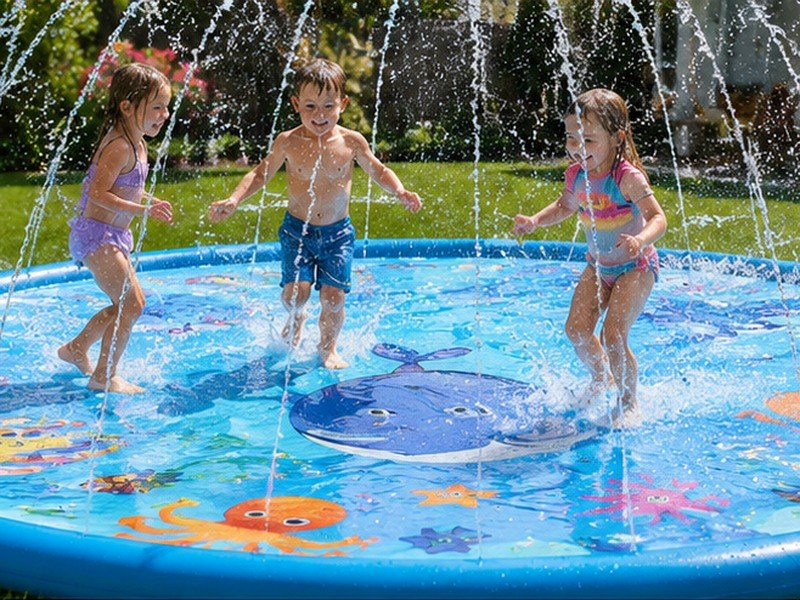
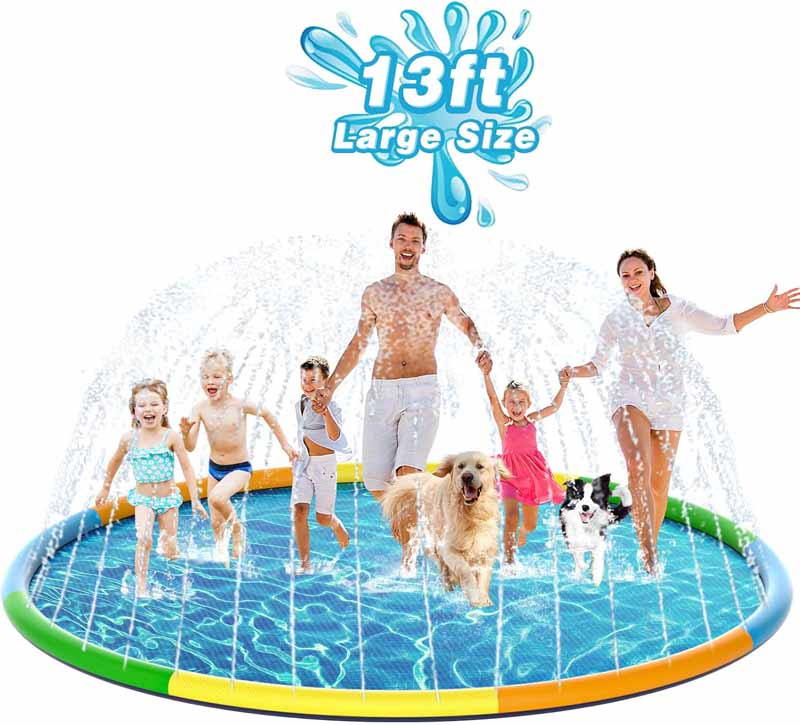
A large kids splash pad can cover eight, ten, twelve, or more feet across a backyard while children are playing, yet the space needed after summer play is usually much smaller. Most flat sprinkler-style pads are built from flexible PVC sheet structures rather than rigid frames. Once the garden hose is disconnected, the perimeter water channel drains, the playing surface lies flat again, and the product can be folded into a bundle suitable for a tote, shelf, closet, deck box, or other seasonal storage area.
The important point is that expanded size, drying space, factory package size, and household folded size describe four different conditions. A splash pad advertised as 10 feet wide does not need a 10-foot storage shelf. At the same time, seeing a surprisingly small shipping carton does not mean every family will reproduce the factory fold after using the product. A factory can fold a new PVC sheet according to a controlled packing sequence, while a household usually creates broader and less compressed folds after cleaning and drying.
For most families, the useful storage question is therefore not, “How many feet wide is the splash pad?” It is, “How large is the clean and dry bundle I will actually store?” Several factors decide the answer: total material area, flexibility of the PVC construction, width of the water channel, welded seams, hose fittings, raised structures, detachable accessories, and the folding method. A very large flat mat can sometimes be simpler to store than a smaller product containing arches, basketball hoops, slides, multiple air chambers, or bulky decorative sections.
From more than two decades of working around PVC and flexible composite products, one pattern appears repeatedly: large deployed area does not automatically mean large stored volume. Flexible materials can spread across substantial surface area while remaining relatively thin. The better storage decision comes from understanding the structure, measuring the folded product instead of guessing from diameter, and planning where the pad will dry before it enters a closed container.
How Much Storage Space Does a Large Kids Splash Pad Actually Need?
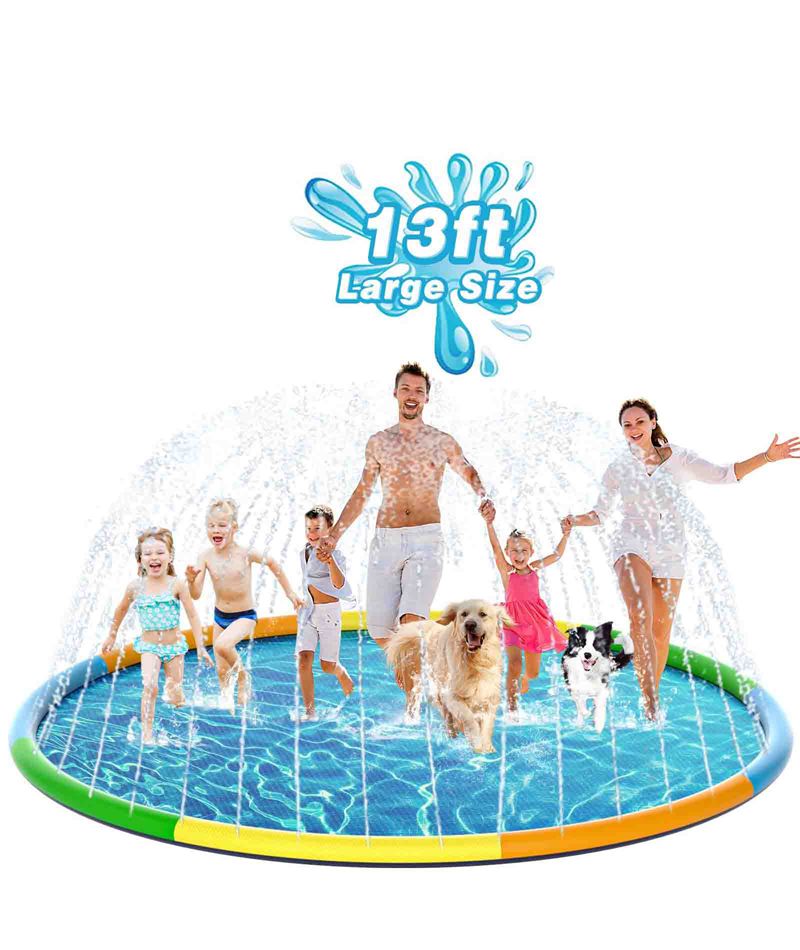
A practical answer should begin with storage categories rather than an invented universal folded dimension. Flat PVC sprinkler mats in the 5–7 ft range often behave like compact seasonal toys after folding. Products in the 8–10 ft range generally contain more material but still remain manageable for many household totes or shelves. Once the diameter reaches the 10–12 ft range and beyond, a larger tote, deck box, or dedicated garage shelf becomes a more sensible planning starting point. These are planning categories, not guaranteed dimensions.
| Splash Pad Type | Typical Expanded Size | Practical Storage Expectation | Places Worth Measuring |
|---|---|---|---|
| Small flat sprinkler pad | 5–7 ft | Compact folded bundle | Toy bin, utility shelf, small closet |
| Medium flat sprinkler pad | 7–9 ft | Small-to-medium bundle | Storage tote, closet shelf, garage shelf |
| Large flat sprinkler pad | 9–12 ft | Medium seasonal bundle | Medium/large tote, garage shelving |
| Extra-large flat sprinkler pad | 12 ft+ | More folded material | Large tote, deck box, dedicated shelf |
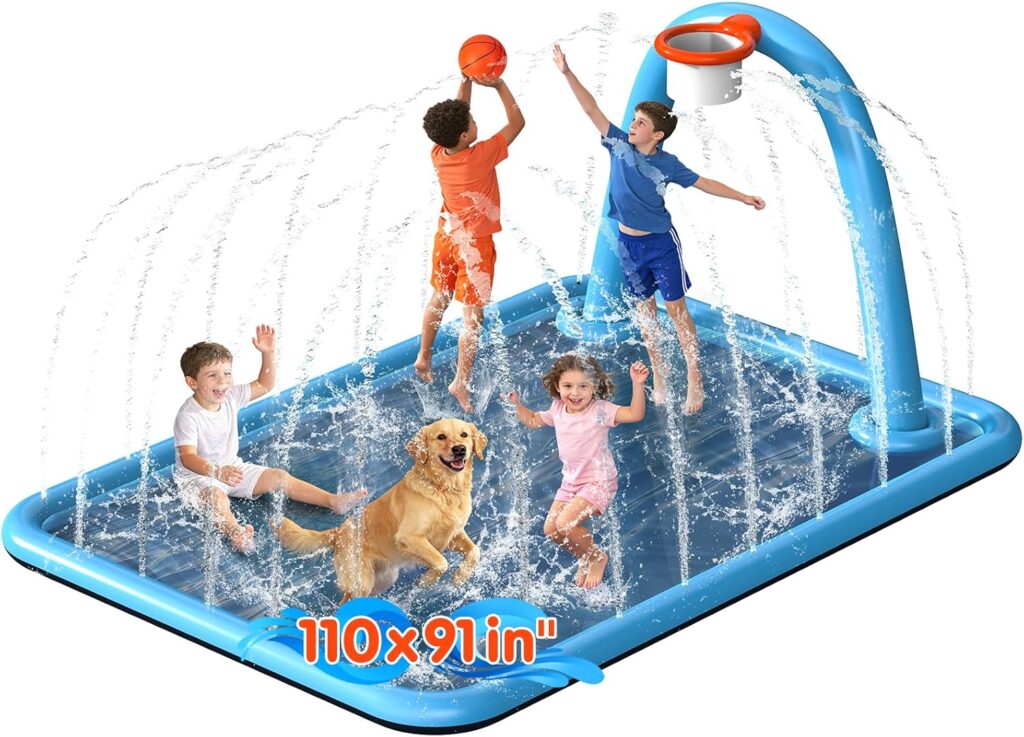
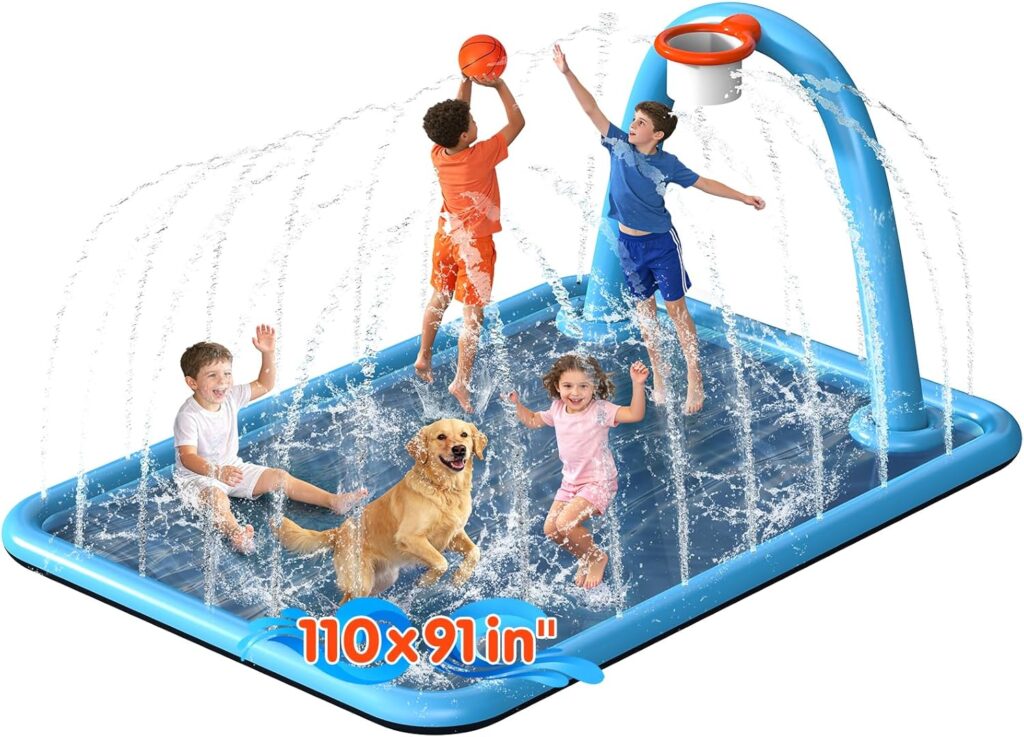
| Pad with arch, hoop, slide, or bulky feature | Varies | Often bulkier than a flat mat | Larger deck box, garage floor or shelf area |
The table works best as a first filter. It should never replace the actual specifications of the product being considered. Two 10 ft products can differ significantly because one may be a mostly flat circular sheet with a water-filled perimeter, while another may contain an inflatable arch and activity features. Even among simple mats, differences in edge-channel width, PVC formulation, reinforcement, welded overlaps, connector size, and included accessories can change the final thickness of the folded stack.
For household planning, think in three dimensions. A folded splash pad has a length, width, and height, so a container must accommodate all three. A 22-inch-wide bundle will not fit through a 19-inch-wide tote opening merely because the tote has a large advertised quart capacity. Likewise, a bundle may fit easily on the footprint of a garage shelf but be too tall for the clearance between two shelves. Actual internal measurements are more useful than marketing descriptions such as “large storage bin.”
A large outdoor water-play product can also be designed specifically to reduce its non-use footprint. Little Tikes describes its Splash Beach product as folding closed for compact storage. Its construction is different from a flat PVC sprinkler mat, so its dimensions should not be transferred to another product, but the example illustrates an important design principle: the area used during play and the shape used during storage can be engineered as separate states.
- Evidence note: Large flexible or collapsible water-play products can be designed around a much smaller storage condition than their operating footprint. Always use the specifications of the individual product rather than copying dimensions between product types.

Why Can a 10–12 FT Splash Pad Fold Down So Much Smaller?
A Large Footprint Is Mostly Surface Area
The easiest comparison is a large picnic blanket. When spread across a lawn, the blanket covers many square feet. Folded into layers, it occupies a fraction of the floor area because its thickness is small compared with its length and width. A flat splash pad follows the same broad geometric idea, although it contains additional features such as welded seams, perimeter water channels, printing layers, reinforced connector areas, and fittings. Its outdoor diameter represents a two-dimensional footprint, while storage is a three-dimensional folded bundle.
Circle geometry also explains why large splash pads can contain considerably more material even when the diameter increase looks modest. An 8 ft circle has a theoretical full-circle area of about 50.3 sq ft. A 10 ft circle covers about 78.5 sq ft, and a 12 ft circle reaches about 113.1 sq ft. Moving from 8 ft to 12 ft increases diameter by 50%, but theoretical circular area becomes 2.25 times as large. These figures describe the complete geometric circle before subtracting the sprinkler perimeter or other structures; they are not measurements of open child play space.
The area relationship matters for storage because a larger pad normally means more sheet material must eventually be folded. It does not mean storage volume grows at the same rate. Flexible material is stacked in layers, so final volume also depends on thickness, trapped air, seam placement, connector position, and fold geometry. A diameter comparison therefore tells you whether one product probably contains more material, but it cannot tell you the finished household storage dimensions by itself.
Water Creates Part of the Operating Shape
On a typical hose-powered sprinkler pad, household water pressure fills the outer channel and sends water through small spray openings around the perimeter. The edge becomes more defined during operation because water occupies the internal channel. After the faucet is closed and the hose is disconnected, the water drains and the outer section relaxes. The product returns much closer to a flat flexible structure, which is why an apparently large backyard item does not remain large in storage.
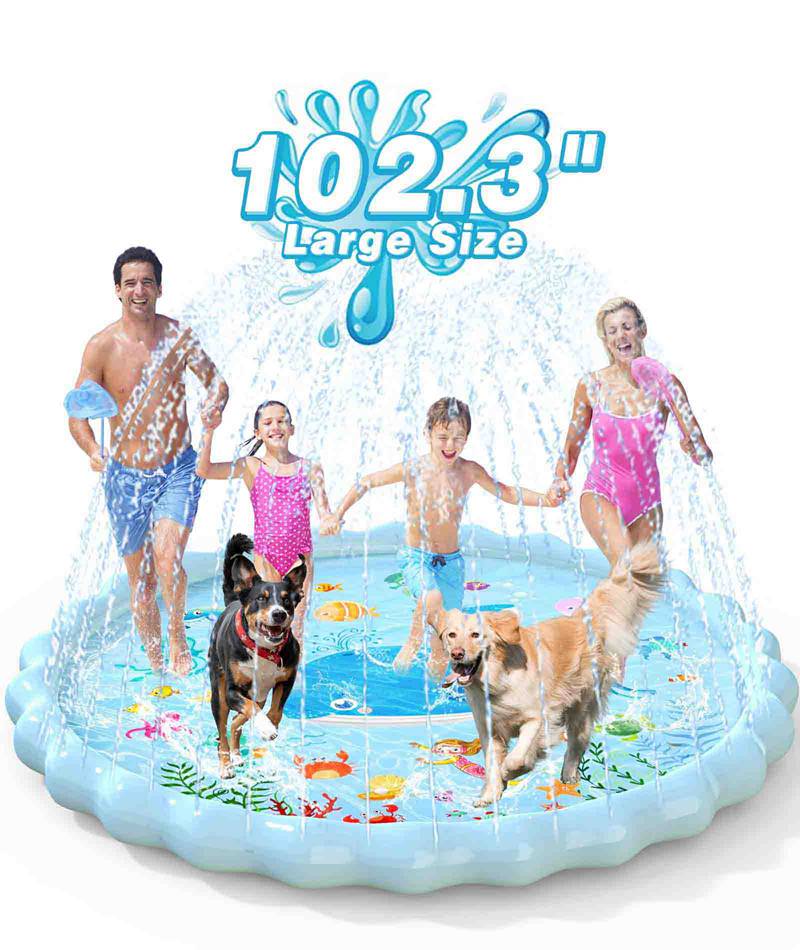
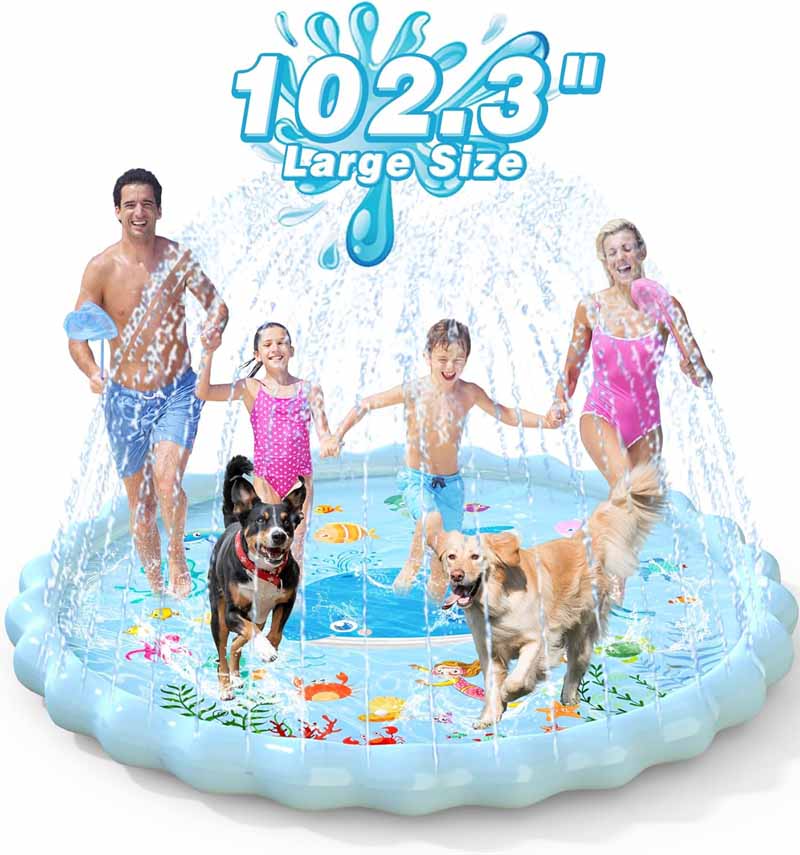
The EPN 102.3-inch model provides a useful structural example. Its confirmed layout includes a central circular water-play surface, an outer water-filled sprinkler ring, perimeter spray openings, and a garden-hose connection. It does not need an air pump for normal operation because the sprinkler effect comes from water supply through the hose. Once the water has been drained and the surfaces are dry, the flexible structure can be folded instead of requiring permanent outdoor installation.
A continuous product demonstration is useful here because video gives a better sense of scale than a tightly cropped photograph. The Vistop splash pad demonstration shows how a folded flexible water-play product is opened into a much broader backyard surface. It should be used as a visual explanation of product behavior, not as dimensional evidence for another brand or model.
- Video reference — See how a flexible splash pad expands into a backyard play surface:
The demonstration helps readers understand how a relatively compact flexible product becomes much larger once spread flat and connected for use.
- Video reference — 10 FT splash pad operating scale:
Use this video to visualize the physical size of a 10 ft sprinkler-style product during use before comparing it with the much smaller storage state.
Expanded Size, Package Size, Folded Size and Storage Space Are Different
Online listings often place several dimensions close together, which can create confusion with flexible products. A number such as 102.3 inches may describe the fully opened diameter, while another group of numbers may describe the retail box. Both can be correct. Problems begin when a shopper assumes one measurement represents the other. A useful storage guide needs to label each state clearly and explain exactly which household question each measurement answers.
| Measurement | What It Describes | Useful For | Main Limitation |
|---|---|---|---|
| Expanded / unfolded size | Product fully spread for use | Yard planning and overall scale | Does not directly predict storage size |
| Factory package dimensions | New product folded and packed for shipping | Showing factory-packed compactness | Not a guarantee of the household re-folded size |
| After-use folded size | Clean, dry product folded at home | Choosing tote, shelf, closet, or box | Varies with folding method |
| Storage-space dimensions | Usable interior of the selected storage location | Final fit decision | Exterior container size may overstate interior space |
Expanded Size Answers a Backyard Question
Expanded diameter tells you how much ground the complete product occupies from edge to edge. A 102.3-inch circular pad is approximately 8.53 ft or 260 cm across and creates a theoretical complete-circle footprint of about 57.1 sq ft. The 57.1 sq ft figure includes the entire geometric circle, including the perimeter sprinkler structure, so it must not be renamed “57.1 sq ft of open play space.” The measurement is useful for understanding physical scale but not for estimating the size of a folded bundle.
For readers working between U.S. customary and metric dimensions, NIST lists one inch as 2.54 centimeters and one foot as 30.48 centimeters. Using a defined conversion source is helpful because product listings, garage shelving, storage boxes, and technical drawings frequently use different units.
- Evidence / conversion reference — NIST Unit Conversion: Use the NIST conversion tables when converting product dimensions between inches, feet, centimeters, and meters.
- Downloadable reference — NIST Metric Conversion Card PDF: This downloadable card covers common length, area, mass, and volume conversions and is useful when comparing product and storage dimensions recorded in different systems.
Factory Package Size Answers a Shipping Question
A factory package measurement describes how a new product has been folded, arranged with accessories, and placed into a carton. Manufacturers can use a repeatable folding sequence and deliberately position thick seams and connectors so layers occupy the available box efficiently. The material is also new, clean, dry, and handled in a controlled production environment. Household storage does not need to reproduce this packing condition, and trying to force a used pad into the smallest possible box can make normal cleanup unnecessarily difficult.
The verified EPN product example makes the difference unusually clear. Its expanded diameter is approximately 102.3 inches / 8.5 ft / 260 cm, while the factory package is approximately 8.66 × 3.93 × 9.84 inches. Multiplying those three box dimensions gives a rectangular package envelope of approximately 335 cubic inches, equal to about 0.19 cubic feet. The figure describes the outside rectangular space represented by the packed dimensions; it is not the physical volume of PVC material itself and is not a guaranteed after-use storage size.
Household Folded Size Answers the Real Storage Question
Once a splash pad has been used, several small differences affect the new bundle. A family may fold from a different side, leave the hose adapter attached, make wider folds to avoid bending a connector, or choose a reusable storage bag larger than the retail carton. The pad may also contain slightly more air between layers than a factory-packed unit. None of these outcomes indicate a problem. The goal is not to recreate the shipping carton; the goal is to produce a dry, protected, manageable bundle.
A sensible product page should therefore use wording such as “factory package dimensions” for the shipping carton and “folded storage dimensions” only when the manufacturer has actually measured the product in a defined folded condition. When exact household folded dimensions are unavailable, the responsible answer is to teach readers how to measure their own bundle rather than manufacture an unsupported number simply because the search query asks “how much.”
What Makes Some Large Splash Pads Bulkier to Store?
Diameter is only the beginning. When flexible PVC products are developed, the finished folded bundle is influenced by the amount of material, structure, localized reinforcement, welding geometry, fittings, print layers, and any three-dimensional features. Two models can therefore advertise the same outer diameter and still feel completely different when lifted, folded, and placed into a box. Understanding these factors helps consumers compare products more intelligently and helps product-development teams design for storage from the beginning.
| Design Factor | Effect on Storage | What to Check |
|---|---|---|
| Total material area | More surface generally creates more folded layers | Overall dimensions and shape |
| Flexible PVC construction | More compliant sheet usually follows broad folds more readily | Product handling and care information |
| Wide perimeter channel | Adds double-layer or multi-layer material around the edge | Ring width and seam layout |
| Reinforced connector zone | Creates local stiffness | Hose inlet position |
| Multiple inflatable chambers | Adds valves, welded layers, and irregular thickness | Product structure |
| Arch or basketball hoop | Adds additional material and may change folding direction | Detachability |
| Molded fittings | Cannot be folded like sheet PVC | Connector size and location |
| Accessories | Require additional protected storage | Included-parts list |
Total Material Area Matters More Than the Headline Number Suggests
Because circular area increases with the square of the radius, seemingly modest diameter increases can add substantial material area. If two hypothetical flat pads were geometrically similar, a 12 ft model would have 2.25 times the complete circular area of an 8 ft model. Real products are not simply mathematical enlargements—ring width, seam layout, graphics, and structure may change—but the relationship explains why larger pads can become noticeably heavier or thicker in storage even when both remain foldable.
Material thickness also contributes, but thickness should not be isolated from formulation and structure. A PVC sheet is not automatically “better,” “stronger,” or easier to store because a single thickness number is larger or smaller. Flexibility is influenced by material composition, temperature, surface treatment, reinforcement, and construction. For household storage decisions, it is usually more useful to ask whether the pad can be folded comfortably and whether thicker structural sections have sensible locations than to treat one raw thickness specification as the entire quality story.
Rigid and Semi-Rigid Parts Change the Fold
The most troublesome part of a flexible product is often not the large sheet surface. It is the small rigid fitting located at exactly the wrong fold line. Garden-hose connectors, valves, drain components, molded adapters, and reinforced attachment patches do not compress in the same way as PVC sheet. A thoughtful fold places these parts on the outside of a layer or within a relatively flat zone rather than trapping them inside a sharp crease.
The same principle matters during custom splash pad development. A product can be designed not only for diameter, artwork, and spray pattern but also for its target carton and storage form. Hose-inlet position, accessory detachability, sprinkler-ring width, seam direction, sports features, storage bags, package dimensions, and fold sequence can be evaluated during sampling. A focused custom manufacturer working with welded PVC recreational products can review these points before mass production rather than discovering packaging conflicts after the design is finalized.
Large Flat Pad vs Smaller Feature-Rich Pad
A 12 ft flat sprinkler mat can contain more sheet material than an 8 ft activity pad, yet the 8 ft design may still create the more awkward bundle if it includes a thick arch, permanent basketball hoop, decorative inflatable animal, or multiple independent air chambers. Storage planning should therefore compare structure first, diameter second. The simplest visual check is to ask which parts remain three-dimensional after the water and air have been removed.

Will a Large Splash Pad Fit in a Tote, Closet, Deck Box or Garage?
A useful household answer needs to translate abstract volume into real places. Most people do not walk through the garage thinking, “I have 2.5 cubic feet available.” They think, “Can it fit under this shelf?” or “Will it go inside the deck box with the pool toys?” Measuring the actual storage location is more reliable than relying on labels such as 70-quart tote, extra-large cabinet, or family-size deck box.
| Storage Location | Best Measurement to Check | Main Advantage | Common Problem |
|---|---|---|---|
| Plastic tote | Internal L × W × H plus lid opening | Clean, contained storage | Tapered walls reduce usable space |
| Closet shelf | Depth × width × clear shelf height | Dry indoor environment | Shelves can be shallow |
| Garage shelf | Depth, height, access, lifting position | Flexible seasonal capacity | Sharp tools or heavy items nearby |
| Deck box | Interior dimensions and moisture protection | Convenient near the yard | Condensation or rain entry |
| Storage bag | Usable opening and relaxed bundle dimensions | Easy handling | Offers less puncture protection |
Measure the Inside, Not the Advertising Label
A molded tote can have exterior dimensions much larger than its usable interior. Handles, tapered sidewalls, wheels, lid channels, and structural ribs all consume space. Measure the narrowest useful width and the internal height with the lid closed. Then measure the opening. A folded pad whose dimensions technically fit inside the lower cavity may still be impossible to insert if the opening is smaller than the bundle.
The same logic applies to shelves. Record usable depth from front edge to back wall, width between vertical supports, and clear height to the next shelf. If the pad is used every few days during summer, also consider access. A technically perfect storage location becomes annoying when bicycles, lawn equipment, or stacked boxes must be moved every time children want to play.
Use Volume as a Secondary Check
For a rectangular tote or shelf space, volume is calculated from length × width × height. For example, a 24 × 18 × 12 inch rectangular space represents 5,184 cubic inches, or 3 cubic feet. Volume is helpful when comparing several containers, but it does not replace dimension-by-dimension fit. A long narrow object can fail to fit inside a high-volume container with the wrong shape.
Omni Calculator provides a rectangular prism volume calculator where length, width, and height can be entered directly. It is useful for comparing two storage containers after you have already checked whether the actual folded bundle fits each dimension.
- External tool — Rectangular Prism Volume Calculator:
Measure the internal length, width, and usable height of a tote or shelf, enter the three values, and compare the resulting volume with alternative storage options.
Think About Weight and Access, Not Only Fit
An extra-large PVC splash pad can be compact enough for a shelf yet awkward to lift when folded. More material normally means more handling weight, and residual water makes the problem worse. If the product must be lifted above shoulder height every weekend, a lower shelf can provide a better everyday experience even when a high shelf offers enough space. Storage planning should reduce both space use and cleanup effort.
For a deck box or shed, moisture is another filter. A product fitting perfectly inside a deck box does not make the box a good long-term storage location if rainwater regularly enters or condensation stays inside. Open the container after heavy rain and check its real conditions. A dry garage or utility closet can be a more predictable seasonal location, even when it is slightly farther from the backyard.

How to Measure the Storage Space Your Splash Pad Really Needs
The most accurate storage specification is created after the actual pad has been cleaned, fully drained, dried, and folded in a way the family can repeat. This method requires no interactive generator, specialized app, or engineering equipment. A tape measure, a clean surface, and a note on a phone are enough. The resulting dimensions can then be compared directly with the internal dimensions of the tote, closet, shelf, or deck box.
Step 1 — Drain Before Trying to Fold
Turn off the faucet and disconnect the hose according to the product instructions. Allow water to move out of the perimeter structure before lifting the entire pad. If water collects in a low point, gently change the angle so gravity can move it toward the opening. Avoid dragging a water-heavy PVC product across rough concrete, stones, roots, or abrasive surfaces merely to speed up the process.
A water-filled edge can make a pad feel dramatically bulkier than its actual storage condition. Water also adds weight, which makes the material harder to reposition and may concentrate force around fittings or folds. A meaningful storage measurement begins only after the product is in its drained state.
Step 2 — Clean Before Measuring
Grass clippings, soil, small stones, food residue, sunscreen, and other debris should be removed before final folding. Material trapped inside several folded layers becomes harder to find later and can leave dirt or local pressure points against the PVC. Cleaning does not need to become an elaborate process after every light play session, but anything going into long-term seasonal storage should be visually clean on both sides.
Step 3 — Dry the Top, Bottom and Perimeter
The center can feel dry while moisture remains underneath or inside a thicker edge structure. Turn or reposition the pad so both surfaces receive airflow. Inspect welded edge areas and fittings rather than checking only the large center. If you can hear water moving when the pad is lifted, final storage measurements should wait until drainage is completed.
A practical video dedicated to splash-pad drying and storage helps make this sequence easier to visualize. It demonstrates the relationship between cleaning, drying location, airflow, folding, and storage rather than treating folding as the first step immediately after play.
- Video reference — How to Dry and Store an Outdoor Splash Pad:
Useful for visualizing the transition from a wet backyard product to a dry folded storage condition.
Step 4 — Create a Fold You Can Repeat
There is little value in producing an extremely compressed bundle during one test if the fold is too complicated to repeat every weekend. Start with broad folds. Keep rigid connectors away from sharp fold lines. For a round pad, folding opposite sides toward the center can turn the circle into a long rectangle; the rectangle can then be folded again according to the width of the intended shelf or tote.
The ideal household fold is not necessarily the smallest possible fold. It is the smallest comfortable and repeatable fold that keeps the pad manageable. If one orientation produces a 20 × 16 × 7 inch bundle while another creates 25 × 12 × 7 inches, the best version depends on the intended storage location. A deep tote and a shallow closet shelf may favor different shapes even if overall volume is similar.
Step 5 — Measure Length, Width and Maximum Height
Place the finished bundle on a flat surface and measure its longest dimension, widest dimension, and thickest point. Do not compress it with your body while measuring. Record the numbers as the normal folded storage size. If a hose adapter, sports accessory, ball, repair kit, or storage pouch is kept separately, measure or note the separate accessory bundle as well.
Step 6 — Perform a Real Fit Test
Put the folded product into the planned container or onto the shelf. Confirm that the lid closes naturally, the door is not pushing against the PVC, and a rigid connector is not trapped under a heavy object. A tape-measure comparison can say “yes” mathematically while the real fit is inconvenient because of a tapered tote, lid hinge, narrow door opening, or shelf support.
A pool liner is significantly larger and structurally different from a kids splash pad, but folding videos for flexible liners are useful because they clearly demonstrate how a broad vinyl/PVC surface can be converted into an organized bundle. The following Intex-related demonstration is best used to understand fold geometry, not as a required folding method for every splash pad.
- Video reference — How to Fold a Large Flexible Pool Liner:
Watch how a broad flexible liner is progressively reduced using planned folds, while keeping the final package manageable.
A Simple Static Storage Worksheet
No interactive recommendation tool is required. A simple printable sheet or phone note can capture the few numbers needed for future seasons. Once recorded, families can replace a damaged tote, reorganize garage shelving, or compare a future larger splash pad without repeating the entire exercise.
Record:
- Product name and model
- Expanded diameter or length × width
- Normal folded length
- Normal folded width
- Normal folded height
- Storage tote internal L × W × H
- Tote opening width
- Shelf depth and clear height
- Accessory storage location
- Main summer storage location
- Winter storage location
- Confirmed dry before long-term storage: Yes / No
Storage Space and Drying Space Are Not the Same Thing
A folded splash pad may need surprisingly little permanent storage space while still requiring a large temporary drying area. This distinction matters most in small yards, townhouses, apartments with patios, and homes where the lawn is not available for several hours after water play. A family can easily have enough closet space to own a 10 ft pad but struggle to find an appropriate place to dry its top, underside, perimeter, and fittings before folding.
Think of the ownership cycle as three separate spatial states. Play space requires the complete outdoor footprint, hose routing, access, and surrounding movement room. Drying space requires enough exposure for wet surfaces and water channels to lose moisture. Storage space begins only after the dry material has been folded. The first two may involve dozens of square feet outdoors while the third may involve only a relatively small shelf or tote.
Drying Should Be Confirmed, Not Assumed
There is no scientifically honest universal sentence saying, “A splash pad dries completely in two hours.” Drying speed changes with temperature, direct sunlight, shade, wind, humidity, orientation, material structure, trapped water, and how much of the surface contacts the ground. A thin exposed center may feel dry quickly while a folded edge or internal water channel still contains moisture.
The U.S. Environmental Protection Agency advises homeowners to act quickly with wet or damp materials and notes that, in general household moisture-control situations, drying wet materials within 24–48 hours helps limit mold growth. This is general moisture and mold guidance for buildings and household materials, not a tested splash-pad drying specification. It should support the principle of prompt drying without being converted into a claim that every PVC splash pad needs exactly 24 or 48 hours.
- Evidence source — U.S. EPA, A Brief Guide to Mold, Moisture and Your Home: The useful lesson for splash-pad storage is moisture control: do not seal persistently damp material into a closed container simply because the product appears dry from one side.
- Downloadable evidence file — EPA Mold and Moisture Guide PDF: Useful as a permanent downloadable reference for general household moisture-control guidance.
Use Airflow and Surface Exposure Before Heat
For a large mat, ordinary airflow and exposing wet surfaces are usually more useful starting points than trying to accelerate the process with intense heat. Lift or turn the product so the underside can dry instead of leaving it pressed against wet grass. If the perimeter can be repositioned safely, change its angle so trapped water has another path toward the outlet. Always follow the specific product instructions when they address drying or heat exposure.
Bestway’s official guidance for its above-ground PVC pool liners provides a useful related-material reference. Its take-down instructions recommend laying the liner out to dry completely and specifically advise against trying to speed the process with a blow dryer or heated instrument because heat can damage the liner. A large pool liner is not a kids splash pad, so its exact procedure should not be presented as the splash pad manufacturer’s instructions, but the caution illustrates sound flexible-PVC storage logic.
An Intex liner-cleaning video is also useful here because it shows how a very large flexible surface can be cleaned and exposed for drying before folding. Again, the liner is a related material application rather than the same product category, so the value is in the dry-before-fold sequence.
- Video reference — Cleaning and Drying a Large Flexible Pool Liner:
The video helps readers see why broad flexible products need surface exposure before they are folded for long-term storage.
What If You Do Not Have Enough Drying Space?
A household does not always need to leave the entire circle perfectly flat. Depending on the manufacturer’s instructions and the product’s structure, a drained mat can sometimes be repositioned over a clean, smooth support to expose the underside, provided it is not hanging from a small fitting or sharp edge. The main goal is to expose wet areas without creating concentrated loads, abrasion, or a new place for water to collect.
If a family repeatedly struggles to dry a very large pad, the problem is not really permanent storage volume. It is ownership workflow. A slightly simpler flat design, a smaller size, a product with easier drainage, or a different drying routine may provide more value than buying the largest diameter that fits the lawn. Storage planning is successful only when the entire process is manageable after real use.
How Should You Fold a Large Splash Pad Without Creating Storage Problems?
Folding is a materials-handling task rather than a competition to produce the smallest possible package. The most useful fold removes air and water naturally, keeps rigid components away from severe creases, avoids trapping debris, creates a bundle the family can lift, and fits the intended storage space. Broad, controlled folds are generally easier to repeat than complex compression techniques designed only to recreate a retail carton.
Begin With the Thickest Areas in Mind
Before making the first fold, identify the hose inlet, reinforced patches, drain components, thicker seam intersections, inflatable features, and any permanently attached accessories. These areas do not behave like a simple sheet. Plan the fold so rigid or multi-layer parts finish on a relatively flat face of the bundle rather than sitting at the center of a sharp bend.
Fold for the Storage Location
A garage shelf and a storage tote may require different bundle proportions. For a shallow shelf, a wider and flatter fold can work better. For a deep tote, a narrower and thicker bundle may be easier to place vertically. Once a folding pattern works well, take a photograph of each stage or make a simple three-step diagram. Next summer, anyone in the household can repeat the same process without guessing.
Avoid Packing Dirt and Accessories Between PVC Layers
Small accessories should usually remain with the splash pad so they do not disappear, but keeping them in a labeled pouch is cleaner than burying a hard adapter somewhere inside folded PVC. The pouch can go into the same tote after the main pad has been placed inside. A similar approach works for instructions, repair patches, small balls, and detachable sports features.
Bestway’s official above-ground pool storage guidance recommends cleaning and fully drying the liner, using somewhat loose folds, and storing the product in a cool, dry location. Its FAQ also specifies that its pool liner should be completely dry before long-term storage and gives product-specific temperature guidance for its pools. Those numbers belong to Bestway pool products rather than every splash pad, so they should not be copied into a universal splash-pad specification. The broader lesson—clean, dry, fold sensibly, protect during storage—is highly relevant.
- Evidence source — Bestway Official Pool Cleaning and Storage Guidance:
Use this as a related PVC-liner care reference rather than as the instruction manual for a different splash pad.
A second folding example can help readers who want to see how a large circular flexible product changes shape through several stages. The Intex 15 ft round liner video focuses specifically on winter folding. Its structure and weight differ from a splash pad, but the visual sequence makes the principle of reducing a large circle into a rectangular storage bundle easy to understand.
- Video reference — Folding a 15 FT Round Flexible Liner:
Useful for readers who want to observe a full circular folding sequence rather than relying on a written description alone.

Where Should You Store a Splash Pad During Summer and Over Winter?
A good summer storage location should reduce friction. If the pad is used twice a week, putting it behind twelve boxes in an attic may technically protect it but makes every play session inconvenient. A dry garage shelf, utility closet, easy-access storage tote, or weather-protected deck box can work better. Long-term winter storage has a different priority: the product may remain untouched for months, so protection from persistent moisture, sharp objects, pests, and unnecessary compression becomes more important than fast access.
Summer Storage: Easy to Reach, Easy to Dry
During active season, it is reasonable to organize the product around the actual routine. Keep the splash pad in one labeled container with its adapter, instructions, and repair items. Towels and outdoor toys do not need to share the same container if they make the bundle harder to remove. A little unused space inside the tote can be helpful because families are less likely to force a damp or poorly folded product into an undersized box.
A deck box can be convenient near the yard, but only if it genuinely remains dry. Check it after rain. Look at the bottom corners and underside of the lid rather than assuming “outdoor storage box” means waterproof in every installation. If condensation or rain regularly appears inside, move the flexible PVC product to a more predictable location.
Winter Storage: Protect the Material, Not Just the Floor Space
Long-term storage is a good time to separate the product from sharp garden equipment, metal tools, screws, exposed shelf brackets, pet claws, or objects with rough corners. Do not place a heavy stack on top merely because the pad is soft enough to compress. A storage tote, carton, or protective bag can reduce incidental contact, while a clean shelf keeps the product away from damp floors.
Bestway’s current guidance for its own above-ground pools recommends storing a dry liner in a dry location and provides a moderate storage-temperature range for those specific products. The manufacturer also recommends winter disassembly for relevant models. These are product-specific pool instructions, not universal splash-pad temperature limits, but they reinforce the general need to consider moisture and seasonal environmental conditions when storing flexible PVC products for months.
For readers who have never stored a large flexible water product before, a seasonal pool take-down video gives useful perspective. The physical product is much larger than a splash pad, but the sequence—drain, clean, dry, organize parts, fold, and store—shows why seasonal storage works best as a process rather than a last-minute attempt to force wet material into a container.
- Video reference — Seasonal Take-Down and Storage of a Flexible Water Product:
Use the sequence as a visual reference for organizing a long-term storage routine.
Another household example comes from a slip-and-slide cleanup demonstration. A slip-and-slide is not structurally identical to a sprinkler pad, but both involve broad flexible surfaces exposed to lawn water, dirt, and repeated folding. The video is useful for seeing the everyday cleaning and drying challenges families face with seasonal backyard water toys.
- Video reference — Clean and Store a Flexible Backyard Water Toy:
Useful for understanding real household cleanup rather than a factory-perfect packing process.
How to Estimate Storage Needs Before You Buy
The easiest storage problem is the one solved before checkout. Start by finding the unfolded dimensions, then look for an actual folded dimension if the manufacturer publishes one. If no folded figure is provided, check the package dimensions, but label them correctly in your notes. A retail carton proves that a new product can be packed to a certain shipping envelope; it does not guarantee you will reproduce the same package after use.
Read Size Labels Carefully
Look for terms such as:
- Overall diameter
- Unfolded dimensions
- Assembled dimensions
- Inflated dimensions
- Package dimensions
- Shipping dimensions
- Carton dimensions
- Folded dimensions
- Storage bag dimensions
Do not combine these values into one “product size.” Each one describes a different condition. Marketplace technical-information areas sometimes present package and product dimensions near each other, so read the field label rather than assuming the largest or smallest number is the relevant one.
Inspect Construction Photos Before Comparing Two Sizes
A photo can reveal information a diameter cannot. Look for the number of chambers, width of the perimeter structure, presence of an arch, hoops, raised fountains, large connectors, removable components, handles, or decorative parts. If two 10 ft products use very different constructions, their folded behavior is unlikely to be identical.
Check Whether Accessories Are Removable
Detachable accessories can make the main pad easier to fold while creating a small secondary storage requirement. Permanent accessories reduce the risk of losing parts but may create irregular thickness. Neither approach is universally better. The best choice depends on how the family uses and stores the product.
Look for Weight as a Handling Clue
Weight does not directly tell you folded dimensions, but it helps reveal the difference between compact and easy to handle. A bundle may fit inside a relatively small container but still feel heavy because a larger product contains more PVC and welded structure. Weight becomes especially relevant for high shelves, attic access, older caregivers, and products stored away after every use instead of once per season.
Check the Drying Plan Before Choosing the Largest Diameter
Before ordering an extra-large model, identify where it will dry. Can it remain on the lawn after use? Can the underside be exposed? Will a patio provide enough clean surface? Does the product have a straightforward drainage path? A family with a very large garage but no practical drying area may find cleanup more difficult than a family with less permanent storage but a convenient sunny lawn.
A simple pre-purchase checklist is more reliable than searching for one generic “large splash pad storage size”:
- Exact unfolded dimensions found
- Package dimensions clearly labeled
- Folded dimensions found, if available
- Flat or feature-rich construction identified
- Rigid fittings identified
- Removable accessories identified
- Product weight checked
- Drying location selected
- Storage tote or shelf measured
- Long-term winter location selected
Real Example: How an 8.5 FT Splash Pad Can Have a Small Package
The verified 102.3-inch EPN splash pad is useful because its expanded and factory-packed measurements illustrate the storage principle without requiring invented estimates. Fully opened, the pad measures approximately 102.3 inches in diameter, or about 8.53 ft / 260 cm. Its theoretical complete-circle footprint is approximately 57.1 sq ft. The central open play area is smaller than the complete geometric circle because the outside measurement includes the sprinkler perimeter.
The factory package dimensions are approximately 8.66 × 3.93 × 9.84 inches. A package under ten inches along its longest listed dimension containing a product that opens to more than eight feet across may initially seem surprising, but the geometry makes sense: most of the outdoor footprint consists of flexible PVC spread into a relatively thin surface rather than a rigid three-dimensional structure.
What the Example Demonstrates
- A large outdoor footprint can come from thin, flexible material
- Expanded diameter is not a storage dimension
- Factory package dimensions can be much smaller than play dimensions
- A hose-powered perimeter relaxes after water is removed
- Flexible PVC can be folded into multiple layers
- Packaging efficiency is influenced by fold sequence and component placement
What the Example Does Not Demonstrate
- Every 8.5 ft splash pad folds to 8.66 × 3.93 × 9.84 inches
- Every household can reproduce the factory packing sequence
- Every brand uses the same PVC construction
- Every 10 ft or 12 ft model scales directly from the 8.5 ft package
- Factory carton volume equals the physical volume of the PVC material
- A compact package automatically means effortless drying or handling
The distinction between these two lists is important for trustworthy product content. Consumers benefit from specific numbers, but precision should remain attached to the condition actually measured. Saying “the factory package is approximately 8.66 × 3.93 × 9.84 inches” is useful and verifiable. Saying “your used 8.5 ft splash pad will always fold to this exact size” would go beyond the available evidence.
For custom splash pad development, this example also illustrates why package planning belongs early in the process. A project can establish a desired play diameter and a target retail-carton range at the same time. Engineers can then evaluate fold direction, connector location, seam stacking, detachable features, artwork orientation, storage bags, accessory arrangement, and material construction during sampling. The goal is not merely to create a large product; it is to create a product whose complete life cycle makes sense from opening the carton through seasonal storage.
Does a Bigger Splash Pad Always Create More Storage Trouble?
A larger flat pad generally contains more material, so size is not irrelevant. However, storage difficulty is broader than material quantity. A 12 ft simple flat mat may be easy to understand, drain, fold, and place into one large tote. A smaller feature-rich splash product may require several deflation steps, removal of accessories, awkward folding around an arch, and storage of additional pieces. Diameter alone therefore cannot identify which product is easier to live with.
A better ownership comparison covers six stages:
- Set up — How complicated is unfolding and connecting the product?
- Play — Does the selected diameter suit the available yard and family?
- Drain — Can water leave the perimeter without excessive lifting?
- Dry — Can both sides and thicker structural areas be exposed?
- Fold — Do fittings and accessories allow a simple repeatable fold?
- Store — Does the dry bundle fit a realistic household location?
A smaller diameter is not automatically the better decision when storage is limited. If a larger flat pad folds cleanly and a medium-size feature-rich pad does not, the larger product may create the easier routine. Likewise, choosing a giant pad simply because it folds is not sensible if the household has nowhere to dry it. The most useful product size is the one fitting the whole routine, not just the backyard or closet independently.
The same approach improves product development. For private-label or custom PVC splash pads, storage can be a measurable design requirement rather than a marketing sentence added at the end. A development brief can specify target expanded dimensions, desired structure, approximate package envelope, connector location, detachable components, storage bag concept, printing requirements, and sampling tests. A focused PVC manufacturer can evaluate these variables together and confirm what is technically repeatable before promising a final storage size.
Conclusion: Measure the Folded Product, Not the Backyard Diameter
A large kids splash pad usually requires far less permanent storage space than its outdoor diameter suggests. A product eight or ten feet across during play is not an eight- or ten-foot rigid object. Once the hose is disconnected, the water channel drains and the flexible PVC structure can be dried and folded into layers. For many households, the final question becomes whether the bundle fits a tote, shelf, closet, garage area, or deck box rather than whether a giant empty storage zone exists.
The most reliable decision method is simple: separate expanded size, package size, after-use folded size, drying space, and storage-space dimensions. Use factory package measurements only as evidence of compact packing, not as a guarantee of the bundle a family will reproduce after use. Measure the actual dry fold whenever possible, check the internal dimensions of the proposed storage location, and make sure the product has somewhere practical to dry before it disappears into a closed container.
Material and construction details matter as much as diameter. A wide flat PVC surface behaves differently from a product with arches, hoops, several chambers, rigid fittings, or permanent accessories. Looking at the complete ownership cycle—set up, play, drain, dry, fold, store—produces a better decision than simply choosing the smallest headline size. When storage is considered during product design as well as household use, even a large splash pad can remain a practical seasonal backyard toy rather than a bulky item nobody knows where to put.
Frequently Asked Questions About Large Kids Splash Pad Storage
Can a 10 FT Splash Pad Fit in a Storage Tote?
Many flat 10 ft sprinkler-style splash pads can be folded into a bundle suitable for a household tote, but the diameter alone cannot confirm which tote will work. Check the construction, drain and dry the product, create a normal repeatable fold, and measure its length, width, and maximum height. Compare those measurements with the internal dimensions and opening of the container rather than relying only on the tote’s advertised quart capacity.
How Small Does a Large Splash Pad Fold?
There is no trustworthy universal expanded-to-folded ratio for the entire category. A flat pad can become surprisingly compact because much of its operating footprint comes from relatively thin flexible sheet material, but total area, PVC construction, welded edges, perimeter channels, fittings, accessories, and the folding method all change the bundle. Manufacturer-published folded dimensions are useful when clearly labeled; otherwise, household measurement after drying is the most dependable answer.
Can I Store a Splash Pad in the Garage?
A garage can be a practical storage location when the selected area stays dry and the folded product is protected from sharp tools, exposed hardware, leaking pipes, heavy objects, and pest activity. Lower or middle shelving often makes a larger folded pad easier to retrieve than overhead storage. Before long-term winter storage, make sure the pad is clean and dry rather than assuming a closed garage automatically provides suitable storage conditions.
Can a Splash Pad Stay in a Deck Box?
A deck box can work when its interior remains dry and the pad enters the box fully drained and dried. Check the container after heavy rain because outdoor boxes vary in water resistance, installation, drainage, and condensation. If moisture regularly appears inside, use the box for items less sensitive to persistent dampness and move the folded PVC product to a more controlled garage shelf, utility closet, or indoor tote.
Should a Splash Pad Fit Back Into Its Original Box?
No. Returning a used splash pad to the exact factory carton is not a requirement for proper household storage. The original product was folded under controlled manufacturing and packaging conditions, while families may naturally use broader folds and different accessory placement. A slightly larger reusable tote or storage bag can be more convenient if it allows the clean, dry pad to fit without excessive compression around seams, fittings, or reinforced areas.
Do I Need to Dry a Splash Pad Before Folding It?
Yes. Drain the pad and allow exposed surfaces and thicker perimeter areas to dry before placing it into long-term closed storage. Drying time should not be reduced to one universal number because weather, humidity, airflow, sunlight, product design, and trapped water all influence the process. General EPA moisture guidance supports prompt drying of wet materials, but its 24–48 hour household guidance should not be presented as a splash-pad-specific drying specification.
Does a Larger Splash Pad Always Need a Larger Storage Bin?
Usually a larger flat pad contains more material, so size can increase the folded bundle, but construction can change the result substantially. A large simple mat may fold more efficiently than a smaller product containing an arch, basketball hoop, multiple chambers, permanent decorations, or several bulky accessories. Compare actual folded dimensions, package information, structure, weight, accessory volume, and your available drying area before deciding that the smallest outdoor diameter is automatically easiest to store.