Skip to content
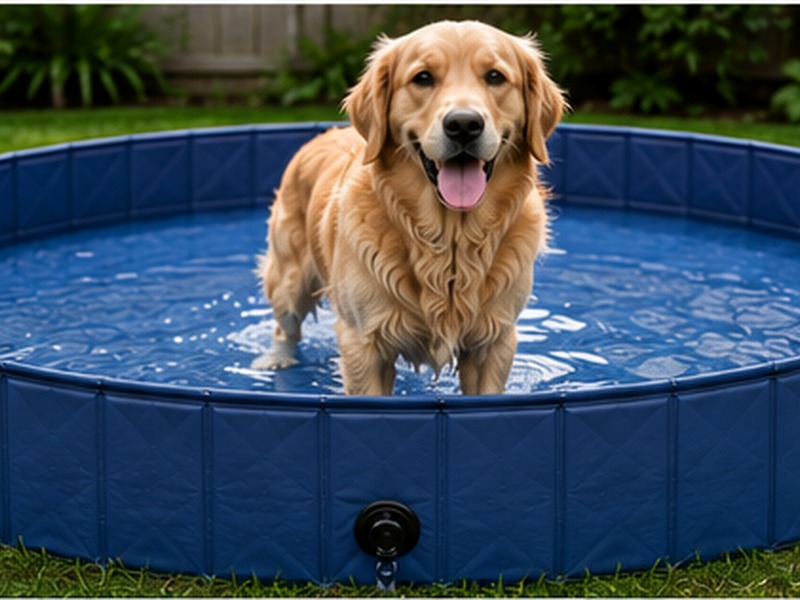
A dog pool may look like a simple basin filled with water, but the way its floor behaves under wet paws can shape the entire experience. Dogs do not stand in water the way people do. They enter quickly, turn suddenly, shake their bodies, chase floating toys, push against the wall, and sometimes jump out before the floor has had time to settle. Once the surface becomes wet, a smooth base can leave even a confident dog searching for stable footing.
A non-slip dog pool base uses surface texture, material grip, floor support, and structural stability to help dogs maintain traction while entering, standing, turning, and playing. It matters because better footing can reduce uncontrolled sliding, improve confidence, support dogs with limited mobility, and make shallow-water activities more comfortable. However, no textured floor can replace level-ground setup, sensible water depth, nail care, and close supervision.
Imagine a senior Labrador stepping into a cool backyard pool on a hot afternoon. The water is inviting, but one rear paw slides as the dog turns. The dog freezes, lowers its body, and refuses to move again. What looked like hesitation around water may actually have been a problem with the floor. That small moment explains why the base deserves as much attention as the pool size, wall strength, drain, or color.

What Is a Non-Slip Dog Pool Base?
A non-slip dog pool base is a textured or specially finished pool floor designed to create more friction between wet paw pads and the PVC surface. It helps limit sliding during entry, standing, turning, and exit. An effective base combines texture with suitable thickness, even support, secure seams, and proper ground placement. It improves traction, but it does not make unsafe movement impossible.
The phrase “non-slip” should not be understood as “slip-proof.” Water, soap residue, loose hair, mud, worn claws, and energetic movement can reduce grip on almost any surface. A well-designed base lowers the likelihood and severity of sliding by giving paw pads more contact points and reducing the smooth, slick feeling associated with untreated vinyl floors.
Its performance also depends on the complete pool structure. A textured top layer may offer useful grip, but the advantage can be weakened when the floor wrinkles, floats, bunches, or rests over uneven ground. For this reason, surface finish, floor construction, wall support, material flexibility, and installation conditions should be considered together.
How Does a Non-Slip Dog Pool Base Work?
A non-slip dog pool base works by increasing friction at the point where a dog’s paw meets the wet floor. Instead of placing the paw on a completely smooth sheet, the dog steps onto a surface with small raised patterns, embossed lines, dimples, or other controlled texture. These details create additional contact points and help the paw resist sideways movement.
The texture must be balanced. A pattern that is too shallow may become ineffective once covered with water. A pattern that is too aggressive may feel uncomfortable, collect dirt, trap loose hair, or become difficult to clean. The goal is not to create a harsh floor. It is to produce a stable, paw-conscious surface that still feels comfortable when a dog stands, sits, or lies down.
Floor tension also matters. A textured material performs more consistently when it lies flat. If the base forms large wrinkles, the dog may step on moving folds rather than a stable surface. Good traction therefore depends on both material finish and the way the floor is supported by the pool structure and the ground beneath it.
What Texture Creates Better Grip?
Useful dog pool base textures often include fine embossing, closely spaced raised dots, shallow geometric patterns, or crosshatched surfaces. These patterns can interrupt the continuous film of water that forms between a wet paw and smooth PVC. They also provide small edges against which paw pads can brace during movement.
More texture is not always better. Deep grooves may look highly slip-resistant, but they can collect grit, mud, cleaning residue, and dog hair. When debris remains in the pattern, the floor may become harder to rinse and less pleasant for sensitive paws. Sharp or rigid patterns may also be unsuitable for dogs that spend long periods standing in shallow water.
A practical texture should remain noticeable after repeated folding, drying, and cleaning. It should not depend only on a thin decorative coating that can wear away. For custom dog pool development, texture depth, pattern spacing, material hardness, and cleaning performance should be evaluated together rather than selected for appearance alone.
Is a Smooth Dog Pool Base Slippery?
A smooth dog pool base can become slippery when water creates a low-friction layer between the PVC and the dog’s paw pads. The risk increases when the dog accelerates, turns sharply, pushes sideways, or tries to jump over the pool wall. A standing dog may seem stable, while the same dog may slide the moment its body weight shifts.
Smooth PVC is not automatically unsafe in every situation. A calm dog standing in very shallow water on a flat, well-supported floor may have no obvious difficulty. The problem is that dog behavior is rarely completely predictable. A door may open, another dog may approach, a toy may move, or the dog may suddenly shake water from its coat.
The safer design decision is to prepare for movement rather than assume the dog will remain still. A textured base offers a wider margin for normal play, uncertain entry, and rapid direction changes. It is especially valuable in larger pools where dogs have enough room to gain speed before turning.
Why Do Wet Paws Slip on a Dog Pool Base?
Dog paw pads provide natural grip, but water can change how they interact with a surface. Moisture fills small gaps between the paw and the PVC, while loose hair around the pads may reduce direct contact. Long nails can also change the angle of the paw, causing the dog to rely less effectively on the pad surface.
The direction of force is important. A paw pressing straight down may hold well, while a paw pushing sideways during a turn may slide. Dogs with weaker rear legs may compensate by spreading their feet or lowering their bodies, but that posture can make movement awkward and tiring.
Mud, skin oils, sunscreen transferred from people, algae, shampoo, and cleaning residue can further reduce traction. This is why a non-slip dog pool base still needs routine rinsing. Surface texture can support grip, but it cannot perform well when covered by a slippery film.

How Does a Non-Slip Dog Pool Base Protect Dogs?
A non-slip dog pool base helps protect dogs by improving footing during the moments when slipping is most likely: stepping over the wall, turning in shallow water, chasing a toy, shaking, and climbing out. Better grip can reduce sudden leg spreading, uncontrolled body rotation, and panic caused by unstable footing. It also helps dogs move more naturally and confidently.
Protection should be understood as risk reduction rather than a guarantee. A dog can still stumble because of excessive excitement, deep water, poor mobility, fatigue, an unstable wall, or uneven ground. The base works as one part of a safer pool system that also includes correct sizing, controlled water depth, accessible entry, and human supervision.
Water confidence is closely connected to physical control. A dog that cannot keep its feet under its body may associate the pool with fear, even when the water is shallow. By contrast, a stable floor allows the dog to pause, investigate, and decide how quickly to move.
How Does a Non-Slip Dog Pool Base Prevent Slips?
A non-slip dog pool base helps prevent slips by resisting the sideways movement of the paw. This is important because many pool-related slips happen during rotation rather than straight walking. When a dog turns its head and shoulders, the rear legs often push diagonally. A textured floor gives the paws more opportunity to hold position during that movement.
The greatest benefit may appear during transitions. Entering and exiting require the dog to shift weight from dry ground to a lower wet surface, or from the pool floor back over the wall. For a brief moment, the dog may have only two or three paws carrying most of its weight. Better floor grip can make that transition feel more controlled.
The pool wall should still be low enough for the intended dog, or an appropriate step or ramp should be used. Traction cannot correct a wall that is too high, an entry point that collapses, or a pool that is oversized for a dog with limited mobility.
Does a Non-Slip Dog Pool Base Improve Balance?
A non-slip dog pool base can improve practical balance by giving the dog a more predictable surface. Balance is not only an internal ability. It also depends on whether the ground remains stable when the body shifts. When a paw slides unexpectedly, the dog must react quickly with its muscles, joints, and other limbs.
Young, healthy dogs may recover from a small slide without visible difficulty. Senior dogs, dogs with reduced muscle strength, and dogs recovering from an injury may not correct their position as quickly. PetMD recommends non-slip surfaces for dogs with arthritis because improved traction can help them move with less fear of slipping and may reduce unnecessary stress on painful joints.
A stable floor also supports slower, deliberate movement. Dogs can stand with a more natural paw position rather than spreading their legs widely for security. This can make bathing, cooling, and supervised water play calmer for both the dog and the person handling it.
Can Better Grip Reduce Joint Strain?
Better grip may reduce some of the sudden muscular effort associated with catching a slip. When a paw moves unexpectedly, the dog may twist, tighten its back, spread its limbs, or push forcefully with another leg. These rapid corrections can be uncomfortable, especially for dogs with existing stiffness or weakness.
This does not mean that a non-slip dog pool base treats arthritis or prevents every joint injury. It is an environmental support feature, not medical care. Dogs with diagnosed mobility problems should use a pool only under guidance suited to their health, and the water activity should match their strength and comfort.
The most useful approach is to remove avoidable difficulty. A textured floor, shallow starting depth, low entry, level placement, and patient handling create a more manageable environment. For dogs that need assistance, a properly fitted support harness or flotation device may also be appropriate after consultation with a veterinarian or canine rehabilitation professional.
How Does Grip Build Water Confidence?
Grip can build water confidence because it allows the dog to explore without feeling that the floor is moving away. A hesitant dog often tests a new surface with one paw before committing its body weight. When that first paw holds securely, the dog is more likely to take the next step.
Confidence should develop gradually. Forcing a frightened dog into the pool can create a lasting negative association. VCA advises beginning in shallow water, increasing depth gradually, and keeping the experience positive. It also emphasizes continuous supervision, even for experienced dogs.
Treats, familiar toys, calm praise, and a clear exit can help. The dog should always know where it can leave. A non-slip base supports this learning process by removing one source of uncertainty, but the dog’s pace still matters. Some dogs enjoy splashing immediately, while others may need several sessions simply to stand comfortably with wet paws.
Which Dogs Need a Non-Slip Dog Pool Base?
Every dog can benefit from a non-slip dog pool base, but puppies, senior dogs, large breeds, dogs with short legs, dogs with limited mobility, and dogs that are nervous around water may need it most. These dogs can have greater difficulty correcting a slide, controlling their body weight, or recovering confidence after unstable movement.
Breed alone does not determine risk. Age, health, body shape, nail condition, coat around the paws, activity level, and previous water experience are also important. A young dog from a water-oriented breed may still panic during its first pool session, while an older small dog may remain calm but need more physical support.
The table below shows how traction needs can vary. It is intended as a practical planning tool rather than a medical classification.
| Dog Profile | Main Traction Concern | Helpful Pool Setup |
|---|---|---|
| Puppies | Excited movement and limited coordination | Shallow water, close supervision, clear exit |
| Senior dogs | Reduced strength and slower recovery from slips | Textured floor, low wall, stable entry |
| Large dogs | Greater force during turns and entry | Reinforced base, larger stable pool, level ground |
| Short-legged dogs | Higher effort when crossing the wall | Low entry point, shallow water, assistance |
| Dogs with long coats | Wet hair around paws may reduce contact | Trim paw hair as appropriate and rinse the floor |
| Nervous dogs | One slip may create fear of the pool | Gradual introduction, quiet setting, firm footing |
| Multi-dog households | Collisions and sudden direction changes | More floor space, controlled group entry |
| Mobility-limited dogs | Difficulty repositioning limbs | Veterinary guidance, support equipment, non-slip base |
Do Puppies Need a Non-Slip Dog Pool Base?
Puppies can benefit greatly from a non-slip dog pool base because their movement is often fast, playful, and poorly controlled. They may leap toward a toy, bite at the water, chase another puppy, or attempt to climb out from the side instead of using the easiest exit.
A stable surface helps a puppy learn that water play can feel manageable. The first sessions should remain short and shallow. The puppy should be able to stand comfortably, turn around, and leave without swimming. VCA notes that puppies can participate in water activities when monitored and when water temperature and conditions are suitable.
The pool should not become an uncontrolled wrestling area. Two puppies may push each other unintentionally, while a larger adult dog can overwhelm a smaller puppy. Introductions should be calm, nails should be smooth, and toys should be chosen carefully to avoid frantic competition.
Are Senior Dogs Safer With More Grip?
Senior dogs are often safer with more grip because age can affect muscle strength, joint comfort, vision, reaction time, and confidence. Some older dogs show only subtle signs of discomfort, such as hesitating before stepping over an edge or becoming unwilling to turn on a slick surface.
A non-slip dog pool base can make cooling, bathing, or gentle supervised movement more accessible. The pool should have a low, predictable entry and enough room for the dog to turn without pressing tightly against the walls. The person supervising should remain close enough to support the dog if its rear legs weaken.
Water activity should never be used to push a senior dog beyond its limits. Panting, trembling, repeated attempts to escape, a lowered posture, or difficulty standing are reasons to stop. For dogs with arthritis, surgery history, neurological changes, or severe weakness, professional guidance should come before pool use.
Do Large Dogs Need Extra Traction?
Large dogs often need extra traction because they generate more force when entering, turning, shaking, and pushing against the pool wall. A small slide under a heavy dog can move the floor, deform a weak wall, or place significant force on one limb.
The pool diameter should allow the dog to stand and turn naturally. A pool that is too narrow may cause the dog to brace against the sides, while an oversized pool with unsupported walls may feel unstable if it is underfilled. Floor thickness and reinforcement become more important as dog weight and activity increase.
For multi-dog use, total movement matters more than the number of dogs alone. Two calm large dogs may use a pool more safely than three highly excited medium dogs. The operator should consider combined weight, turning space, entry pattern, and the possibility of collisions before allowing several dogs inside together.
Which Dogs Have Higher Slip Risks?
Dogs may face higher slip risks when they have weak rear legs, long nails, excess hair between the paw pads, poor vision, neurological difficulties, obesity, joint stiffness, or limited experience on wet surfaces. Dogs with compact, heavy bodies and short legs may also work harder to cross a pool wall.
Behavior can increase risk as much as body condition. A dog that spins repeatedly, jumps at water streams, guards toys, or rushes the exit may overwhelm even a well-textured base. In these cases, the solution is not simply a more aggressive floor pattern. The activity itself must be managed.
Watch how the dog stands. Wide-spread legs, repeated paw repositioning, crouching, tail tucking, and refusal to turn can indicate that the dog does not feel secure. These signs should lead to less water, a slower session, a cleaner floor, or a different setup rather than pressure to continue.

What Makes a Good Non-Slip Dog Pool Base?
A good non-slip dog pool base combines a durable textured PVC surface, appropriate thickness, secure seams, resistance to claw wear, and enough structural support to remain flat during use. The texture should improve wet-paw traction without feeling sharp or trapping excessive dirt. The base must also tolerate folding, cleaning, temperature changes, and repeated outdoor use.
No single material measurement proves that a pool is safe or durable. A thick floor can still wrinkle. A heavily textured surface can still wear. A strong PVC layer can still fail at a weak seam. Product quality comes from how the material, texture, reinforcement, wall panels, edge construction, drain, and manufacturing controls work together.
For both retail selection and custom development, the most useful questions focus on real use: Does the floor stay flat? Can it handle repeated claw contact? Is the texture easy to clean? Does it retain grip after folding? Are the seams reinforced in high-stress areas?
| Base Feature | What to Inspect | Why It Matters |
|---|---|---|
| Surface texture | Even embossing with no sharp ridges | Supports grip while remaining paw-conscious |
| PVC thickness | Suitable for pool size and expected dog weight | Helps resist wear, deformation, and puncture |
| Floor reinforcement | Added support in high-contact areas | Improves stability during turning and entry |
| Seam quality | Wide, even, securely bonded seams | Reduces separation under repeated movement |
| Claw resistance | Material tested under repeated scratching or stepping | Supports longer service life |
| Fold recovery | Floor lies flat after storage | Limits wrinkles that can reduce stability |
| Cleaning performance | Pattern rinses without holding residue | Helps maintain traction and hygiene |
| Ground compatibility | Base performs on a protective, level surface | Reduces concentrated pressure and abrasion |
| Drain position | Water can be removed without dragging the pool | Reduces unnecessary stress on the base |
| Material consistency | Uniform thickness and finish across production | Supports repeatable product performance |
Which PVC Texture Offers Better Grip?
The best PVC texture for a dog pool base is usually a controlled embossed pattern that provides wet traction without creating hard pressure points. Fine geometric textures, small raised dots, and shallow crosshatching can work well when they are evenly formed and remain flexible.
Texture should be evaluated under wet conditions. A pattern that feels rough when dry may become much smoother after water fills the gaps. Testing should include standing pressure, turning movement, repeated paw contact, and cleaning cycles. It should also examine whether the pattern becomes polished or flattened over time.
Color and gloss can offer visual clues, but they do not prove performance. A matte-looking base may still be slick, while a slightly glossy embossed floor may provide better traction. Physical testing is more reliable than judging a product by appearance. For OEM and ODM projects, texture samples should be compared using the intended PVC formulation, thickness, and production process.
How Thick Should the Pool Base Be?
There is no single ideal dog pool base thickness for every product. The correct specification depends on pool diameter, wall height, dog size, expected activity, reinforcement design, ground conditions, portability requirements, and target price.
A thicker base can improve resistance to abrasion and puncture, but thickness alone does not guarantee grip. It can also increase product weight, folding resistance, shipping volume, and material cost. A thinner base may perform well when it uses a suitable composite structure, high-quality reinforcement, and a protective ground layer.
The better question is whether the complete floor system is appropriate for the use case. A compact bathing pool for one small dog has different demands from a large pool intended for several active dogs. EPN matches PVC and composite structures to product function, with pet products placing greater emphasis on wear resistance, support, stability, and repeated paw contact.
Does Claw Resistance Affect Traction?
Claw resistance affects long-term traction because repeated scratching can damage the embossed surface, create cuts, lift thin coatings, or wear smooth paths into the floor. A base may feel secure when new but lose performance if the texture degrades quickly.
Claws also influence how dogs stand. When nails are overly long, the paw may not rest flat, reducing contact between the pads and the textured surface. PetMD includes nail care alongside non-slip surfaces as a way to help senior dogs maintain better traction.
Claw-resistant does not mean puncture-proof. Dog owners should keep nails trimmed and smooth, remove sharp debris beneath the pool, and prevent intentional digging. Manufacturers should test not only a single puncture event but also repeated scratching, stepping, turning, and folding. Repeated low-level wear can reveal weaknesses that one-time pressure testing misses.
How Does Reinforcement Improve Stability?
Reinforcement improves stability by helping the dog pool base resist stretching, shifting, and concentrated pressure. It may involve thicker floor material, composite layers, reinforced perimeter seams, wider joining edges, or added support in areas where dogs enter and turn most often.
The floor and wall connection deserves special attention. When a large dog pushes sideways, the load travels from the floor into the side structure. Weak connections may allow the wall to fold inward or the floor to bunch. Rounded transitions and reinforced joining areas can distribute force more smoothly than narrow, rigid stress points.
Ground protection remains necessary. A reinforced base placed over stones, sharp roots, rough concrete, or broken toys can still suffer abrasion. A clean, level surface and a suitable protective mat can extend service life while helping the floor remain flat. Reinforcement works best when product design and everyday setup support each other.
How Is Slip Resistance Tested?
Slip resistance should be evaluated through repeated wet-use simulations rather than a single dry touch test. Useful evaluations include wet surface friction checks, repeated paw-pressure simulation, claw-scratch wear, loaded turning movement, fold-and-unfold cycles, long-term water exposure, heat aging, UV exposure, and low-temperature flexibility.
EPN operates an independent laboratory and conducts more than 500 material and product performance tests each year. Testing programs can include pet claw abrasion, long-duration water pressure stability, repeated inflation or filling cycles, UV exposure, high-temperature aging, and low-temperature brittleness evaluation. The purpose is to understand how the product performs after repeated use, not only when it first leaves the production line.
For custom development, test conditions should match the target market. A small indoor bathing pool and a large outdoor dog pool do not face the same loading, sunlight, storage, or temperature conditions. Product specifications should therefore be developed around the real setting rather than copied from an unrelated pool design.

How Do You Use a Non-Slip Dog Pool Base Safely?
Use a non-slip dog pool base safely by placing the pool on clean, level ground, removing sharp debris, starting with shallow water, providing an easy exit, keeping nails smooth, and supervising the dog continuously. Rinse away hair and residue after use, drain the pool without dragging it, and allow the base to dry fully before folding.
A textured floor increases the margin for safe movement, but the setup determines whether that advantage is maintained. Uneven ground can tilt the pool, collect deeper water on one side, and create folds in the base. Too much water can increase wall pressure, while too little water may leave some foldable structures insufficiently supported.
AKC guidance emphasizes that not all dogs are natural swimmers and that even experienced dogs need supervision. Dogs should also learn where and how to exit a pool before they are allowed to play freely.
Which Ground Surface Works Best?
The best ground surface for a dog pool is clean, flat, level, and free from sharp objects. A maintained lawn can provide cushioning, but hidden stones, roots, sticks, or uneven soil should be removed. Smooth patios may offer level support but can become slippery around the pool and may abrade the base if the surface is rough.
Concrete requires extra care. Small grit beneath the pool can act like sandpaper when a dog moves. A protective ground mat can reduce direct abrasion, but it must lie flat and should not trap objects underneath. Wooden decks should be checked for splinters, raised fasteners, gaps, and sufficient load support.
Avoid slopes. Even a modest incline can send water toward one side, change wall pressure, and cause the dog to stand at an angle. The area around the pool should also provide traction so the dog does not step from a secure pool base onto a slick exit surface.
What Should Go Under the Dog Pool?
A durable protective mat, outdoor ground cloth, or other manufacturer-approved barrier can be placed under a dog pool. The layer should be smooth, clean, puncture-free, water-tolerant, and large enough to support the entire base without creating raised edges.
The underlayer should not be excessively soft. Thick foam or uneven padding may allow the floor to flex under the dog’s paws, making the surface feel unstable even when the top layer is textured. It should also not become dangerously slippery when water drains around it.
Before filling the pool, walk over the setup area and feel for stones, hard lumps, toys, sprinkler parts, and roots. After placing the ground layer, check again. This two-step inspection is especially useful for large pools because small debris becomes harder to locate after the product is filled with water.
How Deep Should the Water Be?
Water depth should match the dog’s height, confidence, swimming ability, health, and purpose for using the pool. For a first session, begin with enough water to wet the paws while allowing the dog to stand comfortably. Increase the level gradually only when the dog remains calm and can locate the exit.
A backyard dog pool is often used for cooling, splashing, paw cleaning, and supervised play rather than full swimming. Deeper water is not automatically better. It increases the effort required to stand, turn, and exit, and it may make a nervous dog feel trapped.
Dogs with limited mobility may need less water and more assistance. Short-legged, heavy-bodied, young, elderly, or inexperienced dogs may require a properly fitted canine flotation device for deeper activities. The supervising person should remain within immediate reach and stop the session when the dog shows fatigue or distress.
Do Dog Nails Affect the Pool Base?
Dog nails affect both pool durability and the dog’s footing. Sharp nails can scratch PVC, stress surface texture, and concentrate force in small areas. Long nails may also prevent the paw pads from making full contact with the non-slip dog pool base.
Trim nails to a safe length and smooth sharp edges before pool use. Hair growing between the pads may also need appropriate grooming because wet hair can reduce direct contact with the floor. Grooming should be performed carefully or by a qualified professional when the dog resists handling.
Nail care does not remove the need for durable material. Dogs may scrape the floor while entering, playing, or attempting to climb out even when their nails are maintained. A dog-specific pool should therefore use a material and construction system designed for repeated paw contact rather than relying only on owner preparation.
How Should the Non-Slip Base Be Cleaned?
Clean the non-slip dog pool base by draining the water, removing loose hair and debris, rinsing the textured floor, and using a mild product permitted by the manufacturer when deeper cleaning is needed. Pay attention to grooves, corners, wall connections, and the area around the drain.
Cleaning residue can reduce grip, so rinse thoroughly. Oils, heavy soaps, conditioners, and unsuitable surface treatments should not remain on the pool floor. A surface may look clean while still carrying a thin, slippery film.
Allow the pool to dry completely before folding. Trapped moisture can contribute to odor, staining, and unwanted growth during storage. Do not drag a water-filled pool across the ground to empty it. Use the drain when available, remove the remaining water carefully, and lift or fold the product only after the load has been reduced.
Is Adult Supervision Still Necessary?
Adult supervision is always necessary when a dog uses a pool. A non-slip base cannot prevent fatigue, panic, collisions, wall collapse, unsafe jumping, overheating, water swallowing, or difficulty finding the exit. The supervising person should remain close, attentive, and ready to assist.
Do not rely on breed reputation. Retrievers and other water-oriented dogs can still become tired or confused. Dogs with little water experience may begin paddling automatically but fail to locate an exit. AKC warns that dogs can panic when they do not understand how to leave a pool and emphasizes teaching the exit route.
Sessions should end before the dog becomes exhausted. Offer fresh drinking water, provide shade, and watch for heavy panting, trembling, repeated escape attempts, slowing movement, coughing, or unusual behavior. Pool time should remain a controlled activity rather than an unsupervised way to occupy a dog outdoors.
Conclusion
A non-slip dog pool base matters because dogs need stable footing before they can enjoy the water with confidence. Texture helps, but real safety comes from the complete system: a paw-conscious PVC surface, appropriate floor support, secure seams, claw resistance, level placement, controlled water depth, a clear exit, regular cleaning, and continuous supervision.
For dog owners, this means looking beyond pool diameter and color. Consider how the floor feels when wet, whether it remains flat after unfolding, how easily the dog can enter and exit, and whether the structure suits the dog’s size and movement style. Puppies may need a calmer introduction. Senior dogs may need lower walls and more assistance. Large or highly active dogs may require stronger reinforcement and more turning space.
For brands, retailers, distributors, and cross-border sellers, the same principle applies at a larger scale. A reliable dog pool is not created by adding a surface pattern to an existing children’s pool. Material thickness, texture, wall structure, reinforcement, drainage, packaging, storage, compliance, and target use should be developed as one coordinated product.
EPN, part of American Epsilon Inc., develops PVC and composite-material products for pet, family, outdoor, and seasonal use. Its product development resources include 27 research and development specialists, more than 18 designers, an independent laboratory, hundreds of performance tests each year, and integrated support for material processing, structural development, packaging, and production.
EPN supports OEM and ODM dog pool projects with options for custom dimensions, PVC structures, colors, printed patterns, packaging, labels, drains, wall panels, and local-market requirements. Standard samples may be completed in approximately three to five days, while regular production commonly takes about 20 to 30 days, depending on design complexity, packaging, testing, and order quantity.
Whether the goal is a compact home bathing pool, a foldable pool for large dogs, a multi-dog cooling station, or a differentiated retail collection, the non-slip base should be treated as a core performance feature. A well-designed floor does more than help a dog stand. It supports confidence, comfort, product durability, and the kind of everyday experience that encourages customers to use the pool again throughout the season.