Skip to content

Two PVC recreational products can look almost identical online yet perform very differently after they are unpacked. One unfolds smoothly, has only a mild new-material smell, holds water or air reliably, and remains flexible after seasonal storage. Another may feel stiff, release an overwhelming odor, develop deep fold marks, or leak around a seam after only a few uses. These differences usually begin with material and process decisions that are invisible in product photographs.
Material thickness affects puncture resistance, abrasion tolerance, structural stability, weight, flexibility, folding behavior, and welded-seam performance. A low-odor formula improves the opening experience by controlling raw materials, printing, processing temperature, ventilation, storage, and packaging. EPN focuses on both because a dependable recreational product must feel acceptable when first opened and continue performing under water pressure, pet claws, foot traffic, cold weather, sunlight, and repeated folding.
A thicker sheet is not automatically better, and a mild smell does not prove chemical compliance. Reliable quality comes from matching thickness, formula, structure, reinforcements, heat-pressed seams, accessories, and testing requirements to the intended application.
A folding dog pool offers a useful example. Adding thicker PVC to every panel may increase shipping weight without protecting the drains, wall connections, and fold lines where stress actually develops. A better product combines suitable PVC thickness with internal support panels, reinforced outlets, controlled folds, and stable heat-pressing. The specification matters, but how the material is engineered into the finished product matters even more.
What Does PVC Thickness Change?
PVC thickness influences puncture resistance, abrasion tolerance, stretching, weight, flexibility, folding, seam construction, and production cost. Increasing thickness can improve physical durability, but excessive thickness may make a product heavy, stiff, and difficult to store. The most reliable specification balances sheet gauge with material formula, reinforcement, product geometry, heat-pressing conditions, and expected use.
Strength in Daily Use
Thickness is one of the easiest specifications to compare because it can be measured directly. When two sheets use similar formulations, the thicker one generally places more material between the product surface and an external force. This can improve resistance to scraping, stretching, minor punctures, and everyday wear, especially when products are used on lawns, patios, snow, or other outdoor surfaces.
Equal thickness does not guarantee equal performance. Two 0.50 mm PVC sheets may behave differently because of resin quality, plasticizer selection, stabilizers, pigments, surface texture, tensile strength, elongation, and tear resistance. One sheet may feel firm but become brittle after repeated folding. Another may stay flexible but stretch too easily around a valve or narrow welded seam.
The type of stress also changes between products. Splash pads experience foot traffic and ground abrasion. Dog pools must resist water pressure, claws, and repeated folding. Snow tubes face impact, air pressure, and low temperatures. Pool pillows remain inflated under winter covers for several months. Thickness must therefore be evaluated in relation to the most likely failure points of the finished product.

Greater thickness normally adds weight and stiffness. This can help a sidewall or exposed base, but it may create problems when a product must be unfolded, drained, dried, carried, rolled, and stored in a compact space.
A splash pad that is too stiff may retain raised creases after being removed from its carton. These folds can prevent the center from lying flat and may influence spray-ring performance. A folding dog pool needs durable waterproof layers, but the PVC between its support panels must remain flexible enough to open and close repeatedly without whitening or cracking.
Weight becomes even more noticeable after use. Large PVC products often retain water inside folds, channels, seams, and textured areas. Unnecessary material makes lifting and storage more difficult, particularly for families with limited outdoor space.
A difference of only 200 grams per unit becomes 2,000 kilograms across an order of 10,000 units. That additional weight may affect cartons, pallets, container loading, warehouse handling, and fulfillment costs. Material should therefore provide measurable durability without adding weight that offers little practical value.
Seams and Stress Points
Many failures begin around welded seams, valves, drains, handles, hose inlets, corners, and internal dividers rather than in the middle of a flat sheet. These areas concentrate force, and their durability depends on the relationship between thickness, seam width, reinforcement, welding settings, and structural shape.
High-frequency heat pressing uses controlled energy, pressure, dwell time, and cooling to bond compatible PVC layers. A thicker sheet may require different settings from a thinner sheet. Insufficient energy can leave weak channels inside the seam, while excessive heat may thin, distort, or discolor the material beside the bonded area.
Adding thickness without redesigning a connection can simply move the weak point. The welded seam may remain intact while the material tears immediately beside it. Rounded corners, gradual load transitions, wider bonding areas, correctly sized reinforcement patches, and suitable accessory placement can deliver more protection than increasing the entire sheet.
| Design Factor | Practical Benefit | Possible Trade-Off |
|---|---|---|
| Greater PVC thickness | Better puncture and abrasion resistance | Higher weight, stiffness, and cost |
| Wider welded seam | Larger bonding area | Reduced flexibility if oversized |
| Reinforced valve area | Better pull and leak resistance | More layers require precise welding |
| Rounded corners | Lower stress concentration | Accurate tooling is required |
| Softer formulation | Easier folding and better cold flexibility | Tear strength must be controlled |
| Textured surface | Improved wet grip | Cleaning and printing become more complex |
Which Thickness Fits Each Product?
The correct PVC thickness depends on product dimensions, water or air pressure, user load, ground contact, climate, folding frequency, and structural support. Splash pads, dog pools, snow tubes, and pool pillows face different stresses. Using one standard sheet for every recreational product may simplify purchasing, but it rarely creates the best balance of durability, handling, and cost.
Splash Pads
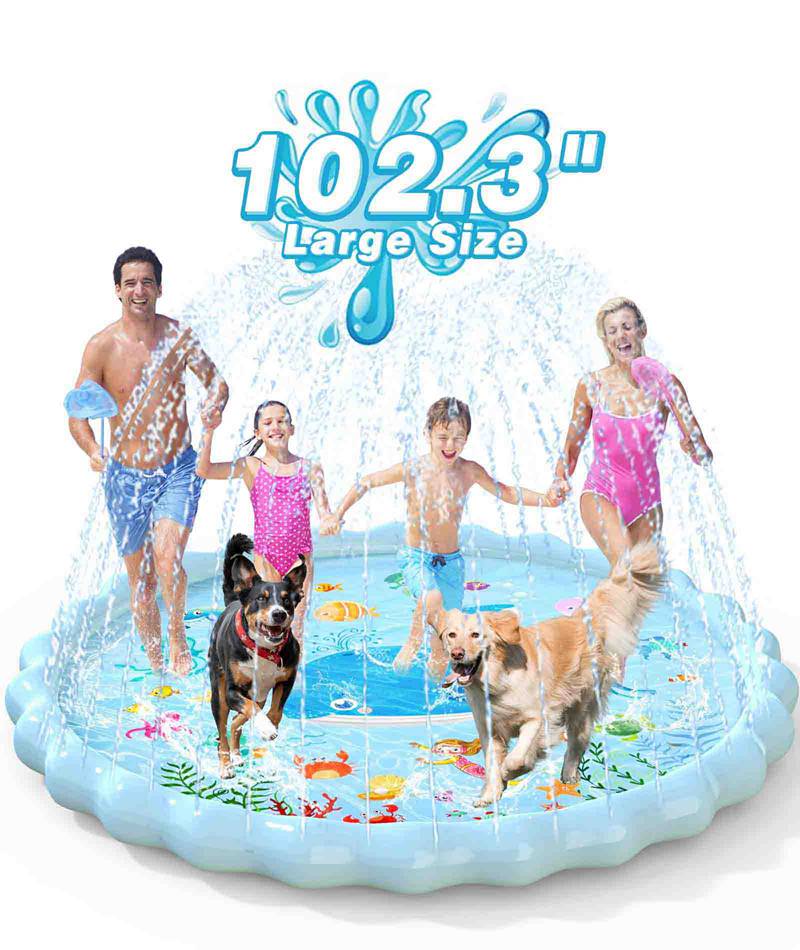
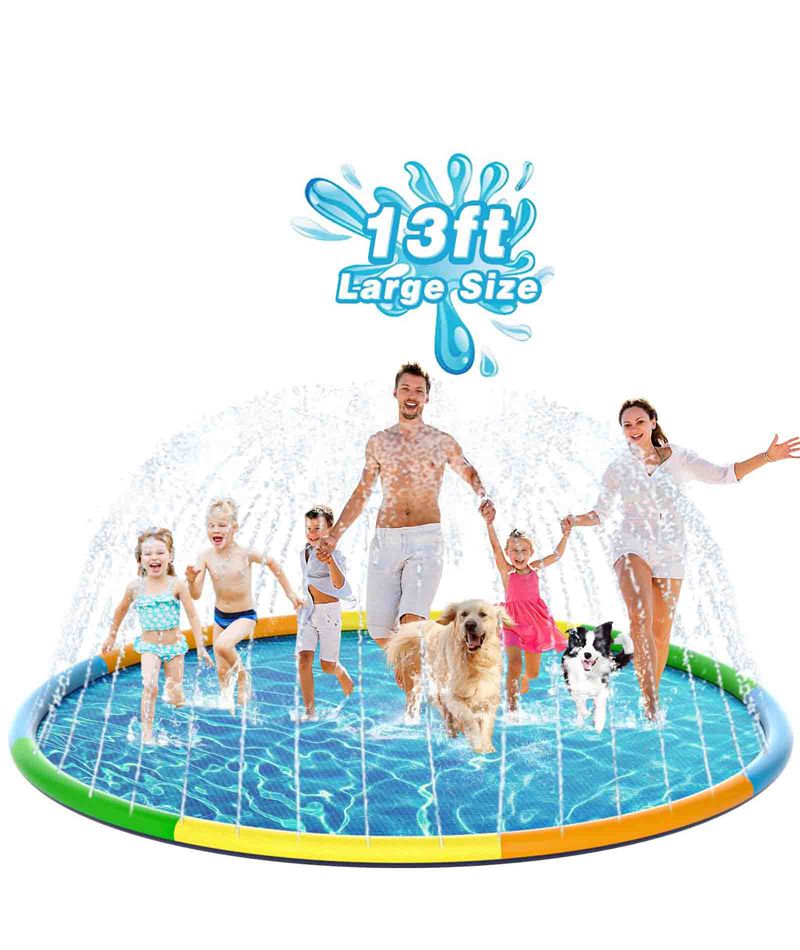
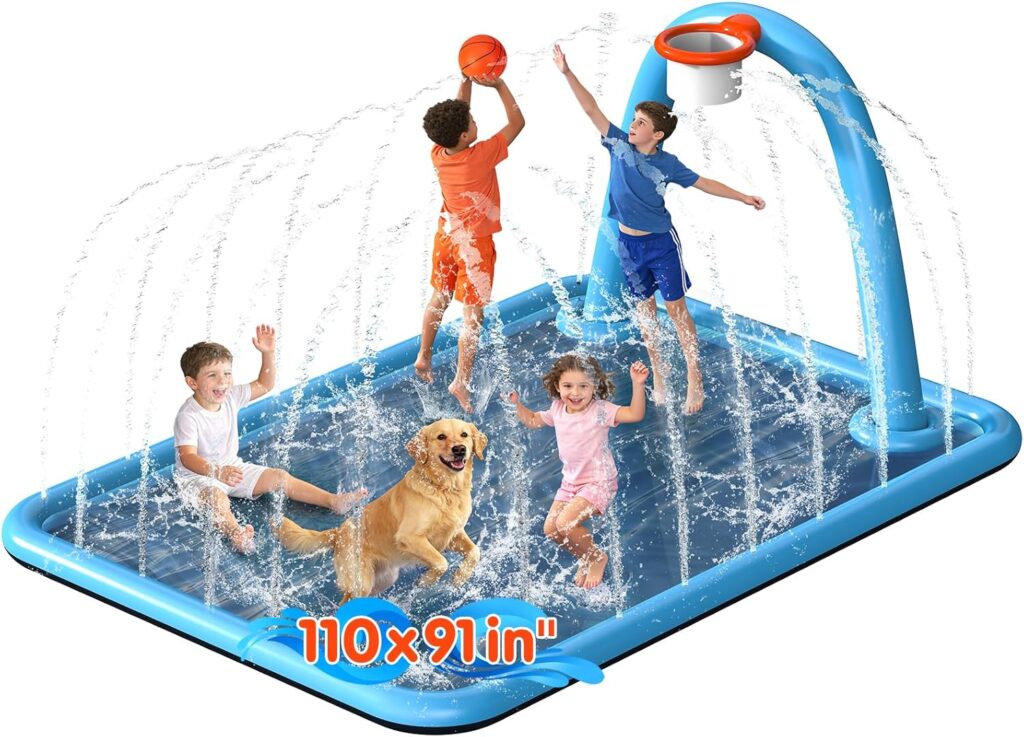
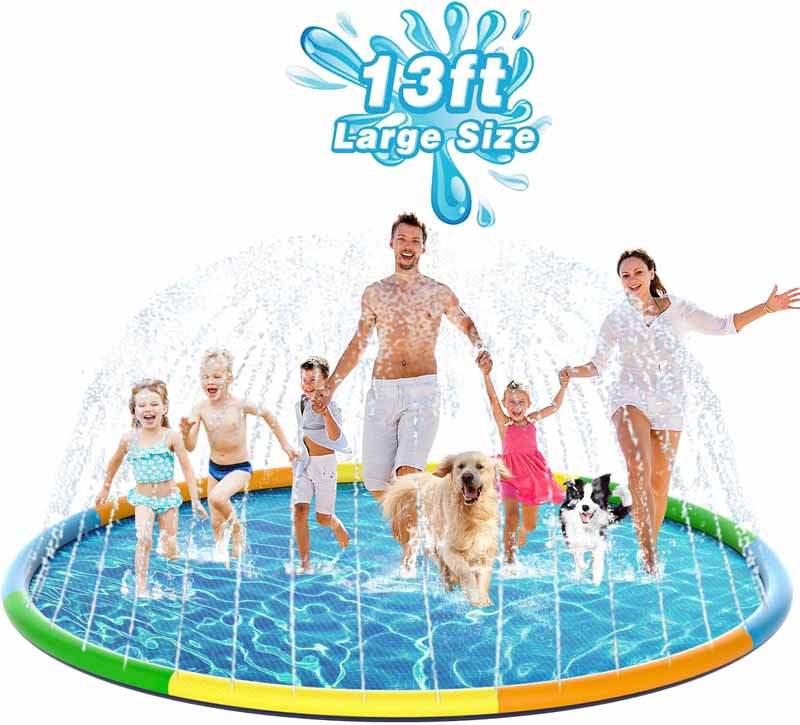
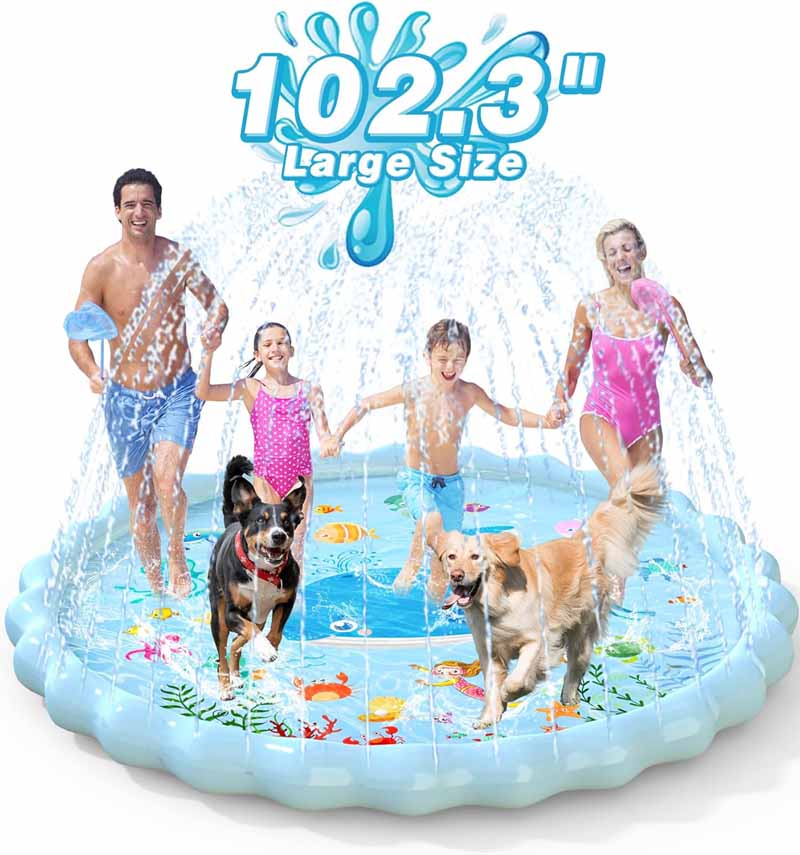
Splash pads need flexibility, ground resistance, stable water distribution, and manageable weight. Many recreational designs use PVC within an approximate development range of 0.40 to 0.55 mm, although diameter, shape, age group, print coverage, spray pressure, and integrated structures may change the final specification.
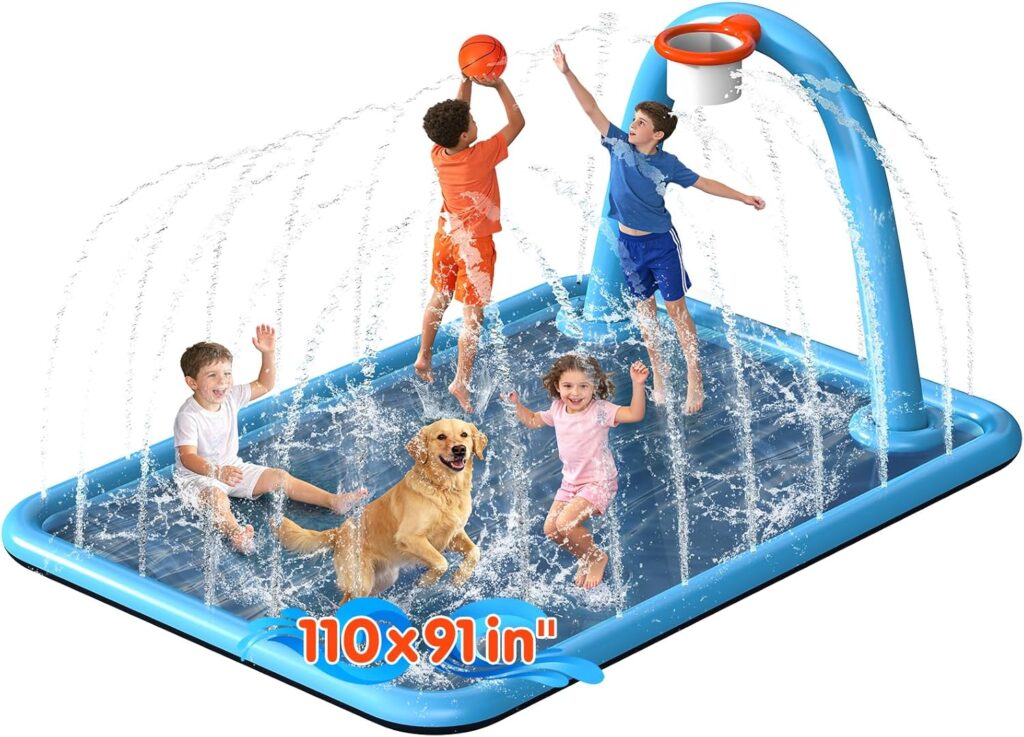
The center experiences repeated walking, sitting, kneeling, and contact with outdoor toys. The surrounding ring must carry water and distribute it through multiple spray holes. Larger products may include basketball hoops, goals, arches, or raised structures that transfer additional force into selected connection points.
Ground conditions remain important regardless of thickness. Grass usually presents lower abrasion risk than concrete, gravel, exposed roots, or patios with sharp edges. A thicker sheet can reduce normal wear, but flexible PVC cannot be expected to resist sharp stones or continuous dragging across rough surfaces.
For larger EPN splash pads, localized reinforcement around hose connectors and structural attachments may offer more value than increasing every panel. This keeps the product durable while reducing unnecessary stiffness, package weight, and drying difficulty.

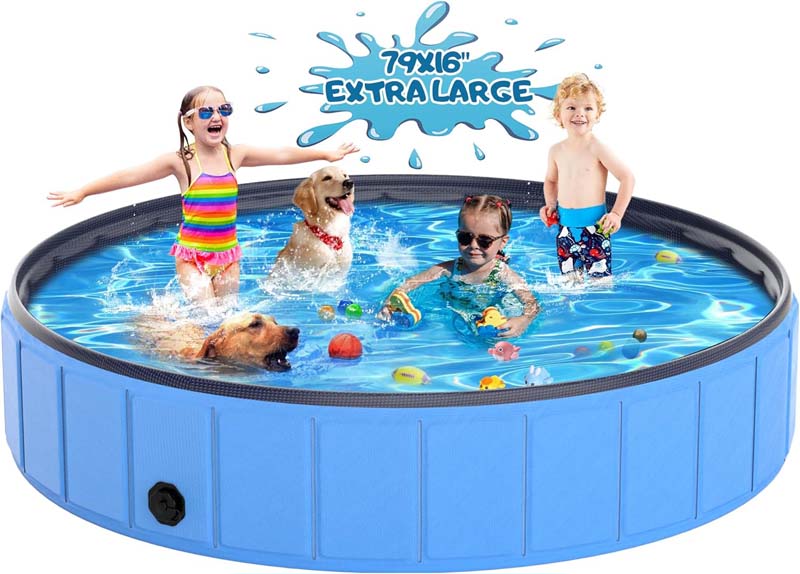
Folding dog pools need a stronger material system because claws create concentrated contact and filled water pushes continuously against the walls. The product must also be drained, dried, folded, and reopened many times without damaging the flexible connections between its internal panels.
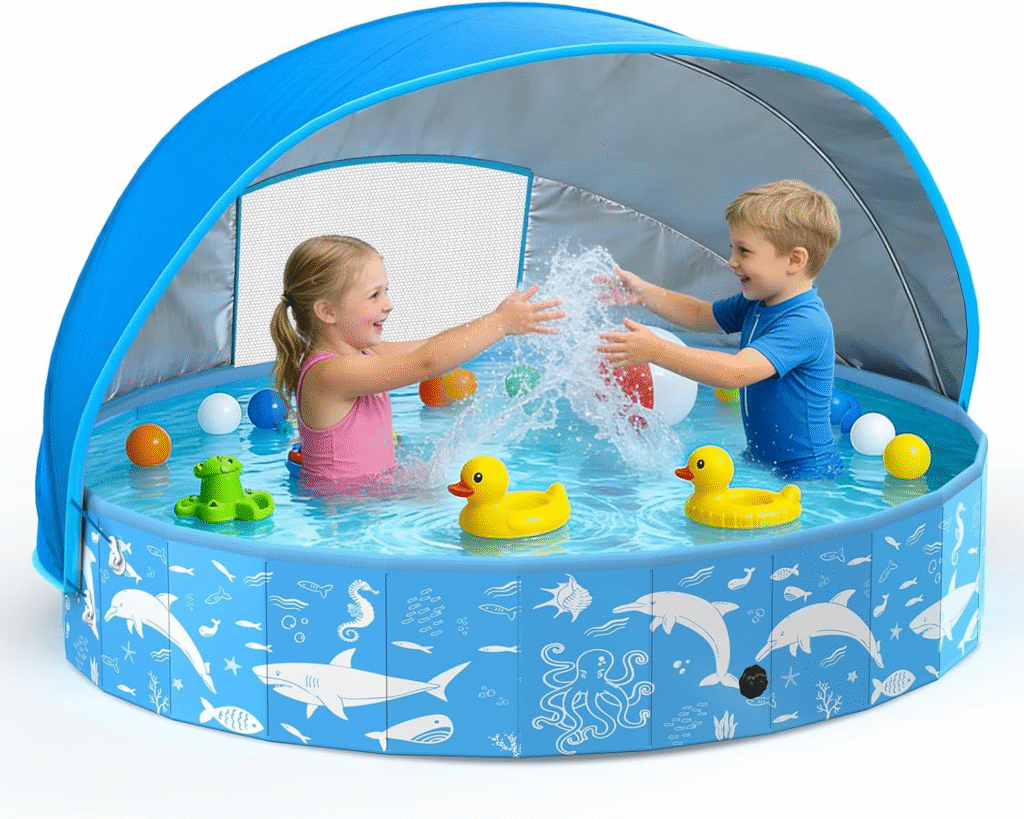
EPN sprinkler dog pools commonly use approximately 0.55 mm PVC with built-in PP wall panels. The PVC provides waterproofing and flexible connections, while the PP panels support the wall. Stability comes from the complete structure rather than from asking a flexible PVC sheet to carry the water load alone.
Pool diameter and wall height influence pressure. Water pressure increases with depth, while a larger circumference creates more total outward load. Medium and large dogs may also place considerable force on one area when entering, turning, sitting, or leaning against the edge.
The base deserves equal attention. A textured inner surface can improve grip for wet paws, while appropriate bottom construction helps resist ground abrasion. Drain locations, hose inlets, spray channels, panel gaps, and fold directions all affect performance. A thicker sidewall cannot compensate for a weak drain connection or poorly arranged folding line.
Cold-Weather Products
Snow tubes and pool pillows require formulas that remain flexible below freezing. A PVC sheet that feels soft at room temperature may become noticeably harder outdoors, increasing stress around folds, handles, valves, corners, and welded seams.
Snow tube requirements depend on tube diameter, rider capacity, inflation pressure, seat design, handle placement, and whether the product includes a fabric cover or reinforced bottom. Larger two-person models experience greater impact and load than small children’s tubes. Stronger base material or a protective cover may improve sliding durability without making the complete inner tube excessively heavy.
EPN pool pillows commonly use approximately 0.50 mm cold-resistant PVC. They should normally be inflated to about 70% rather than filled until completely firm. Partial inflation leaves room for air expansion, external pressure, and movement under the winter cover. Overinflation can place unnecessary force on the seams, valve, corners, and tie points.
| Product Category | Common EPN Reference | Main Material Demands | Supporting Structure |
|---|---|---|---|
| Children’s splash pad | 0.40–0.55 mm | Foot traffic, water pressure, ground abrasion | Reinforced hose inlet and stable spray ring |
| Folding dog pool | Around 0.55 mm | Claws, water load, repeated folding | PP panels, textured base, reinforced drains |
| Snow tube | Structure-dependent | Cold, impact, pressure, sliding abrasion | Handle patches, stronger base, optional fabric cover |
| Pool pillow | Around 0.50 mm | Cold exposure, long inflation, cover pressure | Reinforced corners and secure valve |
| Custom PVC product | Approximately 0.35–0.90 mm | Determined by use and dimensions | Application-specific testing and reinforcement |
These values are development references rather than universal requirements. Printing, embossing, composite layers, product dimensions, accessories, and destination-market requirements can justify a different specification. The complete sample must be tested before mass production is approved.
How Do Low-Odor PVC Formulas Work?
Low-odor PVC is created by controlling raw materials, plasticizers, stabilizers, pigments, inks, processing temperature, ventilation, storage, and packaging as one connected system. It is not achieved by covering the smell with fragrance. A balanced formula reduces strong residual odor while preserving flexibility, weldability, tear resistance, color stability, cold performance, and regulatory readiness.

Flexible PVC contains resin, plasticizers, stabilizers, pigments, processing aids, lubricants, and other ingredients chosen for a particular performance target. Printed products may also carry odors from inks, coatings, adhesives, valves, drains, packaging bags, or cartons.
The smell noticed after opening does not always originate from the main PVC body. A raw sheet may have a mild odor, while the same material smells stronger after printing, welding, folding, and sealed storage. Large printed areas, short drying time, warm transportation, and limited ventilation can concentrate residual odor inside the package.
Product size also influences perception. A large splash pad or dog pool contains far more material surface area than a small inflatable toy. When tightly folded into a sealed bag, residual volatile compounds collect in a small space and are released together when the customer opens the package.
A practical investigation compares the raw sheet, printed sheet, welded components, valves, drains, packaging bag, carton, and finished product separately. This helps identify whether the main source is the formula, ink, process temperature, accessory, storage condition, or packaging material.
Balanced Formulation
Plasticizer selection affects softness, elongation, cold flexibility, migration behavior, surface feel, welding response, and cost. Replacing it solely to reduce smell can weaken another important performance area. Stabilizers, pigments, and processing aids must remain compatible with the complete material system.
The objective is not simply to create the faintest-smelling sheet. A mild-smelling material has little value if it stretches around a valve, tears at a handle, becomes sticky during warm storage, or cannot form reliable heat-pressed seams.
Broad claims such as “odor-free” or “chemical-free” are difficult to support. A more useful material specification defines the destination market, relevant restricted substances, expected opening odor, acceptable airing period, product use, and approved sample.
EPN evaluates trial sheets for smell, flexibility, surface feel, printing, cutting, welding, folding, and mechanical behavior. The final decision is based on the finished product because printing, heat pressing, accessories, and sealed packaging can change the experience significantly.
Processing and Ventilation
A suitable formula can still produce an unpleasant product when manufacturing conditions are poorly controlled. Excessive heating, contaminated equipment, unsuitable printing materials, incomplete drying, and rushed packing can increase residual odor.
Heat-pressing settings must match the formula, thickness, texture, printed surface, and number of material layers. Excessive energy can overheat or distort PVC, while insufficient energy may create weak seams that require additional processing.
Printing needs enough drying or curing time before the product is folded and assembled. Heavily printed panels may require longer conditioning than small decorative areas. Products sealed immediately after welding and printing are more likely to trap concentrated odor inside the bag.
Ventilation should take place in a clean area with controlled airflow, temperature, humidity, and dust exposure. Leaving products open in an uncontrolled warehouse is not a consistent solution. Production teams should compare finished and packaged samples with an approved reference rather than relying on memory.
Odor and Compliance
A person’s sense of smell cannot measure restricted phthalates, lead, heavy metals, organotin compounds, or other regulated substances. Some compounds are noticeable at very low levels, while others produce little odor. A mild-smelling product may still require laboratory testing, and a noticeable new-material smell does not automatically prove non-compliance.
Applicable requirements depend on the product category, intended age group, destination country, accessible materials, and sales channel. A children’s splash pad may require a different testing plan from a dog pool or winter pool accessory, even when similar PVC is used.
Low odor should be treated as a customer-comfort and process-control target rather than a replacement for chemical analysis. Responsible manufacturers avoid absolute language such as “guaranteed odorless.” A large PVC item may still have a mild smell immediately after sealed transportation, but it should reduce after reasonable ventilation.
A smell that remains strong for several days or varies greatly between production units should be investigated before shipment. The source may be the sheet, print, valve, packaging, or storage environment rather than the main PVC formula.
Are Thickness and Odor Enough?
Thickness and odor are useful indicators, but they cannot confirm total product quality. Reliable recreational products must also be evaluated for tensile strength, tear resistance, abrasion, cold flexibility, UV exposure, leakage, folding, valves, drains, handles, seams, restricted substances, packaging, and traceability. Finished-product performance provides stronger evidence than one material number or sensory claim.

A useful test plan begins with how the product is likely to fail. A general raw-material report may confirm tensile or tear properties, but it cannot show whether a splash pad sprays evenly, whether a dog pool wall remains stable, or whether a snow tube handle stays attached after repeated use.
Splash pads may be checked for spray distribution, hose-connector strength, ground abrasion, foot traffic, and folding. Dog pools may be evaluated for water retention, wall support, base grip, drainage, fold durability, and stress around entry points. Snow tubes require low-temperature conditioning, pressure retention, handle strength, and bottom abrasion. Pool pillows need extended inflation, valve checks, cold exposure, and tie-point testing.
Testing should become more intensive when a project introduces a new material source, structure, print system, accessory, mold, or major size change. Stable designs still require routine inspection, but new developments need more evidence before commercial production.
Market Requirements
Safety and chemical requirements vary between countries and product categories. Children’s products commonly face stricter obligations than general-use pet or pool-maintenance items. Product classification, age grading, materials, warnings, labeling, and traceability should be confirmed before the testing plan is finalized.
One report does not automatically cover every color, print, size, or accessory. A test for clear PVC may not represent a heavily printed version. A report for the main body material may not cover valves, drain plugs, handles, coatings, elastic parts, inks, or packaging.
| Quality Area | Practical Evaluation | Main Purpose |
|---|---|---|
| Thickness | Multi-point gauge measurement | Confirm sheet consistency |
| Tensile and tear strength | Controlled mechanical testing | Evaluate stretching and damage growth |
| Leak performance | Air- or water-holding test | Check seams, valves, drains, and connectors |
| Cold flexibility | Low-temperature conditioning | Identify stiffness, whitening, and cracking |
| Abrasion | Repeated surface contact | Evaluate ground and sliding wear |
| UV resistance | Accelerated exposure | Assess fading and surface aging |
| Restricted substances | Laboratory analysis | Confirm market-specific compliance |
| Fold cycling | Repeated opening and closing | Evaluate storage and hinge durability |
Sample and Record Review
Several samples provide more reliable information than one carefully prepared unit. Thickness should be measured at multiple locations, and seams should be checked for consistent width, channels, burns, severe thinning, or distortion. Valves, handles, drains, hose inlets, and tie points should have secure attachment and suitable reinforcement.
Samples must be used under realistic conditions. A dog pool should be filled to its intended depth. A splash pad should be connected to a garden hose at several flow levels. A pool pillow should remain inflated long enough to reveal slow leakage. Cold-weather products should be tested after temperature conditioning rather than only in a warm room.
The approved sample should be linked to material batches, production dates, print references, component suppliers, heat-pressing settings, inspection results, and finished-product lot numbers. These records allow a reported issue to be traced to one batch, shift, component, or process instead of treating every complaint as a complete design failure.
How Does EPN Control Material Quality?
EPN connects intended use, PVC formulation, thickness, structure, high-frequency heat pressing, prototype testing, and production inspection within one development process. Each project is assessed according to dimensions, user group, pressure, outdoor exposure, climate, folding frequency, ground contact, packaging, and destination market. This helps prevent both underbuilt products and unnecessarily heavy designs.

Material approval begins with what the finished product must survive. Engineers consider intended users, expected load, product dimensions, air or water pressure, contact surface, outdoor exposure, storage method, packaging limits, and destination market before selecting a starting formula and thickness.
Trial sheets are evaluated for gauge, flexibility, odor, color, surface feel, cutting, printing, heat-pressing behavior, cold response, and mechanical strength. A raw sheet may appear suitable yet change after printing, reinforcement, welding, or warm sealed storage. Complete prototypes therefore provide the final approval reference.
EPN works with PVC and composite-material specifications across an approximate range of 0.35 to 0.90 mm for different recreational applications. Separate panels may use different constructions, while reinforcement is added at high-risk areas rather than increasing every surface equally.
This method supports a more efficient product. Material is used where it delivers measurable performance, while unnecessary weight, stiffness, packaging volume, and shipping expense are kept under control.
Prototype Testing
Prototype testing recreates realistic use rather than relying on appearance alone. Splash pads are checked for hose connection, spray distribution, ring stability, ground contact, folding, and leakage. Dog pools are evaluated for water load, wall support, wet-paw grip, drainage, panel connections, and repeated folding.
Snow products are examined for pressure retention, handle strength, abrasion, impact, and low-temperature flexibility. Pool pillows are tested under partial inflation, extended holding periods, cold exposure, and tie-point tension.
EPN’s development team includes 27 specialists in material formulation, structure, design, user experience, pet behavior, and ergonomics. Its internal program completes more than 500 material and product performance tests annually, supporting new development and improvements to established designs.
A prototype failure is useful when it appears before mass production. A leak may lead to a larger valve patch, whitening may require a softer formula, and uneven spray may be corrected through channel geometry rather than increased water pressure.
Production Consistency
An approved prototype is converted into measurable production instructions. Material batches are linked with thickness tolerances, color references, print files, component specifications, heat-pressing settings, reinforcement locations, inspection methods, and packaging requirements.
Incoming sheets are checked for gauge, surface condition, color, odor, contamination, and visible defects. Production inspections cover cutting alignment, printing position, seam width, valve placement, drains, handles, panel gaps, reinforcements, and fold lines.
Finished products may undergo air- or water-holding tests, dimensional checks, drainage tests, hose-connection reviews, surface inspection, folding evaluation, odor comparison, and packaging verification. Coordination between material preparation, accessories, cutting, printing, heat pressing, testing, and packing helps problems get corrected before shipment.
For custom projects, material decisions should be confirmed before artwork and packaging are finalized. Late changes to thickness or formula can affect dimensions, product weight, carton size, welding settings, test coverage, production timing, and fulfillment cost.
Material thickness and low odor may seem like separate concerns, but both show how carefully a recreational product has been developed. Thickness reveals whether wear, pressure, folding, and structural demands were considered. Odor control reflects the consistency of formula selection, printing, heating, ventilation, storage, and packaging.
Customers experience both immediately. They notice the smell when the package opens, the feel when the product unfolds, the stability after water or air is added, and the condition after seasonal storage. A well-developed EPN product earns trust through steady performance rather than exaggerated claims: it opens comfortably, works as expected, remains practical to handle, and is ready to be used again when the next season begins.
Frequently Asked Questions
Is thicker PVC always more durable?
Thicker PVC usually improves normal puncture and abrasion resistance, but formula quality, seam construction, reinforcement, folding behavior, and product structure are equally important. Excessive thickness may add weight and stiffness without solving weaknesses around valves, drains, handles, or corners.
What PVC thickness is suitable for a dog pool?
Many folding dog pools use PVC around 0.50 to 0.55 mm with internal support panels. The final specification should also consider pool size, wall height, dog weight, claw contact, water depth, drains, base texture, and folding frequency.
What causes a strong smell in new PVC products?
The smell may come from the PVC formula, plasticizers, inks, coatings, valves, packaging, warm storage, or insufficient ventilation. Comparing raw material, printed components, accessories, finished goods, and packaging helps identify the actual source.
Does low-odor PVC mean the product is safer?
Low odor improves the opening experience but does not prove chemical compliance. Restricted substances must be checked through suitable laboratory testing and supported by product-specific documentation, traceable materials, and market-appropriate certification.
How should PVC thickness be measured?
Use a calibrated gauge at several locations across the material. Avoid welded edges, heavy printing, embossed peaks, and reinforcement patches unless those areas are being inspected separately, and confirm an acceptable production tolerance.
How can a brand evaluate a PVC product sample?
Test several units under realistic conditions and inspect thickness, seams, valves, drains, reinforcement, leakage, folding, odor, and packaging. Confirm that laboratory reports cover the correct material, print, accessories, and final product version.