Skip to content
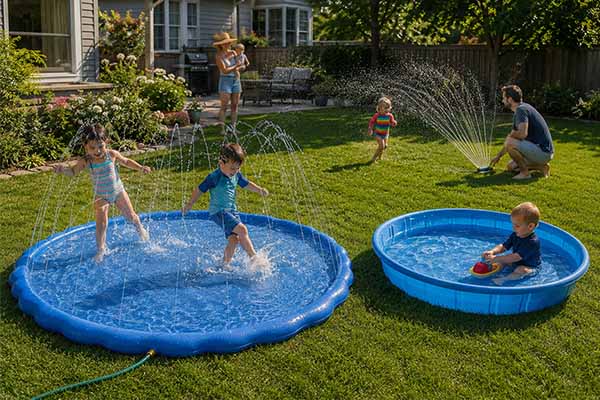
Choosing between a splash pad and a splash pool sounds easy until you picture how each one actually fits into a normal summer day. A splash pad encourages children to run through sprays, chase streams of water, jump across a wet surface, and move freely between different play zones. A splash pool creates a different experience: children sit or stand in retained water, pour it between containers, float toys, splash one another, and often remain in one place for longer periods. Neither option is automatically better. The useful question is which one fits your child’s age, comfort around water, play style, available backyard space, supervision needs, and the amount of setup and cleanup your family realistically wants to manage.
For many families with toddlers and young children, a splash pad is the better choice when the priorities are active play, very little standing water, quick hose-connected setup, easier seasonal storage, and enough open space for several children to play together. A splash pool may be better when children prefer sitting directly in water, using boats and cups, pouring and scooping, or enjoying slower sensory play. Both still require attentive adult supervision and proper cleaning, drying, placement, and storage.
The easiest way to make the decision is to forget the perfect product photograph for a moment and imagine an ordinary Tuesday afternoon. Two children want to play outside before dinner. One wants to run, while the other could spend half an hour filling the same cup. The hose is nearby, somebody will eventually have to deal with the water, and everything needs to be clean and dry before it goes back into storage. The product that still sounds convenient in that situation is usually the better long-term choice.
What Is the Difference Between a Splash Pad and Splash Pool?
A splash pad is primarily a spray-based, low-depth play surface, while a splash pool is designed to retain a shallow body of water inside raised walls. That structural difference changes how children play, how water is supplied, how much water remains accessible, how several children share the space, how the product is cleaned and drained, and how easily it can be stored.
What Is a Splash Pad?
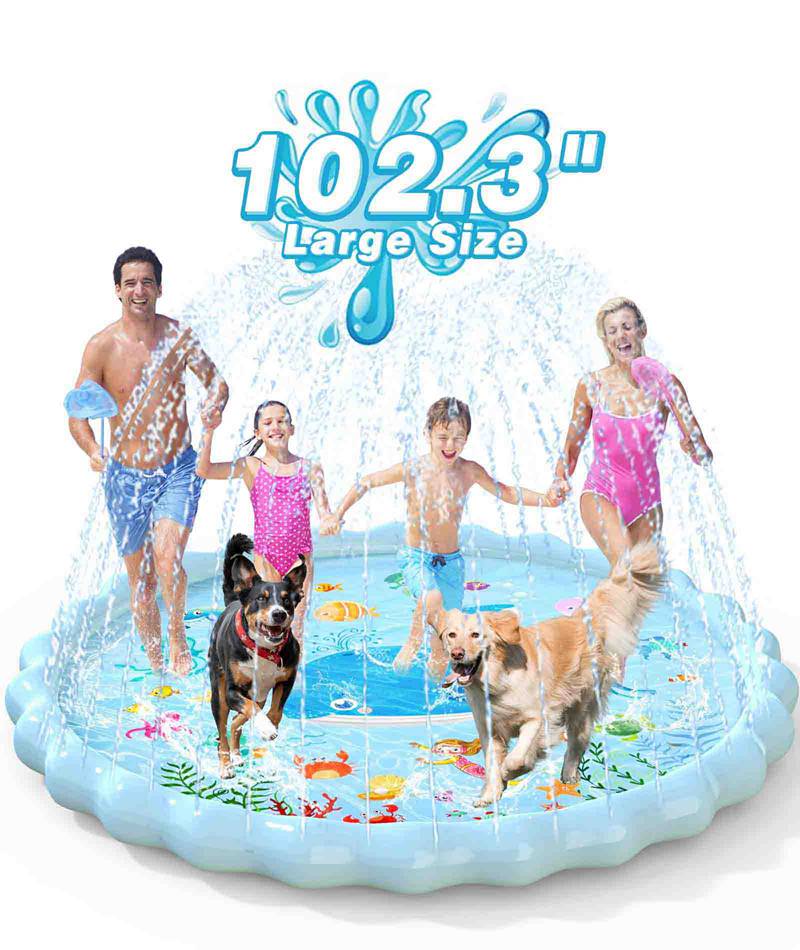
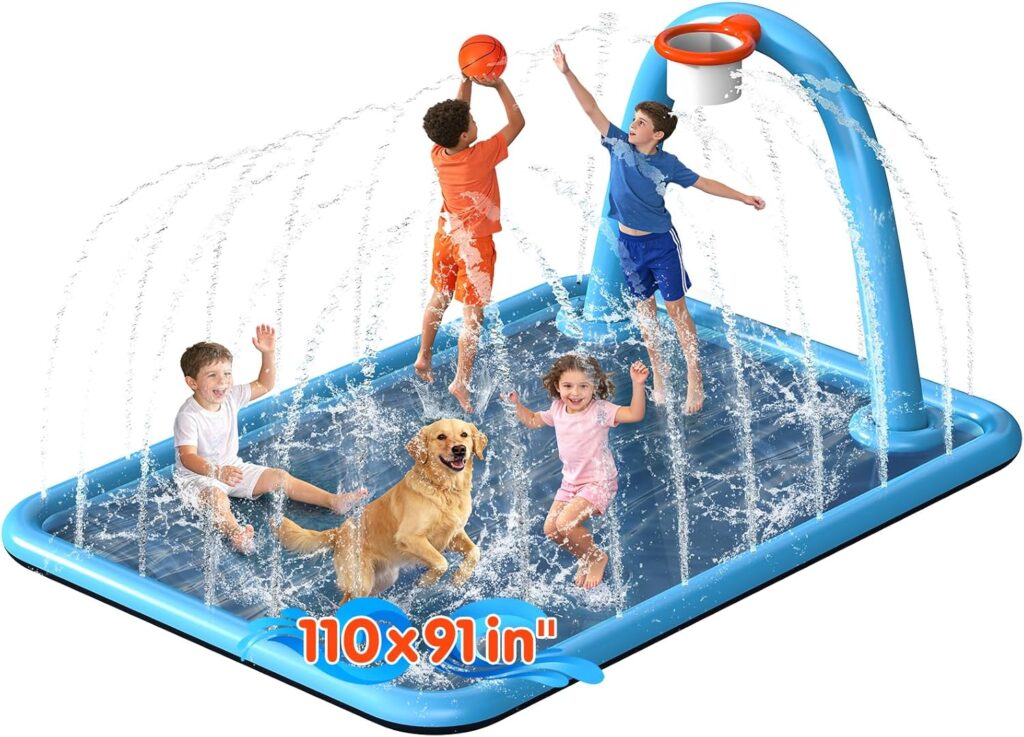
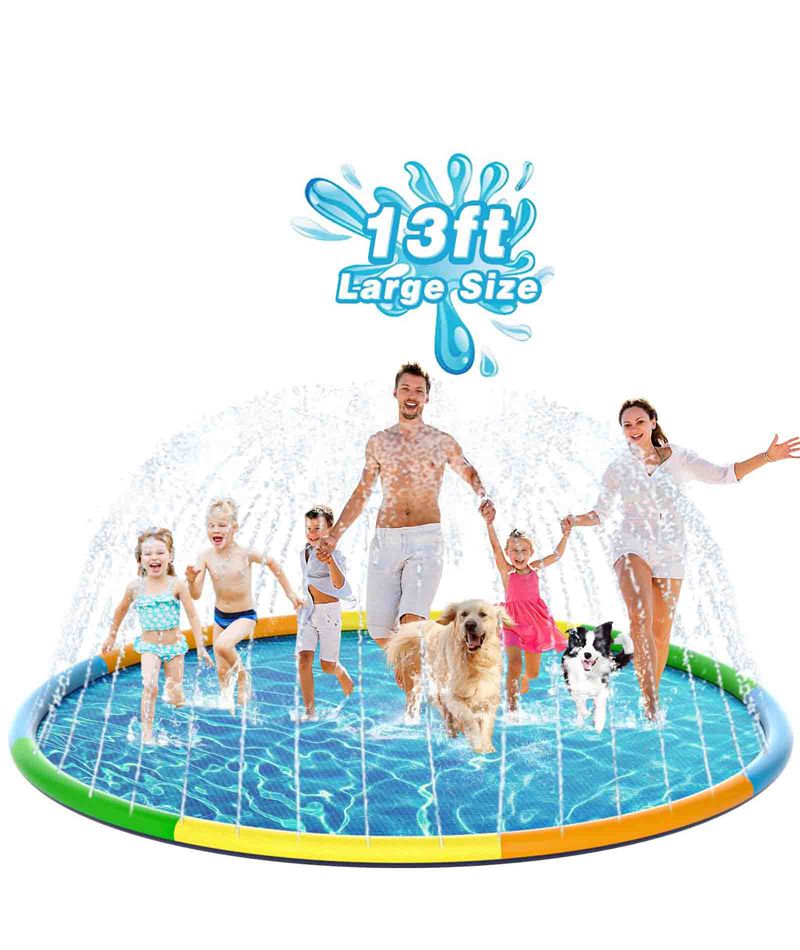
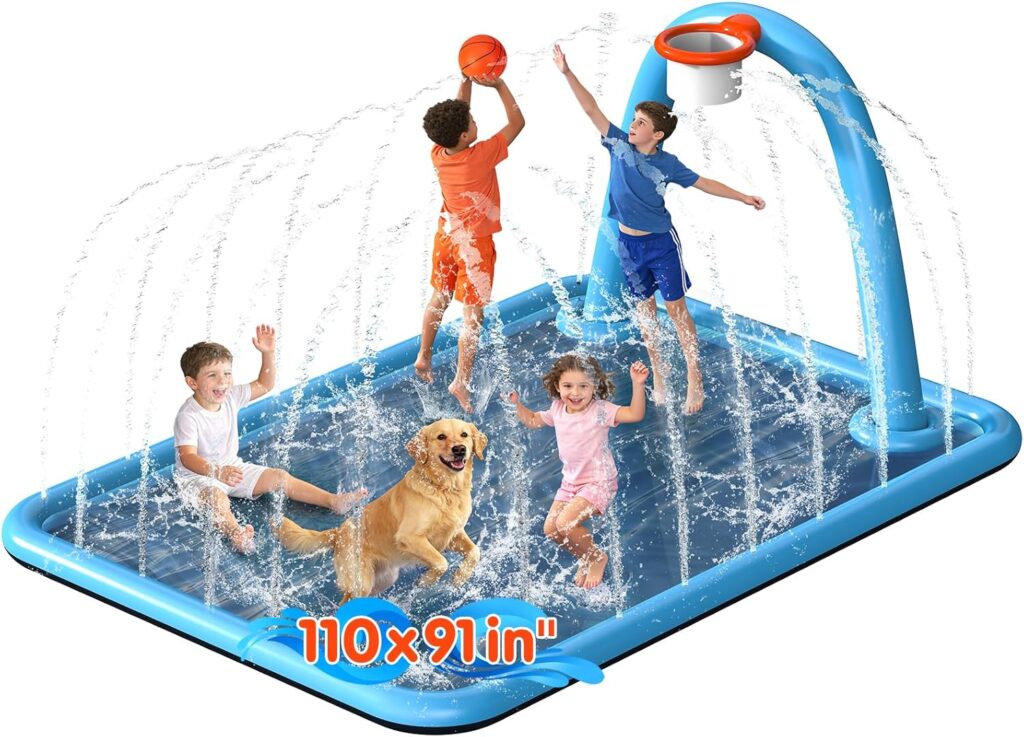
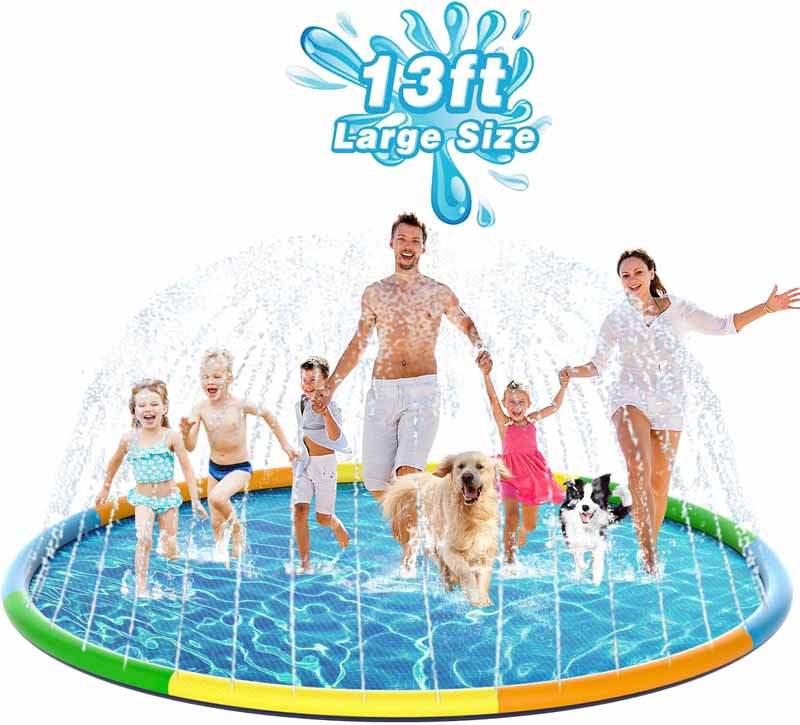
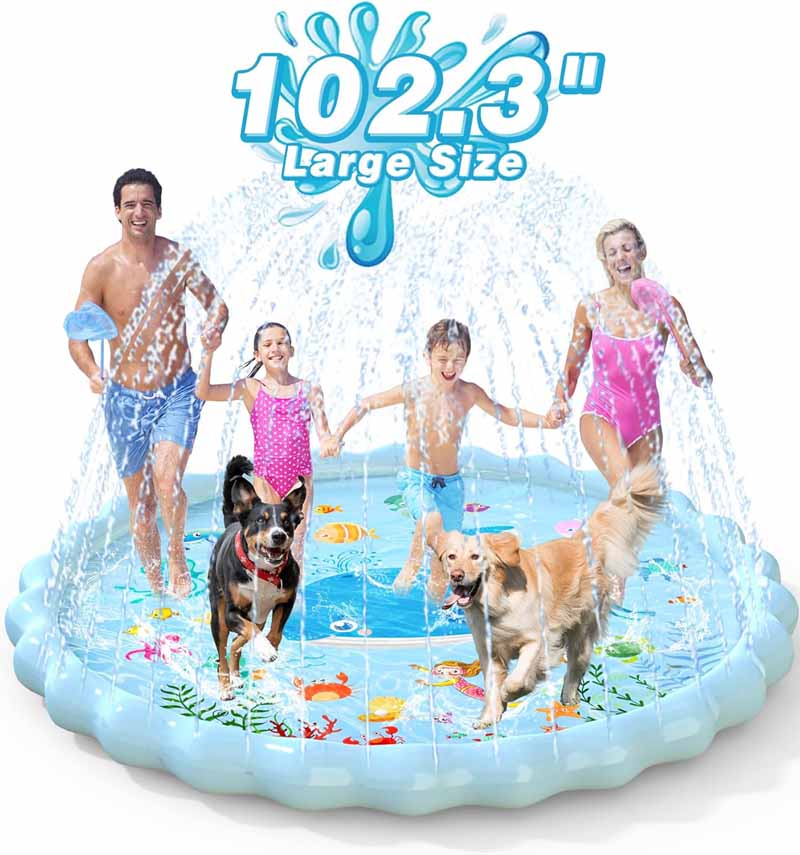
A backyard splash pad is generally a flat or low-profile flexible water-play product connected to a garden hose. Water enters a perimeter chamber or internal channel, builds moderate pressure, and exits through small spray openings positioned around the play area. Children interact with the moving water rather than entering a deep body of water, so the experience naturally encourages running, reaching, jumping, turning, chasing sprays, and moving repeatedly between wet and dry areas.
Flexible PVC is commonly used for portable splash pads because it can be formed into sealed water channels, printed with detailed graphics, folded for seasonal storage, and manufactured in different diameters and shapes. The apparently simple structure still has several areas that affect real performance: the water inlet, perimeter geometry, heat-pressed seams, spray-hole size, spray-hole direction, material flexibility, and the relationship between the raised rim and usable center.
Spray height is not determined by one specification. Household water pressure, hose length, product diameter, internal channel size, the number of outlets, and the diameter of each spray hole all influence the final pattern. A large number of outlets may look impressive on a feature list, but if the available water is spread too thinly, individual streams can remain low. Conversely, unnecessarily small openings can create uneven pressure and inconsistent spraying.
The outside diameter also needs context. A 200 cm pad with a wide perimeter chamber does not provide 200 cm of unobstructed center play space. For families with two or three children, usable area can matter more than the biggest dimension printed on the package. This distinction becomes especially important when comparing pads that appear similar online but use very different rim widths and internal layouts.
What Is a Splash Pool?
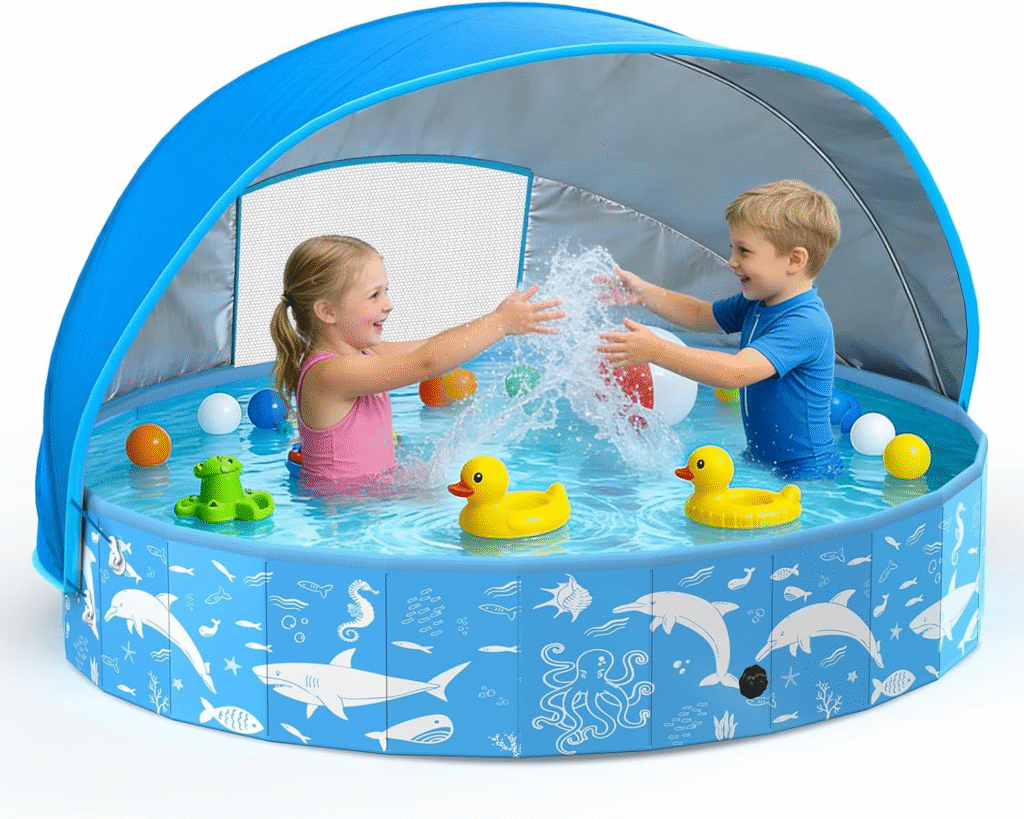
For this comparison, a splash pool means a small children’s pool, kiddie pool, paddling pool, or portable inflatable pool designed to retain shallow water. The phrase can sometimes refer to larger recreational facilities, but families searching for “splash pad vs splash pool” are generally comparing two affordable forms of backyard water play rather than deciding between a portable splash pad and a permanent swimming pool.
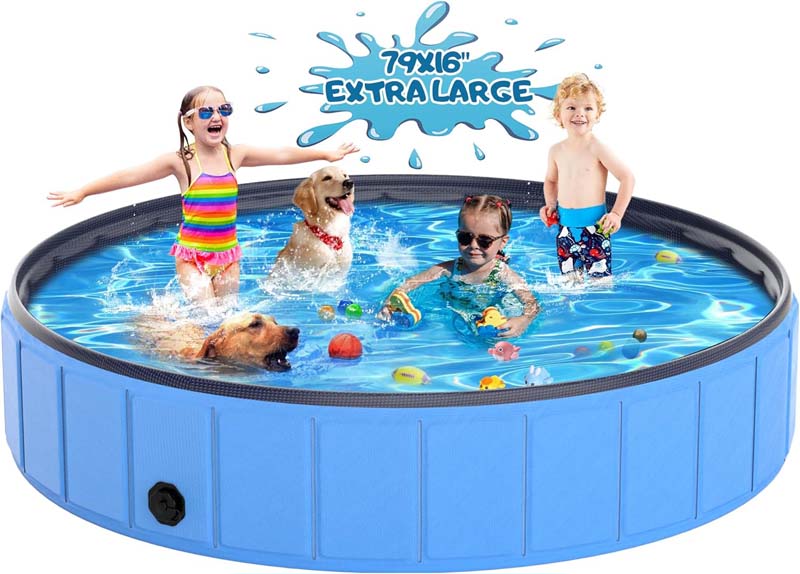
Splash pools may use inflatable sidewalls, multiple independent air chambers, rigid plastic shells, or foldable wall panels. Their common feature is retained water. Once filled, the pool becomes the play environment itself. Children can sit, kneel, scoop water into containers, float boats, use watering cans, play with balls, or simply cool down while staying in one defined space.
The amount of structural load created by shallow water is easy to underestimate. One liter of water has a mass of approximately one kilogram, so a small pool containing 250 liters is holding roughly 250 kg of water before the children and toys are considered. This is one reason the wall-to-floor connection, valves, drainage structure, seams, and levelness of the ground are more important than they may appear when the pool is empty.
A splash pool may suit children who dislike water spraying toward their face or who naturally prefer quiet activities. That same retained water, however, creates a different supervision and maintenance routine. A pool should therefore be evaluated as both a recreational product and a temporary container holding a significant quantity of accessible water.
How Does the Play Structure Differ?
The most useful distinction is open movement versus contained water play. A splash pad spreads activities across a relatively open wet surface, while a splash pool concentrates most activities inside a defined water-filled area. That difference influences how children move, how siblings interact, how much room toys occupy, and how easily a child can enter or leave the main play zone.
| Feature | Splash Pad | Splash Pool |
|---|---|---|
| Main water condition | Spray and thin surface water | Retained standing water |
| Typical play | Running, jumping, chasing sprays | Sitting, scooping, floating toys |
| Child movement | Open and mobile | More contained |
| Water supply | Usually continuous hose flow | Filled before or during use |
| Main structural load | Pressure inside water channels | Weight of retained water |
| Multiple children | Can spread across surface | Limited by interior dimensions |
| Cleanup | Rinse and dry | Drain, clean interior, dry |
| Storage | Usually flat and compact | Depends on wall construction |
This is the decision families should make before comparing graphics, accessories, or promotional features. If children want to move continuously, respond to changing streams, and switch between activities, a splash pad usually fits that pattern more naturally. If they want to remain in one place with cups, boats, floating objects, and a stable supply of water, a splash pool is more likely to match the way they already enjoy playing.
Which Is Safer for Toddlers and Young Kids?
A splash pad usually has less standing water than a splash pool, which reduces one important water-related hazard, but neither product is supervision-free. Safe use depends on water depth, child mobility, floor traction, product condition, surrounding surfaces, sibling behavior, and continuous adult attention. Young children should remain closely supervised whenever they are playing in or around water.

Which Has Less Standing Water?
A typical portable hose-fed splash pad allows water to spray onto its surface and then drain, spread across the lawn, or flow away from the central play area. Small amounts can collect if the surface or ground is uneven, but retaining a pool of water is normally not the product’s main function. A splash pool works in the opposite way because the walls are specifically designed to keep water inside.
The difference becomes clearer when volume is calculated. A circular pool with an internal diameter of 150 cm and an average water depth of only 15 cm has a theoretical volume of approximately 265 liters before allowances are made for curved walls, inflatable structures, and displacement. A pool that looks shallow can therefore still hold hundreds of kilograms of water.
This distinction is consistent with the basic design principle used for public splash pads. CDC describes splash pads as areas that typically have little or no standing water and notes that they are commonly designed to prevent water from collecting in the accessible play zone, which helps minimize drowning risk. Public recirculating splash pads have different hygiene and water-treatment considerations from household single-pass hose products, so the two should not be treated as identical systems.
The surrounding ground matters as well. Water flowing away from a splash pad can create slippery paving or puddles if drainage is poor. A pool placed on sloping ground can load one wall more heavily and increase instability. Both formats need a flat, clear location with enough surrounding space for children to move without colliding with hard objects.
Which Is Better for Toddlers?
A splash pad can provide a gentle introduction to outdoor water play because a toddler does not have to commit to entering a contained body of water. A cautious child can remain near the edge, touch one low stream, step onto the wet center for a few seconds, and then return to dry ground. That freedom can be useful for children who are still becoming comfortable around moving water.
A splash pool may suit a different temperament. Some toddlers strongly dislike unpredictable sprays around the face but are happy sitting in a shallow pool with cups or familiar bath toys. A quiet, contained environment can support scooping, pouring, sorting, and other slower activities without requiring the child to run or react to changing streams.
Chronological age is only one part of the decision. Balance, mobility, coordination, communication, impulse control, comfort around water, and the behavior of siblings all change how a product is used. Two children who are both three years old may need very different play environments. Manufacturer age guidance should therefore be treated as an important starting point rather than a complete assessment of individual readiness.
Water supervision remains essential regardless of which format feels easier. CPSC reported in June 2026 that an average of 376 children under age 15 fatally drowned in pool- or spa-related incidents each year from 2021 through 2023, and nearly 80% of those victims were younger than five. The data relate to pools and spas rather than portable splash pads, but they reinforce the importance of treating any young child’s access to water seriously.
Do Both Need Adult Supervision?
Yes. Both products require attentive adult supervision. Less standing water does not mean no supervision is necessary, and a child should never be considered safe simply because a product is shallow or marketed for toddlers. Adults need to remain close enough to respond immediately, particularly with younger children who can lose balance, become frightened, or move unpredictably within seconds.
A useful approach is to treat the supervising adult as having one primary job during the session: watching the children. Phones, indoor chores, extended conversations, cooking, reading, or other activities can divide attention at exactly the moment a child needs help. Older siblings should not be treated as substitutes for responsible adult supervision when very young children are using water-play products.
Before each play session, families can reduce avoidable problems by checking the setup rather than assuming yesterday’s conditions are unchanged:
- Remove stones, sticks, roots, hard toys, and sharp debris from the setup area.
- Confirm that the product lies flat without material folded underneath.
- Route the garden hose away from the main running and entry paths.
- Increase spray pressure gradually rather than opening the faucet fully at once.
- Inspect seams, valves, drain plugs, and hose fittings for visible damage.
- Stop play if pushing, intentional sliding, or uncontrolled collisions begin.
- Drain retained water appropriately after the session and prevent unsupervised access.
Safety guidance should be grounded in supervision rather than marketing language. The current CPSC drowning report emphasizes close supervision around pools and spas during children’s water activities, particularly for children under five. CPSC Childhood Drowning Report — June 2026

How Does Surface Design Matter?
Wet PVC behaves differently from dry PVC, particularly when sunscreen, grass, soil, soap, body oils, or fine debris are present. Surface embossing can improve practical traction, but no flexible water-play floor should be presented as completely slip-proof. The safest behavior still involves controlled movement rather than deliberate sliding, pushing, or sprinting through crowded areas.
Texture also creates design tradeoffs. A deeper embossed pattern can provide more tactile structure under wet feet, but it may trap dirt or residue more easily. A smoother floor may rinse quickly, yet it can feel more slippery once coated with water and sunscreen. Material thickness, texture depth, print coverage, comfort, cleanability, and flexibility therefore need to work together instead of being treated as separate features.
Parents can learn a great deal during the first few minutes of use. If children repeatedly lose footing while simply walking, it is worth investigating the cause rather than assuming that slipping is normal. Reducing water flow, rinsing away residue, removing soap, checking whether the pad is wrinkled, or changing the setup surface can all make a meaningful difference.
From a PVC product-development perspective, floor performance is one reason material selection alone does not determine quality. The way the surface is embossed, printed, heat-pressed, positioned over the ground, and maintained throughout the season all influence what children actually experience.
Which Gives Kids a Better Play Experience?
Splash pads generally create more active and social play, while splash pools favor contained activities such as sitting, pouring, floating toys, and sensory games. Neither is universally more entertaining. The better option depends on how children naturally play, how many children will share the product, their ages and energy levels, and whether they prefer moving through water or staying inside it.
Which Is Better for Active Play?
A splash pad is usually the stronger choice for children who want to keep moving. The combination of an open wet surface and changing streams naturally creates opportunities for running around the perimeter, stepping between sprays, reaching for water, jumping, changing direction, and interacting with siblings. The water becomes part of the activity rather than simply the environment where the activity takes place.
Spray distribution can affect this experience more than the total number of outlets. If every stream converges on one small central area, several children may crowd together. A more balanced layout creates multiple places where children can interact with water, which can make shared play feel less congested even when the outside dimensions remain the same.
Water pressure is also part of the play experience. Maximum spray height is not automatically better. A toddler may enjoy streams that reach roughly knee or waist level but become uncomfortable when water repeatedly strikes the face. Older children may prefer stronger sprays. Because household water pressure and hose configurations vary, the ability to adjust flow gradually is generally more useful than a single advertised maximum height.
Splash pads can also suit shorter everyday activity windows. A 20- to 40-minute play session may provide plenty of movement and cooling without requiring a lengthy filling process. That makes them practical for families who want to turn an ordinary warm afternoon into outdoor play without committing to several hours of pool use.
Which Is Better for Water Toys?
A splash pool usually has the advantage when the activity depends on a stable body of water. Boats need enough depth to float, cups need a reliable supply for repeated filling, and watering cans or water wheels work more naturally when children can scoop from one place. This makes small pools particularly suitable for slower sensory and imaginative play.
These activities can hold attention for surprisingly long periods. A toddler may repeatedly transfer water between two containers, while an older preschooler creates a pretend harbor for boats or tests which toys float. The activity may look less energetic than a splash pad, but it can be just as absorbing for children who enjoy repetitive experimentation.
Interior dimensions matter more than outside dimensions when toys are involved. Thick inflatable walls can reduce usable space considerably. Depending on the construction, 15 to 30 cm of width on each side may be occupied by the wall structure. A pool that looks large in a photograph can therefore feel crowded once two children, several buckets, and floating toys are inside.
Splash pads can still support toys, but different items work better. Lightweight balls, plastic figures, rings, spray targets, and toys that children can move between streams are generally more suitable than objects requiring stable depth. The key is matching the play accessory to the way the water behaves.
Which Works Better for Multiple Kids?
A large splash pad often provides greater flexibility when several children play together because the surface can be approached from different directions. One child might interact with the sprays at the edge while another stays near the center, and children can enter or leave without stepping over inflated walls or passing through one narrow access point.
Advertised diameter, however, can make usable space look larger than it really is. If a round splash pad measures 200 cm across but has a raised perimeter chamber approximately 15 cm wide, the open central diameter falls to roughly 170 cm. The total theoretical area is about 3.14 square meters, while the simplified center area is only about 2.27 square meters.
| Approx. Outer Diameter | Total Area | Center Diameter With 15 cm Rim | Approx. Center Area |
|---|---|---|---|
| 150 cm | 1.77 m² | 120 cm | 1.13 m² |
| 170 cm | 2.27 m² | 140 cm | 1.54 m² |
| 200 cm | 3.14 m² | 170 cm | 2.27 m² |
| 250 cm | 4.91 m² | 220 cm | 3.80 m² |
These numbers are simplified geometric examples rather than specifications for a particular product, but they illustrate an important buying principle: usable play area deserves as much attention as overall diameter. Families with two or three active children usually benefit more from a genuinely open center than from decorative features that take up much of the advertised footprint.
A splash pool can still be excellent for several children when everyone enjoys seated or contained play. The question is whether the usable interior gives each child enough room for their body and toys without constant crowding. Mixed-age groups require additional supervision because the speed and movement of older children can affect younger users more than the water depth itself.
How Does Play Style Matter?
Children rarely fit neatly into age-based product categories. One four-year-old may spend most of the afternoon running through sprays, while another is perfectly happy sitting at the side of a small pool filling the same cup repeatedly. Observing how children already behave around sprinklers, bath toys, beaches, water tables, or previous paddling pools is often more useful than choosing solely by age.
Children who enjoy motion, social play, chasing, changing activities, and reacting to unpredictable water are usually better matched with a splash pad. Children who enjoy repetitive sensory activities, pouring, floating toys, and staying in one place may get more value from a splash pool. Neither style is more advanced or more worthwhile; they simply create different experiences.
Families with siblings may also find that the open layout of a larger splash pad accommodates different personalities more easily. One child can remain near the edge while another moves through the strongest sprays. A compact pool forces both children to share the same water depth and interior space, which may work beautifully when their play styles match and create frustration when they do not.
A useful buying question is therefore not “Which product has more features?” but “What does my child already do when water is available?” Products tend to stay in regular use when they support an existing preference instead of depending on novelty alone.
How Do Setup, Cleaning, Water Use, and Storage Compare?
Splash pads are usually faster to start and easier to fold away, while splash pools commonly require more filling, draining, and interior cleaning. Water consumption is less straightforward: a pool uses a larger volume during filling, while a hose-fed splash pad may continue using water for the entire session. Real convenience depends on product size, flow rate, session length, drainage, and storage habits.
Which Is Faster to Set Up?
A basic splash pad generally requires only a few steps. The ground is inspected and cleared, the product is unfolded, the hose is connected, and the faucet is opened gradually until the perimeter reaches pressure and the sprays rise to a comfortable height. Because the hose fills the internal chamber and powers the water feature at the same time, play can begin relatively quickly.
An inflatable splash pool normally adds an inflation stage before filling. Multiple chambers may need to be inflated separately, valves checked, and the structure positioned before hundreds of liters of water are added. Foldable pools with internal wall panels remove the inflation step, but filling time still remains.
A simple volume calculation shows how quickly preparation time can increase. Consider a rectangular pool with an interior footprint of approximately 150 × 100 cm and an average water depth of 20 cm. Its theoretical volume at that depth is around 300 liters. If a hose supplies 10 liters per minute, filling alone would take roughly 30 minutes before considering changes in flow, pool shape, or interruptions.
That preparation may be perfectly reasonable for a long weekend play session. It feels very different when children have only half an hour outside before dinner. Families who expect frequent short sessions often place more value on rapid setup than families planning one long pool day each week.
Which Uses More Water?
There is no accurate universal statement that one format always uses less water. Splash pools and splash pads consume water in fundamentally different ways. A pool requires a larger quantity upfront but can retain it during the session. A standard hose-connected splash pad needs continued flow for its sprays to remain active.
At a flow rate of 8 liters per minute, a splash pad would use approximately 160 liters in 20 minutes, 240 liters in 30 minutes, 320 liters in 40 minutes, and 480 liters in an hour. At 12 liters per minute, a 30-minute session would use approximately 360 liters. Household flow rates vary, so these calculations are examples rather than expected figures for every home or product.
| Example Use | Approx. Water Volume |
|---|---|
| Splash pad at 8 L/min for 20 min | 160 L |
| Splash pad at 8 L/min for 40 min | 320 L |
| Splash pad at 12 L/min for 30 min | 360 L |
| 150 × 100 cm pool at 15 cm depth | About 225 L |
| 150 × 100 cm pool at 20 cm depth | About 300 L |
| 180 cm round pool at 20 cm depth | About 509 L theoretical |
The pool calculations use simple geometric dimensions and therefore represent theoretical values. Curved walls, inflatable chambers, lower actual fill levels, and displacement generally reduce usable volume. The point is not to declare a winner but to show how session length changes the comparison.
A short splash-pad session at moderate flow can use less water than filling a medium children’s pool. Leaving a splash pad running for several hours at high pressure can reverse the result. Using only enough faucet pressure to produce comfortable sprays is usually more sensible than running continuously at maximum flow, and local drought restrictions or water-use rules should always take priority.

Which Is Easier to Clean and Dry?
Splash pads generally have fewer enclosed surfaces, so routine cleaning can be relatively simple. Grass, soil, leaves, sunscreen residue, and pet hair tend to remain on the flat center or outer chamber. After play, visible debris can be removed, the product rinsed according to its care instructions, and both sides allowed to dry completely before longer-term storage.
Spray outlets need occasional attention because dirt and mineral deposits can alter water distribution. If several openings become partially blocked, one section of the perimeter may spray lower than another. Sharp objects should not be forced through an outlet to clear it, because enlarging the opening can permanently change the pressure balance across the product.
Splash pools require more interior management because contaminants remain in the retained water. Grass, insects, soil, sunscreen, food particles, and toys all share the same water. Once drained, the floor, walls, seams, valves, folds, and drain area need enough time to dry completely, particularly if the product will remain folded for days or weeks.
Soap and shampoo should not automatically be added to children’s recreational water products. These substances can reduce traction on wet flexible surfaces and may become difficult to rinse from textured areas. Unless the manufacturer’s instructions specifically permit bathing use, clean water and compatible cleaning methods are the more practical default.
Public splash-pad hygiene guidance also needs to be interpreted correctly. CDC notes that inadequately disinfected recirculating public splash pads can transmit waterborne germs. A typical household hose-fed pad that uses potable water once and allows it to drain operates differently from a public recirculation system, so evidence from public facilities should not be used to imply that every home splash pad has the same risk profile.
Which Is Easier to Store?
A low-profile PVC splash pad usually takes up less storage space than a pool with comparable external dimensions because it does not require tall sidewalls or several large air chambers. Once water is removed and the material is completely dry, many portable designs can be folded into a compact shape for a garage shelf, storage bin, closet, or seasonal equipment area.
Storage technique can affect product life. Repeatedly creating the same very sharp crease can concentrate mechanical stress along one line. Dirt or sand trapped between folded PVC layers may also rub against the surface when the package is moved. Cleaning the product thoroughly and using a reasonably loose fold can reduce avoidable wear.
Inflatable pools should generally be fully deflated before long-term storage. Air trapped in chambers makes folding more difficult and can force valves or seams into unnatural positions. Foldable panel-wall pools may require more storage volume but avoid the repeated inflation and deflation process associated with conventional air chambers.
For either format, a cool and dry storage location away from sharp tools, strong chemicals, excessive heat, and prolonged direct sunlight is preferable. Proper cleaning and drying can be just as important as material thickness when the goal is to use a flexible PVC water-play product across more than one summer.
Which Should You Choose for Your Backyard?
Choose a splash pad when your priorities are active movement, little standing water, faster setup, open space for siblings, and compact storage. Choose a splash pool when children prefer sitting in water, pouring activities, floating toys, and longer contained play. The strongest decision combines child behavior, usable yard space, supervision, water use, ground conditions, maintenance, drainage, and product construction.
Is a Splash Pad Better for Small Yards?
A splash pad can be particularly useful in a smaller yard because almost its entire structure remains close to the ground and the product becomes compact once folded. The important measurement, however, is not simply whether the pad itself fits between the fence and patio furniture. Children also need enough surrounding room to approach the pad, step away from the water, and move around the perimeter.
For example, a 200 cm pad placed inside an area exactly 200 cm wide technically fits but provides no useful clearance. Where space allows, roughly 60 to 100 cm of additional open area around an active water-play zone can provide a more practical movement margin. This is a planning concept rather than a universal product requirement, because age, speed, yard layout, and surrounding surfaces all differ.
Hose routing should be planned at the same time. Positioning the water inlet toward the side closest to the outdoor faucet can reduce the chance that the hose crosses the most frequently used path. Ground quality matters as well. A flat lawn often offers natural drainage and softer surroundings, but stones, sticks, exposed roots, irrigation fittings, and sharp debris need to be removed first.
Usable play space deserves the same attention as the yard itself. Experienced PVC product development considers perimeter width, seam geometry, center area, spray direction, and material behavior together because reducing one part of the structure can affect pressure or durability elsewhere. A large outside diameter has limited value if too much of the footprint is occupied by a bulky perimeter or decorative structure.
Is a Splash Pool Better for Longer Water Play?
A splash pool can be better for longer, calmer play because children do not need constant movement to remain engaged. Once filled, the water supports boats, cups, pouring activities, floating toys, small balls, and sensory games. A child who loses interest in running through sprinklers after 15 minutes may happily spend much longer moving water between containers.
The tradeoff is that the water remains accessible for the entire session and often afterward until the pool is drained. Supervision therefore continues even when the play becomes quiet. Water temperature, cleanliness, sun exposure, and the child’s comfort also need attention during longer sessions rather than assuming that a filled pool can simply be left in place.
End-of-session drainage deserves planning before the pool is filled. A pool containing 300 liters holds roughly 300 kg of water. It should not be dragged across the lawn or patio while full, because that load can stress the floor, seams, walls, and handles. The drain location should allow the water to leave without flooding building foundations, neighboring areas, delicate landscaping, or high-traffic walkways.
A well-positioned lower drain can remove much of the water, although many portable designs still retain a small amount that must be tipped out once the majority has drained. Families who value long contained play should therefore consider drainage convenience as part of the buying decision rather than treating it as an afterthought.

How Does PVC Construction Affect Durability?
PVC thickness can influence puncture resistance and structural feel, but it is only one part of durability. Flexible recreation products often experience the highest stresses at transitions: seam intersections, hose connectors, spray openings, valves, corners, floor-to-wall joints, drains, and areas repeatedly folded during storage. A thick sheet combined with weak seam design can perform worse than a more balanced construction.
Increasing material thickness also changes other characteristics. The product becomes heavier, may fold differently, can require adjustments to high-frequency heat-pressing parameters, and may cost more to manufacture and ship. Good product development therefore does not simply pursue the thickest possible material. Thickness needs to match structure, intended users, expected pressure, folding requirements, and the stresses created during actual use.
High-frequency heat pressing is commonly used for compatible flexible PVC structures because it can form strong welded seams between layers. Seam width, tooling accuracy, energy control, pressing time, material formulation, and cooling conditions influence consistency. These manufacturing details are rarely visible in a product listing, but their results can often be seen in even seam lines, stable connectors, controlled geometry, and fewer obvious stress concentrations.
The two product categories also experience different forces. A splash pad perimeter repeatedly expands under household water pressure, while a splash pool wall-to-floor connection resists the outward force created by a large mass of retained water. For this reason, simply comparing two products by saying one uses “thicker PVC” is not enough to determine which has the stronger overall construction.
For EPN’s product-development team, material selection, heat-pressed structure, water distribution, usability, testing, and storage behavior are considered together when developing flexible PVC recreational products. That same principle is useful for consumers: evaluate the complete structure rather than relying on one headline specification.
What Should You Check Before Buying?
The best buying process begins with the people who will actually use the product. Count the children, think about their ages and play habits, measure the available space, locate the nearest suitable water connection, and decide whether the family wants moving spray or retained water. Once those factors are clear, specifications become easier to compare.
| What to Check | Splash Pad | Splash Pool |
|---|---|---|
| Child preference | Active spray and movement | Sitting and water-toy play |
| Dimensions | Outer size plus usable center | Outer size plus usable interior |
| Setup area | Flat, clear, good drainage | Level and stable under water load |
| Water system | Hose fitting and flow control | Fill volume and drainage |
| Main stress areas | Rim seams, spray holes, connector | Wall-floor joint, valves, drain |
| Floor | Texture and comfortable wet use | Texture, floor strength, wall support |
| Multiple children | Check movement area | Check actual interior area |
| Maintenance | Rinse outlets and surface | Drain and clean interior |
| Storage | Usually compact when folded | Varies with wall construction |
Instructions deserve more attention than they usually receive. A well-documented product should explain setup, intended age range, surface requirements, hose connection or inflation, cleaning, drainage, drying, storage, warnings, and basic troubleshooting. Clear instructions do not guarantee quality, but they indicate that the manufacturer has considered more of the ownership cycle than the first five minutes after opening the box.
For brands and retailers developing customized PVC water-play products, these same factors become design decisions rather than shopping criteria. Dimensions, graphics, material selection, surface texture, water channels, seams, spray layout, packaging, fittings, and intended age group should be developed as one system. OEM or ODM customization is most useful when it solves a specific play, durability, packaging, or market-fit problem rather than simply changing a color or logo.
Final Thoughts
There is no universal winner in the splash pad versus splash pool comparison. A family with two energetic preschoolers, a flat lawn, limited storage, and frequent short summer play sessions may use a splash pad far more often because it starts quickly, encourages open movement, and folds away relatively easily. Another family with one child who loves boats, pouring games, and sitting directly in water may get much more value from a small splash pool.
The strongest choice is usually the product that fits ordinary use rather than the one that produces the most impressive product photograph. Think about how long a typical session will actually last, how many children will share the space, whether they prefer running or sitting, how closely adults can supervise, where hundreds of liters of water would drain, and how much time the family is willing to spend cleaning and drying the product afterward.
Construction becomes important once those family needs are clear. Material thickness, surface texture, heat-pressed seams, connectors, valves, usable dimensions, drainage, and storage behavior all affect performance, but none should be judged in isolation. Well-designed flexible PVC water-play products work because the material, structure, water behavior, intended user, and maintenance routine support one another.
For households that want active backyard play, quick everyday setup, open space for several young children, compact storage, and very little retained water, a splash pad is often the more practical starting point. For families that value contained water, floating toys, pouring games, and slower sensory play, a splash pool can be the stronger fit. Once the decision is based on the children and the real backyard routine, the choice becomes much clearer.
Frequently Asked Questions
Is a splash pad better than a kiddie pool for toddlers?
A splash pad is often a good fit for toddlers who enjoy moving in and out of water because it normally has little standing water and lets children choose how close they get to the sprays. A kiddie pool may suit toddlers who dislike water hitting their face and prefer sitting with cups or toys. Both still need close and continuous adult supervision.
What age is best for a splash pad?
Portable splash pads are commonly designed for toddlers, preschoolers, and younger school-age children, but the specific manufacturer’s age guidance should always be followed. Age alone is not enough to determine suitability. Balance, coordination, confidence around water, ability to follow instructions, product dimensions, spray strength, and the behavior of other children sharing the pad all affect whether a particular model is a good match.
Does a splash pad use more water than a splash pool?
It depends on hose flow and how long the session lasts. At 8 liters per minute, a splash pad uses about 240 liters in 30 minutes, while a small splash pool might require roughly 200 to 500 liters for one fill depending on its dimensions and water depth. Short moderate-flow splash-pad sessions can use less water, while long high-flow sessions may eventually use more.
Are splash pads easier to clean than inflatable pools?
Portable splash pads are generally easier to rinse because they have a relatively flat play surface and normally retain little water. Inflatable pools require the retained water to be drained before the interior floor, walls, seams, valves, and folds can be cleaned and dried. Whichever product is chosen, thorough drying before storage is important for reducing trapped moisture, odor, and surface contamination.
Which is better for two or three children?
A sufficiently large splash pad often works well for several active children because they can approach the water from different directions and spread across the surface instead of sharing one confined interior. A splash pool can be equally enjoyable when children prefer seated toy play. In either case, compare actual usable area rather than relying only on the largest outside dimension shown in a listing.
Can a splash pad be used on a patio?
Some splash pads may be suitable for hard surfaces when their instructions specifically allow that type of setup, but wet paving can increase the consequences of slips and falls. A flat, cleared lawn often offers softer surroundings and natural drainage. Families should follow the manufacturer’s surface guidance and make sure runoff cannot create slippery puddles, blocked drains, or water flow toward buildings.
What should I look for in a durable PVC splash pad?
Look beyond PVC thickness alone. Useful quality indicators include consistent heat-pressed seams, a secure hose connection, balanced spray distribution, sensible perimeter geometry, sufficient usable center space, practical floor texture, clearly constructed stress areas, and instructions covering setup, cleaning, drying, repair, and storage. Durability usually comes from the complete structure working together rather than from one impressive material specification.