Skip to content
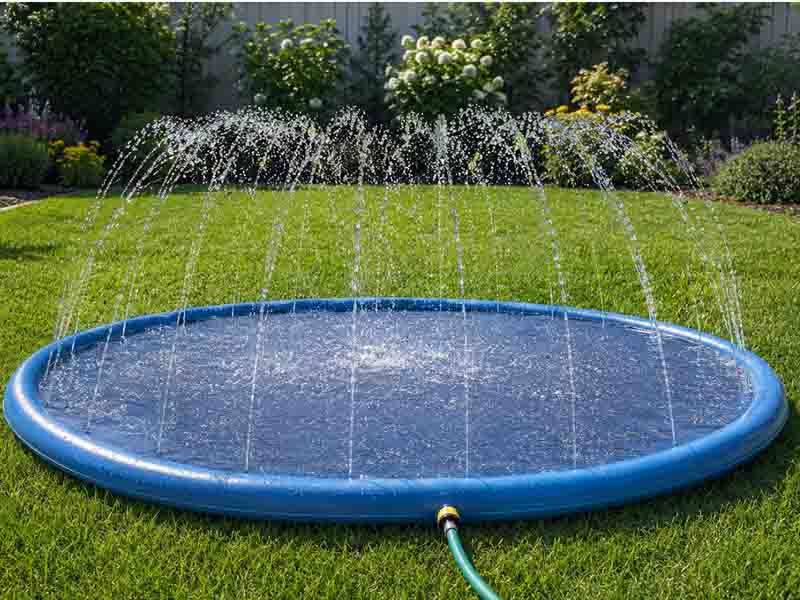
A backyard splash pad looks simple when everything is working correctly: connect a garden hose, open the faucet, and water rises from dozens of holes around the perimeter. The questions usually begin when the spray reaches only a few inches, one side performs better than the other, or a larger pad seems noticeably weaker than a smaller one used on the same lawn. Water pressure is often blamed first, but the pressure reading at the faucet tells only part of the story.
Most hose-fed backyard splash pads are designed to work from ordinary residential water pressure rather than a dedicated high-pressure pump. A household supply around 45–60 PSI is a useful residential reference, but there is no universal PSI requirement for every splash pad. Actual performance also depends on available GPM, hose length, fittings, pad size, spray-hole design, leaks, and the manufacturer’s operating limits.
Two houses can both measure about 50 PSI at an outdoor faucet and still produce very different results. One family may use a short, fully open garden hose directly from the spigot. Another may send the same water through 100 feet of hose, a timer, a Y-splitter, a hose reel, and several narrow connectors while irrigation is running elsewhere. Understanding what happens after the faucet is far more useful than simply looking for the highest possible PSI.
How Much Water Pressure Does a Splash Pad Need?
Most residential splash pads can operate from a normal outdoor faucet when enough water reaches the product. A household supply around 45–60 PSI is a useful reference for residential plumbing, but it is not a universal splash-pad requirement. The practical target is enough pressure and flow to fill the perimeter evenly and create stable spray without exceeding the manufacturer’s instructions.
What PSI Works Best?
There is no single PSI number that works equally well for every splash pad. A compact six-foot model with a relatively short perimeter and limited number of outlets does not place the same demand on a water supply as a 13-foot model containing a much longer water ring and more spray holes. Even products with identical advertised dimensions can perform differently because their inlet openings, chamber geometry, outlet diameter, spacing, and manufacturing tolerances are different.
For residential plumbing, the U.S. EPA WaterSense program states that household fixtures generally operate best when incoming service pressure is between 45 and 60 PSI. That range is useful when checking whether an outdoor faucet has an obvious household pressure problem, but it should not be presented as a mandatory operating range for every splash pad. A particular product may function below it, and product-specific limits should always take priority.
The most meaningful test is what happens across the entire perimeter once water begins flowing. The water ring should fill consistently rather than remaining noticeably flat on the side farthest from the inlet. Spray outlets should also operate reasonably evenly instead of producing very tall jets beside the hose connection while barely dripping at the opposite end.
For normal family use, maximum jet height should not be the goal. Younger children often enjoy lower, softer streams, while older children may prefer stronger inward arcs. Once the ring is stable and the spray pattern covers the play area comfortably, opening the faucet farther may only increase water consumption and structural loading without creating a noticeably better experience.
| Water-Supply Reading | Practical Interpretation | What You May See |
|---|---|---|
| Under 30 PSI | Relatively low source pressure | Smaller pads may work; larger pads become more sensitive to flow |
| 30–45 PSI | Moderate household pressure | Many pads can operate with an efficient hose setup |
| 45–60 PSI | Healthy residential reference range | Generally favorable conditions for hose-fed products |
| 60–80 PSI | Strong household pressure | Maximum faucet opening is often unnecessary |
| Above 80 PSI static | High for residential plumbing | Household pressure regulation should be checked |
The 45–60 PSI figure above describes residential service pressure, not a universal splash-pad specification. The 2024 International Residential Code states that static water pressure should not exceed 80 PSI without an approved pressure-reducing valve, reinforcing the point that simply chasing higher pressure is not good practice.
Is 30 PSI Enough?
Thirty PSI can be enough for some splash pads, especially compact models connected through a short, unrestricted garden hose. A splash pad does not suddenly stop functioning below one universal pressure threshold. The better question is whether enough pressure and water volume remain while the product is operating and dozens of spray openings are using water simultaneously.
A common source of confusion is the difference between static and operating conditions. A pressure gauge attached to an outdoor faucet while little or no water is moving gives a static reading. Once several gallons of water per minute begin moving through household piping, valves, a hose, connectors, and the splash pad itself, resistance and competing water use can reduce what actually reaches the product.
This explains why a home showing 35 PSI can sometimes operate a smaller splash pad successfully while another home showing 45 PSI produces weak spray. The first setup might use a 25-foot hose with a direct connection, while the second sends water through a long hose, reel, timer, splitter, and several narrow fittings. The gauge does not reveal all of those downstream losses.
Instead of treating 30 PSI as an automatic pass or fail, watch how the product behaves. If the complete perimeter fills, most outlets become active, and the far side still produces useful spray, the available supply may already be sufficient. If only the section nearest the inlet works properly, checking flow and restrictions will usually tell you more than simply trying to increase household pressure.

Can Water Pressure Be Too High?
Yes. A flexible PVC splash pad is designed to distribute water through a soft perimeter chamber; it is not a product that benefits indefinitely from increasing inlet pressure. Once the ring has taken shape and spray has stabilized, additional pressure can increase load around welded seams, connectors, reinforced inlet areas, and spray openings without producing an equivalent improvement in play value.
Unusually high household pressure is also undesirable for residential plumbing. Current U.S. residential code guidance uses 80 PSI as the maximum static pressure before an approved pressure-reducing valve is required. EPA WaterSense recommends a considerably lower 45–60 PSI range for efficient household operation. These are plumbing references rather than splash-pad ratings, but they make an important point: higher pressure is not automatically better.
Too much water can also make a children’s product less enjoyable. Very high streams may overshoot the center, spray outside the intended play area, or repeatedly reach a toddler’s face. For younger children, lower jets that remain around ankle, knee, or waist height can provide a more comfortable play experience than the tallest spray the pad can physically produce.
Start with moderate water flow and increase it gradually while watching the complete perimeter. Stop once the ring is stable and the spray is reasonably balanced. If the product instructions specify a maximum inlet pressure or particular water-supply method, those instructions should always take priority over a generic household pressure figure.
What Spray Height Is Normal?
There is no universal spray height that every backyard splash pad should reach. Most hose-fed designs intentionally allow families to adjust the height through the outdoor faucet. A lower setting may create gentle ankle- or knee-height streams for toddlers, while greater flow can create higher inward-facing arcs for older children and larger play areas.
Consistency is generally a better performance indicator than the tallest individual stream. A splash pad producing fairly uniform 18- to 24-inch jets around its perimeter can be functioning better than one producing several 40-inch streams beside the inlet while the opposite side barely sprays. Exact heights vary widely by design, so those figures should be viewed as an example rather than a specification.
Spray height is influenced by pressure, available GPM, hole diameter, hole angle, number of outlets, perimeter length, hose resistance, leaks, and the position of the pad on the ground. Even a child’s foot pressing down on the flexible water ring can temporarily narrow the internal passage and affect outlets farther around the perimeter.
Adjust the faucet gradually and watch whether most streams rise and fall together. When the complete pattern responds consistently, the pad is probably behaving normally. If the same section remains substantially weaker at several different faucet settings, investigate local blockage, folding, leakage, or uneven water distribution rather than assuming the entire house needs more pressure.
Is Household Water Pressure Enough?
For most portable backyard splash pads that connect directly to a garden hose, normal household water pressure is enough and a separate pump is usually unnecessary. What matters is the pressure and flow that actually reach the product after water passes through the faucet, hose, connectors, timers, splitters, and any other restrictions installed between the house and the splash pad.
Do Splash Pads Need a Water Pump?
Most portable children’s splash pads do not require a dedicated water pump. Their perimeter chamber is designed to receive water from a standard outdoor hose connection. Household pressure fills the ring, while the water exits through multiple small spray openings and creates the familiar inward-facing streams around the play surface.
This type of product should not be confused with a permanent municipal splash park. Commercial installations may incorporate circulation pumps, storage tanks, filters, manifolds, underground pipework, solenoid valves, controllers, drains, water treatment equipment, and engineered spray nozzles. Their pressure and flow requirements belong to a different category and should not be used as benchmarks for a foldable PVC backyard splash pad.
If a consumer splash pad produces weak spray, adding a booster pump should therefore not be the first response. Test the simplest possible setup first: outdoor faucet, one garden hose, and the splash pad. Temporarily bypass a hose reel, timer, Y-splitter, extra hose extension, narrow quick connector, or other accessory that might restrict water.
If performance improves considerably after those parts are removed, the home’s basic supply was probably adequate. The original water path was limiting delivery. Adding a pump in that situation would push harder against an unnecessary restriction and could expose the flexible product to pressure outside the conditions for which it was designed.
Does Splash Pad Size Matter?
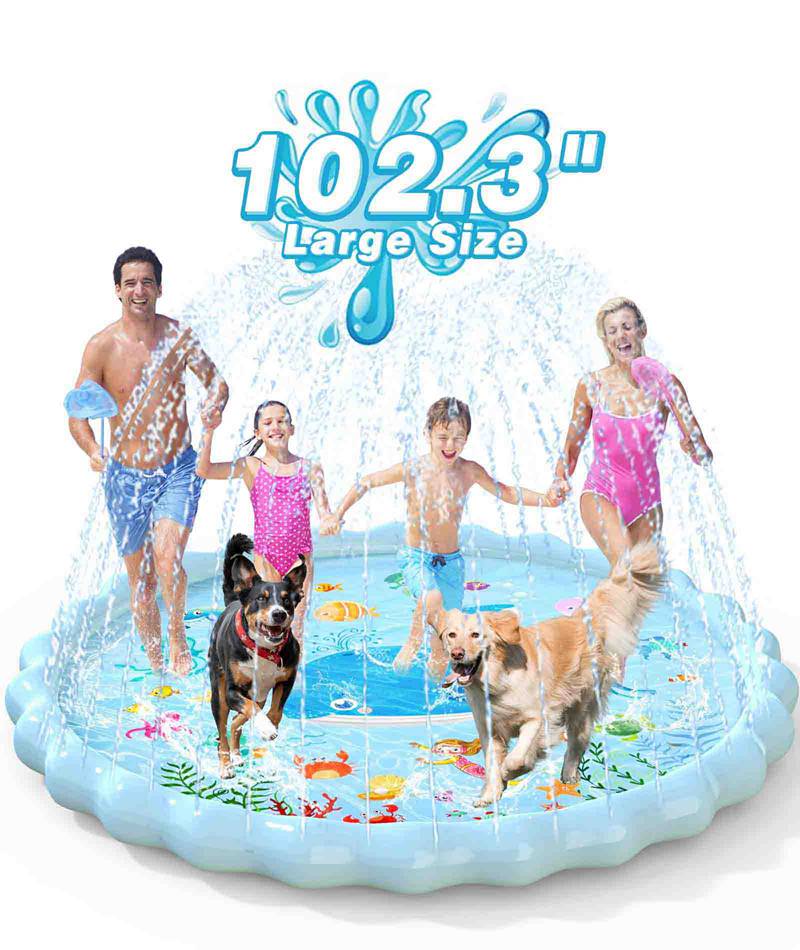
Splash-pad size matters because increasing diameter creates a longer perimeter for water to travel through and usually increases the number of outlets supplied by the same garden hose. A large pad does not automatically require proportionally higher PSI, but it generally makes efficient flow distribution more important.
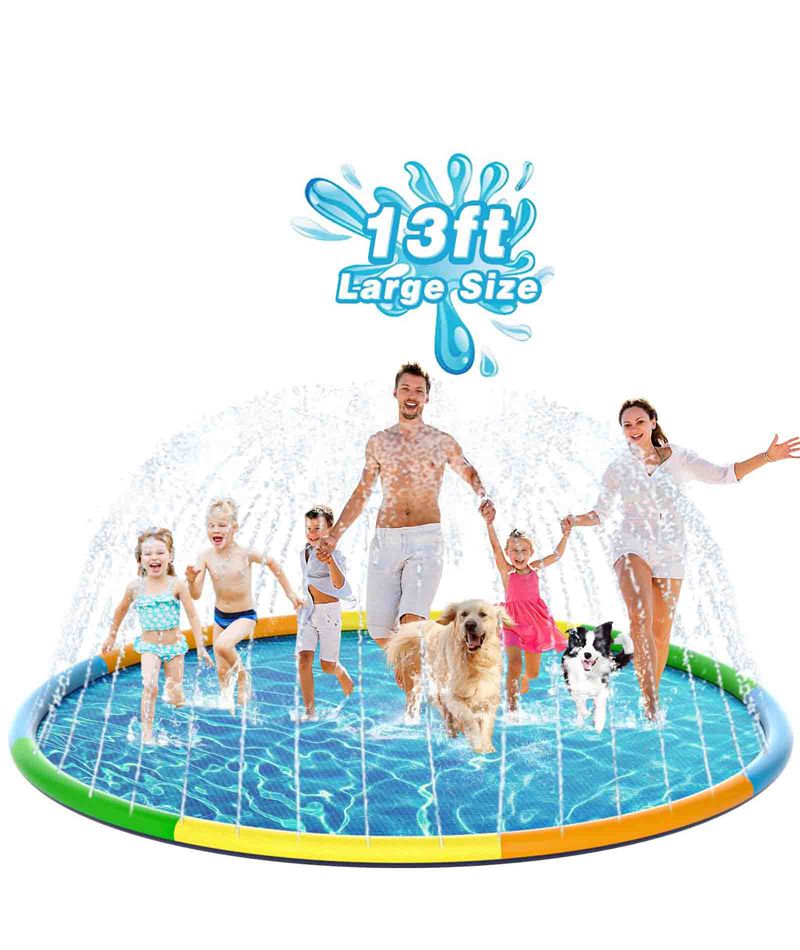
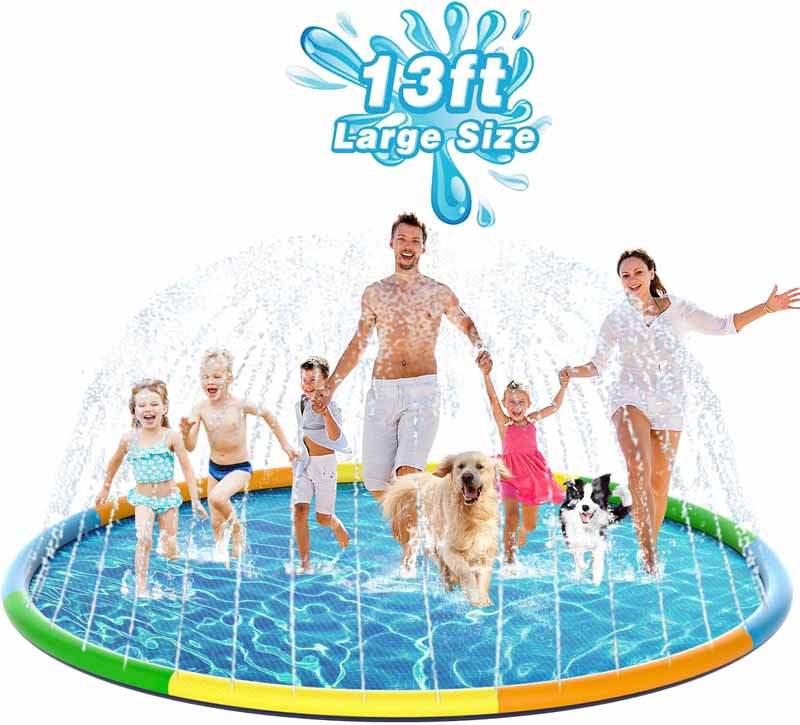
For a round splash pad, circumference equals diameter multiplied by π. An eight-foot pad therefore has approximately 25.1 feet of perimeter, while a 13-foot pad has about 40.8 feet. That adds more than 15 feet of water-distribution path even before changes in spray-hole count are considered.
| Round Pad Diameter | Approx. Circumference | Practical Water-Distribution Consideration |
|---|---|---|
| 6 ft | 18.8 ft | Relatively short water path |
| 8 ft | 25.1 ft | Moderate family-play size |
| 10 ft | 31.4 ft | Additional outlets may increase total demand |
| 12 ft | 37.7 ft | Balanced outlet layout becomes more important |
| 13 ft | 40.8 ft | Low-flow supplies become easier to notice |
| 16 ft | 50.3 ft | Internal water distribution becomes especially important |
These circumference figures describe geometry rather than required GPM. A well-designed 13-foot product can sometimes distribute household water more effectively than a smaller model with an inefficient outlet arrangement.
This is particularly important when products are enlarged during development. Turning an eight-foot design into a 13-foot model should involve more than enlarging graphics and cutting larger PVC panels. Inlet dimensions, perimeter chamber width, spray-hole count, individual outlet area, spacing, and spray direction may all need to be reevaluated.
For a homeowner, the practical takeaway is that advertised diameter tells you how much space the pad occupies, but it does not tell you how efficiently it uses water. Larger products benefit especially from short, unrestricted hose connections because there is less available flow to waste on unnecessary resistance upstream.

Which Hose Size Works Best?
A standard 5/8-inch garden hose is a sensible option for many residential splash pads because it combines common availability with adequate water-carrying capacity for ordinary backyard use. Hose condition and length can matter just as much as the nominal diameter printed on the packaging.
Water experiences friction as it travels through a hose. Longer distances and smaller internal passages generally increase resistance. If a splash pad is only 20 feet from the house, using a 100-foot hose offers no hydraulic advantage and may create avoidable losses, particularly when the hose contains tight bends or remains partly wound on a reel.
Use the shortest practical hose, fully unwind it, and avoid sharp bends around furniture or landscaping. Inspect both end connections as well. A shifted rubber washer, debris inside an adapter, or a narrow quick-connect fitting can reduce the effective opening even when the hose itself has ample diameter.
A 3/4-inch hose can reduce friction losses in some higher-flow applications, but larger is not automatically better. If the outdoor faucet or splash-pad inlet has a much smaller passage, that component may remain the controlling restriction. Good water delivery comes from an efficient complete path rather than choosing one oversized component in isolation.
Do Splitters Reduce Water Pressure?
A hose splitter can reduce splash-pad performance, particularly when both branches operate simultaneously. In everyday conversation this is usually described as a loss of pressure, but the more useful explanation is that multiple devices begin sharing the available flow capacity of the same faucet and household piping.
Imagine one outdoor faucet operating the splash pad comfortably by itself. If a lawn sprinkler is connected to the second side of a Y-splitter and both are opened, the two devices now compete for the same upstream supply. Once combined demand approaches what the plumbing can maintain, operating pressure and flow at the splash pad can fall.
A splitter may also restrict flow when only one side is open. Many timers, Y-valves, shutoff fittings, and quick-connect adapters have internal passages noticeably narrower than the hose connected to them. A fitting can therefore accept a 5/8-inch hose while still creating a bottleneck inside its valve body.
When spray seems weak, remove the splitter completely and connect the garden hose directly to the faucet. If the spray becomes higher or noticeably more even, the splitter, its valve, or the water demand on the second branch was affecting performance. This direct comparison is often more useful than replacing several components at the same time.
Is PSI or GPM More Important?
Both matter. PSI describes water pressure, while GPM measures how much water is delivered each minute. Pressure helps water form useful jets, but flow supplies the total volume required by all of the spray holes. A splash pad can therefore show weak or uneven performance even when the home’s static PSI looks healthy if insufficient GPM reaches the product.
What Is PSI?
PSI stands for pounds per square inch and is a measure of pressure. When diagnosing outdoor water performance, one important distinction is the difference between static pressure and the conditions that exist while water is actually flowing.
Static pressure is commonly checked with a pressure gauge attached to a hose bibb after other water-consuming fixtures have been turned off. EPA WaterSense recommends this basic method for checking household service pressure and identifies 45–60 PSI as a preferred residential range.
Once a splash pad starts operating, several gallons of water may move through pipes, a faucet valve, the garden hose, fittings, and the pad’s perimeter chamber. Every restriction contributes resistance. Simultaneous water use elsewhere in the home can also affect the capacity available outside.
This explains why a perfectly reasonable static PSI reading does not guarantee impressive splash-pad performance. If source pressure is already healthy, increasing the home’s regulator is unlikely to be the most sensible first step. Measuring flow and checking what happens between the faucet and the spray openings usually provides more useful information.

What Is GPM?
GPM stands for gallons per minute and describes the volume of water moving through the system. It is particularly important for splash pads because dozens of spray openings may need water simultaneously. The system needs not only enough pressure to form jets but also enough total water volume to keep feeding every outlet.
A simplified example shows the relationship. Imagine 40 identical outlets that each happened to discharge 0.10 gallon per minute under one specific test condition. Together, they would require 4 GPM. If a larger design contained 80 identical outlets operating under exactly the same hypothetical condition, combined discharge would reach 8 GPM.
Those figures are mathematical examples, not splash-pad operating specifications. Real outlet flow changes with water pressure, hole diameter, spray angle, chamber geometry, outlet shape, and production tolerances. The purpose of the example is simply to demonstrate why adding more outlets can increase the total water demand placed on a garden hose.
This is one reason a smaller splash pad may work perfectly on a particular outdoor faucet while an extra-large model seems weaker. The pressure source has not necessarily changed; the larger product may simply be distributing available water across more outlets and a longer perimeter.
How Can You Test Water Flow?
A five-gallon bucket and stopwatch provide a quick way to estimate outdoor water flow. Fill a container with a known volume, record the number of seconds required, then divide the number of gallons by the filling time and multiply by 60. The result is the approximate gallons per minute available at that test point.
| Time to Fill 5 Gallons | Approximate Flow |
|---|---|
| 20 seconds | 15 GPM |
| 25 seconds | 12 GPM |
| 30 seconds | 10 GPM |
| 40 seconds | 7.5 GPM |
| 50 seconds | 6 GPM |
| 60 seconds | 5 GPM |
| 75 seconds | 4 GPM |
These values measure available flow during the test and are not minimum splash-pad requirements. Different products can have substantially different total water demand.
For a more useful diagnosis, test at several points. Start at the outdoor faucet if practical, then attach the hose and repeat the measurement at its far end. A meaningful reduction between those two tests suggests that hose length, a fitting, a reel, or another restriction is consuming part of the available capacity.
You can also repeat the test while another high-demand fixture or irrigation zone is operating. A large drop indicates that simultaneous household use affects what is available outside. Pressure and GPM measurements together provide a much clearer picture than either number alone.
Do Larger Splash Pads Need More GPM?
Larger splash pads often benefit from greater available flow because their longer perimeter can contain more outlets and distribute water across a larger area. However, the required GPM does not increase in a simple one-to-one relationship with diameter because product designers can change outlet size, quantity, chamber geometry, and spray target.
An eight-foot round pad has a perimeter of approximately 25.1 feet, while a 13-foot model measures about 40.8 feet around the edge. That is roughly a 63% increase in perimeter length. If both products used identical spray-hole spacing, the larger version could also contain roughly 63% more outlets.
That does not mean the home automatically needs to supply 63% more water. Engineers can adjust hole diameter, spacing, outlet count, inlet dimensions, chamber width, and intended spray height. This is one reason water testing is important whenever a successful smaller design is scaled into a substantially larger version.
If a small pad works well but a large model produces weak spray from the same faucet, check household flow before assuming the product is faulty. Remove splitters, use the shortest practical hose, turn off competing outdoor water use, and compare bucket-test results. These simple checks can quickly reveal whether the larger product is exposing a limitation in the available supply.
Why Is My Splash Pad Spraying Weakly?
Weak spray is often caused by a restriction somewhere between the water source and the outlets rather than by a defective splash pad. Long or kinked hoses, competing household water use, restrictive fittings, partially open valves, blocked spray holes, folded perimeter sections, and leaks can all reduce performance. Follow the water from the faucet toward the far side of the pad to isolate the problem.
Why Is the Spray Too Low?
First determine whether every outlet is weak or whether only one area is affected. Uniformly low spray usually points toward the incoming water supply or hose setup. A clearly defined weak section is more likely to involve local blockage, compression, a leak, or uneven distribution inside the product.
If the entire pattern is low, check household demand. Make sure the faucet is open sufficiently and see whether an irrigation system, second garden hose, shower, washing machine, or another high-flow fixture is operating. A pad that performs normally in the morning but poorly at another time may simply be sharing the home’s available capacity.
Inspect the garden hose carefully. Fully unwind hose reels and look around corners, behind furniture, and close to the faucet. A hose does not need to be folded completely in half to restrict flow; even a flattened bend can create substantial resistance.
Temporarily remove timers, splitters, shutoff valves, and quick-connect fittings. If spray remains weak, use the bucket test at the hose end. Good flow at the end of the hose suggests that the next checks should focus on the splash pad itself, while a large difference between faucet and hose-end flow points toward a supply-side restriction.

Why Does One Side Spray Lower?
When one side works normally and another remains weak, the problem is less likely to be simple whole-house pressure. Water is clearly reaching the product, but something is preventing it from being distributed evenly.
Begin by spreading the pad completely flat. Check whether part of the flexible perimeter chamber has folded underneath itself or is being compressed by a stone, tree root, outdoor furniture, or a child’s foot. A narrow section inside the ring can act like a kink in a garden hose and reduce water available farther around the perimeter.
Inspect the spray openings in the weak area next. Grass, soil, fine sand, mineral buildup, and particles from older garden hoses can partially block tiny outlets. Clean carefully rather than enlarging the holes, because even a small increase in diameter can change discharge and alter the balance between neighboring streams.
Finally, check for unintended leakage around seams and the underside. Small leaks are easily missed because a splash pad is already surrounded by water during operation. If the same area remains weak after the product is flattened, cleaned, and connected to an unrestricted hose supply, the problem may involve internal geometry or manufacturing consistency rather than household PSI.
Are Spray Holes Clogged?
Spray holes can become clogged, particularly when a product previously performed normally and then develops only one or two weak streams. Their small size allows the perimeter chamber to turn modest household flow into defined jets, but it also makes them sensitive to outdoor debris.
Grass clippings, fine soil, sand, insects, hard-water deposits, dried residue, and particles from a deteriorating hose can all cause local restriction. Seasonal storage can introduce debris as well, especially if the splash pad was folded while damp or stored where dust and small particles could enter the water connection.
Disconnect the water before cleaning any outlet. Use a gentle method that removes debris without changing the original diameter or direction. Avoid forcing large needles, screws, drills, or other hard objects through the PVC.
The importance of outlet diameter is easy to underestimate. A 1.0 mm circular opening has an area of about 0.79 mm², while a 1.2 mm opening has approximately 1.13 mm² of area. That is about 44% more opening area from only a 20% increase in diameter. Actual flow will not increase by exactly the same percentage, but the calculation shows why enlarging several outlets can noticeably alter spray balance.
How Do You Improve Water Flow?
The most reliable way to improve water delivery is to remove restrictions rather than immediately trying to raise household pressure. Begin with the simplest possible system: outdoor faucet, one short garden hose, and splash pad. This provides a clean baseline before other accessories are added back.
| What You See | More Likely Cause | Best First Check |
|---|---|---|
| All jets are low | Limited delivered flow | Faucet, competing fixtures, bucket test |
| Near side high, far side weak | Flow loss or distribution issue | Hose and perimeter ring |
| One or two weak jets | Local blockage | Individual spray openings |
| One large weak area | Fold, compression, leak, or internal restriction | Pad position and seams |
| Spray suddenly becomes weaker | New kink, debris, leak, or supply change | Compare with earlier setup |
| Spray improves without splitter | Shared demand or accessory restriction | Splitter and second branch |
Once the direct setup performs properly, reconnect accessories one at a time. Add the splitter and test again, followed by the timer, hose reel, additional hose length, and quick connectors. The point where performance drops often identifies the component creating the restriction.
Higher pressure cannot efficiently solve a leaking seam, clogged outlet, or compressed water chamber. If a seam is leaking, more pressure may simply increase unintended discharge. If the hose is kinked, pushing harder against the kink does not remove the problem.
A healthy backyard setup is therefore less about maximizing PSI and more about preserving the water the home already provides. A short hose, open fittings, clean inlet, properly positioned perimeter, and leak-free water ring often make a much larger difference than adjusting the household plumbing.
How Does Splash Pad Design Affect Water Pressure?
Splash-pad performance depends heavily on product design. Spray-hole diameter, outlet count, spacing, inlet dimensions, perimeter length, water-ring geometry, PVC flexibility, seam quality, and manufacturing consistency all influence water distribution. A well-developed product should make efficient use of realistic household pressure and flow rather than depend on unusually high water pressure to compensate for poor hydraulic balance.
How Do Spray Holes Affect Pressure?
Every spray hole removes water from the same perimeter chamber. Increasing outlet quantity or enlarging individual holes can therefore raise total discharge and change how much pressure remains farther around the ring. Hole count, diameter, angle, spacing, product circumference, and inlet performance need to be considered as a connected system.
Hole diameter has a particularly noticeable effect because circular opening area increases with the square of radius. A 1.0 mm opening has an area of approximately 0.79 mm², while a 1.2 mm opening has about 1.13 mm². Although the diameter increased by only 20%, the physical opening area increased by roughly 44%.
Real-world water flow does not increase by precisely the same percentage because pressure, edge geometry, outlet angle, and internal conditions also matter. The calculation nevertheless demonstrates why punching consistency matters in manufacturing. Small dimensional differences repeated across many outlets can create visible changes in the final spray pattern.
Outlet angle matters as well. More vertical openings may create higher individual streams, whereas inward-facing holes direct water toward the usable play area. The goal is not simply to create as many holes or the tallest possible jets. A well-balanced layout distributes the available household water into a stable pattern across the complete play zone.

Does Pad Diameter Affect Spray?
Diameter directly affects the length of the water-distribution path. As a pad becomes larger, water must travel farther around its flexible perimeter while continuously leaving through spray openings. Differences between the inlet side and the far side can therefore become more noticeable as circumference increases.
An eight-foot round pad has about 25.1 feet of perimeter, a 13-foot pad about 40.8 feet, and a 16-foot model more than 50 feet. All three may use the same style of garden-hose connection, but their internal distribution challenge is clearly different.
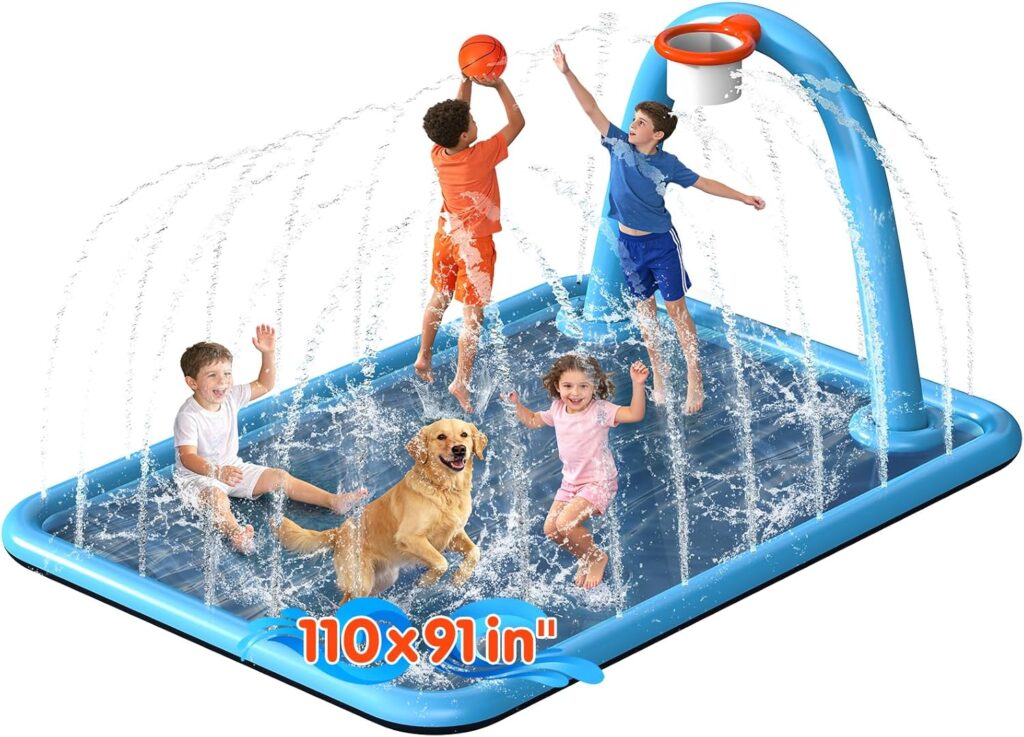
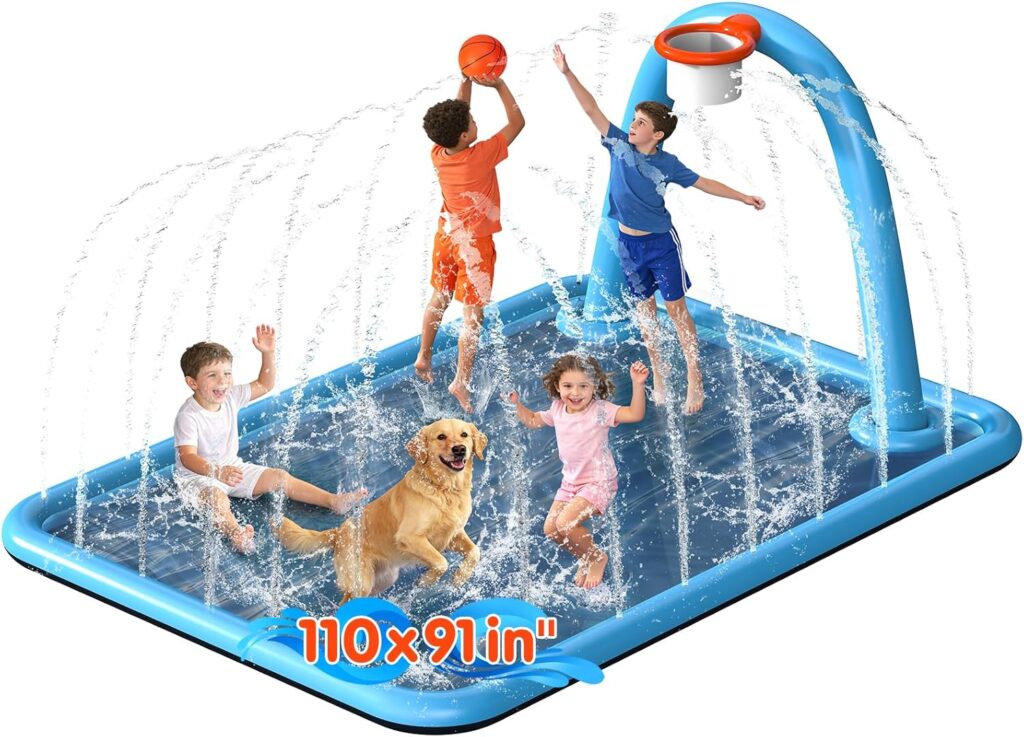
This is why enlarging a splash pad should involve more than scaling the artwork and PVC cutting pattern. Chamber dimensions, inlet geometry, outlet count, hole diameter, spacing, and spray direction may all need adjustment. Rectangular, oval, basketball-goal, arch, and irregular designs introduce additional complexity because their flow paths are less symmetrical.
Physical prototype testing becomes especially important for customized products. A design may look perfectly proportional in a drawing but produce very different spray behavior once water is introduced. Correcting an imbalance during product development is considerably more effective than expecting users to compensate later by increasing household pressure.
How Does the Water Ring Stay Pressurized?
The perimeter chamber of a hose-fed splash pad acts as a flexible water manifold. Water enters through the hose connector, fills the ring, and continuously exits through the spray openings. As inflow and combined discharge approach balance, the ring takes its operating shape and develops enough internal pressure to support the intended spray pattern.
Unlike rigid plumbing pipe, flexible PVC changes shape during use. If one part of the ring is stepped on, folded beneath itself, or pressed against uneven ground, the internal water path becomes narrower. Resistance rises at that point and the effect can become visible as weaker outlets farther around the perimeter.
Material selection therefore matters, but PVC thickness alone does not determine water-distribution quality. Flexibility, welded seam strength, chamber dimensions, inlet reinforcement, temperature behavior, foldability, and product size all work together. A thicker material does not automatically solve a poorly balanced outlet layout, just as more pressure does not automatically solve a restrictive inlet.
In splash-pad development, water distribution should be evaluated together with material behavior and structure. When diameter, geometry, inlet location, or functional features are changed, water performance may need to be validated again instead of assuming the previous configuration will behave identically.
How Is Spray Performance Tested?
Useful splash-pad testing involves more than checking whether water comes out of every hole. The first observation is how the complete perimeter fills and whether outlets close to the inlet and those farther away begin operating with reasonably similar performance.
Testing at several realistic faucet settings is also important. A pad that looks impressive only under unusually strong laboratory conditions may not perform as well in ordinary residential yards. Moderate-supply testing helps reveal whether the outlet layout and water ring use household flow efficiently.
Leak resistance should be checked around the inlet, welded perimeter, corners, and other areas where the structure changes. Small leaks can reduce the amount of water available to downstream outlets even when the product still appears usable. Repeated filling, draining, drying, folding, and reopening can also reveal whether handling changes the integrity or geometry of the water chamber.
For larger or customized products, another round of testing is valuable whenever diameter, shape, inlet position, spray-hole count, or perimeter geometry changes. Scaling one dimension can affect the hydraulic behavior of the entire product.
EPN’s broader PVC and composite product-development process combines material, structural, product-design, and performance evaluation. Its R&D capabilities include specialists in polymer materials and structural development, and splash-pad development considers multi-point water distribution alongside leak resistance, welded construction, durability, foldability, and intended user experience. This type of combined evaluation is more useful than treating PSI or material thickness as a stand-alone measure of product quality.
For brands developing customized splash pads, the same principle is important during sampling. Changing the size, shape, graphics, spray layout, or intended age group can change how a product needs to distribute water. Testing those changes under realistic household conditions helps reduce the risk of producing a visually attractive product that requires an impractical water supply.
A good splash pad should make the setup feel simple to the person using it. The engineering behind the product may involve outlet area, perimeter geometry, inlet dimensions, PVC behavior, and flow distribution, but the final experience should still be straightforward: connect the hose, adjust the water, and get reasonably even spray.
Conclusion
For most hose-fed backyard splash pads, an ordinary residential outdoor faucet is usually sufficient. Approximately 45–60 PSI is a useful reference for healthy household service pressure, but it is not a universal splash-pad requirement. A smaller and efficiently designed product may perform successfully below that range, while a much larger pad can still struggle in a home with higher static pressure if available flow is restricted.
When spray is weak, follow the water before blaming the product or increasing household pressure. Check competing water use, measure flow when necessary, shorten the hose, remove splitters and timers, straighten the perimeter, inspect spray openings, and look carefully for leaks. These steps help determine whether the limitation begins at the household supply, somewhere along the hose connection, or within the splash pad itself.
The most useful splash pad is not the model that demands the highest PSI. It is one designed to turn realistic household water pressure and flow into balanced, controllable spray. Sensible outlet geometry, an unrestricted inlet, stable flexible-PVC construction, reliable welded seams, and appropriate perimeter dimensions all contribute to that result. For families, those details translate into easier setup and more consistent play. For brands developing customized splash pads, they are important considerations from the first prototype through final production.
Frequently Asked Questions
1. Is 40 PSI enough for a splash pad?
Forty PSI can be enough for many residential splash pads when the faucet also supplies adequate water volume and the hose path is not heavily restricted. Instead of judging performance by PSI alone, watch whether the entire perimeter fills and whether outlets farthest from the inlet produce usable spray. If those conditions are met, increasing household pressure simply to reach a higher number is usually unnecessary.
2. Is 50 PSI good for a splash pad?
A household supply around 50 PSI falls within the EPA’s 45–60 PSI residential reference range and is generally a favorable starting condition for a hose-fed backyard splash pad. It still does not guarantee a particular spray height because garden-hose resistance, available GPM, outlet layout, pad size, splitters, leaks, and other restrictions determine what reaches the product while it is operating.
3. How many GPM does a splash pad need?
There is no universal GPM requirement for every portable splash pad. Total water demand changes with pad diameter, perimeter length, spray-hole count, outlet diameter, inlet design, and target spray height. A bucket test can tell you what your outdoor faucet actually supplies, while product performance will show whether that flow is sufficient for the particular design you are using.
4. Why does my splash pad barely spray even when my water pressure is normal?
A healthy static pressure reading does not guarantee adequate flow during operation. Long hoses, narrow quick connectors, timers, splitters, partially closed valves, hose reels, simultaneous household water use, clogged holes, leaks, and local folds can all reduce performance. Connect the pad directly to a short garden hose first. If the spray improves, the original water path was probably creating unnecessary resistance.
5. Does a larger splash pad need higher water pressure?
Not necessarily. A larger pad usually has a longer perimeter and may contain more spray openings, so it can place greater demand on available water volume. Well-designed larger products can compensate through chamber dimensions, inlet geometry, outlet size, spacing, and spray pattern. More GPM may be helpful, but simply increasing PSI is not always the correct solution.
6. Can too much water pressure damage a splash pad?
Excessive pressure can place unnecessary stress on flexible PVC chambers, welded seams, hose connectors, and areas surrounding spray openings. It can also produce jets that overshoot the play area or become uncomfortable for younger children. Open the faucet gradually and stop once the ring is stable and the spray is even. Always follow any pressure limitation provided by the product manufacturer.
7. Does garden hose length affect splash pad spray height?
Yes. Water experiences friction while traveling through a hose, and longer hoses, smaller internal passages, kinks, and additional fittings generally increase resistance. A short, fully uncoiled hose can therefore deliver more usable flow than a much longer hose connected to the same faucet. When troubleshooting weak spray, shortening the hose and removing unnecessary fittings is one of the easiest tests.