Skip to content


A dog pool seems like one of the simplest summer products you can buy. Pick a size, add water, and let the dog jump in. In practice, the differences between a pool that gets used every week and one that ends up folded in the garage usually come down to details that are easy to miss online. The advertised diameter may not equal the usable floor space. A wall that looks low in a product photo can be difficult for a short-legged or older dog to cross. Thin-looking material is not automatically weak, while thick material does not compensate for poor seams, weak wall support, or an awkward drain. Even water depth changes the experience because many dogs want to stand, splash, or lie down rather than swim. Before comparing colors and patterns, it is more useful to think about your dog’s body length, movement, age, confidence around water, intended activity, and the place where the pool will actually be filled, drained, cleaned, and stored.
The best dog pool gives your dog enough usable floor area to stand, turn, lie down, and exit comfortably while providing stable footing and manageable water depth. Choose the size from your dog’s body dimensions and activity, then compare wall height, PVC or other material construction, floor texture, sidewall support, drainage, and storage. More size or depth is not automatically better.
A useful first step requires no product knowledge at all. Take a tape measure outside, mark the dimensions of the pool you are considering on the lawn or patio, and ask your dog to stand inside that outline. Watch what happens when the dog turns, stretches, or lies down. If its body already fills most of the marked area, the pool will probably feel smaller once the sidewalls are added. That five-minute test can prevent the most common mistake in dog-pool shopping: choosing from a photograph instead of choosing from the space the dog actually needs.
What Size Dog Pool Do You Need?
Choose a dog pool with enough interior floor space for your dog to stand naturally, turn without repeatedly hitting the sidewall, and lie down if it wants to cool off. Body length, leg height, activity level, and the number of dogs are more useful than breed labels. Large or active dogs generally benefit more from extra floor area than from unnecessarily tall walls or deep water.
How Big Should a Dog Pool Be?
Start by measuring your dog from the nose to the base of the tail while it is standing naturally. This gives you a more useful reference than weight alone because two dogs that weigh the same can have very different body lengths. Compare that measurement with the pool’s usable interior diameter or floor length whenever the manufacturer provides it. If only external measurements are shown, remember that wall thickness, folds, support panels, and the shape of the perimeter can reduce the space the dog actually gets.
As a practical shopping method rather than a formal safety standard, allow additional room beyond the dog’s straight body length. A calm dog using a pool mainly for bathing may need only enough clearance to turn. A young retriever that circles, paws at water, chases toys, or shares the pool with another dog needs more open floor area. If you are deciding between two adjacent sizes and both fit the available yard, the larger option usually makes more sense for an active dog, while the smaller option can be easier for bathing, water use, drainage, and storage.
| Dog / Use Pattern | Starting Pool Size to Compare | Wall Height to Compare | Main Priority |
|---|---|---|---|
| Toy or small dog | 30–40 in | 8–10 in | Easy entry and low water use |
| Small to medium dog | 40–50 in | 8–12 in | Turning and lying space |
| Medium dog | 48–63 in | 10–12 in | Cooling, play, and bathing |
| Large dog | 63–80+ in | 10–12 in | Usable floor area and support |
| Two medium dogs | 63–80+ in | 10–12 in | Shared movement space |
| Multiple large dogs | 80 in+ | Size-dependent | Floor area and wall stability |
These ranges are planning references, not breed rules or veterinary standards. A long-bodied dog may need more room than a compact dog of the same weight, while a calm dog that mainly lies in shallow water may be comfortable in less space than an energetic dog that continually changes direction. The best check is still to mark the proposed diameter on the ground and watch how much empty space remains around the dog after it turns.
What Size Fits Small Dogs?
Small dogs rarely need the biggest pool available. For many compact breeds, a pool in the 30- to 40-inch class provides enough room to stand, turn, splash, and lie in shallow water without requiring a large amount of filling and draining every time it is used. A more manageable diameter is also easier to position under shade, rinse after muddy play, dry completely, carry between locations, and store when summer ends.
Wall height deserves as much attention as diameter. An edge that looks low to a person may be a genuine obstacle for a Chihuahua, miniature dachshund, toy poodle, young puppy, or older small dog. If the dog must jump into the pool rather than step across the wall naturally, the product becomes less convenient and potentially harder to exit once the dog’s coat and paws are wet. For short-legged dogs, a lower wall can therefore be more valuable than several extra inches of water capacity.
The floor should also remain flat and predictable. Small dogs and puppies often become hesitant if their paws slide immediately after entering. Look for visible floor texture and place the pool on clean, level ground so folds or trapped objects do not create unstable areas. If the dog is new to water, begin with only a shallow layer and allow voluntary exploration rather than filling the pool to its maximum level on the first day.
What Size Fits Large Dogs?
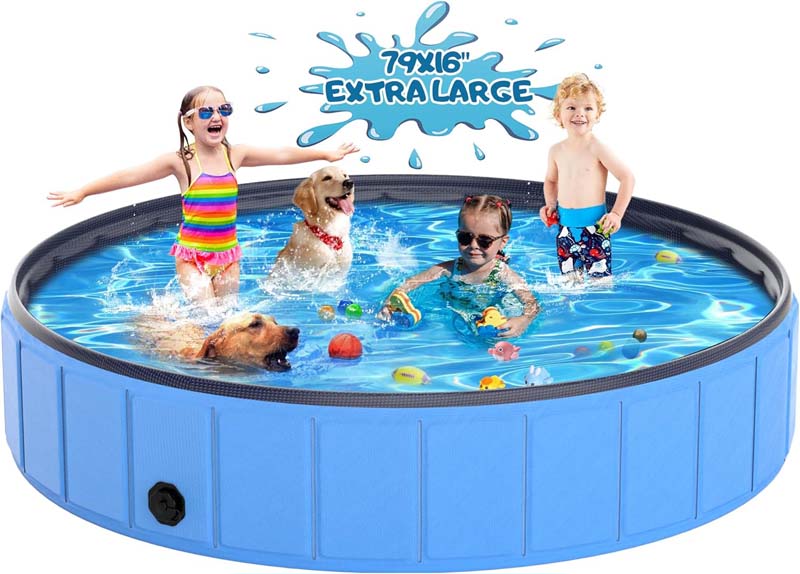
Large dogs need horizontal movement space more than excessive depth. A pool that appears generous in a lifestyle photograph can feel surprisingly tight once a Labrador, Golden Retriever, German Shepherd, Husky, or similarly sized dog steps inside and begins to turn. A 48-inch pool may physically contain a large dog, but moving into a 63-, 79-, or larger size class can make a substantial difference when the dog wants to lie down, circle, splash, or play with toys.
Body length is often a better guide than weight. If a dog’s nose and hindquarters already come close to opposite sides while it stands straight, there will be very little room left for rotation. Marking the pool dimensions on the ground before buying makes this easy to visualize. If the dog nearly fills the outline before there are even walls, water, toys, or another dog inside, a larger diameter is likely to provide a more comfortable everyday experience.
Larger dogs also place greater loads on the pool structure. Their paws concentrate more pressure on the floor, while a dog leaning against one wall panel can create a strong local force that water alone would not produce. When moving into larger sizes, compare the wall reinforcement, floor construction, welded areas, and drainage fittings as carefully as the diameter. A wide pool with weak support is not automatically a better choice than a slightly smaller pool with a well-designed structure.

How Much Room Does Your Dog Need?
The amount of space a dog needs depends on what it will actually do in the pool. Cooling usually requires the least floor area because many dogs simply stand, sit, or lie in shallow water. Bathing requires enough space to turn while still allowing the owner to reach the dog’s back, legs, and underside comfortably. Play requires considerably more room because toys, splashing, circling, and quick changes of direction use space that a stationary dog does not.
It helps to think about three practical zones: standing space, turning space, and activity space. A senior dog that enjoys quiet cooling may need the first two. A young water-loving dog chasing floating toys needs all three. With multiple dogs, the goal is not simply to fit every body inside the perimeter. There should still be open floor so one dog can turn without forcing another dog to move every time.
The area outside the pool is also part of the sizing decision. Leave enough room to walk safely around the perimeter, reach the drain, rinse the walls, and direct water away from doors or frequently used paths. A large pool squeezed between furniture, a fence, and landscaping can be less practical than a slightly smaller model positioned on open, level ground. The right size balances dog comfort with the way the pool will actually be filled, used, emptied, cleaned, dried, and stored.
Which Dog Pool Material Is Best?
For frequent backyard use, reinforced PVC with rigid or semi-rigid wall support provides a useful balance of waterproofing, durability, foldability, and storage efficiency. Hard molded plastic tolerates ordinary claw contact well but requires much more storage space, while inflatable pools pack smaller but depend on air chambers. Do not judge durability from material thickness alone; floor reinforcement, seams, support panels, and drain construction also matter.
Is PVC Good for Dog Pools?
PVC is well suited to foldable dog pools because it can provide a waterproof surface while remaining flexible enough to fold for storage. Depending on the construction, PVC can be textured for grip, printed with graphics, welded into water-resistant seams, and combined with internal PP or composite panels that give the sidewalls their shape without relying on inflation. This combination is one reason PVC is widely used across portable pools and other outdoor water-play products.
The material name alone does not tell you whether a pool is well made. Two products can both be described as PVC dog pools while using different surface thicknesses, floor layers, wall supports, seam designs, and drain assemblies. The bottom experiences dog nails, body weight, dirt, and friction from the ground, while the sidewalls primarily deal with outward water pressure and occasional force when the dog leans, turns, or climbs over the edge.
The setup surface also has a direct effect on durability. Grass is relatively forgiving but can hide small stones, roots, sticks, or garden debris. Concrete is stable but becomes abrasive if a filled or partially filled pool is dragged across it. Decking should be inspected for exposed screws or splinters. Even a strong PVC floor performs best when placed on a clean, level surface that does not concentrate pressure into one sharp point.
For retailers or pet brands developing their own model, material should be selected together with pool diameter, wall-panel construction, floor texture, drainage layout, print requirements, folded package size, and target use. EPN can adjust these elements as part of an OEM or ODM dog-pool project rather than treating material thickness as an isolated specification. For consumers, the same principle applies: evaluate the structure as a system, not as a single number printed in a product listing.
Are Foldable Pools Better Than Inflatable Pools?
Foldable pools are often more practical for regular dog use because they require little setup. The wall panels are unfolded into shape, the drain is closed, and filling can begin. Their basic structure does not depend on air pressure, which removes the need for a pump and avoids the inconvenience of discovering that an air chamber has softened between uses. Once drained and dried, the panels fold together into a package much smaller than the pool’s working diameter.
Inflatable pools still make sense in some situations. They tend to pack into a smaller space, the inflated edges feel soft, and lightweight models are convenient for occasional trips. The tradeoff is that a puncture, valve leak, or damaged welded seam can affect structural support. Dogs that scratch repeatedly, chew edges, or climb heavily onto an inflated rim may therefore place stresses on the product that differ from those experienced by a panel-supported foldable pool.
Hard molded plastic sits at the other end of the spectrum. It handles normal claw contact well and has almost no setup time, but storage can be awkward because the product does not become smaller when empty. A rigid 50-inch pool still occupies approximately the same diameter in a garage, shed, or vehicle. This is an important practical difference for people who only use the pool during part of the year.
| Pool Construction | Everyday Durability | Setup | Storage | Best Fit |
|---|---|---|---|---|
| Reinforced foldable PVC | Good with normal supervised use | Unfold and fill | Very good | Frequent backyard use |
| Hard molded plastic | Very good | Immediate | Poor | Permanent or semi-permanent use |
| Inflatable PVC/vinyl | Moderate | Inflation required | Excellent | Occasional or light use |
| Fabric-supported waterproof pool | Moderate to good | Fast | Good | Travel and temporary use |
No flexible pool should be assumed to be completely resistant to deliberate digging or chewing. A well-made structure can handle normal paw contact far better than a poorly supported one, but dog behavior, nail condition, ground preparation, and correct storage still influence service life. Claims such as “indestructible” or “claw proof” deserve caution unless the manufacturer clearly defines the conditions behind them.

How Thick Should a Dog Pool Be?
Thickness is useful when two otherwise similar pools provide clear specifications, but it should not be used as a complete durability score. If one product lists 0.4 mm PVC and another lists 0.5 mm, the second material is physically thicker, but that information does not tell you whether the bottom has additional reinforcement, whether the seams are consistently welded, how the wall panels are supported, or whether the drain fitting is installed well.
Different areas of a dog pool experience different stresses. The floor receives concentrated paw pressure and abrasion from both above and below. Sidewalls experience water pressure plus local loads from leaning dogs. The joints between foldable panels bend whenever the pool is packed away, while the drainage opening interrupts the continuous waterproof surface and therefore needs reliable sealing. Improving only the nominal PVC thickness can leave other weak points unchanged.
For large and active dogs, pay particular attention to the floor, panel system, seams, and drain area. If a manufacturer provides both material specifications and construction details, those pieces of information are more useful together than either one alone. A well-designed pool uses enough material where it is needed while maintaining the flexibility required for repeated folding and practical storage.
This also explains why the thickest available pool is not automatically the best travel product. Increasing material and panel weight can improve the substantial feel of the structure but also increases dry weight and folded bulk. The ideal construction depends on whether the pool will stay in one backyard, move between homes, travel in a vehicle, or be stored in a small apartment for most of the year.
What Makes a Pool Scratch Resistant?
Scratch resistance comes from the complete floor system, not a single adjective. Material thickness, surface texture, backing layers, floor reinforcement, nail condition, dog behavior, and the ground below the pool all influence wear. A textured floor can also reduce scratching indirectly because dogs that feel secure underfoot are less likely to spread their toes and dig their nails into the surface while trying to regain balance.
Nail care is a simple but important part of pool use. Normal walking paws are very different from paws that repeatedly scratch one area during excited play. A dog that deliberately digs at the bottom or chews the wall can eventually damage many flexible materials, regardless of how strongly the product is marketed. Treat a dog pool as a water-play surface rather than as a chew toy or digging mat.
Ground preparation matters just as much. Before unfolding the pool, remove stones, sharp sticks, metal fragments, exposed fasteners, or other debris. When using the product repeatedly on rough concrete or another abrasive surface, a suitable protective layer beneath the pool can reduce friction. Most importantly, never drag a pool while it still contains a significant volume of water, because the combination of weight and abrasion can place much greater stress on the bottom.
For product development, meaningful durability evaluation should include more than a one-time water fill. Repeated folding, seam inspection, floor abrasion observation, wall-pressure testing, drainage checks, and extended filled-water testing provide a more realistic picture of how the structure behaves. For consumers, detailed construction information is generally more useful than an unsupported promise that a soft pool is completely scratch resistant.
How Deep Should a Dog Pool Be?
Most portable dog pools do not need to be filled to the top. For cooling, bathing, and casual play, shallow water that lets the dog keep secure contact with the floor is usually more useful. Adjust the level to leg length, age, mobility, and confidence around water. Puppies, seniors, short-legged dogs, and inexperienced swimmers should begin particularly shallow and progress only when comfortable.
Is a Deep Pool Safe for Dogs?
Deep water is not automatically better for a dog. Some dogs are confident swimmers, while others struggle once their paws lose contact with the bottom. Short-legged, long-bodied, flat-faced, young, older, or inexperienced dogs may have very different swimming ability from a healthy water-loving retriever. AKC and veterinary guidance both caution against assuming every dog is a natural swimmer and consistently recommend supervision around water.
Portable dog pools are normally most practical as paddling, bathing, cooling, and supervised play spaces rather than as full swimming pools. If genuine swimming exercise is the goal, the dog needs enough length and depth to move without repeatedly striking the walls, and some dogs may benefit from an appropriately fitted canine flotation device. A shallow portable pool should not be treated as a substitute for professional hydrotherapy when rehabilitation is required.
Water depth also changes the physical load on the pool. One US gallon of water weighs approximately 8.34 pounds, so increasing depth across a wide floor can add hundreds of pounds very quickly. This is why a large foldable pool should always be opened fully and placed on a firm, reasonably level surface before filling. A slight-looking change in depth can represent a major difference in total water weight.
| Approx. Circular Diameter | Water Depth | Approx. Water Volume* | Approx. Water Weight* |
|---|---|---|---|
| 48 in | 4 in | 31 gal | 259 lb |
| 48 in | 8 in | 63 gal | 525 lb |
| 63 in | 4 in | 54 gal | 450 lb |
| 63 in | 8 in | 108 gal | 901 lb |
| 79 in | 4 in | 85 gal | 709 lb |
| 79 in | 8 in | 170 gal | 1,418 lb |
These are theoretical cylindrical calculations intended to illustrate how quickly water weight increases. Real dog pools may have tapered walls, folds, internal dimensions smaller than the advertised diameter, recommended maximum fill levels, and displacement from the dog, so actual capacity will differ.
The table highlights an important buying principle: a wide pool does not need to be deep to provide useful water play. Increasing diameter gives the dog room to move, while keeping the water shallower reduces total load, shortens filling and draining time, and makes it easier to refresh dirty water. For most backyard cooling, width and secure footing are more useful than maximum water capacity.

How Much Water Should You Add?
Begin with the dog’s legs rather than the height of the sidewall. For simple cooling, shallow water can be enough for a dog to wet its paws, lower legs, belly, or body when lying down. Blue Cross recommends providing a paddling pool in a shaded area and using cool rather than freezing water, while also warning that excited play can still contribute to overheating on hot days.
For the first session, add only a small amount of water and watch how the dog behaves. A comfortable dog generally walks normally, investigates, sits, lies down, or engages with toys. A dog that freezes, scrambles repeatedly at the wall, lifts its feet constantly, or immediately tries to escape may need a shallower level, better footing, or more time to become familiar with the experience.
The dog should always be able to leave the pool easily, and fresh drinking water should remain available nearby. Pool play can make dogs thirsty, and excited dogs may drink from the pool itself. Giving regular breaks also helps prevent a playful session from becoming excessive exercise during hot weather. Supervision matters even when the water appears too shallow for normal swimming.
Water quality changes quickly in a small outdoor pool. Hair, saliva, soil, grass, dust, insects, and bathing residue can accumulate within a single session. Filling only to the level required for the activity makes it much easier to drain and replace the water when it becomes dirty instead of leaving a large volume standing simply because it took a long time to fill.
What Depth Suits Puppies?
Puppies should begin in very shallow water because their coordination, confidence, and understanding of the environment are still developing. Depending on the puppy’s size, one or two inches may be enough for the first introduction. The purpose is not to test swimming ability. It is to let the puppy discover that the floor feels stable, the water moves predictably, and leaving the pool is easy.
Allow the puppy to approach and enter voluntarily rather than placing it suddenly into deeper water. AKC guidance recommends introducing dogs gradually and avoiding the assumption that every dog will immediately be comfortable swimming. A familiar toy or treat can create a positive association, but the puppy should always be able to turn away or exit instead of being encouraged to remain after it becomes uncertain.
Wall height may actually be more important than water depth for a young dog. A puppy can stand safely in a shallow layer while still struggling with a tall perimeter. If it has to hook both front paws over the top and pull its body across the wall, the pool is not providing an easy independent exit. Choose a lower structure or provide appropriate assistance until the puppy grows.
Young dogs also explore with their mouths. Drain plugs, hose fittings, folded corners, and wall edges can become interesting chew targets during play. Close supervision therefore protects both the animal and the product, even when the water is extremely shallow. Short, relaxed sessions that end while the puppy is still comfortable generally make a better introduction than trying to create a long water-play session immediately.
What Depth Suits Senior Dogs?
Senior dogs often benefit from shallow water because it can provide a comfortable place to cool down without requiring swimming or repeated jumping over a high wall. The most useful depth is one that allows the dog to maintain secure contact with the floor while standing, turning, and resting. Stability becomes more important as mobility, muscle strength, balance, or confidence begins to decline.
Dogs with arthritis, neurological conditions, previous injuries, or significant weakness need more individualized care. Although controlled water exercise may be useful in some rehabilitation programs, home paddling is not the same as veterinary or professional canine hydrotherapy. Owners managing a diagnosed condition should follow their veterinarian’s or rehabilitation professional’s advice about exercise, water depth, session length, and whether a home pool is appropriate.
Pay attention to the exit area as well as the water. A senior dog may step out slowly with wet paws, so polished stone, tile, or smooth decking immediately beside the pool can become more difficult to navigate. A stable route onto grass or another suitable high-traction surface reduces the number of demanding movements the dog needs to make after play.
Wall height should be selected conservatively. An older dog may cross a particular edge easily when dry and rested but find the same movement harder after several minutes in water. A modest pool that the dog can use independently and confidently often provides more everyday value than a larger, deeper product that requires physical assistance every time the dog enters or leaves.
What Features Make a Dog Pool Safer?
The most useful safety features are a textured floor, stable sidewalls, manageable entry height, secure drainage fittings, and enough room for natural movement. The dog should be able to step out without scrambling, and the pool should remain stable when the animal turns or leans against the perimeter. These design features reduce predictable problems, but supervision remains essential whenever dogs are playing around water.
Is a Non-Slip Bottom Important?
A textured bottom is one of the most valuable practical features in a dog pool because wet paws need reliable traction. A smooth wet surface can cause dogs to shorten their steps, spread their toes, or scramble when turning. Puppies, senior dogs, and dogs that are uncertain around water may be particularly sensitive to a floor that shifts or feels slippery beneath them.
Traction also affects the product itself. When a dog feels its feet slide, it may extend its nails and push hard against the floor to stop the movement. Repeated scrambling concentrates more force into small areas of the material than ordinary walking does. A well-designed textured surface cannot eliminate every slip, but it can make normal movement more predictable and reduce unnecessary clawing caused by poor footing.
The condition of the floor changes during use. Hair, shampoo residue, dirt, oils, algae, or other contaminants can reduce grip even when the surface has an embossed texture. If the pool is also used for bathing, rinse the interior thoroughly after soap is used and avoid leaving residue to dry onto the floor. Cleaning is therefore part of maintaining traction rather than merely keeping the product visually tidy.
The pool should also be spread flat before filling. A textured material cannot compensate for a stone, folded panel edge, root, or uneven surface underneath. Walk around the empty pool, smooth the floor, and check the setup area before adding hundreds of pounds of water. Proper placement is one of the simplest safety and durability steps an owner can take.

How Should Dogs Enter and Exit?
A dog should be able to cross the wall without making a difficult jump or hauling its body over the rim. The appropriate wall height depends on leg length and mobility, which means a taller pool is not necessarily an upgrade. A moderate wall that is easy to step across can be more useful than extra water capacity that the owner never intends to use.
Before filling deeply, let the dog practice entering and leaving while the pool is empty or contains very shallow water. Water-safety guidance emphasizes that dogs should know how to get out and should remain supervised because even capable swimmers can become tired or disoriented. Portable dog pools are much shallower than human swimming pools, but the same principle applies: the exit should be obvious and physically manageable.
Avoid encouraging a dog to use a flexible sidewall as a climbing platform. A large animal placing its chest and front legs heavily on one panel can push that section downward, release water suddenly, and create unnecessary stress at the folds or seams. If the dog repeatedly needs to climb rather than step, the wall is likely too high for comfortable everyday use.
Finally, check where the dog lands. Wet paws moving from a textured pool onto polished tile can create a slip risk immediately outside the water. Grass, suitably textured outdoor flooring, or a stable non-slip surface makes the transition easier. Entry and exit should be treated as a complete route rather than simply as the height of the pool wall.
Do Drain Valves Matter?
A drain is one of the least exciting features in a product photograph and one of the most important features after repeated use. Large pools can contain hundreds of pounds of water, making lifting or tipping them impractical. Trying to move the pool before most of that weight has been released can also place unnecessary stress on the floor and seams.
Drain position matters as much as drain size. An outlet near the lower edge can remove most of the water through gravity, while a drain positioned noticeably above the floor may leave a shallow layer behind. In a large-diameter pool, even a small remaining depth can represent many gallons, so some larger designs use a lower outlet or an additional drainage point to make final emptying easier.
The fitting should close securely and remain difficult for a paw to open accidentally. It should also avoid projecting so far that it becomes an obvious chew target or gets kicked whenever someone walks past. If the pool sits on a patio, a hose-compatible drain can be especially useful because water can be directed toward a suitable drainage area rather than flowing across a doorway or walkway.
Good drainage also supports better hygiene. When the owner can empty the pool quickly, replacing dirty water and rinsing the bottom feels routine instead of becoming a major job. A drain therefore influences much more than convenience: it affects how frequently the water gets refreshed, how thoroughly the product can be cleaned, and how likely the pool is to be dried properly before folding.
Are Reinforced Sidewalls Worth It?
Reinforced sidewalls become more valuable as pool diameter, water load, and dog size increase. Many foldable models use individual rigid or semi-rigid panels sealed inside the waterproof wall. When the pool is fully opened, those panels create a supportive perimeter, while the water distributes outward pressure around the structure.
Dogs create forces that are less uniform than water. A large dog can lean heavily against one wall section, push sideways while turning, or place front paws on the edge while exiting. If the internal support is too soft, one panel may bow significantly even though the rest of the pool remains upright. A well-supported wall helps manage these localized loads without requiring inflatable chambers.
The structure still needs enough flexibility to fold. A completely rigid wall would defeat the purpose of a collapsible pool, while an excessively flexible one would provide little support. The joints between panels are particularly important because they bend each time the product is opened and packed away. Good construction therefore balances panel rigidity, surface material, welding, and repeated folding.
Watch the walls during the first fill. The perimeter should remain reasonably even and upright. Significant twisting, leaning, or one section moving outward much more than the others may indicate uneven ground, incomplete unfolding, or a support issue. For larger private-label pool development, wall panels, PVC construction, drain placement, wall height, and diameter are best engineered together rather than changed independently.
Which Dog Pool Is Best for Your Dog?
The best dog pool matches the way your dog will actually use it. Choose broader floor space for active play or multiple dogs, lower walls for puppies and seniors, stronger wall support for larger dogs, efficient drainage for regular bathing, and compact folding for storage. A sprinkler can add interaction for water-loving dogs, but size, stable footing, easy exit, and maintenance should remain the main priorities.
Do You Need It for Cooling or Bathing?
Cooling and bathing create different sizing priorities. For cooling, floor area usually matters more than depth. Many dogs are perfectly happy standing, sitting, or lying in shallow water, particularly when the pool is placed away from strong direct sun. Blue Cross recommends providing a paddling pool in a shady location and notes that dogs can still overheat if play becomes highly energetic in hot weather.
Bathing requires enough room for the dog to turn but also needs the dog to remain within comfortable reach. An oversized pool can make washing less efficient because it uses more water and allows the dog to continually move away from the person doing the bathing. For muddy paws, coat rinsing, or routine washing, a moderate pool with a manageable wall often works better than the deepest or widest option available.
Drainage becomes particularly important when shampoo, dirt, and loose hair are involved. After bathing, the water needs to be removed and the floor rinsed thoroughly rather than left standing. A drain close to the bottom reduces the need to lift one side of the pool or scoop out a large amount of dirty water manually.
If the same pool will handle both cooling and bathing, prioritize a textured floor, moderate wall height, stable panels, useful floor area, and accessible drainage. This combination lets the owner change the water depth according to the activity instead of buying a specialized pool for each purpose. Flexible water level is often more valuable than maximum capacity.

Is a Sprinkler Dog Pool Better for Play?
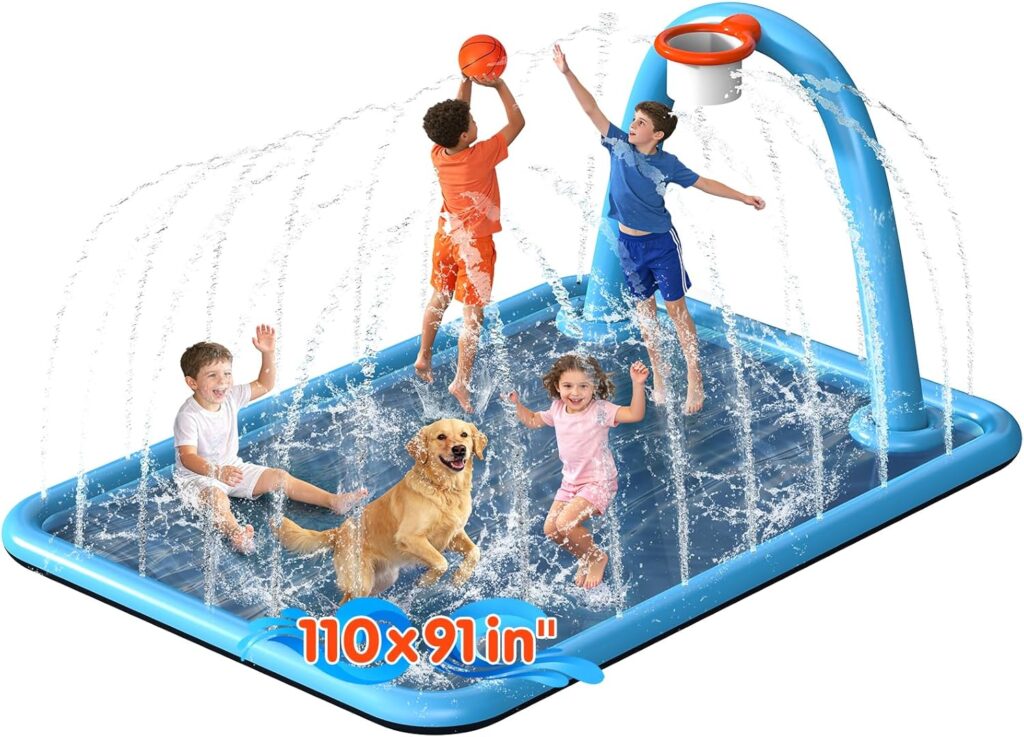
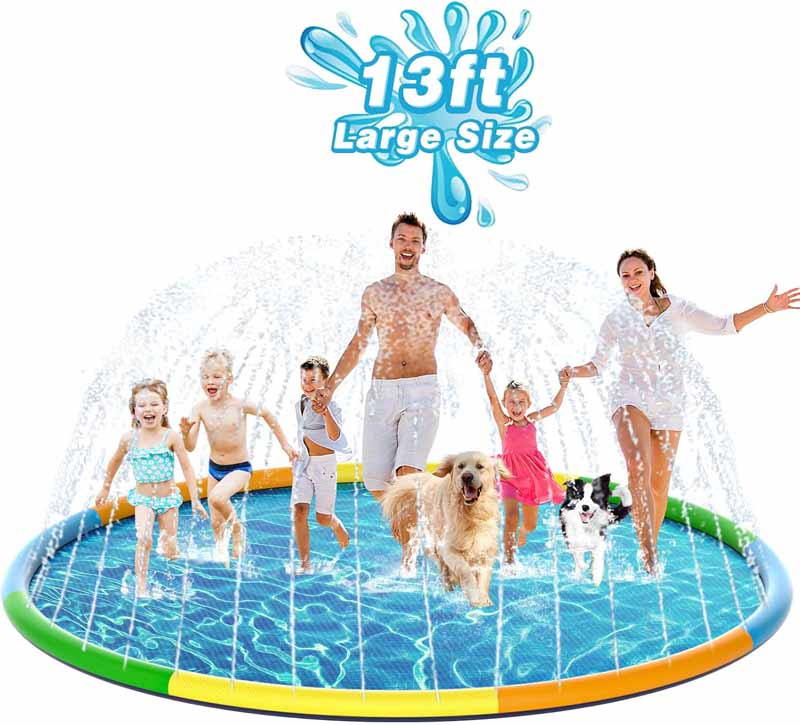
A sprinkler dog pool can create a more interactive experience for dogs that enjoy chasing hose streams or moving water. Perimeter jets add activity without requiring a deep pool, which makes this format appealing for dogs that like splashing but do not necessarily want to swim. The feature is most valuable when it matches the dog’s personality rather than simply adding another specification to the product page.
Water pressure should be adjustable through the hose supply whenever possible. Some dogs enjoy energetic jets, while others become uncomfortable if spray repeatedly reaches the face or ears. Starting gently allows the owner to observe whether the dog approaches confidently. Highly excited play should still be interrupted for rest during hot weather because water play does not prevent overheating if the dog continues running and jumping intensely.
Sprinkler quality also depends on construction. Hose connections need a reliable seal, spray openings should be distributed consistently, and the perimeter should maintain its intended shape while pressurized. Hole diameter, spacing, orientation, water pressure, and the geometry of the water channel all influence whether the spray forms a useful inward play zone or becomes uneven around the pool.
For dogs that prefer quiet cooling, the sprinkler adds little value and a standard pool may be simpler. For brands developing an interactive pet-water product, sprinkler layout, pool diameter, material construction, graphics, drainage, and packaging can be developed together so the play feature works as part of the pool rather than as an afterthought.
Do You Need Space for Multiple Dogs?
Multiple dogs need shared movement space, not simply enough area to squeeze every body inside the walls. Dogs turn, shake, cross paths, chase toys, and often move toward the same interesting object. A pool that feels generous for one medium dog can become crowded almost immediately when a second animal enters.
As a practical starting point, two medium dogs often benefit from looking at approximately 63- to 80-inch-class pools rather than compact models, while households with several large dogs may need more. These are shopping references rather than formal size requirements because body shape and behavior matter enormously. Two calm dogs lying in water use space very differently from two young dogs chasing a floating toy.
Temperament also matters. A larger pool cannot fix resource guarding, rough play, or a dog that becomes uncomfortable when another animal crowds its space. Separate sessions may be more appropriate in those situations. The goal of a shared pool is to give each dog the option to stand, turn, or leave without another dog constantly blocking the path.
Wall height should be chosen for the least mobile dog in the group rather than the tallest. If a large retriever shares the pool with a short-legged senior dog, a wall that suits the retriever may still be inconvenient for its companion. When everyone is inside, there should be visible open floor remaining; if the dogs themselves completely fill the pool, moving to a larger diameter is usually more useful than adding water depth.
How Easy Is It to Clean and Store?
A dog pool that is inconvenient to clean usually gets used less often. Hair, mud, grass, saliva, dust, and insects accumulate quickly, and bathing introduces additional residue. A low drain, accessible interior, and surface that can be rinsed without trapping debris make a noticeable difference after the novelty of the first few uses has disappeared.
Drain the pool before attempting to move it, then rinse the bottom and wall joints with clean water. Pay particular attention to textured areas and around the drain where hair or sediment can collect. Allow the structure to dry thoroughly before folding. Storing wet surfaces pressed together can create odor and makes the next setup unpleasant, while trapped sand or grit can rub against the PVC during transport and storage.
Folded dimensions deserve attention before purchase. “Foldable” does not mean that every pool becomes equally small. A larger model with substantial wall panels naturally creates a thicker package than a compact pool. For travel, compare dry weight as well as folded size so the pool is genuinely practical to carry from a vehicle to a campsite, holiday property, or another outdoor location.
Before making the final choice, use the following checklist to compare products on practical details rather than marketing language.
| What to Check | Question to Ask | What It Tells You |
|---|---|---|
| Usable floor dimensions | Can the dog stand, turn, and lie down? | Whether the pool is truly large enough |
| Wall height | Can the dog step across without struggling? | Entry and exit practicality |
| Floor texture | Is the wet floor visibly textured? | Expected traction |
| Material details | Are construction and reinforcement explained? | More than a “heavy-duty” claim |
| Sidewall support | Are rigid or semi-rigid panels used? | Wall stability |
| Drain location | Is the outlet near the floor? | Ease of emptying |
| Folded dimensions | Where will the pool be stored? | Real storage requirement |
| Sprinkler control | Can spray intensity be adjusted? | Suitability for different dogs |
| Number of users | Will more than one dog enter together? | Required floor space |
| Setup surface | Is the ground level, clean, and drain-friendly? | Stability and material protection |
The most useful pool is rarely the model with the longest feature list. A dog pool that fits the animal correctly, provides dependable footing, empties without lifting, dries without a complicated routine, and folds into the available storage space is much more likely to be used regularly. Convenience is not separate from product quality; for a seasonal backyard product, it is one of the main reasons the pool continues to come out of storage.
Conclusion
Choosing a dog pool is easier when you stop comparing broad labels such as “small,” “large,” or “heavy duty” and start with the dog’s actual use. Measure body length, mark the proposed pool size on the ground, check whether the wall can be crossed comfortably, and decide whether the main job is cooling, bathing, quiet soaking, sprinkler play, or shared use with several dogs. Those decisions narrow the field much faster than appearance alone.
Material matters, but the complete structure matters more than one thickness number. Diameter matters, but only if the floor space is genuinely usable. Water capacity matters much less than the dog’s ability to stand securely and leave easily. Drainage, floor texture, wall support, setup surface, cleaning, and storage may look like secondary details in a listing, yet they often determine whether the pool remains convenient after an entire summer of use.
The final test is straightforward: imagine using the pool on an ordinary hot afternoon rather than on the day it arrives. Can you set it up without special equipment, fill only the amount of water your dog needs, supervise comfortably, empty it without lifting hundreds of pounds, rinse the floor, let it dry, and store it without taking over the garage? If the answer is yes—and your dog has enough room to enter, turn, relax, and exit naturally—you are probably looking at the right type of dog pool.
For retailers and pet brands developing a customized model, these same criteria provide a useful product-development framework. Dimensions, PVC construction, wall panels, drainage, floor texture, sprinkler layout, colors, graphics, and packaging should be selected around the expected dog size and real use environment. Building from the use case first creates a more convincing product than adding features after the basic structure has already been decided.
Frequently Asked Questions
What size dog pool should I buy?
Choose the size from your dog’s body length and activity rather than relying only on breed or weight. Your dog should be able to stand naturally, turn without continually pressing against the wall, and lie down if it enjoys cooling that way. Pools around 30–40 inches may work for many small dogs, while large and active dogs often benefit from 63 inches or more. These are starting points, so mark the proposed size on the ground before buying.
How deep should a dog pool be?
A dog pool does not normally need to be filled to the top. For cooling, bathing, and casual play, shallow water that allows the dog to keep all four paws firmly on the bottom is usually more practical. Puppies, senior dogs, short-legged dogs, and inexperienced swimmers should start particularly shallow. Increase water gradually only if the dog remains relaxed, can exit easily, and is continuously supervised around the pool.
Are PVC dog pools safe for dogs?
A properly constructed PVC dog pool can be suitable for normal supervised pet use when the product is used according to its intended purpose. Look for a stable floor, reliable seams, supported walls, secure drainage, and clear material information rather than relying only on broad claims such as “heavy duty.” Inspect the setup area for sharp objects, keep the dog’s nails reasonably maintained, and prevent deliberate chewing or digging that can damage flexible materials.
Are foldable dog pools better than inflatable pools?
Foldable pools are often more convenient for frequent backyard use because they do not need inflation and usually rely on internal wall panels for support. Inflatable pools pack down very small and can be convenient for occasional travel, but punctures or valve leaks can affect their structure. Neither format is universally better. The right choice depends on the dog’s behavior, available storage space, travel needs, setup frequency, and how much durability is expected from regular use.
Can dogs use a kiddie pool?
Many dogs can enjoy a suitable shallow paddling or kiddie-style pool when the dimensions, entry height, footing, and construction match the dog’s needs. The floor should provide stable traction, and the dog should be able to leave easily without climbing a tall, slippery wall. Not every dog is a confident swimmer, so even shallow water requires supervision. A dog-specific foldable pool may provide features such as textured flooring and convenient drainage that make repeated pet use easier.
Should a dog pool be placed in the shade?
Shade is a sensible choice during warm weather because playing in water does not mean a dog cannot overheat. Blue Cross recommends using a paddling pool in a shaded location and cautions that energetic water play can still become excessive in hot conditions. Keep fresh drinking water nearby, supervise the session, and provide breaks if the dog becomes highly excited or continues running and splashing for an extended period.
How often should I change the water in a dog pool?
There is no single schedule that works for every portable dog pool because cleanliness depends on the number of dogs, surrounding ground, bathing products, weather, and how much debris enters the water. Change it whenever it becomes visibly dirty or collects significant hair, mud, grass, saliva, insects, or residue. Easy drainage makes frequent refreshing practical, while rinsing and drying the pool thoroughly after use helps keep the interior cleaner between sessions.
Get A Fast quote
Here, bringing your inflatable concepts to life is no longer a challenge—it’s a collaborative journey where American Epsilon helps families, outdoor enthusiasts, and global brands transform creative ideas into safe, certified, and market-ready inflatable solutions.


Partner With Epsilon
Whether you are a family looking for safe backyard fun or a brand seeking large-scale OEM/ODM solutions, American Epsilon Inc. guarantees every inflatable is built with safety, durability, and excitement in mind. With flexible low MOQs, strategically placed warehouses in the U.S., Canada, U.K., and Germany, plus 24/7 professional support, we ensure smooth delivery and reliable service worldwide.
Ready to bring your inflatable ideas to life? Request free samples, fast prototypes, and customized designs today—your trusted inflatable journey starts here.