Skip to content

How Deep Should a Dog Pool Be
# Your Trusted Inflatable Supplier In US

A dog pool can look like one of the simplest summer products you can buy: put it on the lawn, add water, and let the dog climb in. In practice, however, the water level changes the entire experience. A Labrador, a Dachshund, a six-month-old puppy, and a senior dog may all use the same pool very differently because their leg length, body shape, confidence, stamina, and ability to enter and exit are not the same. That is why choosing a dog pool by diameter or wall height alone does not tell you how deeply it should actually be filled.
For most backyard cooling, splashing, soaking, and wading, the water should remain shallow enough for the dog to stand naturally with all four paws firmly on the bottom. Water below or around elbow height is a useful reference for many healthy adult dogs, while puppies, seniors, short-legged breeds, and inexperienced dogs generally benefit from starting at a much lower level and increasing gradually.
Veterinary swimming guidance follows the same general principle: introduce dogs in shallow water, increase depth gradually, supervise closely, and make sure the dog knows how to leave the water. Even dogs that appear enthusiastic around water are not automatically strong or efficient swimmers, and some dogs can become tired before their owners expect it.
Imagine filling a 12-inch-high pool with eight inches of water. To a tall German Shepherd, that may still feel like ordinary wading. To a short-legged dog, the same eight inches can approach the lower chest and significantly change balance and movement. The pool has not changed at all, but the usable depth has. Once you start thinking about depth from the dog’s point of view instead of the product label, choosing the right water level becomes much easier.
How Deep Should a Dog Pool Be?
For everyday backyard use, a dog pool should normally be shallow enough for comfortable standing rather than deep enough to force swimming. A practical starting point is paw or lower-leg depth, followed by gradual increases while watching the dog’s posture, turning ability, confidence, and exit behavior. Around elbow height can work for many confident adult dogs, but it should be treated as a reference rather than a required fill line.
What Water Level Is Safe for Wading?
Wading means the dog’s feet remain in reliable contact with the pool floor. For most household dog pools, that is exactly the type of water play owners are trying to create. Dogs can cool their paws, wet the belly, lie down, chase toys, splash with another dog, or rest in the water without needing to use continuous swimming strokes.
The safest first fill is often much shallower than the maximum capacity of the pool. Water around the paws and lower legs lets the dog experience the wet surface while keeping normal walking mechanics. If the dog enters voluntarily, turns easily, stands without hesitation, and leaves without scrambling, the water can be raised gradually. With very small dogs, even a one-inch increase can noticeably change how high the water reaches on the body.
A comfortable dog generally looks in control. It may stand still, change direction, sit, lower its body into the water, or leave and return on its own. A dog that repeatedly tries to climb out, becomes unusually stiff, paddles when it should still be able to walk, or refuses to turn may be telling you that the water level, floor traction, or overall environment is uncomfortable.
| Intended Use | Practical Starting Point | Main Safety Check |
|---|---|---|
| First pool introduction | Paw to lower-leg depth | Voluntary entry and exit |
| Cooling after outdoor activity | Lower-leg depth | Stable natural standing |
| General wading and toy play | Below to around elbow height | Easy turning and stopping |
| Senior or cautious dog | Shallower than normal wading depth | Secure footing and easy exit |
| Swimming practice | Deep enough to lose floor support | Direct supervision and clear exit |
These are practical body-relative references rather than universal veterinary depth limits. The dog’s individual proportions, age, physical condition, confidence, and previous experience should always take priority over a generic chart.
Is Elbow Height a Good Rule?
Elbow height is useful because it automatically adjusts for differences in leg length. Weight categories such as small, medium, and large are convenient for shopping, but they are much less precise when deciding how much water to add. A compact 35-pound dog can have a much lower chest and elbow position than a long-legged dog of a similar weight.
For many confident adult dogs, water that remains below or around the elbow provides enough body contact for cooling while allowing normal standing. There is no need to keep adding water just because the pool can hold more. If a dog is relaxed and happily lying down in shallower water, the lower level is already doing its job.
Short-legged breeds need particular care because their bodies reach the water sooner. Dachshunds, Corgis, Basset Hounds, Bulldogs, and similar dogs can move from shallow wading to much greater body immersion after only a modest increase in water depth. Their weight alone does not reflect how quickly water reaches the chest.
Elbow height should therefore be used as a reference point, not a target. Veterinary swimming guidance recommends starting shallow and gradually increasing depth rather than assuming every dog is ready for deeper water immediately. This gradual approach gives the dog an opportunity to remain relaxed and allows the owner to identify discomfort before the dog is required to swim.

How Do You Measure the Right Depth?
The easiest way to estimate a useful wading level is to measure the dog before focusing on the pool. Have the dog stand naturally on a flat surface and measure vertically from the ground to the elbow. For short-legged breeds, it is also useful to notice belly and lower-chest clearance because those areas can enter the water surprisingly early.
Next, measure or confirm the internal wall height of the pool. Remember that wall height is not the same as recommended water depth. A pool with 12-inch sides can be used with four, six, eight, or another appropriate number of inches of water depending on the dog’s size and the activity.
A gradual filling method is more useful than trying to calculate one perfect figure in advance. Begin at paw depth and allow the dog to move for several minutes. Increase the level in small steps, then watch how the dog stands, turns, sits, and approaches the edge. With medium and large dogs, an increase of roughly one or two inches is usually easy to observe; with tiny dogs, use smaller changes.
This method is particularly useful when several dogs share one pool. If a tall Labrador and a much shorter companion use the pool together, fill for the shorter or less confident dog. The larger dog can still cool down and play in shallow water, while the smaller dog retains better control.
When Is the Water Too Deep?
For ordinary wading, the water is becoming too deep when the dog can no longer keep reliable floor contact during normal movement. If turning requires paddling, the dog’s body becomes noticeably vertical, or the dog needs continuous movement to keep its head comfortably positioned, the activity is shifting from wading toward swimming.
That change does not automatically make the pool unsafe, but it changes the level of supervision and physical effort involved. Swimming is more demanding than standing in water, and even experienced dogs can become tired. VCA specifically advises giving dogs breaks during swimming and making sure they are able to get out of the water.
Behavior remains one of the most useful indicators. Repeatedly heading for the wall, frantic front-leg paddling, hesitation during turns, difficulty stopping, or obvious fatigue are all reasons to reduce depth. A confident dog that initially enjoyed deeper water may also become less coordinated as the session continues.
For routine backyard cooling, there is rarely an advantage in filling a portable pool as deeply as possible. A depth that lets the dog choose between standing, sitting, lying down, playing, and leaving usually creates a more flexible and enjoyable experience.
Which Depth Is Best by Dog Size?
Dog size provides a useful starting point, but leg length and body proportions are more important than weight alone. Small and short-legged dogs generally need less water, while taller medium and large dogs can often use greater depth comfortably. The best approach is to compare the water with the dog’s elbow and chest height, then consider turning space, confidence, age, and how the pool will actually be used.
What Depth Do Small Dogs Need?
Small dogs experience changes in water depth very quickly because every inch represents a larger percentage of their total leg height. Water that looks extremely shallow beside a large dog can reach the belly or lower chest of a toy breed. For that reason, a small dog should normally be introduced with only enough water to wet the paws and lower legs.
If the dog remains relaxed, the level can be raised gradually. Owners should pay attention to whether the dog continues to walk normally and whether it can turn around without lifting its front feet into a paddling motion. A small dog does not need deep water to enjoy cooling, splashing, or lying down.
Pool wall height can become a bigger issue than the actual water level. A dog may be comfortable standing in three or four inches of water but still find a 12-inch side wall difficult to cross. This is particularly important for short-legged breeds, puppies, and older small dogs.
Product labels based on weight should therefore be treated cautiously. A Miniature Poodle and a Dachshund may fall into a similar weight range while having very different elbow, chest, and belly heights. Measuring the dog is usually more useful than relying on a generic “small dog” category.

What Depth Do Medium Dogs Need?
Medium dogs often fit comfortably in many common foldable dog pools, but there is still no single correct fill depth. Dogs within this broad category vary considerably in leg length. A Border Collie, Bulldog, Beagle, and Australian Shepherd can all experience the same water level differently.
For general cooling, start below elbow height and add water only when the dog remains relaxed. Many medium dogs enjoy enough water to wet the belly when sitting or lying down while still having firm footing when standing. This allows them to alternate naturally between cooling and active play.
Pool diameter becomes increasingly important as the dog gets longer. A medium dog can technically fit inside a narrow pool yet still have difficulty turning without pressing against the walls. If a dog appears uncomfortable, do not automatically assume the water is too deep; insufficient floor space or a slippery surface can create very similar behavior.
Experienced pet-pool development therefore considers diameter, wall height, floor structure, and intended fill level together. A taller wall does not automatically make a better product if the dog lacks enough usable space to move comfortably.
What Depth Do Large Dogs Need?
Large dogs can generally stand comfortably in more water because the elbow, belly, and chest are higher above the floor. Still, additional diameter often improves usability more than additional depth. A Labrador, Golden Retriever, or German Shepherd needs enough space to turn, sit, lower its body, and move away from the wall without feeling crowded.
For ordinary cooling, water does not need to reach the chest. Wetting the paws, legs, belly, and lower body already creates a useful cooling and play area while keeping the dog in full control. Deeper water is mainly relevant when actual swimming is the intended activity.
Large pools also contain substantial water weight. Fresh water weighs about 8.34 pounds per US gallon, or approximately 1 kilogram per liter. As pool diameter increases, adding only a few extra inches of water can significantly increase the total load on a patio, deck, temporary platform, or soft lawn.
This is why a large foldable dog pool should be positioned on a level surface before filling. Dragging or lifting a partially filled pool can place unnecessary stress on seams, drains, wall panels, and the person moving it. Depth should be selected with both the dog and the installation surface in mind.
How Does Leg Length Affect Depth?
Leg length determines how quickly the activity changes from walking to partial buoyancy and eventually swimming. Two dogs of identical weight can therefore need very different water levels. A short, compact dog may reach elbow depth several inches sooner than a tall, athletic dog.
Below the elbow, most dogs can maintain fairly normal weight-bearing through the legs. As water rises toward the body, buoyancy begins changing how the dog turns and how much pressure remains on the paws. This can be enjoyable for some confident dogs but unsettling for dogs that were expecting to stand normally.
Before buying a pool, three simple measurements can be useful: approximate elbow height, body length from chest to rump, and overall shoulder height. Those figures help owners judge both likely water depth and the amount of floor area required for turning.
| Dog Profile | Water-Level Approach | Pool Feature to Prioritize |
|---|---|---|
| Toy or very small dog | Begin at paw depth | Low, manageable access |
| Short-legged small dog | Keep well below elbow initially | Chest and belly clearance |
| Medium dog | Gradually increase toward comfortable wading | Turning diameter |
| Tall large dog | More depth may be comfortable | Usable floor area |
| Multi-dog household | Fill for the shorter or less confident dog | Wide shared space |
This type of body-based comparison is generally more practical than assigning one fixed number of inches to every dog in a weight class.
How Do Age and Ability Change Pool Depth?
Age and swimming ability can change the appropriate water level as much as body size. Puppies, senior dogs, hesitant dogs, and first-time swimmers normally benefit from shallower water where stopping and standing are effortless. Healthy, confident adults may be comfortable with more depth, but the transition should still be gradual, and no dog should be assumed to be a capable swimmer simply because of breed or enthusiasm.
How Shallow Should a Puppy Pool Be?
A puppy’s first pool experience should focus on confidence rather than depth. Very shallow water allows a young dog to learn how the pool surface feels without losing normal footing. Start with enough water to cover the paws and let the puppy investigate voluntarily before considering any increase.
Puppies are still developing coordination, and excitement can hide fatigue. A puppy may chase water, bite at splashes, jump repeatedly, or run in and out long after a calmer adult dog would have taken a break. A shallow level gives the puppy the ability to stop immediately rather than needing to continue paddling.
The wall also needs to be considered. A puppy may stand safely in only a few inches of water yet struggle to climb over a tall foldable side. Owners should make sure the puppy can leave comfortably rather than assuming that shallow water automatically makes the whole setup easy to use.
Veterinary guidance for young dogs emphasizes supervision around pools and other water environments. Swimming should remain voluntary, and a shallow introduction is generally easier for a young dog to understand than suddenly placing it into a depth where swimming becomes necessary.

What Depth Is Safer for Senior Dogs?
Senior dogs often enjoy standing or resting in cool water, but age can change balance, muscle strength, joint mobility, vision, and stamina. A dog that happily used deeper water several years ago may now prefer a shallower level that offers more predictable footing.
Water around the paws and lower legs may be enough for a senior dog that mainly wants to cool down. More active older dogs may tolerate greater wading depth, but owners should monitor how easily they turn and whether they hesitate before stepping over the wall.
Entry and exit can be physically harder than standing inside the pool. Stepping over a high side demands hip, knee, shoulder, and spinal movement, and wet paws can reduce traction. For an older dog, a lower wall or assisted entry may therefore be more important than several extra inches of water capacity.
A recreational backyard pool should not be treated as professional hydrotherapy. Dogs with diagnosed orthopedic, neurologic, respiratory, cardiovascular, or other medical conditions may need individualized veterinary advice about water activity, duration, temperature, and physical effort.
Do First-Time Swimmers Need Shallower Water?
Yes. A dog learning about water should normally begin where all four feet can remain on the bottom. That gives the dog the ability to pause immediately, regain balance, and decide whether to move forward or leave.
Some inexperienced dogs initially rely heavily on their front legs when floor contact disappears. Their body can become more vertical, splashing increases, and movement becomes inefficient. PetMD describes supporting the rear of a learning swimmer so the dog can begin coordinating the hind limbs rather than paddling only at the front.
A gradual progression can move from paw depth to lower-leg depth and then toward comfortable wading. True swimming should be considered a separate stage rather than simply the next inch of water added to a portable pool.
Not every dog needs to become a swimmer. Many dogs are perfectly happy soaking, splashing, chasing toys, or lying in shallow water. A dog that chooses to enjoy shallow water is not using the pool incorrectly, and there is little benefit in forcing a deeper experience.
Which Dogs Need Extra Water Safety?
Extra caution is appropriate for very young dogs, seniors, very small dogs, short-legged breeds, dogs with limited stamina, and dogs with body shapes that can make swimming more difficult. Brachycephalic dogs such as Bulldogs and Pugs deserve particular attention because swimming can be harder for stocky, short-legged, short-muzzled breeds.
VCA specifically notes that certain stocky breeds with short legs may require a life jacket whenever they swim, while broader veterinary guidance emphasizes close supervision and gradual introduction for all dogs.
Enthusiasm should never be used as proof of ability. A dog can charge into water confidently and still tire quickly or become confused when looking for the exit. Owners should watch breathing, movement, coordination, and willingness to continue.
If the goal is simply summer play, shallow water avoids many unnecessary complications. Most dogs do not need continuous swimming depth to enjoy a backyard pool, and a dog that can stand whenever it wants has a much easier way to rest.
Is a Deeper Pool Better for Swimming?
Deeper water is necessary only when the dog is expected to swim rather than stand. Once reliable paw contact disappears, the activity requires more stamina, coordination, supervision, and exit planning. For everyday cooling, soaking, and splashing, additional depth often provides less practical value than sufficient floor space, stable footing, and a pool large enough for the dog to move comfortably.
What Is the Difference Between Wading and Swimming?
Wading keeps the dog’s paws connected to the bottom. Swimming occurs when buoyancy supports the body and the dog must paddle continuously to maintain position and direction. That change is more important than a simple difference of several inches.
A wading dog can stop immediately. It can stand still, change direction, sit down, lower its body, or walk to the edge. A swimming dog needs to keep working until it reaches a shallow area or exit. Fatigue therefore becomes a much larger part of the safety equation.
This is why many foldable PVC pet pools are better described as cooling, soaking, bathing, or wading pools rather than true swimming pools. A moderate wall height can provide useful water for a small dog while still remaining far too shallow for a large dog to swim normally.
The same depth can therefore represent two completely different activities. Ten inches of water may require some small dogs to paddle while a tall retriever remains fully supported by the floor. The dog’s body, not the product label, determines when wading becomes swimming.
How Deep Is Enough for Swimming?
There is no single depth that qualifies as swimming depth for every dog. Swimming begins when the individual dog can no longer maintain useful contact with the bottom. That point depends on leg length, body shape, and the way the dog carries itself in water.
Depth alone is not enough. A dog also needs horizontal room to extend its body, move forward, turn, and approach an exit. A narrow container can technically be deep enough to float a dog while still being unsuitable for comfortable swimming.
Specialized canine water activities illustrate how different swimming environments can be from ordinary backyard pet pools. For example, VCA notes that purpose-built dock-diving water must be at least four feet deep. That figure is relevant to dock diving, not a recommended depth for a household dog pool, and it shows how different the structural requirements become once full swimming and jumping are involved.
| Activity | Floor Contact | Main Water Requirement | Space Requirement |
|---|---|---|---|
| Paw cooling | Full | Very shallow | Low |
| Soaking | Full | Shallow | Moderate |
| Wading and toy play | Full | Moderate | Moderate to high |
| Short swimming practice | Limited or none | Enough for buoyancy | High |
| Sustained swimming | None | Full swimming depth | Very high |
Most portable foldable pet pools perform best in the first three categories. If regular swimming exercise is the goal, the overall swimming environment matters much more than simply choosing taller side walls.

Do Dogs Need a Life Jacket?
A dog standing in shallow water with reliable footing does not usually need flotation equipment. A properly fitted canine life jacket becomes more relevant when a dog is learning to swim, entering water where it cannot stand, tires easily, or has a body shape that makes swimming more challenging.
AKC guidance notes that canine flotation devices can be useful for dogs learning to swim and that even capable swimmers may benefit from flotation support in appropriate situations.
Fit is important. A jacket should be secure without interfering with normal movement or breathing, and a sturdy top handle can make it easier for an owner to guide or assist the dog if necessary.
A life jacket is not a substitute for direct supervision. Dogs can still become tired or confused while wearing one, and they still need a practical route out of the water. For ordinary backyard play, keeping the water comfortably shallow is often simpler than creating deep water and then relying on extra equipment to manage the risk.
How Can Dogs Exit the Pool Safely?
A safe exit should be obvious and usable before extended water play begins. In a foldable pool, this usually means making sure the dog can step over the wall without repeatedly jumping, scraping the belly, or slipping on the way out.
For deeper permanent pools, steps or a dog-friendly ramp are far more important. VCA recommends making sure dogs learn how to get out of pools because even experienced swimmers can get into difficulty when they do not know where the exit is located.
Practice the exit early in the session rather than waiting until the dog is tired. Guide the dog toward the same safe route from several parts of the water so it learns where to go instead of simply following the owner once.
Wet paws and fatigue can make an exit that looked easy at the start much harder later. If a dog cannot use the exit comfortably after several minutes of activity, either reduce the water depth or change the access arrangement before continuing.
How Do You Choose the Right Dog Pool?
Choose a dog pool by considering usable floor space, wall height, actual fill depth, traction, structural support, drainage, and entry together. For most household dogs, enough room to turn and lie down is more valuable than maximum depth. The best pool gives the owner flexibility to adjust the water level while allowing the dog to stand, move, rest, and leave comfortably.
Is Pool Height the Same as Water Depth?
No. Pool height is a fixed product dimension, while water depth is controlled by the user. A 12-inch-high dog pool can be used with only a few inches of water for a puppy or short-legged dog and more water for a taller adult.
This difference is essential when comparing products online. A side-wall measurement describes how much vertical containment the pool offers; it does not tell owners how deeply they should fill it. Leaving several inches of dry wall above the water also helps contain splashing when dogs move, shake, or play.
Foldable dog pools often use internal rigid support panels rather than an inflatable top ring. In EPN’s foldable pet-pool construction, for example, the body uses approximately 0.55 mm PVC with 5 mm PP support panels in the walls. This type of structure allows the pool to remain upright while still folding for storage.
The product wall therefore establishes the usable container, while the dog’s size and intended activity determine the actual water level. Keeping those two measurements separate prevents one of the most common sizing mistakes.

How Tall Should the Pool Wall Be?
A useful pool wall needs enough height to hold the intended water level and normal splashing while remaining manageable for the dog. There is no reason to choose the tallest available model simply because the dog is large.
Lower walls can be easier for puppies, seniors, and short-legged dogs to cross, although they also limit maximum water capacity. Taller walls provide more flexibility for larger dogs and active water play but may make independent entry harder.
Wall height also needs to make sense relative to the diameter. A very tall, narrow pool may provide more theoretical capacity without giving the dog enough room to turn or lie down. For pet use, balanced proportions are more useful than maximizing any single dimension.
When comparing options, picture the dog wet and slightly tired rather than fresh and dry. If the side wall would require an awkward jump after ten minutes of play, a lower design or easier entry arrangement may be more practical.
Which Pool Size Fits Your Dog?
A well-sized pool should let the dog rotate its body without repeatedly hitting the walls. Dogs that like to lie down should also have enough floor space to lower most of the body comfortably.
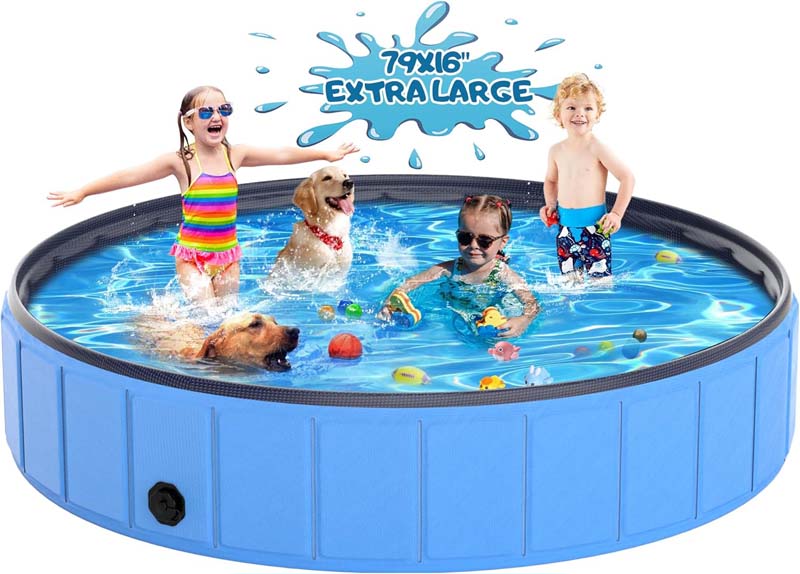
For larger household dogs, diameter becomes particularly important. EPN’s current larger foldable dog-pool-with-sprinkler range includes round sizes of approximately 79, 97, 106, 118, and 132 inches in diameter, with walls around 12 inches high. Those dimensions illustrate how manufacturers can increase usable floor area without requiring the pool to become dramatically deeper.
The relationship between diameter and water volume also matters. As diameter increases, a few additional inches of fill can add a considerable amount of water. Owners should therefore think about drainage, installation surface, and cleaning before choosing an oversized model.
| Pool Feature | What It Controls | What Owners Should Check |
|---|---|---|
| Diameter or length | Turning and lying space | Dog body length |
| Wall height | Maximum containment | Ability to step over the side |
| Actual water depth | Wading versus swimming | Elbow and chest height |
| Floor texture | Wet-paw traction | Stable footing |
| Wall support | Shape during movement | Resistance to leaning |
| Drain position | Emptying and cleaning | Ability to drain near floor level |
A pool described for a particular dog weight may still be too small if the dog’s body is unusually long or if two dogs will use it together. Physical dimensions are more informative than the weight label alone.
What Entry and Exit Features Matter?
The usefulness of a dog pool becomes much clearer once the dog begins moving. Wet paws, sudden turns, leaning, jumping, scratching, and repeated entry all place demands on the floor, side walls, and installation surface.
Always place a portable pool on a clean, level area. Stones, sharp sticks, exposed roots, or uneven paving can create concentrated pressure under the PVC. A textured inner floor can improve traction, but it cannot compensate for an unstable or hazardous surface underneath.
Drainage becomes increasingly important as the pool gets larger. Water is too heavy to make lifting or tipping a full pool practical. A low-position drain lets most of the water escape before the product is folded, moved, or cleaned. Some larger pet-pool designs also use an additional outlet to help control water level and simplify emptying.
After use, remove hair, grass, and dirt, rinse the interior when necessary, and allow the pool to dry before long-term folding and storage. A pool that is easy to drain and dry is more likely to be used regularly than one that turns every afternoon of water play into a difficult cleanup job.
A good dog pool therefore combines suitable depth with enough floor area, secure footing, manageable walls, and convenient drainage. These practical details usually have more influence on day-to-day satisfaction than an extra inch or two of maximum depth.
Conclusion
There is no single correct answer such as six, eight, or twelve inches for every dog. For most backyard pools used for cooling, splashing, soaking, and casual play, the water should remain shallow enough that the dog can stand naturally and stop moving whenever it wants. Below-to-elbow-height water is a useful reference for many healthy adults, while puppies, seniors, short-legged dogs, and beginners usually need less.
The most reliable approach is to start shallow, watch the dog, and increase the water gradually. Consider leg length, age, confidence, floor space, wall height, traction, and exit ability together rather than treating depth as an isolated specification. In many cases, a wider pool with moderate water depth provides a better experience than a narrow pool filled as deeply as possible.
A well-chosen dog pool gives the dog choices. It can stand, walk, lie down, splash, cool off, or leave without struggling. When the dog remains relaxed and in control, you have probably found a much more useful depth than any generic number printed on the side of a box.
Frequently Asked Questions
How much water should I put in a dog pool?
Begin with enough water to cover the dog’s paws and lower legs, particularly during the first few sessions. If the dog walks, turns, sits, and exits comfortably, add water gradually. For many healthy adult dogs using the pool for wading rather than swimming, water below or around elbow height is enough for cooling and play. There is usually no reason to fill a portable dog pool all the way to its wall height.
Is 12 inches too deep for a dog pool?
A 12-inch wall is not the same as 12 inches of water. Twelve inches of actual water can be too deep for small, short-legged, young, or older dogs, while a tall large dog may still be able to stand comfortably. Treat the 12-inch figure as a product dimension and choose the actual fill level according to leg length, elbow height, confidence, and the type of activity planned.
How deep should a dog pool be for a Labrador?
A healthy adult Labrador can usually tolerate more depth than a small or low-bodied dog, but it still does not need swimming depth for ordinary cooling. Begin below elbow height and increase gradually if the dog remains relaxed. For a Labrador, sufficient pool diameter is often more important than adding maximum water because the dog needs room to turn, sit, lie down, and move comfortably.
How deep should a dog pool be for a small dog?
A small dog should generally begin with paw or lower-leg depth. Because a few inches represent a large proportion of a small dog’s leg height, increase the water in small stages rather than filling according to the pool wall. Short-legged breeds should be assessed by elbow, chest, and belly clearance rather than body weight alone. If the dog begins paddling instead of walking, the water has moved beyond ordinary wading depth.
Can dogs swim in a foldable dog pool?
Some small dogs can swim in larger foldable pools because they lose floor contact at a relatively modest depth. Medium and large dogs generally use typical foldable pools for cooling, bathing, soaking, and wading rather than sustained swimming. Genuine swimming also requires enough horizontal space for a full body position, controlled turns, and access to a safe exit, not just deeper water.
Are deeper dog pools better for large dogs?
Not necessarily. Large dogs can handle more water depth, but they also need significantly more floor area. A wide pool with moderate water may be more useful than a narrow, deeper pool because the dog can turn, sit, and lie down comfortably. For normal backyard cooling, additional diameter often provides more practical value than additional depth. Deeper water becomes more relevant only when actual swimming is the intended activity.
How do I know if my dog’s pool is too deep?
Watch the way your dog moves. The water may be too deep for wading if the dog begins paddling instead of walking, becomes unusually vertical, repeatedly heads for the edge, struggles to turn, cannot pause comfortably, or tires quickly. Lower the water and check whether normal standing behavior returns. A comfortable recreational depth should let the dog enter, stand, turn, rest, play, and leave voluntarily.
Sources and Further Reading
For water-safety principles used in this guide, readers can consult current veterinary and canine-safety guidance from VCA Animal Hospitals, which recommends starting dogs in shallow water, increasing depth gradually, supervising swimming, and teaching a reliable exit, as well as current guidance from the American Kennel Club and PetMD on swimming ability and canine flotation support.
Get A Fast quote
Here, bringing your inflatable concepts to life is no longer a challenge—it’s a collaborative journey where American Epsilon helps families, outdoor enthusiasts, and global brands transform creative ideas into safe, certified, and market-ready inflatable solutions.


Partner With Epsilon
Whether you are a family looking for safe backyard fun or a brand seeking large-scale OEM/ODM solutions, American Epsilon Inc. guarantees every inflatable is built with safety, durability, and excitement in mind. With flexible low MOQs, strategically placed warehouses in the U.S., Canada, U.K., and Germany, plus 24/7 professional support, we ensure smooth delivery and reliable service worldwide.
Ready to bring your inflatable ideas to life? Request free samples, fast prototypes, and customized designs today—your trusted inflatable journey starts here.