Skip to content

A dog pool can look enormous in a product photo and surprisingly small once a Labrador steps inside. That is one reason diameter alone is a poor way to judge fit. A 79-inch pool may already give a calm dog plenty of room to stretch out, while another dog of almost identical weight may make the same pool feel crowded within seconds because it runs after the sprinkler, spins around, and repeatedly crosses from one side to the other.
The right dog pool with sprinkler should let your dog stand, turn, lie down, and move toward the spray without constantly touching the walls. Body length, shoulder height, activity level, number of dogs, and play style matter more than weight alone. Larger pools become more useful for active large dogs and shared play, but wall height, water use, yard space, drainage, and storage also need to fit your home.
The easiest way to make a good choice is to stop asking, “What size pool is recommended for a 70-pound dog?” and ask, “How much space does my dog use when it is actually playing?” Imagine two 70-pound dogs. One walks into shallow water, lies down, and remains almost motionless. The other chases every sprinkler jet, turns sharply, shakes water from its coat, and invites another dog to join. Their weight tells you very little about how much pool they need. Their movement tells you almost everything.
What Size Dog Pool Does My Dog Need?
Choose a dog pool that leaves visible space around your dog after it lies down and turns around. Body length is a better starting measurement than weight, while activity determines how much additional clearance is useful. Calm dogs can often use a smaller diameter comfortably, while long-bodied, large, giant, or highly active dogs benefit from a wider floor that provides more room for natural movement.
Start With Body Length
Weight is useful for separating a Chihuahua from a Labrador, but it becomes much less useful when choosing between two nearby pool sizes. Dogs with similar weights can have completely different proportions. A stocky Bulldog, a long Labrador mix, and a tall, lean dog may all weigh around the same amount while requiring noticeably different amounts of horizontal space.
Measure your dog while it is standing naturally. A practical home measurement runs from the front of the chest to the base of the tail. Then watch the dog when it lies down. Some dogs curl tightly, while others extend their front legs and stretch their hindquarters far beyond their standing body length. That resting footprint matters because many dogs spend more time lying in shallow water than standing squarely in the middle.
The pool should still have open floor after the dog settles. If its nose and rear body almost reach opposite walls, the product may work for washing but will provide little room for recreational movement. A sprinkler pool needs extra clearance because the water jets encourage dogs to walk, rotate, paw at the edge, and change position throughout the session.
Allow Room for Real Movement
A useful pool is larger than the dog’s resting footprint. As a practical sizing reference, a calm dog using the pool mainly for cooling can often start with a diameter around 1.5 times its body length. A dog that regularly walks, turns, and follows the sprinkler may be more comfortable closer to 1.7–1.8 times its body length, while highly energetic play can justify roughly twice the body length.
These ratios are not veterinary standards and should not be treated as hard limits. They are simple planning tools developed from how recreational PVC pools are actually used. They help prevent a common shopping mistake: choosing a size that technically contains the dog but gives it no meaningful movement area.
A dog measuring 36 inches through the body, for example, has a 54-inch reference at 1.5 times its length and a 72-inch reference at twice its length. A 79-inch pool therefore offers a useful amount of additional space for many single-dog situations. That same 79 inches may feel much less generous when a second dog is added or when a large dog spends the entire session chasing spray.

Match Size to Play Style
How your dog uses water can matter as much as its measurements. A calm Golden Retriever may enter the pool, lower itself into the water, and spend ten minutes resting in one position. Another Golden Retriever may circle the perimeter, bark at the sprinkler, paw at individual jets, and repeatedly move across the center. Both dogs have similar body dimensions, but their functional space requirements are very different.
Think about the main purpose of the pool before increasing the diameter. Cooling and soaking are relatively low-movement activities. Bathing also requires less free space because the owner normally controls the dog’s position. Wading requires more room, while sprinkler chasing uses even more because the dog changes direction frequently. Shared play adds another layer because two dogs may move independently instead of following the same path.
This is one of the main differences between choosing a conventional pet tub and choosing a dog pool with sprinkler. The sprinkler turns the perimeter into an active part of the play area, so diameter becomes more valuable when the dog is interested in moving water rather than simply resting in it.
Compare Size Classes Carefully
Marketing labels such as Large, XL, XXL, and Giant are not standardized. A pool described as “extra large” by one seller may be smaller than another company’s “large” model. Compare actual diameter and wall height instead of relying on those labels.
The following ranges are practical starting points rather than breed standards:
| Dog or Use Type | Practical Diameter Range | Typical Use |
|---|---|---|
| Small dog, calm use | 50–79 in | Cooling, sitting, light wading |
| Medium dog, regular play | 60–97 in | Turning, lying, moderate sprinkler play |
| Large dog, calm use | 79–97 in | Resting, soaking, light movement |
| Large dog, active use | 97–118 in | Wider turning and sprinkler movement |
| Giant breed | 106–132 in | Greater body length and stride clearance |
| Two or more dogs | 97–132 in | Shared movement and reduced crowding |
These ranges are deliberately broad because behavior changes the answer. An older 75-pound dog that mostly rests may be comfortable near the lower end, while a younger dog of the same weight that spends the whole session chasing water may benefit from considerably more space.
Circular floor area also grows much faster than the diameter number suggests. Moving from a 79-inch pool to a 118-inch pool does not merely add 39 inches of width; the theoretical circular footprint increases from roughly 34 square feet to about 76 square feet. That difference becomes much more noticeable once a dog starts moving.
Which Pool Size Is Best for One or More Dogs?
One dog needs enough open floor to turn and lie down without filling the entire pool. Two or more dogs need additional area because they move independently, pass one another, approach the sprinkler from different directions, and may rest in separate places. Do not choose a multi-dog pool by adding their weights together; consider how much simultaneous movement the available floor can comfortably support.
One Dog Needs More Than a Tight Fit
A dog pool should not be sized like a container where success simply means that the dog can stand inside. A 34-inch-long dog may technically fit into a pool only slightly wider than its body, but that leaves little room to turn, stretch, shake its coat, or change direction. The result works more like a bathing tub than a recreational pool.
For one calm small or medium dog, a 79-inch-class pool already provides a generous backyard footprint. It gives the dog different places to sit or lie and leaves room to approach the sprinkler without occupying nearly the entire floor. A calm large dog may also be comfortable at this size when the main purpose is soaking or cooling.
An active large dog uses that same space differently. If it circles the wall, follows sprinkler jets, crosses the center repeatedly, or likes to enter and leave at speed, moving into the 97- or 106-inch class can create a noticeably less restricted experience. The decision is therefore less about whether the dog physically fits and more about whether the remaining floor is useful.

Two Dogs Change the Space Requirement
Two dogs do not remain neatly positioned beside each other. One may lie down while the other walks around it. Both may chase the same jet. One may enter just as the other is trying to leave. They can also shake water from their coats, turn suddenly, or move around each other when toys or people attract their attention.
This is where floor area becomes more informative than simple diameter. A theoretical 97-inch circle provides about 51 square feet, while a 118-inch circle provides about 76 square feet. Although the diameters differ by only 21 inches, the larger pool adds roughly 25 square feet of geometric area.
Two small dogs with calm play may therefore find a 79-inch pool quite generous. Two active medium dogs are more likely to benefit from 97 or 106 inches. Two medium-to-large dogs can make better use of 106 or 118 inches, while two large energetic dogs may justify 118 or 132 inches when the yard has enough room.
Mixed Sizes Need a Compromise
A mixed-size household presents an interesting sizing problem because the largest dog usually determines the required floor area while the smallest or least mobile dog may determine the practical wall height. A German Shepherd and a Corgi, for example, do not need the same amount of turning room and may not cross the same wall with equal ease.
A wide diameter with a moderate sidewall can often work better than a smaller, deeper pool in this situation. The larger dog gains space to lie and move, while the smaller dog does not have to climb an unnecessarily tall wall simply because the pool was selected for its larger companion.
Age matters for the same reason. A senior Labrador may still need plenty of horizontal space but may step over the side more slowly than a younger dog. Observe how each pet handles ordinary steps and low obstacles around the home. If one animal already hesitates at similar heights, that information should influence pool selection.
Plan for Peak Activity
When estimating capacity, picture the busiest part of play rather than a posed product photograph. The quiet moment when two dogs stand beside each other tells you very little about what will happen once the sprinkler starts and both dogs become excited.
The following ranges provide useful starting points:
| Household Situation | Practical Starting Range | Main Reason |
|---|---|---|
| One calm small or medium dog | 79 in | Resting and turning room |
| One active large dog | 97–106 in | Wider movement path |
| Two small dogs | 79–97 in | Shared use without excessive size |
| Two active medium dogs | 97–106 in | Passing and turning clearance |
| Two medium-to-large dogs | 106–118 in | Less crowding during play |
| Two active large dogs | 118–132 in | More simultaneous movement |
| Giant breed or multi-dog use | 118–132 in | Body length and shared floor area |
Use the lower end when water play is calm and occasional. Use the higher end when dogs move continuously, share the sprinkler, or spend long sessions in the pool. A larger diameter is valuable only when the dogs actually use the additional floor.
How Deep Should a Dog Pool with Sprinkler Be?
A dog pool with sprinkler normally needs shallow water for cooling, sitting, wading, and playing rather than swimming depth. Sidewall height indicates how much water the structure can contain, but it does not tell you how high the water should be. Fill depth should suit the dog’s leg length, mobility, confidence, and activity while preserving easy entry, comfortable footing, and a clear way out.
Wall Height Is Not Fill Depth
One of the easiest mistakes to make is assuming a pool with a 12-inch wall should contain 12 inches of water. The wall describes the physical structure of the product, not a required fill line. A dog new to water may begin with only a shallow layer across the floor, while a confident dog that likes lying down can use more.
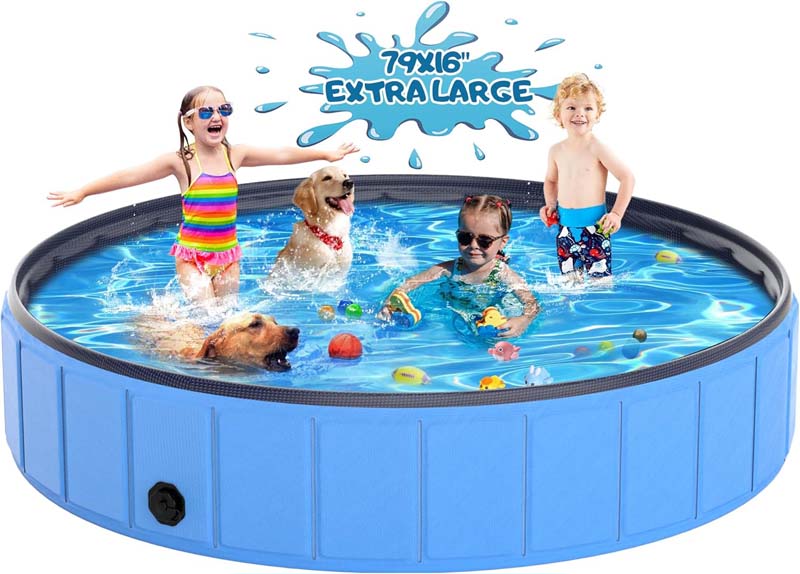
This distinction becomes even more important when comparing different EPN sizes. The current product specification lists the 79-, 97-, and 106-inch versions at approximately 12 inches high, while the 118- and 132-inch versions use approximately 16-inch sidewalls. A customer choosing one of the two largest diameters should therefore consider both the wider floor and the higher step-over height.
The pool still does not need to be filled to the wall height. A 16-inch wall can hold shallow water just as a 12-inch wall can. The useful question is how much water the dog needs for the intended activity.
Match Water to the Activity
Cooling the paws requires very little water. Standing, sitting, and belly cooling need progressively more, while sprinkler chasing often works with a shallow center because the moving spray itself provides much of the interaction. Actual swimming is a different activity and should not be created simply by filling a shallow recreational pool as high as possible.
| Activity | Practical Water Approach | What Matters Most |
|---|---|---|
| Paw cooling | Very shallow | Easy entry and low water use |
| Standing and splashing | Shallow | Stable footing and movement |
| Sitting | Moderate shallow water | Comfortable lower-body cooling |
| Lying down | Adjust to body proportions | Head remains comfortably above water |
| Sprinkler play | Usually shallow | Floor area more important than depth |
| Swimming | Use a suitable swimming setup | Depth, exit access, and supervision |
A fixed depth recommendation is difficult because the same water level reaches very different parts of a Labrador and a Dachshund. Increase the level gradually and watch the dog’s posture. Comfortable dogs generally move freely and choose to remain in the water; hesitation or repeated attempts to leave are signs that the setup should be adjusted.

Consider Entry and Exit
A 12-inch wall is a modest obstacle for many adult medium and large dogs but can feel much higher to a short-legged breed, puppy, senior, or dog with limited mobility. A 16-inch wall makes this difference even more important. The largest diameter is not automatically the easiest pool for every animal.
Watch how the dog crosses the wall. A comfortable entry is controlled: the dog places a front leg over, shifts its weight, and steps through without scraping its belly or scrambling with its hind legs. Repeated jumping, slipping, hesitation, or waiting to be lifted indicates that the pool may need a different setup or more assistance.
The ground underneath should also be flat and free from sharp stones, metal pieces, branches, raised fasteners, or other concentrated pressure points. Stable footing improves confidence during entry and protects flexible PVC flooring from unnecessary abrasion.
Dogs should remain supervised around water even when they are confident swimmers. AKC’s current pool-safety guidance likewise emphasizes continuous supervision and a clear, familiar exit from the water.
Deeper Is Not Automatically Better
A taller pool does more than hold extra water. As fill depth increases, water volume and load rise rapidly, drainage takes longer, and smaller dogs have a higher wall to cross. In a foldable PVC pool, side height also interacts with panel support, seams, floor loading, folding dimensions, and package size.
That is why a dog sprinkler pool is best judged as a complete structure rather than by a single “deepest pool” specification. A moderate fill level inside a supported wall is generally more practical for recreational cooling than filling the product simply because extra wall height is available.
The largest EPN sizes illustrate the point clearly. Their 16-inch walls provide additional containment capacity, but owners can still operate them with shallow water. For a large dog that wants more freedom, the main benefit of moving from 106 to 118 or 132 inches may be the additional horizontal area rather than additional water depth.
How Do I Measure for the Right Dog Pool Size?
Measure the dog’s body length and shoulder height first, then compare those numbers with the pool diameter and wall height. Add room for lying down, turning, and sprinkler movement instead of matching the pool directly to body length. After measuring the dog, mark the actual pool diameter in the yard and allow additional space for the hose, drainage, walking, cleaning, and safe entry around the perimeter.
Measure the Dog First
Use a flexible tape while the dog is standing normally. Measure from the front of the chest to the base of the tail for a practical body-length reference, then measure from the ground to the top of the shoulder. The first number helps with floor-space decisions, while the second gives useful context when comparing 12- and 16-inch sidewalls.
Then observe the dog rather than immediately putting the tape away. A 32-inch body can occupy considerably more space when the animal stretches out on its side with its legs extended. Watch the dog resting on the floor and note the approximate nose-to-feet or chest-to-hind-leg footprint it naturally uses.
Movement is the final measurement. Toss a toy or call the dog from one side of the yard to the other and watch how much room it uses to turn. A sprinkler pool is an active product, so this turning behavior can be more useful than a static breed chart when choosing between two nearby diameters.
Add a Movement Margin
The goal is not to calculate a perfect number to the nearest inch. The measurement is there to prevent obviously poor matches and to tell you when moving up one size makes practical sense.
For a 36-inch-long dog, a 1.5-times body-length reference is about 54 inches, while twice the body length is 72 inches. A 79-inch pool therefore gives many single dogs more than their static footprint. If that dog is highly active or will share the pool, the next size can still be useful because activity consumes open area very quickly.
Do not calculate two-dog requirements by adding body lengths. A pair of 36-inch dogs does not automatically require a 72-inch pool because they rarely stand nose-to-tail in a straight line. They may occupy opposite sides, cross paths, or turn at the same time. Total floor area is therefore more useful once multiple dogs are involved.

Mark the Pool on the Ground
This is one of the most useful steps and takes only a few minutes. Use a garden hose, rope, chalk, or removable tape to mark the approximate diameter on the lawn or patio before ordering. Then stand inside the outline and look at what remains around it.
A 118-inch pool is about 9.8 feet wide. Putting that product on a patio that is only 10 feet wide leaves almost no practical perimeter space. A 132-inch pool is approximately 11 feet across, which can occupy a significant portion of an ordinary residential yard once furniture, landscaping, a grill, children’s equipment, and walkways are considered.
Marking the circle also makes the jump between sizes easier to understand. Diameter numbers on a screen can feel abstract. Seeing an 11-foot circle beside the house usually makes it immediately clear whether the largest model is genuinely practical.
Account for Water and Working Space
Pool size also changes water use substantially. The figures below use an ideal circular cylinder and a six-inch fill depth only to illustrate scale; actual capacity will differ because interior diameter, wall shape, dog displacement, and real fill levels vary.
| Nominal Size | Approx. Width | Geometric Area | Theoretical Water at 6 in |
|---|---|---|---|
| 79 in | 6.6 ft | 34 sq ft | 127 gal |
| 97 in | 8.1 ft | 51 sq ft | 192 gal |
| 106 in | 8.8 ft | 61 sq ft | 229 gal |
| 118 in | 9.8 ft | 76 sq ft | 284 gal |
| 132 in | 11.0 ft | 95 sq ft | 355 gal |
This table shows why buying far more diameter than needed has practical consequences. Larger pools can require considerably more water at the same depth and therefore take longer to fill and drain. The good news is that recreational dog use rarely requires a six-inch fill across every situation; shallow sprinkler play can use much less.
Leave enough room to reach the drain, attach the hose without a sharp bend, rinse the floor, and walk around the pool. Think about where drainage water will flow before filling, particularly on patios or near landscaping. A pool that technically fits but leaves no working clearance is usually larger than the space can comfortably support.
Which Dog Pool Size Should I Buy?
For many single dogs, 79 inches already provides generous cooling and resting room. Choose 97–106 inches when an active large dog needs more turning space or two smaller dogs share the pool. A 118-inch model suits more demanding multi-dog use, while 132 inches is most useful when giant breeds, several dogs, or a genuinely large sprinkler-play area justify the extra footprint and higher sidewall.
When Is 79 Inches Enough?
At approximately 6.6 feet across, a 79-inch pool is already much larger than many compact pet bathing tubs. One small or medium dog has substantial room to sit, lie down, turn, and interact with the sprinkler without filling the entire surface. A calm large dog can also use this size effectively when the main purpose is cooling or resting.
The 79-inch EPN version has an approximately 12-inch side height, which keeps the overall structure relatively manageable while allowing owners to choose a shallow fill level. It also occupies about 34 square feet of theoretical circular floor area, so it deserves to be measured in the yard rather than assumed to be “small.”
This is often the sensible starting size when the household wants a roomy single-dog pool without committing a large part of the backyard to seasonal water play. Moving up makes more sense when the dog constantly uses the perimeter, has an especially long body, or regularly shares the pool.
When Should I Choose 97 or 106 Inches?
The jump from 79 to 97 inches creates much more usable space than the diameter difference suggests. The geometric floor area rises from roughly 34 to 51 square feet. A 106-inch circle increases it again to about 61 square feet, providing a sizeable middle ground before moving into the largest backyard formats.
Both current EPN sizes are listed with approximately 12-inch walls. This makes the decision mainly about horizontal space rather than a major change in step-over height. One active Labrador, Golden Retriever, German Shepherd, Husky, or similarly sized dog can benefit from this wider floor, particularly if sprinkler chasing is the main attraction.
Two small or medium dogs can also make good use of this range. Between 97 and 106 inches, choose based on activity and available yard space rather than trying to distinguish dogs by a narrow weight threshold. If the animals move constantly and the larger outline fits comfortably, the additional floor is likely to be more noticeable than it appears on a product listing.

When Does 118 Inches Make Sense?
A 118-inch pool is almost 10 feet across and provides roughly 76 square feet of theoretical floor area. At this size, the pool begins to function as a substantial backyard activity zone rather than simply a large pet bath.
It is particularly useful when two medium-to-large dogs regularly use the water together or when one highly active large dog needs a broad turning path. Compared with the 106-inch size, the theoretical floor increases by around 15 square feet, creating more separation when two dogs lie down, pass around each other, or chase different parts of the sprinkler.
There is also an important structural difference to consider. The current EPN 118-inch configuration is listed at approximately 16 inches high rather than 12 inches. Owners with smaller, short-legged, older, or hesitant dogs should consider that increased entry height before choosing the model solely for its wider diameter.
The larger footprint, potentially greater water volume, and increased handling are worthwhile when the space will genuinely be used. Otherwise, 97 or 106 inches may offer a better balance.
Who Really Needs 132 Inches?
A 132-inch pool is about 11 feet across and covers close to 95 square feet as a theoretical circle. It is best regarded as a large seasonal water-play area rather than an automatic upgrade for every large dog.
Giant breeds, two large energetic dogs, several smaller dogs, and households that regularly use sprinkler play can benefit from the extra space. The increase from 118 to 132 inches adds only 14 inches of diameter but around 19 square feet of theoretical floor area, enough to noticeably change how freely multiple dogs move.
The current EPN 132-inch configuration is also approximately 16 inches high. That makes pre-purchase measurement particularly important. Mark an 11-foot circle in the yard and consider whether every dog using the pool can cross the wall comfortably.
The advantage of having 79-, 97-, 106-, 118-, and 132-inch options is not that every household should move toward the largest size. It is that dogs, yards, and patterns of use differ enough that one diameter cannot serve every situation equally well.
Choosing a dog pool with sprinkler becomes much easier once diameter is treated as usable activity space rather than a breed label. Measure body length and shoulder height, watch how the dog lies down and turns, decide whether the pool will be used for calm cooling or active sprinkler play, and account for every dog likely to share it. Those observations will usually tell you more than a simple small-medium-large chart.
The smallest suitable size is not always the best choice, because a little additional floor can make movement much more comfortable. The largest available size is not automatically better either. A larger pool uses more yard, can hold substantially more water, takes longer to drain and dry, and becomes more cumbersome to store. The right choice sits between those two extremes: enough room that the dog can use the pool naturally, without creating more pool than the household can conveniently manage.
For many single-dog homes, 79 inches already offers substantial space. The 97- and 106-inch formats are strong choices when larger or more active dogs need greater movement room. The 118- and 132-inch versions become more useful when multiple dogs, giant breeds, or frequent high-energy play justify a much larger floor. Because the two largest EPN formats also move from approximately 12-inch to 16-inch sidewalls, entry height deserves the same attention as diameter.
A pool that is easy to set up tends to be used more often. Before ordering, draw the diameter on the lawn, check the hose route, look at where the drain will discharge, and imagine carrying the pool back to storage after it has been rinsed and dried. If the size still feels comfortable after that exercise and your dog has enough room to stand, stretch, turn, and play, you have probably found the better fit.
Frequently Asked Questions
What Size Dog Pool Is Best for a Labrador?
For many adult Labradors, a 79- to 106-inch dog pool provides a useful starting range, but body length and activity matter more than breed name alone. A calm Labrador that mainly lies in shallow water can find a 79-inch pool quite spacious, while a younger dog that circles the pool and chases sprinkler jets may benefit more from 97 or 106 inches. Measure the individual dog and consider the actual style of play before sizing up.
What Size Dog Pool Is Best for a German Shepherd?
A German Shepherd often benefits from generous horizontal room because of its body length and stride. A 97- to 118-inch pool can be a practical range for many adults, with the lower end better suited to calm cooling and the upper end offering more freedom for active movement. Remember that the current 118-inch EPN pool uses an approximately 16-inch sidewall, so entry height should be considered along with the additional floor area.
Is a 79-Inch Dog Pool Big Enough for a Large Dog?
Yes, a 79-inch pool can be large enough for one large dog when the animal mainly uses it for cooling, sitting, lying down, bathing, or moderate wading. At approximately 6.6 feet in diameter, it already provides about 34 square feet of theoretical circular floor area. A very active large dog, an unusually long-bodied dog, or a dog that constantly follows sprinkler jets may make better use of a 97- or 106-inch option.
What Size Dog Pool Do I Need for Two Dogs?
Two small dogs can often share a 79- to 97-inch pool, while two active medium dogs generally benefit from approximately 97 to 106 inches. Two medium-to-large dogs are more likely to appreciate 106 to 118 inches, and two large energetic dogs may justify 118 to 132 inches. Do not add their weights together to choose a diameter. Focus on whether both animals can lie down, pass one another, turn, and approach the sprinkler without repeatedly crowding the same space.
How Deep Should a Dog Pool Be for a Large Dog?
A large dog does not automatically need deep water. For cooling, standing, sitting, lying down, and sprinkler play, shallow water is usually more useful than trying to fill the pool to the top of its wall. Adjust the level according to the dog’s leg length and confidence, and keep a clear exit available. Wall height is mainly a structural dimension and maximum containment reference; it should not be treated as a required operating depth.
Is a 12-Inch Dog Pool Wall High Enough?
A 12-inch wall works well for many medium and large dogs because it provides useful water containment without creating an unusually high step. It can still be filled with only a shallow layer for cooling and sprinkler play. EPN’s current 79-, 97-, and 106-inch sizes are approximately 12 inches high, while the 118- and 132-inch versions increase to approximately 16 inches, so owners should compare both diameter and entry height.
Is a Bigger Dog Pool Always Better?
No. Increasing diameter provides more movement area, but it also increases the yard footprint, potential water volume, drainage time, drying area, and storage requirements. A large active dog or multi-dog household can make real use of the extra floor, while a calm single dog may gain little from moving several sizes larger. The best pool is the one that provides comfortable movement while remaining convenient enough to set up, clean, drain, dry, and store repeatedly.