Skip to content

Dog Pool with Sprinkler vs Regular Dog Pool
# Your Trusted Inflatable Supplier In US

A regular dog pool already solves a simple summer problem: it gives a dog a shallow place to stand, splash, cool its paws, lie down, or take an outdoor bath. A sprinkler dog pool adds moving water to that experience, which can make the same backyard space much more interesting for dogs that enjoy chasing hose streams. The extra feature sounds like an obvious upgrade, but in everyday use it creates a different type of product rather than a universally better one.
A dog pool with sprinkler is usually the better choice for dogs that enjoy moving water and active backyard play, while a regular dog pool is often better for calm soaking, bathing, easier maintenance, and simpler water management. The right choice depends on the dog’s behavior, body size, mobility, yard space, hose access, drainage conditions, and how often the sprinkler will realistically be used.
That distinction becomes obvious when two dogs meet the same pool. One may walk straight into three inches of water, lower its belly, and remain there happily for twenty minutes. Another may step in once, lose interest, and suddenly become excited when water begins spraying around the edge. Both dogs like water, but they are asking for different experiences. Choosing correctly starts with watching the dog rather than counting the number of features printed on the box.
What Is the Difference Between a Sprinkler Dog Pool and a Regular Dog Pool?
A regular dog pool mainly retains shallow water for soaking, bathing, and splashing, while a sprinkler dog pool adds a hose-fed system that produces moving water around the play area. Both can use foldable PVC construction and rigid side supports, but a sprinkler version introduces additional hose fittings, channels, seals, and spray openings that influence setup, water use, maintenance, and long-term performance.
Pool Structure
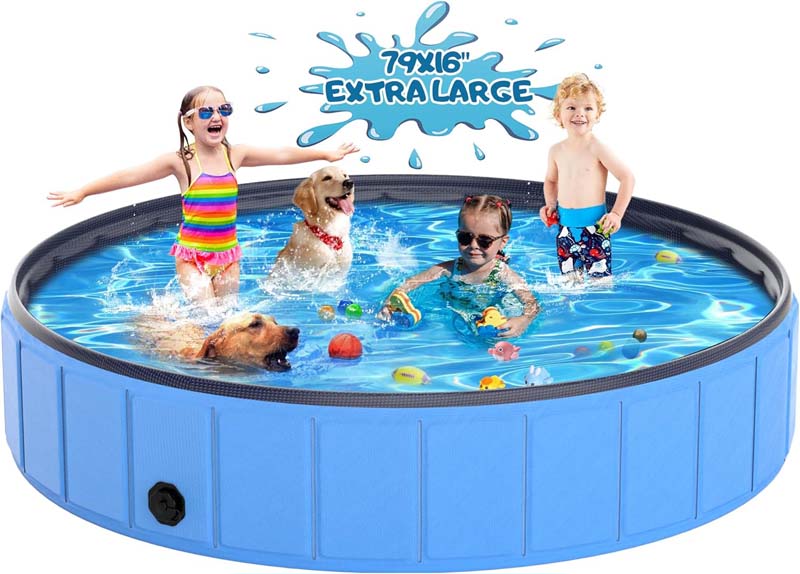
Most foldable dog pools are structurally different from the inexpensive inflatable pools many people remember from childhood. Instead of depending on an air-filled chamber to keep the walls upright, they commonly use flexible waterproof surfaces supported by rigid or semi-rigid internal panels. Once unfolded on level ground, the wall panels resist outward water pressure while the PVC floor contains the water. Current dog-pool reviews continue to emphasize foldability, stable walls, non-slip flooring, drainage, and durability as important selection criteria.
This structure is especially useful around dogs because normal use can involve claws, sudden turns, repeated entry and exit, and pressure against the side wall. An air-filled rim can lose its shape after a puncture, whereas a panel-supported wall does not depend on internal air pressure to remain upright. That does not make foldable PVC pools puncture-proof, but it changes the failure mode and usually makes them more practical for repeated pet use.
A regular dog pool has a relatively straightforward engineering job. It needs to hold water, remain stable when the dog moves, resist repeated folding, maintain the integrity of the floor-to-wall seams, and release water efficiently through the drain. The main stress areas tend to be the floor, lower welds, folding lines, support-panel edges, and drain fittings, particularly when a heavy dog pushes off quickly instead of standing calmly.
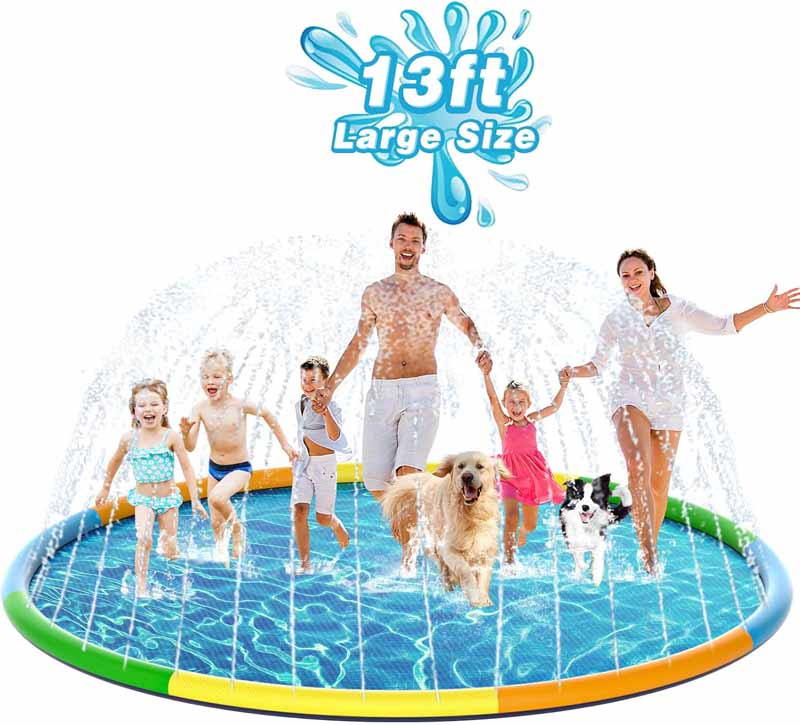
A sprinkler pool must manage those same stresses while carrying incoming water through an additional pressure-fed system. A garden hose typically connects to an inlet that feeds a perimeter channel or sprinkler section, and water exits through multiple small openings. Current sprinkler and splash-pad products use this same basic principle, with spray height often changing according to household water pressure.
Sprinkler Pool vs Splash Pad
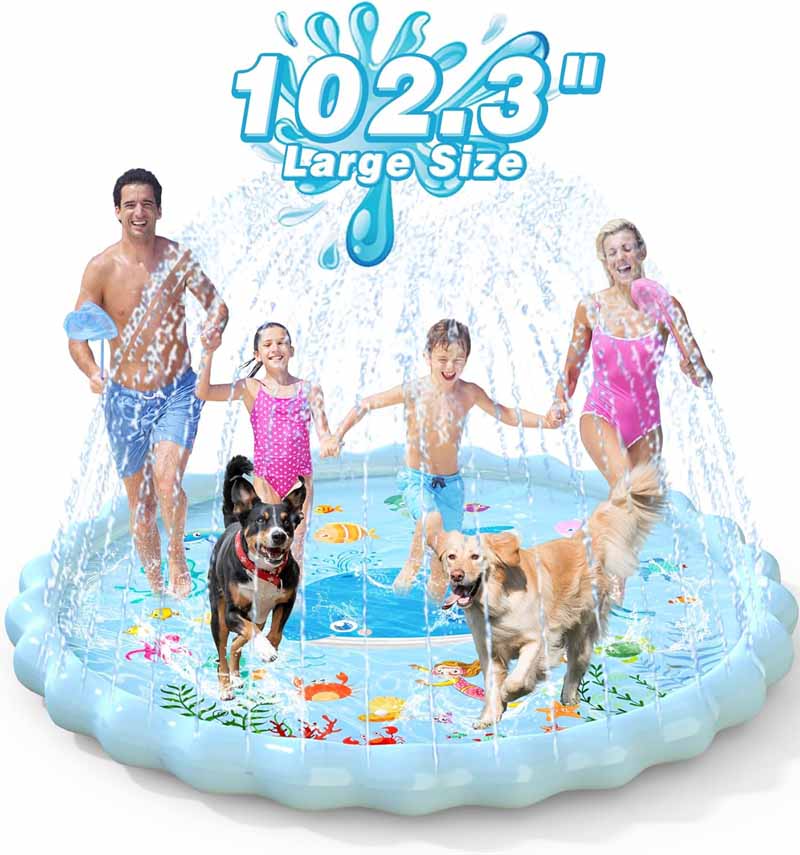
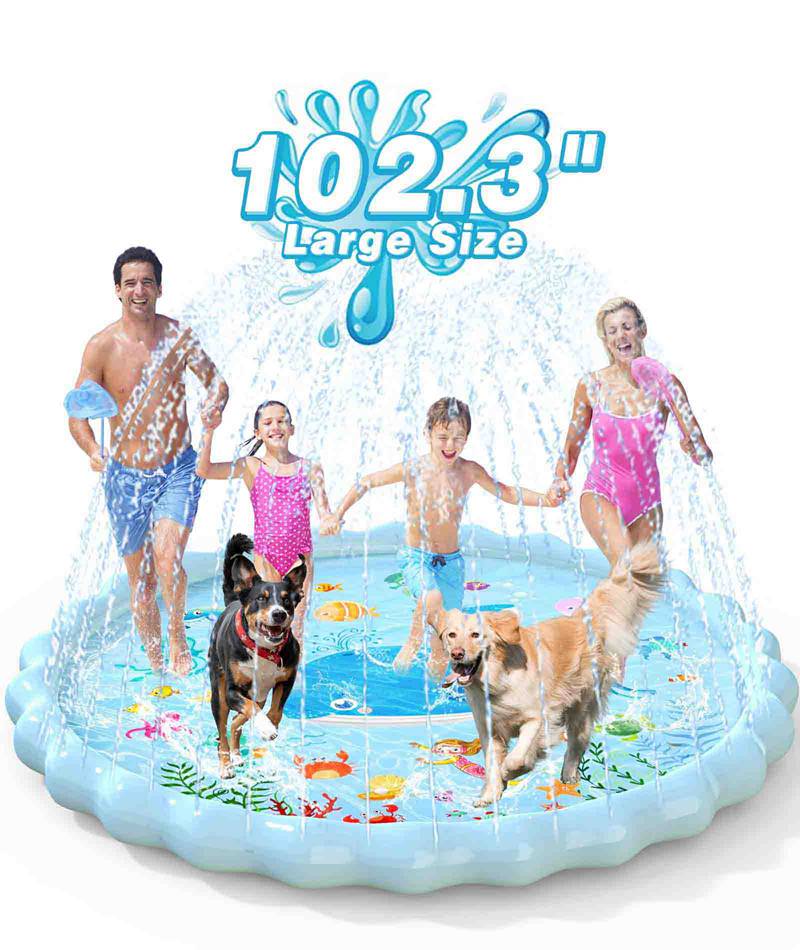
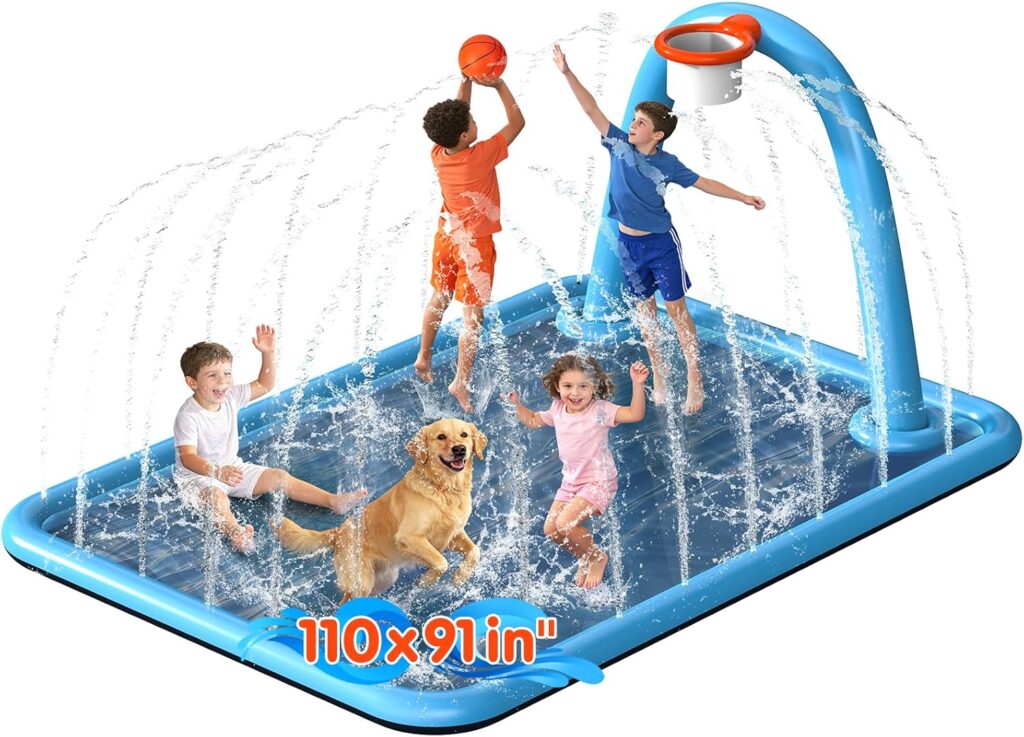
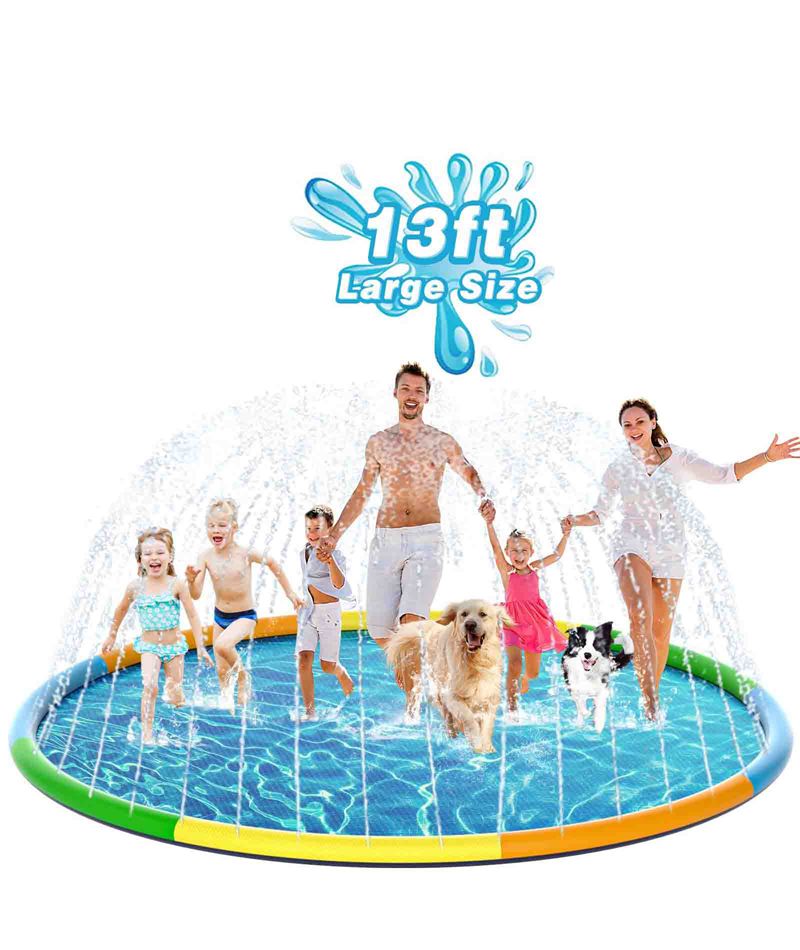
A dog pool with sprinkler should not automatically be treated as another name for a dog splash pad. The two categories overlap in search results because both may use PVC, connect to a garden hose, and send water into the air, but their intended water depth and structural behavior are different. A true foldable sprinkler pool has raised supporting walls and enough basin depth for a dog to stand, sit, turn, or lie in retained water.
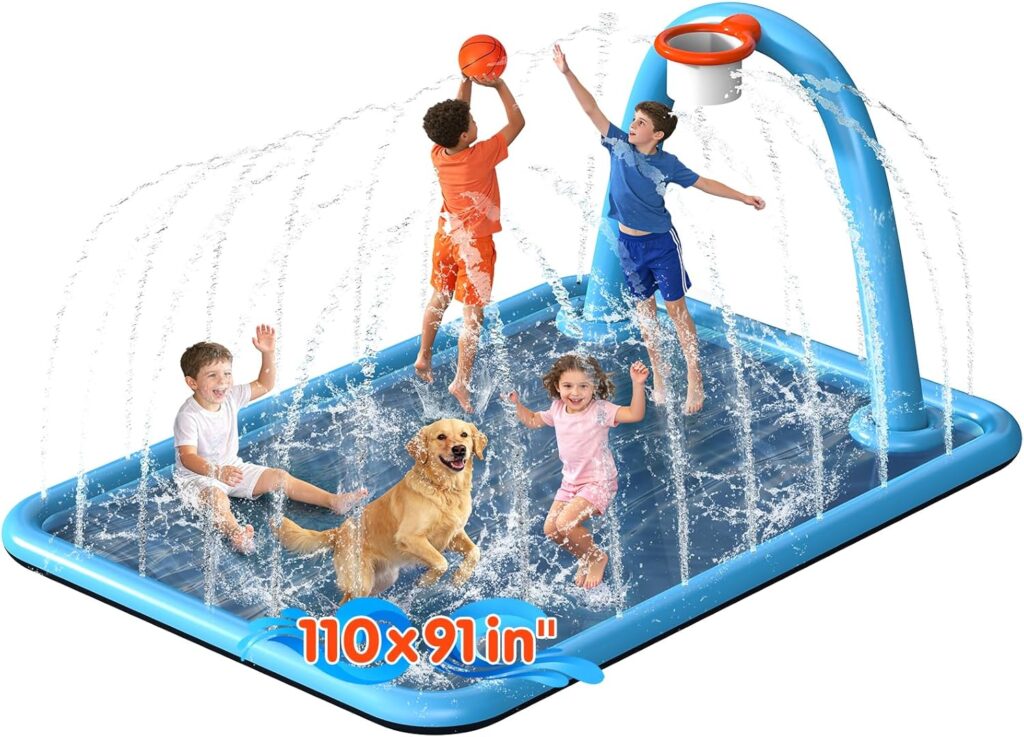
A splash pad is generally much flatter. Water fills a perimeter ring or channel and escapes through small holes while only a shallow layer collects across the central surface. That arrangement works well for running, pawing, and chasing streams, but it offers less water depth for a large dog that prefers to lower its belly or chest into the pool. Current 2026 dog-pool testing treats conventional foldable pools, shallow splash pads, and pool-and-sprinkler combinations as distinct product types.
| Feature | Regular Dog Pool | Dog Pool With Sprinkler | Dog Splash Pad |
|---|---|---|---|
| Raised supporting walls | Yes | Yes | Usually minimal |
| Holds standing water | Main purpose | Yes | Shallow |
| Moving spray | No | Yes | Yes |
| Hose needed during spray | No | Yes | Usually yes |
| Typical activity | Soaking, bathing | Soaking + active play | Running + spraying |
| Water systems | Fill + drain | Fill + spray + drain | Spray channel |
| Maintenance points | Fewer | More | Moderate |
| Strongest use case | Calm water use | Multi-purpose water play | Shallow active play |
This distinction matters most when shoppers compare products by diameter alone. A 90-inch splash pad and a 90-inch foldable pool can occupy similar ground space while delivering very different experiences. One offers a broad, shallow spray area, while the other provides defined walls and greater retained water depth. The better choice depends on whether the dog mainly wants to run through water or settle into it.

Added Components
The sprinkler feature adds useful functionality, but it also adds physical components that do not exist in a basic pool. A conventional foldable dog pool may consist primarily of PVC layers, structural panels, welded seams, one or more drains, and caps. A sprinkler model adds a hose inlet, connector, pressure-bearing channel, sealing points, and multiple spray openings distributed around part or all of the perimeter.
Those parts create additional inspection points rather than automatically creating a durability problem. One group of spray holes may eventually produce lower streams because of debris or mineral residue. A garden hose pulled sideways can place stress on the connector. Repeatedly folding a pressurized channel at exactly the same sharp crease may also create more concentrated material stress than folding a simple wall panel.
The tradeoff is versatility. A well-designed 2-in-1 pool can operate as a normal basin when the sprinkler is off and become an active water toy when the hose-fed spray is turned on. This is especially useful in households where one dog enjoys soaking while another prefers moving water, or where the same pool is used for bathing during the week and more energetic play on weekends.
For manufacturers working with PVC leisure products, this is also where design details become more important than appearance alone. Material formulation, weld consistency, wall-panel stiffness, connector reinforcement, sprinkler-hole spacing, drainage position, and folding geometry all influence the finished experience. In OEM or custom projects, changing those structural details often creates more meaningful differentiation than simply changing the print or color.
What Difference Matters Most?
The difference that matters most is the behavior each design encourages. A regular pool is primarily a place the dog enters and remains. Once inside, it can stand, sit, lie down, paw at the water, interact with floating toys, or receive a bath. The pool itself remains comparatively passive, so the dog’s movement pattern is often slower and easier to predict.
A sprinkler pool can become part of the game. Moving streams encourage some dogs to circle the perimeter, bite at water, turn quickly, run out of the basin, and return from another direction. The dog may therefore put more dynamic stress on the floor and walls even if it weighs far less than a calmer dog using a conventional pool.
That difference explains why size and temperament should be considered together. A relaxed 70-pound dog may need plenty of floor area but very little entertainment. A highly energetic 30-pound dog may need more open space around the pool, reliable traction, and a securely routed hose because it is constantly changing direction.
Before comparing accessories or promotional claims, watch what happens when your dog encounters a garden hose, shallow basin, bath, wet lawn, or lawn sprinkler. A dog that repeatedly chases hose streams gives you useful evidence that a sprinkler feature may justify its extra complexity. A dog that ignores moving water but lies happily in shallow water may get more practical value from a simpler regular pool.
Which Dog Pool Is Better for Cooling and Water Play?
A regular pool often works better for quiet, sustained water contact, while a sprinkler pool usually provides more active play and repeated wetting. Neither design automatically keeps every dog cooler. The practical result depends on how the dog behaves, how intensely it exercises, water and air conditions, access to shade and drinking water, and whether it willingly remains in or around the water.
Cooling Through Soaking
For a dog that willingly stands or lies in shallow water, a regular pool offers one major advantage: cooling does not require continued activity. The dog can remain in contact with water around the paws, lower legs, belly, and chest while using relatively little energy. This makes the design particularly suitable for dogs that naturally prefer slower backyard activity rather than chasing moving streams.
The pool does not normally need to be filled close to the top of the wall to provide this experience. Several inches of water may already be enough for many dogs to wet the lower body while remaining able to stand and exit comfortably. Starting shallower is also useful when introducing dogs that are uncertain around water, because they can explore without suddenly encountering swimming depth.
A backyard dog pool should still be treated as only one part of hot-weather management. Veterinary guidance consistently recommends supervision around water, access to clean drinking water, rest breaks, and an easy way for the dog to leave the water. Dogs can become tired even when they appear enthusiastic, and not every dog is a confident swimmer.
Water temperature deserves attention as well. Water that has been sitting in direct summer sun can become much warmer than expected, while very cold water can be uncomfortable or unsafe in some situations. VCA specifically advises checking that water is a comfortable temperature and warns that cold water can contribute to hypothermia.

Cooling Through Spray
Sprinklers address a different problem: many dogs like water but do not want to remain in a basin. They may step into a regular pool, splash for a minute, and walk away. Moving streams can increase engagement by giving the dog something to track, chase, paw at, or bite, which causes repeated contact with water even when the animal never settles into a soaking position.
The limitation is that sprinkler play is exercise. Running around a pool, accelerating toward streams, turning sharply, and jumping through moving water all generate body heat. A wet coat does not automatically mean the dog is cooler or less fatigued, so owners should pay attention to the intensity and duration of play rather than assuming that continuous spray makes unlimited activity safe.
Short play periods with breaks are often more sensible than leaving an excited dog running around the sprinkler continuously. PetMD and VCA both emphasize supervision, monitoring fatigue, and giving dogs rest during water activities. A shaded resting area and separate bowl of clean drinking water should remain available even when the dog is surrounded by pool water.
Spray height also does not need to be dramatic. High jets may look impressive in product photographs, but a lower setting may be more comfortable for small dogs, cautious dogs, and compact backyards. On many hose-fed products, reducing faucet pressure reduces spray height, allowing owners to find a level that encourages play without constantly hitting the dog’s face or spraying far beyond the pool.
Water Depth and Volume
The amount of water in a wide dog pool rises faster than many owners expect. Because volume increases with both surface area and depth, adding only two more inches of water to a large-diameter pool can mean dozens of additional gallons. That changes filling time, total weight, drainage volume, and the amount of water eventually released onto grass or a patio.
The figures below use simple cylinder geometry and assume that the stated diameter is fully usable. Real foldable pools have wall thickness, panel structure, folds, and slightly different internal dimensions, so these figures are best used as planning estimates rather than the rated capacity of a specific product.
| Pool Diameter | Approx. Water at 2 in | Approx. Water at 4 in | Approx. Water at 6 in |
|---|---|---|---|
| 60 in | 24.5 gal | 49.0 gal | 73.4 gal |
| 80 in | 43.5 gal | 87.0 gal | 130.6 gal |
| 100 in | 68.0 gal | 136.0 gal | 204.0 gal |
A 100-inch circular area filled to approximately four inches represents about 136 gallons before accounting for real product geometry. Since water becomes extremely heavy in these volumes, large pools should be drained through their outlets rather than lifted or tipped while substantially full. This is one reason drainage design becomes progressively more important as diameter increases.
For dogs that mainly want to wet their paws and belly, starting with two or three inches may provide all the water needed. Owners can increase depth gradually if the dog is confident and the product instructions allow it. This approach reduces unnecessary filling time and makes the first experience easier for small, young, senior, or water-hesitant dogs.
Play Value
Sprinkler pools have their clearest advantage when entertainment is a major purchase goal. Moving water changes constantly as pressure fluctuates, individual jets rise and fall, and the dog’s movement interrupts the streams. Dogs that already become excited when someone turns on a garden hose are often the most obvious candidates for this style of product.
A regular pool can still provide meaningful play without a sprinkler. Floating toys, water-safe balls, gentle retrieving games, or interaction with another compatible dog can make standing water interesting. Some dogs even spend long periods pawing at ripples or moving toys around the floor without needing any additional spray system.
Current dog-water-toy testing also reinforces the importance of matching the product to dog size and play style rather than assuming every interactive feature is suitable for every animal. A sprinkler that excites one dog may intimidate another, particularly when the streams begin suddenly or reach face height.
For cautious dogs, introduce the pool before introducing the sprinkler. Allow voluntary investigation, add a shallow amount of water, and only activate low-pressure spray after the dog is relaxed around the basin. PetMD recommends beginning water introductions in shallow conditions and allowing dogs to stop where they feel comfortable rather than assuming natural swimming ability.
Which Pool Is Better for Different Dogs and Backyards?
Large and active dogs generally need more usable floor space, stronger wall support, reliable traction, and open room around the pool. Small, cautious, or less mobile dogs often benefit from shallow water and manageable entry height. Sprinkler pools tend to fit energetic dogs and open yards, while regular pools are often easier to manage where overspray, hose access, drainage, or limited space matters.
Large and Active Dogs
When choosing a dog pool for a large breed, the word “large” on the packaging is far less useful than the actual internal dimensions. A pool should give the dog enough room to step in, rotate its body, lower itself into the water, stand again, and exit without constantly folding the wall inward or pushing against the perimeter.
A large Labrador, German Shepherd, Golden Retriever, Husky, or similarly built dog may technically fit inside a modest pool while still lacking room to lie down comfortably. That distinction matters because a pool used only for paw cooling requires less space than one intended for full-body soaking or active play.
Dynamic movement also changes structural requirements. The pressure created by a large dog standing quietly is very different from the force created when that same dog plants its rear paws, accelerates toward a sprinkler stream, and turns sharply. Floor texture, support-panel stiffness, seam construction, and the condition of the ground underneath therefore matter as much as nominal diameter.
Current real-world dog-pool evaluations assess durability, size, setup, storage, and dog friendliness together rather than treating any one specification as proof of quality. This is a useful way for shoppers to think as well: the pool should be evaluated as a complete structure, not simply as a sheet of PVC with a diameter printed on the box.
Multi-dog households should leave additional space beyond the minimum needed for two bodies. Dogs cross paths, turn, play bow, jump, and compete for interesting streams. A pool that looks generous for one large dog can quickly feel crowded when two dogs become active at the same time.

Puppies and Small Dogs
Small dogs create a different problem because entry height can matter more than overall diameter. A pool may provide generous floor space while still being awkward to use if the wall is high relative to the dog’s legs. Filling the basin with less water does not change the physical height of the perimeter, so access should be evaluated separately from water depth.
For a first introduction, shallow water is generally easier to manage. VCA recommends starting dogs in shallow water and gradually increasing depth rather than immediately placing them in deeper conditions. This gives the dog time to understand the surface, water movement, wall height, and exit route before the experience becomes more demanding.
Sprinkler pressure should also begin conservatively. A stream that reaches the shoulder of a Labrador may hit a small puppy near the face. Reducing supply pressure can make the spray shorter and less intimidating, especially during the first few sessions.
A 2-in-1 pool can be particularly useful for this gradual approach because the sprinkler does not have to operate every time. The owner can begin with an empty basin, move to shallow standing water, and introduce low spray only after the dog is comfortable. That progression makes the extra feature optional instead of forcing the dog to accept moving water from the first use.
Owners should avoid assuming that a puppy or small breed naturally knows how to handle water. Veterinary guidance consistently notes that not every dog is automatically a strong swimmer and that supervision and a clear exit are important around pools.
Older and Less Mobile Dogs
Senior dogs may enjoy water but often need a calmer setup than young, high-energy animals. Floor traction, predictable water depth, wall height, and easy entry can become more important than moving spray or interactive features. An older dog that hesitates before stepping over the perimeter is giving useful information about whether the product suits its mobility.
A textured or non-slip floor can help, but no wet surface should be treated as impossible to slip on. Dog hair, soap from bathing, mud, algae, and repeated paw movement can alter traction, so owners should watch how confidently a senior dog stands and turns rather than relying only on a marketing description.
A regular pool often works well because the environment remains predictable. The dog can walk in, cool its paws or belly, rest, and leave without sudden streams encouraging rapid movement. A sprinkler pool can still serve the same purpose when the spray is optional and simply remains switched off.
Water temperature also deserves extra attention. VCA advises monitoring water conditions and avoiding dangerously cold water, while PetMD emphasizes supervision and fatigue management for dogs in swimming environments. A shaded location and moderate water depth often create a more comfortable backyard setup than a deeply filled pool sitting in direct afternoon sun.
Dogs with diagnosed mobility, orthopedic, cardiac, or neurological problems may need individual veterinary guidance before using water for exercise. A backyard dog pool can provide recreation and cooling, but it should not be confused with professionally supervised canine hydrotherapy, which is a clinical rehabilitation activity.
Backyard Fit
A pool that physically fits in the yard may still be inconvenient once the dog, hose, spray, drainage, and surrounding movement are considered. Regular pools generally keep the activity closer to the basin, while sprinkler models encourage dogs to run around the outside and can send water onto neighboring surfaces depending on pressure and wind.
| Backyard Situation | Regular Pool | Sprinkler Pool | Main Consideration |
|---|---|---|---|
| Compact patio | Strong fit | Possible at low spray | Overspray |
| Large lawn | Strong fit | Strong fit | Plenty of movement space |
| Limited hose access | Strong fit | Less convenient | Continuous supply for spray |
| Dog loves hose play | Basic activity | Strong fit | Moving water |
| Two active dogs | Large size needed | Large size + open perimeter | Running space |
| Frequent bathing | Strong fit | Strong fit | Both retain water |
| Runoff restrictions | Easier to manage | Needs more planning | Ongoing water input |
| Furniture nearby | Easier to contain | Careful placement needed | Spray reach |
The hose should approach from a direction the dog does not repeatedly cross. A hose stretched tightly through the main running route can become a trip point and can pull sideways on the sprinkler connector. Leaving a little slack close to the connection also reduces unnecessary load when the pool shifts slightly during play.
The surface underneath the pool should be inspected before filling. Stones, thorns, sticks, screws, rough edges, and other sharp debris can concentrate pressure against flexible PVC. Material thickness helps resist normal wear, but it cannot make a pool immune to a pointed object trapped underneath hundreds of pounds of water.
Drainage should also be considered before setup. Releasing large volumes repeatedly onto the same patch of lawn can create mud, while draining across smooth concrete can make nearby walkways slippery. The best location is therefore not simply a flat area large enough for the pool; it is a location where filling, play, drainage, drying, and supervision all work together.
Which Pool Is Easier to Use, Maintain, and Keep Durable?
A regular dog pool is usually simpler to maintain because it contains fewer water-delivery parts. A sprinkler model adds hose fittings, pressure channels, and spray openings but provides more play options. Long-term durability depends on material construction, seams, support panels, floor condition, nail contact, ground preparation, drainage, cleaning, drying, folding, and storage rather than whether the product has a sprinkler alone.
Water Use
A regular pool has relatively predictable water consumption. The owner fills it to the desired depth, turns off the faucet, and uses the stored water until it needs to be refreshed or drained. A sprinkler pool adds continuous incoming water whenever the spray is active, so total consumption is influenced more strongly by operating time.
Household hose flow varies according to faucet pressure, hose diameter, hose length, adapters, and the restriction created by the product itself. Owners who want a realistic estimate can perform a simple bucket test instead of relying on a generic online number. If a five-gallon container takes 75 seconds to fill from the hose, the unrestricted reference flow is approximately four gallons per minute.
At that reference rate, fifteen minutes of open-hose flow would represent about sixty gallons. The actual quantity passing through a sprinkler pool may be lower because small openings and internal channels restrict flow, but the example shows why duration matters. Leaving the sprinkler running for an hour after the dog has lost interest can use far more water than several short play sessions.
This does not mean sprinkler pools are inherently wasteful. It means the feature should be used deliberately. If the dog enjoys ten minutes of chasing water and then settles down, the owner can switch off the spray while leaving the pool available for soaking.
For homes where water use is a major concern, this operational flexibility is worth considering before purchase. A sprinkler that can easily be turned off while the basin remains functional offers a different ownership experience from a flat splash pad that relies on continuous hose pressure to maintain its structure and spray. Current splash-pad reviews specifically note that some designs require the hose to remain running during use.
Cleaning and Drainage
Drainage becomes increasingly important as pool size grows because water is far heavier than the empty PVC product. A large foldable pool may be easy for one person to carry when dry but impractical to move once it contains dozens or hundreds of gallons. Owners should therefore use the drain rather than attempting to lift, drag, or tip a substantially filled pool.
Dog-pool water also becomes dirty quickly. Fur, grass, mud, paw debris, pollen, saliva, and outdoor dust enter the basin during normal use. Water should not simply be left stagnant for long periods because outdoor standing water can become unhygienic and attract unwanted problems. VCA specifically advises regularly changing water in outdoor features such as kiddie pools as part of reducing exposure to contaminated standing water.
A practical routine is to remove visible debris, open the drain, rinse the floor and walls, inspect the seams, and allow the product to dry. Sprinkler models deserve an additional look around the inlet and spray openings because mineral residue or small particles can gradually change the pattern of individual jets.
Large drains or multiple drainage points can make maintenance easier, especially when the pool sits on a lawn where the owner wants to control the direction of runoff. The easier the product is to empty and rinse, the more likely it is to receive proper cleaning throughout the season.
Dogs that spend a great deal of time in water may also need basic post-play care. VCA recommends drying ears after swimming or bathing because retained moisture can contribute to ear problems in susceptible dogs. This is particularly relevant for dogs with floppy ears that repeatedly immerse their heads during play.

PVC, Nails, and Durability
PVC thickness is a useful specification, but it should not be treated as a complete durability score. A dog’s nail creates concentrated pressure over a very small contact area. When the dog pushes off, scratches at water, or turns suddenly, the force applied to one part of the floor can be much greater than when the same animal stands quietly.
The performance of a foldable pool therefore depends on several factors working together: PVC formulation, layer construction, welded seam quality, floor reinforcement, wall-panel stiffness, drain installation, folding geometry, and the ground underneath. Current dog-pool reviews continue to emphasize non-slip PVC surfaces, panel support, and resistance to claw use rather than thickness alone.
Current splash-pad products also illustrate why a single number should be interpreted carefully. One reviewed model uses 0.45 mm PVC and includes manufacturer guidance to keep dog nails trimmed, while other foldable pet pools use different constructions and reinforcement strategies. The meaningful question is not whether one sheet is a fraction of a millimeter thicker, but whether the entire product suits the expected dog size and activity.
Ground preparation is one of the simplest ways to extend service life. A sharp stone trapped underneath the floor creates a concentrated pressure point from below while a dog may simultaneously apply force from above. Removing small debris before setup often prevents damage that would otherwise be blamed entirely on the material.
Keeping nails reasonably trimmed can reduce another source of concentrated loading. Owners do not need to alter normal veterinary grooming practices specifically for the pool, but very sharp nails combined with digging or rapid push-off movement place more demand on flexible flooring than smooth, maintained nails.
Storage and Inspection
Many problems with foldable PVC products begin after play rather than during it. A pool that performs well all summer can still develop unpleasant odors, staining, deformation, or fold damage if it is stored wet, compressed beneath heavy objects, or placed against sharp garden tools.
The pool should be completely drained, rinsed, and allowed to dry before long-term folding. Sprinkler models may need additional drying time around channels or inlet areas because a small amount of water can remain after the visible basin appears empty. Folding immediately after use can trap moisture between surfaces.
Storage conditions should be clean and dry, with the folded product kept away from exposed screws, rough metal edges, sharp tools, or other objects capable of pressing into the PVC. When the product is used again, inspect the floor, lower seams, drain fittings, wall folds, and sprinkler connection before filling.
For companies developing custom pet-water products, these same real-world conditions should inform quality control. Static leak testing is necessary, but repeated folding, connector cycling, seam inspection, floor abrasion, panel loading, and simulated movement provide a more complete picture of expected use.
This approach is particularly important for OEM and ODM projects. Brands working with manufacturers such as EPN can define the intended dog size, use frequency, sprinkler behavior, packaging needs, target market, and price position before finalizing wall construction, drainage, graphics, and accessory choices. Structural decisions made around actual use are more valuable than adding decorative features after the product has already been engineered.
How Do You Choose Between a Sprinkler Dog Pool and a Regular Dog Pool?
Choose according to the dog’s real behavior and the job the pool needs to perform. A sprinkler model makes sense when moving water adds genuine play value and the yard can support hose-fed activity. A regular pool is often better for bathing, quiet cooling, easier maintenance, and limited hose use. Size, accessibility, traction, drainage, durability, and available outdoor space should come before decorative features.
Start With Your Dog
The easiest purchasing mistake is choosing a pool for the dog shown in a lifestyle photograph instead of the dog that actually lives in the home. Before comparing product specifications, observe what happens during ordinary water situations. Does the dog chase the garden hose, walk into shallow creeks, enjoy baths, avoid spray near its face, or immediately look for the coolest place to lie down?
Those behaviors provide more useful information than breed stereotypes. Some dogs from breeds known for swimming remain cautious around water, while dogs with no particular water-working history can become fascinated by sprinklers. PetMD specifically recommends introducing dogs gradually rather than assuming even water-oriented breeds will automatically enjoy or understand swimming.
A dog that already lies voluntarily in a shallow kiddie pool provides strong evidence that a regular pool can satisfy its main need. A dog that constantly tries to attack water from a hose provides equally strong evidence that a sprinkler feature may be used frequently enough to justify its additional complexity.
Multi-dog households may benefit particularly from a sprinkler that can be switched on or off independently of the basin. One dog can enjoy quiet standing water while another uses the moving streams during a separate play session. This flexibility makes more sense than assuming every dog in the home will respond to water in the same way.
Match Size to Movement
Diameter should be matched to the way the dog will move inside the pool rather than body weight alone. A dog that only stands to cool its paws needs less floor area than the same dog turning around, lying down, retrieving toys, or chasing sprinkler streams.
Large models also require more planning around the outside. A wide pool can easily fit on a lawn while leaving too little clearance between the edge, furniture, fences, or garden features for an excited dog to move safely. Measure the entire play zone rather than only the pool footprint.
For households comparing sizes, the following decision framework is more useful than a strict weight chart because body shape and activity differ substantially between dogs.
| Main Situation | Priority Features | Better Starting Type |
|---|---|---|
| Calm summer soaking | Floor area, stable walls, drainage | Regular pool |
| Outdoor bathing | Controlled depth, drain access | Regular pool |
| Dog chases hose water | Traction, spray control, open space | Sprinkler pool |
| Small or cautious dog | Low-pressure spray, easy access | Either, used shallow |
| Senior dog | Stable footing, easy entry | Regular pool |
| Two active dogs | Large usable area, strong support | Large sprinkler or regular pool |
| Limited yard space | Controlled runoff, compact footprint | Regular pool |
| Mixed play styles | Optional sprinkler + retained water | 2-in-1 sprinkler pool |
This framework should be treated as a starting point rather than a universal prescription. A highly active small dog can place more dynamic stress on a floor than a much heavier senior dog, while a large dog that simply lies in the water may not require any interactive features.

Check the Essentials
Before being persuaded by bright graphics, included toys, or unusually high sprinkler jets, check the specifications that affect repeated use. Usable dimensions should come first. Look at diameter and wall height together and ask whether the dog can enter, turn, lie down, stand, and exit without assistance.
Floor construction and traction come next because wet dogs frequently turn or push off suddenly. A textured surface can improve footing, but the surrounding lawn or patio should also remain reasonably safe once water begins splashing outside the basin.
Drainage should be easy enough that the owner will actually empty and clean the pool regularly. A large product that is difficult to drain becomes inconvenient quickly, particularly when it contains hair and muddy water after several dogs have played.
Sprinkler models add three more checks: hose compatibility, connector position, and pressure control. A common garden-hose connection makes setup easier, while adjustable supply pressure helps match spray height to dog size and available space. The hose should not need to cross the dog’s main running path.
Finally, review storage and care instructions. Flexible PVC is durable when appropriately designed and used, but no responsible manufacturer should describe it as impossible to puncture. Clear guidance on ground preparation, folding, drying, nail care, and repair provides more practical value than an absolute claim of indestructibility.
Make the Final Choice
The simplest final question is whether you are mainly buying a place for your dog to be in water or a water activity for your dog to interact with. That distinction resolves most of the confusion between the two product types.
If the goal is summer soaking, paw cooling, outdoor bathing, or relaxed backyard use, a regular foldable pool often provides everything necessary with fewer components. Once filled, the hose can be switched off, and the owner mainly needs to manage water cleanliness, drainage, drying, and storage.
If the dog becomes visibly excited around moving streams and the goal is interactive summer play, the sprinkler version adds something a regular basin cannot create by itself. For households wanting both experiences, a 2-in-1 foldable sprinkler pool offers the broadest flexibility because the spray can remain optional.
The sprinkler should not be the deciding feature if the basic pool is too small, difficult to drain, slippery, poorly supported, or inconvenient for the yard. Core construction and fit still matter more than entertainment features.
Whatever style is selected, dogs should remain supervised and should have a clear way to leave the water. Veterinary sources repeatedly emphasize supervision, fatigue monitoring, comfortable water conditions, and easy exit routes rather than assuming every dog can safely manage water without assistance.
Final Thoughts
A dog pool with sprinkler is not automatically an upgraded version of a regular dog pool, and a regular pool is not outdated simply because its design is simpler. They solve overlapping but different problems. One focuses on retained water, bathing, soaking, and predictable use, while the other adds movement and interaction for dogs that enjoy chasing water.
The best choice becomes much clearer when the decision starts with the dog rather than the feature list. Consider its size, age, mobility, confidence around water, energy level, reaction to garden hoses, and preferred style of play. Then consider the physical environment: hose access, available lawn or patio space, drainage, water use, storage, and how much cleaning the household is realistically willing to do.
Construction should be evaluated as a complete system. PVC material, wall support, seams, floor traction, drainage hardware, sprinkler channels, connector reinforcement, and the surface underneath the pool all influence long-term performance. No single number or marketing phrase can describe durability on its own.
For dogs that genuinely enjoy both soaking and chasing moving water, a well-designed 2-in-1 sprinkler pool can provide excellent versatility. For a dog whose ideal summer afternoon consists of quietly lowering its belly into several inches of cool water, a good regular pool may be the better purchase. The most useful dog pool is ultimately the one the dog willingly returns to and the owner can comfortably maintain throughout the season.
Frequently Asked Questions
Is a sprinkler dog pool better than a regular dog pool?
A sprinkler dog pool is generally better for dogs that enjoy chasing moving water and for households wanting more interactive backyard play. A regular dog pool is often better when the main goals are soaking, outdoor bathing, simple cooling, and easier maintenance. Neither design is universally superior because dog temperament, body size, yard space, hose availability, drainage, and frequency of use can completely change which product delivers more practical value.
Can a dog pool with sprinkler be used without the sprinkler?
Many foldable 2-in-1 designs can still hold water and function as conventional pools when the sprinkler is not operating, although owners should always follow the instructions for the specific product. This flexibility is one of the strongest reasons to choose a pool-and-sprinkler combination. Calm dogs can use standing water on quiet days, while the moving spray can be activated during more energetic play sessions.
How deep should water be in a dog pool?
There is no universal depth that suits every dog. For many backyard cooling sessions, a few inches of water can be enough to wet the paws, legs, belly, and lower chest without creating swimming depth. Small dogs, puppies, seniors, and uncertain dogs should generally begin shallower and progress only when comfortable. The dog should be able to stand securely, turn easily, and leave the pool whenever it chooses.
Are sprinkler dog pools suitable for large dogs?
Yes, provided the pool offers enough usable floor space, stable wall support, appropriate traction, and sufficient open area around the perimeter. Large dogs need more than a diameter that merely allows them to stand. They should be able to turn and lower their bodies comfortably. Active large dogs also create greater dynamic loads when chasing spray, so floor construction, seams, wall support, and ground preparation become particularly important.
Do sprinkler dog pools use more water?
They can use more water during active sprinkler sessions because incoming water must continue flowing while the jets operate. The actual amount depends on household pressure, hose flow, product restriction, and operating time. Owners can reduce unnecessary consumption by running the spray only while the dog remains interested and then switching it off while the animal rests or uses the retained water as a conventional pool.
How can I protect a PVC dog pool from dog nails?
Begin with a clean, flat surface and remove sharp stones, sticks, thorns, screws, and rough debris before unfolding the pool. Keep the dog’s nails reasonably maintained and discourage repeated digging or scratching at the floor. PVC thickness is only one part of durability; seam quality, reinforcement, support structure, floor design, folding habits, and the condition of the ground underneath all contribute to how well the pool handles repeated pet use.
Get A Fast quote
Here, bringing your inflatable concepts to life is no longer a challenge—it’s a collaborative journey where American Epsilon helps families, outdoor enthusiasts, and global brands transform creative ideas into safe, certified, and market-ready inflatable solutions.


Partner With Epsilon
Whether you are a family looking for safe backyard fun or a brand seeking large-scale OEM/ODM solutions, American Epsilon Inc. guarantees every inflatable is built with safety, durability, and excitement in mind. With flexible low MOQs, strategically placed warehouses in the U.S., Canada, U.K., and Germany, plus 24/7 professional support, we ensure smooth delivery and reliable service worldwide.
Ready to bring your inflatable ideas to life? Request free samples, fast prototypes, and customized designs today—your trusted inflatable journey starts here.