Skip to content


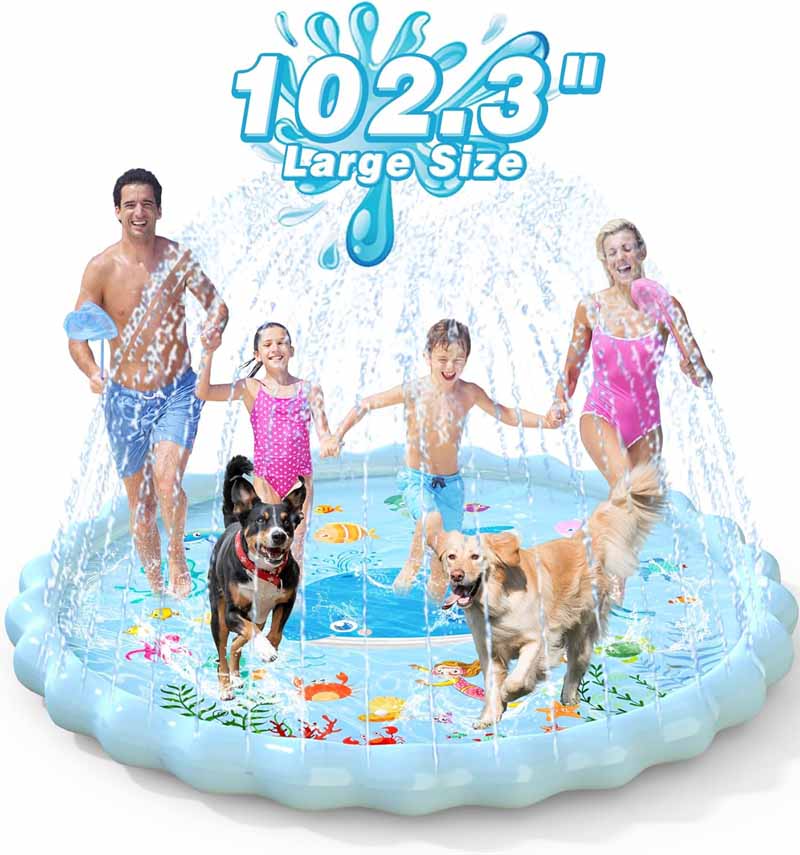
Most flat kids’ splash pads with perimeter sprinkler holes are designed to run from a garden hose or another compatible source capable of delivering a continuous supply of water at useful pressure and flow. Without this supply, the pad may still serve as a wet play surface, and some designs can retain a shallow layer of manually added water, but simply pouring water onto the center does not recreate the normal sprinkler action. The distinction matters because many families searching for a “splash pad without a hose” actually have water available; what they lack is an outdoor faucet, a suitable connector, enough hose length, or a convenient way to maintain continuous flow.
The good news is that several of those problems can be solved without replacing the splash pad. A home with a compatible kitchen or utility faucet may be able to use a faucet-to-garden-hose adapter. A distant outdoor faucet may only require a correctly planned hose route and a flow check. A water tank can become a supply source when paired with an appropriately engineered pump system, although this is far more complicated than a standard household connection. Where no convenient pressurized source exists at all, a refillable sprinkler, water table, or another self-contained water toy may be the better choice.
From the perspective of long-term PVC and welded recreational product development, it helps to stop thinking about the hose as a simple accessory. The complete working system includes the water source, pressure, available flow, hose length and diameter, fittings, product inlet, perimeter water chamber, weld geometry, spray-hole layout, pad size, and ground condition. Weak spray can begin anywhere along that path. Understanding the system first usually saves more time than immediately replacing the product or experimenting with a stronger water source.
Can a Kids Splash Pad Really Work Without a Garden Hose?
A useful answer starts by defining what “work” means. If the expectation is a ring of upward or inward-facing jets around the perimeter, a conventional hose-powered splash pad normally needs moving water entering through its designed inlet. If the goal is simply to let children pour cups of water, splash their feet, move toys across a wet surface, or sit in a very shallow center area, some products may still provide limited play after fresh water is added manually. These are two different operating modes, and they should not be confused when deciding whether a splash pad suits a particular home.
A real consumer product makes this distinction especially easy to see. Poolmaster’s Lil’ Splashers Spray & Play Pad is approximately five feet wide, has 30 perimeter sprinkler outlets, connects to a standard garden hose, and requires no air inflation. In other words, “no inflation necessary” does not mean “no water connection necessary.” The air system and water system are completely separate concepts. Brand-specific spray height and hole counts should not be applied to unrelated products, but the operating principle is a useful example of how common flat sprinkler pads work.
Evidence — Manufacturer Example: Poolmaster’s product information shows a flat sprinkler pad using a standard garden-hose connection while requiring no air inflation. This is useful evidence for separating “no air pump” from “no hose.”
| Water Setup | Normal Perimeter Spray? | What a Family Can Realistically Expect |
|---|---|---|
| Outdoor faucet + standard garden hose | Usually yes | Intended operating method for many household splash pads |
| Compatible indoor faucet + adapter + hose | Often possible | Similar supply concept, but faucet thread and indoor leak control matter |
| Bucket poured onto the pad | No normal spray | Wet-surface or shallow manual water play |
| Water tank without a pump | Usually no | Plenty of stored water may still provide inadequate pressure |
| Tank + correctly matched pump + hose | Possible in some setups | Requires pressure, flow, fittings, power and safety evaluation |
| No usable water source | No | A self-contained water toy is normally more suitable |
If You Mean the Sprinkler Jets, Usually No
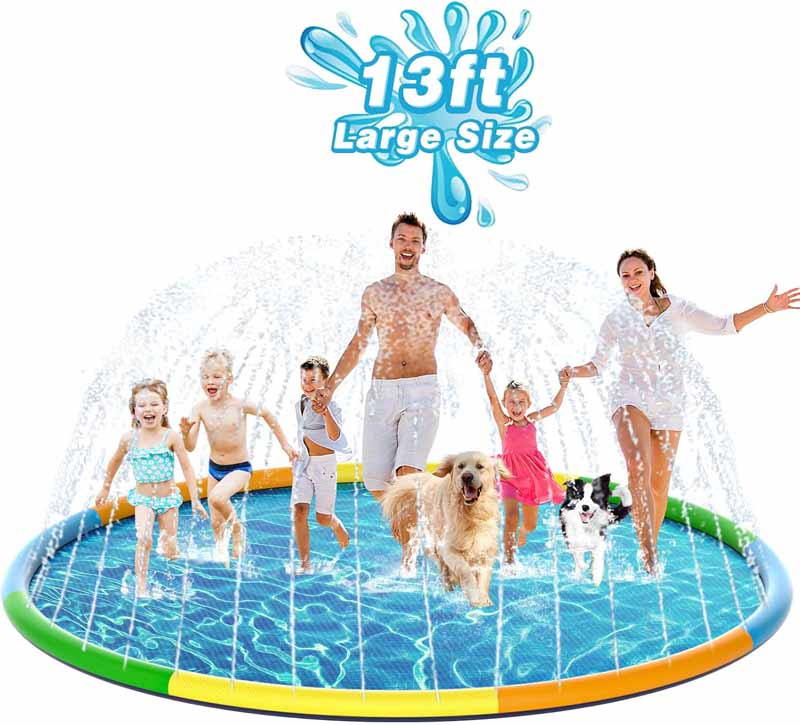
A typical perimeter-spray pad contains an enclosed water pathway around its outside edge. Water enters through one fitting and must travel around the chamber before leaving through many small holes. When the supply becomes weak, every outlet competes for the available flow. Spray can become low across the entire ring, strong near one portion and weak elsewhere, or disappear almost completely. Water poured onto the visible top surface does not normally enter this sealed path, so a bucket cannot activate the spray system in the same way as water delivered through the inlet.
If You Mean Simple Water Play, Sometimes Yes
A hose-free session can still have value if expectations change. Children may use cups, watering cans, floating toys, scoops, small boats, or other age-appropriate water toys on a wet pad. Some raised-edge designs can hold a thin layer of water in the center. Before using a sprinkler pad in this manner, check its own instructions because products differ in floor construction, edge height, drainage, slip resistance, intended age, and water depth. A flat PVC water-play mat should not automatically be treated as a conventional kiddie pool simply because a small amount of water remains on it.

What Does a Garden Hose Actually Do Inside a Splash Pad?
The easiest way to understand the hose requirement is to follow the water from the faucet to the spray holes. Household plumbing first provides the source pressure. The hose carries water to the inlet while creating some resistance of its own. The connector transfers water into the splash pad’s perimeter channel. Pressure inside the channel distributes water around the product, while the small openings act as outlets. The familiar sprinkler effect appears only when the complete path can deliver enough water for all of those outlets simultaneously.
The Hose Supplies More Than Water Volume
Having five, ten, or fifty gallons of water available does not tell you whether the pad will spray. A garden hose normally provides water continuously while also connecting the splash pad to the pressure already present in the household system. This combination is important because the pad is constantly discharging water through its perimeter openings. Once the faucet is closed, incoming flow stops, pressure falls, and the spray rapidly disappears. A standard sprinkler pad therefore behaves very differently from an inflatable toy which is filled once with air and sealed for the duration of play.
Pressure and Flow Are Related but Not the Same
Parents often describe every spray problem as “low water pressure,” although available flow can be equally important. Pressure describes the force available to move water; flow describes the quantity moving through the system over time. A hose, fitting, narrow passage, or kink can restrict flow even when the household supply itself is satisfactory. Pad diameter also matters because a larger perimeter usually means a longer internal path, and designs with more or larger holes demand a different water distribution pattern from smaller products.
For product designers, the relationship becomes even more important. Spray-hole count, hole diameter, hole angle, hole spacing, inlet location, perimeter chamber width, welded seam position, pad diameter, PVC thickness, and material stiffness influence the finished water pattern. Increasing hole count alone can make a marketing specification look impressive while dividing available flow across more outlets. In custom splash pad development, water testing should therefore happen on a full-size functional prototype rather than approving a design only from artwork and dimensions.
No Air Pump Required Does Not Mean No Hose Required
An air pump moves air into an inflatable chamber. A water pump moves water and may create useful pressure depending on its design and operating point. A garden hose normally transports water already pressurized by a household supply. A flat sprinkler pad can therefore be completely non-inflatable while still requiring a hose. This distinction sounds simple once explained, but it is one of the most common misunderstandings created by product descriptions such as “no pump required” or “no inflation needed.”
Immediately after seeing the operating principle, a visual setup example is useful because the transformation from flat mat to active sprinkler is much easier to understand than a technical diagram alone.
Video — See a Hose-Powered Splash Pad Start Working: This setup demonstration shows a flat splash pad placed on a level area and connected to a standard garden hose. Watch the perimeter as running water reaches the product and begins producing spray. The video is a general operating example rather than a product-specific instruction manual.

First Identify What “No Garden Hose” Actually Means
Before buying a pump, adapter, water tank, or completely different toy, identify the missing link. In product support and field troubleshooting, this is often the fastest way to solve the problem. “We have no hose” might mean the family has an outdoor faucet but never purchased a hose, the faucet is on the wrong side of the house, the patio has only an indoor water source, the vacation property provides no outdoor connection, or the family wants to avoid continuous water use altogether.
You Have an Outdoor Faucet but No Hose
This is normally the simplest situation. Measure the actual route from the faucet to the intended play area, including corners, gates, patio furniture, steps, and any area where a hose should not cross a walking path. Avoid choosing length purely from the straight-line distance. A hose stretched tight can pull on the splash pad inlet when children move the product, while a hose far longer than necessary adds resistance, storage bulk, additional opportunities for kinks, and more material lying across the yard.
A useful field rule is to leave enough slack at both ends so the connector is never carrying the pulling force of the hose. The inlet on a flexible PVC product should deliver water, not serve as an anchor point. If a child moves the pad several inches, the hose should move freely with it instead of transferring the load directly to the welded inlet area.
You Have No Outdoor Faucet
This is common in apartments, condominiums, townhouses, balconies, and some renovated homes. The next question is not immediately “Which pump should I buy?” Check the available indoor faucets first. A kitchen, utility, laundry, or traditional bathroom faucet with a removable aerator may accept an adapter capable of converting the faucet outlet to garden-hose thread. Modern pull-down faucets and proprietary spray heads require more caution because many do not use an exposed standard aerator connection.
The Outdoor Faucet Is Simply Too Far Away
A remote spigot is a hose-planning problem, not a no-water problem. Longer hose runs can work, but performance should be tested at the endpoint. Hose length, internal diameter, couplers, splitters, bends, and kinks all affect what finally reaches the splash pad. Before blaming the product for low spray, compare flow near the faucet with flow after the full hose route. A later section provides a simple bucket-and-stopwatch test requiring no pressure gauge or specialist plumbing equipment.
You Have Water but Do Not Want It Running Continuously
Some households want water play without leaving the faucet open for the whole session. The reasons may include water cost, conservation preferences, drought conditions, well capacity, rental restrictions, or simply not wanting continuous runoff across the lawn. A hose-powered sprinkler pad may not be the best match for this use pattern because its visible effect depends on ongoing flow. Reducing the faucet opening lowers consumption but also changes the height and distribution of the spray.
You Are Taking the Pad Somewhere Else
Travel creates another type of “no hose” problem. A vacation rental may have a beautiful yard but a locked outdoor spigot. A grandparent may own a hose which is too short. A campground may provide drinking-water stations where connecting recreational equipment is prohibited. A public park may have no permitted water connection at all. Checking water access before leaving home is far easier than improvising after children are already waiting to play.
Use this non-interactive pre-trip checklist:
- Confirm outdoor water use is permitted
- Confirm a faucet or hose bib is accessible
- Ask whether a hose is already available
- Measure or estimate the required hose route
- Check whether an adapter is likely to be needed
- Confirm the play area is reasonably level
- Identify where runoff water will drain
- Make sure the pad can be rinsed and dried afterward
- Check local drought or water-use restrictions
- Avoid hose routing across public or shared walkways

Can You Just Pour Water Into a Splash Pad?
Pouring water into the center can create a fun wet surface, but it does not normally supply the sealed perimeter channel where the spray is generated. Imagine a conventional splash pad as two related areas: the visible play surface and the hidden water-distribution structure around the edge. A bucket fills only the area where you pour it. The hose inlet, by contrast, feeds the part of the product engineered to distribute water to every sprinkler opening.
A Bucket Gives You Water Volume, Not a Sprinkler Supply
Suppose you pour a five-gallon bucket onto a large pad. The product now has five gallons of water somewhere on its surface, but nothing is continuously pushing this water through the inlet and around the spray ring. If the center is flat, much of the water may spread outward or drain away. If the product has a shallow retaining area, some may remain. Neither condition produces the internal pressure needed for normal perimeter jets.
A bucket is still useful for one important purpose: measuring how much open flow your faucet or hose can provide. In other words, a bucket is generally a much better diagnostic tool for a hose-powered splash pad than a replacement for the hose itself. Later in the article, the same five-gallon container becomes part of a simple flow test which helps separate supply problems from product problems.
Manual Water Play Can Still Be Useful for the Right Product
For younger children who prefer pouring and scooping rather than running through jets, manually added water can support a quieter style of outdoor play. Cups, funnels, toy boats, watering cans, floating balls, and supervised sensory activities can keep children occupied without operating the perimeter sprinkler. Keep water depth shallow, follow the product’s age and supervision instructions, and check the surface for increased slipperiness because a pad being used outside its normal spray pattern may drain differently.
Do Not Store the Same Shallow Water for Several Days
Once a splash pad is used more like a fill-and-play basin, water maintenance becomes a larger part of the routine. Grass, soil, sunscreen, insects, toys, feet, hands, and diapers can introduce contamination. CDC guidance for small inflatable or plastic pools and water slides recommends emptying the water at least daily, removing debris, rinsing dirt away with fresh water, and allowing the product to air dry. A home sprinkler pad is not identical to every product covered by CDC guidance, but the empty-rinse-dry routine is a sensible hygiene reference when standing water is deliberately retained.
Evidence — CDC Kiddie Pool Water Guidance: Read the CDC maintenance guidance directly when a splash pad is being used as a shallow fill-and-play surface instead of as a continuously supplied sprinkler.

No Outdoor Faucet? Check Whether an Indoor Faucet Can Work
For many apartment and patio households, an indoor faucet is the most realistic way to run a traditional splash pad. The method can be straightforward when the faucet has a removable aerator using a known thread standard: remove the aerator, install a compatible faucet-to-hose adapter, connect the garden hose, route it outdoors, and connect the pad. The difficult part is not the concept; it is correctly identifying the faucet connection before buying hardware.
Step 1: Inspect the Faucet Outlet Before Ordering an Adapter
Turn the faucet off and examine the water outlet. Traditional aerators are often removable, either by hand or with an appropriate tool. Once removed, look for threads on the outside or inside of the faucet outlet. Do not force an unknown fitting into the faucet because two connections with similar diameters may use different thread forms. Pull-down and pull-out faucet heads may use proprietary internal connections and should not automatically be treated like a conventional threaded aerator.
Danco’s own aerator guidance notes common regular aerator sizes such as 15/16-inch male and 55/64-inch female configurations, while junior aerators can use other dimensions. Those figures are useful examples rather than a universal rule. The correct adapter is determined by the faucet in front of you, not by the most common product found in a hardware aisle.
Step 2: Match the Faucet Side and Garden-Hose Side Separately
A faucet adapter has two jobs. One side must fit the actual faucet thread; the other must provide the correct garden-hose connection. Danco, for example, lists a multi-thread adapter using 15/16-27 male or 55/64-27 female faucet-side formats and a 3/4-inch GHT male garden-hose connection. The existence of several formats on the same manufacturer’s product line is useful evidence for one simple rule: “universal faucet adapter” should never be interpreted as “fits every faucet ever made.”
Evidence — Faucet-to-Garden-Hose Adapter Specifications: This manufacturer page shows how actual faucet aerator dimensions and a 3/4-inch garden-hose thread are combined in one adapter. Use the dimensions only as examples and verify your faucet separately.
| Faucet Outlet | What to Check First | Sensible Next Step |
|---|---|---|
| Visible external threads | Diameter and thread pitch | Match a female-thread adapter |
| Visible internal threads | Diameter and thread pitch | Match a male-thread adapter |
| Recessed/cache aerator | Faucet model and aerator key | Identify the correct aerator system first |
| Pull-down spray head | Manufacturer-specific connection | Do not assume a standard aerator adapter fits |
| Utility/laundry faucet | Outlet thread and hose compatibility | Often simpler, but still verify |
| Smooth unthreaded spout | Purpose-made connector suitability | Avoid improvised clamps not rated for the faucet |
Step 3: Build the Connection With the Water Off
Once the adapter is confirmed, turn off the faucet and assemble the water path in order. Install the adapter without cross-threading it. Attach the garden hose and keep a loose loop near the sink so pulling the outdoor end does not place leverage on the faucet. Route the hose through an open door or window without crushing it. Connect the splash pad last, then slowly open the faucet while checking every indoor connection for leakage.
A demonstration is helpful at precisely this point because a homeowner can see how a normal hose is connected after the aerator is removed. The hardware shown in any video may not match your faucet, so use the footage to understand the process rather than copying the adapter dimensions without checking.
Video — Connect a Garden Hose to an Indoor Faucet: Shows the general faucet-adapter-hose sequence and is useful for apartment or patio households without an exterior spigot. Verify your own faucet thread before buying the demonstrated hardware.
Step 4: Test for Indoor Leaks at Low Flow First
Do not immediately open the faucet fully. Start at low flow and watch the aerator-adapter joint, adapter-to-hose joint, hose path, and outdoor connection. If a leak appears indoors, close the faucet and correct it before continuing. Excessive force is rarely the best answer; the issue may be a wrong thread, missing sealing washer, misaligned fitting, or incompatible faucet style. The cost of a small outdoor leak is inconvenience. The cost of an unnoticed indoor leak can include damaged cabinets, flooring, or walls.
Can a Water Tank and Pump Run a Splash Pad?
A tank-and-pump arrangement can operate some hose-fed water products in principle, but it should be viewed as a small engineered water-delivery system rather than a simple hose substitute. The tank provides stored volume. The pump creates flow and pressure. The hose transports water. Fittings add resistance. The splash pad creates another restriction through the inlet, internal channel, and spray holes. All of these elements must work together at the same operating point.
A Water Tank Alone Does Not Automatically Provide Useful Spray Pressure
A 20-gallon or 100-gallon container may hold more than enough water for a short play session, yet storage volume tells you very little about outlet performance. Water leaving a low tank under gravity may flow steadily from an open hose and still lack the pressure required to produce acceptable spray through dozens of small openings. Raising a tank increases gravitational head, but building a raised water system around children introduces structural and stability concerns which make it a poor casual workaround for most families.
A Pump Should Be Evaluated at the Pressure and Flow You Actually Need
Many pumps are advertised using a maximum flow number and a maximum head or pressure number. These values typically occur at different operating conditions. Maximum flow is generally associated with relatively low resistance, while maximum head occurs as flow approaches zero. A real splash pad operates somewhere between those extremes. Without a published required pressure and flow range from the splash pad manufacturer, selecting a pump involves uncertainty, even if the pump’s headline specifications appear impressive.
For a basic screening, consider:
- Tank volume
- Desired play duration
- Pump flow curve
- Pump pressure or head
- Pump duty cycle
- Hose internal diameter
- Hose length
- Height difference
- Number of fittings
- Product inlet size
- Spray-hole count and diameter
- Electrical supply and protection
- Manufacturer pressure limits
Do Not Compensate for Poor Distribution With Excess Pressure
Flexible welded PVC structures should not be treated as high-pressure plumbing components unless specifically engineered and tested for such use. Higher pressure can increase loads at the inlet, welded seams, corners, and transitions. If a splash pad does not publish an allowable operating range, do not assume a more powerful transfer or irrigation pump is automatically better. A weak spray pattern may originate from poor flow distribution, a restrictive hose, folding in the perimeter, or an unsuitable pump curve rather than insufficient maximum pressure.
For custom splash pad projects, a pump-fed requirement should be included in the engineering brief before the first functional sample. Inlet reinforcement, PVC thickness, perimeter geometry, weld width, hole layout, expected flow range, pressure range, hose interface, and testing method can then be developed around the intended water source. This is far more reliable than taking a garden-hose product after production and trying to make it compatible with an arbitrary pump.
Use a Pump Calculator to Understand the Relationship, Not to Pick a Splash Pad Pump Automatically
Washington State University provides a calculator estimating required pump horsepower from pressure, flow, pump efficiency, and motor efficiency. It is valuable because it demonstrates how pressure and flow requirements affect pump power. It does not know the hydraulic requirement of your particular splash pad, so the result should never be interpreted as an automatic pump recommendation. You still need the product requirement and the pump manufacturer’s performance curve.
External Tool — WSU Required Water Pump Horsepower Calculator: Use it to understand the pressure-flow-power relationship when evaluating a tank-and-pump concept. It is an engineering reference, not a splash-pad pump selector.
How Much Water Flow Does Your Setup Actually Provide?
If a splash pad sprays weakly, measuring flow is usually more useful than describing the faucet as “strong” or “weak.” A bucket test gives a repeatable number you can compare before and after changing the hose, removing a splitter, switching faucets, or shortening the route. It does not measure dynamic pressure inside the splash pad, but it is one of the easiest ways to identify whether the limitation already exists before water reaches the product.
How to Perform a Bucket Test
Use a container with a known volume, a stopwatch, and the same faucet or hose you plan to use for the splash pad. Disconnect the splash pad so the hose end is completely open. Turn the water to the intended setting and time how long the bucket takes to reach the known volume. Then calculate the open flow rate in gallons per minute using:
GPM = Gallons Collected × 60 ÷ Fill Time in Seconds
A five-gallon bucket filled in 50 seconds gives:
5 × 60 ÷ 50 = 6 GPM
The 6 GPM result describes the free-flowing hose under those test conditions. It does not prove the splash pad itself receives or discharges 6 GPM once attached, because the product adds resistance and changes the operating condition.
| Bucket Volume | Fill Time | Calculated Open Flow | What the Number Means |
|---|---|---|---|
| 5 gal | 30 sec | 10 GPM | Higher free-flow result |
| 5 gal | 50 sec | 6 GPM | Moderate example |
| 5 gal | 75 sec | 4 GPM | Lower free-flow result |
| 2 gal | 30 sec | 4 GPM | Same calculated flow as 5 gal in 75 sec |
| 1 gal | 20 sec | 3 GPM | Useful when a large bucket is unavailable |
These are calculation examples only. They are not minimum specifications for a splash pad. Different products use different diameters, inlet geometries, chamber volumes, hole numbers, and hole sizes, so acceptable spray cannot be predicted from a universal GPM threshold.
Immediately after the calculation is the best time to watch a real bucket test because the visual process removes much of the ambiguity from the formula.
Video — Measure Water Flow With a Bucket and Stopwatch: Demonstrates how to determine GPM from a simple timed bucket fill. Use the test at the actual hose endpoint where the splash pad will connect, not only at the faucet.
Compare the Faucet With the End of the Full Hose
A useful diagnostic test uses the same bucket in two locations. First measure near the water source using the shortest practical hose arrangement. Then assemble the full route you intend to use and repeat the test at the final hose end. If the second result is substantially lower, the loss is occurring upstream of the splash pad. Look for excessive hose length, narrow sections, partially closed connectors, splitters, filters, kinks, damaged hose, or other restrictions.
Longer Hoses Increase Friction Loss
As water moves through a hose, friction between the moving water and the hose wall consumes part of the available pressure. Longer hose means more wall contact and more opportunity for friction. Fittings and bends add additional losses. Washington State University’s Garden Hose Flow Rate and Time calculator uses hose size, supply pressure, and hose length as inputs, and explicitly states its calculation assumes a free-flowing hose end rather than a sprinkler or other attachment. This limitation is important because it keeps the output in the correct context.
External Tool — WSU Garden Hose Flow Rate and Time Calculator: Compare hose diameter, supply pressure and hose length to understand how the water-delivery side of your setup changes before a splash pad is connected.
A real hose-length test adds a useful visual layer to the calculator because it shows endpoint flow changing as additional hose is added.
Video — Garden Hose GPM vs. Hose Length: Shows measured water-flow changes while increasing the length of a 5/8-inch garden hose. It is not a splash-pad specification test, but it helps explain why a long route may change spray performance even when the faucet remains the same.
Hose Diameter Can Become More Important as Distance Increases
A narrower internal diameter tends to create more friction at the same flow rate than a wider path, especially over longer runs. This does not mean every splash pad requires the widest hose available. A 20-foot household setup and a 150-foot route present very different problems. Measure the actual endpoint rather than replacing a hose based only on diameter. If the bucket test remains strong at the far end, the hose route may already be adequate for the product.
Fittings Have Hydraulic Cost Too
Splitters, shutoff valves, quick connectors, filters, adapters, and narrow repair couplings can each add resistance. In a short setup with generous supply, the difference may be too small to notice. In a marginal system, several small restrictions can combine into a visible drop in spray. When troubleshooting, remove optional components temporarily. A direct faucet-to-hose-to-pad test gives you a useful baseline before adding convenience fittings back one at a time.
Washington State University also provides a pipeline pressure-loss calculator explaining how fittings can be represented as additional equivalent pipe length when estimating friction losses. The calculator is intended for irrigation and piping analysis, not consumer splash-pad certification, but the principle helps explain why several connectors may matter on a long water path.
External Tool — WSU Pipeline Pressure Loss Calculator: Useful for readers who want a more technical understanding of friction losses from pipe length and fittings after completing the simple bucket test.
Downloadable Engineering References Are Available for Readers Who Want to Go Further
WSU also maintains a download area containing free Excel 2003 irrigation calculators covering sprinkler, general irrigation, and water-measurement topics. These files are not designed as splash-pad sizing worksheets, so they should be treated as educational references rather than product-selection tools. They are most useful for engineers, product developers, or technically curious readers who want to examine water calculations offline.
Download Resource — WSU Free Excel Irrigation Calculators: Downloadable spreadsheet tools for irrigation and water-measurement calculations.
When Is a No-Hose Water Toy a Better Choice?
Solving the water-source problem is useful only when the resulting setup remains simple enough for everyday use. If running a normal splash pad requires an indoor adapter, a hose through several rooms, a large storage tank, an electric pump, extension cords, several fittings, and repeated assembly every afternoon, a different category of water toy may provide a better experience. A good product fits the environment rather than requiring the environment to be rebuilt around the product.
A Self-Contained Portable Sprinkler Can Be Genuinely Hose-Free
Some portable sprinklers solve the problem by carrying their own water and pumping it internally. One current example is the Fisher-Price 3-in-1 Portable Sprinkler distributed by Little Kids. Its published specifications say no hose is required; the unit is filled and activated with a button, sprays up to 15 feet, and requires three AA batteries. These figures are specific to this product and should not be transferred to other portable sprinklers, but the example clearly demonstrates the engineering difference between a genuine no-hose design and a passive hose-fed PVC mat.
Evidence — Example of a Genuine No-Hose Sprinkler: Use this product page to compare a refillable, battery-powered sprinkler with a standard hose-fed splash pad.
A Water Table Works Well for Fill-Once, Scoop-and-Pour Play
A water table changes the play pattern instead of trying to reproduce the entire splash-pad experience. Children interact with stored water using cups, channels, wheels, funnels, boats, and pouring mechanisms. Some products also provide an optional hose feature. Step2’s Waterpark Wonders Two-Tier Water Table, for example, uses a standard garden hose for its sprinkler attachment while also allowing water to be manually poured into its slide and basin system. The design demonstrates how continuous hose spray and manual water play can coexist without being the same function.
Evidence — Water Table With Manual Play and Hose-Powered Spray: Useful for families comparing a continuous-flow sprinkler pad with a fill-and-play product.
A Small Kiddie Pool May Better Match Sitting and Soaking
If the child’s preferred activity is sitting in water, floating toys, filling cups, or cooling off rather than running through spray, a shallow fill-and-drain pool may be the more logical product type. The tradeoff is standing-water maintenance and supervision. A sprinkler pad keeps introducing fresh water while operating and typically drains after use, whereas a pool is specifically designed to retain water. Matching the product category to the activity reduces the temptation to use one product in a way it was never designed to support.
Custom Products Can Be Engineered Around Different Water-Source Goals
For private-label or custom PVC water-play projects, “Does it need a hose?” should be answered before artwork and tooling are finalized. A conventional household splash pad may be optimized around a standard garden-hose connection. A different concept might use a pump-fed reservoir, a multi-zone spray system, a separate central sprayer, a sprinkler arch, or an alternative inlet position. Each change affects the hydraulic design and potentially the material construction.
A responsible development process evaluates product diameter, PVC thickness, surface texture, print coverage, inlet reinforcement, water-channel geometry, hole diameter, hole spacing, hole direction, welding path, drainage, folding behavior, packaging size, and the expected water source together. A functional sample should then be tested under realistic flow conditions. This kind of development work is particularly relevant to brands trying to solve a recurring consumer pain point rather than simply applying new artwork to an existing splash-pad shape.
Which Setup Makes Sense for Your Home, Patio, or Trip?
Most families do not need to understand every hydraulic detail before choosing a setup. They need to identify the simplest arrangement matching their location. A backyard faucet close to the play area is an easy case. A compatible indoor faucet can still make a splash pad possible on some patios. A tank-and-pump arrangement belongs farther down the list because it adds mechanical and electrical complexity. Locations with no permitted water supply usually favor refillable products.
| Situation | Existing Water Access | Best Starting Point | Traditional Hose-Powered Splash Pad? |
|---|---|---|---|
| Backyard near hose bib | Excellent | Standard garden hose | Very suitable |
| Large yard, distant faucet | Good but remote | Measure route and test endpoint flow | Usually suitable |
| Apartment patio | Indoor faucet only | Verify removable aerator and adapter | Possible |
| Condo with no usable faucet | Poor | Refillable sprinkler or water table | Often inconvenient |
| Grandparents’ house | Unknown | Confirm faucet, hose length and fitting before travel | Suitable if confirmed |
| Vacation rental | Property dependent | Ask about outdoor water access and restrictions | Depends |
| Campsite with tank only | Stored water, limited pressure | Self-contained water toy first | Pumped pad usually overcomplicated |
| Public park | Often restricted | Check park rules and use portable product if permitted | Often impractical |
| Home avoiding continuous flow | Water available | Water table or fill-and-drain play | Often a better fit |
The table is not a quality ranking. A standard hose-powered splash pad can be an excellent product in the environment it was designed for and an awkward product somewhere else. A water table can be perfect on a small patio yet fail to provide the active running-and-spraying experience a large family wants. The correct decision comes from matching the water source, available space, play style, age range, cleanup routine, and setup effort.
For travel, save a static note on your phone before leaving home. Confirm whether outdoor water use is permitted, whether the faucet is accessible, how far it is from the play area, whether a hose and washer are present, where runoff will drain, and where the pad can dry. These five minutes of planning often determine whether the product is usable once you arrive.
Troubleshoot the Water Path Before Blaming the Splash Pad
When a splash pad gives weak or uneven spray, start troubleshooting at the faucet and move toward the spray holes. Beginning at the product end often leads people to enlarge holes, poke the PVC, overtighten connectors, or increase pressure before identifying the real cause. A water-path diagnosis protects the product and makes each test meaningful because only one variable is changed at a time.
If No Water Reaches the Splash Pad
Disconnect the pad and confirm water exits freely from the hose. If it does not, move backward through the system. Check any hose-end shutoff, splitter, quick connector, indoor faucet adapter, kinked section, and faucet valve. If the hose has been stored for a long time, inspect for flattened or damaged sections. Only once reliable open flow reaches the end of the hose should the splash pad inlet become the main suspect.
If All Spray Jets Are Weak
Uniformly weak spray across most of the perimeter often suggests an upstream limitation. Compare the bucket-test result at the complete hose endpoint with a shorter arrangement. Remove optional splitters, straightening the hose and ensuring no valves are partly closed. If the open-flow result is already weak, replacing the splash pad is unlikely to solve the problem because the limitation exists before water reaches the product.
If the Hose Connection Leaks
A garden-hose thread often relies on a washer inside the female fitting to create the water seal. Poolmaster even notes that differences among standard garden hoses may make an appropriate rubber washer necessary for an optimal seal on its splash pad connection. A missing, hardened, damaged, or displaced washer can therefore create a surprising amount of leakage even when the threads themselves appear correctly tightened.
Do not respond to every leak by using extreme hand force or tools on a plastic splash-pad inlet. Remove the hose, inspect the washer, look for debris, realign the threads, and reconnect squarely. Cross-threading a flexible-product connector can turn a small sealing problem into permanent inlet damage.
Right after this inspection is the best place for a washer-replacement demonstration.
Video — Replace a Garden-Hose Washer to Stop Connection Leaks: Shows where the sealing washer sits and how replacing a worn washer can correct leakage at a standard hose connection.
If You Use Quick Connectors
Quick-connect systems can make a seasonal water-play setup much more convenient, particularly when the same faucet is used for a nozzle, sprinkler, garden hose, and splash pad. They also introduce another pair of seals and another potential restriction. Melnor describes its QuickConnect system as compatible with watering tools using standard threads and with common 3/4-, 5/8-, and 1/2-inch garden hoses, although users still need the correct parts for their specific arrangement.
If spray became noticeably weaker immediately after adding a quick connector, remove the connector and retest the pad directly. This A/B comparison is faster than trying several other changes at once.
Video — Assemble a Garden-Hose Quick Connect: Shows the parts and connection sequence of a quick-connect system so families can understand which component stays on the hose and which attaches to the accessory.
If Only One Side Sprays Low
An uneven pattern can have a different cause from uniformly low spray. Turn the faucet off, straighten the splash pad on a reasonably flat surface, and remove folds or twists from the perimeter water channel. Check whether the inlet side is trapped under the product or sharply bent. Restart at moderate flow and observe whether the low section changes. Ground slope can also influence how a flexible water chamber sits while filling.
If one section remains consistently weak after confirming good supply and correct placement, follow the manufacturer’s troubleshooting instructions. Avoid enlarging the spray holes with needles, scissors, punches, or drills. Changing even a few outlets changes the hydraulic resistance of the system and may make water distribution less predictable.
If the Garden Hose Itself Is Damaged
A small split, failed end coupling, severe kink, or crushed section can lose water before it reaches the pad. Hose damage becomes especially easy to miss when the leaking section lies behind furniture or in grass. Inspect the complete route while the hose is pressurized. If a repair is appropriate for the hose material and damage, a proper hose mender or replacement end can restore the connection more reliably than wrapping a heavily pressurized leak with temporary tape.
Video — Repair a Damaged Garden Hose: The Home Depot demonstration shows how damaged hose ends and sections can be repaired with replacement fittings. Use it for hose maintenance, not for cutting or repairing the PVC body of a splash pad.
Use Extra Care With Pumps, Electricity, Standing Water, and Children
A normal garden-hose splash pad has an important simplicity advantage: the water is supplied by household plumbing, so no electric motor needs to sit beside the play area. Adding a tank and electric pump changes the situation. Pumps, plugs, outlets, wet grass, standing water, extension cords, and children should never be combined casually. Follow the pump manufacturer’s installation requirements and applicable electrical rules rather than treating an outdoor pump like an ordinary dry-location appliance.
CPSC explains that wet skin and wet surfaces such as grass or pool decking can greatly increase electrocution risk when electricity is present. Its pool electrical-safety information specifically identifies pumps, electrical outlets, extension cords, and other electrical products as potential sources around water environments. A home splash pad is much smaller than a swimming pool, but the underlying electrical hazard from wet people and energized equipment still deserves attention.
Safety Evidence — CPSC Electrical Safety In and Around Water: Read this before introducing electric pumping equipment, outdoor power connections, or extension cords into a water-play setup.
Shallow Water Still Requires Active Supervision
A splash pad can look much less intimidating than a swimming pool because water depth is usually small. The low depth does not remove the need for direct adult supervision, especially with younger children. Keep the supervising adult close enough to respond immediately, and do not create a hose or extension-cord layout requiring the adult to repeatedly leave the play area to adjust equipment inside the home.
Clean and Dry Flexible PVC Before Storage
PVC splash pads are designed to fold compactly, but folding a product while moisture, grass, sand, soil, or organic debris remain trapped inside creates avoidable storage problems. Drain the water, rinse dirt away, allow the surface and folds to dry thoroughly, and store the pad away from sharp tools or heavy objects. A dry storage routine helps prevent unpleasant odor, dirt transfer, and material sticking after weeks or months in a folded state.
From a manufacturing perspective, storage performance is one reason PVC gauge, printing system, surface texture, weld design, fold lines, and packaging dimensions need to be considered together. A family-size splash pad is not only required to perform while full of water; it also needs to drain, dry, fold, fit into its packaging, and survive repeated setup cycles without placing unnecessary stress on the same welded areas.
Quick Decision Before You Set Up
If your home has a normal outdoor faucet, the simplest answer remains a compatible garden hose. If the faucet is too far away, measure the route and test the endpoint before deciding the pad lacks enough water. If you have no outdoor faucet but do have a traditional indoor faucet with a removable, compatible aerator, a properly matched adapter may solve the problem without adding a pump. If your only water source is a container, decide whether building a safe pumped system is genuinely worth the extra equipment.
For many families with no practical pressurized supply, the more useful answer is not to force the existing splash-pad format into an unsuitable location. Choose a refillable sprinkler, water table, or small fill-and-drain product built around the water access you actually have. This approach is usually easier to assemble, easier to supervise, easier to troubleshoot, and more likely to be used repeatedly instead of becoming a product which stays folded in storage because setup is too complicated.
Before the first play session, run through one final static checklist:
- Identify whether you want sprinkler play or shallow fill-and-play
- Confirm the nearest permitted water source
- Measure the real hose route
- Check connector compatibility
- Inspect washers and hose ends
- Remove unnecessary restrictions
- Run a bucket test when flow is uncertain
- Place the pad on a reasonably flat, clean surface
- Begin with moderate water flow
- Increase flow gradually instead of immediately using maximum pressure
- Keep electrical equipment away from the wet play zone
- Supervise children continuously
- Drain and rinse the product after use
- Allow the PVC to dry fully before folding
The same checklist is useful for product development. A custom splash pad should be designed around its real use environment, not simply around a diameter and printed graphic. Water-source assumptions, target market connection standards, inlet position, pad size, spray-hole geometry, PVC thickness, anti-slip texture, seam construction, drying behavior, and packaging all influence how successfully the product works once it leaves the factory. Prototype water testing is therefore one of the most useful stages for brands developing a new PVC water-play product or correcting performance complaints in an existing design.
Conclusion
A kids’ splash pad can still support some simple water play without a garden hose, but a conventional perimeter-spray pad normally needs a continuous pressurized water supply to work as intended. A bucket can wet the play surface but does not normally operate the internal sprinkler channel. A water tank provides storage but not automatically useful pressure. An indoor faucet can sometimes become a practical supply through the correct adapter, while a distant outdoor faucet may only require better hose planning and a basic flow test.
The most useful approach is therefore to begin with the environment rather than the product. Identify the water source, measure the distance, check the fittings, understand whether continuous spray is really needed, and test flow before purchasing extra equipment. If a normal water connection is available, a hose-powered PVC splash pad remains one of the simplest backyard water-play formats. If no suitable pressurized source exists, choosing a genuinely hose-free product is often more sensible than building a complicated pump system around a product originally intended for household water.
Frequently Asked Questions
Does Every Kids Splash Pad Need a Garden Hose?
No. Many flat PVC sprinkler splash pads use a garden hose because it provides a convenient continuous connection to household water pressure, but not every children’s water-play product works in this way. Some portable sprinklers have refillable reservoirs and small internal pumps, while water tables rely mainly on manually added standing water. Always distinguish between a hose-powered sprinkler pad and other products marketed broadly as water toys or splash play equipment.
Can I Fill a Splash Pad With Buckets Instead of Using a Hose?
You can manually add water for simple wet-surface or shallow play if the product design and instructions allow it, but pouring buckets onto the center normally will not activate the perimeter sprinkler system. The spray holes are supplied by an enclosed water channel connected to the inlet. A bucket places water on the visible play surface rather than delivering pressurized flow through the hidden distribution path, so the experience is different from normal hose-powered operation.
Can I Use a Splash Pad Without an Outdoor Faucet?
Yes, in some homes. A compatible indoor kitchen, utility, laundry, or traditional bathroom faucet can sometimes be converted to a garden-hose connection with the correct adapter. The key step is identifying the faucet’s aerator and thread before buying hardware. Pull-down and proprietary spray-head faucets may not accept common adapters. If no compatible pressurized faucet is available, a refillable water-play product may be simpler than adding a tank and pump.
Can a Water Tank Run a Kids Splash Pad?
A tank alone usually provides stored water rather than the combination of pressure and flow needed for normal perimeter spray. A tank can become part of a working system when paired with an appropriately selected pump, hose, fittings, and power arrangement, but the system must be evaluated rather than assumed to work. Without a published splash-pad pressure and flow requirement, pump selection involves uncertainty, so avoid connecting a high-pressure pump simply to obtain taller spray.
Does a Splash Pad Need Continuous Running Water?
A conventional hose-powered sprinkler pad generally needs continuous flow for as long as the perimeter jets are expected to spray. Water is constantly leaving through the holes, so the incoming supply must replace it. Closing the faucet causes spray to fall and stop. Reducing the water setting can lower spray height and water use, but the minimum useful flow depends on product size, internal geometry, hole count, hole diameter, hose setup, and household supply.
Can a Long Garden Hose Make the Spray Weaker?
Yes. Longer hose creates additional friction, and fittings, narrow sections, kinks, splitters, damaged hose, and smaller internal diameter can add more restriction. The effect may be insignificant in a short backyard setup but more noticeable over a long route. A timed bucket test at the final hose end is an easy way to compare setups. If open flow falls substantially after adding hose length, the water-delivery path should be corrected before concluding the splash pad itself is defective.
Are There Kids’ Sprinklers That Work Without Any Garden Hose?
Yes. Some portable products use a refillable reservoir and battery-powered pump, while other water toys use manually poured water instead of continuous spray. These products solve a different engineering problem from a passive PVC splash pad connected directly to household plumbing. They can be especially useful for apartments, small patios, campsites, or other places where an outdoor faucet is unavailable, provided their own age, cleaning, battery, electrical, and supervision instructions are followed.