Skip to content
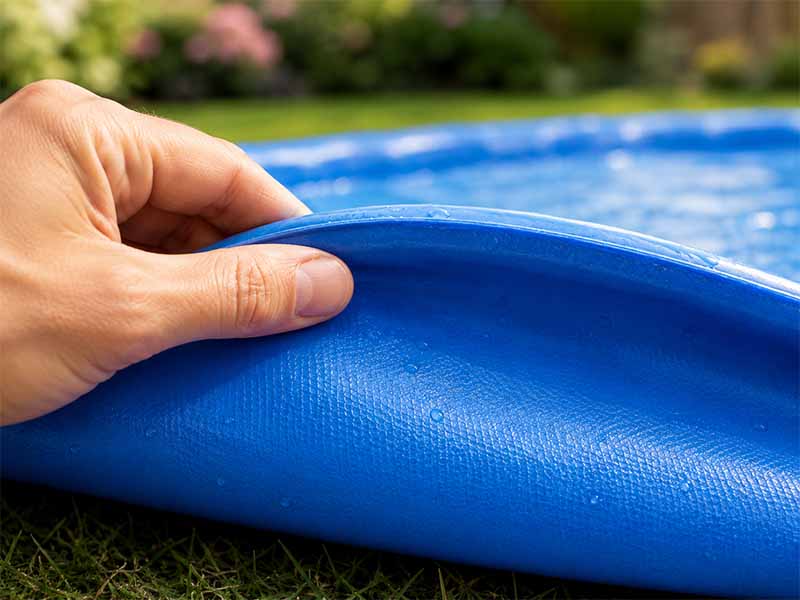
A dog splash pad can look strong in photos and still fail quickly in a real backyard. Dogs do not play gently with water. They step with concentrated paw pressure, turn quickly on wet PVC, scratch at moving spray, drag toys across the center, and sometimes jump directly onto the outer rim. A mat that works for light children’s play may not survive the same way when a 60 lb dog runs across it every weekend in July.
For most backyard dogs, a dog splash pad should be around 0.50–0.55 mm thick. A 0.55 mm PVC dog splash pad is a strong practical choice for repeated summer use because it offers better claw resistance, rim stability, and surface strength than thinner 0.25–0.35 mm splash mats while still staying flexible enough to fold and store.
Thickness matters, but it is not the whole story. A good dog splash pad also needs a non-slip surface, strong edge welding, a stable hose connector, balanced spray holes, and proper setup on clean flat ground. If the pad is used on sharp gravel or with long dog nails, even thick PVC can be damaged. If the seams are weak, a thicker surface alone will not prevent leaks. The best dog splash pad is built for the way pets actually play: excited, wet, fast, and not always careful.
What Is Dog Splash Pad Thickness?
Dog splash pad thickness means the PVC material gauge used in the pad body and water-filled rim. For dog use, thickness affects scratch resistance, rim shape, water pressure stability, folding life, and how secure the pad feels under wet paws. For most backyard dogs, 0.50–0.55 mm PVC is a safer range than thin seasonal mats around 0.25–0.35 mm.
Thickness should not be treated as a single quality score. A thicker dog splash pad can still leak if the seam is narrow, the hose connector is weak, or the pad is placed on sharp ground. A thinner pad may survive light use if the dog is small, calm, and the setup area is clean. The right choice depends on dog weight, nail condition, play style, water pressure, and how often the pad is used during summer.
Many early leaks are not caused by the center surface alone. They often come from the rim, inlet, spray holes, or repeated fold lines. Families who want to understand where water mats usually fail can also read why some splash pads leak easily before choosing a pet-use splash pad.
Is 0.55 mm Dog Splash Pad Enough?
A 0.55 mm dog splash pad is enough for most family dogs when used on flat grass, smooth patio, or a protective ground mat. It gives better resistance against paw pressure, light scratching, and rim stretching than thinner PVC while still staying flexible enough to drain, fold, and store after use.
The thickness difference is easy to understand. A 0.55 mm PVC sheet is about 57% thicker than 0.35 mm PVC and about 120% thicker than 0.25 mm PVC. For pets, that extra material helps reduce the chance of small claw marks turning into early punctures. It also helps the water-filled outer ring hold its shape when hose pressure builds.
| PVC Thickness | Best Use | Dog Use Fit |
|---|---|---|
| 0.25–0.35 mm | Light seasonal splash play | Better for occasional use |
| 0.40–0.50 mm | Calm small pets | Works with clean grass and low pressure |
| 0.50–0.55 mm | Regular backyard dog play | Stronger choice for most families |
| 0.55 mm+ | Large or rough-playing dogs | Better for frequent or heavier use |
A 0.55 mm PVC pad works especially well for medium dogs that play several times a week, large dogs that step heavily without digging aggressively, and families who use the pad on grass or another soft outdoor surface. It also works well when dogs and children share the pad under supervision.
Still, 0.55 mm PVC should not be treated as claw-proof. A dog that digs hard at one spray hole, chews the rim, or jumps onto the pad from a running start can damage even stronger material. Sharp stones, dry roots, rough concrete, and garden debris underneath the pad can also create punctures from below.
EPN uses 0.55 mm PVC as a practical pet-use direction because it balances stronger surface feel, better daily durability, and easier seasonal storage. A pad that is too thin may feel disposable. A pad that is too stiff may be harder to fold and less comfortable for dogs.
Is Thin Dog Splash Pad Risky?
A thin dog splash pad becomes risky when used by active dogs, large dogs, or more than one pet at the same time. PVC around 0.25–0.35 mm can work for light splash play, but it gives less protection against dog nails, uneven ground, repeated folding, and water pressure around the rim.
The problem is not always an instant puncture. Thin PVC often fails slowly. The rim may start to stretch after repeated filling. The surface may wrinkle more when a dog turns. The hose area may feel pulled when water pressure rises. Small scratches may become weak spots after drying and folding several times.
A thin splash pad is more likely to disappoint when a dog weighs over 40–50 lb, two dogs play together, the dog paws at moving water, or the pad is placed on concrete, gravel, or rough patio. High water pressure and wet folding can also shorten the life of thinner PVC.
For a small calm dog that only steps into low spray for cooling, a thinner pad may be acceptable. For a high-energy dog that treats the pad like a water game, thin PVC is a weaker choice. The cost difference may seem attractive at first, but early leaks, poor spray shape, and frustration usually cost more over time.
Material choice should match real use, not product photos. A 0.35 mm dog splash pad on clean grass with a calm 15 lb dog is very different from the same pad used by a 70 lb retriever on a rough patio. For a deeper material comparison, see what material is best for a splash pad.

A durable dog splash pad should feel dense, flexible, and stable. It should not feel like a thin plastic sheet, and it should not feel so stiff that it creates hard crease lines when folded. When the pad is laid flat, the center should settle smoothly. When the outer rim fills with water, it should rise evenly without twisting badly near the hose connector.
A stronger pad usually feels firm in the center, stable at the rim, and slightly textured on the surface. The seam should look even and wide. The hose connector should not pull the pad out of shape. After drying, the material should fold without sharp white stress marks.
Thickness is only one part of the feeling. Surface grip matters because wet paws can slide on smooth PVC. Edge strength matters because dogs often step on the outer ring. Flexibility matters because the pad needs to be folded and stored after summer. A good dog splash pad should feel strong in use but still manageable for one adult to set up, drain, and put away.
Which Dog Splash Pad Lasts?
A dog splash pad lasts longer when its thickness, seam strength, size, surface grip, and setup surface match the way the dog actually plays. For most households, a longer-lasting dog splash pad should use around 0.50–0.55 mm PVC, have reinforced edges, offer enough room for turning, and be used on clean flat grass or a soft outdoor surface.
Longevity is not decided by thickness alone. A thick splash pad can still fail early if it is too small for the dog, placed on rough concrete, used with sharp nails, or filled with too much water pressure. A thinner pad may survive longer than expected if the dog is small, calm, and the ground is clean.
Which Dogs Scratch Dog Splash Pad More?
Some dogs scratch a dog splash pad more because of their play style. Moving water can trigger chasing, digging, pawing, biting, and fast turning. A dog may not be trying to damage the pad. It may simply be trying to catch the spray. That is why a splash pad used by pets needs stronger PVC and better surface stability than a basic summer water mat.
Large dogs over 50 lb, high-energy puppies, water-loving breeds, and dogs that dig at toys or water usually need a stronger pad. Multi-dog households also need better material strength because two dogs create more foot traffic, more turning, and more edge pressure.
A 15 lb calm dog walking slowly through low spray does not create the same pressure as a 70 lb retriever turning quickly on wet PVC. Even when the heavier dog does not scratch on purpose, its paw pressure is stronger. When a large dog pushes off with its back legs, nails can scrape the surface with more force.
| Dog Behavior | Durability Risk | Better Dog Splash Pad Choice |
|---|---|---|
| Calm walking | Low | 0.40–0.50 mm PVC may work |
| Light pawing | Medium | 0.50–0.55 mm PVC |
| Fast turning | Medium to high | 0.55 mm PVC with non-slip surface |
| Digging at spray holes | High | 0.55 mm+ PVC with supervision |
| Two dogs playing | High | Larger pad with reinforced seams |
| Long sharp nails | High | Trim nails before use |
Nail condition is one of the biggest durability factors. A dog with rounded, trimmed nails is much easier on PVC than a dog with long nails that click loudly on hard floors. For frequent summer play, nail trimming before the season and light checks every 2–3 weeks can help reduce surface marks.
Which Dog Splash Pad Leaks Less?
A dog splash pad leaks less when the material and structure are designed to handle water pressure and paw movement together. Many leaks do not start in the center of the mat. They often appear around the outer rim, hose connector, spray holes, folded corners, or areas where the pad rubs against sharp ground.
A stronger leak-resistant pad usually combines 0.50–0.55 mm PVC, wider welded edges, a reinforced hose inlet, even spray-hole placement, stable rim shape, and a non-slip surface. The hose connector deserves extra attention because it receives both water pressure and pulling force. If the hose is twisted or stretched, the inlet area can become stressed before the dog even starts playing.
| Leak Area | Common Cause | How To Reduce Risk |
|---|---|---|
| Hose inlet | Twisted hose, pulling force, high pressure | Connect straight and start water slowly |
| Outer rim | Overpressure or repeated paw stepping | Use moderate pressure and a larger pad |
| Spray holes | Digging, biting, uneven pressure | Stop repeated pawing at one area |
| Bottom surface | Stones, roots, rough patio | Use clean grass or a protective mat |
| Fold lines | Wet storage or tight folding | Dry fully and fold loosely |
| Seam edge | Weak bonding or sharp ground stress | Choose wider welded edges |
Most dogs do not need extreme spray height. Moderate water pressure is usually better for durability, comfort, and cleaner backyard use. A tall spray may look exciting, but too much pressure can over-expand the rim, tilt the spray holes, and stress the seam.

Dog splash pad size affects durability more than many families expect. If the pad is too small, dogs step on the rim more often, turn in tight circles, and put repeated pressure on the same edge area. A larger pad gives dogs more room to move across the center instead of crowding the outer ring.
| Dog Size / Use Case | Suggested Pad Size | Suggested Thickness | Why It Lasts Better |
|---|---|---|---|
| Small calm dog under 25 lb | 43–59 in | 0.40–0.50 mm | Less paw pressure and slower movement |
| Medium dog 25–50 lb | 59–75 in | 0.50–0.55 mm | More room for turning and walking |
| Large dog 50–90 lb | 67–87 in+ | 0.55 mm | Reduces repeated rim pressure |
| Two dogs | 75–95 in+ | 0.55 mm+ | More space and less crowding |
| Dog and child shared play | 75–95 in+ | 0.55 mm | Better for mixed movement and repeated use |
Size should also match the yard. A large pad placed on uneven ground may perform worse than a smaller pad placed on clean flat grass. Before buying, families should measure the available space and leave extra room around the pad for safe entry and exit. Dogs should not have to jump directly onto a wet surface from a hard patio or narrow walkway.
For long-term value, how to choose a splash pad that lasts more than one summer can help connect thickness, setup, storage, and material quality into one clearer decision.
How Does Dog Splash Pad PVC Matter?
Dog splash pad PVC matters because it decides how well the pad handles paw pressure, nail scratches, water pressure, sun exposure, folding, and repeated backyard use. For dogs, PVC should not only be thick. It should also be flexible, low-stretch, non-slip, well-welded at the edges, and strong enough to keep the rim stable when water runs through it.
A dog splash pad is different from a simple water play mat. It has to carry water through the outer ring, spray from small holes, stay flat in the center, and survive excited dogs stepping, turning, and pawing at moving water. When the PVC is too thin or too soft, the surface may wrinkle, the rim may stretch, the hose area may pull, and the pad may start leaking after only a few uses.
How Dog Splash Pad PVC Handles Paws
Dog splash pad PVC needs to handle concentrated paw pressure. Dogs do not step like people. A child’s foot spreads weight over a larger flat area, but a dog’s paw presses through smaller pads. When a dog runs, stops, or turns, part of its body weight may shift onto one or two paws for a short moment. That creates stronger pressure on a smaller area of PVC.
For example, a 70 lb dog standing still spreads weight across four paws. During turning or jumping, much more force can move to the front paws or back paws. If the dog also uses its nails to grip the wet surface, the PVC receives pressure and scraping at the same time. That is why thin material can wrinkle, stretch, or show claw marks faster.
PVC around 0.55 mm gives the pad more resistance against this kind of use. It has more material between the dog’s nails and the inner water chamber, so small scratches are less likely to become instant punctures. It also helps the center stay flatter when the dog steps across the pad.
| Dog Movement | PVC Stress Level | What Helps |
|---|---|---|
| Slow walking | Low | 0.40–0.50 mm PVC may work for small dogs |
| Standing in water | Low to medium | Flat ground and low spray pressure |
| Fast turning | Medium to high | 0.55 mm PVC and textured surface |
| Jumping onto pad | High | Larger pad and controlled entry |
| Digging at spray holes | Very high | Trimmed nails and supervision |
| Two dogs playing | Very high | Larger size, 0.55 mm PVC, reinforced rim |
PVC thickness cannot replace good use habits. A dog splash pad lasts longer when nails are trimmed, hard chew toys are kept away, and the dog is discouraged from digging at one spray hole. For active dogs, a non-slip surface is just as important as thickness. If the pad is too smooth, wet paws may slide, and the dog may scratch harder while trying to regain balance.
How Dog Splash Pad Seams Hold Water
Dog splash pad PVC also matters at the seams. The seam is where the PVC sheets are joined together to form the water-filled rim. A strong seam keeps water inside the ring, supports the spray holes, and helps the pad hold shape while the hose is running. If the seam is weak, the pad may leak even when the PVC surface itself is thick.
Most leaks do not start in the clean middle area. They often appear around the outer edge, folded corners, hose connector, or spray-hole line. These areas receive more stress because water pressure pushes from the inside while dogs step from the outside. A narrow seam may not give enough bonding area to handle repeated pressure.
Good dog splash pad seams should look even, wide, and clean. The rim should fill smoothly without one side ballooning too much. The seam should not show open gaps, rough edges, peeling lines, or uneven bonding marks. When water pressure increases, the rim should stay controlled instead of twisting hard near the hose connector.
For EPN dog splash pad development, PVC thickness and seam structure are considered together. A thicker material gives the seam more body to hold, while a wider welded edge gives the rim better support. This matters because dogs often step on the outer ring when entering, leaving, or chasing water.

Dog splash pad PVC is often exposed to direct sun, warm ground, and repeated wet-dry cycles. Summer use can be tough on plastic materials. Heat can soften the surface during play, while UV exposure can slowly reduce flexibility if the pad is left outside for long periods. PVC quality matters beyond thickness.
A dog splash pad may only be used for 20–40 minutes at a time, but many families leave it on the lawn or patio for hours after play. If the pad stays under strong sun all afternoon, the PVC may age faster. Over time, poor-quality material may become stiff, faded, sticky, or easier to crack along fold lines.
Thicker PVC gives more physical material, but better outdoor performance also depends on formulation and care. Pet owners can protect the pad by draining it after use, rinsing off grass and dirt, drying it in shade when possible, and storing it indoors or in a deck box after it is fully dry.
For EPN, outdoor water products are developed with real seasonal use in mind. Children’s splash pads, dog splash pads, pet pools, inflatable pools, and pool accessories all face sunlight, water pressure, and storage stress. For dog splash pads, the material needs to stay strong enough for paws while still folding without cracking after summer use.
Can Dog Splash Pad Use Grass?
A dog splash pad can be used on grass, and clean flat grass is often the best surface for everyday backyard water play. Grass gives the PVC a softer base, reduces underside rubbing, and helps wet paws step on and off more comfortably. The key is to use short, clean, level grass without stones, roots, thorns, toys, or sharp garden debris underneath.
Grass is not automatically safe just because it looks soft. A dog splash pad can still leak if a hidden stick, sprinkler head, dry root, or small rock presses into the underside while a dog steps on top. For most homes, the best setup is a flat lawn area with grass trimmed to about 1–3 inches, moderate water pressure, and enough space around the pad for dogs to enter and exit without jumping.
Can Grass Protect Dog Splash Pad PVC?
Grass can help protect dog splash pad PVC because it works like a natural cushion between the pad and the ground. Compared with rough concrete, gravel, or brick patio edges, grass creates less friction against the underside of the pad. This matters more for dogs than many people expect because dogs move quickly, push off with their paws, and may step heavily near the rim.
The best grass surface is short, clean, and level. A lawn height around 1–3 inches works better than long grass because it lets the pad sit flat while still providing cushion. The ground should be free from exposed roots, sharp stones, thorny weeds, hard pet toys, garden tools, raised sprinkler heads, and steep slopes.
Before setup, spend 2–3 minutes walking the area by hand and foot. This small step can prevent many punctures. Soft grass is helpful, but hidden hard objects still matter.
Customers who plan to use the pad mainly on lawn can also read can you use a splash pad on grass for more setup details around lawn height, drainage, mud control, and safe placement.
Can Rough Ground Damage Dog Splash Pad?
Rough ground can damage a dog splash pad quickly, even when the pad uses thicker PVC. The most common underside hazards are not always obvious. Small stones, dry roots, sharp mulch, broken patio edges, old nails, deck splinters, and rough concrete can press into the material from below. When a dog steps or turns on top of that pressure point, the PVC receives force from both sides.
| Surface Type | Dog Splash Pad Risk | Better Setup Choice |
|---|---|---|
| Short flat grass | Low | Best daily backyard option |
| Smooth patio | Medium | Use only if surface feels gentle by hand |
| Rough concrete | High | Add a soft ground mat underneath |
| Gravel | Very high | Avoid for dog splash pad use |
| Sharp mulch | Very high | Avoid completely |
| Uneven lawn with roots | High | Move to a flatter area |
| Wooden deck | Medium to high | Check for splinters, screws, and gaps |
| Artificial turf | Medium | Check heat level and hidden seams |
A simple hand test can help. Rub your palm across the setup surface. If it feels sharp, gritty, splintered, or uneven, it may wear the PVC faster. For patios, a soft protective mat underneath can reduce friction. For grass, clear the space and make sure the pad is not sitting across a hard ridge or exposed root.

Setup can reduce dog splash pad leaks more than thickness alone. A strong 0.55 mm dog splash pad can still leak early if it is dragged across rough ground, filled at full water pressure, folded while wet, or used over hidden debris.
A better routine is simple: clear the lawn for 2–3 minutes, unfold the pad fully, check the underside, connect the hose without twisting, and turn the water on slowly. Start with low to medium pressure and watch the rim fill. If one side bulges, spray points outward, or the edge lifts unevenly, lower the pressure and adjust the pad.
Drainage also matters. After play, water may collect around the pad and make the lawn muddy. Mud can make dogs slip when they run off the pad and can carry dirt onto the PVC surface. Moving the pad slightly between uses can help protect the lawn and reduce muddy wear around the entry area.
How To Choose Dog Splash Pad Thickness?
Choose dog splash pad thickness by looking at the dog’s weight, nail condition, play style, use frequency, ground surface, and storage habits. For most homes, 0.50–0.55 mm PVC is the safest practical range. A 0.55 mm dog splash pad gives better resistance against paw pressure, light scratching, rim stretching, and repeated summer use without becoming too stiff to fold and store.
The wrong thickness usually shows up in small problems first. The rim may twist. The surface may wrinkle. The hose area may pull. A small claw mark may become a leak. The dog may slip because the pad no longer lies flat. Choosing the right thickness early helps avoid these problems and gives families a better summer play experience.
Do Small Dogs Need Dog Splash Pad Thickness?
Small dogs do not always need the thickest dog splash pad, but they still need enough material strength for safe and repeated use. A calm dog under 25 lb may use a 0.40–0.50 mm PVC splash pad comfortably if the pad is placed on clean grass and the water pressure stays low to moderate. However, if the small dog scratches, digs, jumps, or plays every day, moving closer to 0.55 mm PVC is a smarter choice.
| Small Dog Use Case | Suggested Thickness | Better Choice |
|---|---|---|
| Calm dog, occasional cooling | 0.40–0.50 mm | Light pet splash pad |
| Daily summer play | 0.50–0.55 mm | Stronger PVC surface |
| Dog scratches at water | 0.55 mm | Textured surface and supervision |
| Dog shares with kids | 0.55 mm | Larger pad with reinforced edge |
| Senior small dog | 0.40–0.55 mm | Non-slip surface matters most |
Small dogs are lighter, but that does not mean they cannot damage PVC. Many small breeds are quick, energetic, and curious around moving water. Some will paw at the spray holes again and again. Others may bite at the rim or dig at the center when excited.

Big dogs need more dog splash pad thickness because they put more pressure on the surface, seams, and rim. A dog over 50 lb can create strong force when stepping, turning, stopping, or jumping near the edge. For regular large-dog use, 0.55 mm PVC should be treated as the practical starting point.
Large dogs also need more room. A thick but undersized dog splash pad can still wear out quickly. If a 70 lb dog only has a small play area, it may step on the rim every few seconds. The seam receives more stress, the spray pattern may shift, and the pad may move on the ground. A larger pad spreads movement across more surface area and reduces repeated pressure on one point.
For one large dog, a 67–87 inch pad or larger is usually easier to use. For two dogs, 75–95 inches or larger gives more room for movement. The pad should also have a non-slip surface, wider welded edge, reinforced hose inlet, moderate spray pressure, and clean grass setup.
Are Thicker Dog Splash Pads Better?
Thicker dog splash pads are usually better for durability, but the thickest pad is not always the best pad. A splash pad that is too stiff may be harder to fold, slower to flatten after storage, and less comfortable under paws. A good dog splash pad should feel strong without feeling rigid.
For most homes, 0.55 mm PVC is a strong middle point. It is noticeably stronger than thin 0.25–0.35 mm splash mats, but it still stays manageable for everyday use. Families can drain it, dry it, fold it, and store it without needing a large storage space.
| Thickness Choice | Main Advantage | Possible Concern | Best Fit |
|---|---|---|---|
| 0.25–0.35 mm | Lightweight and low cost | Easier to scratch or stretch | Occasional light play |
| 0.40–0.50 mm | Better than thin mats | May not suit large active dogs | Small calm pets |
| 0.50–0.55 mm | Strong daily-use balance | Needs proper drying and storage | Most family dogs |
| 0.55 mm+ | Stronger resistance | May feel heavier or stiffer | Large or rough-playing dogs |
EPN dog splash pads focus on practical pet-use balance because real durability comes from material, structure, and use habits working together.
How To Order EPN Dog Splash Pad?
Ordering an EPN dog splash pad starts with the use case. A backyard pet cooling pad, an Amazon-ready summer listing, a retail pet product, and a private-label outdoor line may all need different sizes, material choices, artwork, packaging, and production plans. Epsilon can support both EPN branded product orders and custom dog splash pad development.
For ready pet water play solutions, EPN offers dog splash pad options designed around outdoor family use, pet cooling, stronger PVC structure, and convenient seasonal storage. For sellers, retailers, and distributors, EPN can help match product specifications to market needs, price range, and channel requirements.
For OEM/ODM projects, Epsilon can adjust PVC thickness, diameter, shape, surface texture, spray-hole layout, hose connector style, private-label artwork, retail packaging, multilingual instructions, barcode labels, carton labels, and pet-focused positioning based on the target market. Sample development, small test orders, and scaled production planning can also be arranged according to project timing and order size.
A stronger dog splash pad is not only about one material number. It is the result of better PVC, better seams, better spray control, better setup guidance, and better product development. For most customers, 0.55 mm PVC is the right starting point. For brands and project clients, Epsilon can help turn that starting point into a complete product ready for market.
To order EPN branded dog splash pads or request a custom pet splash pad quotation, contact Epsilon with your target size, market, quantity, packaging needs, and preferred timeline.