Skip to content

How to Keep a Dog Pool From Sliding
# Your Trusted Inflatable Supplier In US

A dog pool that moves every time your dog jumps in can turn a simple summer activity into a frustrating backyard problem. On wet patios, smooth decking, tile, or uneven grass, a portable pool may slowly shift as a dog walks, turns, splashes, or pushes against the sidewall. With medium and large dogs, the effect can become much more noticeable because their movement creates considerable sideways force even when the pool already contains a useful amount of water.
The important first step is understanding what is actually sliding. Sometimes the whole pool is moving across the ground. In other cases, the pool remains exactly where it was placed while the dog’s paws lose traction on a smooth wet floor. These two situations look similar during active play, but they need different solutions.
To keep a dog pool from sliding, set it on a clean, level surface with enough friction, flatten the bottom before filling, use a suitable non-slip or protective underlay when necessary, and fill the pool to its normal working depth. If the pool stays still but the dog slips inside, focus instead on interior traction using a textured floor or a compatible water-safe non-slip mat.
Repeated movement is worth correcting rather than simply tolerating. When a flexible PVC bottom rubs back and forth over rough concrete or trapped debris, the same small area may experience repeated abrasion. A shifting pool can also leave wrinkles in the floor, place uneven pressure against foldable sidewalls, or move toward furniture, steps, fences, or other objects nearby.
Picture a Labrador entering a shallow pool on a wet patio. The dog turns quickly, its rear paws push sideways, and the entire pool moves a few inches. Adding an anchor may seem like the obvious solution, but the real cause may be nothing more complicated than a smooth surface, too little initial water weight, and a wrinkled base. Solving those basics first usually produces a safer and cleaner result.
Why Does a Dog Pool Slide?
A dog pool usually slides when there is too little friction between the pool bottom and the ground, the surface is uneven or wet, the bottom has not been flattened properly, or the dog creates enough horizontal force to overcome the available grip. Shallow water can make the problem more noticeable because the pool has less stabilizing weight during active play.
What Makes a Dog Pool Move?
The most common cause is the relationship between the bottom material and the ground underneath it. Flexible PVC can sit securely on textured grass or a high-friction mat but behave very differently on smooth tile, polished concrete, composite decking, or a thin plastic tarp. Once splash water reaches those surfaces, friction can decrease enough for the entire pool to shift when a dog turns or pushes against one side.
Small amounts of debris can make the situation worse. Fine sand, soil, grass clippings, leaves, pet hair, algae, or other loose material can form a thin moving layer beneath the pool. Sand is especially easy to overlook because only a small amount may be present, yet individual grains can reduce stable surface contact between smooth materials.
Storage folds are another practical issue with collapsible pools. A pool that has been folded for shipping or storage may not immediately lie completely flat. If it is filled while several large creases remain underneath, the water load is concentrated along those raised areas rather than spread evenly across the full floor. The pool may then pivot or move around those contact points.
Outdoor drainage slopes also matter. Many patios and decks are deliberately built with a slight fall so rainwater moves away from buildings. A surface can look flat to the eye while still encouraging a lightly filled dog pool to creep gradually toward the lower side during energetic play.
Does Water Depth Affect Stability?
Water can add substantial stabilizing weight. One US gallon of water weighs roughly 8.34 pounds, or about 3.78 kilograms. This means even a modest amount of water can change how firmly a portable pool sits against the ground. The effect is especially noticeable when comparing an almost-empty pool with the same pool filled to a normal shallow play depth.
| Water Volume | Approx. Water Weight | Practical Effect |
|---|---|---|
| 5 gal | 42 lb / 19 kg | Limited added stability |
| 10 gal | 83 lb / 38 kg | Noticeably harder to move |
| 25 gal | 209 lb / 95 kg | Strong stabilizing load |
| 50 gal | 417 lb / 189 kg | Very high stationary load |
Water weight alone should not be treated as the solution. A pool on a severely sloped patio or slippery plastic tarp may still move even when it contains substantial water. More importantly, portable pools should be used within their intended fill range rather than filled unusually high simply to increase weight.
Very shallow water is often where movement becomes most obvious. A dog can still create significant lateral force, but there may only be a small amount of downward water load holding the pool in position. Once a normal working depth is reached, the same pool may become noticeably more stable without any other changes.

Do Large Dogs Make Pools Slide More?
Large dogs can expose an unstable setup faster because their movements often create more horizontal force. However, weight is only part of the equation. An 80-pound dog standing calmly in shallow water may barely affect the pool, while a much smaller energetic dog that repeatedly runs in, spins around, and jumps out can cause considerable movement.
Direction of movement matters as well. Water mainly adds downward load, which helps press the pool against the ground. A dog’s paws can push sideways against the floor and walls. When the underlying surface has limited friction, that sideways force can move the entire pool even though the pool feels heavy when someone tries to lift it.
Usable floor space is equally important for larger breeds. If a dog cannot comfortably turn without leaning against the perimeter, the sidewall is repeatedly used as a brace. That transfers additional force into the pool structure. A larger diameter gives the dog more space to stand, change direction, and exit without constantly pushing against the walls.
For medium and large breeds, stability is therefore better evaluated as a combination of floor area, ground friction, water depth, wall support, and the dog’s typical movement rather than by body weight alone.
Is the Pool or the Dog Actually Sliding?
Before buying a mat or changing the setup, watch the pool for several minutes during normal use. Choose a patio joint, deck board, edge of a mat, or another fixed reference point and note the pool’s starting position. If the pool moves relative to that point, the external setup needs attention.
If the pool remains in exactly the same location while the dog’s feet slide across the bottom, the main issue is interior traction. Adding another under-pool layer will not necessarily improve the dog’s footing because the friction problem is occurring on the opposite side of the PVC.
Both problems can occur together. When a dog loses footing, it may push harder against the floor or wall to regain balance. That additional force can then move an already marginally stable pool. This is why separating the two problems is useful before making changes.
A good setup should satisfy two independent tests: the pool should remain reasonably stationary on the ground, and the dog should be able to stand, turn, and exit without repeatedly scrambling for traction.
What Should You Put Under a Dog Pool?
A good dog-pool underlay should remain flat when wet, support the complete pool base, protect flexible PVC from rough surfaces, and provide enough friction to reduce movement. Textured rubber mats and purpose-made pool ground pads are practical choices on many hard surfaces. Ground cloths can protect against dirt and abrasion, but very smooth plastic tarps may increase sliding on wet concrete or tile.
Are Rubber Mats Good Under Dog Pools?
A dense textured rubber or rubber-like outdoor mat is often useful on hard surfaces because it can perform two jobs at once. It creates a more stable contact layer beneath the pool and separates flexible PVC from abrasive concrete, paving stones, or deck boards. This is particularly useful when the pool is used repeatedly in the same location.
The mat should support most or all of the floor rather than only several isolated points. Water distributes substantial weight over the entire pool base, so broad and even support is preferable to several small pads. Individual pieces with thick beveled edges can create noticeable height changes under flexible PVC if they are not positioned carefully.
A thicker mat is not automatically better. Very soft foam can compress differently under the middle and perimeter of a heavily loaded pool. A thinner but denser outdoor mat may provide more consistent support and better grip. Wet performance is also more important than how grippy the material feels when dry.
Before long-term use, check whether the mat remains stable in summer heat and whether it leaves any sticky, oily, or colored residue. After each session, lift the pool or mat when practical so trapped water can dry rather than remaining sealed between two waterproof surfaces.

Can You Use a Ground Cloth?
A ground cloth can be helpful when base protection is the primary goal. On lawns, it can reduce direct contact with soil, mud, rough grass stems, and small debris. On hard ground, it can prevent repeated rubbing between the PVC floor and coarse concrete or paving.
The limitation is that protection and traction are not the same thing. A smooth polyethylene tarp may protect the bottom from dirt but provide poor friction against smooth concrete. Once water reaches the tarp, the pool and tarp can sometimes move together as a single layer.
A suitable ground cloth should be durable, water-resistant, and large enough to support the entire pool footprint. It should also be stretched flat before filling begins. Large folds, doubled sections, or loose corners under the water-loaded portion of the pool can create pressure ridges or allow the base to move independently.
On grass, a woven ground sheet may be sufficient because the lawn itself already provides texture. On polished patios or tile, a more heavily textured rubberized layer is generally more useful when movement is the main concern.
What Materials Should You Avoid?
Thin plastic tarps are often the first material people reach for because they are cheap and easy to store. They can be useful as a dirt barrier, but they may perform poorly as an anti-slip solution. Smooth plastic against wet tile, polished concrete, or another smooth surface can move more easily than the original pool bottom.
Loose gravel, crushed stone, broken paving, exposed tree roots, metal edges, and other irregular hard materials should also be avoided. Flexible PVC conforms to the surface below it. Once tens or hundreds of gallons of water are added, a small stone can carry much more localized pressure than it would beneath an empty pool.
Household rugs and thick absorbent carpets are not ideal for repeated outdoor use either. They can hold large amounts of water along with pet hair, soil, and organic debris, making drying and cleaning more difficult.
| Under-Pool Material | Grip Potential | Base Protection | Main Limitation |
|---|---|---|---|
| Textured rubber mat | High | High | Needs ventilation after use |
| Pool ground pad | Medium to high | High | Check compatibility and grip |
| Woven ground cloth | Medium | High | Can wrinkle if installed loosely |
| Smooth plastic tarp | Low | Medium | Can become slippery when wet |
| Outdoor carpet | Medium | Medium | Holds water and debris |
| Gravel or rough stone | Unpredictable | Low | Abrasion and pressure points |
The simplest test is practical: the material should stay flat, remain reasonably stable when wet, contain no sharp projections, and be easy enough to clean and dry after repeated use.
Does the Underlay Need to Be Larger Than the Pool?
The underlay should cover the complete contact area of the pool so no part of the loaded bottom rests unexpectedly on a rough or slippery transition. Extending it slightly beyond the edge makes positioning easier and provides some tolerance if the pool is not perfectly centered.
There is little advantage in leaving several feet of smooth underlay exposed around the perimeter. Once water begins splashing, a large wet tarp or smooth mat surrounding the pool can become a walking hazard for dogs and people. The goal is full support underneath the pool rather than creating a second floor around it.
Interlocking mats can be practical for large pools, but their joints should remain flat. A raised connection running through the center of the floor may form a pressure line under the PVC after water is added. When possible, position seams where they are least likely to create a noticeable ridge.
The best underlay is therefore not necessarily the largest or thickest option. Full coverage, stable wet grip, easy drainage, and even support are more important.
How Do You Stop a Dog Pool From Moving?
Start with the ground rather than trying to anchor the pool. Clean and level the setup area, fully unfold the pool, smooth major bottom creases, use a flat high-friction protective layer where necessary, and fill the pool gradually to its normal working depth. Once it is filled, observe how the dog enters, turns, and exits before deciding whether any further adjustment is necessary.
How Do You Level the Pool Area?
Inspect an area slightly larger than the complete pool footprint. On hard surfaces, sweep away stones, dirt, sand, leaves, and other debris. On grass, use your hands and feet to check for hidden roots, sprinkler components, holes, sticks, or uneven patches that may not be obvious from above.
A shallow-water test can reveal slope more accurately than visual inspection. After covering the bottom with roughly one or two inches of water, look at the depth around the perimeter. If most of the water immediately collects against one wall, the surface is noticeably uneven even if it looked flat when empty.
Moving the pool to another location is generally preferable to placing bricks, wooden boards, individual tiles, or other hard objects underneath one side. Those materials can create abrupt changes in height and concentrate pressure across narrow parts of a flexible floor.
On lawns, small depressions can be corrected before setup by addressing the ground itself. On patios, a different section may have a gentler drainage fall. The objective is not perfect laboratory-level flatness, but a surface where water and structural load are reasonably even across the pool.

How Do You Increase Grip Under the Pool?
Start by cleaning both the setup surface and the bottom of the pool. Fine dust and sand can reduce friction surprisingly well, particularly between two smooth surfaces. Mud, algae, sunscreen, soap residue, or other organic material may have a similar effect after the area becomes wet.
Next, unfold the pool completely before adding substantial water. Work obvious storage folds toward the perimeter and allow the flexible floor time to relax. Add only a shallow layer of water at first, pause, and smooth remaining wrinkles while the base is still easy to move.
If the pool continues to shift on tile, concrete, or smooth decking, place a suitable textured underlay beneath the complete floor. Mechanical grip from surface texture is generally more practical than trying to permanently attach a portable pool to the ground.
A reliable setup sequence is:
- Inspect and clean the area.
- Place the selected protective or anti-slip layer.
- Fully unfold the dog pool.
- Smooth the floor outward.
- Add a shallow layer of water.
- Remove remaining wrinkles.
- Continue to the intended play depth.
- Observe the first few minutes of use.
Avoid applying household construction adhesives, solvent-based coatings, or aggressive anti-slip tapes directly to flexible PVC unless their compatibility with that specific material has been confirmed.
Do You Need to Fill the Pool More?
If a pool contains only a very thin layer of water, bringing it to a suitable normal play depth can improve stability considerably. Water adds downward load, increasing the force pressing the base against the ground. Where the underlying surface already provides reasonable friction, this can make the pool much more resistant to movement.
The effect can be substantial. Ten gallons add roughly 83 pounds of water, while 25 gallons add just over 200 pounds. That is why a pool may seem easy to push during initial filling but noticeably more planted later in the session.
The key is staying within the pool’s appropriate fill range. Overfilling a portable foldable pool simply to add weight can increase pressure on its sidewalls and seams. A poor surface should be corrected at the surface rather than compensated for by excessive water.
Water depth should also suit the dog. Smaller, older, or hesitant dogs may be more comfortable in shallower water. In those cases, choosing a better underlay and surface becomes more important because there is less water weight available to stabilize the pool.
How Do You Stop Shifting During Play?
Once the pool is stable while empty and during filling, observe how the dog approaches it. Repeated entry from the same direction can cause the dog to push against one wall every time it turns or exits. Positioning the pool in a more open area may allow a calmer, straighter path into and out of the water.
Dogs that are unfamiliar with foldable pools often benefit from a slower first session. Allow the dog to step over the wall and explore the water rather than immediately encouraging running jumps with toys. This gives the dog time to understand the floor texture and wall height.
Interior dimensions make a practical difference. A dog that can comfortably turn without pressing against the perimeter transfers less repeated force into the sidewalls. This is especially relevant for medium and large breeds, where a pool may technically be big enough for standing but still too restrictive for active turning.
A stable wall structure helps as well. Foldable dog pools commonly use individual rigid or semi-rigid panels inside flexible sidewalls. These panels help the perimeter retain its shape while still allowing the product to collapse for transport and storage.
Which Surface Is Best for a Dog Pool?
A firm, level lawn is often one of the most forgiving dog-pool surfaces because it combines natural texture with some cushioning. Concrete, patios, decks, and artificial turf can also work when they are level, clean, well drained, and protected where necessary. No single surface is best everywhere; grip, abrasion, heat, drainage, and structural support should be considered together.
Is Grass Good for a Dog Pool?
A healthy, firm lawn usually provides more natural friction than smooth tile or polished concrete. Grass also creates a slightly softer layer beneath flexible PVC, so minor movement is less likely to produce the same abrasive rubbing that can occur on coarse hard ground.
The main concern is what cannot immediately be seen. Before setting up the pool, inspect the complete footprint for stones, sticks, pinecones, hard roots, irrigation components, holes, and sharp plant stems. A small object hidden by long grass can become a concentrated pressure point when the pool is filled.
Ground condition can change after use as well. Draining tens of gallons of water into the same area can soften soil, create muddy low spots, or allow one section to settle. A location that was stable early in the season may become less level after repeated sessions.
For frequent use, allow the ground and pool bottom to dry between sessions. A woven protective sheet can reduce mud transfer where necessary, provided the sheet itself remains flat and does not introduce a new slippery layer.

Can You Put a Dog Pool on Concrete?
Concrete can provide an excellent firm foundation, especially when it is level and clean. The disadvantage is abrasion. Coarse concrete contains surface texture and exposed aggregate, and repeated movement under a water-loaded flexible PVC floor can wear the same area over time.
Sweep the entire footprint carefully before setup. A single trapped pebble is more concerning under a pool containing hundreds of pounds of water than beneath an empty pool because the load becomes concentrated around a much smaller contact area.
A dense ground pad or textured rubber mat can reduce direct rubbing while also improving grip. If using a mat, make sure it remains stable after water reaches the patio rather than judging it only when dry.
Temperature should also be considered. Sun-exposed concrete can become uncomfortable for paws and can heat the underside of a pool before it is filled. During hot weather, shade or a cooler section of the patio may provide a more comfortable setup.
Concrete is therefore not a poor choice. It simply requires more attention to surface preparation and base protection than a clean lawn.
Can You Use a Dog Pool on a Deck?
A deck offers a convenient, clean area close to the house, but the combined load should be considered before placing a large pool on an elevated structure. Water is heavy, and the total load includes the water, pool, dog, and anyone standing nearby.
For perspective, 50 gallons of water alone weigh roughly 417 pounds. Larger dog pools may hold considerably more depending on diameter and operating depth. If an elevated deck is older, damaged, or of uncertain structural capacity, it should not automatically be treated the same way as ground-level concrete.
Surface material also affects traction. Natural wood may provide reasonable texture but can become slippery when algae or mildew develops. Composite boards vary widely in surface finish and may feel much slicker after splashing.
Drainage is another consideration. Water can flow between boards, but that does not mean surrounding surfaces remain safe. The walking route into and out of the pool should remain clear, and protective mats should not trap moisture against timber for extended periods.
What About Patios and Artificial Grass?
Patios vary more than the word suggests. Rough outdoor pavers may provide useful friction, while polished stone or glazed tile can become extremely slippery after splash water spreads beyond the pool. When using a smooth patio surface, a textured under-pool layer is generally more useful than a thin plastic sheet.
Artificial turf often offers reasonable friction and some cushioning, but it should still be inspected carefully. Seams, hidden fasteners, hard edging, drainage channels, or uneven substrate can form raised areas below a flexible pool. The turf should also allow water to drain rather than holding it directly under the base.
| Surface | Typical Wet Grip | Abrasion Concern | Main Setup Check |
|---|---|---|---|
| Natural grass | Medium to high | Low | Roots, stones and soft soil |
| Concrete | Medium | High | Debris and bottom protection |
| Smooth tile | Low | Low to medium | Wet traction |
| Wood deck | Medium | Medium | Load, algae and drainage |
| Composite deck | Low to medium | Low to medium | Wet surface behavior |
| Artificial turf | Medium to high | Low to medium | Seams, edging and drainage |
Whatever surface is used, evaluate it after water is introduced. A patio that feels perfectly safe while dry may behave very differently after a dog has splashed around it for ten minutes.
How Do You Keep Dogs From Slipping Inside?
When the pool stays in position but the dog’s feet slide, the solution needs to improve traction inside the pool. A clean textured PVC floor, suitable water depth, calm entry, and a compatible water-resistant non-slip mat can all help. Any insert should remain flat under water and should not float, curl, bunch, create a raised edge, or catch the dog’s claws.
Does a Textured PVC Bottom Improve Grip?
A textured PVC floor can provide better paw traction than a completely smooth wet sheet because the embossed pattern creates more surface variation beneath the paws. The improvement can be useful during turning and standing, particularly when a dog first enters shallow water.
Texture should not be described as completely slip-proof. Mud, pet hair, algae, shampoo, body oils, and rapid movement can reduce grip on almost any wet surface. A textured floor still needs regular rinsing and cleaning if the pool is used frequently.
The design of the texture also matters. Extremely aggressive patterns may trap dirt or feel uncomfortable, while a very shallow pattern may provide little practical difference. For foldable pet pools, embossed flexible PVC is useful because it can combine waterproofing, flexibility, cleanability, and paw traction without requiring a separate coating.
In more robust foldable designs, floor material and wall structure perform different jobs. For example, selected EPN dog-pool configurations use approximately 0.55 mm PVC together with approximately 5 mm PP structural panels and a textured interior floor. The PVC contributes flexibility and water containment, while the panels support the sidewall shape and the texture addresses wet-floor grip.

Can You Put a Non-Slip Mat Inside?
A suitable non-slip mat can be useful when a dog is uncomfortable on the existing floor, particularly for animals that move cautiously or have difficulty finding secure footing. The mat needs to perform well while submerged or partially submerged, not merely feel grippy when dry.
Choose a material that remains flat and does not float when the water is disturbed. Curling corners and loose sections can create more instability than the original floor. One appropriately sized mat is often easier to manage than several small pieces because it reduces the number of exposed edges.
Check openings carefully if the mat uses holes for drainage. They should not be large or irregular enough to catch claws during turning or play. The mat should also avoid blocking the pool drain in a way that makes emptying difficult.
After each session, remove and rinse the insert. Pet hair, dirt, skin oils, and other material can collect between the mat and PVC floor. Allowing both surfaces to dry helps keep the pool easier to maintain over repeated summer use.
Which Pool Features Improve Stability?
Dog-pool stability is not created by one feature labeled “non-slip.” The floor, walls, seams, panels, drainage system, material thickness, and overall dimensions all influence how the pool behaves when a dog moves inside it.
The floor needs to lie flat and resist ordinary wear. The sidewalls need enough support to maintain their shape when a dog leans against them. Drains should allow water to be removed without requiring the owner to repeatedly drag or tip a heavy pool across the ground.
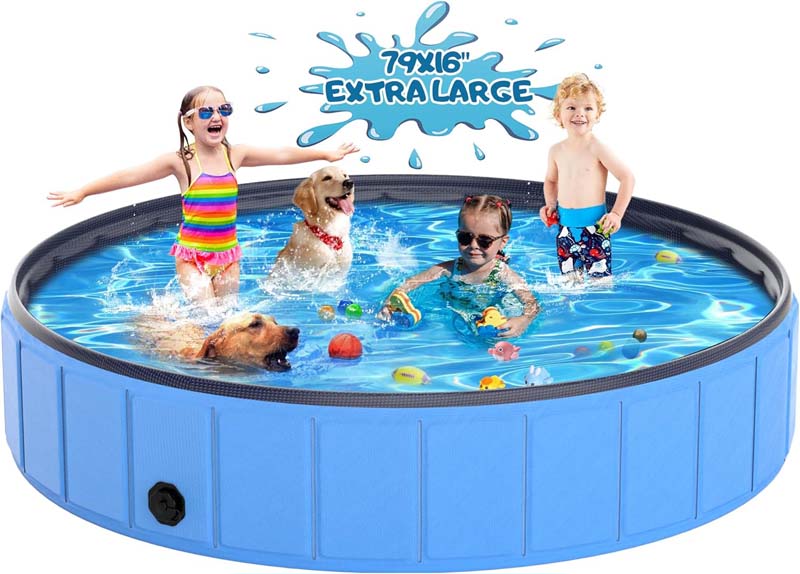
Foldable dog pools frequently use segmented PP or similar rigid support boards enclosed by flexible PVC. This construction allows the walls to stand without inflation while still folding down for storage. Selected EPN foldable dog-pool designs, for example, combine approximately 0.55 mm PVC, 5 mm PP structural boards, textured flooring, and a side height around 12 inches.
Those specifications should be viewed as a system rather than independent selling points. Thicker PVC mainly contributes to durability and abrasion resistance; wall panels contribute structural support; floor embossing affects traction; and drainage design affects how easily the product can be emptied without unnecessary dragging.
For customized products, manufacturers can adjust these variables according to intended dog size, pool diameter, retail positioning, climate, packaging volume, and typical outdoor surfaces instead of relying on one generic construction for every application.
Which Features Matter for Large Dogs?
Large dogs need enough usable floor area to move naturally. A pool may be wide enough for a dog to stand in but still feel cramped when the dog turns, lies down, plays with a toy, or shares the pool with another dog. When space is limited, repeated contact with the walls becomes more likely.
Wall height also affects usability. A lower wall may be easier for older or shorter dogs to step over, while a taller wall allows greater water depth. Around 12 inches is a common practical side height for many foldable pools intended for medium and larger dogs, but the most suitable height depends on the animal’s body size, age, mobility, and intended activity.
Construction details are more useful than general claims such as “heavy duty” or “extra strong.” Useful specifications to compare include:
- PVC thickness and surface texture
- Interior diameter or usable floor area
- Wall-panel material and thickness
- Sidewall height
- Drain number and position
- Intended operating water level
- Folded storage dimensions
- Repair and maintenance options
For brands developing private-label dog pools, these variables can also be adjusted around a specific use case. A pool designed for large active dogs on patios may prioritize different floor texture and reinforcement from a smaller portable bathing pool intended for occasional lawn use.
Keeping a dog pool stable ultimately comes down to matching the product, ground, water level, and dog rather than searching for one accessory that solves every situation. A clean lawn may need little more than careful inspection and a flat setup, while smooth patio tile may benefit considerably from a textured underlay. A large energetic dog may need more turning room, while a hesitant older dog may benefit more from improved interior traction than additional pool weight.
The most useful habit is to solve the problem in order. First confirm that the ground is clean and reasonably level. Next flatten the pool and establish good contact underneath it. Then fill gradually and observe whether the pool itself moves. Finally, watch the dog’s footing inside the water. Working through the problem in that sequence makes it much easier to distinguish poor surface grip from insufficient paw traction.
A well-installed dog pool should eventually feel uneventful. It should stay in roughly the same place while the dog moves, drain without needing to be dragged across abrasive ground, and give the dog enough traction and room to enter, turn, cool down, and leave comfortably. When those practical details are considered together, sliding usually becomes a manageable setup issue rather than a reason to stop using the pool.
Frequently Asked Questions
What can I put under a dog pool to stop it from sliding?
A dense textured rubber mat or suitable pool ground pad is often helpful on concrete, tile, and other smooth surfaces. The material should remain flat and stable when wet, support the complete pool bottom, and contain no sharp edges or raised joints. A woven ground cloth can protect the PVC on grass, but smooth plastic tarps may provide poor traction on wet hard surfaces.
Can I put a dog pool directly on concrete?
Yes, provided the concrete is reasonably level, clean, and free from stones or sharp debris. The main concern is repeated abrasion between rough concrete and a flexible PVC bottom. For frequent use, a dense protective pad can reduce direct rubbing and may also improve traction. Inspect the area every time the pool is moved because even one small pebble can become a pressure point after water is added.
Is grass better than concrete for a dog pool?
Grass is often more forgiving because it provides natural texture and cushioning, while concrete offers firmer and usually more predictable support. The better choice depends on the condition of the actual surface. Grass should be checked for roots, stones, holes, and saturated soil, while concrete benefits from careful sweeping and additional bottom protection where the surface is coarse.
How do I stop my dog from slipping inside the pool?
Keep the pool floor clean and choose a textured interior surface where possible. Mud, hair, algae, or soap residue can reduce traction even on embossed PVC. If the dog still struggles, a compatible water-resistant non-slip mat may help, provided it lies completely flat, does not float or curl, and has no large openings or edges that may interfere with the dog’s paws.
Does adding more water stop a dog pool from moving?
Adding water to the pool’s normal operating depth can improve stability because every US gallon contributes approximately 8.34 pounds of additional weight. Ten gallons add about 83 pounds, while 25 gallons add more than 200 pounds. However, a pool should not be overfilled to compensate for a slippery tarp, uneven ground, or poor surface preparation.
Should I anchor a dog pool with stakes or ropes?
Improvised anchoring is generally unnecessary for a portable foldable dog pool and can introduce new pressure points or trip hazards. Unless a pool is specifically designed with an anchoring system, it is usually better to improve the ground surface, flatten the base, add a suitable high-friction layer, use the intended water depth, and provide the dog with a clear entry and exit route.
What type of dog pool is best for a large dog?
Look for enough usable floor area for comfortable turning, a textured bottom, supportive sidewall construction, durable PVC, practical drainage, and a wall height the dog can step over comfortably. Measurable information such as material thickness, panel construction, diameter, wall height, and drain layout is generally more useful than broad marketing descriptions such as “extra durable” or “heavy duty.”
Get A Fast quote
Here, bringing your inflatable concepts to life is no longer a challenge—it’s a collaborative journey where American Epsilon helps families, outdoor enthusiasts, and global brands transform creative ideas into safe, certified, and market-ready inflatable solutions.


Partner With Epsilon
Whether you are a family looking for safe backyard fun or a brand seeking large-scale OEM/ODM solutions, American Epsilon Inc. guarantees every inflatable is built with safety, durability, and excitement in mind. With flexible low MOQs, strategically placed warehouses in the U.S., Canada, U.K., and Germany, plus 24/7 professional support, we ensure smooth delivery and reliable service worldwide.
Ready to bring your inflatable ideas to life? Request free samples, fast prototypes, and customized designs today—your trusted inflatable journey starts here.