Skip to content

Is a Dog Pool with Sprinkler Safe for Dogs
# Your Trusted Inflatable Supplier In US

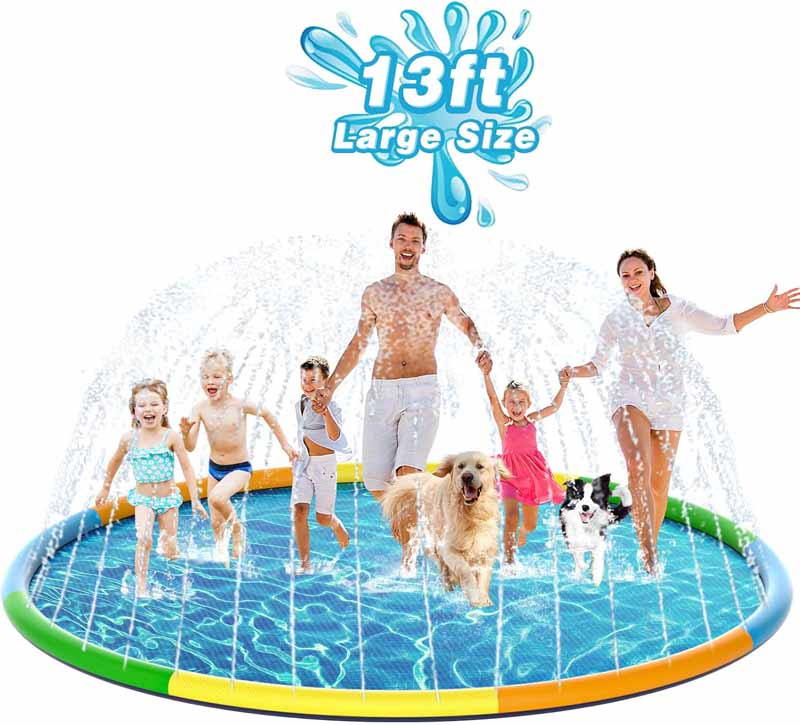
A dog running through a sprinkler pool can look like one of the easiest ways to make a hot afternoon more enjoyable. The water is shallow, the dog can usually step in and out on its own, and the moving spray gives active dogs something to chase. Yet the same features that make the product entertaining can create problems when a dog becomes overexcited, repeatedly bites the water, loses traction during sharp turns, or keeps playing after it is tired.
A dog pool with a sprinkler can be safe for many dogs when the water remains shallow enough for secure footing, the spray is moderate, the pool provides stable traction and an easy exit, and an owner supervises the activity. The main concerns are excessive water ingestion, slipping, fatigue, unsuitable spray intensity, damaged surfaces, and using a pool that does not match the individual dog.
That distinction matters because safety is not determined by a “pet-safe” label alone. Imagine two dogs in the same sprinkler pool. One calmly walks through the water, catches an occasional splash, rests, and then returns. The other spends fifteen minutes jumping at every jet with its mouth open and skidding around the perimeter. The equipment has not changed, but the way it is being used has changed considerably. Understanding that difference makes it easier to set up a sprinkler pool that suits the dog rather than expecting the dog to adapt to the product.
Is a Dog Pool with Sprinkler Safe for Dogs?
A dog pool with a sprinkler can generally be safe when it is placed on stable ground, operated with manageable water pressure, filled to a suitable depth, and used under close supervision. The dog should be able to stand securely, move comfortably, leave whenever it wants, and take regular breaks. Individual age, size, mobility, confidence, and water-chasing behavior remain important parts of the decision.
When Is a Sprinkler Dog Pool Safe?
A sprinkler pool is at its safest when it works as a controlled play space rather than an unattended backyard water feature. Setup begins with the ground underneath the pool. Stones, screws, exposed roots, sharp branches, garden edging, toys, or other hard objects can create concentrated pressure against flexible PVC once water and a moving dog are added. The footprint should therefore be inspected before the pool is unfolded, even when it is being placed on familiar grass.
For dogs that have not used a water-play product before, shallow water is usually the better starting point. The American Kennel Club recommends introducing dogs to water gradually and beginning where they can maintain secure footing. A dog that can stand naturally, turn around, and choose to leave is easier to observe than one that is immediately placed into water deep enough to require swimming or continual effort.
Spray pressure also needs to be introduced gradually. A perimeter sprinkler does not need to produce the highest possible arc to keep a dog interested. In many backyards, a lower and more predictable stream gives the dog enough movement to investigate while reducing hard spray toward the eyes, nose, and mouth. The owner should be able to lower the flow quickly from the faucet if the dog’s behavior becomes too intense.
Space is another part of safety that is easy to overlook. A dog may physically fit inside a pool while still having too little room for comfortable movement. Large and athletic dogs need enough usable floor area to turn without repeatedly colliding with the wall. When two or more dogs share the pool, extra space also helps prevent one animal from blocking another dog’s path to the edge.
What Are the Main Safety Concerns?
Most problems associated with sprinkler pools fall into a small number of predictable categories: swallowing too much water, losing traction, becoming overexcited or fatigued, encountering water pressure that is too intense, and damaging the pool through claws, rough ground, or repeated stress. These issues are connected, which is why focusing on one specification alone does not tell the full story.
A highly excited dog, for example, may run faster, make sharper turns, catch more sprinkler water in its mouth, and ignore normal rest behavior at the same time. A textured floor can help with traction, but it cannot stop excessive water ingestion. Thicker PVC can improve resistance to wear, but it cannot compensate for a stone trapped underneath the pool or a dog repeatedly digging at one point.
| Safety Factor | More Manageable Condition | Condition Requiring More Attention |
|---|---|---|
| Water depth | Dog keeps all four paws securely planted | Dog struggles to stand or repeatedly loses footing |
| Spray | Gentle, adjustable perimeter flow | Concentrated jets repeatedly hitting the face |
| Water intake | Occasional licking or catching spray | Continuous biting, gulping or chasing water |
| Pool floor | Flat, textured and clean | Wrinkled, dirty, damaged or unstable |
| Ground | Level and clear of debris | Sharp, rough, soft or noticeably sloped |
| Play style | Relaxed activity with regular pauses | Continuous sprinting, jumping or frantic chasing |
| Exit | Dog can leave easily and voluntarily | Wall height or surroundings restrict movement |
| Supervision | Owner remains close enough to intervene | Dog is left unattended around the pool |
The dog’s response is ultimately one of the most useful indicators. Relaxed dogs usually approach and leave voluntarily, move without repeated slips, remain responsive to their owner, and take natural pauses. A dog that becomes increasingly frantic, continuously catches water in its mouth, repeatedly crashes into the wall, or tries to escape is showing that the setup or activity needs to change.

Do Dogs Need Supervision in a Sprinkler Pool?
Dogs should remain under active supervision whenever they are playing in or around a sprinkler pool. Even shallow water does not eliminate risks such as repeated water ingestion, slipping, overexertion, rough play between dogs, digging at the floor, or an older animal having difficulty getting back over the wall. Pet swimming guidance consistently recommends staying close enough to intervene when a dog is in the water.
Active supervision means more than occasionally checking from inside the house. An owner should be able to lower the hose flow, call the dog away from the spray, separate dogs whose play becomes too rough, remove an obstacle, or help a nervous or senior dog leave. The first few minutes are especially useful because they reveal whether the dog feels secure on the wet surface and whether moving water produces curiosity or excessive arousal.
Observation should continue briefly after an unusually energetic session. Excessive water ingestion can occur when dogs repeatedly bite streams from hoses or sprinklers, and serious symptoms require prompt veterinary attention. Vomiting, marked abdominal swelling, unusual weakness, poor coordination, disorientation, tremors, seizures, or other sudden neurological changes after heavy water exposure should not be treated as ordinary tiredness from playing outside.
What Risks Should Dog Owners Know?
The most important sprinkler-pool risks are excessive water intake, strong or poorly directed spray, slipping on wet surfaces, physical fatigue, and damage caused by claws or rough ground. These problems can usually be reduced by controlling water flow, keeping initial water depth conservative, providing regular breaks, maintaining a stable floor, inspecting the product before use, and interrupting continuous water-catching behavior.
Can Dogs Drink Too Much Sprinkler Water?
Yes. A dog does not need to stand beside a bowl and deliberately drink for water intake to become excessive. During sprinkler play, some dogs repeatedly jump toward the water with an open mouth and swallow a small amount during each attempt. Because the behavior happens while the animal is running and playing, it can be much harder for an owner to estimate intake than normal drinking from a bowl.
The American Kennel Club specifically notes that excessive water intake can occur during swimming, retrieving, diving, and play-biting streams from hoses or sprinklers. Very large amounts of water can disturb the body’s normal sodium balance and, in severe cases, cause water intoxication. The condition is not the expected result of ordinary sprinkler play, but its seriousness makes continuous water gulping a behavior worth stopping rather than encouraging.
Body size provides context but should not be used as a safety guarantee. The same amount of swallowed water represents a larger intake relative to body weight in a small dog than in a much larger animal. At the same time, an athletic large dog that spends a long session repeatedly catching jets can also consume a substantial amount. What matters most is how frequently the dog is swallowing water and how long the behavior continues.
If water chasing becomes the main activity, switch the sprinkler off temporarily and redirect the dog toward a toy, a short training activity, calm walking, or a shaded rest area. A separate bowl of fresh drinking water should still be available. The goal is not to prevent a dog from ever catching a splash, but to avoid turning repetitive water ingestion into an extended game.
Can Water Pressure Hurt a Dog?
There is no single household water-pressure number that can be used as a universal safety setting for every sprinkler pool and every dog. The final spray depends on local supply pressure, hose diameter, hose length, connector design, the number and diameter of sprinkler openings, and how evenly the pool wall is positioned. Two households can therefore connect the same product and produce noticeably different spray height and force.
A practical setup starts with the faucet only partly open. Increase the flow until the perimeter spray becomes consistent and engaging without producing hard jets toward the dog’s face. Small dogs, puppies, dogs with short muzzles, and dogs that are uncertain around water may be less comfortable with strong spray, but individual behavior matters more than breed assumptions.
Watch how the dog responds rather than judging the system by the height of the water. A comfortable dog can voluntarily approach, turn away, and re-enter without repeated squinting or avoidance. Persistent face turning, backing away, crouching, excessive barking at the water, rubbing the face, or trying to escape suggests that the flow should be reduced or the sprinkler turned off.
From a product-design perspective, multiple evenly spaced outlets can distribute flow more gradually than a few concentrated jets. Hole size, hose connection, wall geometry, material alignment, and welding consistency all influence spray performance. This is one reason responsible product testing should evaluate sprinkler behavior at more than one practical household flow condition rather than focusing only on maximum spray height.

Are Slips and Falls a Risk?
Wet PVC offers different traction from dry grass, especially when a dog accelerates, stops quickly, or changes direction. A textured floor can improve contact, but no wet flexible surface should be treated as completely slip-proof. Hair, mud, algae, dirt, nail length, water depth, surface wear, and the dog’s movement speed can all change how much grip is available during a particular session.
The base should also lie as flat as possible. Foldable products naturally develop storage creases, but trapped objects, deep wrinkles, or uneven ground can create raised areas that interfere with normal paw placement. Larger dogs generate greater lateral force when turning, which means insufficient floor area can contribute to loss of footing even when the surface material itself is appropriate.
The area immediately outside the pool is just as important. A dog that has stable footing inside may step onto wet stone, smooth concrete, decking, tile, or mud as it exits. Because the transition happens while the paws are already wet, this part of the movement path deserves as much attention as the internal floor.
Owners can reduce avoidable risks by keeping hoses and fittings out of the main running route, checking that the base remains flat, clearing the perimeter, and providing enough usable diameter for natural turns. If a dog begins sliding repeatedly, lowering the intensity of play or ending the session is more sensible than assuming the textured floor will compensate.
Can Dog Claws Damage the Pool?
Yes. Flexible PVC can be durable and suitable for foldable pet products without being claw-proof. Puncture and wear depend on PVC formulation, thickness, welding quality, nail sharpness, dog weight, movement style, repeated folding, and the condition of the ground below. A sharp object trapped underneath the pool can sometimes create greater localized stress than ordinary paw contact from above.
One current EPN foldable sprinkler-pool design uses approximately 0.55 mm PVC together with 5 mm PP structural wall panels. These figures are product specifications for that particular construction, not universal thresholds that make every pool safe. The combination illustrates how flexible waterproof material and rigid wall support can be used together so that the side wall does not rely on an inflatable air chamber for its shape.
Thickness alone does not determine durability. Weld quality, seam geometry, floor-to-wall transitions, fold locations, drain installation, hose fittings, and the compatibility between flexible sheet and structural components also influence service life. For this reason, experienced PVC product development evaluates the complete construction rather than simply increasing material thickness and assuming that every other weakness has been solved.
Owners can help reduce avoidable wear by keeping sharp nails reasonably maintained, discouraging digging, inspecting the ground before setup, and never dragging a filled pool across a surface. Light cosmetic scratches may not affect function, but deep cuts or damage close to drains, welded seams, folds, or structural edges should be examined before the next use.
Which Pool Features Make It Safer?
Useful safety-oriented features include a textured floor, stable reinforced walls, suitable flexible material, controllable sprinkler flow, practical drainage, appropriate wall height, and enough usable floor area for normal movement. No individual feature makes a sprinkler pool automatically safe. The best results come from matching construction, size, water level, setup, and supervision to the dog that will actually use the product.
Is PVC Safe for Dogs?
PVC is widely used in water-play products, inflatable leisure equipment, outdoor products, pet pools, and many other flexible applications. However, the letters “PVC” alone are not a complete safety specification. Flexible PVC is a formulated material that may include plasticizers, stabilizers, pigments, and processing aids chosen according to the intended use, manufacturing process, performance requirements, and rules of the market where the product will be sold.
For consumers, the practical point is that finished-product quality matters more than relying on a generic material name. For retailers or private-label brands, material traceability, restricted-substance requirements, appropriate testing, formulation consistency, and documented production controls are more useful questions than simply asking whether a pool is “made from PVC.”
Mechanical performance should also be considered alongside chemical compliance. A foldable pet pool needs enough flexibility for storage while tolerating repeated filling, drying, folding, paw movement, abrasion, and stresses around welded seams and fittings. A thicker sheet may increase resistance to certain forms of wear, but it does not automatically correct poor welding, badly positioned fittings, or unsuitable structural reinforcement.
For custom pet-pool development, manufacturers with experience in PVC formulation, high-frequency welding, structural panels, printing, drains, and sprinkler components can adjust these variables as a system. That is more useful than treating material selection as an isolated number on a specification sheet, particularly when the finished product needs to meet different retailer, market, packaging, or performance requirements.
Which Bottom Surface Helps Prevent Slipping?
A moderately textured or embossed surface is generally more appropriate for active dog use than a deliberately smooth decorative finish. Texture increases contact between paw pads and the floor, but it still needs to remain comfortable, flexible, and easy to clean. Very deep embossing can trap hair, soil, and organic debris, while extremely shallow patterns may provide limited practical benefit once the entire surface is wet.
The substrate underneath the pool can change the result substantially. A well-textured floor may still feel unstable when it sits on uneven soil, hidden stones, deep foam, raised joints, or a sloped area. Before filling, owners should walk around the entire footprint and remove anything that could create a hard pressure point or cause the base to lie unevenly.
| Surface Under the Pool | Practical Advantage | Main Point to Check |
|---|---|---|
| Short grass | Softer surroundings for dogs | Hidden stones, roots and uneven soil |
| Smooth concrete | Firm and generally level support | Abrasion underneath and slippery wet perimeter |
| Patio pavers | Stable hard base | Raised joints, gaps and sharp edges |
| Wooden decking | Flat and convenient near the house | Wet boards may become slippery outside the pool |
| Protective ground mat | Separates PVC from abrasive surfaces | Must remain flat and should not compress unevenly |
A protective layer can be useful on abrasive ground, but softer is not always safer. Thick foam that compresses under a large dog may create an unstable feel beneath the flexible floor. A reasonably firm, clean, level surface generally provides a more predictable base than either very rough ground or a deeply cushioned layer.

What Pool Depth Is Safe for Dogs?
There is no universal depth that is appropriate for every dog because leg length, body shape, confidence, swimming ability, age, health, and mobility differ substantially. For a sprinkler pool, deep water is often unnecessary because much of the entertainment comes from the moving perimeter spray. Starting shallow also makes it easier to judge how the dog responds to the wet floor before adding more water.
For a first introduction, water around the paws or lower legs may be enough to let the dog investigate while keeping all four feet securely on the bottom. The level can be adjusted gradually if the dog remains relaxed and the product is also being used for bathing, soaking, or general cooling. The dog should never have to struggle simply because the pool is capable of holding more water.
Wall height should not be confused with recommended water depth. A product with a 12-inch wall is designed with that structural height and capacity, but ordinary sprinkler play does not require filling the pool to the top. The working level should be selected according to the dog rather than according to the maximum volume the product can physically contain.
Small and short-legged dogs, puppies, senior dogs, inexperienced swimmers, and animals with mobility limitations generally deserve a more conservative starting level. Whatever the depth, the dog should have an obvious exit and be able to leave without repeatedly scrambling over an edge that is difficult for its body size or condition.
Which Drainage and Edge Designs Matter?
Drainage affects more than convenience. Large pools hold substantial water weight, so an outlet positioned near the base allows the owner to empty the pool without trying to lift or tip a heavy flexible structure. Some designs also include an additional higher outlet that can help control operating water level while the lower drain remains available for final emptying.
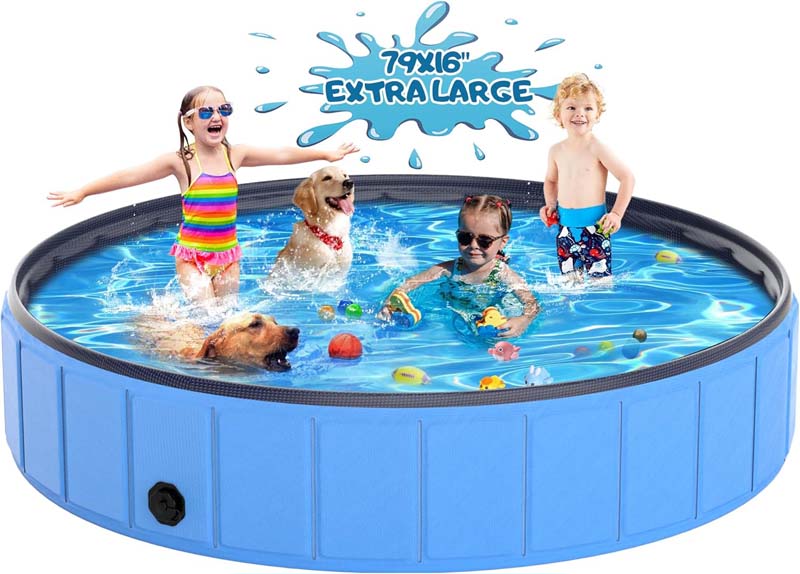
One EPN foldable sprinkler-pool configuration combines an upper water-level drain with a lower emptying drain and uses an approximately 12-inch wall. The range includes several diameters, providing different amounts of usable floor space. These dimensions are examples of available product configurations rather than veterinary recommendations for specific breeds.
| Approx. Diameter | Practical Space Consideration |
|---|---|
| 79 in | More suitable for households needing a compact footprint |
| 97 in | Provides additional movement area for an active single dog |
| 106 in | Offers wider turning room where backyard space allows |
| 118 in | Useful when a large dog benefits from more open floor area |
| 132 in | Designed for very large play areas or compatible multi-dog use |
Actual selection should take body length, activity level, number of dogs, available garden space, wall height, and storage requirements into account. A highly active medium-sized dog may use more floor area than a heavier dog that prefers standing quietly. The table therefore describes usable space differences rather than creating a fixed dog-weight or breed-to-size formula.
Edge construction also affects the experience. Foldable pools supported by internal rigid or semi-rigid panels maintain their wall shape without relying on air pressure. This means the wall does not lose its entire supporting structure simply because an inflatable top ring has been punctured, although damage to the flexible covering or internal panel still needs to be inspected and addressed.
Which Dogs Need Extra Care?
Puppies, senior dogs, small or short-legged dogs, animals with limited mobility, inexperienced swimmers, flat-faced dogs, and dogs that become intensely focused on moving water may require more conservative use. Safety decisions should be based on the individual dog’s body shape, health, confidence, coordination, and behavior rather than assuming that every member of a particular breed will respond to water in the same way.
Are Sprinkler Pools Safe for Puppies?
A sprinkler pool can provide a gentle introduction to water for some puppies, but the first experience should be deliberately uncomplicated. Young dogs are still developing coordination and confidence, and combining a slippery new surface with strong spray and loud water noise can create more stimulation than an adult owner may expect. Gradual introduction makes it easier to see which part of the experience the puppy understands and which part causes hesitation.
Begin with the sprinkler switched off and either an empty pool or a very shallow layer of still water. Let the puppy step over the edge voluntarily and investigate the floor. Familiar toys or small rewards can encourage exploration, but physically placing a reluctant puppy in the center removes its ability to choose and may create an unnecessary negative association with water.
Once the puppy is moving comfortably, introduce a low sprinkler flow. Puppies frequently investigate objects with their mouths, so owners should watch for repeated attempts to catch every water jet. Redirecting that behavior early with a toy, recall exercise, or short break is preferable to allowing continuous water chasing to become the main form of play.
Early sessions do not need to be long or dramatic. A puppy that walks through shallow water, notices the sprinkler, leaves, shakes off, and later chooses to return has already had a useful experience. Voluntary re-entry is generally a better sign of comfort than keeping a hesitant puppy inside until it stops trying to leave.
Are They Safe for Senior Dogs?
Senior dogs can still enjoy gentle water play, but age-related changes may alter how they use a sprinkler pool. Joint stiffness, muscle loss, reduced balance, declining vision, slower reflexes, and lower exercise tolerance can make stepping over the wall or changing surfaces more difficult than standing in the water itself.
For older dogs, keep the water shallow enough for confident walking and use a gentle spray. The area outside the pool deserves particular attention because wet paws moving from textured PVC onto smooth decking, stone, tile, or concrete can create an abrupt change in traction. A clear, stable exit path can be more valuable than adding extra water.
Fatigue may appear gradually. A senior dog may begin turning more slowly, stand still for longer periods, hesitate before stepping over the wall, slip more often, or lose interest in following the spray. These smaller changes are useful reasons to finish the session before the dog becomes obviously exhausted.
Dogs with diagnosed orthopedic, neurological, respiratory, cardiac, or other medical conditions may need individualized veterinary guidance before starting new physical activity. A backyard sprinkler pool is recreational equipment and should not be presented as a substitute for veterinary rehabilitation or professionally managed canine hydrotherapy.

Do Small and Large Dogs Need Different Pool Sizes?
Yes, although the difference cannot be reduced to a simple weight chart. The dog should have enough usable space to stand naturally, turn without constantly touching the side wall, move away from the sprinkler, and reach the exit. Larger dogs generally require more floor area, while smaller dogs may be more affected by wall height and water depth.
Activity level changes the calculation considerably. A calm 70-pound dog that stands or lies in shallow water may use less floor space than an athletic 45-pound dog that repeatedly runs around the perimeter. Choosing only by body weight can therefore underestimate how much turning room an energetic dog actually needs.
Multi-dog use adds another variable. Two dogs that calmly share the water may need relatively little additional space, while two highly excited dogs competing for the same sprinkler jets can collide or block one another’s path. Owners should watch whether each dog can leave independently and whether one dog is consistently crowding another against the wall.
For product development, offering several diameters is more practical than treating one configuration as universally suitable. For homeowners, the same principle means considering the dog’s movement style together with available lawn or patio space, storage room, hose location, wall height, and the number of animals expected to use the pool.
What If a Dog Is Afraid of Water?
A nervous dog should not be expected to become comfortable simply because a sprinkler pool is marketed as a toy. Fear may come from the sound of running water, reflections on the surface, unstable footing, moving jets, wet paws, or a previous unpleasant experience. Forcing the dog into the pool can intensify that concern rather than teaching it that water is enjoyable.
Begin with the pool dry and the sprinkler off. Allow the dog to walk around it, investigate the material, and approach the edge voluntarily. A familiar toy or food reward can make the environment more positive, but the dog should retain the option to walk away. Once it confidently steps inside, a shallow layer of still water can be introduced before any moving spray is added.
The sprinkler should come later and at the lowest practical setting. Some dogs are more comfortable watching the spray from outside for several minutes before moving closer. Giving them that opportunity helps make the water predictable instead of creating the impression that stepping into the pool means being immediately surrounded.
Progress is better measured through relaxed choices than through how wet the dog becomes. A hesitant dog that willingly puts two paws into shallow water and leaves calmly has made more meaningful progress than one that has been physically placed into full spray and prevented from exiting.
How Do You Use a Sprinkler Dog Pool Safely?
Place the pool on clean, level ground, inspect it before filling, begin with shallow water, and start the sprinkler at a low setting. Stay close throughout play, interrupt continuous water gulping, provide fresh drinking water and shade, allow regular rest periods, and end the session when the dog’s movement or behavior changes. Drain, rinse, dry, and inspect the pool before storage or reuse.
How Should You Set the Water Pressure?
Begin with the household faucet only partly open and watch the sprinkler pattern before encouraging the dog to enter. The goal is an even, manageable perimeter spray rather than maximum height. A lower flow makes it easier for the dog to approach voluntarily and allows the owner to judge whether the animal responds to moving water with relaxed interest or excessive chasing.
Spray performance varies between homes because local water pressure is only one part of the system. Hose length, internal hose diameter, fittings, elevation, connector restrictions, sprinkler-hole size, and the number of outlets all affect flow. Manufacturers can control product geometry, but they cannot assume that every customer’s plumbing conditions will reproduce exactly the same water height.
If a small number of jets suddenly become much stronger than the rest, inspect the wall and sprinkler holes before turning the faucet higher. A fold, partial blockage, twisted hose, or uneven position can concentrate the flow. Increasing pressure may exaggerate the problem instead of correcting it.
The dog should remain the final guide. Squinting, repeatedly turning away, backing up, trying to escape, or spending most of the session aggressively catching jets are reasons to lower or stop the water. A sprinkler system that responds well across a range of moderate flows is generally more useful than one designed mainly to produce a dramatic maximum spray.
How Long Should Dogs Play in the Pool?
There is no universal session length that is appropriate for every dog. Weather, humidity, age, fitness, body size, health, coat, excitement level, and the amount of water swallowed all influence how quickly an individual dog becomes tired. A fixed number of minutes may be convenient, but it should not replace watching the animal in front of you.
Regular pauses are a more practical approach. Early fatigue may appear as slower turns, increased slipping, repeatedly lying down, loss of interest, persistent heavy panting, or hesitation at the pool edge. Very excitable dogs may need a break even while they are still eager to continue because excitement can hide normal self-limiting behavior.
During a pause, turn off the sprinkler and allow the dog to rest in shade with access to fresh drinking water. AVMA warm-weather guidance recommends ready access to fresh water and shade for pets outdoors, and a sprinkler pool should complement those basics rather than replace them.
Finishing earlier is sensible on very hot or humid days and for puppies, senior animals, or dogs that have been highly active before entering the pool. The objective is comfortable recreation, not testing how long the dog can keep chasing water without stopping.

How Do You Keep the Water Clean?
Most foldable dog sprinkler pools are designed as fill-and-drain products rather than permanently filtered swimming pools. Hair, saliva, soil, grass, leaves, insects, and dirt from paws can accumulate quickly, particularly when several dogs are sharing the water. Keeping the water for long periods without filtration or managed treatment makes routine hygiene more difficult.
CDC guidance for small inflatable and plastic pools intended for people recommends emptying the water at least daily, removing debris, rinsing away dirt with fresh water, and allowing the pool to air-dry. A household dog pool is a different use case, but the basic fill-drain-rinse-dry approach is still a practical hygiene model for small unfiltered backyard water products.
Drainage design matters because water becomes heavy very quickly. One US gallon weighs approximately 8.34 pounds, or 3.78 kilograms. Thirty gallons therefore weighs about 250 pounds, before the weight of the pool itself is considered. Owners should drain a large pool rather than attempting to lift or carry it while it contains water.
After draining, remove hair and debris, rinse the internal surfaces, and use only cleaning products that are appropriate for the pool material and pet environment. Any cleaning residue should be removed according to the product directions before the dog uses the pool again. Drying the surface also makes scratches, seam changes, drain damage, and trapped debris easier to inspect.
What Signs Mean Playtime Should Stop?
Ordinary play should end when a dog begins moving less comfortably or becomes increasingly difficult to redirect. Repeated slipping, uncontrolled chasing of water, persistent attempts to escape, rough interactions between dogs, unusual fatigue, or a clear loss of interest are sufficient reasons to switch off the sprinkler and move to a rest period.
Equipment changes are another reason to stop. A wall that suddenly leans, an exposed damaged area, a loosened drain plug, an abnormal leak, or a sprinkler jet that becomes sharply concentrated should be checked before the dog continues. Continuing play simply because the rest of the pool appears functional can turn a small maintenance problem into a larger one.
More serious physical symptoms should not be treated as ordinary exhaustion. Vomiting, pronounced abdominal swelling, weakness, loss of coordination, marked disorientation, tremors, seizures, collapse, or other sudden abnormal behavior after substantial water exposure require prompt professional veterinary assessment.
Stopping early does not reduce the value of the activity. Several shorter, controlled periods with rest in between can be easier to manage than one prolonged session and give the owner repeated opportunities to check the dog’s movement, water-catching behavior, comfort, and the condition of the pool.
How Should You Inspect the Pool Before Each Use?
A quick pre-use inspection can prevent many avoidable problems. Foldable PVC products experience repeated storage, unfolding, water loading, outdoor temperature changes, claw contact, abrasion, and stress around seams and fittings. Small cosmetic marks may appear over time, but deeper damage should be found before water and an active dog place additional load on the structure.
Spread the pool on the intended ground before filling and examine the floor, lower wall area, folding lines, welded seams, drain fittings, hose connector, and sprinkler openings. Make sure rigid wall panels remain completely enclosed and that no unusual bend or exposed edge has developed during storage.
| Component | What to Inspect | Practical Reason |
|---|---|---|
| PVC floor | Deep scratches, cuts or thinning | Helps identify potential leak or puncture areas |
| Welded seams | Separation, distortion or leakage | Maintains structural integrity |
| Wall panels | Unusual bending, shifting or exposed edges | Keeps the perimeter stable |
| Drain plugs | Cracks, damaged seals or loose fit | Prevents uncontrolled draining |
| Hose fitting | Loose connection or abnormal leakage | Keeps spray flow predictable |
| Spray openings | Blockage or strongly redirected jets | Supports more even water distribution |
| Ground footprint | Stones, roots, screws and hard debris | Protects the underside from concentrated pressure |
| Exit area | Obstacles and slippery surrounding surfaces | Helps dogs leave more securely |
Do not drag a filled pool to a different part of the yard. Water load dramatically increases the force pressing flexible material against the ground, making abrasion more likely around the base, folds, and lower seams. Drain it first, move the empty product, inspect the new footprint, and refill it after repositioning.
Storage also affects service life. The pool should be cleaned and allowed to dry before longer storage whenever practical. Avoid repeatedly forcing extremely sharp creases into the same small area, and keep folded products away from cutting tools, rodents, excessive heat, and heavy items that could deform internal structural panels.
Conclusion
A dog pool with a sprinkler can be a practical and enjoyable summer play space when the product and the way it is used are considered together. Stable footing, manageable water depth, controllable spray, adequate movement room, easy drainage, a clear exit, regular inspection, clean water, shade, and active supervision all contribute to a better experience. None of those features is difficult to understand, but overlooking several of them at once can quickly make play less predictable.
The most useful takeaway is that no single specification creates safety by itself. A thicker PVC floor can improve mechanical durability but cannot prevent a dog from repeatedly swallowing water. A textured surface can support traction but cannot compensate for a sloped or debris-covered base. A larger diameter offers more movement room, yet the owner still needs to notice fatigue, anxiety, rough play, and obsessive water chasing.
For brands and retailers developing pet-pool products, material formulation, sheet thickness, high-frequency welding, floor texture, PP wall reinforcement, drain placement, hose connection, sprinkler distribution, dimensions, packaging, and quality inspection all deserve attention during sampling and production. These are areas where an experienced PVC leisure-product manufacturer can adjust a design around a target market instead of relying only on cosmetic changes to an existing pool.
For dog owners, the practical routine is simpler. Introduce the pool slowly, start with shallow water, keep the spray moderate, let the dog choose whether to participate, provide fresh drinking water and shade, interrupt continuous gulping, inspect the pool regularly, and end the session before excitement turns into fatigue. Used in that way, a sprinkler dog pool can offer engaging backyard water play while keeping the most predictable risks easier to manage.
Frequently Asked Questions
Are sprinkler pools good for dogs in hot weather?
Sprinkler pools can provide a refreshing form of supervised water play during warm weather and may help dogs wet their paws, legs, and coat while remaining active. They should not be treated as complete protection from heat. Dogs outdoors still need unlimited access to fresh drinking water, shade, appropriate rest, and reduced strenuous activity when temperatures or humidity are high. A dog showing signs of heat-related distress needs more than continued sprinkler play.
Can dogs drink water from a sprinkler pool?
Dogs may lick or accidentally swallow small amounts of clean water while playing, but owners should discourage continuous drinking directly from sprinkler streams. Repeated spray biting can cause a dog to swallow much more water than is obvious from watching the activity. Providing a separate bowl of fresh drinking water, interrupting obsessive water-catching behavior, and building rest periods into the session makes total water intake easier to manage.
What size dog pool with sprinkler should I buy?
Choose a pool that gives the dog enough usable floor area to stand, turn, lie down, move away from the sprinkler, and exit without repeatedly hitting the walls. Body weight alone is not enough to determine size because an athletic medium dog may need more turning room than a heavier but less active animal. Wall height, dog body length, number of dogs, storage space, and the available backyard area should also be considered.
Are foldable PVC dog pools suitable for large dogs?
Foldable PVC pools can be suitable for large dogs when the product provides adequate floor area, stable wall support, appropriate construction, secure seams, and a floor designed for wet use. Large dogs create greater loads when turning and pushing against walls, so the pool should not be undersized. Ground preparation, claw maintenance, inspection, and avoiding dragging the filled pool also play important roles in limiting unnecessary wear.
How deep should a sprinkler dog pool be?
There is no universal depth that is right for every dog. For ordinary sprinkler play, starting with water around the paws or lower legs can help a dog maintain secure footing while becoming familiar with the wet surface. The level can then be adjusted according to body size, leg length, confidence, mobility, and intended use. Puppies, senior dogs, short-legged dogs, and inexperienced swimmers generally warrant a more conservative approach.
How often should I change the water in a dog pool?
A foldable unfiltered pet pool is generally easier to keep clean when water is drained regularly rather than left standing for long periods. Hair, saliva, soil, grass, insects, and other debris can build up quickly. After use, drain the pool, remove visible debris, rinse the surfaces, and allow them to dry when practical. Water should be replaced sooner whenever it becomes cloudy, dirty, contaminated, or heavily used by multiple dogs.
Can I leave a dog sprinkler pool outside all summer?
A dog pool can remain outside between nearby uses when conditions are suitable, but leaving it continuously filled and exposed makes cleaning, inspection, and material care more difficult. Standing water collects debris, and prolonged outdoor exposure subjects the product to sunlight, weather changes, animals, and garden contamination. Periodically draining, cleaning, drying, and inspecting the pool gives owners a better opportunity to identify wear before the next play session.
Get A Fast quote
Here, bringing your inflatable concepts to life is no longer a challenge—it’s a collaborative journey where American Epsilon helps families, outdoor enthusiasts, and global brands transform creative ideas into safe, certified, and market-ready inflatable solutions.


Partner With Epsilon
Whether you are a family looking for safe backyard fun or a brand seeking large-scale OEM/ODM solutions, American Epsilon Inc. guarantees every inflatable is built with safety, durability, and excitement in mind. With flexible low MOQs, strategically placed warehouses in the U.S., Canada, U.K., and Germany, plus 24/7 professional support, we ensure smooth delivery and reliable service worldwide.
Ready to bring your inflatable ideas to life? Request free samples, fast prototypes, and customized designs today—your trusted inflatable journey starts here.